
A complete issue · 16 pages · 1906
Judge — October 13, 1906
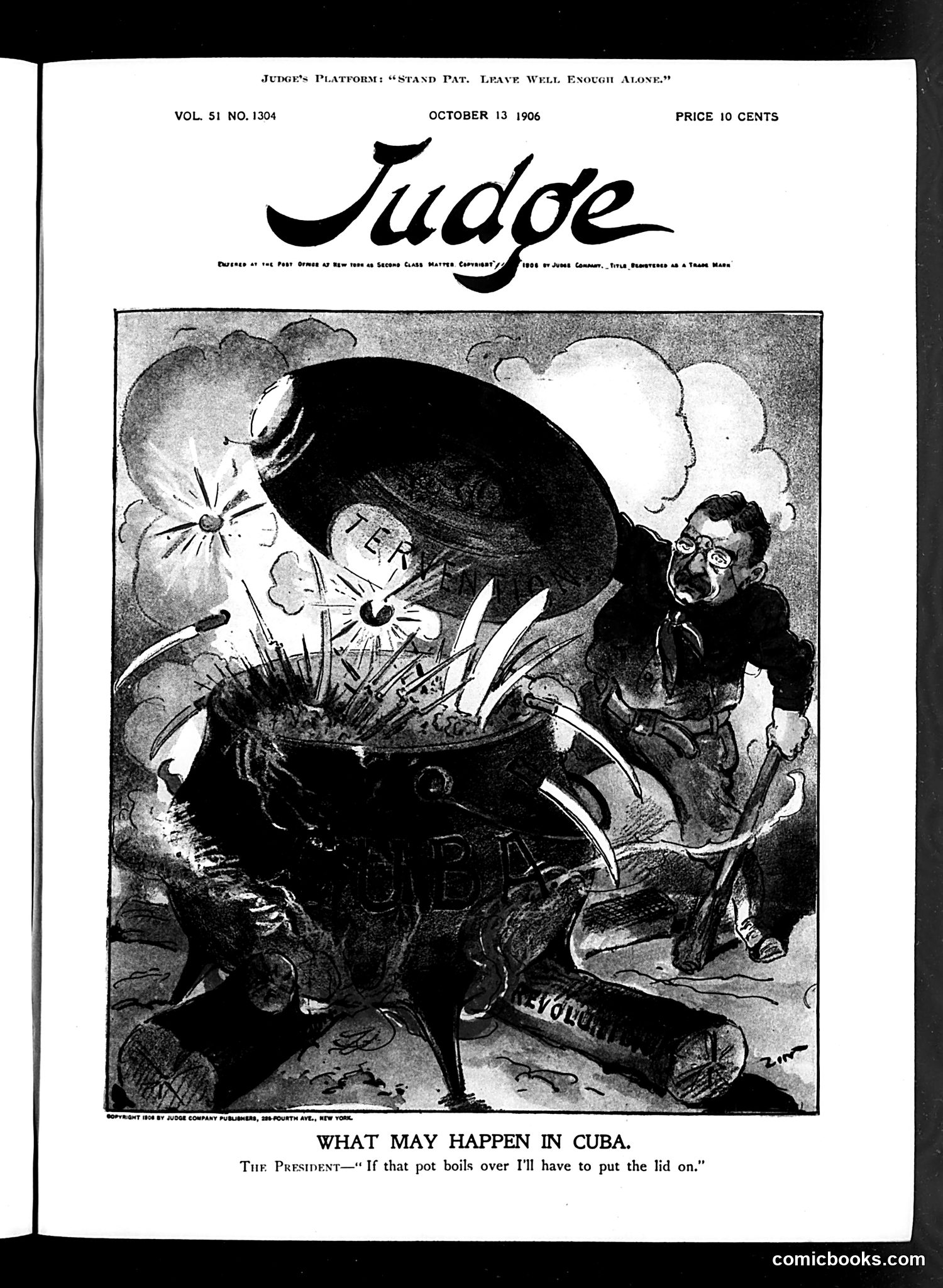
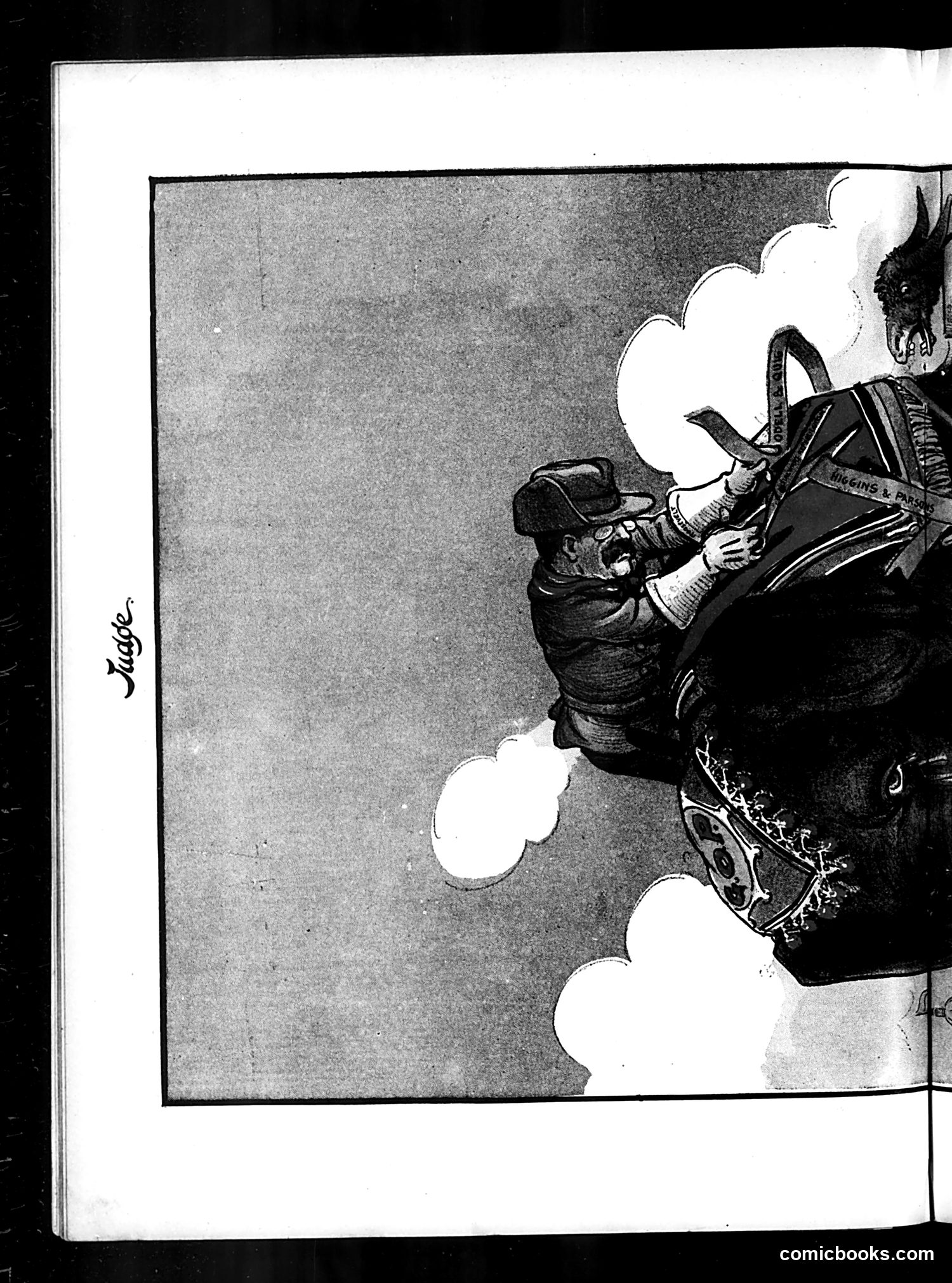
This October 1906 Judge cartoon satirizes President Theodore Roosevelt's concerns about potential instability in Cuba. The image shows a large cauldron labeled "CUBA" boiling over violently with explosions and weapons, while Roosevelt (identifiable by his distinctive glasses and mustache) stands nearby with a lid, saying "If that pot boils over I'll have to put the lid on." The satire mocks Roosevelt's interventionist posture toward Cuba—suggesting he stands ready to suppress Cuban unrest with American military force. The boiling cauldron represents the political turmoil and violence erupting on the island, while the lid symbolizes military intervention. The cartoon critiques Roosevelt's willingness to use American power to control Cuban affairs.
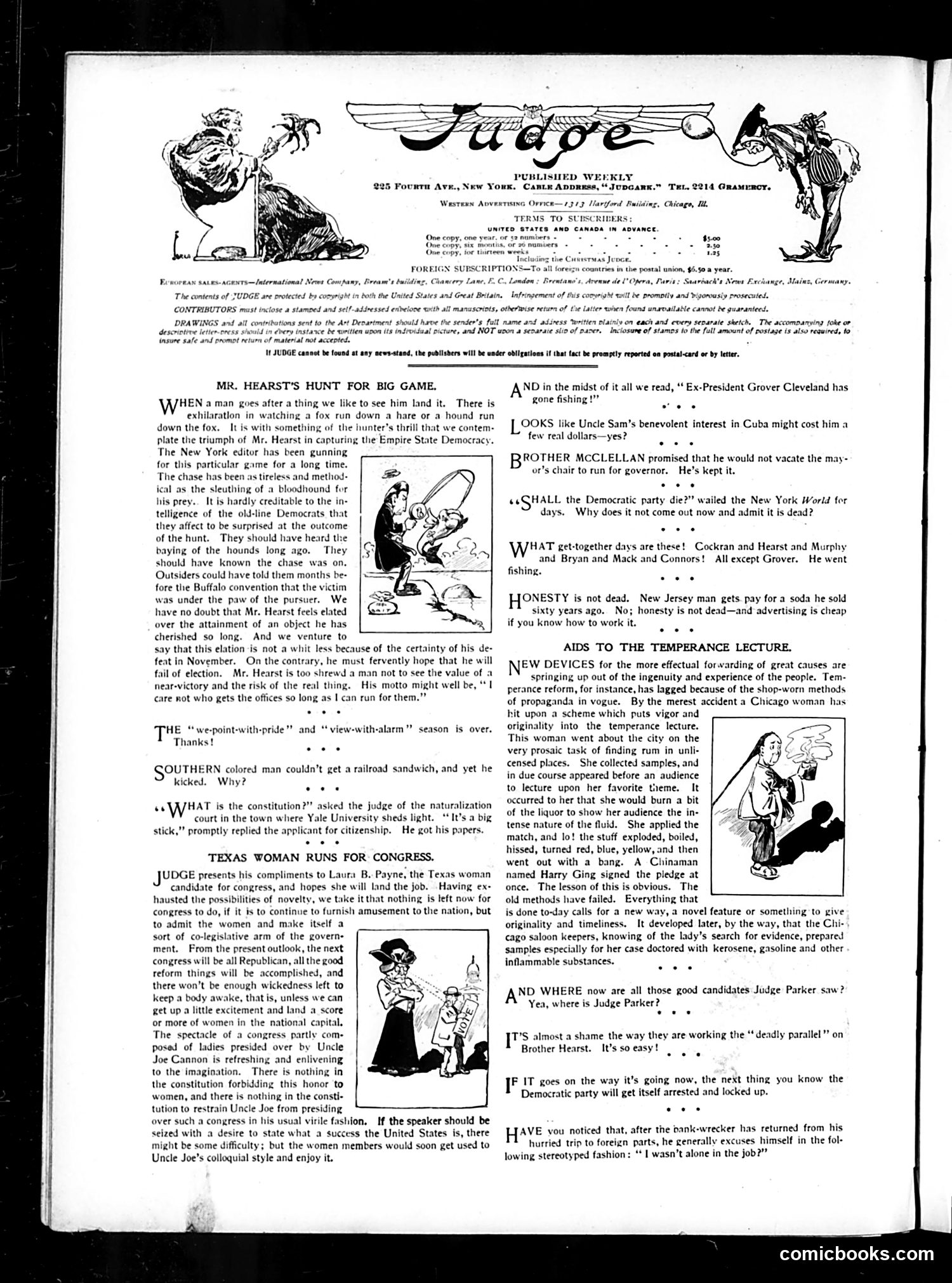
This page satirizes late-19th century Democratic politics. The main article "Mr. Hearst's Hunt for Big Game" mocks newspaper publisher William Randolph Hearst's political ambitions, comparing his pursuit of power to hunting. The text references former President Grover Cleveland going fishing (likely implying political withdrawal), attacks on the Democratic Party's viability, and commentary on Brother McClellan's mayoral ambitions. The cartoons appear to mock temperance reform advocates and women entering politics—one shows a woman collecting liquor samples for a "temperance lecture," satirizing the movement's methods. Another cartoon references Laura B. Payne, a Texas woman candidate for Congress, mocking her candidacy as novelty rather than serious political engagement. The overall tone ridicules Democratic leadership and progressive reform movements of the era.
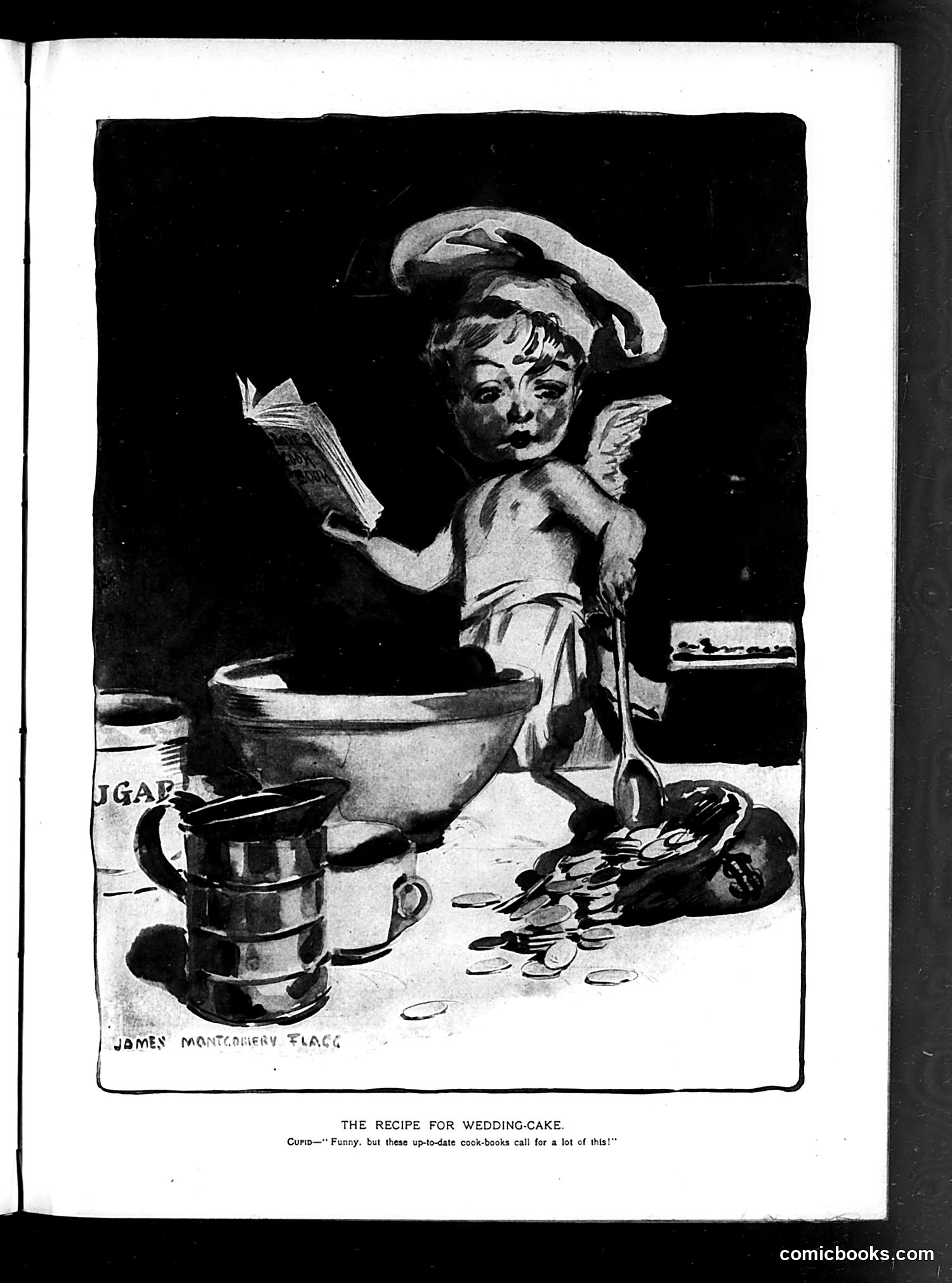
This cartoon by James Montgomery Flagg satirizes the commercialization of weddings. A cherub (Cupid) in a chef's hat presides over kitchen implements and ingredients—a mixing bowl, pitcher, sugar jar, and scattered coins—while holding an open cookbook. The caption reads: "Cupid—'Funny, but these up-to-date cook-books call for a lot of this!'" The joke targets how modern weddings had become expensive, profit-driven affairs. Rather than romance or love, the "recipe" now requires money—represented by the coins spilling across the table. The cartoon mocks how commercialization has reduced marriage to a financial transaction, with even Cupid (the symbol of love itself) bewildered by the monetary costs involved in contemporary wedding ceremonies and celebrations.
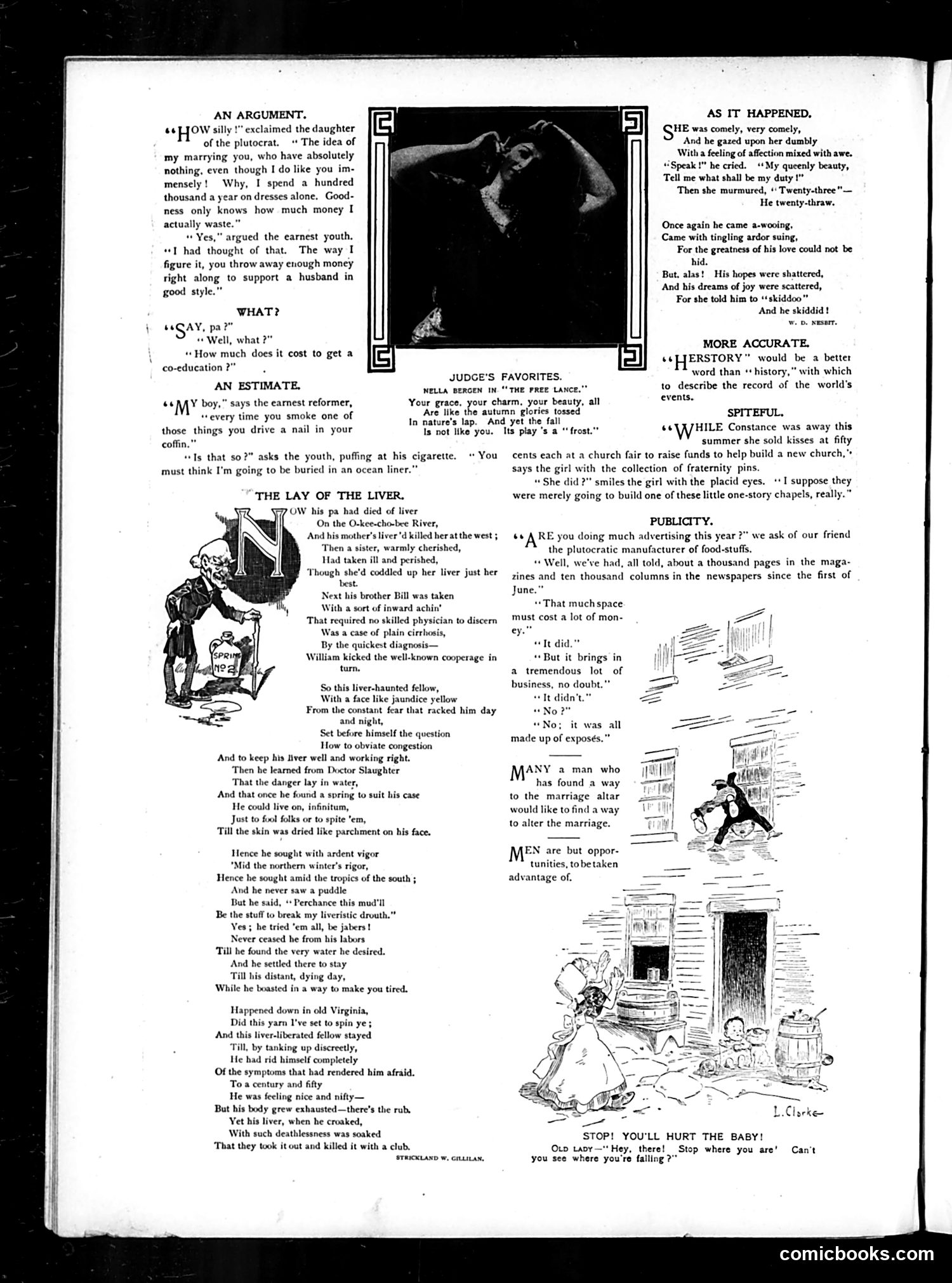
This page contains multiple satirical pieces typical of early 20th-century American humor: **"The Lay of the Liver"** is a lengthy poem mocking a man with liver disease who ignored medical advice, eventually dying. The accompanying illustration shows a skeletal figure labeled "Liver," satirizing the consequences of poor health choices. **"An Argument"** depicts a debate between reformers and wealthy individuals about spending on luxuries versus social good—critiquing both excessive wealth and earnest moralizing. **"Judge's Favorites"** offers brief, witty observations about beauty and nature. **"Publicity"** mocks newspaper advertising culture and space costs. The bottom illustration by L. Clarke shows domestic chaos—a woman falling with a baby—satirizing domestic mishaps or marital discord. The humor reflects Progressive-era concerns: health reform, wealth inequality, and commercialism.
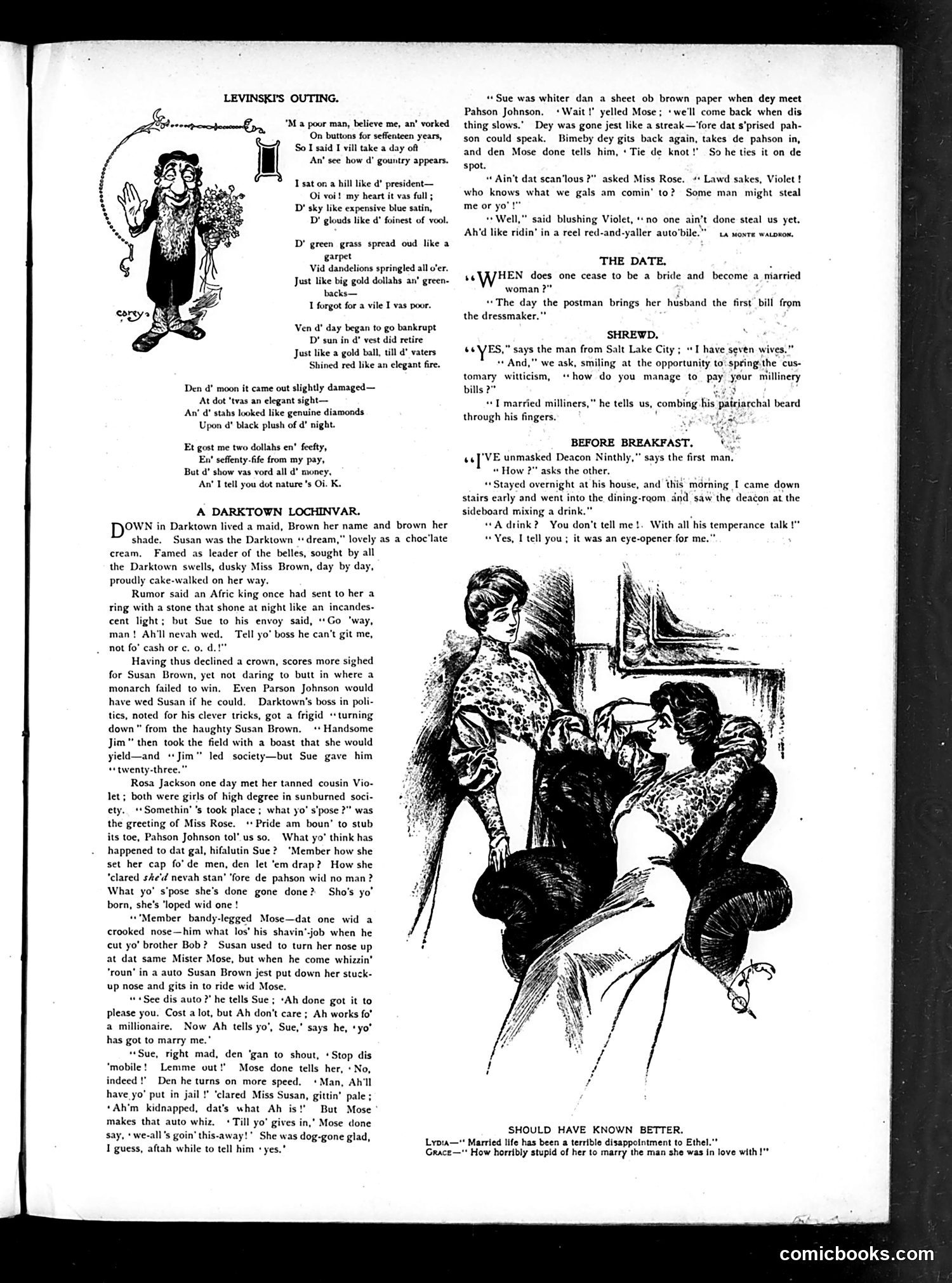
The page contains three distinct pieces: 1. **"Levinski's Outing"** - A cartoon satirizing a poor man's financial desperation. The illustrated figure represents the stereotype of an impoverished immigrant (suggested by the name "Levinski"), depicted with exaggerated features common to early 20th-century ethnic caricature. The poem mocks his poverty and desperate schemes. 2. **"A Darktown Lochinvar"** - A narrative story using "Darktown" (a period term for African American communities), employing racial stereotypes in dialect and characterization typical of the era's offensive humor. 3. **Short joke sections** ("The Date," "Shred," "Before Breakfast") featuring domestic and social humor. The page primarily reflects period prejudices through ethnic and racial caricature now considered deeply offensive.
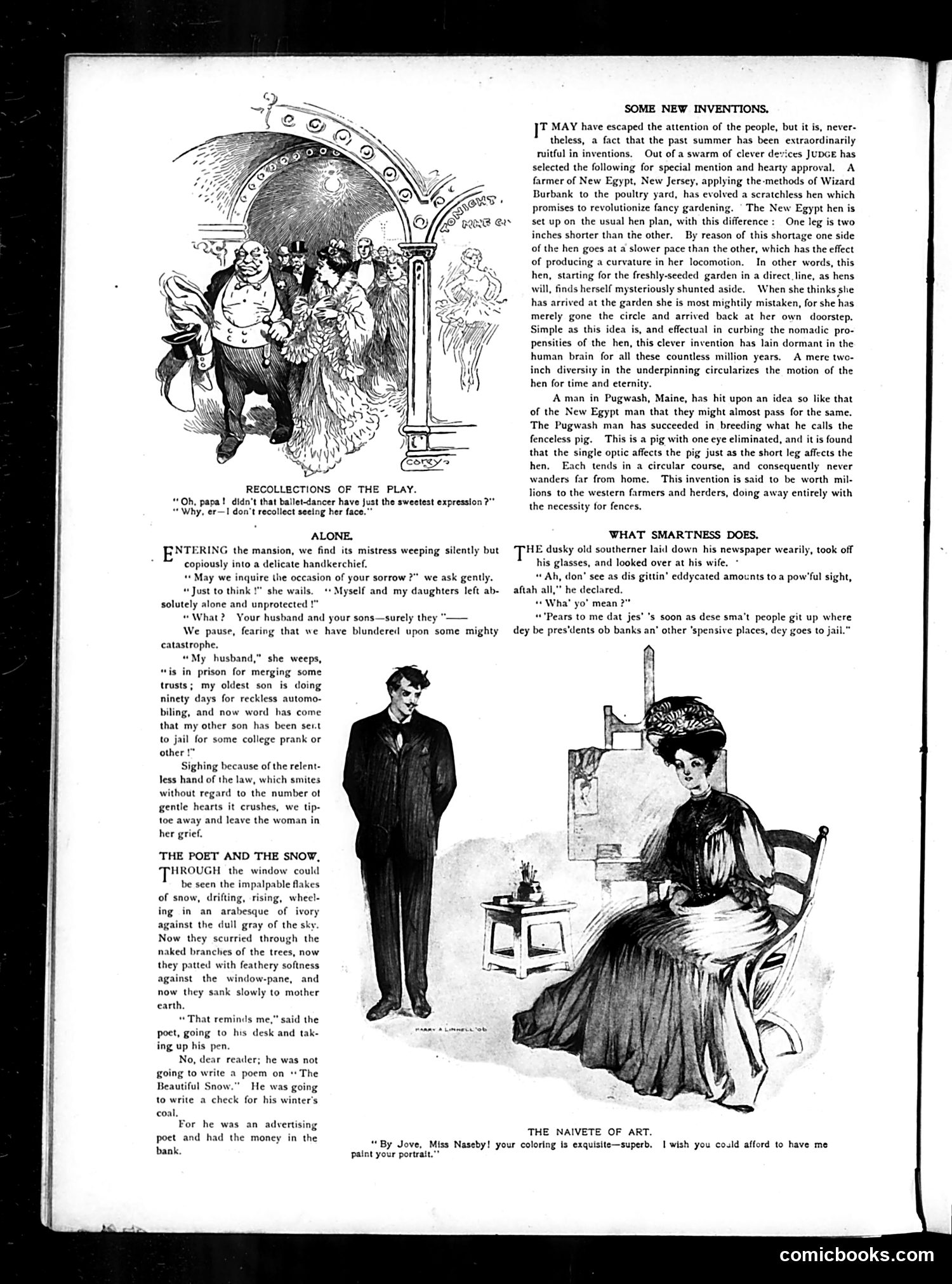
This page contains three separate satirical pieces typical of early 1900s humor: **"Some New Inventions"** mocks pseudo-scientific farming fads. It describes absurd "inventions"—a hen with one shorter leg that circles back home instead of raiding gardens, and a one-eyed pig that similarly stays put. The satire targets wealthy farmers' gullibility toward elaborate "solutions" to simple problems, likely referencing Luther Burbank's actual plant-breeding fame. **"Alone"** satirizes wealthy women's helplessness. A widow laments being "unprotected" while her husband sits in prison for trust fraud, her son serves time for reckless driving, and another faces jail for college pranks. The joke: she has no male protector because the men are imprisoned for various modern crimes—mocking both aristocratic dependence and the era's criminal justice system. **"The Poet and the Snow"** and **"The Naiveté of Art"** appear to be brief sketch introductions, likely continuing on another page. The overall tone reflects Judge's satirical approach to contemporary social pretension and institutional failings.
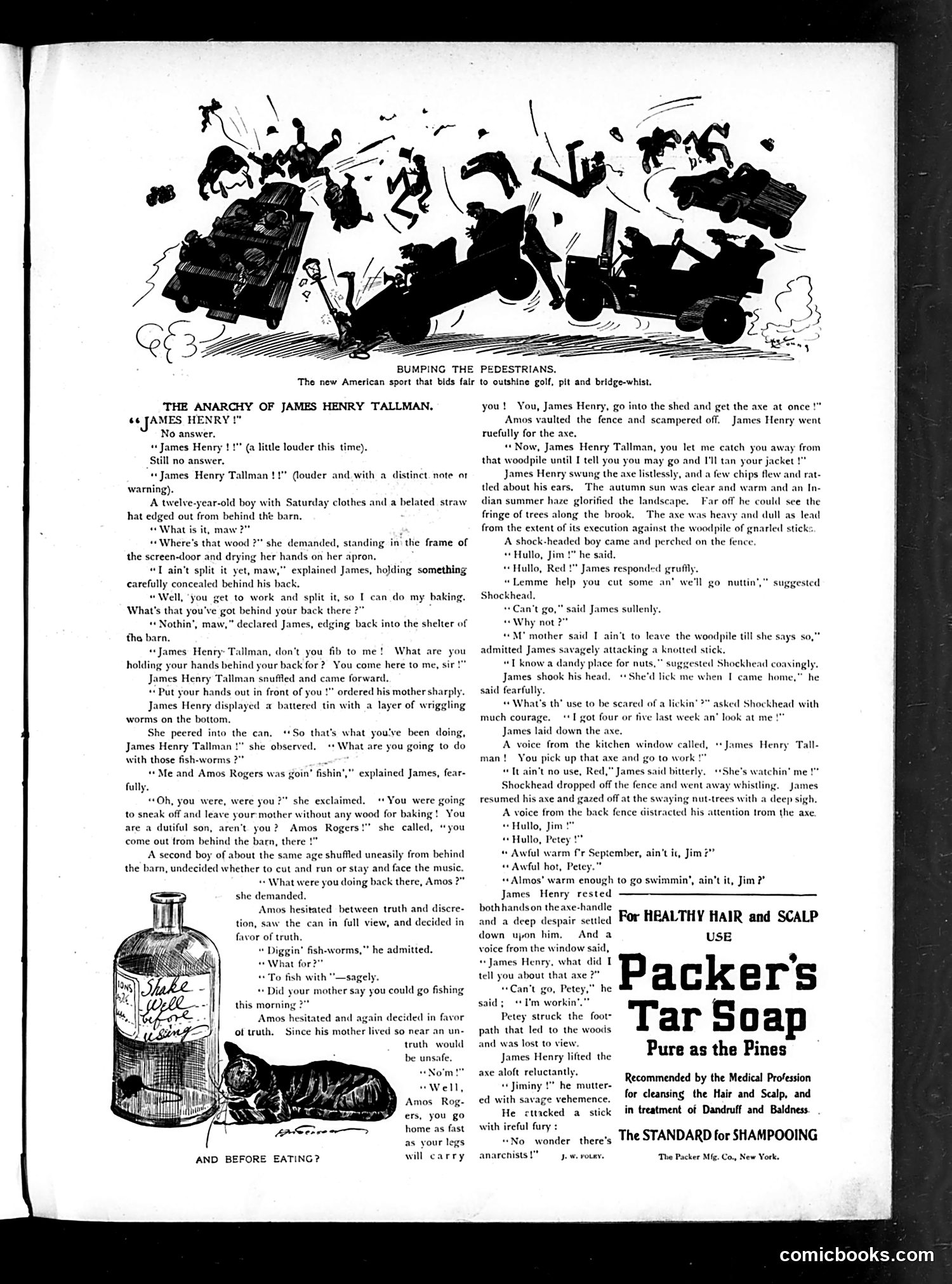
This page contains two distinct elements: a satirical cartoon at top and a serialized story below. **The Cartoon**: "Bumping the Pedestrians" depicts cars violently hitting pedestrians—titled as "the new American sport" competing with golf and bridge. This satirizes the dangerous early automobile era when cars were new, fast, and caused frequent accidents. The joke mocks both reckless drivers and society's casual acceptance of traffic deaths as entertainment. **The Story**: A domestic narrative where a boy named James Henry is caught neglecting chores (not splitting wood) to go fishing. His mother discovers the deception and punishes him by forcing him back to work. The satire appears gentle—mocking childhood mischief and parental discipline—rather than political. The advertisement for Packer's Tar Soap occupies the right column. The page reflects early 20th-century anxieties: dangerous new automobiles and traditional concerns about children's obedience and duty.
The OCR text is largely unreadable and appears to be garbled characters. Based solely on the IMAGE, this page shows a black and white cartoon featuring a rotund figure in dark clothing smoking a cigar, surrounded by white cloud shapes. The figure's posture and styling suggest early 20th-century political cartooning. The artist's signature appears to read "Judge" on the left margin. However, **without legible text identifying the specific figure, political target, or satirical point**, I cannot definitively explain what this cartoon means. The clouds and cigar smoke may suggest prosperity, smugness, or obfuscation, but determining the exact satire requires readable OCR text or additional context about the publication date and issue.
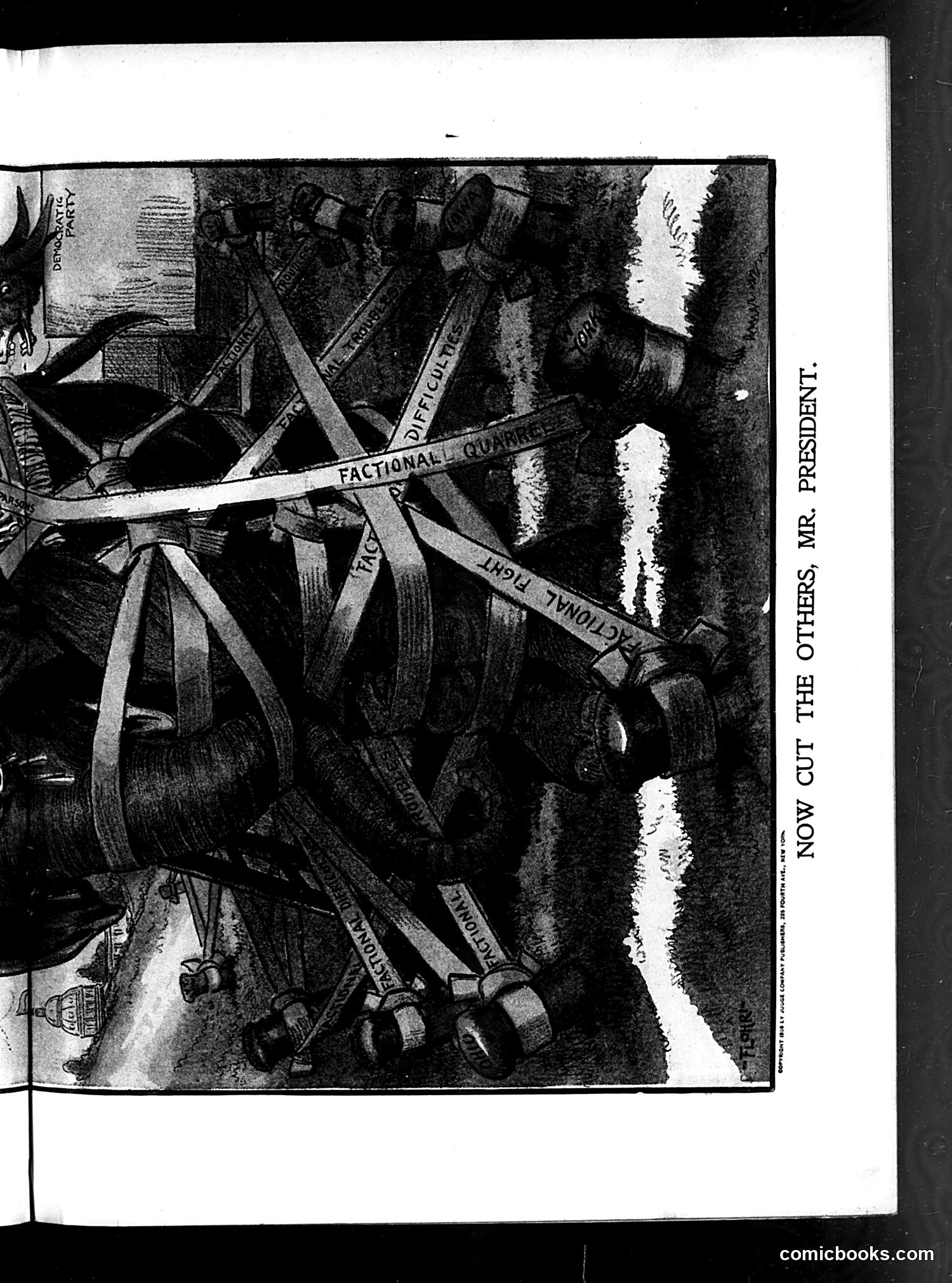
This political cartoon depicts a tangled knot of ribbons or bonds labeled with various political factions and positions, including "FACTIONAL CONFLICT," "DEMOCRATIC," and what appears to be other partisan labels. The image suggests political divisiveness and competing interests becoming hopelessly entangled. The caption reads "NOW CUT THE OTHERS, MR PRESIDENT," implying that the President must untangle or resolve these factional disputes. The cartoon critiques political fragmentation—likely from the late 19th or early 20th century based on Judge magazine's style—suggesting that multiple competing political interests and factions have created a knotty problem only strong executive action can solve. The satirical point: political gridlock requires decisive leadership to cut through partisan complications.
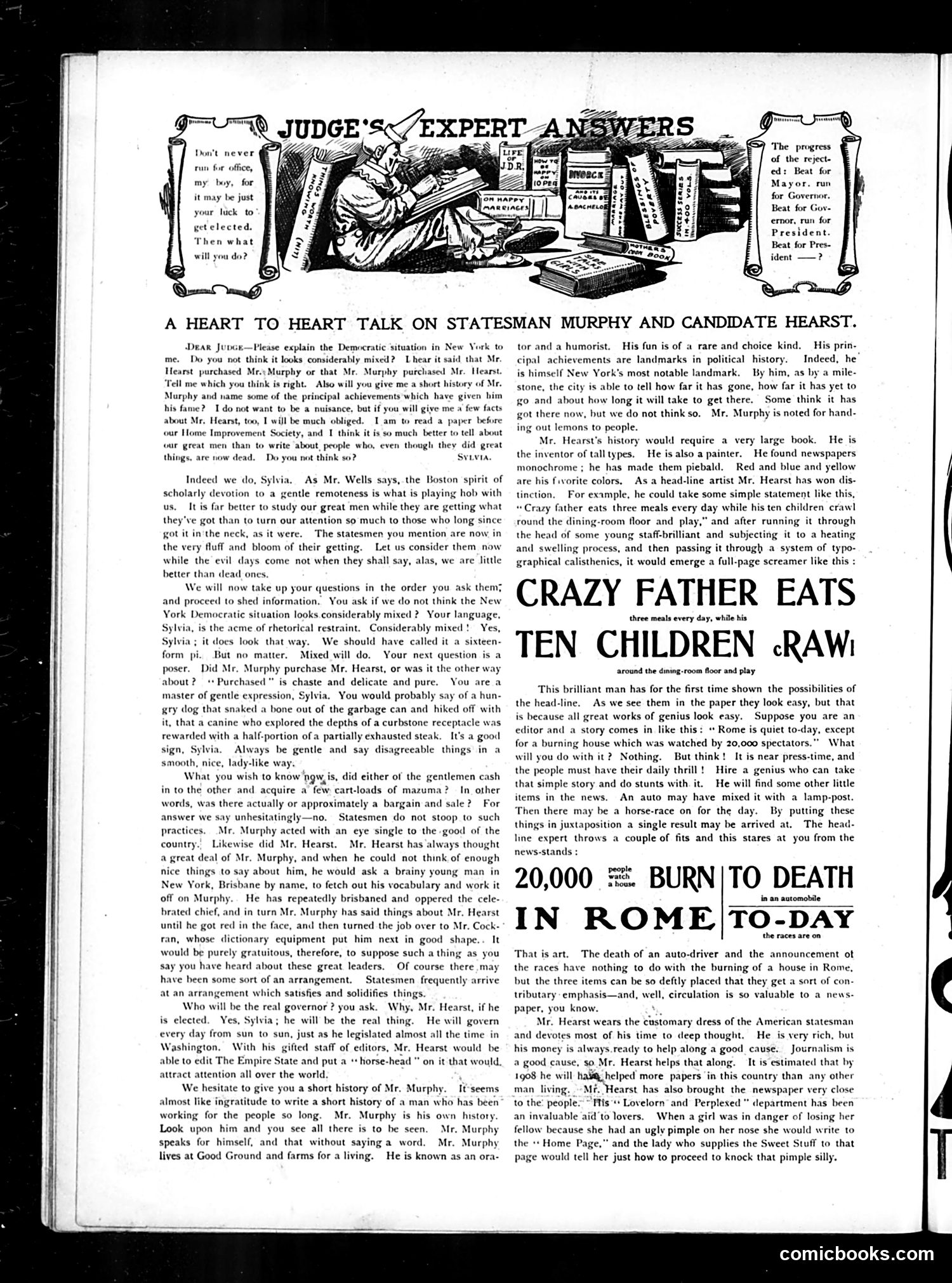
This Judge magazine page satirizes the chaotic 1906 New York Democratic primary involving media mogul William Randolph Hearst and political boss Charles Murphy. The format is a fake "advice column" where readers ask Judge to explain their confused political situation. The satire mocks the murky relationship between Hearst and Murphy: did one "purchase" the other's support? Judge responds with heavy sarcasm, claiming no actual bargain occurred while simultaneously implying obvious backroom dealing. It ridicules both figures' public attacks on each other through surrogates (Brisbane for Hearst, Cockran for Murphy). The cartoon also questions who would actually govern if Hearst won election—a jab at his outsider status despite his political ambitions. The overall tone suggests New York Democrats were hopelessly "mixed up" and that these powerful men's political maneuvering was transparently corrupt, though publicly deniable.
This is a **Schlitz beer advertisement**, not political satire. The page promotes Schlitz as a premium beer brand by emphasizing its 50-year history and commitment to purity over cost-cutting. The ad's pitch: while Schlitz doubles brewing expenses to ensure quality, competitors charge similar prices despite inferior standards. The ornamental border with hop designs and the tagline "The Beer That Made Milwaukee Famous" reinforce brand prestige. This reflects early-20th-century advertising strategy—associating a product with quality and tradition while undercutting rivals. The reference to "aiming at new ideals" suggests industrial progress and innovation alongside heritage. Modern readers might note the absence of health warnings and the assumption that "purity" (undefined) is a primary consumer concern.
This page is primarily **advertisements and filler content** rather than political satire. The major elements are product ads (Hunter Baltimore Rye whiskey, Pears' soap, Boston Garter, Williams' Shaving Soap) interspersed with brief humorous items. The editorial content includes: **"Mitford the Misspeller"** — A brief article mocking a historical figure (the Greek historian Mitford) for his pretentious and incorrect spelling reforms, presented as an example of failed pedantry. **Short humor snippets** — Including jokes about champagne, mail pneumatic tubes, barber conversation, and loose teeth allegedly cured by Grape-Nuts cereal. The page reflects **early 20th-century magazine culture**: mixing legitimate product advertising with light satirical commentary on social pretensions and quirks. The "Mitford" piece typifies Judge's approach—mocking intellectual affectation rather than targeting specific politicians or events. Nothing here references current events or identifiable public figures beyond the historical Mitford reference.
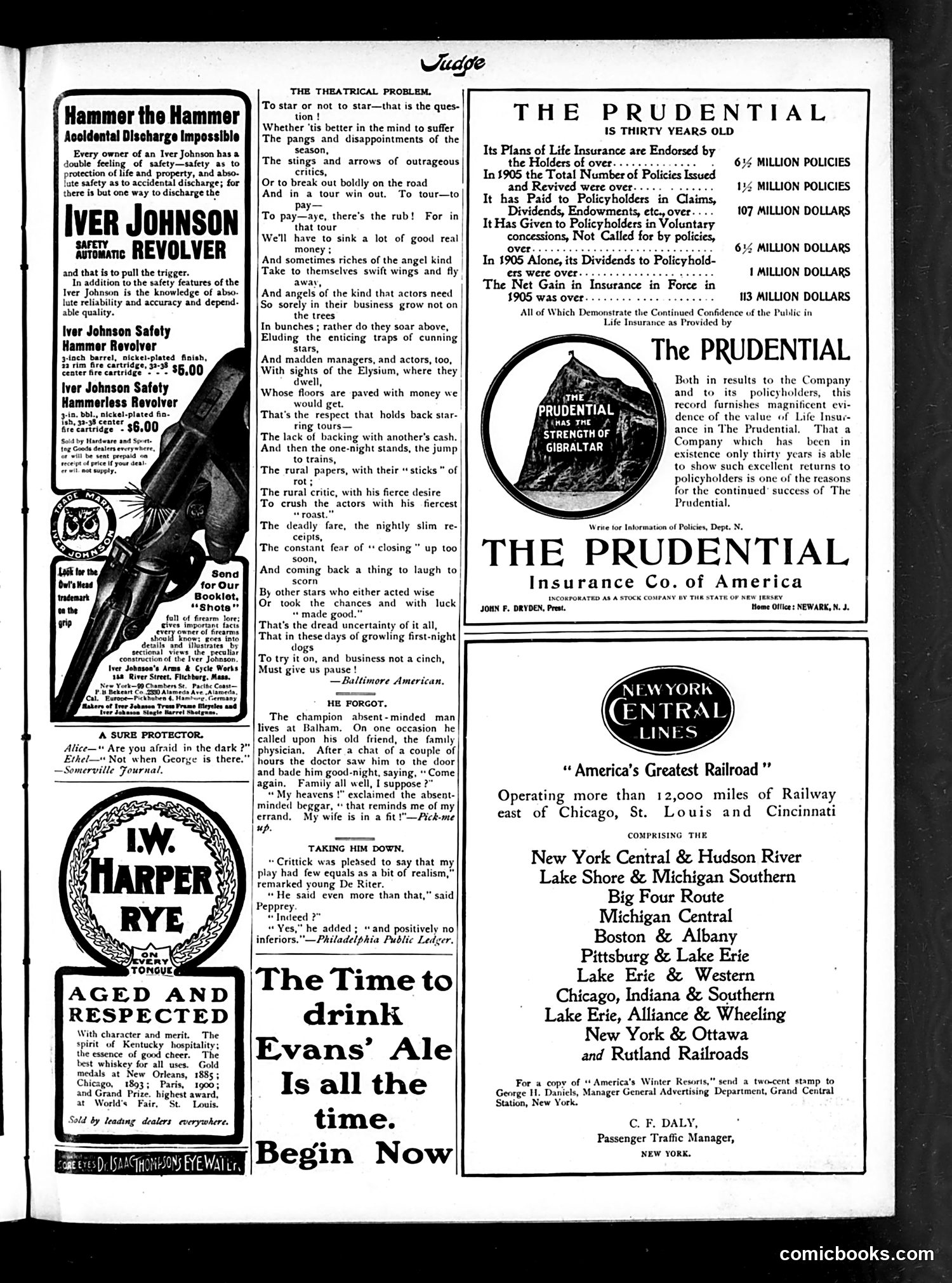
This page primarily features **advertisements and short humorous pieces** rather than political cartoons. The main advertisements include: - **Iver Johnson Safety Revolver**: marketed with emphasis on accidental-discharge prevention ("only one way to discharge") - **I.W. Harper Rye Whiskey**: touting awards and "Kentucky hospitality" - **Evans' Ale**: a simple drink advertisement - **The Prudential Insurance Company**: showcasing 30 years of business success with statistics - **New York Central Lines**: railroad advertising The humor pieces are brief, lightweight jokes: - A domestic comedy about a woman feeling safe with her boyfriend in the dark - "The Theatrical Problem": a satirical piece (written in Shakespearean style) mocking theater producers' financial anxieties about funding touring shows - "He Forgot": an anecdote about an absent-minded man who visits a doctor but forgets his actual errand (his wife is having a fit) - "Taking Him Down": wordplay about theater criticism The page reflects early 1900s American consumer culture with no evident political satire—primarily lifestyle and commercial content.
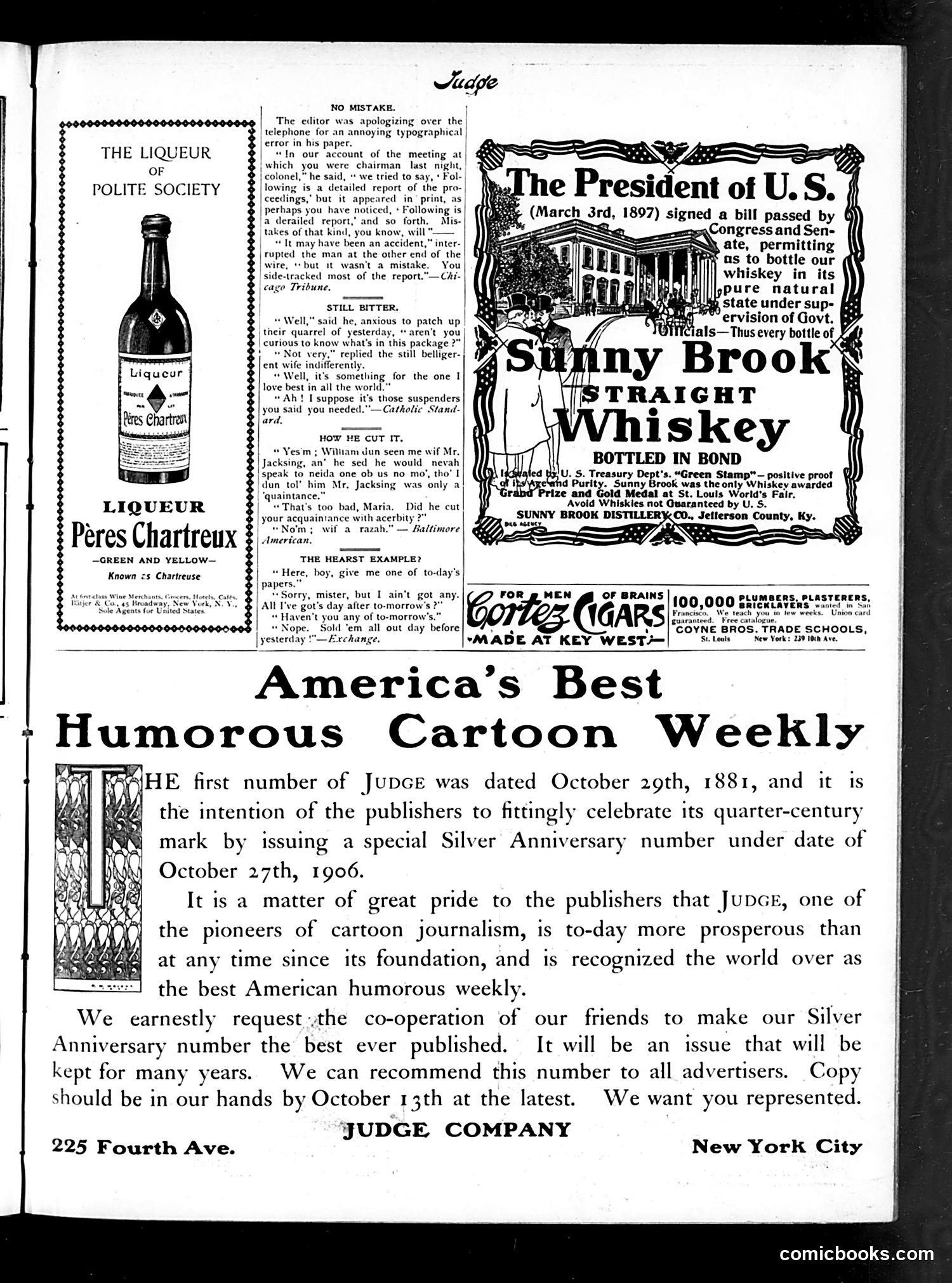
This page is primarily **advertising and promotional material** rather than satirical content. The main elements are: **Advertisements:** - Liqueur de Pères Chartreux (left column) - Sunny Brook Straight Whiskey (center), advertising a presidential bill from March 3, 1897 allowing bottled whiskey supervision - Cortes Cigars and Coyne Bros. Trade Schools (right) **Humor Filler Content:** Four brief jokes appear between ads: - "No Mistake": Editor apologizes for typo ("derailed" instead of "detailed") - "Still Bitter": Reconciling couple; she dismisses his gift as suspenders - "How He Cut It": Racial dialect joke about a man cutting off acquaintance "wif a razah" - "The Hearst Example": Boy can't get yesterday's papers (unclear reference—possibly mocking Hearst's sensationalism) **Institutional Notice:** The bottom half announces Judge's 25th anniversary (October 1906), claiming status as "America's Best Humorous Cartoon Weekly" and soliciting advertiser participation. The page reflects period advertising practices and casual racial stereotyping common to 1906 publications.
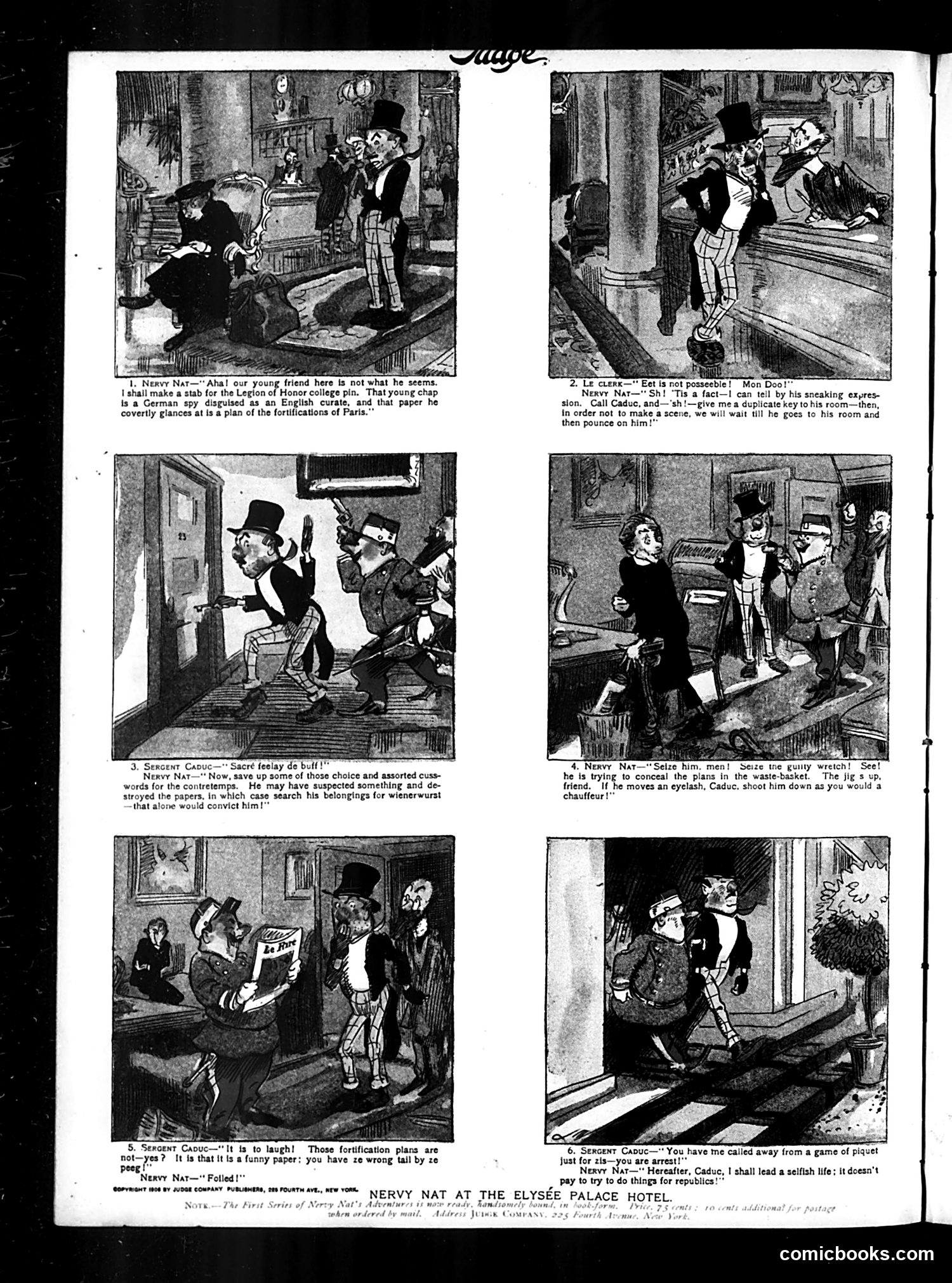
This multi-panel comic strip satirizes pre-World War I spy paranoia and French military security anxieties. The narrative follows "Nervy Nat" (an American character) as he attempts to help French officials expose what he believes is a German spy disguised as an English clergyman. Nat suspects the man is concealing plans of Paris fortifications. The satire operates on multiple levels: Nat's bumbling attempts at espionage create chaos; French Sergeant Caduc is portrayed as both incompetent and reluctant; and the "fortification plans" plot device reflects genuine contemporary concerns about industrial espionage and military secrets during the pre-war period. The humor derives from Nat's meddling zeal contrasted against French bureaucratic indifference—ultimately, after disrupting Caduc's leisure time, Nat decides heroic duty "doesn't pay" and abandons republicanism for selfishness. The joke satirizes American naïveté and exaggerated spy-hunting fervor.