
Judge, 1906-10-13 · page 5 of 16
Judge — October 13, 1906 — page 5: what you’re looking at
What you’re looking at
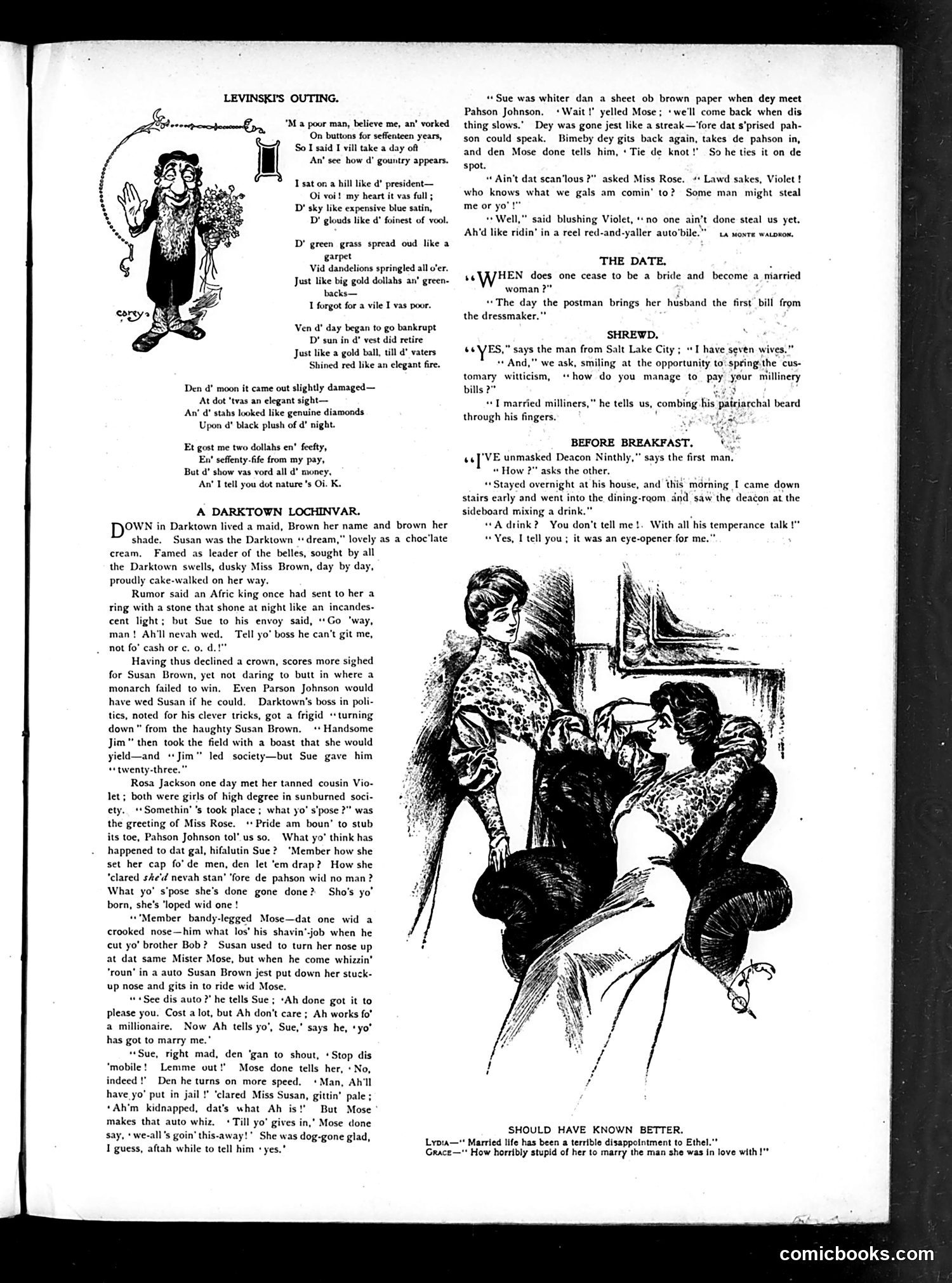
The page contains three distinct pieces: 1. **"Levinski's Outing"** - A cartoon satirizing a poor man's financial desperation. The illustrated figure represents the stereotype of an impoverished immigrant (suggested by the name "Levinski"), depicted with exaggerated features common to early 20th-century ethnic caricature. The poem mocks his poverty and desperate schemes. 2. **"A Darktown Lochinvar"** - A narrative story using "Darktown" (a period term for African American communities), employing racial stereotypes in dialect and characterization typical of the era's offensive humor. 3. **Short joke sections** ("The Date," "Shred," "Before Breakfast") featuring domestic and social humor. The page primarily reflects period prejudices through ethnic and racial caricature now considered deeply offensive.
📄 Transcribed text from this page (OCR, searchable)
Machine-transcribed from the original scan — historical spelling and the odd misread are preserved.
"M a poor man, believe me, an’ vorked On buttons for seffenteen years, So I said I vill take a day off An’ see how d’ gountry appears. I sat on a hill like d’ president— Oi voi! my heart it vas full ; D’ sky like expensive blue satin, D’ glouds like d’ foinest of vool. D’ green grass spread oud like a garpet Vid dandelions springled all oer. Just like big gold dollahs an’ green- backs— 1 forgot for a vile I vas poor. Ven d’ day began to go bankrupt D’ sun in d’ vest did retire Just like a gold ball, till d’ vaters Shined red like an elegant fire. Den d’ moon it came out slightly damaged— ‘At dot ‘tvas an elegant sight— An’ d’ stahs looked like genuine diamonds Upon d" black plush of d’ night. Et gost me two dollahs en’ feefty, En’ seffenty-fife from my pay, But d’ show vas vord all d* money, An’ tell you dot nature's Oi. K. A DARKTOWN LOCHINVAR. DOWN in Darktown lived a maid, Brown her name and brown her shade, Susan was the Darktown + dream,” lovely as a choc’late cream. Famed as leader of the belles, sought by all the Darktown swells, dusky Miss Brown, day by day, proudly cake-walked on her way. Rumor said an Afric king once had sent to her a ring with a stone that shone at night like an incandes- cent light; but Sue to his envoy said, “Go ‘way, man! Ah'll nevah wed, Tell yo" boss he can’t git me, not fo’ cash or c. 0. d.!” Having thus declined a crown, scores more sighed for Susan Brown, yet not daring to butt in where a monarch failed to win, Even Parson Johnson would have wed Susan if he could. Darktown’s boss in poli- tics, noted for his clever tricks, got a frigid “turning down" from the haughty Susan Brown. “+ Handsome Jim" then took the field with a boast that she would yield—and «Jim led society—but Sue gave him “twenty-three.” Rosa Jackson one day met her tanned cousin Vio- let; both were girls of high degree in sunburned soci- ety. ‘Somethin’ ’s took place ; what yo" s‘pose ?” was the greeting of Miss Rose. + Pride am boun’ to stub its toe, Pahson Johnson tol’ us so. What yo" think has happened to dat gal, hifalutin Sue? ‘Member how she set her cap fo’ de men, den let ‘em drap? How she ‘clared she'd nevah stan’ ‘fore de pahson wid no man? What yo’ s'pose she’s done gone done? Sho's yo" born, she's ‘loped wid one ! “'Member bandy-legged Mose—dat one wid a crooked nose—him what los’ his shavin'.job when he cut yo’ brother Bob? Susan used to turn her nose up at dat same Mister Mose, but when he come whizzin’ ‘oun’ in a auto Susan Brown jest put down her stuck- up nose and gits in to ride wid Mose. “+See dis auto ?* he tells Sue ; “Ah done got it to please you. Cost alot, but Ah don't care ; Ah works fo" a millionaire. Now Ah tells yo’, Sue,’ says he, *yo" has got to marry me." “Sue, right mad, den ‘gan to shout, + Stop dis ‘mobile! Lemme out!’ Mose done tells her, «No, indeed!" Den he turns on more speed. + Man, Ah'll have yo" put in jail !" ‘clared Miss Susan, gittin’ pale ; *Ah'm kidnapped, dat’s what Ah But Mose makes that auto whiz. + Till yo’ gives in," Mose done say, ‘ we-all’s goin’ this-away!' She was dog-gone glad, I guess, aftah while to tell him + yes." “Sue was whiter dan a sheet ob brown paper when dey meet Pahson Johnson, + Wait!’ yelled Mose; «we'll come back when dis thing slows.’ Dey was gone jest like a streak—'fore dat s‘prised pah- son could speak. Bimeby dey gits back again, takes de pahson in, and den Mose done tells him, «Tie de knot!" So he ties it on de spot. “ Ain't dat scan‘lous 2” asked Miss Rose. “+ Lawd sakes, Violet ! who knows what we gals am comin’ to? Some man might steal me or yo"! ++ Well," said blushing Violet, «no one ain’t done steal us yet. Ah’d like ridin’ in a reel red-and-yaller auto’bile.” La sowre watpnox. THE DATE, se WHEN does one cease to be a bride and become a miarried woman ?” “The day the postman brings her husband the first bill from the dressmaker.” SHREWD. ‘CY ES,” says the man from Salt Lake City; “I have seven wives.” “And,” we ask, smiling at the opportunity to: spring. the cus- tomary witticism, ‘how do you manage to pay’ your millinery bills ?" «L married milliners,” he tells us, combing his patriarchal beard through his fingers. BEFORE BREAKFAST. ee oe [VE unmasked Deacon Ninthly,” says the first man. « How ?” asks the other. “Stayed overnight at his house, and this’ mérning [ came down stairs early and went into the dining-raom and saw the deacon at the sideboard mixing a drink.” “A drink? You don’t tell me!. With all his temperance talk !* “Yes, I tell you ; it was an eye-opener for me.” SHOULD HAVE KNOWN BETTER. Married life has been a terrible disappointment to Ethel.”* How horribly stupid of her to marry the man she was in love with !"* comicbooks.com