
Judge, 1906-10-13 · page 10 of 16
Judge — October 13, 1906 — page 10: what you’re looking at
What you’re looking at
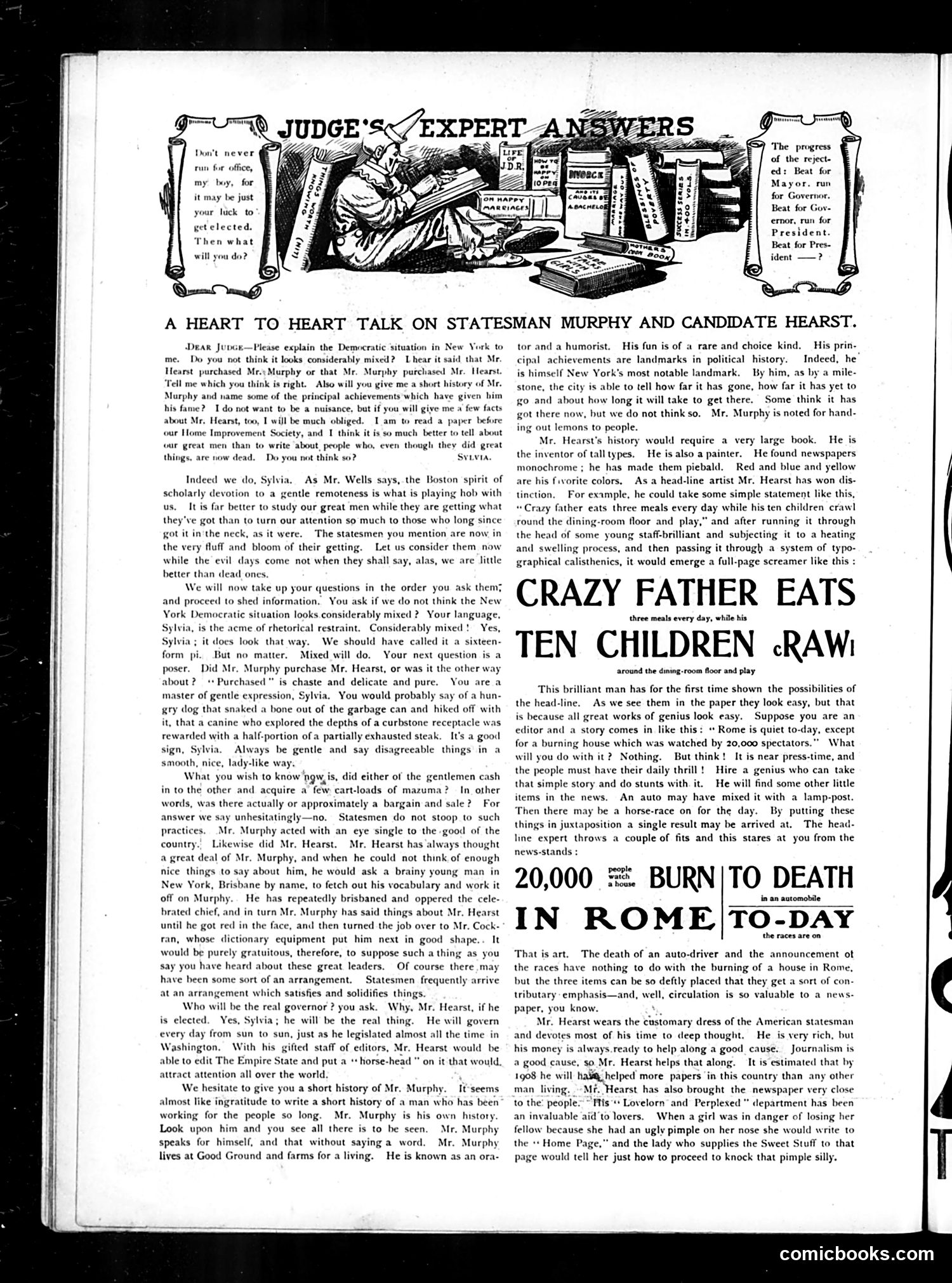
This Judge magazine page satirizes the chaotic 1906 New York Democratic primary involving media mogul William Randolph Hearst and political boss Charles Murphy. The format is a fake "advice column" where readers ask Judge to explain their confused political situation. The satire mocks the murky relationship between Hearst and Murphy: did one "purchase" the other's support? Judge responds with heavy sarcasm, claiming no actual bargain occurred while simultaneously implying obvious backroom dealing. It ridicules both figures' public attacks on each other through surrogates (Brisbane for Hearst, Cockran for Murphy). The cartoon also questions who would actually govern if Hearst won election—a jab at his outsider status despite his political ambitions. The overall tone suggests New York Democrats were hopelessly "mixed up" and that these powerful men's political maneuvering was transparently corrupt, though publicly deniable.
📄 Transcribed text from this page (OCR, searchable)
Machine-transcribed from the original scan — historical spelling and the odd misread are preserved.
Don't never office, it may be just your lick to get elected. Then what do? A HEART TO HEART TALK ON Deak JuDGE—Please explain the Democratic ‘situation in New York to me. Do you not think it looks considerably mixed? Lhear it said that Mr. Hearst purchased Mr.; Murphy or that Mr. Murphy purchased Mr. Hearst. ‘Tell me which you think is right. Also will you give me a short history of Mr. Murphy and name some of the principal achievements which have given him his fame? I do not want to be a nuisance, but if you will give me a few facts about Mr. Hearst, too, I will be much obliged. Iam to read a paper before ‘our Home Improvement Society, and I think it is so much better to tell about write about, people who, even though they did great Do you not think so? Svivta, our great men than things, are now dead. Indeed we do, Sylvia. As Mr. Wells says, the Boston spirit of scholarly devotion to a gentle remoteness is what is playing hob with us, It is far better to study our great men while they are getting what they’ve got than to turn our attention so much to those who long since got it in'the neck, as it were. ‘The statesmen you mention are now in the very fluff and bloom of their getting. while the evil days come not when they shall say, alas, we are little better than dead ones. We will now take up your questions in the order you ask them; and proceed to shed information, You ask if we do not think the New York Democratic situation looks.considerably mixed ?- Your language, Sylvia, is the acme of rhetorical restraint. Considerably mixed! Yes, Sylvia; it does look that way. We should have called it a sixteen- form pi Mixed will do. Did Mr, Murphy purchase Mr. Hearst, or was it the other way about ? chaste and delicate and pure. You are a master of gentle expression, Sylvia. You would probably say of a hun- gry dog that snaked a bone out of the garbage can and hiked off with it, that a canine who explored the depths of a curbstone receptacle was rewarded with a half-portion of a partially exhausted steak. It's a good Let us consider them now But no matter. Your next question is a poser. «Purchased " i: sign, Sylvia. Always be gentle and say disagreeable things in a smooth, nice, lady-like way, What you wish to know ‘ngw,is, did either of the gentlemen cash in to the other and acquire a few cart-loads of mazuma? In other words, was there actually or approximately a bargain and sale? For answer we say unhesitatingly—no, Statesmen do not stoop to such practices. Mr. Murphy acted with an eye single to the good of the country.) Likewise did Mr. Hearst, Mr. Hearst has’always thought a great deal of Mr. Murphy, and when he could not think of enough nice things to say about him, he would ask a brainy young man in New York, Brisbane by name, to fetch out his vocabulary and work it off on Murphy. He has repeatedly brisbaned and oppered the cele- brated chief, and in turn Mr, Murphy has said things about Mr. Hearst until he got red in the face, and then turned the job over to Mr. Cock- ran, whose dictionary equipment put him next in good shape.. It would be purely gratuitous, therefore, to suppose such a thing as you say you have heard about these great leaders. Of course there. may have heen some sort of an arrangement. Statesmen frequently arrive at an arrangement which satisfies and solidifies things. Who will be the real governor ? you ask. Why, Mr. Hearst, if he is elected. Yes, Sylvia; he will be the real thing. every day from sun to sun, just as he legislated almost all the time in Washington. With his gifted staff of editors, Mr. Hearst would be able to edit The Empire State and put a *+horse-head " on it that would attract attention all over the world. We hesitate to give you a short history of Mr. Murphy. Itseems almost like ingratitude to write a short history of a man who has been working for the people so long. Mr. Murphy is his own history Look upon him and you see all there is to be seen. Mr. Murphy speaks for himself, and that without saying a word. Mr. Murphy lives at Good Ground and farms for a living. He is known as an ora- He will govern ‘The progress of the reject- ed: Beat for Mayor. run for Governor. Beat for G ernor, run for President. Beat for Pres- STATESMAN MURPHY AND CANDIDATE HEARST. tor and a humorist. His fun is of a rare and choice kind. His prin- cipal achievements are landmarks in political history. Indeed, he is himself New York's most notable landmark. By him, as by a mile- stone, the city is able to tell how far it has gone, how far it has yet to go and about how long it will take to get there. Some think it has got there now, but we do not think so. Mr. Murphy is noted for hand- ing out lemons to people. Mr. Hearst's history would require a very large book. the inventor of tall types. He is also a painter. He found newspapers monochrome ; he has made them piebald, Red and blue and yellow are his fivorite colors, As a head-line artist Mr. Hearst has won dis- tinction. For example, he could take some simple statement like this, “Crazy father eats three meals every day while his ten children crawl round the dining-room floor and play,” and after running it through the head of some young staff-brilliant and subjecting it to a heating and swelling process, and then passing it through a system of typo- graphical calisthenics, it would emerge a full-page screamer like this : CRAZY FATHER EATS three meals every day, while his TEN CHILDREN -RAW around the dining-room floor and play He is This brilliant man has for the first time shown the possibilities of the head-line. As we see them in the paper they look easy, but that is because all great works of genius look easy. Suppose you are an editor and a story comes in like this: “ Rome is quiet to-day, except for a burning house which was watched by 20,000 spectators.” What will you do with it? Nothing. But think! It is near press-time, and the people must have their daily thrill! Hire a genius who can take that simple story and do stunts with. it. He will find some other little items in the news. An auto may have mixed it with a lamp-post. Then there may be a horse-race on for the day. By putting these things in juxtaposition a single result may be arrived at. The head- line expert throws a couple of fits and this stares at you from the news-stands : 20,000 5. BURN|TO DEATH in an automobile IN ROME|TO-DAY the races are on That is art. The death of an auto-driver and the announcement ot the races have nothing to do with the burning of a house in Rome, but the three items can be so deftly placed that they get a sort of con- tributary: emphasis—and, well, circulation is so valuable to a news- paper, you know. Mr. Hearst wears the customary dress of the American statesman and devotes most of his time to deep thought. He is very rich, but his money is always.ready to help along a good cause, Journalism is a good cause, so. Mr. Hearst helps that along. It is estimated that by 1908 he will hai helped more papers in this country than any other man livin, Mr. Hearst has also brought the newspaper very close to the’ people. “Flis“* Lovelorn and Perplexed " department has been an invaluable aid’to lovers. When a girl was in danger of losing her fellow because she had an ugly pimple on her nose she would write to the «Home Page,” and the lady who supplies the Sweet Stuff to that page would tell her just how to proceed to knock that pimple silly. comicbooks.com