
A complete issue · 16 pages · 1906
Judge — September 15, 1906
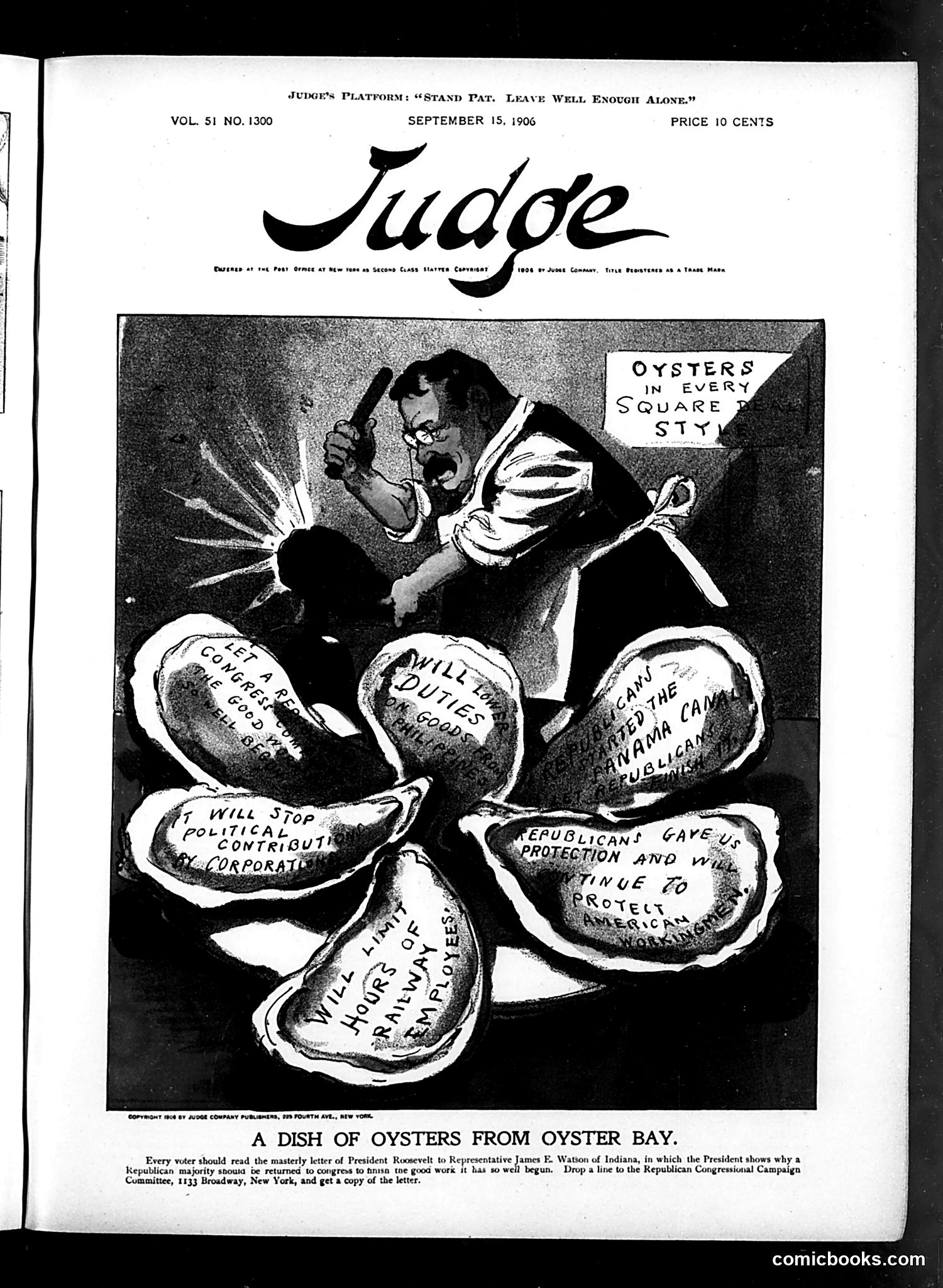
This political cartoon satirizes President Theodore Roosevelt's handling of Republican Congressional issues. The oysters represent various political problems or "dishes" Roosevelt must address, each labeled with political concerns including corporate contributions, protective tariffs, and conservation policy. The figure wielding an oyster knife appears to be Roosevelt himself, depicted as a chef preparing to serve or manage these contentious issues. The "Oyster Bay" reference points to Roosevelt's Long Island home, a familiar location associated with his presidency. The cartoon implies Roosevelt must carefully "carve up" or resolve these competing Republican party concerns—suggesting the complexity and difficulty of balancing various political interests. The text references a Roosevelt letter to Representative James E. Watson regarding Republican Congressional strategy.
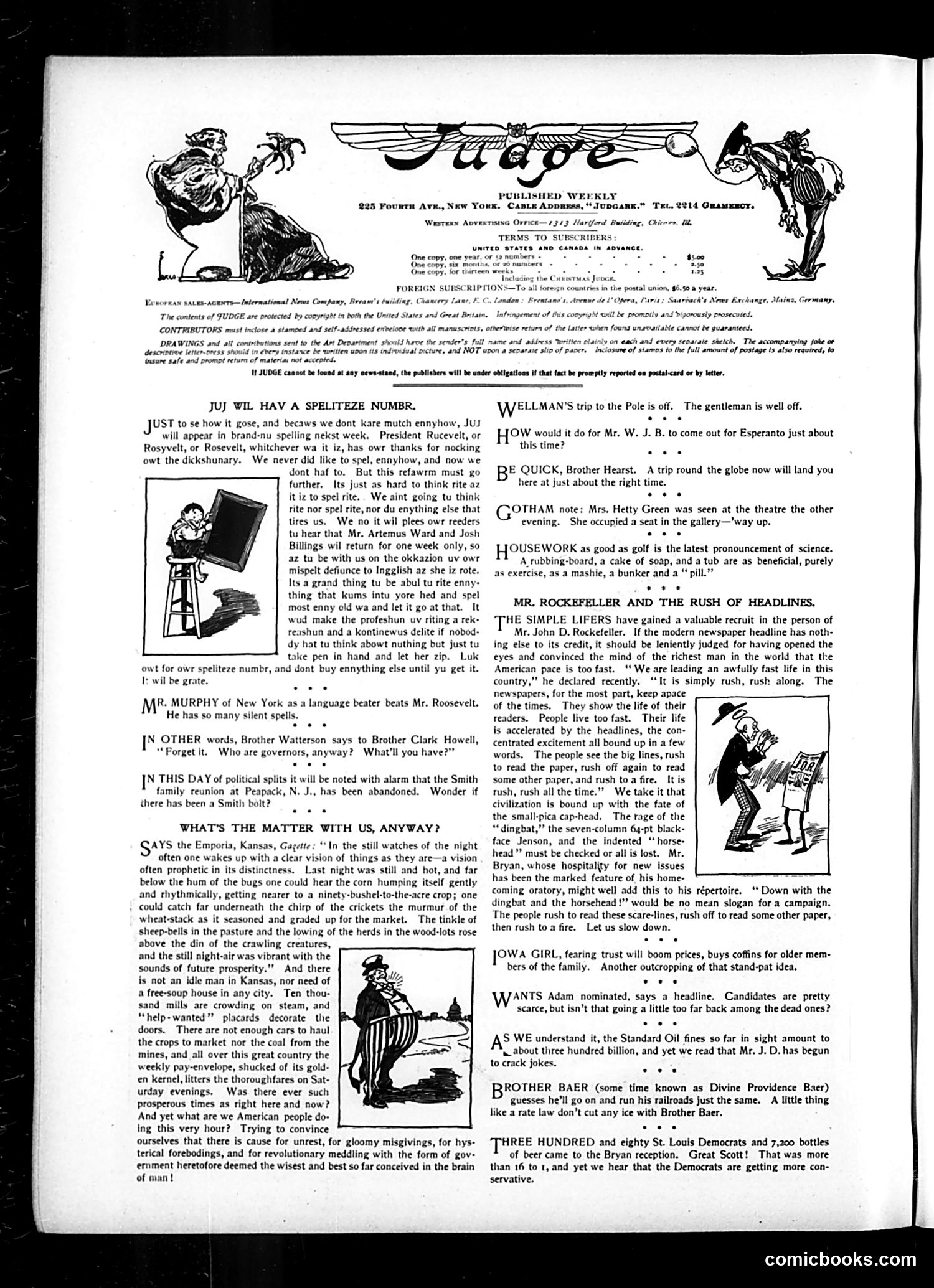
This page contains satirical commentary and short jokes rather than a primary political cartoon. The "Wellman's trip to the Pole is off" section references Arctic exploration (likely Wellman's failed polar expedition attempts, which occurred in the early 1900s). "Mr. Rockefeller and the Rush of Headlines" criticizes sensationalist newspaper journalism. The piece argues that newspapers obsess over dramatic headlines and "rush" to print, causing readers to live in constant excitement rather than contemplation. It mocks the "dingbat" and "horse-head" headline styles as symptoms of civilization's decline toward superficiality. Other brief jokes reference political figures like Roosevelt and contemporary social issues. The overall tone is one of satirical social critique typical of Judge magazine's commentary on American life and press practices.
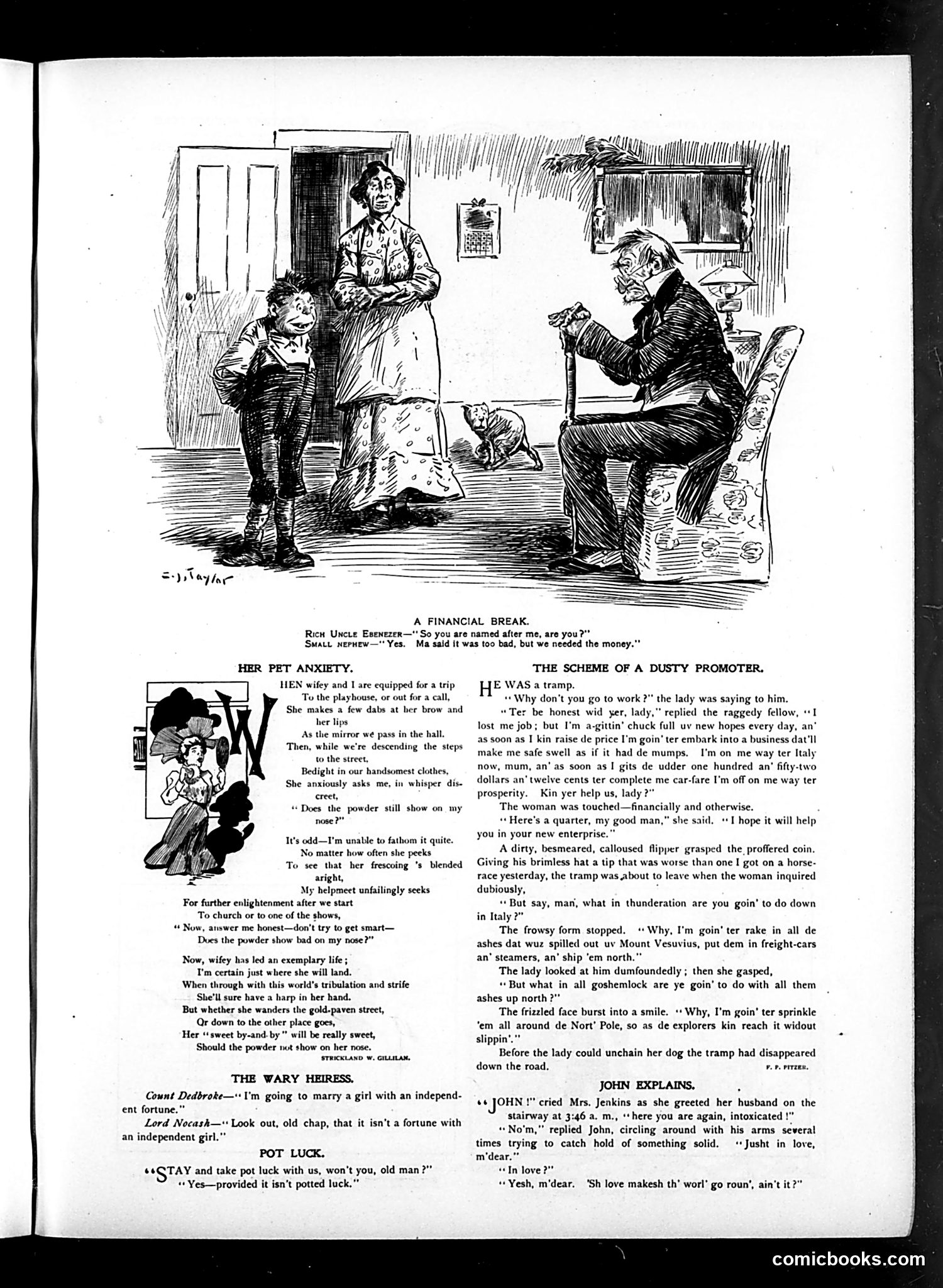
The main cartoon "A Financial Break" depicts a wealthy uncle interrogating a small nephew about his name, with a woman (likely the boy's mother) present. The caption reveals the uncle has money but the family needed it badly—suggesting satirical commentary on class desperation and inheritance seeking. Below are several short humorous pieces: "Her Pet Anxiety" mocks a wife's obsessive mirror-checking; "The Scheme of a Dusty Promoter" depicts a con artist ("tramp") manipulating a working-class woman with promises of wealth; and "John Explains" shows domestic banter about marital fidelity. The overall theme targets financial anxiety, social climbing, and domestic life among turn-of-century American classes, using working-class and immigrant characters for satirical effect.
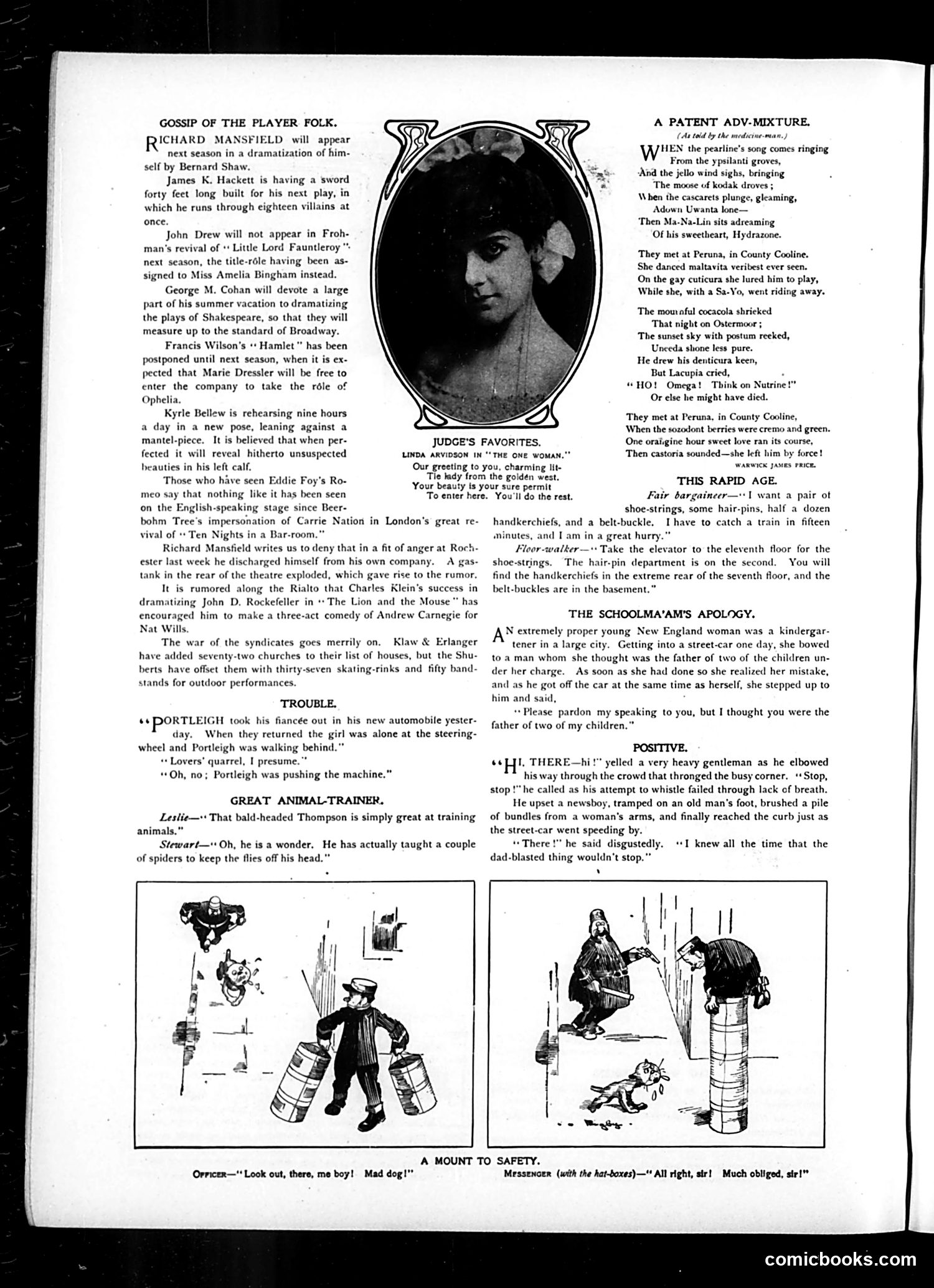
This page contains theatrical gossip and humor pieces rather than political cartoons. The content discusses Broadway players and upcoming productions—Richard Mansfield, James K. Hackett, George M. Cohan, and others. The two cartoons at bottom are humorous anecdotes: "Great Animal-Trainer" jokes about teaching spiders to avoid a bald man's head, while "A Mount to Safety" depicts a mishap involving someone on a street-car with a child and bundles—the humor deriving from physical comedy and domestic confusion rather than political commentary. The page's central photograph shows "Judge's Favorites: Linda Arvidson in 'The One Woman.'" This reflects Judge's dual nature: a satirical magazine that mixed political commentary with entertainment industry gossip and slapstick humor.
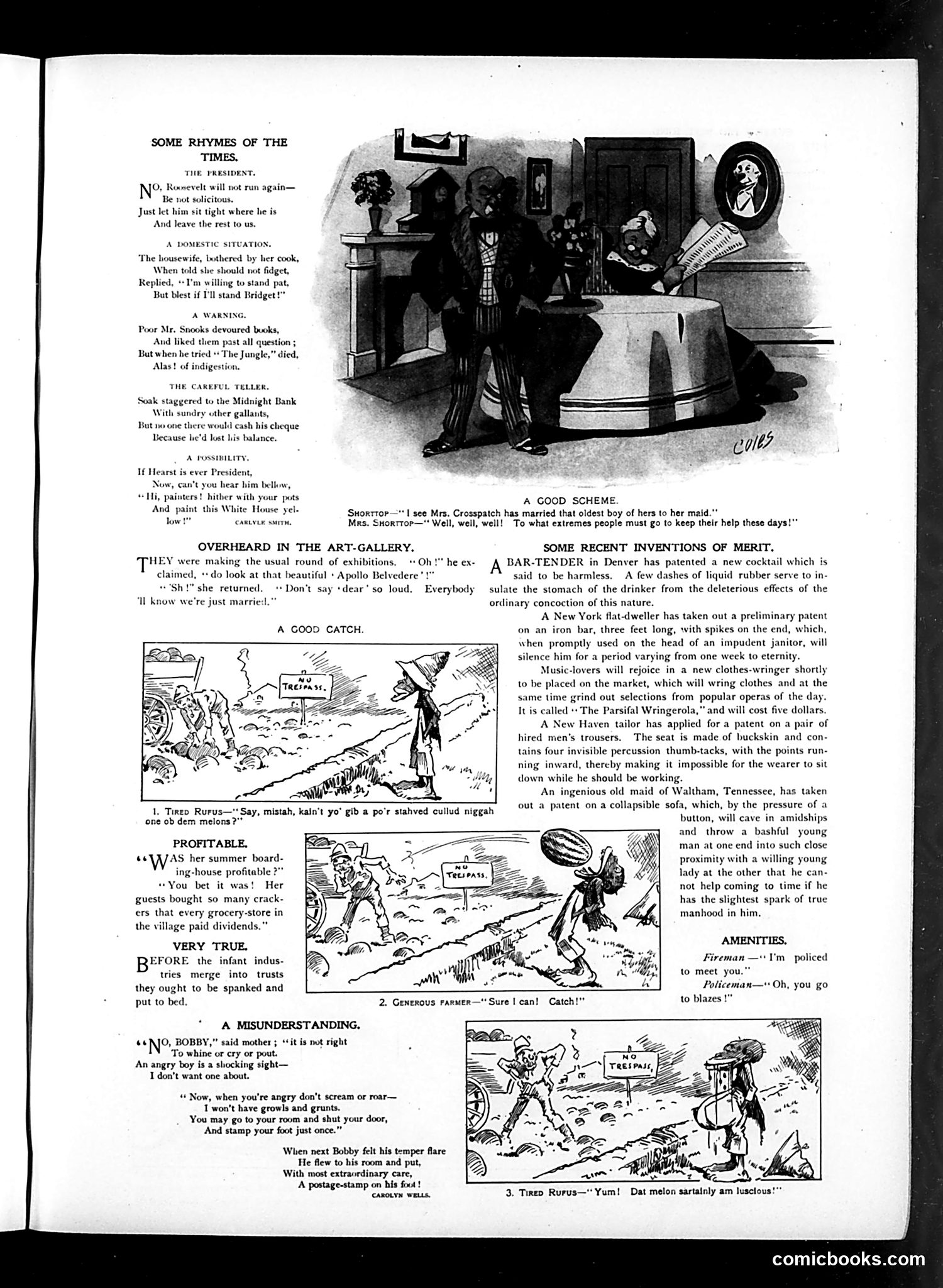
This page contains multiple satirical poems and cartoons typical of Judge's turn-of-the-century humor. The top illustration depicts a domestic interior scene, likely satirizing home life or social pretension, though specific figures are unclear from the image. The text sections include poems like "A Domestic Situation," "A Warning," and "A Good Scheme," which mock contemporary social behaviors—ineffective servants, indigestion from eating "The Jungle" (Upton Sinclair's exposé), and marrying off daughters for financial security. The three comic strip panels at bottom show a "Tired Rufus" character (appearing to be a racial caricature) attempting to catch what appears to be a runaway animal or person, reflecting the period's problematic humor conventions. The "Recent Inventions of Merit" section satirizes absurd patent claims circulating at the time.
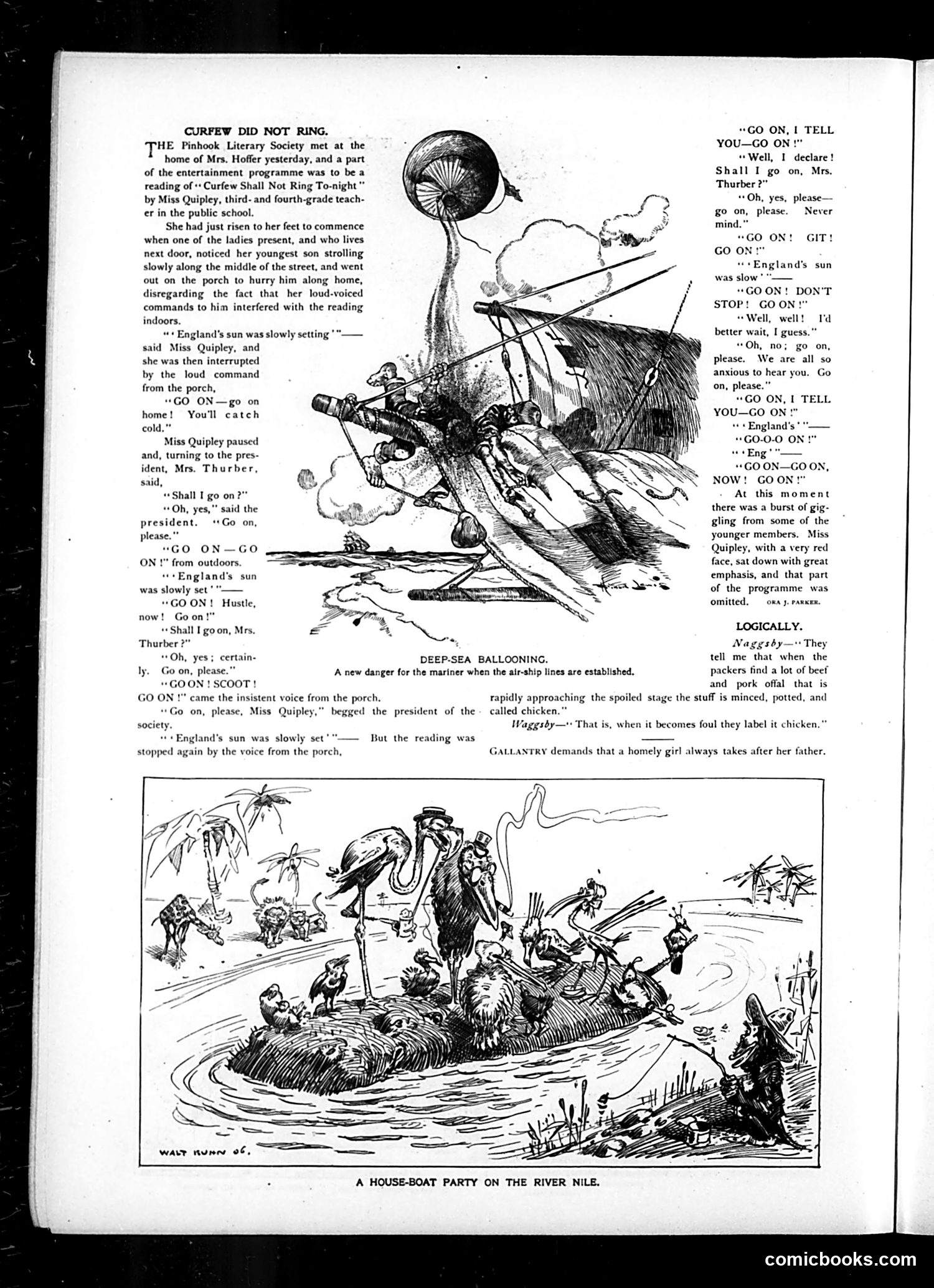
This humorous piece mocks a literary society meeting disrupted by a neighbor's loud outdoor commands to her son. Miss Quipley attempts to read the sentimental poem "Curfew Shall Not Ring To-night" indoors while the neighbor repeatedly shouts "GO ON!" from the porch, creating unintended comedy through the collision of genteel indoor culture with working-class domestic chaos. The satire targets the pretentiousness of small-town "literary societies" and the futility of refined entertainment when disrupted by ordinary neighborhood life. The audience finds this accidental humor hilarious—Miss Quipley abandons the reading in embarrassment. The page also includes unrelated cartoons: "Deep-Sea Ballooning" (mocking aviation safety), a meat-packing industry joke, and "A House-Boat Party on the River Nile," likely satirizing upper-class travel aspirations.
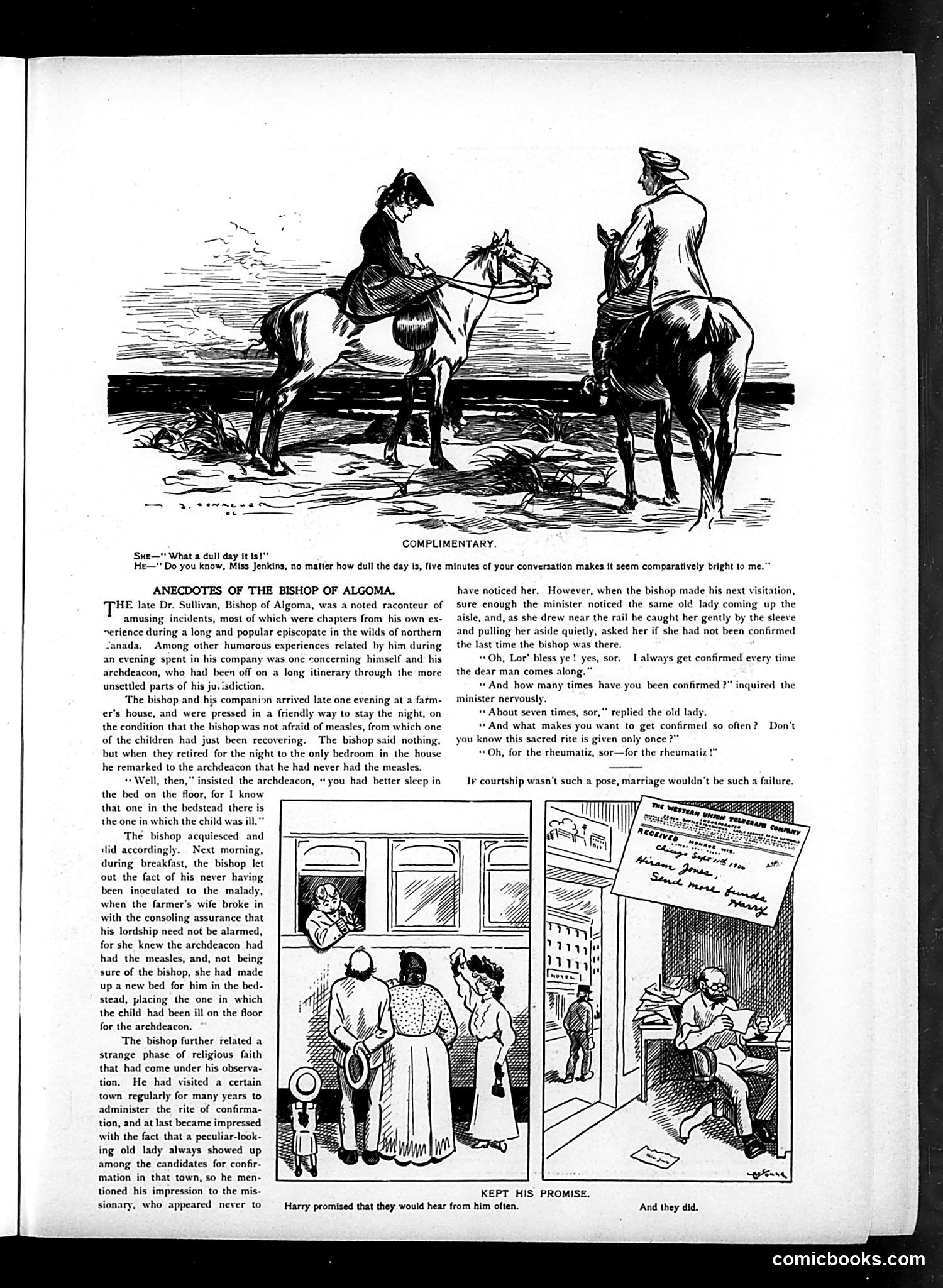
This page contains three distinct pieces of humor: **"Complimentary"** (top): A simple romantic joke where a man flatters a woman by saying her conversation brightens even dull days—transparent flattery presented as genuine compliment. **"Anecdotes of the Bishop of Algoma"** (main text with illustrations): Humorous stories about Dr. Sullivan, Bishop of Algoma (a real Canadian diocese). The anecdotes illustrate the bishop's wit and encounters with religious practice in remote northern Canada: 1. A mix-up where the bishop and archdeacon nearly swap beds, with the archdeacon unknowingly prepared for measles exposure 2. An old woman repeatedly seeking confirmation for rheumatism rather than spiritual reasons, misunderstanding the sacrament as a cure The satire mocks both ecclesiastical formality and rural religious folk's superstitious misunderstanding of church rituals. **"Kept His Promise"** (bottom cartoons): Depicts a man named Harry who promised frequent letters but instead sends repeated eviction/debt notices—ironic "keeping" of a promise through unwanted correspondence.
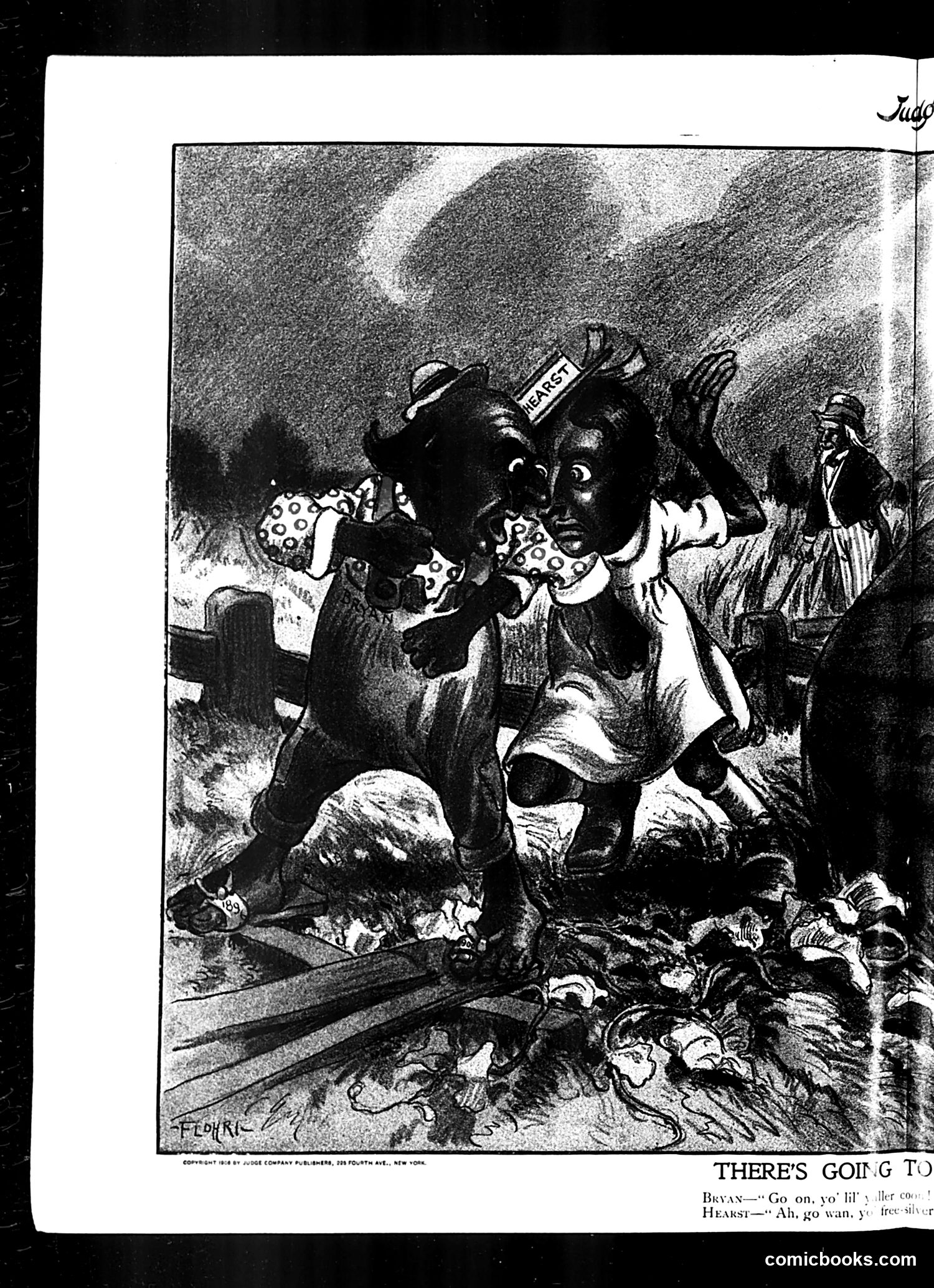
This Judge magazine cartoon titled "There's Going To" depicts a caricatured Black figure labeled "HEARST" being confronted by another figure labeled "BRYAN." The exaggerated racial caricature and offensive visual style is characteristic of early 20th-century American political satire. The text fragments suggest dialogue between these two figures, likely referencing a political dispute. Without the complete caption, the specific conflict is unclear, but this appears to satirize either William Jennings Bryan or William Randolph Hearst—both prominent political/media figures of that era. The cartoon uses crude racial imagery typical of period satire to mock or criticize one or both figures through association. The exact historical context and political point require the full caption to determine accurately.
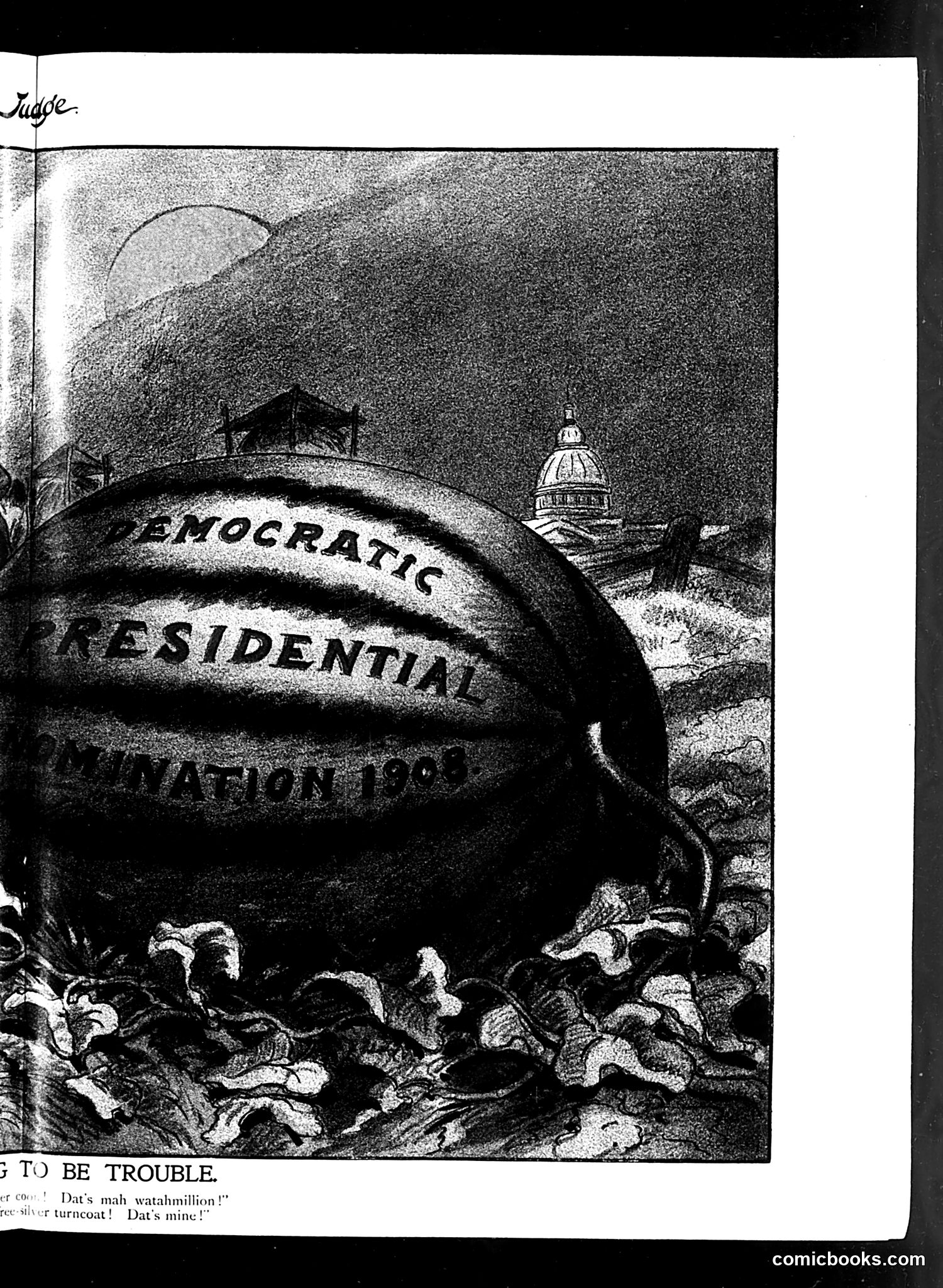
This political cartoon depicts a large bomb or spherical object labeled "DEMOCRATIC RESIDENTIAL NOMINATION 1908" sitting amid rubble near the Capitol building. The text at bottom suggests a dispute over ownership, with dialogue about a "watermelon" and accusations of being a "turncoat." The cartoon satirizes the 1908 Democratic presidential nomination process, portraying it as explosive and contentious. The watermelon reference and dialect suggest this uses period racial stereotypes in its commentary. The competing claims over the nomination ("Dat's mine!") depict the nomination as something being fought over destructively, with the Capitol watching in the background. The cartoon critiques the Democratic Party's internal conflict during this election cycle.
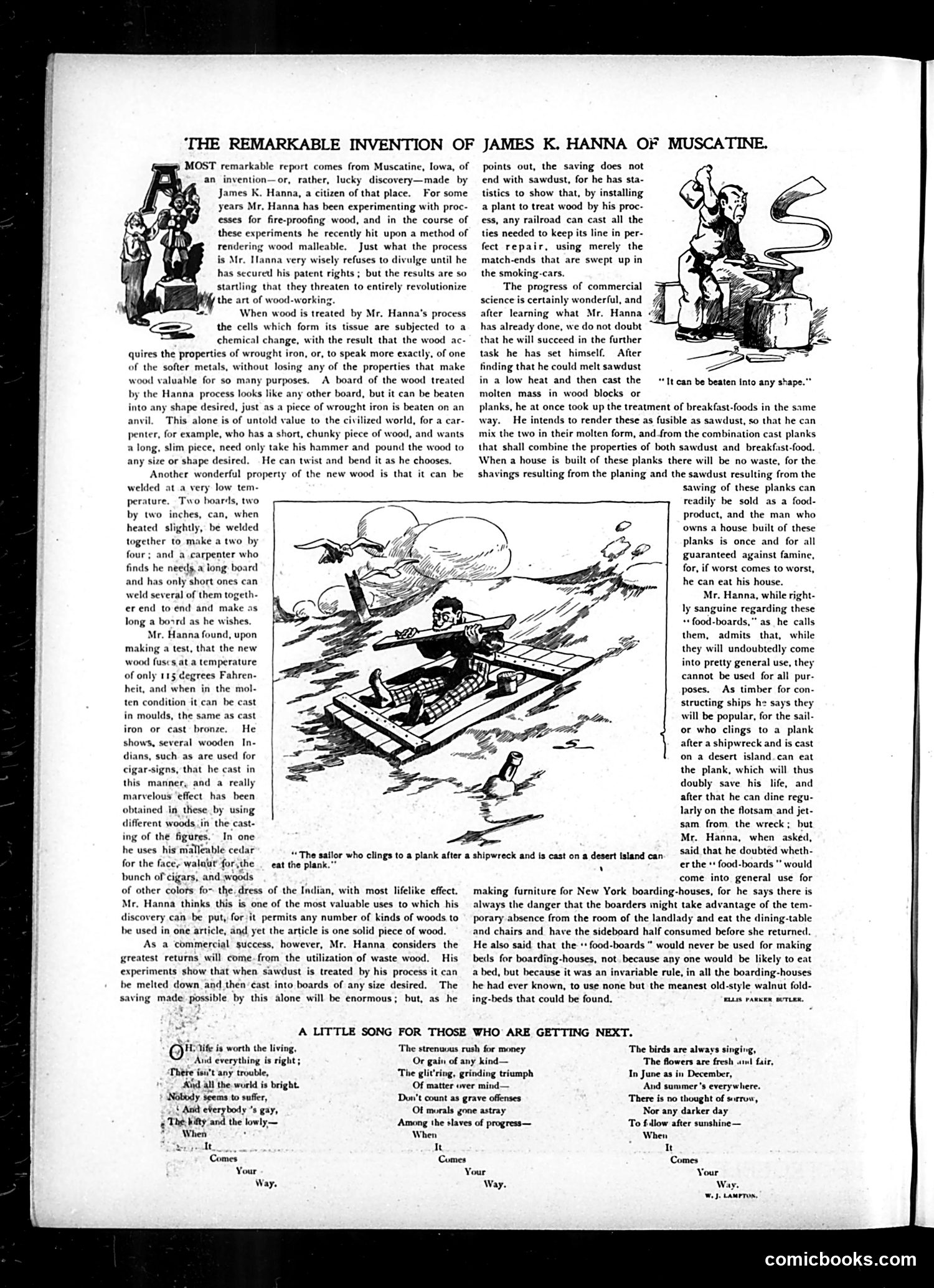
This is a satirical piece mocking pseudo-scientific invention claims and technological utopianism. The article describes James K. Hanna's purported discovery: a chemical process making wood malleable like metal, weldable at low temperatures, and fusible like cast iron. The satire works through escalating absurdity. Initial claims (bendable wood boards) seem plausible enough to intrigue readers. But the joke intensifies: melting sawdust into planks, then combining sawdust with breakfast foods to create structural material, and casting wooden cigar-store Indians in multiple wood types. The final punchline—that houses built from these breakfast-food planks could be eaten during famine—reveals this as complete nonsense. The piece satirizes both credulous inventors and the public's appetite for revolutionary technological promises. By presenting increasingly ridiculous claims in serious, technical language, Judge mocks the era's breathless enthusiasm for industrial "progress" and gets taken-in optimism about American ingenuity.
This page from *Judge* (a satirical magazine) contains mostly **short humorous anecdotes and poetry instruction**, not political cartoons. The main content includes: - **"How to Make One"**: Instructions on writing ballades (French poetic forms), presented as satire on formulaic poetry-writing - **"It Ruined Him"**: A dialect anecdote where a farmer blames a pocket watch for his son's posture problems—satirizing superstitious causation - **"The Faith of the Boy"**: A joke about a senator's young son meeting Theodore Roosevelt's portrait; the boy finds his father more impressive than the President—satire on paternal pride and relative importance - Various other short jokes about watches, cooks, and mosquitoes The page also contains **advertisements** for Pabst Beer and other products, typical of period magazines. The humor is gentle, domestic, and non-partisan—standard Judge fare mocking everyday foibles rather than specific political figures or events.
This Judge magazine page is primarily **advertising**, with some light satirical humor scattered throughout: **Main Cartoon/Humor**: "THE AUTO SPEED MANIAC" (poem) mocks reckless drivers who drove dangerously on public roads—a new social menace of the early automotive era. The joke: a driver dies speeding but "may be scorching yet" (implying he's still driving in hell). **Other Brief Jokes**: - Amusing anecdotes about ticklish wives, poverty, and a drowning Scotsman who won't release a whiskey bottle - These are period humor snippets typical of Judge magazine **Advertisements**: The page is dominated by product ads (Hunter Rye whiskey, Pears soap, kidney remedies, Cook Remedy Co. for syphilis treatment, Sunny Brook whiskey). One ad includes **a U.S. Capitol building** and large text about penalty for "re-using or refilling" whiskey bottles—likely referencing Prohibition-era regulations. **No identifiable political cartoons or caricatures** appear on this page. It's essentially a humor/lifestyle magazine with extensive advertising.
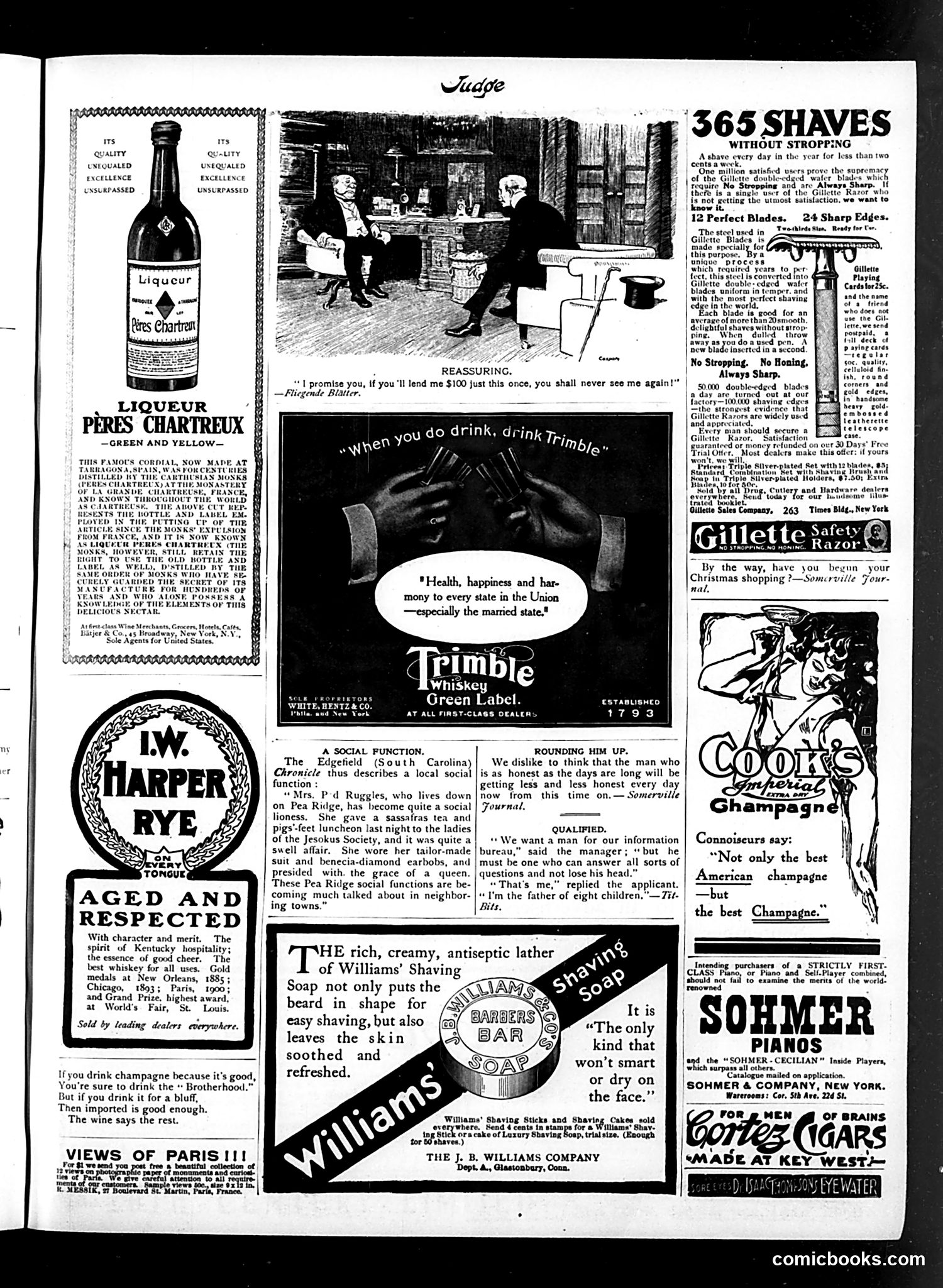
This page consists primarily of **advertisements rather than political cartoons**, reflecting Judge's business model as a satirical magazine supported by liquor, grooming, and luxury goods advertising. The one clear satirical item is "A Social Function," which mocks rural Southern pretension. It quotes the *Edgefield Chronicle* describing Mrs. Pod Ruggles' "sassafras tea and pigs'-feet luncheon" as a refined social event where she presides "with the grace of a queen" while wearing diamond earrings. The humor lies in the contrast between genuinely humble Southern fare (sassafras tea, pig's feet) and the affected gentility claimed for the occasion—satire aimed at working-class social climbing and regional affectation. The other non-advertisement content includes brief humorous quotes on urban manners ("Rounding Him Up") and workplace dynamics ("Qualified"), typical of Judge's light satirical commentary on American social behavior.
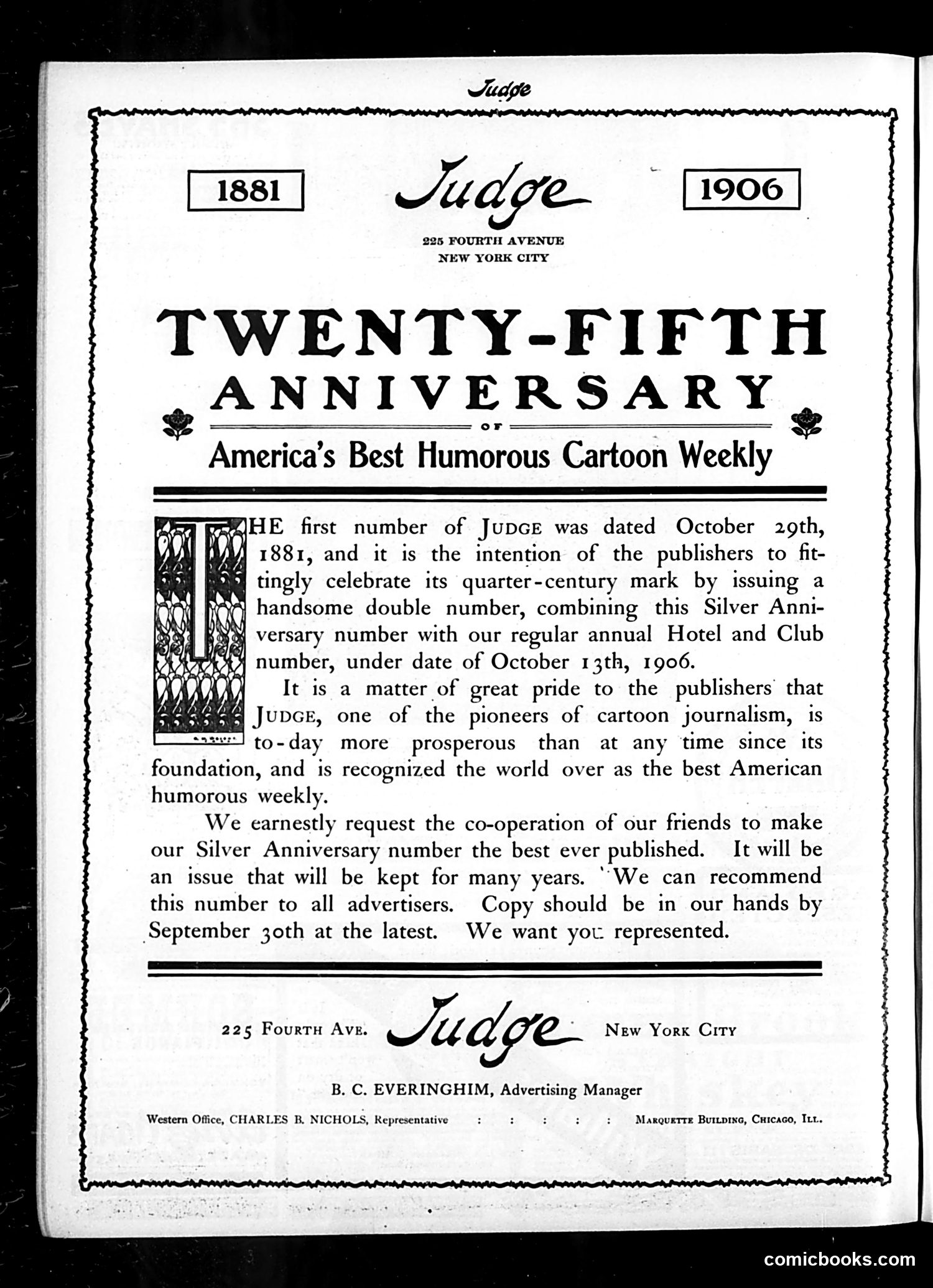
This is a **title/advertising page**, not a cartoon. Judge magazine is announcing its **Silver Anniversary**—25 years since its founding on October 29, 1881. The publication, based at 225 Fourth Avenue in New York City, describes itself as "America's Best Humorous Cartoon Weekly" and claims to be prospering and widely recognized. The page is an **appeal to advertisers** to contribute to a special double issue (combining the anniversary celebration with their annual Hotel and Club number), set for October 13, 1906. Publishers emphasize the commemorative issue will be "kept for many years" and solicit advertising copy by September 30th. The tone reflects **turn-of-century magazine business practices**—leveraging milestone anniversaries to attract advertisers and promote prestige. B.C. Everinghim handled advertising; Charles B. Nichols represented western offices from Chicago.
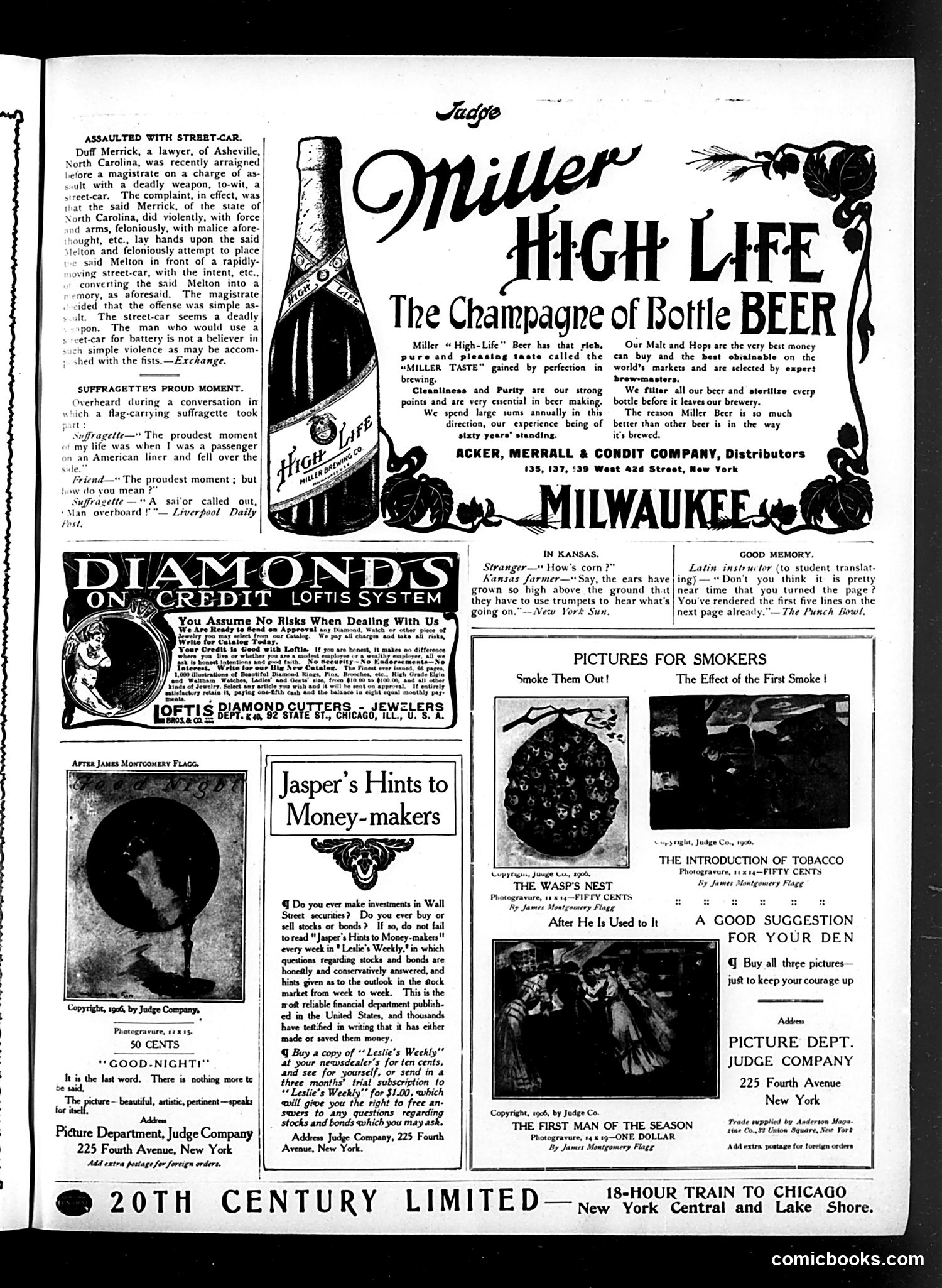
This page is primarily **advertising**, typical of early 1900s magazines. However, it includes two satirical pieces: ## "Assaulted with Street-Car" A humorous legal anecdote mocking both a lawyer's creative complaint and modern urban hazards. Duff Merrick literally used a moving streetcar as a weapon against someone, and the magistrate had to rule it "simple assault"—the joke being that a streetcar is simultaneously too public and too dangerous to claim as a traditional weapon. ## "Suffragette's Proud Moment" This satirizes women's suffrage activists as reckless and attention-seeking. A suffragette proudly recounts falling overboard from an ocean liner, interpreting a sailor's rescue call as validation. The humor targets suffragettes as self-dramatizing, their cause reduced to foolish behavior. The rest is commercial: Miller beer advertising, diamond dealer promotion, and financial advice. The "Pictures for Smokers" section appears to be serialized photographic content sold separately.
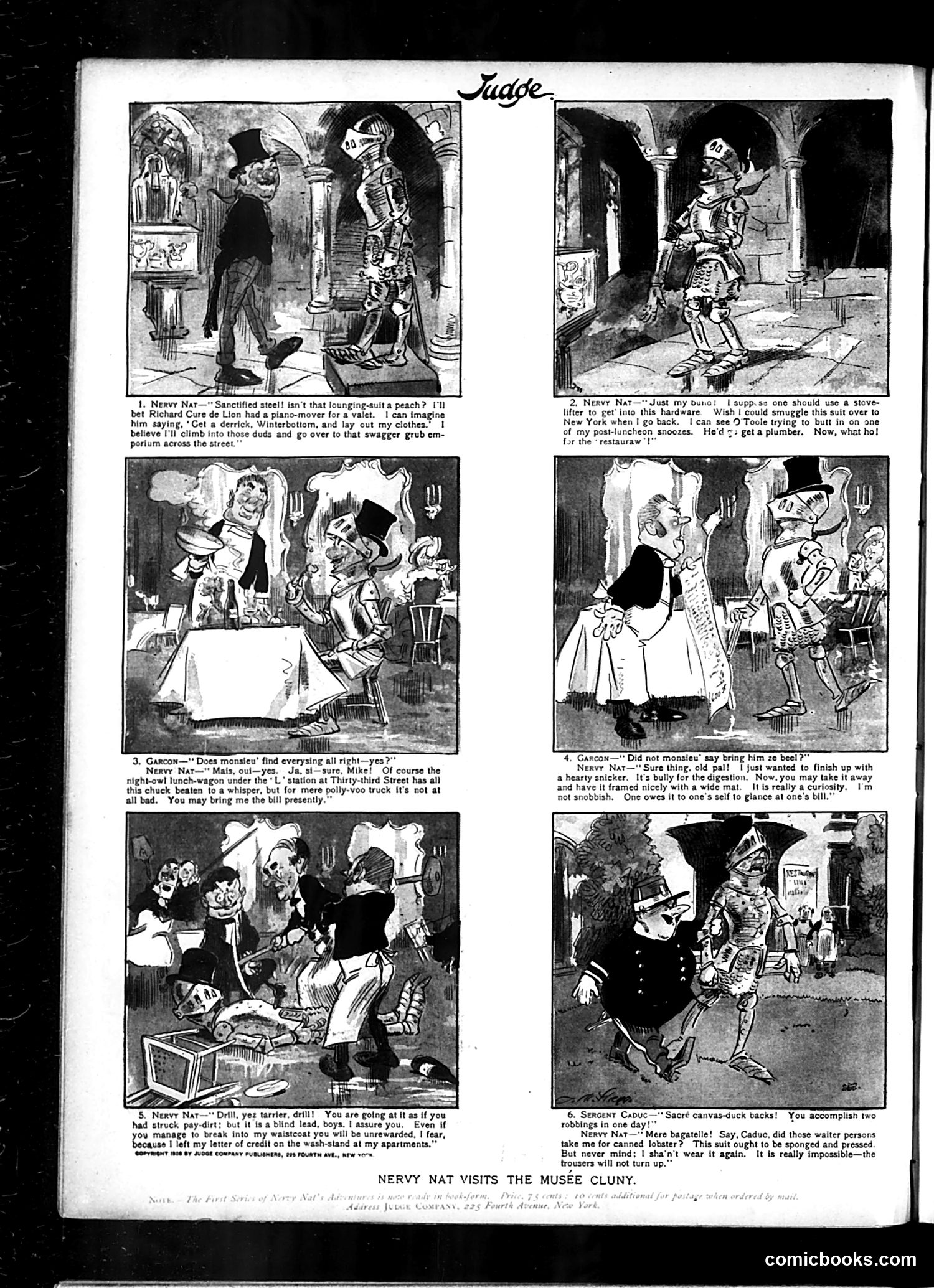
This is a humorous comic strip following "Nervy Nat," a wealthy American dandy visiting Paris's medieval museum (Musée Cluny). The joke is that Nat tries on ornate medieval armor and knight's clothing, then treats the experience with exaggerated sophistication and absurdity. Throughout the sequence, Nat makes ridiculous pronouncements: comparing armored knights to piano-movers, obsessing over restaurant quality, casually mentioning his "letter of credit," and treating the heavy armor as if it were a fashionable suit he might bring back to New York. He's portrayed as a stereotypical nouveau-riche American tourist—ostentatious, name-dropping ("Toole," restaurant references), and completely oblivious to how absurd he sounds. The satire targets both wealthy American tourists abroad and the pretension of treating casual experiences as profound cultural moments. His constant references to dining and servants underscore the character's vapid materialism masquerading as sophistication.