
Judge, 1906-09-15 · page 10 of 16
Judge — September 15, 1906 — page 10: what you’re looking at
What you’re looking at
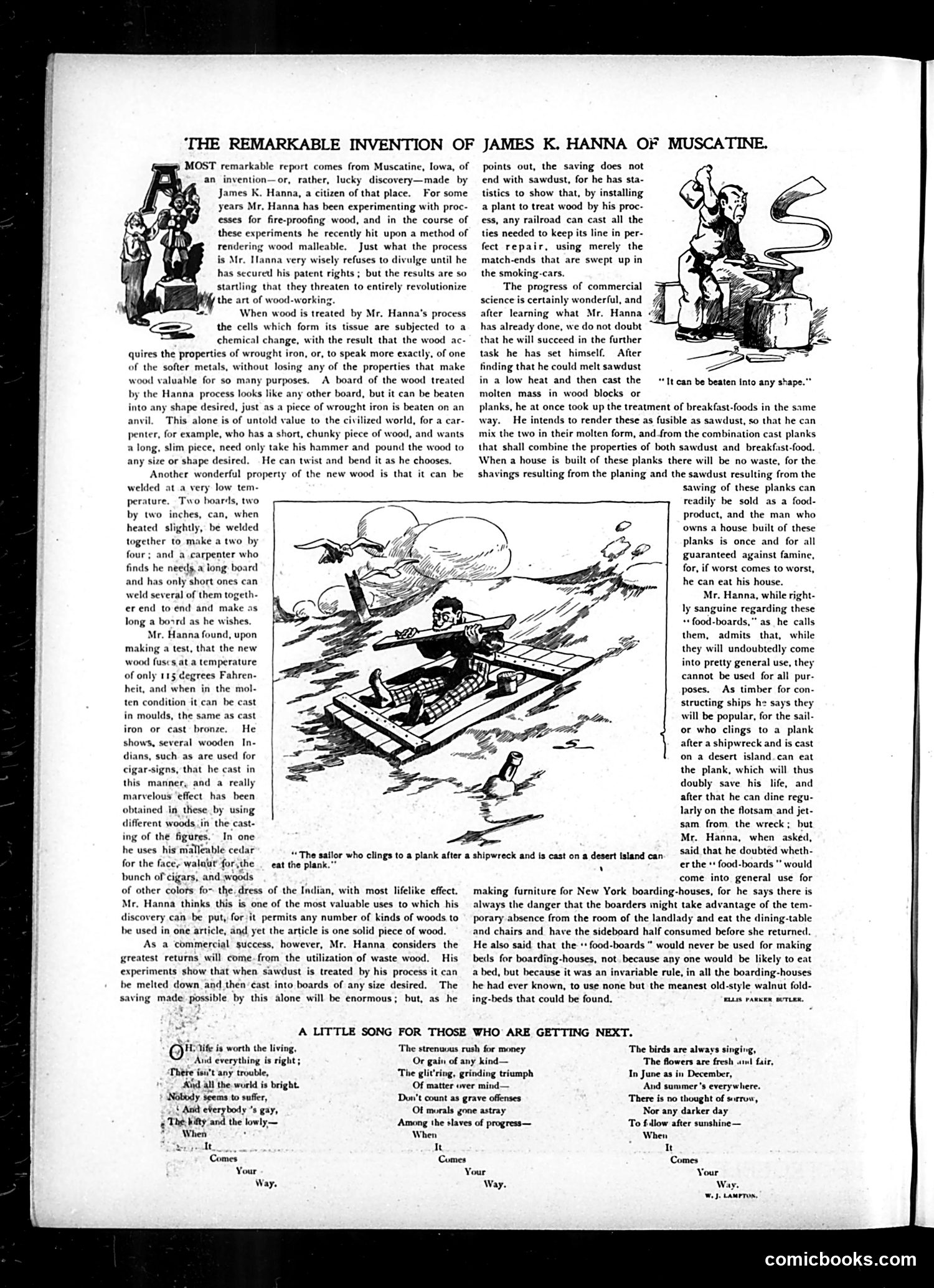
This is a satirical piece mocking pseudo-scientific invention claims and technological utopianism. The article describes James K. Hanna's purported discovery: a chemical process making wood malleable like metal, weldable at low temperatures, and fusible like cast iron. The satire works through escalating absurdity. Initial claims (bendable wood boards) seem plausible enough to intrigue readers. But the joke intensifies: melting sawdust into planks, then combining sawdust with breakfast foods to create structural material, and casting wooden cigar-store Indians in multiple wood types. The final punchline—that houses built from these breakfast-food planks could be eaten during famine—reveals this as complete nonsense. The piece satirizes both credulous inventors and the public's appetite for revolutionary technological promises. By presenting increasingly ridiculous claims in serious, technical language, Judge mocks the era's breathless enthusiasm for industrial "progress" and gets taken-in optimism about American ingenuity.
📄 Transcribed text from this page (OCR, searchable)
Machine-transcribed from the original scan — historical spelling and the odd misread are preserved.
‘THE REMARKABLE INVENTION OF JAMES K. HANNA OF MUSCATINE. MOST remarkable report comes from Muscatine, Iowa, of an invention—or, rather, lucky discovery—made by James K. Hanna, a citizen of that place. For some years Mr. Hanna has been experimenting with proc- esses for fire-proofing wood, and in the course of these experiments he recently hit upon a method of rendering wood malleable. Just what the process is Mr. Hanna very wisely refuses to divulge until he has secured his patent rights; but the results are so startling that they threaten to entirely revolutionize the art of wood-working. When wood is treated by Mr. Hanna’s process the cells which form its tissue are subjected to a chemical change, with the result that the wood ac- quires the properties of wrought iron, or, to speak more exactly, of one of the softer metals, without losing any of the properties that make wood valuable for so many purposes. A board of the wood treated by the Hanna process looks like any other board, but it can be beaten d, just as a piece of wrought iron is beaten on an into any shape des zed world, for a car- anvil, This alone is of untold value to the civ penter, for example, who has a short, chunky piece of wood, and wants a long, slim piece, need only take his hammer and pound the wood to any size or shape desired. He can twist and bend it as he chooses. Another wonderful property of the new wood is that it can be welded at a very low tem- points out, the saving does not end with sawdust, for he has sta- tistics to show that, by installing a plant to treat wood by his proc- ¢ss, any railroad can cast all the ties needed to keep its line in per- fect repair, using merely the match-ends that are swept up in the smoking-cars. The progress of commercial science is certainly wonderful, and after learning what Mr. Hanna has already done, we do not doubt that he will succeed in the further task he has set himself. After finding that he could melt sawdust in a low heat and then cast the molten mass in wood blocks or planks, he at once took up the treatment of breakfast-foods in the same way. He intends to render these as fusible as sawdust, so that he can mix the two in their molten form, and-from the combination cast planks. that shall combine the properties of both sawdust and breakfast-food. When a house is built of these planks there will be no waste, for the shavings resulting from the planing and the sawdust resulting from the sawing of these planks can readily be sold as a food- “* It can be beaten into any shape.” perature. Two boards, two by two inches, can, when heated slightly, be welded together to make a two by four; and a carpenter who finds he needs, a long board and has only short ones can weld several of them togeth- erend toend and make as long a borrd as he wishes. Mr. Hanna found, upon making a test, that the new wood fuses at a temperature of only 115 degrees Fahren- heit, and when in the mol- ten condition it can be cast in moulds, the same as cast iron or cast bronze, He shows, several wooden In- dians, such as are used for cigar-signs, that he cast in this manner, and a really marvelous ‘effect has been obtained in, these by using different woods..in the cast- ing of the figures.’ In one he uses his malleable cedar for the face, walalat forthe bunch of cigars, and woods of other colots. fo~ the. dress of the Indian, with most lifelike effect. Mr, Hanna thinks this is one of the most valuable uses to which his discovery can be put, for it permits any number of kinds of woods to be used in one article, and yet the article is one solid piece of wood. As a commercial success, however, Mr. Hanna considers the greatest returns will come. from the utilization of waste wood. His experiments show that when sawdust is treated by his process it can be melted down and. then east into boards of any size desired. The saving made possible by this alone will be enormous; but, as he eat the plank.” “The sailor who clings to a plank after a shipwreck and is cast on a desert Island can product, and the man who owns a house built of these planks is once and for all guaranteed against famine, for, if worst comes to worst, he can eat his house. Mr. Hanna, while right- ly sanguine regarding these **food-boards,” as_he calls them, admits that, while they will undoubtedly come into pretty general use, they cannot be used for all pur- poses. As timber for con- structing ships he says they will be popular, for the sail- or who clings to a plank after a shipwreck and is cast on a desert island can eat the plank, which will thus doubly save his life, and after that he can dine regu- larly on the flotsam and jet- sam from the wreck; but Mr. Hanna, when asked, said that he doubted wheth- er the ** food-boards " would come into general use for making furniture for New York boarding-houses, for he says there is always the danger that the boarders might take advantage of the tem- porary absence from the room of the landlady and eat the dining-table and chairs and have the sideboard half consumed before she returned. He also said that the ++ food-boards * would never be used for making beds for boarding-houses, not because any one would be likely to eat a bed, but because it was an invariable rule, in all the boarding-houses he had ever known, to use none but the meanest old-style walnut fold- ing-beds that could be found. BUTLRR. mus PARKE A LITTLE SONG FOR THOSE WHO ARE GETTING NEXT. The birds are always singing, ‘The flowers are fresh «inl fair, In June as in December, And summer's everywhere. There is no thought of sorrow, Nor any darker day ny ‘The strenuous rush for money 1 of any kind— ring, grinding triumph Of matter uver mind— Don't count as grave offenses Of morals gone astray ¢ The, hifty-as Among the slaves of progress— To flow after sunshine— * When When When Pepaltes It It Comes Comes Your Your Way. w: WJ. LAMPTON. ife is worth the living, i (o} And everything is right; Thete isn’t any trouble, ind all the world is bright. Nobody seems to suffer, { And e¥erybody ’s gay, the lowly— Comes Your Way. comicbooks.com