
A complete issue · 16 pages · 1906
Judge — September 8, 1906
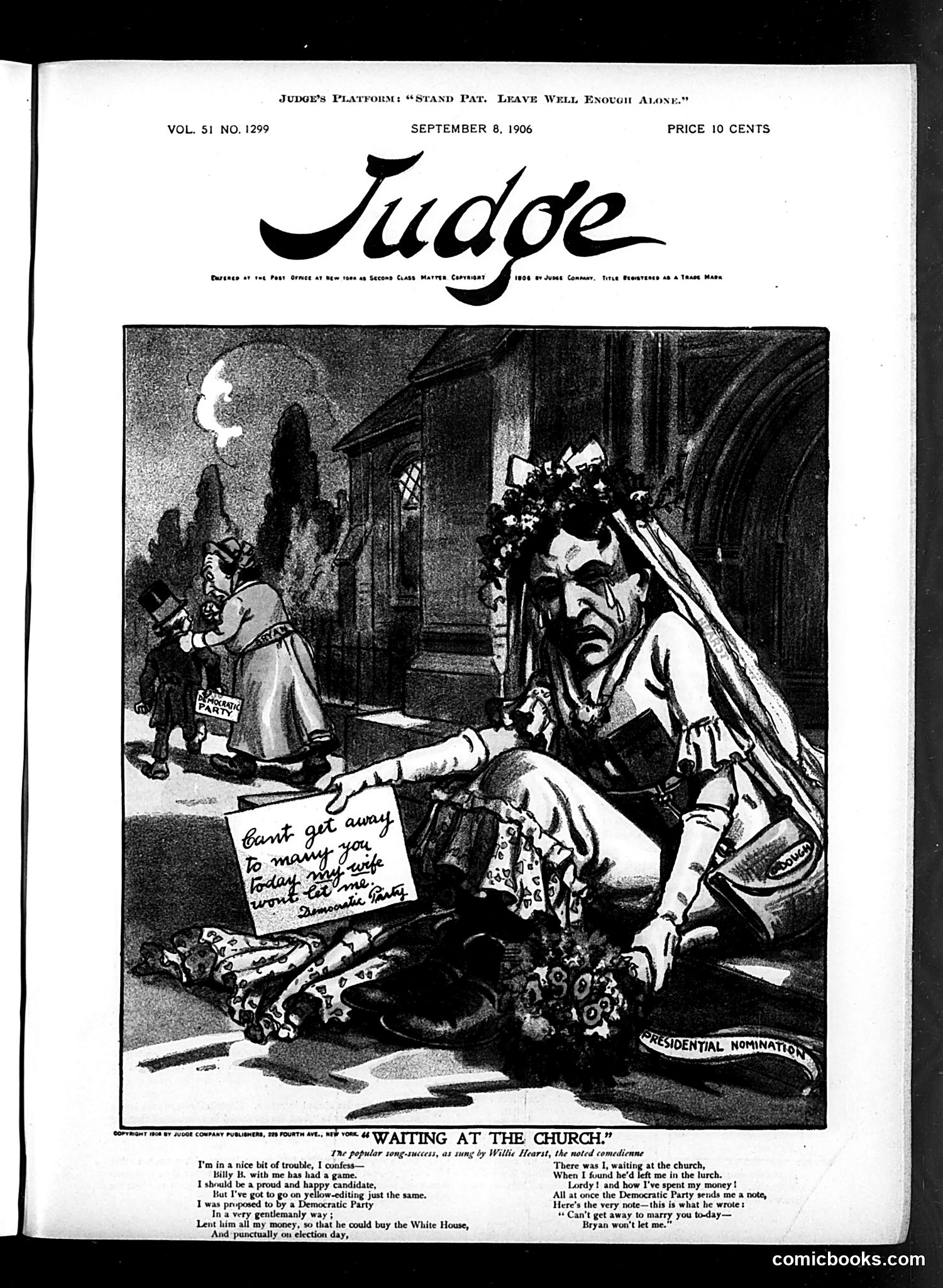
This cartoon satirizes the 1906 presidential nomination process. A bride waits at the church altar, her wedding dress labeled "Presidential Nomination." The groom is absent, represented by a figure labeled "Democratic Party" departing in the background. The satire suggests the Democratic Party faced uncertainty about its presidential candidate—the "groom" hadn't committed to appearing. The song lyrics referenced ("I'm in a nice bit of trouble, I confess...") are from a popular 1906 music hall song about a jilted bride, reinforcing the abandonment theme. This likely references Democratic hesitation over whom to nominate following Theodore Roosevelt's presidency, portraying the party as unreliable or indecisive about its political commitments.
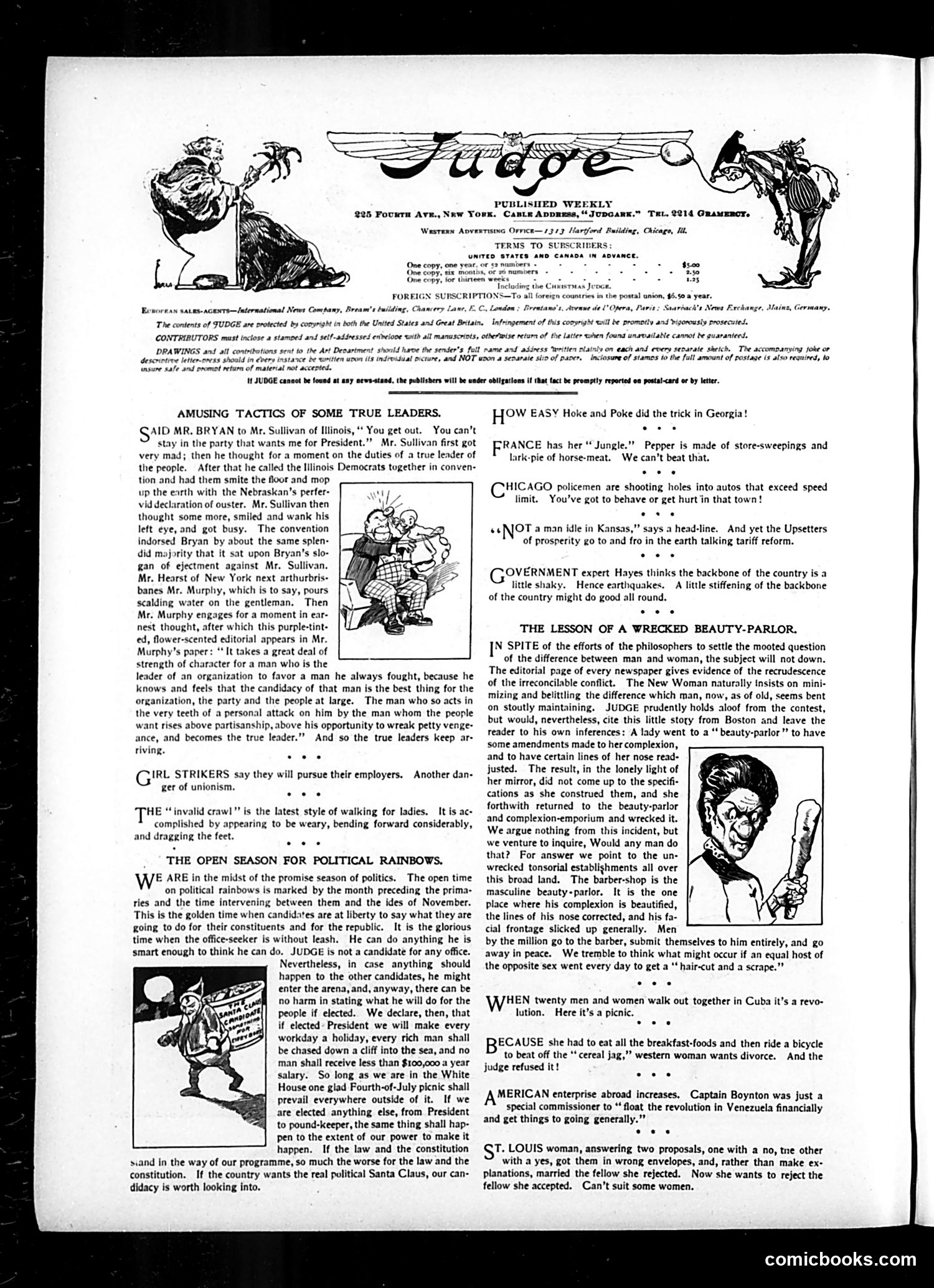
This page from Judge magazine contains several brief political satirical items and jokes rather than large cartoons. The content appears to target: **"Amusing Tactics of Some True Leaders"** - A piece mocking Bryan and Sullivan of Illinois over their contrasting political positions, with accompanying illustration of two figures in conflict. **Various one-liners** satirizing contemporary issues: Chicago police shootings, Kansas tariff reform debates, and government expert Hayes's views on "backbone" (likely Theodore Roosevelt-era politics). **"The Lesson of a Wrecked Beauty-Parlor"** - A longer piece critiquing New Woman philosophy and gender debates, with illustration of a woman at a beauty parlor, arguing that beauty-maintenance represents an unresolved philosophical conflict between genders. The remaining items mock unionism, political promises, and various social behaviors (women strikers, invalid walking styles). Without clearer dates or bylines visible, the specific political context remains somewhat unclear, though the tone suggests early 20th-century American progressive-era debates.
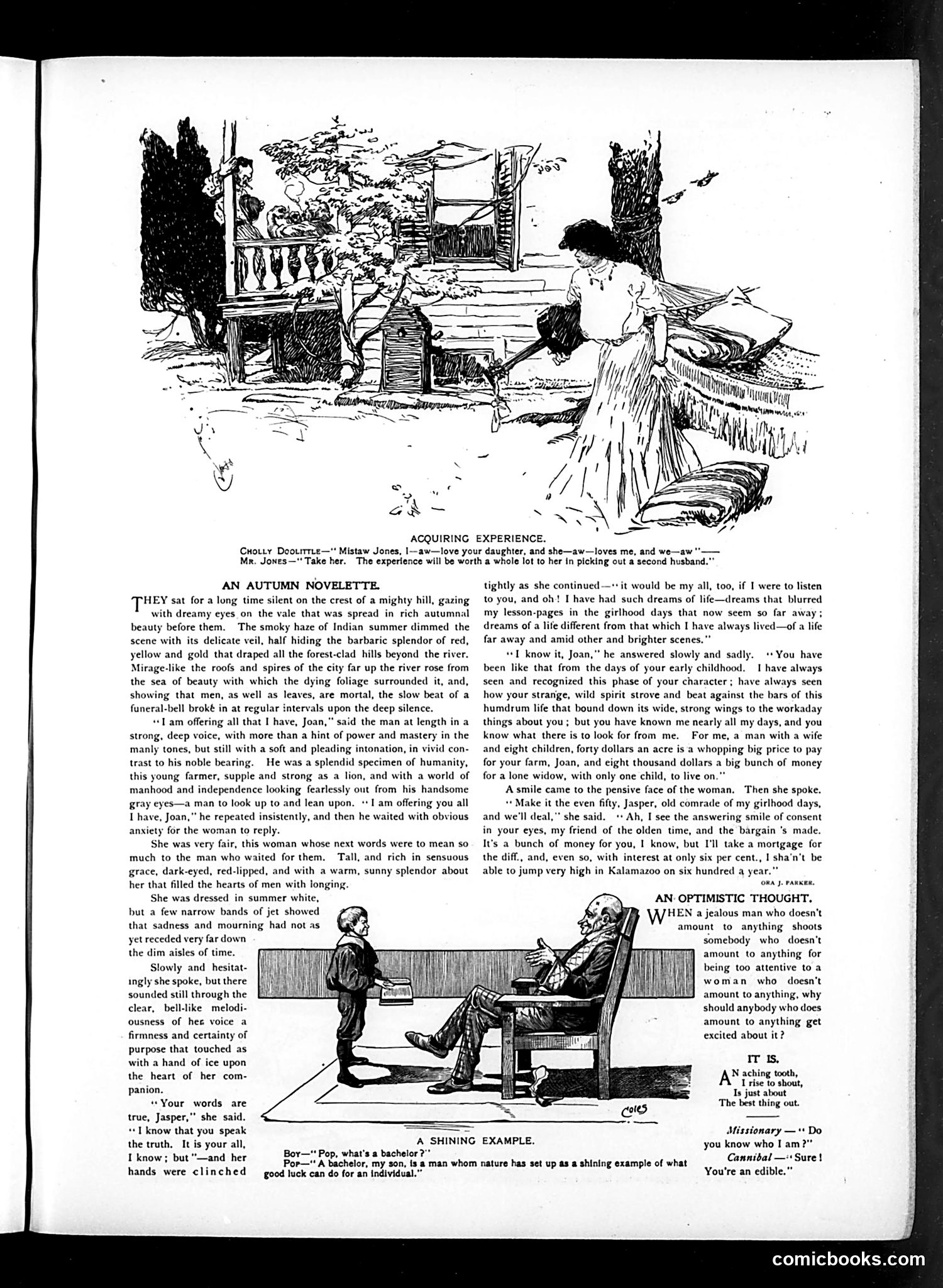
This page contains three distinct pieces of social satire: 1. **"Acquiring Experience"** (top): A comedic sketch about marriage negotiation. Mr. Jones offers his daughter to a suitor, framing marriage as a financial transaction where the man gains "experience" while the woman gets a husband—satirizing how marriages were often arranged as economic deals. 2. **"An Autumn Idylette"** (center): A longer story about a rural romance, mocking sentimental literature and idealized portrayals of country life. 3. **"A Shining Example"** (bottom): A brief joke about bachelorhood, suggesting unmarried men are society's model citizens—ironically praising male independence while critiquing marriage. The cartoons collectively mock marriage customs, gender economics, and literary sentimentality of the era.
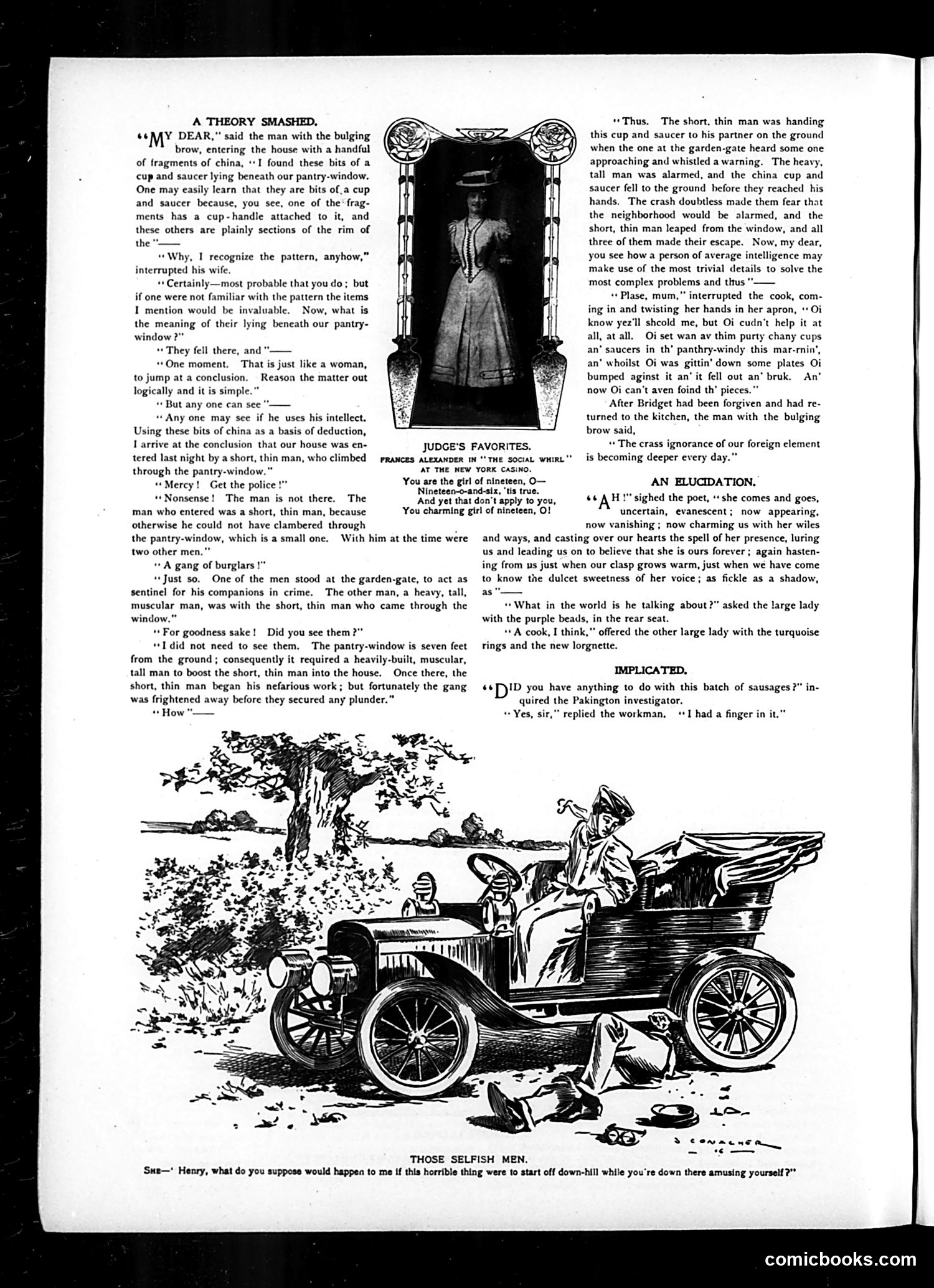
This page contains two separate stories with illustrations: **"A Theory Smashed"** (top) depicts a domestic mystery involving a broken teacup—a woman deduces that a short man entering through a pantry window was the culprit based on the cup's location. The story demonstrates how "a person of average intelligence may make use of the most trivial details to solve the most complex problems." **"Those Selfish Men"** (bottom cartoon) shows a woman confronting a man beside a broken-down automobile. She sarcastically questions why he's amusing himself while she's stranded. The joke critiques men's self-centeredness and lack of responsibility toward their female companions during automobile troubles—reflecting early 20th-century gender tensions around new technology and social obligations. Both pieces target perceived character flaws through humor.
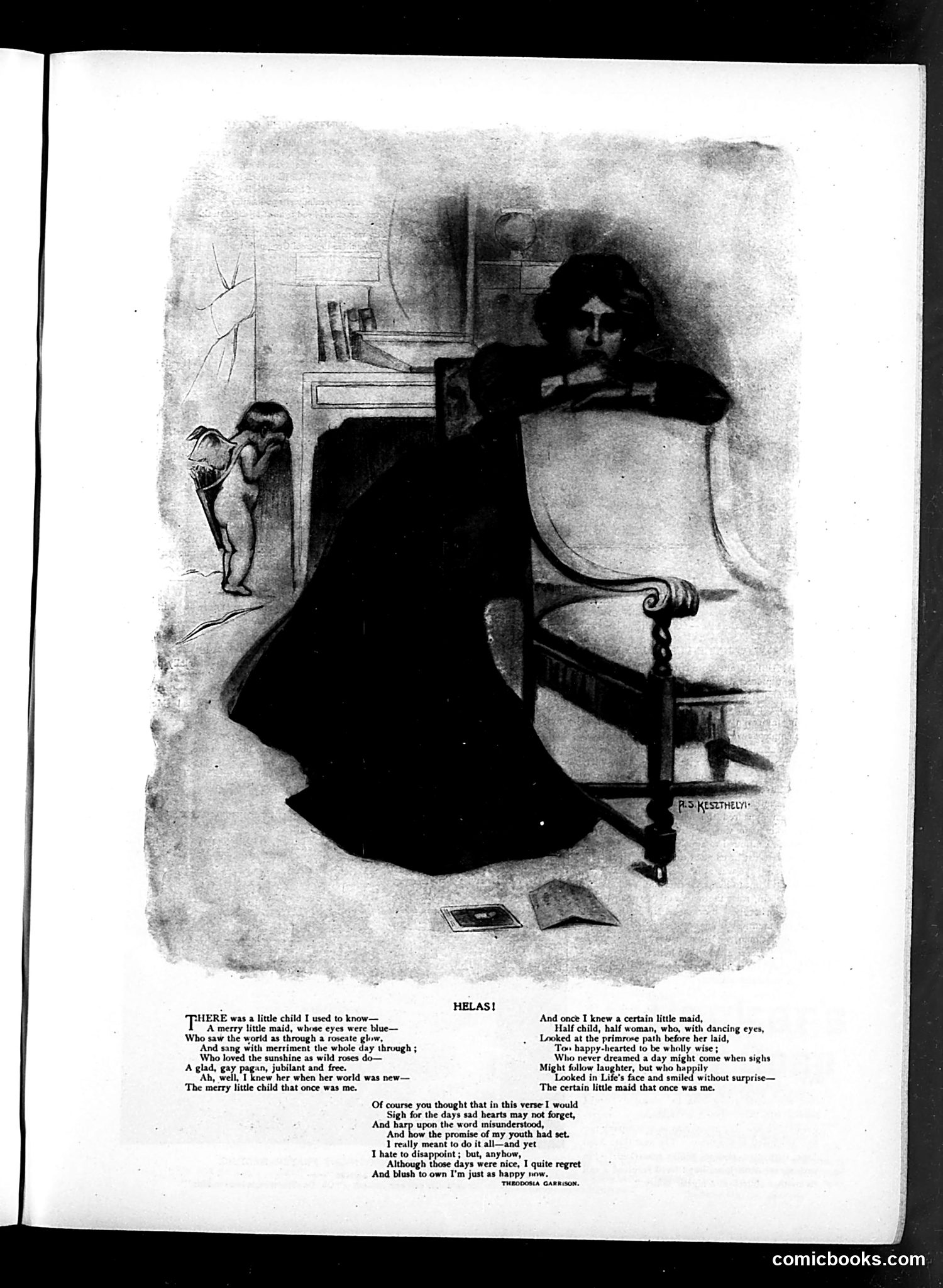
This illustration and poem by R.S. Klatchkin appears to be a sentimental or melancholic piece rather than explicit satire. The silhouetted figure—a woman in dark clothing gazing pensively—dominates the composition. The poem "Helasi" reflects on lost innocence and romantic disappointment. The speaker recalls a carefree childhood and mentions "a certain little maid" who once brought joy but is now associated with broken promises and regret. The final lines express self-reproach about remaining "as happy-hearted" as in youth. Rather than targeting specific political figures or events, this appears to be Judge magazine's offering of romantic or nostalgic verse typical of early 20th-century periodicals—exploring themes of love, loss, and the passage of time through both image and poetry.
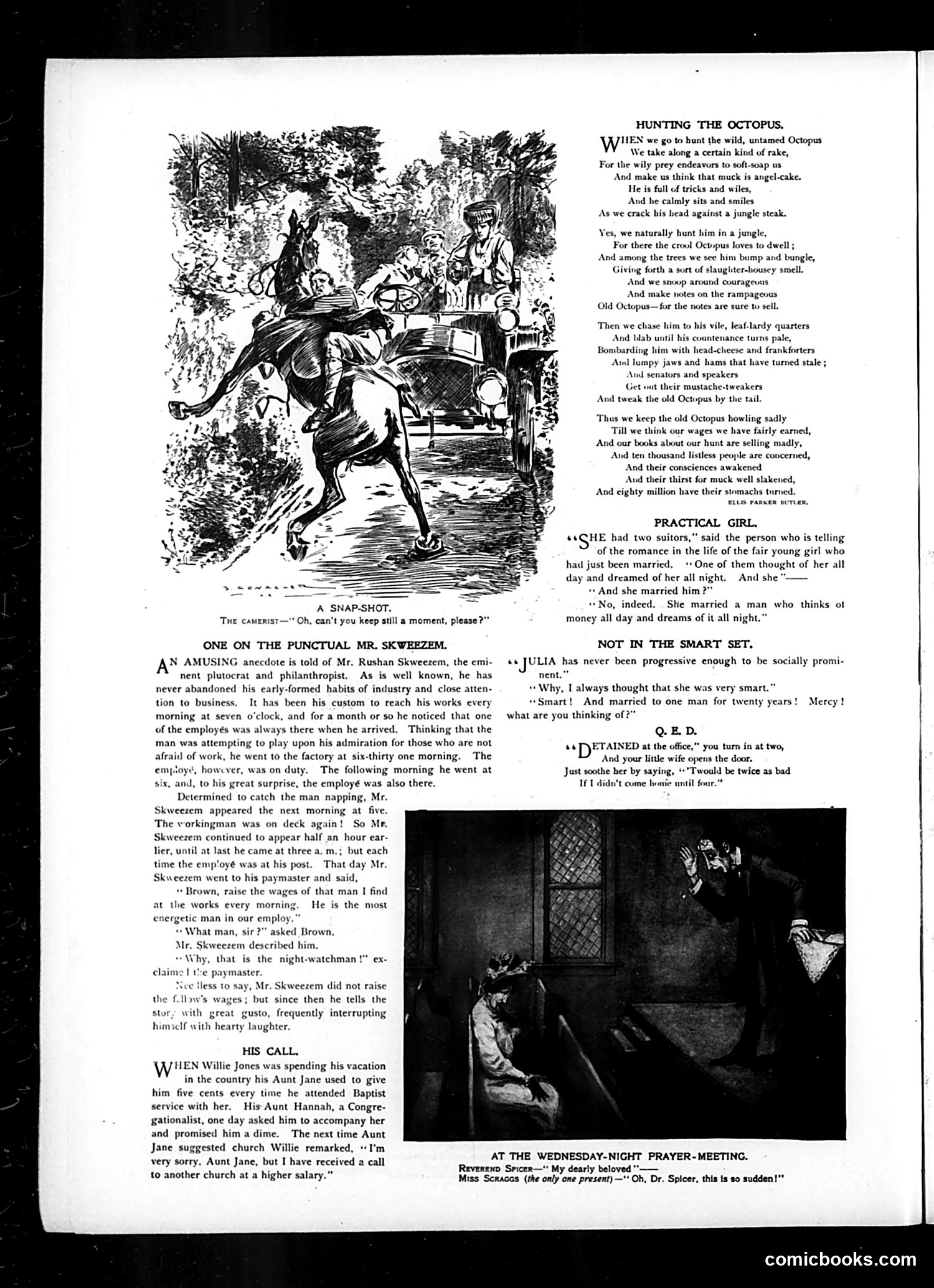
**"Hunting the Octopus"** is a political allegory where the octopus represents a corrupt or duplicitous public figure or institution. The "hunters" (senators, speakers, journalists) pursue it with crude weapons, selling sensational accounts to generate public outrage and book sales. The satire critiques both the subject being hunted and the exploitative media cycle around it—ten thousand "listless people" gain awakened consciences while their "thirst for muck" is satisfied. The remaining content consists of four brief humorous anecdotes: "Practical Girl" jokes about mercenary marriage; "A Snap-Shot" is a photographer's quip; "One on the Punctual Mr. Skweezem" features a wealthy man unable to catch his night-watchman napping; and "Not in the Smart Set" mocks a woman's two-decade marriage as evidence of unsophistication. These are typical Judge humor pieces targeting middle-class pretension and social anxieties.
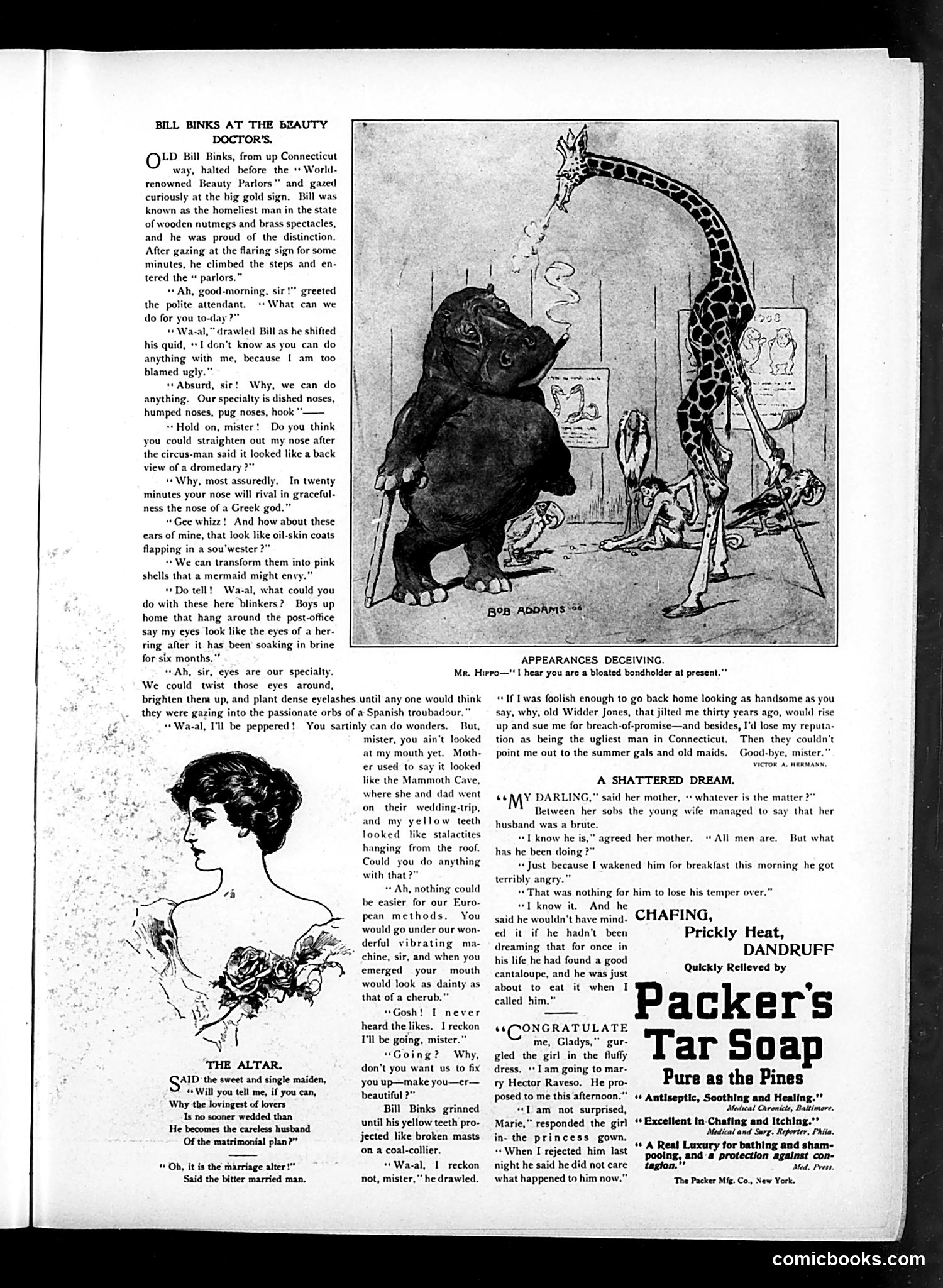
This page contains three humorous satirical pieces typical of early 20th-century Judge magazine: **"Bill Binks at the Beauty Doctor's"** (main cartoon): A rustic Connecticut man ("Bill Binks") visits a beauty parlor. The satire mocks both the emerging cosmetic surgery industry and rural attitudes toward vanity. Bill's self-deprecating humor about his ugliness—his dromedary nose, oil-skin ears, and stalactite teeth—contrasts with the beauty doctor's confident promises to transform him. The joke's punch: Bill refuses treatment because being "the ugliest man in Connecticut" is his *distinction*. It satirizes rural pride and also the dubious claims of beauty "specialists." **"The Altar"** (short verse): A bitter joke about marriage, where the "altar" becomes a pun on "alter"—suggesting marriage alters a loving husband into a careless one. **"A Shattered Dream"**: A husband grows angry when his wife wakes him during a dream about eating cantaloupe—satirizing male selfishness and marital discord. The page also contains a Packer's Tar Soap advertisement.
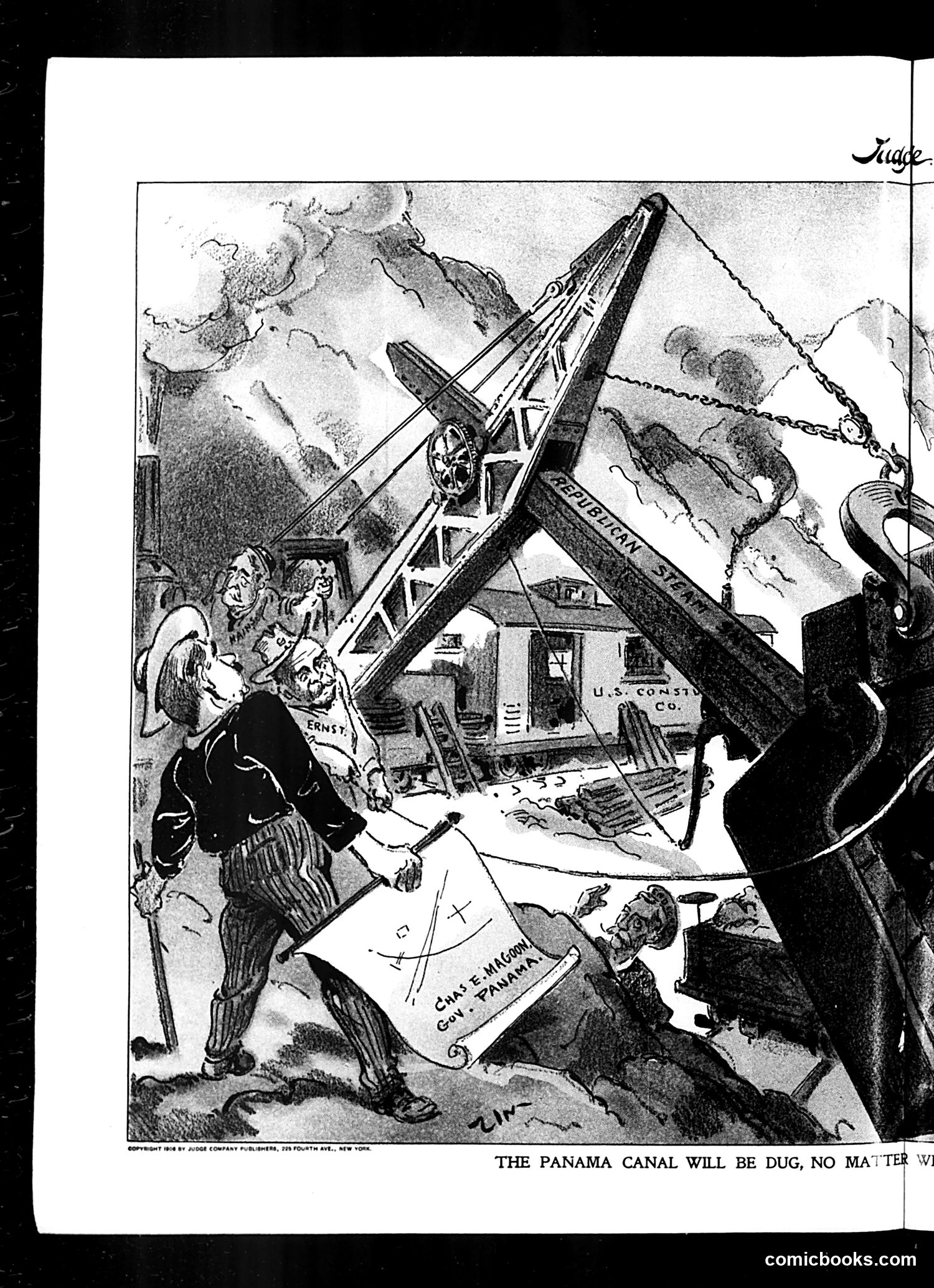
This satirical cartoon depicts the determination to build the Panama Canal despite obstacles. The incomplete caption reads "The Panama Canal will be dug, no matter..." suggesting unstoppable resolve. The image shows figures representing American interests (marked "U.S. Const. Co." on a building) operating heavy machinery in mountainous terrain. What appears to be a government official holds a document labeled "Gov. Panama Franchise," indicating U.S. negotiations for canal rights. The cartoon satirizes American determination to construct the canal regardless of challenges—whether natural (mountains), political (Panama's sovereignty), or practical. This reflects early 20th-century American expansionism and confidence in accomplishing the ambitious engineering project, which began in 1907 and opened in 1914.
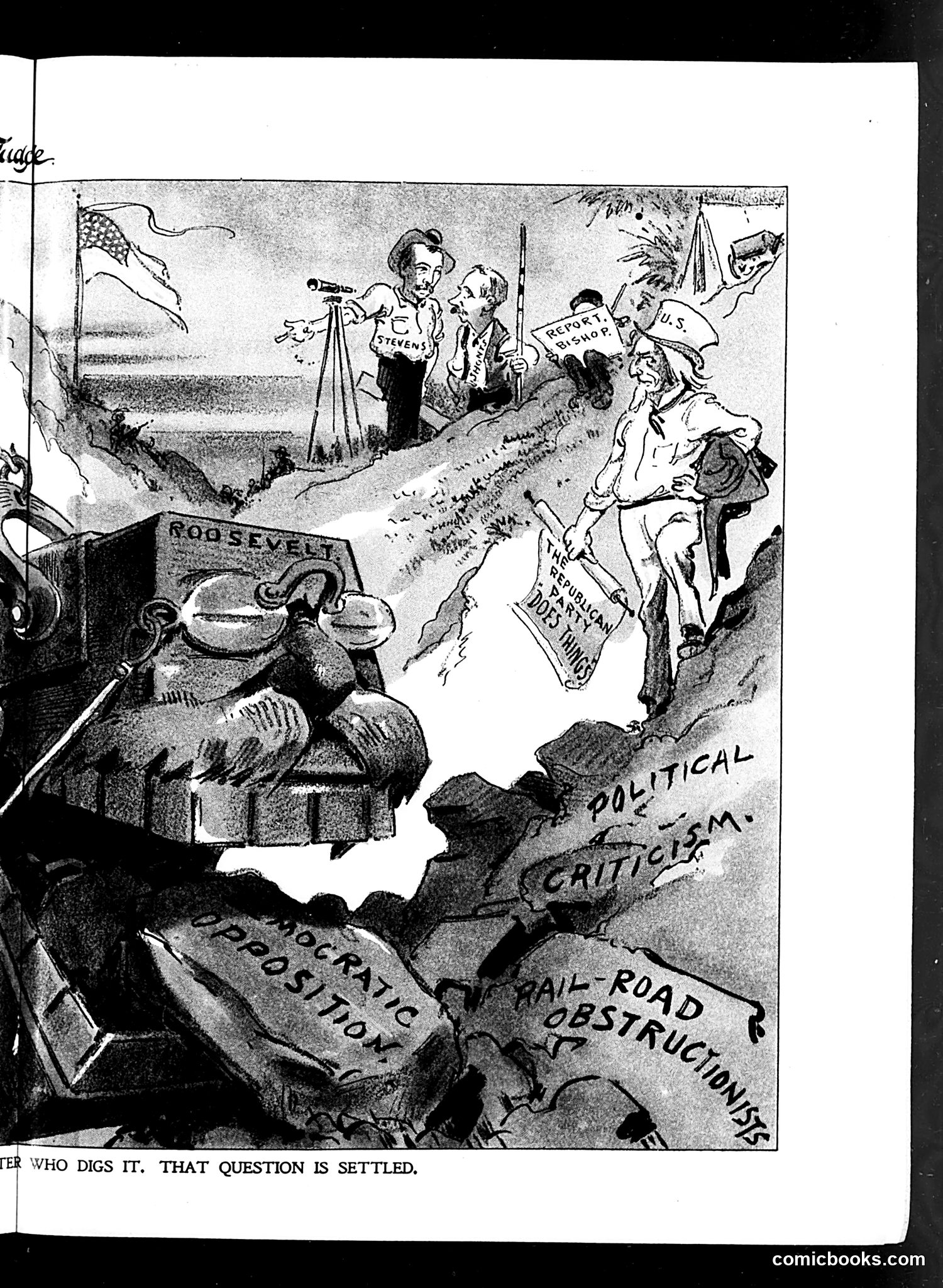
This Judge magazine cartoon satirizes early Theodore Roosevelt administration obstacles. The map of the United States shows various impediments labeled "Political Criticism," "Rail-Road Obstruction," and "Democratic Opposition." Roosevelt (identifiable by the characteristic hat and "Stevens" label on a figure) stands at a surveying instrument with assistants, apparently trying to map or navigate the nation while facing these obstacles. The cartoon suggests Roosevelt's ambitious agenda—likely infrastructure or progressive reforms—encounters resistance from multiple directions: political critics, railroad interests, and the Democratic party. The caption "He Who Digs It, That Question Is Settled" appears to reference Roosevelt's determination to proceed despite opposition. The cartoon's tone suggests skepticism about whether Roosevelt can accomplish his goals amid these competing interests.
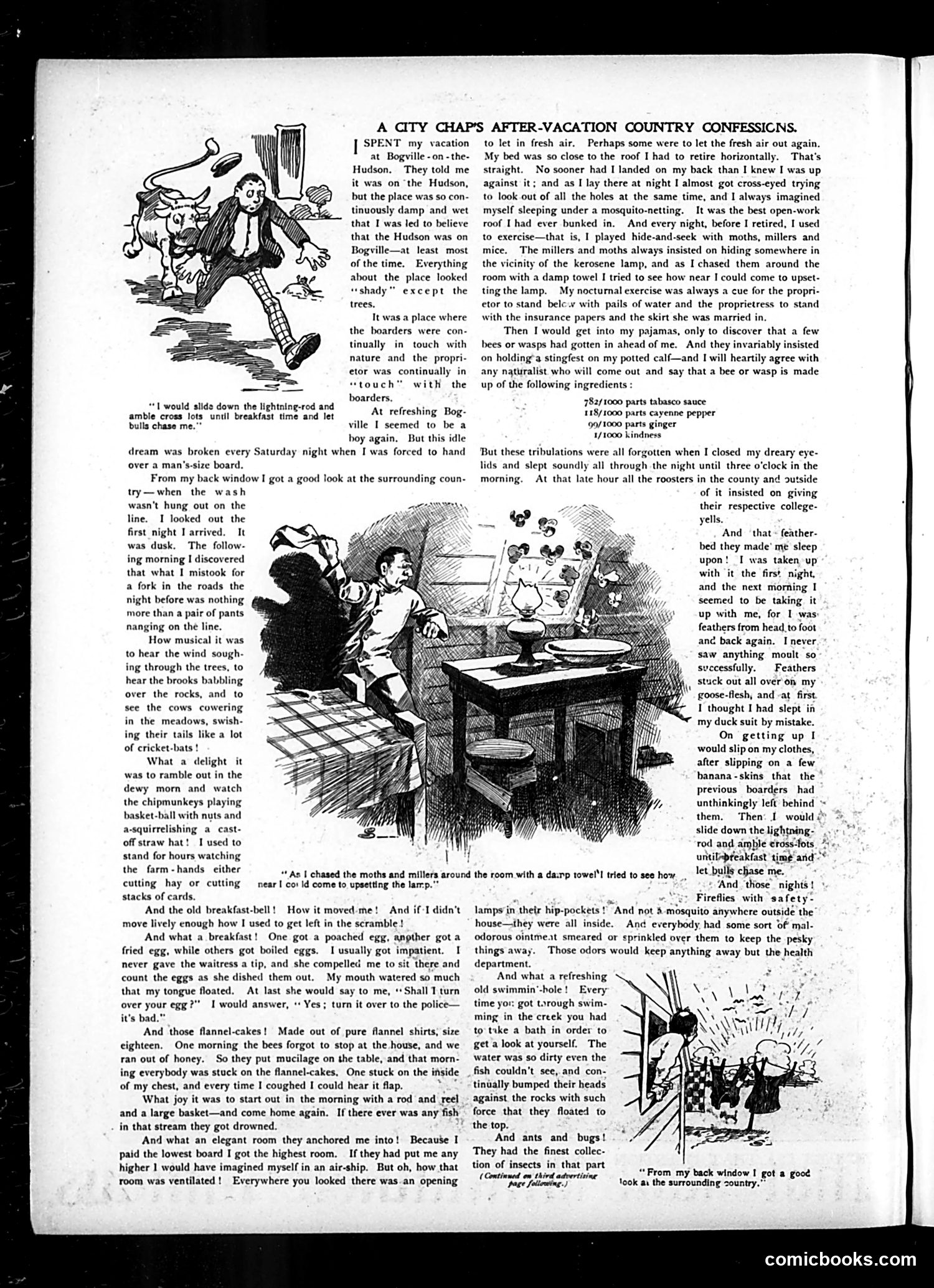
This is a humorous first-person account satirizing the gap between city dwellers' romantic notions of rural vacations and harsh reality. The narrator—a "city chap"—describes his stay at "Bogville-on-the-Hudson," a boarding house that fails to deliver the advertised pastoral experience. The satire targets: - **False advertising**: The location is perpetually damp despite being billed as desirable - **Budget accommodations**: He paid the lowest board rate and received the highest, most poorly ventilated room - **Rustic meal quality**: Breakfast eggs are unpredictable; flannel cakes are literally made from flannel; honey is replaced with mucilage - **Urban discomfort in nature**: Instead of peaceful countryside sounds, he encounters annoying insects; fishing yields only drowned fish The accompanying illustrations reinforce the comedic contrast between what he anticipated (pastoral idyll) and what he experienced (squalid, uncomfortable conditions). The humor relies on exaggeration and wordplay typical of early 20th-century American comic writing.
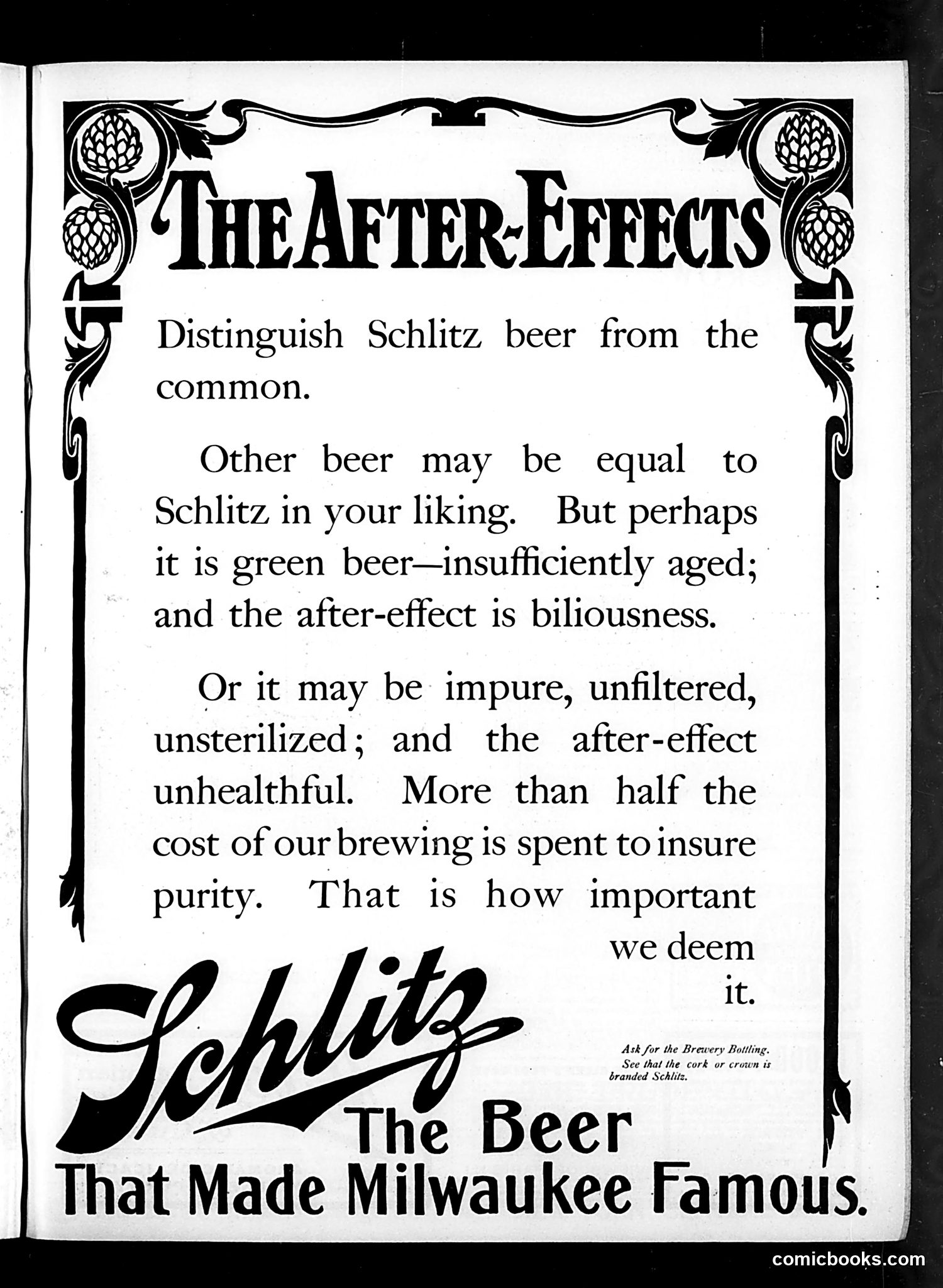
This is a **full-page advertisement**, not satire or political content. It's a vintage Schlitz brewery ad emphasizing the beer's superiority through purity claims. The ad distinguishes Schlitz from competitors by highlighting manufacturing quality: other beers are dismissed as either "green" (insufficiently aged, causing digestive upset) or impure and unsterilized (unhealthy). Schlitz boasts that over half its brewing costs go toward ensuring purity—a major selling point for early 20th-century consumers concerned about food safety and adulteration. The decorative hop vine border and prominent "Schlitz" signature reinforce brand prestige. A small note instructs buyers to verify authenticity via brewery branding on the cork or crown cap, suggesting counterfeiting concerns. This reflects the era's competitive beer market and growing consumer consciousness about product quality and safety.
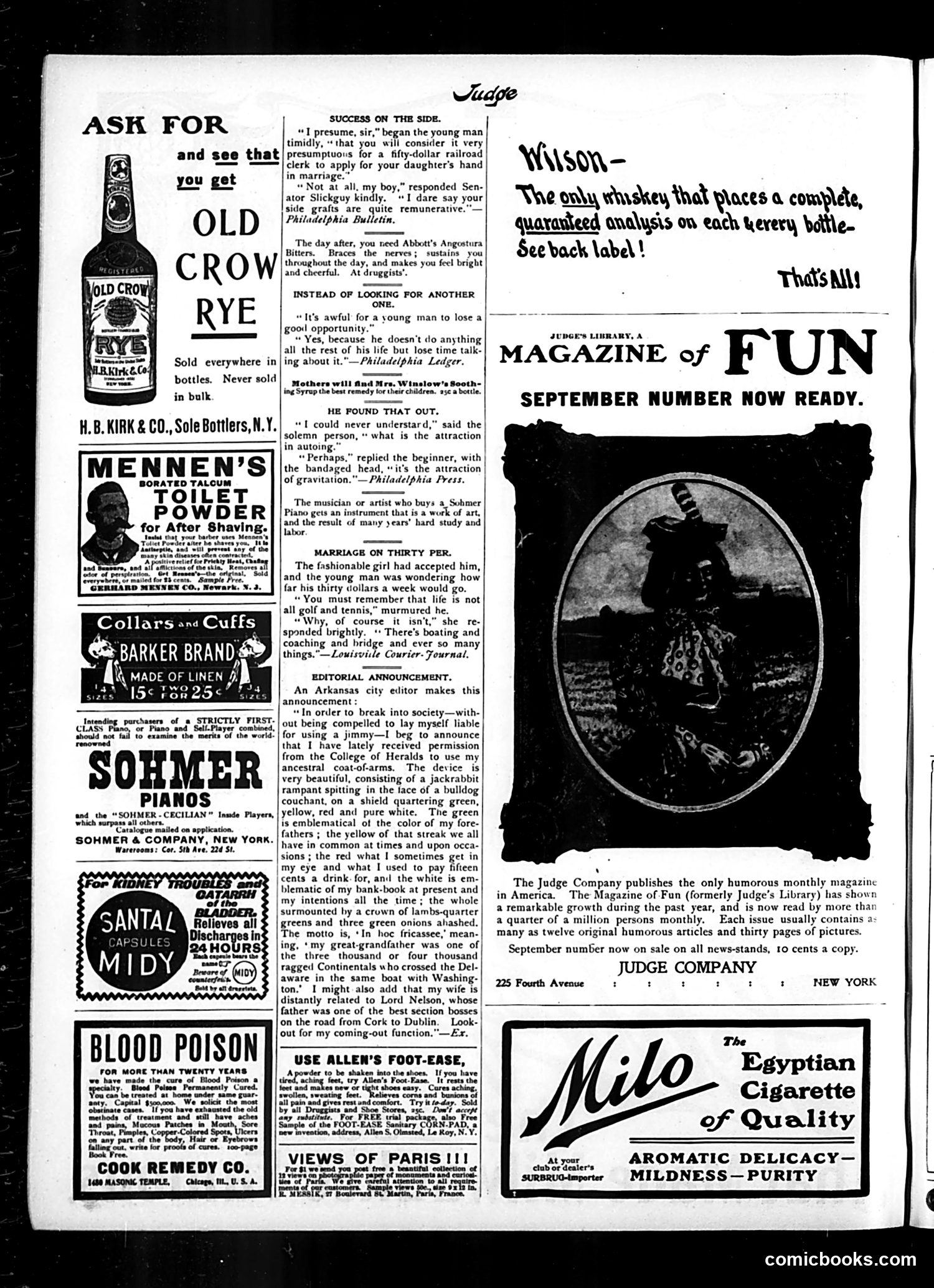
This is primarily an **advertising page** from Judge magazine with a few scattered joke items. The main content consists of commercial advertisements for products like Old Crow Rye whiskey, Mennen's talcum powder, piano manufacturers, and patent medicine remedies (notably a "Blood Poison" cure). The few satirical pieces are brief topical jokes: - A joke about a railroad clerk seeking marriage, with a senator cynically noting that "side grafts are quite remunerative"—a reference to **railroad corruption and bribery**, common scandals of the era. - An Arkansas newspaper editor's humorous "coat of arms" announcement, satirizing **social climbing** through false genealogy claims and pretentious heraldry. These jokes reflect Judge's typical focus on **urban corruption, social pretension, and matrimonial mercenary motives**—standard satirical targets of early 20th-century American humor magazines. The page otherwise demonstrates the magazine's heavy reliance on advertising revenue.
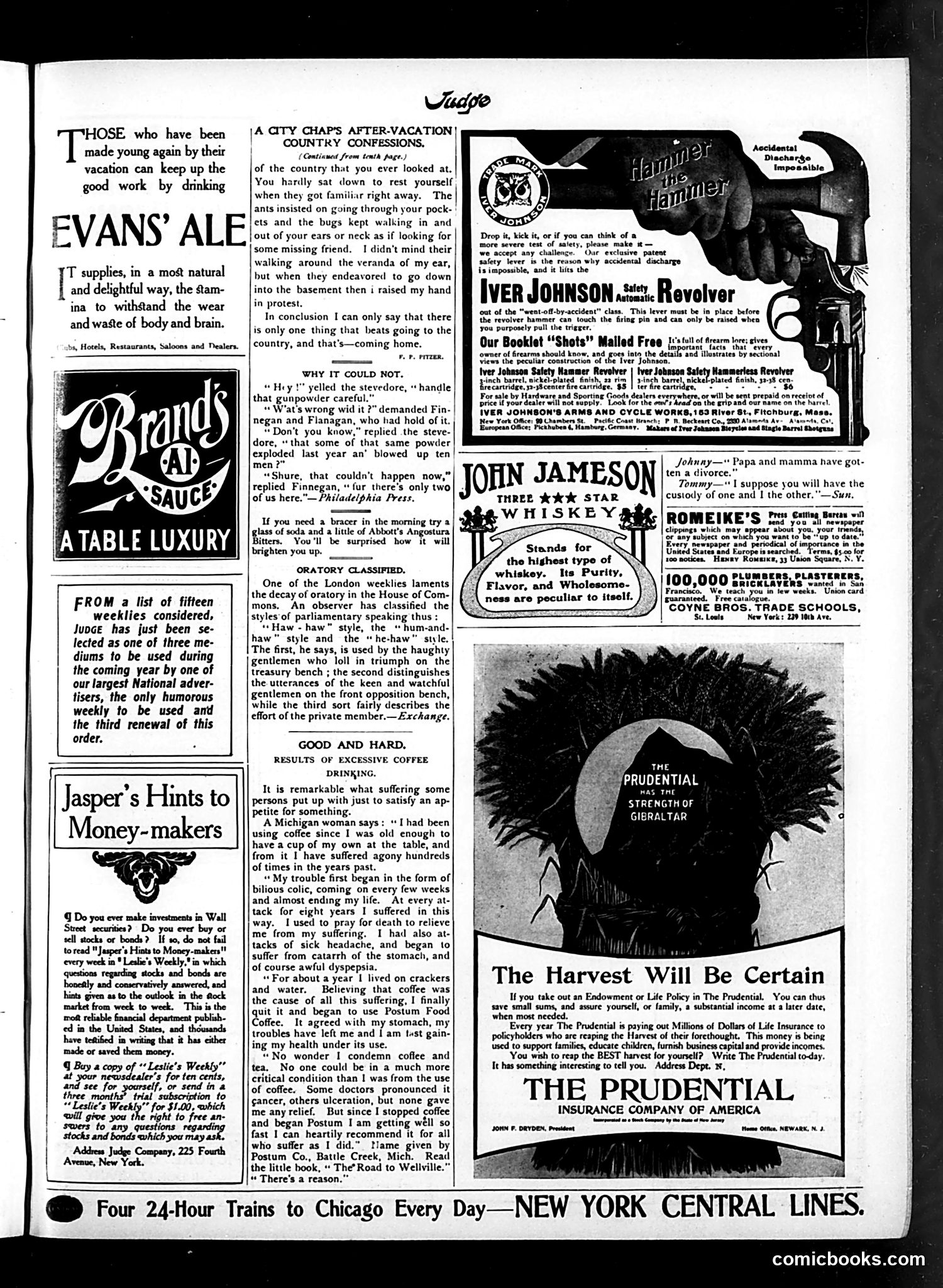
This page is primarily **advertising**, with only minor satirical content. The main pieces are: **"City Chaps After-Vacation Country Confessions"** — A humorous complaint about rural insects (ants, bugs) invading a visitor's body during a country vacation, concluding that returning home beats the countryside. **"Why It Could Not"** — A brief joke playing on logic: Irish laborers Finnegan and Flanagan handle gunpowder carelessly. When warned it previously killed ten men, they reason it's safe now because there are only two of them. **"Oratory Classified"** — A satirical observation about British Parliament, categorizing speakers by their vocal styles ("haw-haw," "hum-and-haw," "he-haw"), mocking different politicians' delivery mannerisms. The page is otherwise dominated by advertisements for Evans' Ale, Brand's Sauce, John Jameson Whiskey, Iver Johnson Revolvers, and other products, plus promotional content for Judge and Leslie's Weekly magazines themselves.
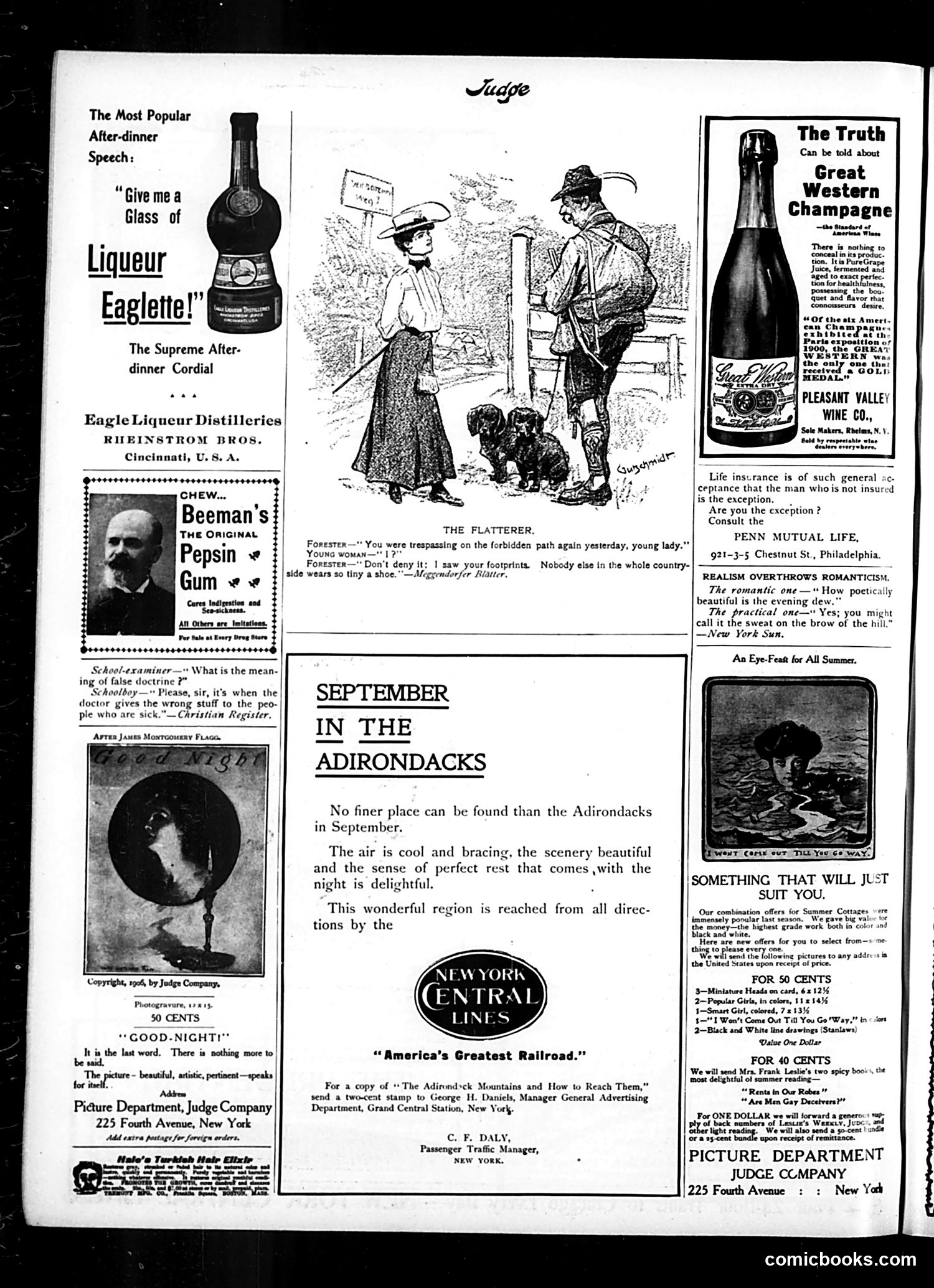
This page from Judge magazine (circa 1906) is primarily **advertising with one cartoon**. The main content is commercial pitches for liqueurs, gum, wine, life insurance, and railroad travel. The notable cartoon is **"The Flatterer,"** depicting a forest ranger complimenting a young woman's tiny feet while catching her trespassing. The joke is ironic: the ranger pretends to scold her for breaking rules but actually flatters her appearance, revealing his romantic interest beneath his authority. This satirizes how men use false reprimands as pretexts for flirtation—a commentary on courtship conventions of the era. The page also includes a school joke mocking doctors who give wrong remedies and a brief piece on "Realism Overthrows Romanticism," contrasting poetic sentiment with practical observation. The bulk of the page consists of period advertisements for consumer goods and services, reflecting Judge's primary revenue model.
This is primarily an **advertising announcement**, not a satirical cartoon page. Judge magazine is celebrating its "Silver Anniversary"—25 years in publication (1881–1906)—by issuing a special double issue combining their Silver Anniversary number with their regular annual "Hotel and Club" number. The text emphasizes Judge's prominence as "America's Best Humorous Cartoon Weekly" and a pioneer in cartoon journalism. The publishers claim the magazine is "more prosperous than at any time since its foundation" and "recognized the world over" as the leading American humorous weekly. The announcement solicits advertisements for this commemorative issue, positioning it as a collectible that "will be kept for many years." Contact information for the advertising manager (B.C. Everinghim) and regional representative is provided at the bottom. The decorative ornamental border and formal typography reflect early 20th-century publication aesthetics.
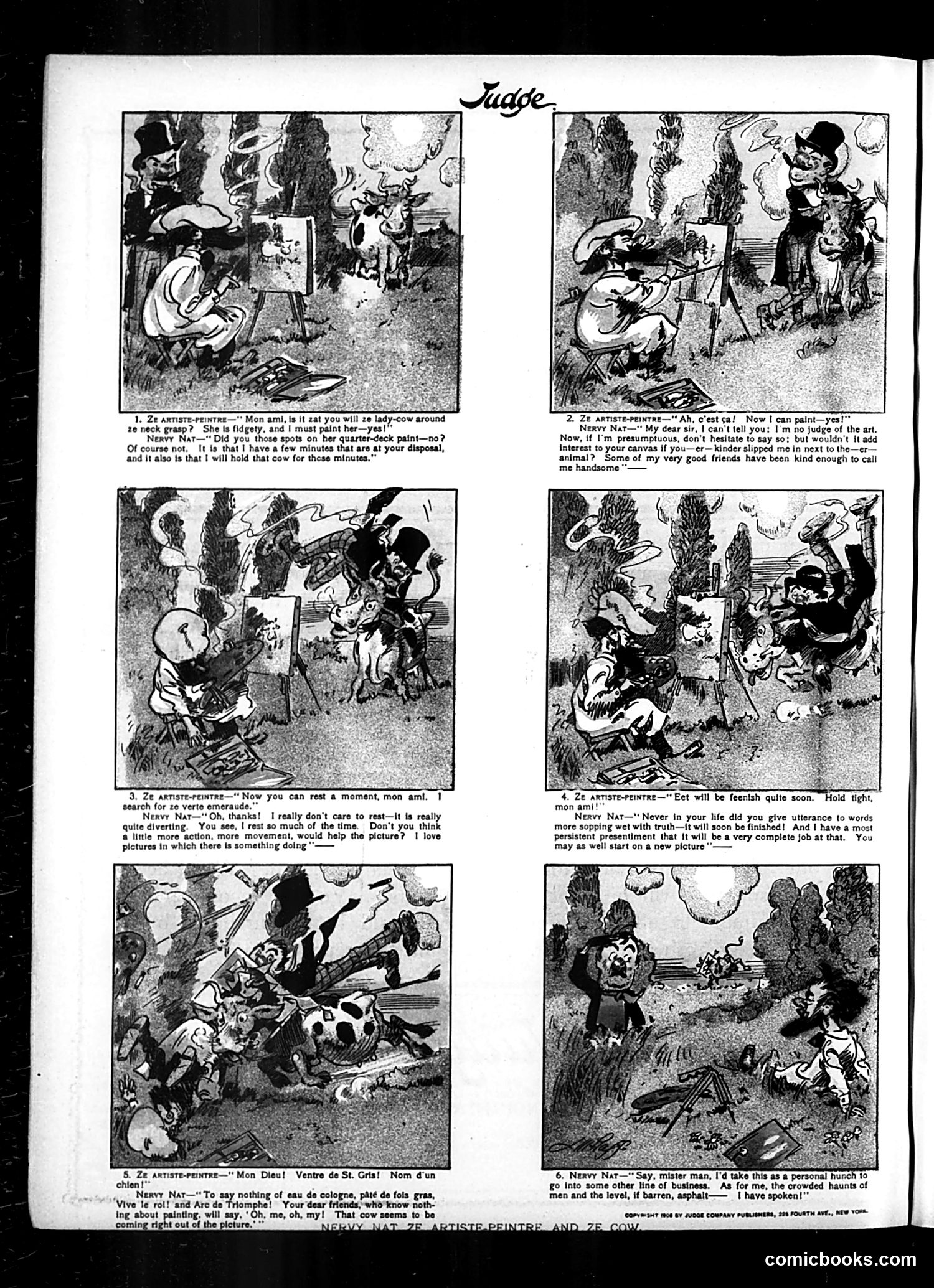
This is a humorous six-panel comic strip about "Nervy Nat," a persistent character who inserts himself into a French artist's portrait-painting session. The artist (identified by French phrases like "Ze artiste-peintre") is attempting to paint a cow, but Nat keeps offering unsolicited advice and suggestions—requesting the artist add him to the canvas, commenting on the composition, and generally disrupting the work while claiming he's "helping." The satire targets two things: American tourists' tendency to intrude with confidence despite lacking expertise, and the pretentiousness of artistic circles. Nat speaks in exaggerated French phrases while giving philistine suggestions ("eau de cologne, pâté de foie gras"). The joke culminates when the frustrated artist finally finishes and Nat—perhaps sensing he's worn out his welcome—abruptly declares he'll "go into some other line of business" and depart to the "asphalt." The humor relies on Nat's oblivious persistence and the artist's increasingly exasperated reactions.