
A complete issue · 16 pages · 1906
Judge — August 18, 1906
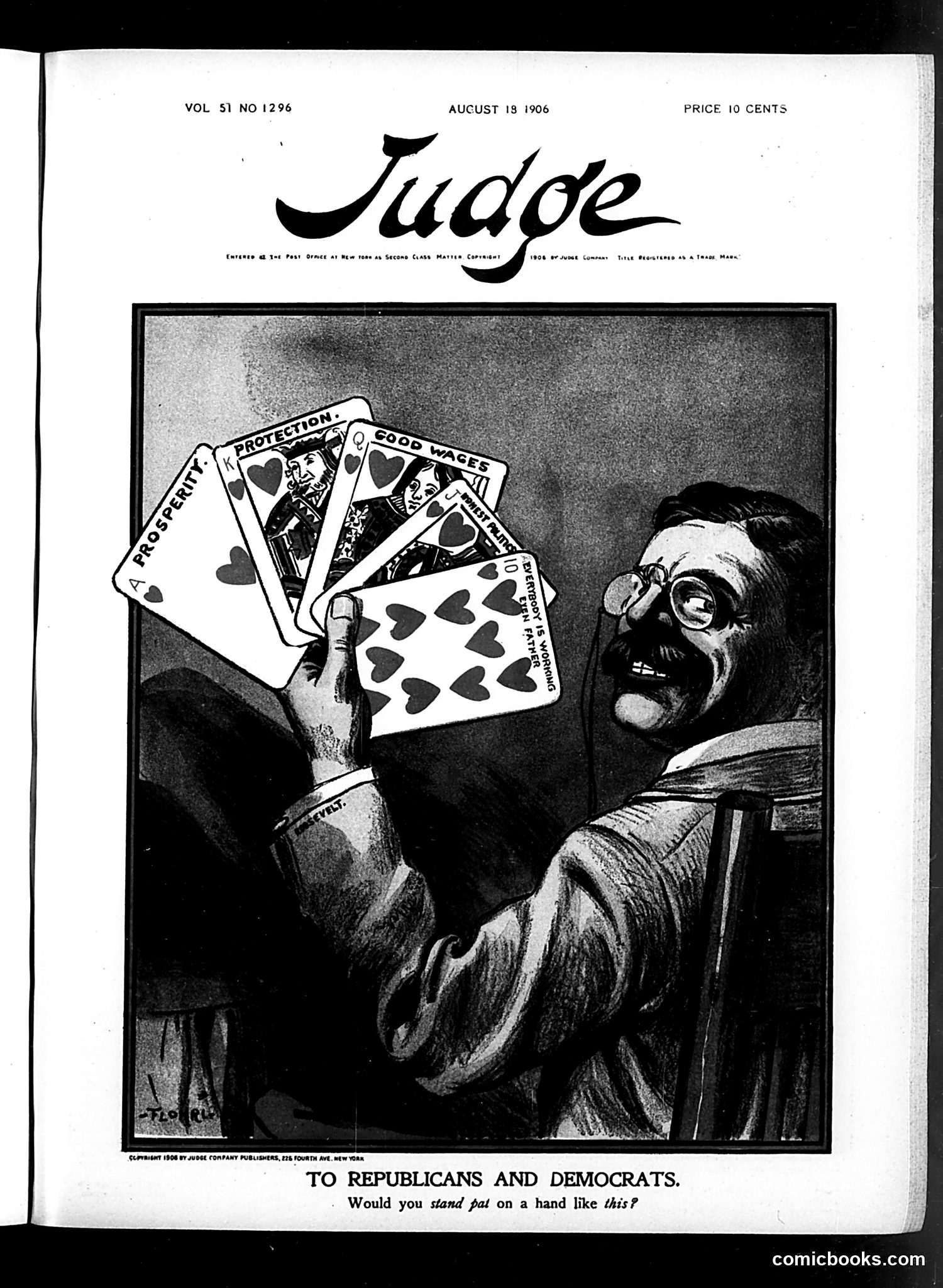
This political cartoon addresses Republicans and Democrats before the 1906 midterm elections. A caricatured man with exaggerated features holds a fanned hand of playing cards labeled with policy positions: "Protection," "Good Wages," and others (text partially illegible). The cards appear marked or rigged—suggesting political deception. The caption "Would you stand pat on a hand like this?" references President Theodore Roosevelt's policies and the phrase "stand pat" (accepting the current situation). The implication is that both major parties are dealing from a stacked deck, asking voters whether they'd accept the current political hand being offered. This reflects 1906 concerns about political corruption, monopolies, and whether either party genuinely served working people's interests.
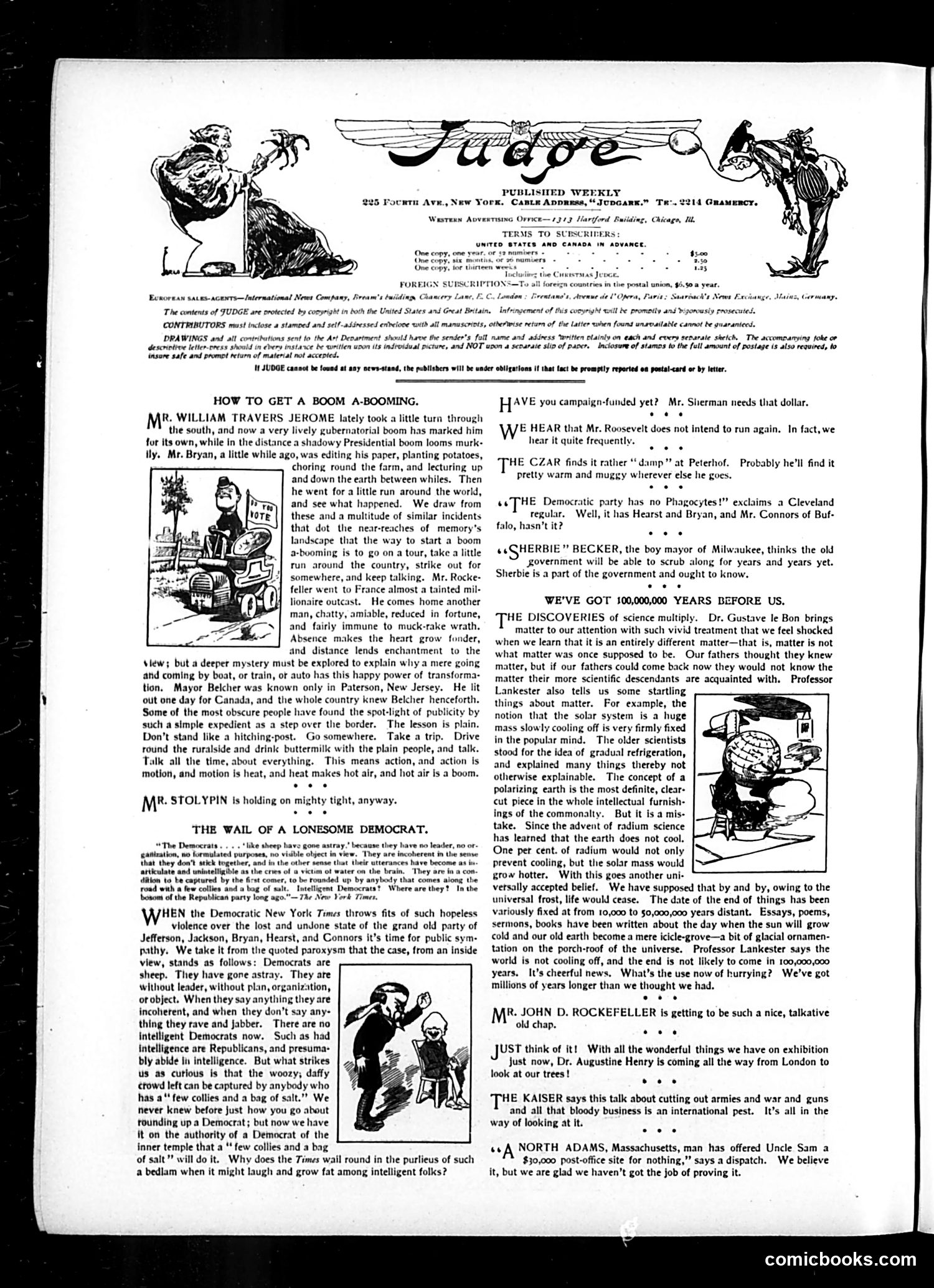
This page contains satirical commentary on early 20th-century American politics and society, rather than a single unified cartoon. **"How to Get a Boom A-Booming"** mocks Republican efforts to stimulate economic growth, suggesting that merely traveling and talking won't create genuine prosperity—you need real action. **"The Wail of a Lonesome Democrat"** ridicules the Democratic Party as disorganized and ineffectual, portraying Democrats as argumentative idealists who lack practical leadership and cohesion, unable to mount effective political opposition. The remaining items are brief satirical notes about contemporary figures and events (Roosevelt, the Czar, Rockefeller, Kaiser Wilhelm), using humor to comment on current affairs. The page functions as a political humor publication targeting educated readers familiar with ongoing news and public figures.
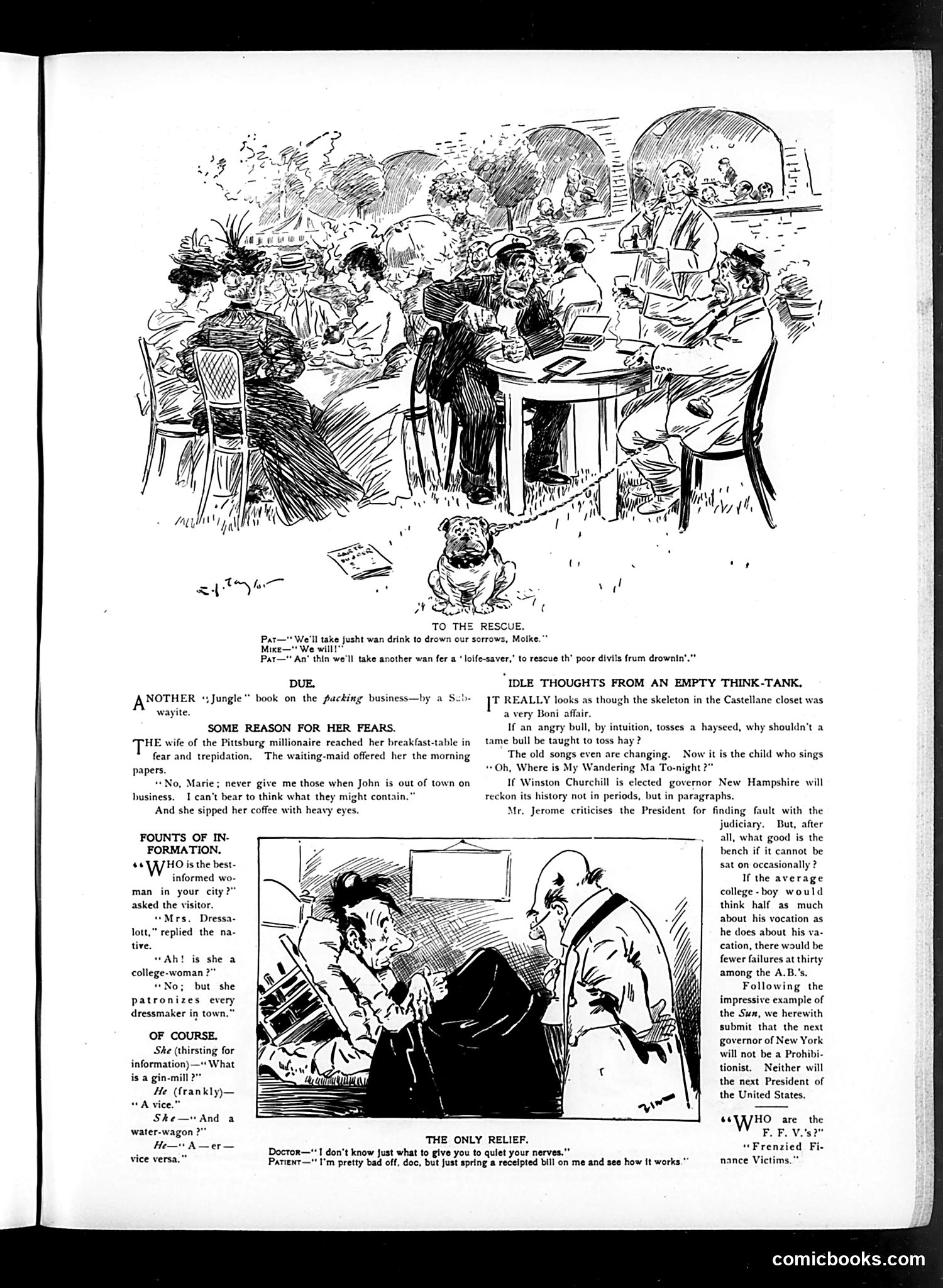
This page contains several satirical pieces targeting early 20th-century American politics and society: **"To the Rescue"** (top cartoon): A social gathering where characters discuss drinking alcohol as emotional relief, likely satirizing contemporary drinking habits and prohibition debates. **"Due"** and related pieces: Multiple short comedic commentaries on various topics, including references to Winston Churchill's election as New Hampshire governor and criticism of President Theodore Roosevelt's judicial appointments. **"The Only Relief"** (bottom cartoon): A doctor-patient exchange where the physician prescribes a bill to cure the patient's nerves—satirizing medical practices and possibly economic/financial anxieties of the era. The page reflects Judge magazine's typical format: mixing visual satire with brief written commentary on contemporary political figures, social customs, and institutional practices.
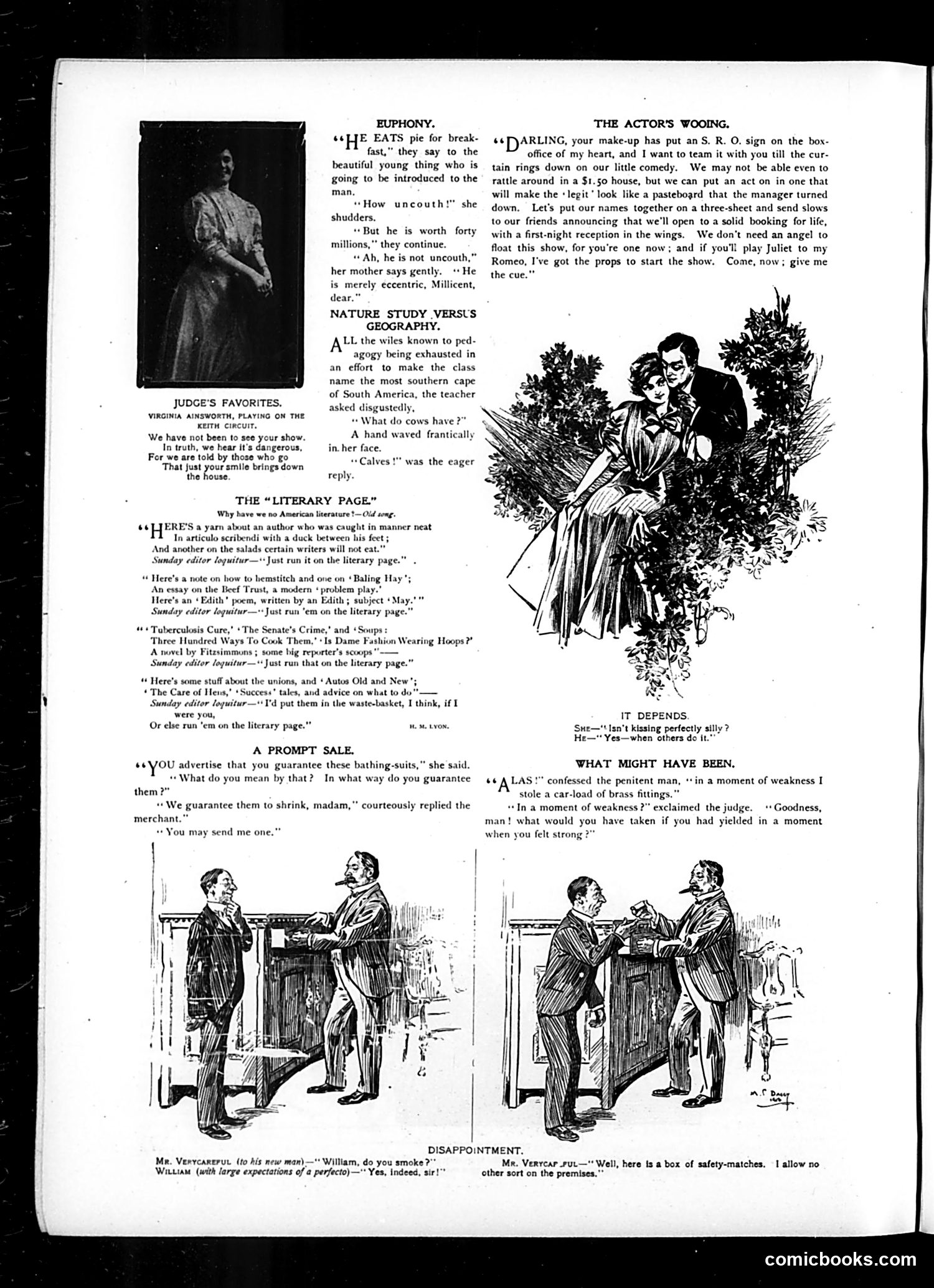
This page contains several brief humorous sketches typical of Judge magazine's satirical format: **"The Actor's Wooing"** features two figures discussing a theatrical production, with jokes about stage props and Romeo and Juliet. **"Judge's Favorites"** credits Virginia Ainsworth for a performance on the Keith Circuit (a major American vaudeville theater chain), praising her as the show's highlight. **"A Prompt Sale"** depicts a merchant guaranteeing bathing-suits won't shrink—a common consumer concern of the era. **"Disappointment"** shows two men discussing safety-matches, with one forbidding their use on his premises. The illustrations are typical Judge-style ink sketches of everyday domestic and commercial situations. The humor relies on wordplay and mundane social interactions rather than political commentary. These appear to be filler content typical of early 20th-century magazines.
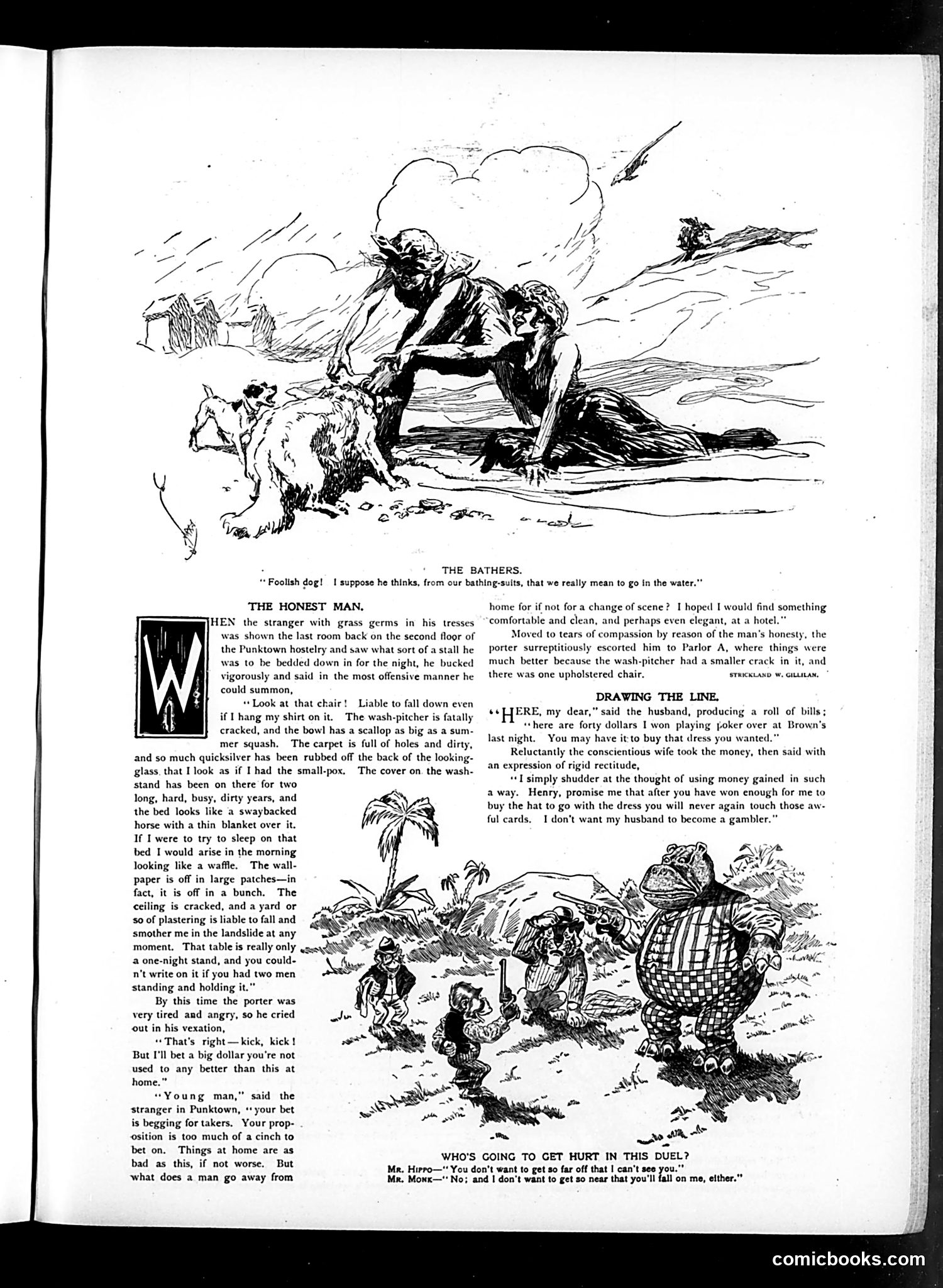
This page contains two satirical stories with illustrations: **"The Bathers"** (top) mocks working-class beach etiquette, showing a man and woman in bathing attire with a dog. The caption "Foolish dog! I suppose he thinks, from our bathing-suits, that we really mean to go in the water" jokes that the couple has no intention of actually swimming—suggesting beach-going was more about social display than recreation. **"The Honest Man"** (bottom) presents a narrative about a vagrant's failed attempt to find respectable lodging. The story critiques both homelessness and hypocrisy: despite claiming respectability, the stranger is rejected by innkeepers. The accompanying cartoon "Who's Going to Get Hurt in This Duel?" depicts two figures refusing to harm each other—likely satirizing the gentleman's code of honor as performative. These stories reflect early 20th-century class anxieties and social pretension.
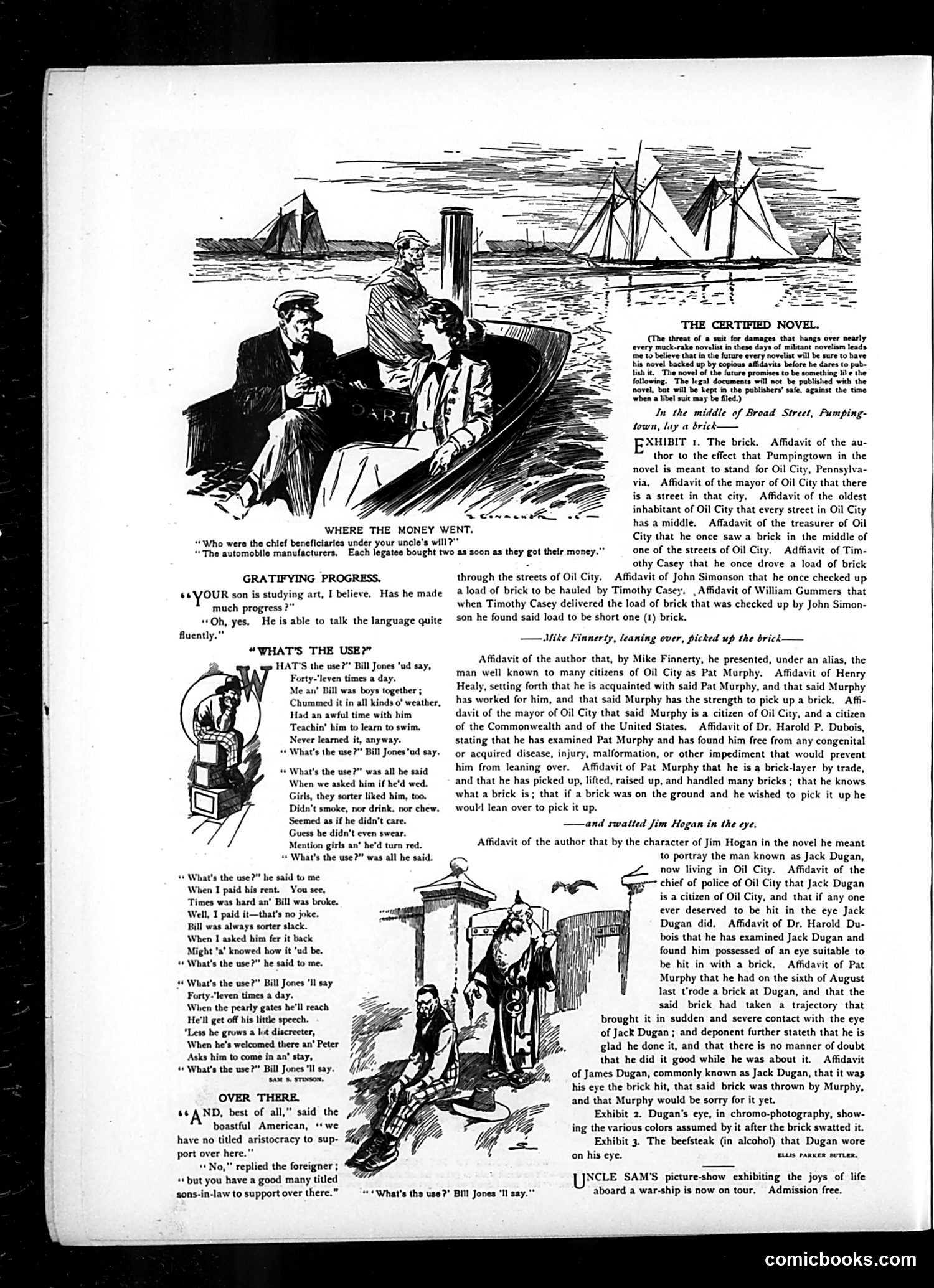
This page contains three separate satirical pieces mocking American social pretensions and legal absurdity: **"Gratifying Progress"** jokes that an art student's only learning is talking pretentiously about art—empty sophistication without substance. **"Over There"** satirizes American bragging about lacking a titled aristocracy. The foreign reply—that Americans instead support "titled sons-in-law"—mocks wealthy Americans marrying European nobility, effectively creating the same aristocratic burden they claim to reject. **"The Certified Novel"** (the lengthy right section) skewers litigation-happy America. It imagines future novels requiring extensive affidavits proving every detail isn't libelous—including absurd documentation that a brick existed in a street. This mocks both frivolous American lawsuits and the emerging culture of defensive litigation affecting publishing. The "Where the Money Went" snippet ridicules automobile-industry wealth and nouveau-riche spending habits.
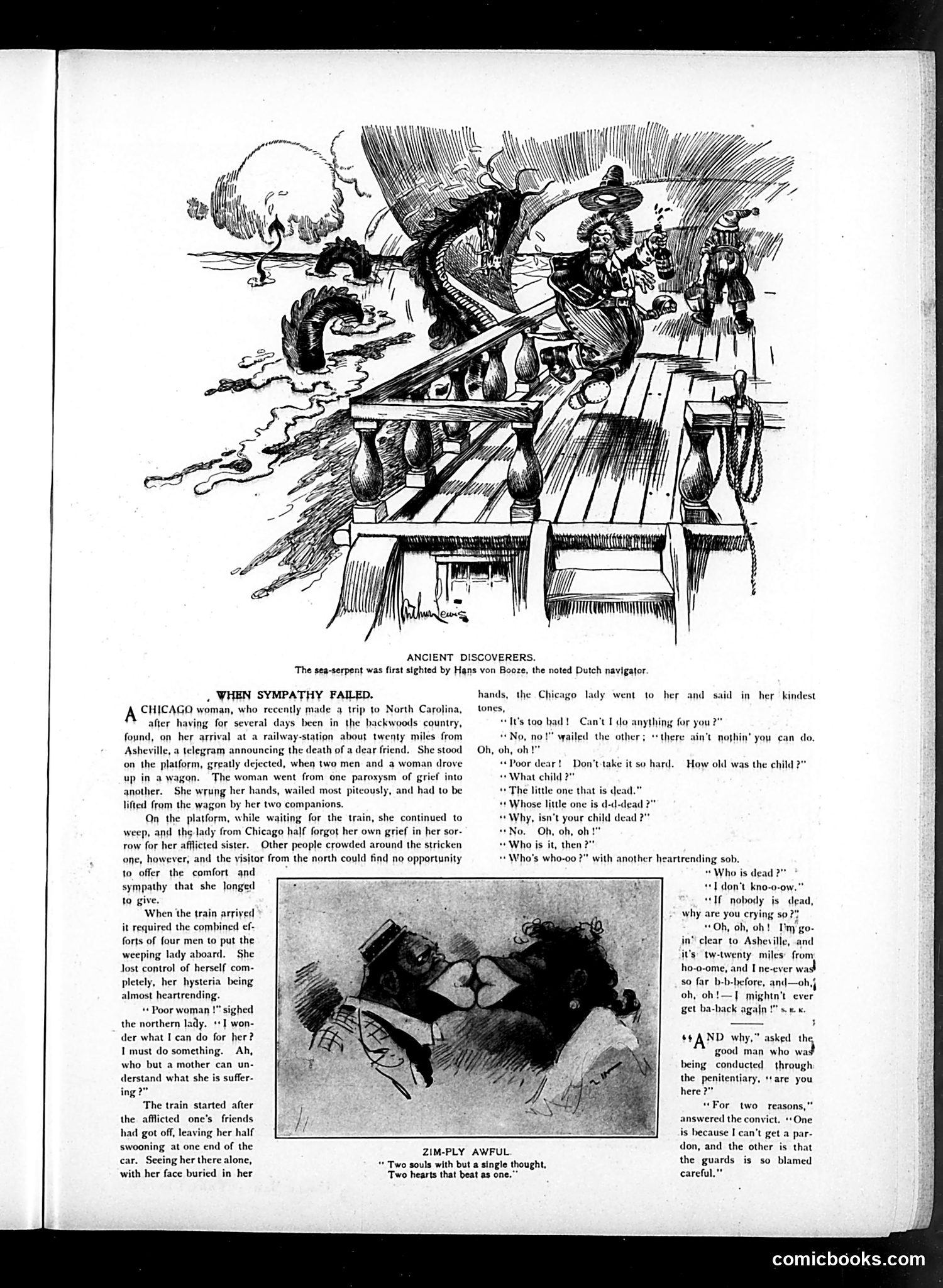
This piece satirizes the disconnect between a sympathetic Northern woman and Southern grief customs. A Chicago woman encounters a distraught woman at a train station in North Carolina and attempts to console her, assuming a child has died. Through escalating comic confusion, we learn the woman isn't grieving a death at all—she's emotionally overwhelmed about traveling twenty miles from home for the first time, fearing she'll never return. The satire mocks Northern sentimentality and patronizing assumptions about Southern backwoods life, while simultaneously ridiculing the Southern woman's provincial anxiety about leaving her isolated community. The joke turns on the Northern lady's well-meaning sympathy being entirely misdirected, exposing both regional stereotypes: the earnest Northern do-gooder and the sheltered, emotionally fragile Southerner.
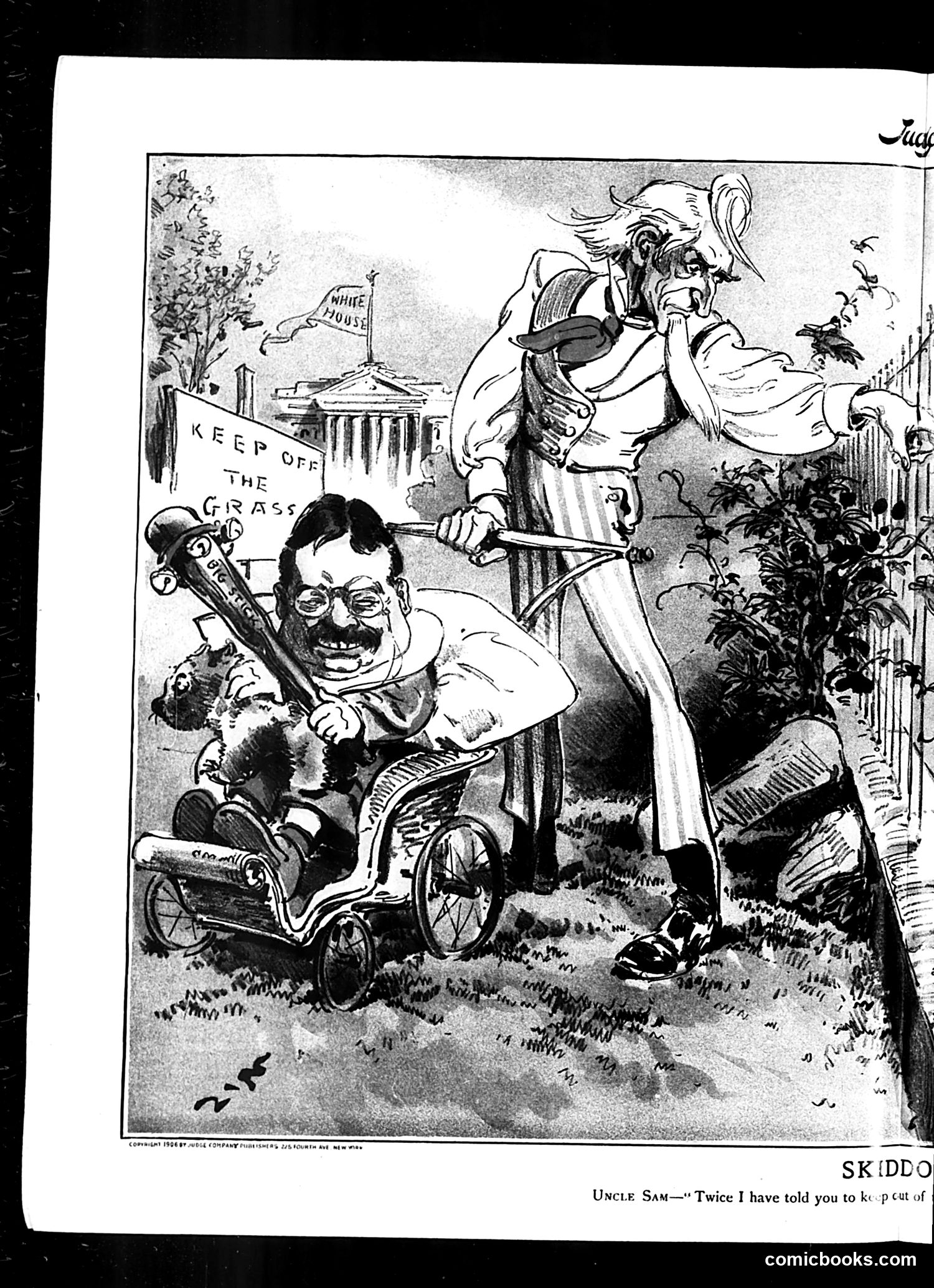
This Judge magazine cartoon depicts **Uncle Sam** (representing the U.S. government) scolding a caricatured figure in glasses riding a tricycle near the White House. The figure appears to be a political opponent or public figure whom Uncle Sam has warned twice to "keep cut of the grass"—suggesting unwanted interference in government affairs. The sign reading "KEEP OFF THE GRASS" reinforces the message of staying out of restricted space. The giant Uncle Sam wielding a large club/bat represents governmental authority enforcing boundaries. Without the publication date visible, the specific political figure and conflict remain unclear, but the cartoon satirizes a recurring problem: someone persistently violating Uncle Sam's warnings about political interference or trespassing on federal/presidential grounds.
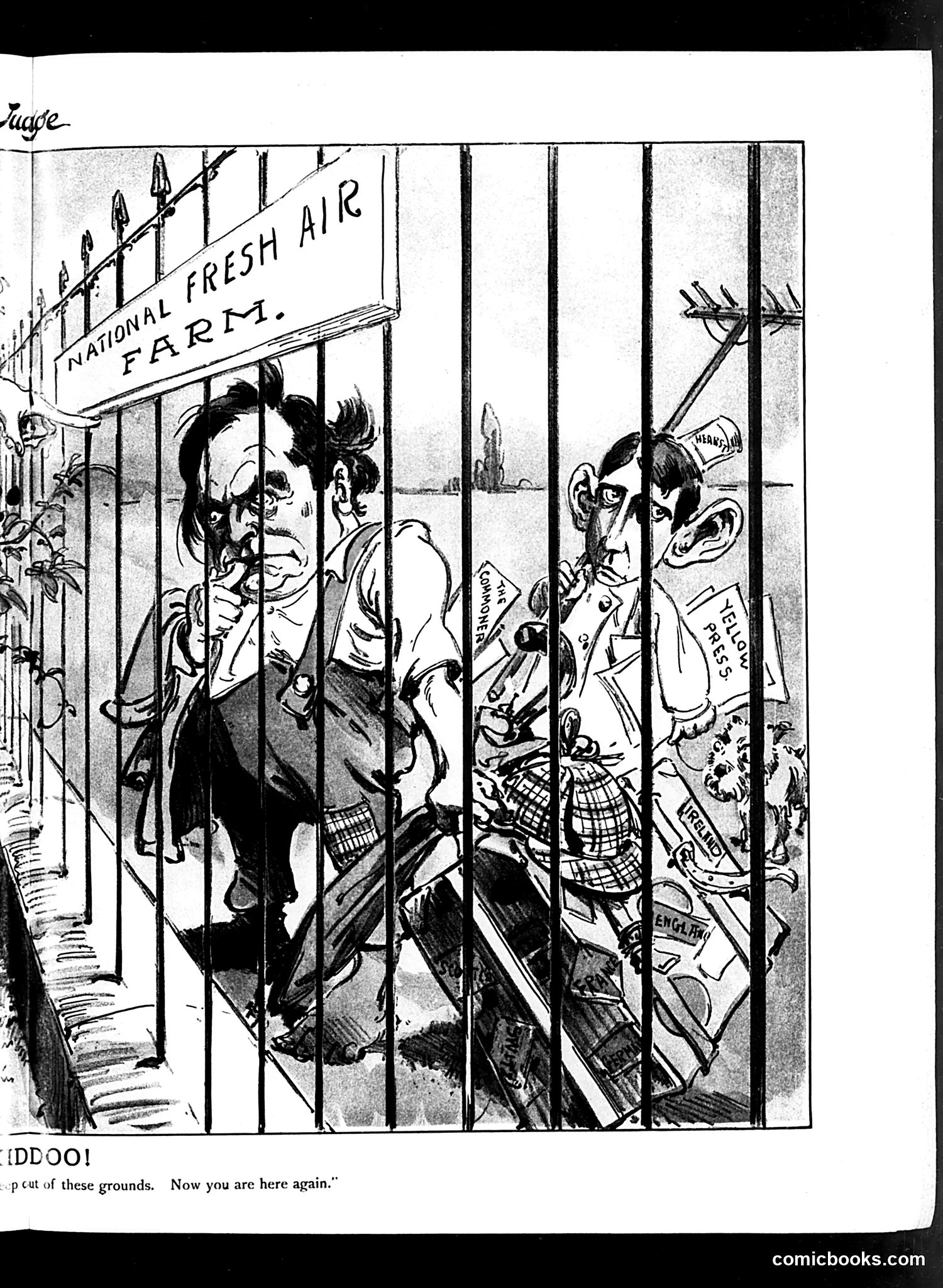
This cartoon by an artist named Haas depicts two working-class men behind bars at what appears to be a "National Fresh Air Farm"—likely a charitable institution for poor urban workers. The men are imprisoned despite being at a facility ostensibly designed to help them. The satire critiques the hypocrisy of wealthy benefactors who provided "fresh air" charity to commoners while simultaneously restricting their freedom. The barred enclosure suggests these charitable efforts were paternalistic and controlling rather than genuinely liberating. The caption's resigned tone ("Now you are here again") implies cyclical poverty and the inadequacy of such charitable gestures. This reflects Progressive-era tensions about poverty relief and social class in early 20th-century America.
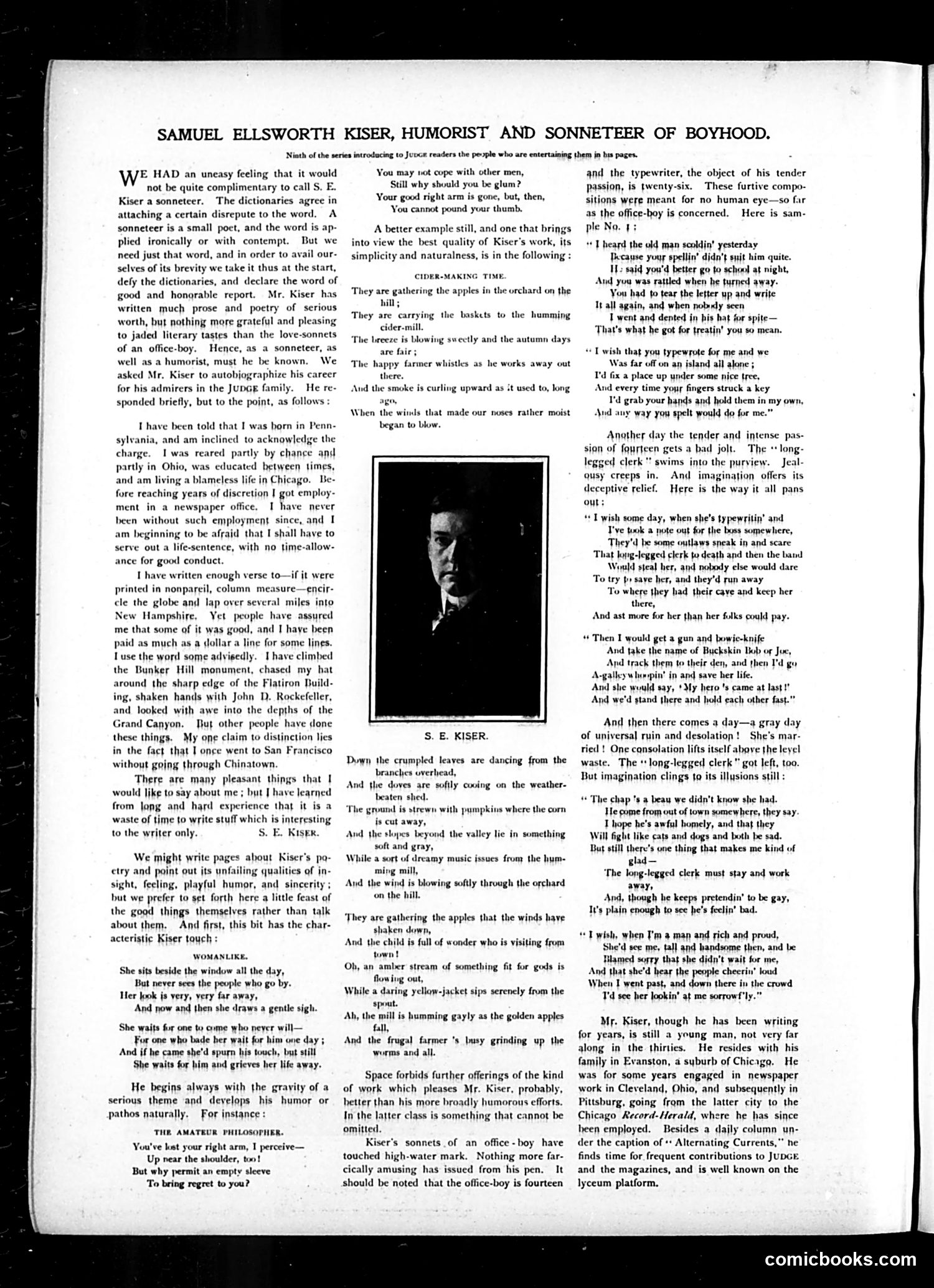
This is a biographical feature introducing S.E. Kiser, a humorist and poet contributor to *Judge* magazine. The page includes his autobiography and sample poems demonstrating his work. Kiser was a newspaper writer from Pennsylvania/Ohio who worked in Chicago. The article defends calling him a "sonneteer" despite the word's traditionally pejorative meaning, arguing his work has genuine merit—he's even been paid up to a dollar per line. The poems shown exemplify his style: "Womanlike" deals with unrequited love with gentle melancholy, while "The Amateur Philosopher" uses humor to address hardship (a man missing his arm). His approach emphasizes simplicity, naturalness, and playful observation of ordinary life rather than grand themes. The portrait photo shows Kiser as a serious-faced man, establishing him as a legitimate literary figure within *Judge's* pages during this era of American satirical journalism.
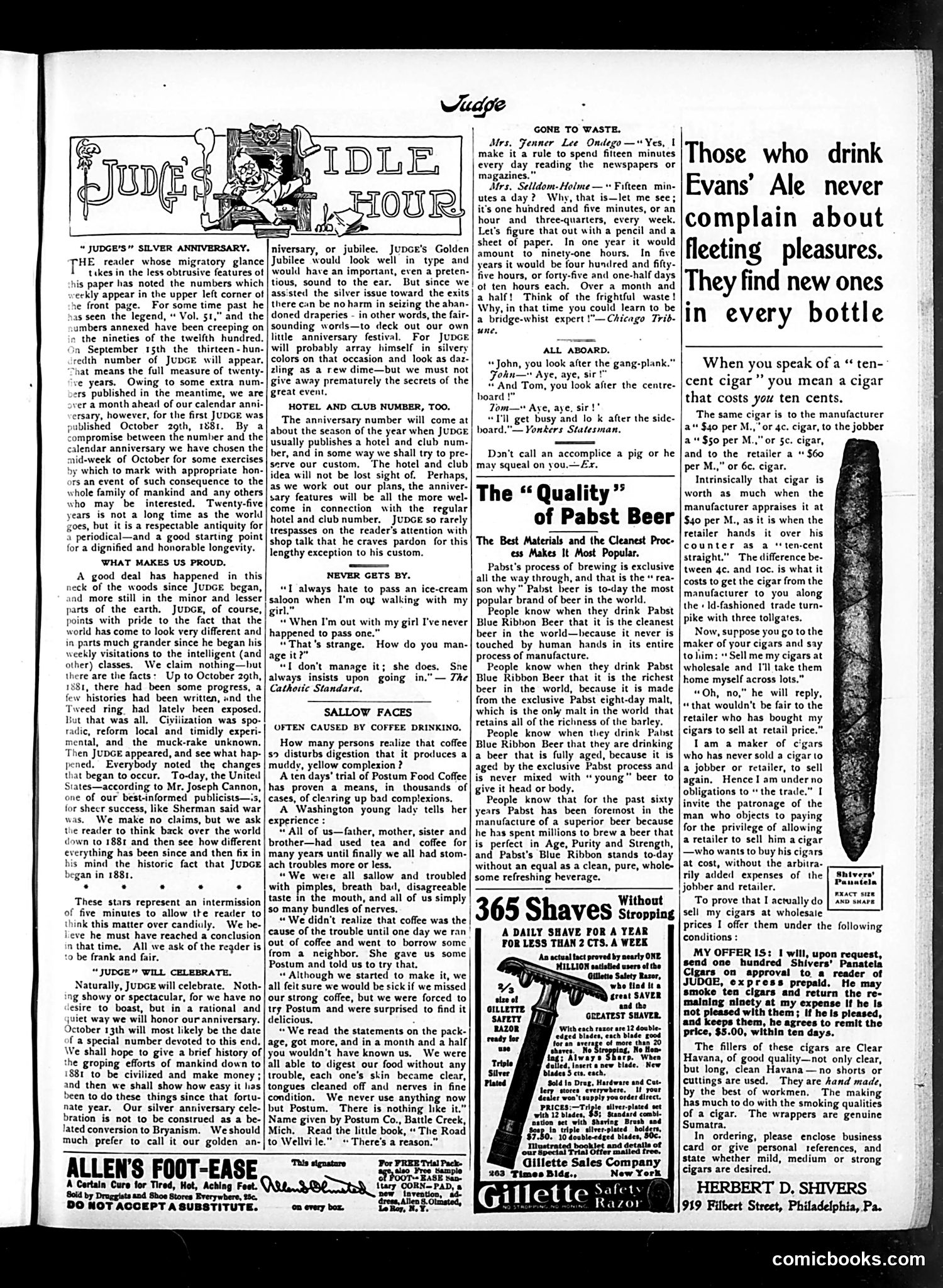
This page announces Judge magazine's silver anniversary—25 years since its October 1881 founding. The editorial celebrates the magazine's longevity and claims credit for America's progress, humorously suggesting that civilization itself improved because Judge began publishing. The satire works on two levels: Judge boasts that the world has become more prosperous and reformed since 1881, yet admits it makes "no claims"—a transparent contradiction. The magazine jokingly attributes major developments (the Tweed ring exposure, general civilization) to its own existence, parodying the self-importance of media institutions. The piece also gently mocks the magazine's preference for calling this a "golden" rather than "silver" anniversary, suggesting they'd prefer grander language but will "seize the abandoned draperies" of a more modest celebration. This is fundamentally a house advertisement celebrating Judge's own institutional significance during the Progressive Era.
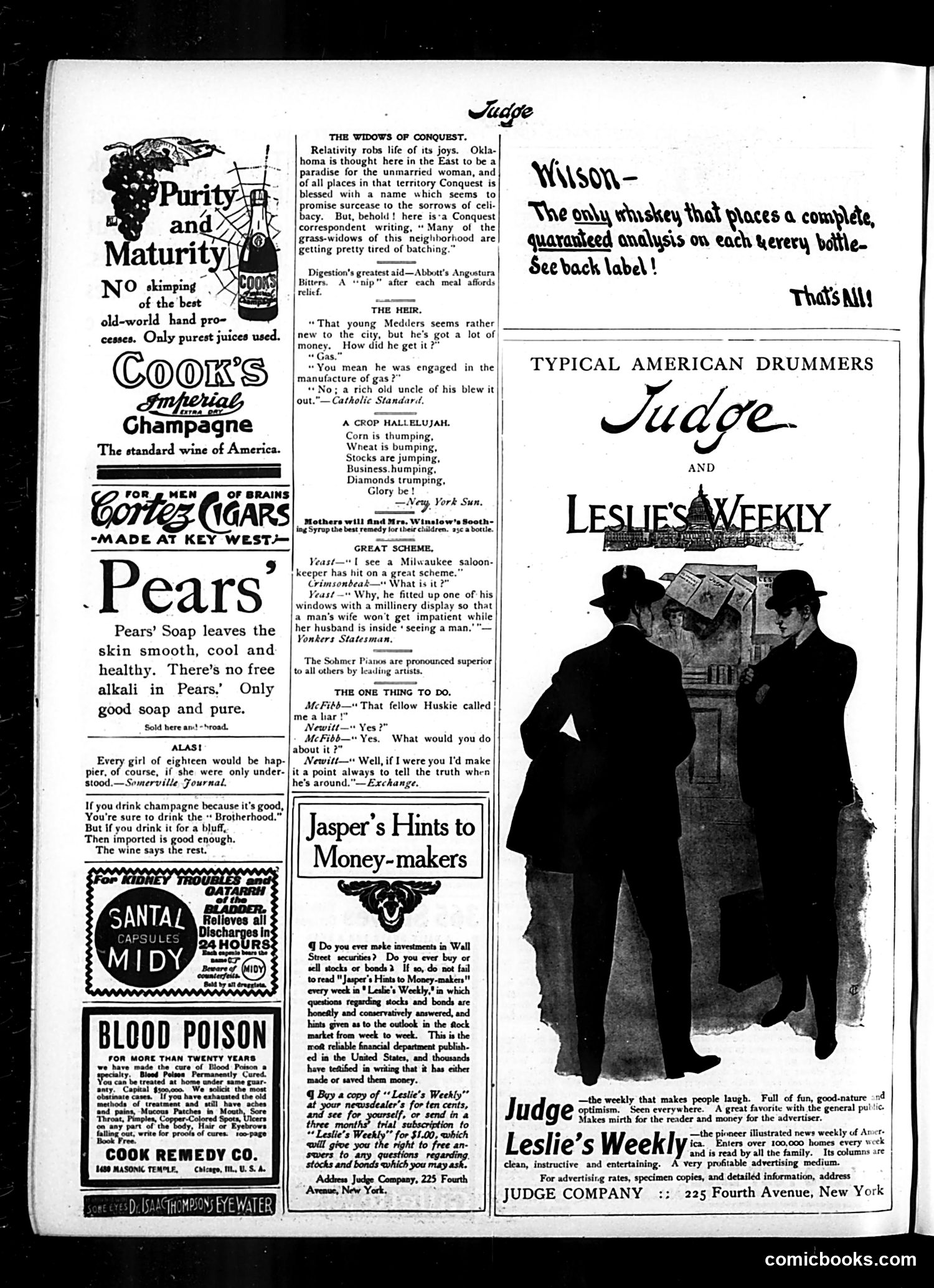
This is primarily an **advertising page** with minimal editorial content. The few satirical pieces are brief: **"The Widows of Conquest"** jokes that Oklahoma towns with suggestive names (like "Conquest") promise romance to unmarried women, but the reality disappoints—grass widows there are "getting pretty tired of batching" (cooking for themselves alone). **"The Great Scheme"** satirizes a Milwaukee saloonkeeper who displays millinery in his window so wives won't grow impatient while their husbands are inside "seeing a man"—a euphemism for drinking. **"The One Thing to Do"** is a brief dialogue about always telling the truth. These reflect early 1900s concerns: **women's loneliness on the frontier, wives' frustration with husbands' drinking habits, and masculine hypocrisy**. The page is otherwise dominated by patent medicines (Blood Poison cure, Santa Capsules), soaps, champagne, and piano advertisements—typical of Judge's revenue model.
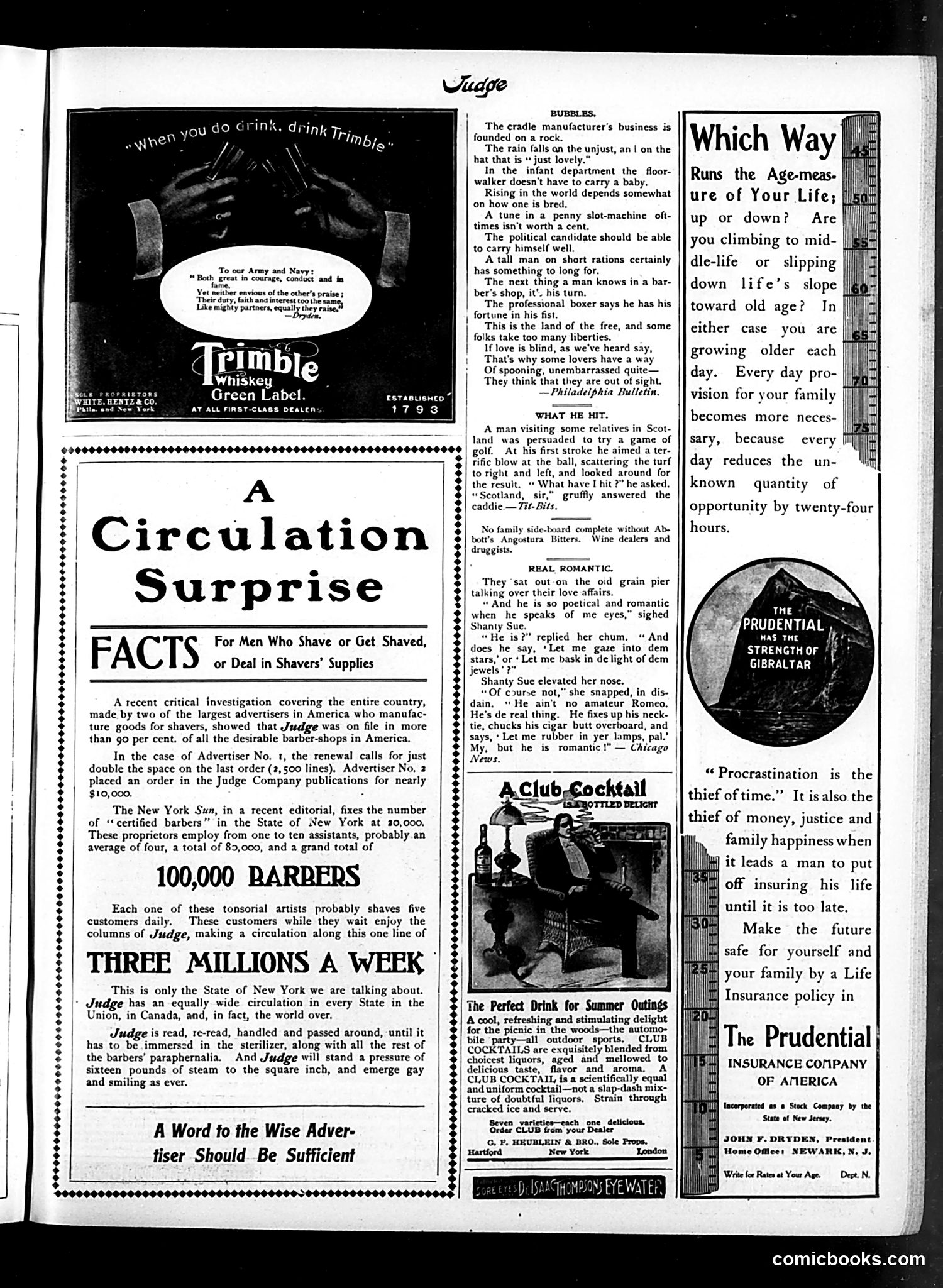
This page is primarily **advertising and promotional content** for Judge magazine itself, with scattered humorous filler items. The dominant feature is a circulation-boasting advertisement targeting potential advertisers. It claims Judge reaches 100,000 barbers across New York State alone, with approximately 3 million weekly readers through barbershops—a significant distribution channel in the early 20th century. The logic: barbers display the magazine for waiting customers, and magazines survive multiple sterilizations. The Trimble Whiskey advertisement at top features Army/Navy personnel toasting, using patriotic imagery to sell liquor. Scattered throughout are brief jokes typical of Judge's format: puns about professions ("rising in the world depends on how one is bred"), light romantic humor, and a golf anecdote about a Scottish caddie. These require no historical context—they're simple wordplay. The Prudential Insurance advertisement warns against procrastination, using life insurance as the pitch. Overall, this represents a typical Judge page: mostly ads interspersed with brief jokes, rather than sustained satirical commentary.
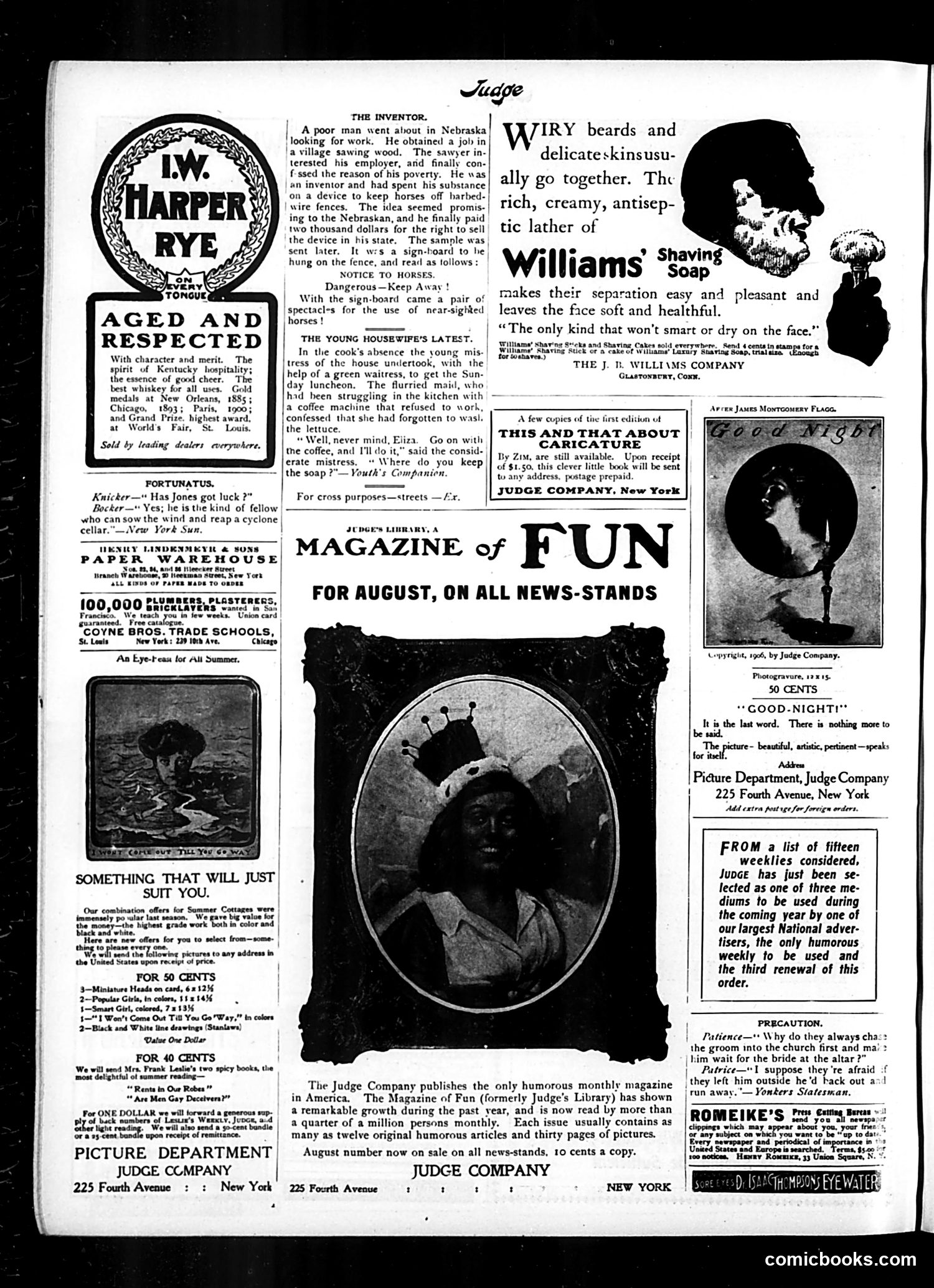
This page mixes humor pieces with advertising typical of early 1900s satirical magazines. **The cartoons/jokes shown:** "The Inventor" mocks gullible investors: a poor Nebraska man sells a $2,000 "device" to keep horses off barbed wire—it's merely a sign reading "NOTICE TO HORSES" with spectacles for "near-sighted horses." The satire targets both the inventor's audacity and the buyer's credulity. "The Young Housewife's Latest" jokes about domestic incompetence: a mistress attempts cooking without the maid and, when lettuce isn't washed, asks "Where do you keep the soap?"—confusing dishwashing with food preparation. **Advertising dominates** the rest: I.W. Harper Rye whiskey (emphasizing age and respectability), Williams Shaving Soap (appealing to men's grooming), and the August issue of Judge's own *Magazine of Fun* (50 cents, available at newsstands). The page reflects early-20th-century consumer culture and gender-role humor now dated and clichéd.
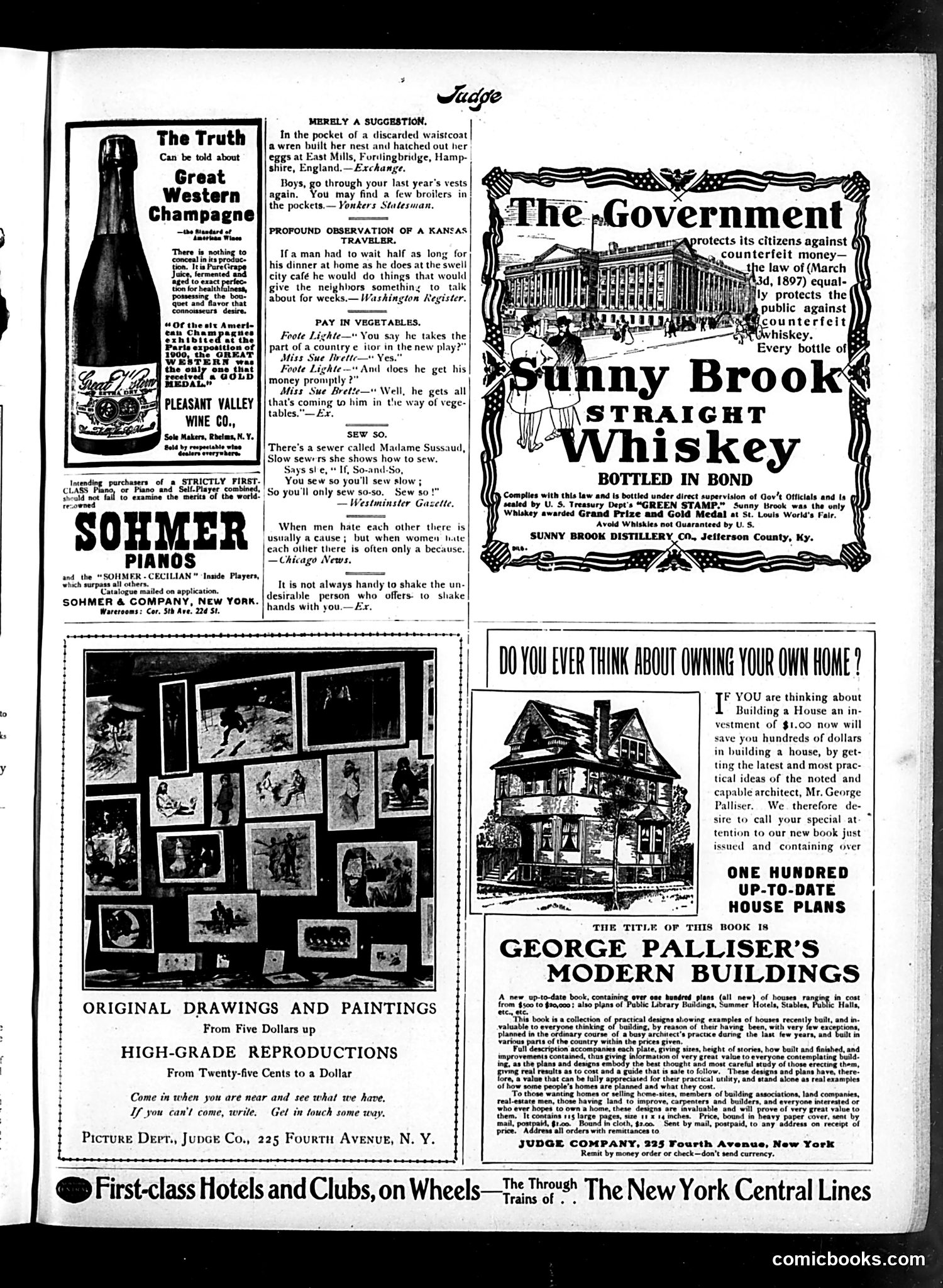
This page is primarily **advertising**, with minor satirical content typical of Judge's filler material. The main advertisements include: - **Pleasant Valley Wine Co.** and **Sohmer Pianos**: Straightforward product promotions - **Sunny Brook Whiskey**: Emphasizes government protection against counterfeits (invoking the 1897 law), with claims of "Grand Prize and Gold Medal at St Louis World's Fair" - **George Palliser's Modern Buildings**: Architectural design book promotion The satirical content consists of brief, unrelated **humorous observations** rather than coherent cartoons—small jokes about finding birds in old coat pockets, restaurant wait times, and sewing. These are typical "filler" humor for the era. The **Sunny Brook ad** is noteworthy for its invocation of federal government authority to legitimize the product, reflecting early 20th-century consumer concerns about whiskey adulteration and counterfeiting—a real problem that prompted regulatory legislation. The page reflects Judge's mixed editorial/advertising model and the era's direct appeals to nationalist sentiment and government protection as sales tools.
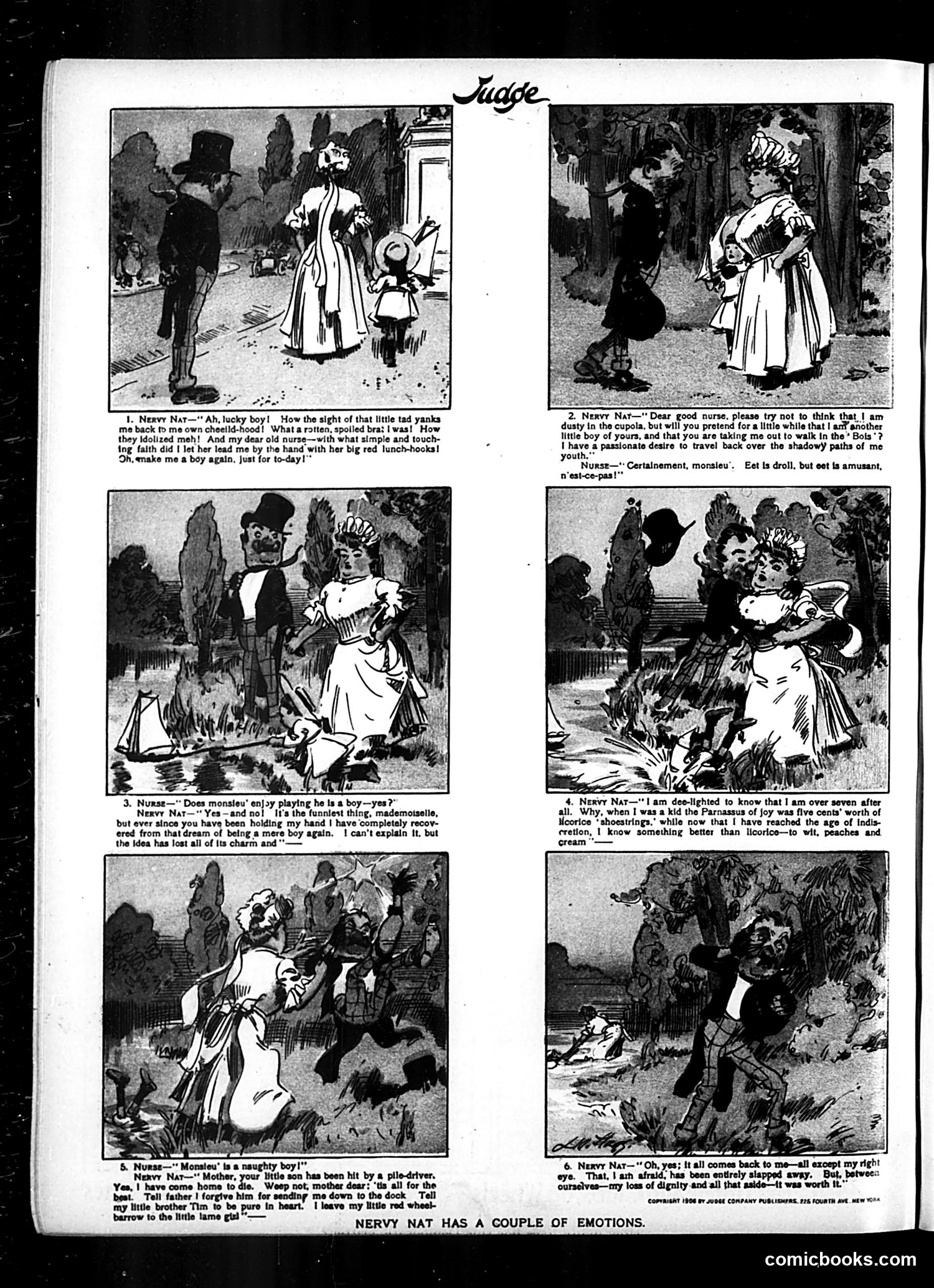
This is a comic strip satirizing a character called "Nervy Nat," a sentimental adult man who nostalgically yearns to be a child again. The humor relies on the contrast between his affected, theatrical emotional displays and his rapid mood swings. In each panel, Nat dramatizes childhood experiences (being led by a nurse, eating licorice, playing) with exaggerated sentimentality—using flowery language about "shadowy paths of youth" and claiming to be "hit by a pile-driver" when slightly injured. However, his emotions flip instantly: once the nurse actually treats him as a boy, he loses interest; when he matures mentally, he dismisses childish pleasures. The satire targets adult nostalgia and performative sentimentality—the affectation of adults who romanticize childhood while actually preferring grown-up pleasures. The title's reference to "a couple of emotions" suggests Nat oscillates between two superficial emotional states rather than experiencing genuine feeling. The French-speaking nurse adds a cosmopolitan, slightly pretentious dimension to the critique.