
Judge, 1906-08-18 · page 10 of 16
Judge — August 18, 1906 — page 10: what you’re looking at
What you’re looking at
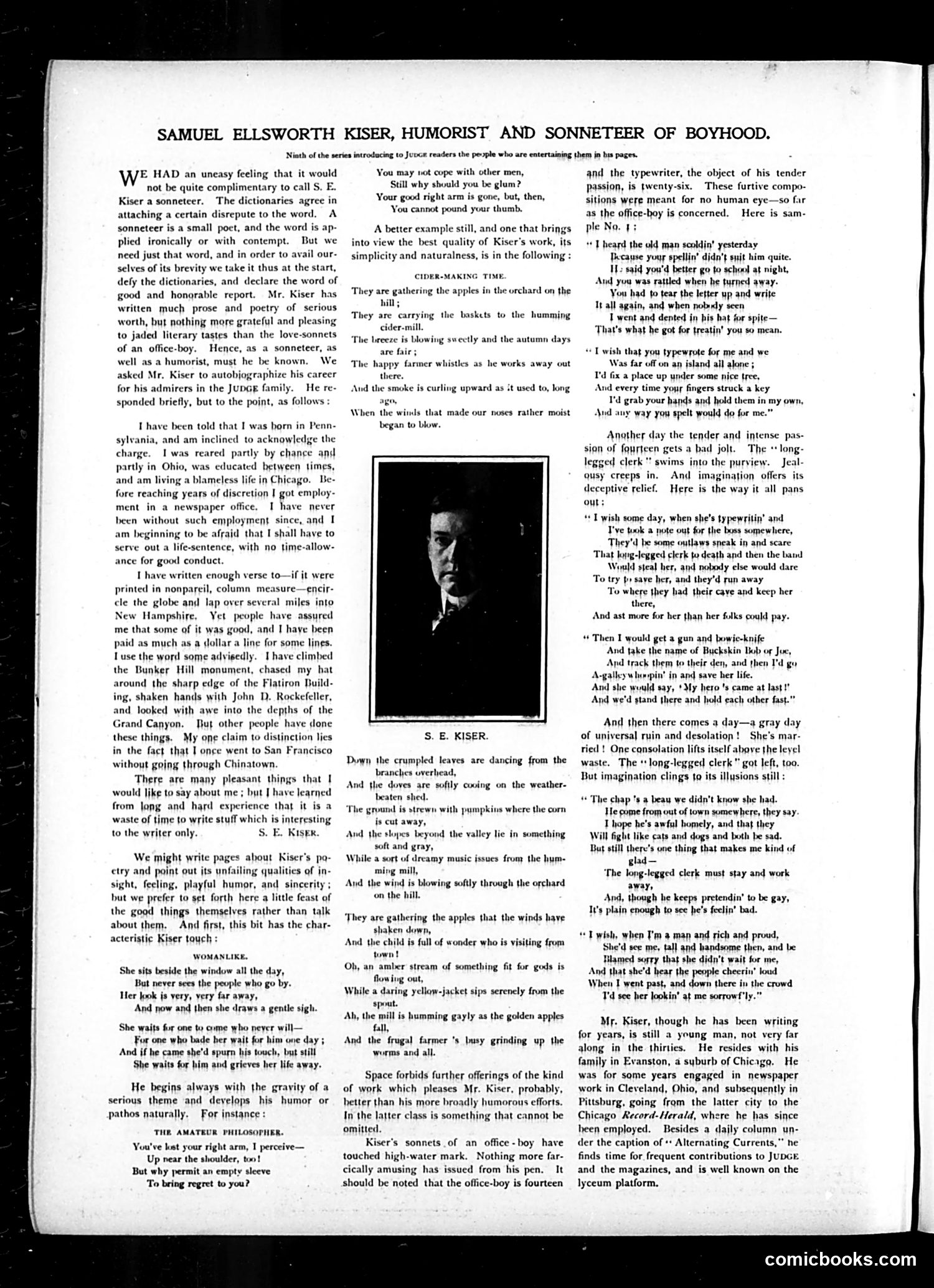
This is a biographical feature introducing S.E. Kiser, a humorist and poet contributor to *Judge* magazine. The page includes his autobiography and sample poems demonstrating his work. Kiser was a newspaper writer from Pennsylvania/Ohio who worked in Chicago. The article defends calling him a "sonneteer" despite the word's traditionally pejorative meaning, arguing his work has genuine merit—he's even been paid up to a dollar per line. The poems shown exemplify his style: "Womanlike" deals with unrequited love with gentle melancholy, while "The Amateur Philosopher" uses humor to address hardship (a man missing his arm). His approach emphasizes simplicity, naturalness, and playful observation of ordinary life rather than grand themes. The portrait photo shows Kiser as a serious-faced man, establishing him as a legitimate literary figure within *Judge's* pages during this era of American satirical journalism.
📄 Transcribed text from this page (OCR, searchable)
Machine-transcribed from the original scan — historical spelling and the odd misread are preserved.
SAMUEL ELLSWORTH KISER, HUMORIST AND SONNETEER OF BOYHOOD. Ninth of the series introducing to Juvce readers the pesple who are entertaining them in bis pages. E HAD an uneasy feeling that it would not be quite complimentary to call S. E. Kiser a sonneteer. The dictionaries agree in attaching a certain disrepute to the word. A sonneteer is a small poct, and the word is ap- plied ironically or with contempt. But we need just that word, and in order to avail our- selves of its brevity we take it thus at the start, defy the dictionaries, and declare the word of good and honorable report. Mr. Kiser has written much prose and poetry of serious worth, but nothing more grateful and pleasing to jaded literary tastes than the love-sonnets of an office-boy. Hence, as a sonneteer, as well as a humorist, must he be known. asked Mr. Kiser to autobjographize his ca for his admirers in the JUDGE family. He re- sponded briefly, but to the point, as follows : T have been told that I was born in Penn- sylvania, and am inclined to acknowledge the charge. I was reared partly by chance and partly in Ohio, was educated between times, and am living a blameless life in Chicago. Be- fore reaching years of discretion | got employ- ment in a newspaper office. I have never been without such employment since, and I am beginning to be afraid that I shall have to serve out a life-sentence, with no time-allow- ance for good conduct. I have written enough verse to—if it were printed in nonpareil, column measure—encir- cle the globe and lap over several miles into New Hampshire, Yet people have assured me that some of it was good, and I have been paid as much as a dollar a line for some lines. Luse the word some advisedly. I have climbed the Bunker Hill monument, chased my hat around the sharp edge of the Flatiron Build- ing, shaken hands with John D. Rockefeller, and looked with awe into the depths of the Grand Canyon. But other people have done these things. My one claim to distinction lies in the fact that | once went to San Francisco without going through Chinatown. There are many pleasant things that I would like to say about me ; but | have learned from Jang and hard experience that it is a waste of time to write stuff which is interesting to the writer only. KISER. We might write pages about Kiser’s po- etry and point out jts unfailing qualities of in- sight, feeling, playful humor, and_ sincerity ; but we prefer to set forth here a little feast of the good things themselves rather than talk about them. And first, this bit has the char- acteristic Kiser touch WOMANLIKE. She sits beside the window all the day, But never sees the people who go by. Her Jook js very, very far away, And pow and then she draws a gentle sigh. ‘She waits fur one to come who neyer will— For one who bade her wait for him one day ; And if he came she'd spurn his touch, but still She waits for him and grieves her life away. He begins always with the gravity of a serious theme and develops his humor or pathos naturally. For instance : THE AMATEUR PHILOSOPHER You've last your right arm, I perceive— Up near the shoulder, too! But why permit an empty sleeve To bring regret to you? You may not cope with other men, Still why should you be glum? Your good right arm is gone, but, then, You cannot pound your thumb. A better example still, and one that brings into view the best quality of Kiser’s work, its simplicity and naturalness, is in the following : CIDER-MAKING TIME They are gathering the apples in the orchard on the hill; They are carrying the baskets to the humming cider-mill. The Ureeze is bh are fair The happy farmer whistles as he works away out t And the smoke is curling upward as it used to, long g swectly and the autumn days age When the winds that made our noses rather moist began to blow. S. E. KISER. Duyn the crumpled leaves are dancing from the branches overhead, And the doves are sofily cooing on the weather- beaten shed. The ground is stre is cut away, with pumpkins where the oorn And the slopes beyond the valley lie in something soft and gray, While a sort of dreamy music issues from the hum= ming mill, And the wind is blowing softly through the orchard on the hill. ‘They are gathering the apples that the winds have shaken down, And the child is full of wonder who is visiting from town! Ob, an amber stream of something fit for gods is flowing out, While a daring yellow-jacket sips serenely from the spout. Ah, the mill is humming gayly as the golden apples fall, And the frugal farmer 's busy grinding up the worms and all. Space forbids further offerings of the kind of work which pleases Mr. Kiser, probably, better than his more broadly humorous efforts. In the latter class is something that cannot be omitted. Kiser’s sonnets of an office-boy have touched high-water mark. Nothing more far- cically amusing has issued from his pen. It should be noted that the office-boy is fourteen and the typewriter, the object of his tender passion, is twenty-six. These furtive compo- sitions were meant for no human ey so far as the office-boy is concerned. Here is sam- ple No. 4; + Theapd the old man scoldin’ yesterday Because your spellin’ didn’ spit him quite. He said you'd better go to school at night, And you was rattled when he turned away. You had to tear the letter up and write It all again, and when pobsdy seen T went and dented in bis hat for spite— That's what he got for treatin’ you so mean. “ [wish that you typewrote for me and we Was far off on an island all alone T'd fix a place up ynder some nice tree, And every time your fingers struck a key T'd grab your hapds and hold them in my own, \nd any way you spelt would do for me." Another day the tender and intense pas- sion of fourteen gets a bad jolt. The + long- legged clerk" swims into the purview. —Jeal- gusy creeps in, And imagination offers its deceptive relief. Here is the way it all pans our: ++ Lwish some day, when she's typewritin’ and T’ve took a pote out for the boss somewhere, They'd be some outlaws speak in and scare That long-legged clerk fo death and then the band Wonld steal her, and nobody else would dare To try py save her, and they'd run away To where they had their cave and keep her there, And ast more for her than her folks could pay. “Then I would get a gun and bowie-knife And take the name of Buckskin Bob of Juc, Apd track them to their den, and then I'd go, A-galley hovpin’ in and save her life. And she would say, ‘My hero 's came at last!” And we'd stand there and hold each other fast.” And then there comes a day—a gray day of universal ruin and desolation! She's mar- ried ! One consolation lifts itself above the leyel waste. The *long-legged clerk" got left, too. But imagination clings to its illysions still: «The chap 's a beau we didn’t know she had. He gome from out of town somewhere, they say. T hope he's awful homely, and that they Will fight like cats and dogs and both be sad. Bus still there's one thing that makes me kind of glad— ‘The long-legged clerk must stay and work away, And, though he keeps pretendin’ to be gay, It's plain enough to sce he’s feelin’ bad. “Tish, when T'm a map and rich and proud, She'd see me, tal] and handsome then, and be Blamed sorry that she didn’t wait for me, And that she'd hear the people cheerin’ loud When I went past, and down there in the crowd T'd see her Jookin’ at me sorrowf’ Mr. Kiser, though he has been writing for years, is still a young man, not very far along in the thirties. He resides with his family in Evanston, a syburb of Chicaga. He was for some years engaged in newspaper work in Cleveland, Ohio, and subsequently in Pittsburg, going fram the latter city to the Chicago Record-Herald, where he has since heen employed. Besides a daily column un- der the caption of «+ Alternating Currents,” he finds time for frequent contributions to JUDGE and the magazines, and is well known on the lyceum platform. comicbooks.com