
Judge, 1906-08-18 · page 7 of 16
Judge — August 18, 1906 — page 7: what you’re looking at
What you’re looking at
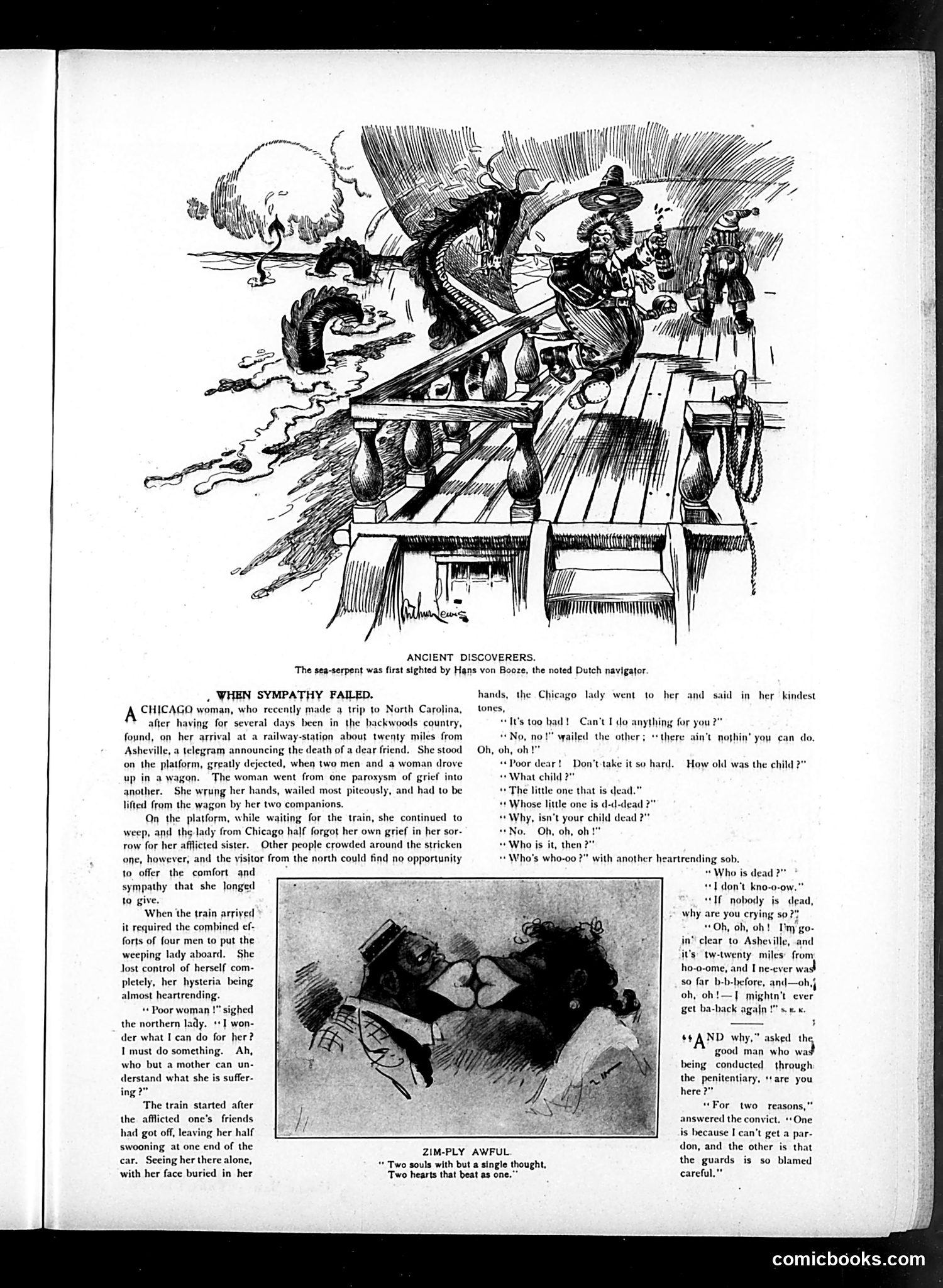
This piece satirizes the disconnect between a sympathetic Northern woman and Southern grief customs. A Chicago woman encounters a distraught woman at a train station in North Carolina and attempts to console her, assuming a child has died. Through escalating comic confusion, we learn the woman isn't grieving a death at all—she's emotionally overwhelmed about traveling twenty miles from home for the first time, fearing she'll never return. The satire mocks Northern sentimentality and patronizing assumptions about Southern backwoods life, while simultaneously ridiculing the Southern woman's provincial anxiety about leaving her isolated community. The joke turns on the Northern lady's well-meaning sympathy being entirely misdirected, exposing both regional stereotypes: the earnest Northern do-gooder and the sheltered, emotionally fragile Southerner.
📄 Transcribed text from this page (OCR, searchable)
Machine-transcribed from the original scan — historical spelling and the odd misread are preserved.
\ A ( ANCIENT DISCOVERERS. The sea-serpent was first sighted by Hans von Booze, the noted Dutch navigator. . WHEN SYMPATHY FAILED. CHICAGO woman, who recently made 9 trip to North Carolina, after having for several d in the backwoods country, found, on her arrival at a railway-station about twenty miles from Asheville, a telegram announcing the death of a dear friend. She stood on the platform, greatly dejected, when two men and a woman drove The woman went from one paroxysm of grief into vailed most piteously, and had to be up in a wagon. another. She wrung her hands, w lifted from the wagon by her two companions. Qn the platform, while waiting for the train, she continued to weep, and the lady from Chicago half forgot her own grief in her sor- row for her afflicted sister. Other people crowded around the stricken one, however, and the visitor from the north could find no opportunity to offer the comfort and sympathy that she longed to give. When the train arrived it required the combined ef- forts of four men to put the weeping lady aboard. She Jost control of herself com- pletely, her hysteria being almost heartrending. + Poor woman !" sighed the northern lady. **T won- der what I can do for her? I must do something. Ah, who but a mother can un- derstand what she is suffer- ing?” The train started after the afflicted one’s friends had got off, leaving her half the C to her and said in her kindest hands, hicago lady went tones, “It’s too had ! “No, no!" wailed the othe Oh, oh, oh!" “Poor dear! Don't-take it so hard. + What child ?” + The little one that is dead. + Whose little one is d-d-dead ?” “Why, isn’t your child dead 2” ++No. Oh, oh, oh!” “Who is it, then ?” + Who's who-o0 ?” with another heartrending sob. * Who is dead ?” “I don’t kno-o-ow.”* “If nobody is dead, why are you crying so?" “Oh, oh, oh! I'ny go- clear to Asheville, and it’s: tw-twenty miles: from, ho-o-ome, and I ne-ever wa: so far b-b-before, and—oh,j oh, oh!—] mightn't ever get ba-back agajp !” Can't I doa thing for you?” ‘there ain't nothin’ you can do. How old was the child 2" +6AND why,” asked the good man who wad being conducted through the penitentiary, ‘tare you here?” ‘For two reasons," answered the convict. ‘One is because I can't get a par- don, and the other is that swooning at one end of the car. Seeing her there alone, with her face buried in her ZIM-PLY AWFUL * Two souls with but a single thought, Two hearts that beat as one.” the guards is so blamed careful." comicbooks.com