
A complete issue · 16 pages · 1906
Judge — June 23, 1906
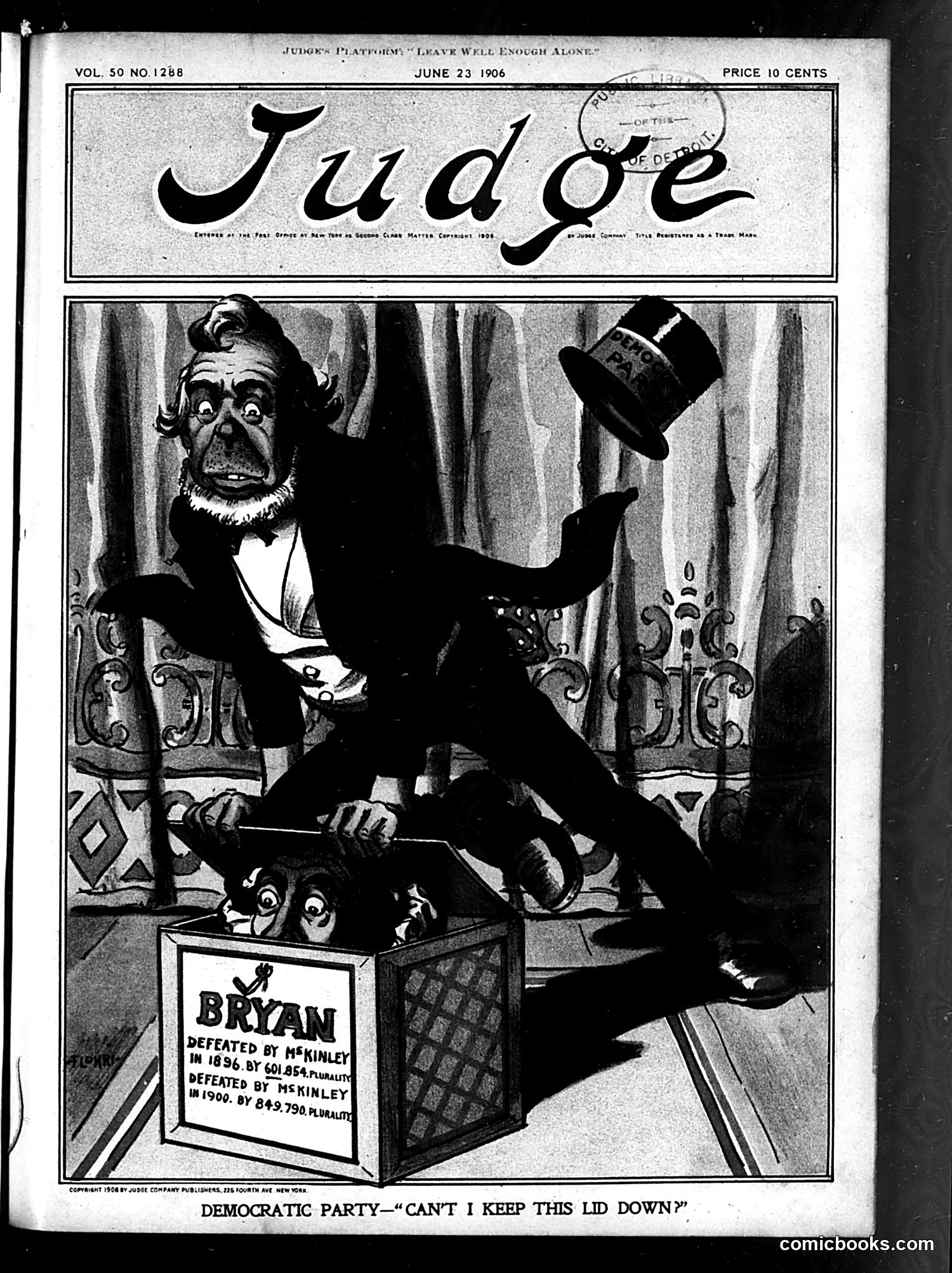
This 1906 *Judge* cartoon satirizes the Democratic Party's struggle to suppress the controversial legacy of William Jennings Bryan. The caricatured figure (likely a Democratic Party leader) desperately tries to keep a box lid closed, but Bryan's head keeps popping out. The inscription on the box references Bryan's electoral defeats: "defeated by McKinley in 1896 by 601,854 plurality" and "defeated by McKinley in 1900 by 849,793 plurality." The joke: The Democratic Party cannot escape Bryan's repeated failed presidencies and his persistent influence on party politics. The "lid" represents their attempts to move beyond him, while his continued prominence makes containment impossible—a visual metaphor for political baggage that won't stay buried.
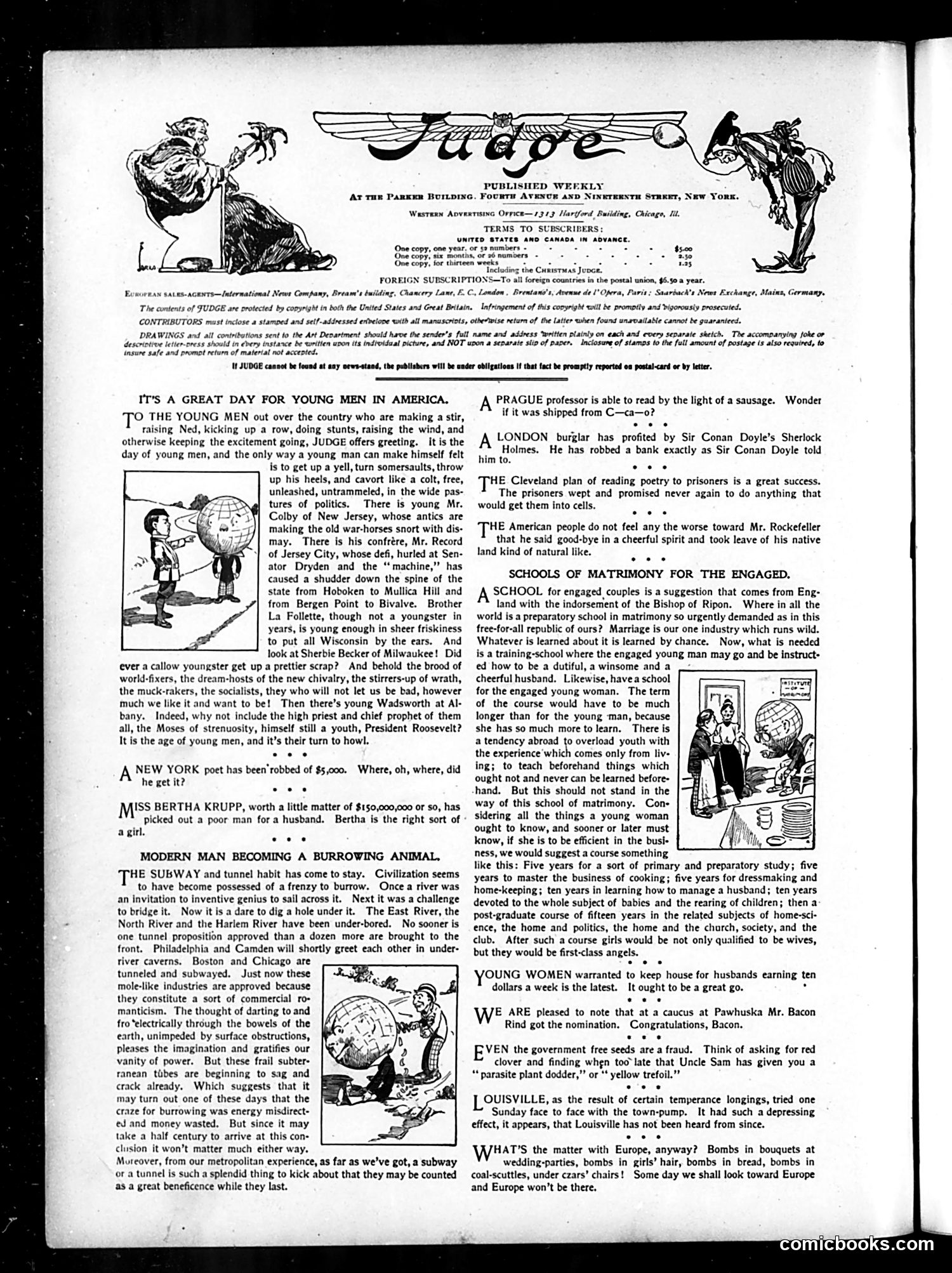
This satirical page from Judge magazine contains several brief social commentaries rather than a single cartoon. The main piece, "It's a Great Day for Young Men in America," celebrates opportunities available to American youth through various pursuits—athletics, business, and public service. The accompanying illustration depicts young men engaged in energetic activities. Other brief items mock contemporary issues: a Prague professor's unusual reading habits, a London burglar copying Sherlock Holmes, and Cleveland's poetry program for prisoners. There's satire about matrimony schools for engaged couples, subway tunnels as engineering feats, and various social oddities. The overall tone is lighthearted social commentary on American life, rather than sharp political critique. Without specific dates visible, the exact historical context remains unclear, though the references suggest early-to-mid 20th century concerns.
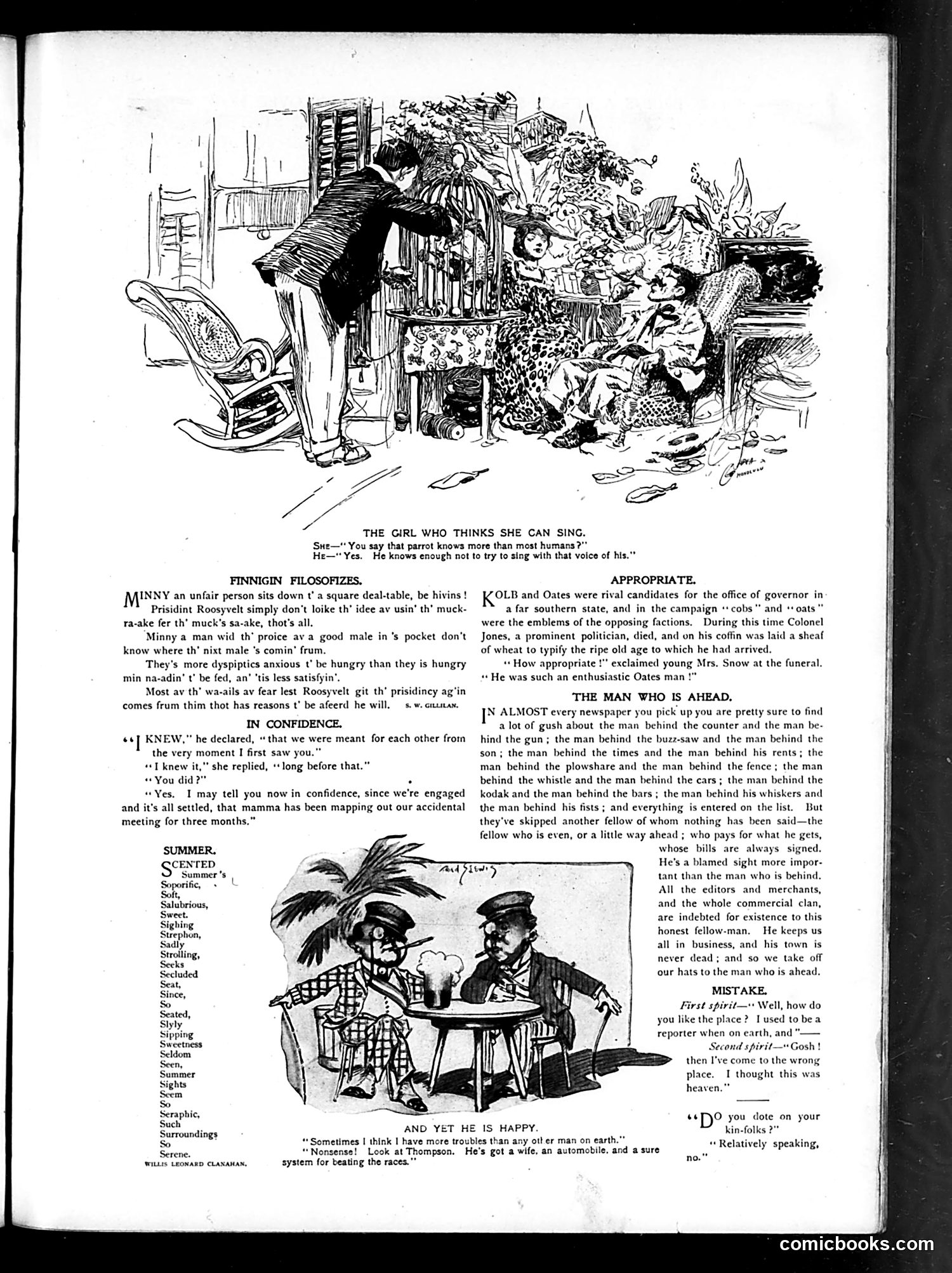
This Judge magazine page contains several satirical pieces. The top cartoon "The Girl Who Thinks She Can Sing" mocks a woman performer while men listen politely—social satire about amateur entertainers with unwarranted confidence. "Finnigin Filosofizes" presents working-class dialect humor about a man's domestic frustrations and hunger. "Appropriate" contrasts two political candidates (Kolb and Oates, apparently rivals for a southern governor's office) with the observation that one candidate is always visible while the other remains mysteriously absent—likely mocking how one politician gets blamed for every problem while his opponent avoids accountability. The other sections contain miscellaneous humorous observations and poems typical of Judge's satirical style, including commentary on summer and various social situations.
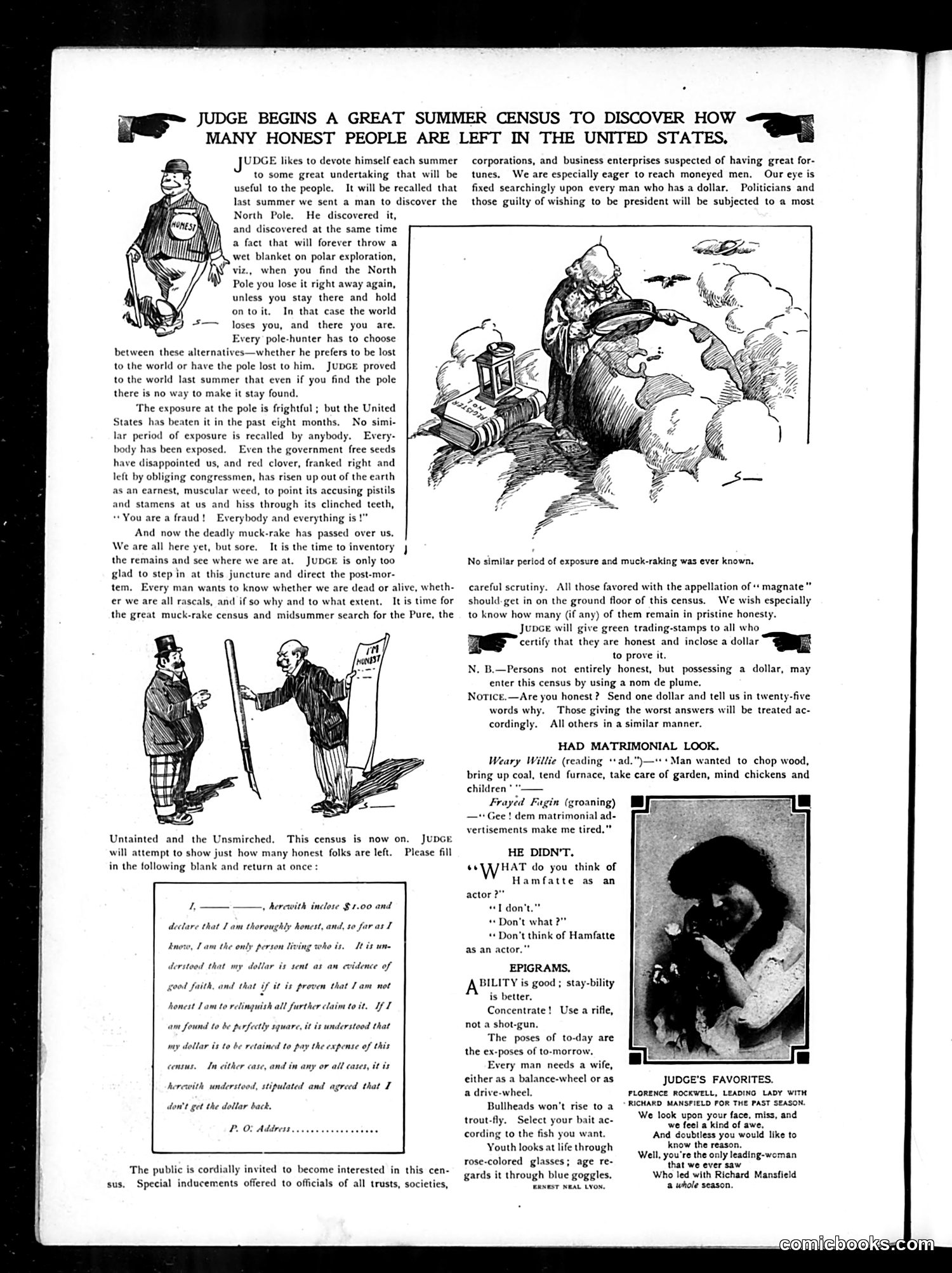
This Judge magazine page satirizes a "summer census" to count honest people in America. The satire's dark premise: after recent exposure of corruption among government officials, businessmen, and politicians, honesty has become so rare it requires special investigation. The cartoon depicts census-takers on clouds gathering data. The text mockingly invites citizens to submit dollar bills as "evidence of good faith" proving their honesty—a joke about widespread dishonesty requiring literal proof. The form requests applicants swear under penalty of perjury that they're honest. The page also includes unrelated humor about matrimonial advertisements and character judgments. Overall, this reflects Progressive Era skepticism toward institutions and public figures caught in corruption scandals, treating honesty as nearly extinct.
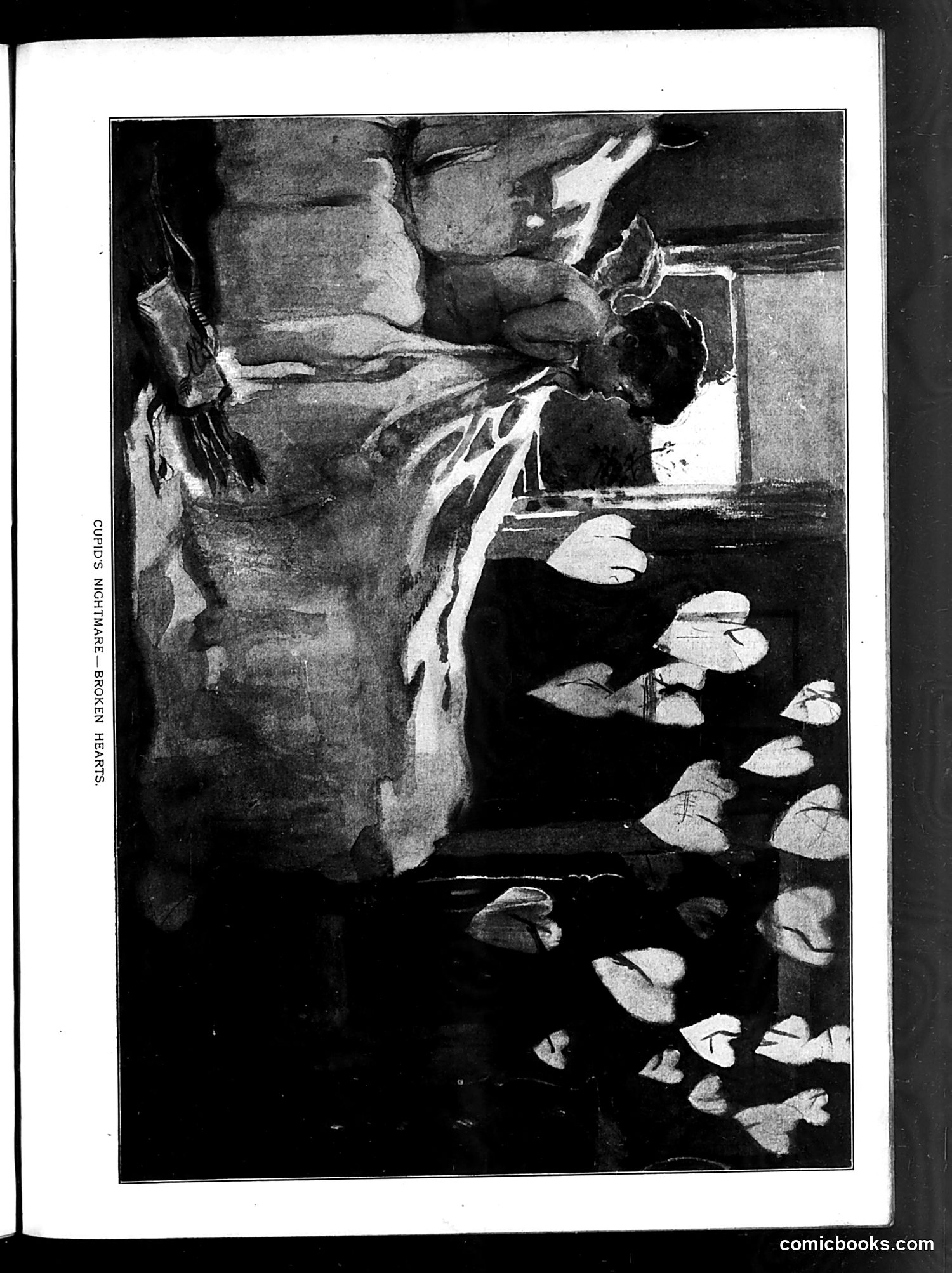
I can see this is a black and white photograph or illustration from *Judge* magazine, but the image is rotated and quite dark, making specific details difficult to discern with confidence. The OCR text provided ("CUPID'S NIGHTMARE: BROKEN HEARTS") suggests the content concerns romantic themes or relationship failure. The caption indicates this is satirical commentary on romance or courtship, likely depicting the consequences of failed love affairs—a common *Judge* subject. However, without being able to read accompanying text clearly or identify specific figures with certainty, I cannot reliably explain what particular social commentary or contemporary references are intended. **I cannot confidently identify the specific figures, date, or exact satirical target from this image alone.**
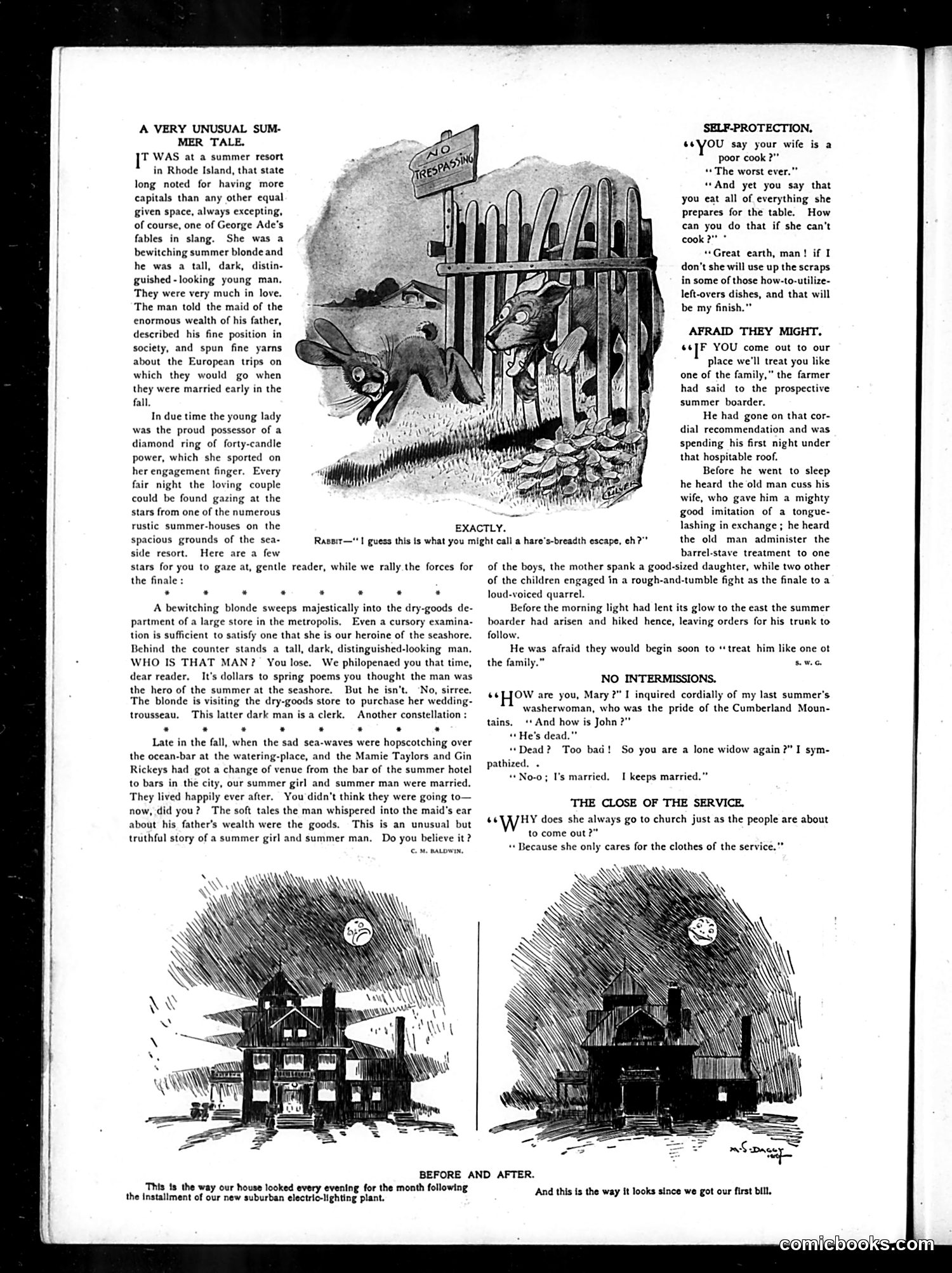
This page contains three humorous short pieces typical of Judge's satirical style: **"A Very Unusual Summer Tale"** mocks romance and class pretense. A wealthy-seeming man courts a "summer blonde" at a resort, proposing marriage with an elaborate diamond ring. The twist: he's actually a dry-goods clerk, not the wealthy heir he claimed. The story satirizes both the deception and the woman's acceptance of the false courtship despite the man's actual modest station. The humor relies on subverting reader expectations about romantic conventions. **"Self-Protection"** and **"Afraid They Might"** are brief joke pieces about domestic life—one about tolerating bad cooking to avoid worse leftovers, another about a summer boarder fleeing a boarding house after witnessing violent family quarrels, fearing he'll soon be treated "like one of the family." The **"Before and After"** illustrations at bottom show a house before and after installing an electric light plant—satirizing the dramatic appearance change new technology brought to suburban homes. Overall, these pieces mock social pretension, domestic realities, and the promise of modern conveniences.
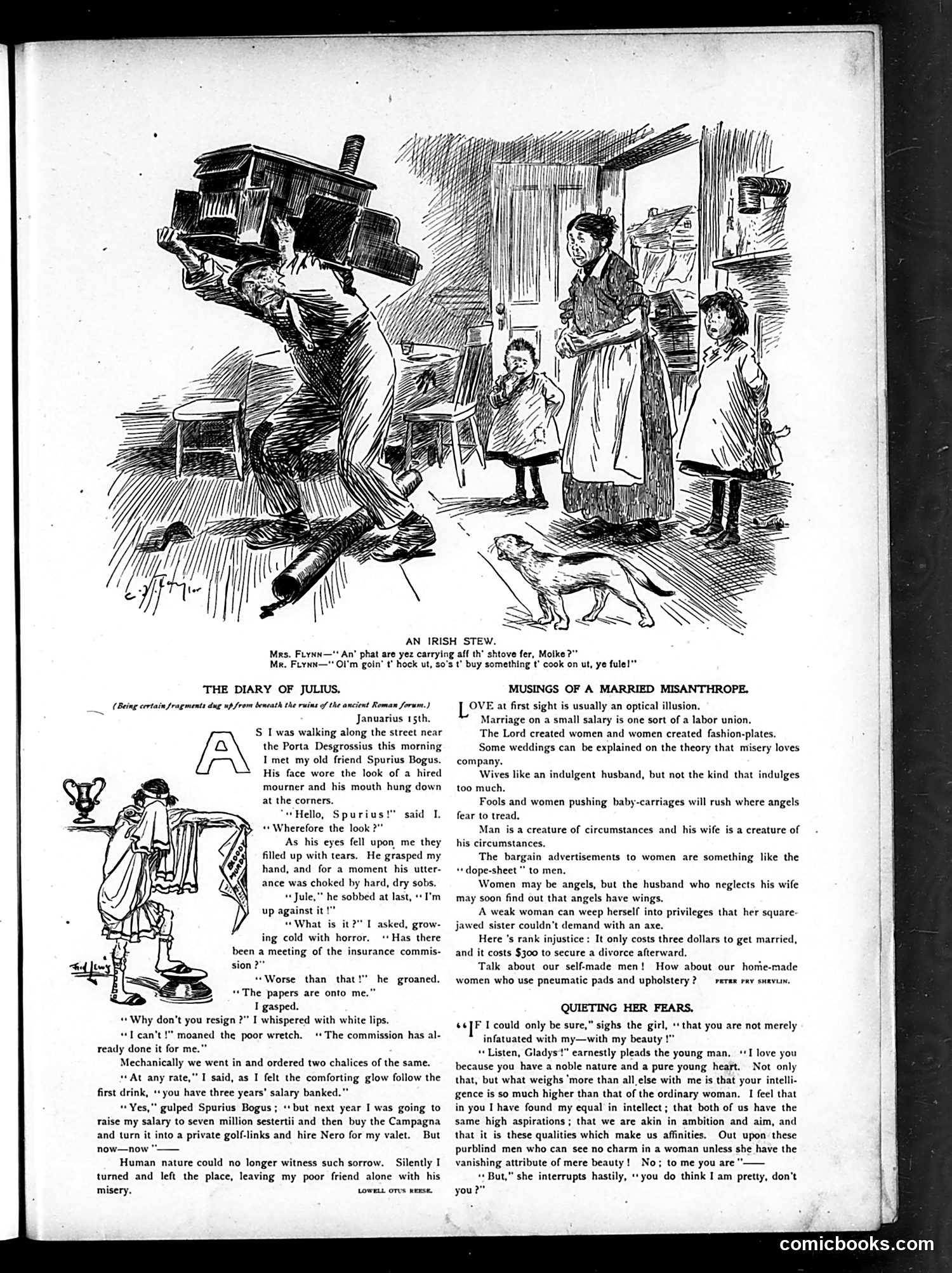
The top cartoon mocks Irish poverty through ethnic stereotype. Mr. Flynn is pawning his stove to buy food to cook on it—a circular logic joke highlighting desperate poverty. "Moike" and phonetic Irish dialect ("phat," "yez," "fule") typify Judge's use of exaggerated Irish-immigrant caricature, common in late 19th-century American satire that portrayed Irish as poor and foolish. The page also includes "The Diary of Julius" (satirizing Roman history/corruption), "Musings of a Married Misanthrope" (cynical observations on marriage and women's materialism), and "Quieting Her Fears" (mocking courtship where a woman claims disinterest in beauty while obviously caring only about it). These pieces reflect Judge's satirical attacks on marriage, divorce costs, and women's vanity—typical of the magazine's gender politics.
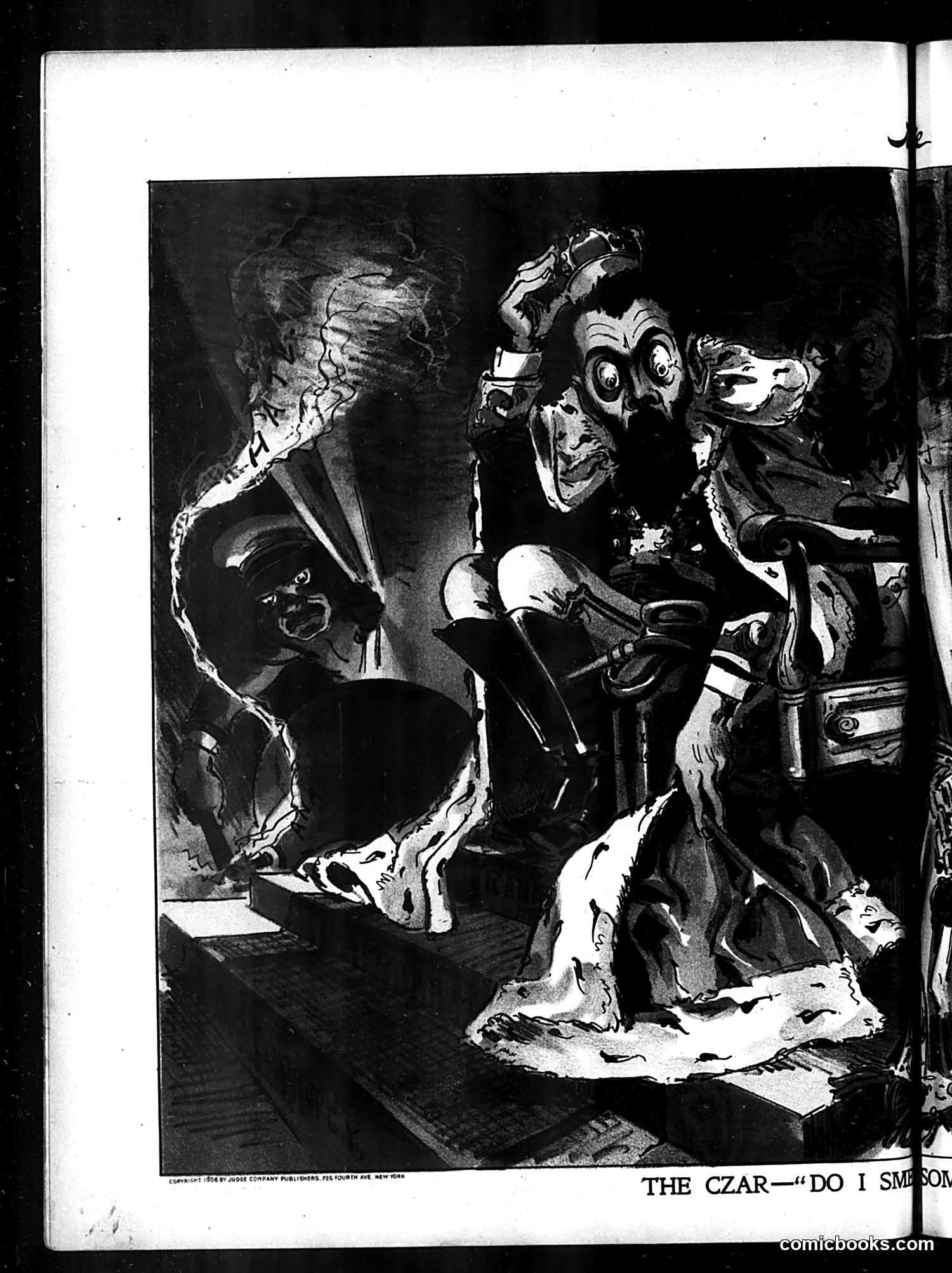
This political cartoon depicts the Russian Czar (likely Nicholas II) on the left, recoiling in apparent disgust or alarm. On the right, caricatured figures with exaggerated, grotesque features appear to represent revolutionary or radical elements—possibly anarchists, communists, or revolutionaries threatening the Russian autocracy. The Czar's dialogue ("Do I smell...") suggests he's detecting the presence of revolutionary forces or social upheaval. The cartoon satirizes the tensions between Russian imperial authority and growing revolutionary movements in early-20th-century Russia. Judge magazine frequently used such imagery to mock foreign leaders and comment on international political instability. The grotesque depictions of the figures on the right reflect period stereotypes used to dehumanize political opponents.
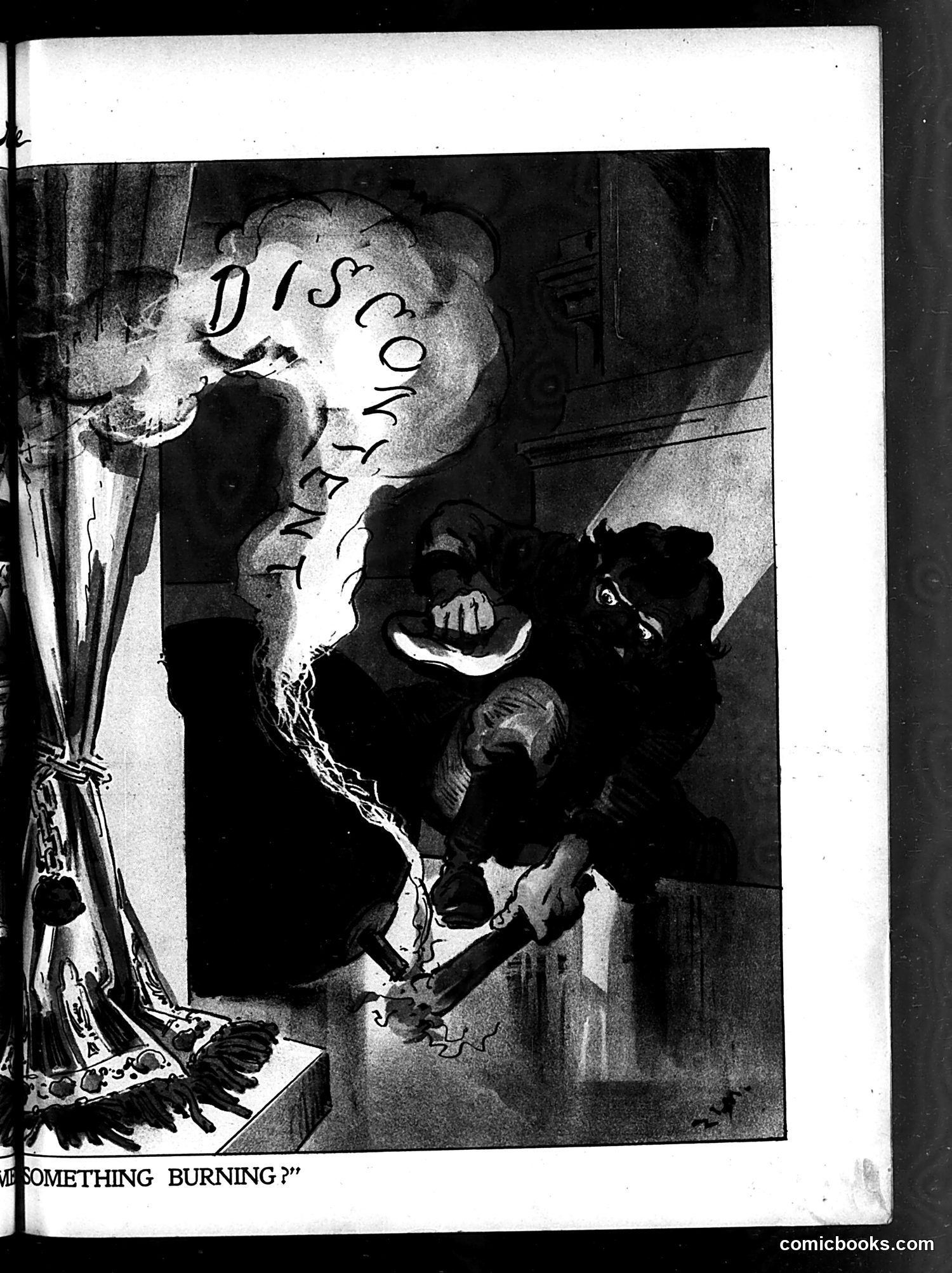
This political cartoon appears to depict a scene where a large, corpulent figure (likely representing a politician or corrupt official) is asking "Something burning?" while smoke or flames emerge from behind him. The figure's exaggerated facial features and grotesque appearance are typical of Judge magazine's satirical caricature style. The "IRSCOW" text visible on the image suggests this may reference Russian affairs or Cold War tensions, though the exact historical context remains unclear without additional dating information. The cartoon's satire appears to target political corruption or malfeasance—the ironic question about something burning implies the figure is responsible for destructive actions while feigning innocence. The ornate setting and clothing suggest critique of a high-ranking official or wealthy corrupt figure.
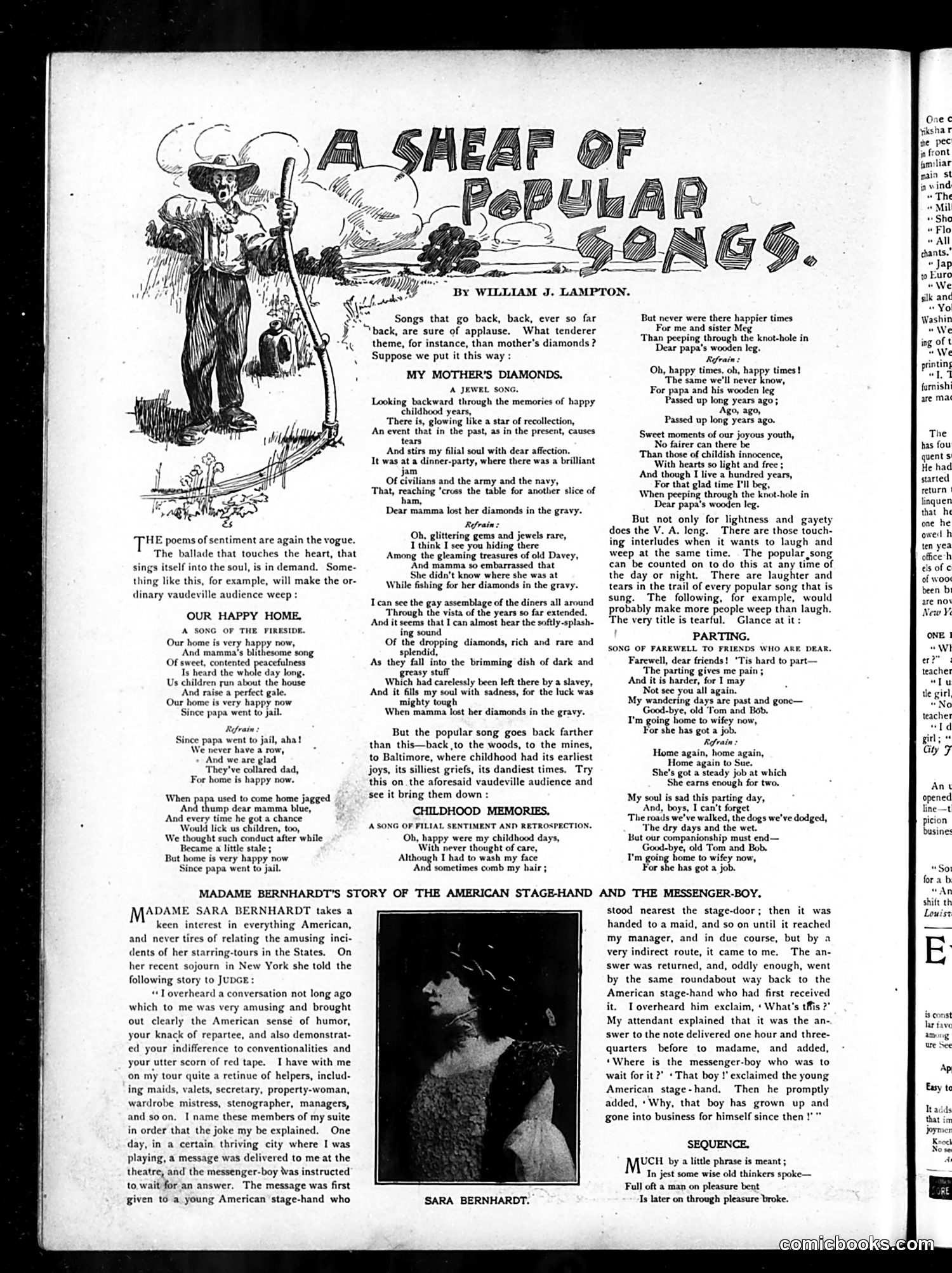
This page satirizes the vogue for sentimental songs in vaudeville entertainment. William J. Lampton parodies overly maudlin "popular songs" by writing deliberately absurd lyrics that juxtapose tear-jerking sentiment with ridiculous premises. The satire works by taking the *form* of heartfelt ballads seriously while filling them with absurd content: a child singing happily because his father went to jail (replacing domestic violence), a mother losing her diamonds in gravy at a dinner party, and nostalgic memories of peeping through a wooden-legged father's prosthetic limb. The joke targets vaudeville audiences' predictable emotional responses—Lampton suggests they'll cry at anything framed as sentimental, regardless of how nonsensical the actual subject matter is. This is social satire about mass entertainment and lowbrow taste, mocking both the songs and the audiences who enjoy them uncritically. The page also includes an unrelated article about actress Sarah Bernhardt.
This page features a humorous poem titled "A Wasted Life," which satirizes American obsession with baseball through the early 1900s. The poem describes a Pennsylvania man who has never attended a baseball game, systematically cataloging all the experiences he's missed—seeing home runs, cheering at games, watching pitchers work, rushing to the park, and the camaraderie of fandom. The satire is gentle but pointed: the poem treats never attending baseball as a genuine tragedy, calling his life "a blank" and "a dreary place." The exaggeration is intentional—baseball fandom is elevated to something almost religious or essential to American identity. This reflects the era when baseball was becoming America's "national pastime," and attendance at games was viewed as a core American experience. The joke mocks both the sport's cultural prominence and fans' passionate devotion to it. The byline attributes the poem to the *Birmingham Age-Herald*, a regional newspaper. The page also contains unrelated advertisements and brief humor columns typical of Judge's format.
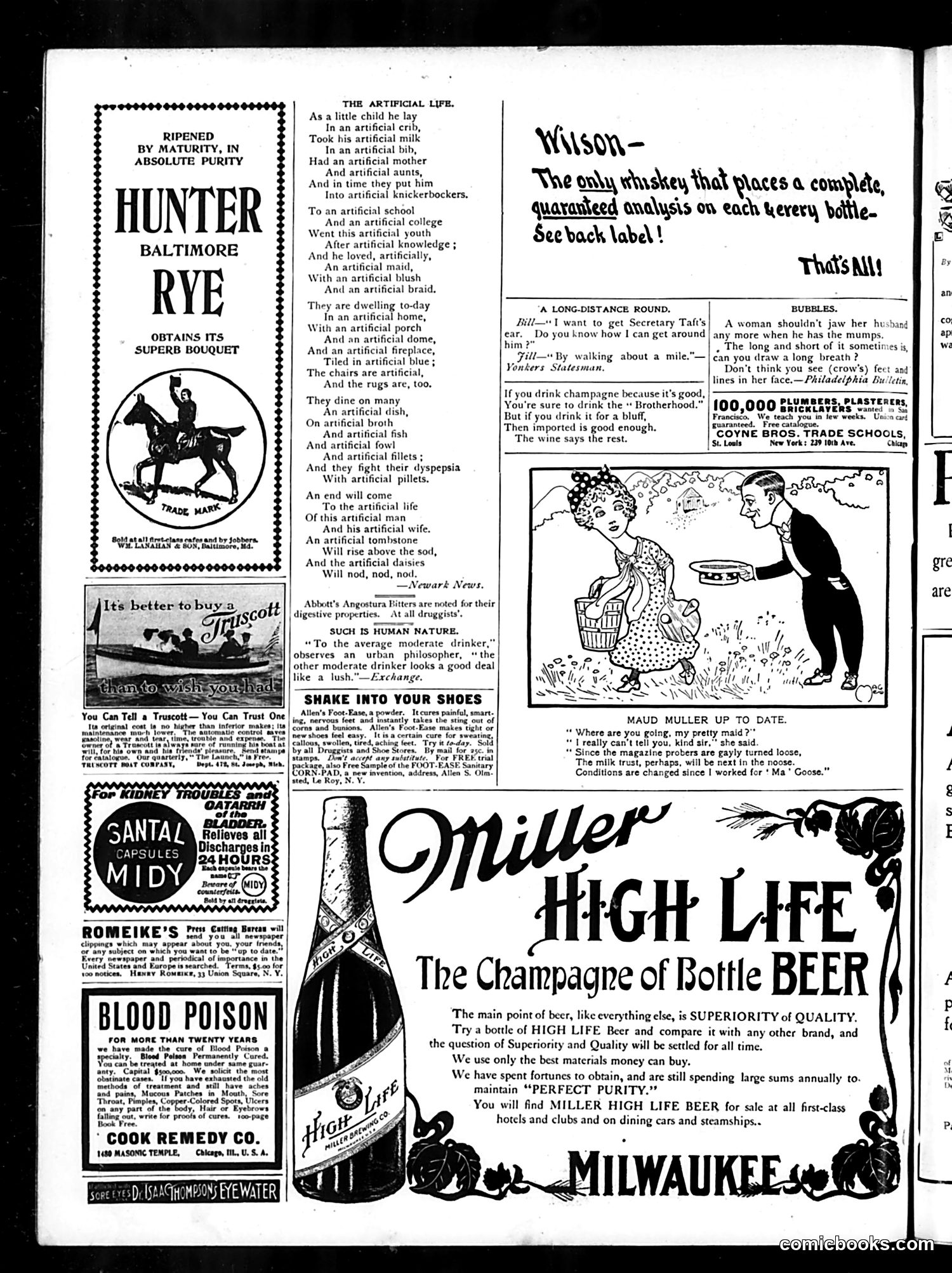
This page is primarily **advertising with light humor and social commentary**, typical of Judge magazine's format. **Main Content:** The page features product ads (whiskey, beer, patent medicines) interspersed with brief satirical pieces. "The Artificial Life" is a poem mocking consumer culture and materialism—a man lives entirely surrounded by artificial/manufactured goods, even fighting "dyspepsia" (indigestion) with artificial pills. The satire targets early 20th-century anxious consumerism. **The "Maud Muller" cartoon** references a famous 19th-century poem, updating it to modern times. The joke: instead of romantic pastoral concerns, the maid now worries about "magazine probers" investigating trusts (monopolies). This references contemporary "muckraking" journalism exposing corporate malfeasance—a major political issue of the Progressive Era (roughly 1900-1920). **Cultural Context:** These pieces reflect anxiety about industrialization, artificial products replacing natural ones, and growing corporate power—concerns driving Progressive Era reform movements.
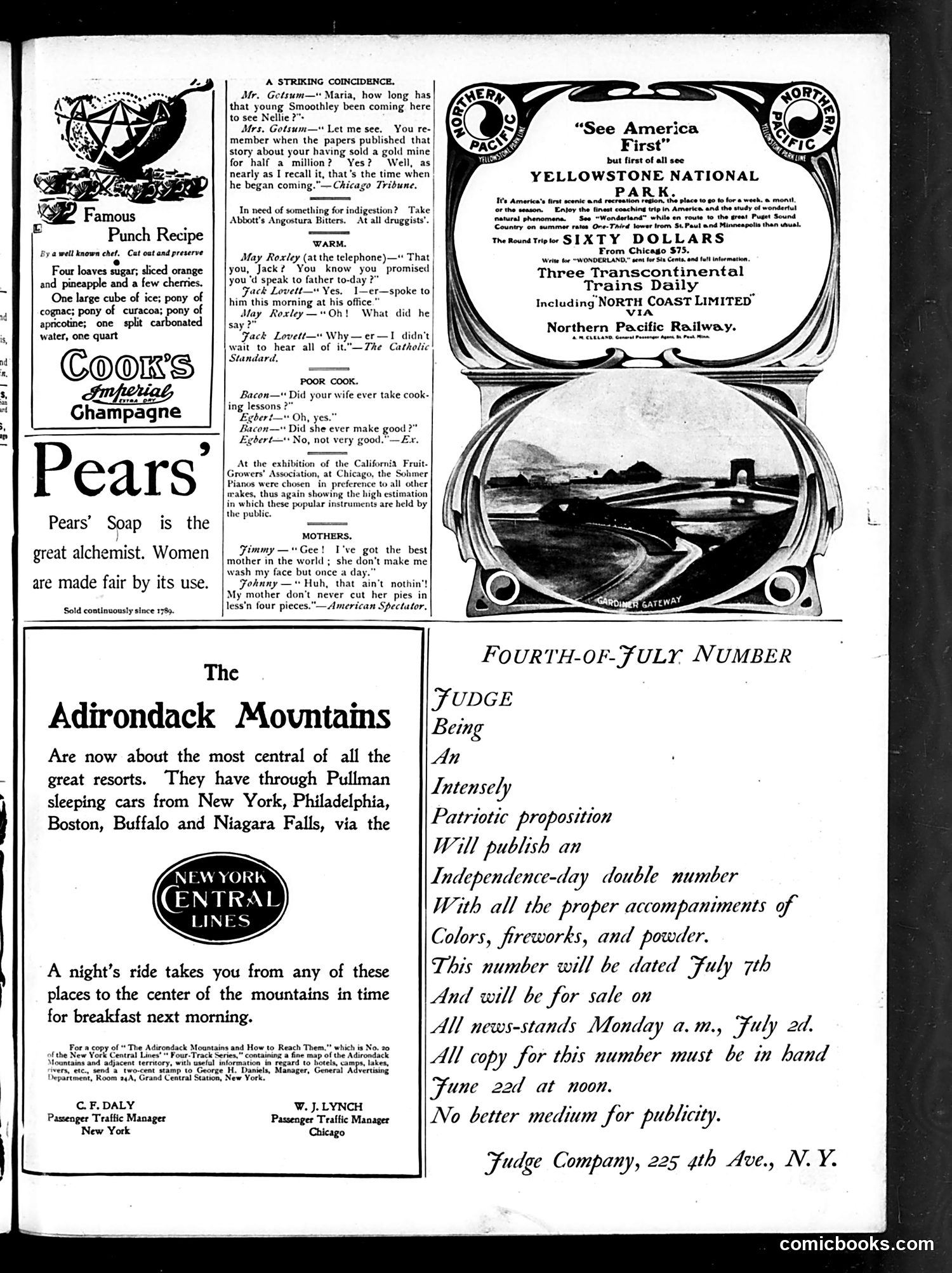
This page contains several brief jokes and advertisements rather than political cartoons. The main humor piece is "A Striking Coincidence," where Mr. and Mrs. Getsum discuss how long a young man named Smoothley has been courting their daughter Nellie. The wife notes he arrived precisely when her husband sold a gold mine for half a million dollars—implying the suitor is clearly interested in the family's newfound wealth rather than genuine affection. It's a straightforward satire of fortune-hunting courtship, a common theme in early 20th-century humor. The page is otherwise filled with advertisements for travel (Yellowstone, Adirondacks), Cook's champagne, Pears' soap, and Abbott's bitters, along with various short comedic anecdotes about mothers, cooking, and courtship.
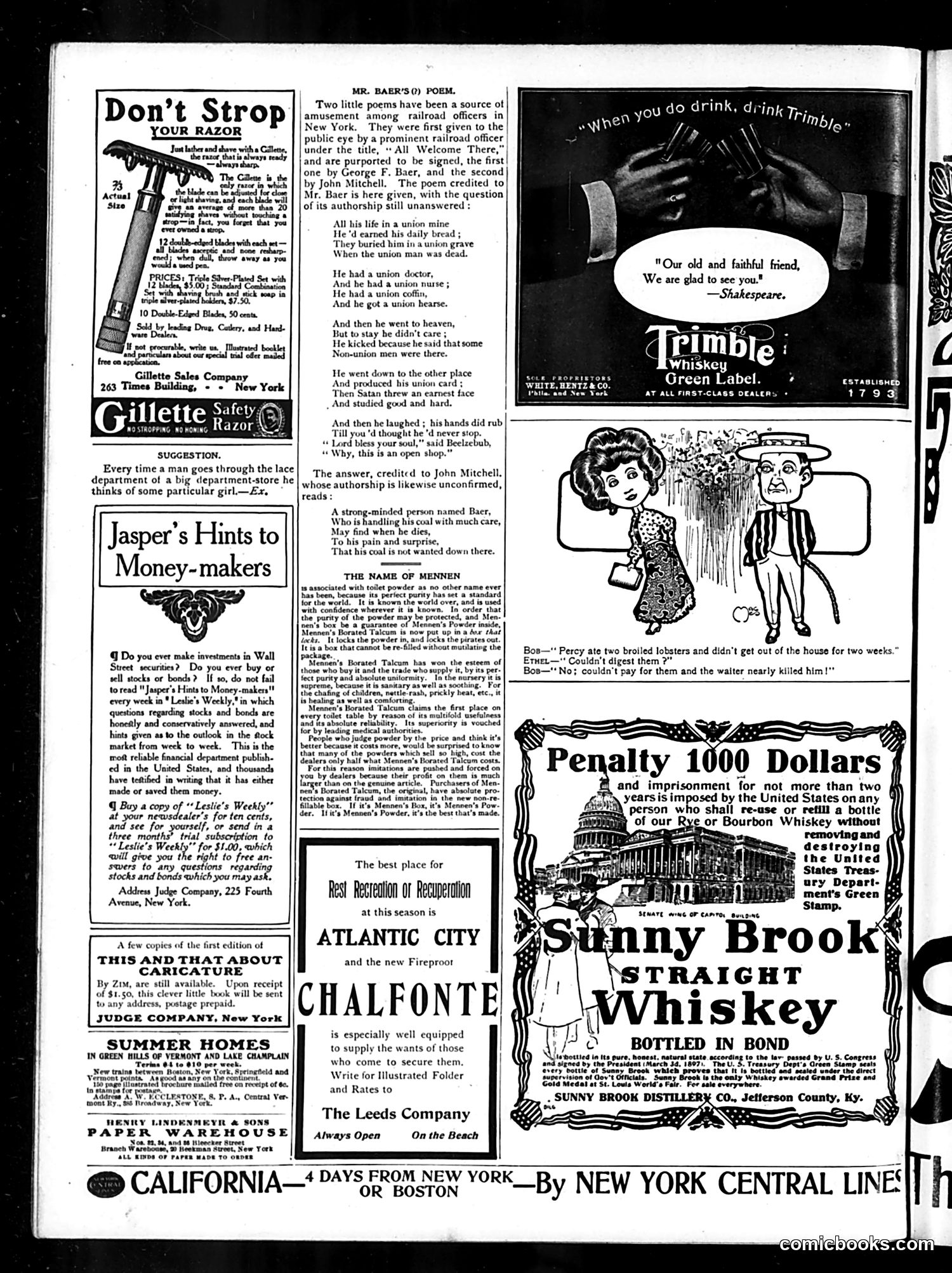
This page primarily features **advertising and satirical poetry** from an era of labor conflict (appears to reference the early 1900s coal strike involving union leader John Mitchell and coal operator George F. Baer). The main content is "Mr. Baer's (?) Poem"—two competing satirical verses mocking each other. The first, attributed to Baer, ridicules a union worker so devoted to unionism that he carries his union card to Hell itself, where even Satan calls it "an open shop" (a workplace without union requirements). Mitchell's response poem mocks Baer, suggesting his coal won't be wanted in the afterlife. The satire reflects real tension between labor and management: Baer represented coal owners' anti-union stance, while Mitchell led the miners' union. The poems use dark humor to lampoon both sides' rigidity. The remainder is typical period advertising for razors, financial advice, whiskey, and travel—with no apparent connection to the labor satire above.

This page is **advertising copy**, not satire or editorial cartoon. It's a Schlitz beer advertisement promoting the brand's purity claims. The ad explains Schlitz's manufacturing process—absolute cleanliness, filtered air cooling, months of aging to prevent digestive issues ("biliousness"), white wood pulp filtration, and bottle sterilization—to justify why the brand deserves premium positioning for purity. The headline "It is Easy" is ironic: the text then demonstrates it's *not* easy, requiring expensive, elaborate processes to achieve genuine purity versus competitors merely claiming it. This reflects early 20th-century beer marketing's emphasis on hygiene and scientific process—particularly relevant post-Prohibition era when consumer trust in beverages required visible assurance of safety and quality.
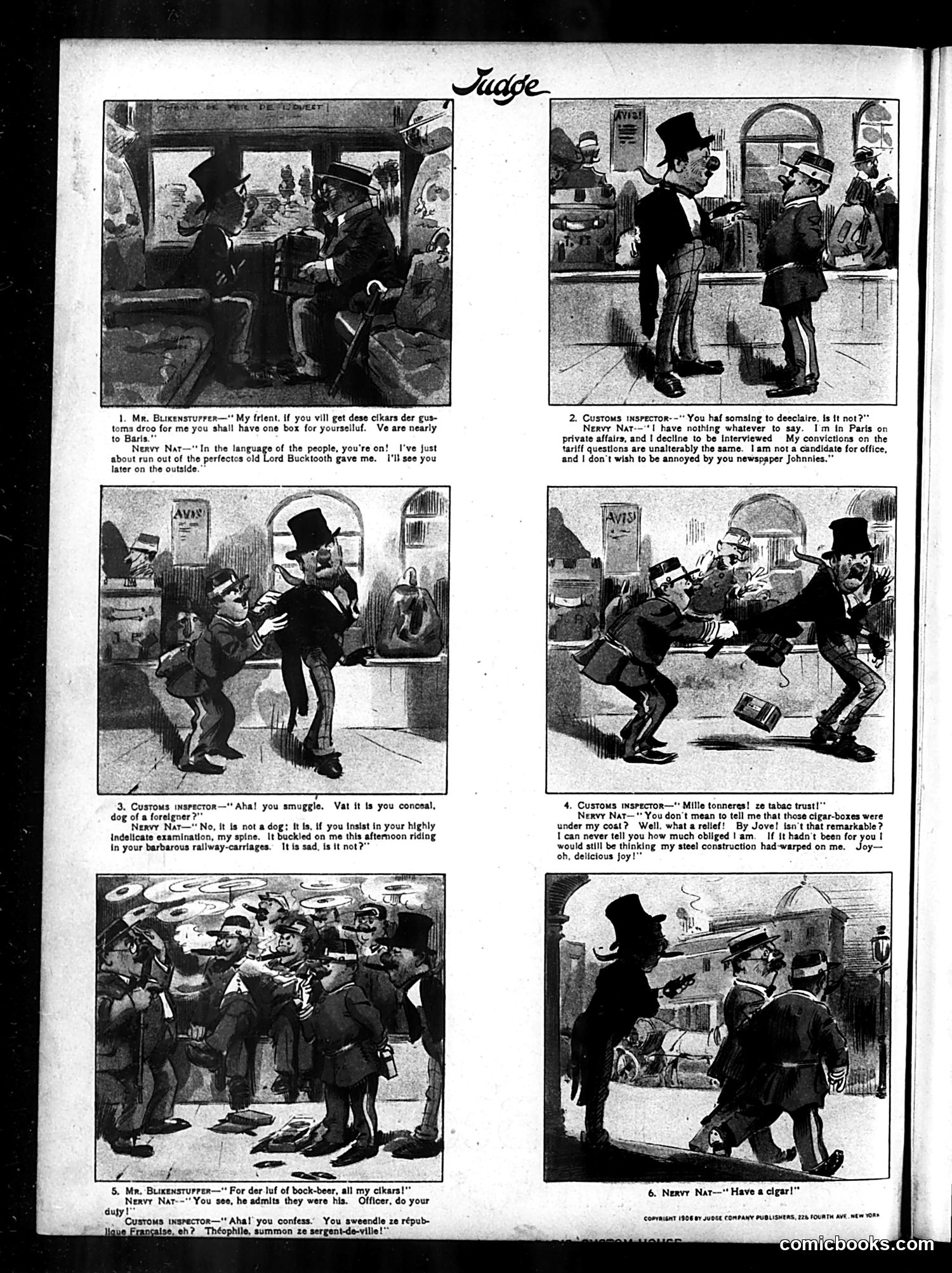
This 1906 Judge comic satirizes smuggling and customs corruption. "Nervy Nat" is an American traveler attempting to smuggle cigars into France. The satire works through Nat's escalating deceptions: he first plays coy with customs, then claims the cigars belonged to his spine (injured from train travel), and finally feigns ignorance about ownership. Meanwhile, a foreign businessman ("Mr. Buxensturrern," depicted with Germanic dialect) has bribed Nat to move the contraband through customs. The joke hinges on Nat's smooth-talking ability to manipulate the bumbling French customs inspector, who keeps providing Nat excuses or seemingly doesn't realize he's being lied to. The title character lives up to his name—he's "nervy" enough to bribe officials and fool authorities with absurd explanations. The cartoon mocks both smuggling and the ease of corrupting official processes, while poking fun at French bureaucratic incompetence and accent-based ethnic stereotypes common to the era.