
Judge, 1906-06-23 · page 10 of 16
Judge — June 23, 1906 — page 10: what you’re looking at
What you’re looking at
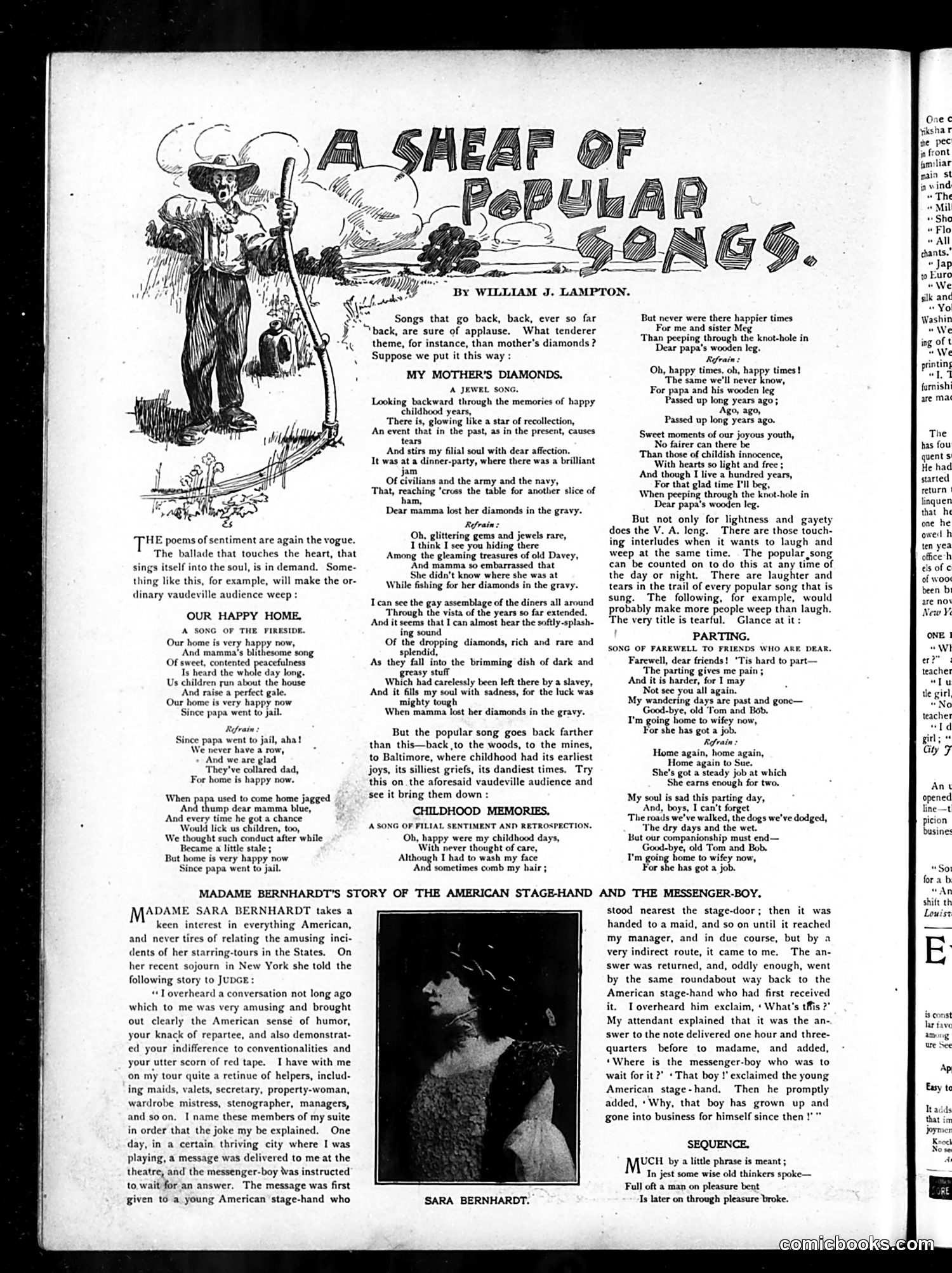
This page satirizes the vogue for sentimental songs in vaudeville entertainment. William J. Lampton parodies overly maudlin "popular songs" by writing deliberately absurd lyrics that juxtapose tear-jerking sentiment with ridiculous premises. The satire works by taking the *form* of heartfelt ballads seriously while filling them with absurd content: a child singing happily because his father went to jail (replacing domestic violence), a mother losing her diamonds in gravy at a dinner party, and nostalgic memories of peeping through a wooden-legged father's prosthetic limb. The joke targets vaudeville audiences' predictable emotional responses—Lampton suggests they'll cry at anything framed as sentimental, regardless of how nonsensical the actual subject matter is. This is social satire about mass entertainment and lowbrow taste, mocking both the songs and the audiences who enjoy them uncritically. The page also includes an unrelated article about actress Sarah Bernhardt.
📄 Transcribed text from this page (OCR, searchable)
Machine-transcribed from the original scan — historical spelling and the odd misread are preserved.
THE poems of sentiment are again the vogue. The ballade that touches the heart, that sings itself into the soul, is in demand. Some- thing like this, for example, will make the or- dinary vaudeville audience weep : OUR HAPPY HOME, A SONG OF THE FIRESIDE. Our home is very happy now, And mamma’s blithesome song Of sweet, contented peacefulness Is heard the whole day long. Us children run about the house And raise a perfect gale. Our home is very happy now Since papa went to jail. Réfrain: nce papa went to jail, aha! We never have a row, And we are glad ‘They've collared dad, For home is happy now. When papa used to come home jagged ‘And thump dear mamma blue, And every time he got a chance Would lick us children, too, We thought such conduct after while Became a little stale ; But home is very happy now ce papa went to jail. Songs that go back, back, ever so far “back, are sure of applause. What tenderer theme, for instance, than mother's diamonds ? Suppose we put it this way : MY MOTHER'S DIAMONDS. A JEWEL SONG. Looking backward through the memories of happy childhood years, There is, glowing like a star of recollection, An event that in the past, as in the present, causes tears And stirs my filial soul with dear affection. It was at a dinner-party, where there was a brilliant jam Of civilians and the army and the nay} That, reaching ‘cross the table for another slice of ham, Dear mamma lost her diamonds in the gravy. Refrai Oh, glittering gems and jewels rare, I think I see you hiding there Among the gleaming treasures of old Davey, ‘And mamma so embarrassed that She didn't know where she was at While fishing for her diamonds in the gravy. Tcan see the gay assemblage of the diners all around ‘Through the vista of the years so far extended, And it seems that I can almost hear the softly-splash- ing sound Of the dropping diamonds, rich and rare and splendid, As they fall into the brimming dish of dark and greasy stuff Which had carelessly been left there by a slavey, And it fills my soul with sadness, for the luck was mighty tough When mamma lost her diamonds in the gravy. But the popular song goes back farther than this—back ,to the woods, to the mines, to Baltimore, where childhood had its earliest joys, its silliest griefs, its dandiest times. Try this on the aforesaid vaudeville audience and see it bring them down : CHILDHOOD MEMORIES. A SONG OF PILIAL SENTIMENT AND RETROSPECTION. Ob, happy were my childhood days, With never thought of care, Although T had to wash my face And sometimes comb my hair; But never were there happier times For me and sister Meg Than peeping through the knot-hole in Dear papa’s wooden leg. Refrain: Oh, happy times, oh, happy times ‘The same we'll never know, For papa and his wooden leg Passed up long years ago; Ago, ago, Passed up long years ago. Sweet moments of our joyous youth, No fairer can there be Than those of childish innocence, With hearts so light and free And though I live a hundred years, For that glad time I'll beg, When peeping through the knot-hole in Dear papa's wooden leg. But not only for lightness and gayety does the V. A. long. There are those touch- ing interludes when it wants to laugh and weep at the same time. The popular song can be counted on todo this at any time of the day or night. There are laughter and tears in the trail of every popular song that is sung. The following, for example, would probably make more people weep than laugh. The very title is tearful. Glance at it : PARTING. SONG OF FAREWELL TO FRIENDS WHO ARE DEAR. Farewell, dear friends! "Tis hard to part— ‘The parting gives me pain ; it is harder, for I may Not see you all again. My wandering days are past and gone— Good-bye, old Tom and Bob. T’'m going home to wifey now, For she has got a job. Refrain Home again, home again, Home again to Sue. She's got a steady job at which She earns enough for two. My soul is sad this parting day, And, boys, I can’t forget ‘The roads we've walked, the dogs we've dodged, he dry days and the wet. But our companionship must end— Good-bye, old Tom and Bob. I'm going home to wifey now, Hor the has got a jos MADAME BERNHARDT’S STORY OF THE AMERICAN STAGE-HAND AND THE MESSENGER-BOY. MAPAME SARA BERNHARDT takes a keen interest in everything American, and never tires of relating the amusing inci- dents of her starring-tours in the States. On her recent sojourn in New York she told the following story to JUDGE: «+ Toverheard a conversation not long ago which to me was very amusing and brought out clearly the American sense of humor, your knack of repartee, and also demonstrat- ed your indifference to conventionalities and your utter scorn of red tape. I have with me ‘on my tour quite a retinue of helpers, includ- ing maids, valets, secretary, property-woman, wardrobe mistress, stenographer, managers, and soon. I name these members of my suite in order that the joke my be explained. One day, in a certain. thriving city where I was playing, a message was delivered to meat the theatre, and the messenger-boy Was instructed to.wait for an answer. The message was first given to a young American stage-hand who SARA BERNHARDT. stood nearest the stage-door; then it was handed to a maid, and so on until it reached my manager, and in due course, but by a very indirect route, it came tome. The an- swer was returned, and, oddly enough, went by the same roundabout way back to the American stage-hand who had first received it. Toverheard him exclaim, * What's this ?° My attendant explained that it was the an- swer to the note delivered one hour and three- quarters before to madame, and added, ‘Where is the messenger-boy who was to wait for it?" «That boy !" exclaimed the young American stage-hand. Then he promptly added, ‘Why, that boy has grown up and gone into business for himself since then ! SEQUENCE, MUSH by a tittle phrase is meant In jest some wise old thinkers spoke— Fall oft a man on pleasure bent Is later on through pleasure broke. The Mil Sho «Flo «All chants.’ «Jap p Euro “We sik and “Yo Washin wWe ing of t We printing 1.1 farnish are mai The has fou quent s He had started return | linquen that he one he owed h ten yea office "h ds of of woo been bi are nov teacher “lu te girl “No teacher picion busines “An Louist E