
A complete issue · 16 pages · 1906
Judge — February 3, 1906
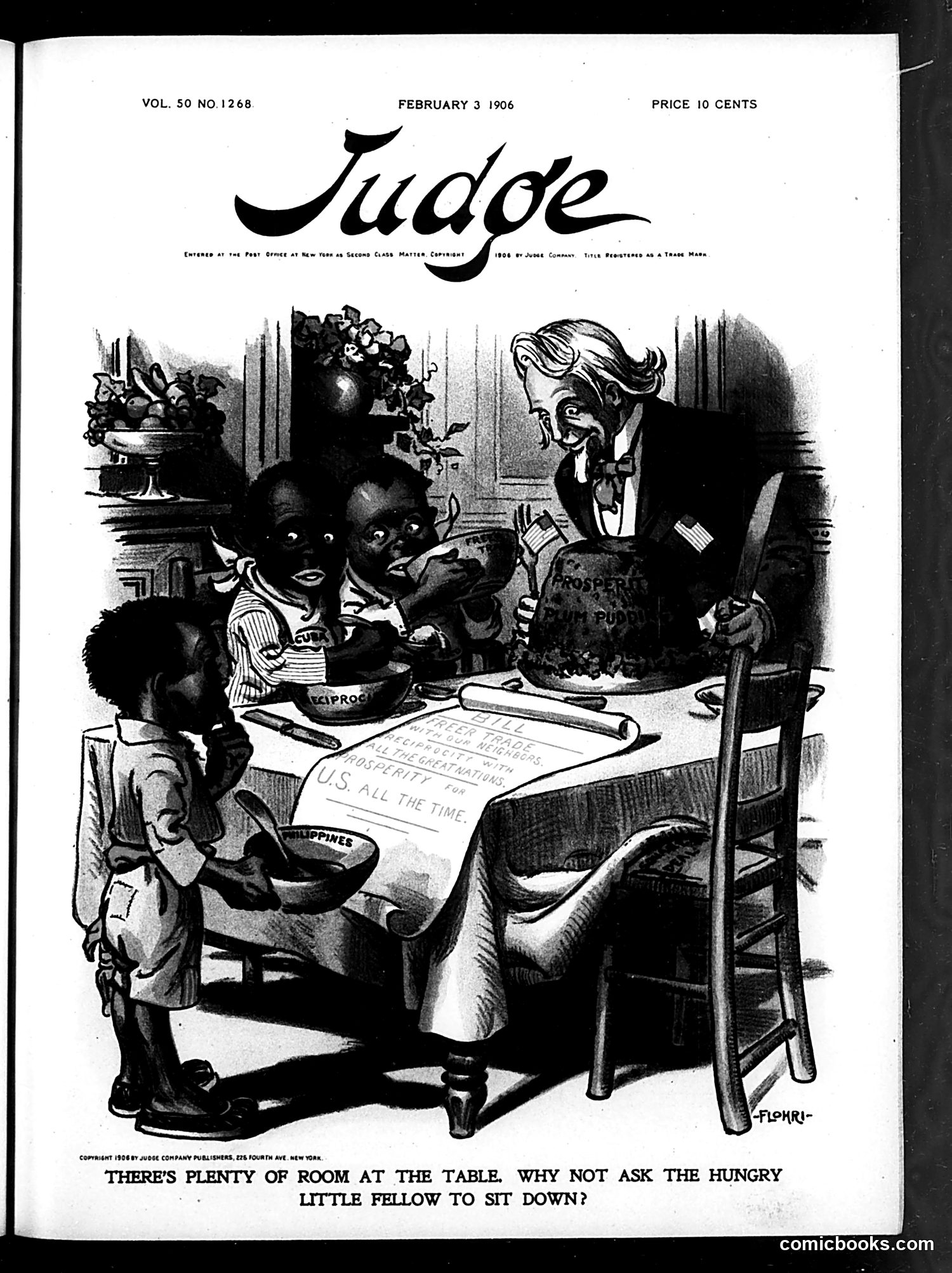
This is a racist political cartoon from the Jim Crow era. The caption reads: "There's plenty of room at the table. Why not ask the hungry little fellow to sit down?" The cartoon depicts a white man and woman at a dining table with what appear to be caricatured Black children with exaggerated features—a common racist visual trope of the period. The document on the table reads "U.S. ALL THE TIME," suggesting commentary on American inclusivity or citizenship. The satire likely critiques perceived hypocrisy: while Americans claimed ideals of equal opportunity and inclusion, actual racial segregation and exclusion were standard practice. The "hungry little fellow" represents excluded Black Americans, while the invitation to "sit down" sarcastically highlights the gap between stated American values and lived reality.
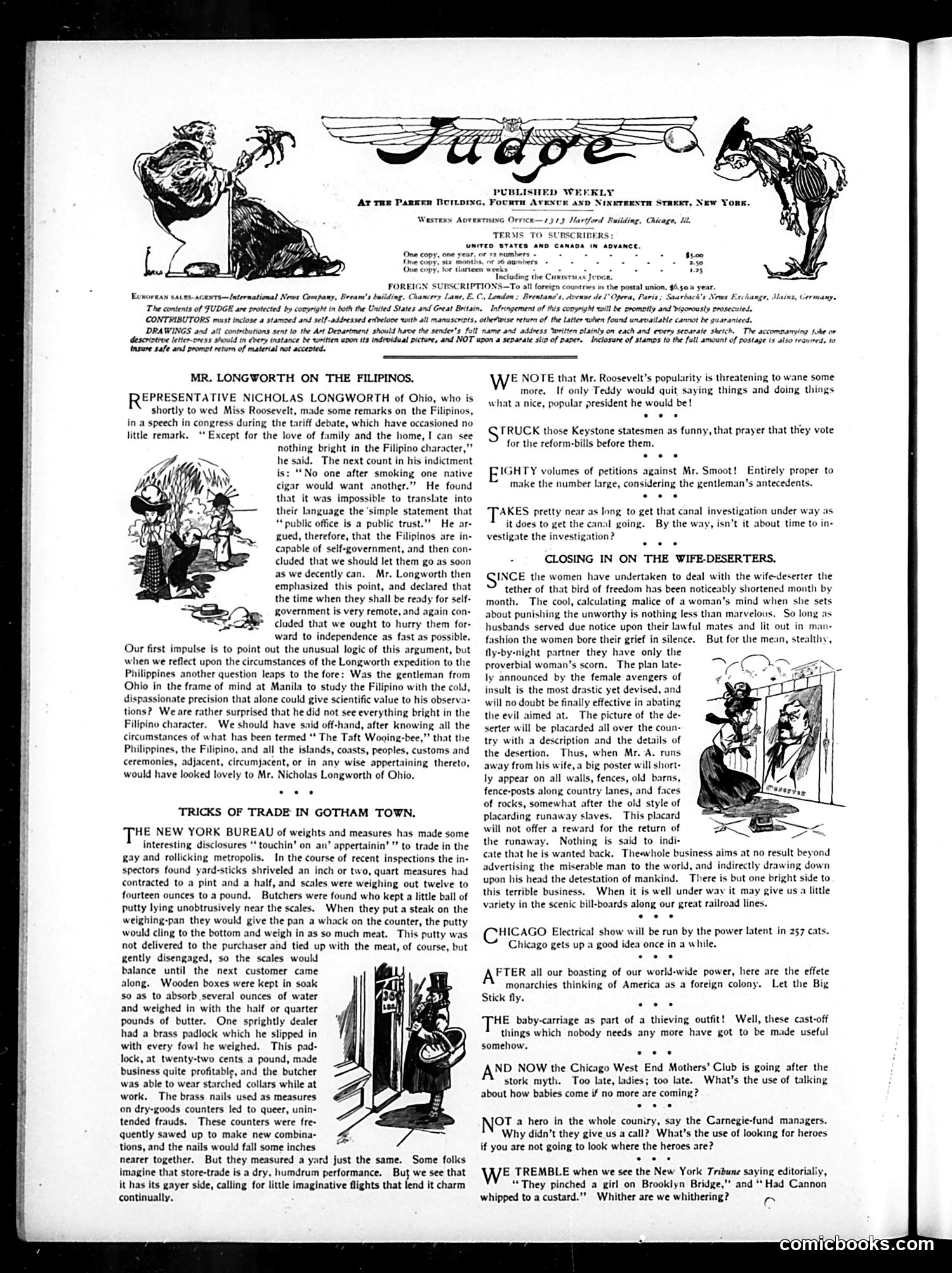
This page contains several political commentaries typical of Judge's satirical approach. The main article discusses **Representative Nicholas Longworth of Ohio**, who defended the Philippines in congressional debate, arguing Filipinos lack readiness for self-government. The satire criticizes Longworth's paternalistic position, suggesting his logic about the Philippines' "unfitness" was flawed and self-serving. Other brief items mock contemporary issues: **Roosevelt's popularity** threatening to eclipse Teddy's influence; **Keystone statemen** voting against reform bills; and critiques of women's "wife-deserter" notices and runaway-husband posters—social problems the magazine treats with dark humor. The page reflects early 1900s imperialist debates and gender dynamics, using sardonic commentary to challenge establishment positions.
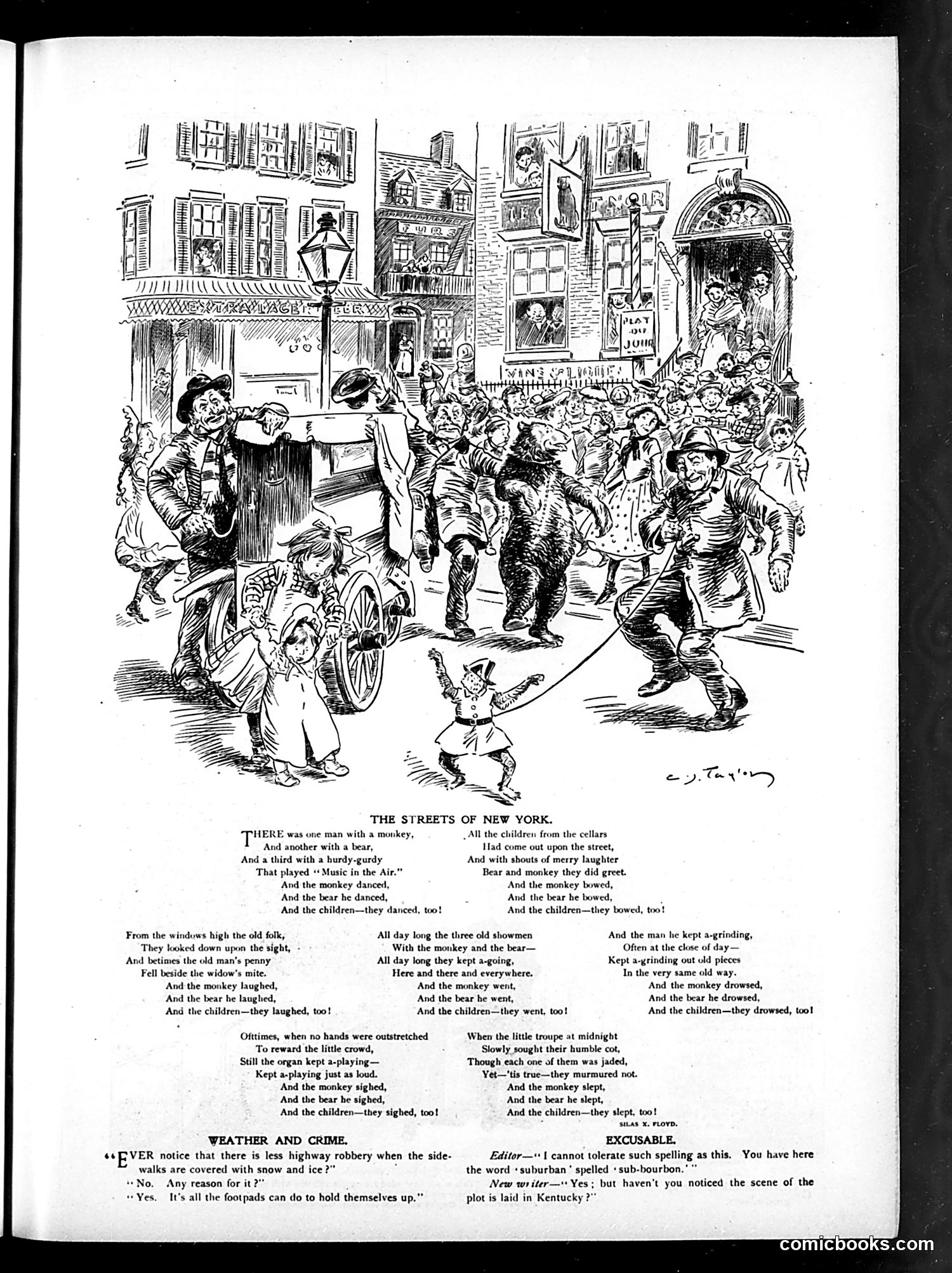
The main illustration depicts "The Streets of New York" with street performers entertaining crowds—a man with a monkey, another with a bear, and a hurdy-gurdy player. The accompanying poem celebrates working-class street entertainment, with children dancing and laughing while watching these humble performers. Below, two brief sections appear: "Weather and Crime" discusses highway robbery being less common in snowy conditions, suggesting footpads cannot operate effectively. "Excusable" presents an editorial exchange where a writer defends misspelling "suburban" as "sub-burban," joking that Kentucky's rural setting justifies such errors. The page satirizes urban street life and contains editorial humor typical of Judge's social commentary, though the specific historical context remains unclear without additional dating information.
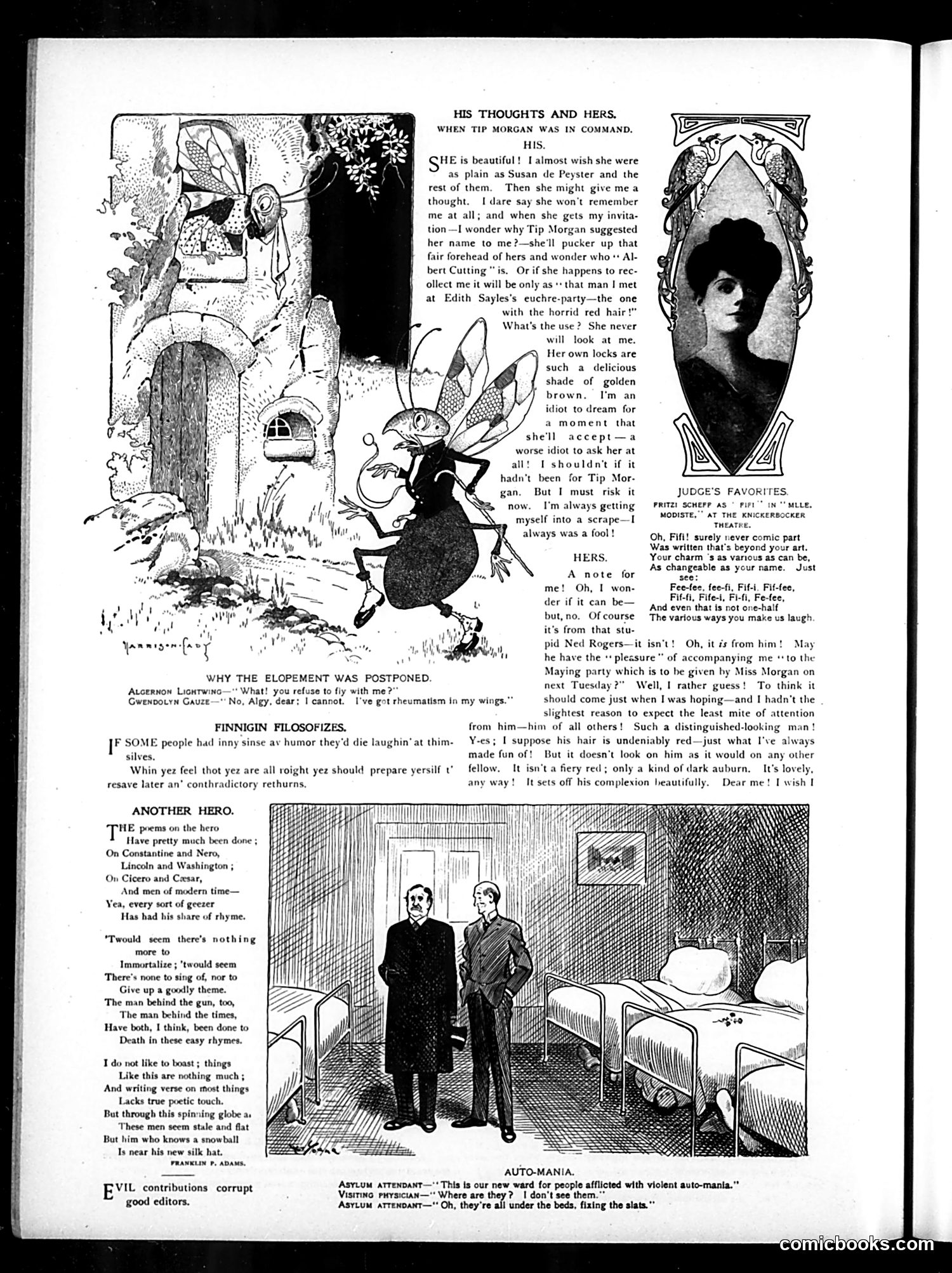
This page contains several satirical pieces typical of early 20th-century Judge magazine: **"Why the Elopement Was Postponed"** features an anthropomorphic ant character, likely making light of romantic complications through animal humor—a common Judge format. **"Judge's Favorites"** appears to be a humorous poem mocking someone named "Fritzi Schepp" and references to changing names and making people laugh, suggesting commentary on a public figure (possibly an entertainer), though the specific individual is unclear without additional context. **"Auto-Mania"** uses an asylum setting to satirize the era's growing automobile obsession, with asylum attendants explaining that patients are "under the beds, filing the slats"—implying people are so obsessed with cars they've lost their minds. The page exemplifies Judge's blend of social satire, wordplay, and illustrated humor targeting contemporary American trends and personalities.
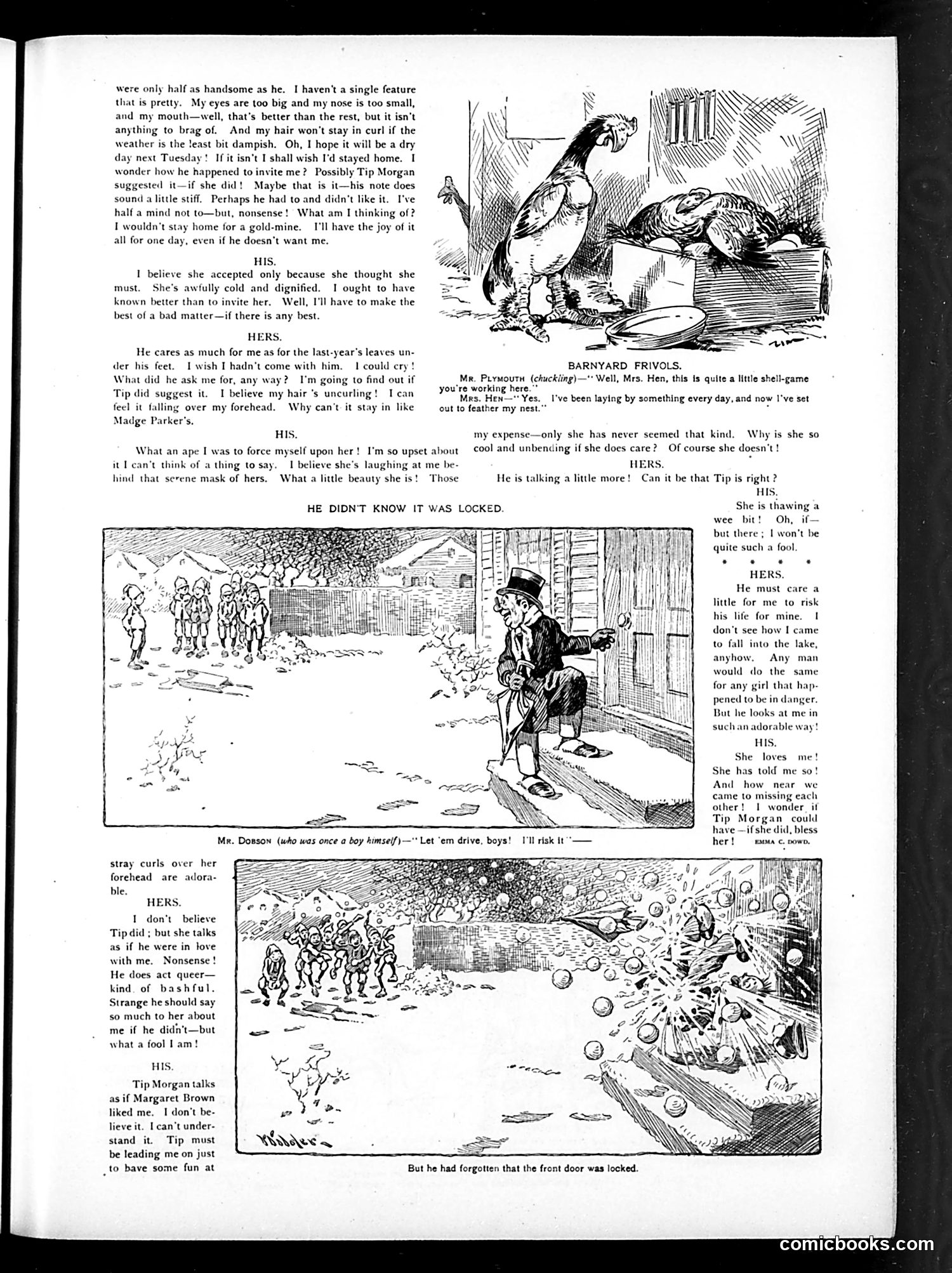
This page appears to be from a serialized romantic story rather than political satire. The narrative concerns a male character's internal conflict about courting a woman. The text presents alternating "HIS" and "HERS" perspectives on their relationship—he's anxious and self-doubting, she's distant and dignified. The illustrations show: 1. A man (Mr. Dobson) at a cottage door with children present 2. A domestic scene with people in what appears to be a yard or garden The story's humor derives from the romantic miscommunication between characters and social awkwardness, not political commentary. References to "Tip Morgan" and "Margaret Brown" appear to be character names within this narrative. This is domestic comedy-drama typical of Judge magazine's entertainment content rather than satirical commentary.
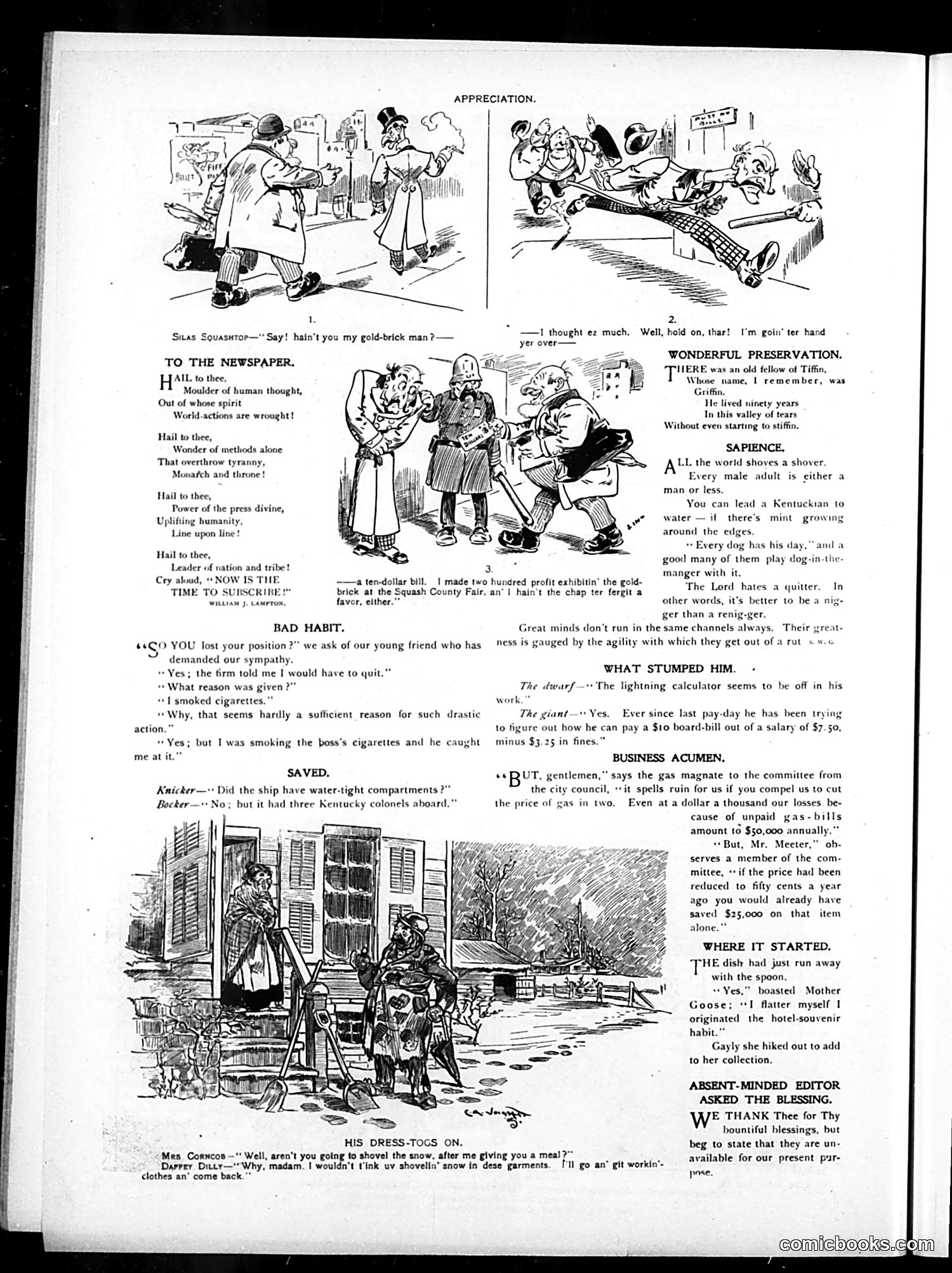
This page contains miscellaneous satirical pieces typical of early 20th-century American humor magazines. **Main Cartoons:** 1. **"Appreciation"** (top left): A mock-heroic poem praising newspapers, ending with a commercial plea to "subscribe now"—satirizing how publications mix lofty ideals with crude advertising. 2. **"Bad Habit"** (center): A young man loses his job for smoking—but the joke is he was smoking *his boss's* cigarettes. It mocks both overly strict employers and employees who steal from work. 3. **"Saved"** (lower left): A ship has water-tight compartments *and* "three Kentucky colonels aboard." The joke plays on the period stereotype of Kentuckians as tough, indestructible characters. 4. **"His Dress-Togs On"** (bottom): A poor man refuses to shovel snow while wearing borrowed fancy clothes, prioritizing appearance over earning meals. The remaining items are short joke pieces about absent-mindedness, business greed, and folk-tale references—typical filler content for humor magazines of this era.
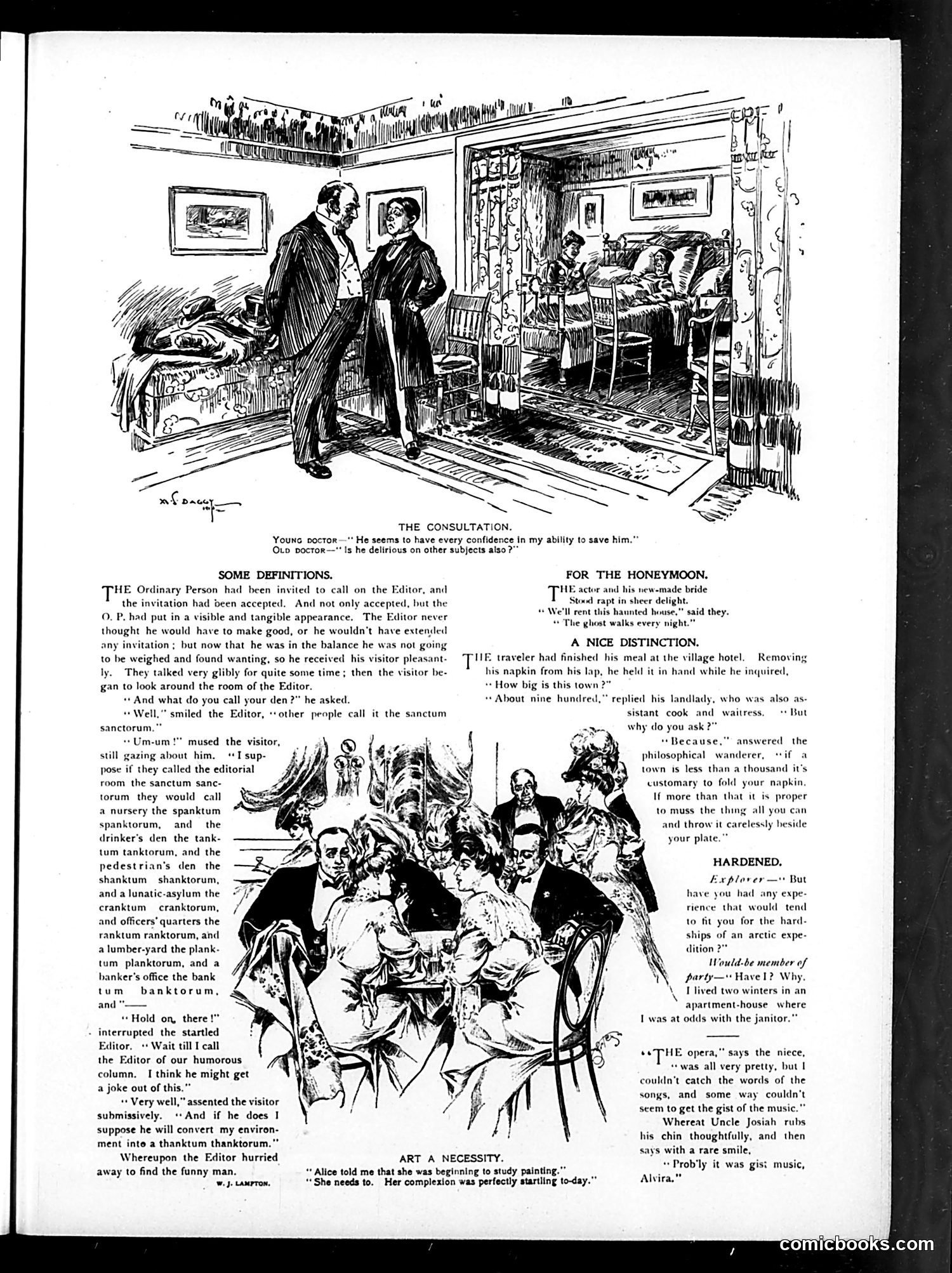
This page contains multiple humorous sketches satirizing early 20th-century social conventions and professional pretensions. **Top cartoon:** A young doctor consults with an older physician about a patient. The joke plays on medical confidence—the young doctor expresses absolute certainty he can save the patient, prompting the older doctor to ask if the patient is "delirious on other subjects also?" The satire targets professional overconfidence and youthful arrogance in medicine. **Main illustration:** An editor receives a visitor in his office. The visitor creates an elaborate linguistic joke, coining faux-Latin terms ("spanktum spanktorum," "tanktum tanktorum") by applying the editor's pretentious phrase "sanctum sanctorum" to other professions and locations. The satire mocks editorial pomposity and overwrought language. **Smaller sketches:** Various brief anecdotes satirize social pretension—honeymoon expectations, hotel etiquette regarding napkins (class-based), arctic expedition readiness, and opera appreciation. All mock either social climbing or professional pretense. The page's overall theme: deflating American middle-class vanity and professional self-importance through linguistic and social humor.
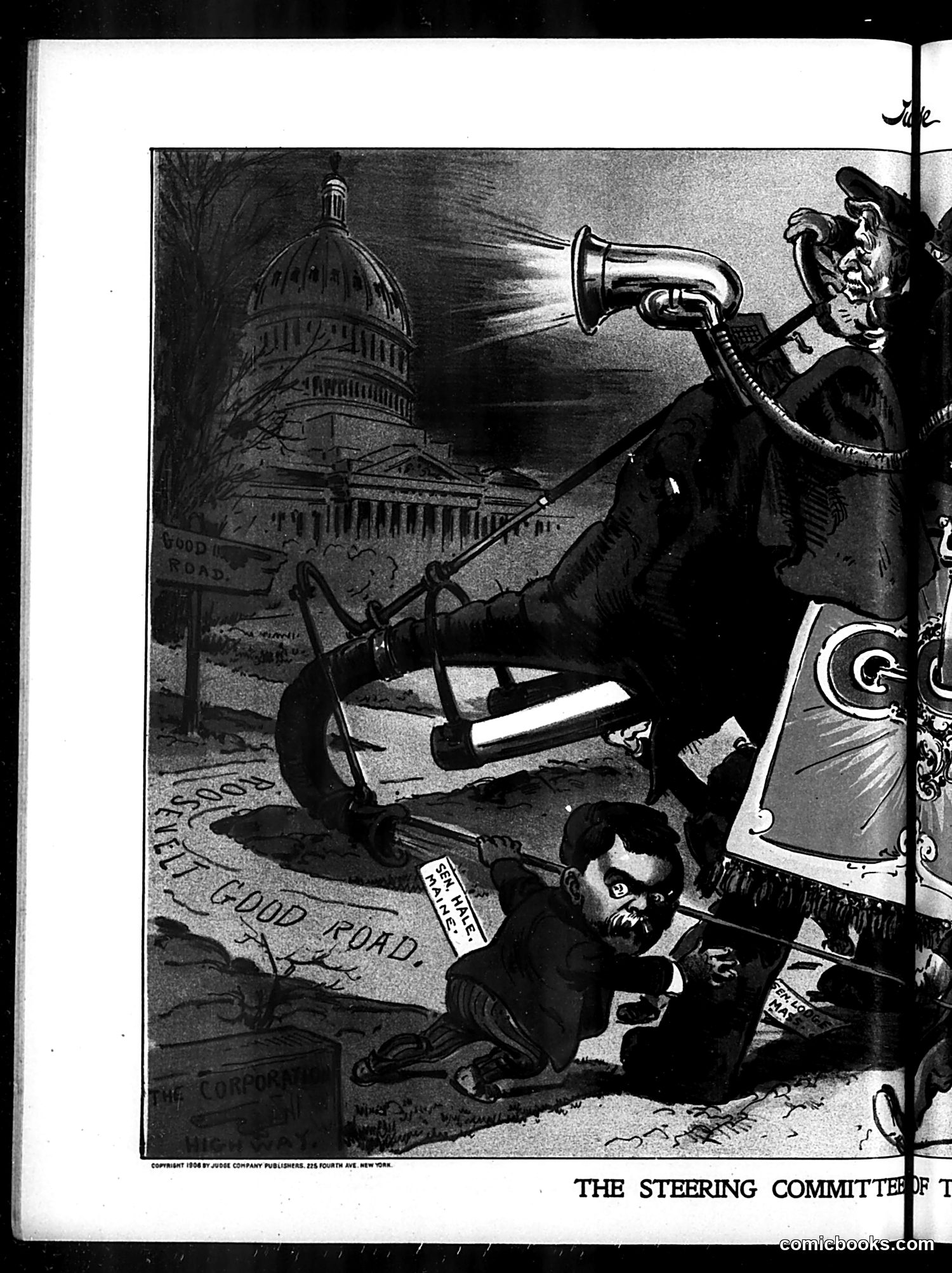
This 1906 Judge magazine cartoon satirizes political control of Congress. A caricatured figure (likely representing a powerful political boss or corporate interest) stands atop the Capitol building, literally steering it like a ship's wheel while blowing a trumpet/megaphone toward the building. Below, a small, submissive figure labeled "Congress" crawls obediently on the ground near a "Good Road" sign. The satire critiques how special interests and political machines controlled legislative decisions rather than elected representatives acting independently. The image suggests Congress was merely a puppet following commands from unseen power brokers, unable to chart its own course or serve public interest. This reflects Progressive Era concerns about corporate influence and political corruption in American government.
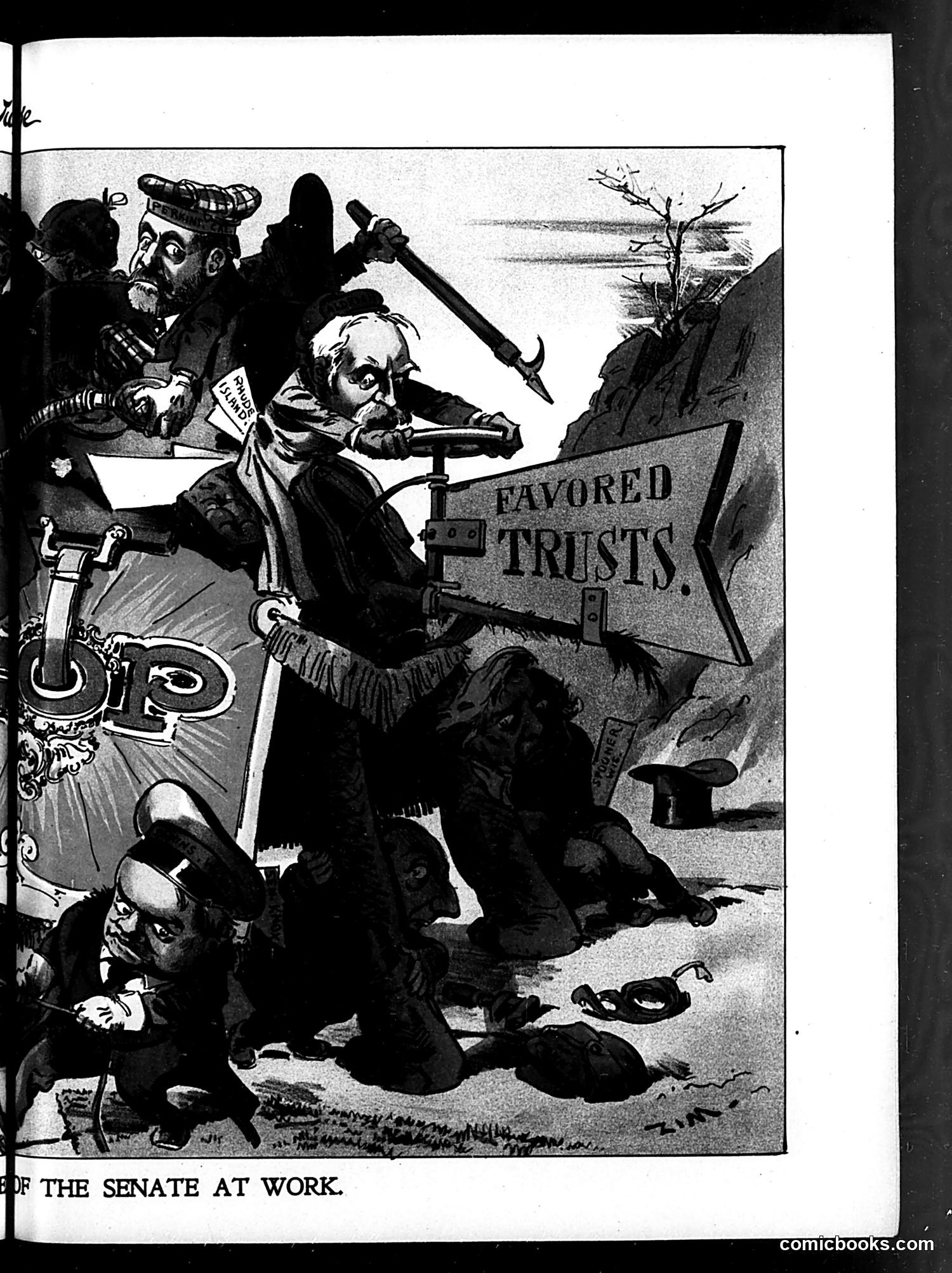
This Judge magazine cartoon satirizes corrupt political collusion, specifically targeting **favored trusts**—the monopolistic business cartels that dominated American politics in the early 20th century. The image depicts senators as tools of corporate interests. A figure with a telescope represents political myopia or willful blindness to wrongdoing. The caricatured men appear to be senators actively serving trust interests rather than the public good. The dead bodies and tools of destruction scattered below suggest the human cost of unchecked monopolies—economic devastation for ordinary citizens. The "$" symbol visible on the left emphasizes money's corrupting influence. The cartoon's title and "Favored Trusts" label make explicit that the Senate operates not to regulate these monopolies, but to protect them—a common Progressive Era critique of Senate corruption and the need for reform.
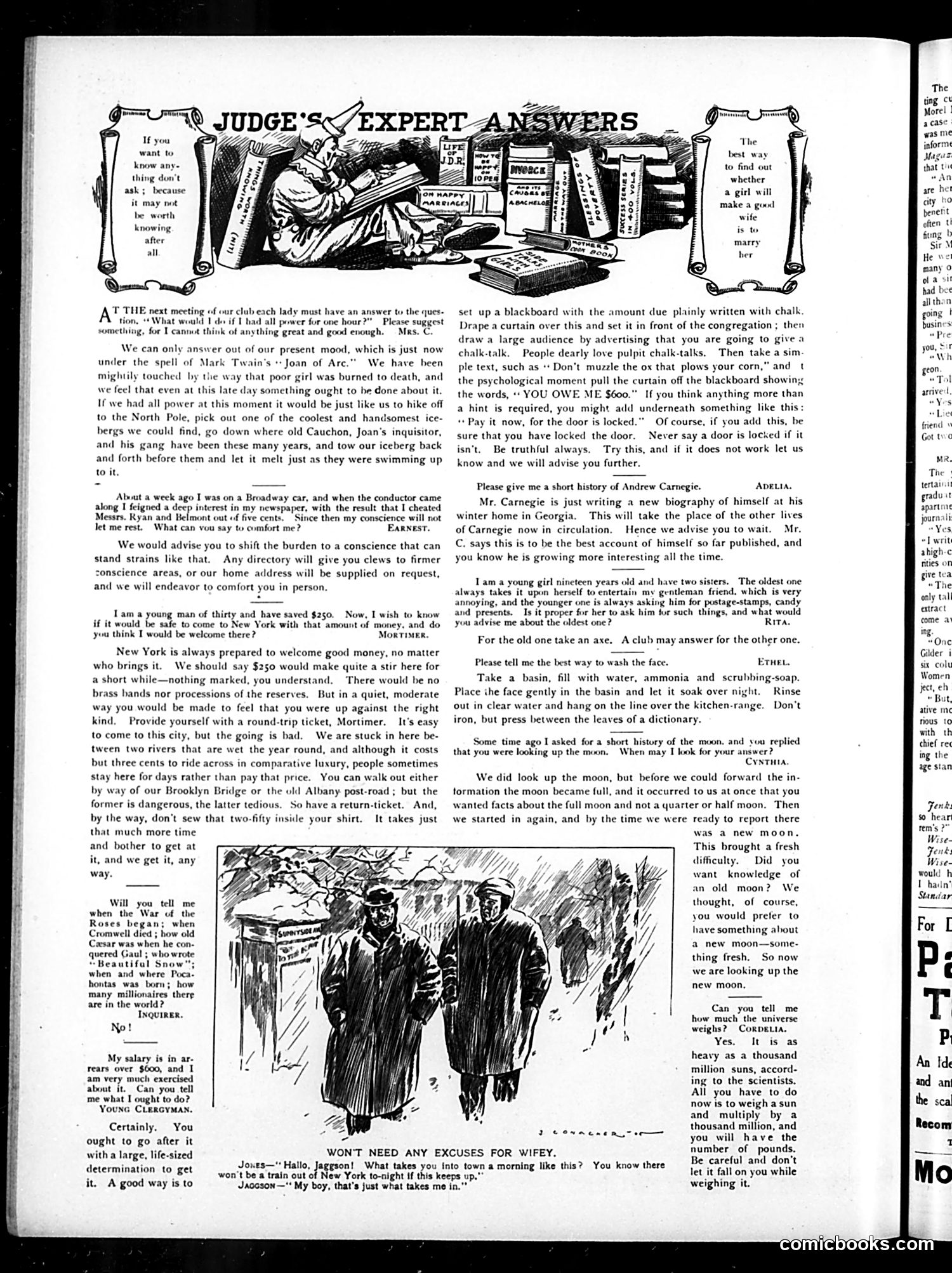
This is an advice column page from Judge magazine, a major American satirical publication. The header features a cartoonish illustration of someone drowning in books and papers—visual humor about the overwhelming nature of advice-giving. The content consists of humorous Q&A responses to readers' questions. Notable elements include: **The Joan of Arc reference**: One writer, inspired by Mark Twain's recent novel, fantasizes about dragging an iceberg to hell to torment the medieval inquisitor Cauchon—dark satirical humor about literary influence. **The Broadway fare-cheating confession**: A reader admits cheating a conductor of five cents and seeks moral comfort; the magazine sarcastically suggests finding a "conscience that can stand strains like that." **The $250 visitor**: A young man asks if $250 is enough to visit New York. The response humorously suggests it will attract attention but warns that leaving the city is harder than entering—a jab at New York's appeal and difficulty escaping. **The Andrew Carnegie answer** (partially visible): Sarcastically notes Carnegie is writing his own biography, mocking wealthy industrialists' self-promotion. The tone throughout is witty, irreverent social commentary typical of Judge's satirical approach.
This page is primarily **advertising and light humor** rather than political satire. The content includes: **Humor pieces:** - "A Trick on Sir Morel": Anecdote about Sir Morel Mackenzie (a real Victorian-era surgeon), tricked into performing free operations in Antwerp by being told his patient died - "Ms. Gilder's Judicious Reply": Woman journalist's quip about Richard Watson Gilder (real editor of *The Century* magazine), who dismissively tells her the chief requirement for young women in literature is "postage stamps" - Brief joke items ("Saving Himself," "Over a Habit") **Advertisements:** Large product ads for Parker's Tar Soap, Williams' Shaving Soaps, Liquid Pistol (likely a firearm), and Evans bottle (depicted inverted). The satire is mild and personal rather than political—targeting individual figures and social pretensions rather than broader issues. This appears to be a typical Judge magazine page mixing gossip-style humor with advertising.
This page from the satirical magazine *Judge* is primarily **advertising and light humor** rather than political commentary. The main content includes: **"Hopeless Case"** — A humorous poem about "Bill Jones," a man immune to pessimism. Despite warnings about financial ruin and legal deficiency, he dismisses concerns with "Oh, pshaw!" The joke satirizes stubborn optimism or willful ignorance in the face of legitimate concerns—likely referencing early 20th-century economic anxiety. **"Wilson - That's All!"** — The large illustration shows a couple, apparently referencing President Wilson, though the specific satire is unclear from visible text. The remaining content is **pure advertising**: Hunter Baltimore Rye whiskey, children's story pictures, investment advice columns, and patent medicines (blood poison cure, kidney remedies). The page reflects *Judge's* format: mixing light social satire with commercial pitches, targeting middle-class readers interested in investments and consumer goods. The humor is gentle rather than biting.
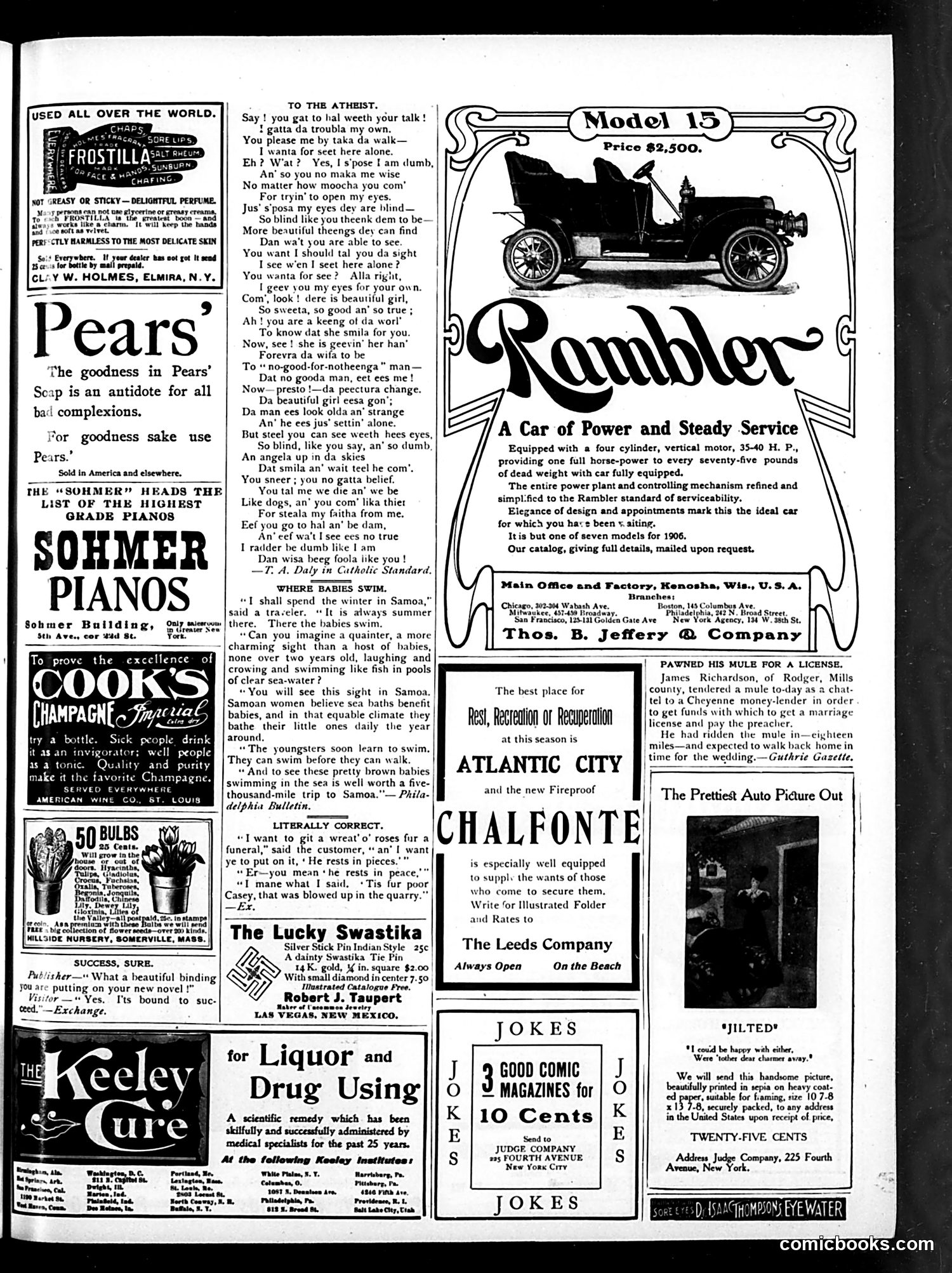
This page is primarily **advertisements and miscellaneous content** rather than political satire. The main notable item is a poem titled "TO THE ATHEIST." ## The Atheist Poem Written in dialect (attributed to T.A. Daly), this poem presents a working-class immigrant perspective defending religious faith against atheist arguments. The speaker—using heavy phonetic dialect suggesting an Italian or Eastern European accent—argues that faith provides comfort and beauty that reason cannot explain. He contrasts an atheist's claims of superior logic with his own experience of finding meaning in love, family, and hope for the afterlife. The satire targets atheist intellectuals as arrogant and unfeeling, positioning simple faith as superior to rationalist skepticism. ## Page Context The remaining content consists of period product advertisements (Pears' Soap, Sohmer Pianos, Rambler automobiles, Cook's Champagne, etc.) and brief miscellaneous items. One anecdote describes a man pawning his mule to pay for a marriage license—a folksy humor piece. The page reflects early 1900s concerns about secularism and immigration alongside consumer culture marketing.
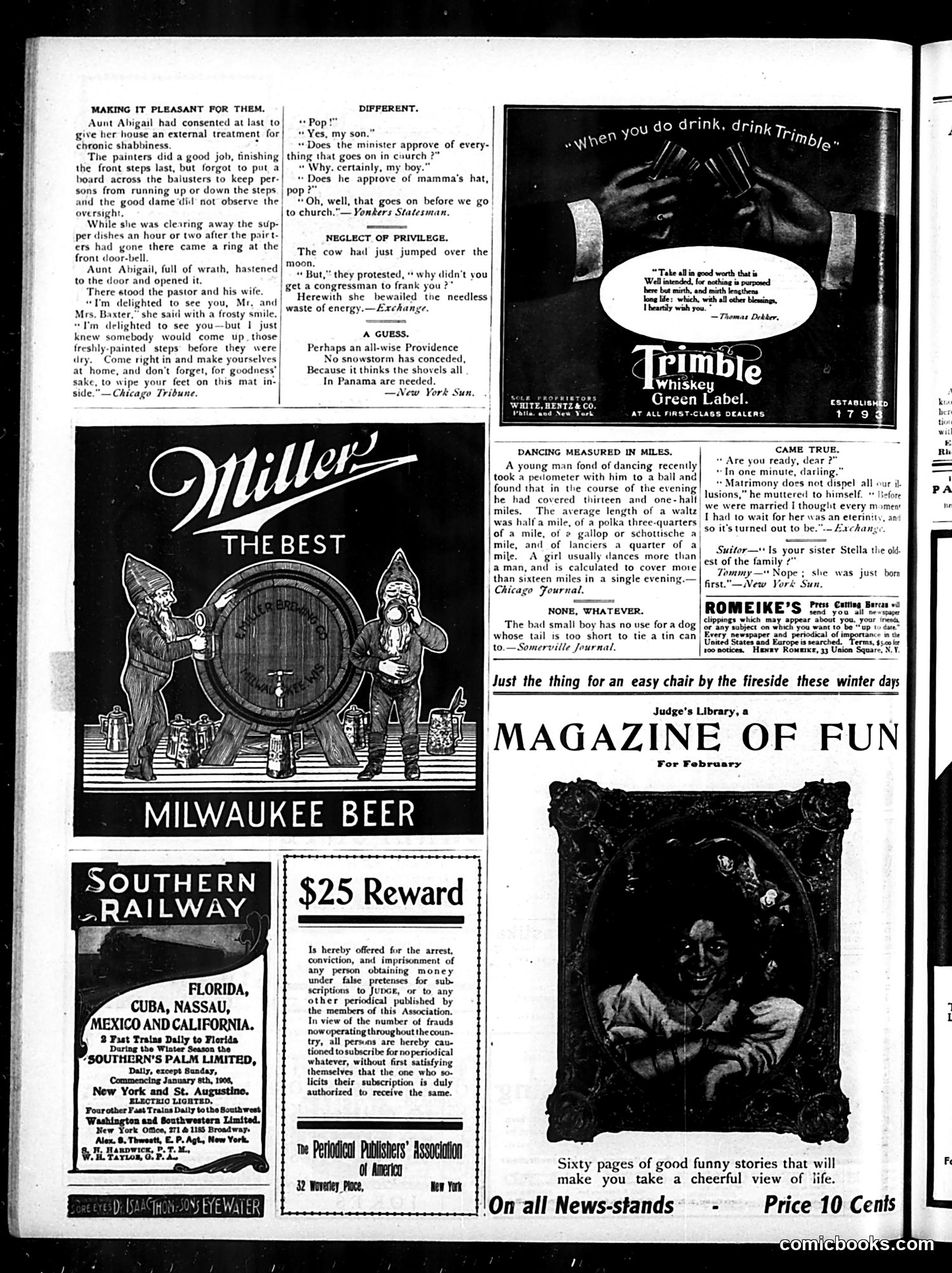
This page is primarily **advertising and filler content** from Judge magazine, with several short humorous anecdotes rather than political cartoons. The brief jokes satirize everyday American life around 1906: - **"Making It Pleasant for Them"** mocks social courtesy—a woman pointedly welcomes guests to freshly painted steps she knows will soil their clothes, passive-aggressively punishing their intrusion. - **"Different"** jokes about a minister's selective morality: he approves church doctrine but not a woman's fashionable hat—poking fun at religious hypocrisy about vanity. - **"Neglect of Privilege"** references a cow jumping over the moon (nursery rhyme nonsense) to satirize government waste: why didn't she use a congressman's franking privilege (free mailing)? This mocks congressional perks. - **"A Guess"** blames the Panama Canal project for America's snow shortages—topical satire about the ongoing construction (1881-1914). The remainder is **advertisements** for Miller Beer, Southern Railway, and other products—standard magazine filler of the era.
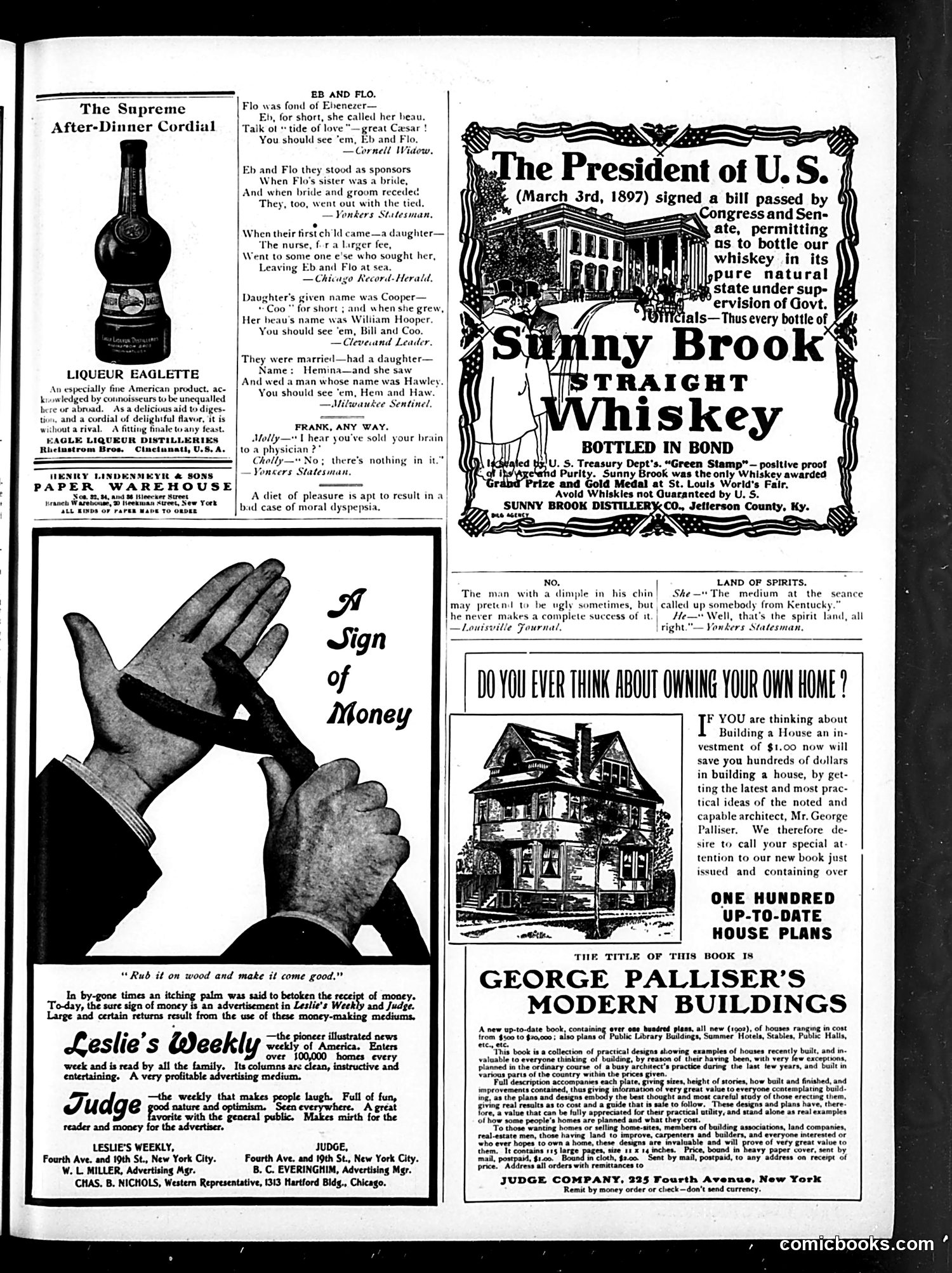
This page is primarily **advertising**, with minimal editorial content. The main items are: **Top Left:** "The Supreme After-Dinner Cordial" advertises Liqueur Eaglette, promoting it as an American digestif. **Top Right:** A large advertisement for **Sunny Brook Straight Whiskey**, emphasizing that President McKinley signed legislation (March 3, 1897) permitting whiskey to be bottled under government supervision—a "bottled in bond" guarantee of purity and proof. The ad claims Sunny Brook won awards at the St. Louis World's Fair. **Lower Left:** A brief joke about money-making, promoting *Leslie's Weekly* and *Judge* magazines as effective advertising mediums. **Lower Right:** An advertisement for architect George Palliser's book *Modern Buildings*, offering over 100 house plans for $1.00, targeting potential homebuilders. **Scattered humor:** Small jokes about nicknames (Eb and Flo, etc.) and a quip about selling one's brain to a physician. The page reflects early 1900s advertising priorities: spirits, home ownership, and magazine subscriptions.
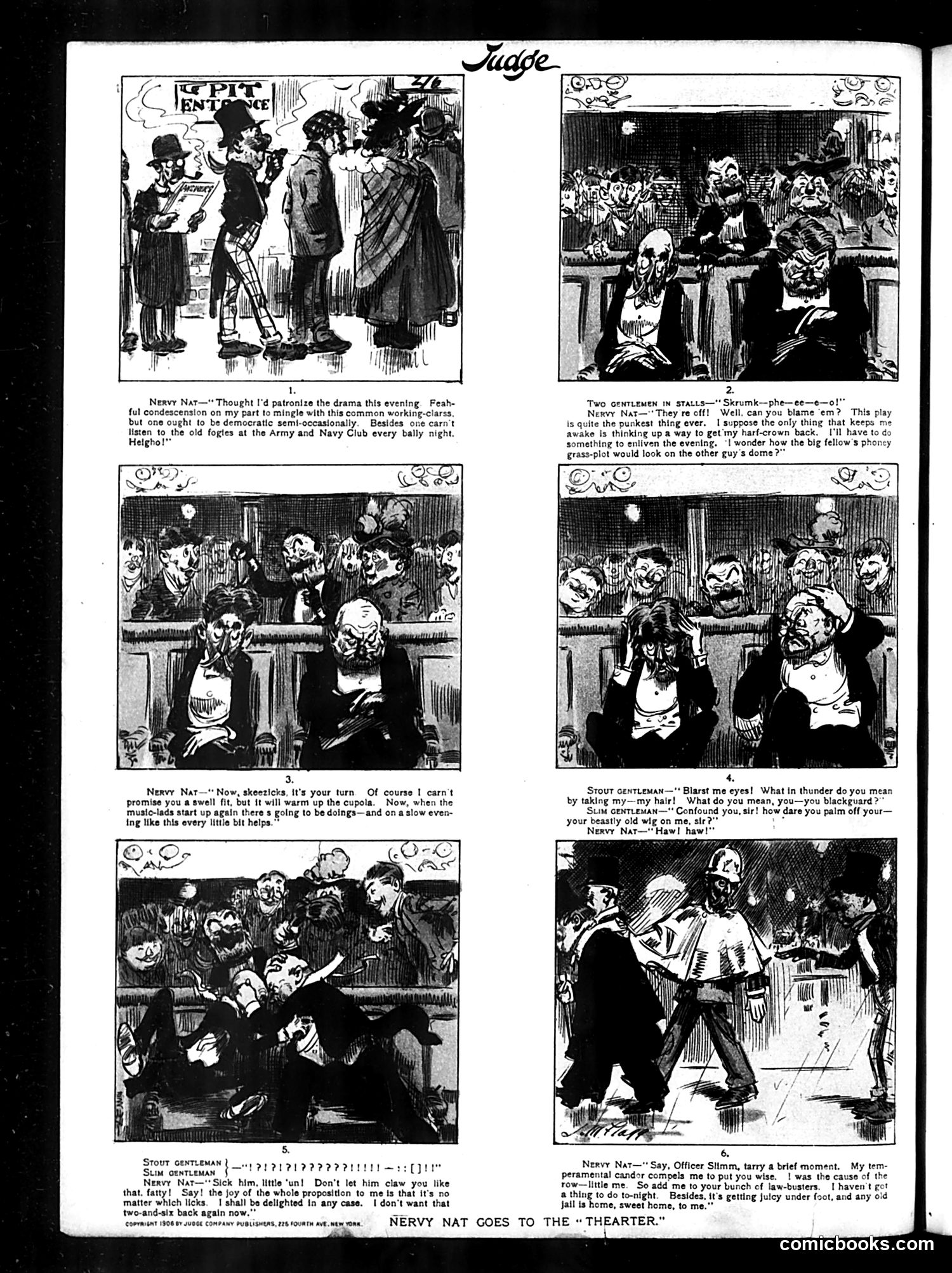
This comic strip satirizes a snobbish upper-class character ("Nervy Nat") who attends a theatrical performance while affecting democratic sympathy for working-class people. The humor derives from his consistent rudeness and destructive behavior disguised as noblesse oblige: he deliberately disrupts the show, incites audience members to fight over stolen hats and wigs, and generally causes chaos. The satire targets pretentious wealthy men who claim charitable tolerance while actually displaying contempt for common folk. Nat's casual vandalism and provocation—followed by his gleeful arrest—suggest he views consequences as mere entertainment. The recurring refrain that he has "nothing to do tonight" and finds jail appealing mockingly implies such men face no real accountability for their actions.