
Judge, 1906-02-03 · page 2 of 16
Judge — February 3, 1906 — page 2: what you’re looking at
What you’re looking at
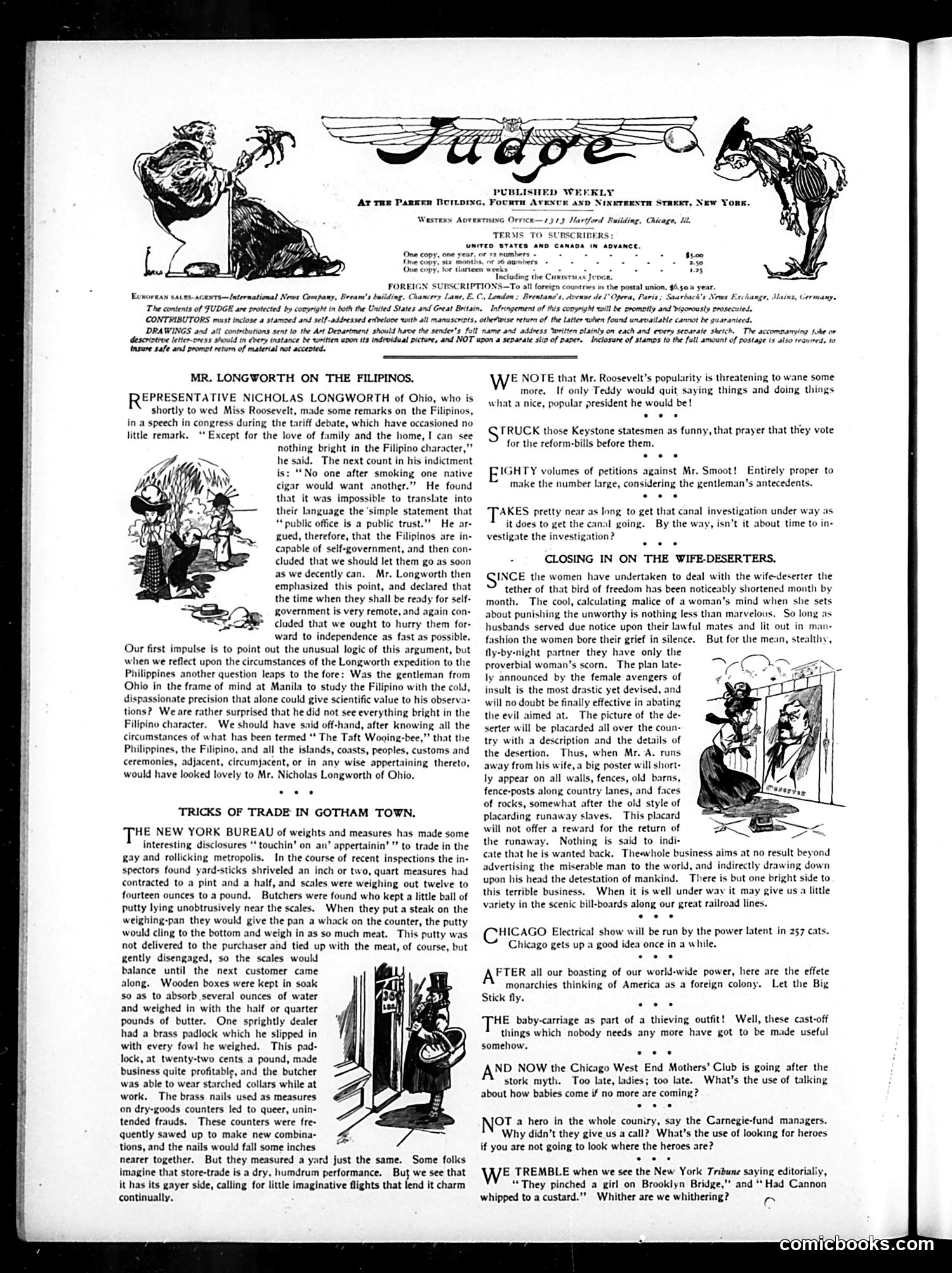
This page contains several political commentaries typical of Judge's satirical approach. The main article discusses **Representative Nicholas Longworth of Ohio**, who defended the Philippines in congressional debate, arguing Filipinos lack readiness for self-government. The satire criticizes Longworth's paternalistic position, suggesting his logic about the Philippines' "unfitness" was flawed and self-serving. Other brief items mock contemporary issues: **Roosevelt's popularity** threatening to eclipse Teddy's influence; **Keystone statemen** voting against reform bills; and critiques of women's "wife-deserter" notices and runaway-husband posters—social problems the magazine treats with dark humor. The page reflects early 1900s imperialist debates and gender dynamics, using sardonic commentary to challenge establishment positions.
📄 Transcribed text from this page (OCR, searchable)
Machine-transcribed from the original scan — historical spelling and the odd misread are preserved.
Ax Tue Panger Bereprxc, Fourrm Avexce axp Westexx Aoverrisinc Orrice— 313 Hartford Building, Chicago, tt. RIDERS : TERMS TO SU UNITED STATES AND CANADA IN ADVANCE. One copy, one year, or sznumbers= =e One ec FOREIGN EvKornan sates-acents—lutermational News Company, Bream's building, Chancery Lane, EC, London: Brentans’s, cee The contents of FUDGE are protected by conyrigh in both the United States ant Great Britain. CONTRIBUTORS must inclose a stamoed and self-asdressed erivelove with all mana scripts, otherwise return of the Latter when found unavailaNe cannot be guaranteed. DRAWINGS and all contributions sent lo the Art Devartment should have the sender's fall name and adiress Written plainly on each and every seoarate sketch. descriotive letier-cress should in eery instance be written upon its indroidual pictare, and NOT upon a separate slip of paper. tnsure safe and promot return of material not accented. MR. LONGWORTH ON THE FILIPINOS. REPRESENTA TIVE NICHOLAS LONGWORTH of Ohio, who is shortly to wed Miss Roosevelt, made some remarks on the Filipinos, in a speech in congress during the tariff debate, which have occasioned no little remark. “Except for the love of family and the home, I can see nothing bright in the Filipino character,” he said. The next count in his indictment is: “No one after smoking one native cigar would want another.” He found that it was impossible to translate into their language the ‘simple statement that “* public office is a public trust.” He ar- gued, therefore, that the Filipinos are in capable of self-government, and then con- cluded that we should let them go as soon as we decently can, Mr. Longworth then emphasized this point, and declared that the time when they shall be ready for self- government is very remote, and again con- cluded that we ought to hurry them for- ward to independence as fast as possible. Our first impulse is to point out the unusual logic of this argument, but when we reflect upon the circumstances of the Longworth expedition to the Philippines another question leaps to the fore: Was the gentleman from Ohio in the frame of mind at Manila to study the Filipino with the cold, dispassionate precision that alone could give scientific value to his observa- tions? We are rather surprised that he did not see everything bright in the Filipino character. We should have said off-hand, after knowing all the circumstances of what has been termed ** The Taft Wooing-bee,”’ that the Philippines, the Filipino, and all the islands, coasts, peoples, customs and ceremonies, adjacent, circumjacent, or in any wise appertaining thereto, would have looked lovely to Mr. Nicholas Longworth of Ohio. TRICKS OF TRADE IN GOTHAM TOWN. THE NEW YORK BUREAU of weights and measures has made some interesting disclosures ** touchin’ on an’ appertainin’ ” to trade in the gay and rollicking metropolis. In the course of recent inspections the in- spectors found yard-sticks shriveled an inch or two, quart measures had contracted to a pint and a half, and scales were weighing out twelve to fourteen ounces to a pound. Butchers were found who kept a little ball of putty lying unobtrusively near the scales. When they put a steak on the weighing-pan they would give the pan a whack on the counter, the putty would cling to the bottom and weigh in as so much meat. This putty was not delivered to the purchaser and tied up with the meat, of course, but gently disengaged, so the scales would balance until the next customer came along. Wooden boxes were kept in soak so as to absorb several ounces of water and weighed in with the half or quarter pounds of butter. One sprightly dealer had a brass padlock which he slipped in with every fowl he weighed. This pad- lock, at twenty-two cents a pound, made business quite profitable, and the butcher was able to wear starched collars while at work. The brass nails used as measures on dry-goods counters led to queer, unin- tended frauds. These counters were fre- quently sawed up to make new combina- tions, and the nails would fall some inches nearer together. But they measured a yard just the same. Some folks imagine that store-trade is a dry, humdrum performance. But we see that it has its gayer side, calling for little imaginative flights that lend it charm continually. de" Opera, Paris; Saarbach's News Exchange, Mainz, Cermany, Infringement of this cooyright will be promptly and ricorously prosecuted. The accompany Inclosure of stamps to the full amount of postage ts also 1 WE NOTE that Mr. Roosevelt’s popularity is threatening to wane some more. If only Teddy would quit saying things and doing things what a nice, popular president he would be! TRUCK those Keystone statesmen as funny, that prayer that they vote for the reform-bills before them. eee E'Guty volumes of petitions against Mr. Smoot! Entirely proper to make the number large, considering the gentleman's antecedents. TAkes pretty near as long to get that canal investigation under way as it does to get the canal going. By the way, isn’t it about time to in- vestigate the investigation? a & CLOSING IN ON THE WIFE-DESERTERS. SINCE the women have undertaken to deal with the wife-deserter the tether of that bird of freedom has been noticeably shortened month by month. The cool, calculating malice of a woman’s mind when she sets about punishing the unworthy is nothing less than marvelous. So long as husbands served due notice upon their lawful mates and lit out in m fashion the women bore their grief in silence. But for the mean, stealthy, fly-by-night partner they have only the proverbial woman’s scorn. The plan late- ly announced by the female avengers of insult is the most drastic yet devised, and will no doubt be finally effective in abating the evil aimed at. The picture of the de- serter will be placarded all over the coun- try with a description and the details of the desertion, Thus, when Mr. A. runs away from his wife, a big poster will short- ly appear on all walls, fences, old barns, fence-posts along country lane: of rocks, somewhat after the old style of placarding runaway slaves. This placard will not offer a reward for the return of the runaway. Nothing is said to indi- cate that he is wanted back. Theewhole business aims at no result beyond advertising the miserable man to the world, and indirectly drawing down upon his head the detestation of mankind. There is but one bright side to this terrible business. When it is well under way it may give us a little variety in the scenic bill-boards along our great railroad lines. CHICAGO Electrical show will be run by the power latent in 257 cats. Chicago gets up a good idea once in a while. AFTER all our boasting of our world-wide power, here are the effete monarchies thinking of America as a foreign colony. Let the Big Stick fly. THE baby-carriage as part of a thieving outfit! Well, these castoff things which nobody needs any more have got to be made useful somehow. AND NOW the Chicago West End Mothers’ Club is going after the stork myth. Too late, ladies; too late. What’s the use of talking about how babies come if no more are coming? NOT @ hero in the whole couniry, say the Carnegie-fund managers. Why didn’t they give us a call? What's the use of looking for heroes if you are not going to look where the heroes are? E TREMBLE when we see the New York Tribune saying editorialiy, “They pinched a girl on Brooklyn Bridge,” and ‘* Had Cannon whipped to a custard.’”” Whither are we whithering? lad