
A complete issue · 16 pages · 1905
Judge — December 2, 1905
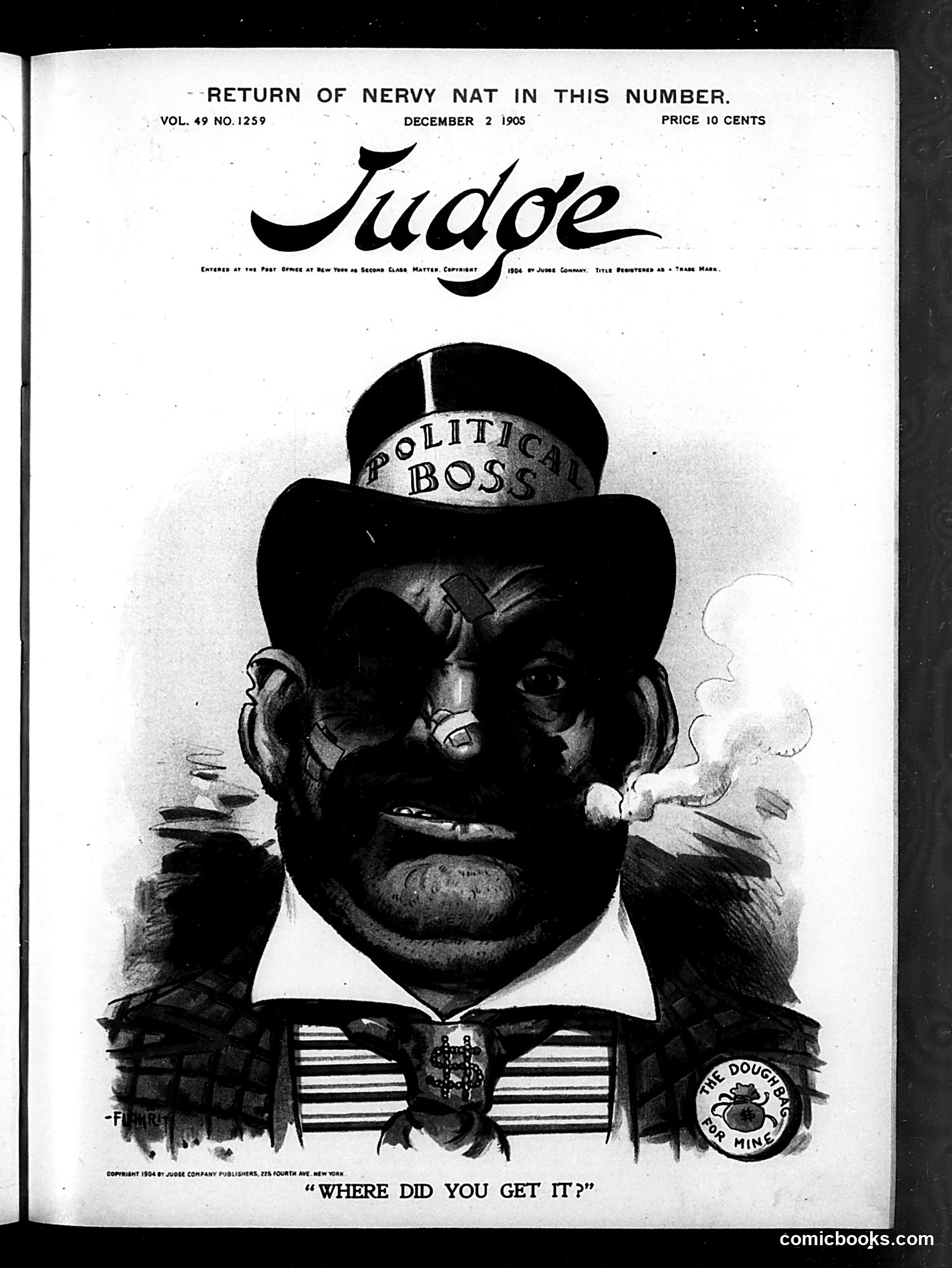
This cover satirizes a "Political Boss" — a figure wearing a hat labeled "POLITICAL BOSS" with a cigar and menacing expression. The caricature uses exaggerated facial features typical of early 1900s political cartoons to mock corrupt urban political machines that controlled American cities through patronage and graft. The caption reads "WHERE DID YOU GET IT?" — likely referencing the widespread public awareness that political bosses enriched themselves through corruption and kickbacks. The figure's aggressive demeanor and cigar convey the stereotype of domineering, unscrupulous politicians who wielded power outside formal government structures. The magazine's subtitle promises "RETURN OF NERVY NAT IN THIS NUMBER," indicating the cover relates to ongoing satirical commentary on contemporary politics and corruption.
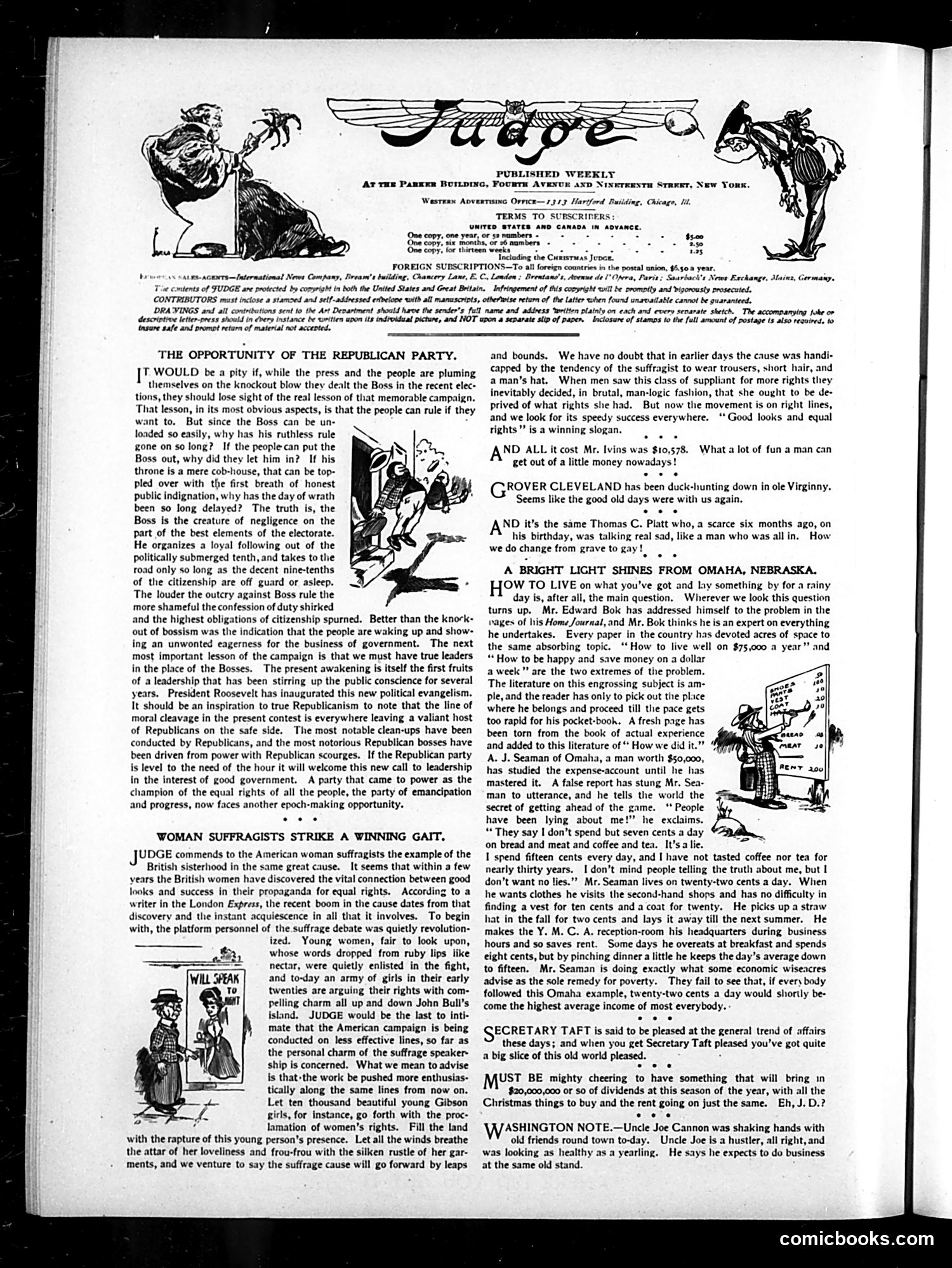
This page contains two main political cartoons critiquing women's suffrage. The left cartoon labeled "Woman Suffragists' Stride—A Winning Gait" depicts a woman in masculine attire (short hair, trousers) striding forward. Judge's text mocks suffragists by suggesting they adopt "masculine" appearance and behavior to win rights, sarcastically encouraging them to adopt Gibson Girl imagery while adopting "men's rights" arguments. The right cartoon appears to show figures in conflict, likely commenting on suffrage debates, though specific identities are unclear from the image alone. The accompanying article "The Opportunity of the Republican Party" discusses Republican electoral strategy, separate from the suffrage content. The page also includes miscellaneous brief commentary items typical of Judge's format. The cartoons' tone is dismissive toward women's suffrage activism, employing caricature and mockery common to anti-suffrage propaganda of the era.
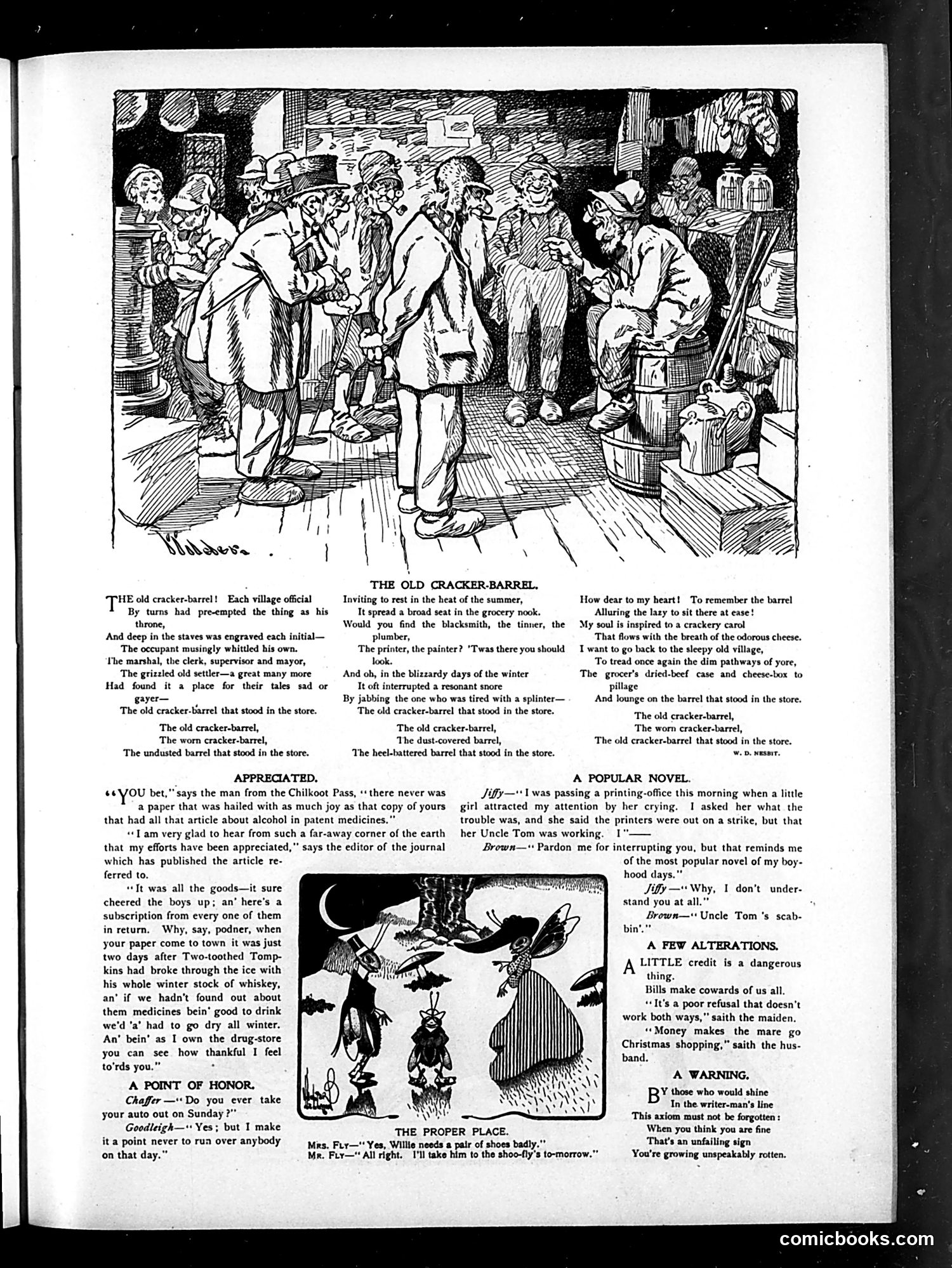
This page contains several short humorous pieces rather than a unified political cartoon. "The Old Cracker-Barrel" is a nostalgic poem about a village general store and its barrel—a common gathering place for rural male conversation and gossip. The "Appreciated" section features brief anecdotes about everyday life, including one where a man defends his paper subscription despite containing an article about cheap alcohol in patent medicines—suggesting satirical commentary on dubious patent medicine advertising. "A Popular Novel," "A Few Alterations," and "A Warning" are short comic dialogues and verses poking fun at domestic life, credit, and marital dynamics. The illustration "The Proper Place" shows a simple domestic joke about a woman needing shoes. These are general-interest humor pieces typical of Judge's content—satire of ordinary American life rather than specific political events or figures.
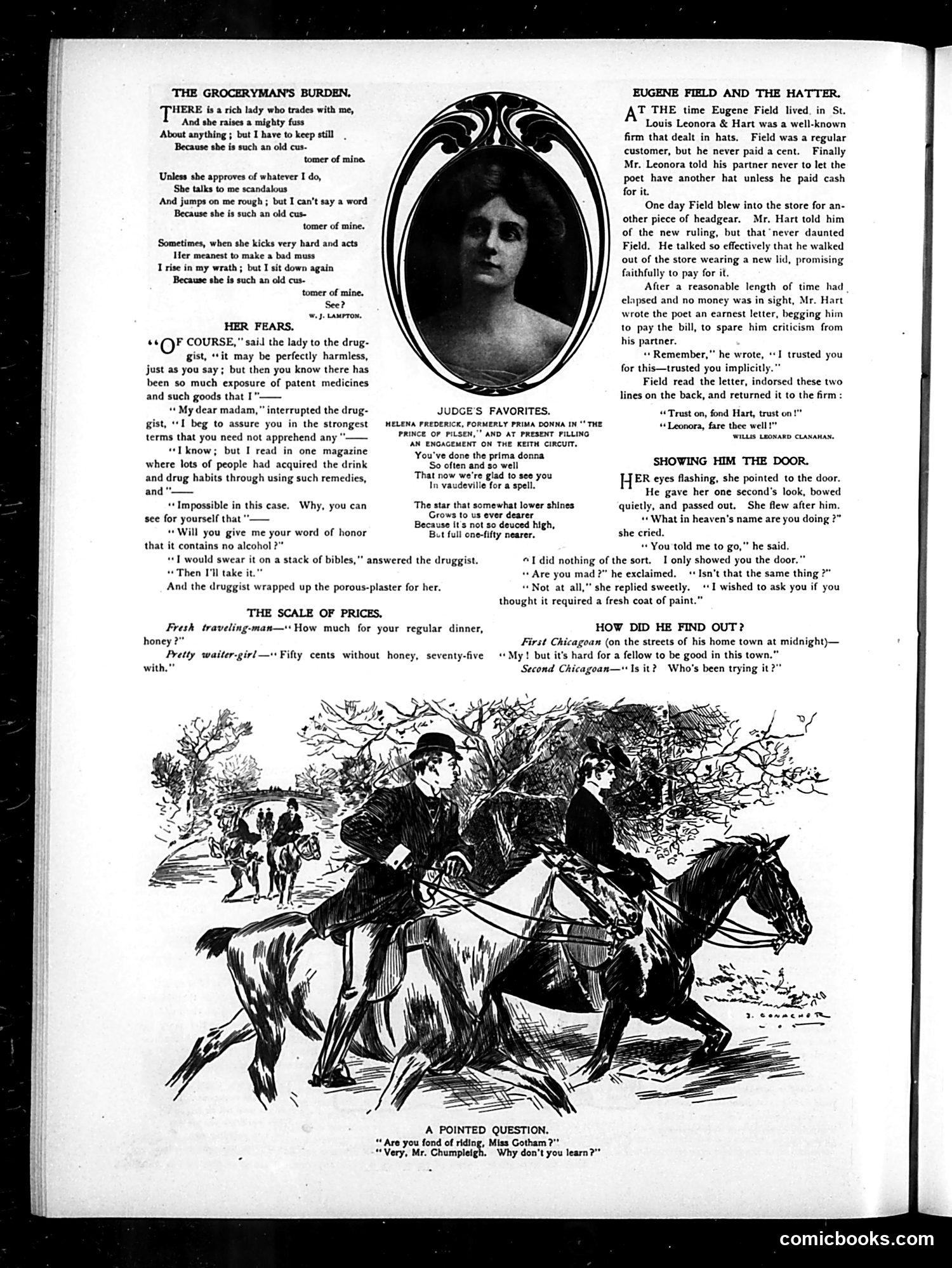
This page contains several unrelated satirical pieces and illustrations typical of Judge's format: 1. **"The Groceryman's Burden"** and **"Her Fears"**: Social commentary poems about domestic economics and anxiety, likely reflecting turn-of-the-century concerns about household finances and marital tensions. 2. **"Eugene Field and the Hatter"**: A brief anecdote about poet Eugene Field's refusal to pay for a hat, presented as humorous commentary on artistic eccentricity. 3. **"A Pointed Question"** (bottom illustration): Shows two riders on horseback with the caption "Are you fond of riding, Miss Cotham?" / "Very, Mr. Champleigh. Why don't you learn?" This appears to be a romantic/social satire about courtship and competitive masculinity. The page reflects Judge's mix of poetry, short humor pieces, and visual gags targeting middle-class American life and social pretensions.
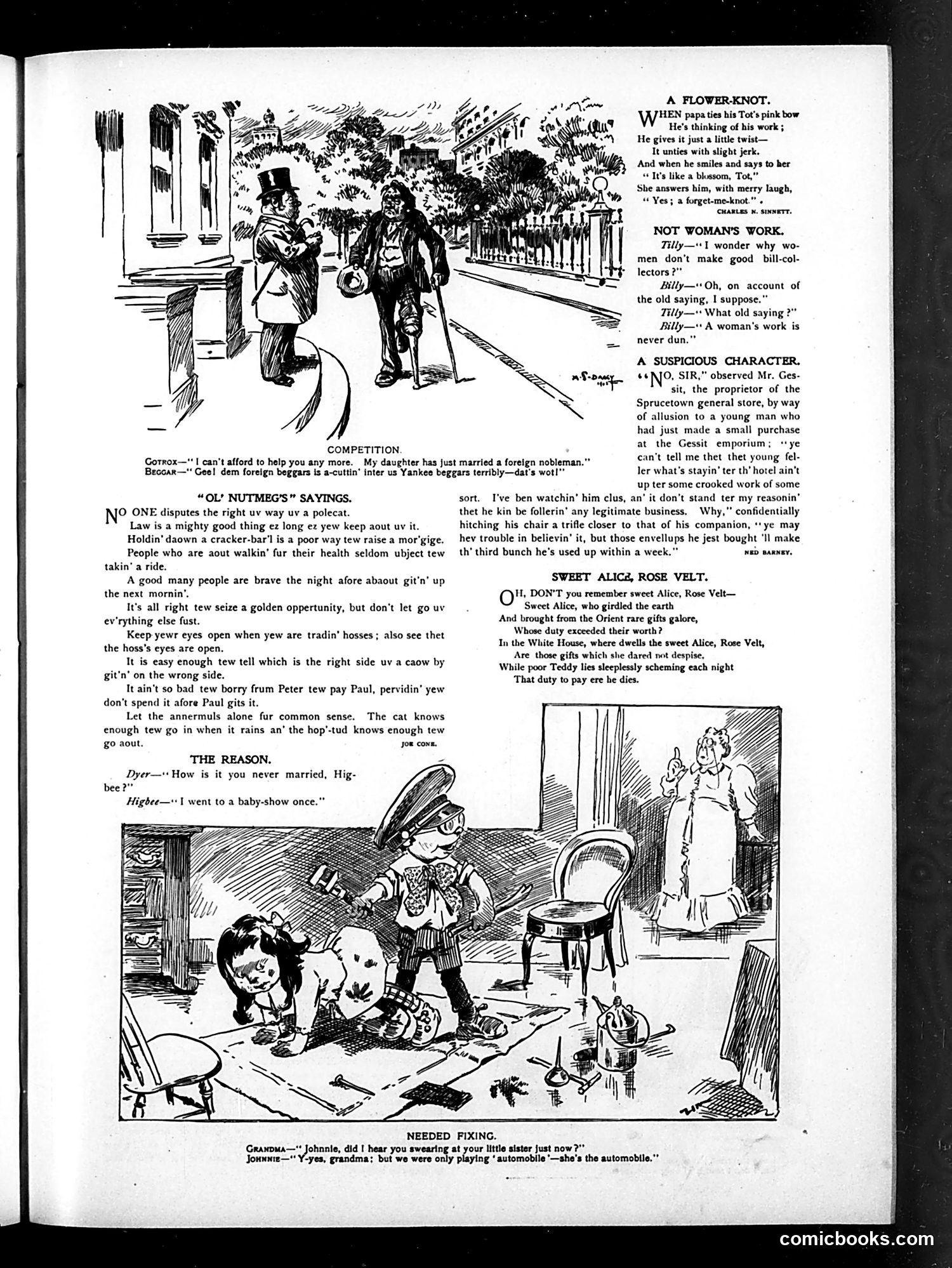
This page contains several satirical pieces typical of early 20th-century Judge humor: **"Competition"** (top cartoon): Two men discuss a woman who married a foreign nobleman. One mentions "Yankee beggars" marrying foreign titles—a jab at wealthy American heiresses marrying impoverished European aristocrats for status, a common practice of that era. **"Old Nutmeg's Savings"** and **"The Reason"**: Brief humorous dialogues about practical matters and marriage. **"Sweet Alice Rose Velt"**: A poem about someone named Alice Rose Velt, possibly alluding to Alice Roosevelt (Theodore Roosevelt's daughter), who was prominent in society news. **"Needed Fixing"** (bottom cartoon): A domestic scene where a child has made a mess while playing "automobiles," satirizing the novelty of automobiles in society. The overall content reflects upper-class social concerns and the emerging automobile age.
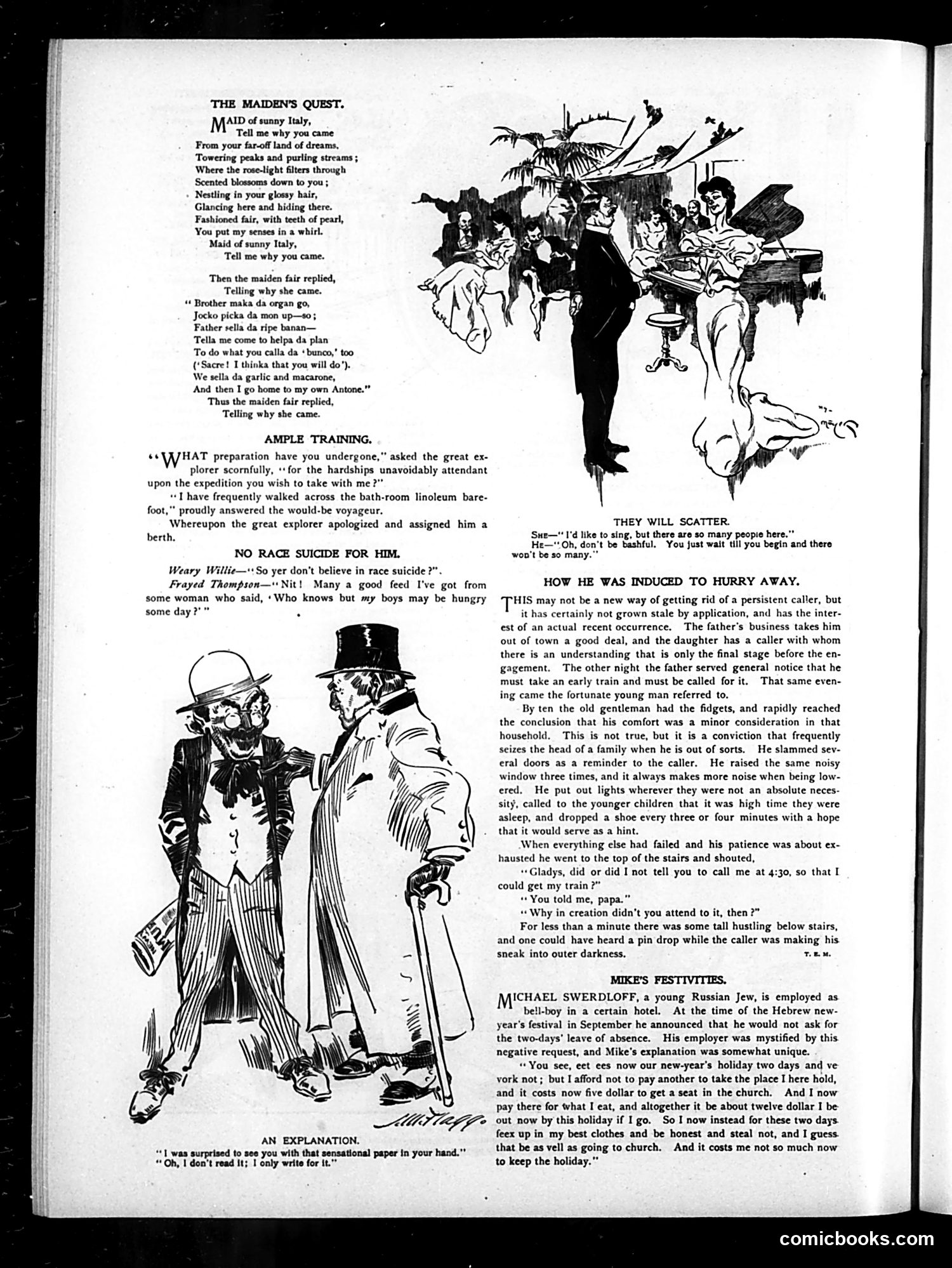
This Judge magazine page contains period humor reflecting early 20th-century American attitudes: **"The Maiden's Quest"** mocks Italian immigrants through stereotype—a romantically described Italian girl is revealed to be hustling her family's street-vending operation (organs, bananas, garlic, macaroni). The broken English dialect amplifies the satire targeting immigrant economic desperation presented as comic. **"No Race Suicide for Him"** references the contemporary "race suicide" panic—fears that native-born Americans weren't reproducing enough while immigrant populations grew. The joke presents a homeless man's reproductive prospects cynically, inverting middle-class anxieties about population decline. **"How He Was Induced to Hurry Away"** offers a domestic humor scenario about a father driving away his daughter's suitor through deliberate discomfort—standard courtship-era comedy. **"Mike's Festivities"** begins a story about a Jewish hotel worker, suggesting religious/ethnic workplace dynamics of the era. The overall tone reflects Judge's satirical focus on immigration, social class, and ethnic difference as humor sources.
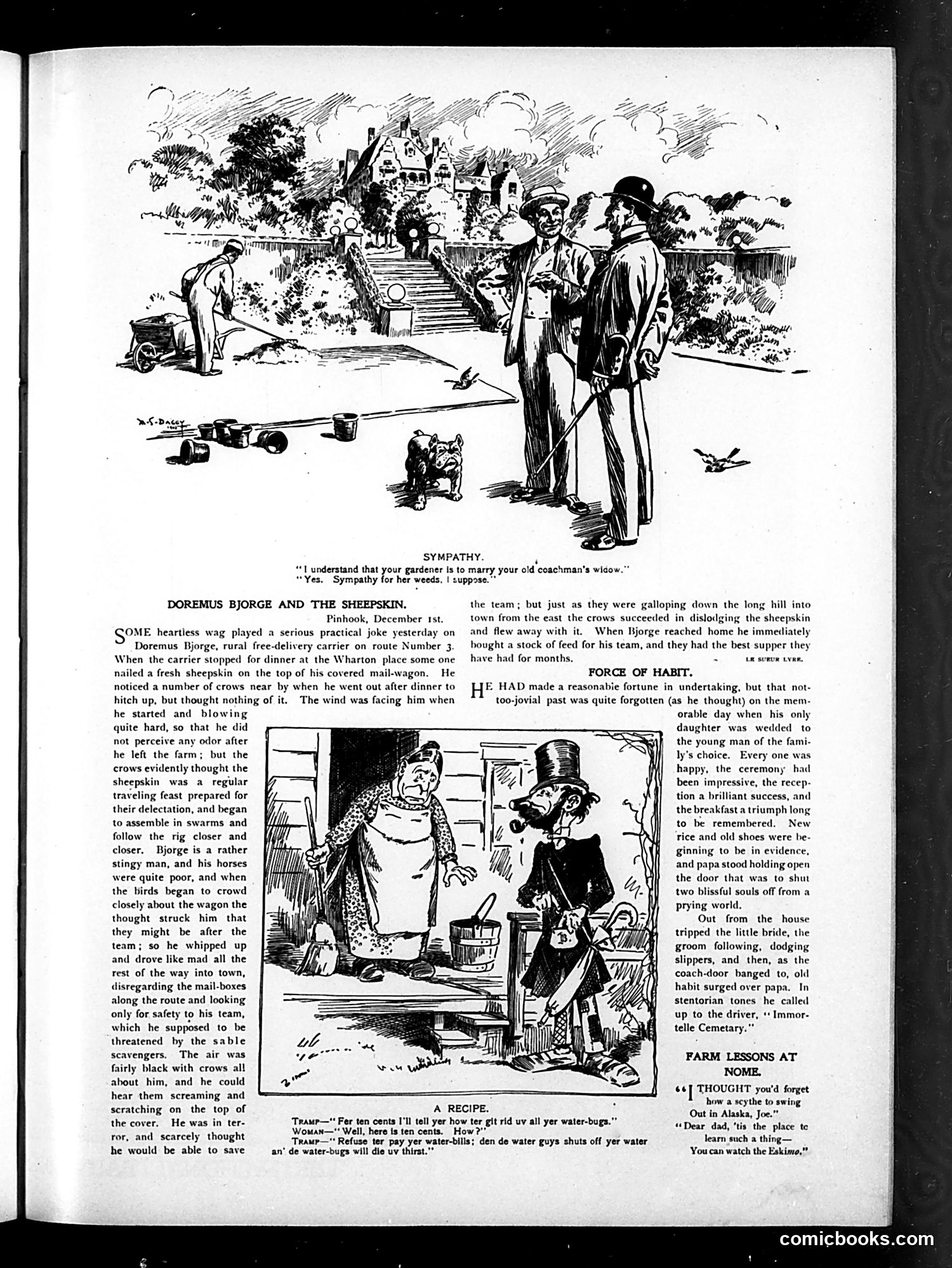
This page contains three humorous pieces satirizing American rural and working-class life circa early 1900s: **"Sympathy"** is a brief pun: a woman marries a widower, so she'll wear mourning clothes ("weeds")—hence "sympathy for her weeds." **"Doremus Bjorge and the Sheepskin"** mocks rural naïveté. A mail carrier, pranked with a sheepskin nailed to his wagon, panics when crows gather, fearing they attack his horses. He drives frantically into town; the crows merely wanted the sheepskin. The joke targets rural superstition and gullibility. **"Force of Habit"** satirizes an undertaker's unconscious occupational bias. At his daughter's wedding, overcome by habit, he shouts to the carriage driver: "Immortelle Cemetery!"—treating the honeymoon destination as a funeral errand. The humor relies on dark irony about how professions shape reflexive behavior. All three pieces use simple, vernacular humor typical of Judge's working-class comedy.
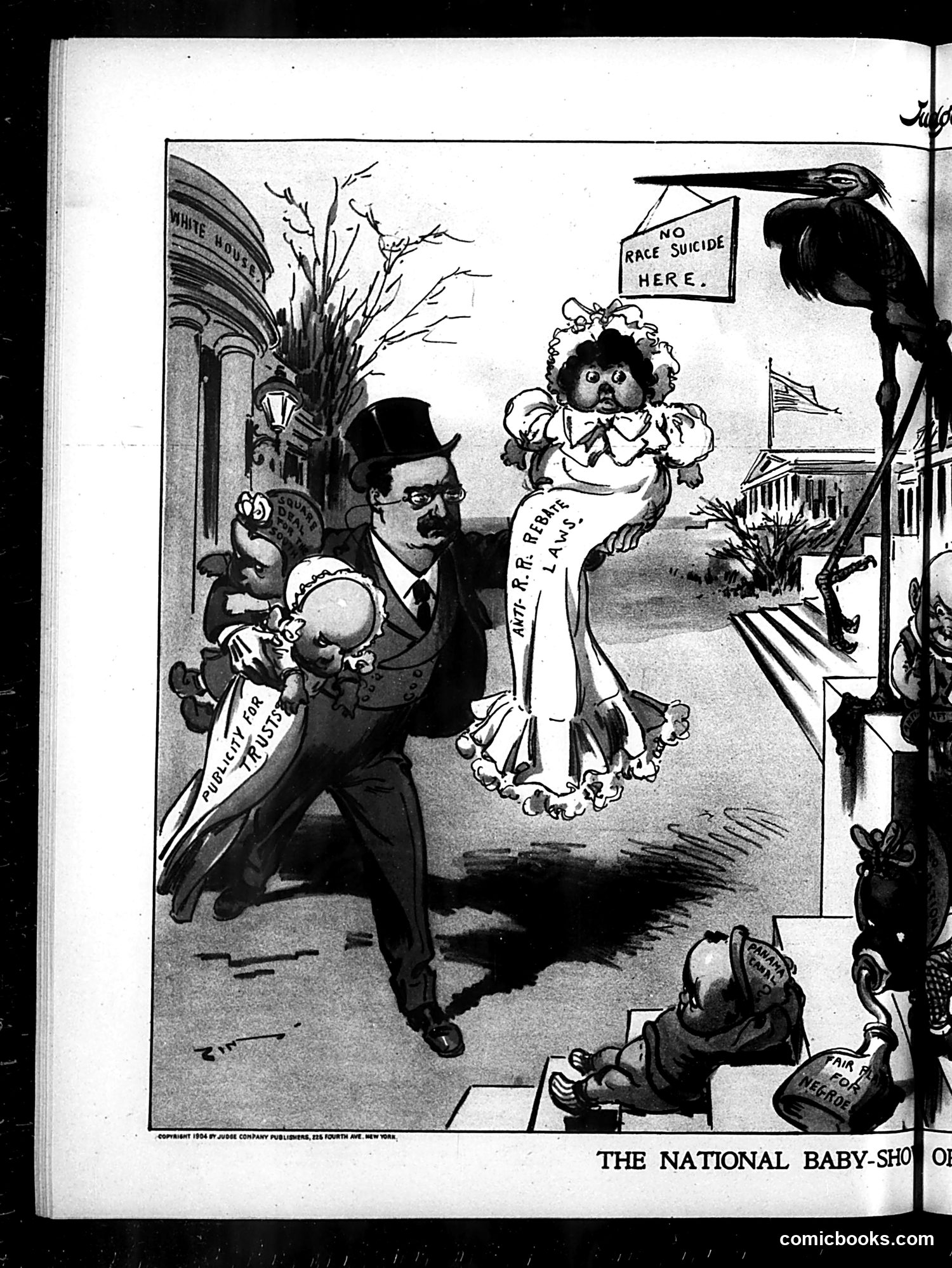
This 1904 Judge cartoon satirizes American politics as a "baby show" at the White House. A well-dressed man (likely representing a political figure or the nation itself) proudly displays various infant-like caricatures labeled with political issues and concerns: "Publicity for Trusts," "American Lands," and others visible in the image. The crane perched above holds a sign reading "No Race Suicide Here"—referencing contemporary anxieties about declining birth rates among white Americans, a concern often tied to nativist and racist rhetoric of the era. The satire suggests that American politics treats serious national issues like infants in a competition, implying political leaders are childish, vain, or foolishly proud of managing national problems. The overall message critiques how politicians grandstand over substantive policy concerns.
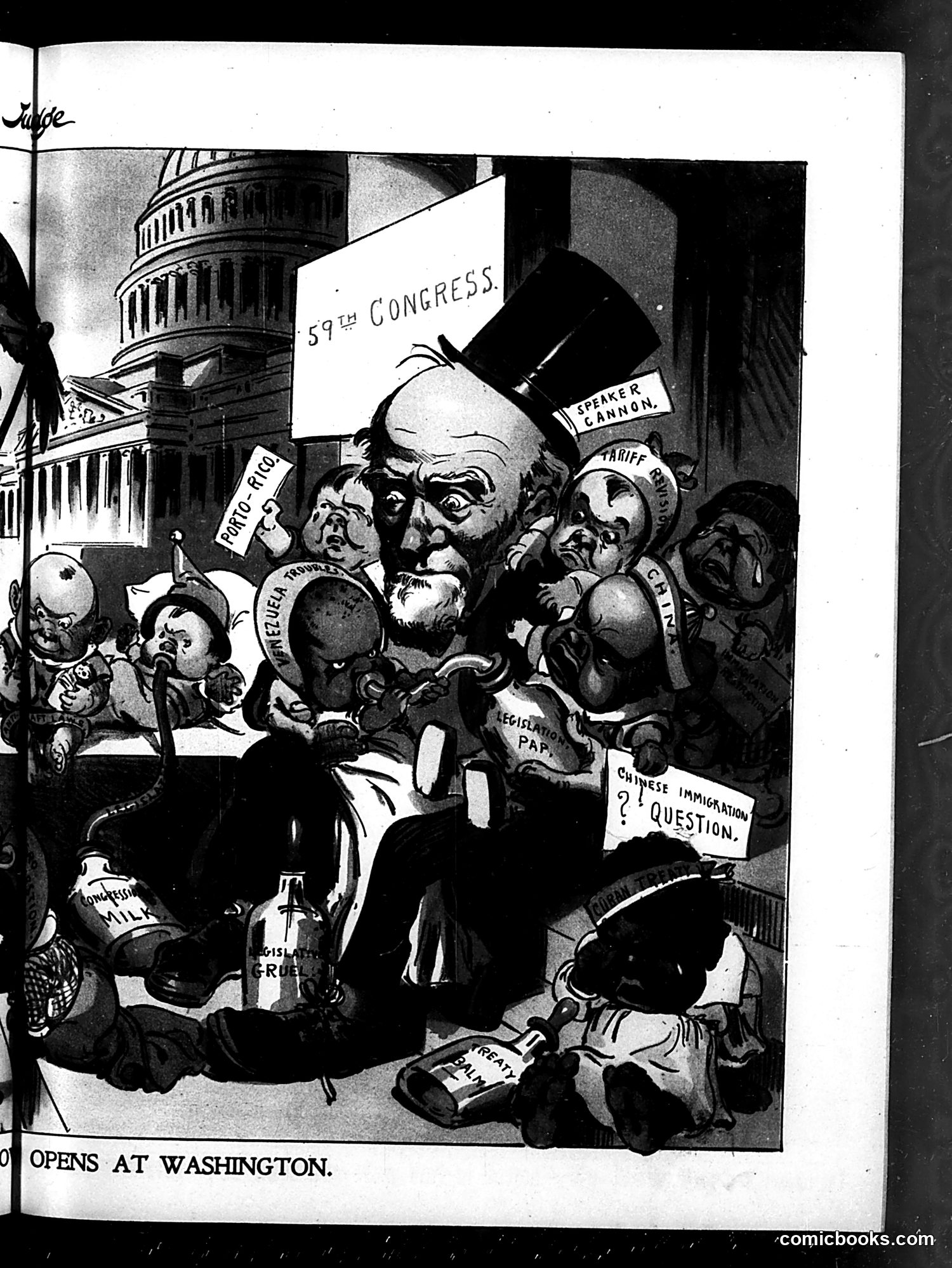
This Judge magazine cartoon satirizes the 59th Congress convening at the Capitol. The central figure—a large man in a top hat labeled "Speaker Cannon"—is surrounded by smaller figures representing various special interests and lobbying groups, identifiable by labels including "Tariff," "Special Privilege," "Chinese Immigration Question," and others. The satire depicts Congress as controlled by competing corporate and partisan interests rather than serving the public good. The chaotic crowd of caricatured figures literally surrounding and pressuring the Speaker suggests that special interests dominate legislative proceedings. This reflects Progressive Era concerns about corporate influence in politics and the perceived corruption of democratic processes through lobbying. The Capitol building looms in the background, suggesting the disconnect between democratic ideals and actual congressional practice.
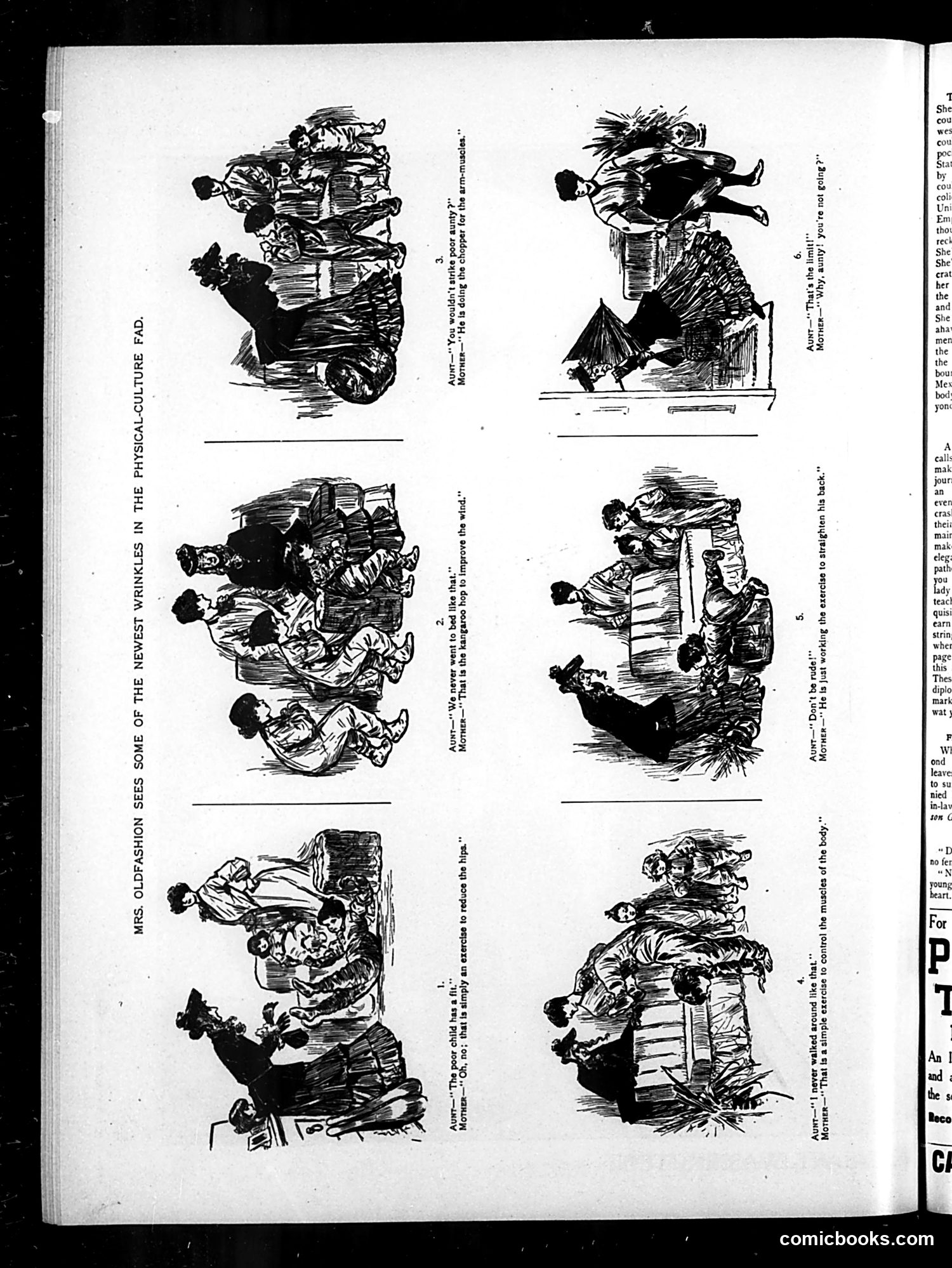
This page presents six satirical illustrations mocking the "physical culture" (fitness/bodybuilding) craze that was popular in early 20th-century America. The cartoons ridicule exaggerated exercises and poses promoted by fitness enthusiasts of the era. The OCR text is severely corrupted and largely unreadable, making precise caption identification impossible. However, the sketches clearly depict a woman (presumably Mrs. Guldemson, the title's subject) attempting various absurd physical exercises—contorted poses, awkward stretches, and ridiculous positions with household items used as props. The satire targets the faddish nature of fitness trends and their sometimes nonsensical or dangerous movements. By showing increasingly bizarre and undignified positions, Judge mocks both the fitness industry's dubious claims and society's gullible pursuit of wellness fads. The humor relies on visual absurdity rather than text.
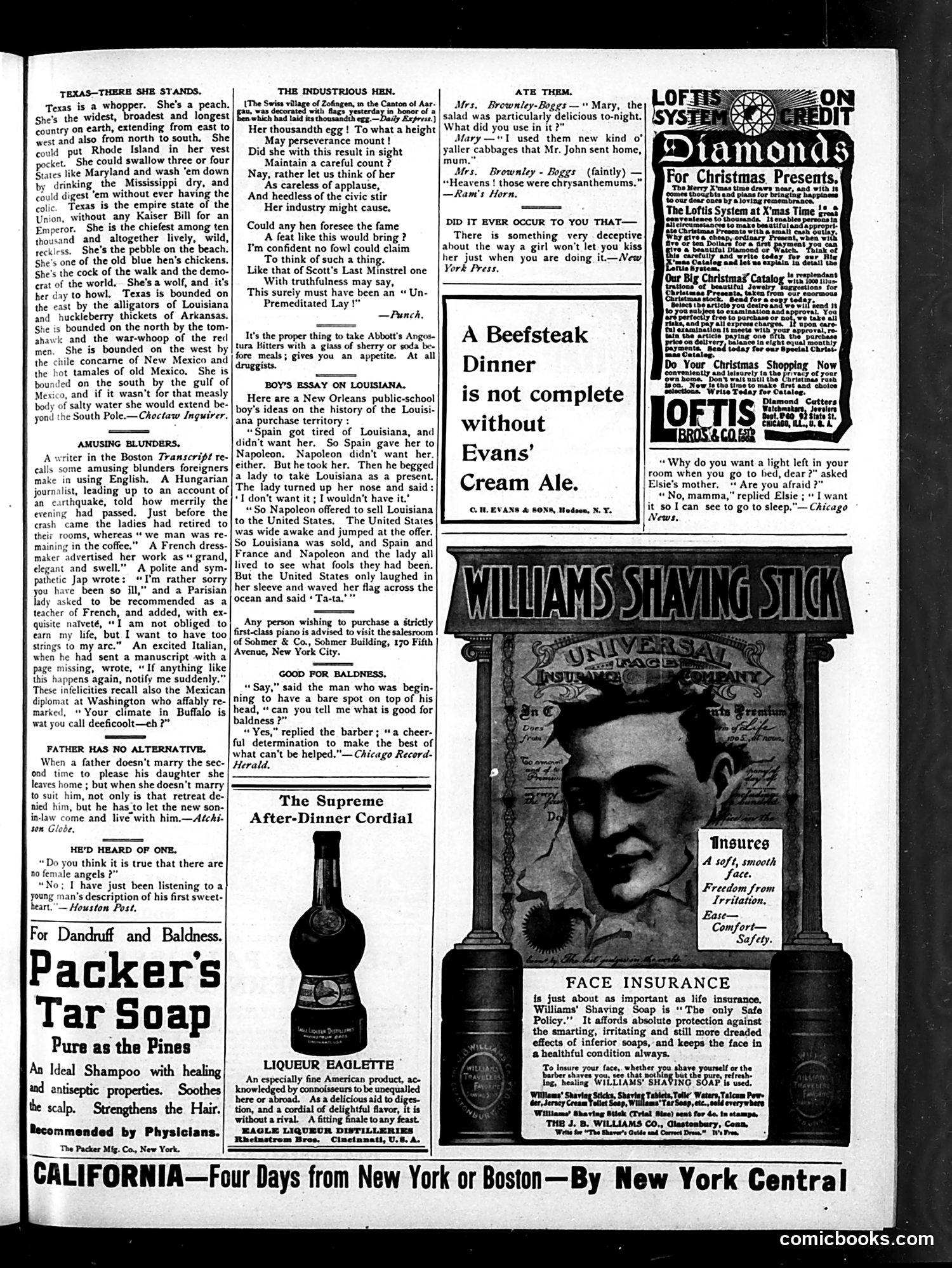
This page from *Judge* magazine consists primarily of **humorous essays and advertisements** rather than political cartoons. The main content includes: 1. **"Texas—There She Stands"**: A wildly exaggerated, affectionate satirical description of Texas as an enormous, boisterous state—larger than life and impossible to contain. The humor relies on hyperbolic comparisons (could swallow Maryland, drink the Mississippi dry). 2. **"The Industrious Hen"**: A poem mocking overwrought praise for a Swiss hen that laid its 1,000th egg. The satire suggests people absurdly celebrate mundane animal productivity as if it were conscious achievement. 3. **"Amusing Blunders"**: A collection of malapropisms from foreigners and non-native English speakers—"remaining in the coffee" instead of "remaining in the room," etc. This reflects period attitudes treating non-native speakers as comic figures. 4. **Brief humorous anecdotes** on marriage, fathers, and sweethearts with conventional punchlines. The page is largely **filler content with period advertisements** (Parker's Tar Soap, Evans' Cream Ale).
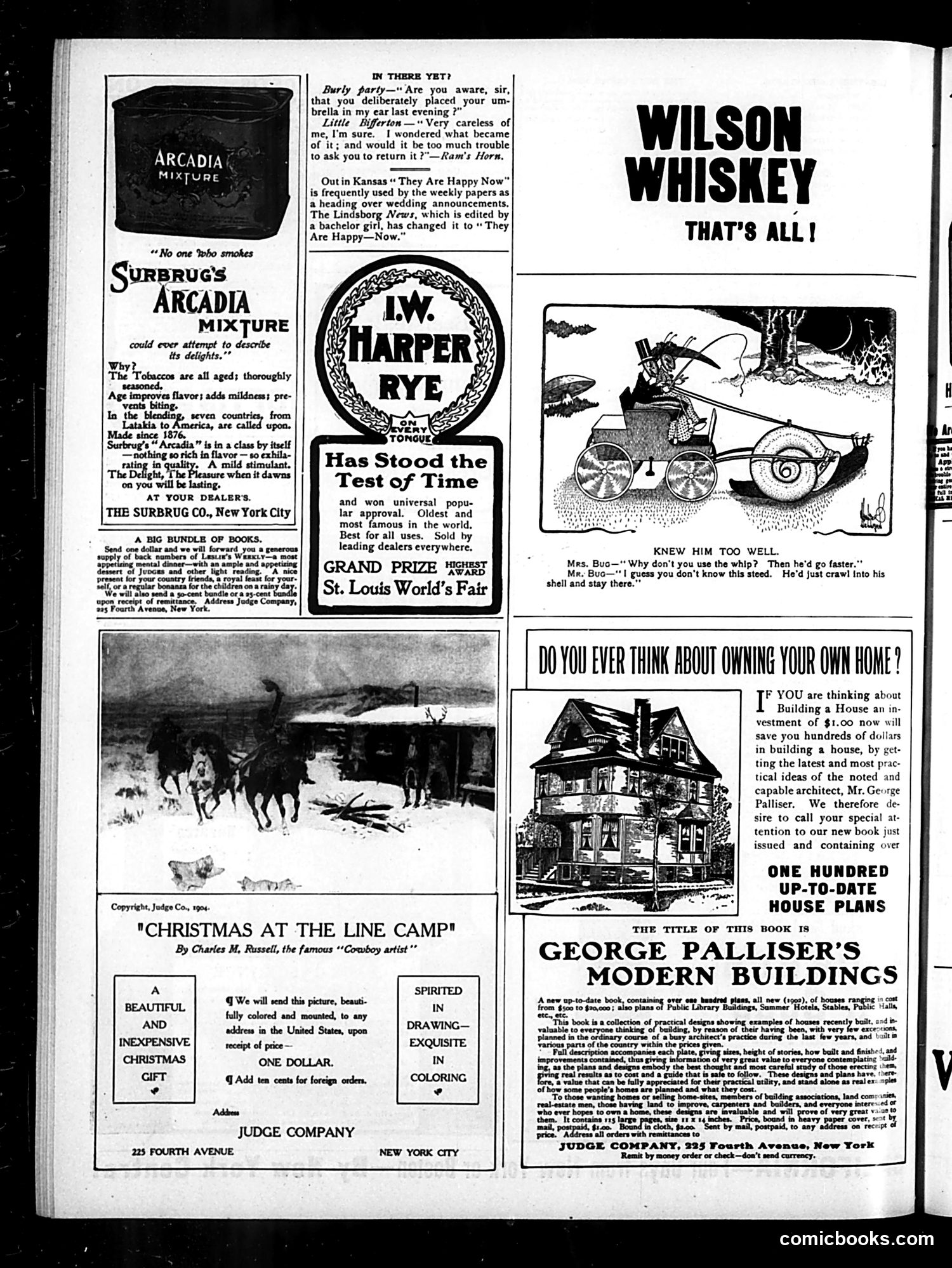
This page combines satirical content with period advertising, typical of early 1900s Judge magazine. **The Cartoons:** The main cartoon, "Christmas at the Line Camp" by Charles M. Russell (noted "Cowboy artist"), depicts a Western winter scene—likely depicting cowboys or ranch workers in harsh conditions. The title suggests sardonic humor about celebrating Christmas in remote, difficult circumstances. **The Jokes:** Short humorous anecdotes appear under "In There Yet?"—including a joke about an umbrella placed in someone's ear, and a Kansas newspaper editor's wry observation about wedding announcements ("They Are Happy—Now" implying marriages breed regret). **The Advertisements:** The page is dominated by product ads (tobacco mixture, rye whiskey) and a book advertisement for George Palliser's "Modern Buildings"—a practical architecture guide for homeowners. **Social Context:** This reflects Judge's typical format: mixing gentle satirical commentary on American life with commercial promotion, aimed at educated, middle-class readers interested in both humor and self-improvement literature.
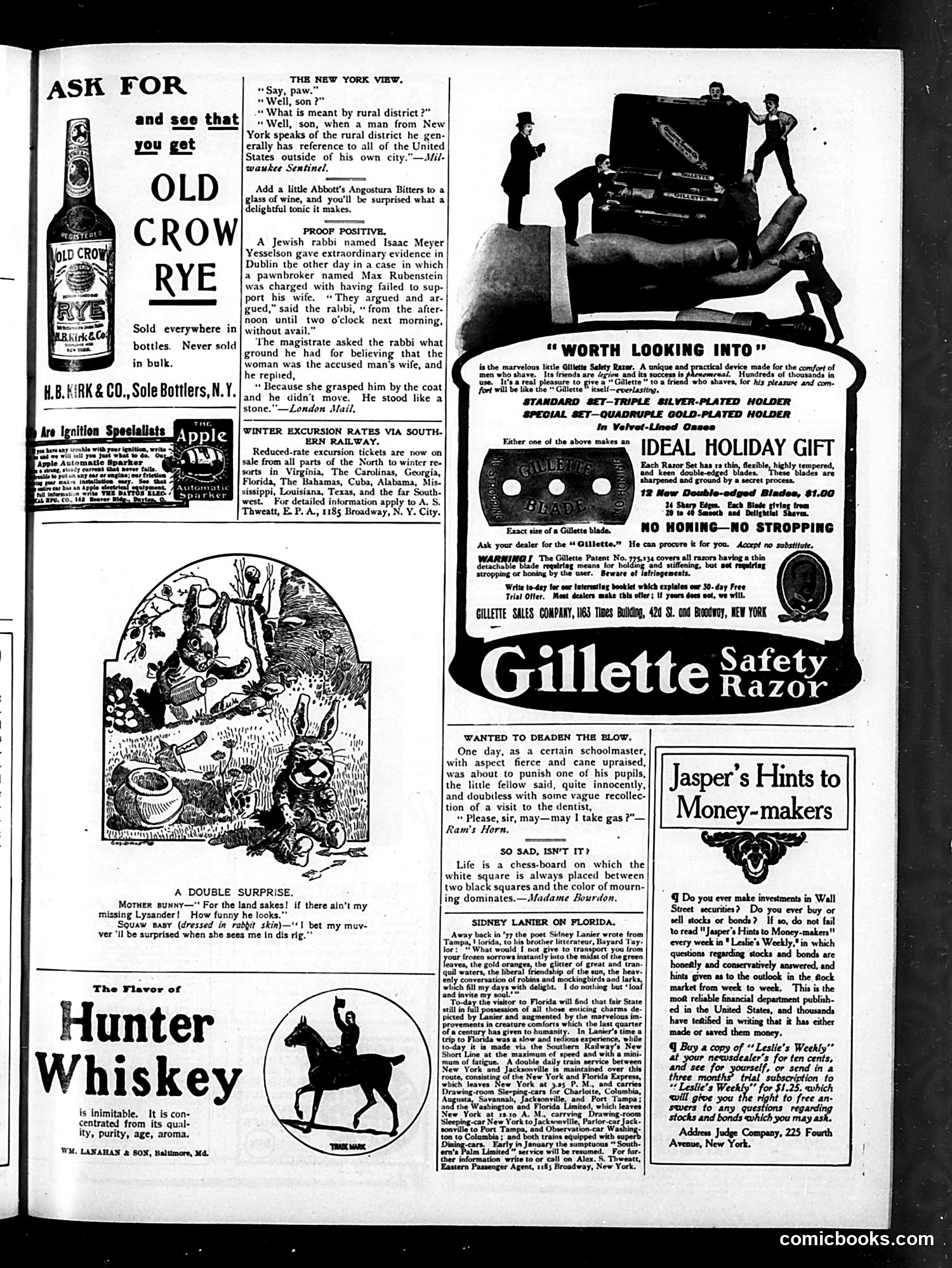
This page is primarily **advertisements and light humor pieces** rather than political satire. The main satirical content is minimal: **"The New York View"** opens with a joke about New York City parochialism—a man from NYC refers to all of America outside the city as "the rural district," mocking metropolitan condescension toward the rest of the country. The remaining short pieces are humorous anecdotes: a rabbi proving a woman is someone's wife because she grabbed his coat and he "didn't move...like a stone" (implying marital resignation); a schoolboy asking for anesthesia before punishment; and a frontier woman surprising her husband by appearing in Native American dress. **The bulk of the page is product advertising**: Old Crow Rye whiskey, Gillette Safety Razors (prominently featured), Hunter Whiskey, Southern Railway excursions, and Abbott's Bitters. These ads reflect early 20th-century consumer culture. The page contains **no significant political commentary or identifiable caricatures of public figures**—it's typical period magazine filler combining light humor with commercial content.
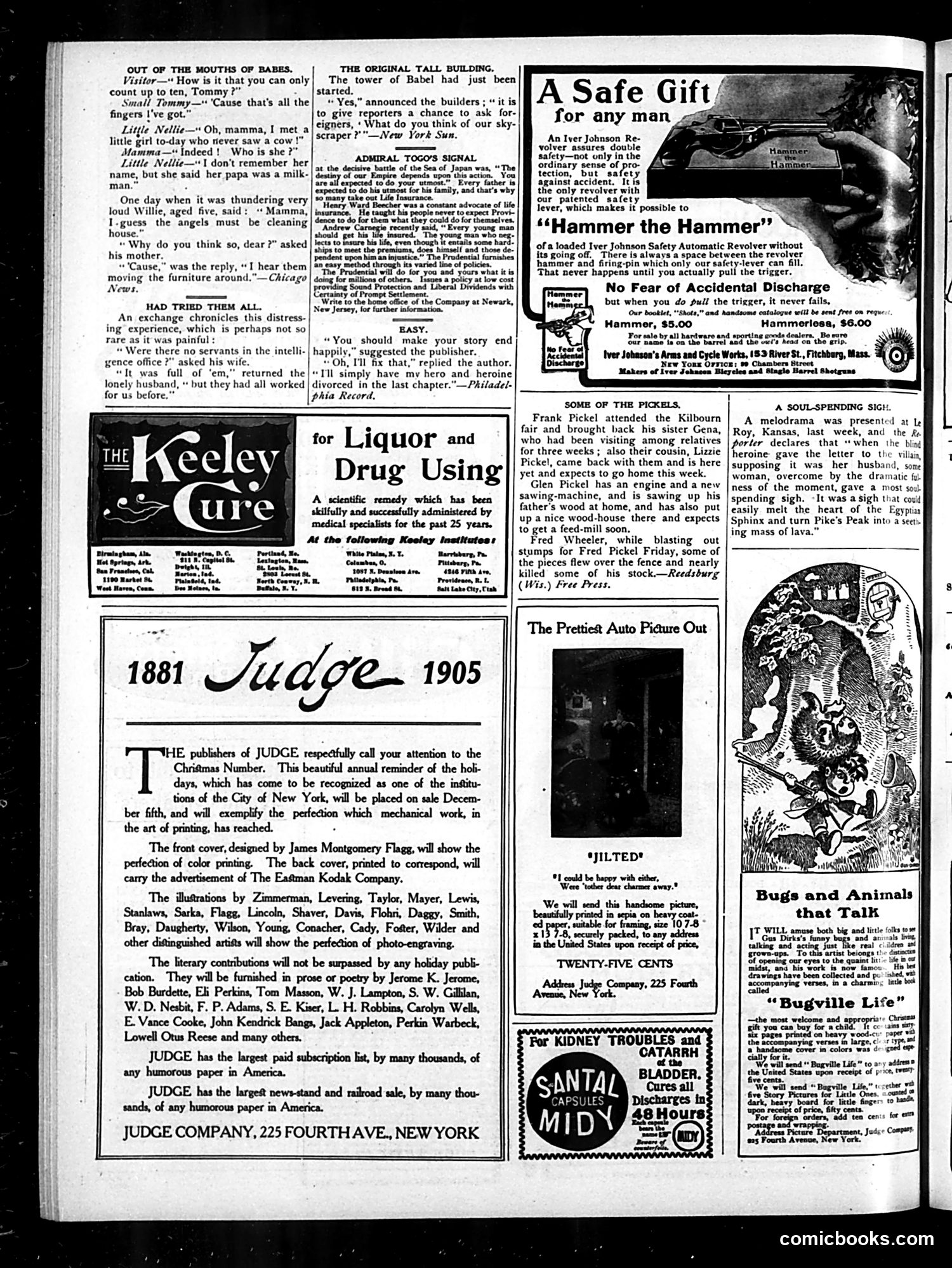
This is primarily a **page of miscellaneous advertisements and humor pieces**, typical of Judge's format. The main content includes: **Humor columns**: Brief jokes about children's innocent logic ("I can only count to ten because that's all the fingers I've got"), servants quitting after working for the same employer, and a publisher's suggestion that an author make his story "happy" by having the couple divorce—satirizing contemporary literary conventions. **Admiral Togo reference**: A brief aside about the Japanese admiral's famous signal before the 1905 Russo-Japanese War, used humorously to promote a patent medicine company. **Advertisements**: Iver Johnson revolvers (emphasizing "safety" features), Keeley Institutes (drug/alcohol rehabilitation), and Judge magazine's own Christmas issue promotion. **Rural gossip column**: A "Pickels" family news item from Wisconsin, a humorous filler common to period magazines. The page reflects Judge's mix of light satire, domestic humor targeting middle-class readers, and commercial advertising—not political cartooning.
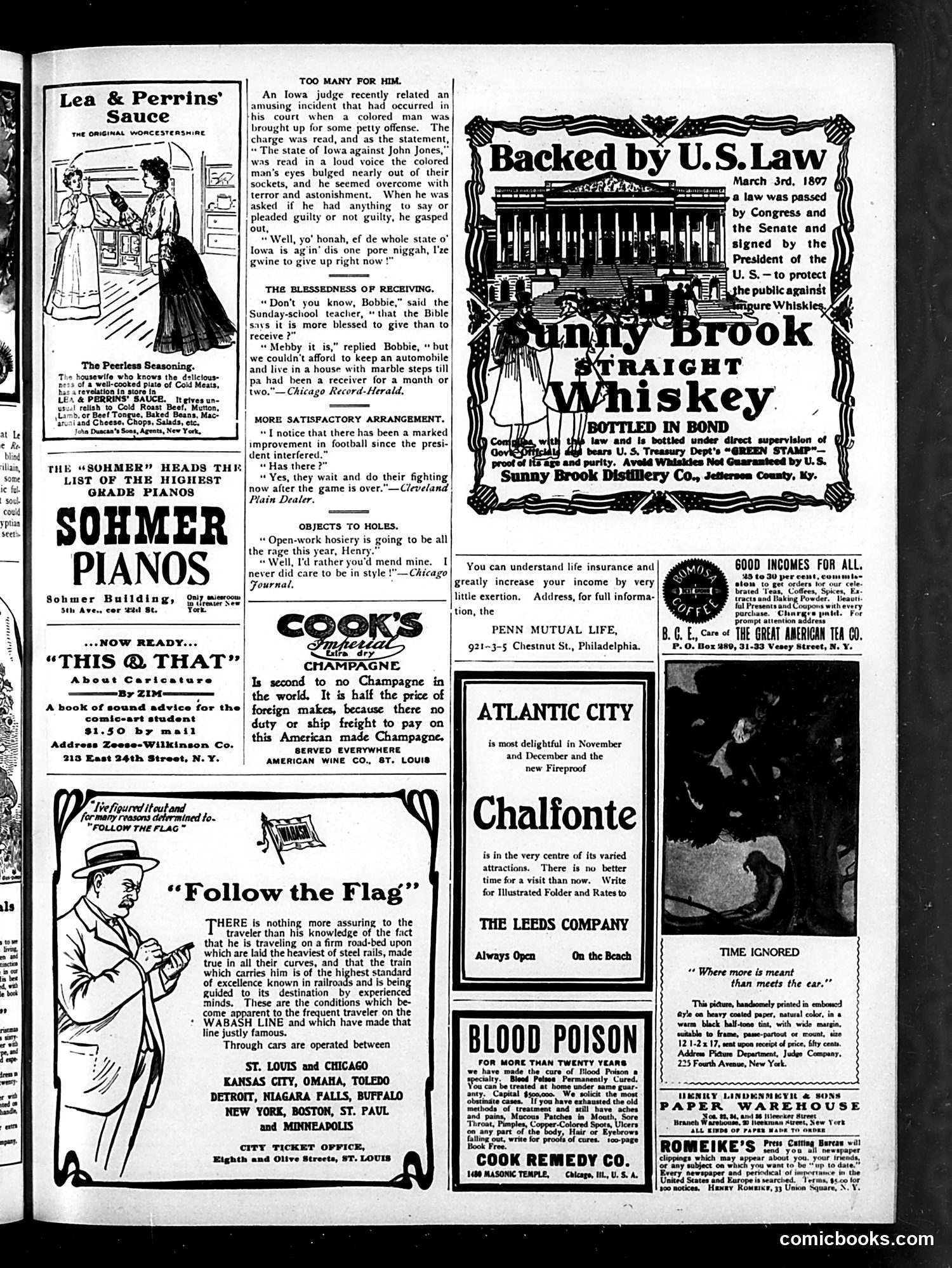
This page is primarily advertisements and filler content from *Judge* magazine, with two brief satirical pieces: **"Too Many For Him"**: A racist joke about an enslaved or formerly enslaved Black man terrified upon hearing the state of Iowa named as his prosecutor, thinking the entire state opposed him. The humor relies on crude dialect and portraying Black defendants as ignorant and cowardly. **"The Blessedness of Receiving"**: A child's response to a teacher's lesson that "it is more blessed to give than receive"—the boy notes his father became wealthy as a "receiver" (likely referring to court-appointed receivership positions, sometimes corrupt), allowing them to buy luxuries. This satirizes political patronage and corruption. The page is otherwise dominated by period advertisements for Lea & Perrins sauce, Sommer pianos, Cook's champagne, Sunny Brook whiskey, railroad travel, and life insurance—typical of early 20th-century magazine content.
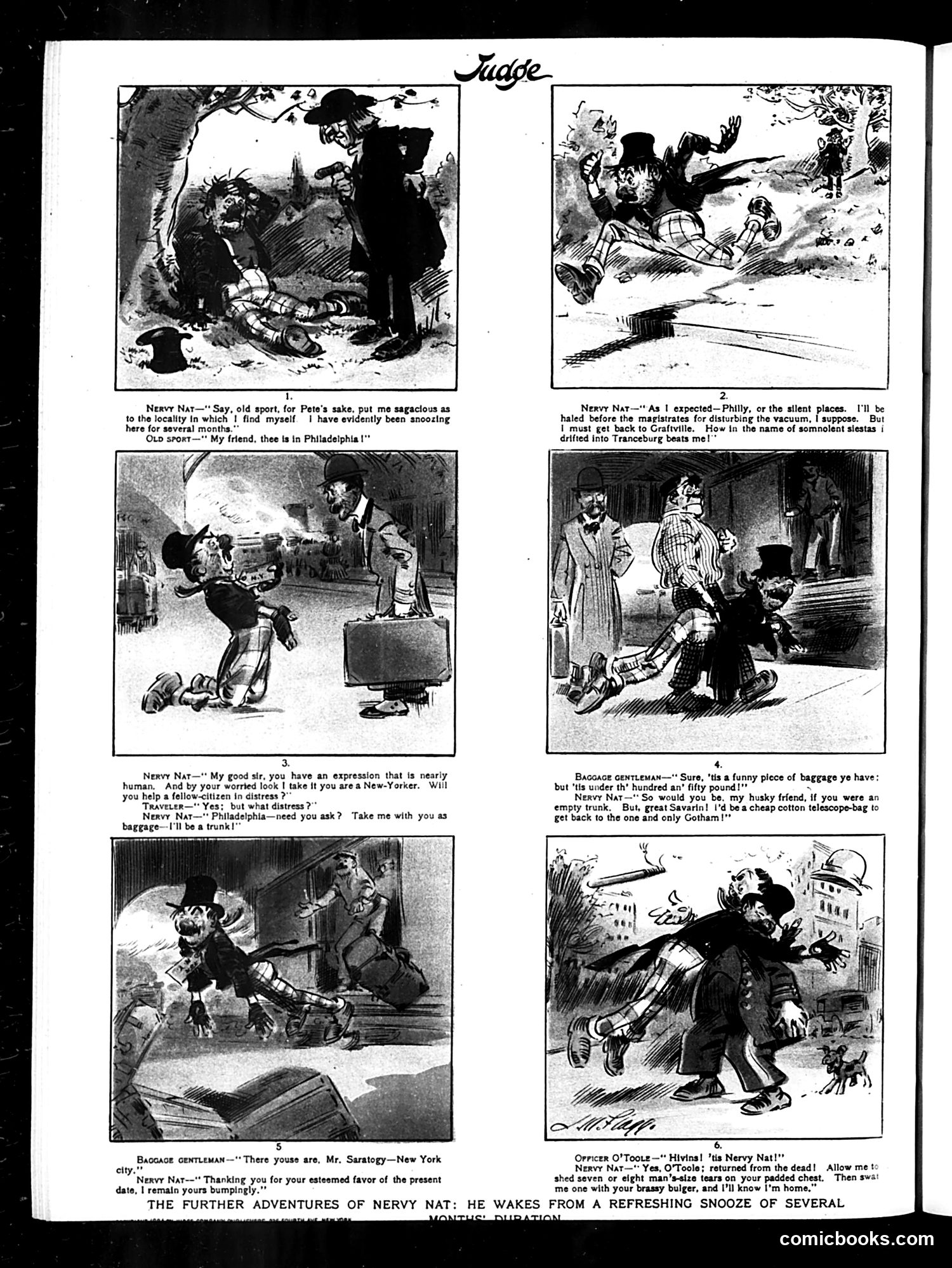
This is a comic strip satirizing the perceived dullness of Philadelphia compared to New York City. The protagonist, "Nervy Nat," wakes up in Philadelphia after sleeping for months and treats it as a catastrophe—calling it "the silent places" and a "vacuum." He desperately wants to escape back to New York (mockingly called "Graftville" and "Gotham"), willing to hide in baggage to do so. The satire targets the common early-20th-century urban prejudice that Philadelphia was boring and culturally inferior to the vibrant, energetic New York. The joke relies on New York superiority sentiment popular among Judge magazine's urban readership. The ethnic humor in "Officer O'Toole" (Irish stereotype) and "Saratogy" (suggesting a wealthy but somewhat simple character) reflects period comic conventions. The overall tone mocks both Philadelphia's perceived dullness and New Yorkers' smugness about it.