
Judge, 1905-12-02 · page 6 of 16
Judge — December 2, 1905 — page 6: what you’re looking at
What you’re looking at
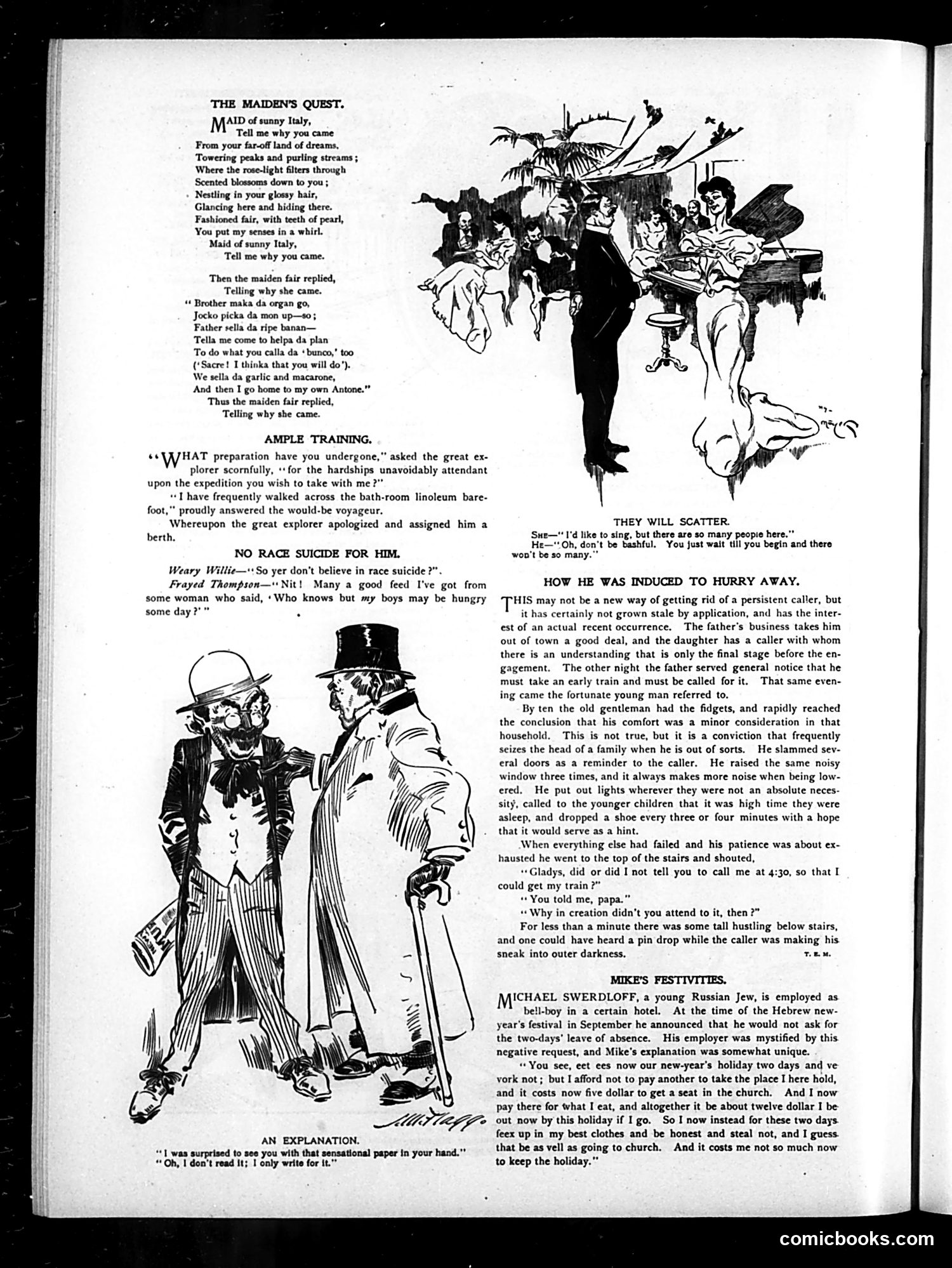
This Judge magazine page contains period humor reflecting early 20th-century American attitudes: **"The Maiden's Quest"** mocks Italian immigrants through stereotype—a romantically described Italian girl is revealed to be hustling her family's street-vending operation (organs, bananas, garlic, macaroni). The broken English dialect amplifies the satire targeting immigrant economic desperation presented as comic. **"No Race Suicide for Him"** references the contemporary "race suicide" panic—fears that native-born Americans weren't reproducing enough while immigrant populations grew. The joke presents a homeless man's reproductive prospects cynically, inverting middle-class anxieties about population decline. **"How He Was Induced to Hurry Away"** offers a domestic humor scenario about a father driving away his daughter's suitor through deliberate discomfort—standard courtship-era comedy. **"Mike's Festivities"** begins a story about a Jewish hotel worker, suggesting religious/ethnic workplace dynamics of the era. The overall tone reflects Judge's satirical focus on immigration, social class, and ethnic difference as humor sources.
📄 Transcribed text from this page (OCR, searchable)
Machine-transcribed from the original scan — historical spelling and the odd misread are preserved.
THE MAIDEN’S QUEST. MAD of sonny Tealy, Tell me why you came From your far-off land of dreams, Towering peaks and purling streams ; Where the rose-light filters through Scented blossoms down to you ; Nestling in your glossy hair, Glancing here and hiding there. Fashioned fair, with teeth of pearl, You put my senses in a whirl. Maid of sunny Italy, Tell me why you came. Then the maiden fair replied, Telling why she came. “ Brother maka da organ go, Jocko picka da mon up—so; Father sella da ripe banan— Tella me come to helpa da plan To do what you calla da ‘bunco,’ too (Sacre! I thinka that you will do’). We sella da garlic and macarone, And then I go home to my own Antone." ‘Thus the maiden fair replied, Telling why she came. AMPLE TRAINING. ‘YVHAT preparation have you undergone,” asked the great ex- plorer scornfully, «for the hardships unavoidably attendant upon the expedition you wish to take with me?” I have frequently walked across the bath-room linoleum bare- proudly answered the would-be voyageur. Whereupon the great explorer apologized and assigned him a berth, NO RACE SUICIDE FOR HIM. Weary Willie—« So yer don't believe in race suicide ?”. Frayed Thompson—“ Nit! Many a good feed I've got from some woman who said, ‘Who knows but my boys may be hungry some day?" a 4 AN EXPLANATION. irprised to see you with that sensational paper in your hand."’ n't read It; T daly write for i.” ts THEY WILL SCATTER. ‘d like to sing, but there are so many peopie here.”* He—‘Oh, don’t be bashful, You just wait till you begin and there won't be so many.” HOW HE WAS INDUCED TO HURRY AWAY. HIS may not be a new way of getting rid of a persistent caller, but it has certainly not grown stale by application, and has the inter- est of an actual recent occurrence. The father’s business takes him out of town a good deal, and the daughter has a caller with whom there is an understanding that is only the final stage before the en- gagement. The other night the father served general notice that he must take an early train and must be called for it. That same even- ing came the fortunate young man referred to. By ten the old gentleman had the fidgets, and rapidly reached the conclusion that his comfort was a minor consideration in that household, This is not true, but it is a conviction that frequently seizes the head of a family when he is out of sorts. He slammed sev- eral doors as a reminder to the caller. He raised the same noisy window three times, and it always makes more noise when being low- ered. He put out lights wherever they were not an absolute neces- sity, called to the younger children that it was high time they were asleep, and dropped a shoe every three or four minutes with a hope that it would serve as a hint. When everything else had failed and his patience was about ex- hausted he went to the top of the stairs and shouted, “Gladys, did or did I not tell you to call me at 4:30, so that I could get my train?” + You told me, papa.” “Why in creation didn’t you attend to it, then 2” For less than a minute there was some tall hustling below stairs, and one could have heard a pin drop while the caller was making his sneak into outer darkness. nem MIKE’S FESTIVITIES. MICHAEL SWERDLOFF, a young Russian Jew, is employed as bell-boy in a certain hotel, At the time of the Hebrew new- year's festival in September he announced that he would not ask for the two-days’ leave of absence. His employer was mystified by this negative request, and Mike's explanation was somewhat unique. “You see, eet ees now our new-year’s holiday two days and ve york not; but I afford not to pay another to take the place I here hold, and it costs now five dollar to get a seat in the church. And I now pay there for that I eat, and altogether it be about twelve dollar I be out now by this holiday if I go. So I now instead for these two days feex up in my best clothes and be honest and steal not, and I guess. that be as vell as going to church. And it costs me not so much now to keep the holiday.” comicbooks.com