
A complete issue · 16 pages · 1905
Judge — November 4, 1905
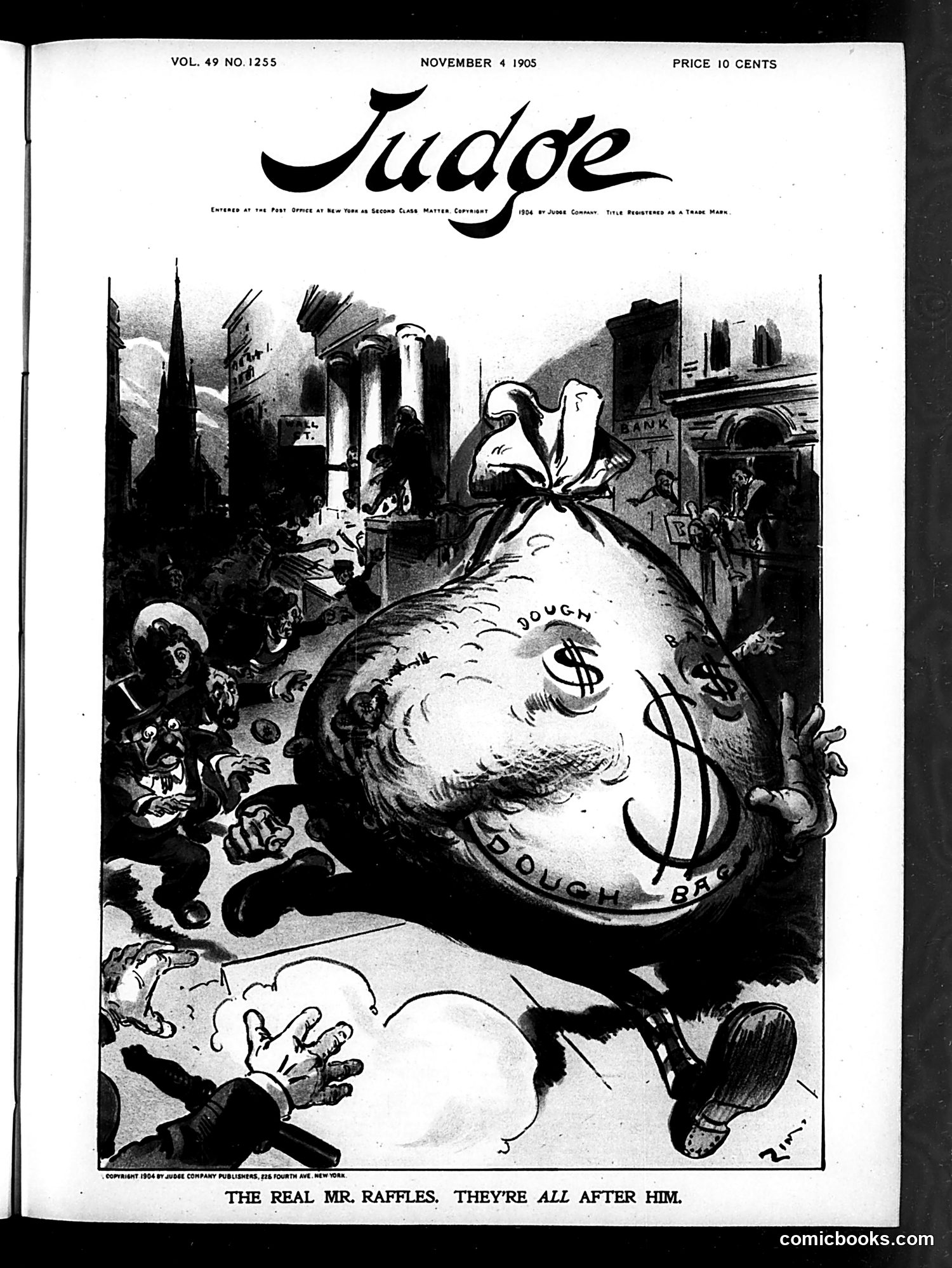
This 1905 *Judge* cartoon satirizes the wealthy through the figure of a portly man whose head is literally a large money bag labeled "DOUGH" with dollar signs. He's depicted stumbling through a city street while various figures—appearing to represent different social classes and professions—pursue him aggressively, reaching out with grasping hands. The satire targets both wealth itself and those who pursue it relentlessly. "Mr. Raffles" (likely referencing the fictional gentleman burglar) represents the wealthy man as simultaneously a victim and the object of universal desire. The cartoon critiques how money attracts parasitic attention from all directions—a commentary on Gilded Age materialism and the corrupting influence of wealth on society.
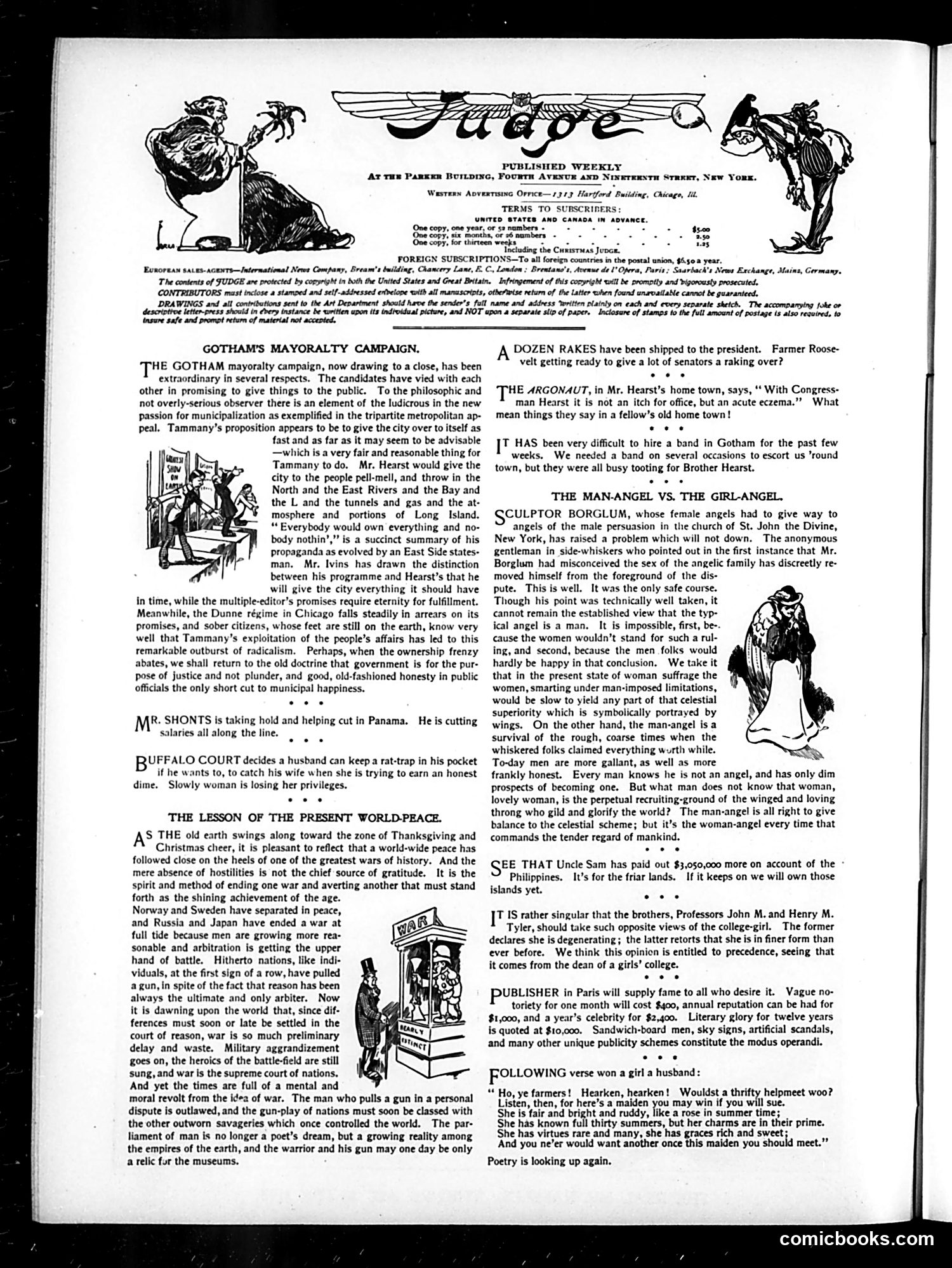
This page contains several satirical pieces about contemporary political and social issues, though specific dates and figures are difficult to identify with certainty from the image alone. **"Gotham's Mayoralty Campaign"** appears to mock New York City's mayoral race, suggesting candidates engage in frivolous theatrics rather than substantive governance. The satire criticizes proposals to "give the city over to itself" as absurd. **"The Man-Angel vs. The Girl-Angel"** discusses sculptor Borglum's controversy regarding angelic gender representation in art, satirizing debates about masculinity and femininity in cultural symbols. Additional brief items reference Panama Canal salaries, rat-traps in marriage, and world peace philosophy—typical Judge fare mixing political commentary with social satire. The page demonstrates the magazine's approach to mocking contemporary institutional and social pretensions.
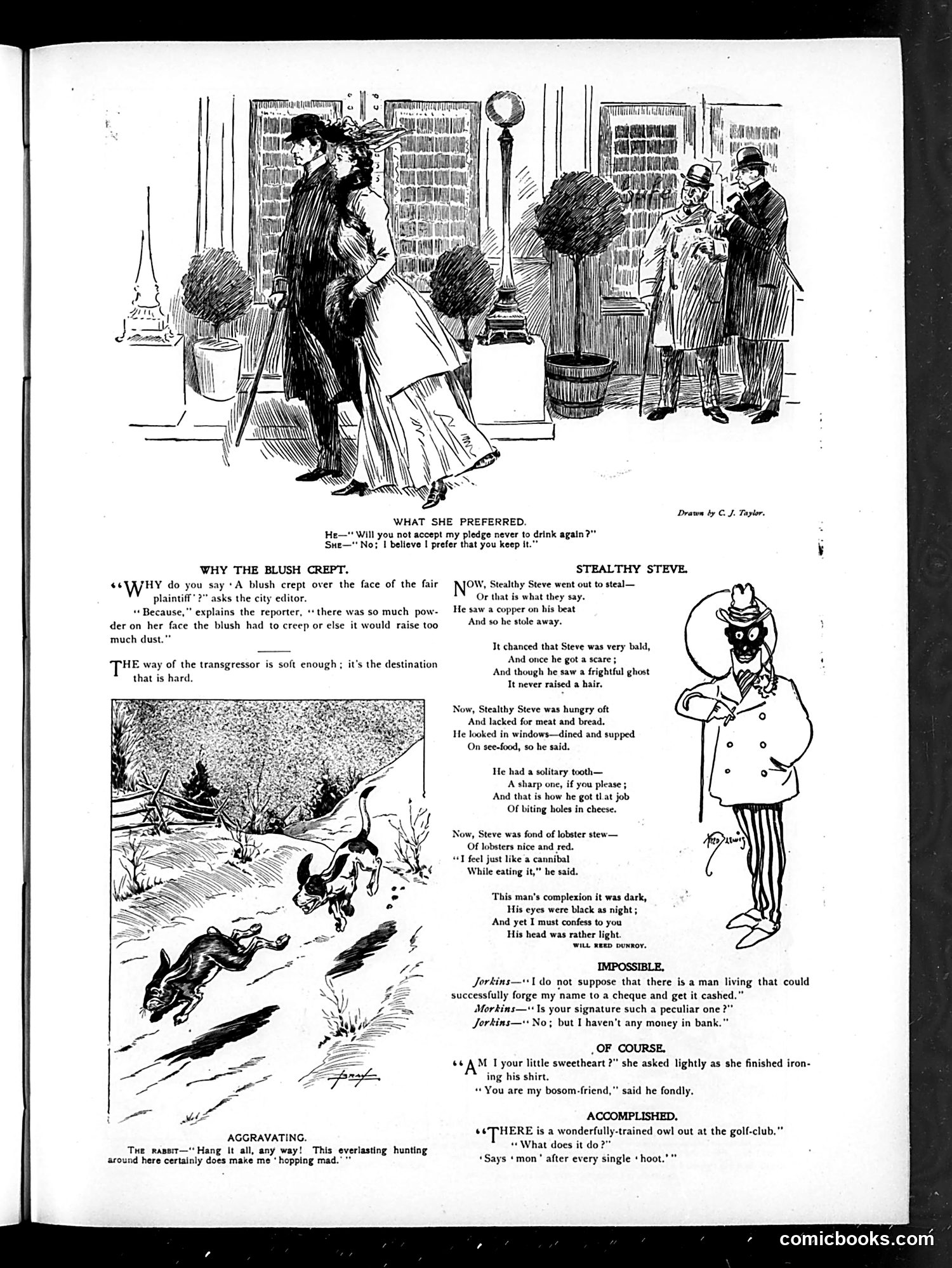
This page contains several humor pieces typical of Judge's satirical style: **"What She Preferred"** (top): A romantic comedy sketch about a woman rejecting a man's pledge to stop drinking, preferring he keep it—suggesting she'd rather he continue than make false promises. **"Why the Blush Crept"** and **"Stealthy Steve"**: Appear to be humorous short stories with accompanying illustrations about embarrassment and a character named Steve. **"Aggravating"**: A joke about a rabbit disrupting a hunt. **"Impossible," "Of Course," and "Accomplished"**: Brief comedic dialogues and observations about signature forgery, romance, and a trained owl at a golf club. The content focuses on domestic humor, romantic mishaps, and absurdist jokes rather than explicit political commentary. The drawings by C.J. Taylor use period-appropriate ink styling typical of early 20th-century American humor magazines.
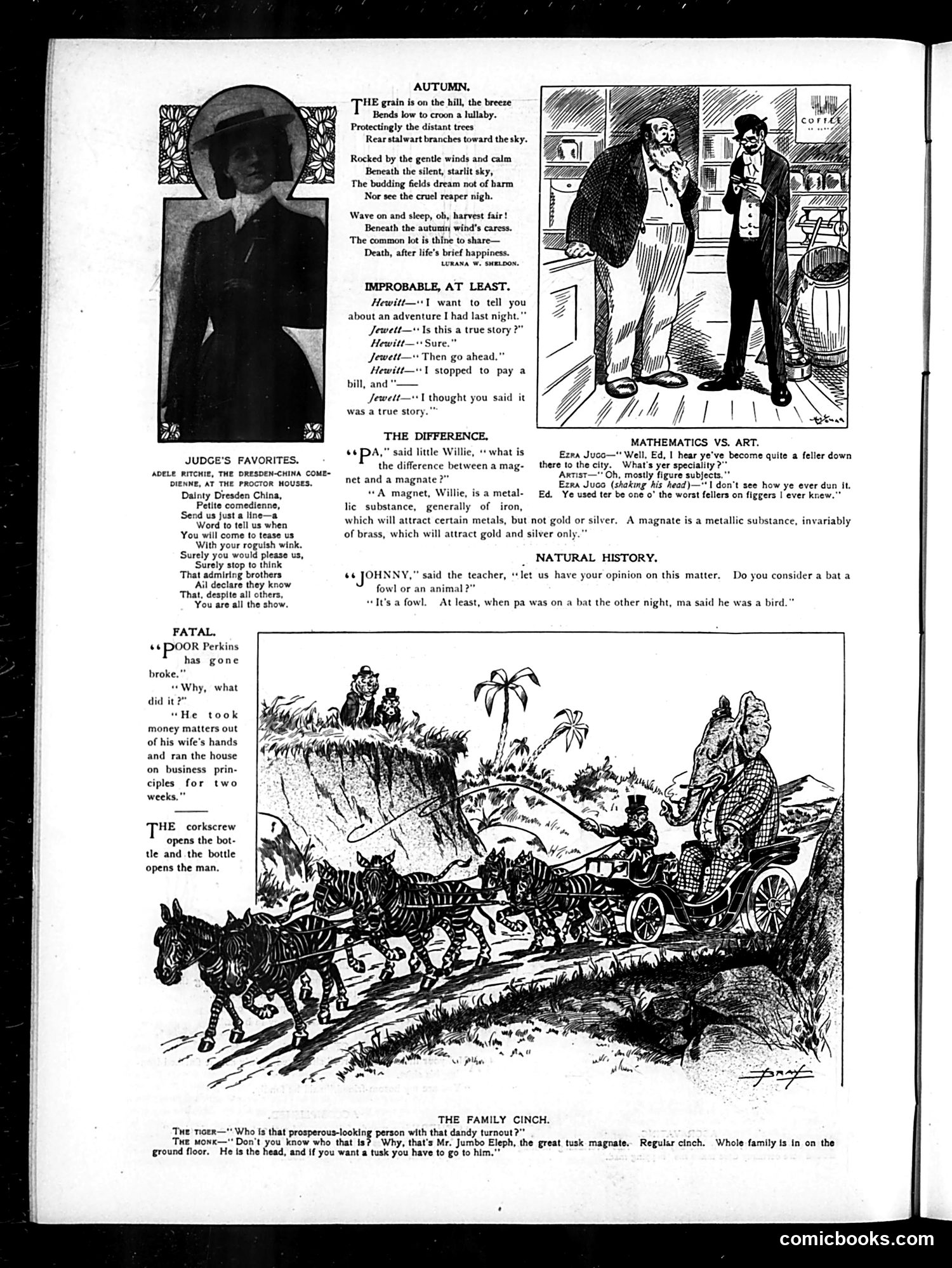
This page contains several unrelated short humorous pieces typical of Judge's format: **"Autumn"** - A poem about fall's beauty, seemingly straightforward. **"Judge's Favorites"** - A complimentary poem about someone (possibly a public figure), likely satirical given Judge's nature. **"The Difference," "Mathematics vs. Art," and "Natural History"** - Brief dialogue jokes contrasting subjects or playing on definitional confusion—typical mild humor of the period. **"Fatal"** and **"The Family Cinch"** - Anecdotal jokes about money and domestic situations. The large cartoon at bottom depicts a fantastical scene with zebras pulling a carriage through tropical terrain, with figures appearing to represent colonial-era exploration or safari themes. Without clearer context or captions, the specific satire remains unclear, though it likely mocks Victorian-era adventure narratives or colonial attitudes.
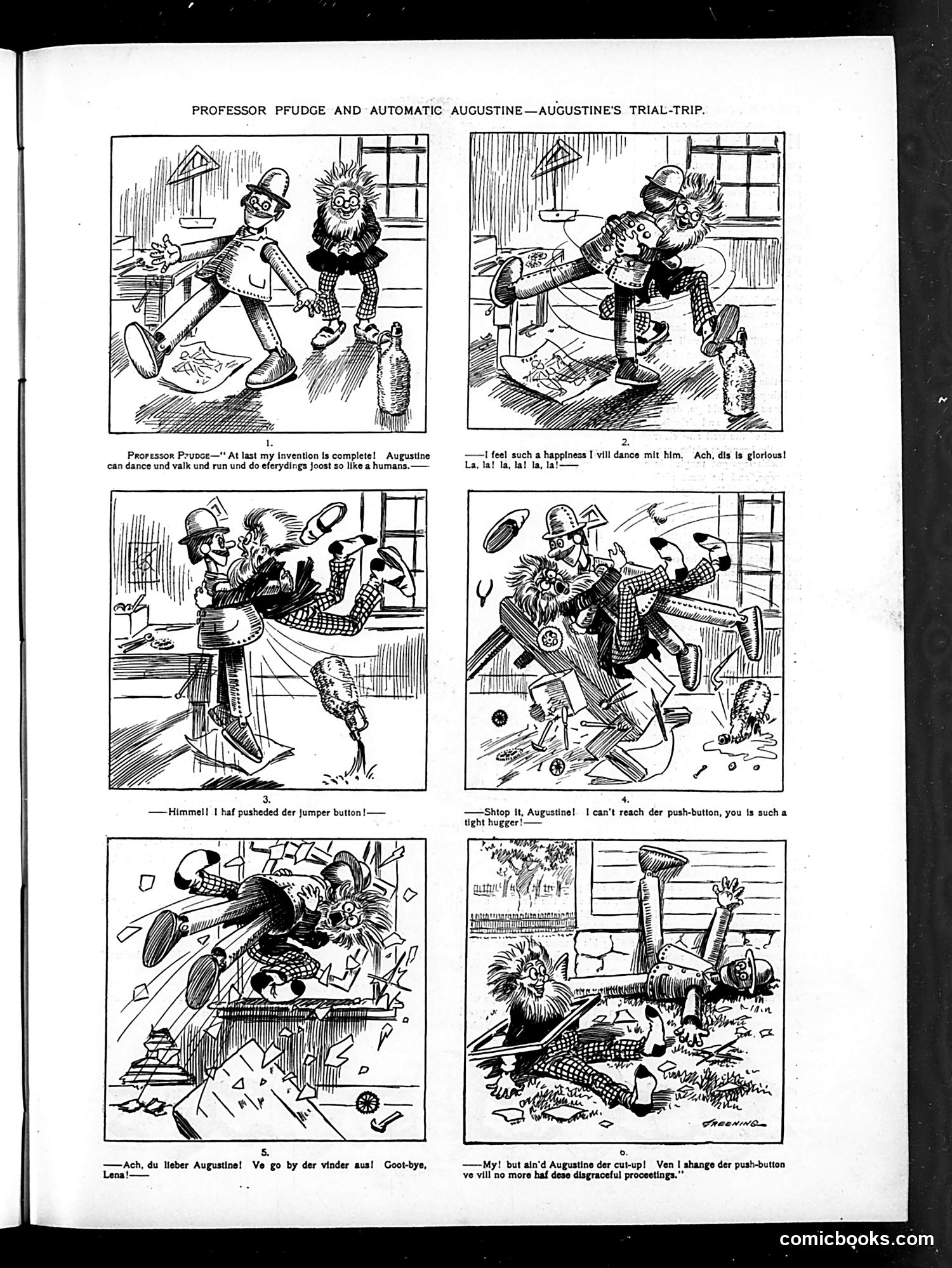
This appears to be a six-panel comic strip titled "Professor Pfudge and Automatic Augustine—Augustine's Trial-Trip." The narrative follows Professor Pfudge demonstrating his invention—a mechanical or automated device called "Automatic Augustine"—which apparently malfunctions catastrophically. The sequence shows: (1) Pfudge proudly presenting the invention; (2) Augustine dancing uncontrollably; (3-4) the device spinning wildly out of control; (5) violent destruction; (6) the device crashing outdoors, completely demolished. The satire likely mocks turn-of-century inventors and their overconfident demonstrations of mechanical contraptions that inevitably fail spectacularly. The humor derives from the gap between Pfudge's enthusiasm and the actual disaster his invention causes—a common theme in early 20th-century satire about technological "progress."
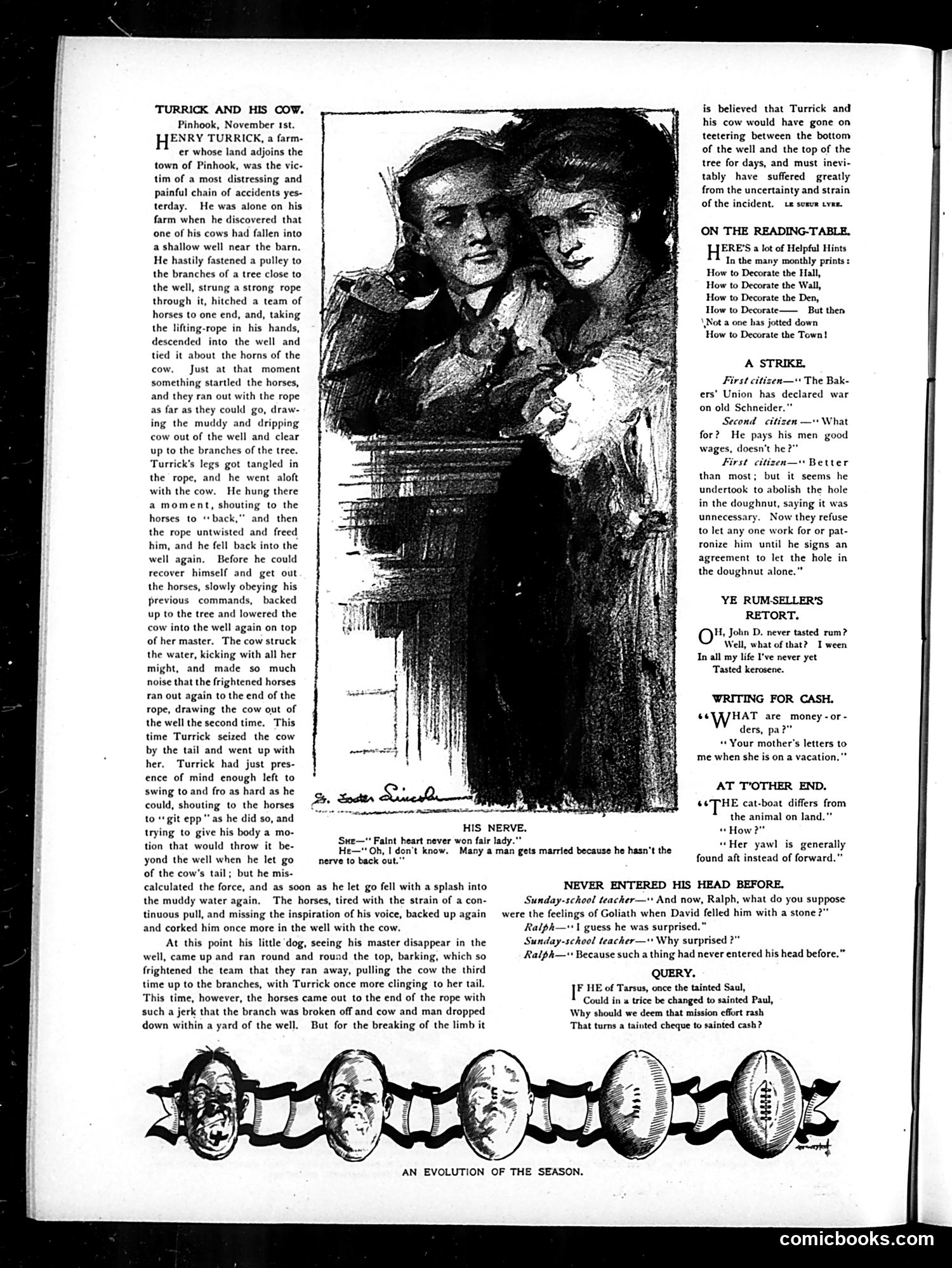
This page contains a tall-tale humorous story about Henry Turrick from Pinhook who attempts to rescue his cow from a well using a pulley system. The narrative escalates absurdly: startled horses pull him up with the cow, he falls back down, they lower the cow onto him, and the cycle repeats until he seizes the cow's tail during an upswing. The story satirizes rural mishaps and the chain-reaction chaos of farm life. The page also includes several brief comedic vignettes: a strike dispute over a baker allegedly abolishing doughnuts, a rum-seller's retort about never tasting kerosene, and Sunday-school humor. The decorative footer shows "An Evolution of the Season" (faces changing expression). The central illustration depicts Turrick and his cow mid-rescue, emphasizing the physical absurdity. Judge magazine used such exaggerated rural narratives to entertain urban readers with stereotypical country-life scenarios.
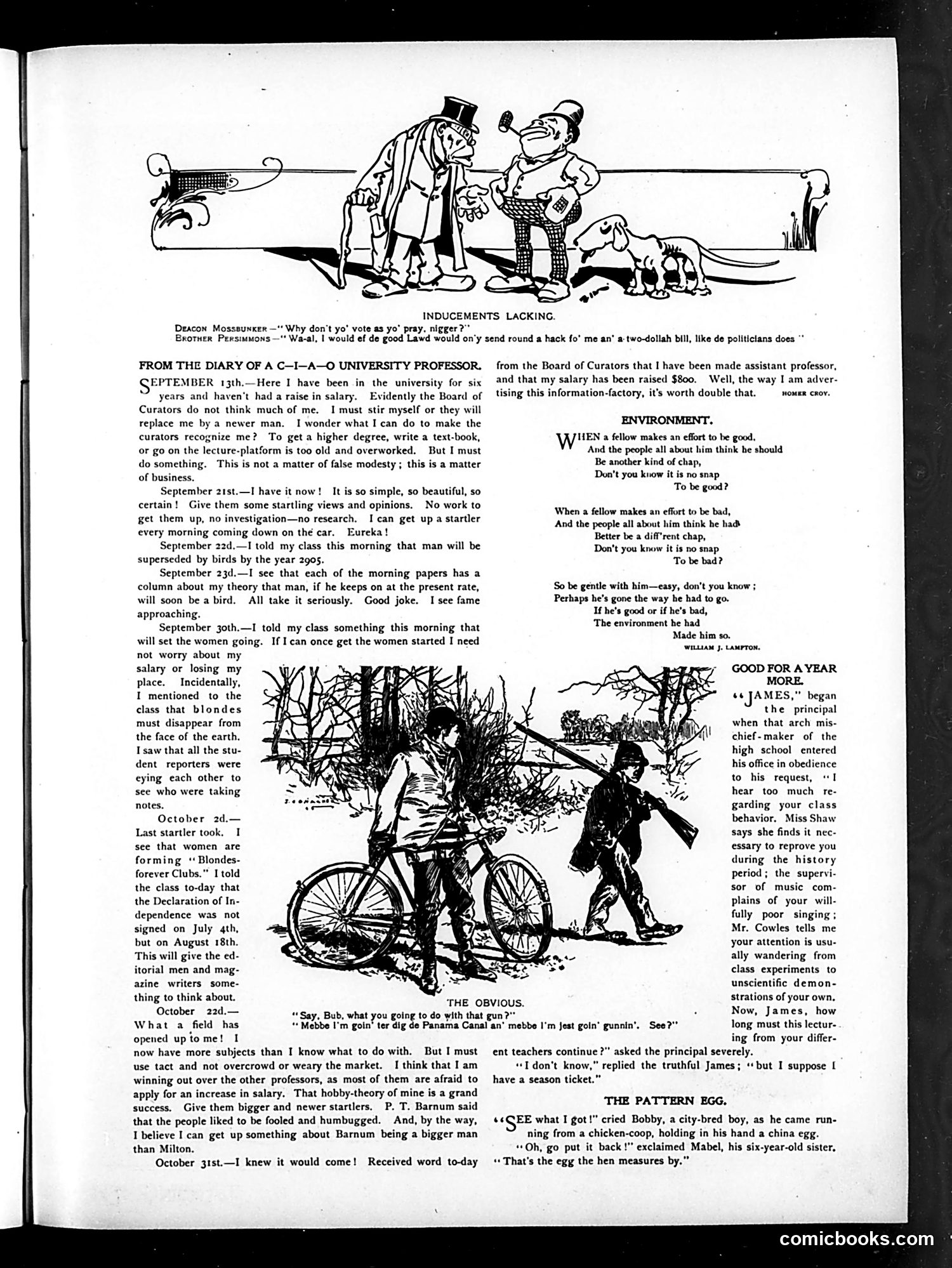
The top cartoon titled "INDUCEMENTS LACKING" employs racist caricature (with offensive period dialect) to satirize Southern hypocrisy—a Black minister questions a white man's failure to practice what he preaches. The "DIARY OF A C-I-A-O UNIVERSITY PROFESSOR" is satirical commentary on academic careerism. It mocks a professor who manufactures outrageous, unsupported claims (men will become birds, blonde women should disappear, the Declaration of Independence's real date) purely for publicity and self-promotion, explicitly following P.T. Barnum's philosophy about entertaining crowds. His scheme succeeds—he gets promoted and a salary raise. The satire targets intellectual dishonesty and the pressure professors face to gain attention through sensationalism rather than legitimate research. "THE OBVIOUS" cartoon features crude dialect humor about digging the Panama Canal. The poem "ENVIRONMENT" emphasizes environmental determinism in moral behavior—a fashionable Progressive-era idea that circumstances, not individual character, determine whether someone is "good" or "bad."
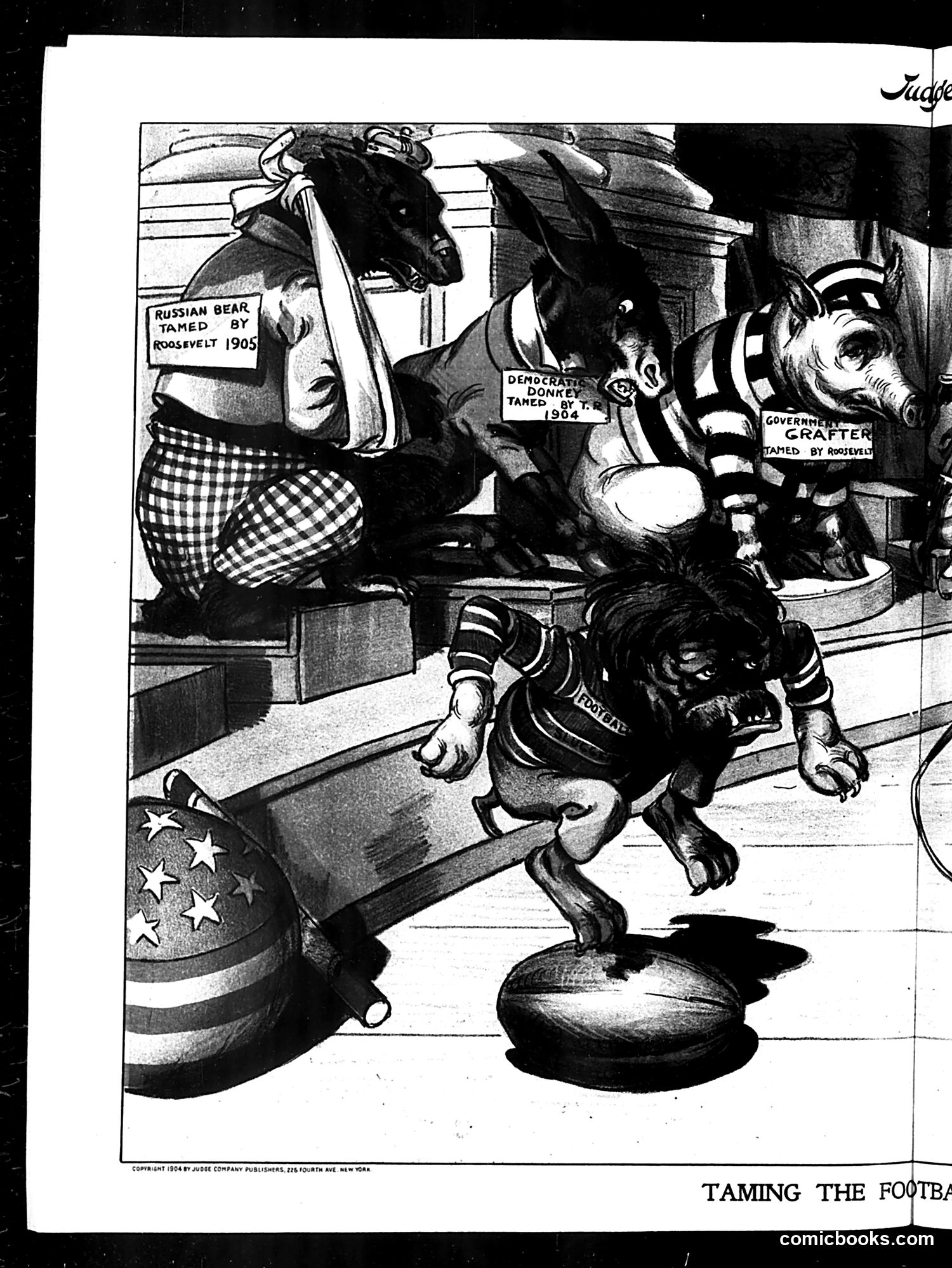
This 1904 Judge cartoon satirizes President Theodore Roosevelt's attempts to reform American college football, which was then notoriously violent and dangerous. The cartoon depicts Roosevelt (labeled "Russian Bear Tamed by Roosevelt 1905") as a trainer controlling wild animals representing different football-related forces: a "Democracy's Donkey" (likely partisan politics), a "Government Grafter," and what appears to be anarchist or radical elements (the figure with the bomb marked with stars). The title suggests Roosevelt is "taming" the chaos of football—a metaphor for his broader Progressive Era reforms to regulate dangerous practices. The cartoon implies Roosevelt is managing various unruly political and social forces through his executive authority, much as he sought to bring order and safety to the brutal sport through legislative pressure on universities.
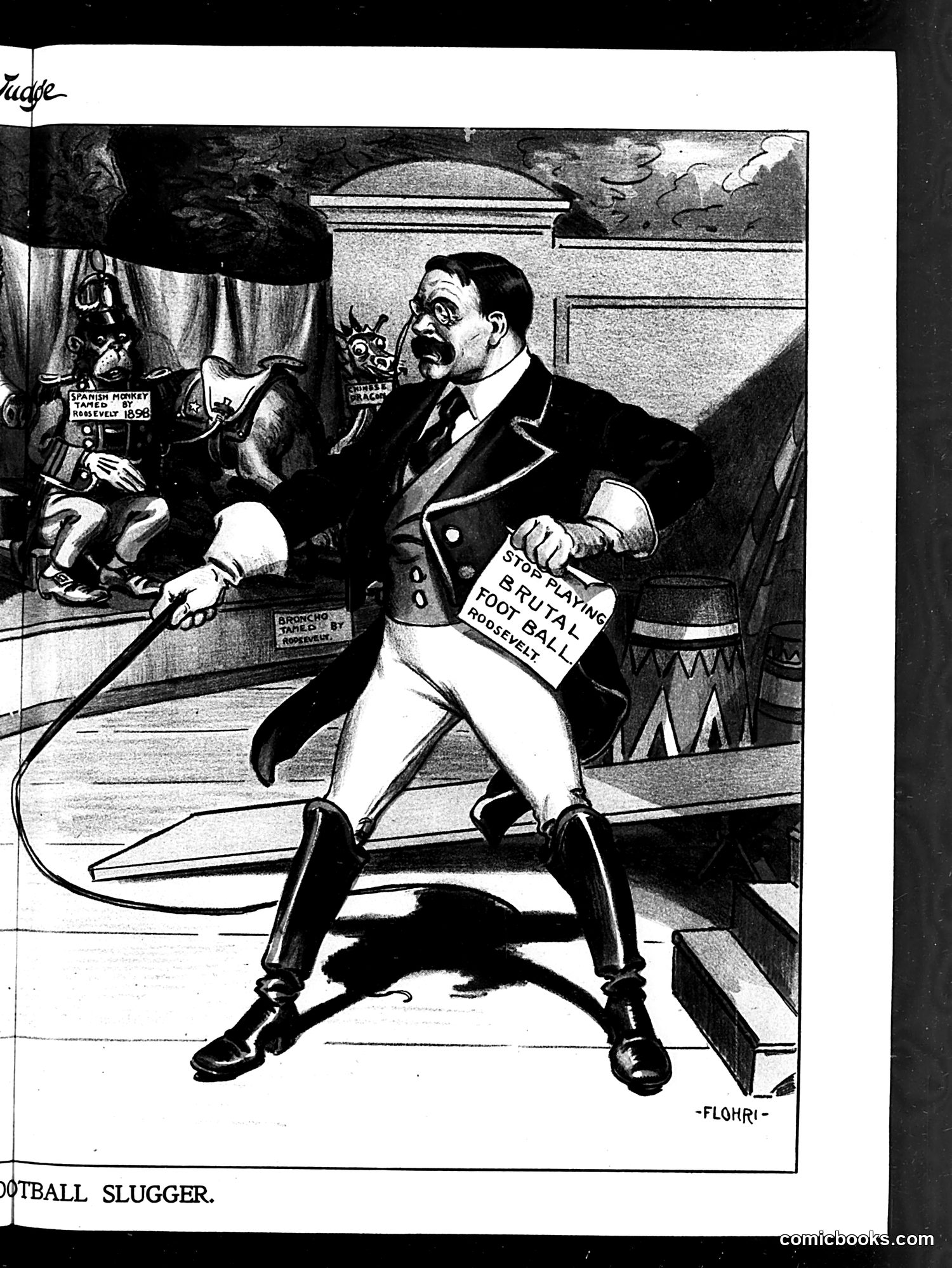
This Judge magazine cartoon satirizes Theodore Roosevelt's foreign policy, specifically the Spanish-American War of 1898. The figure labeled "Spanish Monkey" (a racist caricature representing Spain) is depicted as a performing animal "tamed" by Roosevelt. The main character—a man in formal dress wielding a club labeled "Stop Playing Foul Ball Roosevelt"—represents Roosevelt as an aggressive "football slugger." The cartoon appears to criticize Roosevelt's bellicose approach to international relations, portraying his military interventions as crude, violent tactics rather than diplomatic solutions. The satirical message suggests Roosevelt uses blunt force ("slugging") rather than finesse in foreign policy, turning international relations into a brutal sport. This reflects contemporary debate about American imperialism and Roosevelt's expansionist policies.
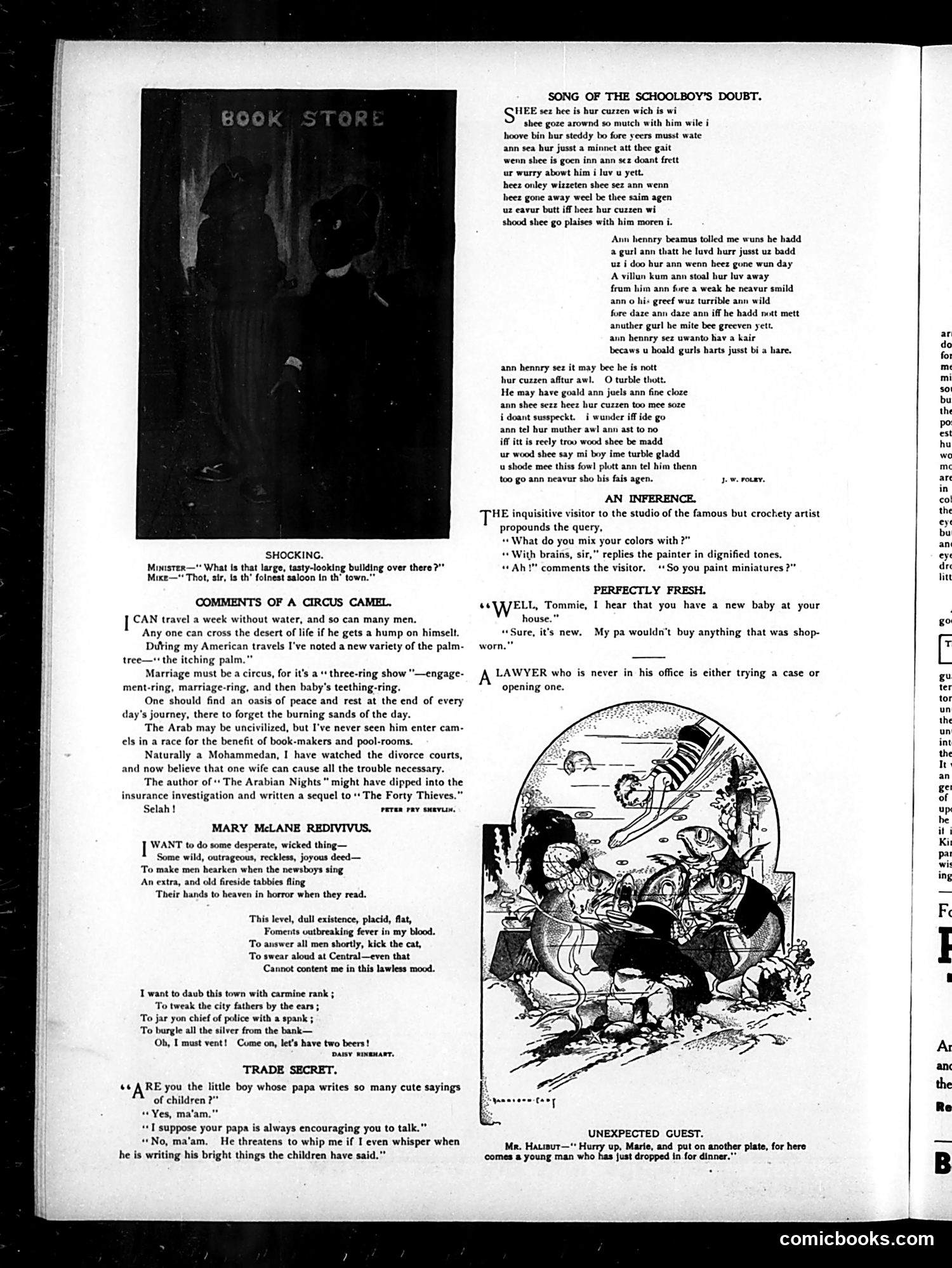
This page contains satirical humor typical of early 20th-century Judge magazine. Key items include: **"Shocking"**: A minister mistakes a saloon for a fine building—mocking rural naiveté or clergy ignorance. **"Circus Camel" commentary**: Observational humor comparing camel endurance to human resilience, with jabs at American materialism ("itching palm"), marriage's complications, and Arab culture presented through a camel's perspective—reflecting period attitudes toward non-Western peoples. **"Mary McLane Redivivus"**: A poem mocking youthful rebellion and desire for notoriety, likely referencing the actual controversial writer Mary MacLane (misspelled here) known for shocking autobiographical writings. **"Trade Secret"**: A joke about a writer-father threatening to whip his child into silence so he can fabricate "cute sayings" for publication—satirizing the period's sentimental children's literature and parental fraud. **Other sketches** mock lawyers, provide visual humor, and offer workplace observations typical of Judge's social commentary targeting urban American life and pretensions.
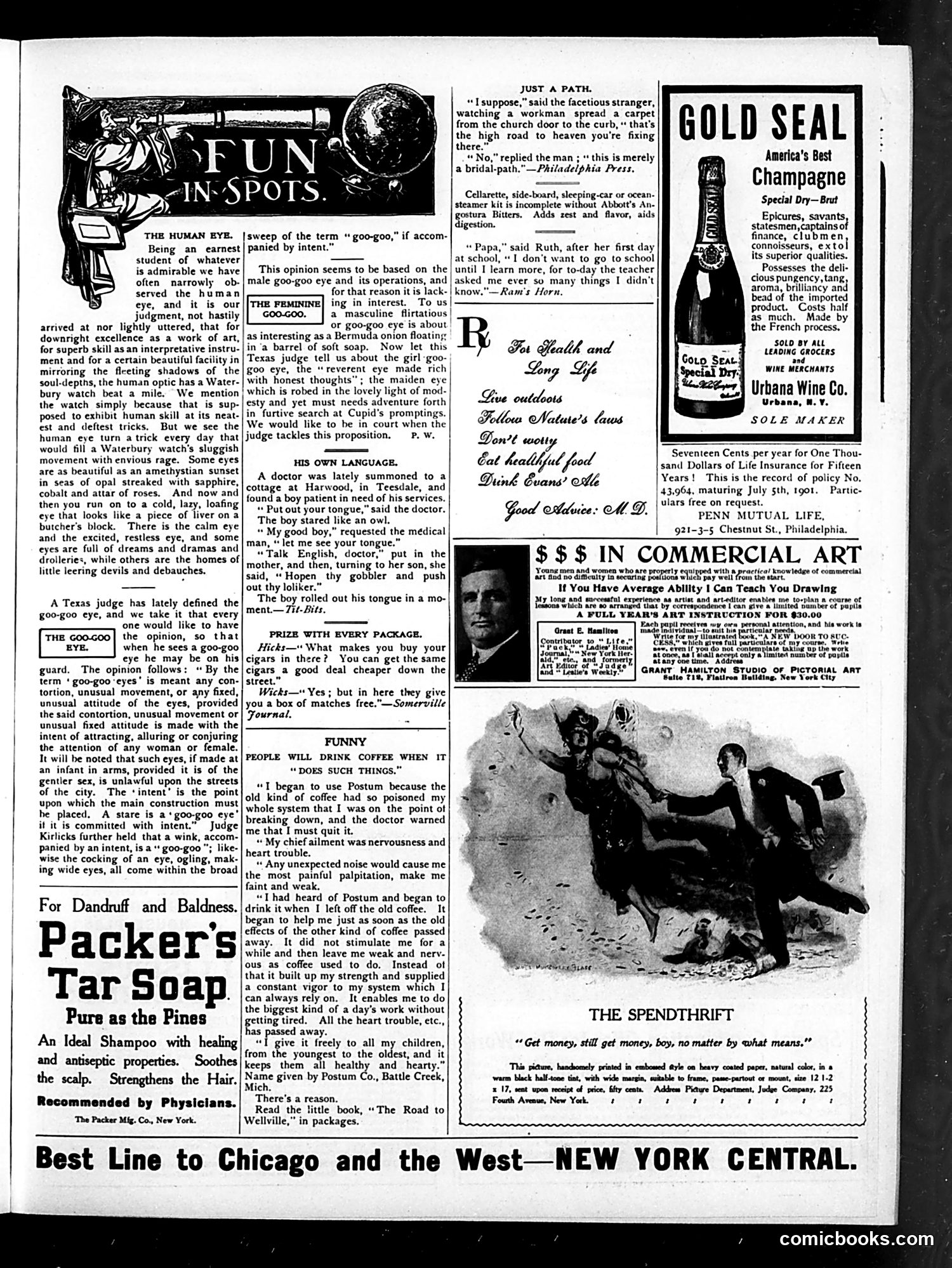
This is primarily an **advertising and humor page** from Judge magazine, not a political cartoon page. The main content is "The Human Eye" essay, which humorously discusses the "goo-goo eye"—a flirtatious look. A Texas judge has legally defined it as eye movements made "with intent of attracting, alluring or conjuring the attention of any woman or female." The satire mocks this absurdly literal legal definition of flirtation, particularly noting the judge only addressed male behavior and missed the subtler "reverent eye" and "maiden eye" of women. The page includes three short humorous anecdotes: a doctor's visit where a boy only understands dialect; a man buying expensive cigars for free matchboxes; and various advertisements (Parker's Tar Soap, Gold Seal Champagne, etc.). **No specific political figures or events are referenced.** The satire targets legal overreach and male cluelessness rather than contemporary politics.
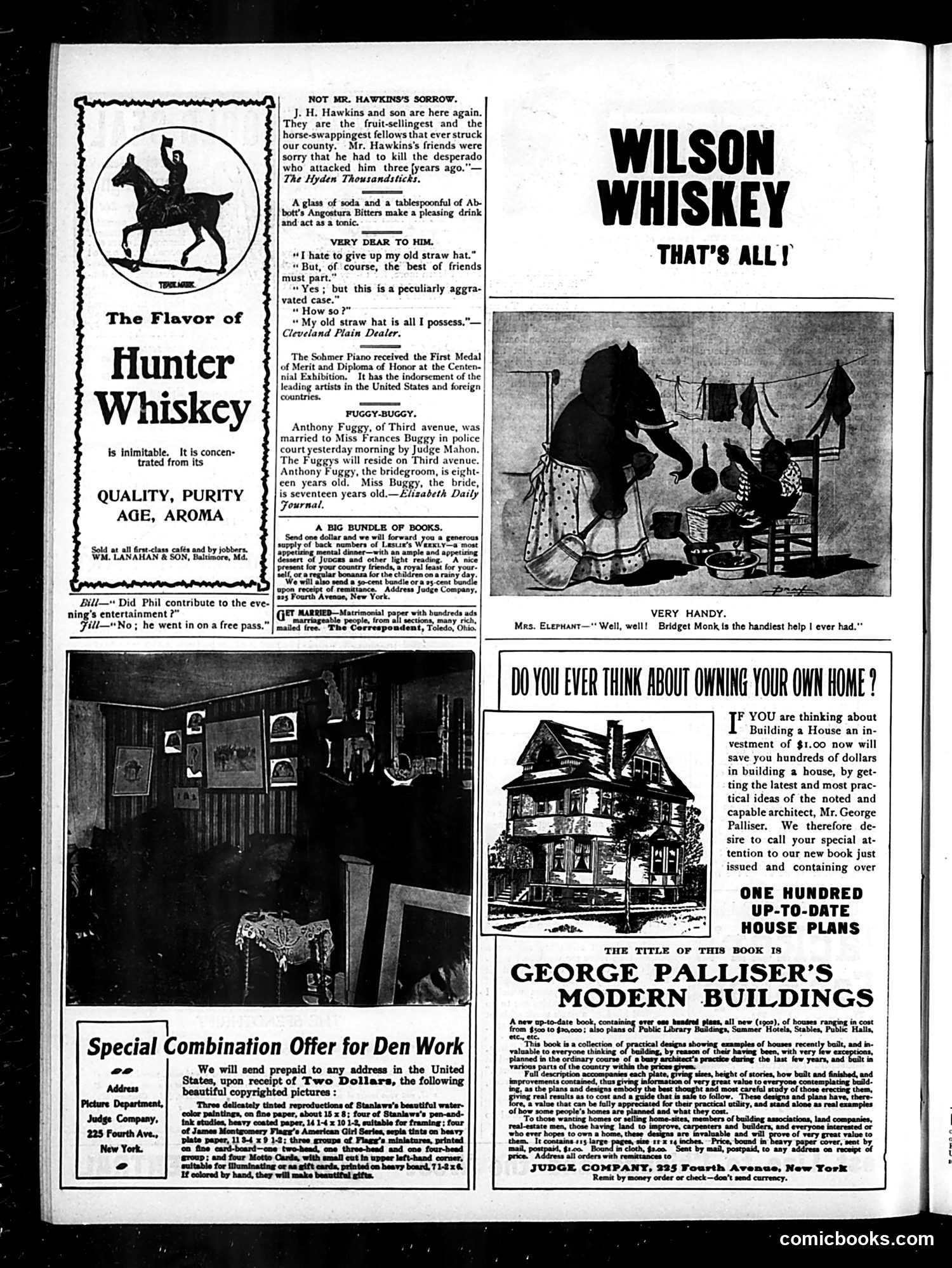
This page is primarily **advertising and filler content** rather than political satire. It contains: **Advertisements:** - Hunter Whiskey (quality/purity claims) - Sohmer Piano (Centennial Exhibition awards) - George Palliser's "Modern Buildings" (house plan book) - Judge Company's copyrighted pictures offer - Various matrimonial and book services **Humor/Filler:** Several brief jokes and anecdotes, including: - A quip about someone attending an event on a free pass - A story about J.H. Hawkins killing a "desperado" (appears to be local gossip) - Short humor pieces about reluctance to part with a straw hat and an Irish servant named Bridget Monk - A wedding announcement of Anthony Fuggy and Frances Buggy (the surnames appear chosen for comedic effect) **Social Context:** The ads reflect late-19th-century concerns: home ownership, servant hiring ("help"), and piano ownership as status symbols. The humor is mild, domestic, and relies on wordplay rather than political commentary.
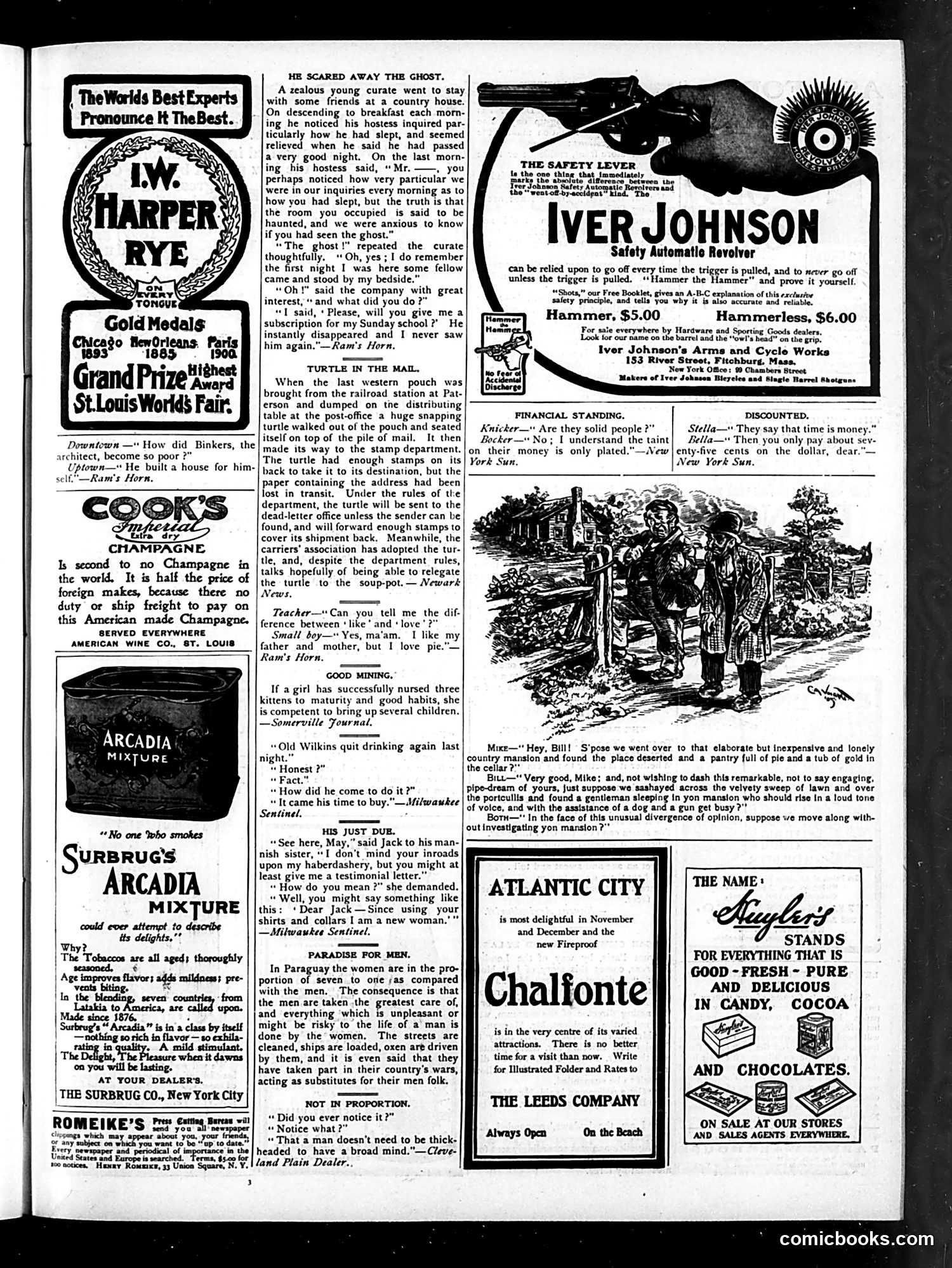
This page is primarily **advertising and humor filler** rather than political satire. The content includes: **Main Content:** - Humorous anecdotes ("He Scared Away the Ghost," "Turtle in the Mail") — brief jokes about a curate who solicits donations to scare away a ghost, and a snapping turtle accidentally mailed through the postal system - A joke contrasting "like" vs. "love" (preferring pie to parents) - A quip about Paraguay having seven women per man, creating a "paradise for men" **Advertising:** The page is dominated by period product ads: I.W. Harper Rye whiskey, Cook's Champagne, Arcadia tobacco mixture, Iver Johnson revolvers, and Surbrug's Arcadia tobacco. **Historical Context:** These items reflect early 1900s consumer culture. The Iver Johnson revolver ad emphasizes it as "Safety Automatic" — noteworthy given evolving firearm safety concerns of that era. The humor is gentle, domestic, and family-friendly — typical of Judge's satirical but not particularly pointed content for this era.
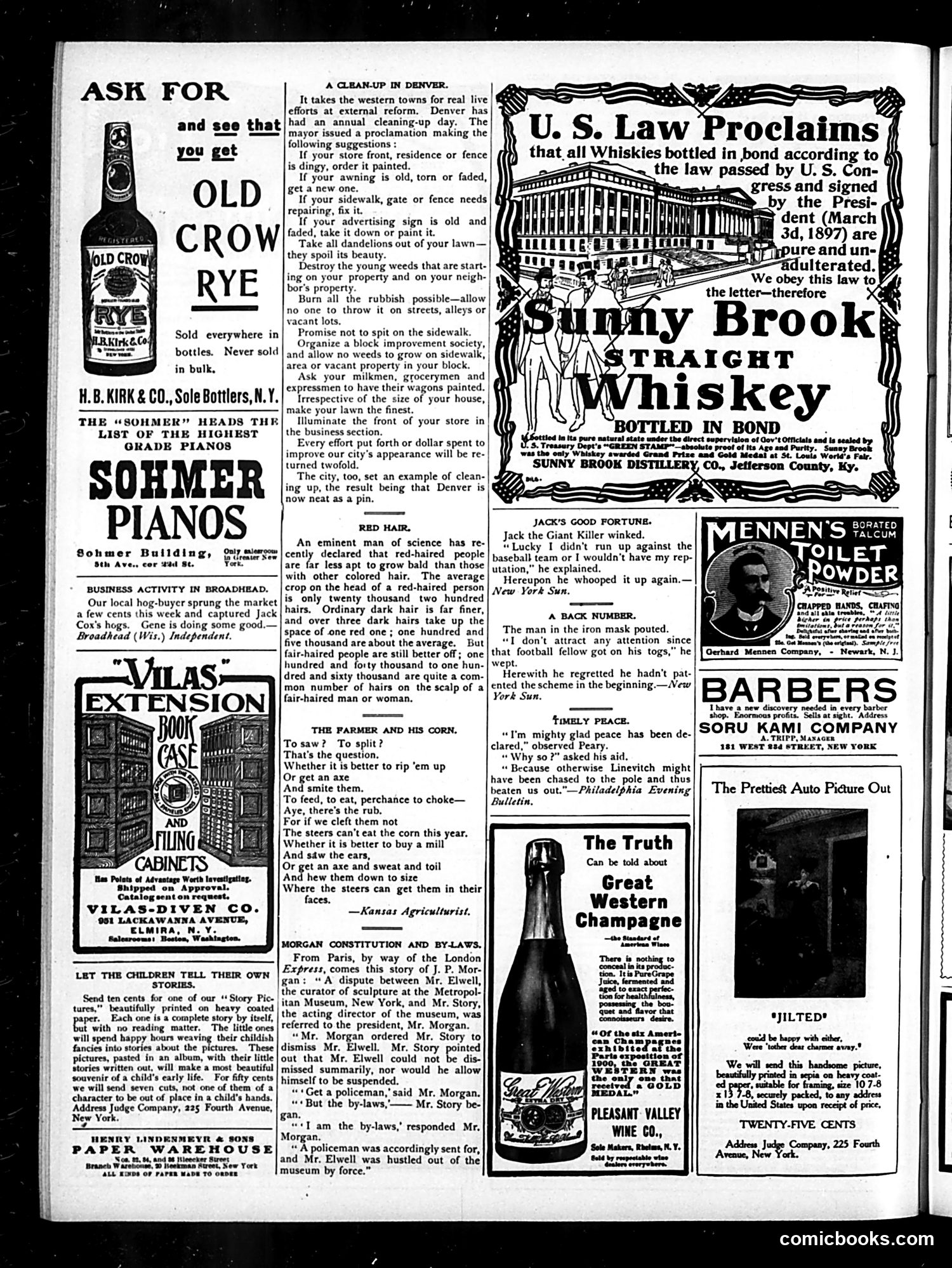
This is primarily an **advertising page** with minimal editorial content. The main items are commercial advertisements for products like Old Crow Rye whiskey, Sohmer pianos, and paper goods. The small editorial pieces included are **humorous local anecdotes** rather than political satire: - "A Clean-Up in Denver" praises Denver's municipal cleanliness initiative with tongue-in-cheek enthusiasm - "Red Hair" reports pseudo-scientific claims about hair density in different hair colors - "The Farmer and His Corn" is a playful parody of Hamlet's soliloquy applied to corn processing There are no identifiable political cartoons or caricatures on this page. The content reflects **Judge's typical mix of light humor, local interest stories, and advertising**—this appears to be a fairly standard issue without the sharper satirical political content the magazine was known for at other times.
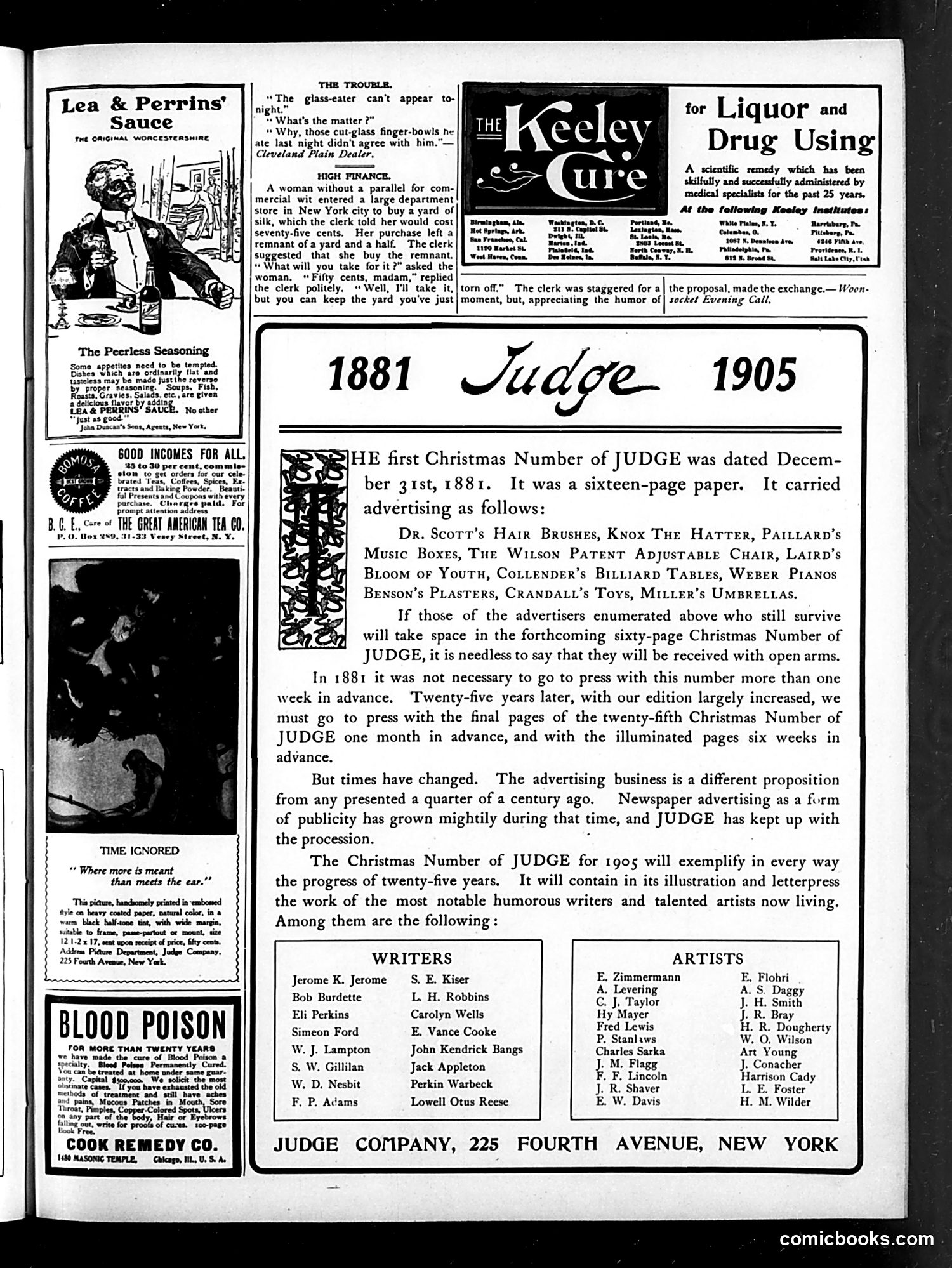
This page is primarily a **25th anniversary celebration** of Judge magazine (1881-1905) rather than featuring political cartoons. The upper left contains brief **humorous anecdotes** mocking foolish customer behavior—a woman buying expensive ribbon remnants at inflated prices, and a "glass-eater" performer whose digestion fails. These appear to be generic jokes typical of the era's humor magazine content. The main feature is Judge's **boastful retrospective**: the 1881 Christmas issue was 16 pages requiring only one week's advance notice; by 1905, the magazine needed one month's advance planning and six weeks for illustrated pages, reflecting advertising's explosive growth. Judge celebrates this expansion by listing prominent **writers** (Jerome K. Jerome, Mark Twain) and **artists** (J.M. Flagg) contributing to their 1905 Christmas edition. The surrounding advertisements—for "Keeley Cure" (drug addiction treatment), "Blood Poison" remedies, and commercial products—reveal the magazine's actual readership and the dubious medical claims common to the period. This is essentially a **trade publication moment**: Judge asserting its importance and influence in American popular culture.
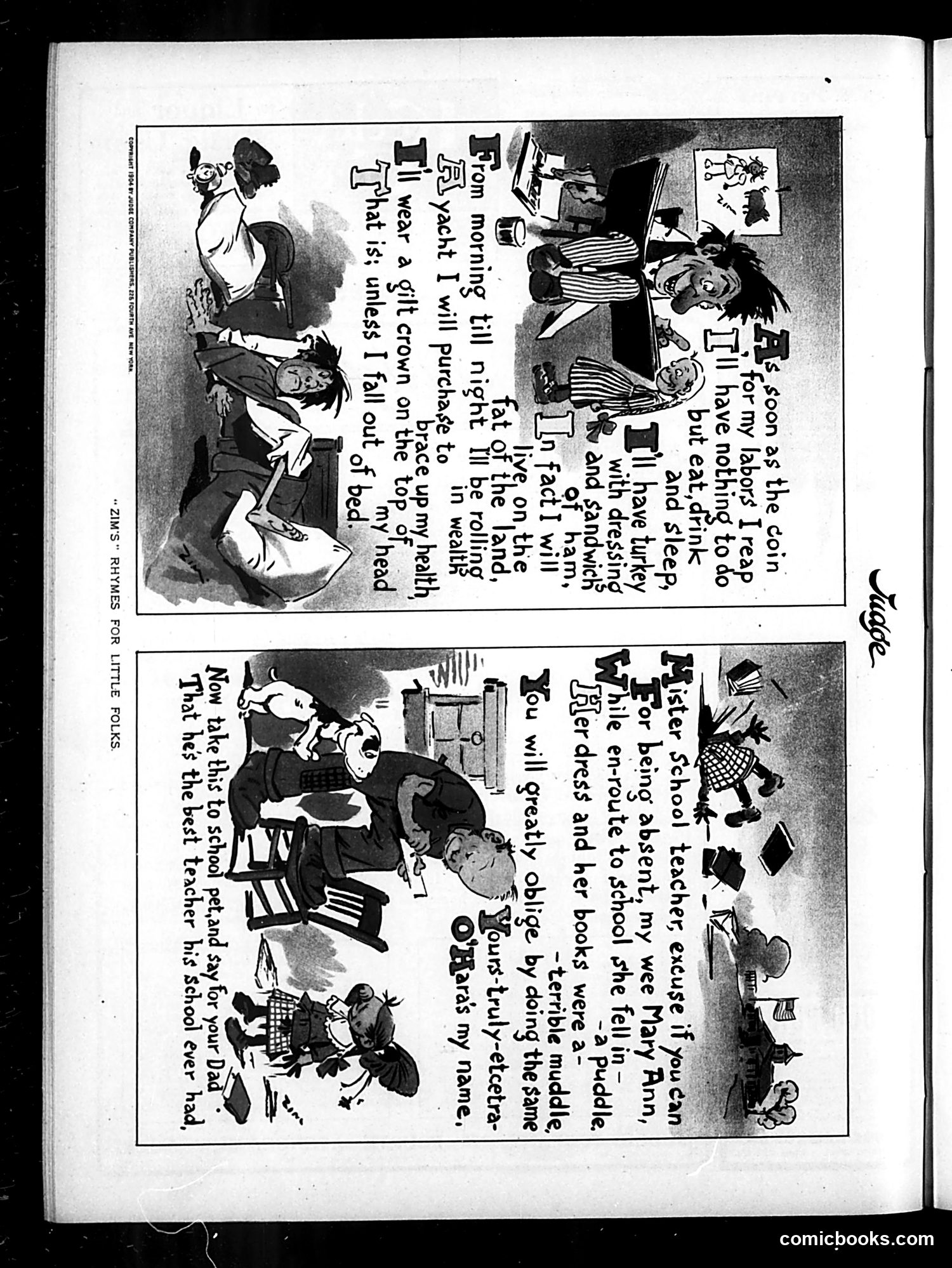
This page contains two illustrated poems by "Zim" (the cartoonist's signature visible) presenting satirical domestic scenarios in verse form, targeting early 1900s American social attitudes. **Top cartoon**: A man lounges while his wife works, fantasizing about wealth and leisure. The satire mocks male idleness and get-rich-quick schemes—he imagines sailing yachts and enjoying luxury while refusing honest labor. **Bottom cartoon**: A neglectful father sends his young daughter to school disheveled with muddy clothes and scattered books, then has the audacity to ask the teacher to excuse her absence and compliment him as "the best teacher his school ever had." The satire targets parental irresponsibility and delusional self-regard. Both poems ridicule men who expect rewards without effort—whether through fantasy wealth or unearned praise—while their family obligations suffer. The "rhymes for little folks" format allows harsh social criticism through ostensibly children's verse, typical of Judge's satirical approach to contemporary American behavior and values.