
A complete issue · 16 pages · 1905
Judge — October 28, 1905
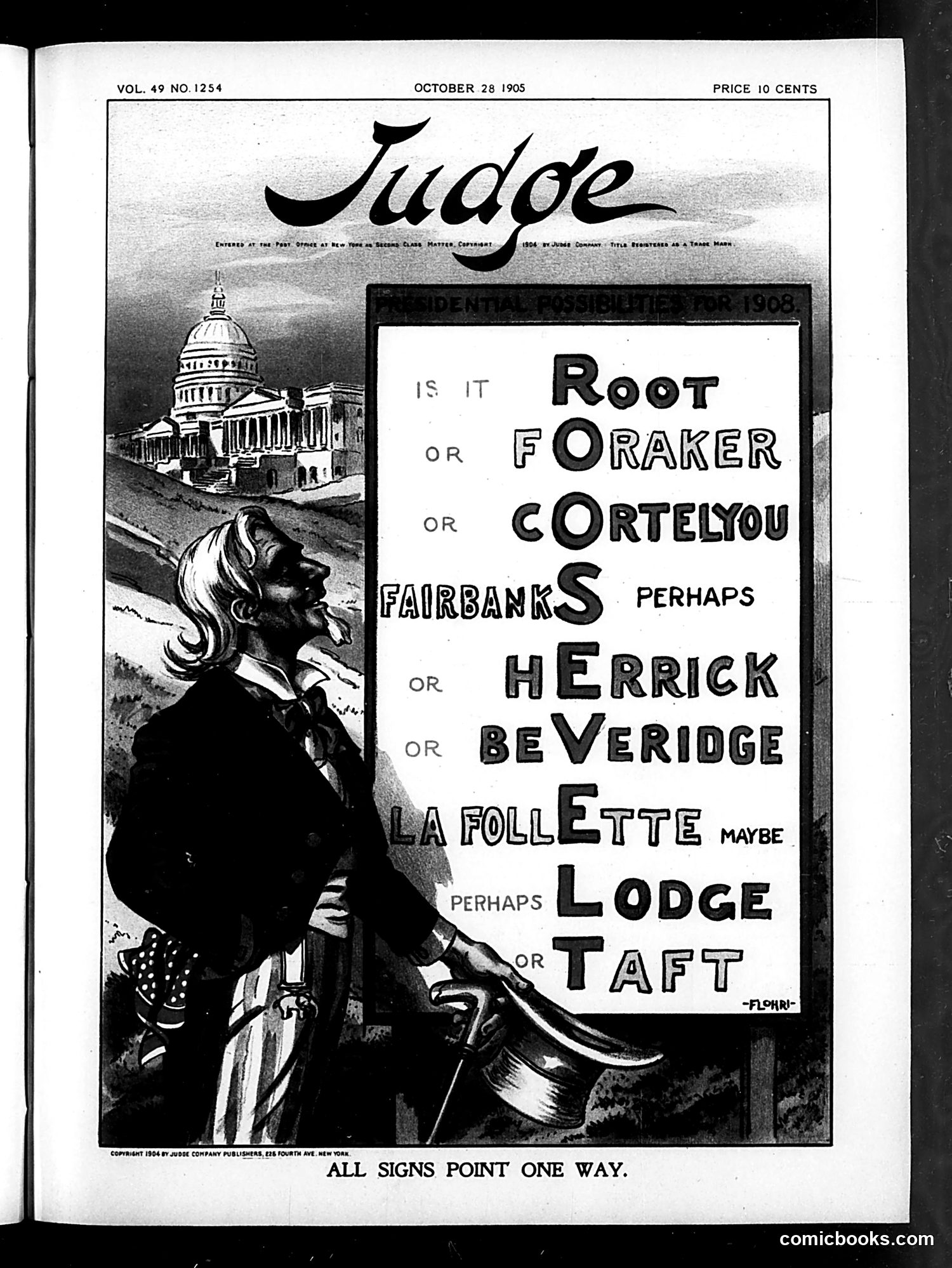
This political cartoon satirizes uncertainty about **who will be the next Republican presidential candidate**. Lady Liberty, depicted as Columbia (the allegorical female figure of America), stands confused before a signpost with multiple directional arrows pointing different candidates: - Root, Foraker, Cortelyou, Fairbanks, Herrick, Beveridge, La Follette, Lodge, and Taft The caption "ALL SIGNS POINT ONE WAY" is ironic—the signs actually point every direction, suggesting no consensus exists. This reflects genuine 1905 confusion about **President Theodore Roosevelt's successor**, as the Republican Party debated various candidates before eventually nominating William Howard Taft in 1908.
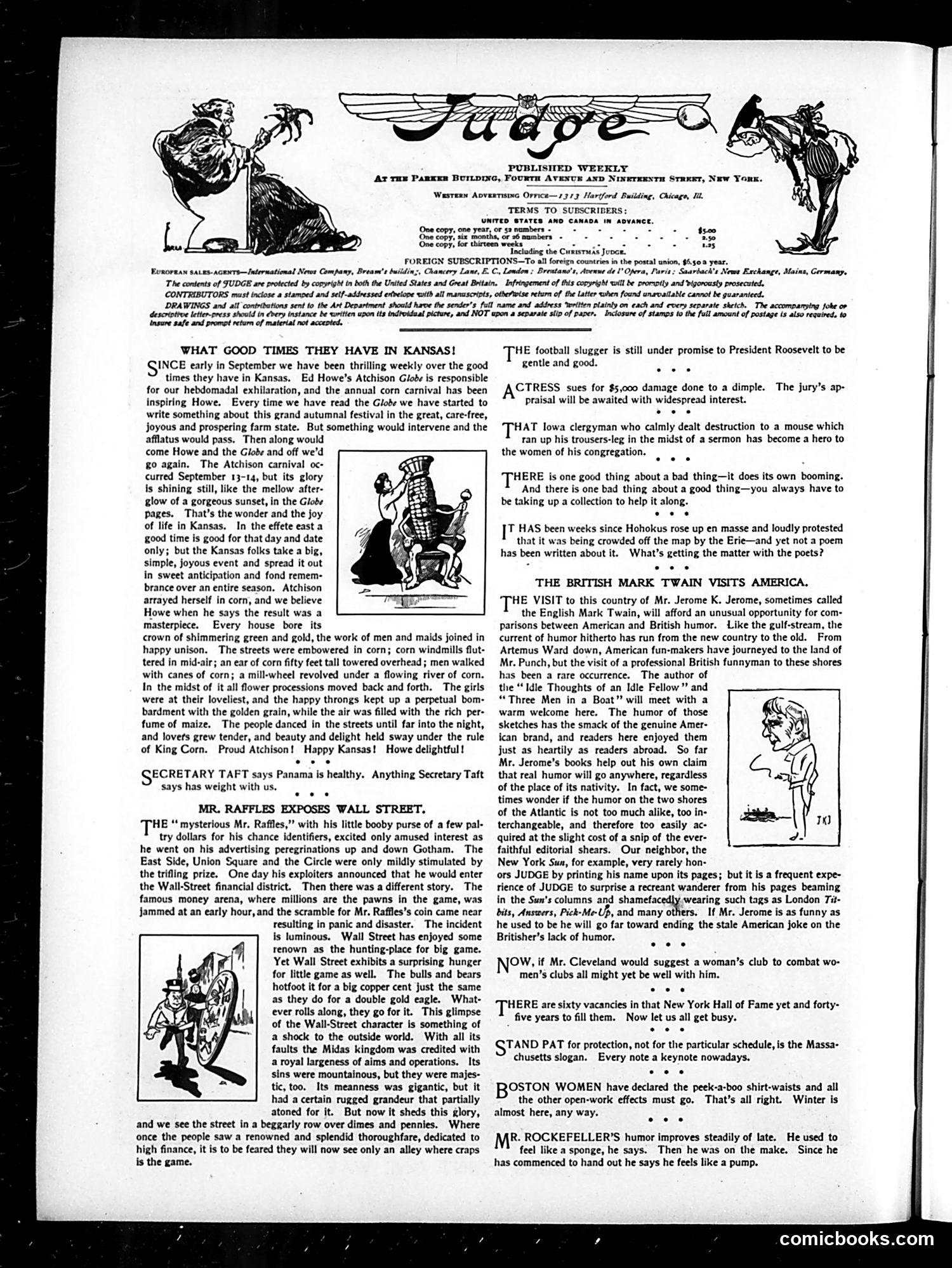
This appears to be a **humor and commentary page** rather than political cartoons. The small illustrations accompany brief satirical observations about contemporary American life and figures. References include: - **Kansas farming**: Praising Ed Howe's recent writings celebrating prosperous Kansas farm life - **Wall Street financial schemes**: Mocking "Mr. Raffles" and stock market gambling, with a cartoon showing financial speculators - **Jerome K. Jerome's visit**: Commenting on the English humorist's American tour and comparing British/American humor styles - **Social commentary**: Brief quips about Secretary Taft, Cleveland, Boston women's fashion, and Rockefeller The page primarily uses **witty written humor** rather than large political cartoons, targeting business practices, celebrity visitors, and contemporary social trends. The tone is lighthearted rather than intensely partisan.
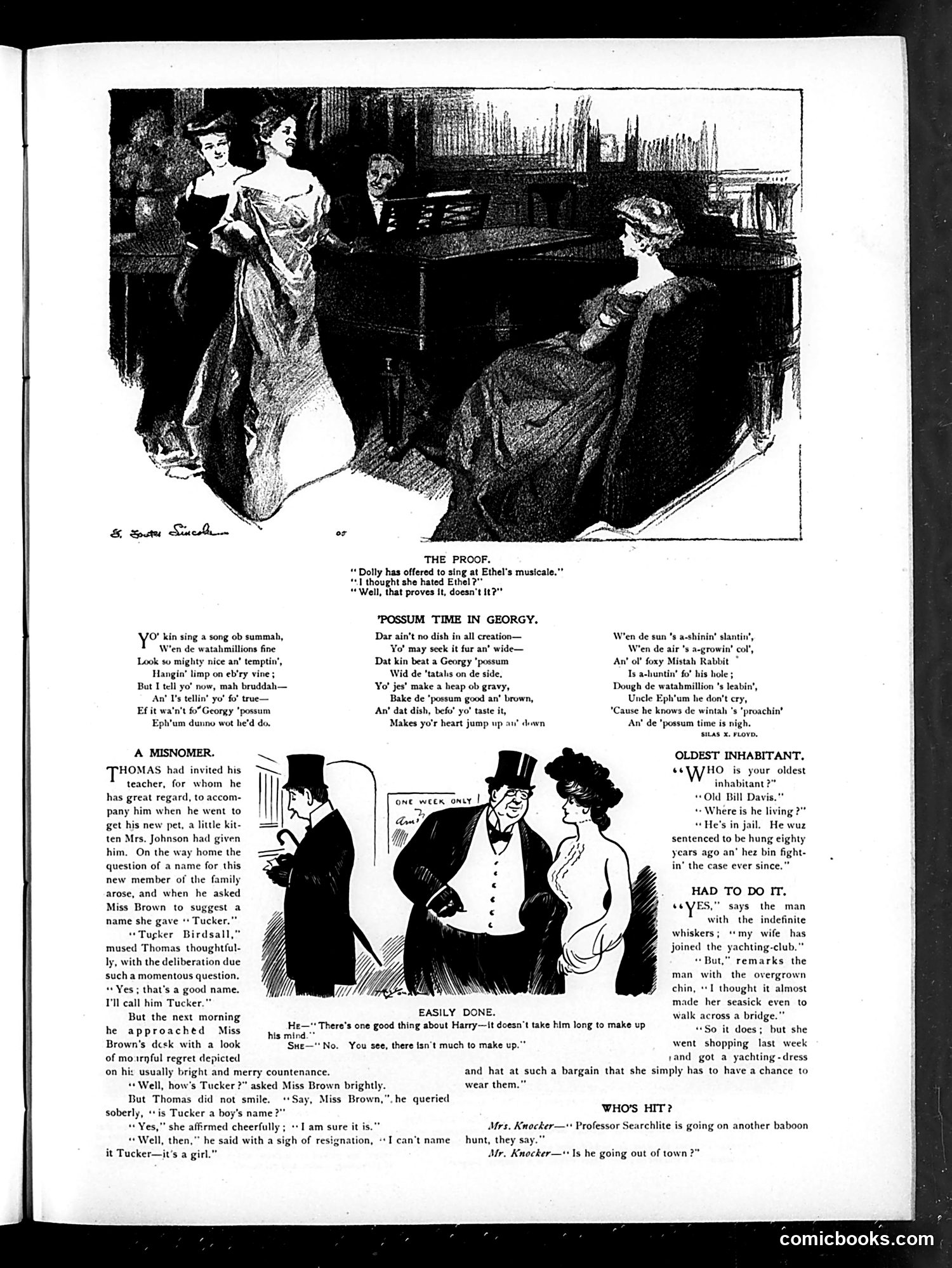
This page from *Judge* magazine contains several humor pieces and sketches typical of early 20th-century satirical publication. The top illustration shows a social scene with women in formal dress, accompanied by dialogue about someone named Ethel's musicale (musical performance). Below are several short comic sketches: "Missnomer" deals with naming a child, "Easily Done" shows characters discussing a man named Harry, and "Oldest Inhabitant" features dialogue about someone in jail. "Had To Do It" involves a yachting-club anecdote. These pieces appear to be genteel domestic humor—drawing comedy from social conventions, miscommunications, and upper-class social situations rather than political commentary. The cartoons target everyday bourgeois life and social pretension typical of *Judge*'s satirical approach during this era.
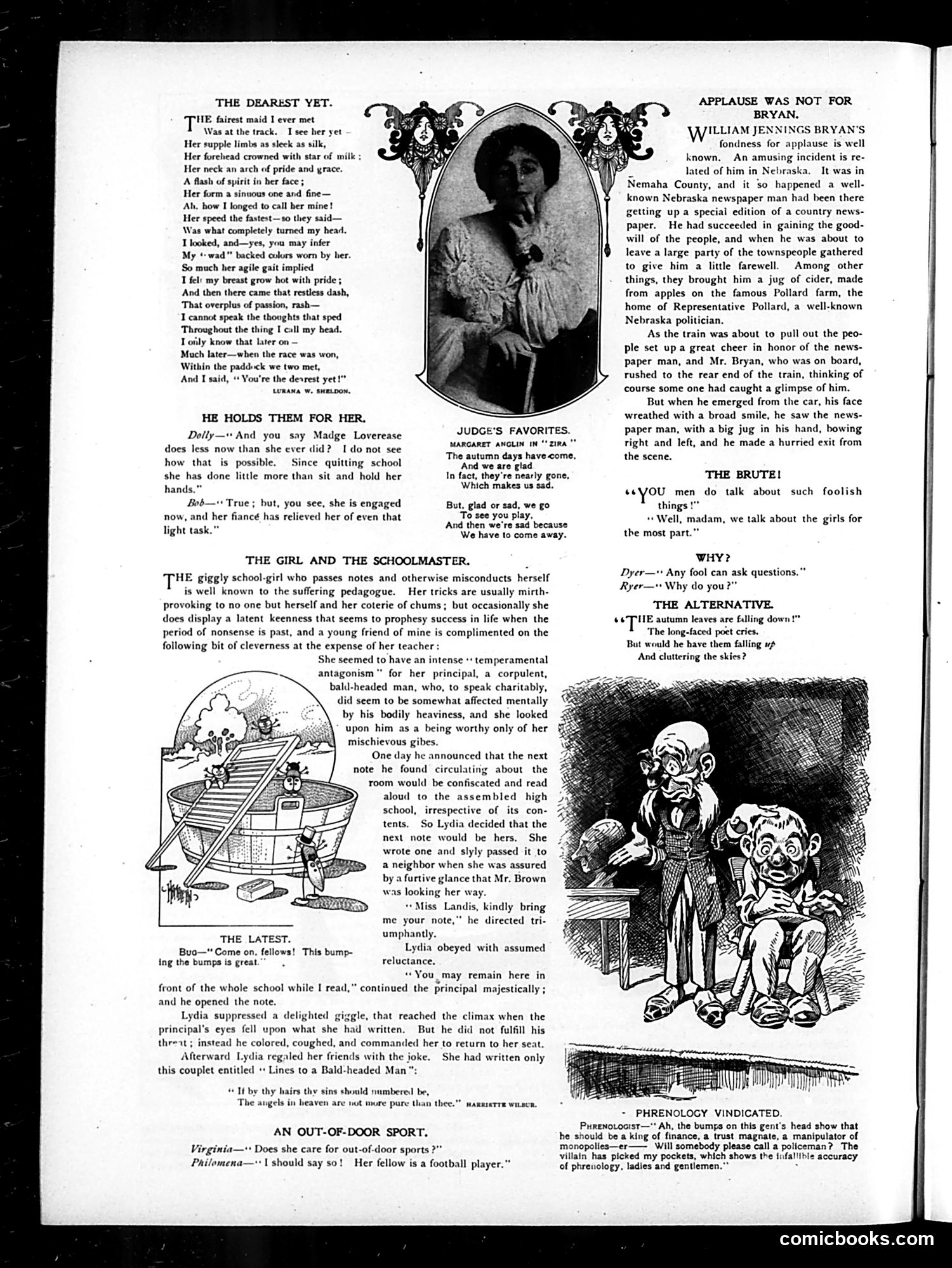
This page contains several short humorous pieces and illustrations typical of Judge's satirical style. **"The Dearest Yet"** and **"He Holds Them for Her"** are romantic poems about courtship and engagement. **"Applause Was Not for Bryan"** recounts an anecdote about William Jennings Bryan (a prominent politician known for seeking applause) at a Nebraska newspaper event. The joke: Bryan thought cheering was for him, but it was actually for cider made from apples. **"Judge's Favorites"** and other sections are brief humorous observations on autumn and daily life. **"The Girl and the Schoolmaster"** describes a mischievous schoolgirl who plays a prank on her pompous principal by circulating a false note, then submits an essay mocking him—a satire on pretentious authority figures. **"Phrenology Vindicated"** mocks pseudoscientific phrenology (reading character from skull bumps) as a con artist's tool. The illustrations are typical period comic drawings accompanying these satirical anecdotes.
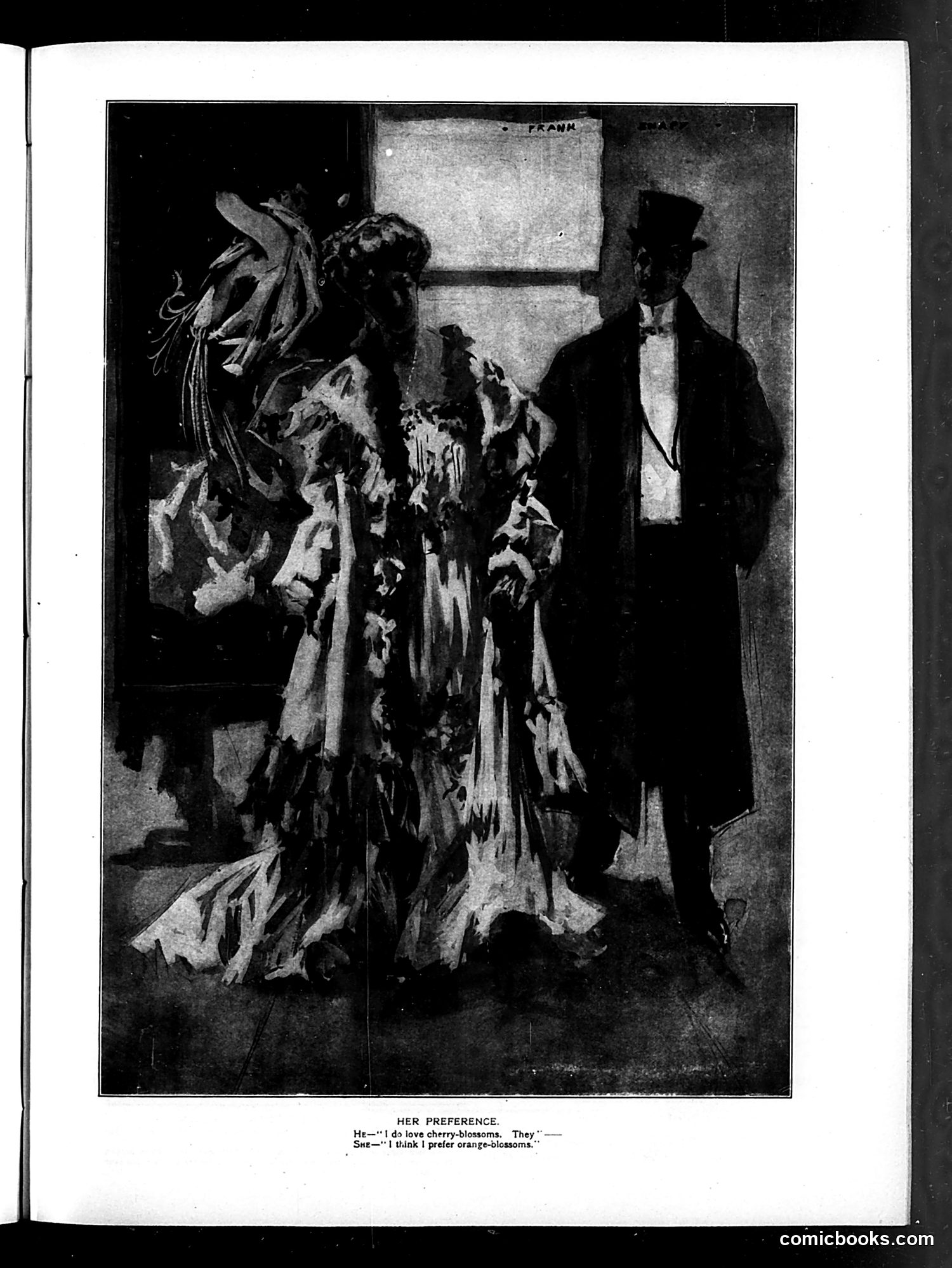
This cartoon satirizes gender preferences in flowers. The caption reads: **He:** "I do love cherry-blossoms." **She:** "I think I prefer orange-blossoms." The humor lies in a contemporary social observation: while the man expresses aesthetic appreciation for cherry blossoms, the woman's preference for orange blossoms carries matrimonial significance. Orange blossoms were traditionally associated with weddings and bridal wear in this era, symbolizing fertility and marriage. The cartoon gently mocks the difference between male and female romantic priorities—the man admires flowers for their beauty alone, while the woman's stated preference implies her deeper interest in marriage itself. The formal attire and gallery setting suggest cultured society, making the joke about divergent romantic motivations among the educated classes.
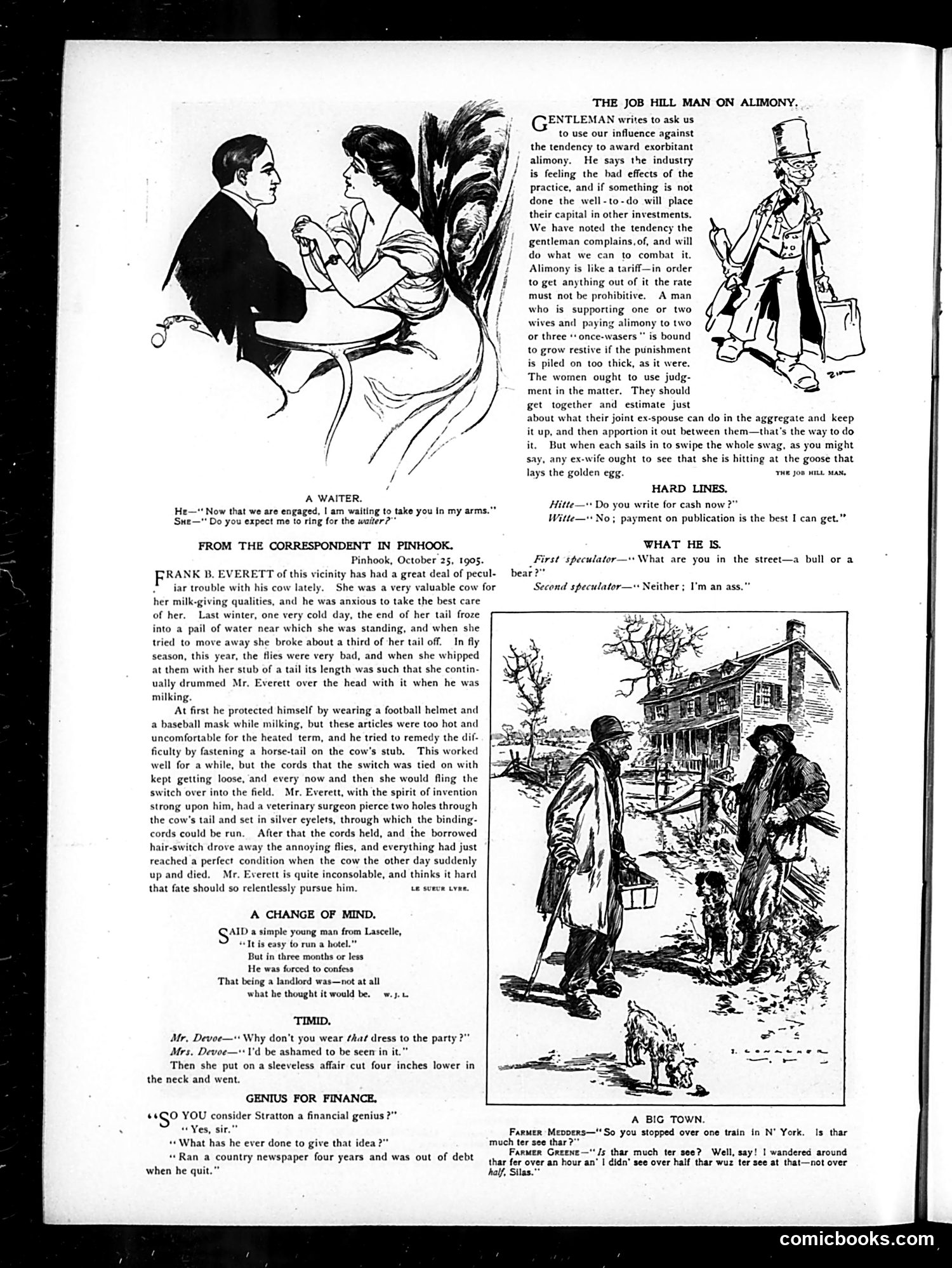
This page from Judge (dated October 25, 1905) satirizes several social issues: **"The Job Hill Man on Alimony"** (top): Judge's editorial mocks wealthy men complaining about high alimony payments. The satire suggests that ex-wives should "cooperate" rather than each demanding the full amount from their ex-husband—treating alimony like a business arrangement where women must be reasonable or risk losing their "golden egg" (the man's wealth). This reveals period attitudes: men's financial burden from multiple ex-wives is portrayed as legitimate grievance, while women's claims are treated as excessive. **Other items** include brief humorous anecdotes and jokes about waiters, stock speculators, and a farmer's mishap with his cow's tail—typical of Judge's miscellaneous humor format. The overall tone reflects early-1900s wealthy-male anxiety about divorce settlements and property division, presenting alimony as an economic problem rather than women's financial security issue.
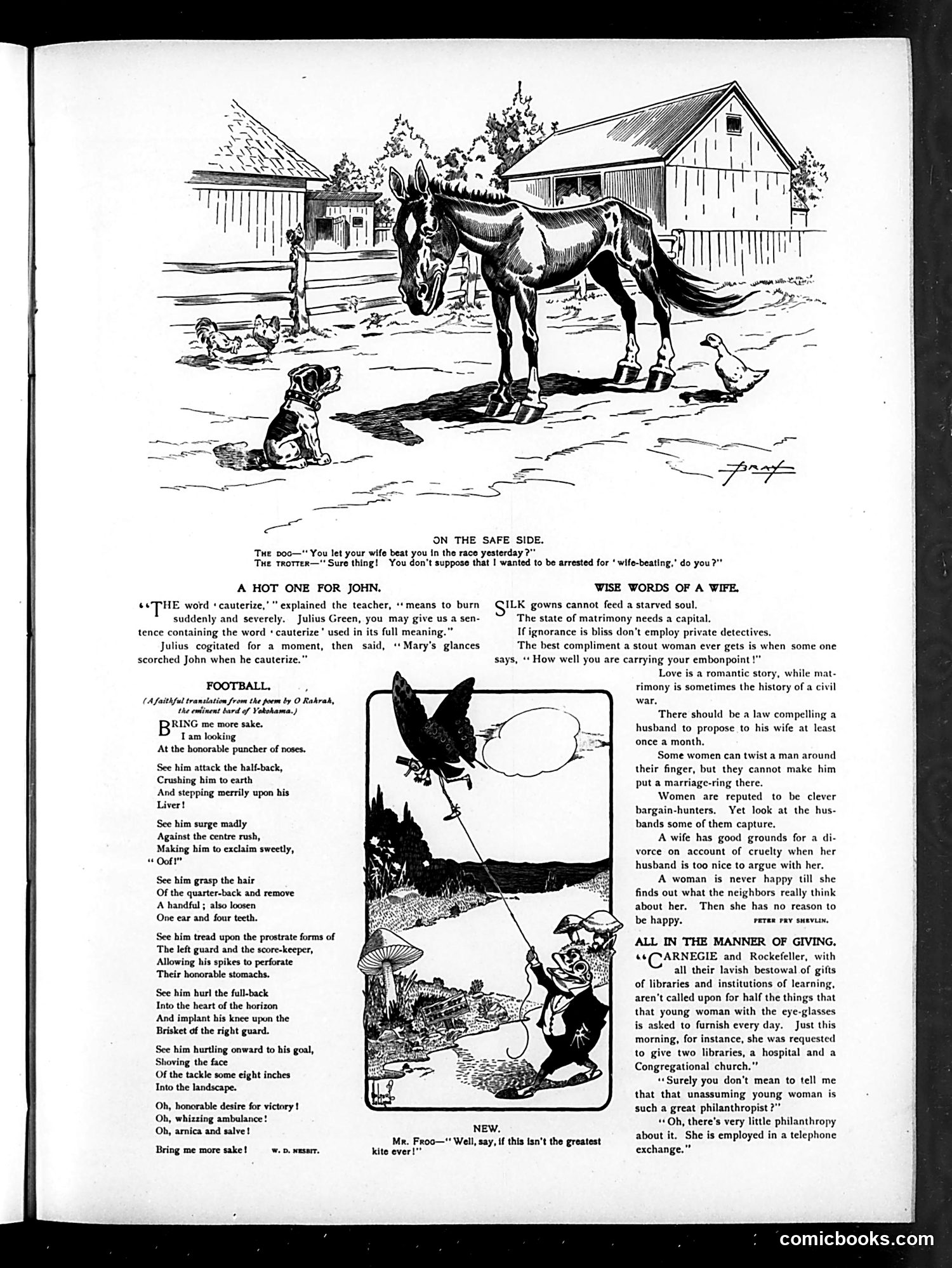
This page contains three distinct satirical pieces typical of early 20th-century American humor: **"On the Safe Side"**: A joke about a man deliberately losing a race to his wife to avoid accusations of "wife-beating"—satirizing contemporary concern over domestic violence charges. **"A Hot One for John"**: A schoolboy humor piece where student Julius Green creates an absurd sentence using "cauterize" ("Mary's glances scorched John when he cauterized"), mocking both the student and marital discord. **"Football"**: A humorous poem (translated from Japanese) mockingly describes American football as violent brutality, with players attacking, crushing, and injuring each other. The repetitive refrain "Bring me more sake" emphasizes foreigners' bewilderment at the sport. **Right column**: "Wise Words of a Wife" and "All in the Manner of Giving" offer cynical observations on marriage and female philanthropy—suggesting women's charitable giving is obligatory rather than generous, and comparing it unfavorably to Carnegie and Rockefeller's lavish donations. The overall tone reflects period attitudes: skepticism toward marriage, amusement at gender relations, and gentle mockery of American customs.
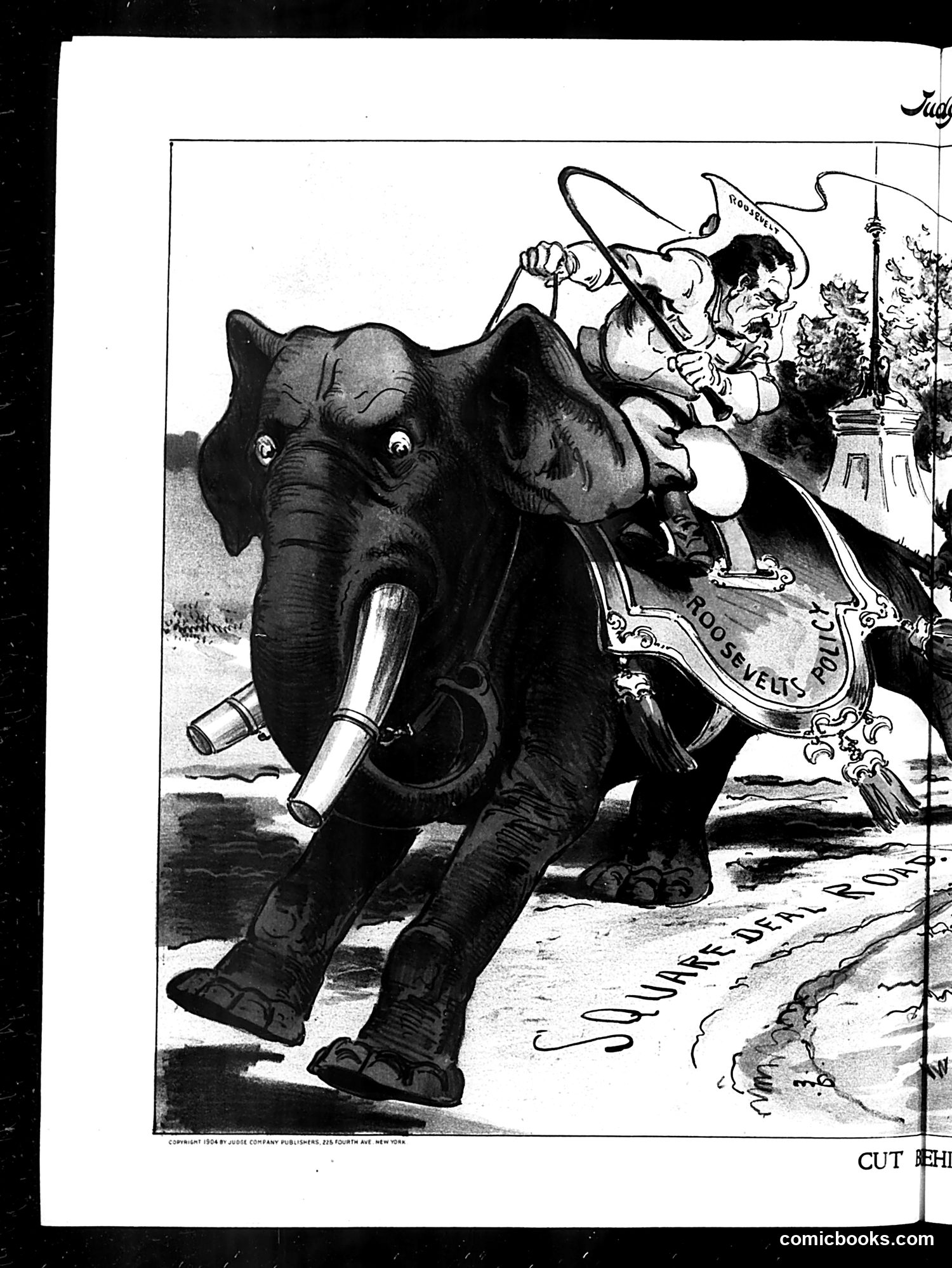
This is a satirical Judge magazine cartoon depicting an elephant (the Republican Party symbol) carrying riders on its back. The elephant appears distressed or burdened. The text "ROOSEVELT" is visible on the saddle/blanket, and text reading "OUR DRIFT 100" appears on the ground. The cartoon likely critiques Republican leadership during the Theodore Roosevelt presidency (1901-1909), suggesting the party is weighed down or being misguided by Roosevelt's policies or political direction. The riders appear to represent Republican party figures struggling to control or direct the elephant. Without clearer text visibility, specific identities of the riders remain unclear, but the overall message suggests satirical commentary on Republican party discord or concerns about Roosevelt's influence on the party's direction during this era.
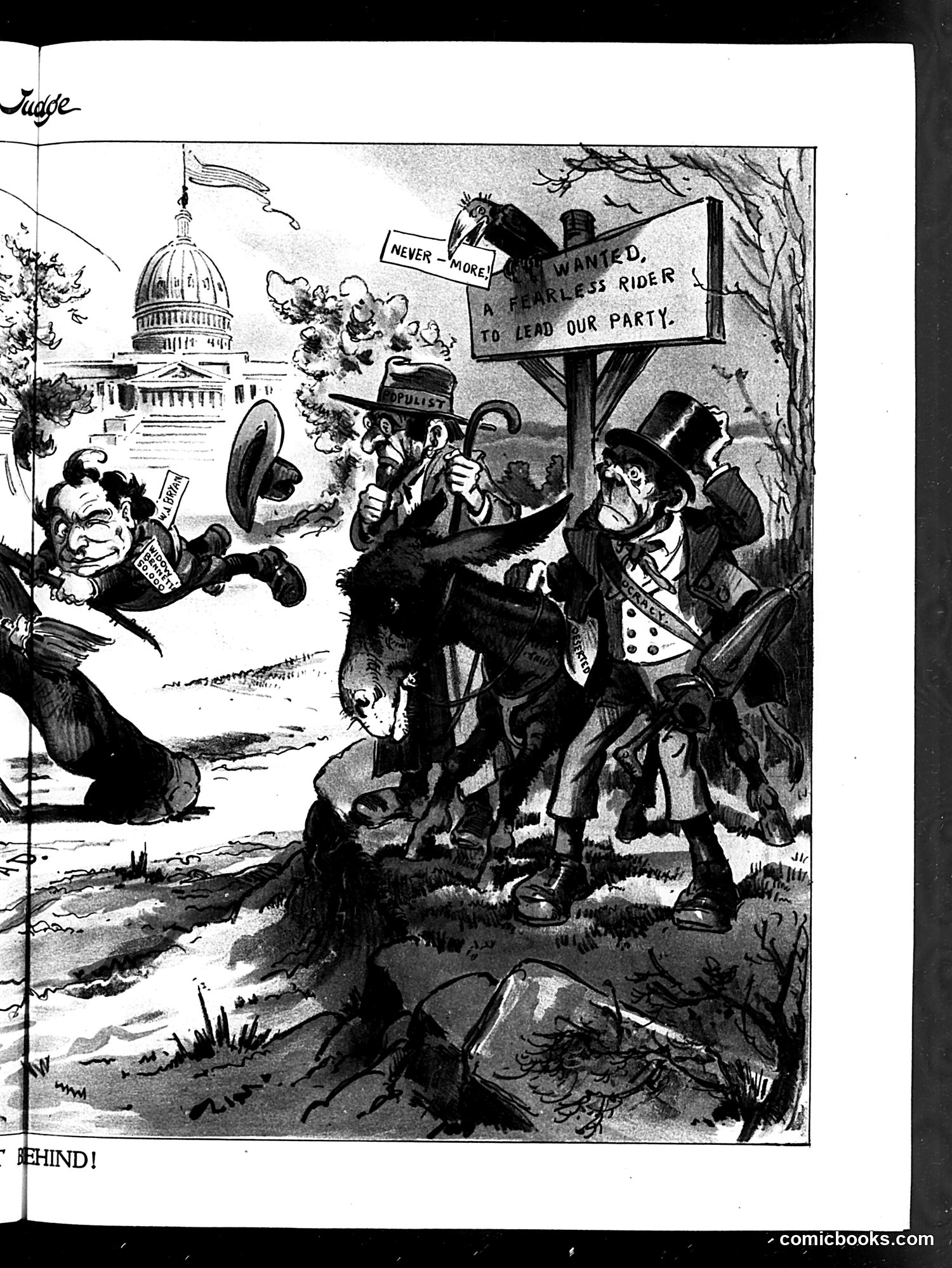
This appears to be a Judge magazine political cartoon satirizing Republican Party leadership circa the early 20th century. The central figure holding a "POPULIST" sign appears to represent a Republican leader seeking an aggressive, fearless party leader (the sign reads "NEVER MORE A FEARLESS RIDER TO LEAD OUR PARTY"). On the left, a caricatured figure labeled with what appears to be a derogatory term runs away holding papers, likely representing a political opponent or unpopular faction being rejected. The Capitol building visible in the background grounds this in American politics. The cartoon satirizes internal Republican party disputes and the search for strong leadership, mocking both competing factions through exaggerated caricature. The overall message criticizes the party's leadership struggles and divisiveness.
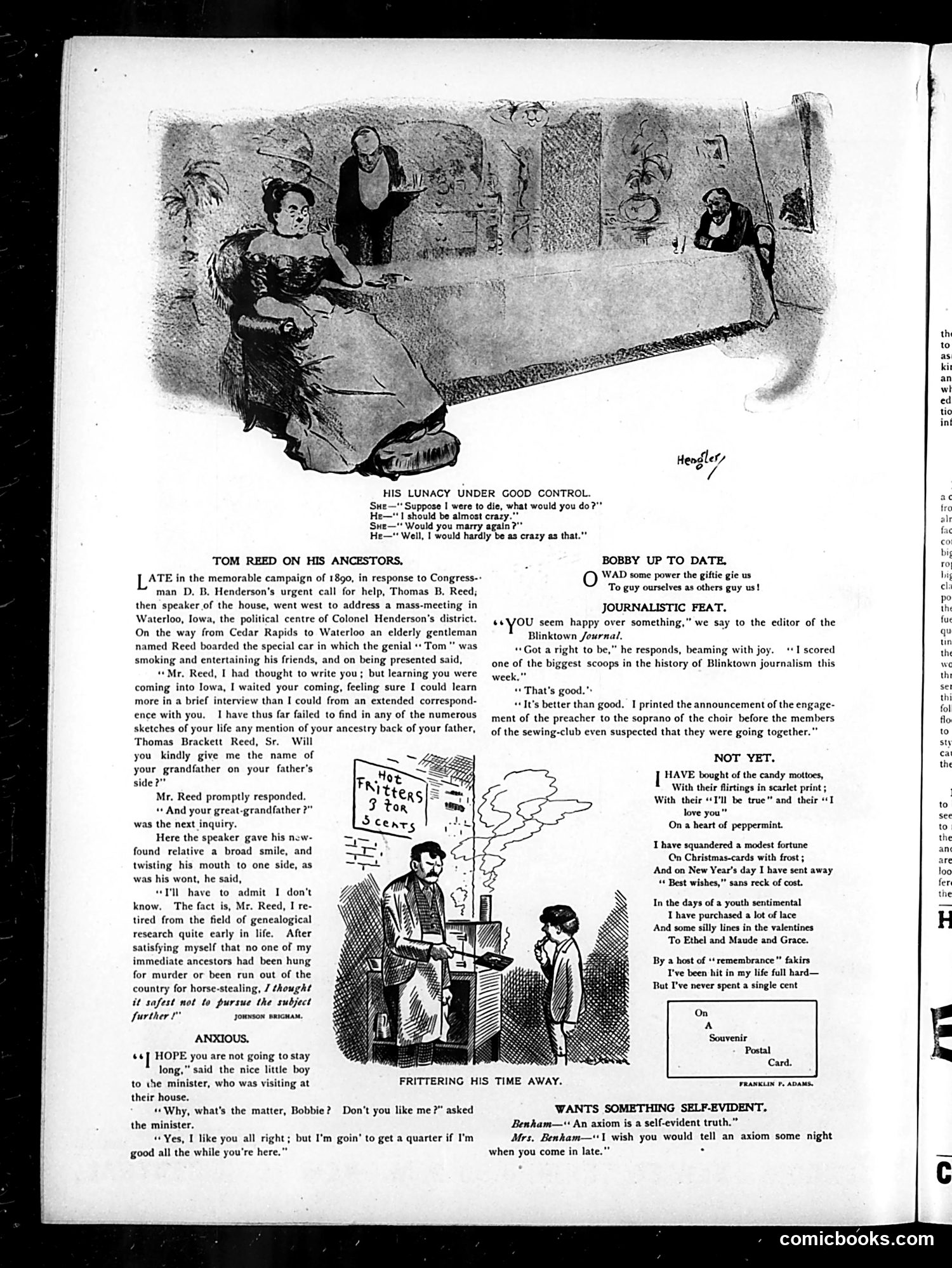
This page contains several satirical pieces typical of Judge's humor: **Top cartoon** ("His Lunacy Under Good Control"): A domestic joke where a husband reassures his wife that if she died, he'd go "almost crazy"—but insists he wouldn't be crazy *enough* to remarry. The satire targets male attitudes toward remarriage and wealth. **"Tom Reed on His Ancestors"**: Anecdote about Speaker Thomas B. Reed (prominent 1890s politician) meeting a genealogy-obsessed relative. Reed humorously admits he stopped tracing his ancestry after confirming no ancestors were hanged for murder or exiled for horse-stealing—satirizing both obsessive genealogy-tracking and frontier-era lawlessness. **"Anxious" & "Bobby Up to Date"**: Brief jokes about a boy wanting the minister to leave (to earn a quarter for good behavior) and journalistic sensationalism. **"Not Yet"**: Verse mocking sentimental romance spending—candy mottos, Christmas cards, valentines—suggesting the speaker has wasted money on romantic gestures without reciprocation. The overall tone is light social satire targeting vanity, materialism, and human folly rather than serious political critique.
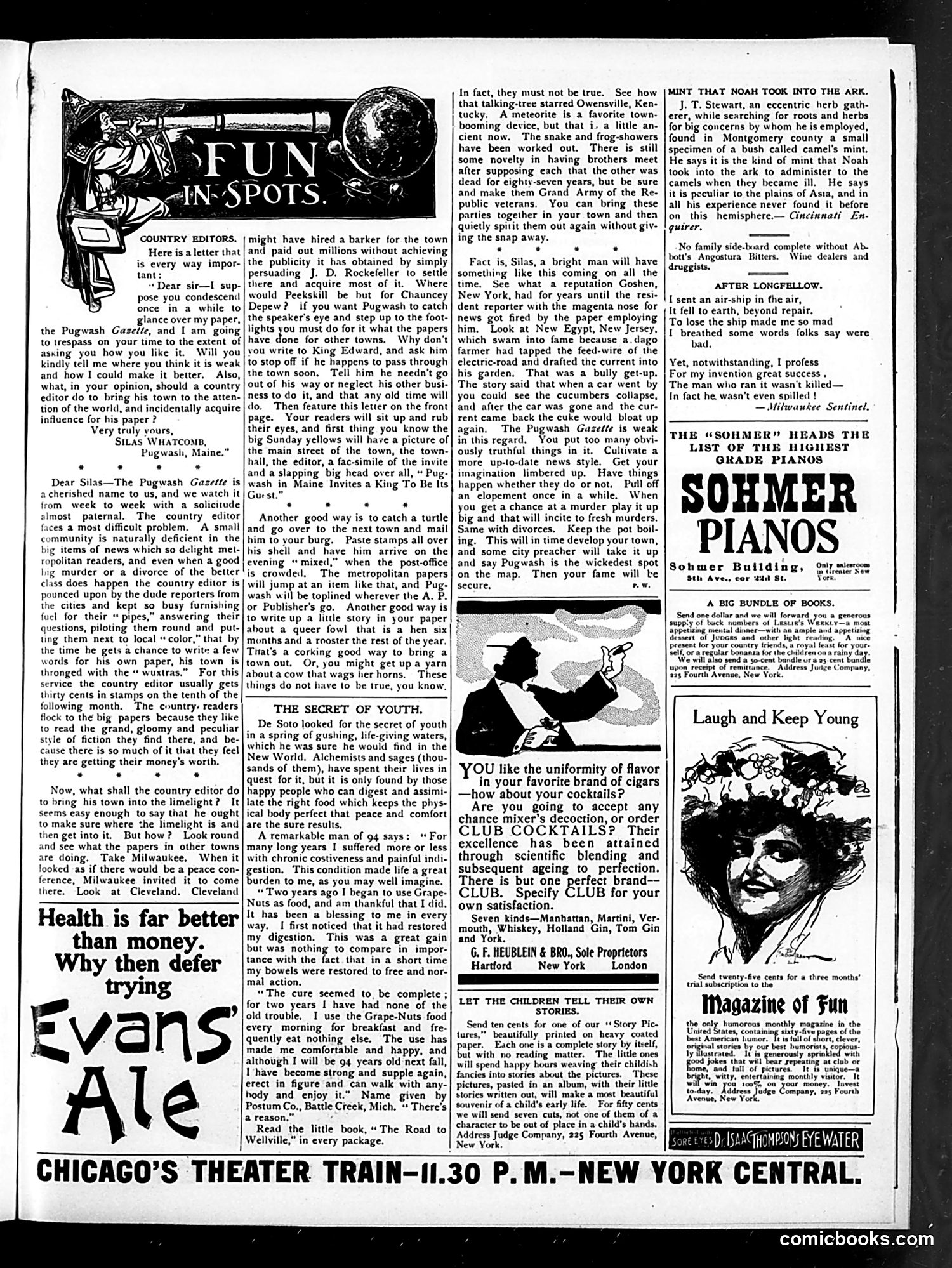
This page features **country journalism advice** disguised as satire. The main section is a letter from "Silas Whatcomb" (a rural editor) asking how to gain publicity for his small Maine town, Pugwash. The satirist's response mocks small-town editors' desperation for attention by suggesting increasingly absurd publicity stunts: inviting King Edward to visit, mailing a turtle through the post office, or fabricating stories about a hen-rooster hybrid or horn-wagging cow. The key satirical point: **"These things do not have to be true, you know."** The joke exposes how country papers manufacture sensational false stories to compete with big-city newspapers for readers and prestige. It mocks both the gullibility of rural audiences and the unethical practices of desperate small-town editors trying to make their insignificant communities seem newsworthy. The satire targets the gap between urban and rural America—rural readers hunger for excitement while rural editors will fabricate it shamelessly to gain influence.
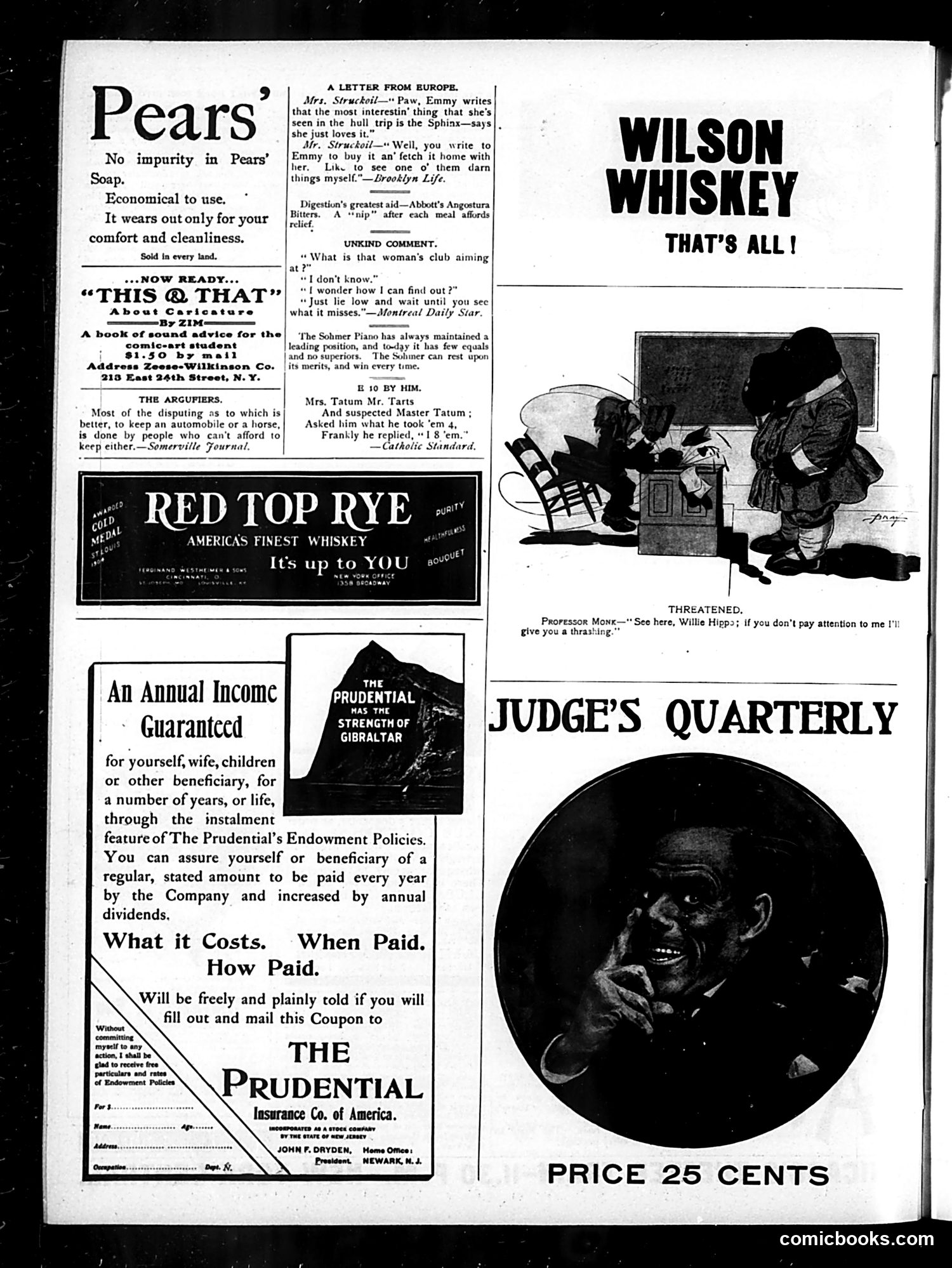
This is primarily an **advertising and humor page** from Judge magazine, a satirical weekly. The content mixes light social commentary with period advertisements. **Key Humor Pieces:** - **"The Argufiers"**: A one-liner mocking people who debate automobiles versus horses—suggesting they can't afford either - **"A Letter from Europe"**: Rural dialect humor about Emmy's European trip and a sphinx - **"Unkind Comment"**: A jab at women's clubs, implying their goals are unclear/ineffectual - **"Threatened"**: A cartoon captioned about Professor Moore threatening student Willie Hipp with a thrashing for inattention **Advertisements** dominate: Pears' Soap, Red Top Rye whiskey, Prudential Insurance (with income guarantees), and Sohmer Pianos. The large illustration titled **"Threatened"** shows a classroom scene with physical punishment implied—reflecting early 20th-century attitudes toward student discipline. **Judge's Quarterly** (price 25 cents) is promoted with a circular portrait, likely a cover or content preview. The page reflects period humor conventions: class anxieties, gender stereotypes, and casual endorsement of corporal punishment.
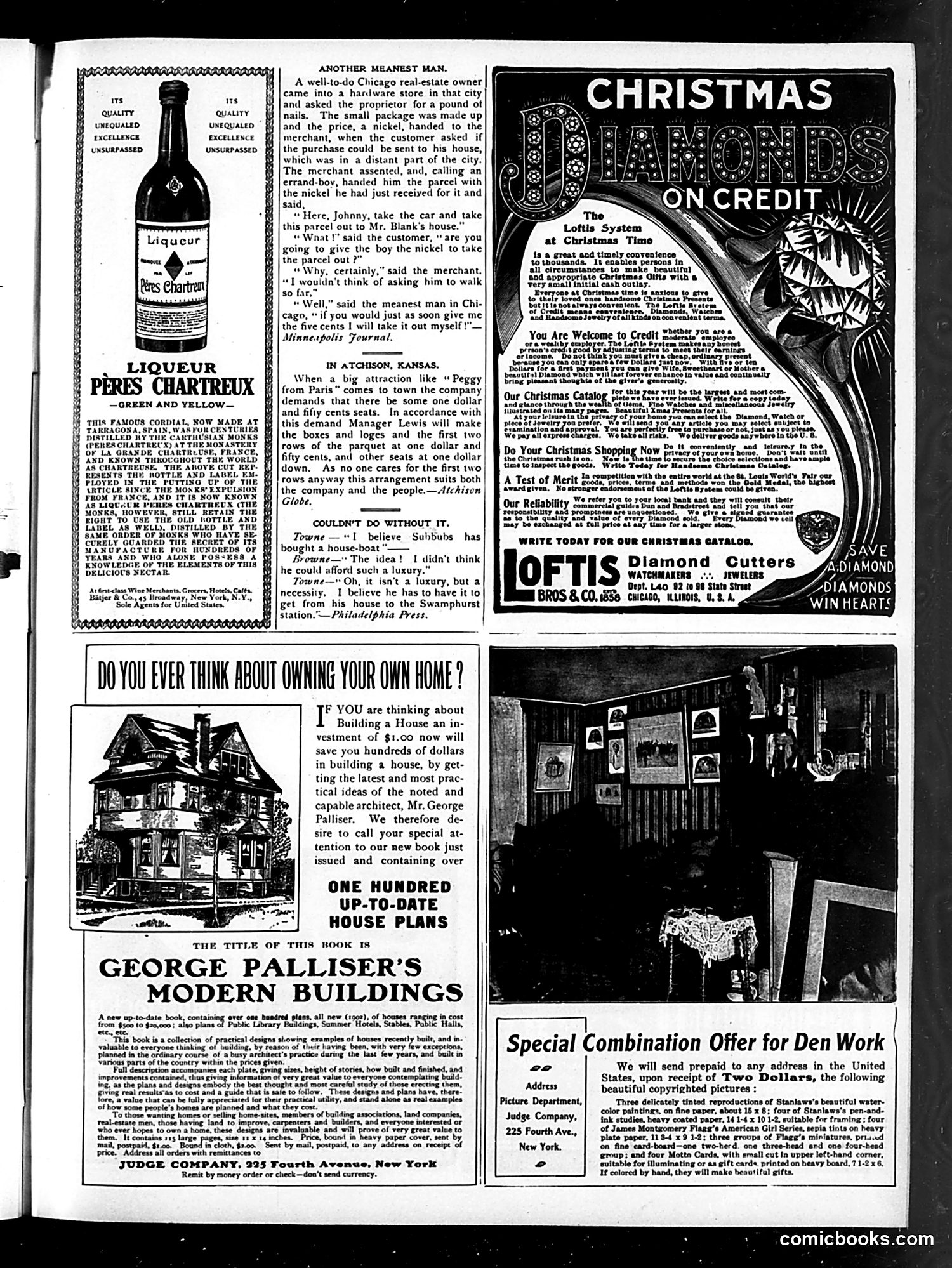
This page is primarily **advertisements and humor pieces**, not political cartoons. **Main Content:** The page contains four unrelated short humorous anecdotes: 1. **"Another Meanest Man"**: A cheapskate Chicago real-estate developer asks a hardware store to deliver a 5-cent package of nails to his distant house, then demands the merchant give him back the nickel so he can deliver it himself—saving the store a delivery cost. 2. **"In Atchison, Kansas"**: Theater manager prices seats affordably for a show ("Peggy from Paris"), making expensive front rows cheap since nobody wants those seats anyway. 3. **"Couldn't Do Without It"**: A man supposedly bought a houseboat as a "necessity"—not luxury—because he needs it to get from his house to the train station (implying he lives in a swamp). 4. **"Towne/Browne" dialogue**: Similar setup questioning an expensive purchase's practicality. **Context:** These are gentle, class-based humor pieces mocking wealthy people's penny-pinching or absurd justifications for luxury purchases—common Judge magazine fare. The ads below (liqueur, jewelry, house plans) are standard period advertising.
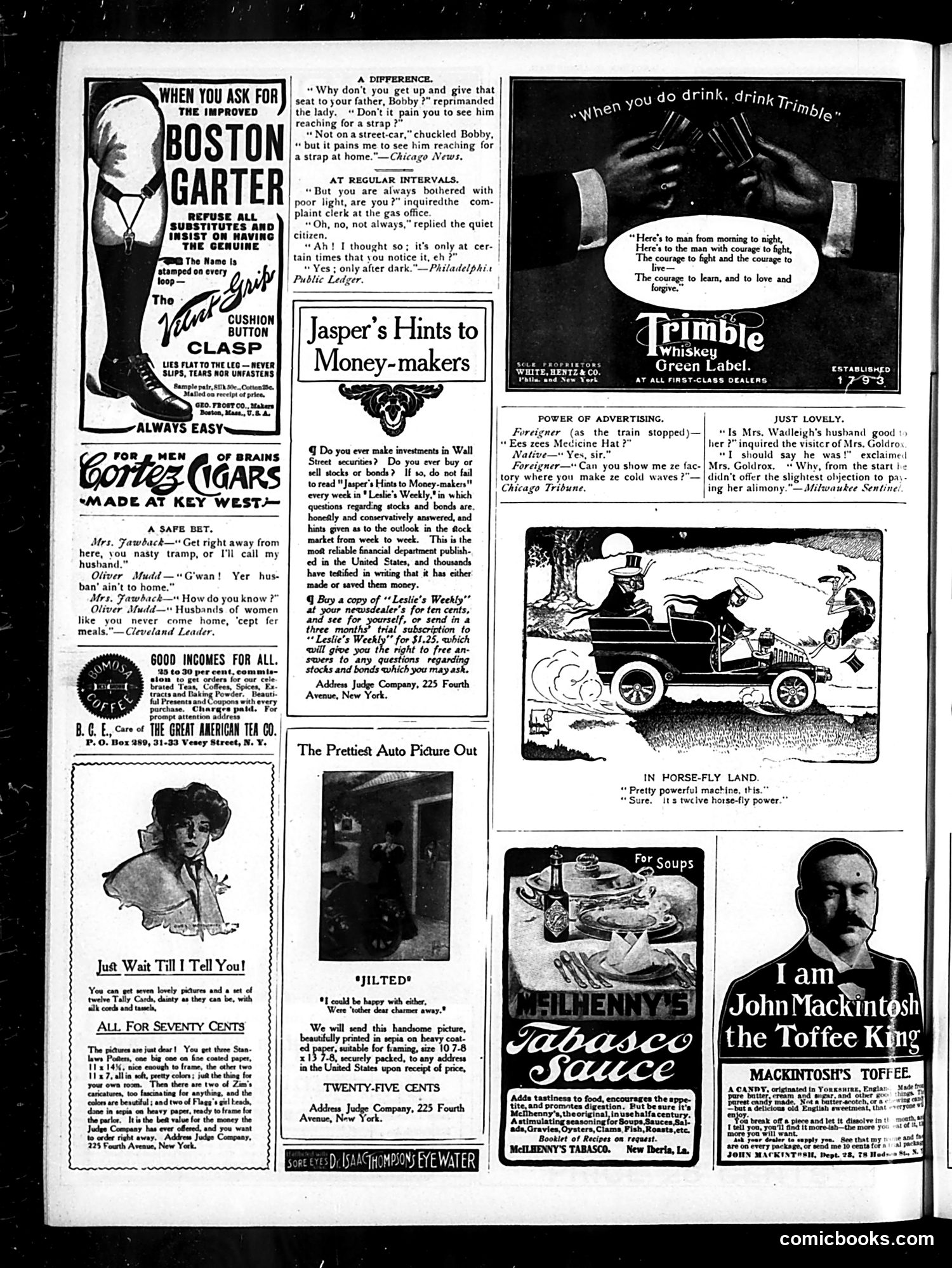
This page from **Judge** magazine is primarily **advertising** with several short humor pieces typical of early 20th-century American publications. The cartoons and jokes use gentle domestic satire: - **"A Difference"**: A boy refuses to give his seat to his father on a streetcar (no pain), but fears his father reaching for a strap at home (implying corporal punishment). This reflects period assumptions about paternal discipline. - **"At Regular Intervals"**: A clerk assumes a citizen has lighting problems; the citizen reveals he only notices poor gas service "after dark"—a mild complaint about utility service. - The **Foreigner/Medicine Hat** joke plays on the absurd place name, with a traveler unable to believe it's a real location. The remaining content consists of **product advertisements** (Boston Garter, Corbet Cigars, Trimble Whiskey, Tabasco Sauce, Mackintosh Toffee) and **classifieds** offering financial advice, pictures, and business opportunities—typical of Judge's revenue model in this era.
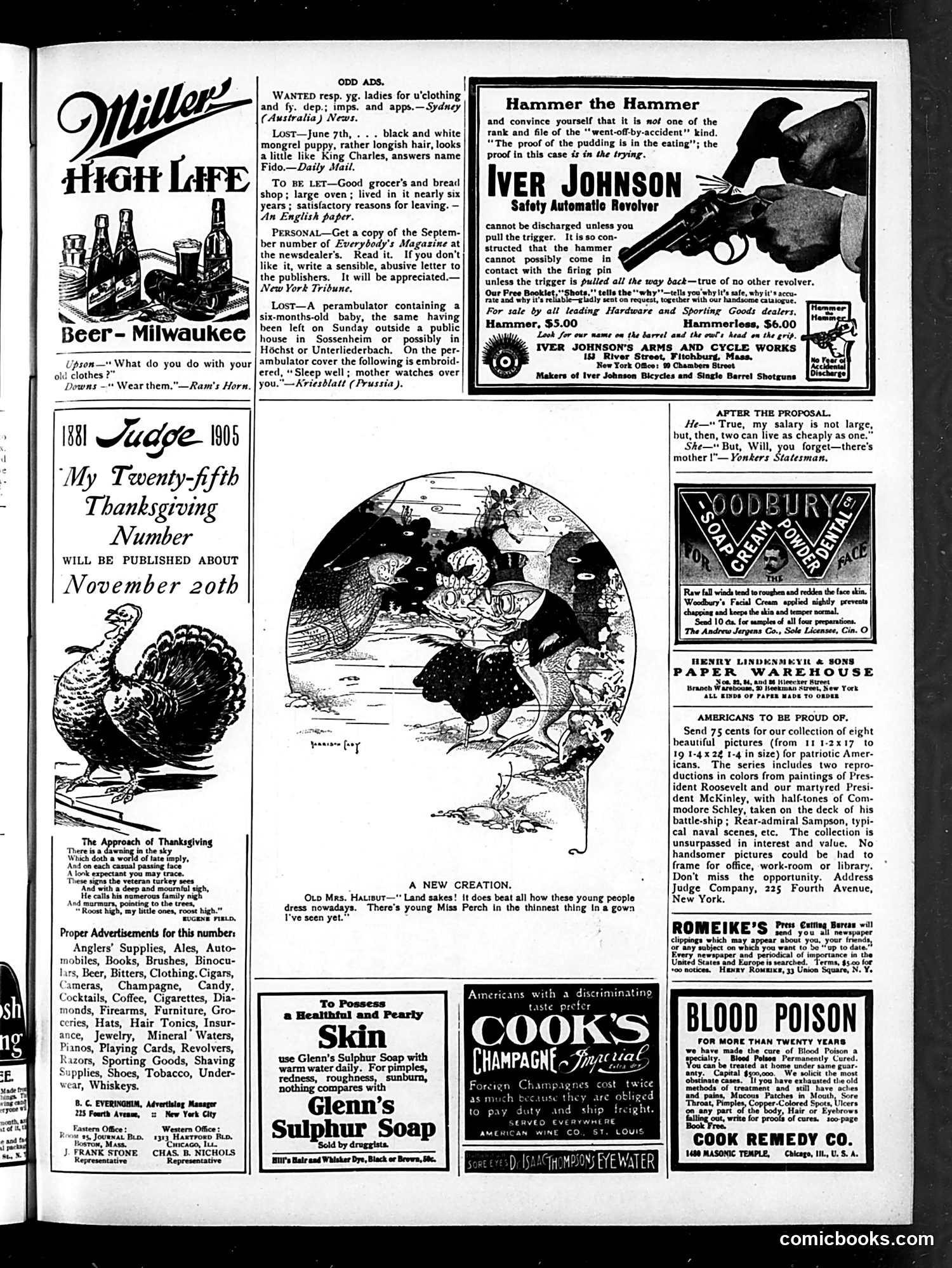
This page from Judge (circa 1905, based on the Thanksgiving and Iver Johnson advertisements) is primarily **advertising-focused** rather than featuring significant political cartoons. The main illustrated content includes: 1. **"A New Creation"** — A brief comedic sketch showing a woman criticizing young Miss Perch's thin dress, with a husband's response about household economics that reveals the joke: he says "two can live as cheaply as one," but his wife reminds him they have her mother living with them too—a common source of domestic comedy. 2. The central circular illustration appears to be decorative/whimsical rather than satirical. The bulk of the page consists of classified advertisements ("Odd Ads") featuring humorous classified listings, product advertisements (Iver Johnson revolvers, Glenn's Sulphur Soap, Cook's Champagne), and notices for upcoming Thanksgiving issues. The satirical content is minimal; this is primarily a **commercial magazine page** showcasing period advertisements and light domestic humor rather than political or social satire.
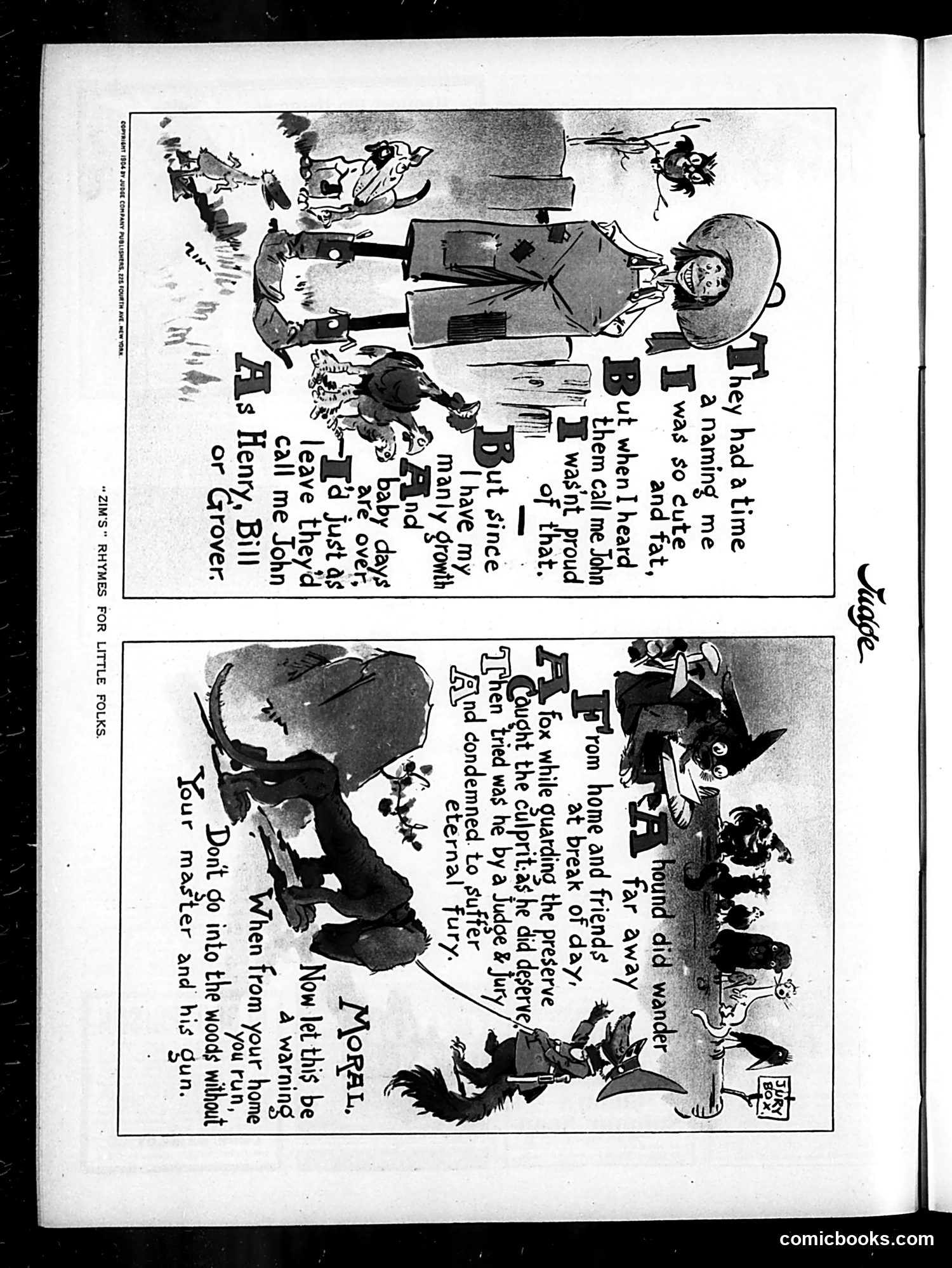
This page contains two separate children's illustrated rhymes by "Zim." **Top cartoon:** A child named John expresses relief that he's outgrown being called by cute pet names ("Baby days"). Now that he has "manly growth," adults call him by proper names like John, Henry, Bill, or Grover—suggesting he's achieved respectable masculinity and maturity. **Bottom cartoon:** A moral fable warning children against disobedience. A young animal (appears to be a fox or similar creature) runs away from home without parental supervision. It's caught "guarding the preserve," tried by judge and jury, and condemned to "eternal fury" as punishment. The moral: obey your parents and don't venture into dangerous places without adult authority ("your master and his gun"). Both rhymes reflect early-1900s values: gender-defined respectability and strict parental authority. The content is typical of *Judge*'s family entertainment section rather than its satirical political cartoons.