
A complete issue · 16 pages · 1905
Judge — October 21, 1905
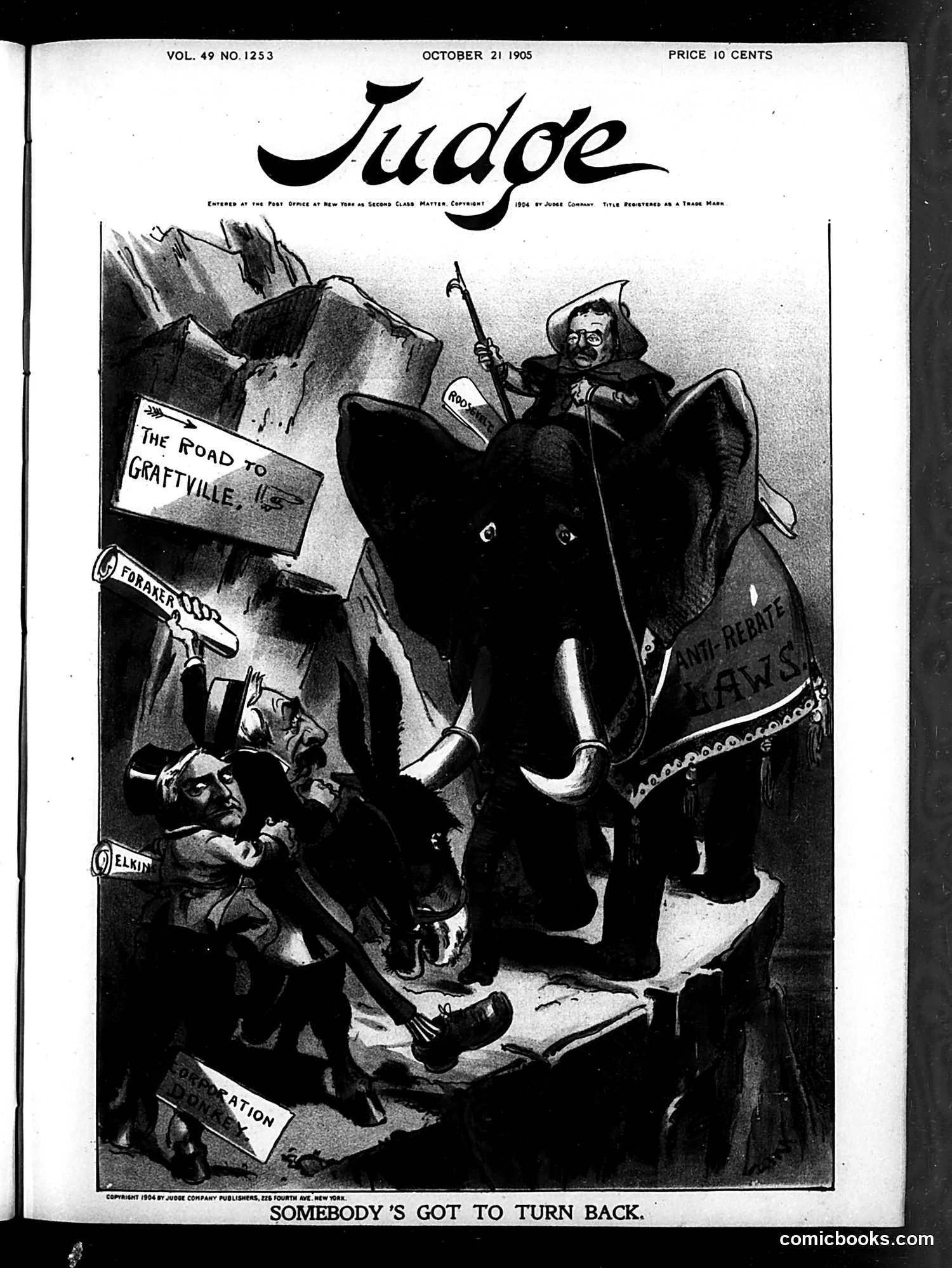
This political cartoon satirizes the "road to Graftville"—criticizing political corruption. A large elephant (likely representing the Republican Party) is laden with various burdens including "Anti-Rebate Law" and other regulatory labels. A figure riding the elephant appears to be steering it off course. Below, smaller figures representing different political interests are being trampled or dragged along. The caption "Somebody's Got to Turn Back" suggests the cartoonist is warning that current political direction—apparently favoring corrupt practices ("Graftville") over reform—must be reversed. The elephant imagery and reference to anti-rebate legislation suggest this relates to Progressive Era debates over railroad regulation and corporate accountability circa 1905. The satire criticizes how powerful interests are controlling the political agenda despite reform efforts.
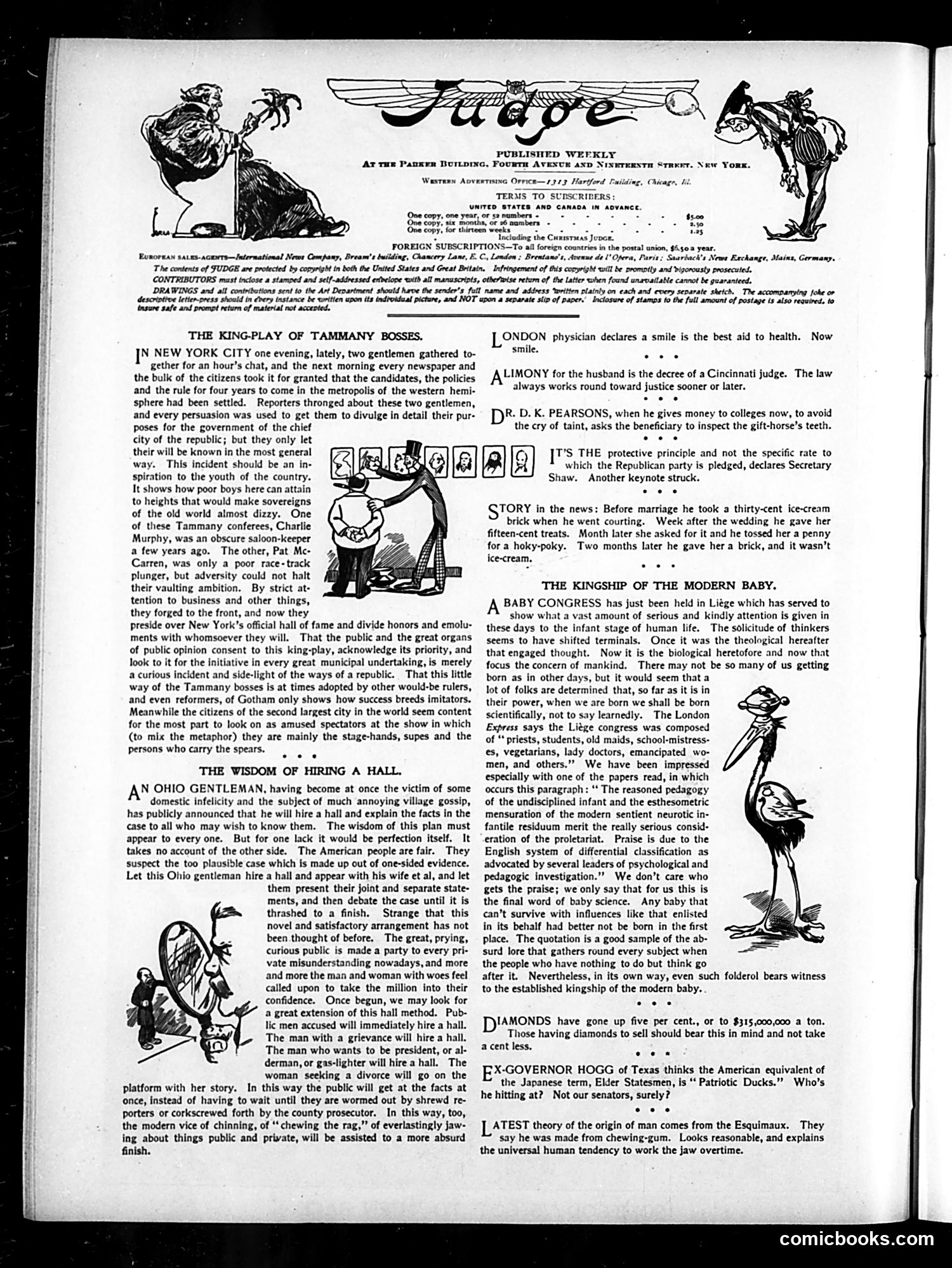
This page contains satirical commentary and brief humorous items rather than major political cartoons. The visible illustrations appear to be decorative mastheads and small vignettes accompanying short quips about contemporary figures and social topics. The text references include items about New York City politics, a Cincinnati judge's views on alimony, a comment about Dr. D.K. Pearson's advice regarding gift horses, and remarks on Republican party pledges. There's also extended commentary on a "Baby Congress" held in Liège addressing theories of infant development and child-rearing practices. Additional items mock diamonds rising in value, reference an "Ex-Governor Hogg of Texas," and discuss theories about human origins. The overall tone is light satirical commentary on contemporary news, personalities, and social debates, typical of Judge magazine's format.
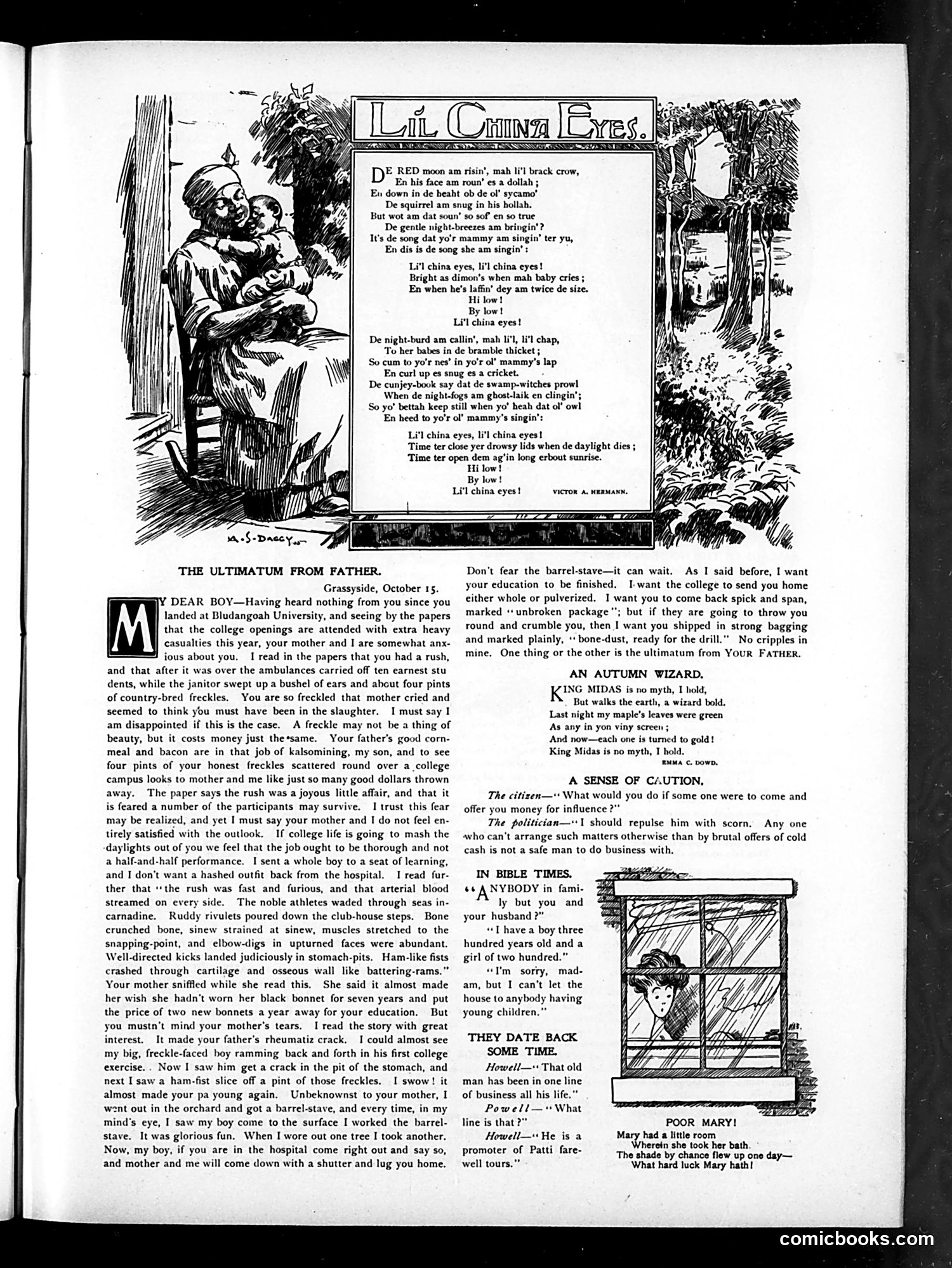
This page contains primarily **literary/humorous content rather than political satire**. The main features are: 1. **"Li'l China Eyes"** (top): A poem with illustration by W.S. Dasey depicting a figure holding a child, using dialect verse. The content appears to employ racial stereotypes common to the era, though the exact satirical target is unclear from the image alone. 2. **"The Ultimatum from Father"** (center): A lengthy letter about college expenses and casualties, presenting a father's frustrated response to his son's education costs during what appears to be wartime. 3. **Various short humor pieces** below, including "An Autumn Wizard," "A Sense of Caution," and other comic vignettes. The page functions as general entertainment rather than pointed political commentary.
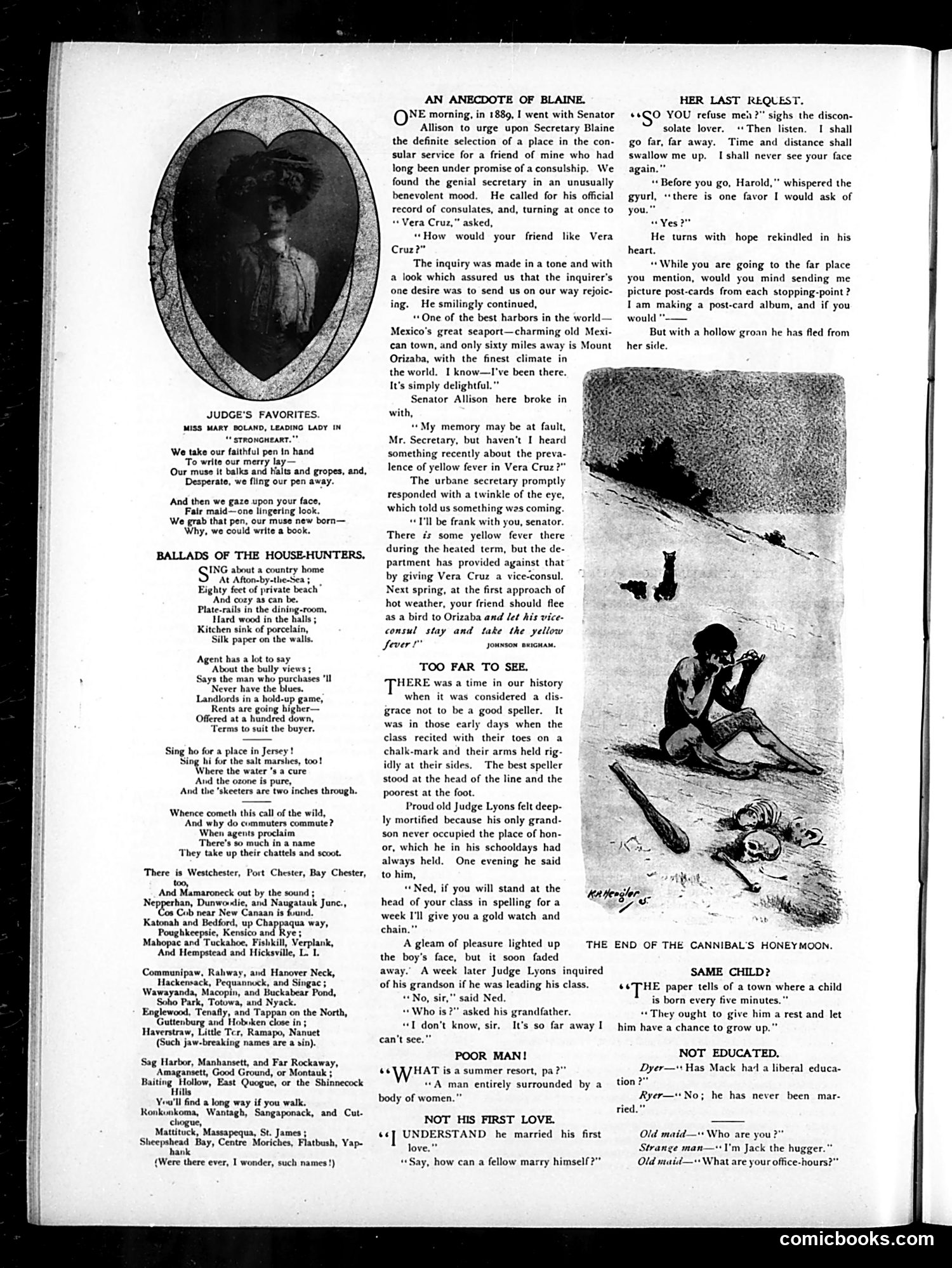
This page contains primarily **literary content rather than political cartoons**. The left side features poems titled "Judge's Favorites" (credited to Miss Mary Roland in "Strongheart"), "Ballads of the House-Hunters," and other verse—typical filler content for Judge magazine. The right side contains several short humorous anecdotes and joke items with titles like "An Anecdote of Blaine," "Her Last Request," "Too Far to See," "The End of the Cannibal's Honeymoon," and "Same Child?" The single illustration shows what appears to be a beach or seaside scene with figures and objects. Without clearer visual detail or explicit political commentary, **the specific satirical targets remain unclear**. This appears to be a typical mixed-content page from Judge's satirical-but-also-literary format.
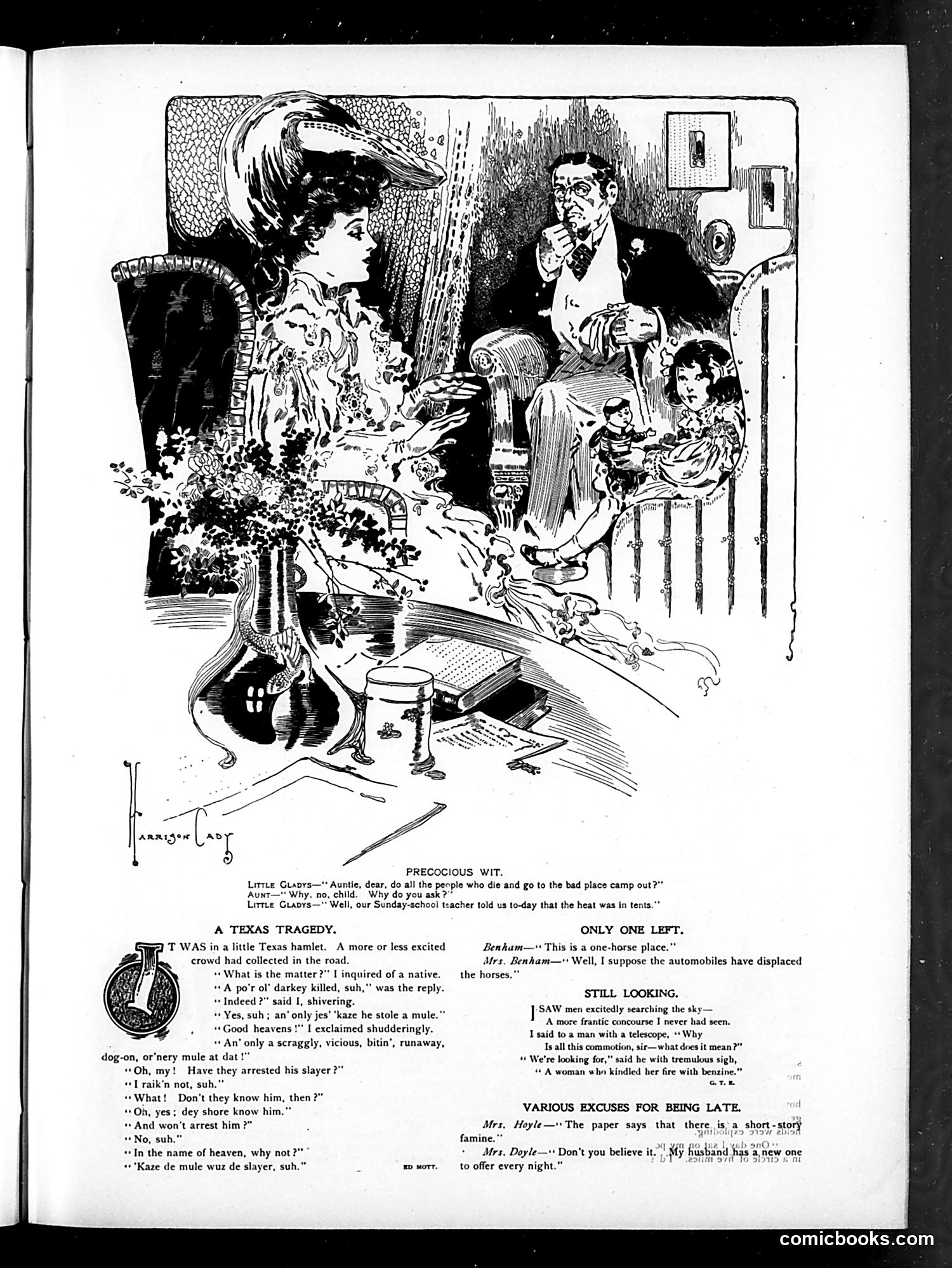
This page contains multiple unrelated humor pieces typical of Judge's format: **"Precocious Wit"** (top cartoon): A child asks an adult why people die and go to "bad place camp" — likely a naive reference to hell. The humor relies on the child's innocent misunderstanding of religious concepts. **"A Texas Tragedy"** and other sections below present brief humorous anecdotes about rural/frontier life, including a dialogue about a mule being stolen and arrests. **"Only One Left," "Still Looking," and "Various Excuses for Being Late"** are separate short humor pieces featuring domestic scenarios and marital comedy. The page represents Judge's typical mixed-content approach: satirical cartoons combined with brief comedic stories and observations on contemporary American life, without apparent political commentary. The humor is genteel and domestic rather than explicitly partisan.
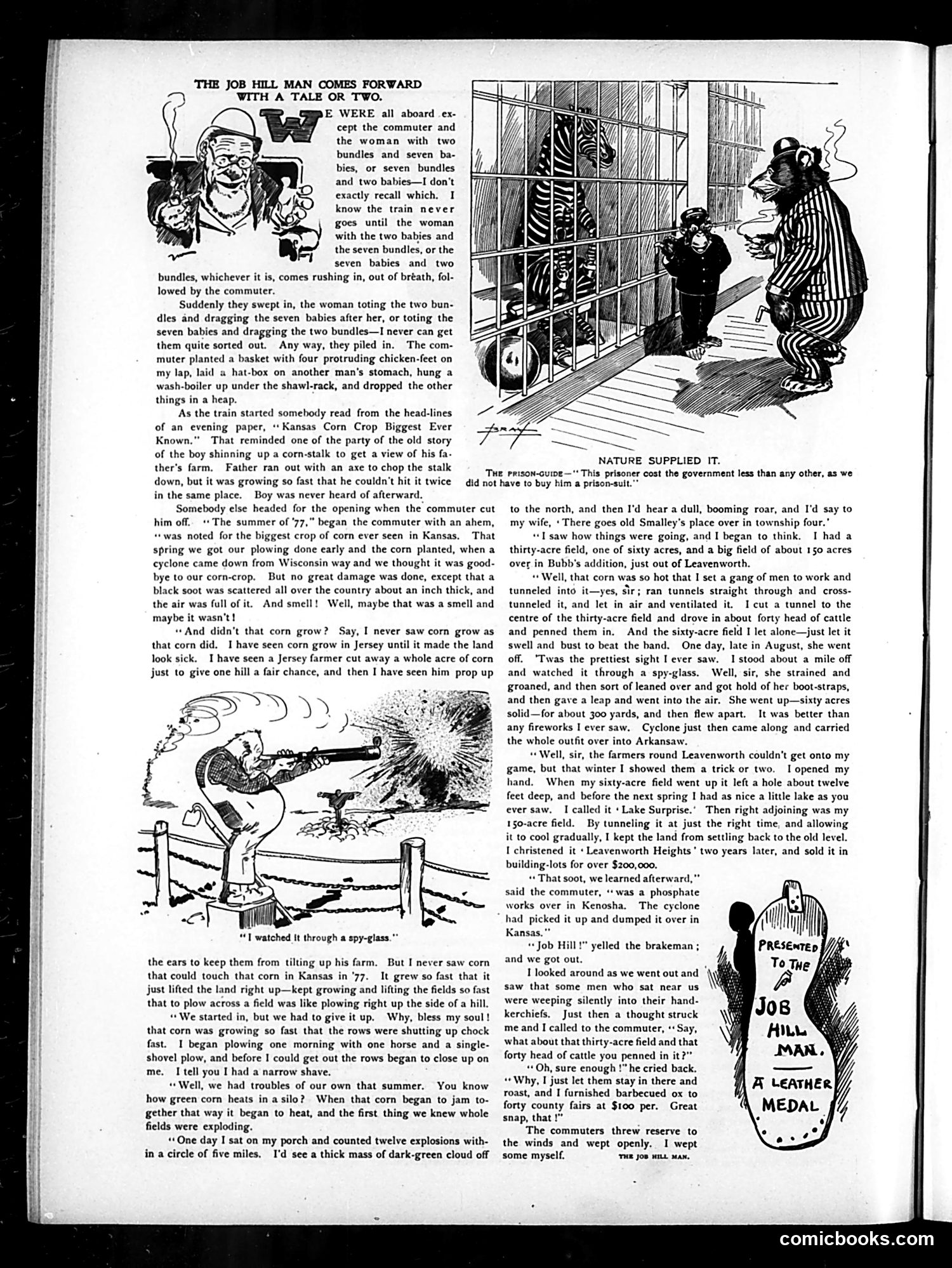
This is a tall-tale humor piece in *Judge* magazine satirizing exaggerated frontier stories. The "Job Hill Man" is a stock character—a rambling commuter who tells increasingly absurd anecdotes on a train. The main story concerns Kansas corn during the summer of 1877. The commuter claims the corn grew so rapidly it lifted the earth itself, requiring him to abandon plowing. Fields then spontaneously exploded from internal heat, destroying neighboring properties. The narrator mentions a thirty-acre field, sixty-acre field, and 150-acre field in the Leavenworth area. The satire targets American boastfulness about agricultural abundance and frontier exceptionalism. By pushing claims to ridiculous extremes—corn exploding across miles, fields rising—the piece mocks tall-tale conventions and regional pride. The bottom caption references a "prison-guide" illustration, appearing unrelated to the main narrative.
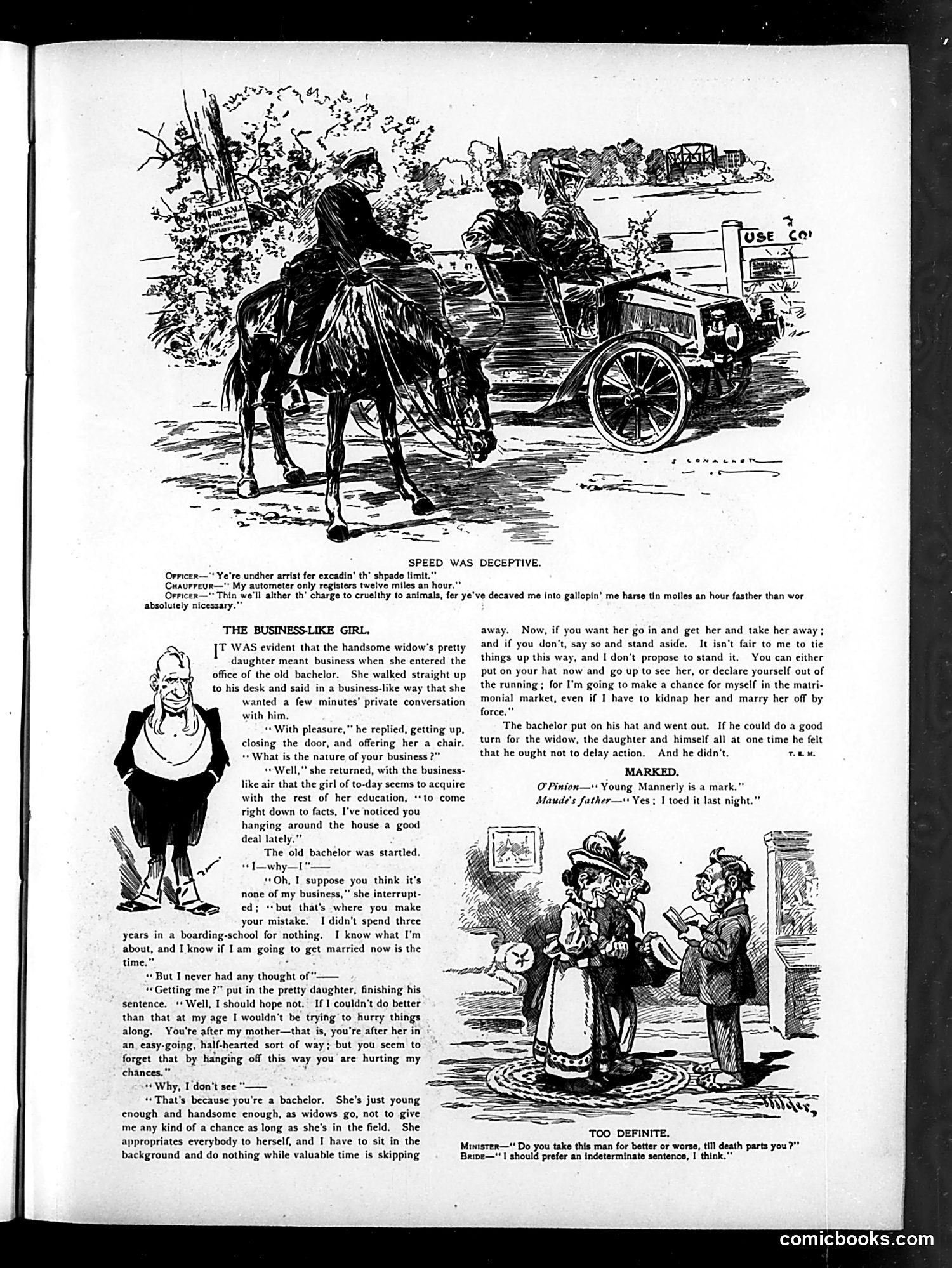
This page contains two satirical pieces reflecting early 20th-century social attitudes: **"Speed Was Deceptive"** (top): A humorous sketch mocking both a speeding motorist and an Irish police officer. The officer arrests the driver for exceeding a "speed limit," but when the driver claims his speedometer shows only twelve miles per hour, the officer switches the charge to animal cruelty—the horse was forced to gallop faster than necessary. The joke satirizes either unreliable early automobile technology or overzealous law enforcement inventing charges. **"The Business-Like Girl"** (main story): A satirical take on the "New Woman"—educated, independent-minded young women of the era. A widow's daughter directly confronts an aging bachelor courting her mother, demanding he either marry the mother immediately or stop wasting time. She treats marriage as a business transaction and threatens to sabotage her own marriageability by forcing the match herself. The satire mocks both aggressive female ambition and the daughter's mercenary approach to matrimony. Both pieces reflect period anxieties about changing social conventions.
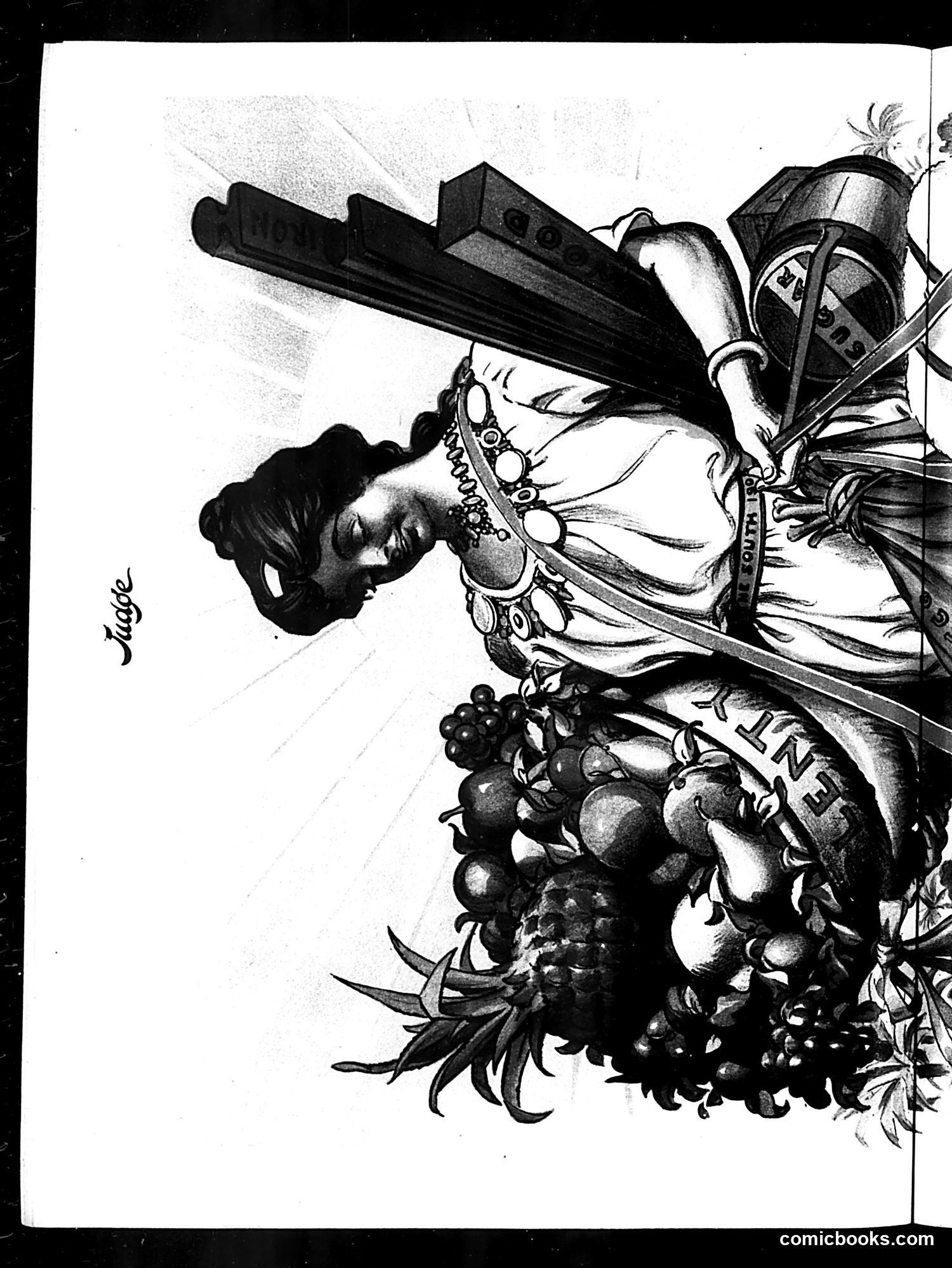
This appears to be a satirical illustration from *Judge* magazine featuring an allegorical female figure (likely representing "Liberty" or "America") adorned with elaborate classical dress and a feathered headdress. She is surrounded by abundant fruits and vegetables labeled "LINE," suggesting agricultural bounty or prosperity. The figure holds what appears to be a cornucopia or harvest symbol, emphasizing themes of abundance and fertility. The ornate, decorative style and prominent positioning suggest this is celebrating American agricultural wealth or promoting agricultural interests—a common subject in late 19th/early 20th-century satire. Without a visible date or clearer text, the specific political context remains unclear, though the emphasis on agricultural production and national prosperity is evident. The artist's signature appears to read "Judge."
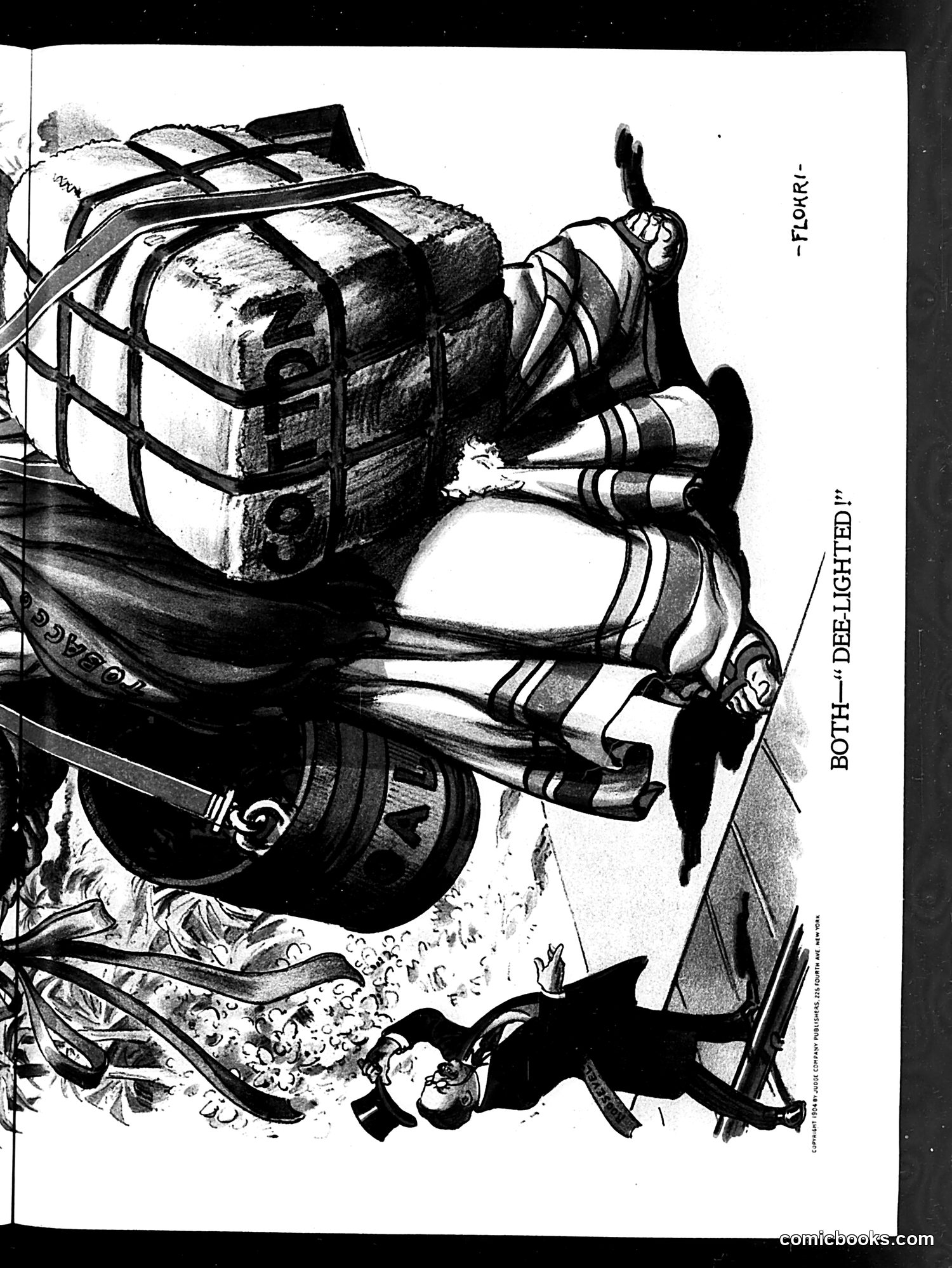
This appears to be a satirical cartoon from *Judge* magazine showing two figures who are "dee-lighted" (delighted) receiving delivery of large crates or packages. The figures are drawn in exaggerated style typical of early 20th-century political satire, with one appearing to be a worker or laborer and another figure in formal dress. The cartoon likely satirizes either: - Political corruption or bribery (accepting suspicious "deliveries") - Labor disputes or questionable business dealings - Some contemporary scandal involving wealthy figures and workers Without clear identifying labels or dates visible, I cannot definitively identify the specific figures or the exact political event referenced. The "fork" label visible on the right may indicate additional context, but its meaning is unclear from this image alone.
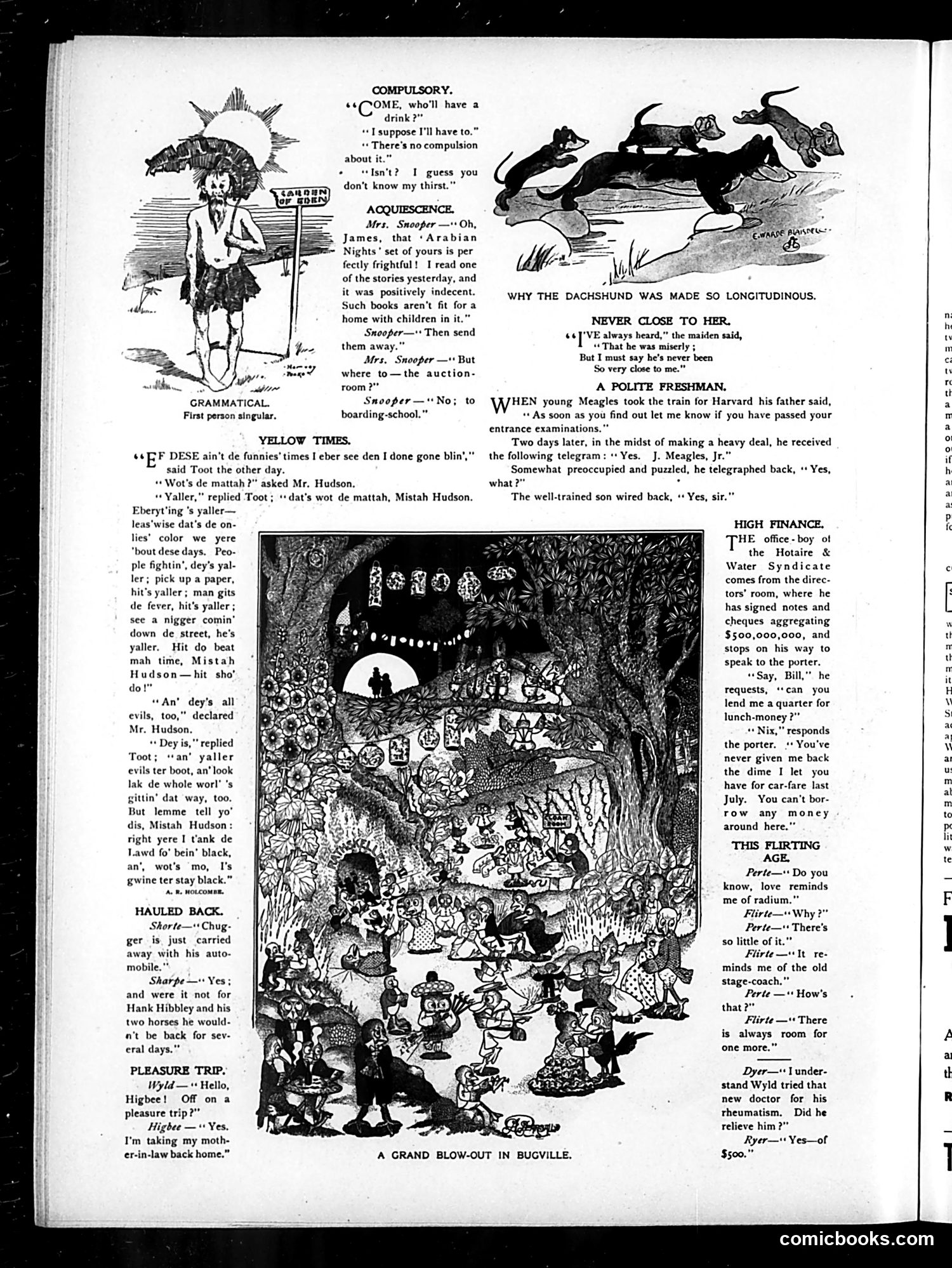
This page contains multiple short satirical pieces typical of early 20th-century humor magazines: **Main Cartoon ("A Grand Blow-Out in Bugville")**: An intricate illustration depicting insects in human situations—a visual pun satirizing society by replacing people with bugs. The detailed scene likely mocks human social pretensions and frivolity. **Text Pieces**: Brief comedic dialogues satirizing contemporary social attitudes: - **"Compulsory"**: Jokes about obligatory drinking customs - **"Yellow Times"**: A dialect piece where a Black character observes that "yellow" (cowardice) dominates society—from violence to fever to racism. The satire critiques pervasive social corruption. - **"High Finance"**: Mocks wealthy businessmen's casual indifference to vast sums and their stinginess toward servants - **"Flirting Age"**: Light romantic banter The humor relies on period-specific references (Arabian Nights "indecency," Harvard entrance exams, automobile culture) and social hierarchies now dated. The "Yellow Times" piece uses offensive dialect but appears to satirize systemic cowardice and racism rather than endorse it.
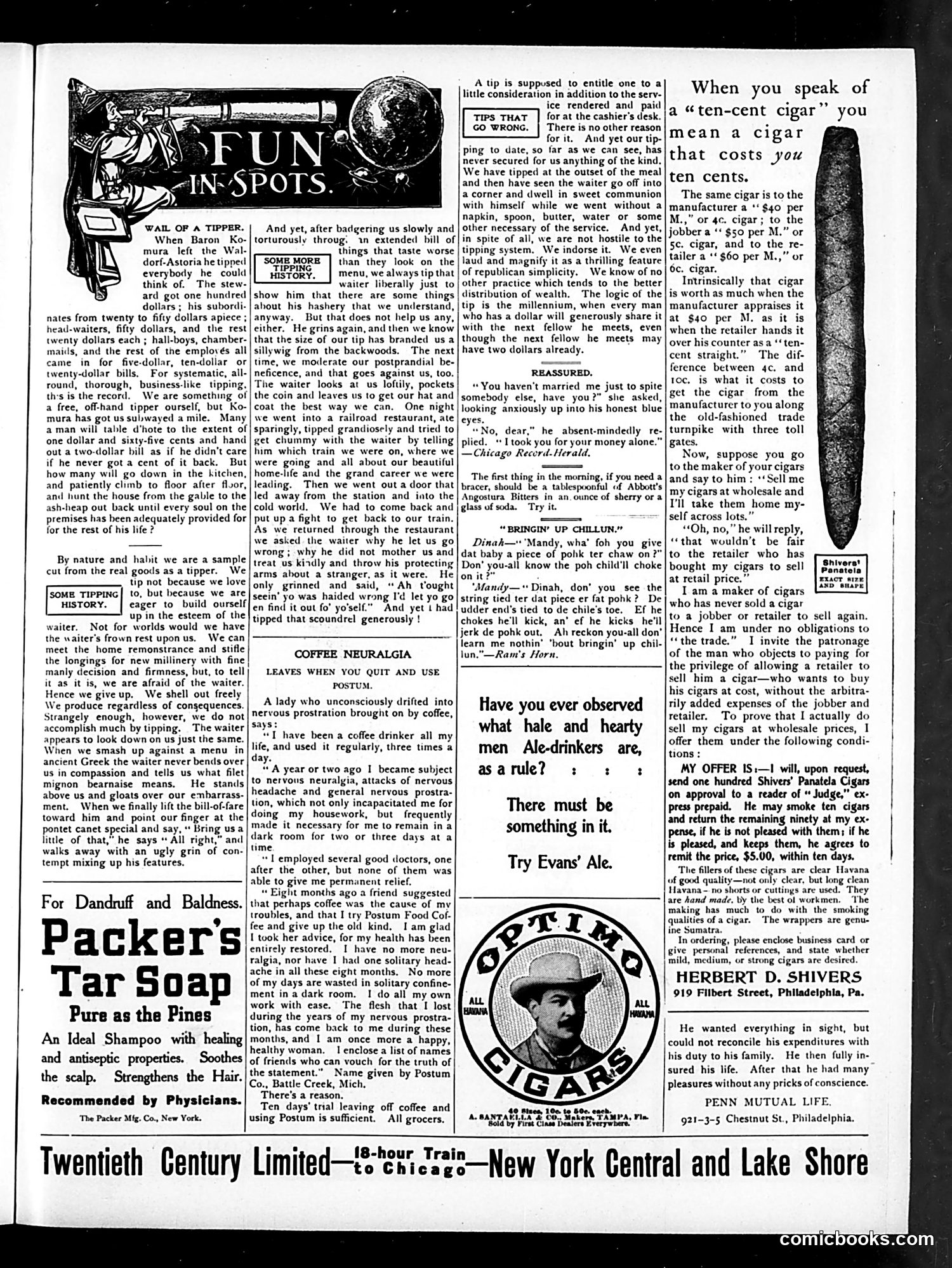
This page is primarily **advertising and advice columns** rather than political satire. The main content includes: **"Fun in Spots"** - A humorous anecdote about tipping practices, mocking both cheap customers and overly demanding waiters who expect exorbitant tips. The satire targets middle-class anxiety about proper etiquette and service standards. **Advertisements** include Packer's Tar Soap and Evans' Ale, positioned alongside lifestyle advice. **"Coffee Neuralgia"** - A personal essay describing how quitting coffee improved the author's health. **Herbert D. Shivers cigar advertisement** - A lengthy pitch for quality cigars, addressing consumer concerns about value and authenticity. The page reflects early 20th-century consumer culture anxieties: tipping customs, health remedies, and distinguishing genuine products from inferior ones. There is minimal political content—the humor is social rather than topical.
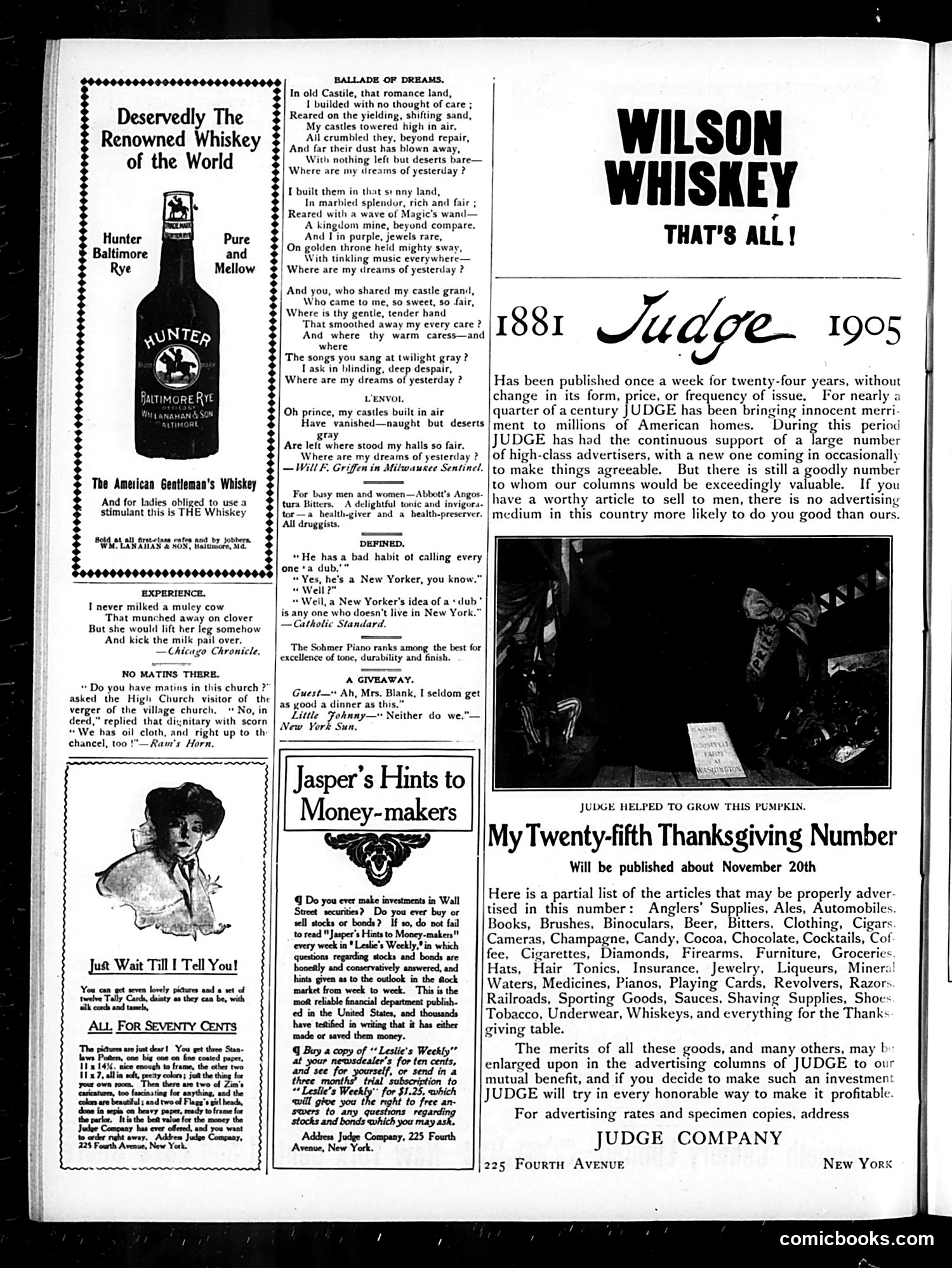
This page is primarily **advertising and filler content** rather than political satire. **Main Content:** - Large Wilson Whiskey ad ("That's All I") dominates the right side - Hunter Baltimore Rye whiskey advertisement (left) - Judge magazine self-promotion announcing its 25th Thanksgiving issue **Minor Humorous Pieces:** - Brief jokes about church practices ("No Matins There") - A cow-milking anecdote - A definition joke mocking New Yorkers' snobbery (anyone not from NYC is a "dub") - A dinner joke about modest hospitality **The "Ballad of Dreams"** is a romantic poem about lost castles and abandoned love—sentimental rather than satirical. **Historical Context:** By 1905, Judge had shifted from hard-hitting political cartooning toward lifestyle magazine content, heavy advertising, and genteel humor. The page reflects the magazine's commercialization and appeal to affluent readers—note the emphasis on fine whiskey, piano quality, and consumer goods. There's no evident political commentary.
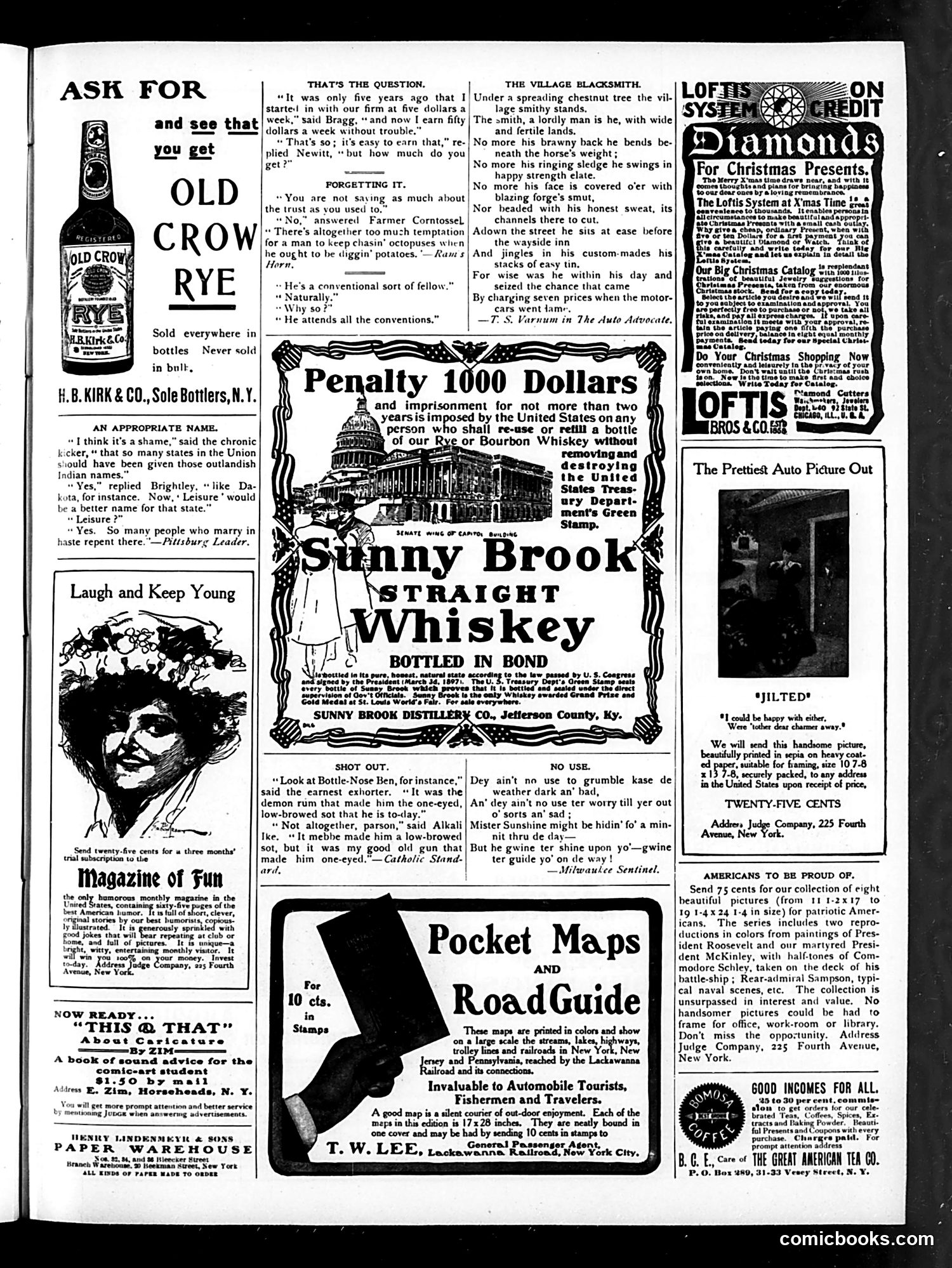
This page is primarily **advertisements and humor pieces**, typical of Judge magazine's format. **Key content:** The main cartoon/poem is "The Village Blacksmith"—a satirical update of Longfellow's famous poem. Instead of an honest laborer, the modern blacksmith has abandoned his forge to become a wealthy landowner who exploits motorists by "charging seven prices" for services. The satire mocks the rapid commercialization of rural America and opportunistic profiteering during the automobile boom. **Other humor pieces** include brief jokes about state names ("Dakota" vs. "Leisure" for regretful marriages), a minister condemning alcohol while ignoring actual violence, and farmers distracted from work. **Advertisements** dominate: Old Crow whiskey, Sunny Brook whiskey (with stern warnings about federal penalties for bottle reuse—Prohibition-era enforcement), diamonds for Christmas gifts, and pocket maps. The overall tone reflects early-20th-century anxieties about industrialization, commercialism, and changing rural life.
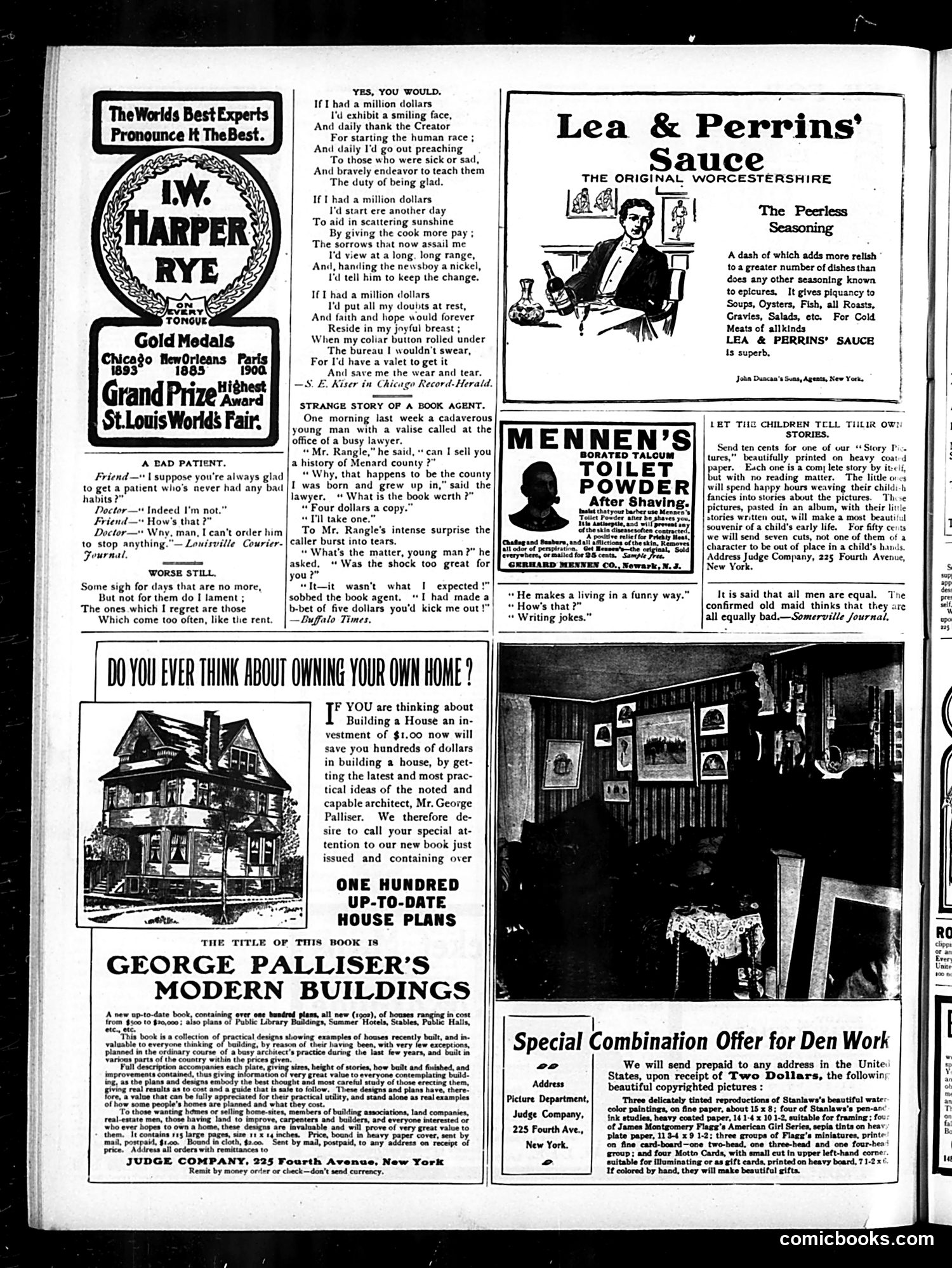
This page from *Judge* magazine contains multiple satirical items reflecting early 1900s American humor and advertisements. The main cartoons are brief joke exchanges: a doctor prefers patients with "bad habits" so he can order them to stop; a lawyer unexpectedly buys a local history book, shocking a pessimistic book agent who'd bet he'd be rejected; and observations about wealth and human nature. The advertisements promote products (Lea & Perrins sauce, Mennen talcum powder) and services typical of the era, including George Palliser's architectural house plans book. One ad invites children to create stories around pictures—a period entertainment method reflecting different notions of leisure and childhood development. The humor is gentle domestic satire aimed at middle-class readers, with no obvious political content visible. The overall tone reflects *Judge*'s satirical tradition of poking fun at everyday behaviors, social pretensions, and consumer culture.
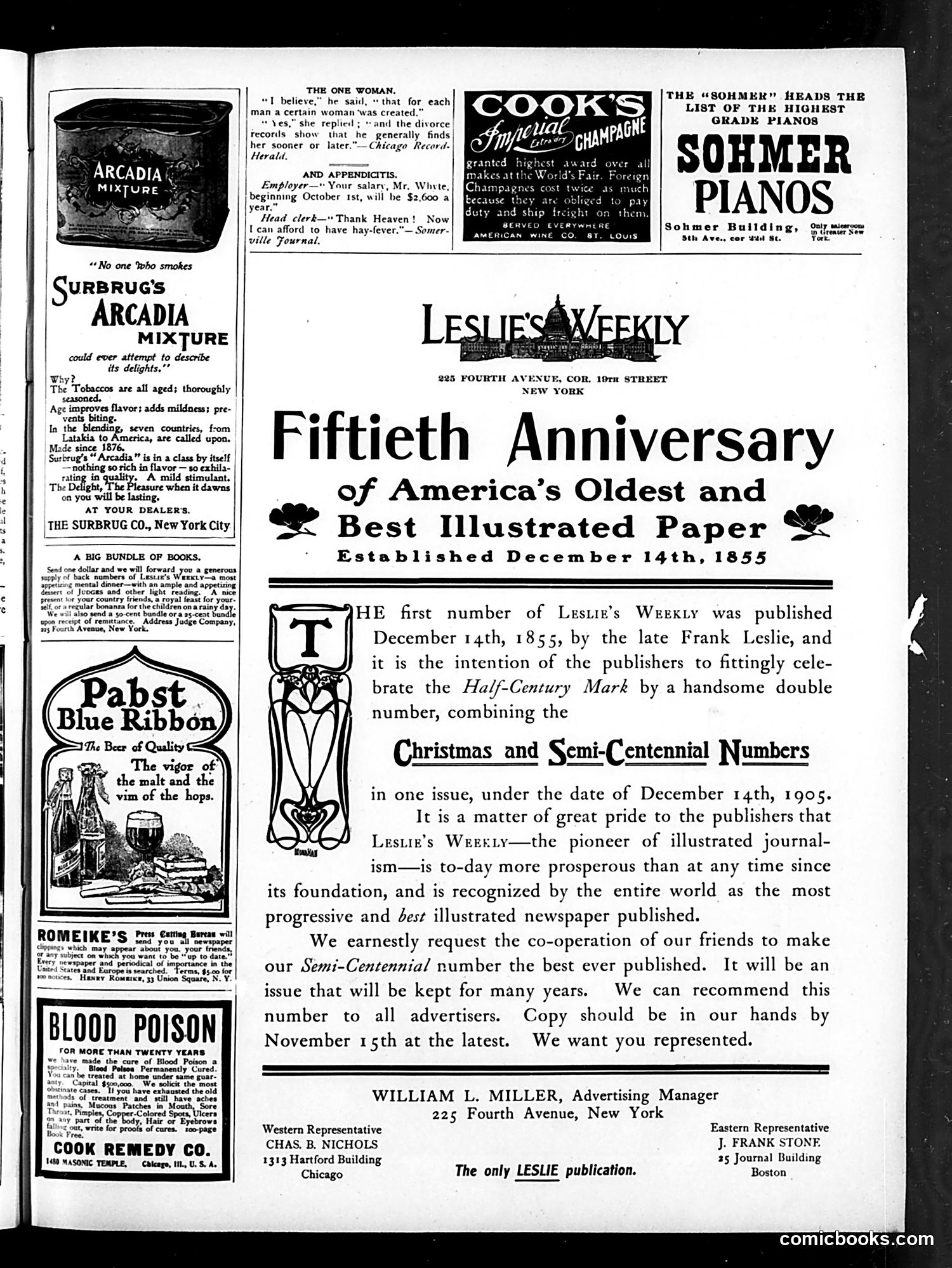
This is primarily **an advertising and announcement page**, not a satirical cartoon page. The main content is Leslie's Weekly's announcement of its **50th anniversary** (established December 14, 1855; this issue dated December 14, 1905). The page contains several period advertisements with minor humorous taglines rather than political satire: - **"Surburg's Arcadia Mixture"** tobacco ad claims no smoker could describe its delights - A small joke about an employee who can now "afford to have hay-fever" with his raise - **Pabst Blue Ribbon** beer ad emphasizing quality ingredients - Various patent medicine ads (blood poison cure, etc.)—typical of the era The Leslie's announcement emphasizes the publication's status as "America's Oldest and Best Illustrated Paper" and requests advertisers submit copy by November 15th for the special semi-centennial/Christmas double issue. **No identifiable political figures or satire appear on this page.** It reflects early 1900s advertising conventions and journalistic self-promotion rather than social commentary.
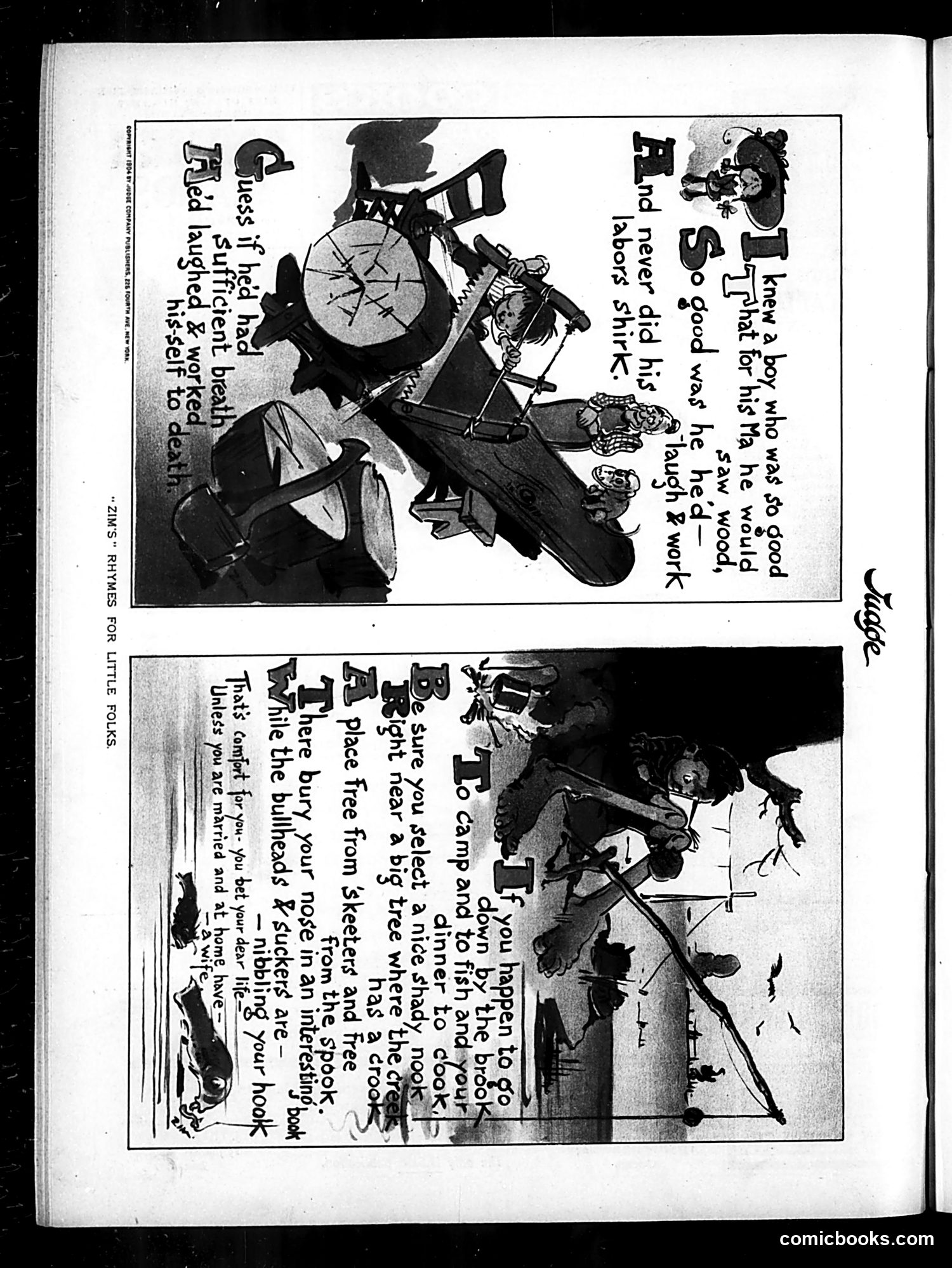
This page contains **"Rhymes for Little Folks,"** a children's verse section rather than political satire. The OCR'd text is heavily degraded, but the visible content appears to be moralistic poetry for young readers. The top illustration shows a boy described as exceptionally virtuous—one who "never did his labors shirk" and was "so good." The bottom illustration depicts outdoor advice: when camping or fishing, select a shady spot near trees, away from mosquitoes ("skeeters") and presumably unsafe areas ("spook"). The humor is gentle and instructional rather than satirical—typical of Judge's family content. The final couplet's reference to being "married and at home" suggests domestic comfort as the ultimate refuge, a lighthearted jab at marital life common to the era. This appears to be filler content rather than the magazine's signature political commentary. The 1904 copyright date places it in the Progressive Era, but the material itself targets children with straightforward moral lessons.