
Judge, 1905-10-21 · page 7 of 16
Judge — October 21, 1905 — page 7: what you’re looking at
What you’re looking at
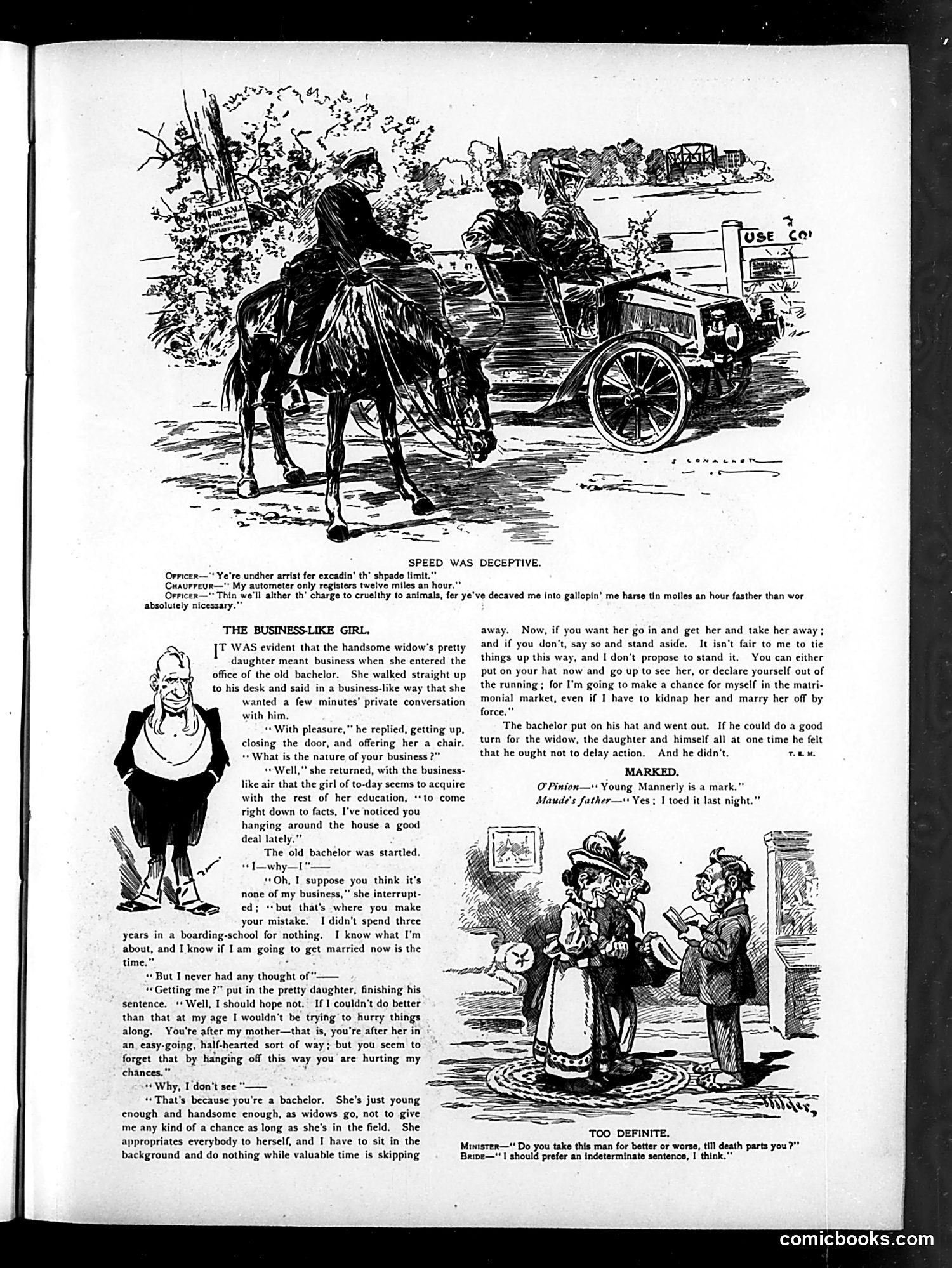
This page contains two satirical pieces reflecting early 20th-century social attitudes: **"Speed Was Deceptive"** (top): A humorous sketch mocking both a speeding motorist and an Irish police officer. The officer arrests the driver for exceeding a "speed limit," but when the driver claims his speedometer shows only twelve miles per hour, the officer switches the charge to animal cruelty—the horse was forced to gallop faster than necessary. The joke satirizes either unreliable early automobile technology or overzealous law enforcement inventing charges. **"The Business-Like Girl"** (main story): A satirical take on the "New Woman"—educated, independent-minded young women of the era. A widow's daughter directly confronts an aging bachelor courting her mother, demanding he either marry the mother immediately or stop wasting time. She treats marriage as a business transaction and threatens to sabotage her own marriageability by forcing the match herself. The satire mocks both aggressive female ambition and the daughter's mercenary approach to matrimony. Both pieces reflect period anxieties about changing social conventions.
📄 Transcribed text from this page (OCR, searchable)
Machine-transcribed from the original scan — historical spelling and the odd misread are preserved.
SPEED WAS DECEPTIVE. Orricen—"' Ye're undher arrist fer excadin’ th’ shpade limit.”* Cuaurreur—"" My autometer only registers twelve miles an hour."* Orricer—“* Thin we'll alther th’ charge to cruelthy to animals, fer ye’ve decaved me into gallopin' me harse tin molles an hour fasther than wor absolutely nicessary.”” ‘THE BUSINESS-LIKE GIRL. T WAS evident that the handsome widow's pretty daughter meant business when she entered the office of the old bachelor. She walked straight up to his desk and said in a business-like way that she wanted a few minutes’ private conversation with him, «With pleasure,” he replied, getting up, closing the door, and offering her a chair. «* What is the nature of your business ?” ++ Well,” she returned, with the business- like air that the girl of to-day seems to acquire with the rest of her education, to come right down to facts, I've noticed you hanging around the house a good deal lately.” The old bachelor was startled. + T—why—1"— ‘Oh, I suppose you think it’s none of my business,” she interrupt- ed; ‘but that's where you make your mistake. I didn’t spend three years in a boarding-school for nothing. I know what I'm about, and I know if Iam going to get married now is the time.” : «But I never had any thought of "—— “Getting me ?” put in the pretty daughter, finishing his sentence. ‘Well, I should hope not. If I couldn't do better than that at my age I wouldn't be trying to hurry things along. You'te after my mother—that is, you're after her in an. easy-going, half-hearted sort of way; but you seem to forget that by hanging off this way you are hurting my chances.”” SFE “Why, I'don’t see"—— * ‘That's because you're a bachelor. She's just young enough and handsome enough, as widows go, not to give me any kind of a chance as long as she’s in the field. She appropriates everybody to herself, and I have to sit in the background and do nothing while valuable time is skipping Now, if you want her go in and get her and take her away ; and if you don’t, say so and stand aside. It isn't fair to me to tie things up this way, and I don’t propose to stand it. You can either put on your hat now and go up to see her, or declare yourself out of the running; for I'm going to make a chance for myself in the matri- monial market, even if I have to kidnap her and marry her off by force." The bachelor put on his hat and went out. If he could do a good turn for the widow, the daughter and himself all at one time he felt that he ought not to delay action. And he didn't. nem MARKED. O'Pinion—« Young Mannerly is a mark.” Maude's father—" Yes; 1 toed it last night.” away. TOO DEFINITE. ‘Do you take this man for better or worse, till death parts you?” should prefer an indeterminate sentence, | think."’ comicbooks.com