
Judge, 1905-10-21 · page 6 of 16
Judge — October 21, 1905 — page 6: what you’re looking at
What you’re looking at
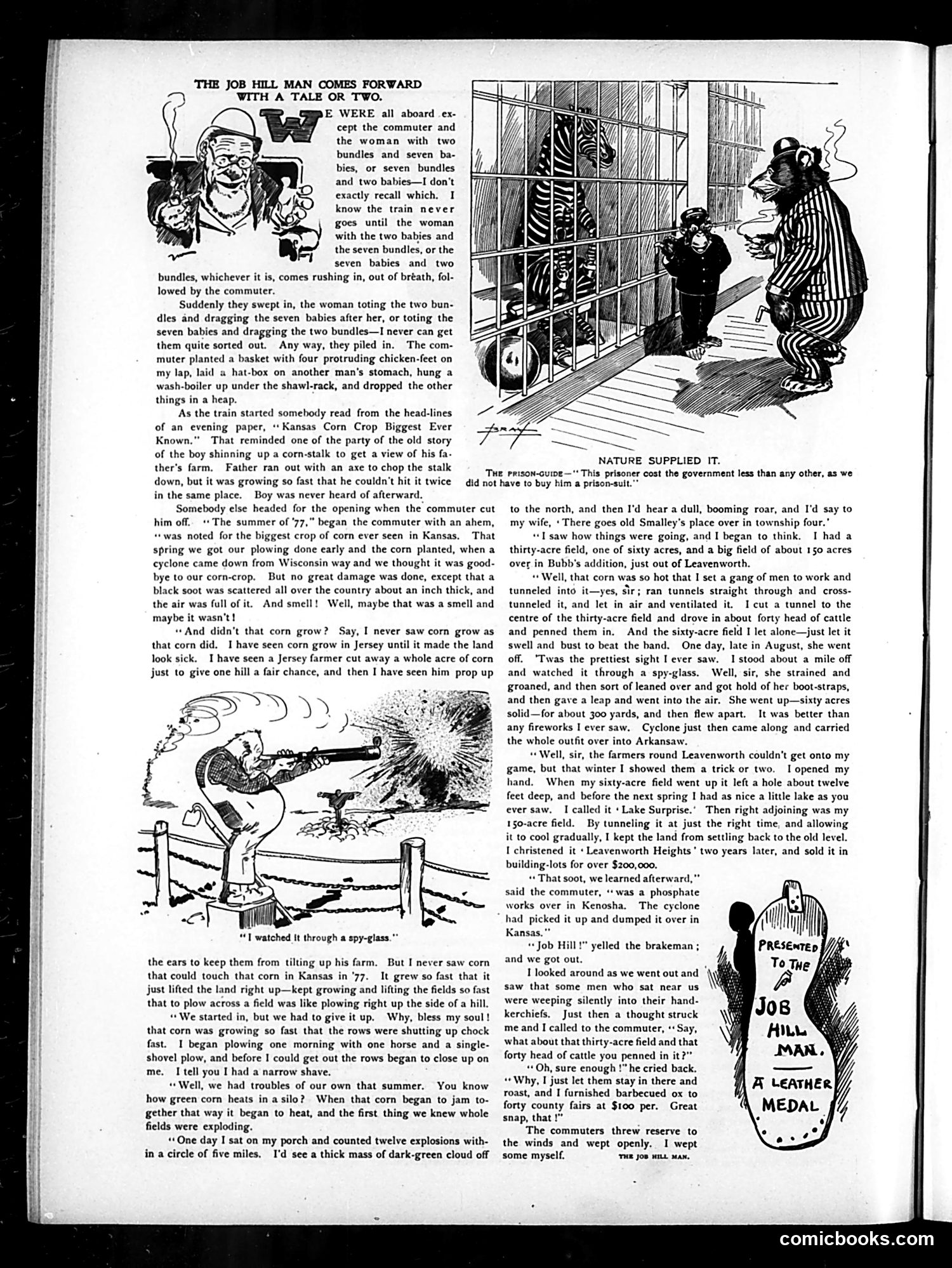
This is a tall-tale humor piece in *Judge* magazine satirizing exaggerated frontier stories. The "Job Hill Man" is a stock character—a rambling commuter who tells increasingly absurd anecdotes on a train. The main story concerns Kansas corn during the summer of 1877. The commuter claims the corn grew so rapidly it lifted the earth itself, requiring him to abandon plowing. Fields then spontaneously exploded from internal heat, destroying neighboring properties. The narrator mentions a thirty-acre field, sixty-acre field, and 150-acre field in the Leavenworth area. The satire targets American boastfulness about agricultural abundance and frontier exceptionalism. By pushing claims to ridiculous extremes—corn exploding across miles, fields rising—the piece mocks tall-tale conventions and regional pride. The bottom caption references a "prison-guide" illustration, appearing unrelated to the main narrative.
📄 Transcribed text from this page (OCR, searchable)
Machine-transcribed from the original scan — historical spelling and the odd misread are preserved.
‘THE JOB HILL MAN COMES FORWARD WITH A TALE OR TWO. E WERE all aboard ex- cept the commuter and the woman with two bundles and seven ba- bies, or seven bundles and two babies—I don't exactly recall which. I know the train never goes until the woman with the two babies and the seven bundles, or the seven babies and two bundles, whichever it is, comes rushing in, out of bréath, fol- lowed by the commuter. Suddenly they swept in, the woman toting the two bun- dles and dragging the seven babies after her, or toting the seven babies and dragging the two bundles—I never can get them quite sorted out. Any way, they piled in. The com- muter planted a basket with four protruding chicken-feet on my lap, laid a hat-box on another man’s stomach, hung a wash-boiler up under the shawl-rack, and dropped the other things in a heap. As the train started somebody read from the head-lines of an evening paper, “Kansas Corn Crop Biggest Ever Known." That reminded one of the party of the old story of the boy shinning up a corn-stalk to get a view of his fa- ther’s farm. Father ran out with an axe to chop the stalk down, but it was growing so fast that he couldn't hit it twice in the same place. Boy was never heard of afterward. Somebody else headed for the opening when the commuter cut him off. «The summer of '77," began the commuter with an ahem, ++ was noted for the biggest crop of corn ever seen in Kansas, That spring we got our plowing done early and the corn planted, when a cyclone came down from Wisconsin way and we thought it was good- bye to our corn-crop. But no great damage was done, except that a black soot was scattered all over the country about an inch thick, and the air was full of it. And smell! Well, maybe that was a smell and maybe it wasn’t! “And didn’t that corn grow? Say, I never saw corn grow as that corn did. I have seen corn grow in Jersey until it made the land look sick. I have seen a Jersey farmer cut away a whole acre of corn just to give one hill a fair chance, and then I have seen him prop up “| watched It through a spy-glass."" the ears to keep them from tilting up his farm. But I never saw corn that could touch that corn in Kansas in '77. It grew so fast that it just lifted the land right up—kept growing and lifting the fields so fast that to plow across a field was like plowing right up the side of a hill. “We started in, but we had to give it up. Why, bless my soul! that corn was growing so fast that the rows were shutting up chock fast. I began plowing one morning with one horse and a single- shovel plow, and before I could get out the rows began to close up on I tell you I had a narrow shave. “Well, we had troubles of our own that summer. You know how green corn heats in a silo? When that corn began to jam to- gether that way it began to heat, and the first thing we knew whole fields were exploding. «One day I sat on my porch and counted twelve explosions with- in a circle of five miles. I'd see a thick mass of dark-green cloud off me. NATURE SUPPLIED IT. ‘Tue Prison-curve—"' This prisoner cost the government less than any other, as we did not have to buy him a prison-sult.”* to the north, and then I'd hear a dull, booming roar, and I'd say to my wife, ‘There goes old Smalley’s place over in township four.’ “I saw how things were going, and I began to think, I had a thirty-acre field, one of sixty acres, and a big field of about 150 acres over in Bubb’s addition, just out of Leavenworth. + Well, that corn was so hot that I set a gang of men to work and tunneled into it—yes, sir; ran tunnels straight through and cross- tunneled it, and let in air and ventilated it. I cut a tunnel to the centre of the thirty-acre field and drove in about forty head of cattle and penned them in. And the sixty-acre field I let alone—just let it swell and bust to beat the hand, One day, late in August, she went off. "Twas the prettiest sight I ever saw. I stood about a mile off and watched it through a spy-glass. Well, sir, she strained and groaned, and then sort of leaned over and got hold of her boot-straps, and then gave a leap and went into the air, She went up—sixty acres solid—for about 300 yards, and then flew apart. It was better than any fireworks I ever saw. Cyclone just then came along and carried the whole outfit over into Arkansaw. ‘Well, sir, the farmers round Leavenworth couldn't get onto my game, but that winter I showed them a trick or two. I opened my hand. When my sixty-acre field went up it left a hole about twelve feet deep, and before the next spring I had as nice a little lake as you ever saw. I called it ‘Lake Surprise.’ Then right adjoining was my 150-acre field. By tunneling it at just the right time, and allowing it to cool gradually, I kept the land from settling back to the old level. I christened it « Leavenworth Heights’ two years later, and sold it in building-lots for over $200,000. + That soot, we learned afterward,” said the commuter, ‘was a phosphate works over in Kenosha. The cyclone had picked it up and dumped it over in Kansas. Job Hill!” yelled the brakeman ; and we got out. I looked around as we went out and saw that some men who sat near us were weeping silently into their hand- kerchiefs. Just then a thought struck me and I called to the commuter, “Say, what about that thirty-acre field and that forty head of cattle you penned in it?” «Oh, sure enough !" he cried back. “Why, I just let them stay in there and roast, and I furnished barbecued ox to forty county fairs at $100 per. Great snap, that !” The commuters threw reserve to the winds and wept openly. I wept some myself. Fur Jou WL Max, comicbooks.com