
A complete issue · 16 pages · 1905
Judge — September 30, 1905
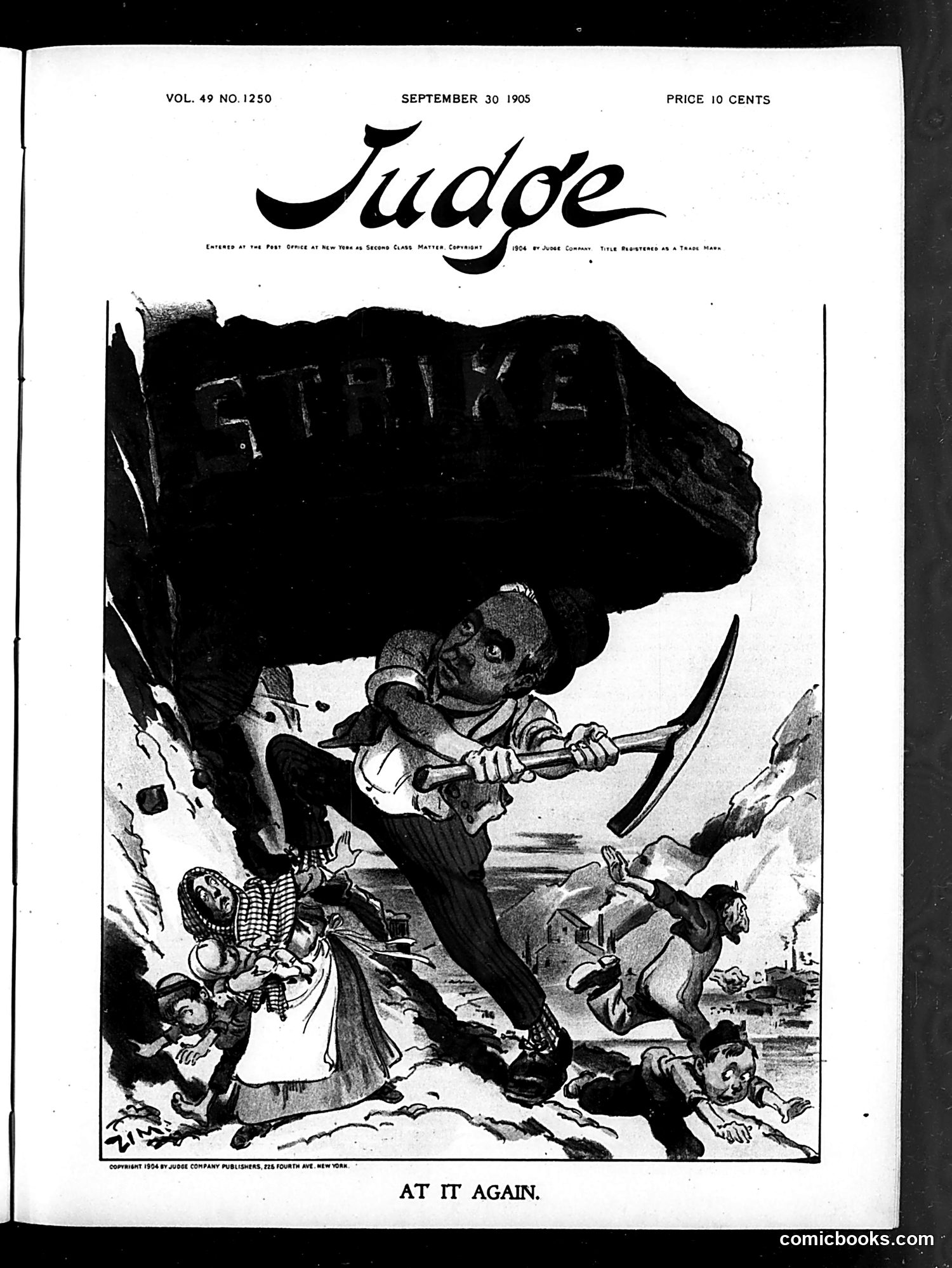
**Title and Subject:** "At It Again" depicts a caricatured figure wielding a large axe against a massive dark shape labeled "ETHICS." **The Satire:** This appears to be political commentary on someone (likely a prominent public figure of 1905) repeatedly attacking ethical standards or practices. The axe-wielding figure is surrounded by smaller figures and chaos, suggesting destructive behavior. **Historical Context:** Without clearer identification of the specific figure caricatured, the exact target remains uncertain. However, the cartoon criticizes repeated attacks on ethical conduct—a common Judge magazine theme during the Progressive Era when corporate and political corruption were frequent subjects. **Visual Style:** The heavy black shading and exaggerated features are typical of early 20th-century satirical illustration, employing caricature to ridicule the subject.
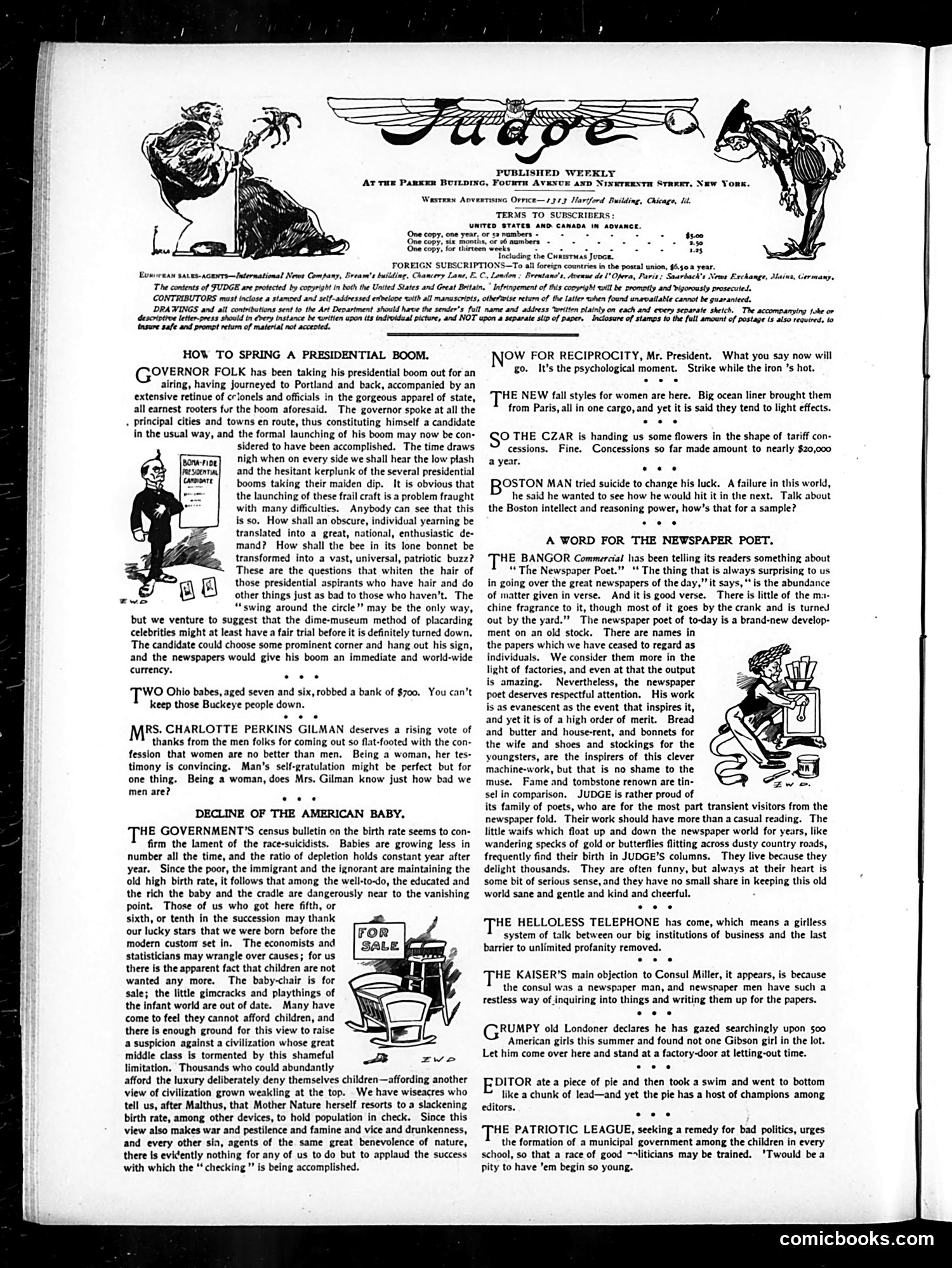
This page features several short political commentaries typical of Judge magazine's format. The main cartoon (top left) appears to show a figure labeled "Don't talk Candidates" - likely mocking presidential hopefuls making premature campaign announcements. The text sections satirize various targets: Governor Folk's "presidential boom," newspaper poets (treated as inferior to serious writers), declining American birth rates, and the Kaiser's objection to a newspaper consul (referencing German-American tensions, likely pre-WWI). One piece mocks "grumpy old Londoner" searching for Gibson Girls—referencing Charles Dana Gibson's famous idealized illustrations of American femininity. The overall tone is characteristic of Judge's role as a satirical weekly: poking fun at political pretensions, cultural trends, and international affairs through brief, sharp commentary and illustrations.
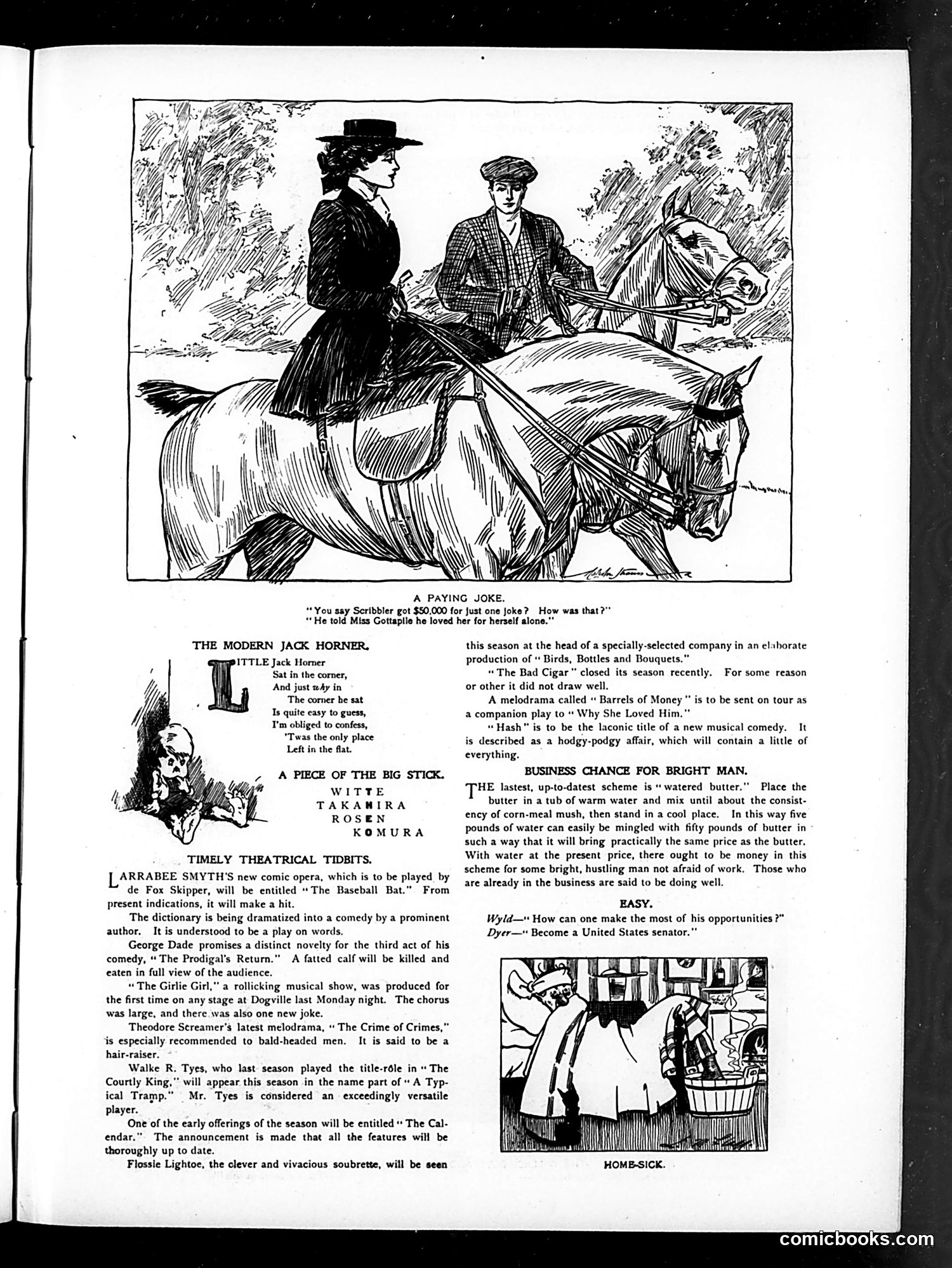
This page contains theatrical and entertainment commentary rather than political satire. The main illustration shows two people horseback riding, captioned with a joke about someone named Scribbler receiving $50,000 for "just one joke" while Miss Cottapple loved him "for himself alone"—a commentary on wealth disparities in entertainment. The text discusses theatrical productions and performers of the season, including references to comic operas and various theatrical productions. There's a section called "The Modern Jack Horner" (likely a nursery rhyme reference) and commentary on theatrical tidbits featuring performers like Larrabee Smyth and George Dale. The bottom section includes a small comic labeled "HOME-SICK" and a joke about becoming a United States senator. This appears to be general entertainment and theatrical gossip rather than political commentary.
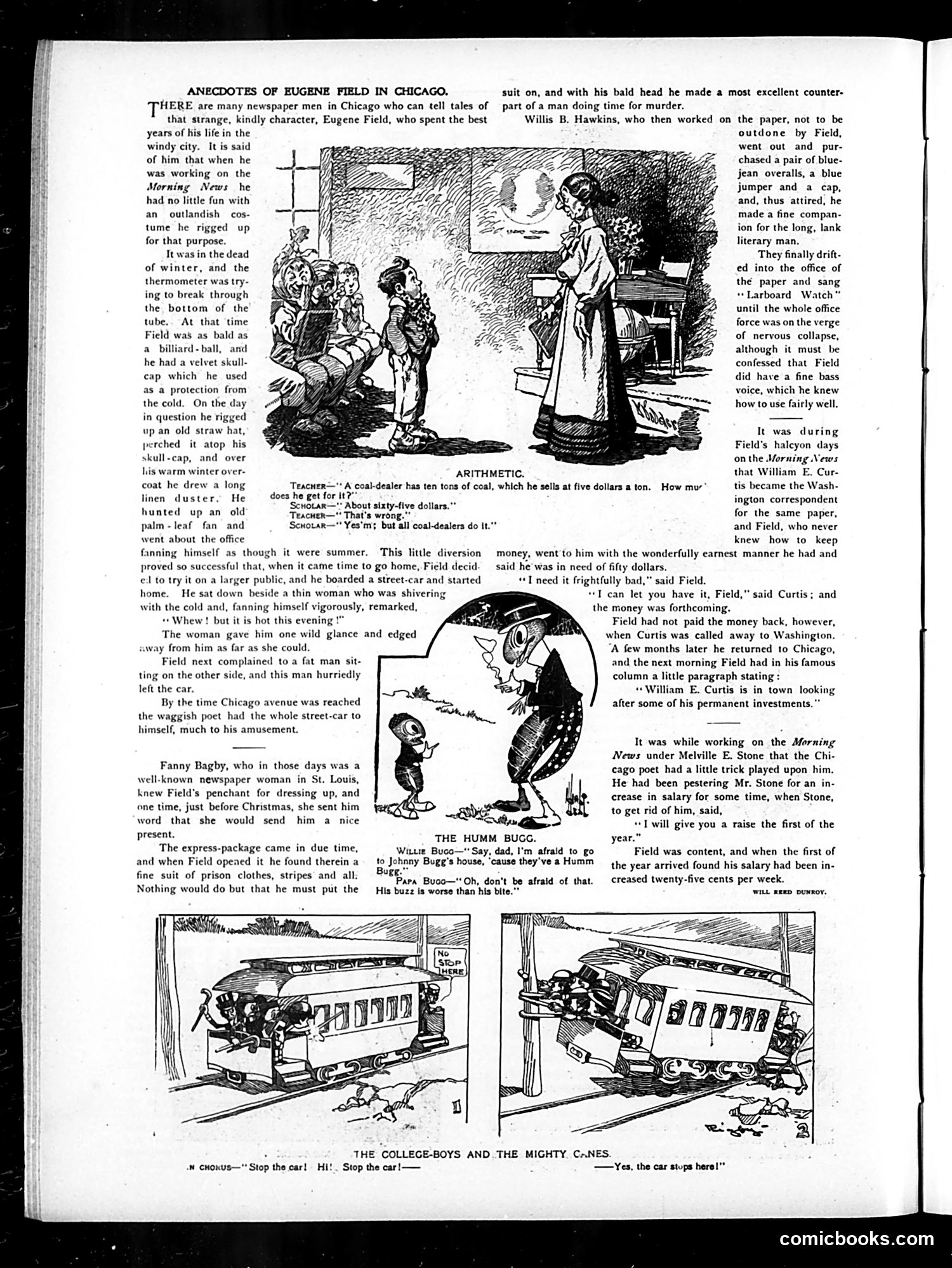
This page contains **anecdotes about Eugene Field**, a well-known Chicago newspaper columnist and humorist (1850-1895). The text recounts humorous incidents from his time at the *Morning News*, including pranks and personality quirks. The cartoons illustrate two separate jokes: 1. **"Arithmetic"**: A teacher's lesson about coal prices, likely satirizing the disconnect between mathematical exercises and real-world economics. 2. **"The College-Boys and the Mighty C-nes"** (bottom): A visual gag about a streetcar crash, with dialogue about stopping the car—appears to be slapstick humor common to the era. The page primarily focuses on **Field's reputation as an eccentric, mischievous journalist** known for pranks and singing in offices, presenting him as a colorful character in Chicago newspaper history.
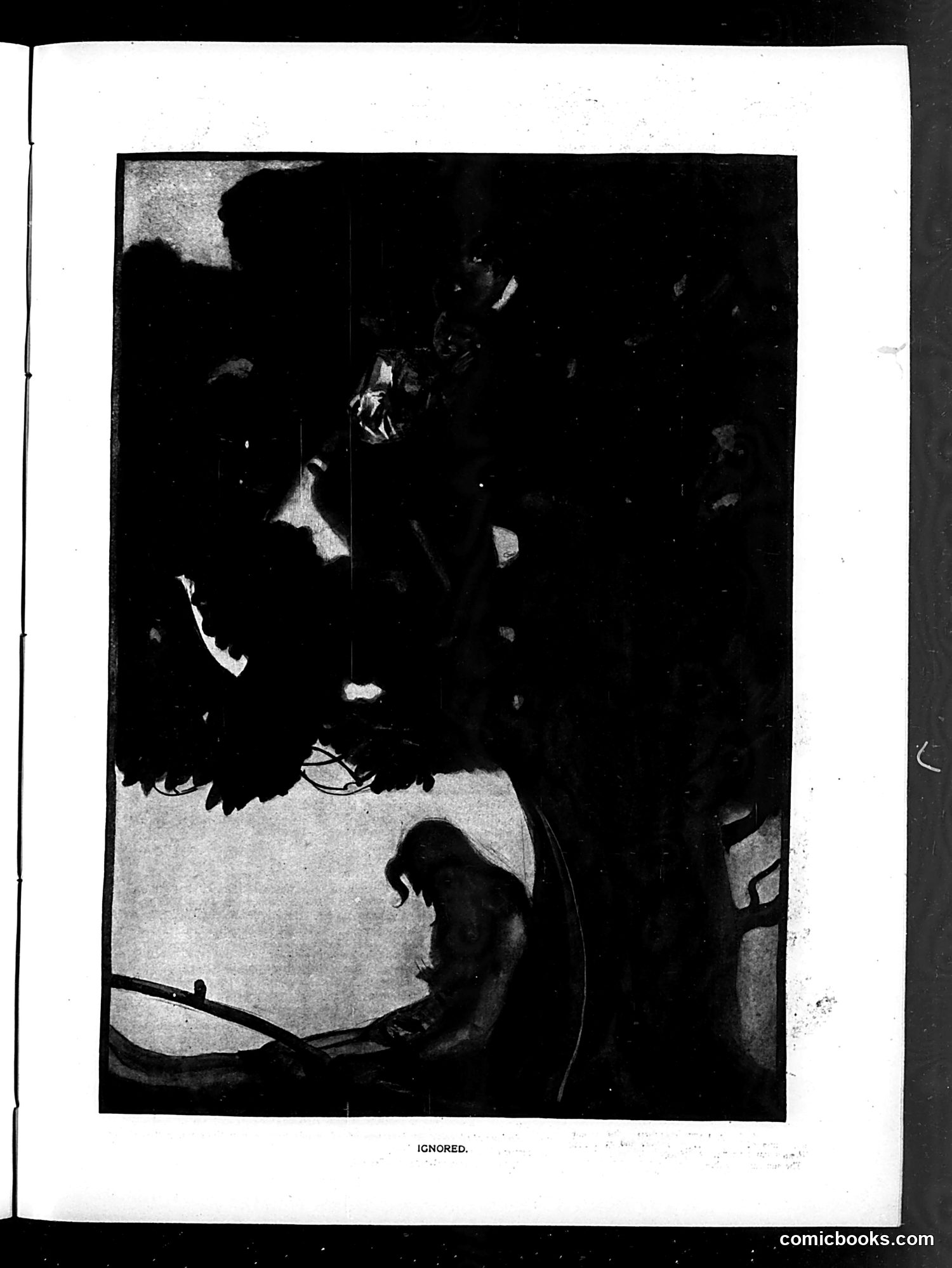
The image shows a high-contrast black and white illustration depicting what appears to be a social or political scene. A figure sits isolated at the bottom while others gather above, seemingly engaged with each other but pointedly excluding the seated person. The caption "IGNORED" makes the satirical point explicit: this is about social ostracism or exclusion. Without additional context from Judge magazine's publication date or surrounding articles, I cannot identify the specific figures or the particular political/social event being referenced. The cartoon likely critiques either a person or group being deliberately shut out of political or social discourse during a specific contemporary moment—a common Judge theme. However, determining which historical event or individuals are depicted requires additional documentation beyond what's visible here.
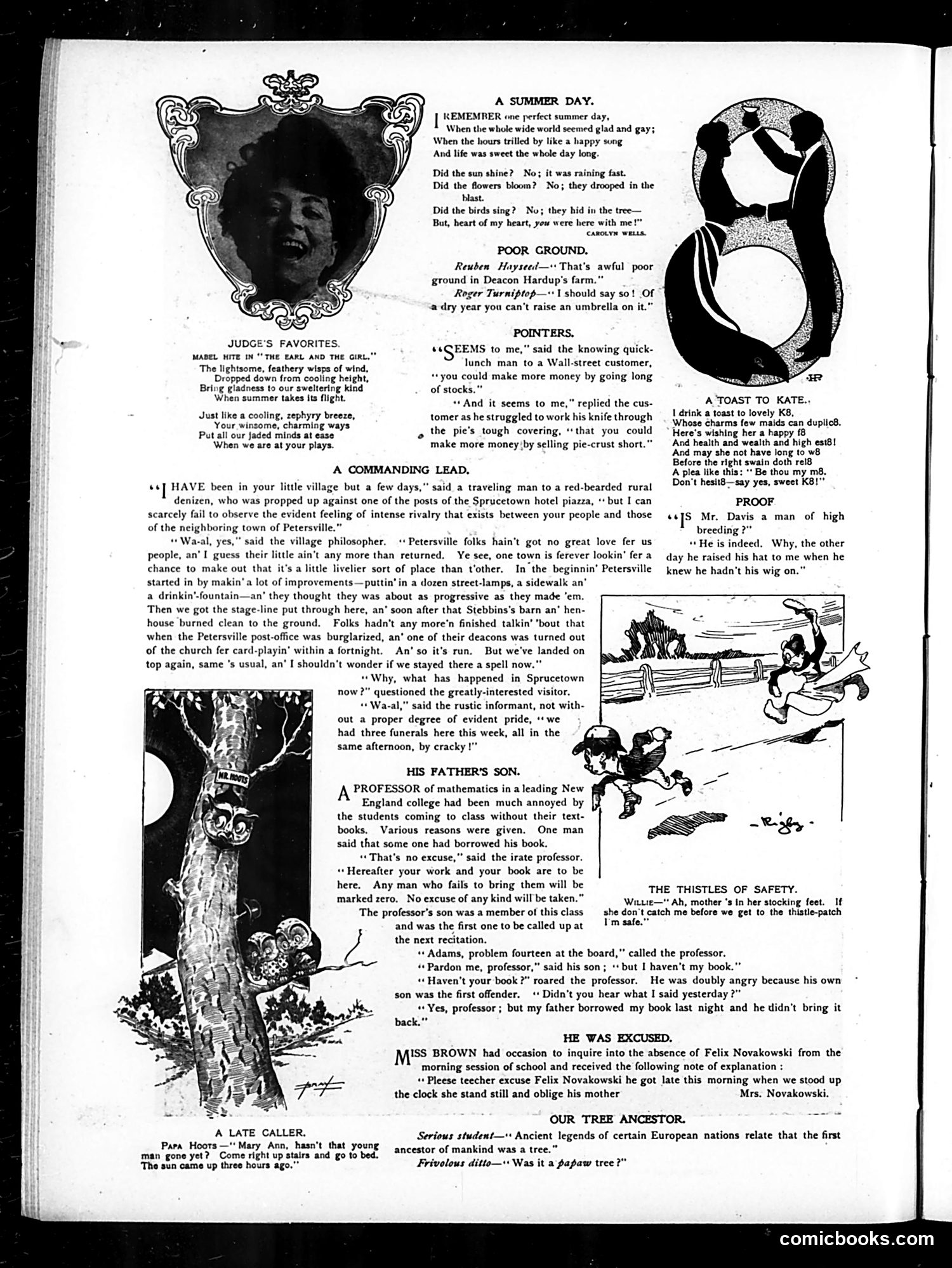
This page from *Judge* (a prominent American satirical weekly) contains several humorous pieces typical of early 20th-century humor: **"A Summer Day"** (by Carolyn Wells) uses ironic contrast—describing a "perfect" summer day while listing all the miserable weather, ultimately affirming romantic companionship over sunshine. **"Poor Ground"** presents rural characters using exaggerated dialect humor, popular for city audiences mocking rural speech patterns and logic. **"Pointers"** satirizes Wall Street speculation versus the reliability of tangible goods, with a pun on financial "shorts" versus actual pie crust. **"A Commanding Lead"** is a longer piece where a village philosopher boasts that his town beats the rival town of Petersville—not through progress but by having more funerals that week, suggesting small-town rivalry is absurdly petty. The illustrations include decorative theatrical photographs and genre scenes of rural life. The humor relies on wordplay, dialect comedy, and social observation rather than political content—typical of *Judge's* entertainment-focused approach.
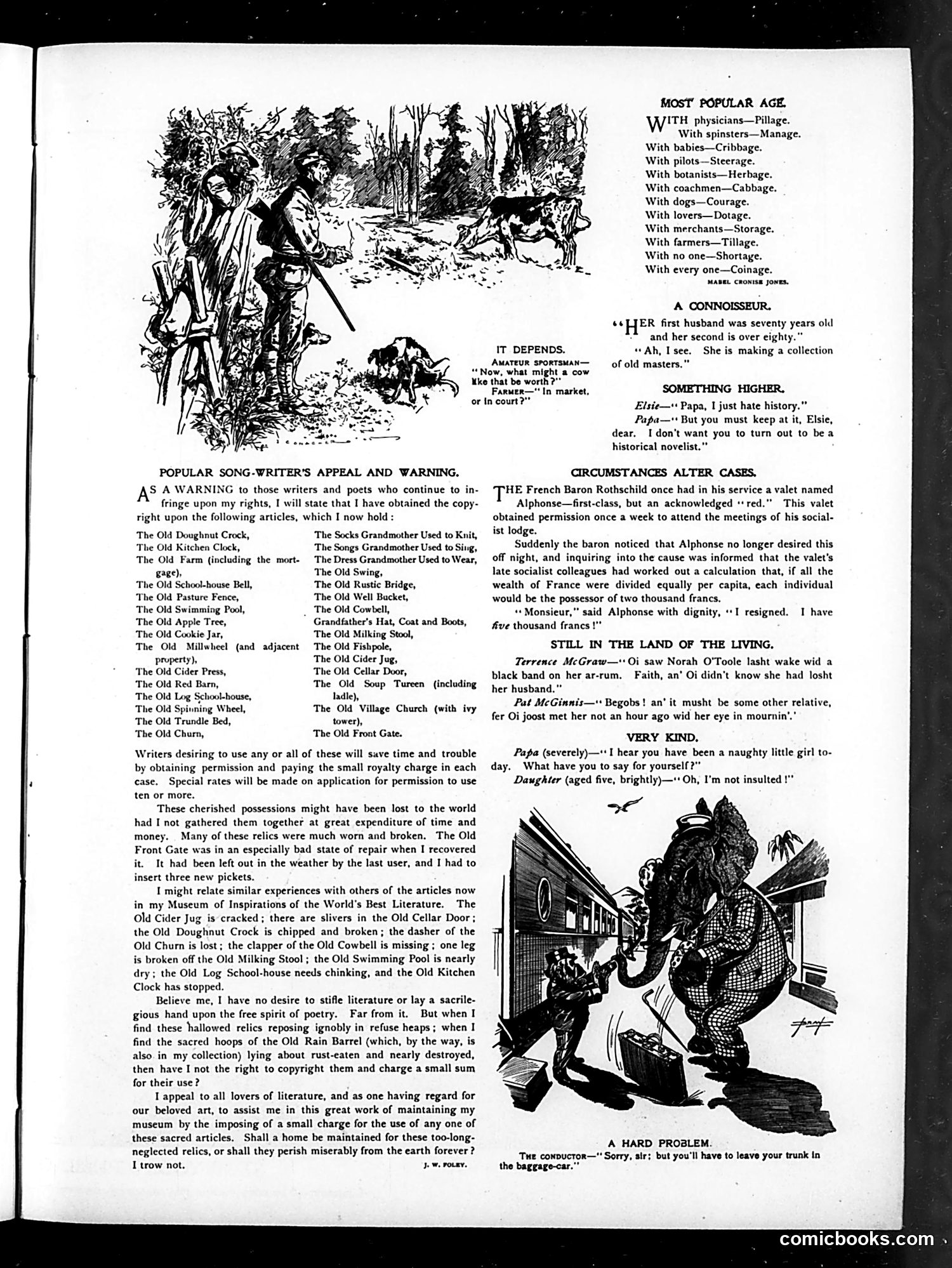
This page satirizes sentimental Americana and literary conventions. The main piece, "Popular Song-Writer's Appeal and Warning," mocks the clichéd nostalgia pervading popular song and verse. A fictional character, J.W. Poultry, claims copyright over archetypal "old" objects—grandmother's spinning wheel, the old barn, the rustic bridge—that dominated period sentimentality. The satire targets how these stock images were endlessly recycled by mediocre writers exploiting nostalgic feelings for rural America. The accompanying short comedic pieces use wordplay: "Most Popular Age" makes puns on words ("With babies—Cribbage"), while "A Connoisseur" jokes that a woman collecting aging husbands collects "old masters." The page ridicules both hackneyed literary sentimentality and lazy writing conventions of the era.
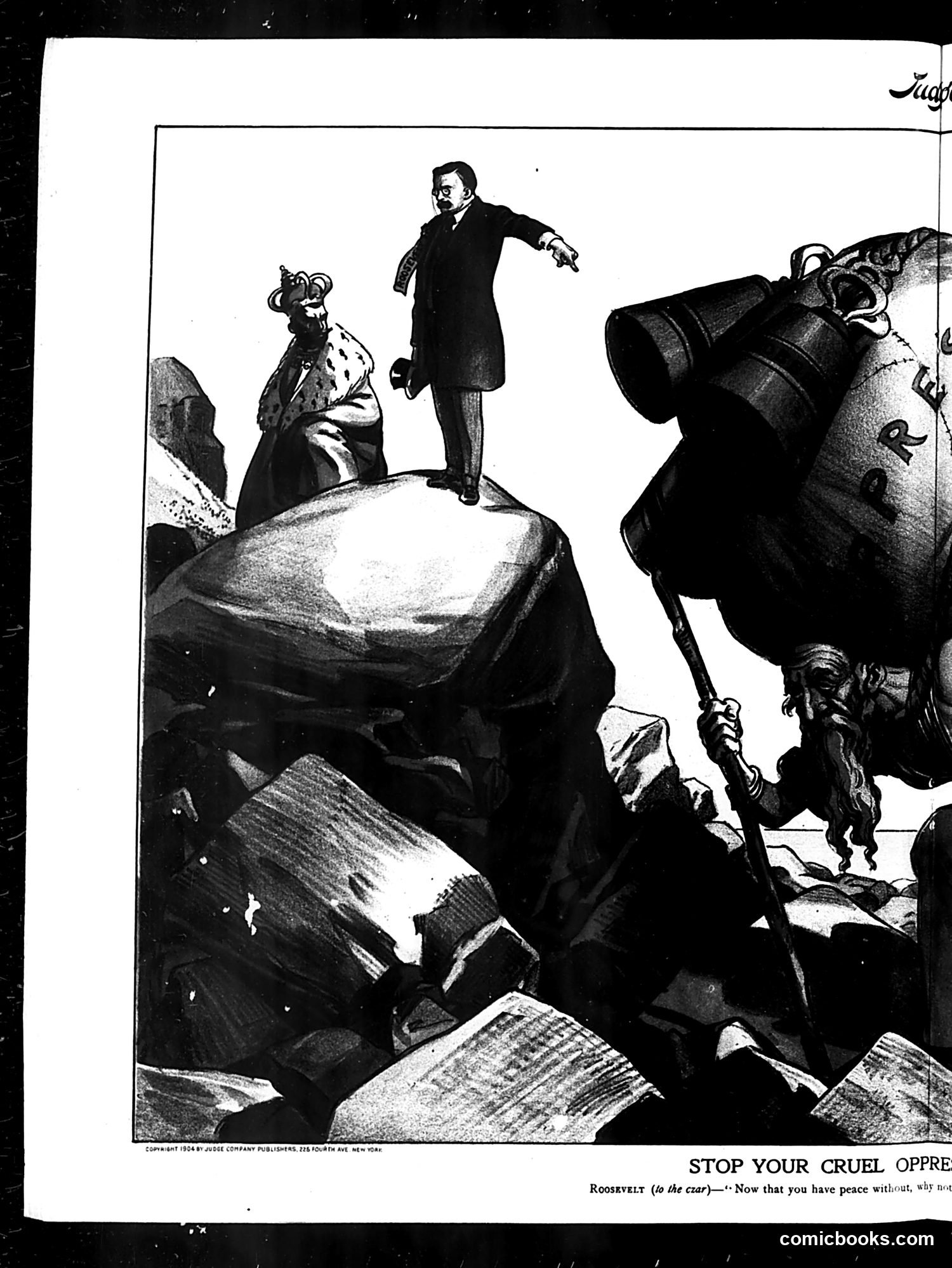
This Judge magazine cartoon depicts **Roosevelt addressing the Czar of Russia**, likely referencing Theodore Roosevelt's role in brokering peace during the Russo-Japanese War (1904-1905). The caption reads: "Now that you have peace without, why not [stop your cruel oppression]"—the text cuts off but clearly addresses internal repression. **The satire**: Roosevelt is depicted as a moralist lecturing the Russian Czar about ending domestic cruelty and oppression, despite having just negotiated external peace. The giant figure of the Czar dominates the composition, suggesting the enormous scale of Russian autocratic power that Roosevelt is challenging. This critiques either Roosevelt's idealism or hypocrisy—the cartoon questions whether peace treaties matter if internal tyranny continues.
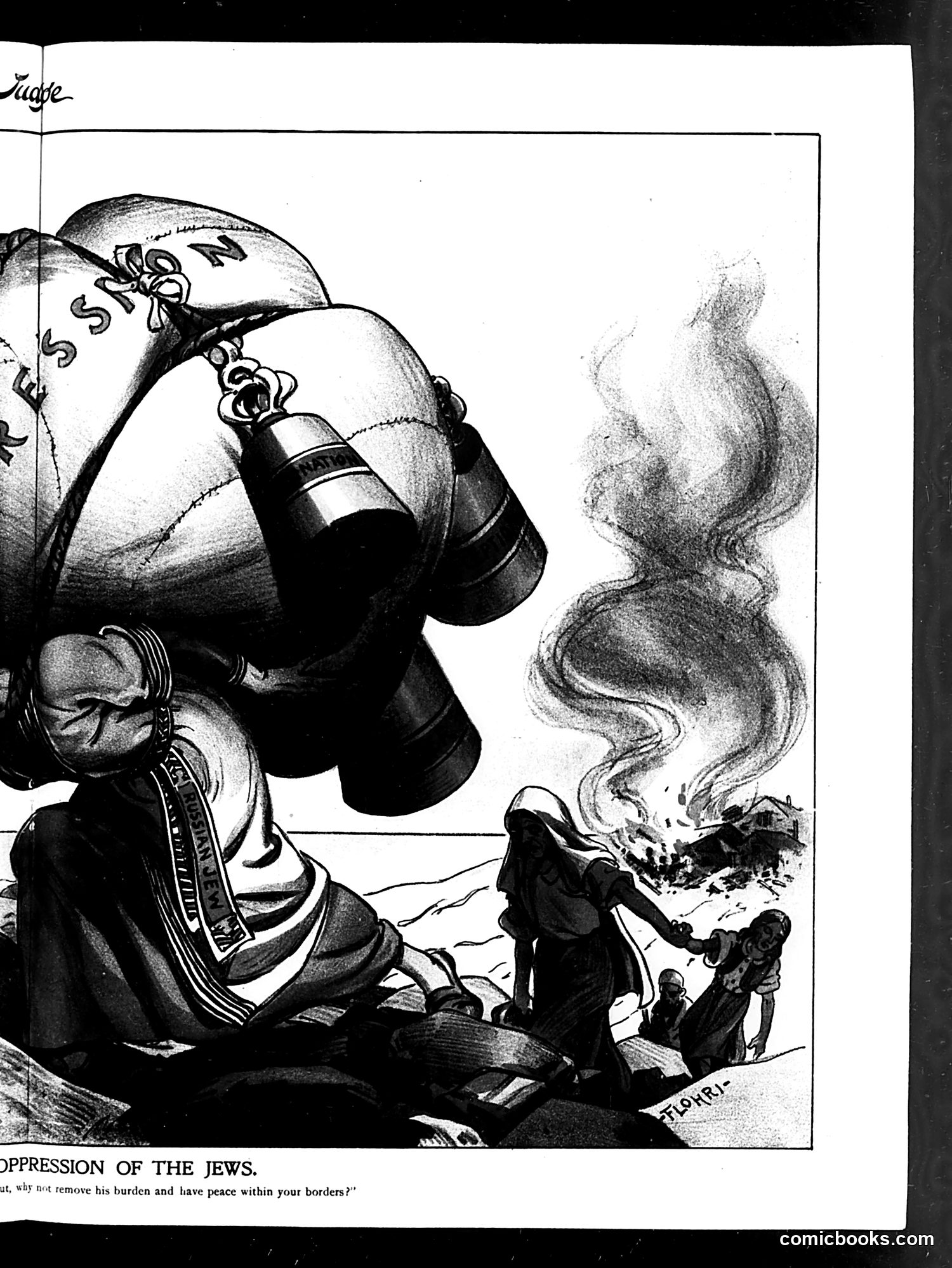
This is a political cartoon titled "Oppression of the Jews." The image depicts a large, menacing figure (appearing to represent an authority or state power) bearing down on smaller figures below, with smoke and fire in the background suggesting violence or persecution. The caption asks why those in power don't "remove his burden and have peace within your borders"—suggesting the cartoon critiques persecution as both morally wrong and destabilizing to society. The cartoon employs antisemitic caricature conventions common to early 20th-century satirical magazines, though it appears to be satirizing persecution rather than endorsing it. The exact historical context and publication date aren't visible, but Judge magazine used such imagery to comment on social issues of its era.
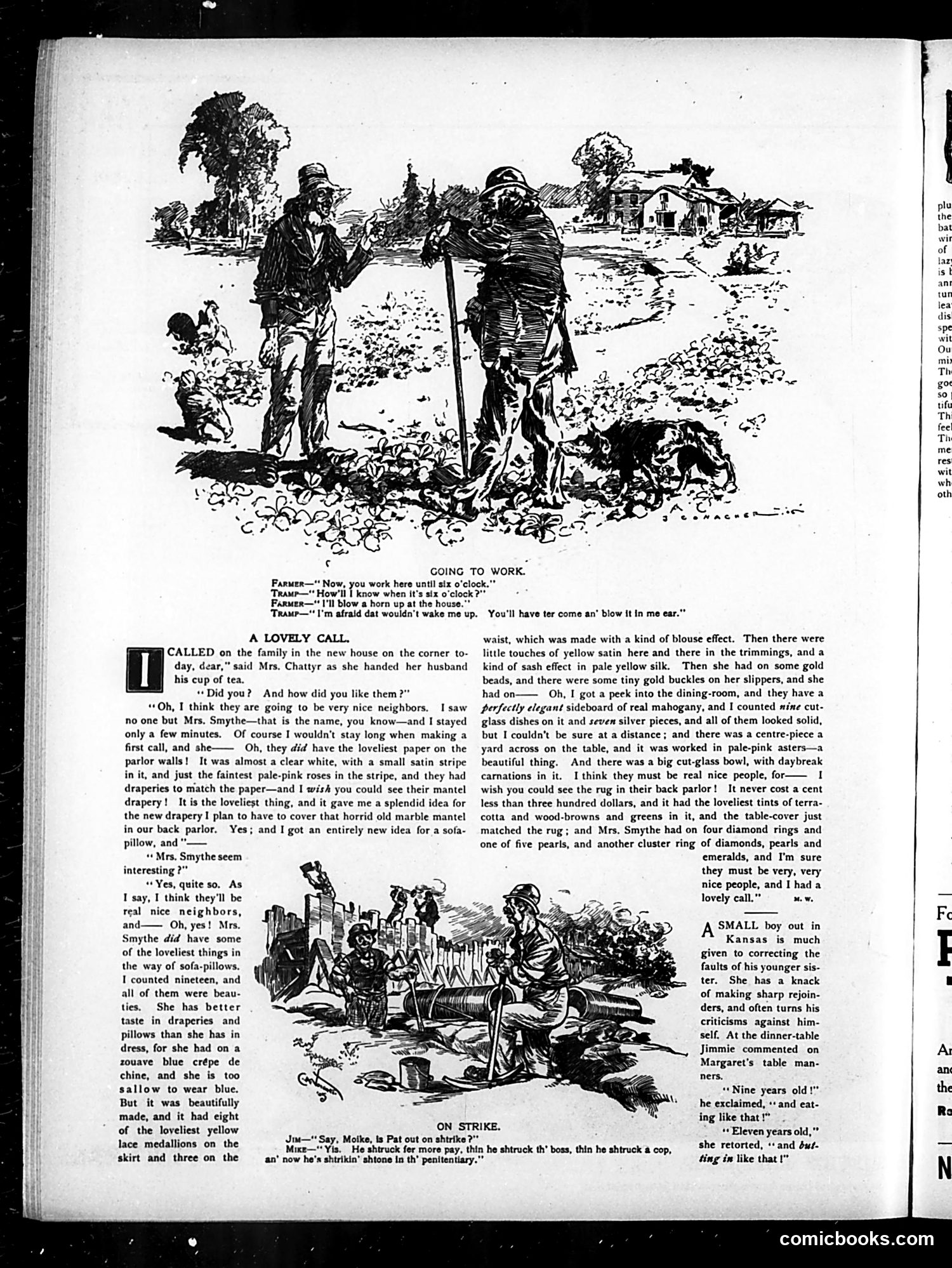
**"A Lovely Call"** satirizes shallow upper-middle-class social visiting. Mrs. Chattyr describes her new neighbor entirely through material possessions—wallpaper, draperies, sofa pillows, mahogany furniture, cut-glass dishes, jewelry—never mentioning the neighbor's character or personality. The joke targets how Victorian women's social calls reduced people to inventories of expensive goods. The husband's deadpan responses ("Mrs. Smythe seem interesting?") underscore the vapidity being mocked. **"Going to Work"** and **"On Strike"** are brief comic dialogues. The first depicts a tramp negotiating work terms with a farmer (the horn-blowing joke plays on the tramp's laziness). The second appears to reference labor unrest, with Irish workers ("Pat," "Mike") discussing strikes and arrests. The sketches collectively mock class pretension, working-class desperation, and gender-specific consumer obsession—typical Judge magazine targets of the early 1900s.
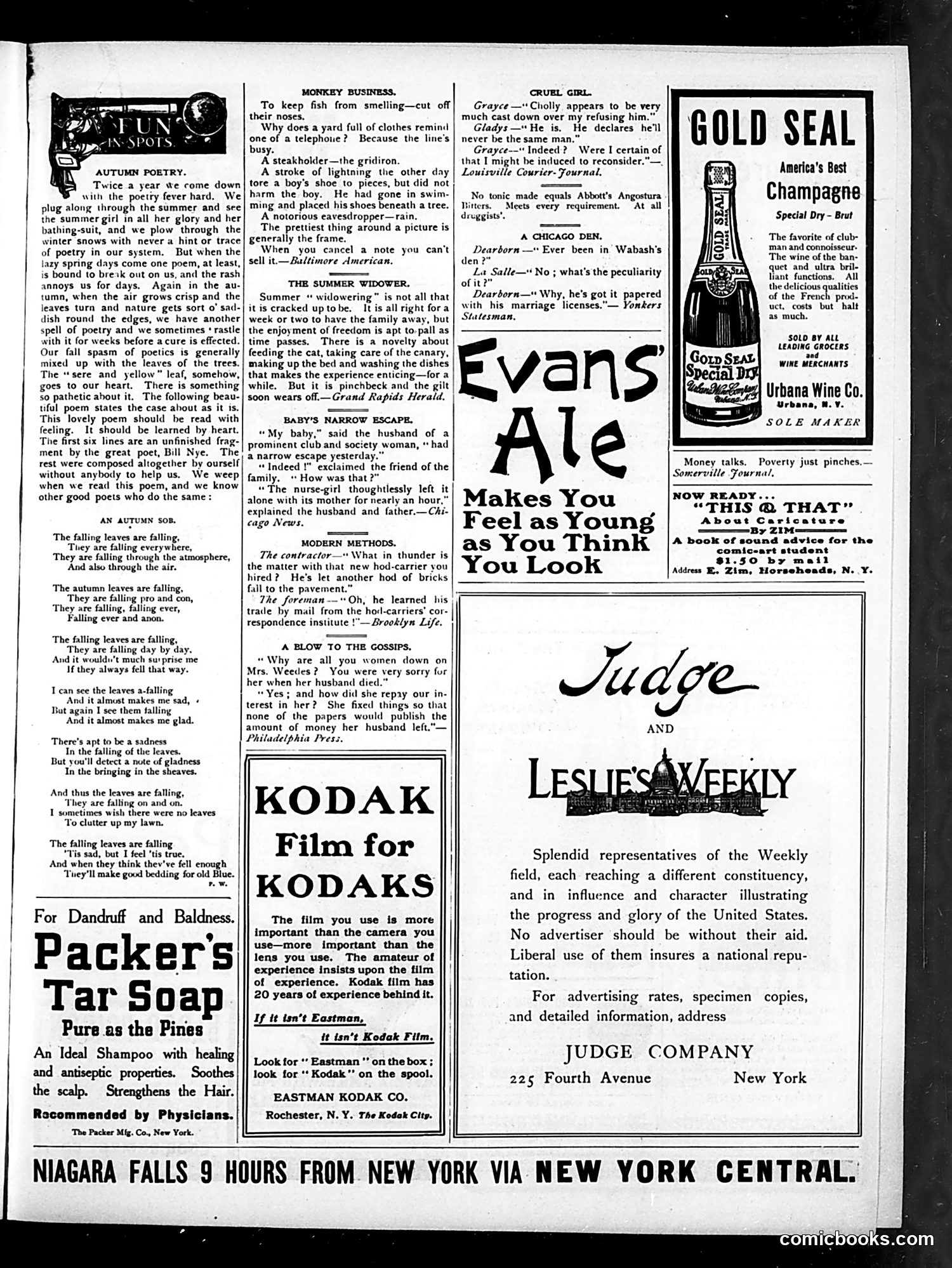
This is primarily an **advertising and humor page** from Judge magazine, lacking a single unifying political cartoon. The main content includes: **"An Autumn Sob"** — a self-aware satire on sentimental autumn poetry. The magazine mocks the predictable melancholy of fall verse, parodying the obsession with "sere and yellow leaves" through deliberately repetitive, overwrought lines. The poem hilariously devolves into mundane complaints (leaves cluttering the lawn, using them as dog bedding), exposing how genuinely bad such poetry typically is. **"Monkey Business"** and **"The Summer Widower"** sections present brief social humor—quips about household life and the unexpected tedium of bachelor living when wives vacation. **"Baby's Narrow Escape"** offers a dark joke: the "danger" is leaving an infant alone with its *mother*—implying mothers are incompetent caregivers, a common (if offensive) trope of the era. The page is otherwise dominated by product advertisements (Packer's Tar Soap, Kodak film, Gold Seal Champagne), typical of Judge's revenue model. No specific political references or identifiable caricatures appear.
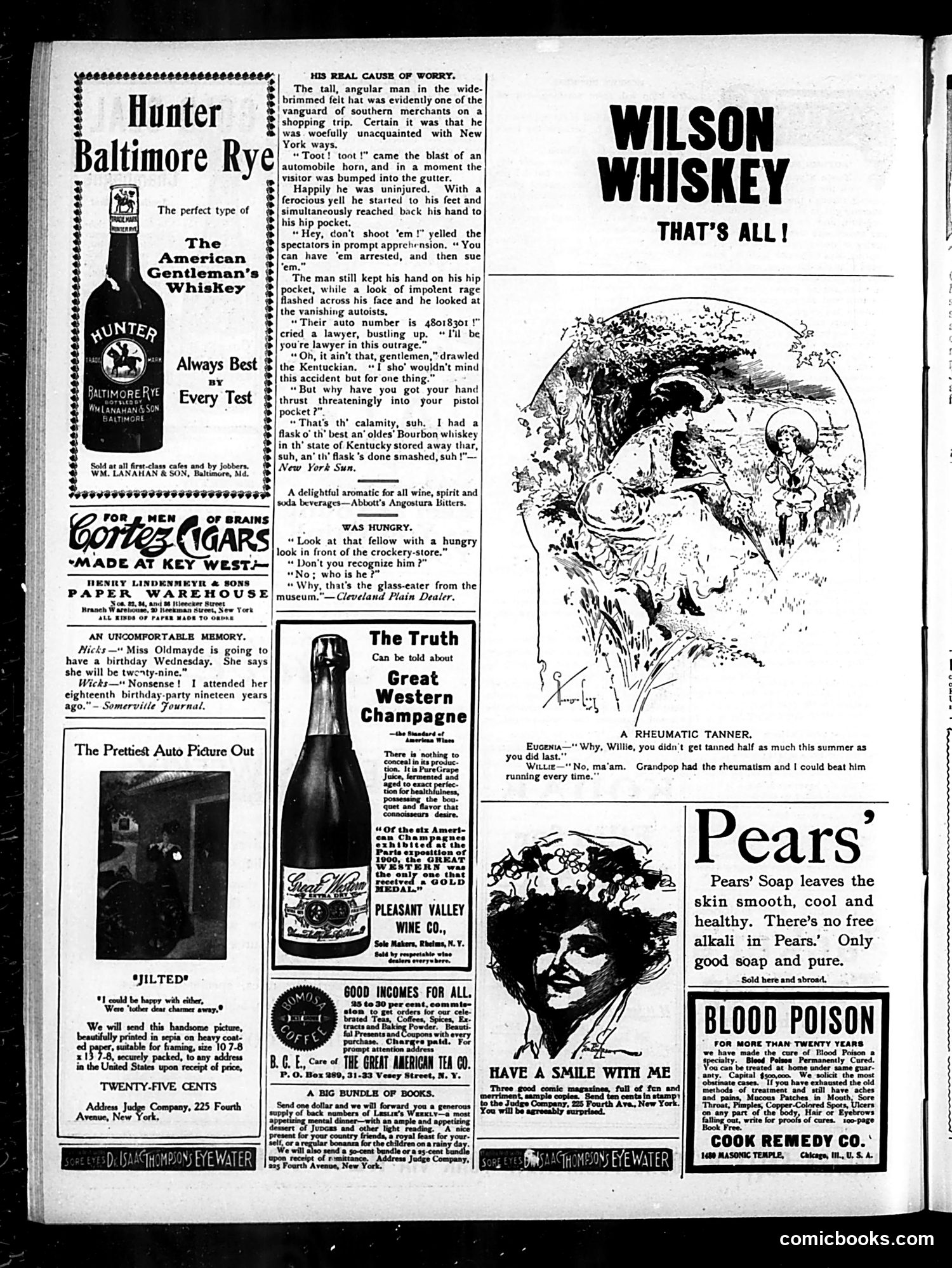
This page consists primarily of **advertisements and short humorous anecdotes** rather than political cartoons requiring historical context. The main content includes: **"His Real Cause of Worry"** — A comedic anecdote about a Kentucky visitor to New York City who is hit by an automobile but doesn't care about injury; his real distress is that his flask of bourbon whiskey was destroyed in the accident. The joke plays on regional stereotypes (the Southern gentleman and his attachment to whiskey) and early 1900s urban hazards (automobiles as novel dangers). **Other brief jokes** mock everyday situations: a "glass-eater" newspaper performer, someone exaggerating a woman's age, and a child outrunning his grandfather with rheumatism. **The advertisements** dominate, promoting Hunter Baltimore Rye whiskey, Pears' Soap, Great Western Champagne, Wilson Whiskey, and a blood poison remedy — typical early 20th-century patent medicine and luxury goods marketing. The page requires little historical knowledge beyond recognizing early automobiles as relatively new urban hazards and understanding period attitudes toward regional stereotypes.
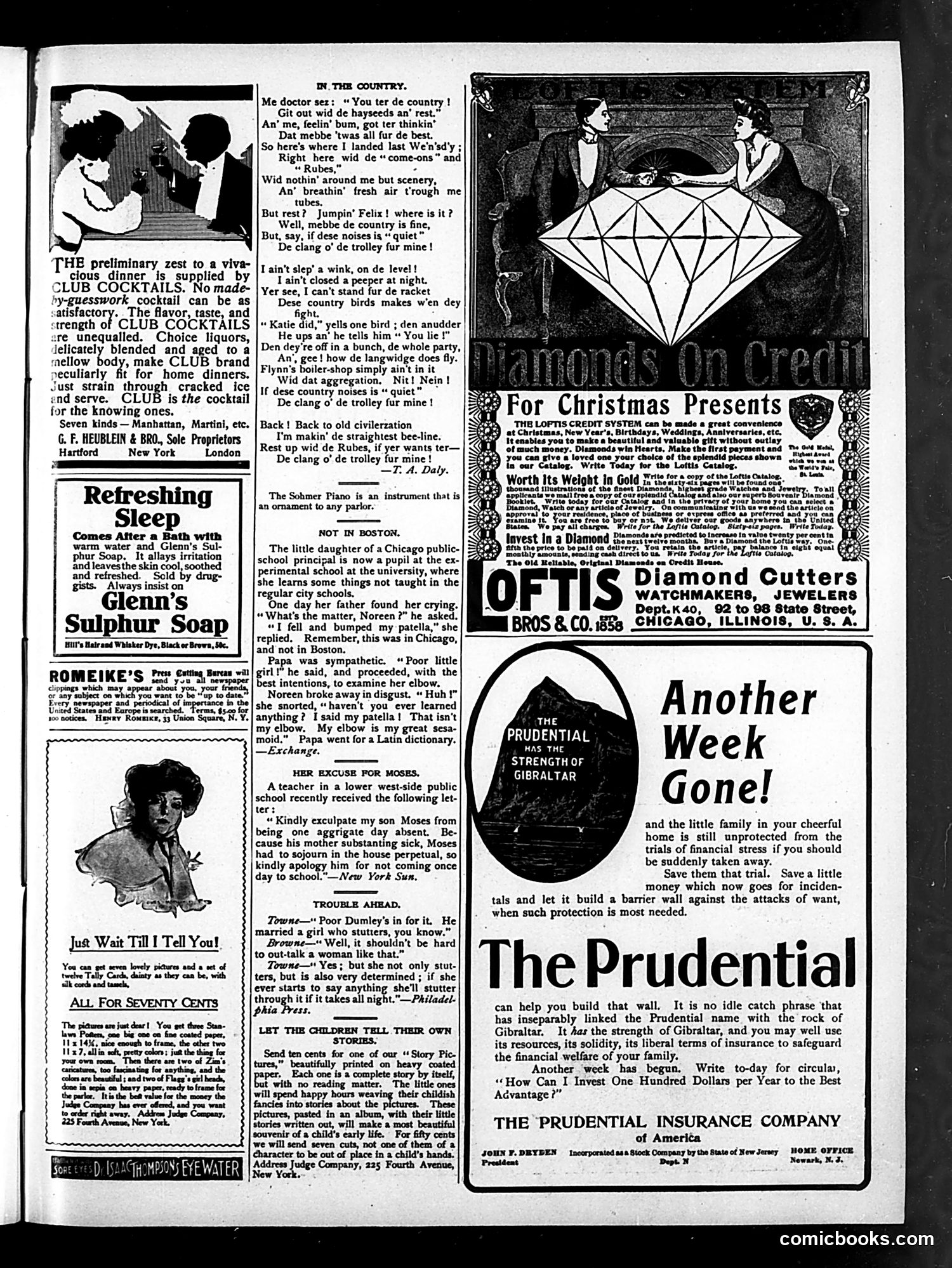
This page is primarily **advertisements and humorous short pieces** rather than political cartoons. The satirical content consists of: **Main Humor Pieces:** 1. **"In the Country"** — A working-class character (dialect suggests Irish-American) complains that his doctor's advice to rest in the countryside is terrible because country birds make noise at night, which he finds worse than urban trolley sounds. The satire mocks both the romanticization of rural life and urban workers' actual preferences for city noise. 2. **"Not in Boston"** — A light joke about a Chicago school principal's embarrassment when his educated daughter uses the scientific term "patella" (kneecap) and he mistakenly examines her elbow instead, missing the obvious reference. 3. **"Her Excuse for Moses"** — Humor from a mangled, grammatically incorrect letter of excuse from an immigrant parent. 4. **"Trouble Ahead"** — A brief wordplay about a man marrying a stuttering woman. The page is otherwise dominated by **product advertising** (cocktails, soap, insurance, pianos) typical of early 20th-century magazines.
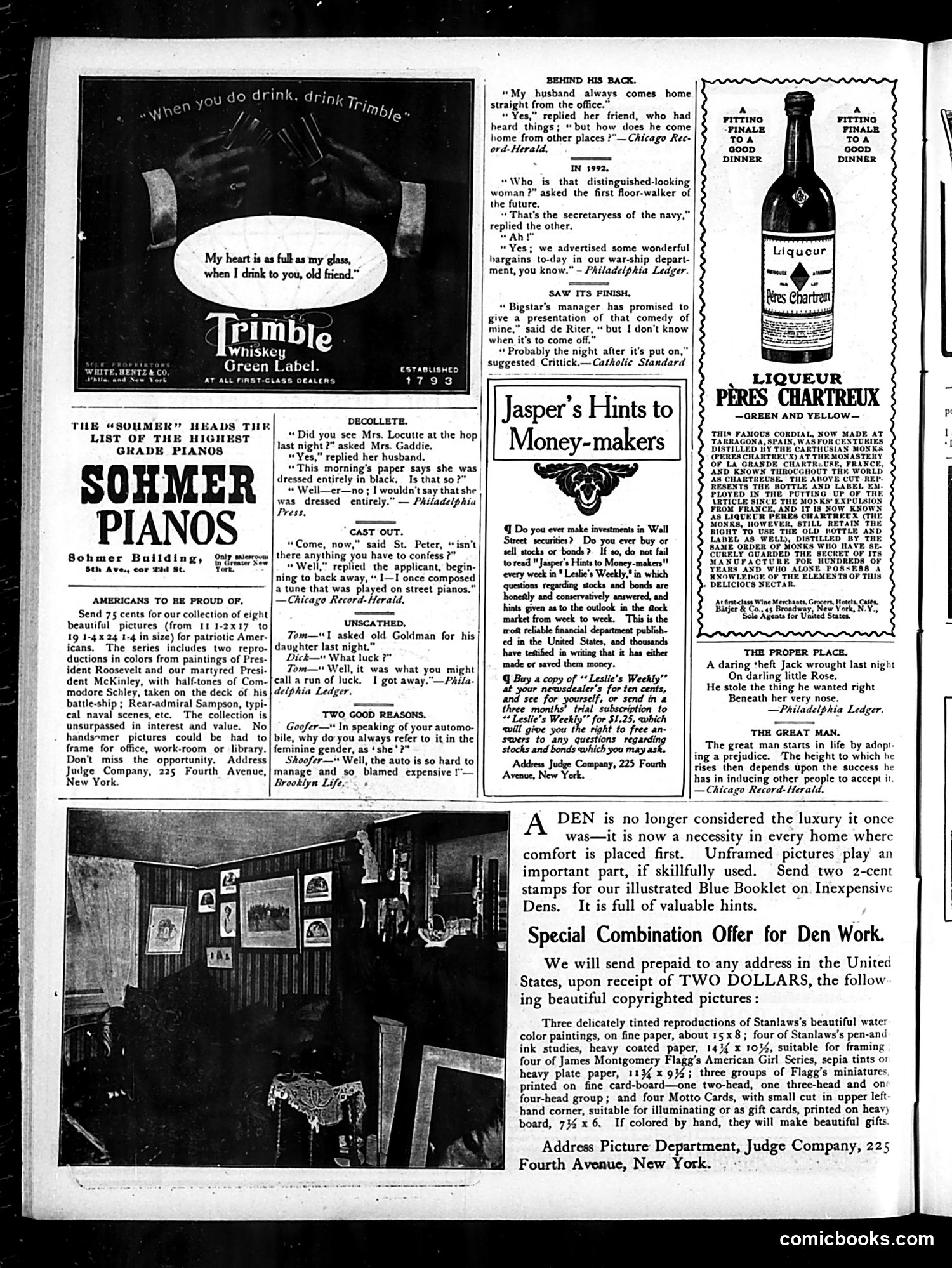
This page from *Judge* (a satirical American magazine) contains several brief humorous pieces typical of early 20th-century social commentary: **Main Cartoons/Jokes:** 1. **"Behind His Back"** — A wife claims her husband comes straight home from the office, but her friend skeptically asks how he arrives home from "other places," implying infidelity or suspicious behavior. 2. **"In 1992"** — Satirizes women entering traditionally male professions. Floor-walkers joke about a female "secretaryess of the navy" who advertises warship department bargains—mocking the idea of women in military administration. 3. **Street musicians** — A man confessing to composing music played on street pianos (considered low-class entertainment) is compared unfavorably to serious musicians. The page also contains period advertisements for Sommer Pianos, Trimble Whiskey, and Pérès Chartreaux liqueur, plus financial investment advice columns. **Context:** These jokes reflect early-1900s attitudes toward gender roles, class distinctions, and social propriety.
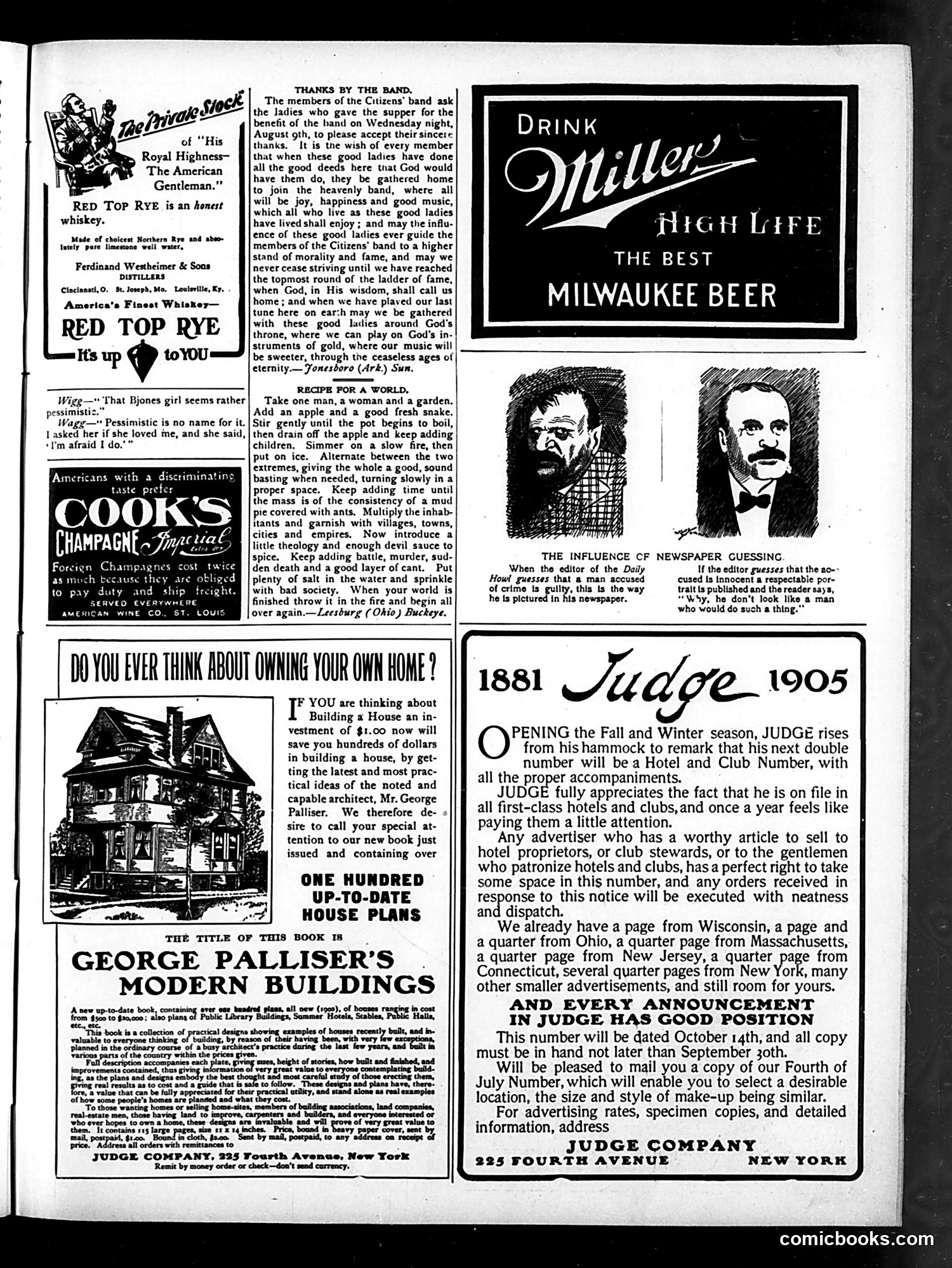
This page is primarily **advertising and announcements** rather than political cartoons. However, it contains one notable satirical piece: **"The Influence of Newspaper Guessing"** presents two side-by-side mugshots of the same man—one appearing guilty, one innocent. The satire critiques how **newspaper editors' bias influences public perception**: when an editor assumes guilt, the accused is pictured menacingly; when presuming innocence, respectably. This mocks the power of press narratives to shape how readers judge accused persons before trial, suggesting newspapers convey prejudgment through visual presentation rather than objective reporting. The page also includes a humorous "Recipe for a World" poem satirizing existence—mixing theology, war, and social ills into a dark commentary on civilization. The remaining content consists of whiskey, champagne, and beer advertisements, plus a housing plan book promotion—typical Judge magazine commercial matter from this era.
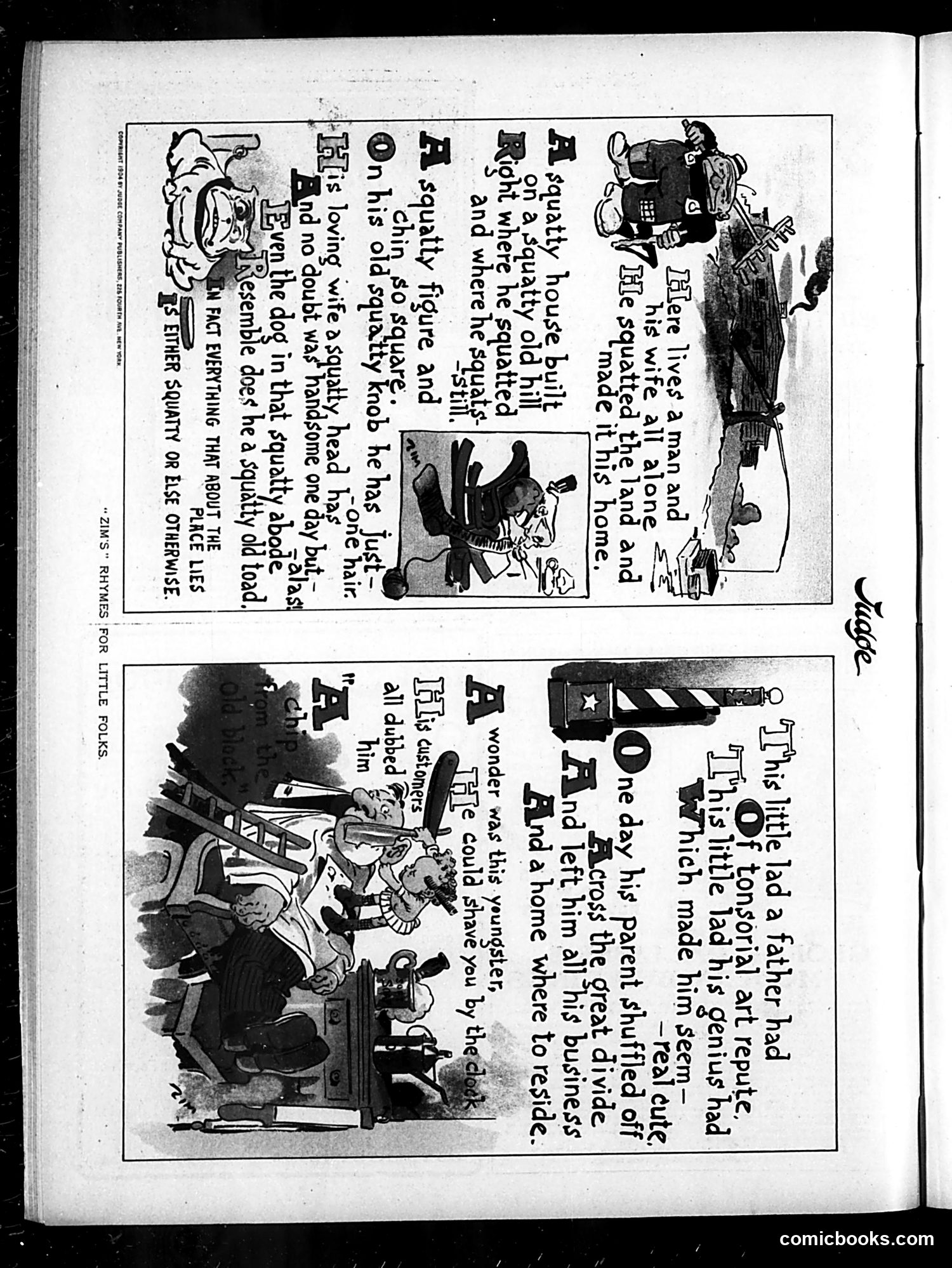
This is a children's rhyming story page from Judge magazine (copyright 1904). The narrative follows a barber's son who inherits his father's barbershop business. The repeated use of "squatty" throughout the verse is the joke's anchor—everything about the barber, his house, his hill, even his dog is described as "squatty" (short, squat, dumpy). The humor appears to be gentle, absurdist verse humor aimed at children, playing on the sound and repetition of "squatty" as a comedic word. The illustrated panels show the barber character and his inherited shop. This is domestic American humor without obvious political satire—simply whimsical character-driven verse typical of Judge's lighter children's content from the early 1900s.