
Judge, 1905-09-30 · page 4 of 16
Judge — September 30, 1905 — page 4: what you’re looking at
What you’re looking at
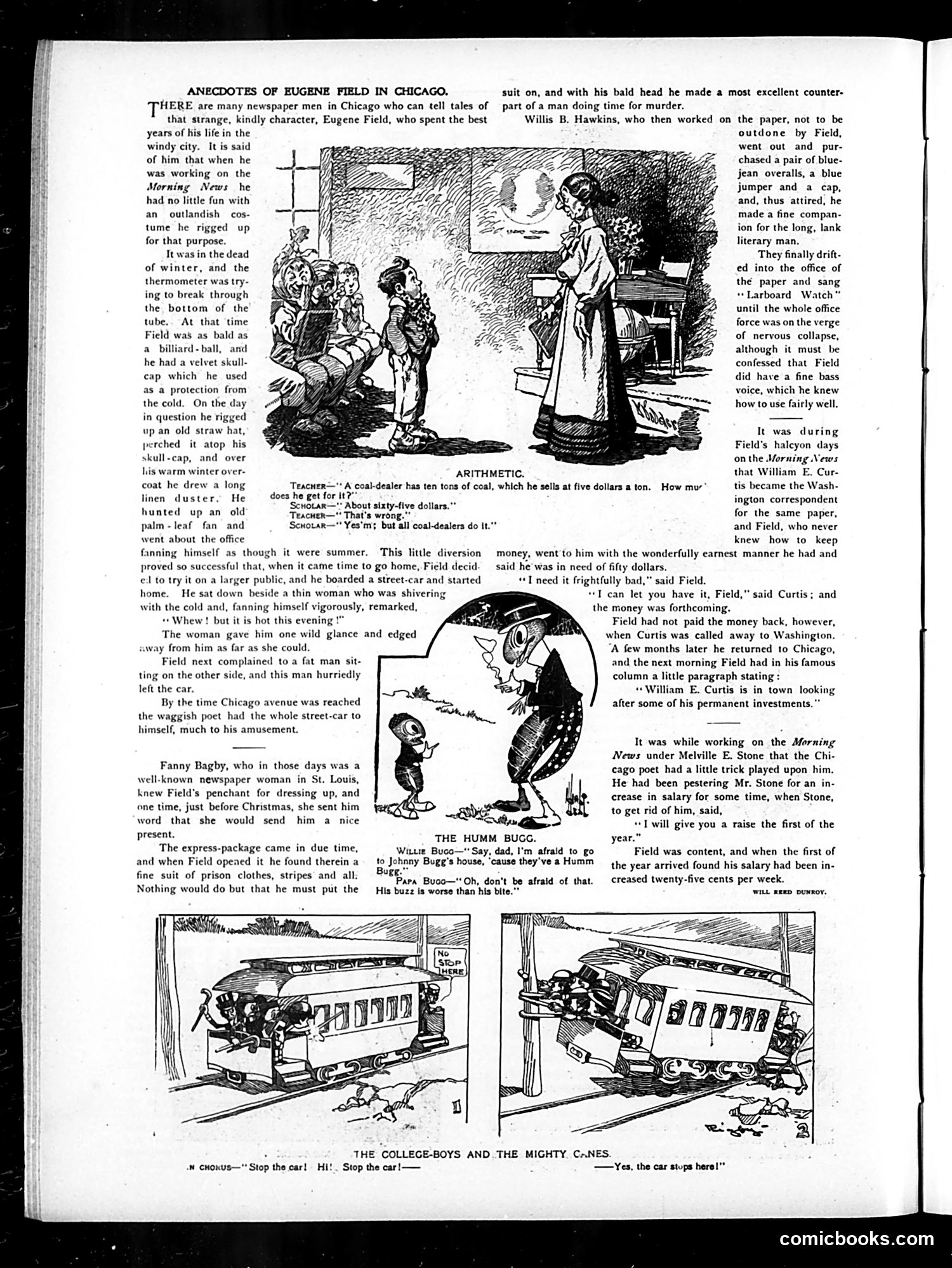
This page contains **anecdotes about Eugene Field**, a well-known Chicago newspaper columnist and humorist (1850-1895). The text recounts humorous incidents from his time at the *Morning News*, including pranks and personality quirks. The cartoons illustrate two separate jokes: 1. **"Arithmetic"**: A teacher's lesson about coal prices, likely satirizing the disconnect between mathematical exercises and real-world economics. 2. **"The College-Boys and the Mighty C-nes"** (bottom): A visual gag about a streetcar crash, with dialogue about stopping the car—appears to be slapstick humor common to the era. The page primarily focuses on **Field's reputation as an eccentric, mischievous journalist** known for pranks and singing in offices, presenting him as a colorful character in Chicago newspaper history.
📄 Transcribed text from this page (OCR, searchable)
Machine-transcribed from the original scan — historical spelling and the odd misread are preserved.
ANECDOTES OF EUGENE FIELD IN CHICAGO. HERE. are many newspaper men in Chicago who can tell tales of _ part of a man doing time for murder. Willis B. Hawkins, who then worked on that strange, kindly character, Eugene Field, who spent the best years of his life in the windy city. It is said of him that when he was working on the Morning News he had no little fun with an outlandish tume he rigged for that purpose. It was in the dead of winter, and the thermometer was try- ing to break through the bottom of the tube.. At that time Field was as bald as a billiard-ball, and he had a velvet skull- cap which he used as a protection from the cold. On the day in question he rigged up an old straw hat, perched it atop his skull-cap, and over his warm winter over- coat he drew a long linen duster. He hunted up an old palm-leaf fan and went about the office fanning himself as though it were summer. cos- up does he get for it?" * About Th proved so successful that, when it came time to go home, Field decid and he boarded a street-car and started He sat down beside a thin woman who was shivering with the cold and, fanning himself vigorously, remarked, ed to try it on a larger publi home. «+ Whew ! but it is hot this evening !” ARITHMETIC. ‘Teacter—"* A coal-dealer has ten tons of coal, which he sells at five dollars a ton. sixty-five dollars."* wrong.” Scnotar—"" Yes'm; but all coal-dealers do it."" This little diversion The woman gave him one wild glance and edged away from him as far as she could. Field next complained to a fat man sit- ting on the other side, and this man hurriedly left the car. By the time Chicago avenue was reached the waggish poet had the whole street-car to himself, much to his amusement. Fanny Bagby, who in those days was a well-known newspaper woman in St. Louis, knew Field’s penchant for dressing up, and one time, just before Christmas, she sent him word that she would send him a nice present. The express-package came in due time, and when Field opened it he found therein a fine suit of prison clothes, stripes and all: Nothing would do but that he must put the Para Buco—"*Oh, don’t be afraid of that. His buzz is worse than his bite."” suit on, and with his bald head he made a most excellent counter- the paper, not to be outdone by Field, went out and pur- chased a pair of blue- jean overalls, a blue jumper and a cap, and, thus attired, he made a fine compan- ion for the long, lank literary man, They finally drift- ed into the office of thé paper and sang ‘*Larboard Watch" until the whole office force was on the verge of nervous collapse, although it must be confessed that Field did have a fine bass voice, which he knew how to use fairly well. It was during Field's halcyon days onthe Morning News that William E. Cur- tis became the Wash- ington correspondent for the same paper, and Field, who never knew how to keep How mur money, went to him with the wonderfully earnest manner he had and said he was in need of fifty dollars. “Tneed it frightfully bad,” said Field. *T can let you have it, Field,” said Curtis; and the money was forthcoming. Field had not paid the money back, however, when Curtis was called away to Washington. “A few months later he returned to Chicago, and the next morning Field had in his famous column a little paragraph stating : «William E. Curtis is in town looking after some of his permanent investments." It was while working on the Morning News under Melville E. Stone that the Chi- cago poet had a little trick played upon him. He had been pestering Mr. Stone for an in- crease in salary for some time, when Stone, to get rid of him, said, “Twill give you a raise the first of the year.” Field was content, and when the first of the year arrived found his salary had been in- creased twenty-five cents per week. wit REED DUwnoY, THE COLLEGE-BOYS AND THE MIGHTY. C-.NES. M cHoxus—"* Stop the car! Hi! ‘Stop the car!— —Yes, the car stups here!" comicbooks.com