
Judge, 1905-09-30 · page 7 of 16
Judge — September 30, 1905 — page 7: what you’re looking at
What you’re looking at
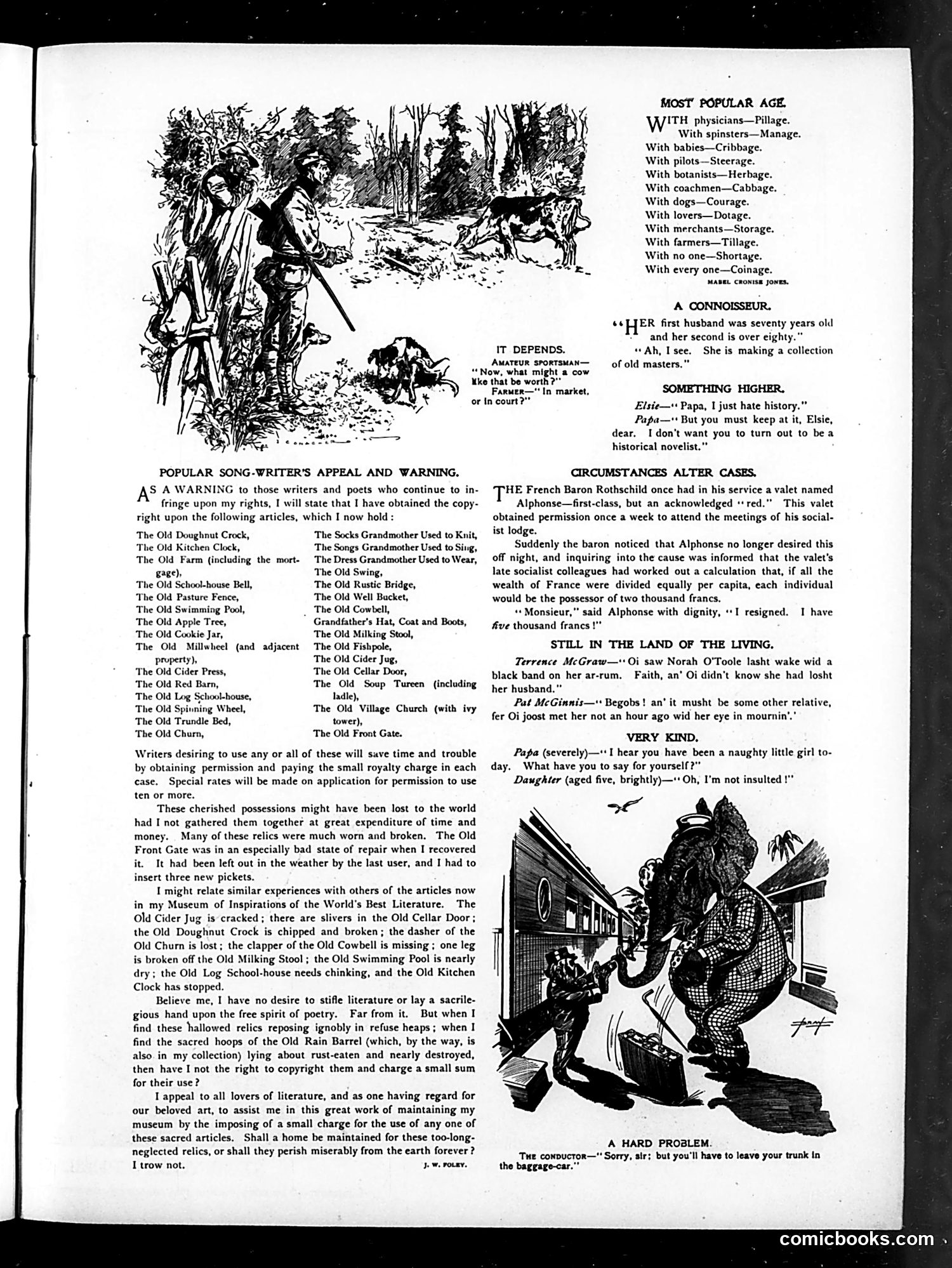
This page satirizes sentimental Americana and literary conventions. The main piece, "Popular Song-Writer's Appeal and Warning," mocks the clichéd nostalgia pervading popular song and verse. A fictional character, J.W. Poultry, claims copyright over archetypal "old" objects—grandmother's spinning wheel, the old barn, the rustic bridge—that dominated period sentimentality. The satire targets how these stock images were endlessly recycled by mediocre writers exploiting nostalgic feelings for rural America. The accompanying short comedic pieces use wordplay: "Most Popular Age" makes puns on words ("With babies—Cribbage"), while "A Connoisseur" jokes that a woman collecting aging husbands collects "old masters." The page ridicules both hackneyed literary sentimentality and lazy writing conventions of the era.
📄 Transcribed text from this page (OCR, searchable)
Machine-transcribed from the original scan — historical spelling and the odd misread are preserved.
POPULAR SONG-WRITER’S APPEAL AND WARNING. S A WARNING to those writers and poets who continue to in- fringe upon my rights, I will state that I have obtained the copy- right upon the following articles, which I now hold : The Old Doughnut Crock, ‘The Socks Grandmother Used to Knit, The Old Kitchen Clock, ‘The Songs Grandmother Used to Sing, The Old Farm (including the mort- The Dress Grandmother Used to Wear, gage), The Old Swing, The Old School-house Bell, The Old Rustic Bridge, The Old Pasture Fence, The Old Well Bucket, The Old Swimming Pool, _ The Old Cowbell, ‘The Old Apple Tree, Grandfather's Hat, Coat and Boots, The Old Cookie Jar, The Old Milking Stool, The Old Millwheel (and adjacent The Old Fishpole, Property), The Old Cider Jug, ‘The Old Cider Press, The Old Cellar Door, ‘The Old Red Barn, The Old Soup Tureen (including The Old Log School-house, ladle), The Old Spinning Wheel, The Old Village Church (with ivy ‘The Old Trundle Bed, tower), ‘The Old Churn, The Old Front Gate. Writers desiring to use any or all of these will save time and trouble by obtaining permission and paying the small royalty charge in each case. Special rates will be made on application for permission to use ten or more, These cherished possessions might have been lost to the world had I not gathered them together at great expenditure of time and money. Many of these relics were much worn and broken. The Old Front Gate was in an especially bad state of repair when I recovered it. It had been left out in the weather by the last user, and I had to insert three new pickets. I might relate similar experiences with others of the articles now in my Museum of Inspirations of the World's Best Literature. The Old Cider Jug is cracked; there are slivers in the Old Cellar Door ; the Old Doughnut Crock is chipped and broken ; the dasher of the Old Churn is lost; the clapper of the Old Cowbell is missing ; one leg is broken off the Old Milking Stool; the Old Swimming Pool is nearly dry; the Old Log School-house needs chinking, and the Old Kitchen Clock has stopped. Believe me, I have no desire to stifle literature or lay a sacrile- gious hand upon the free spirit of poetry. Far from it. But when I find these hallowed relics reposing ignobly in refuse heaps; when I find the sacred hoops of the Old Rain Barrel (which, by the way, is also. in my collection) lying about rust-eaten and nearly destroyed, then have I not the right to copyright them and charge a small sum for their use? I appeal to all lovers of literature, and as one having regard for our beloved art, to assist me in this great work of maintaining my museum by the imposing of a small charge for the use of any one of these sacred articles. Shall a home be maintained for these too-long- neglected relics, or shall they perish miserably from the earth forever ? J. w. pouny, I trow not. “Now, what might a cow rt or in court ?"* MOST POPULAR AGE. W'TH physicians—Pillage. With spinsters—Manage. With babies—Cribbage. With pilots—Steerage. With botanists—Herbage. With coachmen—Cabbage. With dogs—Courage. With lovers—Dotage. With merchants—Storage. With farmers—Tillage. With no one—Shortage. With every one—Coinage. MABEL CRONISH JONES, A CONNOISSEUR. *+FJER first husband was seventy years old and her second is over eighty.” “Ah, Isee. She is making a collection of old masters.” IT DEPENDS. AwATEUR SPORTSMAN— hat be worth faire. SOMETHING HIGHER, Elsie—« Papa, I just hate history.” Papa— But you must keep at it, Elsie, dear, I don't want you to turn out to bea historical novelist.” CIRCUMSTANCES ALTER CASES. THE French Baron Rothschild once had in his service a valet named Alphonse—first-class, but an acknowledged ‘red. This valet obtained permission once a week to attend the meetings of his social- ist lodge. Suddenly the baron noticed that Alphonse no longer desired this off night, and inquiring into the cause was informed that the valet’s late socialist colleagues had worked out a calculation that, if all the wealth of France were divided equally per capita, each individual would be the possessor of two thousand francs. “Monsieur,” said Alphonse with dignity, «I resigned. five thousand francs!" STILL IN THE LAND OF THE LIVING. Terrence McGraw—* Oi saw Norah O'Toole lasht wake wid a black band on her ar-rum, Faith, an’ Oi didn’t know she had losht her husband." Pat McGinnis— Begobs! an’ it musht be some other relative, fer Oi joost met her not an hour ago wid her eye in mournin’.’ VERY KIND. Papa (severely)—"'I hear you have been a naughty little girl to- What have you to say for yourself?” Daughter (aged five, brightly) —« Oh, I'm not insulted !" 1 have day. A HARD PROBLEM. ‘Tue conpuctor—" Sorry, sir; but you'll have to leave your trunk in the baggage-car.”” comicbooks.com »