
A complete issue · 20 pages · 1905
Judge — July 8, 1905
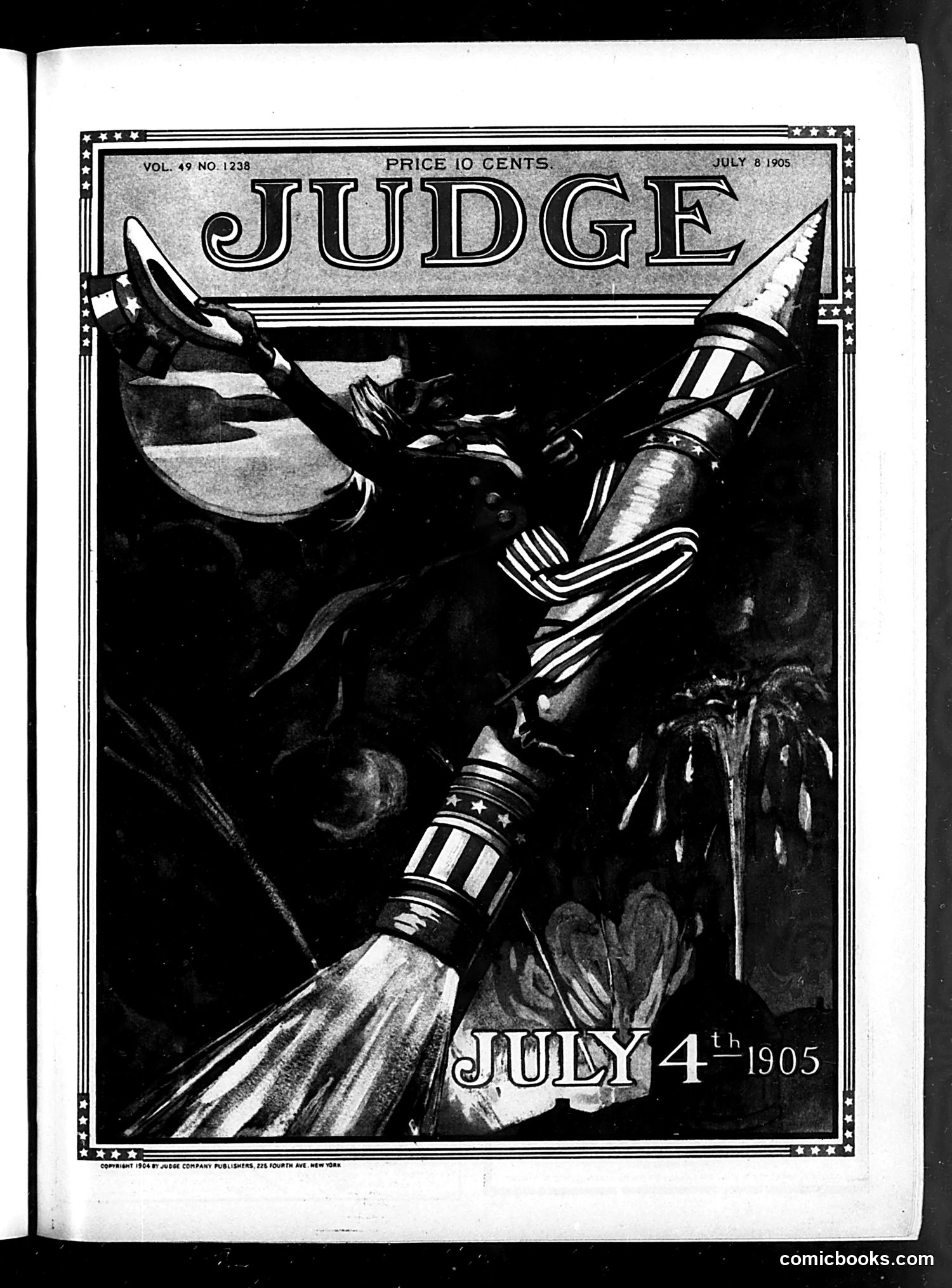
This cover depicts a figure dressed as Uncle Sam (identifiable by the starred top hat and patriotic striped clothing) reclining or falling backward in a celebratory pose for Independence Day. He's surrounded by fireworks and patriotic imagery. The satire likely comments on American Independence Day festivities and national pride in 1905. Uncle Sam's relaxed, exuberant posture suggests either celebration of American strength or possibly mockery of American complacency or excess during the holiday period. Without accompanying article text, the precise political critique is unclear, but *Judge* typically used such imagery to satirize American foreign policy, imperialism, or domestic politics of the Progressive Era. The bold, dramatic illustration style was characteristic of the magazine's cover art.
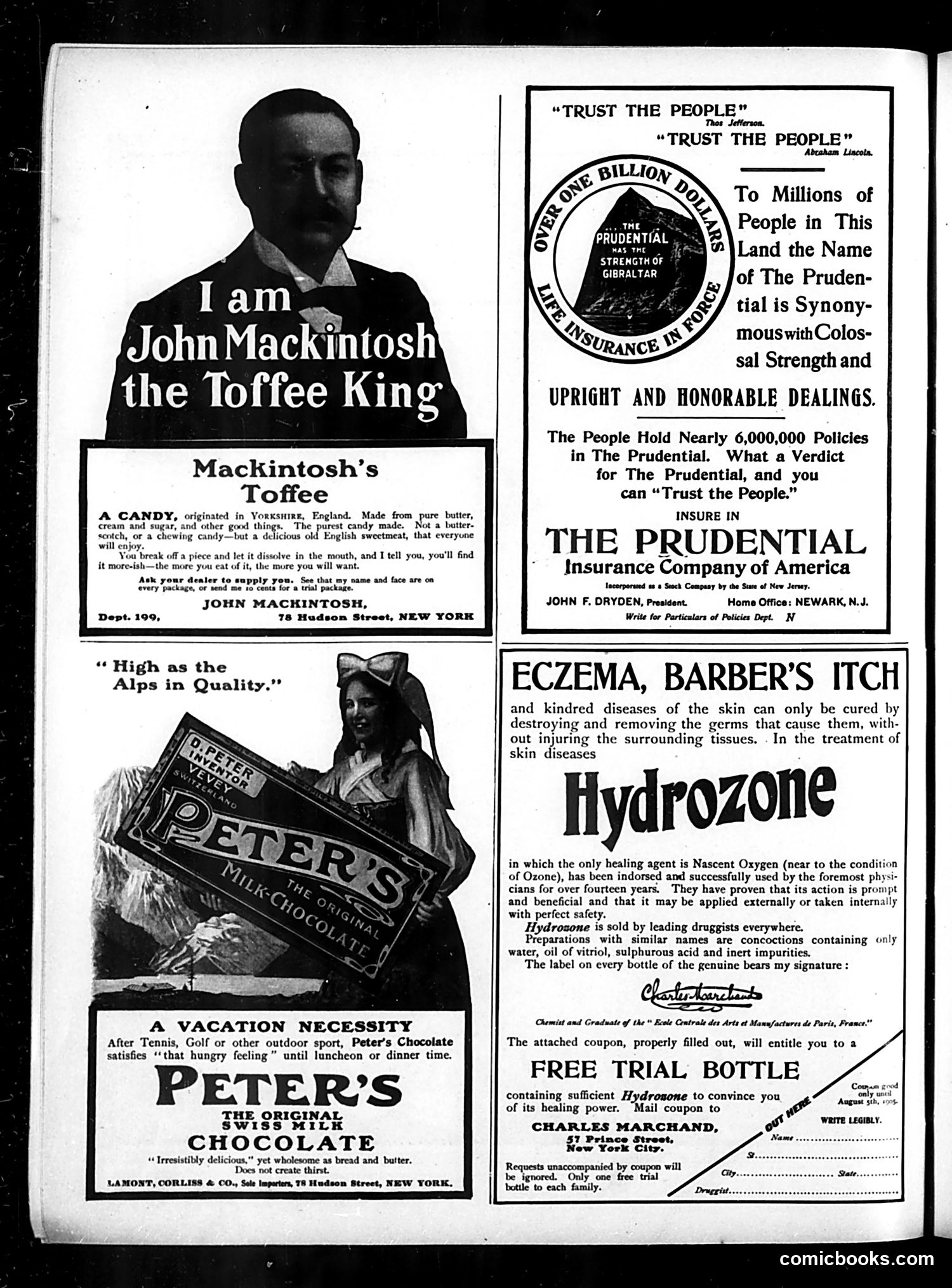
This page is primarily **advertising**, not political satire. It contains four commercial advertisements: 1. **John Mackintosh "Toffee King"** — a candy product advertisement from New York 2. **The Prudential Insurance Company** — emphasizing customer trust and their 6 million policyholders 3. **Peter's Milk Chocolate** — a Swiss chocolate product marketed as refreshment after sports 4. **Hydrozone** — a patent medicine claiming to cure skin diseases like eczema The advertisements are typical of early 20th-century marketing, featuring endorsements, testimonials, and free trial offers. No political cartoons or satire appear on this page. The "Trust the People" quote accompanying the Prudential ad is simply marketing language, not commentary.
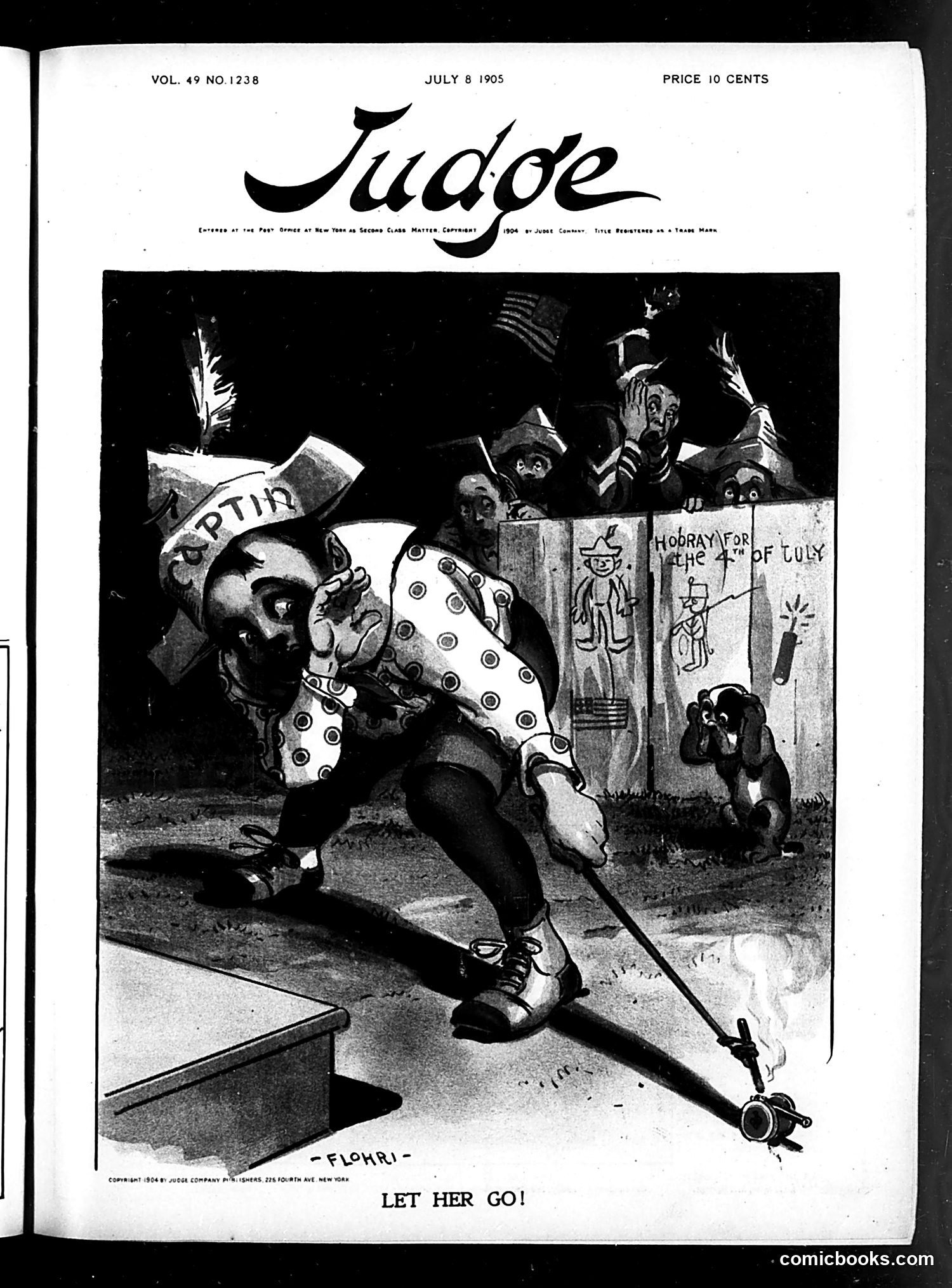
This political cartoon depicts a clown or fool figure in polka-dotted costume being pulled on a rope by what appears to be a small figure (possibly representing the common people or a political opponent). Behind him, onlookers cheer from a makeshift stand with a banner reading "HOORAY FOR THE 4TH OF JULY," suggesting an Independence Day celebration context. The title "LET HER GO!" and the rope imagery suggest the cartoon critiques someone or some policy being "released" or abandoned. The clown's exaggerated costume and the celebratory backdrop indicate mockery of a public figure or failed initiative. Without identifying specific 1905 political events, the exact target remains unclear, though the patriotic holiday setting suggests commentary on American political leadership or policy.
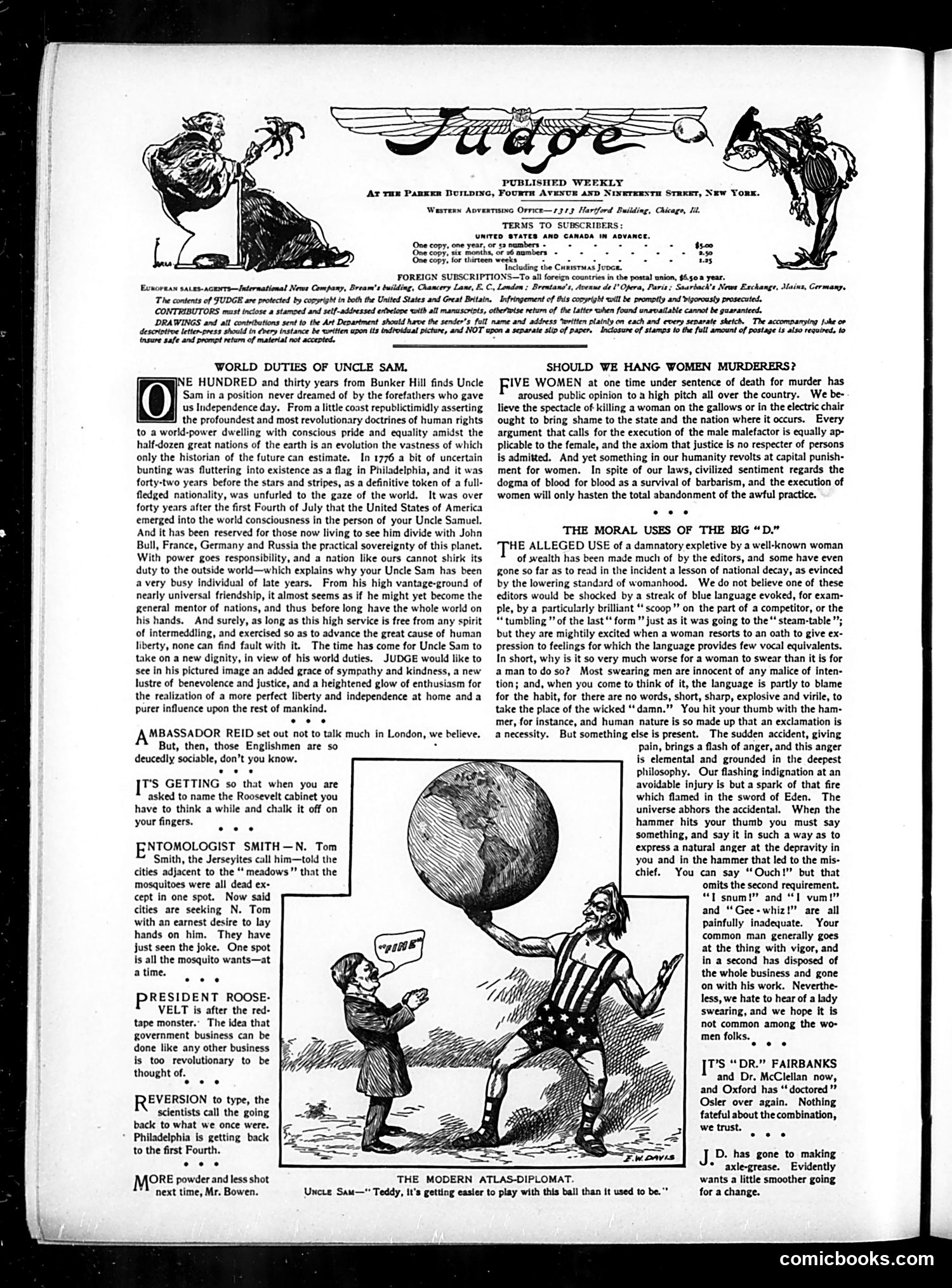
The main cartoon, titled "The Modern Atlas-Diplomat," depicts a small figure (labeled "Uncle Sam") struggling to hold up an enormous globe. This satirizes American diplomatic efforts and global responsibilities in the early 20th century. The page's text columns critique various topics: capital punishment for women murderers, women's use of profanity, and political figures including President Roosevelt and what appears to be references to diplomatic matters. The shorter satirical items mock specific individuals—"Entomologist Smith" and his mosquito research, "Ambassador Reid" in London, and various political figures' policies. The overall theme suggests Judge was commenting on contemporary American foreign policy overreach, gender issues, and political leadership circa 1910s, using humor to critique expansionist ambitions and moral questions of the era.
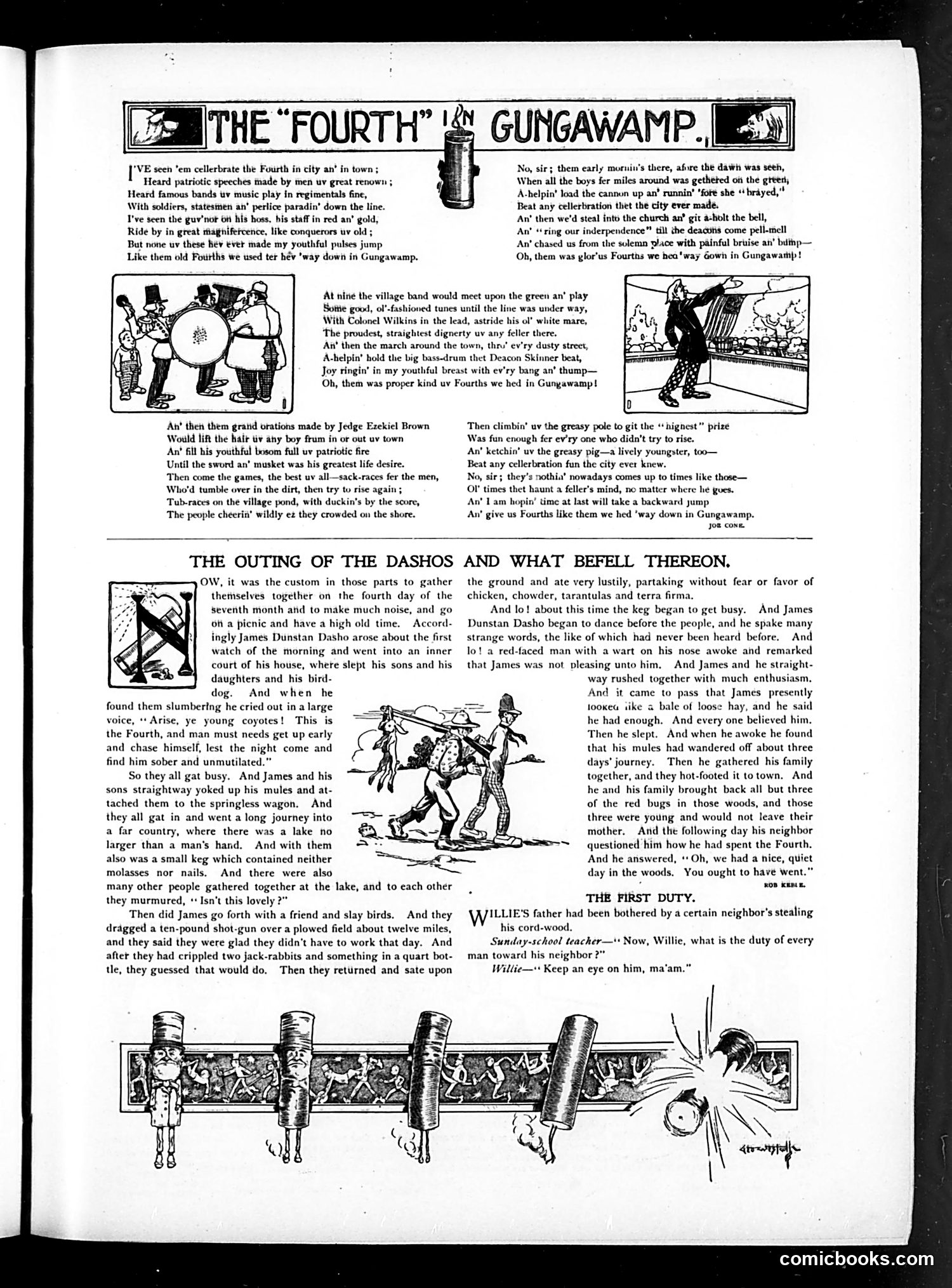
This *Judge* page presents nostalgic rural Americana through two pieces: **"The Fourth in Gungawamp"** is a dialect poem celebrating small-town Fourth of July celebrations—church bell-ringing, village bands, Judge Ezekiel Brown's patriotic speeches, sack races, and greasy-pole contests. The speaker contrasts these humble, chaotic rural traditions with fancy city parades featuring governors and soldiers, finding the former superior. The satire targets urban pretension by valorizing rustic authenticity. **"The Outing of the Dashos"** parodies biblical prose style ("And when he found them slumbering...") to humorously describe a family picnic. The mock-grandiose language about humble activities (yoking mules, traveling to a tiny lake, carrying a mysterious keg) creates absurdist humor. The reference to "a small keg which contained neither molasses nor nails" appears to joke about Prohibition-era alcohol smuggling, though context is unclear. Both pieces celebrate rural life while gently mocking its eccentricities and formality.
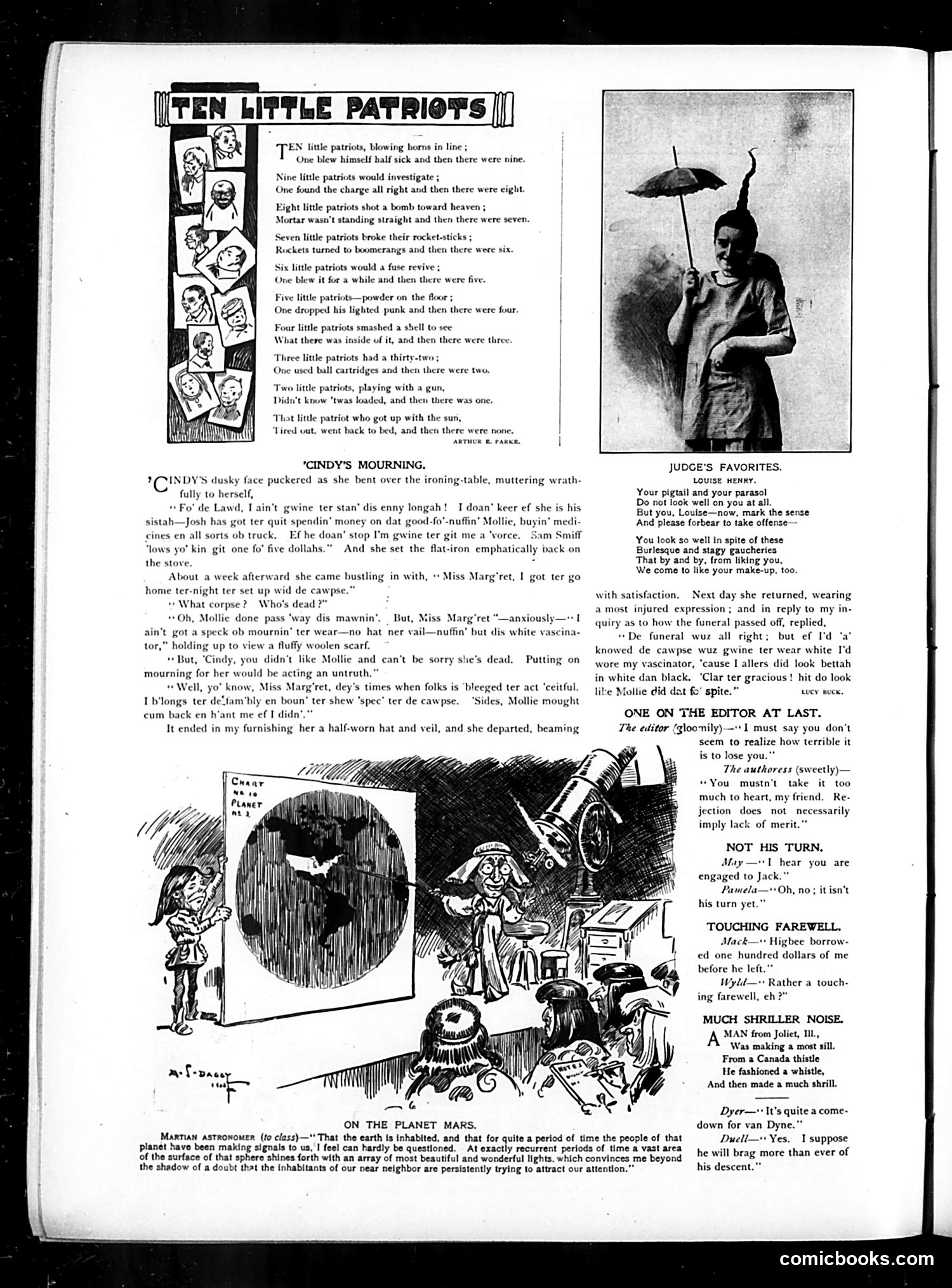
This page contains several satirical pieces typical of early Judge magazine: **"Ten Little Patriots"** is a dark-humor poem mocking incompetent radicals or anarchists. Each stanza follows the "Ten Little Indians" format, with "patriots" accidentally killing themselves through bungled bomb-making and weapons handling. The satire targets violent extremists of the era—likely anarchists or radical bomb-throwers who were a contemporary concern in early 20th-century America. **"Cindy's Mourning"** is a dialect-heavy story mocking African American speech and mourning customs. A Black maid named Cindy initially refuses to mourn her employer's sister Mollie, whom she disliked, but performs elaborate mourning anyway out of family obligation and superstition. **"On the Planet Mars"** presents a brief joke where a Martian astronomer interprets Earth's city lights as intentional signals, unknowingly describing electric streetlights. The remaining sections are brief humorous poems and quips. The overall tone reflects period attitudes: casual racism in dialect humor, mockery of radical violence, and genteel social comedy.
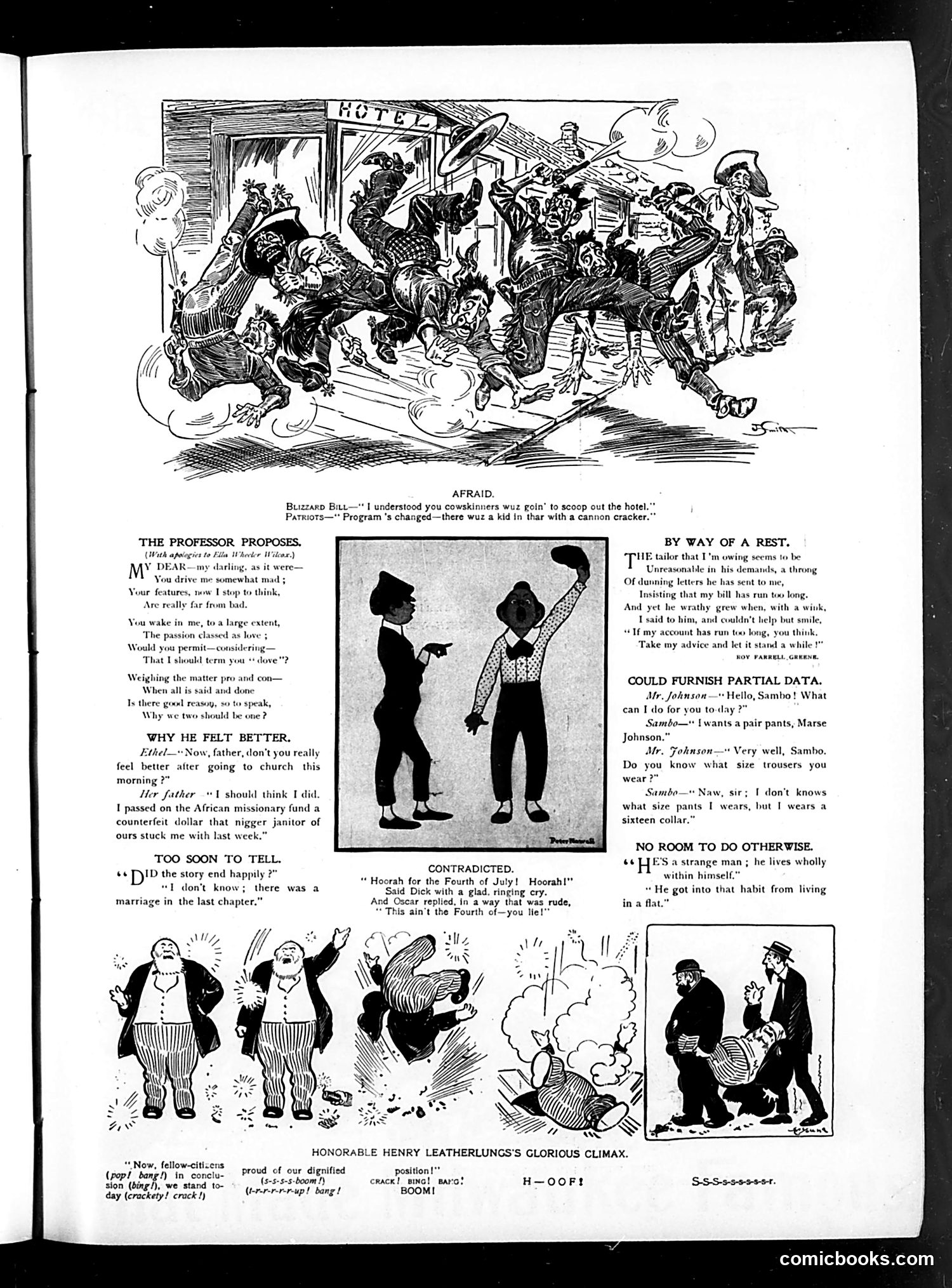
This page collects humorous sketches and satirical poems typical of late 19th-century American humor. Key content includes: **"The Professor Proposes"**: A romantic poem parodying sentimental verse, mocking flowery marriage proposals through exaggerated language. **"Why He Felt Better"**: A joke satirizing hypocrisy—a churchgoer feels good after passing counterfeit money to the Black janitor, exposing racist attitudes and moral corruption. **"Honorable Henry Leatherlungs's Glorious Climax"**: Political satire mocking windy political speeches, where a politician's grand conclusion is literally drowned out by explosive noises, suggesting empty rhetoric. **"Could Furnish Partial Data"**: A crude racial joke playing on stereotypes about Black men's ignorance. **"No Room to Do Otherwise"**: A mild joke about apartment living constraints. The page reflects period attitudes including casual racism, anticlericalism, and skepticism toward political bombast—typical of Judge's satirical agenda.
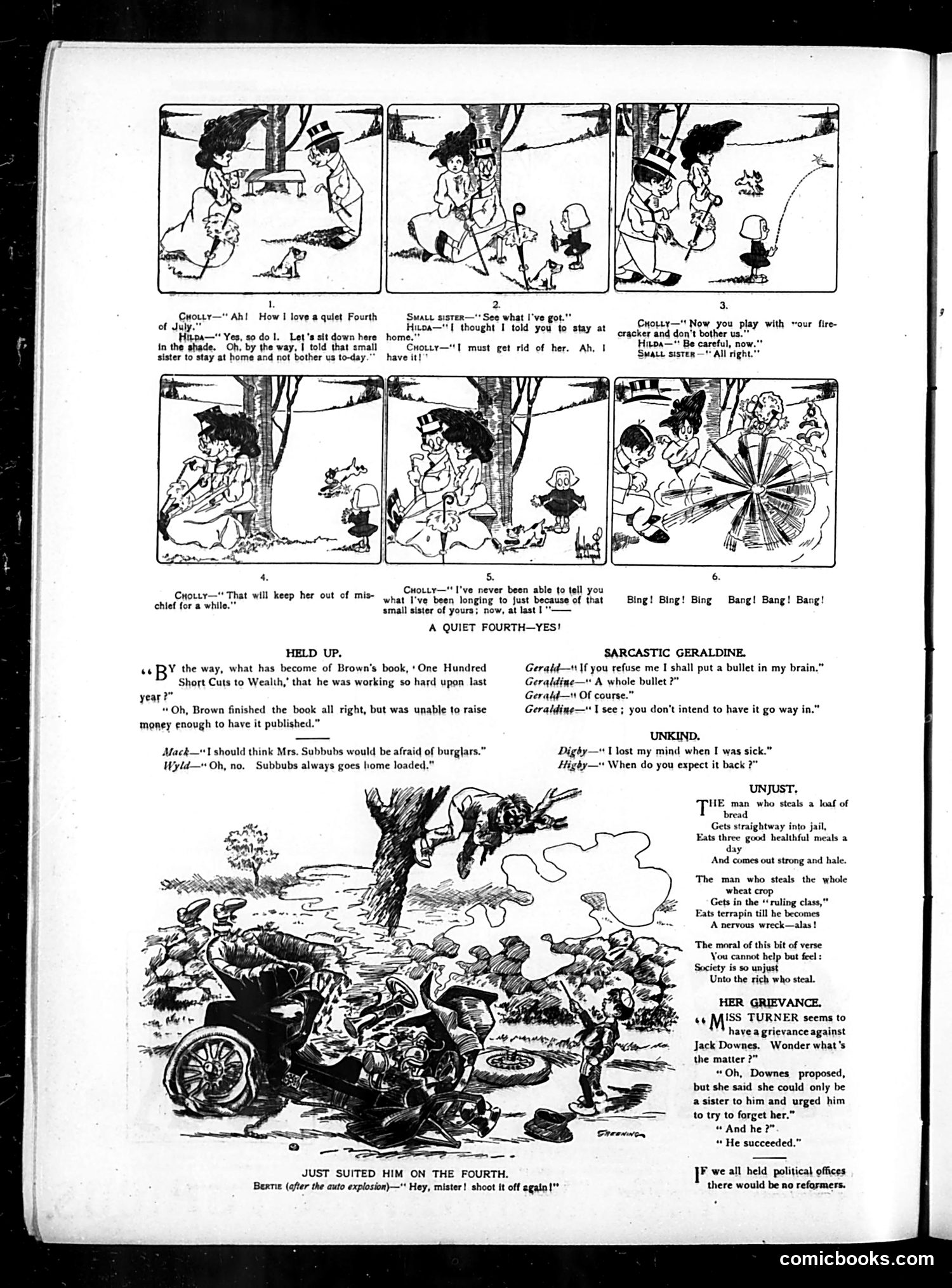
The top comic strip depicts the irony of families seeking a peaceful Fourth of July holiday. Parents send away a bothersome younger sister to avoid disruption, only to have her return with firecrackers, creating the noise they sought to escape—hence the title's sarcastic "YES!" The page also contains brief satirical jokes typical of *Judge* magazine's social commentary. "Held Up" mocks get-rich-quick schemes and suggests wealthy people avoid consequences (Mrs. Subbubs goes "home loaded," implying she's wealthy). "Unjust" critiques class hypocrisy: petty theft lands poor people in jail where they're fed well, while wealthy crop-stealers join the "ruling class" but suffer nervous breakdowns from indulgence—satirizing how justice favors the rich. Other short jokes target romance, proposals, and political corruption. The overall tone reflects Progressive-era skepticism toward wealth inequality and class privilege.
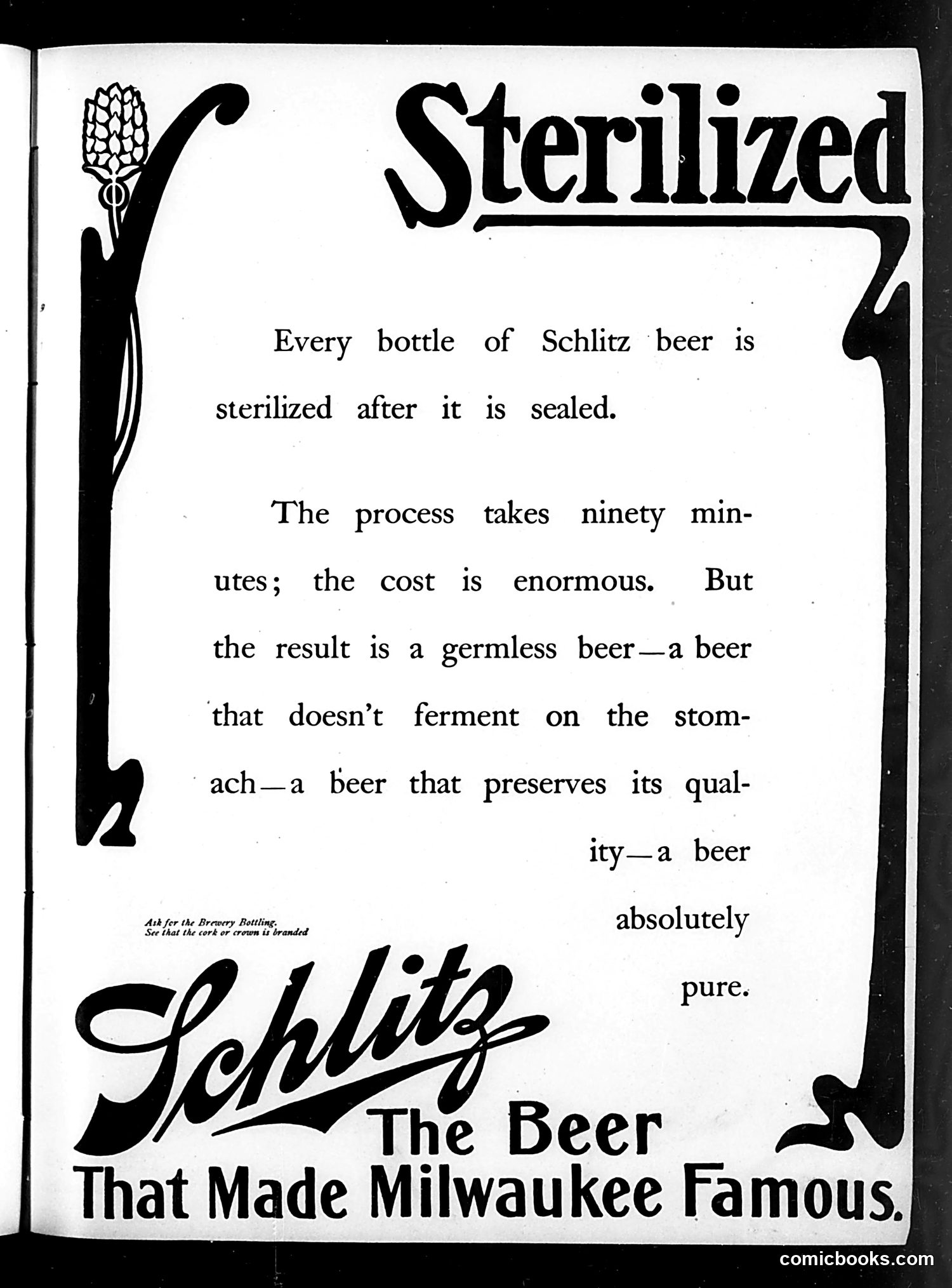
This is a **full-page advertisement** for Schlitz beer, not satire or political commentary. The decorative border features stylized wheat/grain imagery, appropriate for beer marketing. The ad highlights Schlitz's competitive advantage: their post-sealing sterilization process (taking 90 minutes) that prevents fermentation in the stomach and preserves quality. This emphasizes **purity**—a major selling point for early 20th-century brewers competing in an era of food-safety concerns. The tagline "The Beer That Made Milwaukee Famous" references Milwaukee's dominance in American beer production during this period. The note about asking "for the Brewery Bottling" suggests consumers should specifically request authentic Schlitz bottles to ensure they received the sterilized product, implying counterfeit or inferior versions existed in the market.
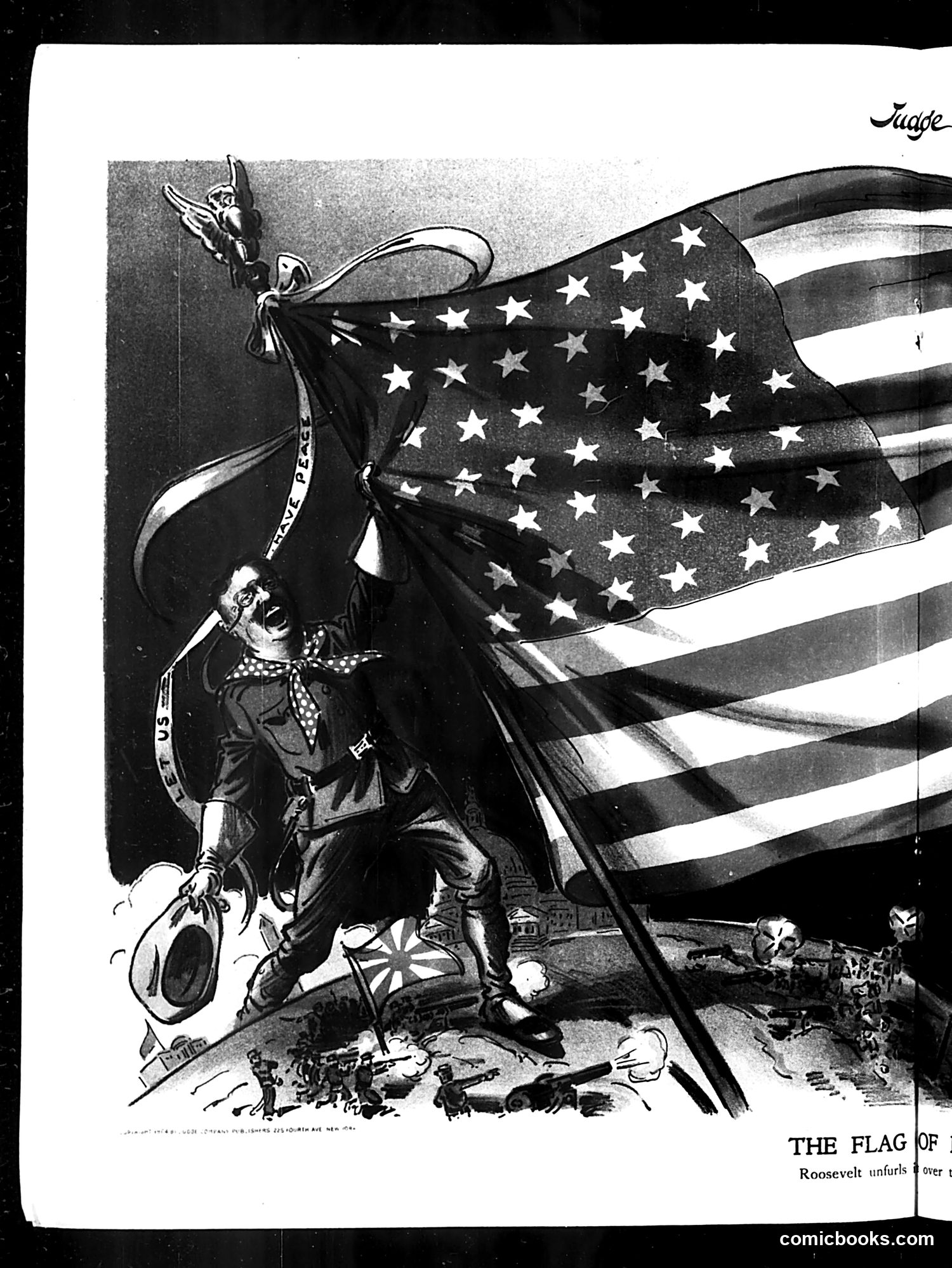
This Judge magazine cartoon depicts a figure in military dress—apparently representing Theodore Roosevelt or a Roosevelt-era leader—dramatically unfurling the American flag. The figure stands triumphantly over fallen enemies or defeated adversaries shown at the bottom of the composition. The satire likely comments on Roosevelt's expansionist foreign policy and military interventionism in the early 1900s. The "unfurling" of the flag suggests American imperial ambitions or the projection of American power abroad. The defeated figures beneath represent nations or peoples subjugated through this aggressive policy. The cartoon's heroic visual style is itself ironic—presenting militarism and expansionism as noble while the satirical intent critiques such interventionism as destructive and imperialistic.
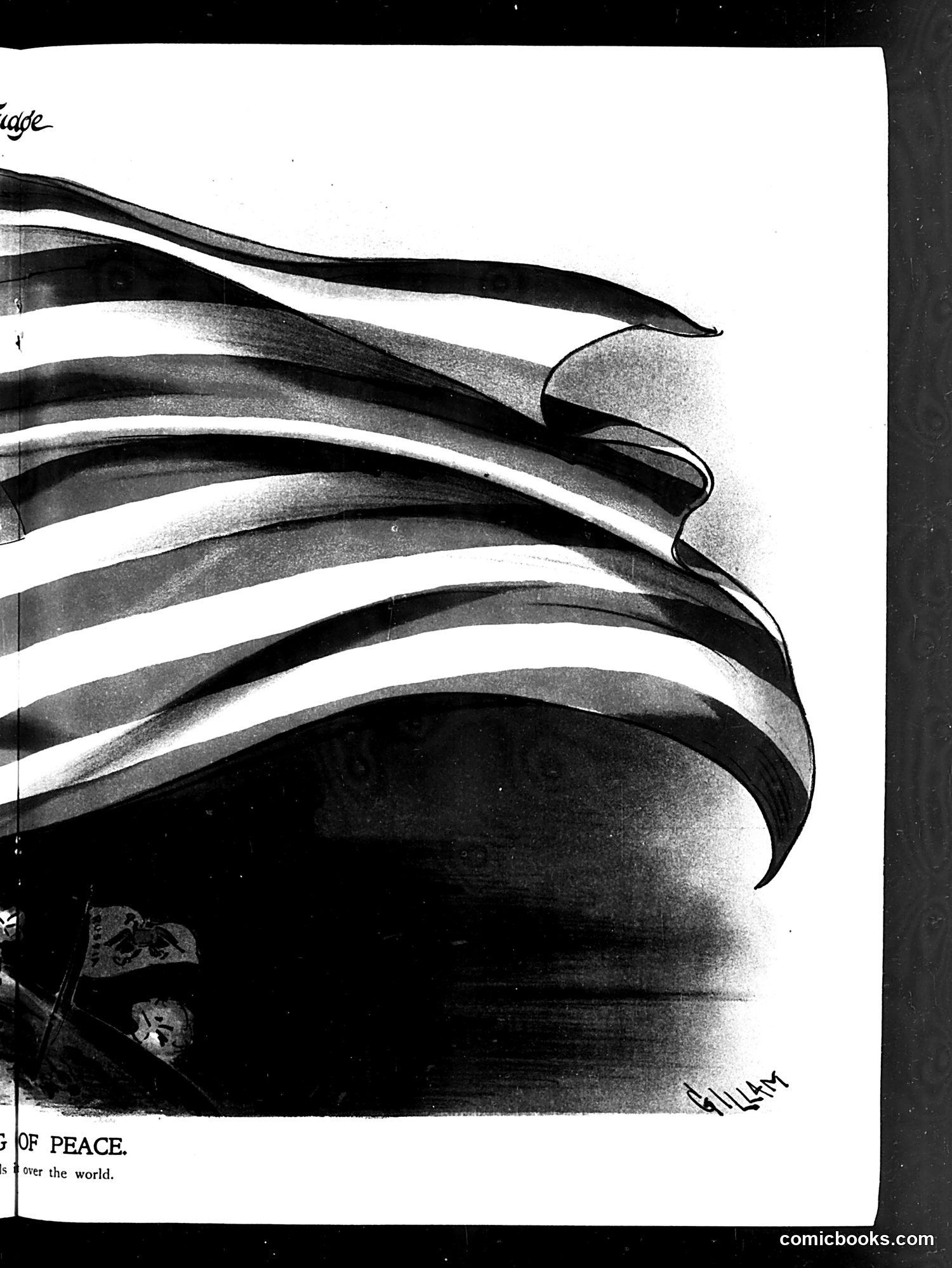
This appears to be a political cartoon depicting a large, spiraling or coiled form rendered in black and white with dramatic shading. The visible text fragments reference "OF PEACE" and mention "over the world," suggesting the cartoon concerns peace as a global theme. The spiral/coiled composition could represent entanglement, complexity, or cyclical nature of peace efforts. The dramatic chiaroscuro (light/dark contrast) emphasizes tension. Without the complete caption or surrounding context visible, the specific political situation being satirized remains unclear—it could reference peace negotiations, failed peace initiatives, or the illusory nature of peace itself during a contentious historical period. The artist's signature appears in the lower right corner.
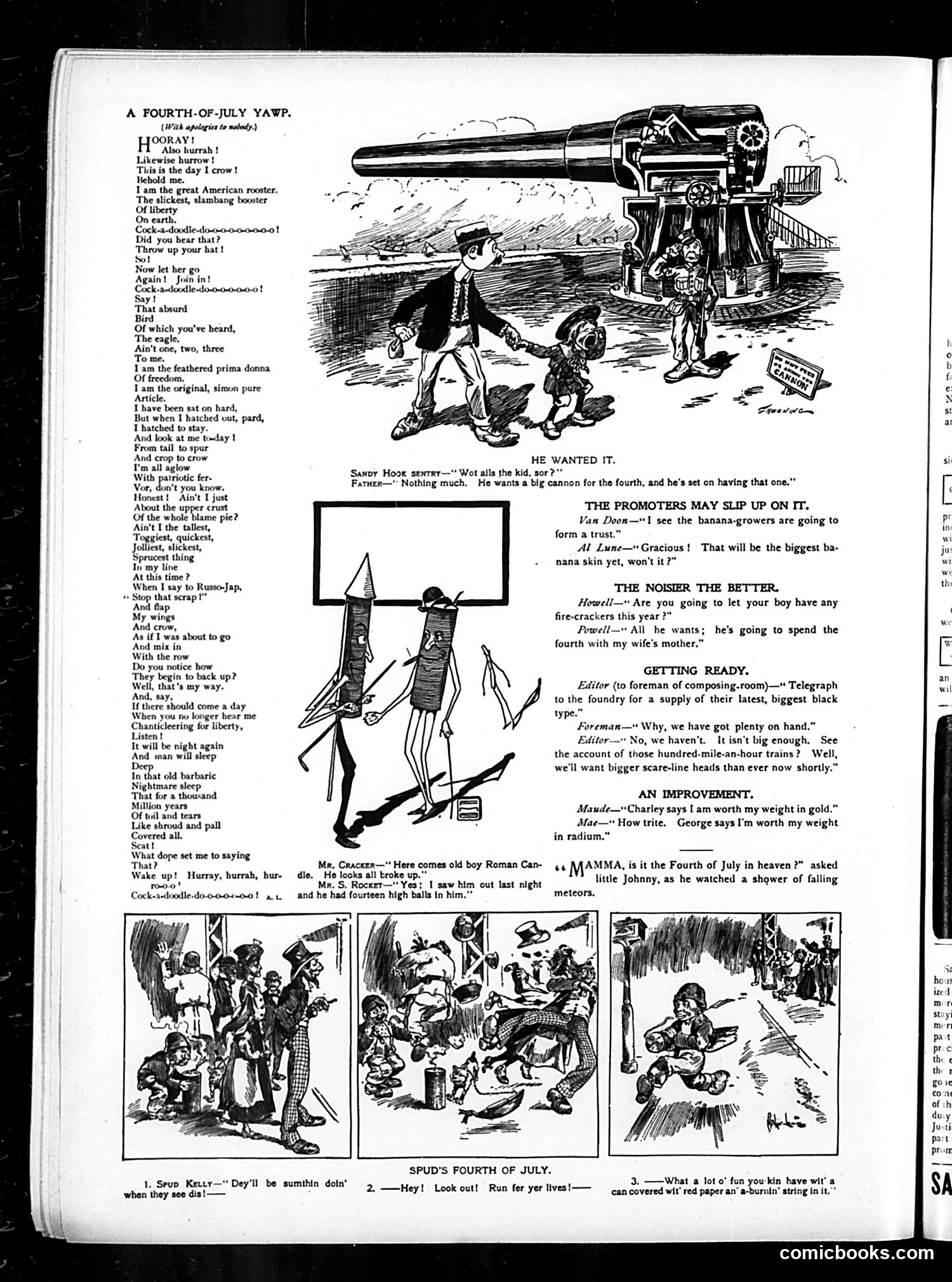
This page celebrates American independence through exuberant, tongue-in-cheek patriotism. The main poem, "A Fourth-of-July Yawp," features an anthropomorphic rooster as Uncle Sam's stand-in, crowing bombastically about American superiority and freedom. The rooster boasts of being democracy's "feathered prima donna," suggesting American self-importance and swagger. The accompanying cartoons mock contemporary concerns: one jokes about a boy wanting a cannon for July Fourth; another references recent "hundred-mile-an-hour trains" requiring larger newspaper headlines; a third puns on banana growers forming a monopoly as a "banana skin" (slip-up). The "Spud's Fourth of July" comic strip at bottom shows working-class children celebrating wildly with firecrackers and explosives—likely satirizing both fireworks enthusiasm and class differences in holiday observance. Overall, the page blends patriotic fervor with gentle mockery of American boosterism, consumer culture, and technological anxieties of the early 1900s.
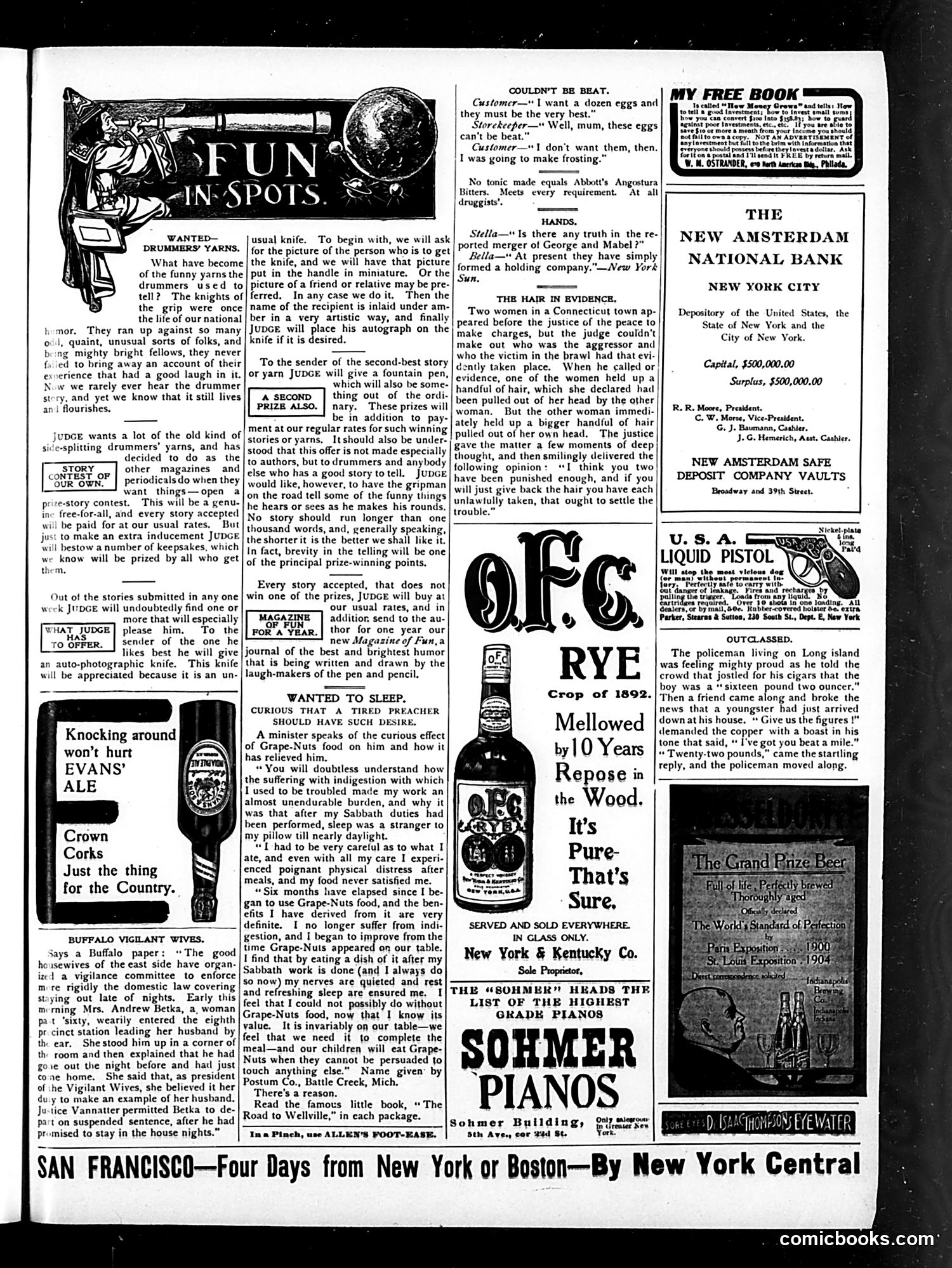
This page is primarily **advertising and contest announcements** rather than political satire. The main content includes: 1. **"Wanted: Drummers' Yarns"** — Judge announces a fiction contest seeking humorous stories from traveling salesmen ("drummers"), offering prizes including an auto-photographic knife and fountain pen. This reflects early 1900s nostalgia for salesmen's tall tales. 2. **"Buffalo Vigilant Wives"** — A humorous news item about wives enforcing domestic curfews, with one woman literally bringing her errant husband to police court by his ear. This satirizes both spousal control and turn-of-the-century gender dynamics. 3. **Advertisements** — O.F.C. Rye whiskey, Evans Ale, Sohmer Pianos, and other products dominate the page. The humor is gentle, domesticity-focused satire typical of Judge's era — poking fun at salesmen, husbands, and consumer culture rather than political figures or movements.
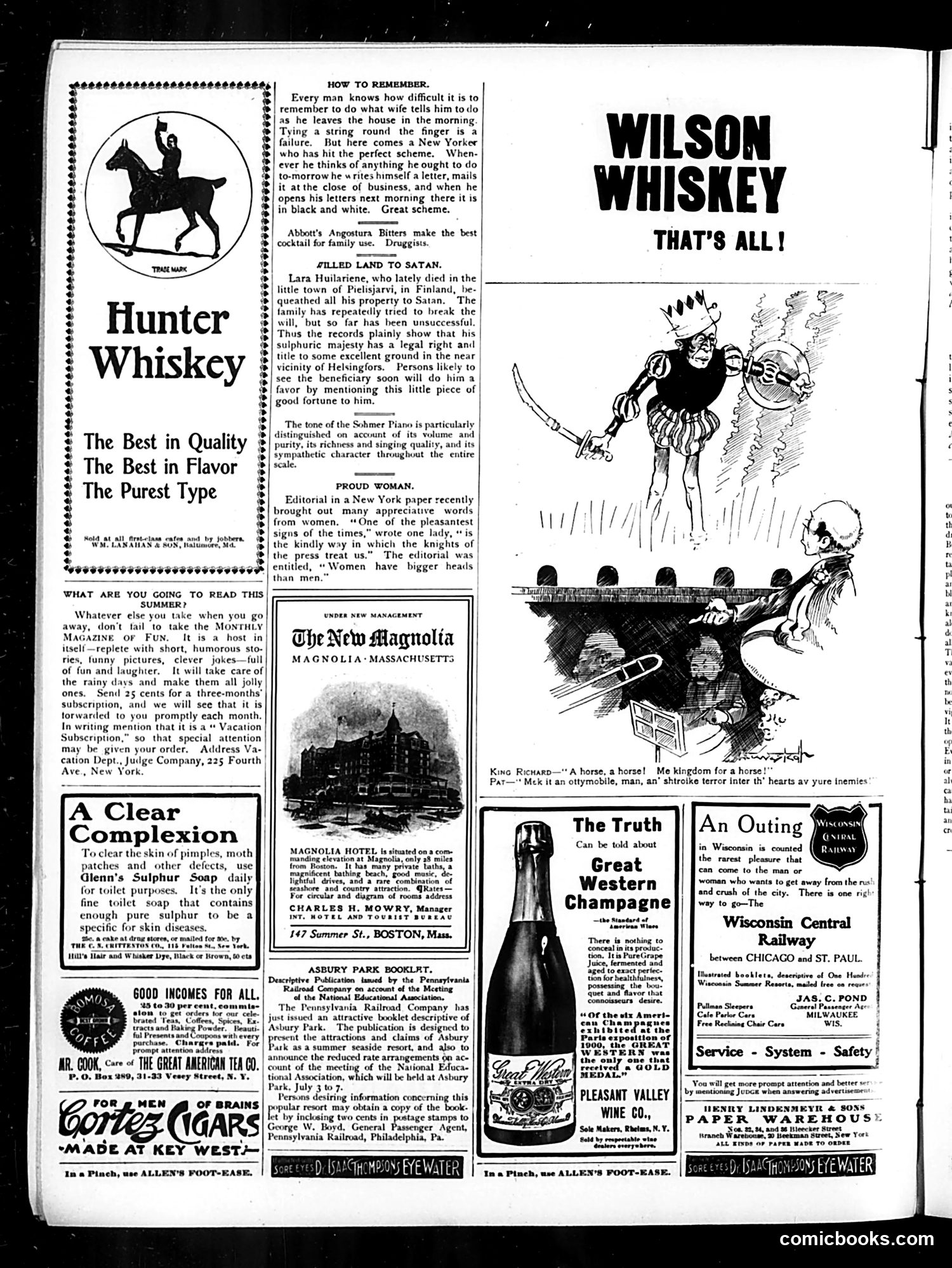
This page is primarily **advertising** with one substantive cartoon. The main illustrated content shows a **"King Richard" cartoon** depicting a demon-like figure menacing people in what appears to be a carriage or vehicle, captioned with wordplay about horses and an "automobile, man" (an early automobile reference). The cartoon satirizes the **emerging automobile technology** of the era, joking that demonic "terror" lurks in the hearts of early motorists—likely poking fun at both the mechanical dangers and the social anxiety surrounding these new vehicles. The page contains **numerous product advertisements** (whiskey, soap, hotels, champagne, cigars, railways) typical of Judge's revenue model. Notable text items include anecdotes about memory tricks, Finnish inheritance law, and women's intelligence, reflecting the magazine's mix of humor and social commentary. The overall tone is lighthearted satire characteristic of early-20th-century American humor publications.
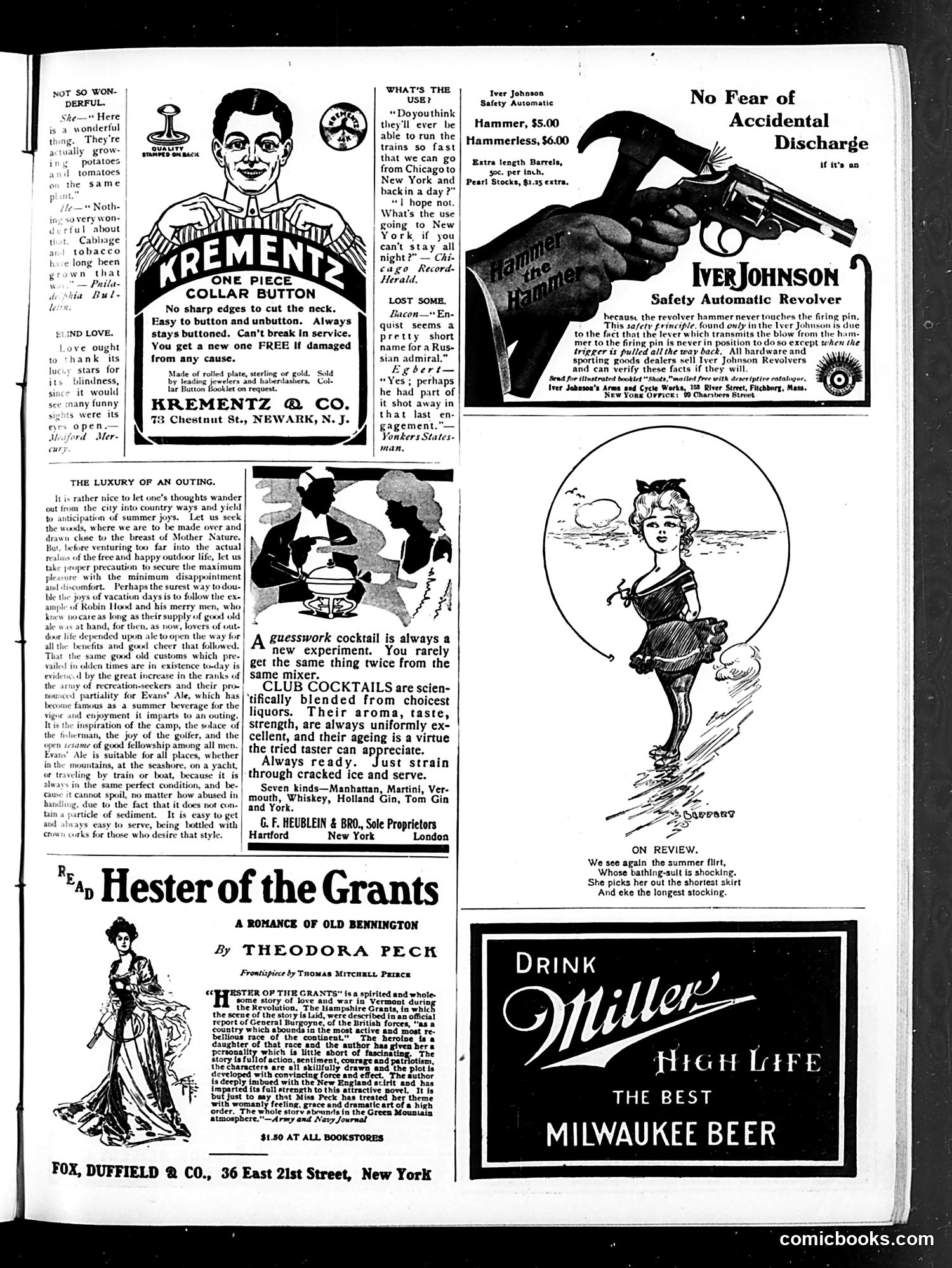
This Judge magazine page contains several distinct satirical pieces: **"What's the Use?" dialogue**: Mocks technological progress by suggesting faster train travel defeats the purpose of trips—you'd lose time enjoying your destination. The joke plays on early-20th-century anxiety about modernity's relentless pace. **"Lost Some" joke**: References a Russian admiral (likely from the Russo-Japanese War era, given the context), with a dark humor quip that his short name resulted from battle wounds. This targets both Russian military losses and the absurdity of casual wartime commentary. **Product advertisements** dominate the lower half: Iver Johnson revolvers emphasize "safety," Krementz collar buttons, and Heublein cocktails. These ads reflect consumer culture and emerging product-safety marketing. The page primarily showcases Judge's blend of social commentary, wordplay humor, and advertising—typical of early-1900s satirical magazines targeting middle-class readers concerned with modernity, technology, and leisure.
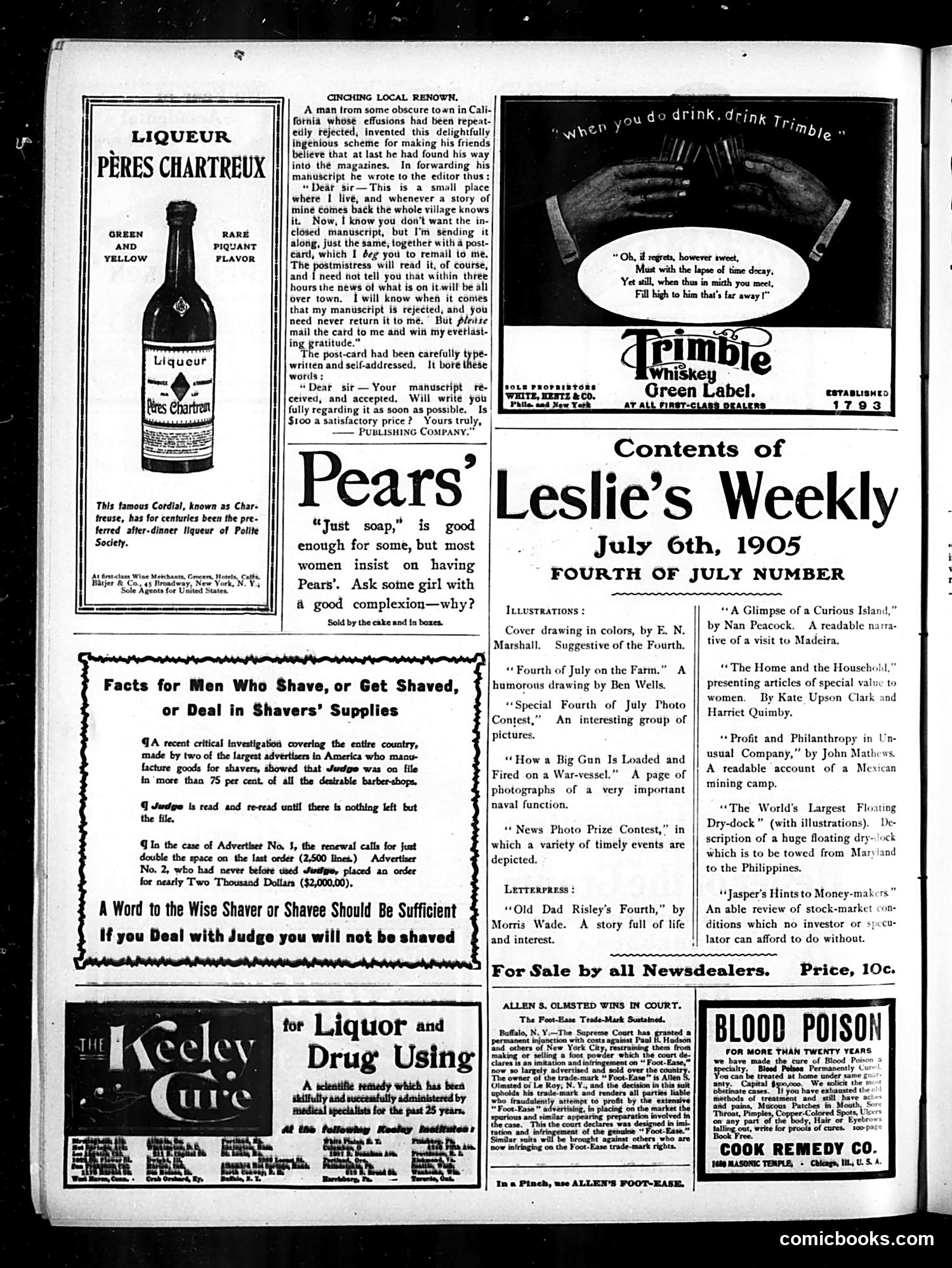
This page is primarily **advertisements and table of contents** for Leslie's Weekly (July 6, 1905, Fourth of July issue), interspersed with ads for liqueur, soap, and patent medicines. The only substantive satirical content is **"Cinching Local Renown,"** which mocks a struggling writer's scheme to deceive his small-town postmistress into spreading false news that his manuscript was accepted. The writer sends a pre-written fake acceptance postcard, betting that the postmistress will gossip about it before delivery. The satire targets both the writer's pathetic desperation for literary credibility and the predictable small-town rumor mill. The remaining content includes advertisements for Pears' soap and various patent remedies, plus self-promotional copy about Judge's reach in barbershops—essentially trade advertising aimed at other advertisers, not social satire.
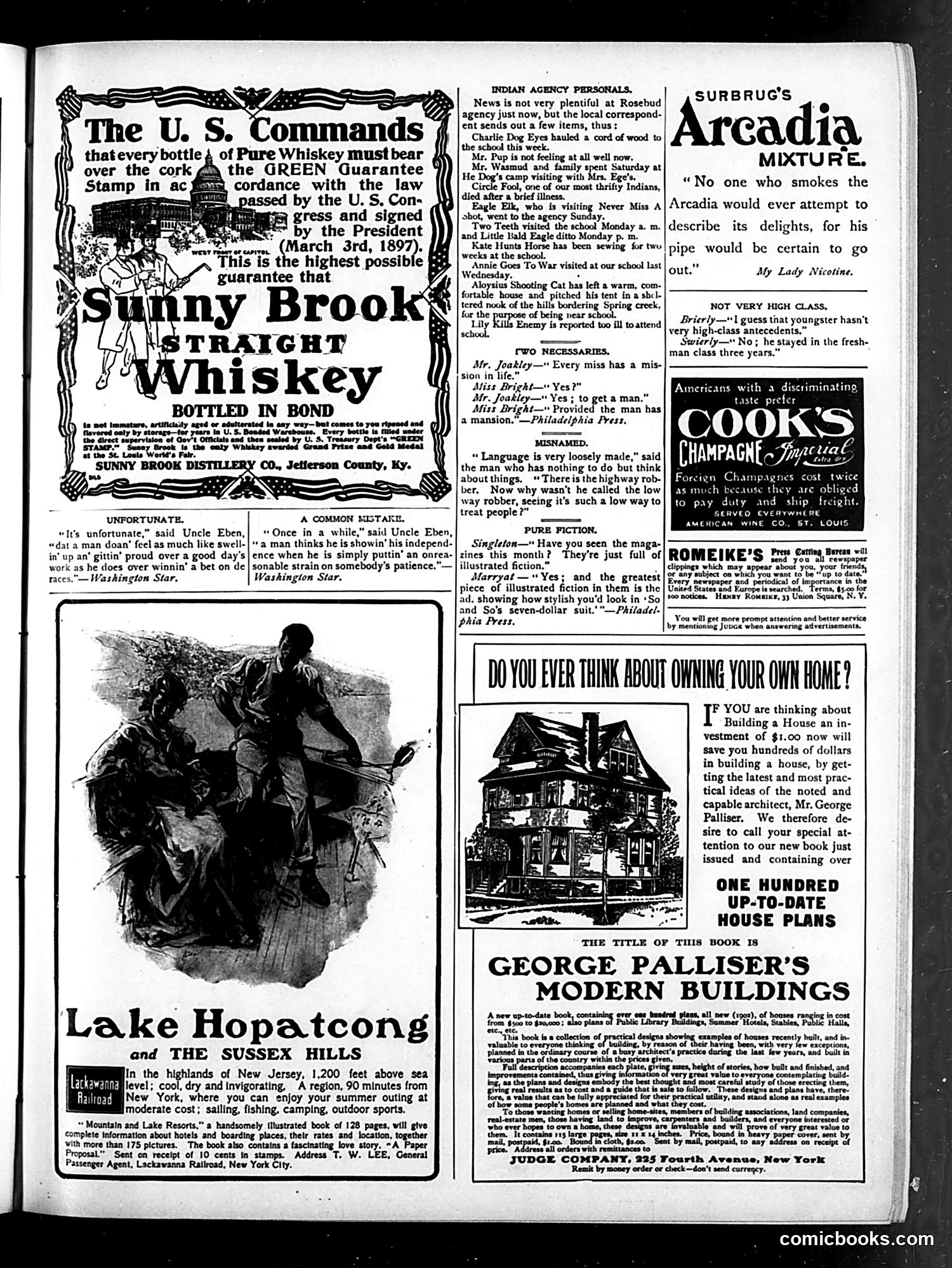
This page is primarily **advertising and filler content** rather than political satire. The main elements are: **Advertisements:** - Sunny Brook Whiskey (large left column): emphasizes the GREEN Guarantee Stamp required by U.S. law since 1897—a regulatory assurance of purity - Lake Hopatcong resort (bottom left): vacation destination near New York - Surbrug's Arcadia tobacco mixture - Cook's Champagne (American brand) - Romeike's press clipping service - George Palliser's house-plan book **Satirical content** (minor): Several brief "Uncle Eben" observations and joke items mock everyday foibles—a man confusing independence with being unreasonably stubborn, the absurdity of advertising claims, etc. The "Indian Agency Personals" appears to be **mocking Native American names** through obvious caricature. The page reflects **early 1900s consumer culture** and advertising practices. There is no significant political cartoon; Judge here functions primarily as a vehicle for paid advertisements interspersed with light humor.
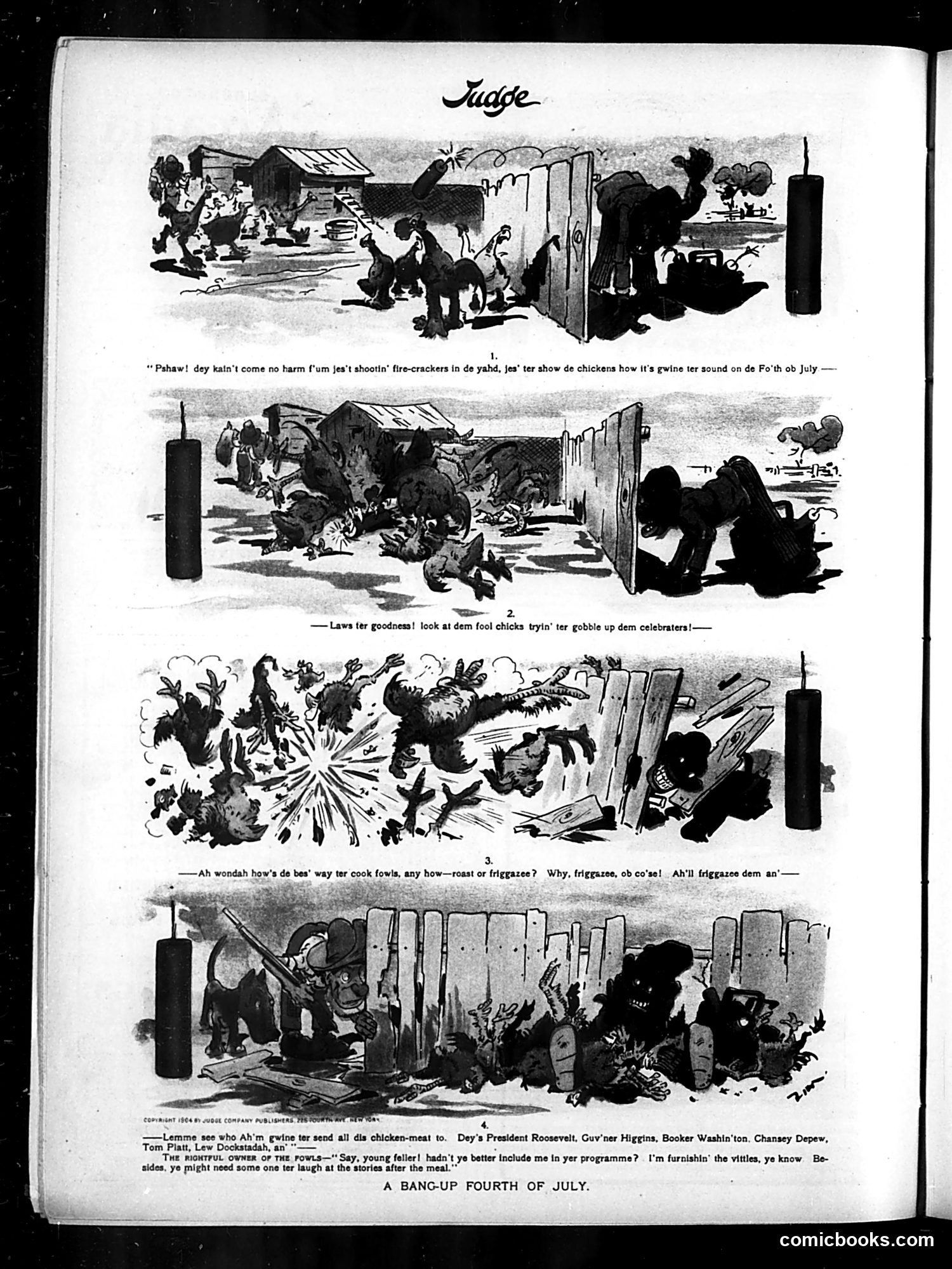
This four-panel comic satirizes Fourth of July chaos in a rural setting, featuring African American characters preparing an Independence Day celebration by setting off firecrackers near a chicken coop. The humor derives from the comic destruction: chickens scatter wildly as explosions erupt, and the final panel shows the chickens apparently killed or ruined. The text indicates the character plans to distribute the "chicken-meat" to various prominent figures including President Roosevelt, Governor Higgins, Booker T. Washington, and others. The joke appears to work on multiple levels: the absurdity of using patriotic celebration as cover for reckless behavior, the chaotic outcome, and the list of prominent recipients. The inserted dialogue from "the rightful owner" suggests tension over who controls the resources and who deserves credit/blame for the disaster. The satire reflects early 1900s attitudes toward both rural life and racial caricature common in period Judge cartoons.
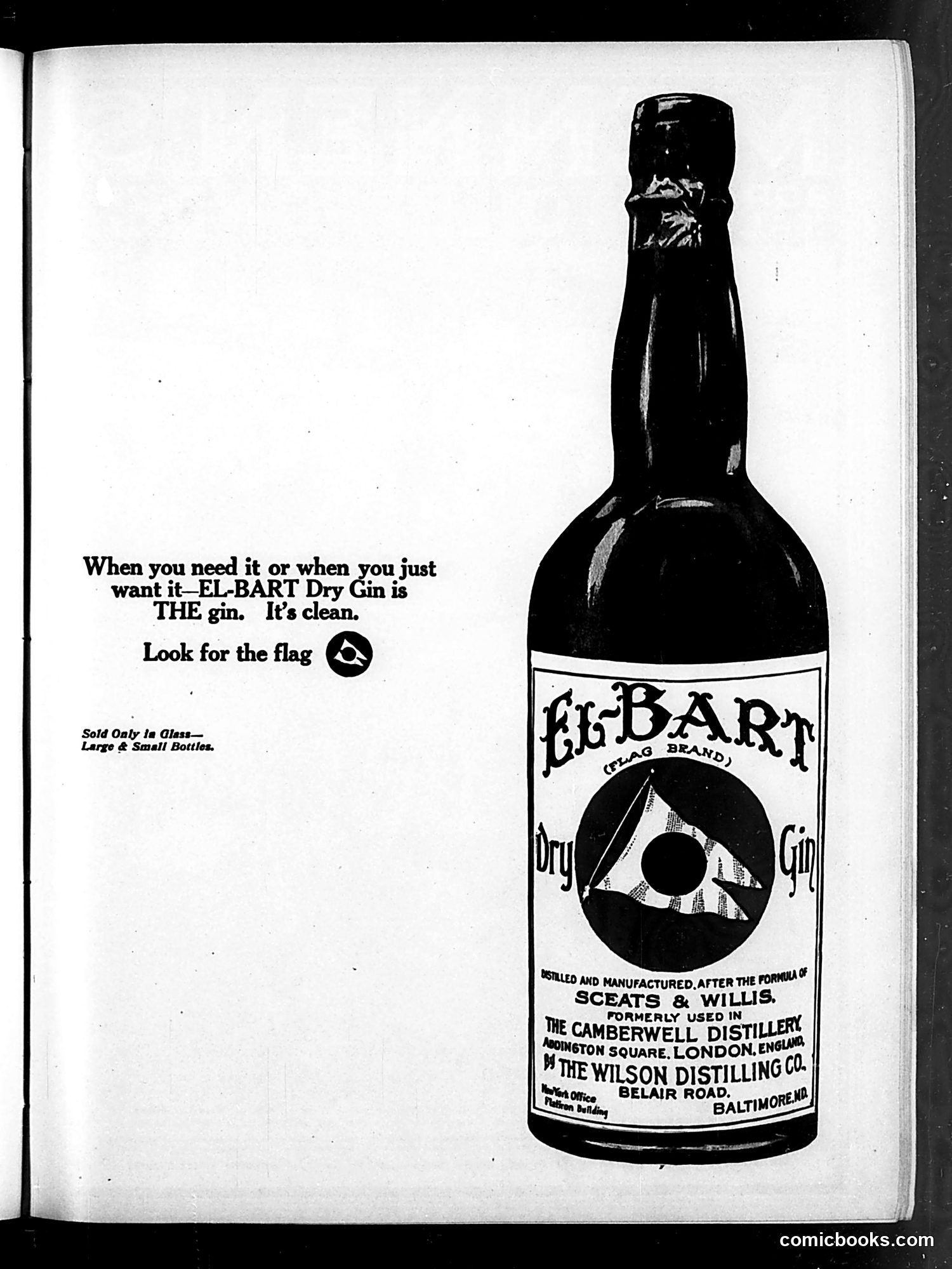
This page is primarily a **product advertisement**, not political satire. It promotes El-Bart Dry Gin, manufactured by The Wilson Distilling Co. in Baltimore, Maryland. The ad features a large bottle illustration with the El-Bart label (showing a flag symbol as the identifying mark). The copy uses straightforward marketing language: "When you need it or when you just want it—EL-BART Dry Gin is THE gin. It's clean." The advertisement mentions the gin was "distilled and manufactured, after the formula of Sceats & Willis, formerly used in the Camberwell Distillery, Addington Square, London, England"—suggesting British heritage to enhance prestige. This appears to be from an era when *Judge* magazine carried commercial advertisements alongside satirical content. There is no discernible political or social satire on this particular page.
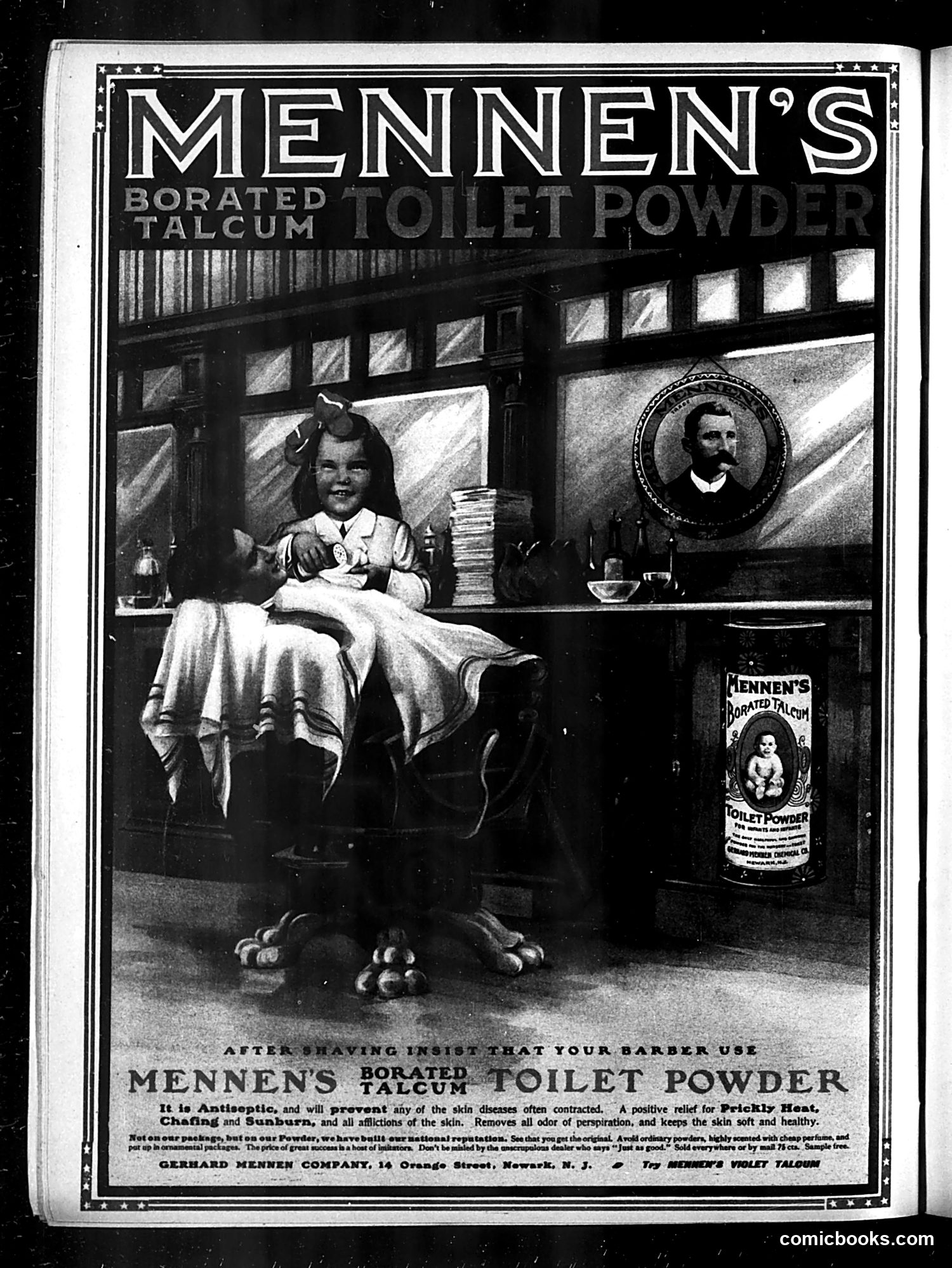
This is a **product advertisement**, not political satire. It promotes Mennen's talcum powder, a grooming product popular in the early 20th century. The image depicts a surreal scene: a young girl sits at a vanity mirror while a man's face appears in the mirror itself—likely representing a barber or groomer. The bizarre staging (the girl has animal-like feet) is designed to catch attention. The ad's copy emphasizes the product prevents skin irritation from shaving ("After shaving insist that your barber use..."), treats prickly heat and sunburn, and removes perspiration odor. Notably, it warns against cheap imitations and "highly scented" competitors, positioning Mennen's as the superior, authentic choice backed by "national reputation." This reflects early advertising strategy: brand-building through claims of quality and warnings against counterfeits.