
Judge, 1905-07-08 · page 5 of 20
Judge — July 8, 1905 — page 5: what you’re looking at
What you’re looking at
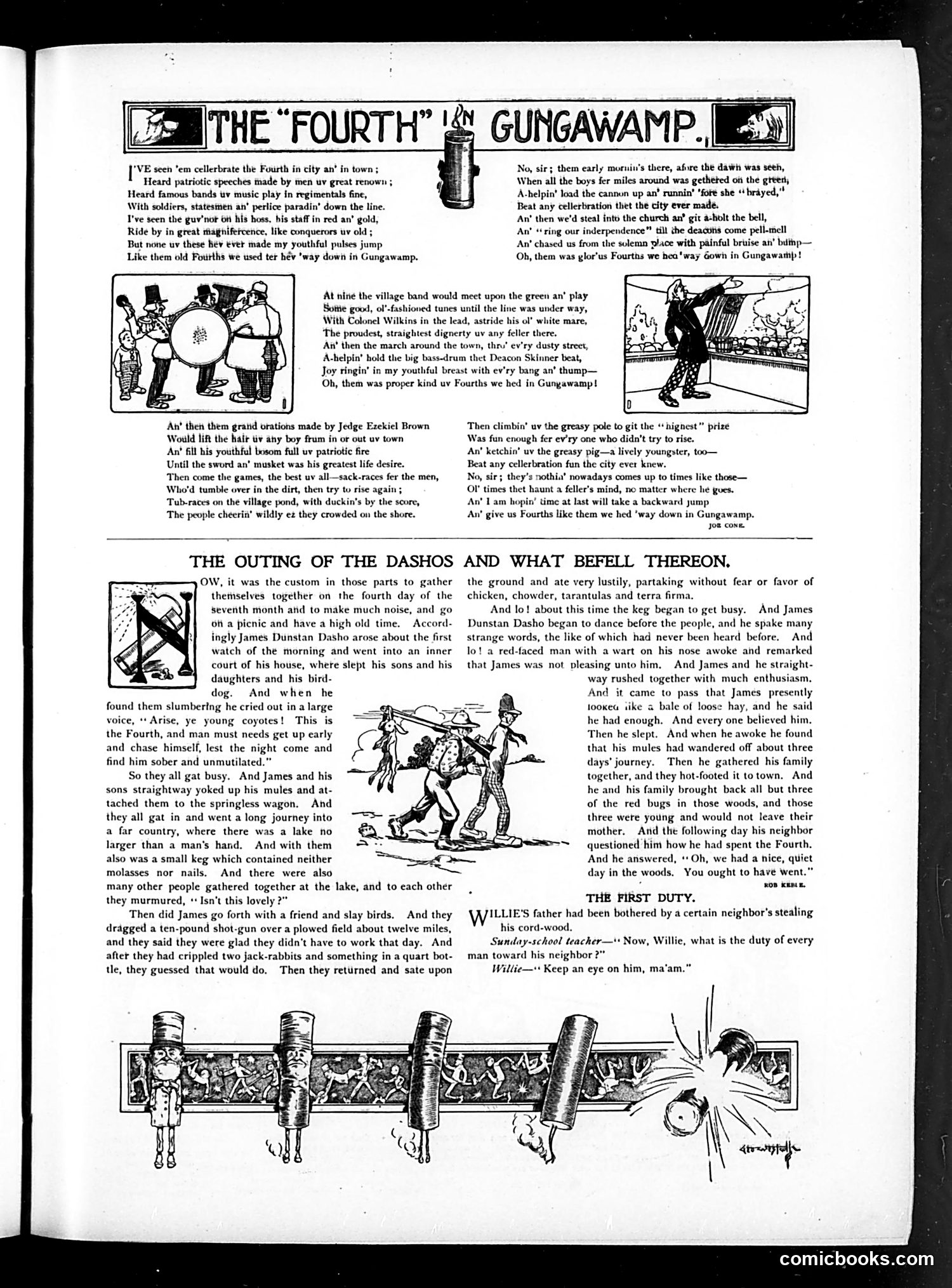
This *Judge* page presents nostalgic rural Americana through two pieces: **"The Fourth in Gungawamp"** is a dialect poem celebrating small-town Fourth of July celebrations—church bell-ringing, village bands, Judge Ezekiel Brown's patriotic speeches, sack races, and greasy-pole contests. The speaker contrasts these humble, chaotic rural traditions with fancy city parades featuring governors and soldiers, finding the former superior. The satire targets urban pretension by valorizing rustic authenticity. **"The Outing of the Dashos"** parodies biblical prose style ("And when he found them slumbering...") to humorously describe a family picnic. The mock-grandiose language about humble activities (yoking mules, traveling to a tiny lake, carrying a mysterious keg) creates absurdist humor. The reference to "a small keg which contained neither molasses nor nails" appears to joke about Prohibition-era alcohol smuggling, though context is unclear. Both pieces celebrate rural life while gently mocking its eccentricities and formality.
📄 Transcribed text from this page (OCR, searchable)
Machine-transcribed from the original scan — historical spelling and the odd misread are preserved.
['VE seen “em cellerbrate the Fourth in city an’ in town ; Heard patriotic speeches made by men uv great renown ; Heard famous bands tw music play in regimentals fine, With soldiers, statesinen an’ perlice paradin’ down the line. I've seen the guv’noF 6 his hoss. his staff in red an’ gold Ride by in great maghifervence, like conquerors uv of But none uy these Kev ever made my youthful pulses jump Like them old Fourths we used ter hév 'way down in Gungawamp. No, sir; them early mornin’s there, afore the dawh was seeh, When all the boys fer miles around was getheted oii the gteert; A-helpin’ load the cannon up an’ runnin’ ‘fore she ‘ brayed,"’ Beat any cellerbration thet the city ever made, An’ then we'd steal into the church an’ git a:holt the bell, An’ “ring our inderpendence” till the deacohis come pell-mell An’ chased us from the sulemn place with painful bruise an’ buthp— Oh, them was glor’us Fourths we hea'way Gown in Gungawarhp! At nine the village band would mect upon the green an’ play Sottie good, ol’-fashioned tunes until the li With Colonel Wilkins in the lead, astride hi: was under way, ol" white mare, ‘The proudest, straightest dignerty uv any feller there, An’ then the march around the town, thru’ ev'ry dusty street, A-helpin’ hold the big bass-drum thet Deacon Skinner beat, Joy ringin’ in my youthful breast with ev'ry bang an’ thump— Oh, them was proper kind uy Fourths we hed in Gungawamp! An’ then them gratid orations made by Jedge Ezekiel Brown Would lift the hair tiv any boy frum in or out uv town An’ fill his youthful bosom full uv patriotic fire Until the sword an’ musket was his greatest life desire. Then come the games, the best uv all—sack-races fer the men, Who'd tumble over in the dirt, then try to rise again ; Tub-races on the village pond, with duckin’s by the score, The people cheerii’ wildly ez they crowded on the shore. Then climbin’ uy the greasy pole to git the “hignest” prize Was fun enough fer ev'ry one who didn't try to rise. An’ ketchin’ uv the greasy pig—a lively youngster, too— Beat any cellerbration fun the city ever knew. No, sir; they’s nothin" nowadays comes up to times like those— OF times thet haunt a feller’s mind, no matter where he gues. 1am hopin’ time at last will take a backward jump ive us Fourths like them we hed ‘way down in Gungawamp. 408 cone, THE OUTING OF THE DASHOS AND WHAT BEFELL THEREON. OW, it was the custom in those parts to gather themselves together on the fourth day of the seventh month atid to make much noise, and go oft a picnic and have a high old time. Accord- ingly James Dunstan Dasho arose about the first watch of the morning and went into an inner court of his house, where slept his sons and his daughters and his bird- dog. And when he found them slumbering he cried out in a large voice, “Arise, ye young coyotes! This is the Fourth, and man must needs get up early and chase himself, lest the night come and find him sober and unmutilated.” So they all gat busy. And James and his sons straightway yoked up his mules and at- tached them to the springless wagon. And they all gat in and went a long journey into a far country, where there was a lake no larger than a man’s hand. And with them also was a small keg which contained neither molasses nor nails. And there were also many other people gathered together at the lake, and to each other they murmured, «Isn't this lovely 2” Then did James go forth with a friend and slay birds. And they dragged a ten-pound shot-gun over a plowed field about twelve miles, and they said they were glad they didn’t have to work that day. And after they had crippled two jack-rabbits and something in a quart bot- tle, they guessed that would do, Then they returned and sate upon the ground and ate very lustily, partaking without fear or favor of chicken, chowder, tarantulas and terra firma. And lo! about this time the keg began to get busy. And James Dunstan Dasho began to dance before the people, and he spake many strange words, the like of which had never been heard before. And lo! a red-faced man with a wart on his nose awoke and remarked that James was not pleasing unto him, And James and he straight- way rushed together with much enthusiasm, And it came to pass that James presently tooxea tike 2 bale of loose hay, and he said he had enough, And every one believed him. ‘Then he slept. And when he awoke he found that his mules had wandered off about three days’ journey. Then he gathered his family together, and they hot-footed it to town. And he and his family brought back all but three of the red bugs in those woods, and those three were young and would not leave their mother. And the following day his neighbor questioned him how he had spent the Fourth. And he answered, ‘Oh, we had a hice, quiet day in the woods. You ought to have went.” * won ken e. THE FIRST DUTY. ILLIE'S father had been bothered by a certain neighbor's stealing his cord-wood. Sunday-school teacher—* Now, Willie, what is the duty of every man toward his neighbor 2” Willie—« Keep an eye on him, ma‘am.” comicbooks.com