
A complete issue · 16 pages · 1905
Judge — July 1, 1905
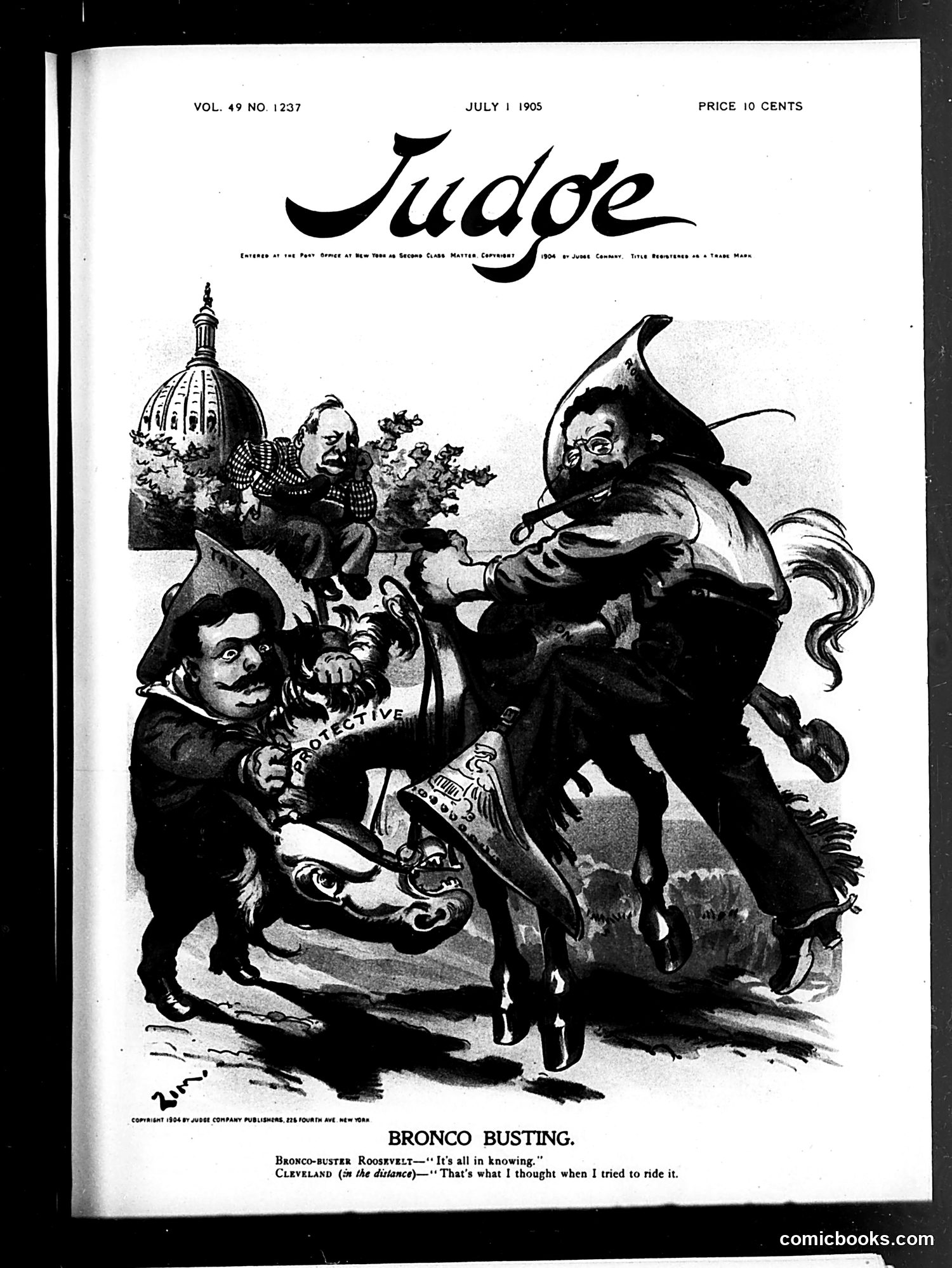
This political cartoon satirizes President Theodore Roosevelt's handling of a bucking bronco labeled "PROTECTIVE" (likely referring to protective tariffs). Roosevelt, depicted as a confident bronco buster on horseback, claims "It's all in knowing." Cleveland (shown at a distance) responds, "That's what I thought when I tried to ride it." The cartoon compares managing economic policy to breaking a wild horse. Roosevelt's boast suggests his superior skill, while the Cleveland reference (likely former President Grover Cleveland) implies even he underestimated the difficulty. The Capitol dome in background emphasizes the political stakes. The satire mocks Roosevelt's confidence in controlling complex economic forces through willpower and expertise alone.
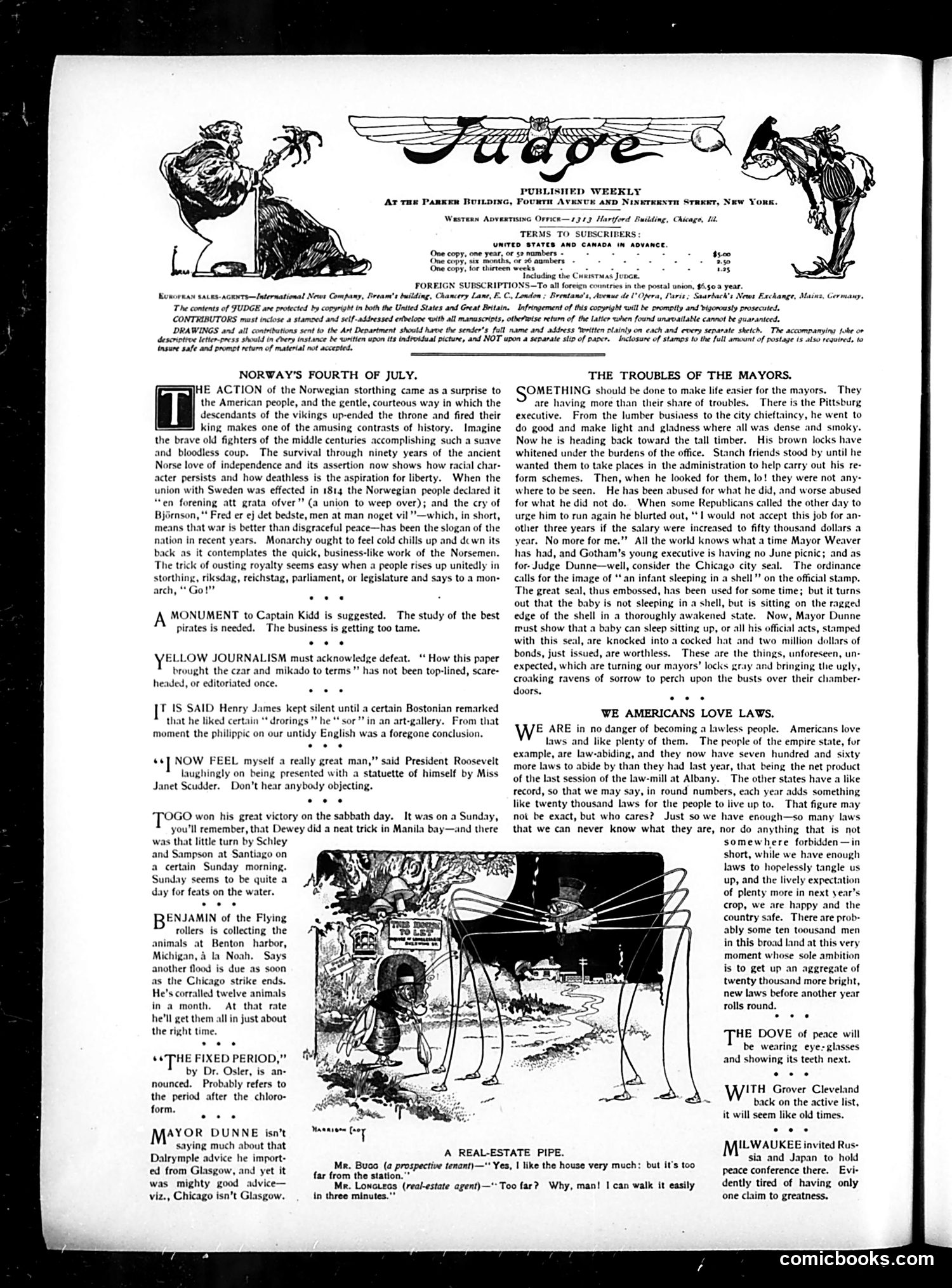
This satirical piece mocks urban mayors struggling with civic problems. The text references **Mayor Dunne** (likely of Chicago, given the Chicago strike reference) and **Judge Gould**, both facing public criticism despite efforts to improve their cities. The satire targets the impossible position of mayors: they attempt reforms—better sanitation, infrastructure—yet face relentless complaints from citizens and press. The cartoon suggests mayors become scapegoats for systemic urban failures beyond their control, including labor strikes and infrastructure decay. The piece also critiques **yellow journalism**, accusing newspapers of sensationalism ("How this paper 'freighted the cart and mickade to terms'"). Overall, it satirizes both incompetent or unlucky municipal leadership and the media's role in amplifying mayoral failures for entertainment value.
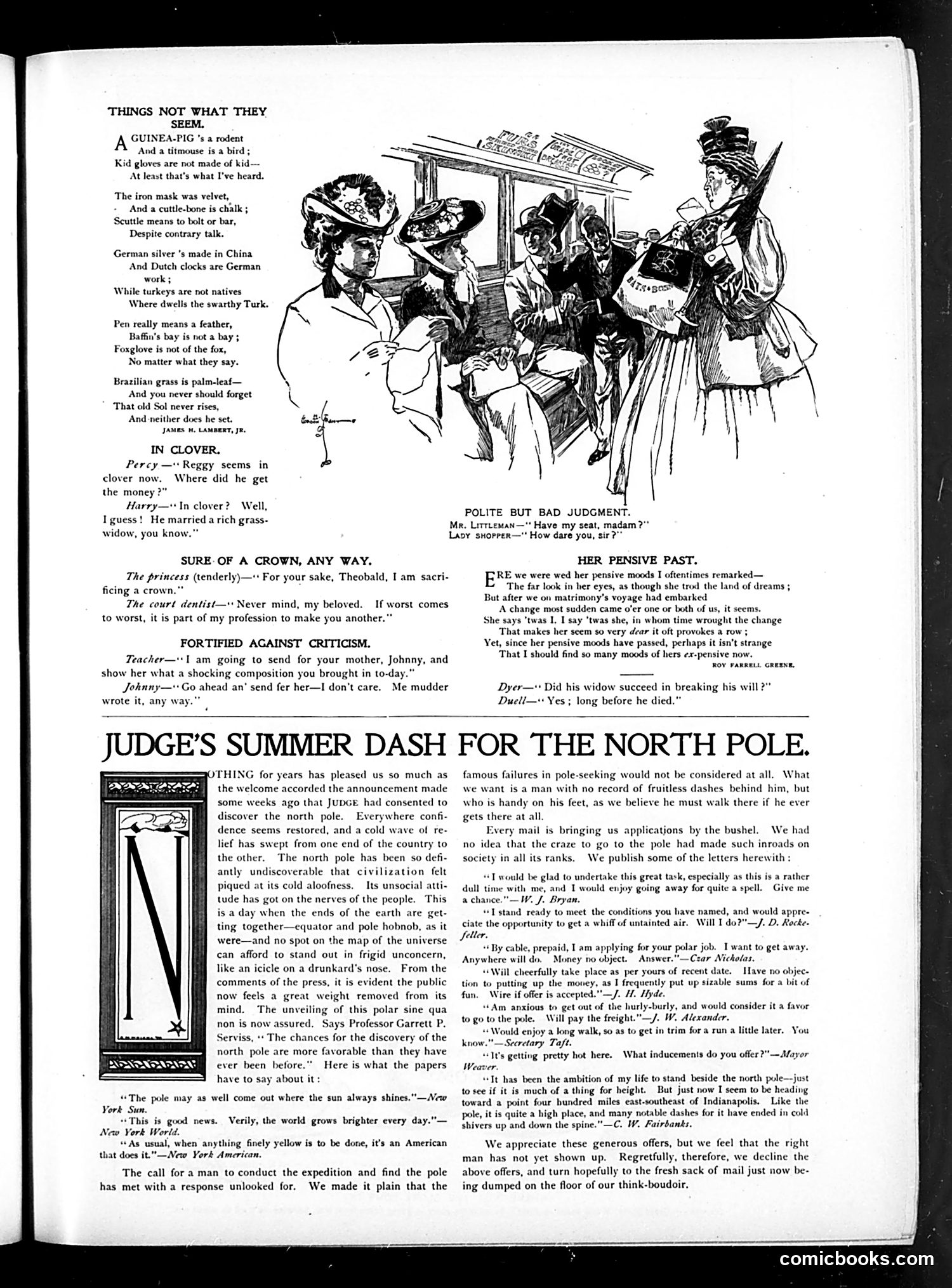
The main feature is "Judge's Summer Dash for the North Pole," satirizing enthusiasm for polar exploration. The editorial mocks the craze for Arctic expeditions, noting that Judge had received numerous applications from society members wanting to fund a pole-seeking expedition. The magazine declines these offers, expressing skepticism about the enterprise. The text quotes various wealthy applicants offering money and resources, revealing the era's fascination with polar exploration as a status symbol among the elite. Judge's satirists critique this as frivolous fashion rather than serious scientific endeavor—poking fun at wealthy Americans' tendency to pursue expensive adventures for prestige. The smaller comic vignettes above address unrelated topics (mistaken identities, social awkwardness), typical of the magazine's miscellaneous humor format.
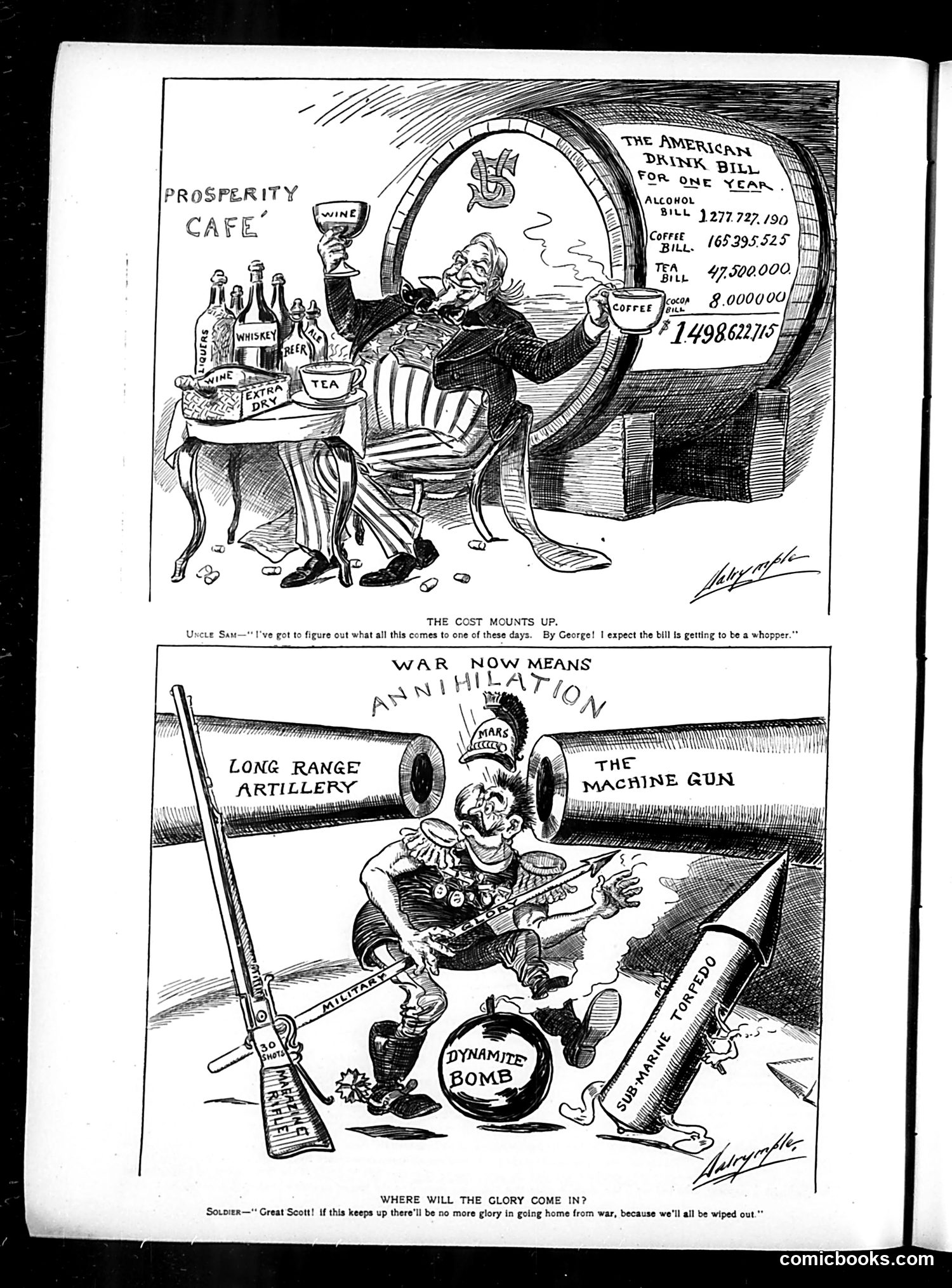
**Top Cartoon - "The Cost Mounts Up":** Uncle Sam sits at a "Prosperity Cafe," surrounded by bottles of alcohol, wine, and tea. He examines an enormous bill totaling nearly 1.5 billion dollars, breaking down costs for alcohol, coffee, tea, and cocoa. The satire criticizes American wartime spending and consumption habits, suggesting that while prosecuting war, the nation indulges in luxuries. Uncle Sam expresses shock that "the bill is getting to be a whopper." **Bottom Cartoon - "War Now Means Annihilation":** A caricatured enemy soldier sits surrounded by modern weapons: long-range artillery, machine guns, dynamite bombs, and submarine torpedoes. The caption suggests that modern warfare offers no "glory"—only mutual destruction, making traditional concepts of victory hollow. Both cartoons critique war's true costs: financial excess and technological brutality.
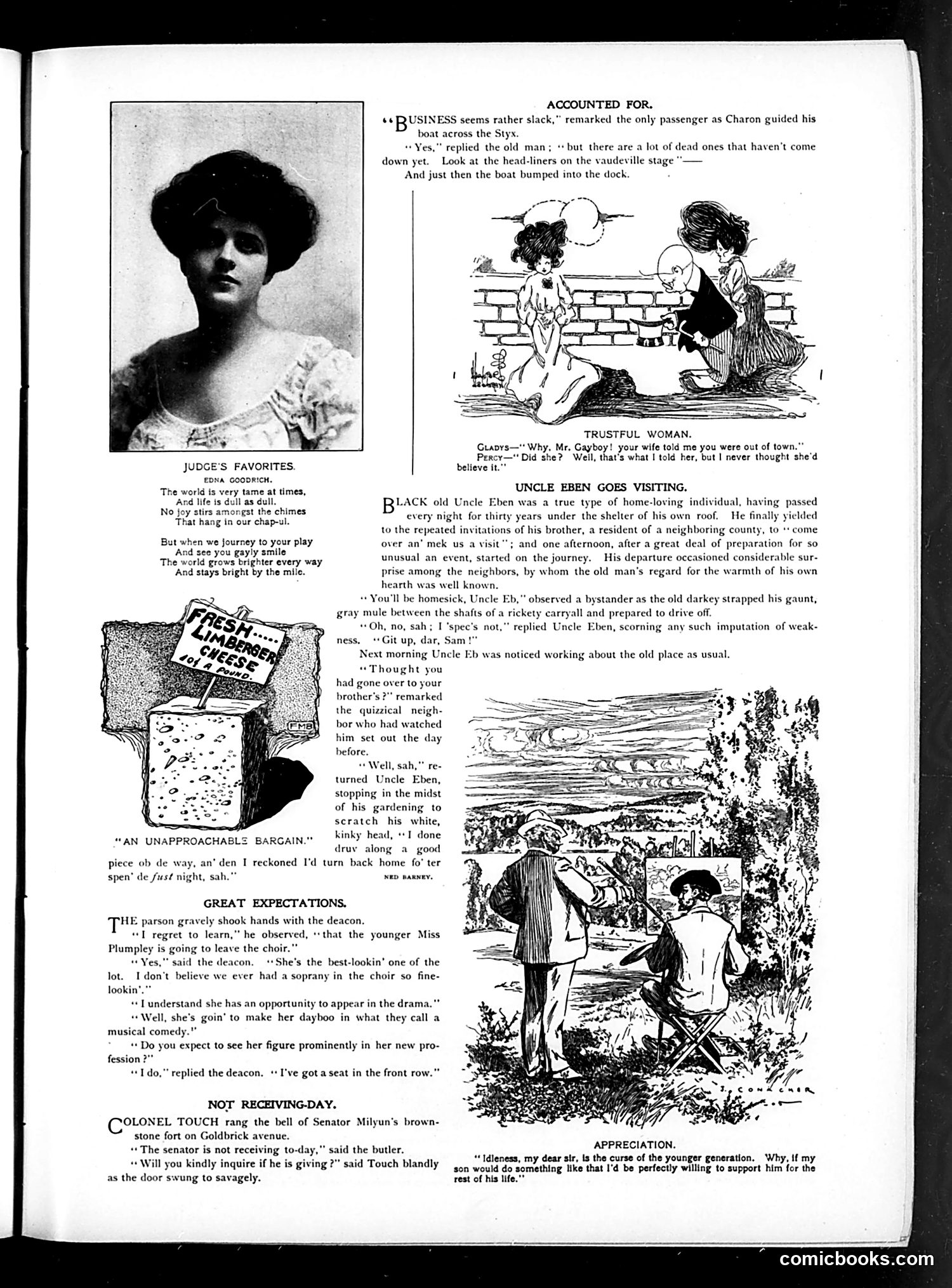
This page contains multiple short satirical pieces typical of early 20th-century American humor magazines: **"Accounted For"** jokes that vaudeville performers are so talentless they're "dead" (metaphorically), explaining why business is slow for Charon (the ferryman of the dead in Greek mythology). **"Trustful Woman"** mocks marital infidelity—a husband lies about being out of town, and his wife naively believes him despite apparently seeing through the deception. **"Uncle Eben Goes Visiting"** uses racial stereotypes common to the era, depicting an elderly Black man too homesick to complete a visit, leaving after the first day. **"Great Expectations"** satirizes a deacon's hypocrisy: he regrets losing a choir singer to theatrical work, yet eagerly attends her debut—valuing her appearance over her musical talent. **"Not Receiving Day"** puns on "receiving" (visiting hours) versus "giving" (charity), mocking a wealthy senator's sudden unavailability when asked for money. The page emphasizes period humor about infidelity, class pretension, and social hypocrisy.
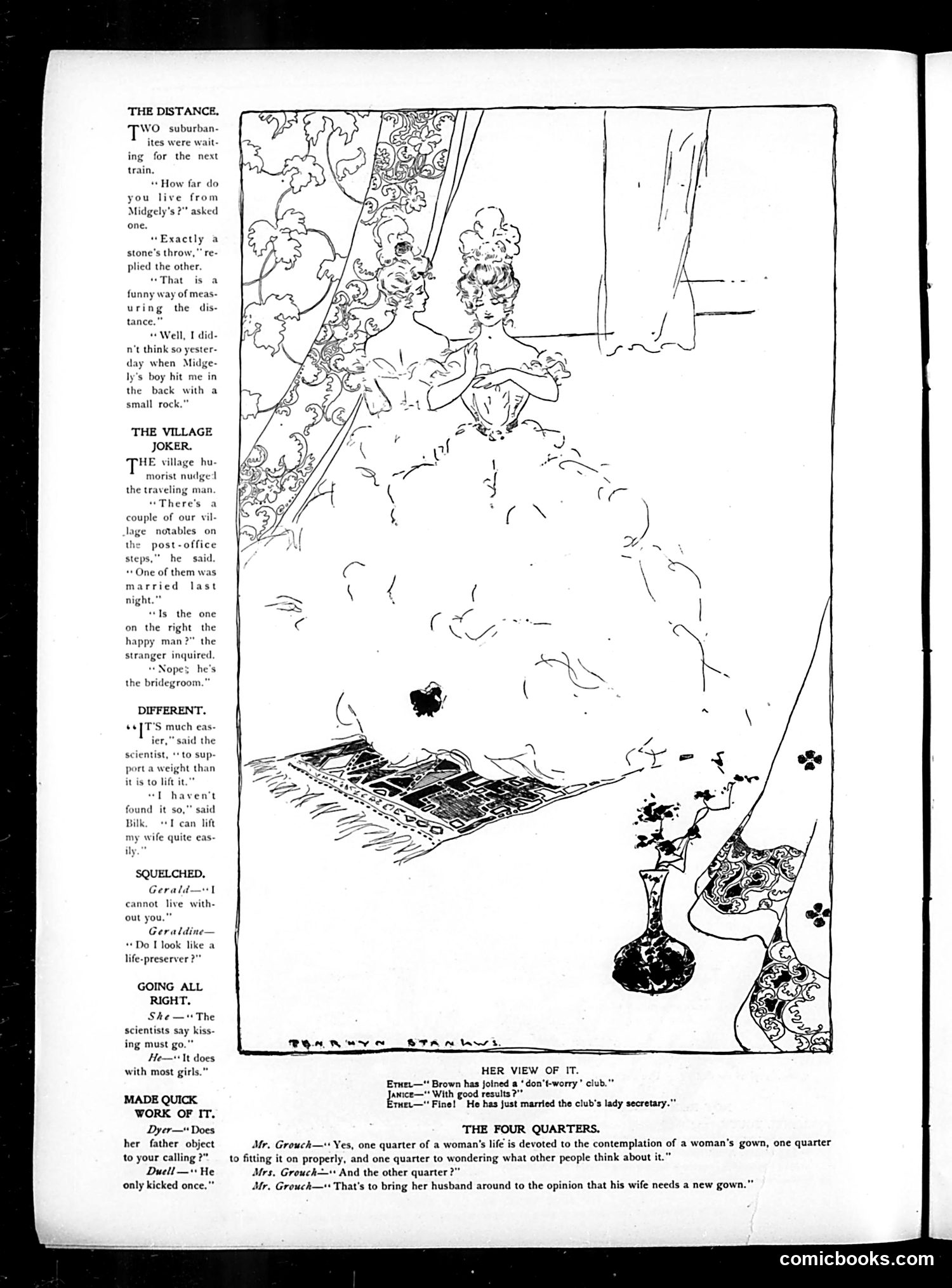
This page contains multiple short humorous vignettes satirizing early 20th-century social customs and gender relations: **"The Distance"** and **"The Village Joker"** are gentle neighborhood humor about suburban life and small-town gossip. **"Different"** jokes about a scientist's theory being contradicted by everyday experience—specifically a man easily lifting his wife, inverting the expected strength hierarchy. **"Squelched"** presents a rejected suitor being sardonically compared to a life preserver—suggesting his romantic utility rather than genuine appeal. **"Going All Right"** mocks scientific pronouncements about romance with cynical male observation. **"The Four Quarters"** and the bottom dialogue are the page's main satire: critiquing women's supposed obsession with clothing and appearance. The husband's four-part breakdown reduces women's lives to gown contemplation, fitting, social anxiety about fashion, and manipulating husbands into buying new clothes—reflecting period stereotypes about feminine vanity and materialism while positioning men as reluctant providers. The humor targets both genders' perceived failings within marriage and social hierarchies.
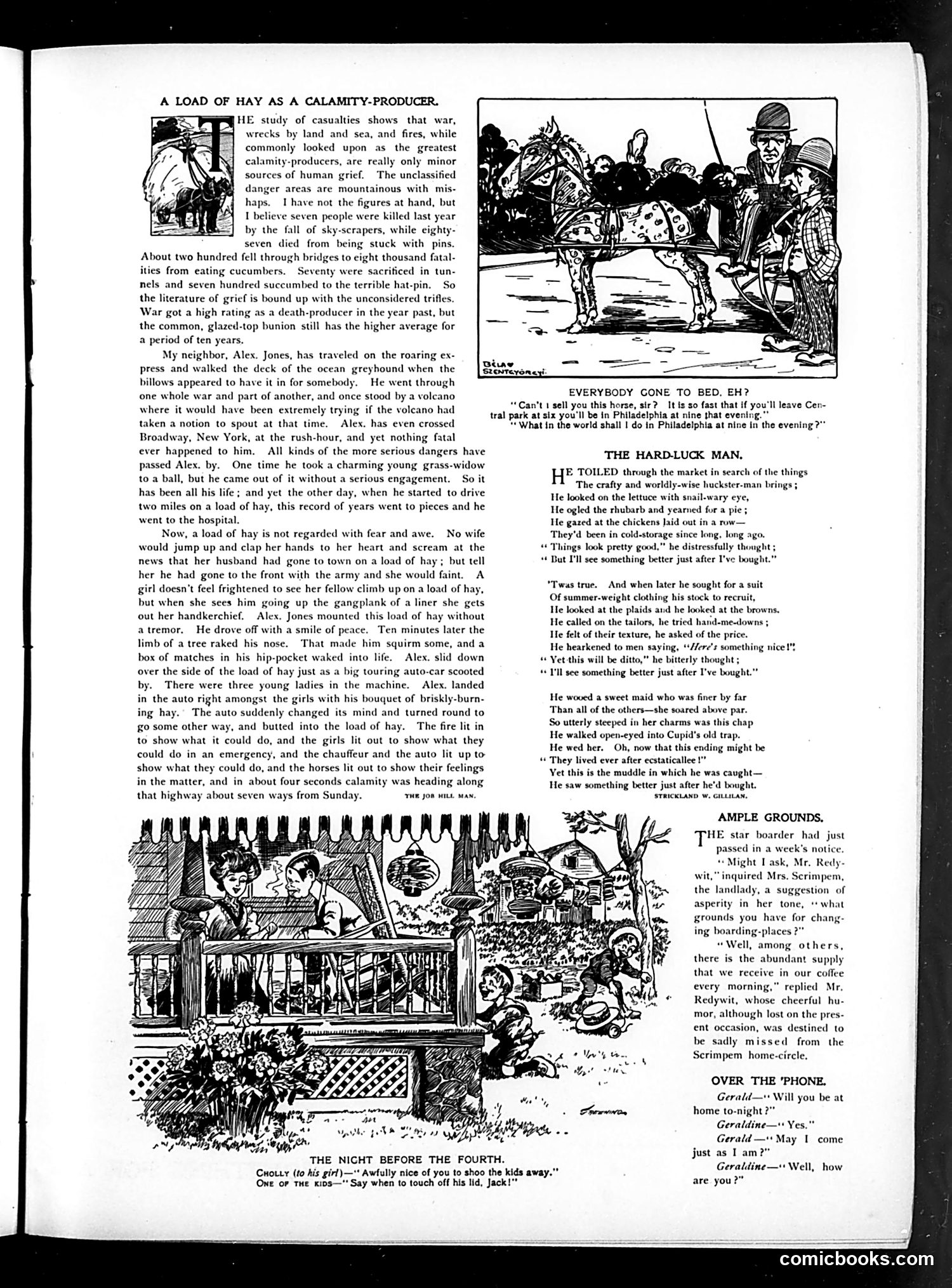
This humorous piece satirizes society's disproportionate fear of dramatic dangers while ignoring mundane ones. The article ironically catalogs minor, everyday hazards—hat pins, cucumbers, bunions—as actually deadlier than wars and disasters. The central joke concerns Alex Jones, a man who survived war, volcanoes, and Broadway traffic unscathed, yet gets seriously injured simply by driving a hay wagon. A tree branch scratches his nose, causing matches in his pocket to ignite. The resulting fire creates chaos—the burning hay frightens a passing automobile full of women, leading to collisions and mayhem. The satire mocks how people's risk perception is inverted: a woman would faint hearing her husband went to war, but wouldn't worry about hay. Yet ordinary circumstances prove most dangerous. The piece pokes fun at both human irrationality and the unpredictability of everyday life.
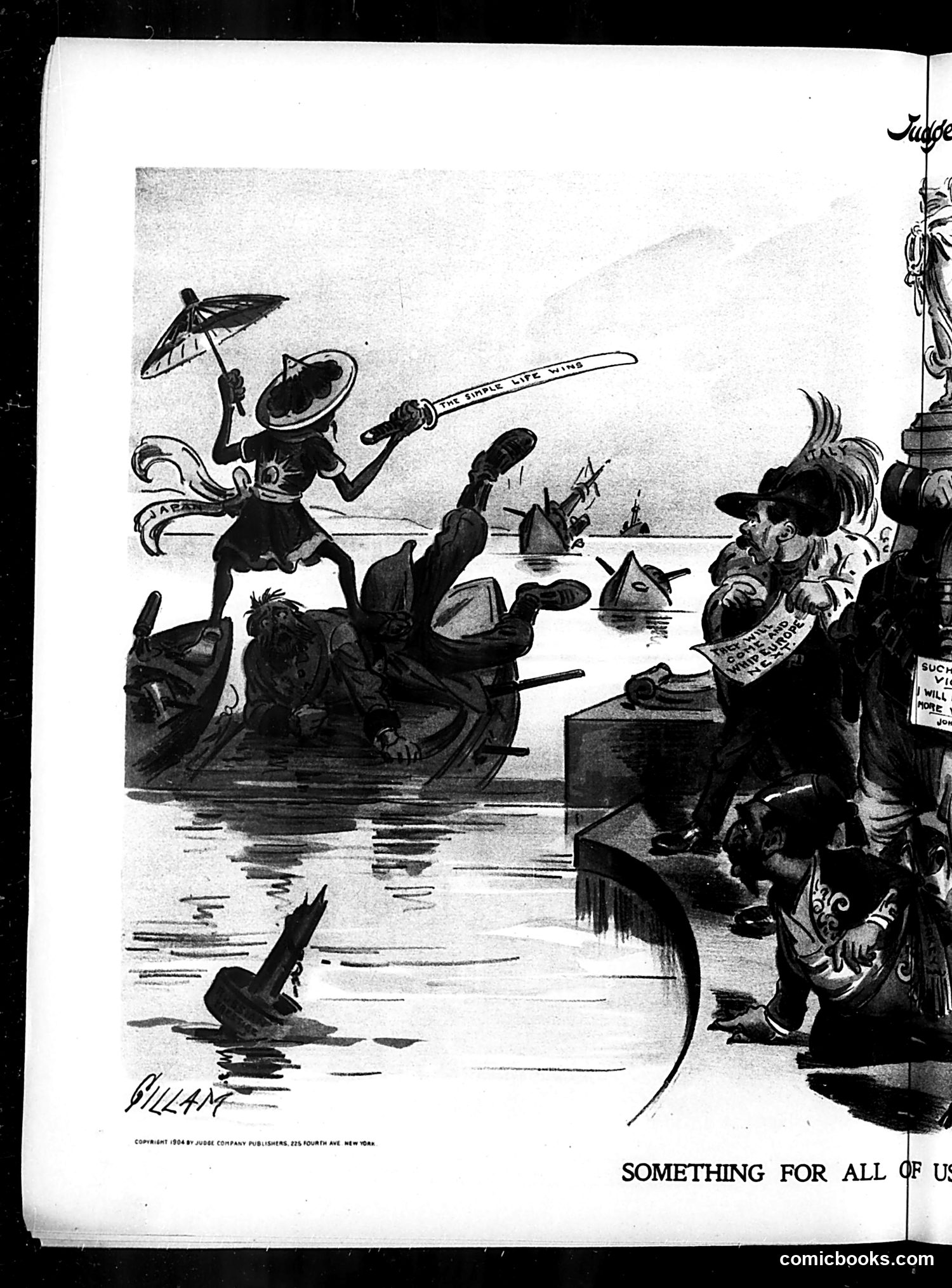
This political cartoon by Cesare Viviani depicts a satirical water scene with the caption "SOMETHING FOR ALL OF US." The image shows figures in water—some appear to be drowning or struggling, while others on shore observe. One figure holds an umbrella marked "THE SIMPLE LIFE WINS," suggesting ironic commentary on wealth or class disparities. The cartoon likely critiques economic inequality or social conditions of its era. The drowning figures may represent struggling workers or the poor, while the well-dressed observers on shore suggest the wealthy or privileged classes. The "simple life wins" phrase appears mockingly placed, suggesting that while some prosper, others suffer—hence "something for all of us" as bitter satire. Without knowing the specific publication date, the exact political context remains unclear, though the imagery strongly suggests commentary on class division.
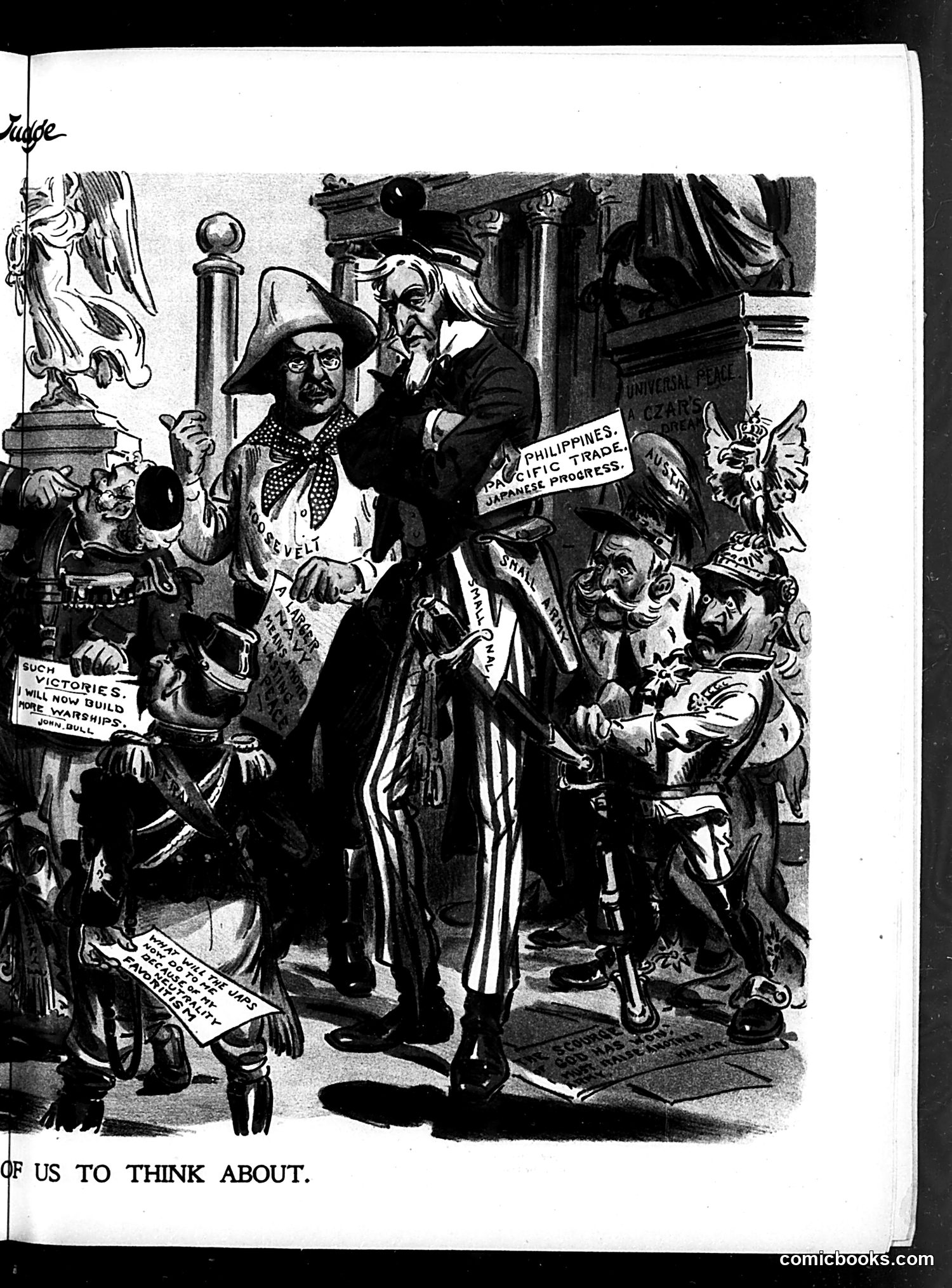
This Judge magazine cartoon satirizes American imperial ambitions in the Philippines. The central figure appears to be Uncle Sam (identifiable by the striped trousers and top hat), surrounded by caricatured figures representing various nations or interests. Visible text references "Philippines, Race, Trade, Japanese Progress" and "Such Victories as Now Build More Warships." The cartoon mocks the contradiction between America's stated peaceful intentions ("Universal Peace") and its actual military expansion—building warships while claiming to pursue progress in the Philippines. The grotesque surrounding figures likely represent competing imperial powers or domestic political opposition. The satire suggests that American involvement in the Philippines involves contradictions between stated ideals and militaristic reality that citizens should "think about."
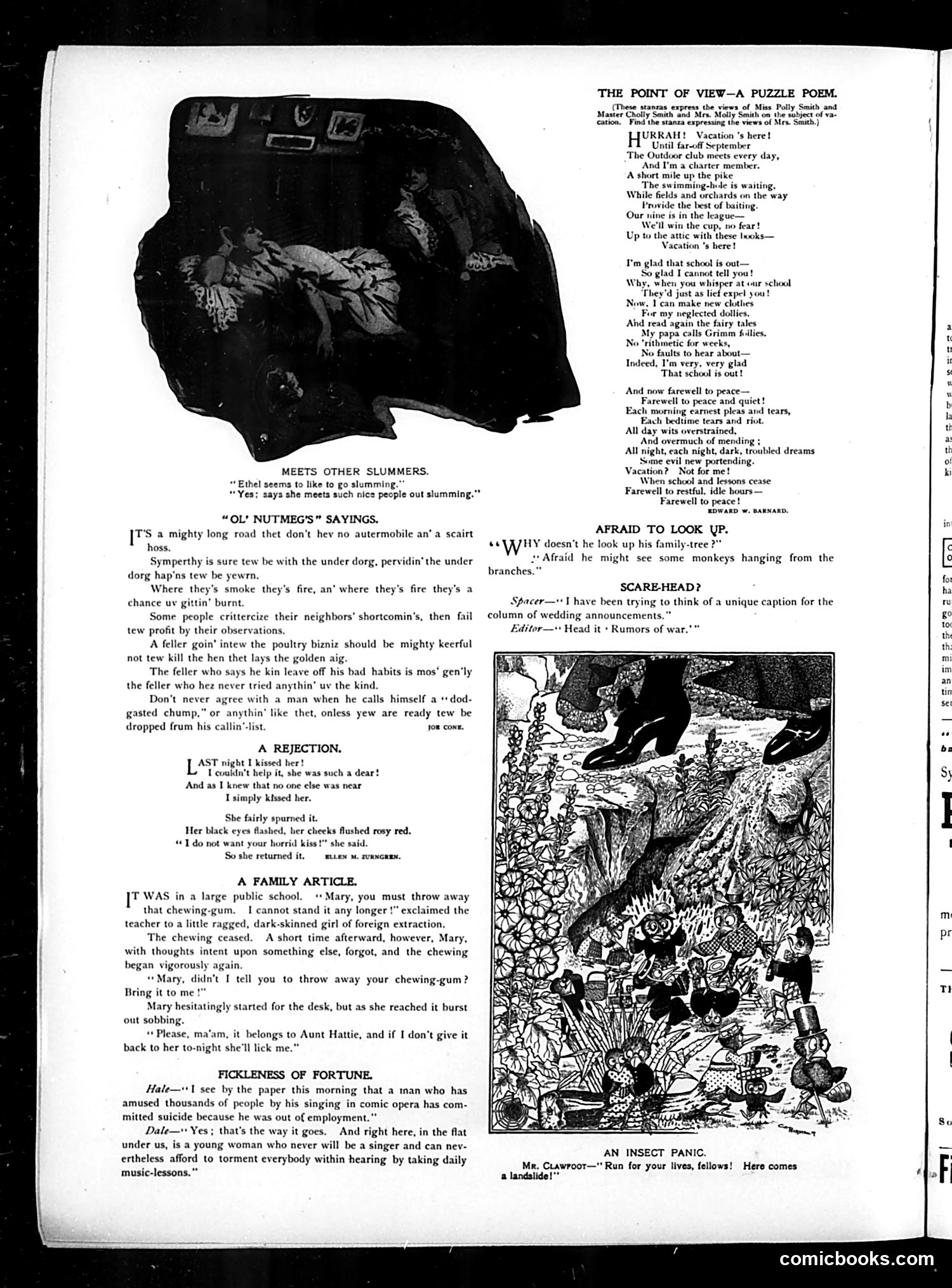
This page contains several satirical pieces typical of early 20th-century American humor: **"Meets Other Slummers"** mocks wealthy people ("Ethel") who visit poor neighborhoods as entertainment, finding the poor quaint rather than recognizing systemic inequality. **"Ol' Nutmeg's Sayings"** offers folksy rural wisdom in dialect, a common Judge feature—homespun philosophy about sympathy, hypocrisy, and self-knowledge. **"A Rejection"** is a light romantic poem about a spurned kiss. **"A Family Article"** satirizes class prejudice: a teacher shames a poor immigrant girl for chewing gum, not understanding the child's economic desperation—she must return it to her aunt. **"The Point of View—A Puzzle Poem"** contrasts children's summer vacation excitement with a mother's exhaustion managing them (implied rather than stated). **"Afraid to Look Up"** is a brief joke about someone avoiding genealogical research, likely implying embarrassing family background. The illustrated cartoon **"An Insect Panic"** depicts comical chaos among insects fleeing a approaching landslide—visual humor without political content.
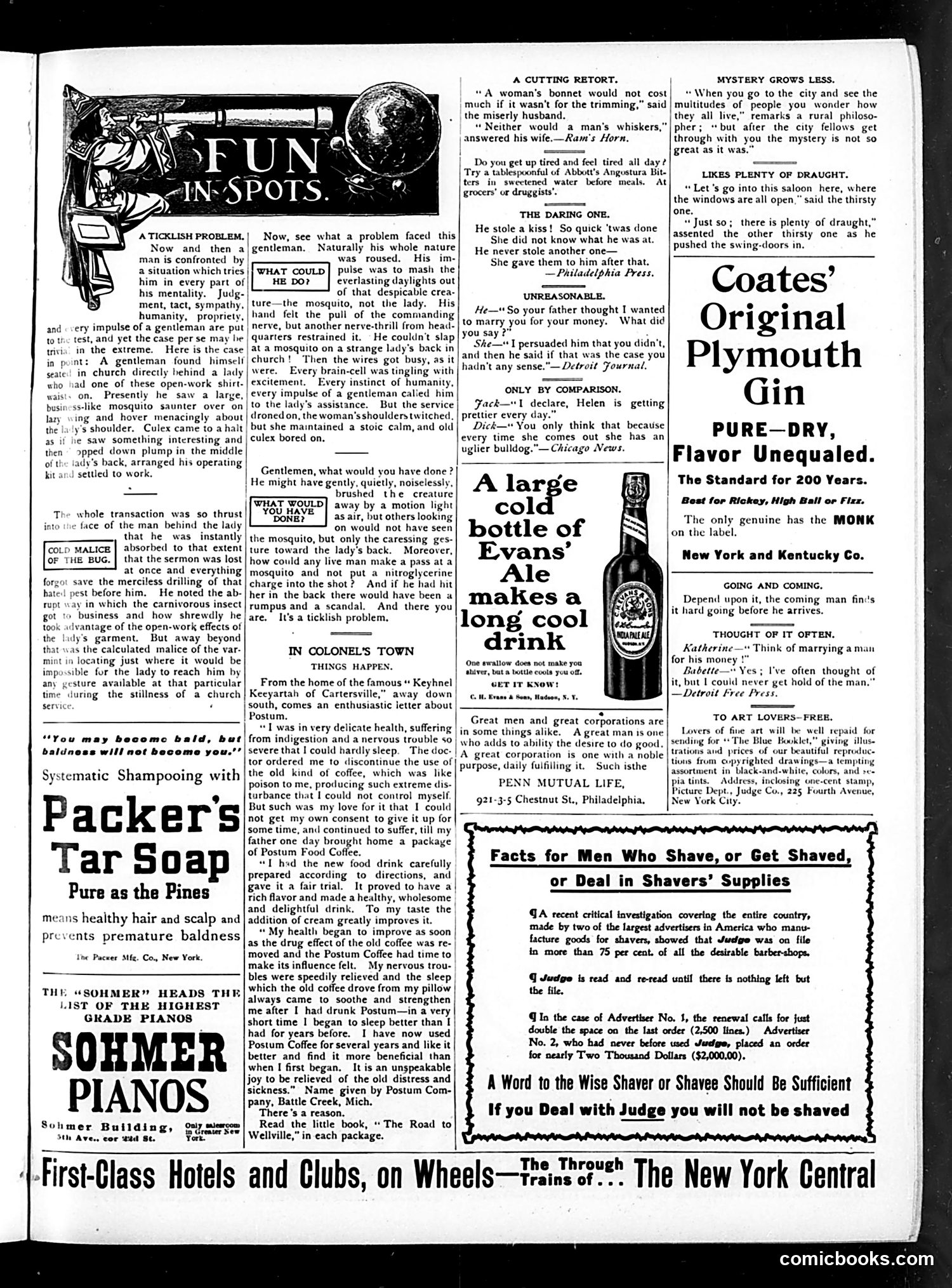
This cartoon satirizes the impossible social constraints placed on gentlemen in early 20th-century society. A man sits behind a woman in church and notices a mosquito landing on her bare shoulder (visible through her open-work dress). **The dilemma:** He wants to help by swatting the insect, but cannot touch a strange woman's back without causing scandal. Any gesture could be misinterpreted as improper touching. He's paralyzed by competing impulses—gentlemanly duty to assist versus propriety that forbids physical contact with an unrelated woman in public. **The satire's point:** The cartoon mocks the absurd rigidity of Victorian/Edwardian social codes that created impossible situations. A simple, helpful act becomes unthinkable because of strict etiquette governing male-female interaction. The joke highlights how these social rules were sometimes more important than practical human decency, leaving everyone—including the woman being bitten—suffering in silence.
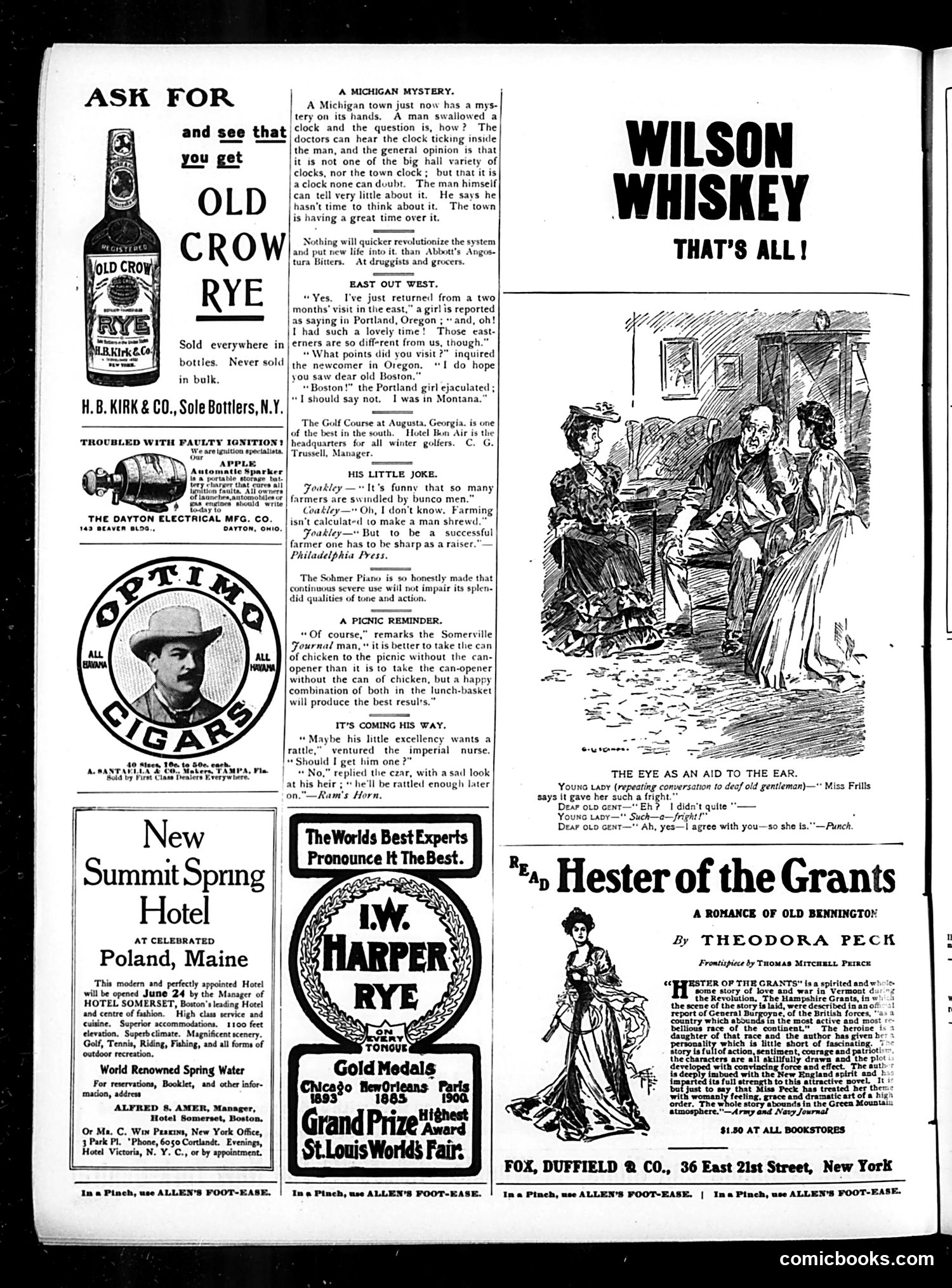
This page from *Judge* magazine is primarily **advertising with occasional humor pieces and jokes** rather than political satire. The advertisements promote whiskey, rye, hotels, and pianos—typical turn-of-the-century products. The main cartoon ("The Eye as an Aid to the Ear") is a simple visual gag: a deaf elderly man misinterprets a young woman's lip-reading attempts, mishearing "fright" as agreement with her statement. Other content includes brief anecdotes poking fun at regional differences (an Oregon girl claiming to visit "Montana" instead of Boston), farming, and a dark joke about the Russian Czar expecting his child to be "rattled" (troubled) later in life—likely referencing contemporary anxieties about Russian autocracy and unrest. The "Michigan Mystery" describes a man who swallowed a clock, a surreal premise presented as factual news, illustrating how early *Judge* blended absurdist humor with current events. Overall, the page reflects early 1900s popular humor: genteel, punning, and focused on domestic comedy rather than sharp political critique.
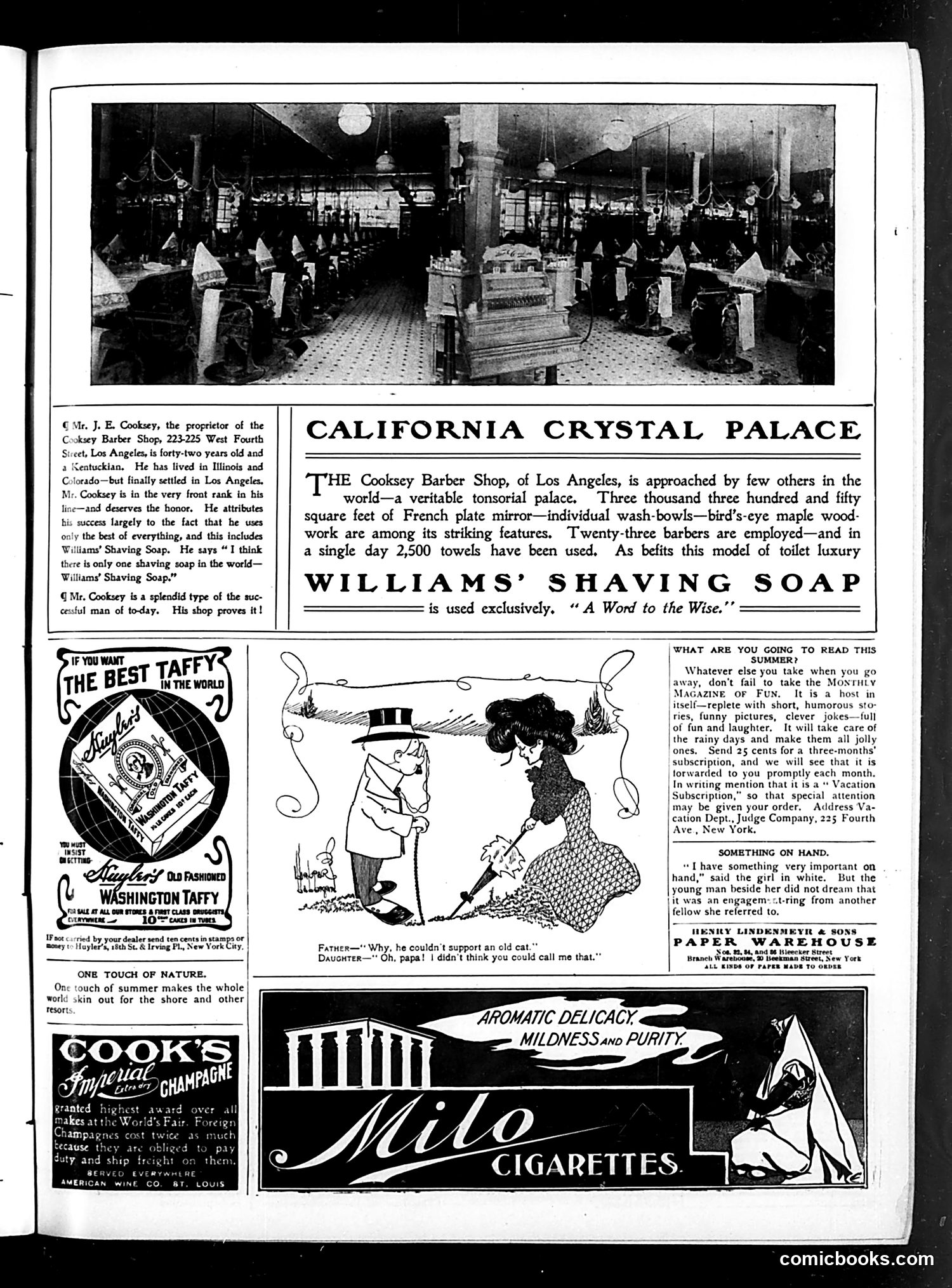
This small cartoon presents a domestic joke playing on Victorian propriety and courtship conventions. A father disapproves of his daughter's suitor, dismissing him as unable to "support an old cat"—meaning he's financially worthless. The daughter responds indignantly: "Oh, papa! I didn't think you could call me that." The humor relies on a double meaning: she interprets his comment as him calling *her* an "old cat" (an insult to women, particularly regarding appearance or temperament), when he was actually criticizing the suitor's poverty. The joke satirizes both paternal gatekeeping of daughters' romantic choices and the thin-skinned vanity of young women quick to take offense at perceived slights to their own status. The page is primarily advertising (Williams' Shaving Soap, Milo Cigarettes, Cook's Champagne, etc.) with this single cartoon as filler content—typical for Judge magazine of this era.
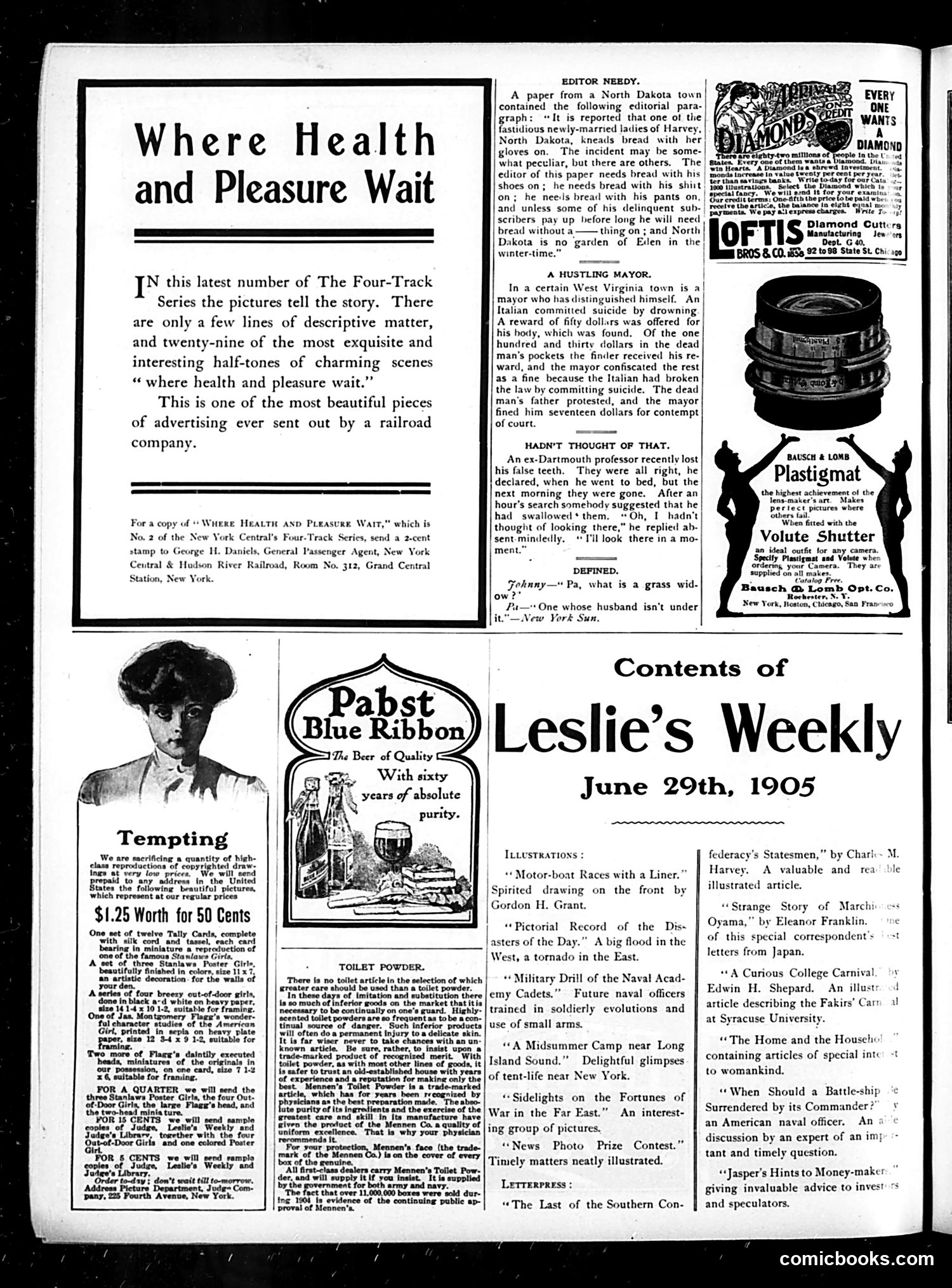
This page from Leslie's Weekly (June 29, 1905) contains mostly advertisements and brief humorous editorial anecdotes rather than political cartoons. The "Editor Needy" section satirizes rural hardship through exaggerated complaints: a North Dakota newspaper editor claims he'll soon need bread "without a—— thing on" (naked) due to unpaid subscriptions. "A Hustling Mayor" mocks corrupt small-town governance: a West Virginia mayor confiscates money from a drowned Italian suicide victim's body and fines the victim's father for protesting—treating suicide as a punishable crime. "Hadn't Thought of That" is a joke about an absent-minded ex-professor who lost his dentures and hadn't considered he might have swallowed them. The main content is advertisement for the New York Central Railroad's "Where Health and Pleasure Wait" promotional booklet, described as "one of the most beautiful pieces of advertising ever sent out by a railroad company."
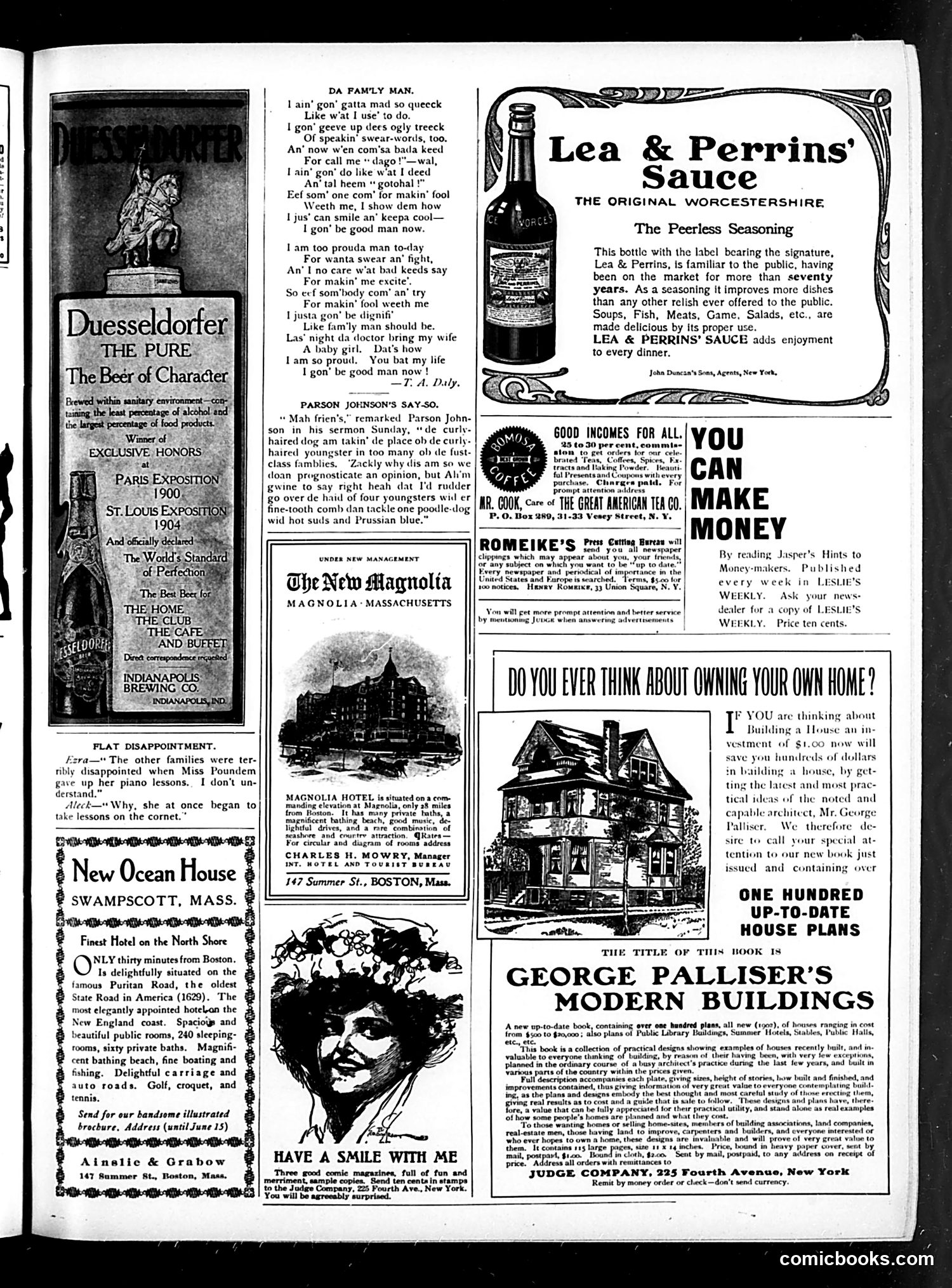
This page mixes satirical humor with period advertisements. The main cartoon is "Da Fam'ly Man" by T.A. Daly, written in exaggerated Italian-immigrant dialect. It depicts an Italian immigrant pledging to reform his behavior—abandoning swearing and fighting—now that he's become a father. The satire likely plays on contemporary stereotypes of Italian immigrants as hot-tempered and prone to violence, while ironically showing the character's desire for respectability through fatherhood. "Parson Johnson's Say-So" uses racist dialect to present a Black preacher commenting on wealthy families replacing children with poodle dogs—social commentary on class priorities disguised as folk wisdom. The page otherwise consists of hotel advertisements (New Ocean House, Magnolia Hotel), product ads (Lea & Perrins sauce, house-building plans), and other period promotions. The ethnic caricatures reflect common Judge magazine practices of the era.
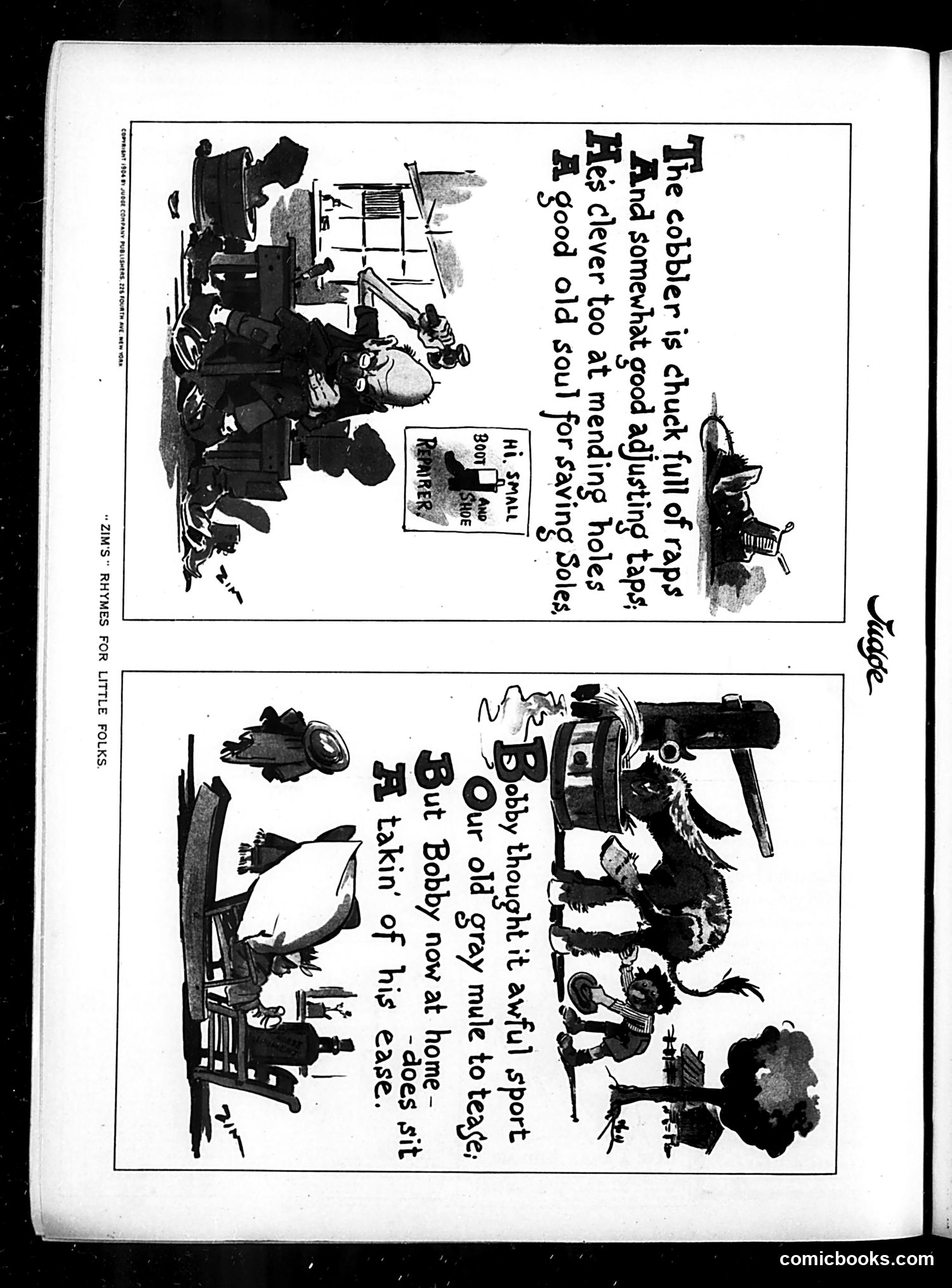
This appears to be a children's nursery rhyme page titled "Zim's Rhymes for Little Folks" rather than political satire. The page contains two illustrated verses: The top panel depicts a cobbler at work, with text praising his skill at mending shoes and "saving soles" (a pun on "souls"). The bottom panel shows a boy named Bobby teasing a gray mule, with the rhyme describing how Bobby thought tormenting the animal was sport, but now stays home nursing an injury—presumably kicked by the mule as comeuppance. This is lighthearted, moralistic children's content teaching lessons about hard work (the cobbler) and consequences for cruelty (Bobby's injury). It's not political commentary but rather wholesome Victorian-era verse with gentle humor.