
Judge, 1905-07-01 · page 7 of 16
Judge — July 1, 1905 — page 7: what you’re looking at
What you’re looking at
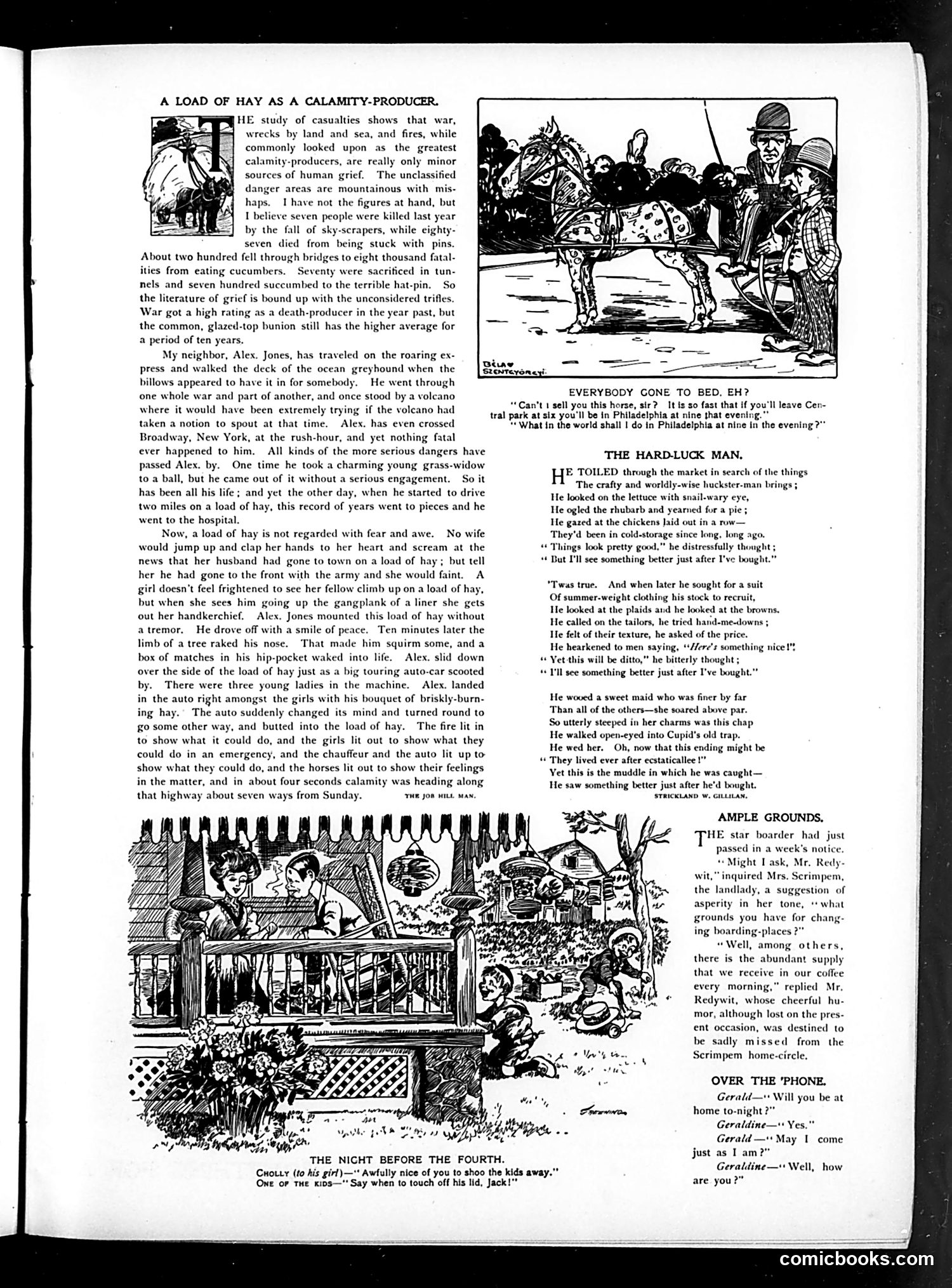
This humorous piece satirizes society's disproportionate fear of dramatic dangers while ignoring mundane ones. The article ironically catalogs minor, everyday hazards—hat pins, cucumbers, bunions—as actually deadlier than wars and disasters. The central joke concerns Alex Jones, a man who survived war, volcanoes, and Broadway traffic unscathed, yet gets seriously injured simply by driving a hay wagon. A tree branch scratches his nose, causing matches in his pocket to ignite. The resulting fire creates chaos—the burning hay frightens a passing automobile full of women, leading to collisions and mayhem. The satire mocks how people's risk perception is inverted: a woman would faint hearing her husband went to war, but wouldn't worry about hay. Yet ordinary circumstances prove most dangerous. The piece pokes fun at both human irrationality and the unpredictability of everyday life.
📄 Transcribed text from this page (OCR, searchable)
Machine-transcribed from the original scan — historical spelling and the odd misread are preserved.
A LOAD OF HAY AS A CALAMITY-PRODUCER. HE study of casualties shows that war, wrecks by land and sea, and fires, while commonly looked upon as the greatest producers, are really only minor of human grief. The unclassified f areas are mountainous with mis- haps. I have not the figures at hand, but I believe seven people were killed last year by the fall of sky-scrapers, while eighty- seven died from being stuck with pins. About two hundred fell through bridges to eight thousand fatal- ities from eating cucumbers. Seventy were sacrificed in tun- nels and seven hundred succumbed to the terrible hat-pin. So the literature of grief is bound up with the unconsidered trifles. War got a high rating as a death-producer in the year past, but the common, glazed-top bunion still has the higher average for a period of ten years. My neighbor, Alex. Jones, has traveled on the roaring ex- press and walked the deck of the ocean greyhound when the billows appeared to have it in for somebody. He went through one whole war and part of another, and once stood by a volcano where it would have been extremely trying if the volcano had taken a notion to spout at that time. Alex. has even crossed Broadway, New York, at the rush-hour, and yet nothing fatal ever happened to him. All kinds of the more serious dangers have passed Alex. by. One time he took a charming young grass-widow to a ball, but he came out of it without a serious engagement. So it has been all his life; and yet the other day, when he started to drive two miles on a load of hay, this record of years went to pieces and he went to the hospital. Now, a load of hay is not regarded with fear and awe. No wife would jump up and clap her hands to her heart and scream at the news that her husband had gone to town on a load of hay; but tell her he had gone to the front with the army and she would faint. A girl doesn’t feel frightened to see her fellow climb up on a load of hay, but when she sees him going up the gangplank of a liner she gets out her handkerchief, Alex. Jones mounted this load of hay without a tremor. He drove off with a smile of peace. Ten minutes later the limb of a tree raked his nose. That made him squirm some, and a box of matches in his hip-pocket waked into life. Alex. slid down over the side of the load of hay just as a big touring auto-car scooted by. There were three young ladies in the machine. Alex. landed in the auto right amongst the girls with his bouquet of briskly-burn- ing hay.’ The auto suddenly changed its mind and turned round to go some other way, and butted into the load of hay. The fire lit in to show what it could do, and the girls lit out to show what they could do in an emergency, and the chauffeur and the auto lit up to show what they could do, and the horses lit out to show their feelings in the matter, and in about four seconds calamity was heading along that highway about seven ways from Sunday. Twn Jon MILL Man. Wd, ZA Ga NL! WA Vida \ im THE NICHT BEFORE THE FOURTH. Crotty (to his girl)—"* Awfully nice of you to shoo the kids away.” One oF THe xips—* Say when to touch off his lid, Jack!"" “Can't 1 sell you this horse, sir? tral park at six you'll be in Philadelphia at nine that ever “What in the world shall | do in Philadelphia at nine in the evening?" EVERYBODY GONE TO BED, EH? It ts so fast that if you'll leave Cen- ‘THE HARD-LUCK MAN. HE TOILED through the market in search of the things The crafty and worldly-wise huckster-man brings ; He looked on the lettuce with snail-wary eye, He ogled the rhubarb and yearned for a pie; He gazed at the chickens Jaid out in a row— They'd been in cold-storage since long, long ago. “Things look pretty good,” he distressfully thought + But I'll see something better just after I've bought.” "Twas true. And when later he sought for a suit Of summer-weight clothing his stock to recruit, He looked at the plaids and he looked at the browns. He called on the tailors, he tried hand-me-downs ; He felt of their texture, he asked of the price. He hearkened to men saying, ‘/fere’s something nice!"! “ Vet this will be ditto,” he bitterly thought ; + T'll see something better just after I've bought.”* He woved a sweet maid who was finer by far ‘Than all of the others—she soared above par. So utterly steeped in her charms was this chap He walked open-eyed into Cupid’s old trap. He wed her. Oh, now that this ending might be “ They lived ever after ecstaticallee !” Yet this is the muddle in which he was caught— He saw something better just after he'd bought. STRICKLAND W. GILLILAN, AMPLE GROUNDS. star boarder had just passed in a week's notice. Mr. Redy- the landlady, a suggestion of asperity in her tone, + what grounds you for chang- ing boarding-places ?” “Well, among others, there is the abundant supply that we receive in our coffee every morning,” replied Mr. Redywit, whose cheerful hu- mor, although lost on the pres- ent occasion, was destined to be sadly missed from the Scrimpem home-circle. OVER THE 'PHONE. Gerald— Will you be at home to-night 2” Geraldine—“ Yes." Gerald —" May 1 come just as I am? Geraldine—" Well, how are you?" comicbooks.com