
A complete issue · 20 pages · 1904
Judge — December 10, 1904
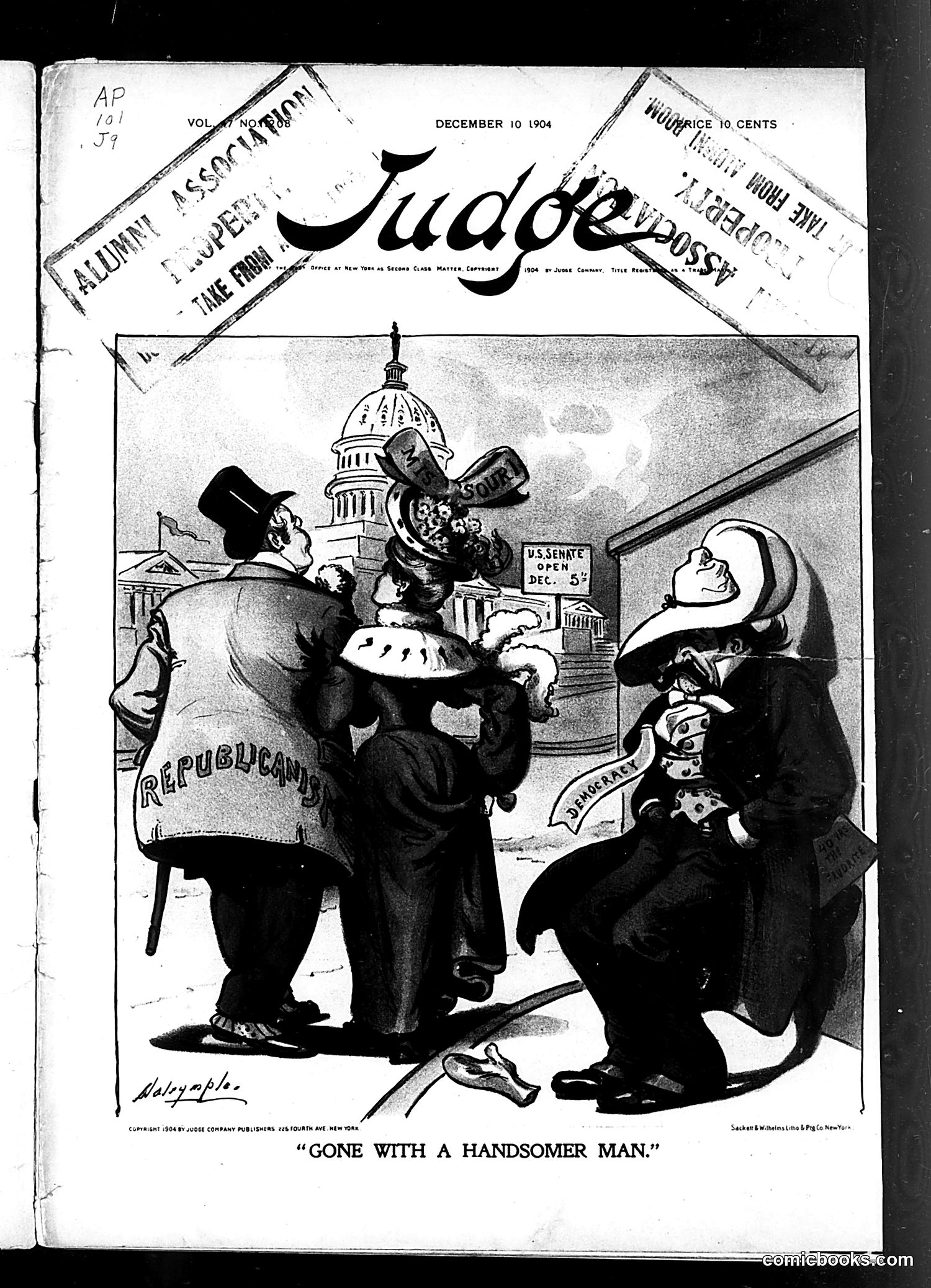
This December 10, 1904 *Judge* cartoon satirizes the U.S. Senate's opening (scheduled December 5th, visible on the sign). The central figure being carried away appears to represent a political issue or bill, while the surrounding figures likely represent Republican and Democratic parties (labeled on their clothing). The title's phrase—a play on romantic abandonment—suggests that one party has stolen away a legislative matter or priority from the other. The Capitol building in the background emphasizes the Washington political context. Without clearer identification of the specific individuals or legislative issue at stake, the exact political dispute remains unclear, but the cartoon mocks partisan competition over control of Senate proceedings and priorities.
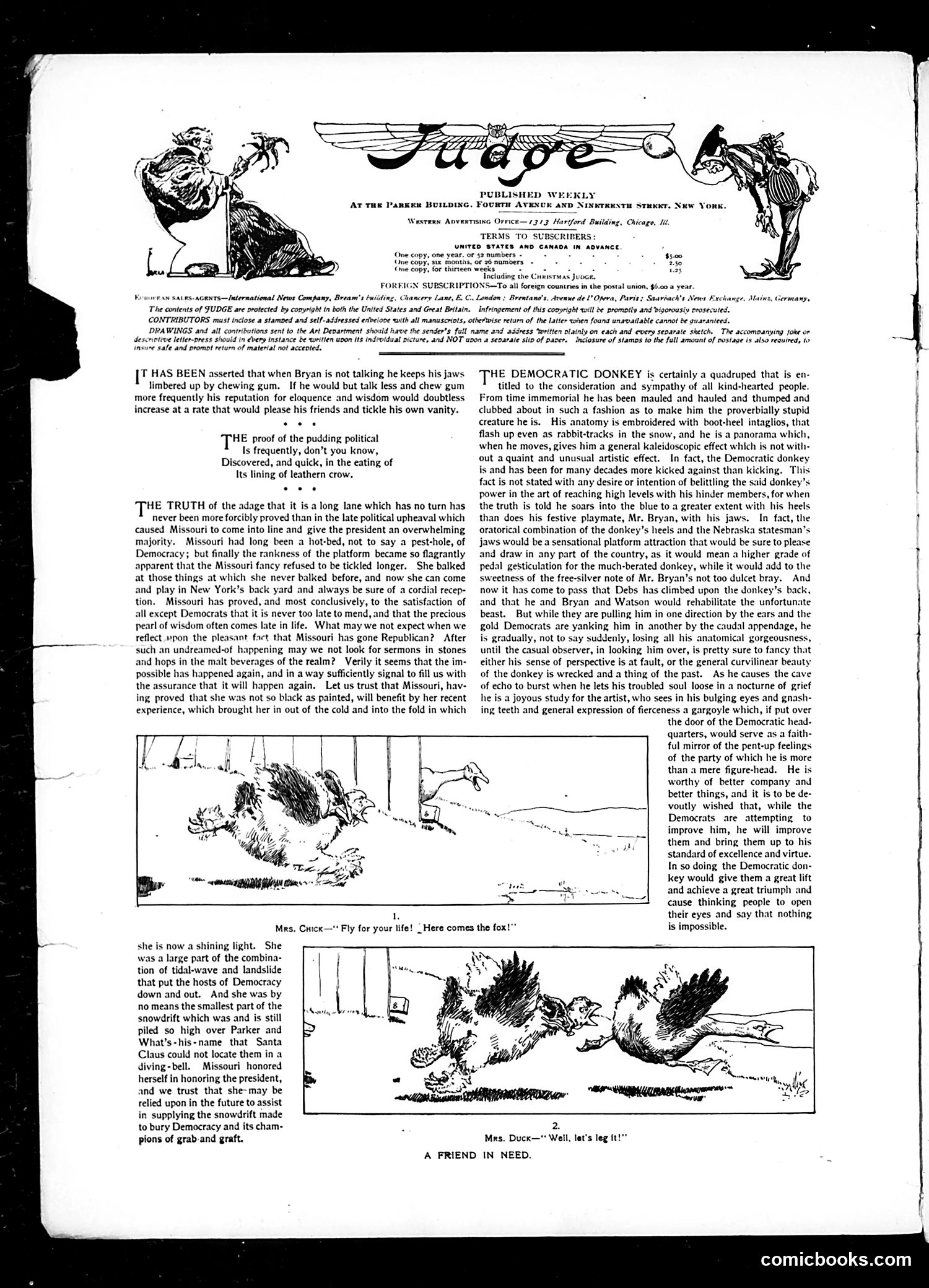
This page contains political commentary and satirical cartoons about William Jennings Bryan's 1896 presidential campaign. The main text criticizes Bryan for his speaking style and political positions, describing him as prone to exaggeration and lacking substance. The cartoons depict "The Democratic Donkey" as a stubborn, worn creature being kicked and mistreated—likely representing the Democratic Party's predicament under Bryan's leadership. The accompanying sketches show the donkey in distress with captions "Fly for your life!" and "Well, let's leg it!" The satire suggests Bryan was damaging the Democratic Party through his controversial policies (particularly free silver coinage) and his perceived lack of intellectual rigor, making him a liability rather than an asset to the party's prospects.
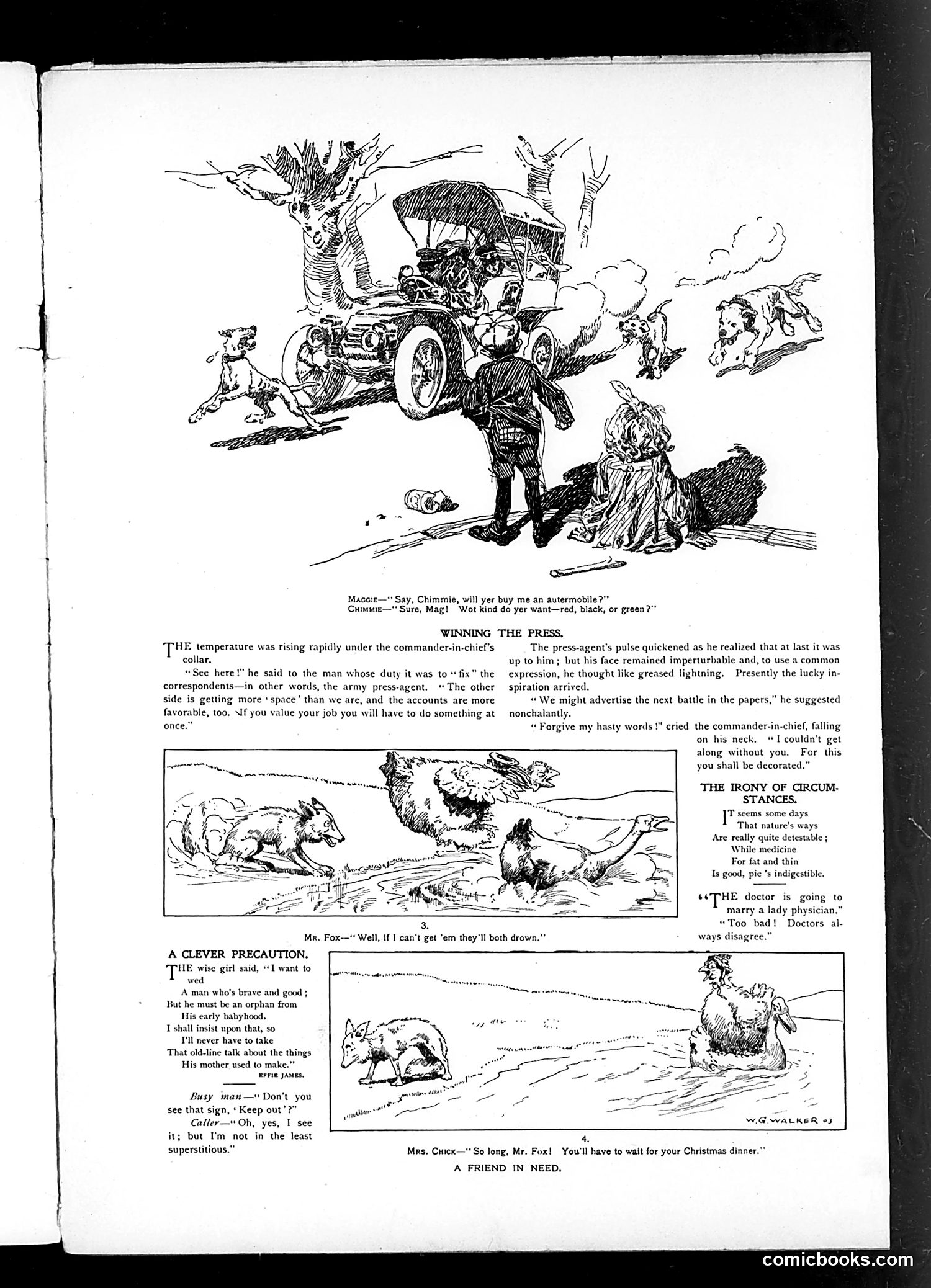
This page contains several animal-themed cartoons and comic sketches, likely from the early 20th century based on the style. **Top cartoon** ("Winning the Press"): Shows an early automobile colliding with a tree while children watch. The dialogue between "Maggie" and "Chimmie" concerns what color automobile to purchase—appears to be satirizing either early automobile dangers or consumer choices during the automobile boom. **Middle cartoons** ("A Clever Precaution," "The Irony of Circumstances"): Feature anthropomorphic animals in domestic situations, using their behaviors to comment on human nature and social conventions. **Bottom cartoon** ("A Friend in Need"): Shows a fox and hen in apparent distress, likely playing on the folk tale dynamic between predator and prey. These are primarily observational humor pieces rather than explicit political satire, focusing on everyday ironies and social absurdities.
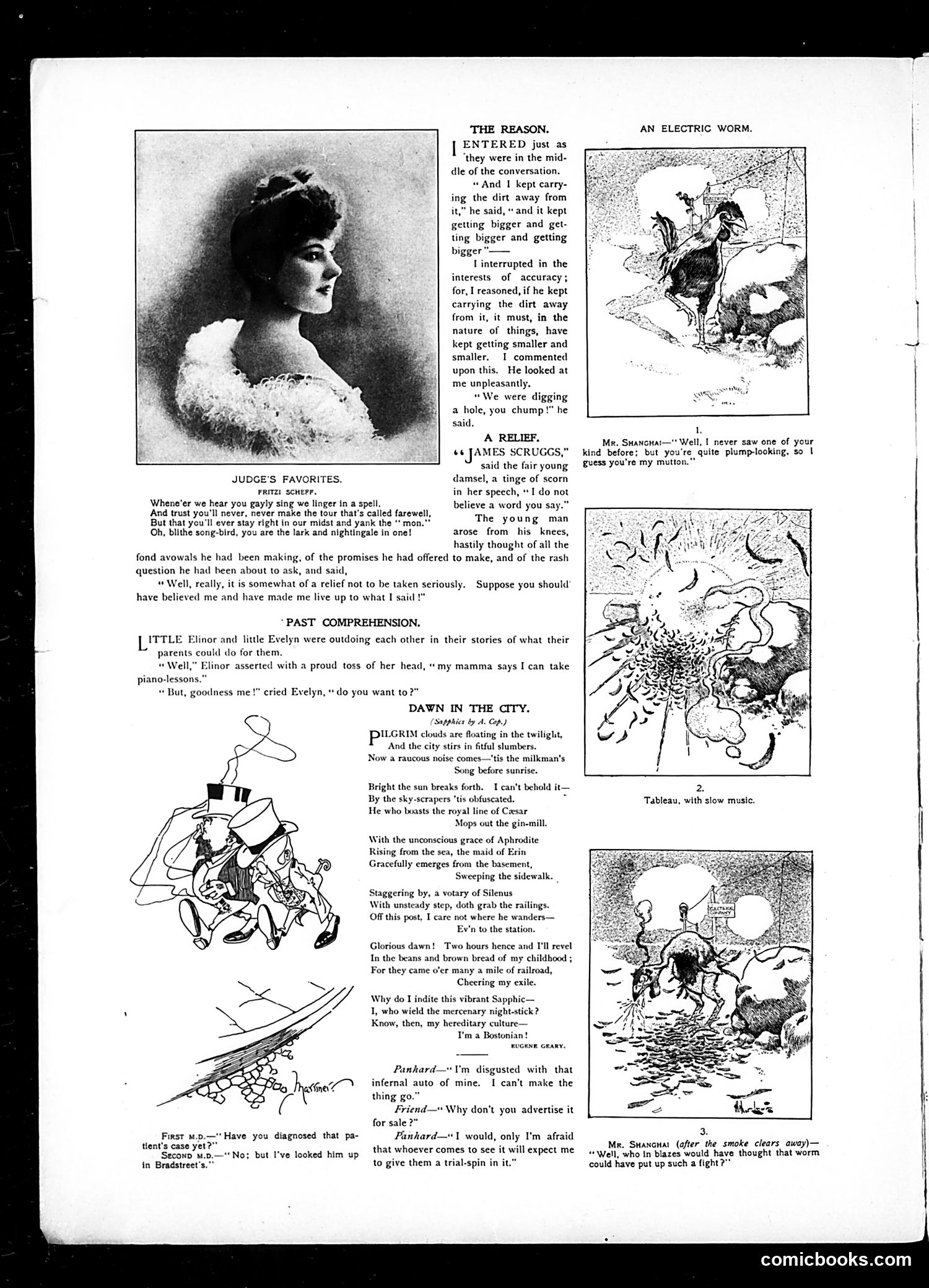
This page contains several satirical pieces and illustrations typical of early 20th-century Judge magazine: **"Judge's Favorites"** features a poem by Fried Scheef about romantic farewells, likely commenting on social conventions around courtship. **"A Relief"** depicts a young man (James Scruggs) challenged by a woman over his logic—she dismisses his reasoning about dirt getting larger or smaller as nonsensical. The satire appears to mock men's flawed reasoning when trying to impress women. **"Past Comprehension"** humorously presents children's naive logic about their parents' abilities. **"Dawn in the City"** is a poem by Rudolph Gravy celebrating urban morning life with references to milkmen, sky-scrapers, and trains. The scattered illustrations include satirical drawings of urban scenes and a humorous sketch of well-dressed figures, typical of Judge's social commentary on contemporary American life.
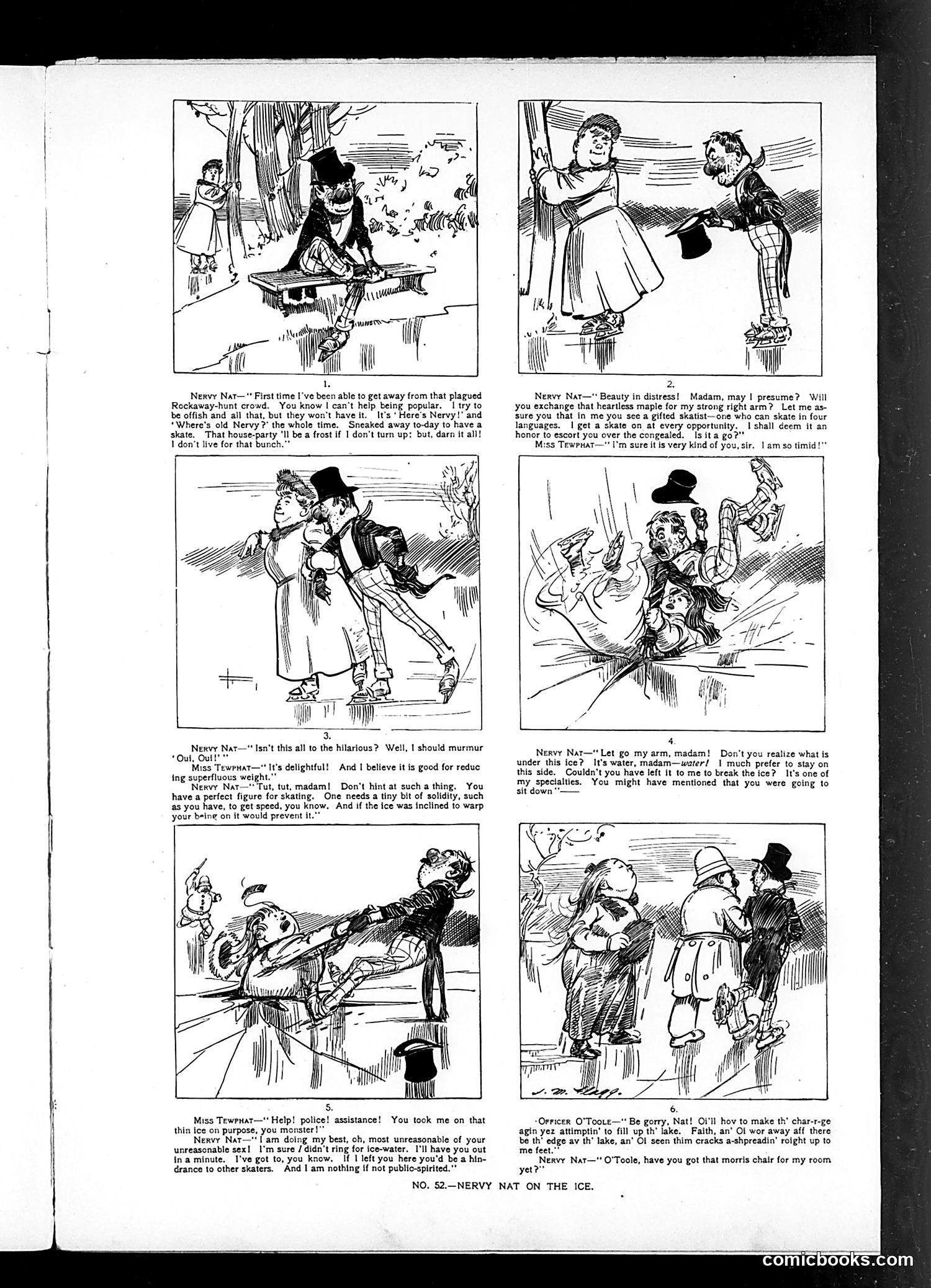
This six-panel comic strip follows a character named "Nervy Nat," a young man attempting to impress a woman (Miss Teweat) while ice skating. The humor derives from Nat's repeated social failures despite his affected sophistication and self-regard. Nat initially brags about his popularity and skating prowess, then encounters Miss Teweat on thin ice. He flirts ostentatiously ("skate in four languages"), but when she sits down, the ice cracks—and Nat must rescue her from falling through. He blames her for not warning him of danger while simultaneously taking credit for his "public-spirited" rescue efforts. Officer O'Toole arrives to report dangerous ice conditions, which Nat had ignored. The final panel suggests Nat avoids accountability by changing the subject entirely. The satire targets masculine vanity: Nat's self-importance blinds him to real danger, he takes undeserved credit, and he resents the woman for inconveniencing him during his own rescue of her.
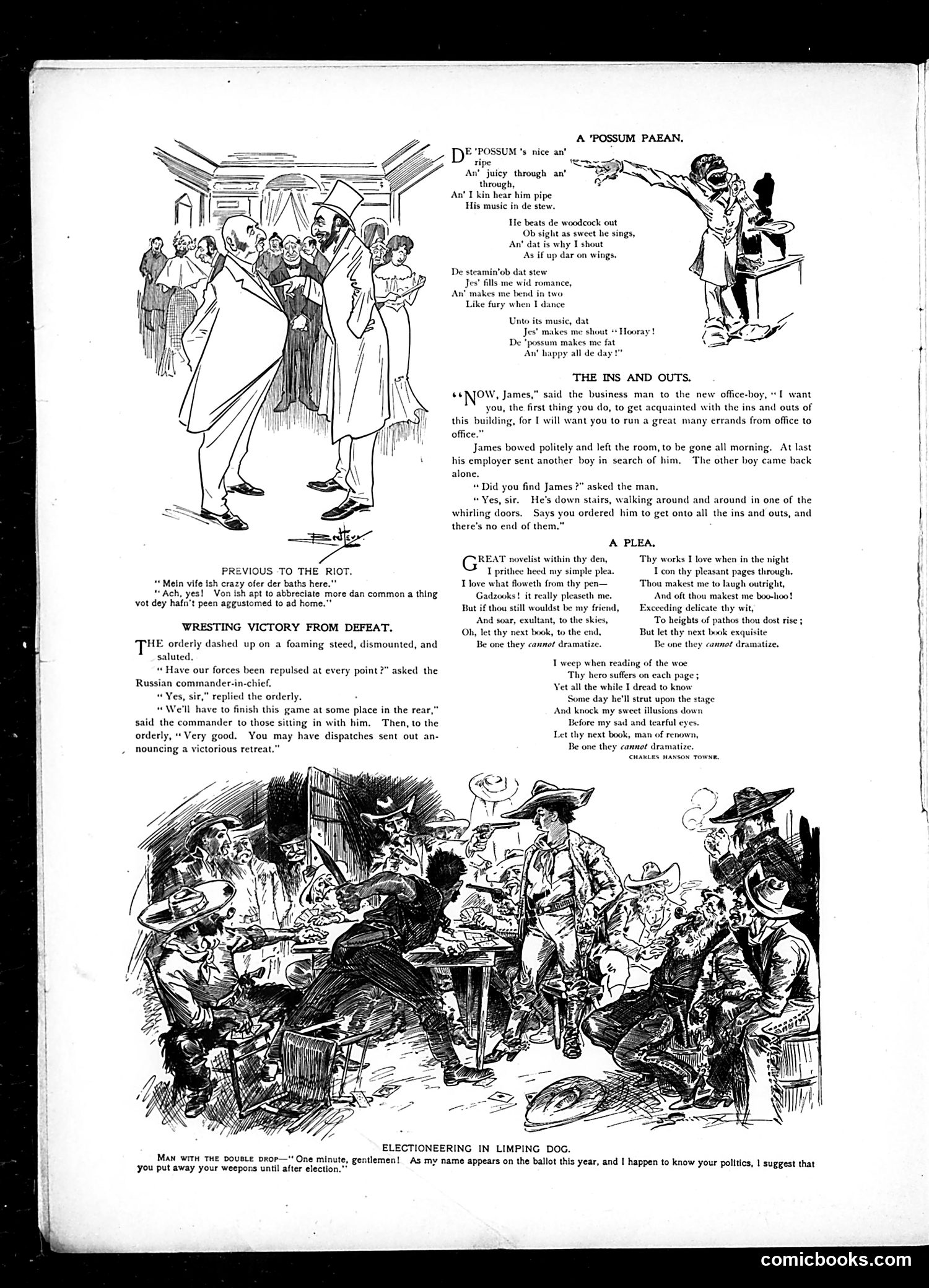
This page contains several satirical pieces: **"Wrestling Victory from Defeat"** mocks Russian military incompetence during what appears to be the Russo-Japanese War (early 1900s). The joke: a Russian commander, after being "repulsed at every point," cynically orders dispatches announcing a "victorious retreat"—satirizing military spin and propaganda. **"The Ins and Outs"** is a workplace humor piece about a naive new office boy who, ordered to learn the building's layout, gets literally stuck in revolving doors, misunderstanding "ins and outs" as physical spaces rather than procedural knowledge. **"A Plea"** is verse mocking novelists whose works get adapted for theater, with the author pleading: don't write dramatizable books, preserve your work's literary purity. **"Electioneering in Limping Dog"** shows armed men agreeing to truce during elections—satirizing how political campaigns briefly interrupt violence or conflict, suggesting cynical opportunism. The German-dialect opening joke and Russian military satire reflect early 20th-century American attitudes toward immigrants and foreign powers.
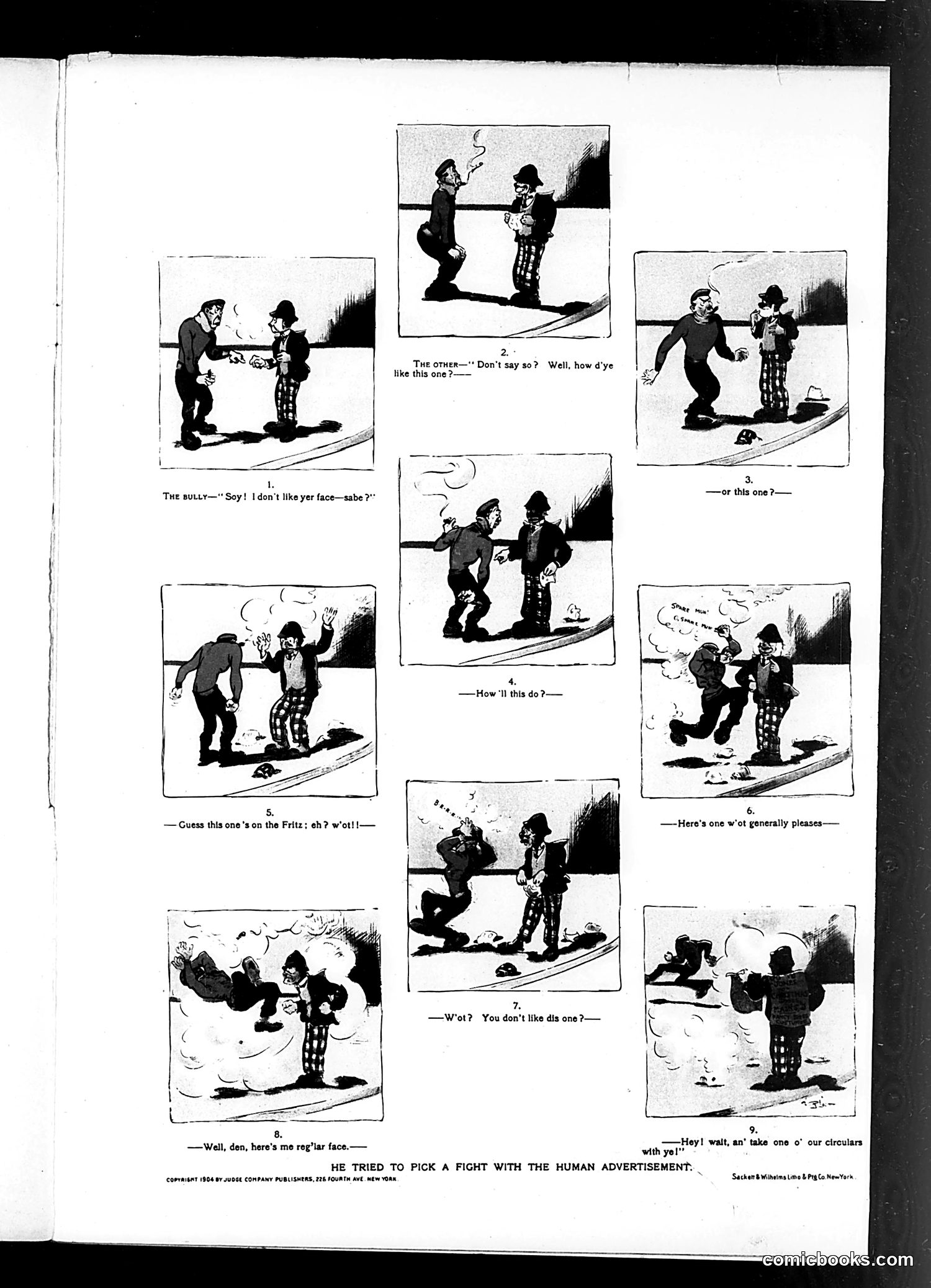
This 1904 Judge cartoon satirizes street advertising tactics. Two working-class men (likely Irish immigrants, suggested by dialect like "W'ot?" and "den") encounter a human billboard—a person hired to stand on streets wearing sandwich boards promoting products. The bully on the left repeatedly insults the advertisement man's face ("Say! I don't like yer face"), escalating through panels. The "human advertisement" responds by changing expressions or poses to show different products/services, treating each insult as a sales opportunity. The joke critiques aggressive street advertising: the advertiser's commercial purpose overrides normal social responses to rudeness. The final panel shows him trying to hand out circulars despite the confrontation, satirizing advertisers' relentless pursuit of consumers. The cartoon mocks both invasive advertising practices and the working-class desperation of those hired for such degrading work.
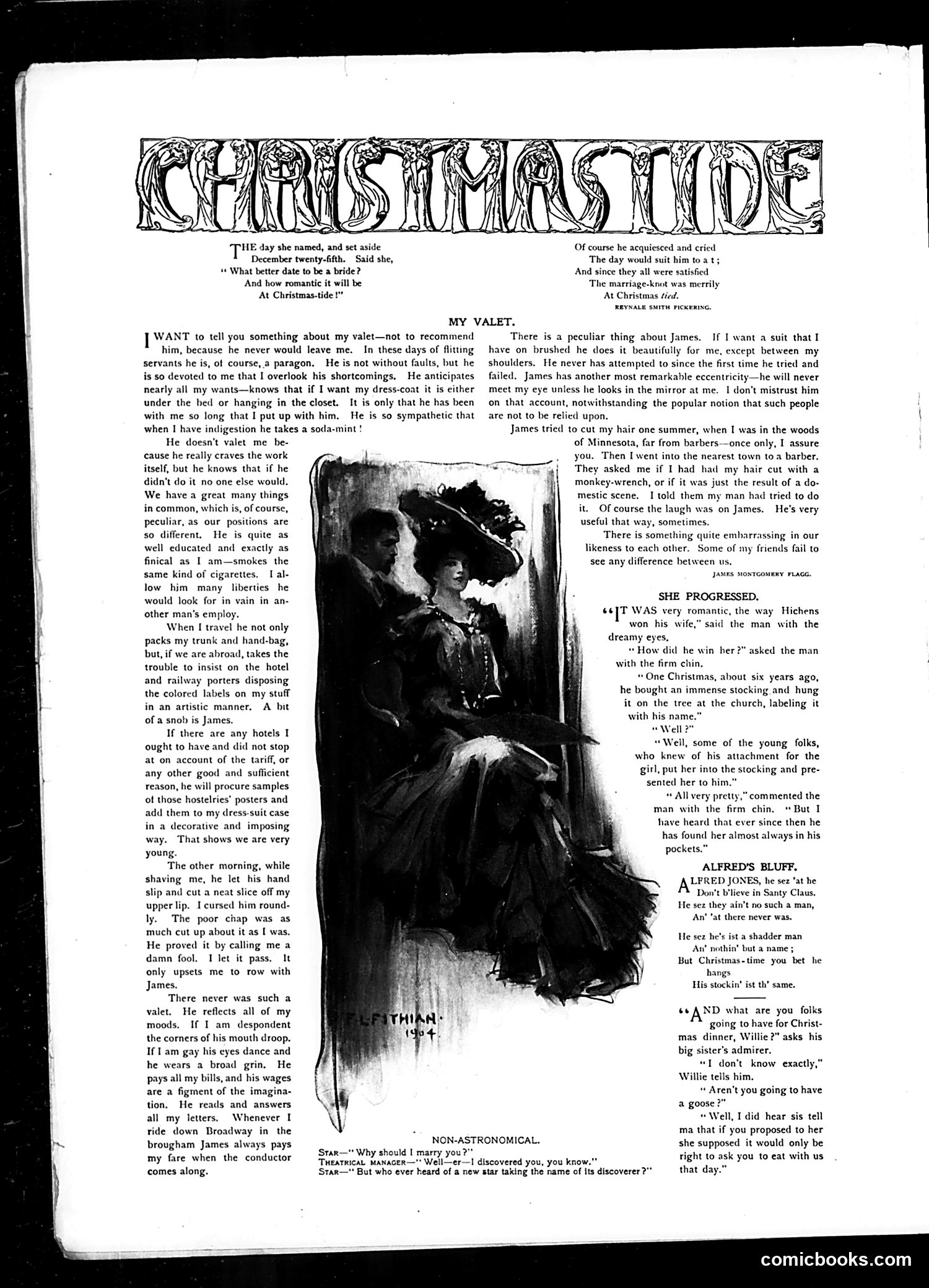
This page contains two separate pieces from Judge magazine: **"My Valet"** (main article with illustration): A humorous essay about the author's exceptionally devoted servant, James. The piece satirizes the peculiar intimacy of employer-servant relationships in the Gilded Age. The joke centers on James's unusual characteristics—he's so devoted he pays the author's bills, answers letters, and even mirrors his moods. The anecdote about cutting the author's hair with a "monkey-wrench" (likely meaning clumsily) demonstrates their comfortable, familiar dynamic. The satire targets both the servant's unhealthy dependency and the employer's casual cruelty mixed with affection—a commentary on class relations and the blurred boundaries between master and man. **"Non-Astronomical"** (small cartoon): A brief theatrical joke where a theatrical manager claims he "discovered" a star actress, but she points out sarcastically that stars are named after their discoverers—so she should be named after him, not herself. It mocks theatrical vanity and credit-claiming.
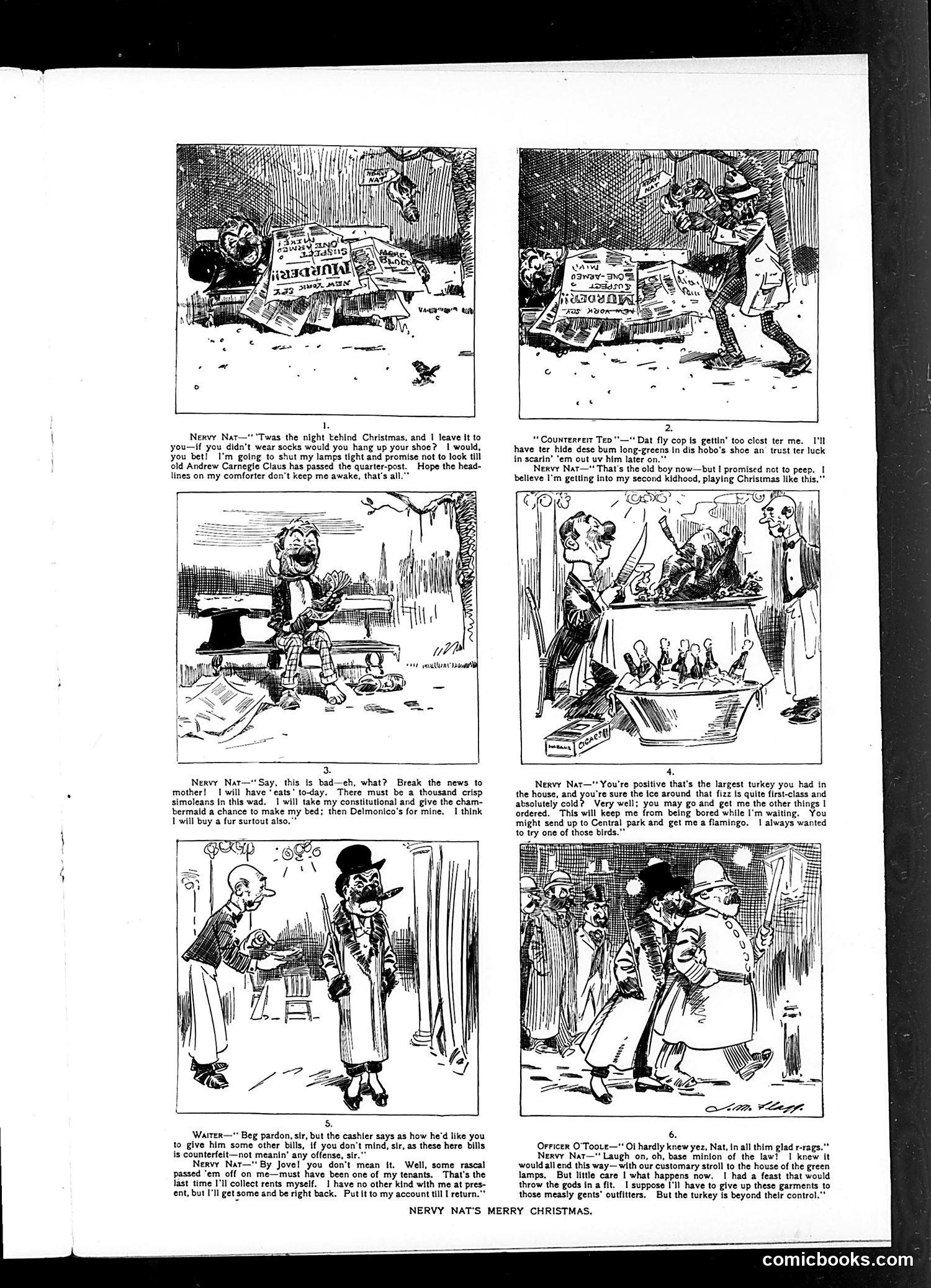
This is a comic strip satirizing a street character—"Nervy Nat"—who appears to be a con artist or petty criminal experiencing an unexpectedly fortunate Christmas. The humor follows his escalating schemes and delusions: He finds money and plans to enjoy luxury meals and fine clothing. He hides counterfeit bills in a homeless man's shoe to evade a "fly cop" (police officer). Later, when passing fake money at a restaurant, he blames a tenant. The strip culminates with Officer O'Toole arresting him, yet Nat remains unrepentant, boasting about his brief luxuries. The satire mocks both Nat's criminal optimism and the era's class tensions—his casual counterfeiting, theft, and blame-shifting reflect period anxieties about urban crime and moral corruption among the poor. The "merry Christmas" framing adds ironic commentary on holiday excess and criminality coexisting in city life.
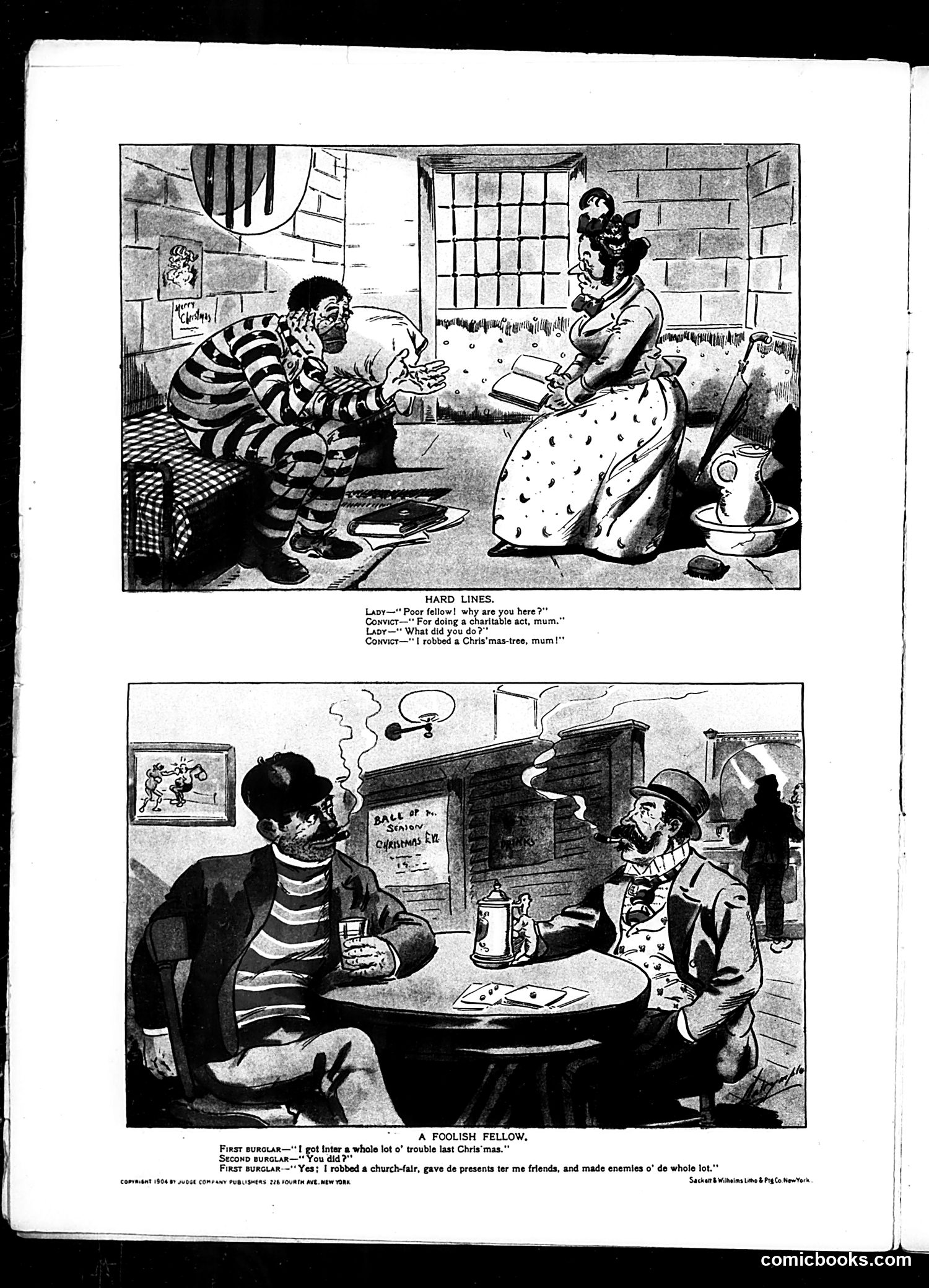
These paired cartoons mock petty criminals who justify theft as charity during Christmas. **"Hard Lines"** depicts a convict in prison stripes explaining to a sympathetic lady that he stole from a Christmas tree—attempting to frame common theft as a charitable act. The irony: stealing presents meant for children is presented as virtuous. **"A Foolish Fellow"** shows two burglars discussing their Christmas crimes. The first robbed a church fair and distributed the stolen goods to friends, making enemies of everyone else. The joke targets criminals who rationalize theft as generosity while creating actual victims among the broader community. Both cartoons satirize the hypocrisy of criminals who claim moral justification for their actions, particularly around Christmas—a season associated with charity and goodwill. The satire suggests that such self-serving "charitable" theft is merely an excuse for petty criminality, not genuine morality.
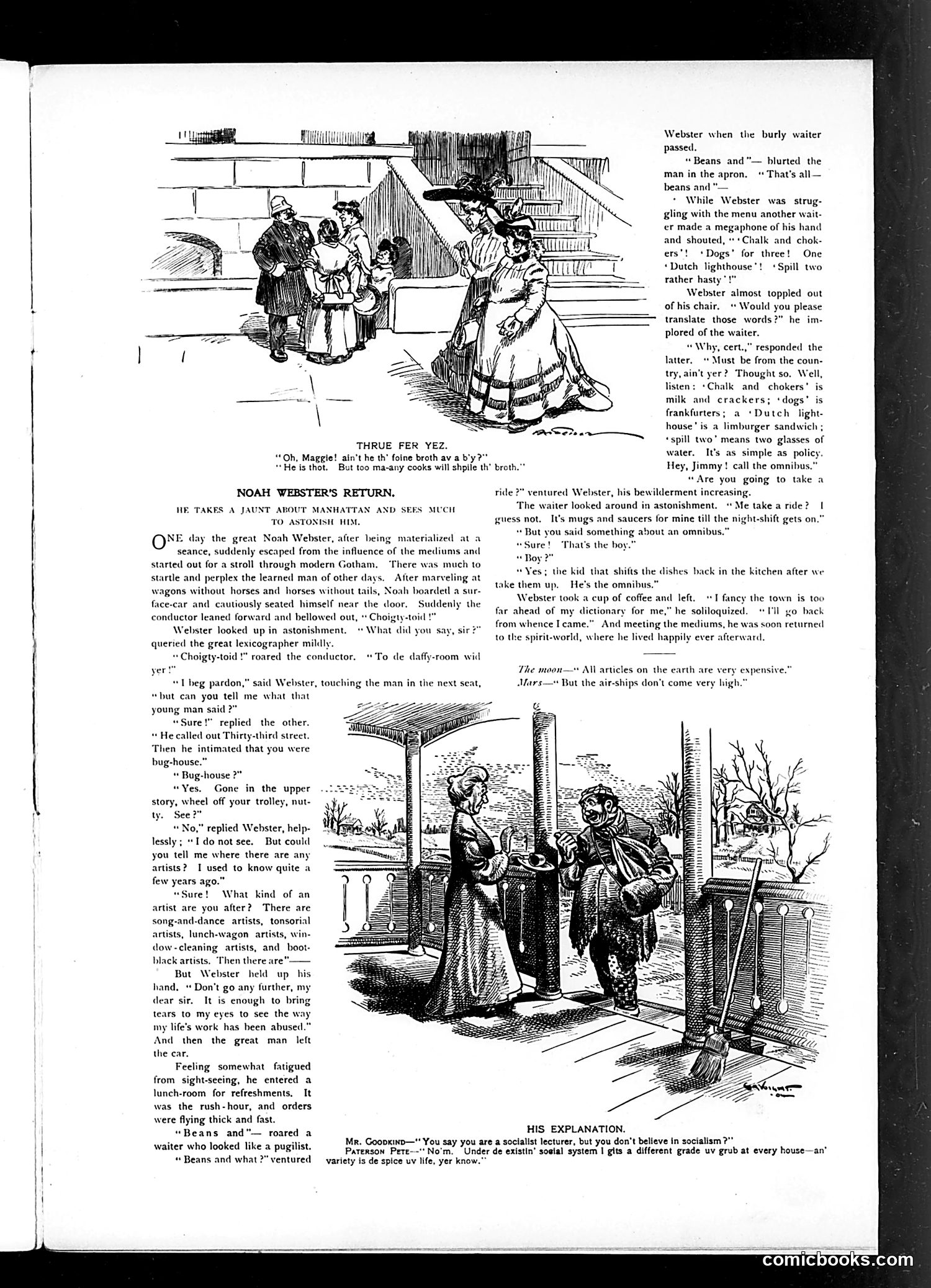
This Judge magazine page contains two satirical pieces mocking linguistic and social changes in turn-of-the-century America. **"Noah Webster's Return"** imagines the famous dictionary-maker materialized in modern Manhattan, bewildered by: - Urban slang ("Choigty-toid" for Thirty-third Street; "bug-house" for crazy) - Working-class diner argot ("chalk and chokers," "dogs," "Dutch lighthouse," "omnibus") - The proliferation of "artists" in modern professions (song-and-dance, lunch-wagon workers, etc.) The satire targets both rapid language evolution and the supposed degradation of proper English. Webster's horror at the corruption of his life's work reflects anxieties about immigration and class change reshaping American speech. The bottom cartoon ("His Explanation") shows a socialist lecturer admitting he doesn't actually believe in socialism—satirizing perceived hypocrisy among radical speakers of the era. The page overall mocks linguistic chaos, working-class vernacular, and suspect political rhetoric.
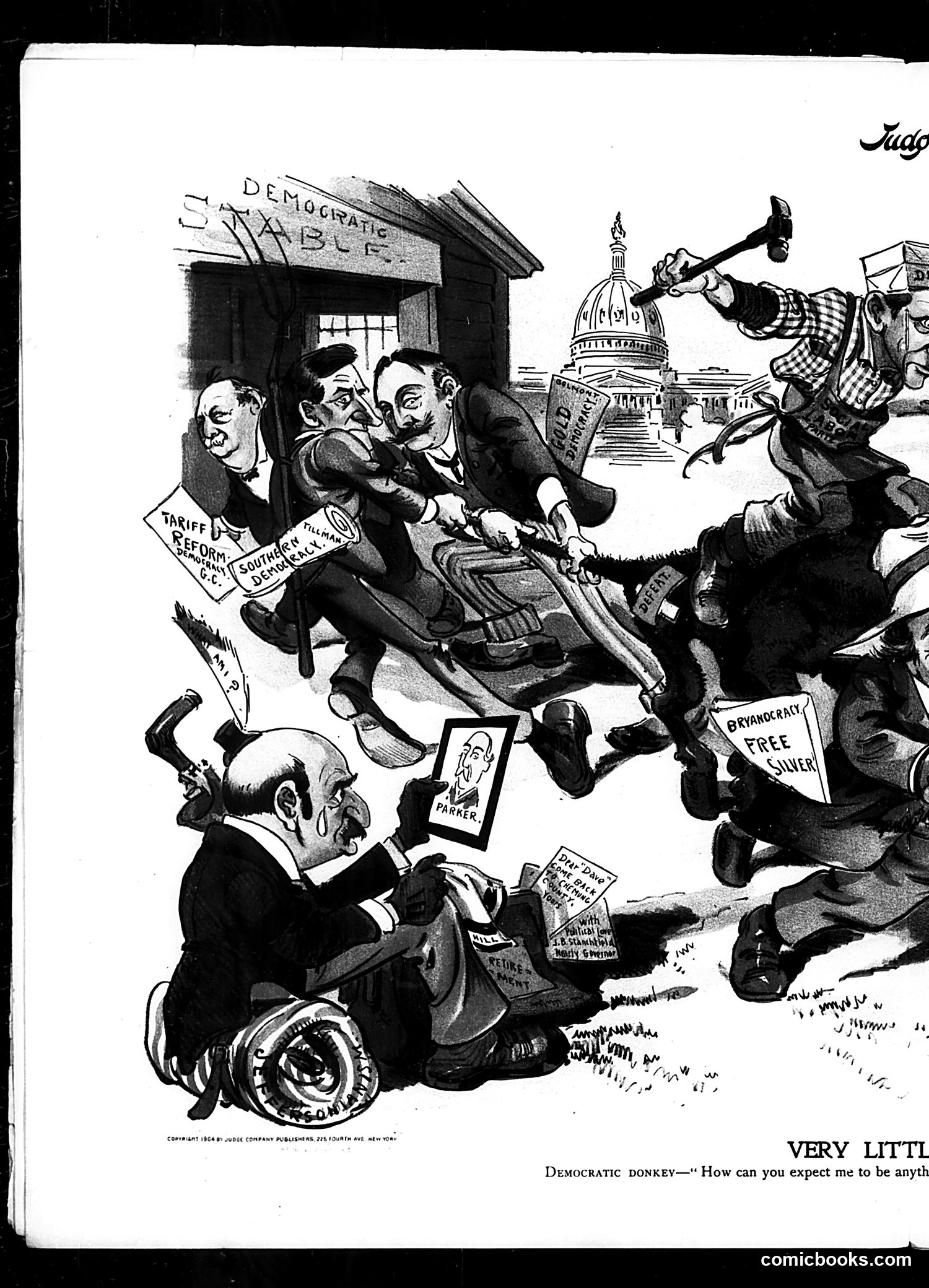
This Judge magazine cartoon satirizes the Democratic Party, represented as a donkey—the traditional Democratic symbol. Three men in suits emerge from a "Democratic Stable," carrying documents labeled "Tariff Record," "Southern Record," and "Free Silver," while being chased by a figure wielding an axe labeled "Bryandracy" (referencing William Jennings Bryan). The cartoon criticizes the Democratic Party's internal contradictions and conflicting policy positions. The donkey's exasperated caption—"How can you expect me to be anything"—suggests the party cannot maintain a coherent platform. The papers scattered around reference divisive issues of the era: tariffs, Southern/regional interests, and the free silver debate, which caused significant party fracturing in the 1890s. The satirist mocks Democratic disunity and inability to present unified policy positions to voters.
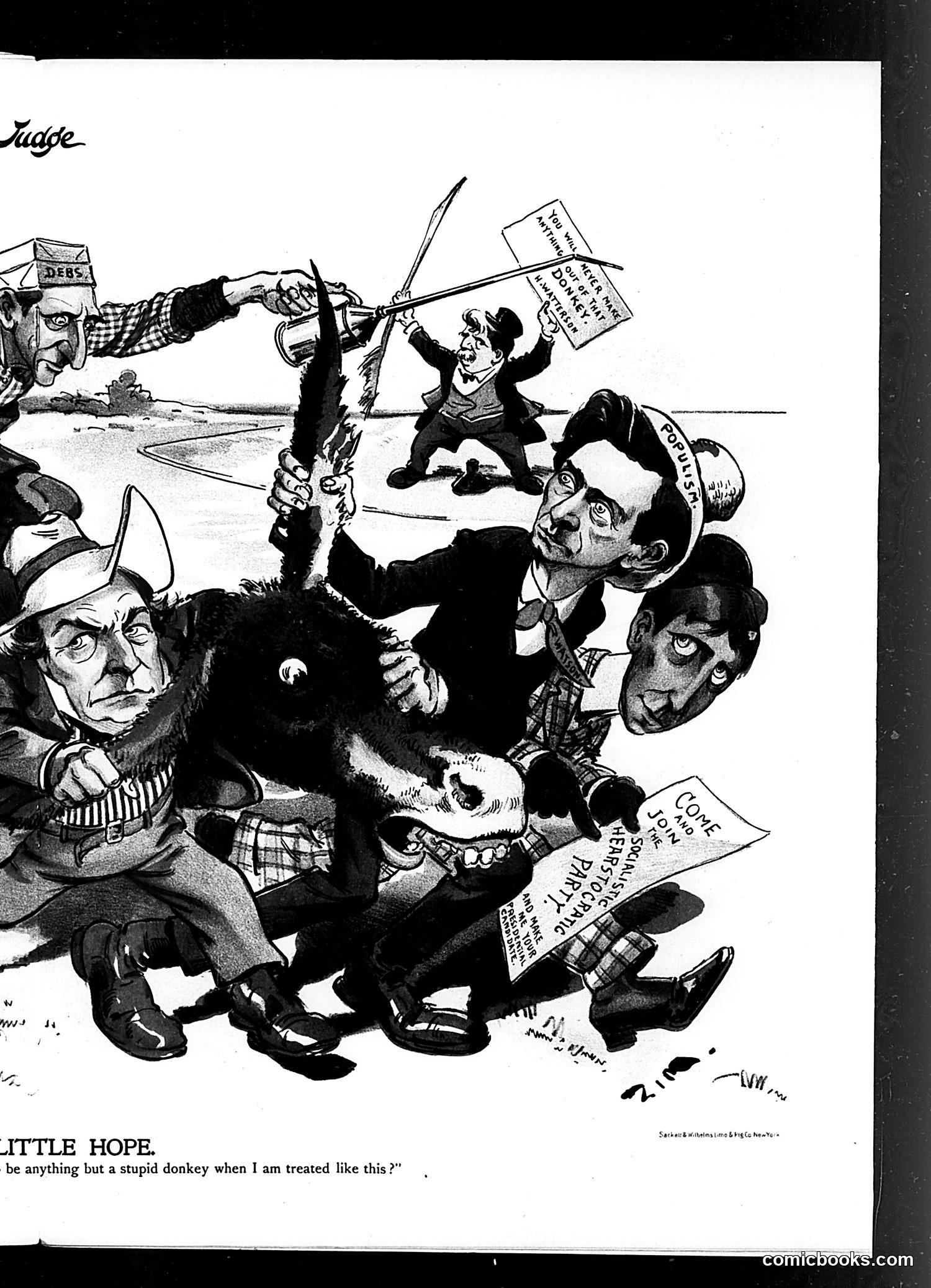
This is a satirical cartoon titled "Little Hope" depicting a donkey being beaten by multiple caricatured figures wielding weapons and clubs. The donkey says it can be "nothing but a stupid donkey when I am treated like this." The donkey appears to represent a nation or populace being mistreated by authority figures (likely politicians or military leaders). The figures carry signs, though the text is difficult to read clearly in this reproduction. The cartoon satirizes harsh governance—suggesting that oppressive treatment breeds only ignorance and compliance, not progress or enlightenment. Without clearer signage or date information, the specific historical context remains unclear, though the style suggests early-to-mid 20th century American satirical commentary on authoritarian rule or political abuse.
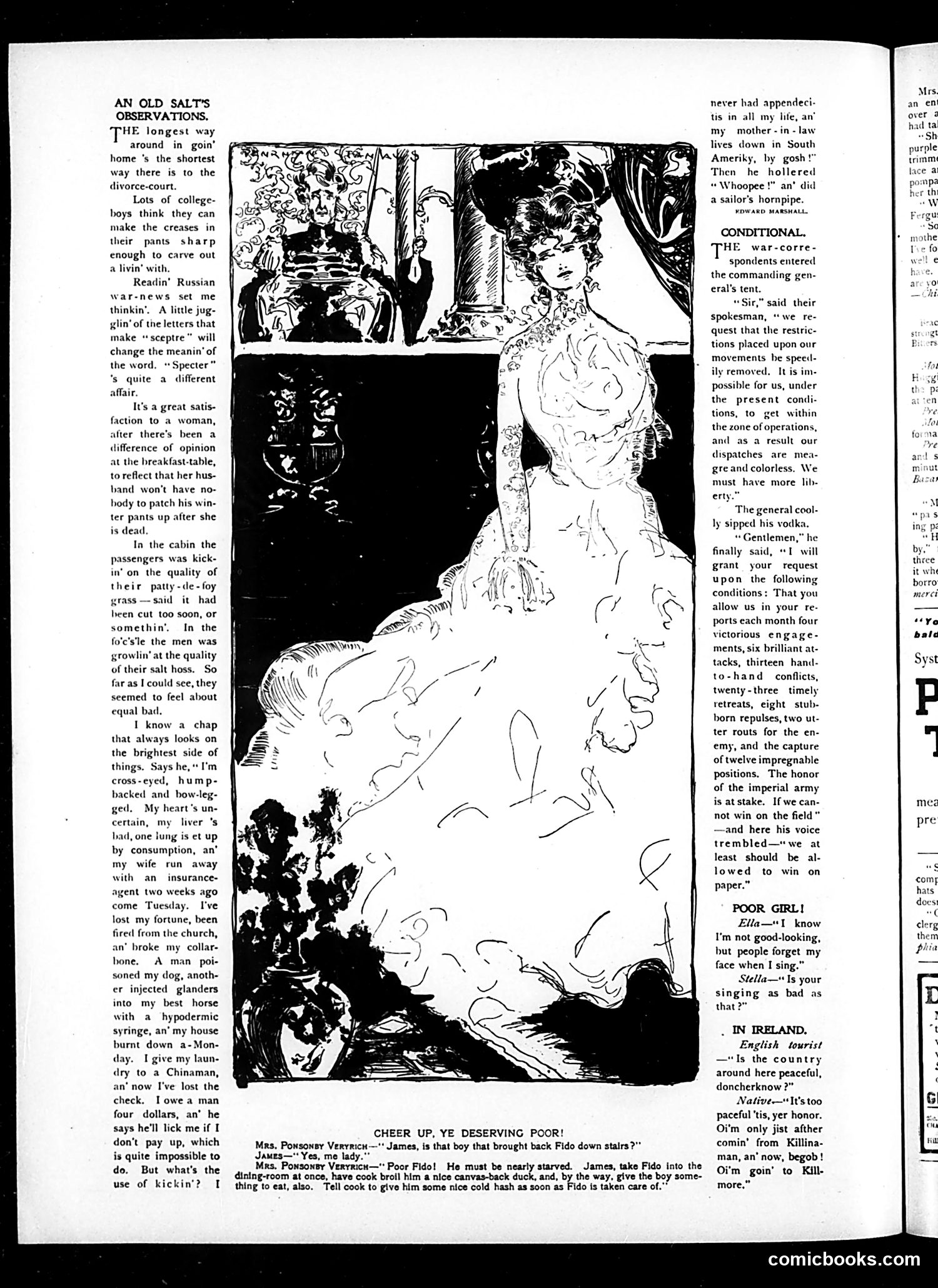
This page contains several satirical pieces typical of early 20th-century American humor: **"An Old Salt's Observations"** features a garrulous sailor character offering folk wisdom on marriage, divorce, and military life—standard working-class comic relief of the era. **"Conditional"** satirizes war correspondents' complaints to a general about reporting restrictions. The general's absurdly inflated list of required military victories (four victorious engagements, thirteen hand-to-hand conflicts, etc.) mocks both the correspondents' demands for access and military propaganda claims. **"Cheer Up, Ye Deserving Poor!"** depicts wealthy Mrs. Ponsonby Vervrich instructing her servant James to feed her starving dog a canvas-back duck while tossing scraps to the poor boy who brought the dog home. This directly satirizes class inequality and the misplaced priorities of the wealthy—they lavish luxury on pets while the poor go hungry. **"In Ireland"** offers quick ethnic humor about Irish character stereotypes. The page reflects Progressive-era critique of wealth disparity and wartime information control.
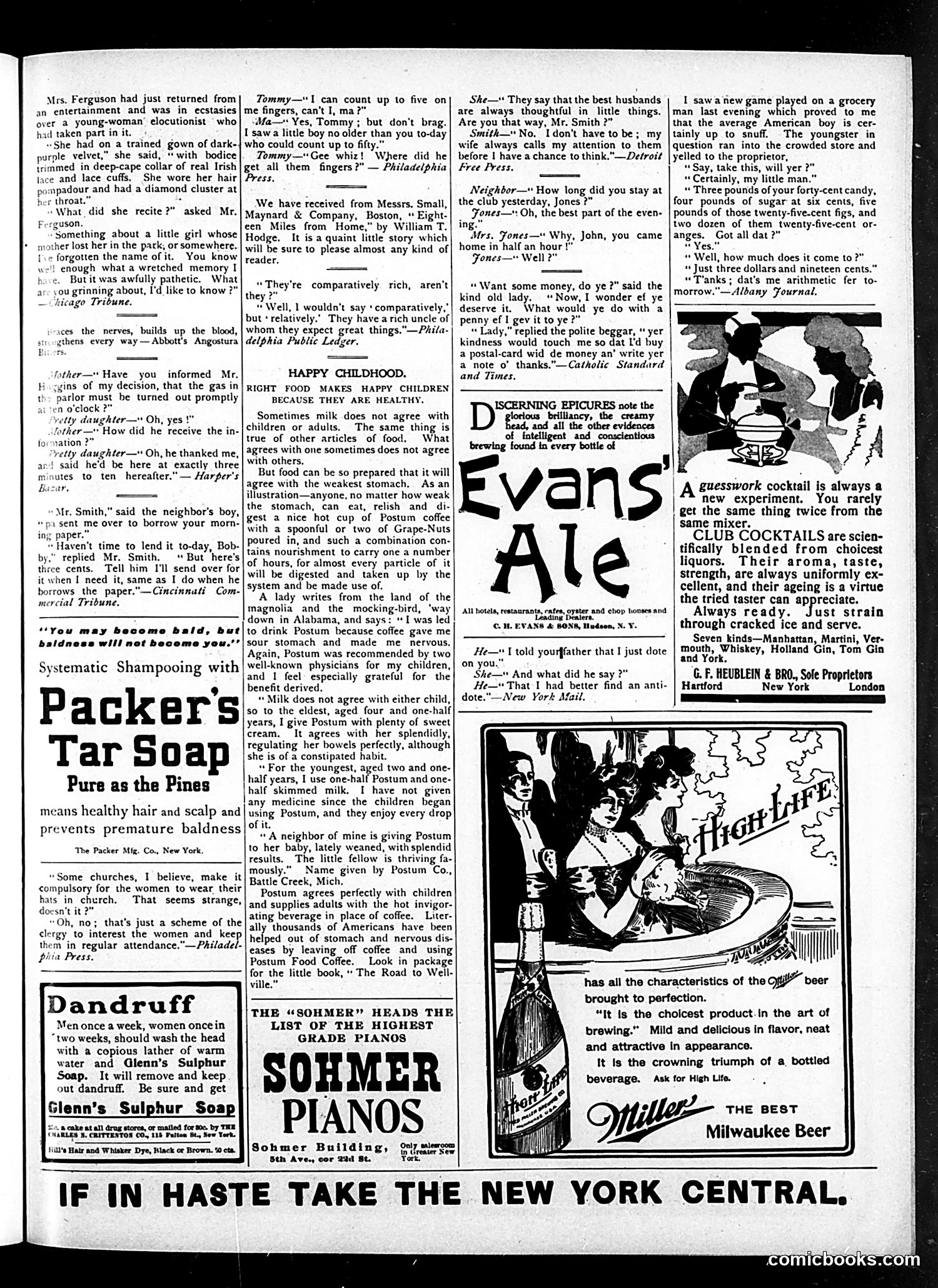
This page is primarily **advertising and humorous anecdotes** rather than political cartoons. The content consists of: **Humorous short jokes** (typical for Judge magazine): - A woman enthusiastically describing an elocutionist's outfit but forgetting what she recited—mocking women's superficiality - A child's innocent misunderstanding about counting (confusing finger-counting with the number 50) - Social commentary on church hat-wearing as a clergy ploy to keep women attending **Full-page advertisements** for: - Packer's Tar Soap - Glenn's Sulphur Soap - Sohmer Pianos - Evans' Ale - Miller Milwaukee Beer The ads use period marketing tactics: health claims for soaps, product endorsements via testimonials, and illustrated beer/beverage promotions. The page reflects early 20th-century consumer culture and domestic concerns (hair care, women's fashion, church attendance). No significant political satire appears here—this is a light entertainment/advertising page from a satirical magazine.
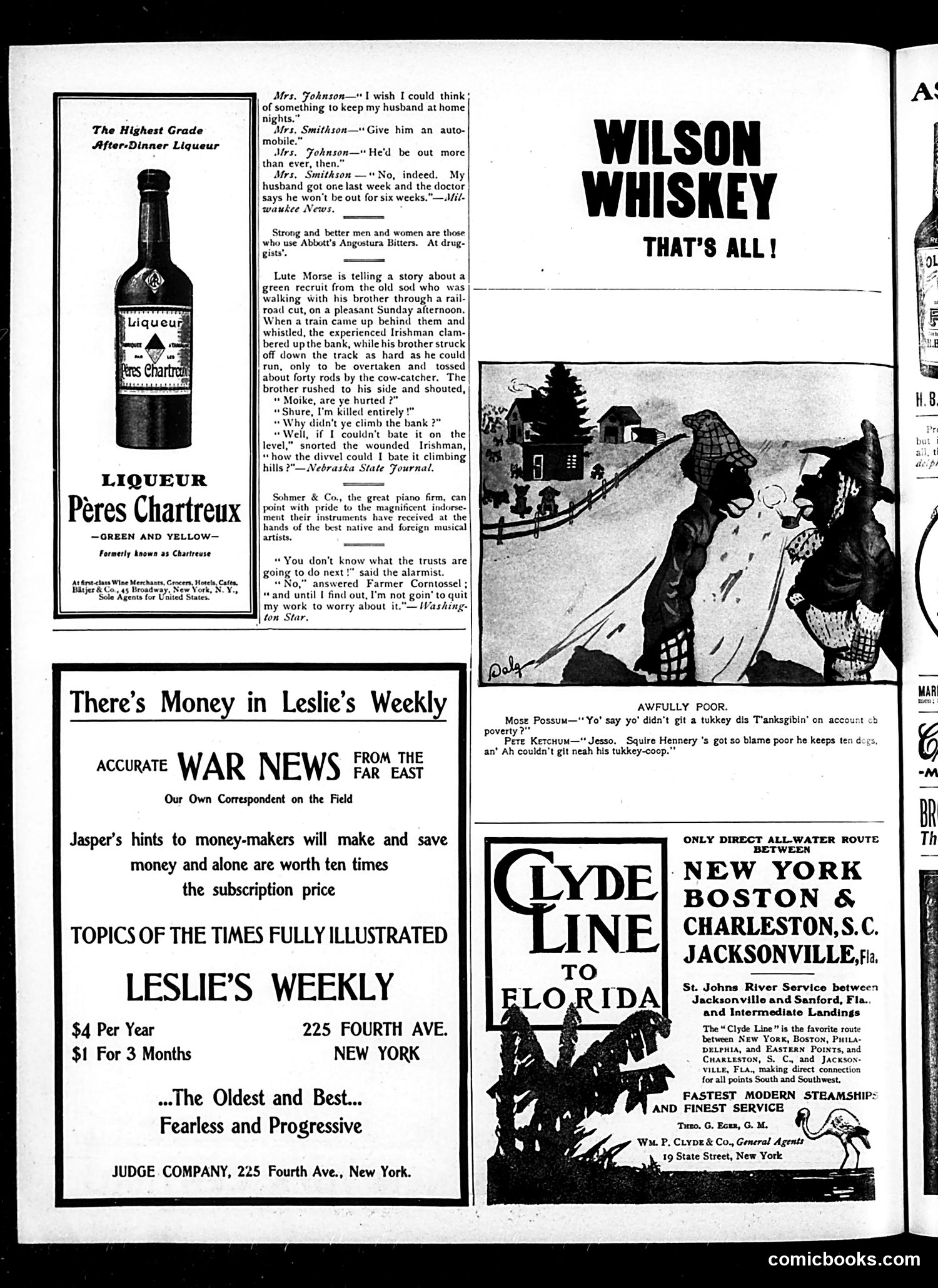
This page is primarily **advertising** with minimal editorial cartooning content. The main illustrated cartoon depicts a snowy rural scene with poorly-dressed figures, captioned "AWFULLY POOR." The dialogue below references poverty during what appears to be the Thanksgiving season—one character claims he couldn't afford a turkey because a neighbor (implied to be wealthy) is so "blame poor" he keeps only ten dogs and won't share his turkey-coop. This is **ironic humor**: the "poor" neighbor actually has resources (multiple dogs), suggesting either false poverty claims or inverted logic about wealth and stinginess. The page otherwise consists of product advertisements (Wilson Whiskey, Peres Chartreux liqueur, Leslie's Weekly magazine, and Clyde Line steamship service) and filler humor excerpts from various newspapers about automobiles, trains, and trusts. Without visible dates or specific historical context, the cartoon's exact satirical target remains unclear, though it appears to mock either economic hypocrisy or the absurdity of Depression-era poverty claims.
This page is primarily **advertising**, featuring vintage product promotions rather than political cartoons. The content consists of short humorous anecdotes interspersed with ads. The jokes are light social commentary typical of early 1900s humor: - A "silver-tongued orator" whose oratory is worthless (silence being golden) - A child using "slang" unknowingly - A ladies' debating society disrupted by an essay on "the yellow peril" (likely referencing contemporary anxieties about Asian immigration) - Various quips about wealth, laziness, and romantic rejection The advertisements promote products including Old Crow Rye whiskey, Kodak cameras, Pears' soap, W.L. Douglas shoes, and Overholt whiskey. **No significant political cartoons appear on this page.** The "yellow peril" reference reflects period xenophobia, but it's merely a setup for a joke about fashion rather than serious satire. This is a standard Judge page mixing light humor with commercial content.
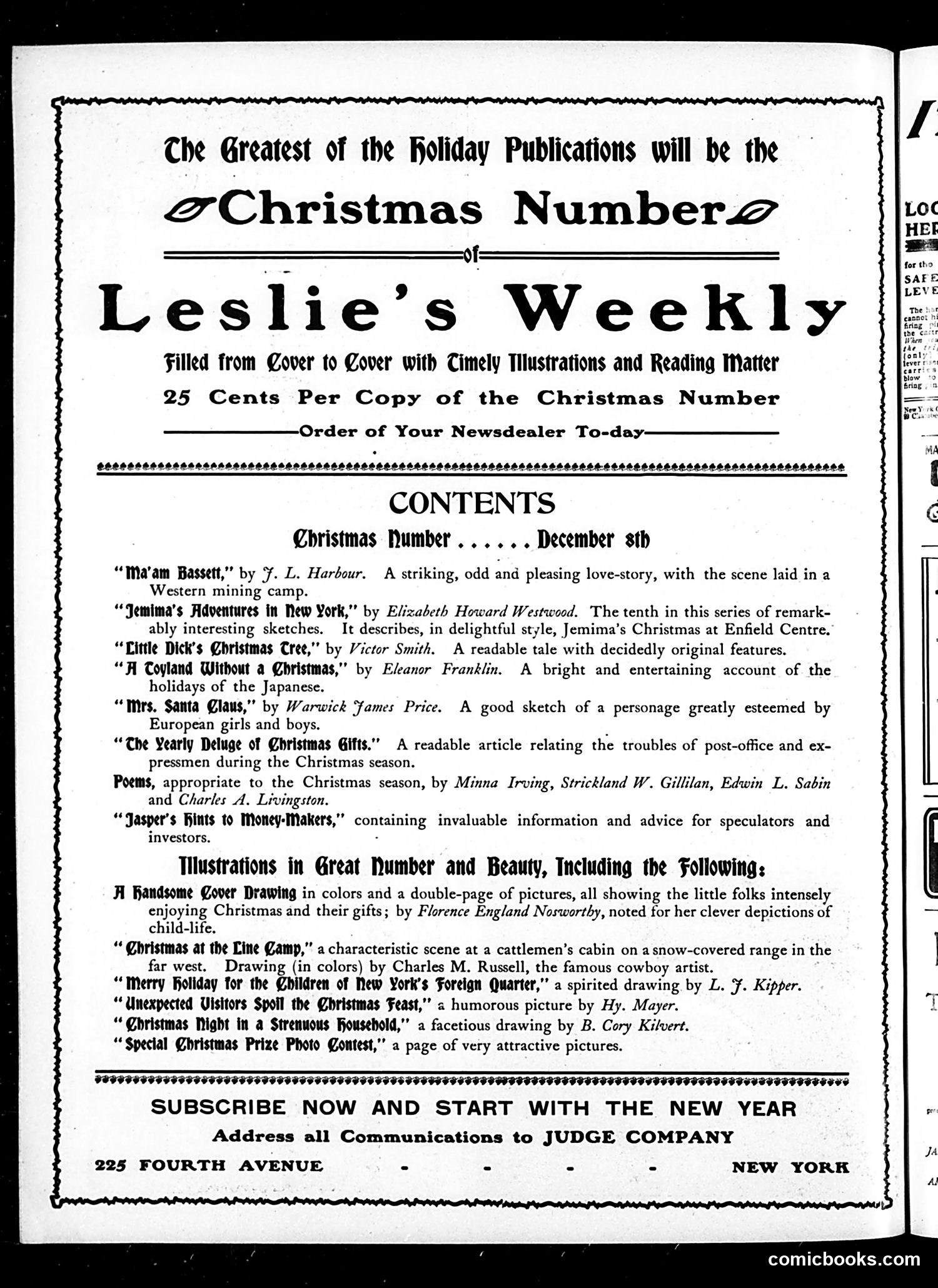
This is a **title/advertisement page**, not a cartoon. It promotes Leslie's Weekly magazine's special Christmas issue (December 8th), priced at 25 cents. The page lists contents emphasizing holiday entertainment: love stories set in Western mining camps, adventures in New York, Christmas tales, and articles about Japanese holidays and gift-delivery chaos. Notable illustrators include Charles M. Russell (the famous cowboy artist) and others depicting festive domestic scenes and children enjoying Christmas. The emphasis on diverse stories—from mining camps to "New York's Foreign Quarter" to Japanese customs—reflects early 1900s American interest in both frontier nostalgia and immigrant experiences. The inclusion of financial advice ("Jasper's Hints to Money-Makers") suggests the magazine targeted middle-class readers seeking both entertainment and practical information. This was typical magazine marketing: positioning the special holiday issue as the year's must-have publication.
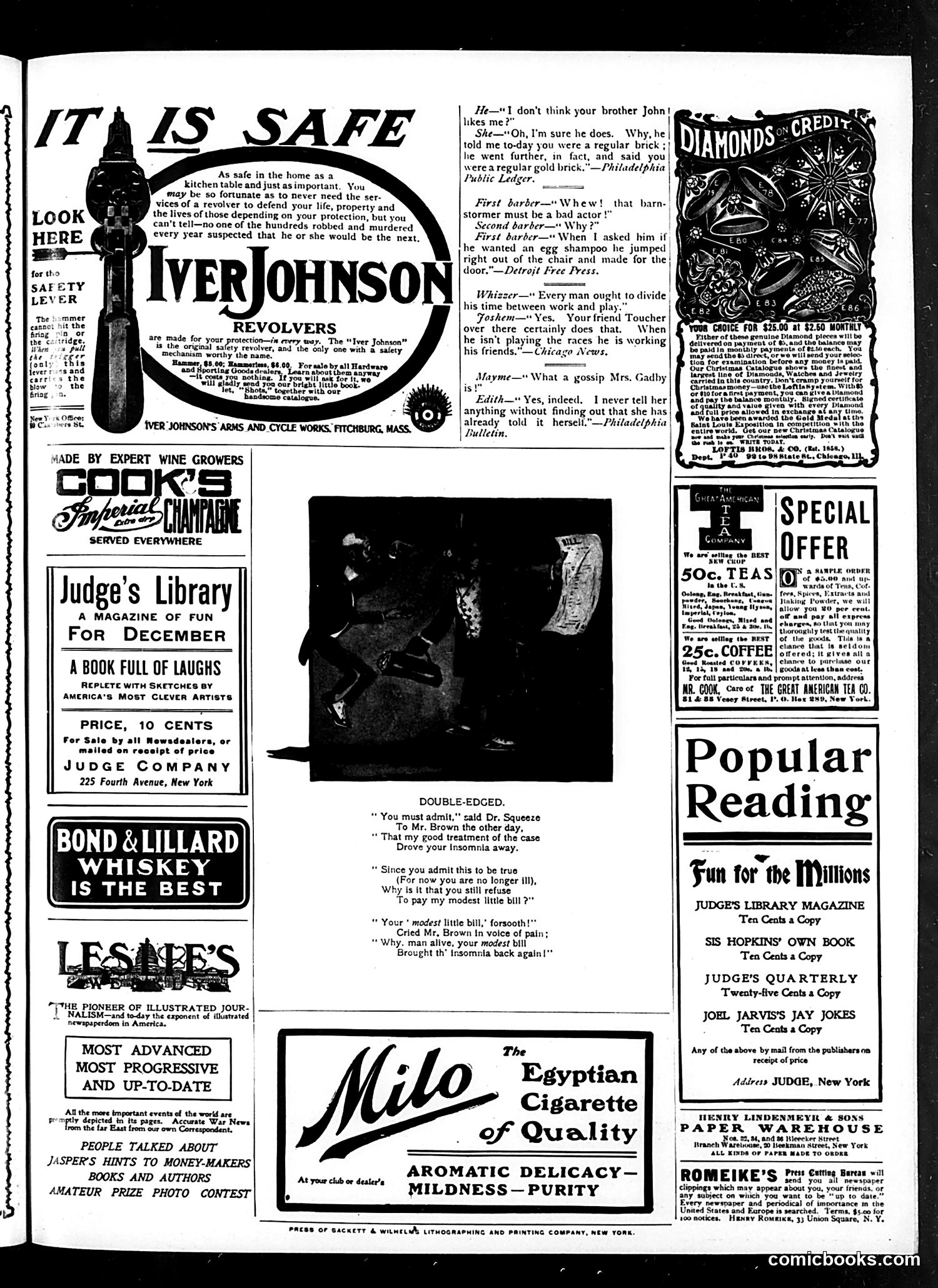
This is primarily an **advertising page** from Judge magazine, with minimal editorial content. The main cartoon, "Double-Edged," depicts a doctor-patient dispute: Dr. Squeeze claims his treatment cured Mr. Brown's insomnia, demanding payment. Brown retorts that the doctor's bill itself caused the insomnia to return—the "double edge" being that the cure created a new problem worse than the original. The page is dominated by period advertisements: Iver Johnson revolvers (marketed as home safety devices), Cook's champagne, Judge's own publications, and cigarettes. The text includes brief humor snippets ("First barber," "Whiszer," etc.)—typical Judge filler jokes about everyday situations. **For modern readers:** This reflects early 1900s anxieties about home security and the normalization of firearms for civilian self-defense. The doctor joke satirizes medical incompetence and billing practices—concerns that remain relevant today.
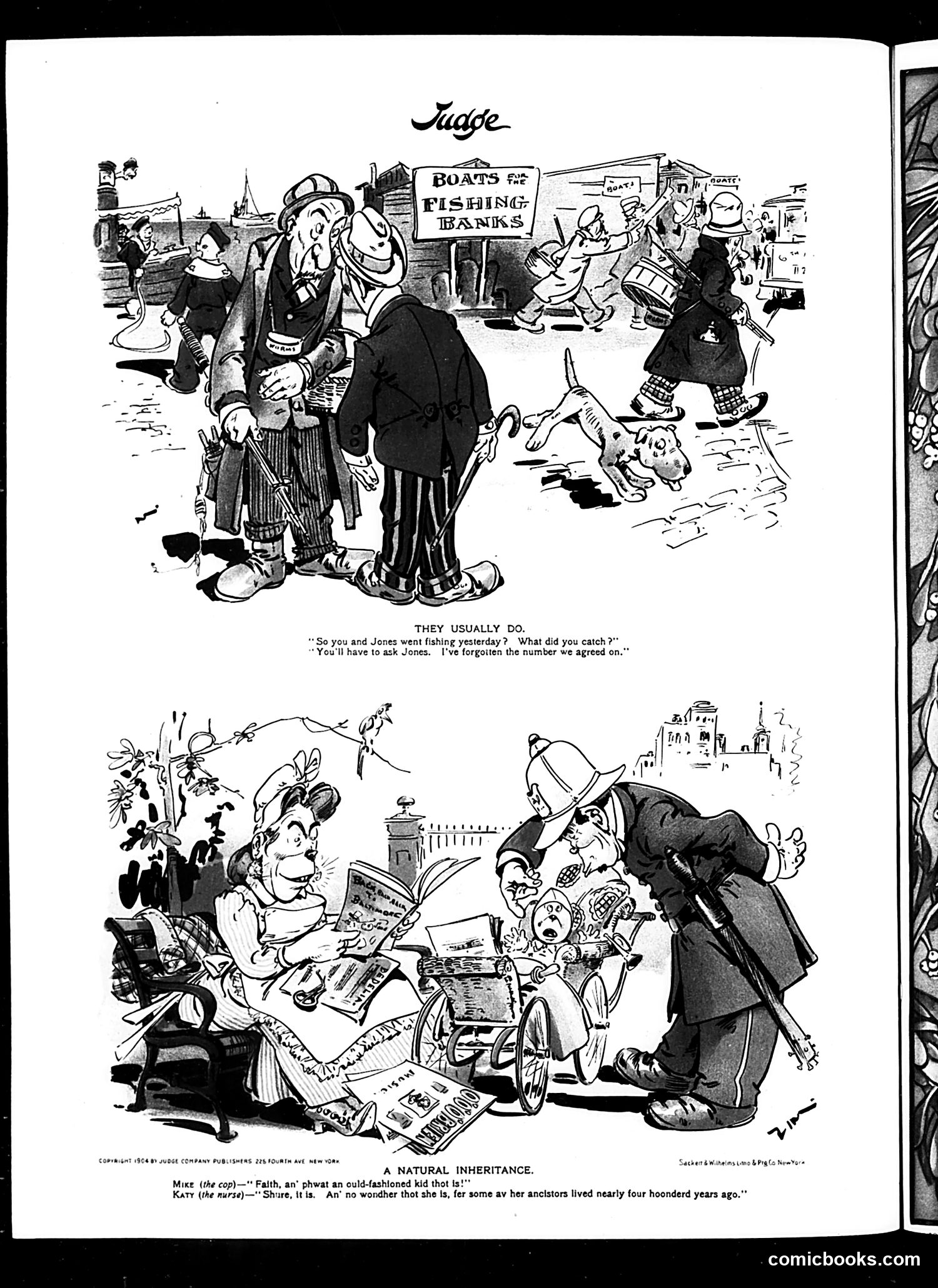
**Top cartoon ("They Usually Do"):** Two men discuss a fishing trip. One says he must ask his fishing partner Jones about their catch because he's "forgotten the number we agreed on." This satirizes collusion and pre-arranged lies—suggesting fishermen coordinate false stories about their catch beforehand, likely exaggerating quantities. **Bottom cartoon ("A Natural Inheritance"):** A police officer (Mike, speaking in Irish dialect) comments on an old-fashioned child, while a nurse (Katy, also Irish-accented) explains the girl's antiquated behavior by noting her ancestors lived nearly 400 years ago. This mocks Irish immigrants by suggesting they inherit outdated customs from distant ancestors, implying Irish people are inherently backward or unable to modernize—a common xenophobic stereotype of the era. Both cartoons use ethnic humor and casual social commentary typical of early 20th-century American satire.