
Judge, 1904-12-10 · page 4 of 20
Judge — December 10, 1904 — page 4: what you’re looking at
What you’re looking at
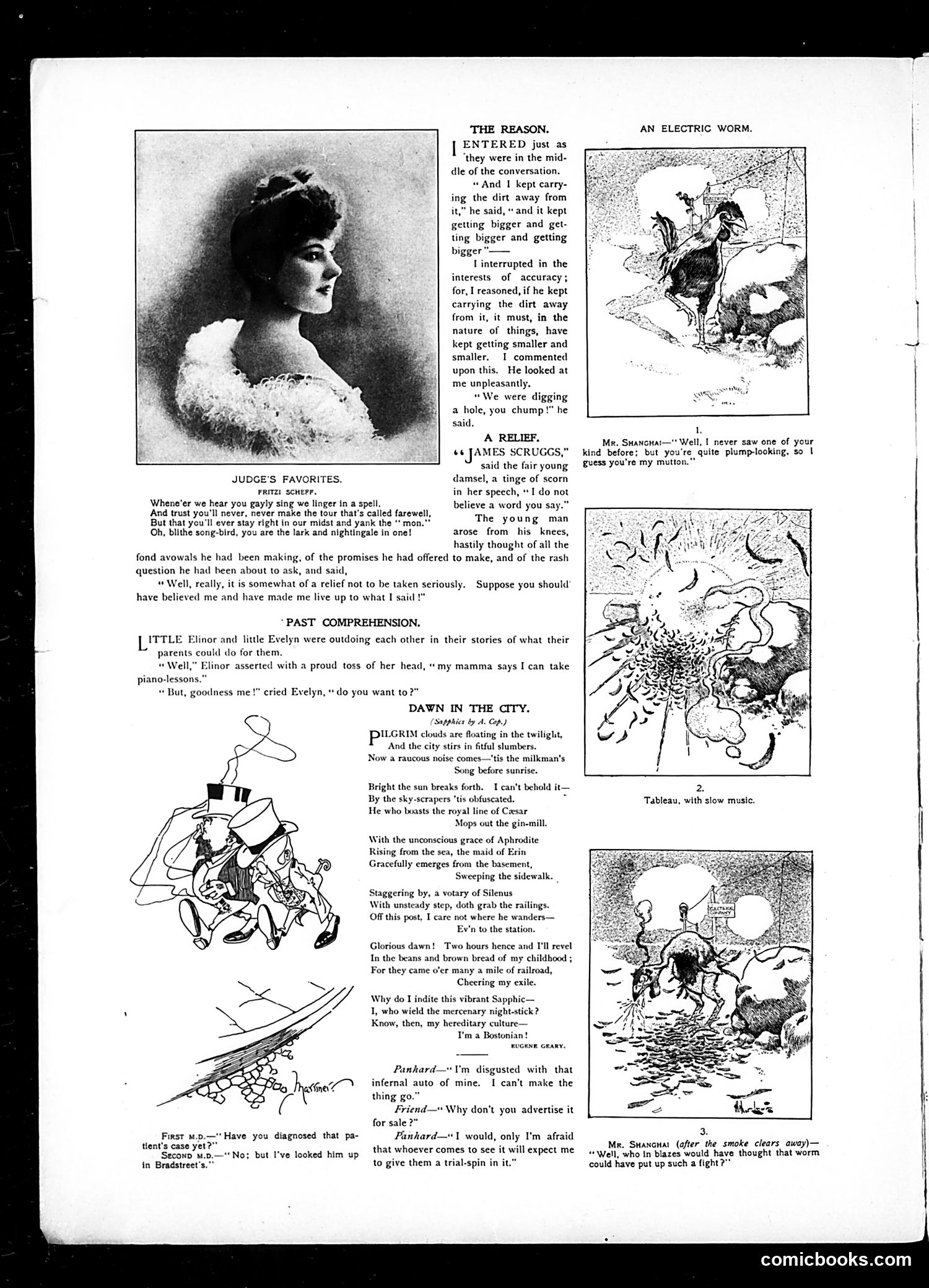
This page contains several satirical pieces and illustrations typical of early 20th-century Judge magazine: **"Judge's Favorites"** features a poem by Fried Scheef about romantic farewells, likely commenting on social conventions around courtship. **"A Relief"** depicts a young man (James Scruggs) challenged by a woman over his logic—she dismisses his reasoning about dirt getting larger or smaller as nonsensical. The satire appears to mock men's flawed reasoning when trying to impress women. **"Past Comprehension"** humorously presents children's naive logic about their parents' abilities. **"Dawn in the City"** is a poem by Rudolph Gravy celebrating urban morning life with references to milkmen, sky-scrapers, and trains. The scattered illustrations include satirical drawings of urban scenes and a humorous sketch of well-dressed figures, typical of Judge's social commentary on contemporary American life.
📄 Transcribed text from this page (OCR, searchable)
Machine-transcribed from the original scan — historical spelling and the odd misread are preserved.
‘THE REASON. ENTERED just as “they were in the mid- dle of the conversation. “And I kept carry- ing the dirt away from it,” he said, “and it kept getting bigger and get- ting bigger and getting bigger”. [interrupted in the interests of accuracy; for, I reasoned, if he kept carrying the dirt away from it, it must, in the nature of things, have kept getting smaller and smaller. I commented upon this, He looked at me unpleasantly, “We were digging a hole, you chump!” he said, 46 JAMES SCRUGGS,” said the fair young JUDGE'S FAVORITES. damsel, a tinge of scorn FRITZ SCHEPF. in her speech, “I do not Whene’er we hear you gayly sing we linger in a spell, believe a word you say.” And trust you'll never, never make the tour that's called farewell, ‘ But that you'll ever stay right in our midst and yank the "mon." The young man Oh, blithe song-bird, you are the lark and nightingale in one! arose from his knees, hastily thought of all the fond avowals he had been making, of the promises he had offered to make, and of the rash question he had been about to ask, and said, “Well, really, it is somewhat of a relief not to be taken seriously. Suppose you should have believed me and have made me live up to what I said !” “PAST COMPREHENSION. L'TTLE Elinor and little Evelyn were outdoing each other in their stories of what their pts could do for them, Well,” Elinor asserted with a proud toss of her head, “my mamma says I can take piano-lessons. “ But, goodness me !" cried Evelyn, do you want to?” DAWN IN THE CITY. (Sapphice by A. Cop.) ILGRIM clouds are floating in the twilight, And the city stirs in fitful slumbers. Now a raucous noise comes—tis the milkman's Song before sunrise. Bright the sun breaks forth. I can’t behold it— By the sky-scrapers ‘tis obfuscated. He who boasts the royal line of Czesar Mops out the gin-mill. With the unconscious grace of Aphrodite Rising from the sea, the maid of Erin Gracefully emerges from the basement, ‘Sweeping the sidewalk. Staggering by, a votary of Silenus With unsteady step, doth grab the railings. Off this post, I care not where he wanders— Ev'n to the station. Glorious dawn! Two hours hence and I'll revel In the beans and brown bread of my childhood ; For they came o'er many a mile of railroad, Cheering my exile. Why do I indite this vibrant Sapphi 1, who wield the mercenary night-stick? Know, then, my hereditary culture— I'ma Bostonian! RUGENE GARY. Panhard—«\'m disgusted with that infernal auto of mine. I can't make the thing go.” Friend —“ Why don't you advertise it for sale ?” First u.o.—""Have you diagnosed that pa- Panhard—“1 would, only I'm afraid tent’s case yet that whoever comes to see it will expect me Seconp ut. 2 Seared in Bradstreet’s. to give them a trial-spin in it. —"'No; but I've looked him up AN ELECTRIC WORM. Me. Suancntat—"' Well, | never saw one of your kind before; but you're quite plump-looking, 30 | guess you're my mutton.” 3. Mr. Sancuat (after the smoke clears away)— “Well, who In blazes would have thought that worm could have put up such a fight?” comicbooks.com