
A complete issue · 16 pages · 1904
Judge — October 22, 1904
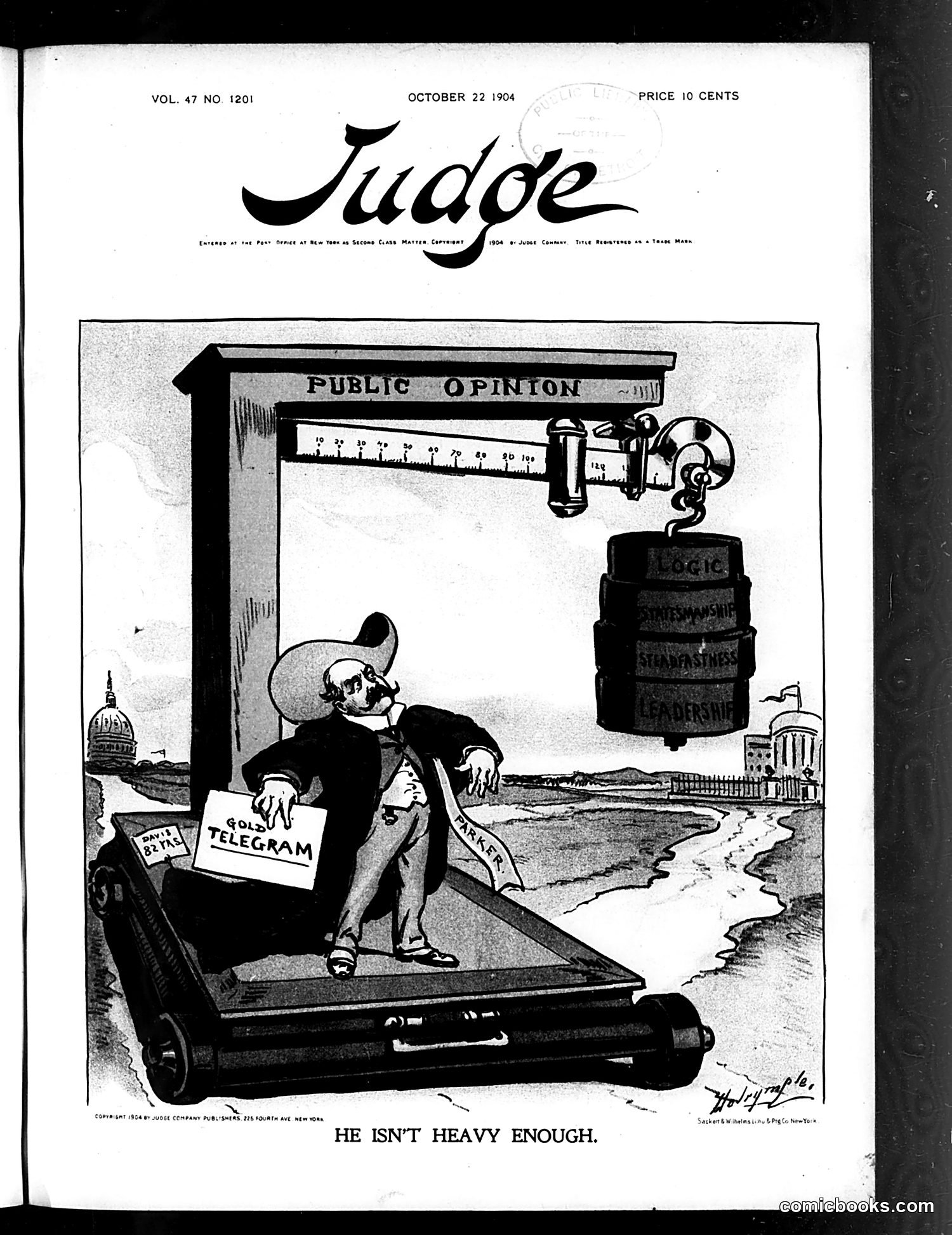
This October 1904 Judge cartoon depicts a figure representing public opinion being weighed on a scale labeled "PUBLIC OPINION." The man holds documents labeled "GOLD TELEGRAM" and "MARKET," suggesting financial/economic concerns. A large weight labeled with text including "LOGIC," "FRIENDSHIP," "STRENGTH," and "LEADERSHIP" is suspended above him, appearing to outweigh him significantly. The title "HE ISN'T HEAVY ENOUGH" suggests the figure (likely a political candidate or public sentiment) lacks sufficient substance or credibility to counterbalance opposing forces. The Capitol and governmental buildings visible in the background indicate this concerns American politics. Without clearer textual detail on the weight's labels, the specific 1904 political context remains unclear, though it likely addresses presidential campaign issues.
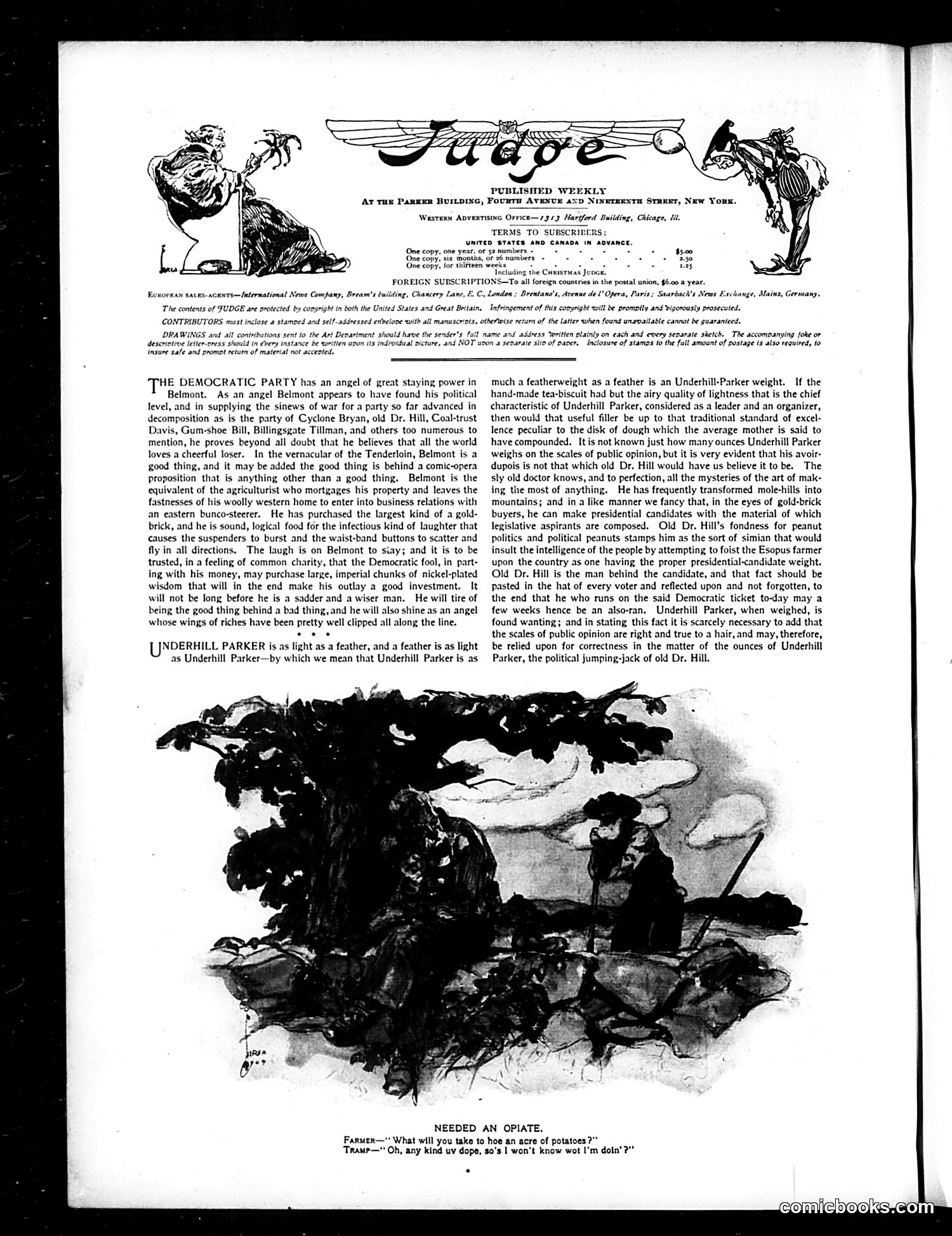
This page satirizes the Democratic Party and political figures around presidential selection. The main article critiques Democratic leaders—including names like Davis, Tilman, and others—for their role in choosing candidates, comparing the process to how "Underhill Parker" (a featherweight boxer) is weightlessly insubstantial despite appearing authoritative. The satire's central metaphor equates political decision-makers with "Dr. Hill," suggesting whoever controls the Democratic ticket nomination process is merely a jumping-jack manipulated by public opinion rather than genuinely authoritative. The bottom cartoon, "Needed an Opiate," depicts a farmer and tramp in rural poverty, illustrating economic hardship—likely commentary on working-class struggles Democrats claimed to address. The overall message: Democratic Party leadership is hollow and disconnected from real people's needs.
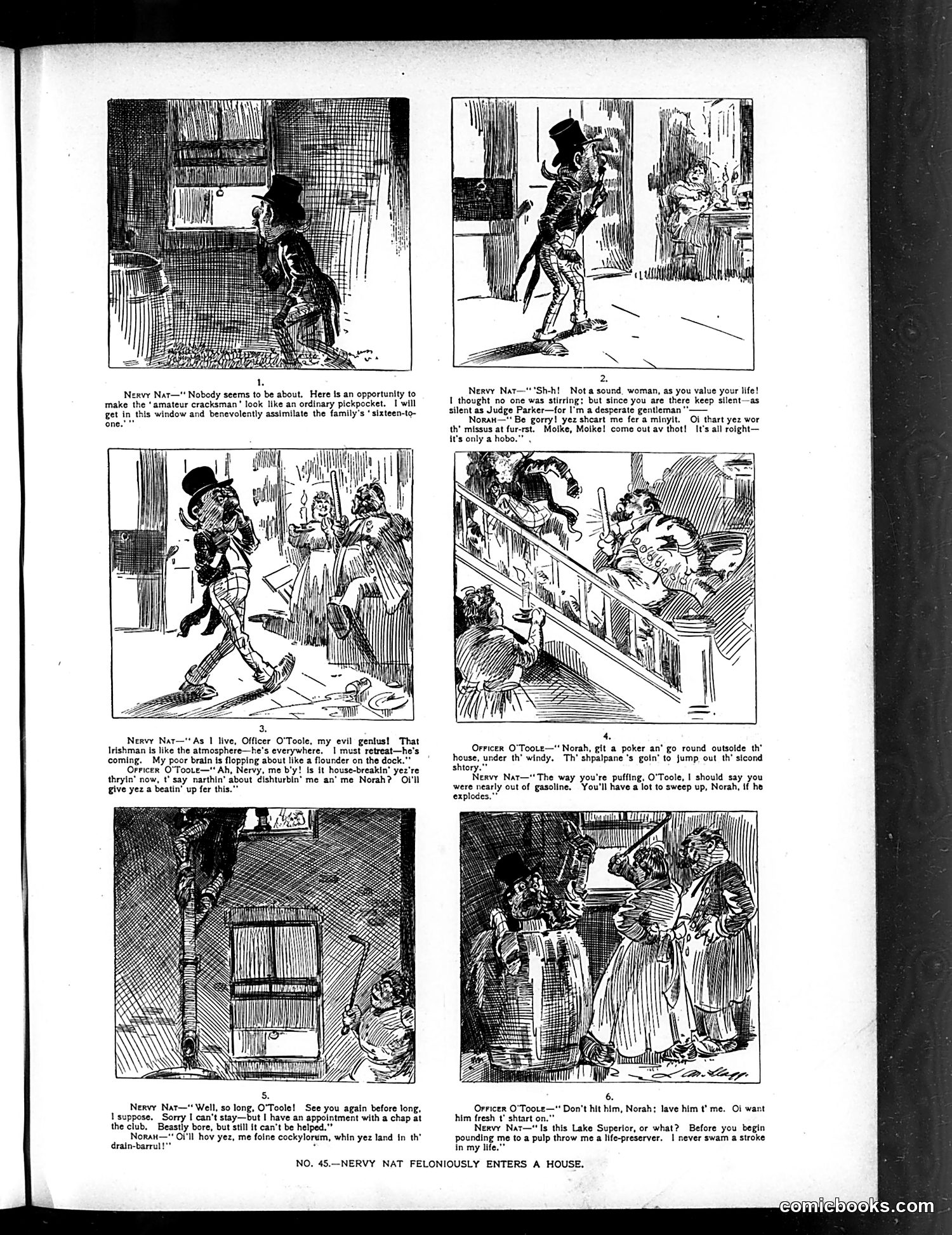
This appears to be a comic strip featuring "Nervy Nat," a recurring character in Judge magazine. The narrative follows Nat's attempt to enter Officer O'Toole's house through deception—posing as an "amateur pickpocket" to gain entry. The satire targets class pretension and social climbing. Nat uses flattery and lies to convince the officer he's a "desperate gentleman" rather than admitting his true criminal intent. When discovered, he tries bribery and further manipulation. The humor derives from Nat's bumbling criminality and his transparent attempts at social deception. O'Toole represents working-class authority (an Irish police officer, suggested by the name), while Nat embodies the scheming urban rogue trying to exploit others through manipulation rather than honest means. The strip satirizes both petty crime and social fraud.
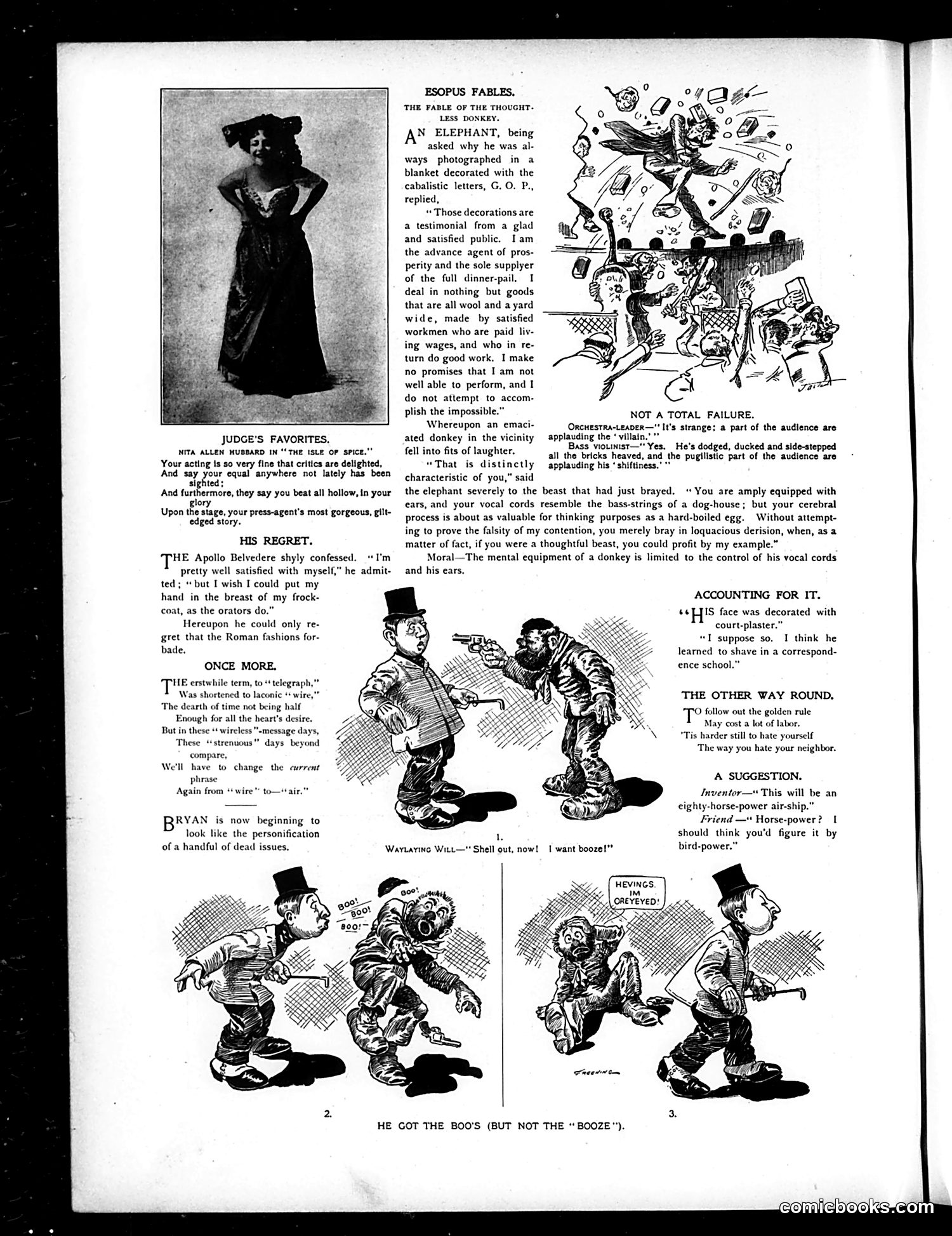
This page contains Aesop's Fables parodies and political satire typical of Judge magazine's humor. **Top section**: "The Fable of the Thought-Less Donkey" mocks an elephant's vanity about being photographed with GOP (Grand Old Party) letters, satirizing Republican self-promotion and materialism. **Middle cartoons**: "Wattling Will" and related panels appear to reference a political figure (likely William Jennings Bryan or similar contemporary politician) haggling over "boots" and "booze"—satirizing political corruption, bribery, or the gap between politicians' public promises and private dealings. **Right column**: Various short satirical quips mock contemporary figures and behaviors—orchestral conductors, business practices, and political hypocrisy. The overall tone ridicules political figures, corporate greed, and hypocrisy through animal fables and character sketches, typical of Judge's late 19th/early 20th-century political commentary.
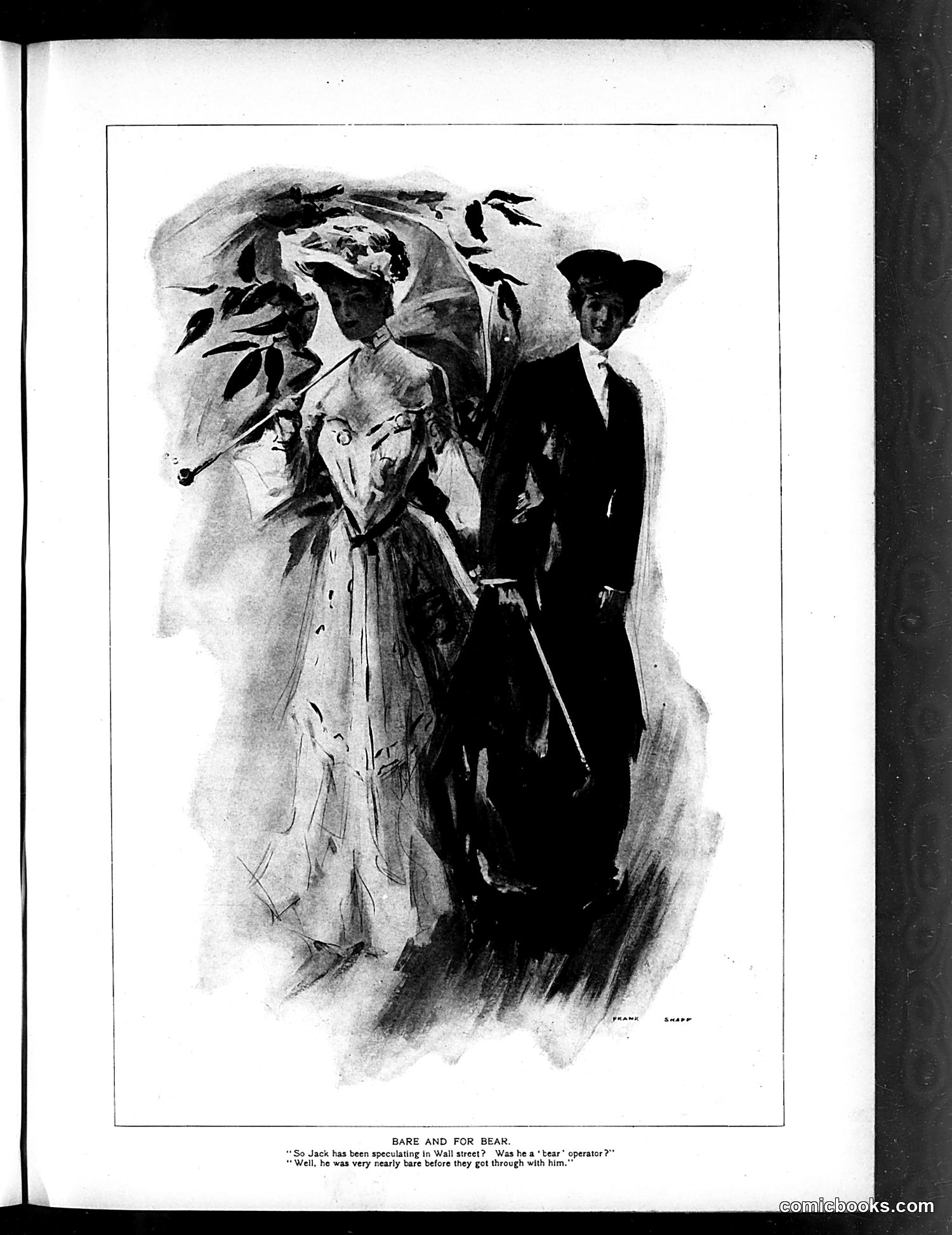
This cartoon satirizes financial speculation during what appears to be a market downturn. The dialogue is a pun: "bear" (a pessimistic investor betting on price declines) versus "bare" (stripped of money). The scene depicts a well-dressed man (Jack) who speculated on Wall Street, apparently as a "bear operator"—someone profiting from falling prices. However, the joke's dark irony suggests he ended up financially ruined instead, "nearly bare" (stripped of his wealth) by other investors. The illustration shows figures in formal dress against a shadowy background, emphasizing the serious consequences of failed speculation. The cartoon mocks both the risky nature of Wall Street gambling and the person who lost their fortune, reflecting Judge magazine's satirical commentary on Gilded Age financial excess and market volatility.
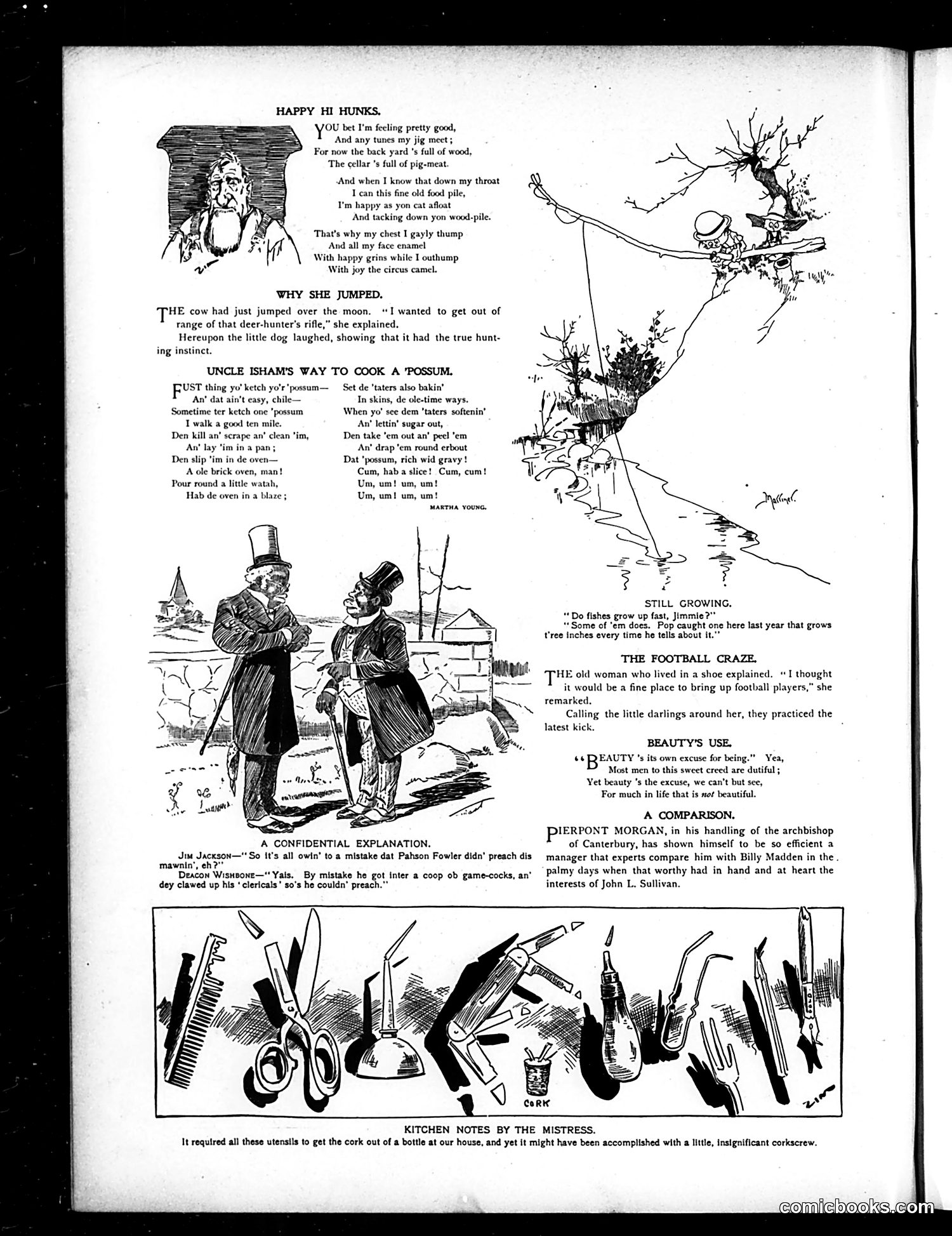
This page contains humorous short pieces typical of Judge's satirical format: **"Happy Hi Hunks"** satirizes rural contentment—a man boasts about full woodpiles and preserved meat, personified with exaggerated joy. **"Why She Jumped"** references the nursery rhyme "cow jumped over the moon," reframing it as escape from a deer hunter—absurdist humor about hunting season. **"Uncle Isham's Way to Cook a Possum"** uses dialect humor (common but now problematic) to present a Southern recipe in vernacular speech, reflecting period entertainment conventions. **"Still Growing"** jokes about fishermen's exaggerations—the fish "grows three inches every time he tells about it." **"The Football Craze"** mocks the football mania sweeping America by applying it to the nursery rhyme's shoe-dwelling family. **"Beauty's Use"** offers philosophical commentary on beauty as excuse for superficiality. **"A Comparison"** references J.P. Morgan's handling of Canterbury's archbishop, comparing him favorably to prizefighter Billy Madden—likely praising Morgan's negotiating skill. The "Kitchen Notes" illustration humorously shows excessive utensils needed for one simple task.
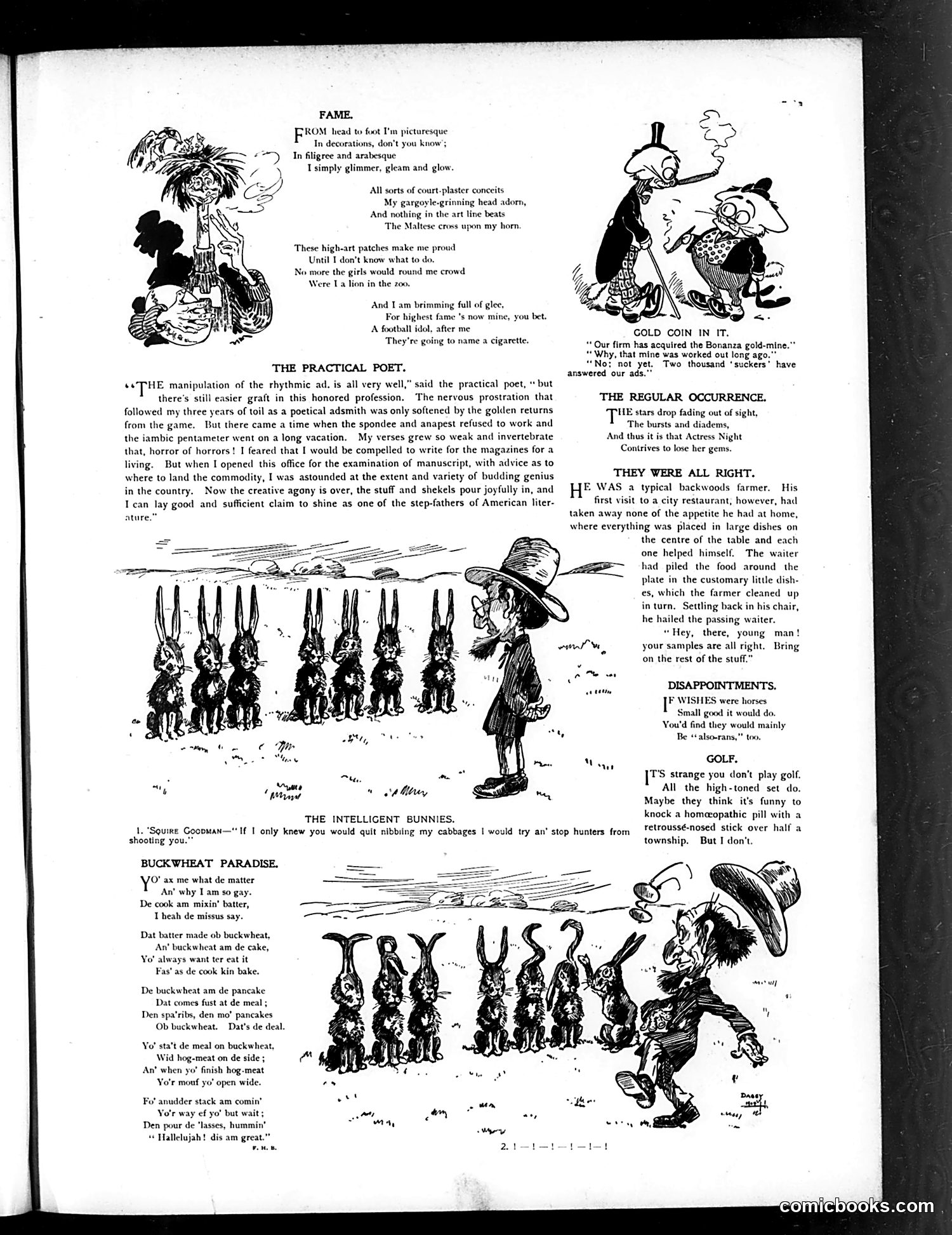
This page contains several satirical pieces typical of early 20th-century American humor: **"Fame"** mocks shallow celebrity culture. The speaker is a decorated society figure so obsessed with status that he'd prefer being a named cigarette to being a lion—satirizing how commercial endorsement surpasses genuine achievement. **"The Practical Poet"** critiques the poetry profession's decline. The poet abandoned serious verse-writing to profit from manuscript consultation services, exploiting amateur writers' hopeless literary ambitions—a jab at commercialized culture replacing artistic integrity. **"Buckwheat Paradise"** uses exaggerated dialect humor (common and offensive by modern standards) to mock the supposed contentment of African Americans with simple food, reflecting period racial stereotypes. **"Gold Coin in It"** exposes stock fraud schemes: mining companies sell worthless claims to gullible investors—"suckers"—via misleading advertisements. **"They Were All Right"** humorously depicts a rural farmer's confusion at restaurant service, treating individual dishes as "samples" before the main meal. The page mixes social criticism with period-typical racial humor and celebrates urban sophistication over rural naïveté.
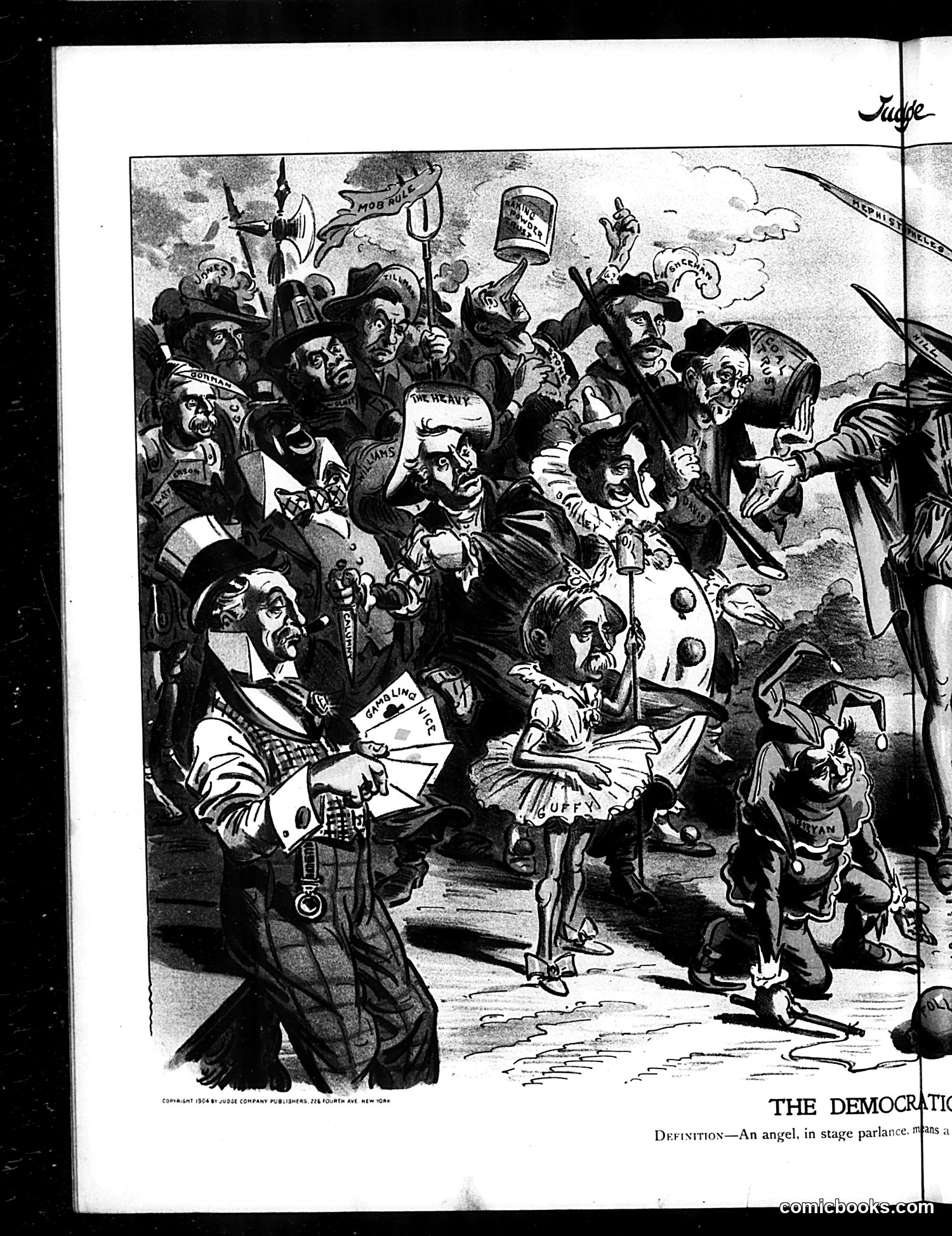
This satirical cartoon depicts the Democratic Party as a chaotic theatrical production. The central figure appears to be a performer in stage costume labeled "THE HEAVY," surrounded by a raucous mob of caricatured politicians and party members wielding various props and symbols—axes, torches, banners. The satire suggests internal Democratic Party disorder and conflict, portraying the party as a disorganized "stage farce" rather than a serious political force. The definition at bottom—"An angel, in stage parlance, means a financial backer"—provides the joke's key, though the specific financial scandal or controversy referenced is unclear without knowing Judge's publication date. The exaggerated facial features and costumes mock Democratic leadership as theatrical performers rather than serious statesmen.
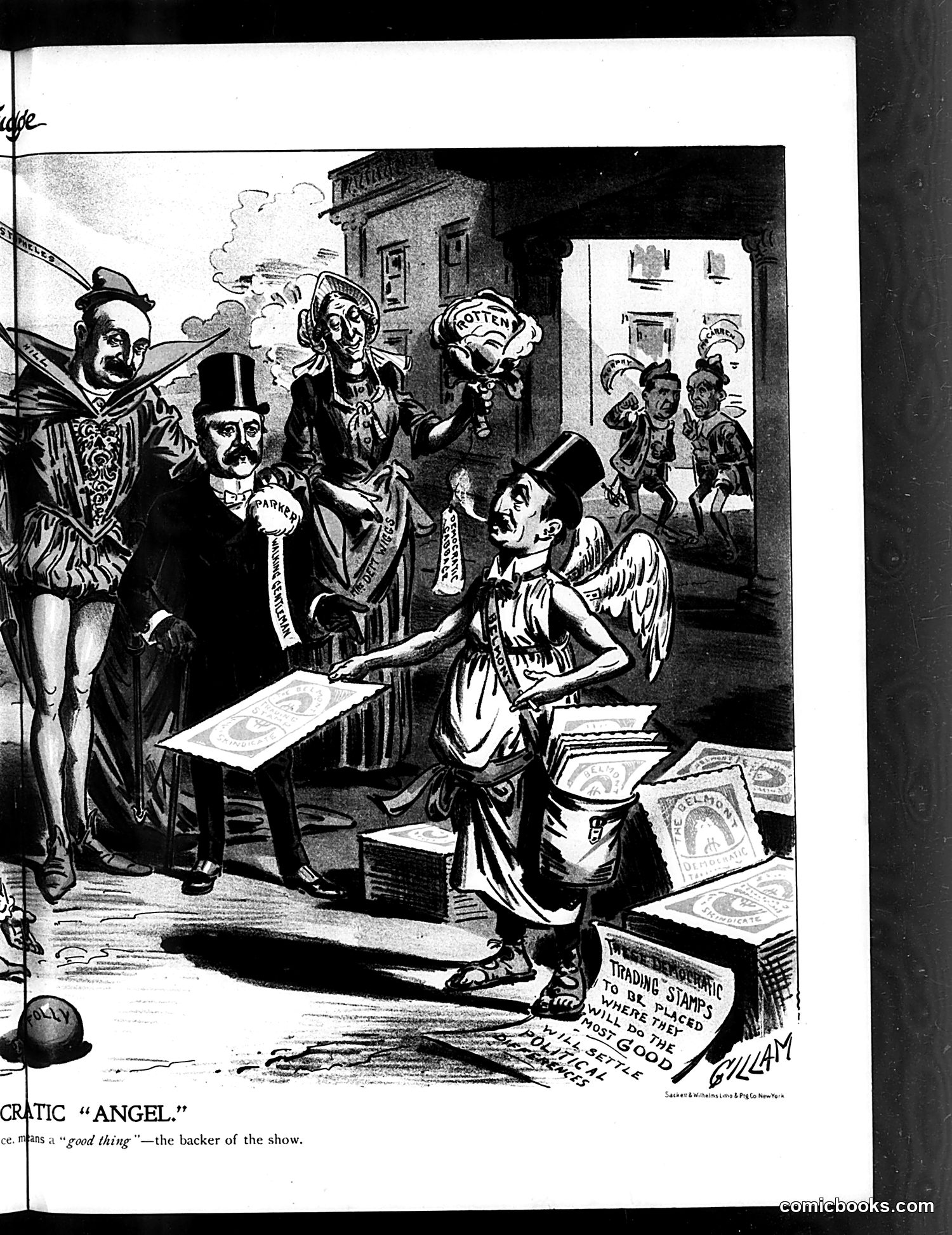
This cartoon satirizes fraudulent stock trading, likely from the Gilded Age. An angelic figure (labeled "Trading Stamps") sits at a desk surrounded by dishonest businessmen in top hats—caricatured with exaggerated, grotesque features typical of Judge magazine's style. The "angel" represents a "good thing" (the backer of the scheme), while the well-dressed men appear to be con artists or promoters. The visible text references "Trading Stamps to be placed" and mentions something being "good," suggesting satire of deceptive investment schemes marketed as legitimate opportunities. The contrast between the "angel" facade and the villainous characters illustrates how fraudulent ventures presented themselves respectably while enriching corrupt operators.
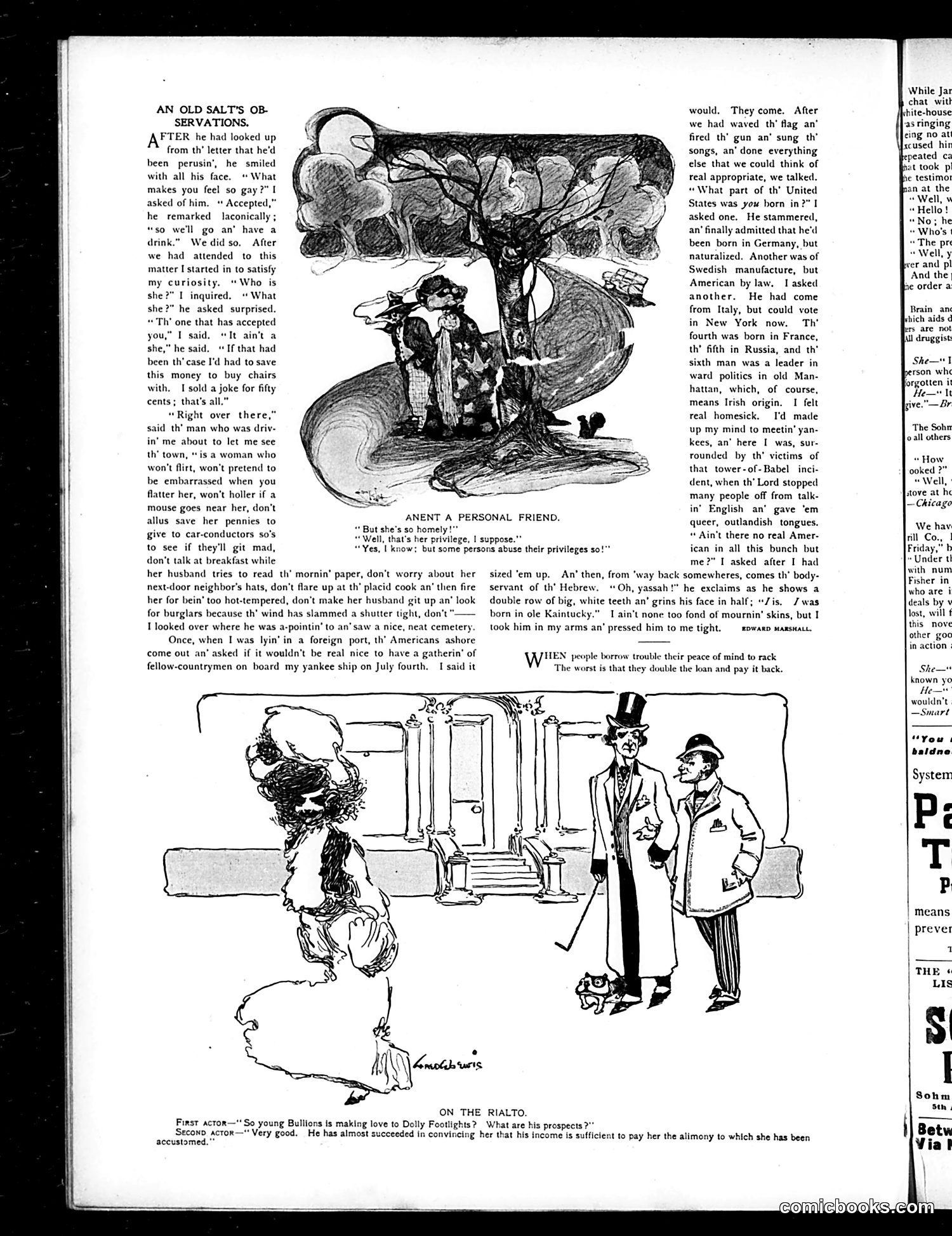
This Judge magazine page contains two satirical pieces about American identity and immigration. **"An Old Salt's Observations"** (top narrative) mocks the melting pot myth. A sailor expects to meet "Yankees" but instead encounters immigrants from Germany, Sweden, Italy, France, and Russia—all now American citizens or voters. The satire's point: despite naturalization, these foreign-born residents don't represent the "real American" the sailor sought. The final paragraph about the Tower of Babel reinforces nativist anxiety: immigrants fragment American unity by bringing foreign languages and cultures. **"On the Rialto"** (bottom cartoon) is a theatrical joke about a young man (Bullions) courting an actress (Dolly Footlights). The humor hinges on his persuading her that his income suffices to pay *her alimony*—implying she's been divorced multiple times and extracting payments from previous husbands. The satire ridicules both theatrical morality and economic desperation. Both pieces reflect early-20th-century anxieties: nativist suspicion of immigrants and satirical commentary on theatrical/urban social mores.
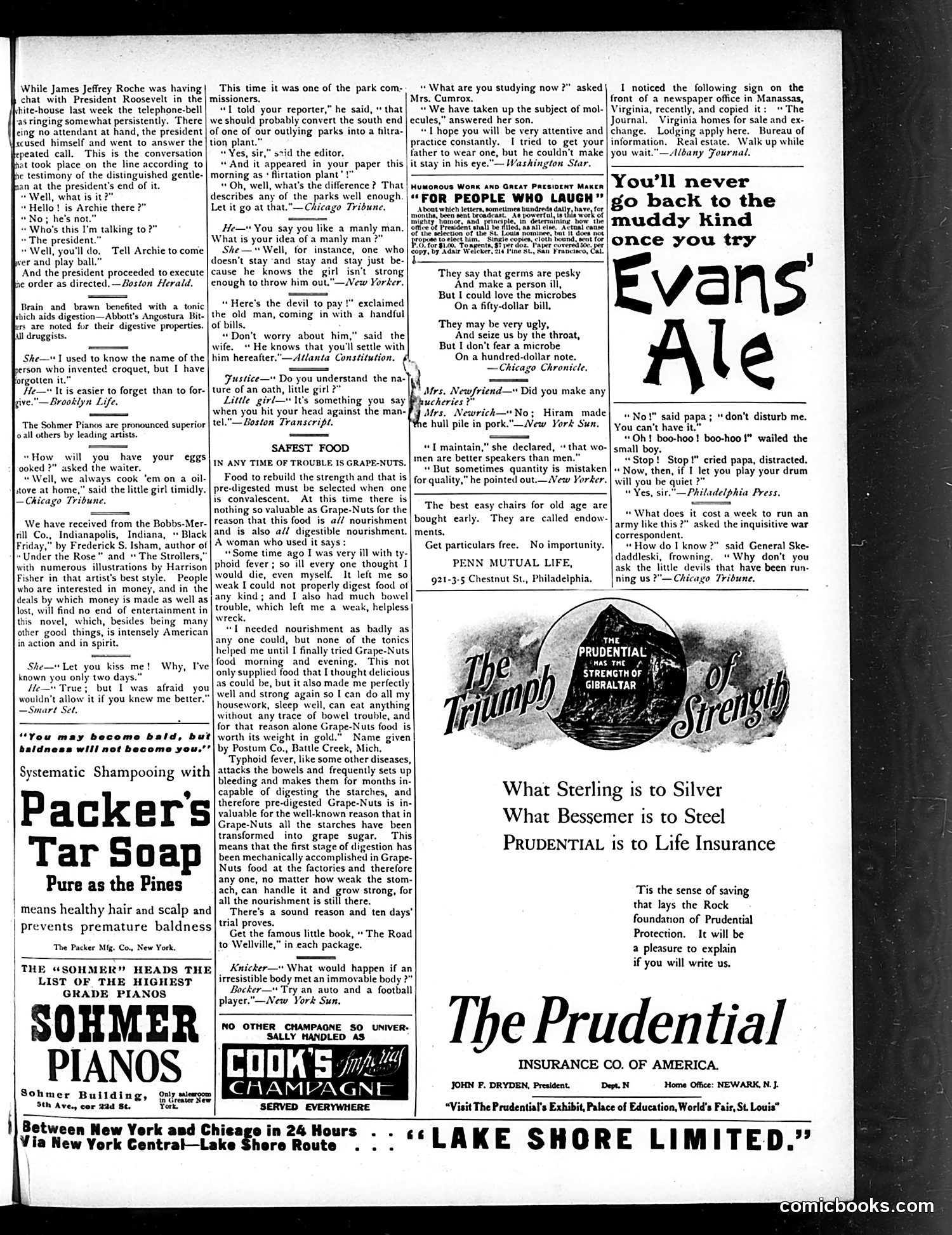
This page from **Judge** (an American satirical magazine) contains primarily **short humorous anecdotes** rather than political cartoons. The main content includes: **Key Humorous Items:** - An anecdote about President Roosevelt answering a telephone call asking for his son Archie, then complying with a caller's request to "tell Archie to come over and play ball"—satirizing the president's casual accessibility - A joke about a park commissioner's "filtration plant" being misreported as a "flirtation plant," mocking newspaper errors - Various domestic humor pieces about marriage, courtship, and family life **The Satire:** The Roosevelt anecdote gently mocks the president's informal, approachable demeanor during his administration. The piece suggests Roosevelt's willingness to step away from official duties for casual requests. **Advertisements:** The page is heavily populated with period product ads (Packer's Tar Soap, Sohmer Pianos, Prudential Insurance) typical of early 20th-century magazines. The overall tone is light domestic humor rather than sharp political commentary.
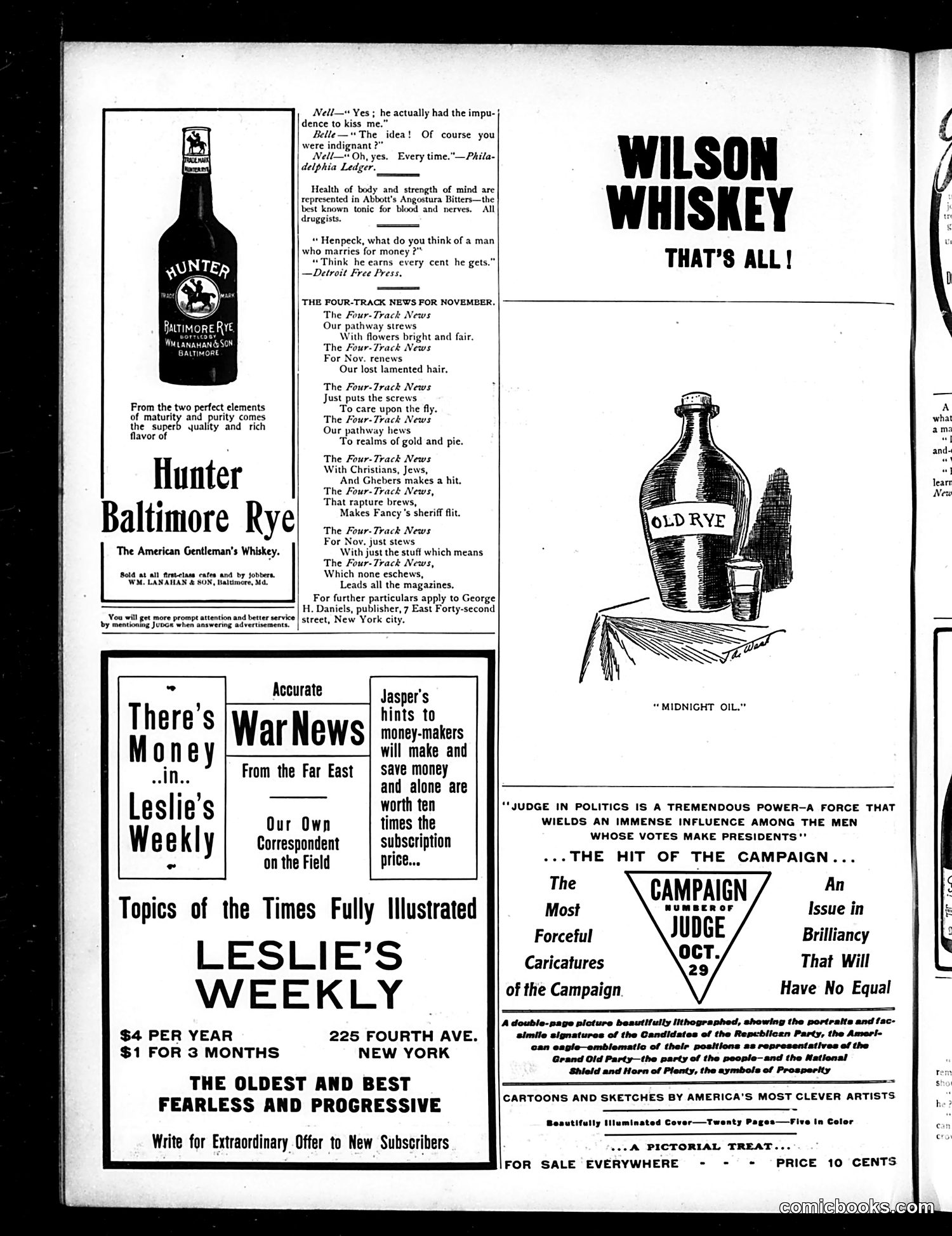
This is primarily a **advertising and promotional page** from Judge magazine, not a satirical cartoon page. The dominant content includes ads for whiskeys (Hunter Baltimore Rye, Wilson Whiskey) and magazine subscriptions (Leslie's Weekly, Judge itself). The only humor content consists of **brief joke items**: two mild exchanges about kissing and marriage, plus a playful advertising poem for "Four-Track News" magazine using repetitive verse structure for comedic effect. The page's main feature is a large advertisement promoting Judge's October 29 campaign issue, which promises "double-page pictures beautifully lithographed" of Republican Party candidates with "caricatures of the campaign" by "America's most clever artists." This appears to reference a U.S. presidential election (likely 1908 or 1912, based on typography), promoting Judge's political coverage as influential in swaying voter opinion. The content reflects Judge's role as both satirical publication and political commentary medium during the Progressive Era.
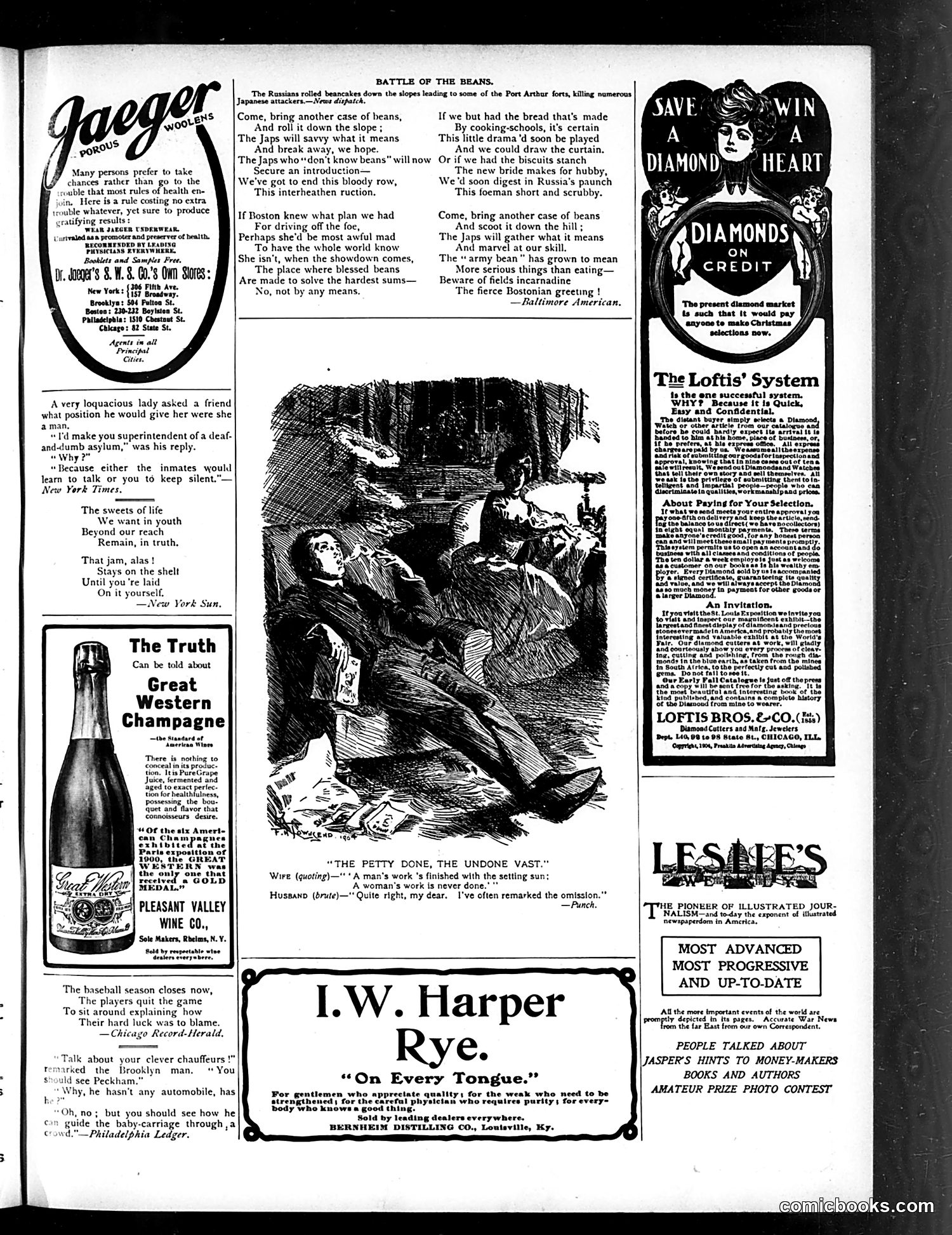
This satirical poem mocks the Russo-Japanese War (1904-1905), specifically referencing a news dispatch about Russian forces rolling beancakes down slopes at Port Arthur to repel Japanese attackers. The joke targets Boston's reputation as the center of American baked bean culture—a regional stereotype. The poem suggests that if Boston's famous cooking schools or homemade biscuits were available instead of beans, the Russians could solve their military problem more effectively. The satire works on multiple levels: it ridicules both the desperate, absurd Russian military tactics and New England's famous food identity. The final stanza warns of "fields incarnadine" (blood-red fields) and Boston's "greeting"—darkly suggesting that bean-related pride has become something more ominous. The poem's title, quoting Shakespeare, emphasizes how small military victories matter little against larger, unfinished wars—the "petty done, the undone vast."
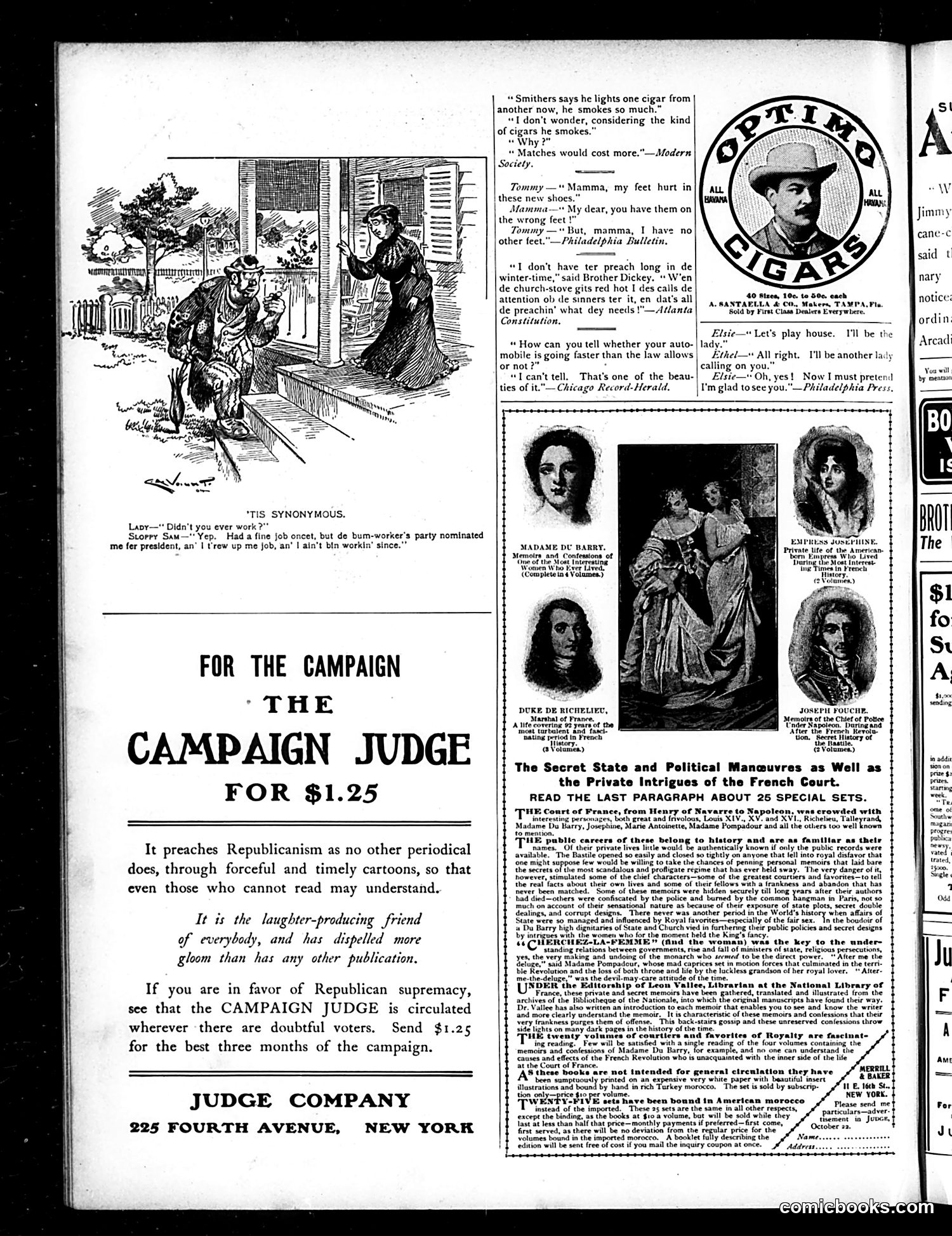
This page primarily contains **advertisements and filler content** rather than substantive political cartoons. The main cartoon, titled "TIS SYNONYMOUS," depicts a dialogue between a "Lady" and "Sloppy Sam," a working-class figure. Sam claims he lost his job after the "bum-worker's party" nominated him for president—a joke about labor unions and working-class political involvement. The satire suggests that labor activism or union politics interfered with honest work, reflecting Judge magazine's generally conservative, Republican-leaning editorial stance. The large advertisement for "Campaign Judge" emphasizes the publication's pro-Republican advocacy through "forceful and timely cartoons," particularly targeting readers "who cannot read"—a dismissive reference to working-class or immigrant voters. The remaining content consists of brief humorous anecdotes and an advertisement for a multi-volume history of Madame du Barry, the French courtesan—likely included for sensational appeal to contemporary readers.
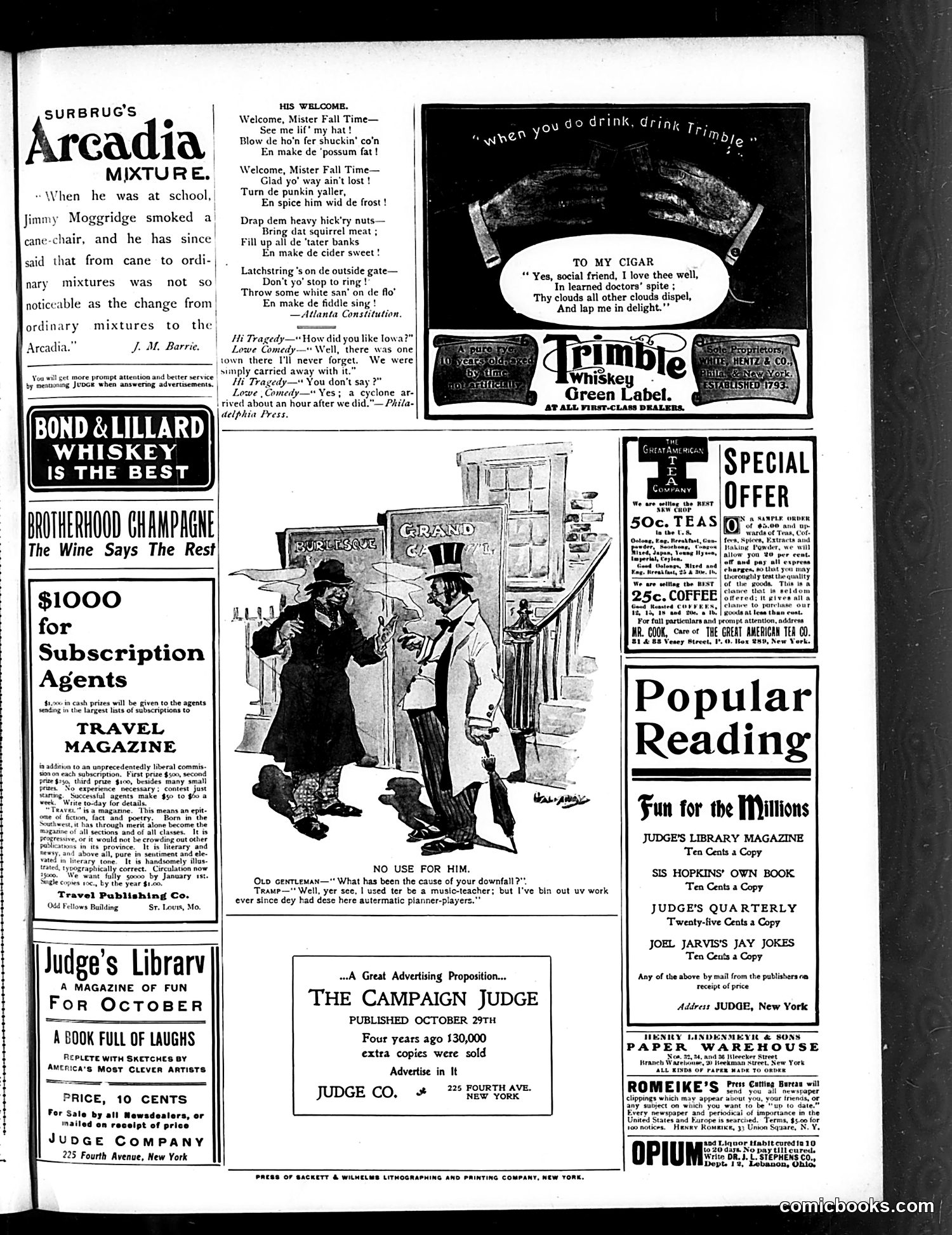
This single-panel cartoon satirizes **technological unemployment** during the early industrial era. A impoverished tramp explains his downfall to a gentleman: he was once a music teacher but has been jobless ever since "automatic pianner-players" became common. The joke reflects genuine anxiety about mechanical player pianos—which could reproduce recorded performances without human musicians—displacing skilled workers. This was a real concern circa 1910, when automatic musical instruments threatened the livelihoods of music instructors and performers. The cartoon's dark humor presents this as inevitable and permanent ("ever since"), offering no solution—hence the title's resignation. For modern readers, it's an early commentary on automation replacing human labor, a theme that persists today with AI and robotics replacing various professions. The tramp's fate represents society's indifference to those displaced by progress.
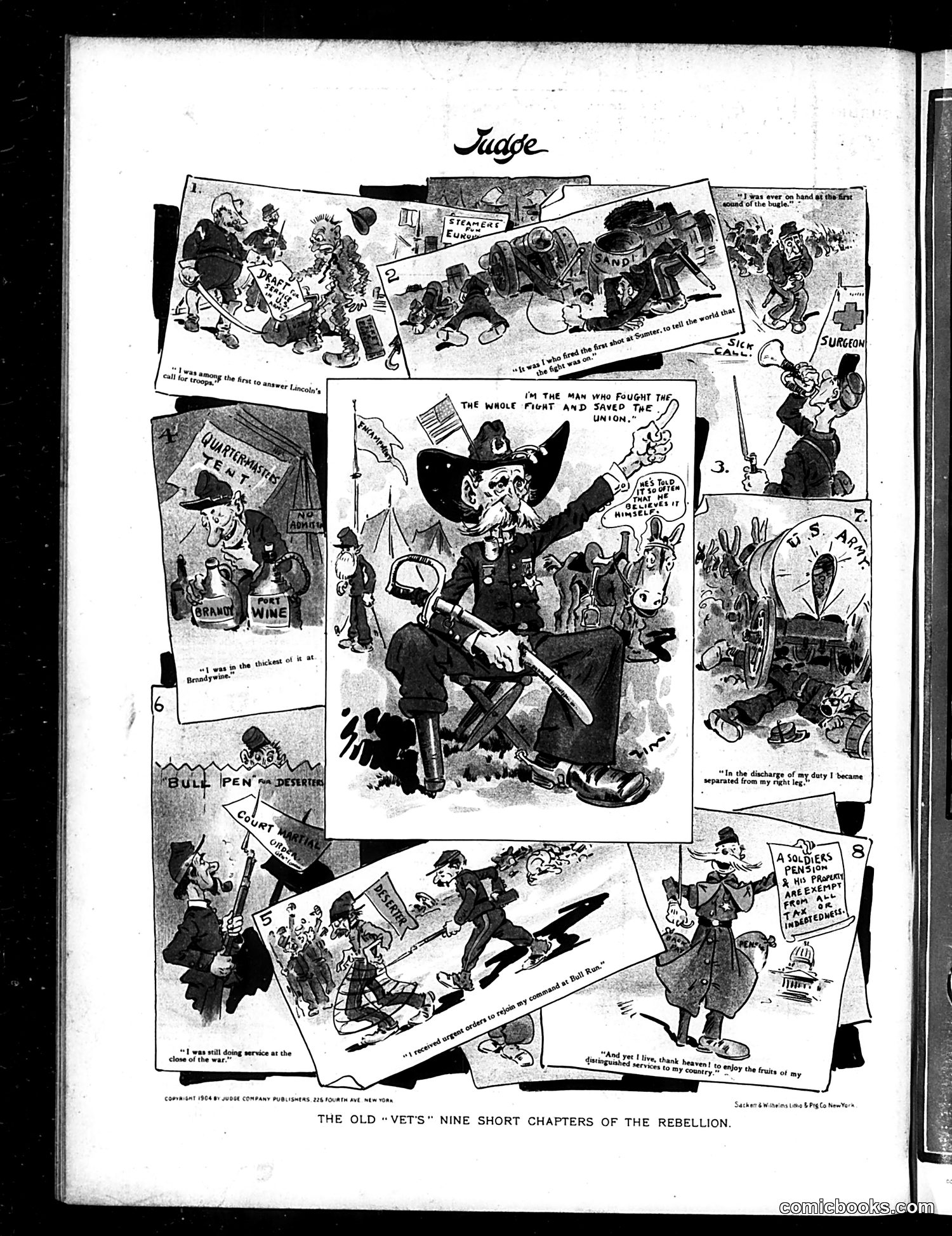
This Judge satirical cartoon mocks an aging Civil War veteran who boasts of his wartime service while seeking financial benefit. The central figure—a disheveled old man in a military hat—claims he "fought the whole fight and saved the Union," referencing famous battle locations like Brandywine (appearing to confuse Revolutionary and Civil Wars). His exaggerated claims contrast with reality: he lost a leg, admits being separated from combat, and by war's end was merely "doing service." The satire targets veterans or politicians who inflated their war records to gain pensions or political advantage in the post-war era. The scattered vignettes around him emphasize the disconnect between his grandiose self-promotion and his actual modest contributions. This reflects late-19th-century skepticism about dubious veterans' benefit claims.