
A complete issue · 16 pages · 1904
Judge — October 1, 1904
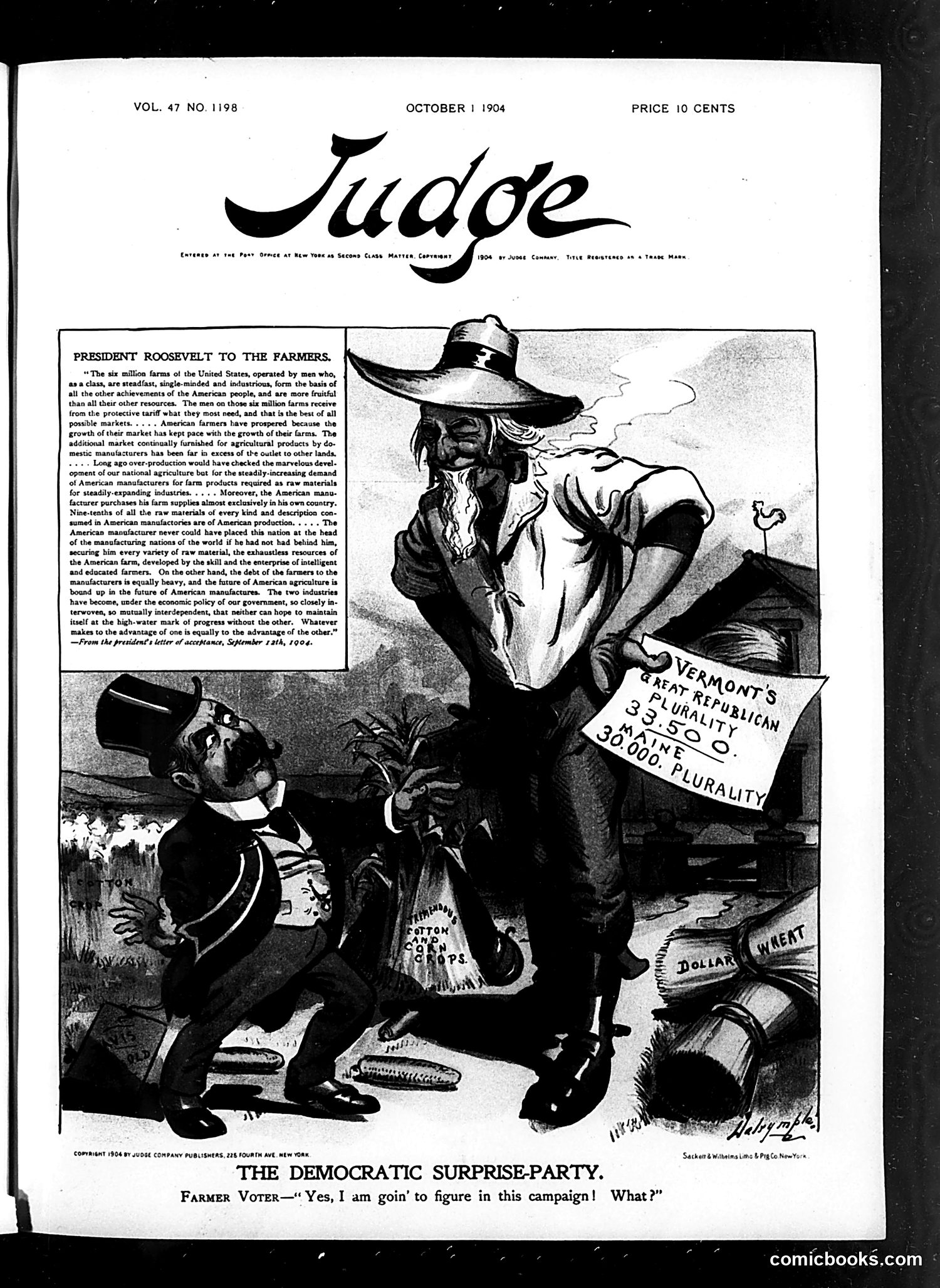
This political cartoon satirizes the Democratic Party's 1904 election strategy regarding farmers. The tall figure appears to represent the Democratic Party or its candidate, holding a banner reading "VERMONT'S REPUBLICAN SURPLUS 30 GOOD, PLURALITY 30,000." A caricatured farmer (left) looks confused or skeptical, examining bags labeled "Cotton Crops," "Dollar," and "Wheat"—representing agricultural commodities. The caption reads "The Democratic Surprise-Party," with the farmer asking, "Yes, I am goin' figure in this campaign! What?" The satire mocks Democratic attempts to appeal to farmers by promising economic benefits, suggesting farmers find the party's agricultural policy proposals unconvincing or contradictory. The Vermont reference indicates Republican electoral strength in farming regions.
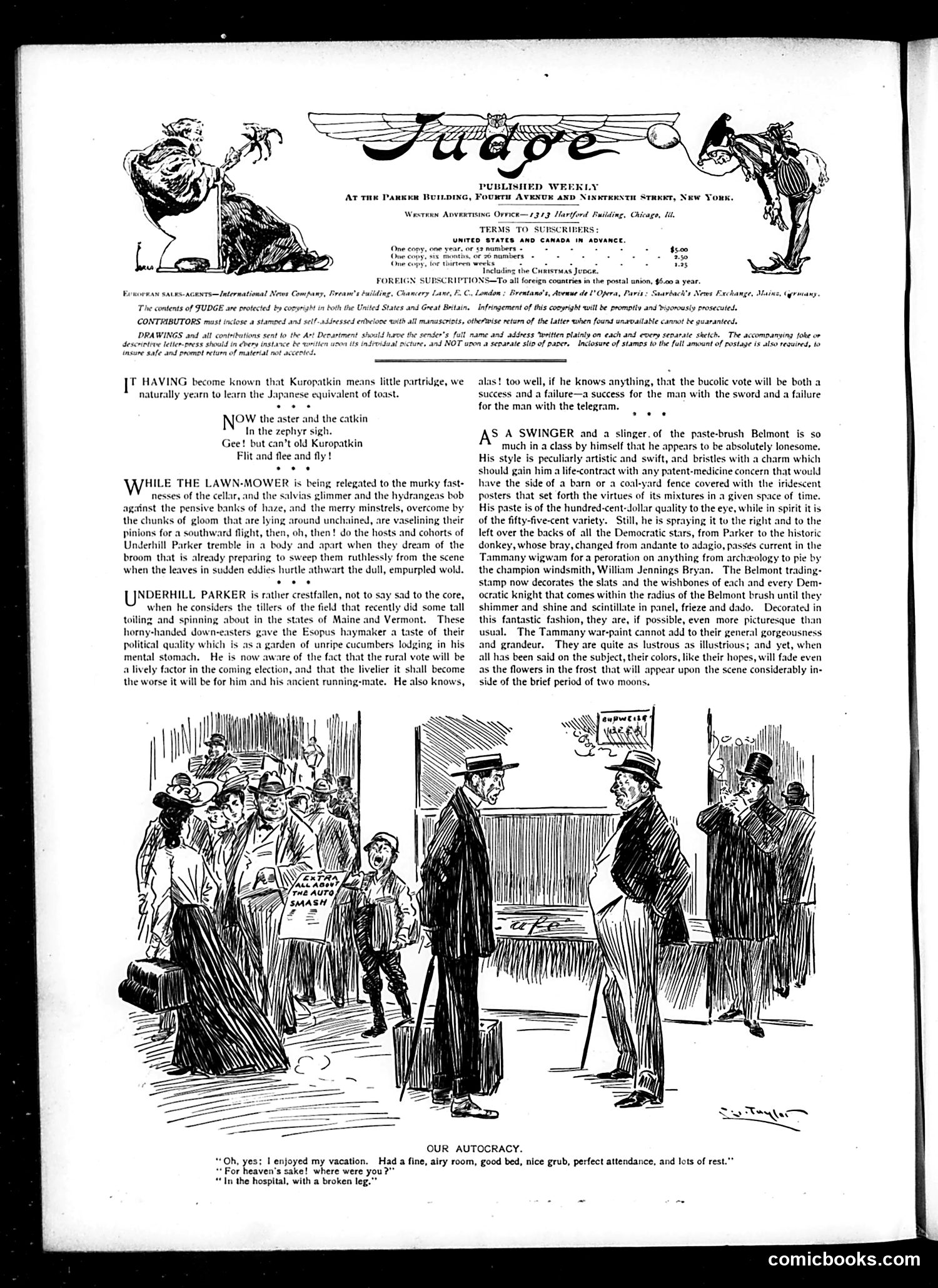
This cartoon satirizes American bureaucratic inefficiency and red tape. The scene depicts a street-level interaction where citizens encounter officials behind windows and barriers—the visual metaphor for government obstruction. The joke below—contrasting a pleasant vacation with a hospital stay from a "broken leg"—suggests that dealing with government bureaucracy is as unpleasant as being injured. The title "Our Autocracy" sarcastically compares American democratic institutions to authoritarian rule, implying that citizens experience government as oppressively rigid and impersonal. The cartoon criticizes how ordinary people navigate multiple official channels and offices, reduced to anonymous applicants facing indifferent institutional power. This reflects Progressive Era complaints about bloated, inefficient government becoming increasingly distant from citizens' needs.
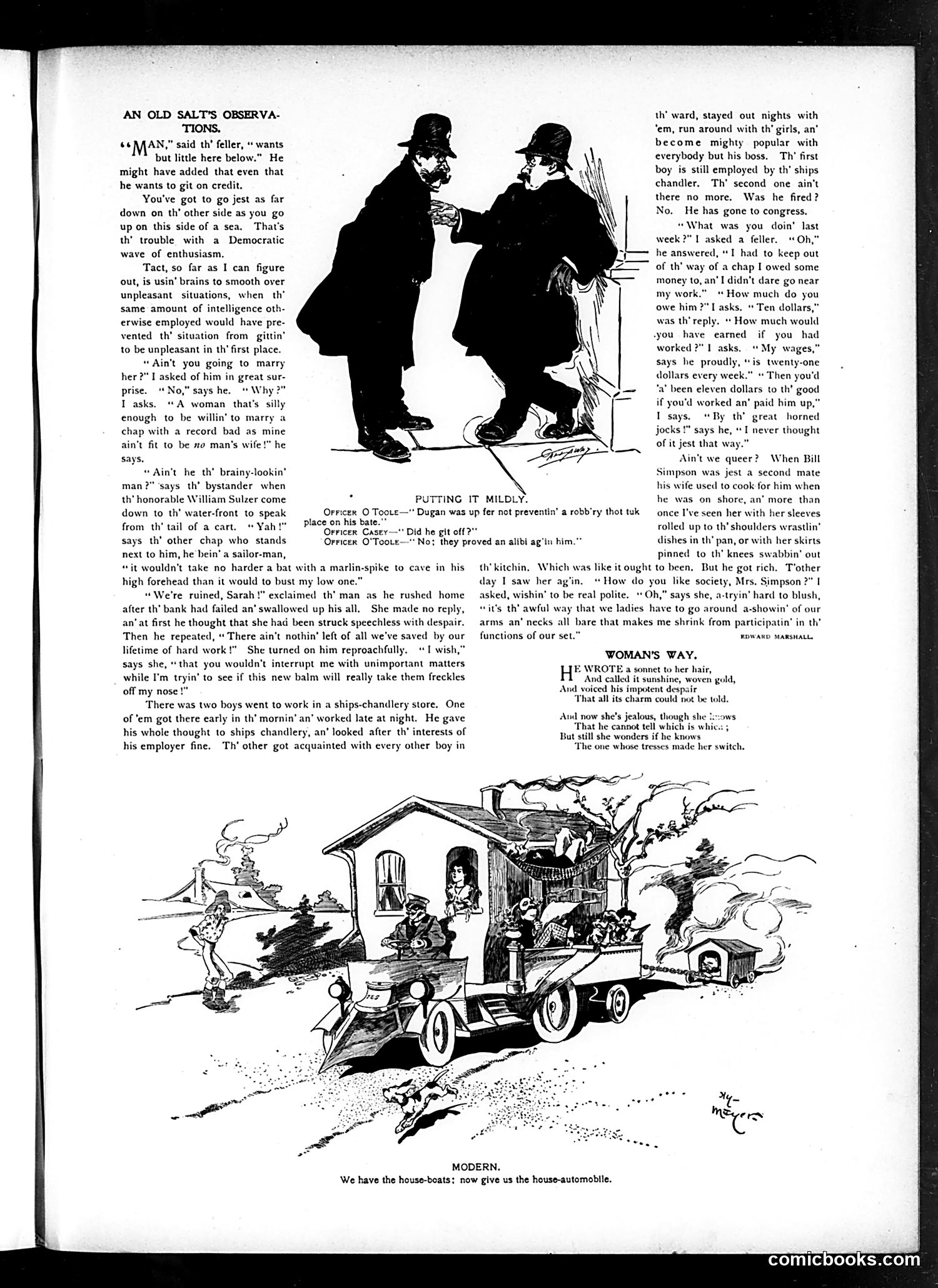
The upper section contains "An Old Salt's Observations," featuring two working-class men in conversation about social mobility and wages. The dialogue satirizes the gap between aspirations and economic reality—one man asks another about marriage prospects, only to learn the other man owes money and cannot afford it. The satire mocks Democratic political promises of prosperity while workers remain trapped in poverty. The lower illustration titled "Modern" depicts a fantastical "house-automobile"—a vehicle designed as a mobile home. This appears to satirize modern convenience culture and the American obsession with mechanical solutions to domestic life. The caption's deadpan humor suggests skepticism about such technological novelties. The page also includes a poem, "Woman's Way," offering sentimental commentary on female virtue and domestic sacrifice.
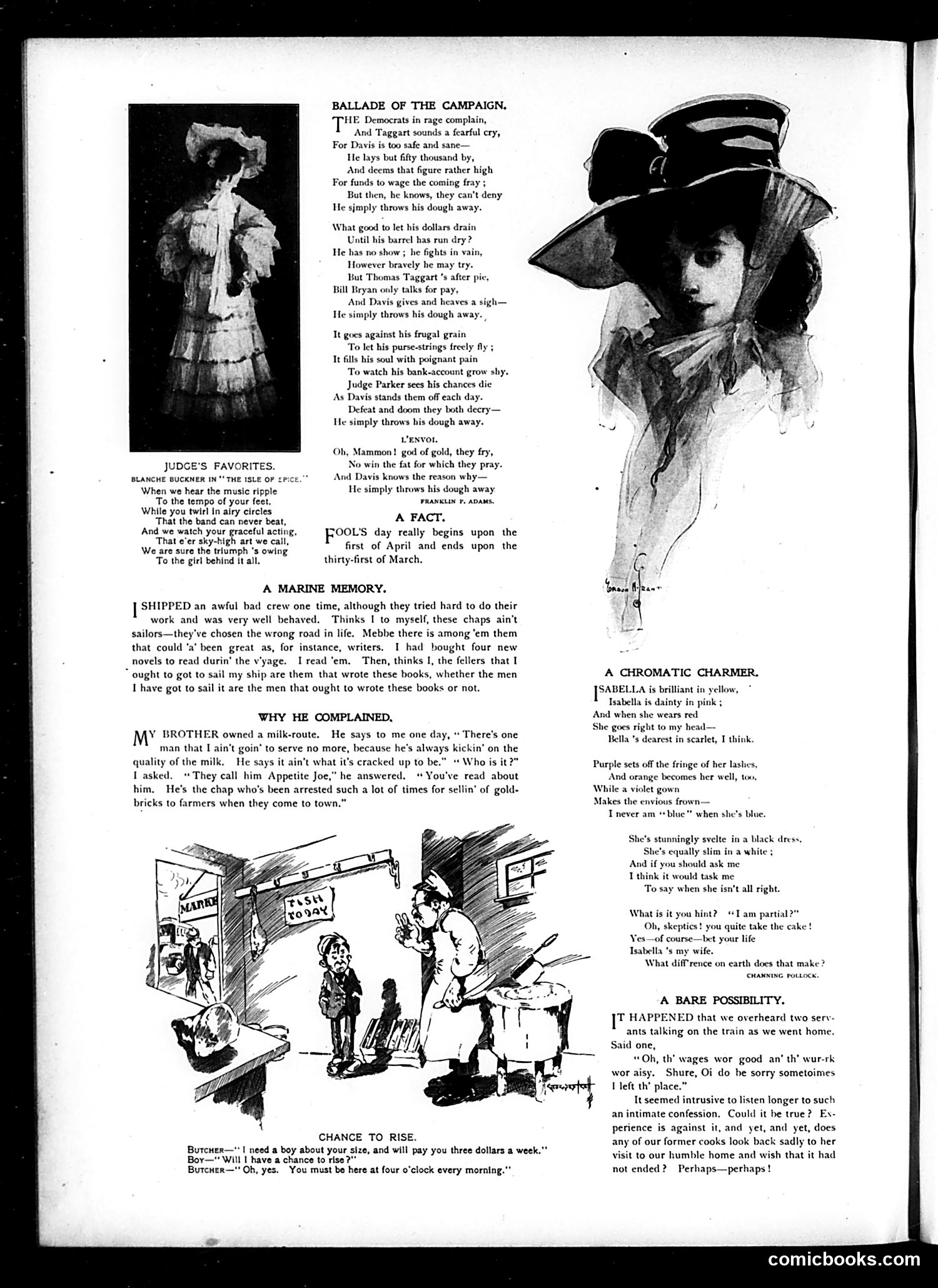
This page contains multiple satirical pieces rather than a single political cartoon: **"Ballade of the Campaign"** appears to mock **William Jennings Bryan** and **Richard "Dick" Davis** (likely a political figure of that era), criticizing them for financial mismanagement during an election campaign. The poem suggests Davis "throws his dough away" while Bryan merely "talks for pay." **"Judge's Favorites"** features **Blanche Becker in "The Isle of Spice,"** a theatrical reference suggesting entertainment/cultural commentary. Other pieces like **"A Marine Memory"** and **"Why He Complained"** are humorous anecdotes rather than political satire. The illustrations depict everyday scenes—sailors, workers, domestic situations—used for comedic effect rather than direct political commentary. Without specific publication date context visible, precise identification of referenced figures remains uncertain.
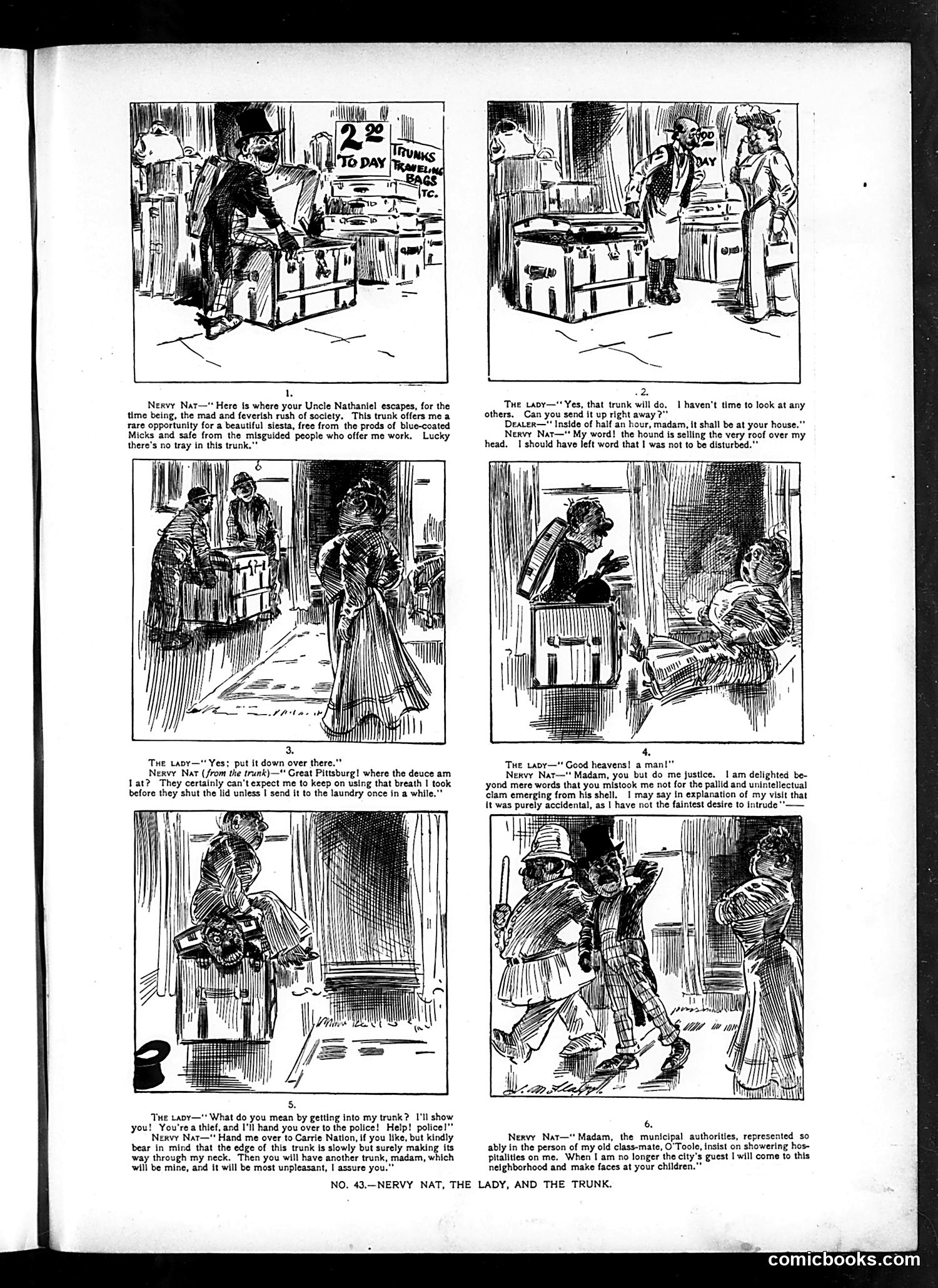
This comic strip follows a recurring character, "Nervy Nat," a vagabond or hobo evading police and societal obligations. Desperate to escape "the mad and feverish rush of society," Nat hides in a woman's trunk she's selling to a dealer. When discovered, he's caught between the angry lady threatening police and his predicament—the trunk lid cutting off his air supply. The satire targets early-20th-century attitudes toward homelessness and vagrancy. Nat's elaborate excuses ("purely accidental") and veiled threat that involving police will create worse problems (he'll become "the city's guest"—jail—then return to harass her) mock both the vagrant's cunning and society's inability to address poverty. The reference to "Carrie Nation" (the temperance crusader) adds period-specific humor about reform movements. The joke hinges on Nat's brazen audacity and the lady's helplessness.
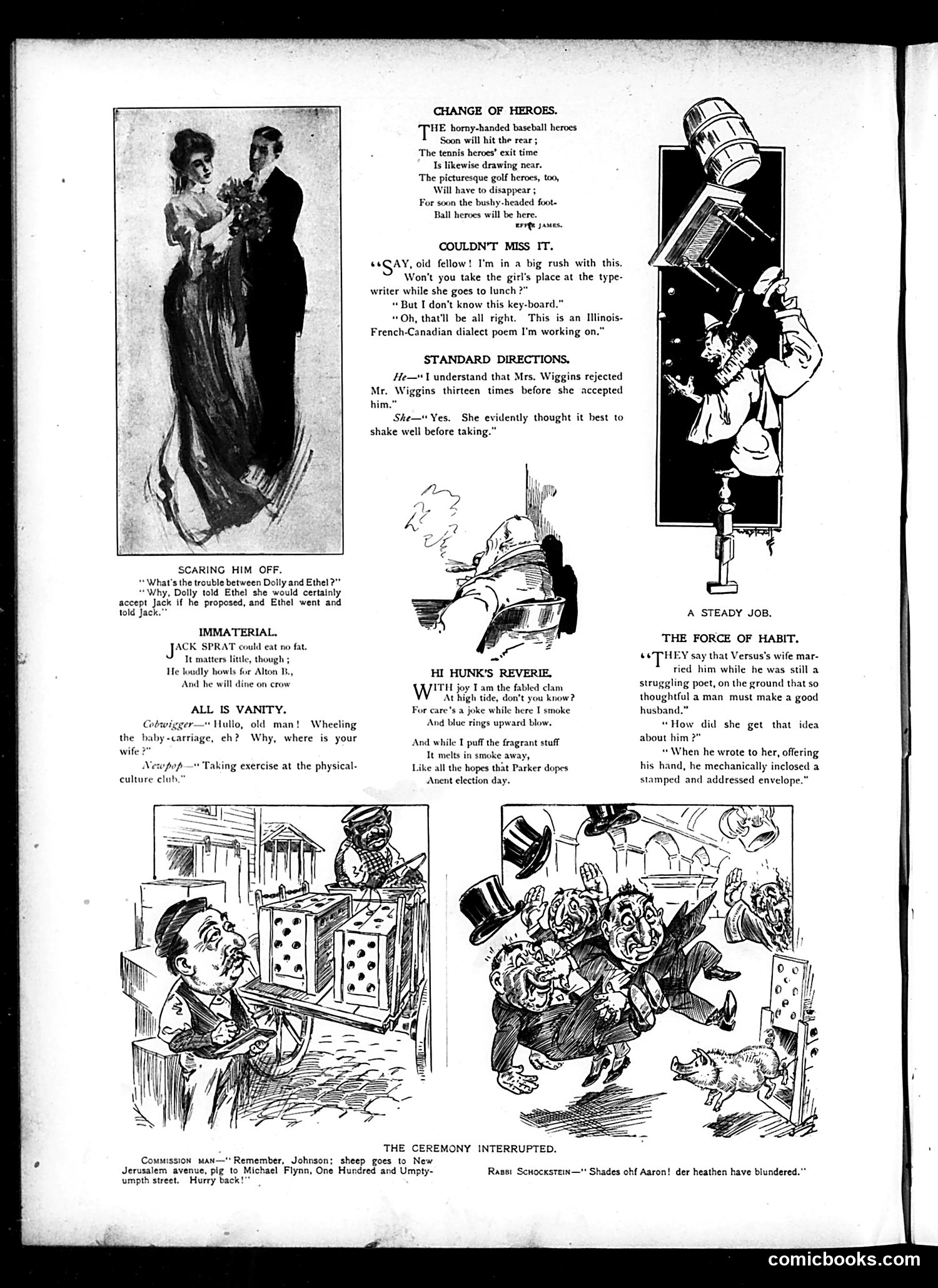
This page contains several brief satirical humor pieces typical of early 20th-century Judge magazine: **"Scaring Him Off"** mocks female social maneuvering—a woman's strategic comment backfires when relayed to the man she's trying to attract. **"All Is Vanity"** jokes about a man's pretentious claim to "culture club" exercise when he's merely pushing a baby carriage. **"Change of Heroes"** satirizes seasonal American sports obsessions, predicting football will soon displace baseball, tennis, and golf in public attention. **"Couldn't Miss It"** plays on workplace incompetence—a typewriter operator agrees to cover lunch despite not knowing the keyboard, justified by the poem's difficulty making errors acceptable. **"Standard Directions"** and **"The Ceremony Interrupted"** appear to reference Irish-immigrant characters and ethnic stereotyping common to the era. **"The Force of Habit"** mocks a struggling poet's mercenary courtship—even his romantic proposal includes a self-addressed stamped envelope, revealing his true character. The humor relies on period-specific social conventions and workplace dynamics now largely unfamiliar.
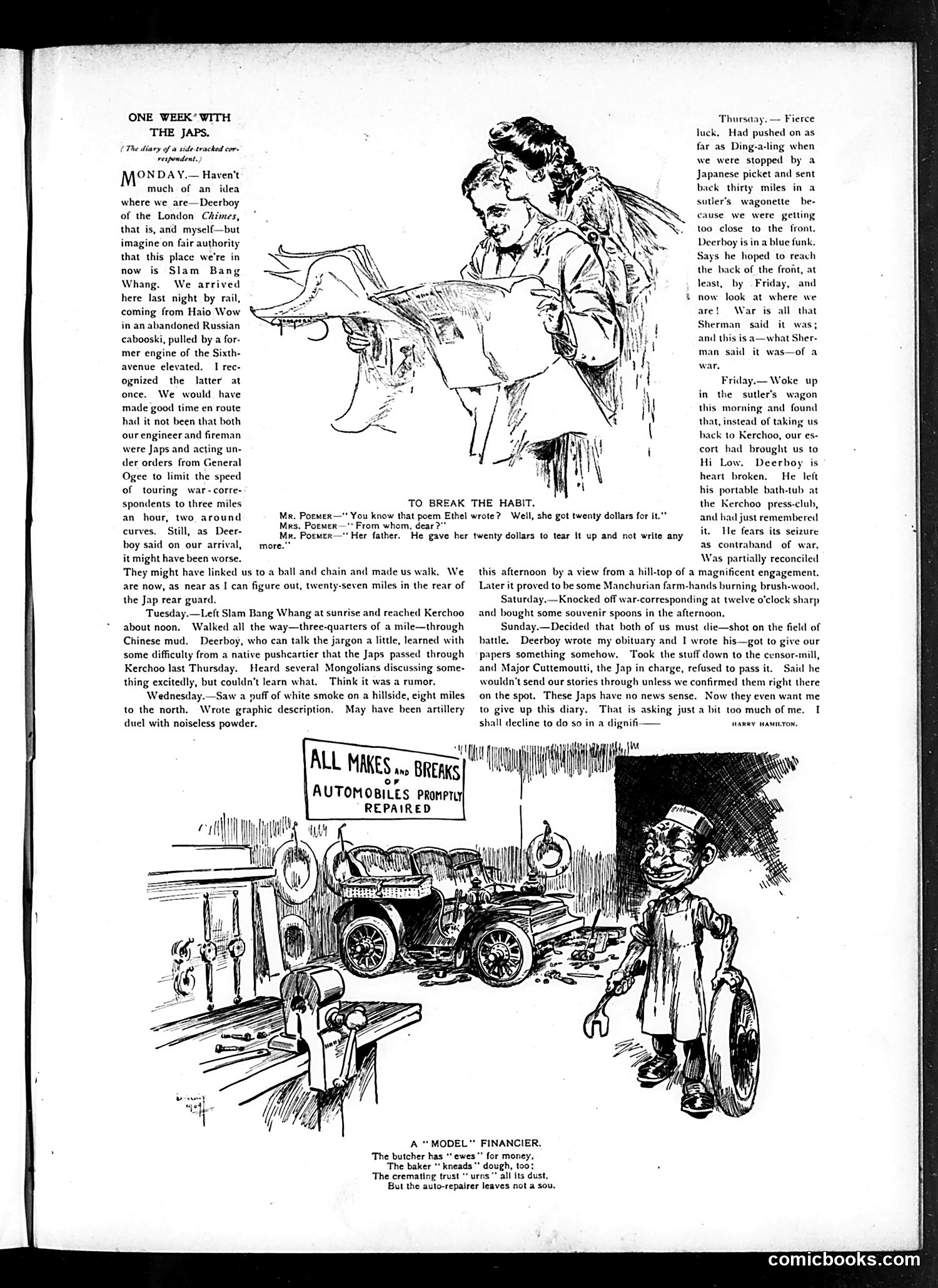
This page satirizes war correspondents covering the Russo-Japanese War (1904-1905). The main diary narrative mocks journalists' frustrations being kept far from actual combat by Japanese military handlers—stuck in remote locations, repeatedly redirected, and prevented from witnessing real battles. The humor lies in their desperation to access "the front" while accomplishing nothing: mistaking farm-hands burning brush for artillery, writing obituaries preemptively, and losing personal possessions to censorship. The censor refusing to pass their stories unless verified on-site highlights the absurdity of war reporting. The page satirizes both military censorship and correspondents' theatrical self-importance during wartime. The smaller cartoon about auto-repair finances is unrelated advertising humor.
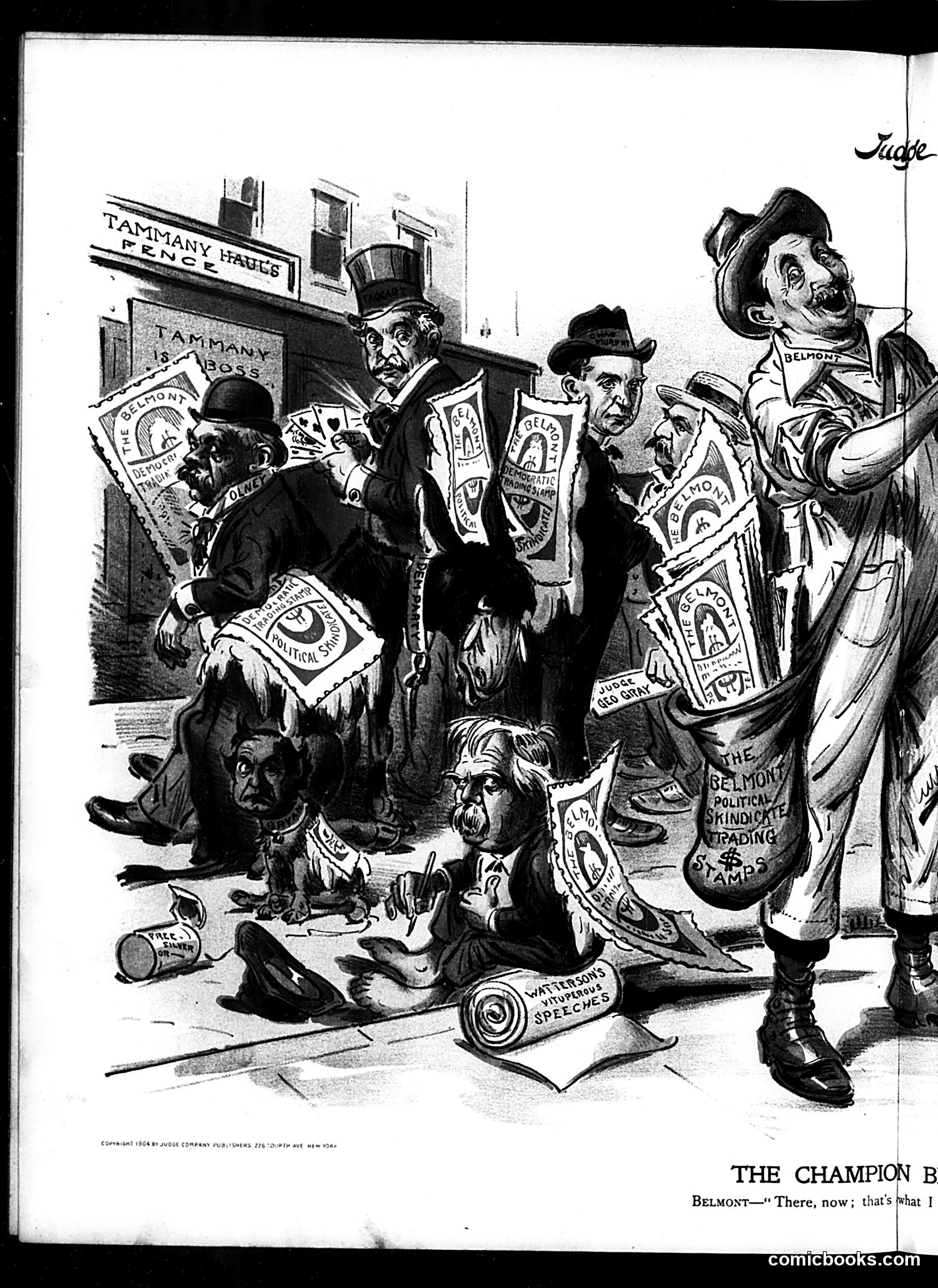
This appears to be a Judge magazine political cartoon titled "The Champion B[...]" with a caption from someone named Belmont saying "There, now; that's what I..." The cartoon depicts several well-dressed men wearing sashes or badges labeled "Belmont" gathered around figures on the ground. Visible business names include "Tammany Hauls" and "Tammany Boss," suggesting this satirizes **Tammany Hall**, the notorious Democratic political machine that dominated New York City politics through patronage and corruption. The composition—with authority figures standing over prone figures—suggests the cartoon critiques Tammany's exploitation or domination of constituents or rival politicians. However, without seeing the complete caption or having the publication date, the specific political context and identities of individual figures remain unclear.
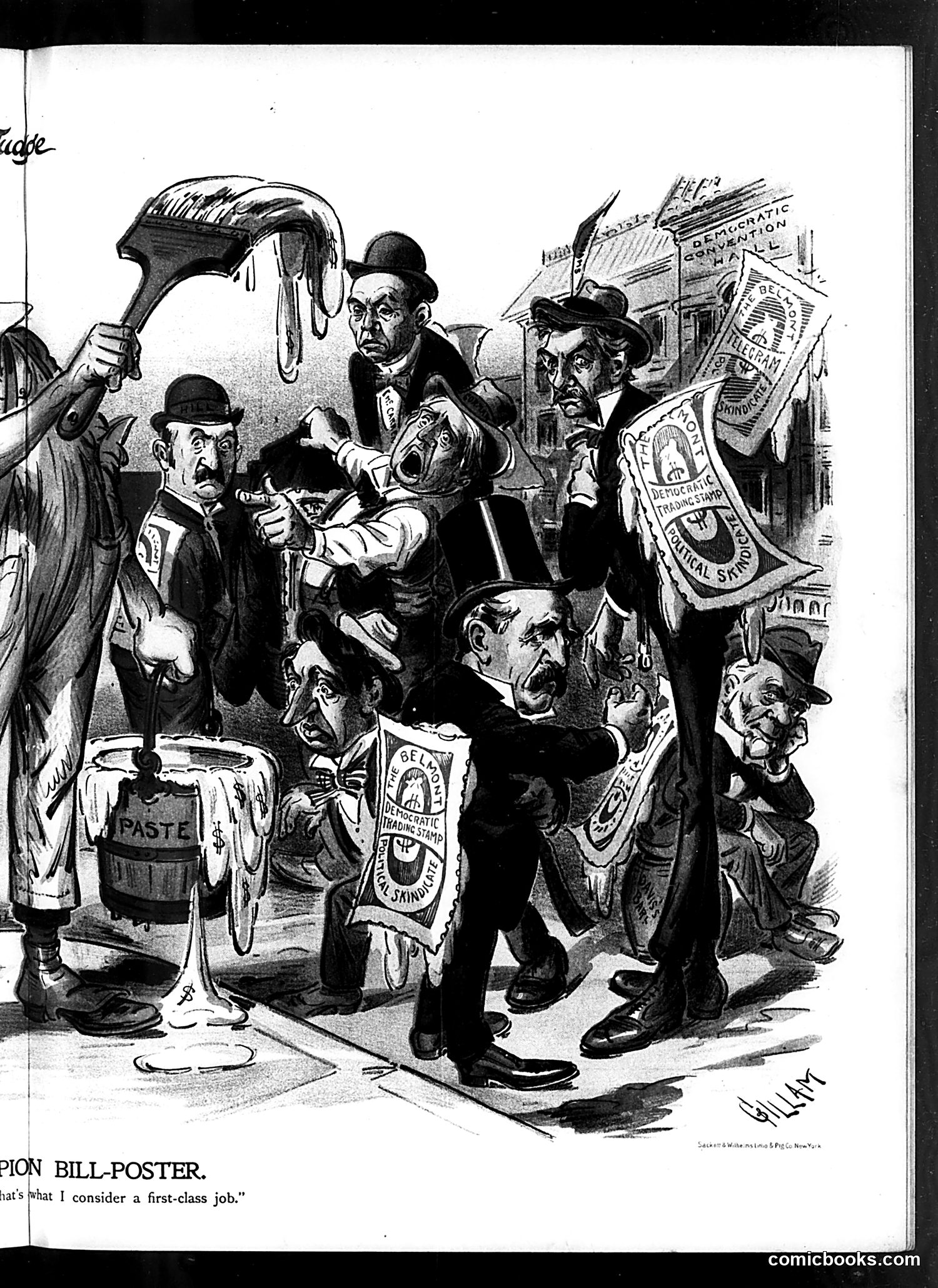
This political cartoon satirizes political bill-posters—men hired to plaster campaign posters on walls. The figure in the center, labeled a "champion bill-poster," proudly displays his work: multiple Democratic Party posters and banners covering surfaces and figures around him. The caricatured faces wearing these posters appear exaggerated and grotesque, suggesting the cartoon mocks Democratic candidates or the party itself. The satire works on two levels: it ridicules both the bill-poster's crude application of political propaganda (literally covering people's faces with party materials) and implicitly critiques the Democratic Party for saturating public spaces with their messaging. The "first-class job" quote is ironic—what he considers professional work is actually depicted as absurd, invasive, and dehumanizing. This reflects late-19th or early-20th-century anxieties about aggressive political advertising and partisan excess.
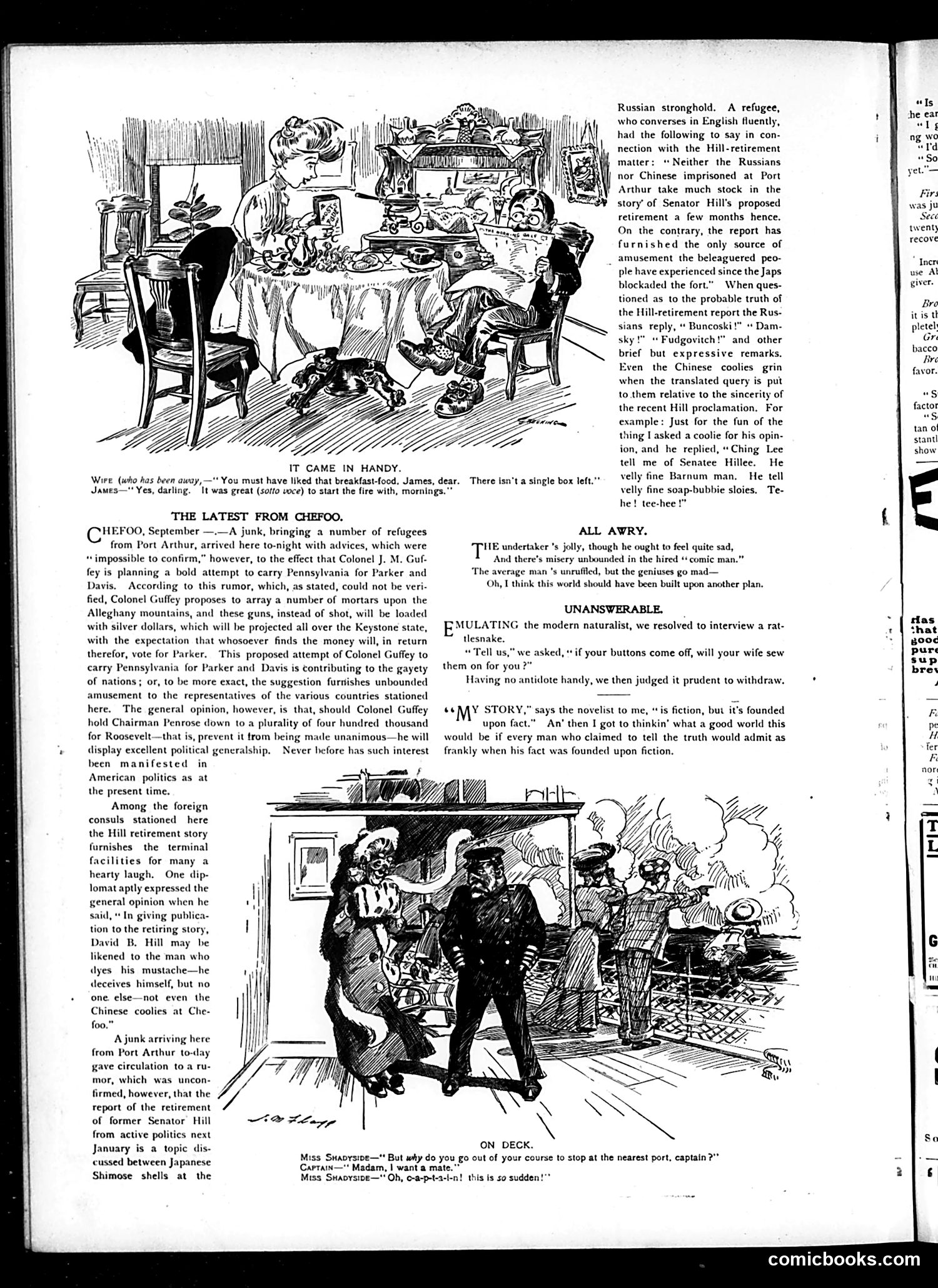
This page satirizes **American politics during the 1904 election season**, featuring several interconnected jokes: **"It Came in Handy"** (top): A domestic humor strip about breakfast food doubling as kindling—unrelated to politics. **"The Latest from Chefoo"**: The main political satire mocks **Colonel J.M. Guffey's** alleged scheme to win Pennsylvania for the Democratic ticket (Parker-Davis) by literally shooting silver dollars across the state to bribe voters. The satire extends to **Senator David B. Hill's** rumored political retirement, which the text suggests is as deceptive as a man dyeing his mustache—fooling nobody. Even Russian prisoners at Port Arthur and Chinese coolies find the retirement claim amusing and unbelievable. **"On Deck"**: A shipboard scene with Miss Shapesize making a nautical joke—likely unrelated political humor. The humor assumes readers know these figures and the 1904 election context. The satire's bite depends on recognizing Guffey's bribery scheme as absurdly transparent commentary on actual electoral corruption of the era.
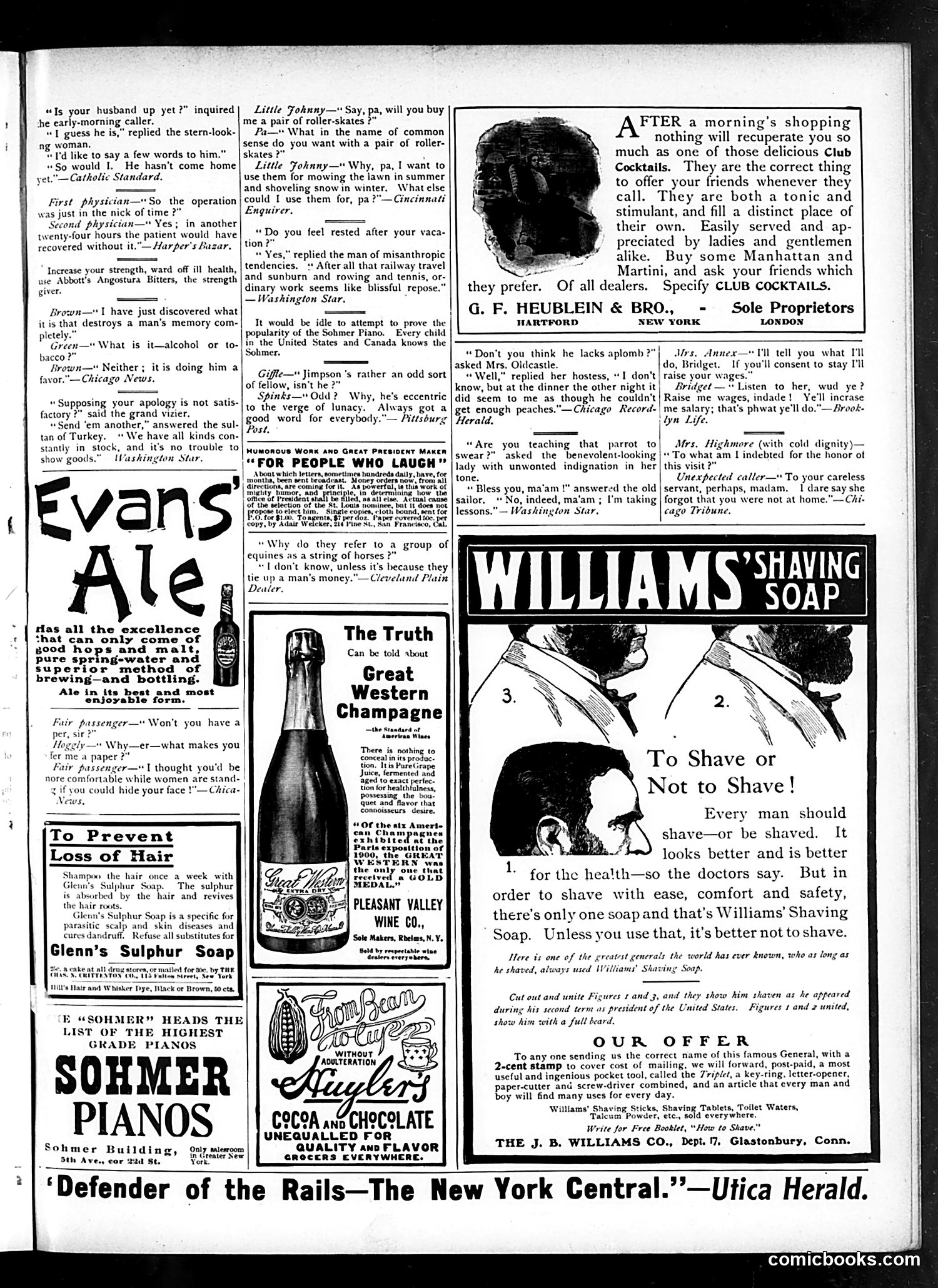
This page is primarily **advertisements and humor columns** with no significant political cartoons. The jokes reflect early 20th-century domestic humor: a wife's complaint that her husband hasn't come home (marital discord), a doctor's admission that surgery was unnecessary (medical skepticism), and a child's absurd logic about roller-skates for lawn-mowing (innocent humor). The advertisements reveal period concerns: hair loss treatments, piano makers (Sohmer), champagne, shaving soap, and cocktails. The Williams' Shaving Soap ad presents the era's standard grooming debate—"To Shave or Not to Shave?"—treating it as a health question. **Context modern readers miss**: These jokes assume readers share skepticism about marriage stability, medical ethics, and doctors' motives—common satirical targets. The abundance of personal grooming and alcohol advertisements reflects Prohibition-era anxieties and the marketed "scientific" solutions to everyday problems. No identifiable political figures or events appear on this page.
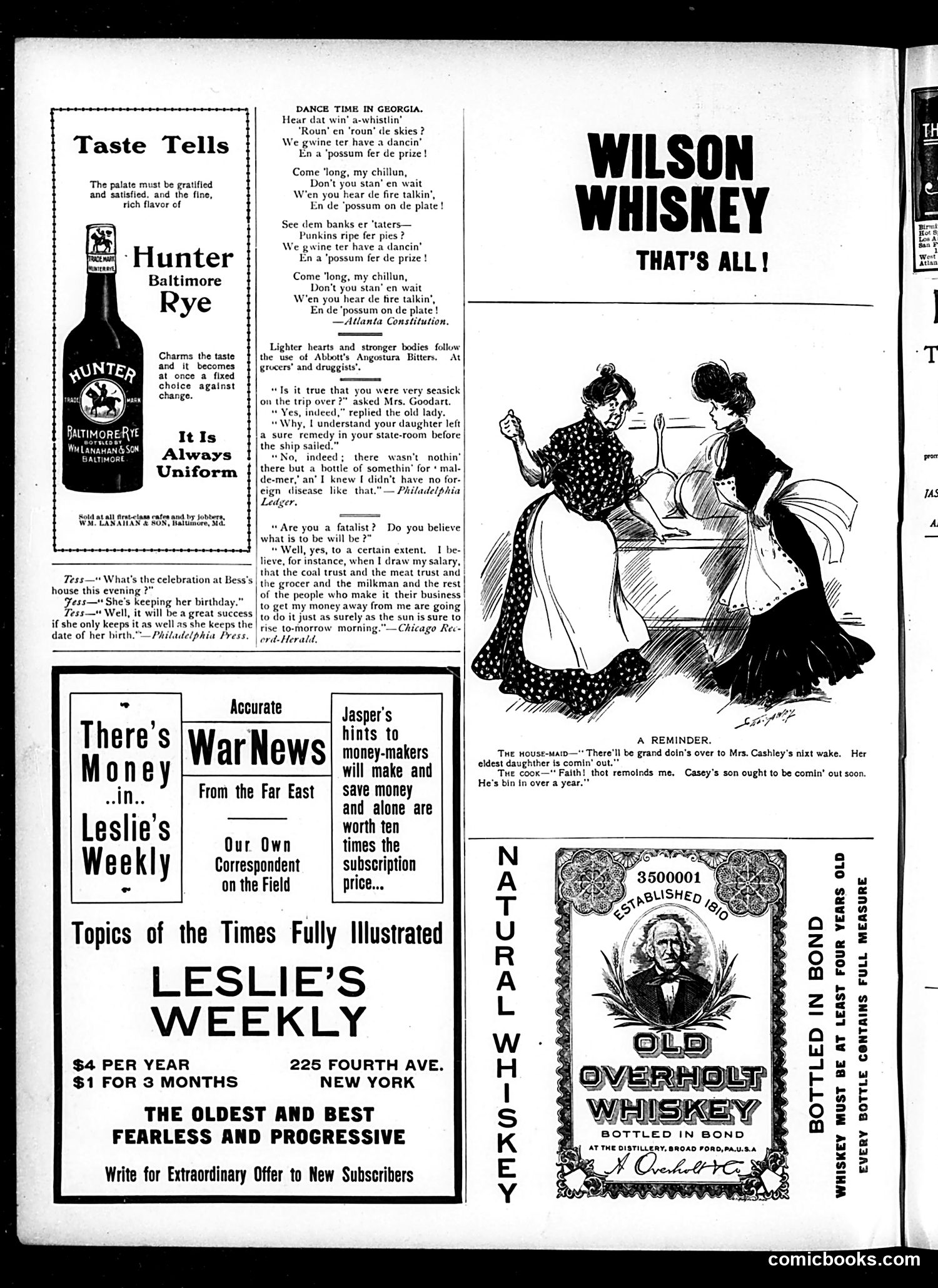
This page combines advertisements with period humor reflecting early 20th-century racial stereotypes. **Main Cartoon:** "A Reminder" depicts two domestic workers—a housekeeper and cook—discussing their employers' children "coming out" (making social debuts). The joke plays on the phrase's double meaning: the cook misunderstands it as the son being released from prison after serving time. The artwork uses heavy dialect spelling ("comin' out," "thot") typical of how Judge portrayed working-class and Irish-American characters. **"Dance Time in Georgia":** A poem in exaggerated African American dialect describes a rural dance with possum as a prize. It relies on period stereotypes about Southern Black rural life, using dialectical language and imagery meant to be humorous to contemporary readers. **Advertisements:** The page also features whiskey, rye, and Leslie's Weekly ads—standard magazine content of the era. The satire targets working-class misunderstandings and relies heavily on ethnic and racial caricature—humor that modern readers would recognize as offensive rather than entertaining.
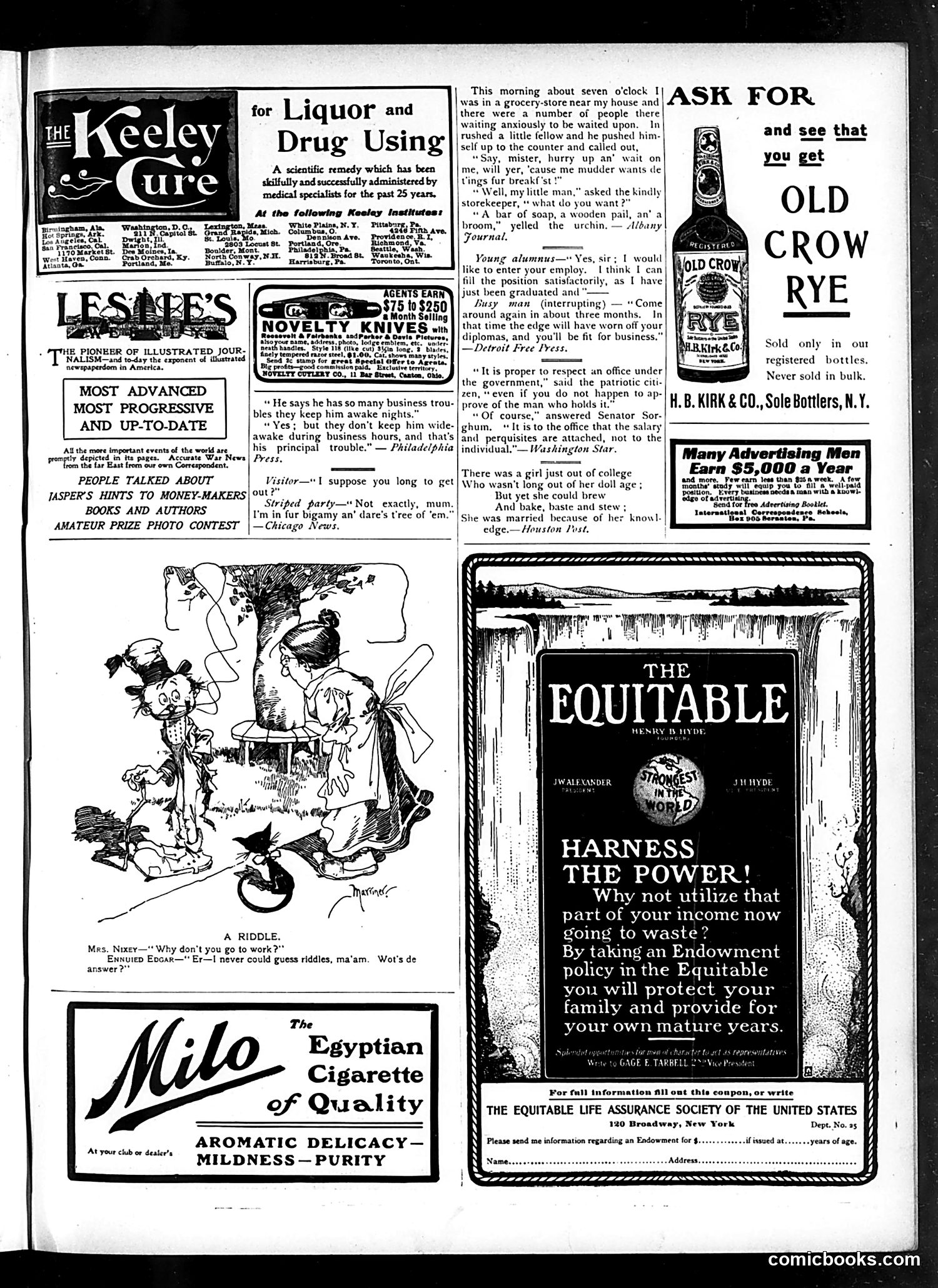
This page is primarily **advertising** with several brief satirical anecdotes rather than political cartoons. The main cartoon ("A Riddle") depicts a domestic scene with simple wordplay—a woman asks a man to guess a riddle, and he admits he can't solve riddles, requesting the answer instead. The anecdotes mock everyday social situations: an impatient immigrant child demanding soap and a broom in broken English; a recent college graduate told his "diplomas" must wear off before he's hireable; and commentary on office politics suggesting respect goes to the office itself, not the person holding it. The page is dominated by **period advertisements** for remedies (Keeley Cure for alcohol/drug addiction), cigarettes (Milo Egyptian), insurance (Equitable Life Endowment), and professional opportunities. These reflect early-1900s consumer culture and social concerns—substance abuse treatment, life insurance as family protection, and employment anxieties—rather than political satire.
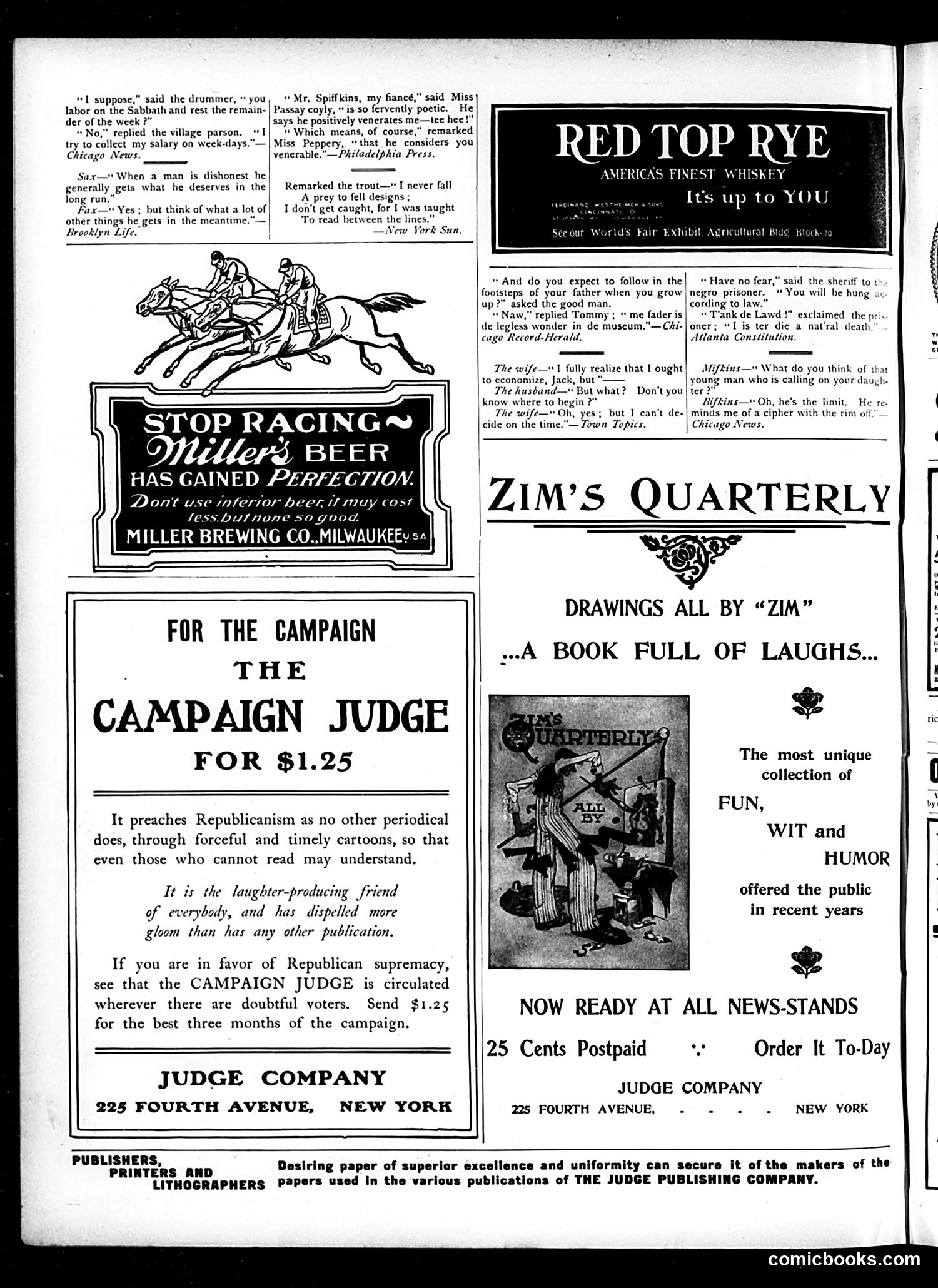
This page from *Judge* magazine contains mostly **advertisements and joke snippets** rather than editorial cartoons. The content includes: **Jokes:** Several brief, disconnected humor items about a parson avoiding salary collection, dishonest men, a woman calling her fiancé "venerable" as an insult, and a trout avoiding hooks by "reading between the lines." **Main Advertisements:** - **Miller Brewing Co.** promotes their beer as superior - **The Campaign Judge** (a political publication) advertises itself as spreading Republican messaging through cartoons to those "who cannot read" - **Zim's Quarterly**, a humor book of cartoons and jokes, priced at 25 cents - **Red Top Rye** whiskey The page appears to be from an election period, given the prominent "Campaign Judge" ad promoting Republican supremacy. The humor is light, wholesome vaudeville-style material typical of early 20th-century American magazines. No specific political figures or events are clearly referenced or caricatured on this particular page.
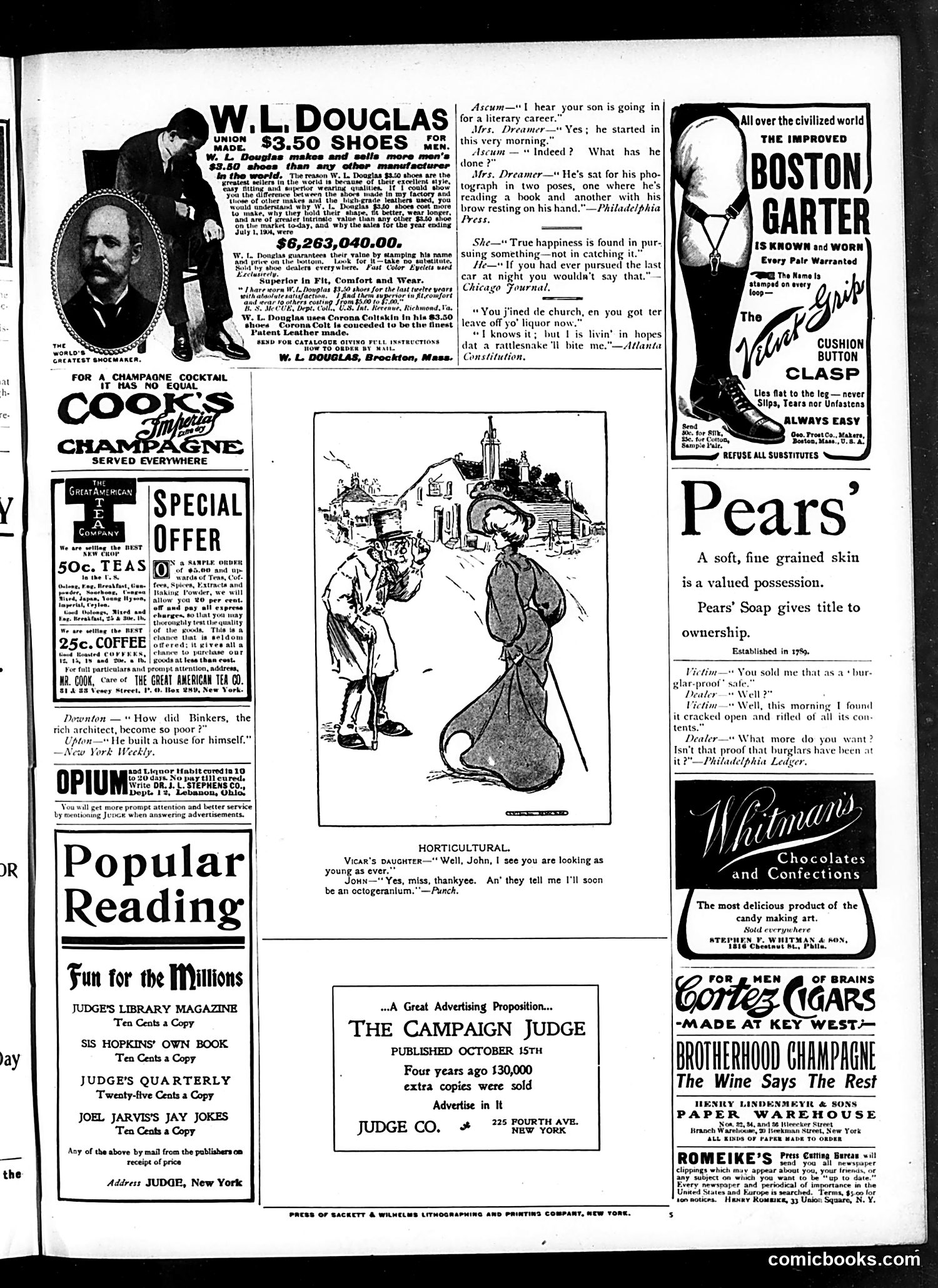
This is primarily an **advertising page** from Judge magazine (October 15th issue, date unclear from visible text). The central cartoon depicts a young man posing for photographs—one reading a book, another with his hand on his brow—satirizing aspiring literary figures who adopt aesthetic poses for publicity rather than doing actual work. The page is dominated by period advertisements: W.L. Douglas shoes, Pears' soap, Boston garters, Whitman's chocolates, and various publications. Between ads are short humor jokes typical of the era, including racial dialect humor ("de church") reflecting problematic 1910s conventions. The satire targets **pretentious young artists and writers** who prioritize their public image and photographic presentation over substantive literary production—a timeless critique of style over substance in artistic circles.
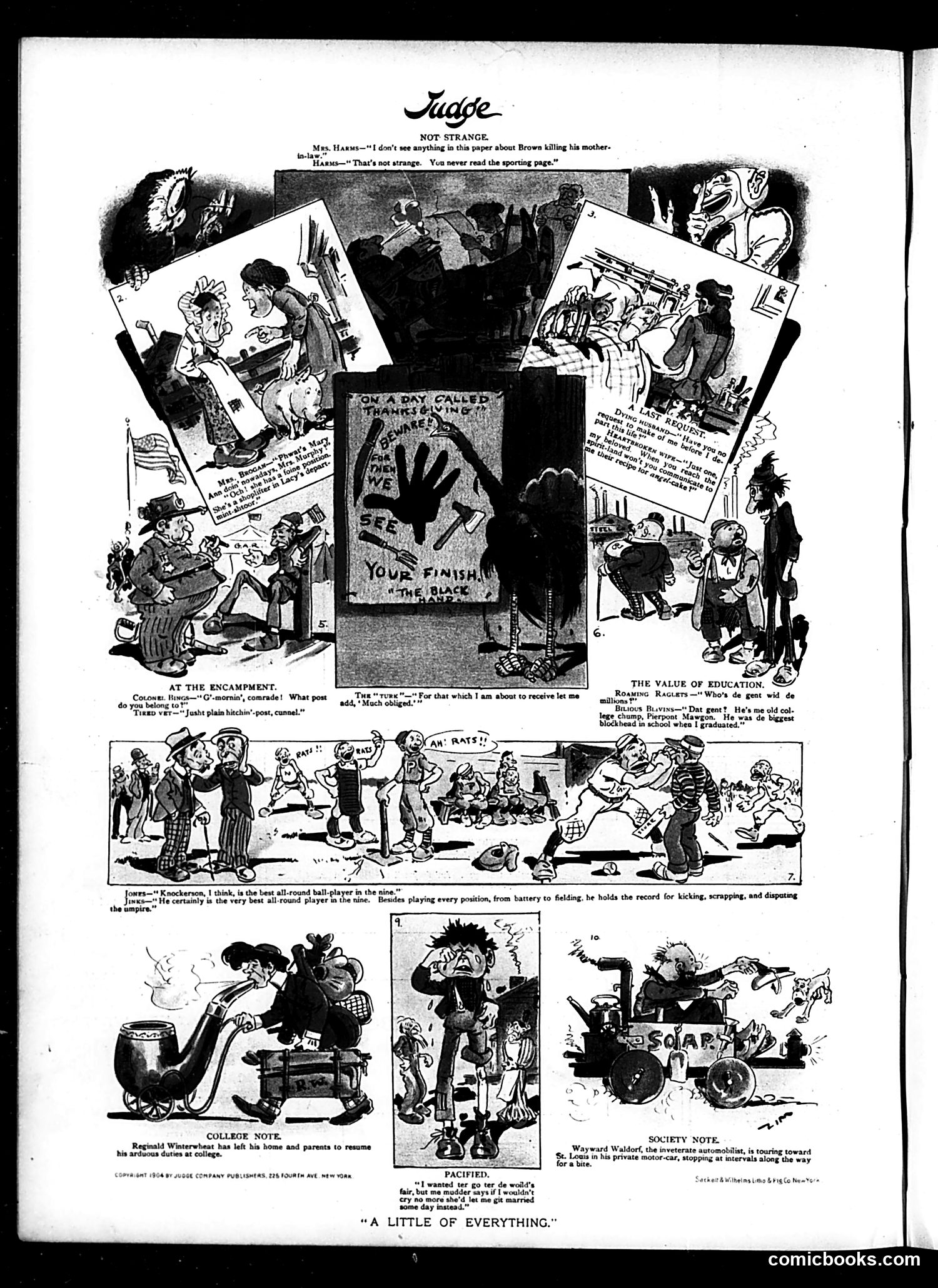
This page contains multiple brief satirical comics and notes typical of Judge's style. The opening joke plays on class assumptions: a man finds no mention of someone killing his mother-in-law in the newspaper's main sections, only in the "sporting page"—implying violence is treated as entertainment for rough working-class readers. The remaining panels satirize American social life: military encampment life, education's limited value for the poor ("college chump"), baseball culture, and wealthy society. A recurring target appears to be nouveau-riche pretension—particularly "Wayward Waldorf," the wealthy motorcar enthusiast stopping at intervals during leisure touring, contrasted with working-class characters' limited opportunities. The "College Note" and "Society Note" format allows Judge to mock both ambitious strivers and the idle rich. The final joke about a poor young person choosing marriage over the World's Fair suggests satirical commentary on class mobility and limited options for working-class youth in early 1900s America.