
Judge, 1904-10-01 · page 3 of 16
Judge — October 1, 1904 — page 3: what you’re looking at
What you’re looking at
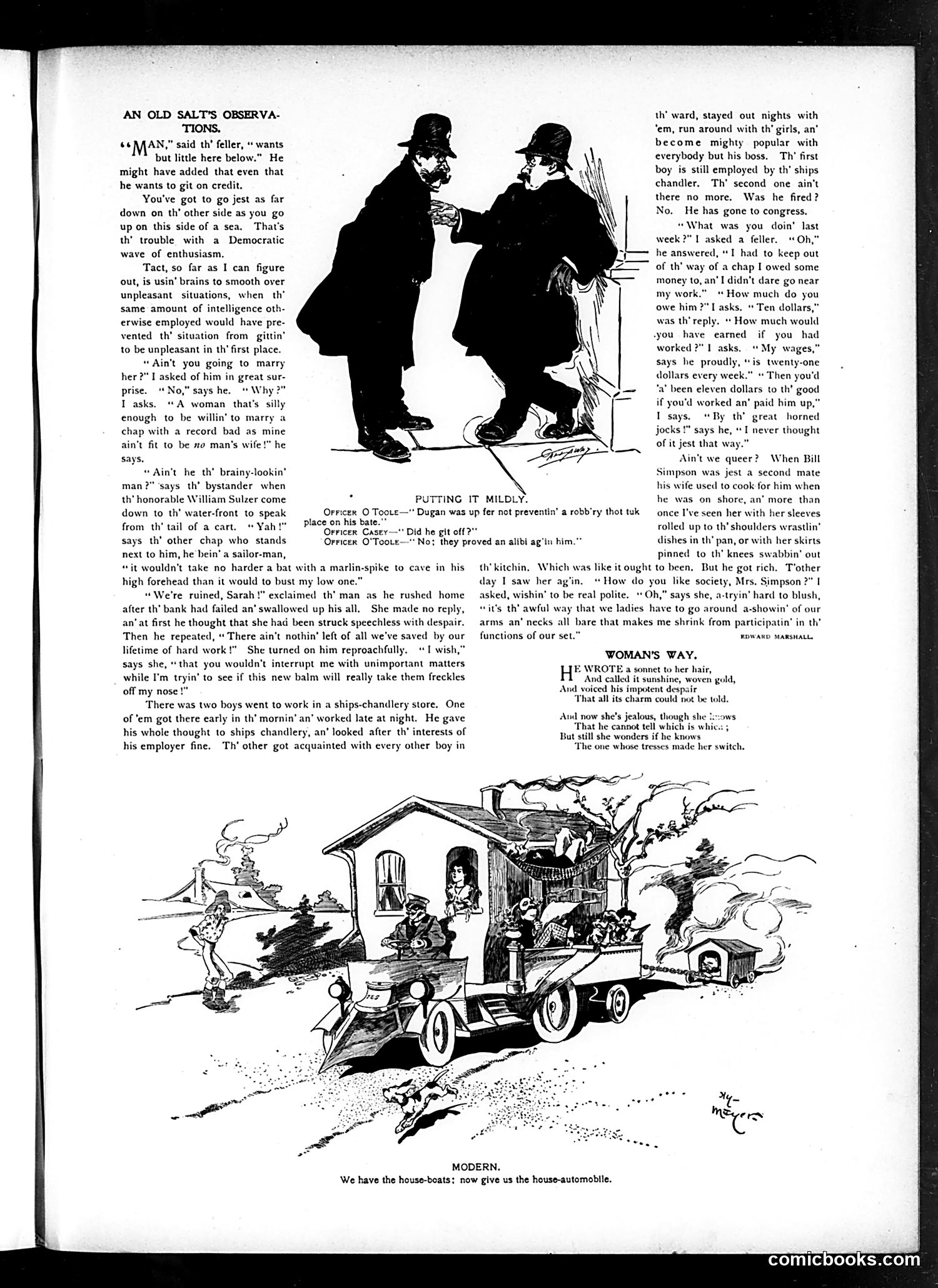
The upper section contains "An Old Salt's Observations," featuring two working-class men in conversation about social mobility and wages. The dialogue satirizes the gap between aspirations and economic reality—one man asks another about marriage prospects, only to learn the other man owes money and cannot afford it. The satire mocks Democratic political promises of prosperity while workers remain trapped in poverty. The lower illustration titled "Modern" depicts a fantastical "house-automobile"—a vehicle designed as a mobile home. This appears to satirize modern convenience culture and the American obsession with mechanical solutions to domestic life. The caption's deadpan humor suggests skepticism about such technological novelties. The page also includes a poem, "Woman's Way," offering sentimental commentary on female virtue and domestic sacrifice.
📄 Transcribed text from this page (OCR, searchable)
Machine-transcribed from the original scan — historical spelling and the odd misread are preserved.
AN OLD SALT’S OBSERVA- TIONS, 66 \AAN,” said th’ feller, « wants but little here below.” He might have added that even that he wants to git on credit. You've got to go jest as far down on th’ other side as you go up on this side of a sea. That's th’ trouble with a Democratic wave of enthusiasm. Tact, so far as I can figure out, is usin’ brains to smooth over unpleasant situations, when th’ same amount of intelligence oth- erwise employed would have pre- vented th’ situation from gittin’ to be unpleasant in th’ first place. “Ain't you going to marry her 2?" I asked of him in great sur- prise. 0,” says he. Why?” I asks. “A woman that’s silly enough to be willin’ to marry a chap with a record bad as mine ain't fit to be zo man’s wife!" he says. « Ain't he th’ brainy-lookin’ man?" ’says th’ bystander when th’ honorable William Sulzer come down to th’ water-front to speak from th’ tail of a cart. «Yah! says th’ other chap who stands next to him, he bein’ a sailor-man, “it wouldn't take no harder a bat with a marlin-spike to cave in his high forehead than it would to bust my low on “We're ruined, Sarah !" exclaimed th’ man he rushed home after th’ bank had failed an’ swallowed up his all, She made no reply, an’ at first he thought that she had been struck speechless with despair. Then he repeated, “ There ain't nothin’ left of all we've saved by our lifetime of hard work!" She turned on him reproachfully. «1 wish, says she, “that you wouldn't interrupt me with unimportant matters while I'm tryin’ to see if this new balm will really take them freckles off my nose!" There was two boys went to work in a ships-chandlery store. One of ‘em got there early in th' mornin’ an’ worked late at night. He gave his whole thought to ships chandlery, an’ looked after th’ interests of his employer fine. Th’ other got acquainted with every other boy in place on his bate."* Orricer Casey * Did he git off ?" Orricer O'Toore: \ PUTTING IT MILDLY. Orricer O Toote—"" Dugan was up fer not preventi “No; they proved an alibi ag'in him." th’ ward, stayed out nights with em, run around with th’ girls, an’ become mighty popular with everybody but his boss. Th’ first boy is still employed by th’ ships chandler. Th’ second one ain't there no more. Was he fired? No. He has gone to congress. What was you doin’ last week ?" I asked a feller. “Oh,” he answered, “I had to keep out of th’ way of a chap I owed some money to, an’I didn’t dare go near my work.” “How much do you owe him?" L asks. “ Ten dollars,” was th' reply. « How much would syou have earned if you had worked ?" 1 asks. “My wages,” says he proudly, “is twenty-one dollars every week.” “ Then you'd ‘a’ been eleven dollars to th’ good if you'd worked an’ paid him up,” I says. “By th’ great horned jocks !” says he, “I never thought of it jest that way.” Ain't we queer? When Bill Simpson was jest a second mate his wife used to cook for him when. he was on shore, an’ more than once I've seen her with her sleeves rolled up to th’ shoulders wrastlin’ dishes in th’ pan, or with her skirts pinned to th’ knees swabbin’ out th’kitchin, Which was like it ought to been, But he got rich. Tother y I saw her ag'in, “How do you like society, Mrs, Simpson ?” I asked, wishin’ to be real polite. “Oh,” says she, a-tryin’ hard to blush, “it’s th’ awful way that we ladies have to go around a-showin’ of our arms an’ necks all bare that makes me shrink from participatin’ in th’ functions of our set.” a robb'ry thot tuk EDWARD MARSHALL, WOMAN'S WAY. E WROTE a sonnet to her hair, And called it sunshine, woven gold, And voiced his impotent despair ‘That all its charm could not be told. And now she's jealous, though she t=:ows That he cannot tell which is whica ; But still she wonders if he knows ‘The one whose tresses made her switch. MODERN. We have the house-boats: now give us the house-automoblle. comicbooks.com