
A complete issue · 16 pages · 1904
Judge — September 24, 1904
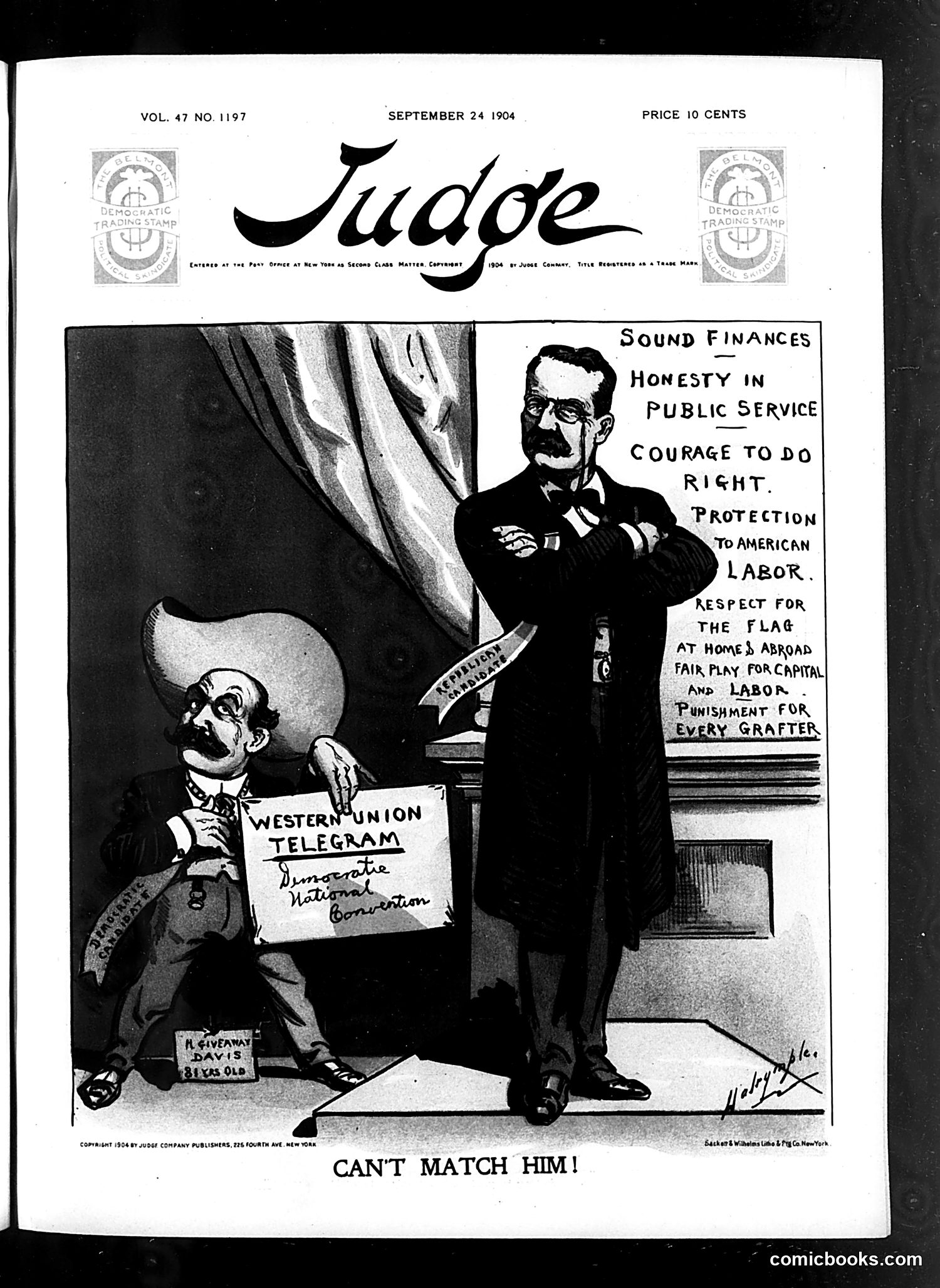
This political cartoon titled "Can't Match Him!" contrasts two figures: a small man in a Mexican sombrero (labeled with what appears to be a Western Union telegram referencing the "Democratic National Convention") and a tall, stern-faced man in formal attire standing with arms crossed. The cartoon advocates for the standing figure's platform, which lists progressive policies: sound finances, honesty in public service, labor protection, respect for the flag, and anti-corruption measures. The satire suggests that the Democratic candidate (represented by the small figure) cannot match the Republican candidate's stature and credibility on these issues. The 1904 context indicates this likely supports Theodore Roosevelt's re-election campaign against Democrat Alton B. Parker.
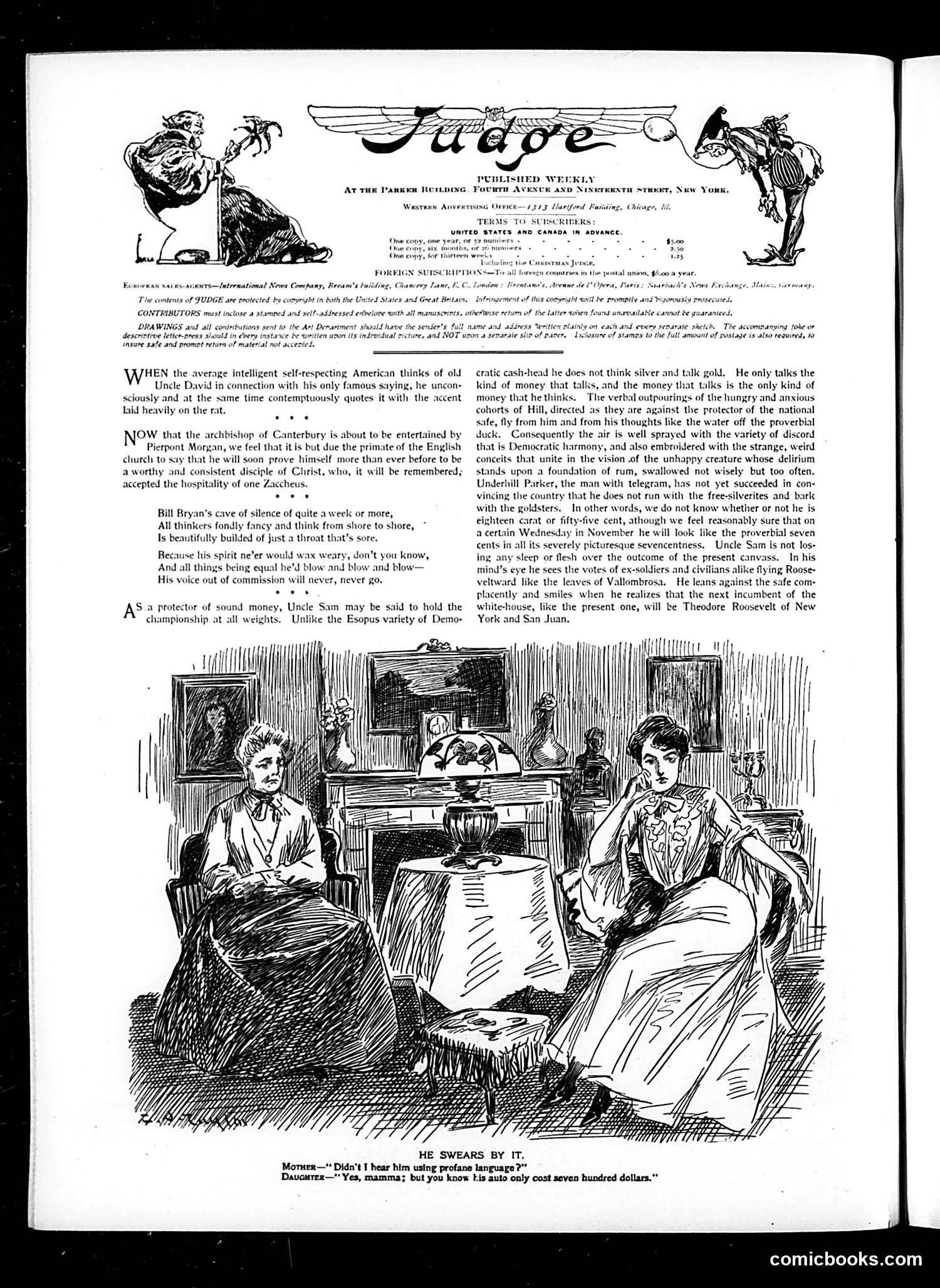
This page contains two main elements: **Top Section:** Editorial commentary referencing Uncle Sam and political figures. The text discusses Archbishop of Canterbury's upcoming visit and mentions Bill Bryan's "cave of silence," along with references to Theodore Roosevelt, Uncle Sam, and York and San Juan—likely addressing American political and diplomatic matters of the era. **Bottom Cartoon ("He Swears by It"):** Shows two women in conversation. The mother remarks she didn't hear profanity, while the daughter responds that the man "only cost seven hundred dollars"—a joke about purchasing a husband or romantic prospect. The humor relies on the daughter's matter-of-fact acceptance of a man's vulgarity justified by his financial worth, satirizing mercenary attitudes toward marriage among certain social classes. The specific historical context and figures referenced require additional period documentation to identify with certainty.
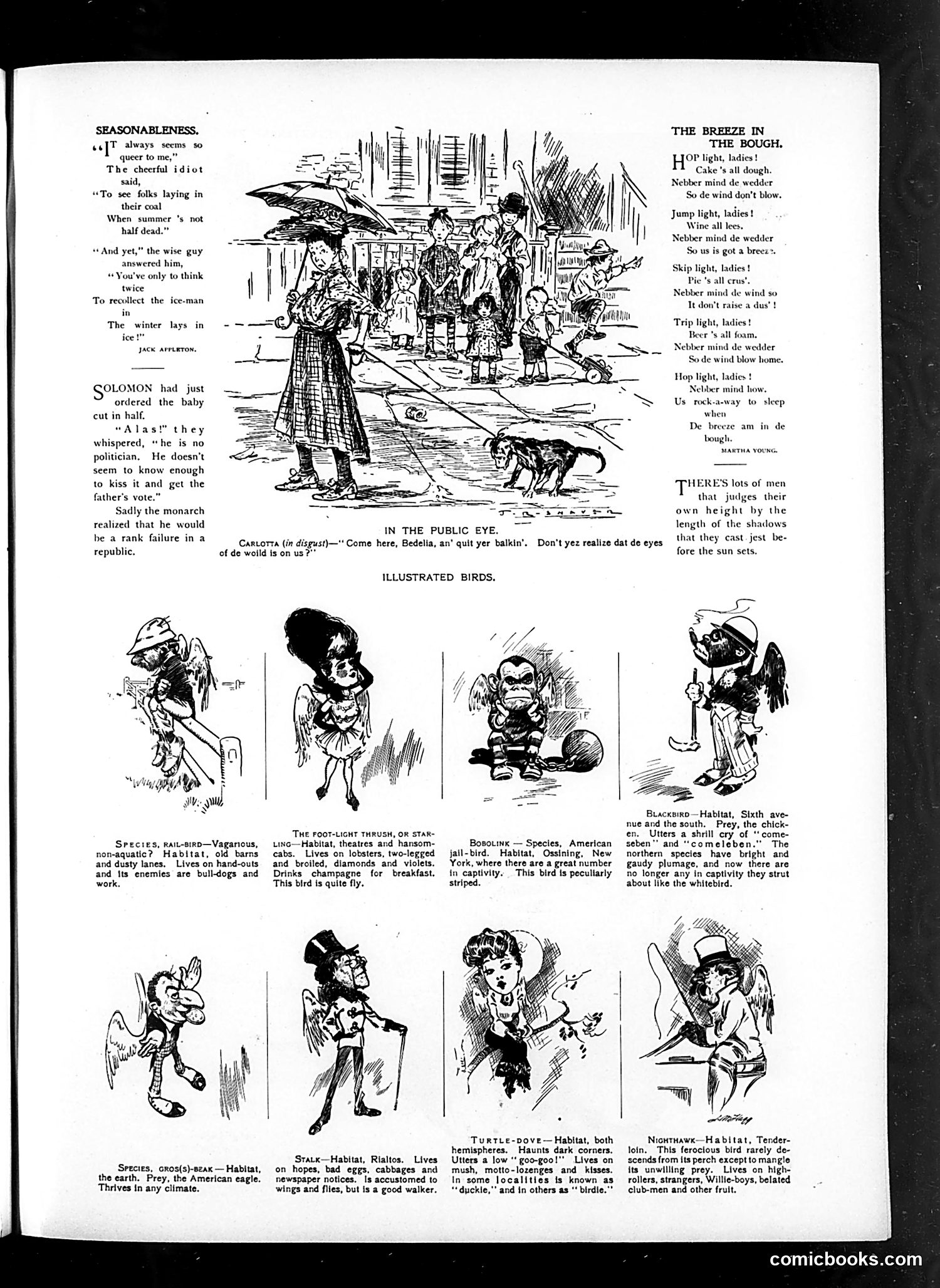
This page contains three distinct sections: **"Seasonableness"** (top left): A poem by Jack Appleton about winter, with an accompanying illustration of people in snowy conditions. **"The Breeze in the Bough"** (top right): A children's rhyming poem by Martha Young, illustrated with a scene of adults and children in windy weather. **"In the Public Eye"** (center): A cartoon captioned with dialogue between characters named Carlotta and Bedelia, appearing to satirize social pretension or fashion consciousness. The specific reference is unclear without additional context. **"Illustrated Birds"** (bottom half): Humorous anthropomorphized bird illustrations with species descriptions (Foot-light Thrush, Grosbeak, Stalk, Turtle-dove, Nighthawk). These are visual puns applying theatrical or social stereotypes to bird names—satirizing show business performers and social types rather than actual ornithology.
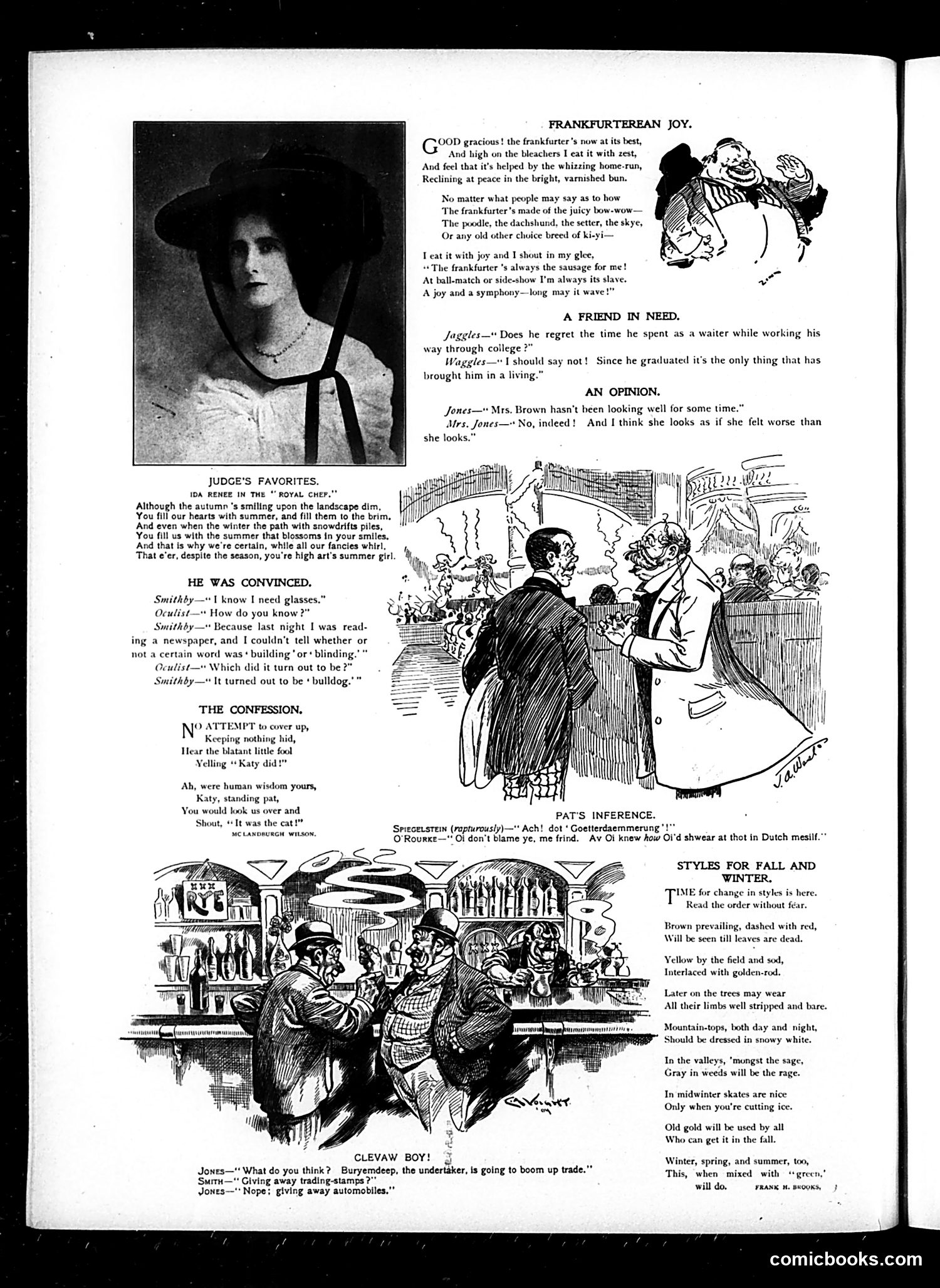
This page contains several humor pieces and illustrations typical of early 20th-century satirical magazines. **"Frankfurter Ean Joy"** celebrates the frankfurter sausage as a culinary staple. **"A Friend in Need"** jokes about college-to-waiter career transitions. **"An Opinion"** briefly mocks someone's appearance. **"He Was Convinced"** plays on word confusion—a man misunderstands "building" as "bulldog." **"The Confession"** is sentimental verse about human folly and cats. The largest illustration, **"Pat's Inference,"** depicts what appears to be a baseball or sporting scene with working-class characters making ethnic jokes (references to "Dutch" dialect humor were common period stereotypes). **"Styles for Fall and Winter"** offers fashion predictions in verse form. **"Clever Boy!"** makes a brief joke about trade and automobiles replacing older commerce. The humor relies heavily on period stereotypes, wordplay, and class-based comedy typical of Judge magazine's early 20th-century readership.
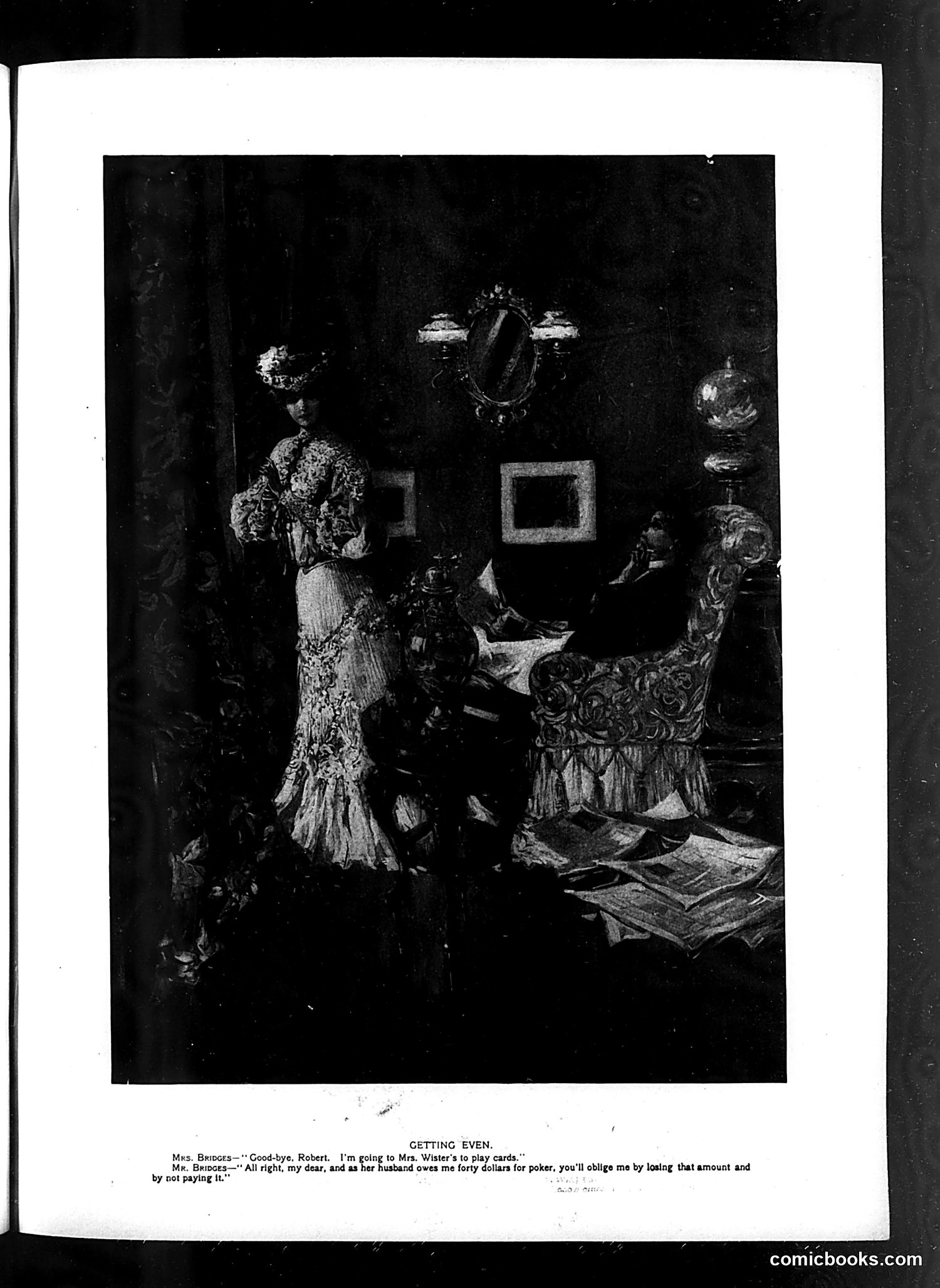
This cartoon satirizes marital dynamics and gambling debt settlements among the upper classes. Mr. Brivces instructs his wife to deliberately lose forty dollars at cards to Mrs. Wister, thereby evening a poker debt her husband owes him—without directly involving money between the men. The joke targets several social conventions: the acceptance of gambling among wealthy socialites, the assumption that wives obediently execute their husbands' schemes, and the absurdity of this indirect debt-settling method. The elaborate interior setting emphasizes the upper-class context. The satire mocks both male arrogance (assuming compliance) and the genteel pretense of "polite society" masking crude financial maneuvering. It's fundamentally about how wealthy men used their wives as financial proxies in social circles.
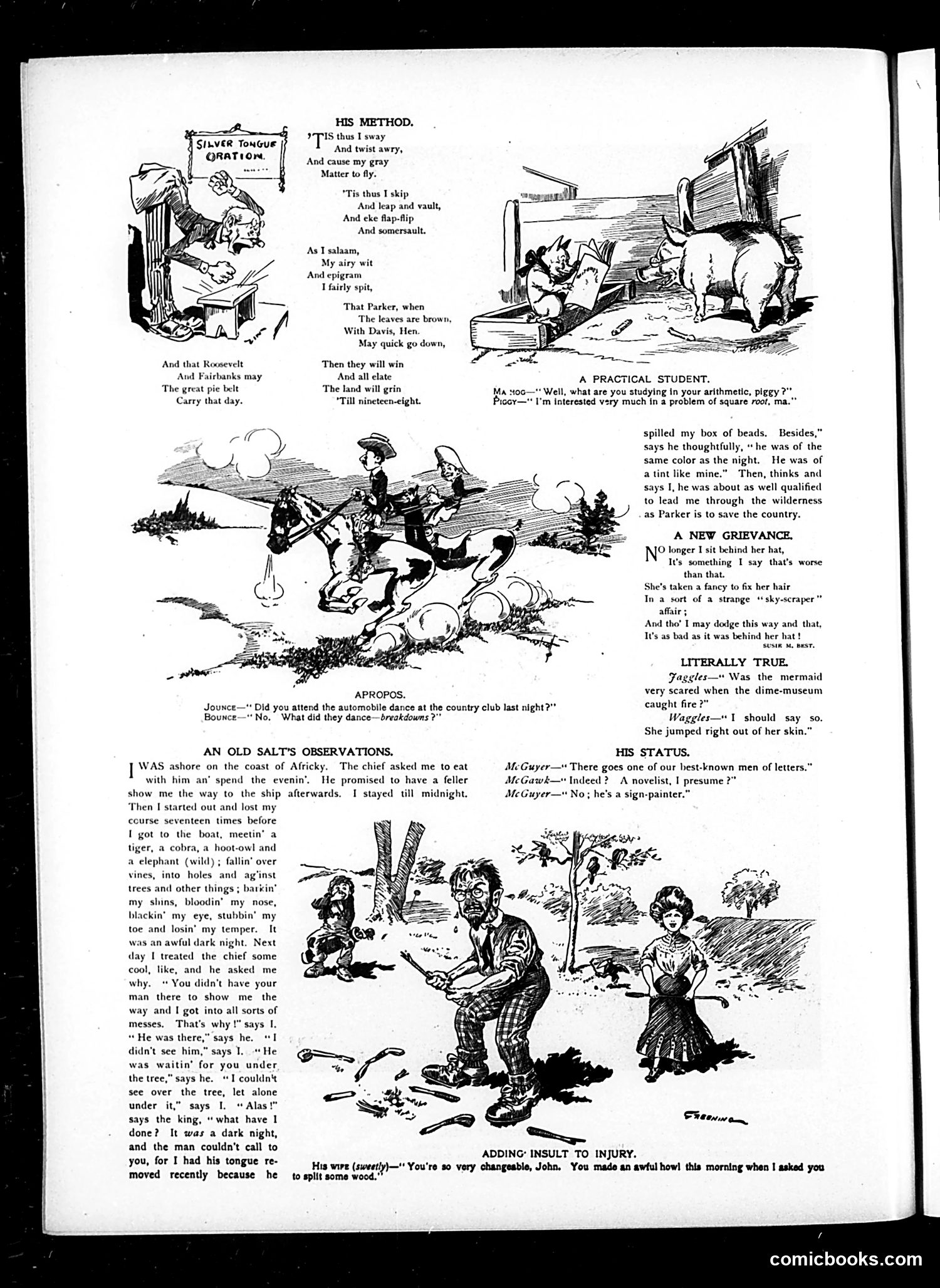
This page contains multiple humor pieces typical of Judge magazine's early 20th-century satirical style: **"HIS METHOD"** appears to mock a political orator (likely a candidate) whose theatrical gestures and empty rhetoric aim to sway voters in the 1908 election cycle—references to Parker, Davis, Roosevelt, and Fairbanks suggest 1904-1908 presidential politics. The satire ridicules flowery "silver tongue" oratory disconnected from substance. **"A PRACTICAL STUDENT"** is a simple children's joke about a pig studying arithmetic, playing on "square root." **"A NEW GRIEVANCE"** satirizes women's fashionable "sky-scraper" hairstyles as obstructing theater-goers' views—a common complaint of the era. Other pieces include light anecdotes ("An Old Salt's Observations"), puns ("Literally True," "Apropos"), and observational humor about modern life (automobiles, sign-painters vs. novelists, marital complaints). The overall tone is genteel, domestic satire with occasional political jabs—characteristic of Judge's middle-class readership and pre-WWI American humor conventions.
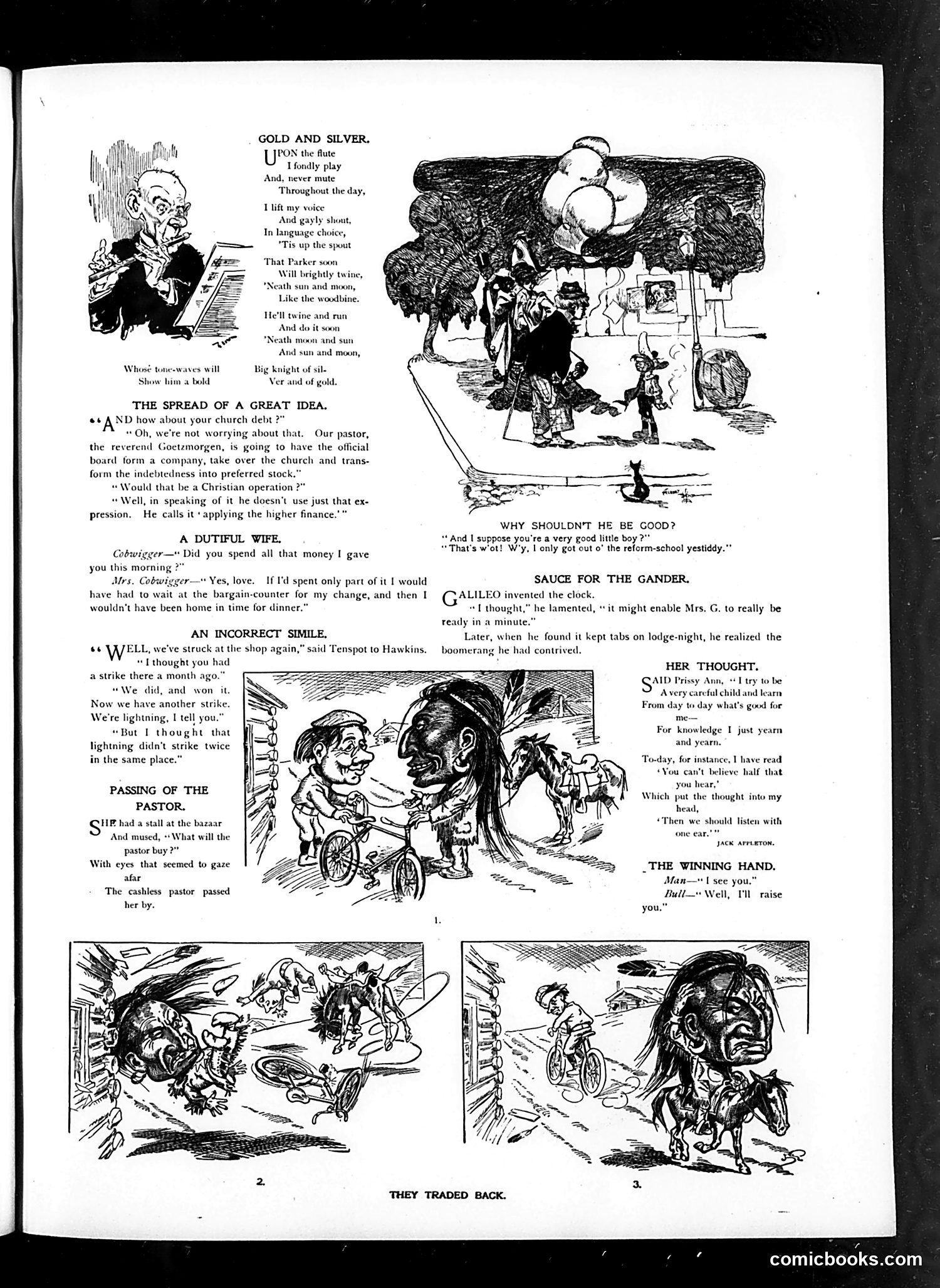
This page collects multiple satirical vignettes typical of early-20th-century American humor magazines: **"The Spread of a Great Idea"** mocks clergy financial schemes, showing a pastor planning to incorporate church debt as "preferred stock"—dressed up corporate finance language to disguise questionable ethics. **"A Dutiful Wife"** contains misogynistic humor about wives' shopping habits and frivolous spending. **"An Incorrect Simile"** jokes about labor strikes, with workers claiming to be "lightning" despite the old saying that lightning doesn't strike twice. **"Passing of the Pastor"** satirizes clergy poverty—a pastor can't afford bazaar merchandise. **"Why Shouldn't He Be Good?"** presents dark humor about a reform-school boy, reflecting period attitudes toward juvenile delinquency. Other brief pieces mock modern inventions (Galileo's clock making wives punctual), marital dynamics, and gambling ("The Winning Hand"). The page reflects Judge's satirical approach to contemporary social issues: organized religion, labor unrest, class economics, and gender relations.
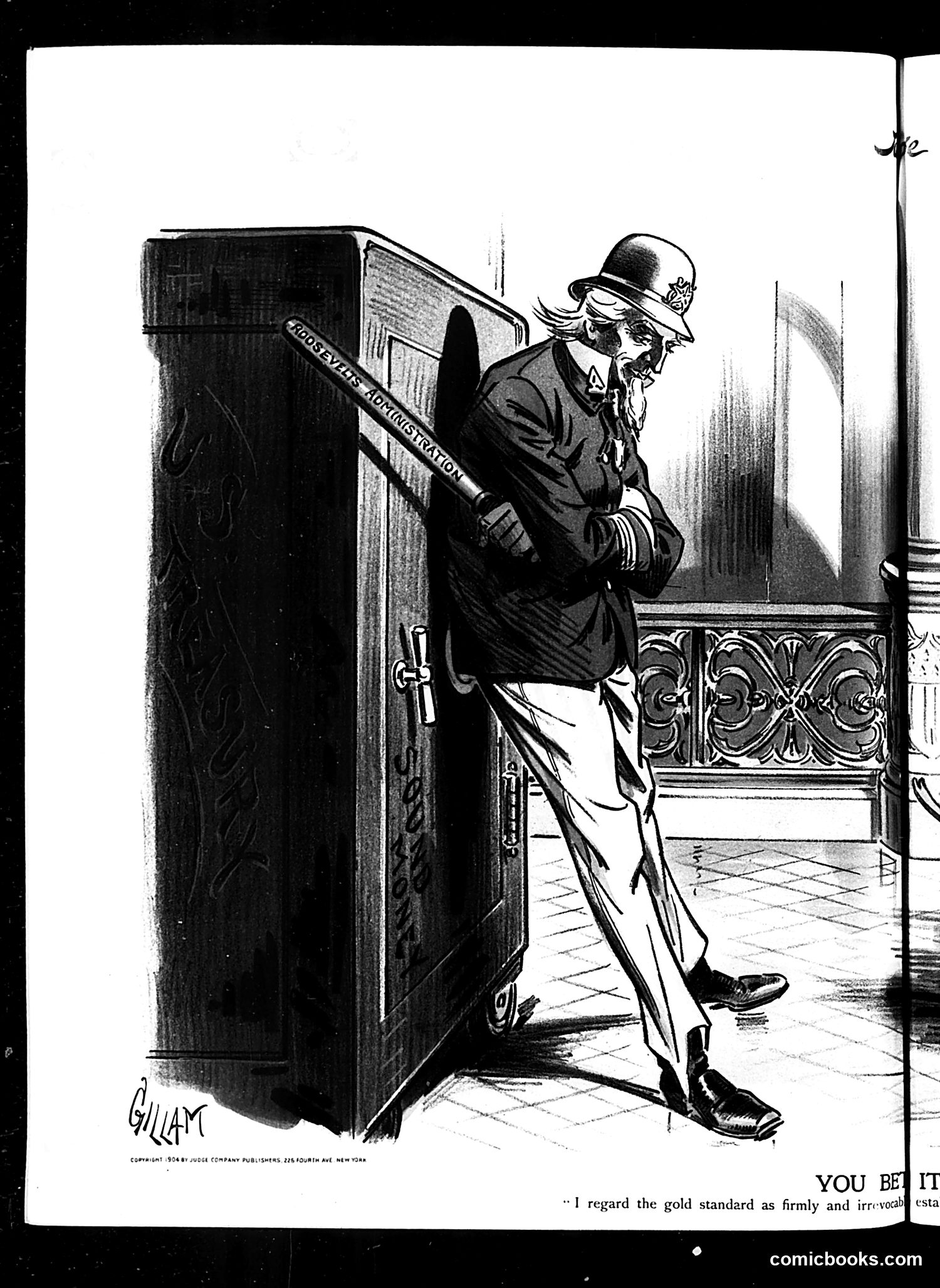
This 1904 *Judge* magazine cartoon depicts a well-dressed gentleman emerging from a cabinet labeled "CIVIL SERVICE ADMINISTRATION," carrying what appears to be a large stick or club. The partial caption reads "I regard the gold standard as firmly and irrevocably esta[blished]..." The cartoon satirizes debates over economic policy during the Theodore Roosevelt administration. The figure, likely representing a politician or administrator, emerges from civil service matters while discussing the gold standard—a major political issue of the era. The exaggerated posture and the weapon-like object suggest the cartoonist is mocking either aggressive advocacy for the gold standard or heavy-handed administrative tactics. The satire appears to critique how political figures wielded economic policy as a blunt instrument rather than nuanced governance.
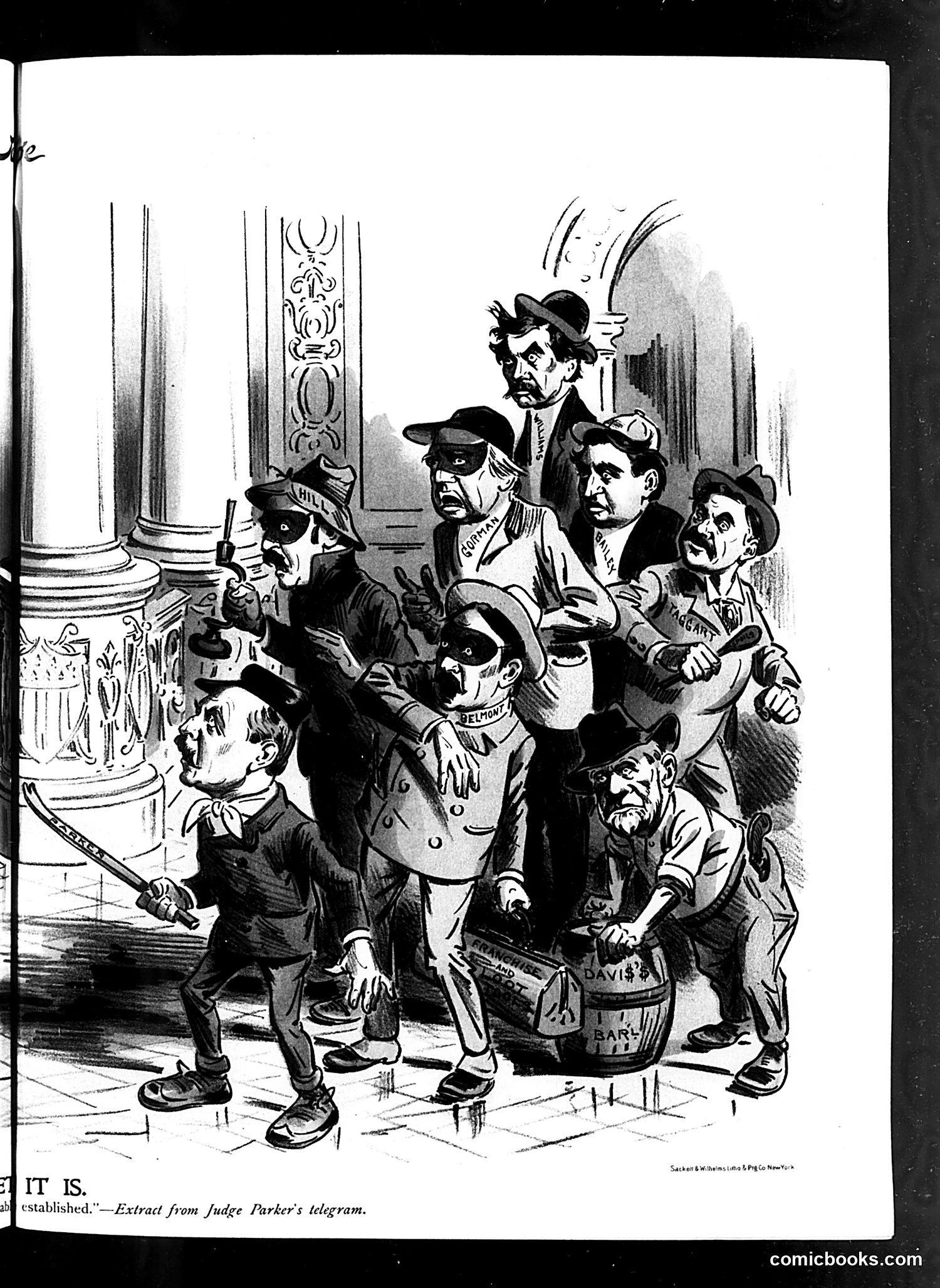
This is a satirical cartoon from *Judge* magazine depicting what appears to be political corruption or backroom dealing. The caption references "Judge Parker's telegram" and the phrase "it is established," suggesting an official pronouncement legitimizing something questionable. The cartoon shows caricatured figures (appearing to represent political operatives or party bosses) gathered around ornate government architecture, with some labeled figures carrying items marked with names. The exaggerated facial features and grouped composition suggest these are recognizable political personalities of the era engaged in corrupt practices. Without the specific date visible, the exact figures and political context remain unclear, but the satire targets how official authority ("Judge Parker") is being invoked to legitimize established political corruption or machine politics.
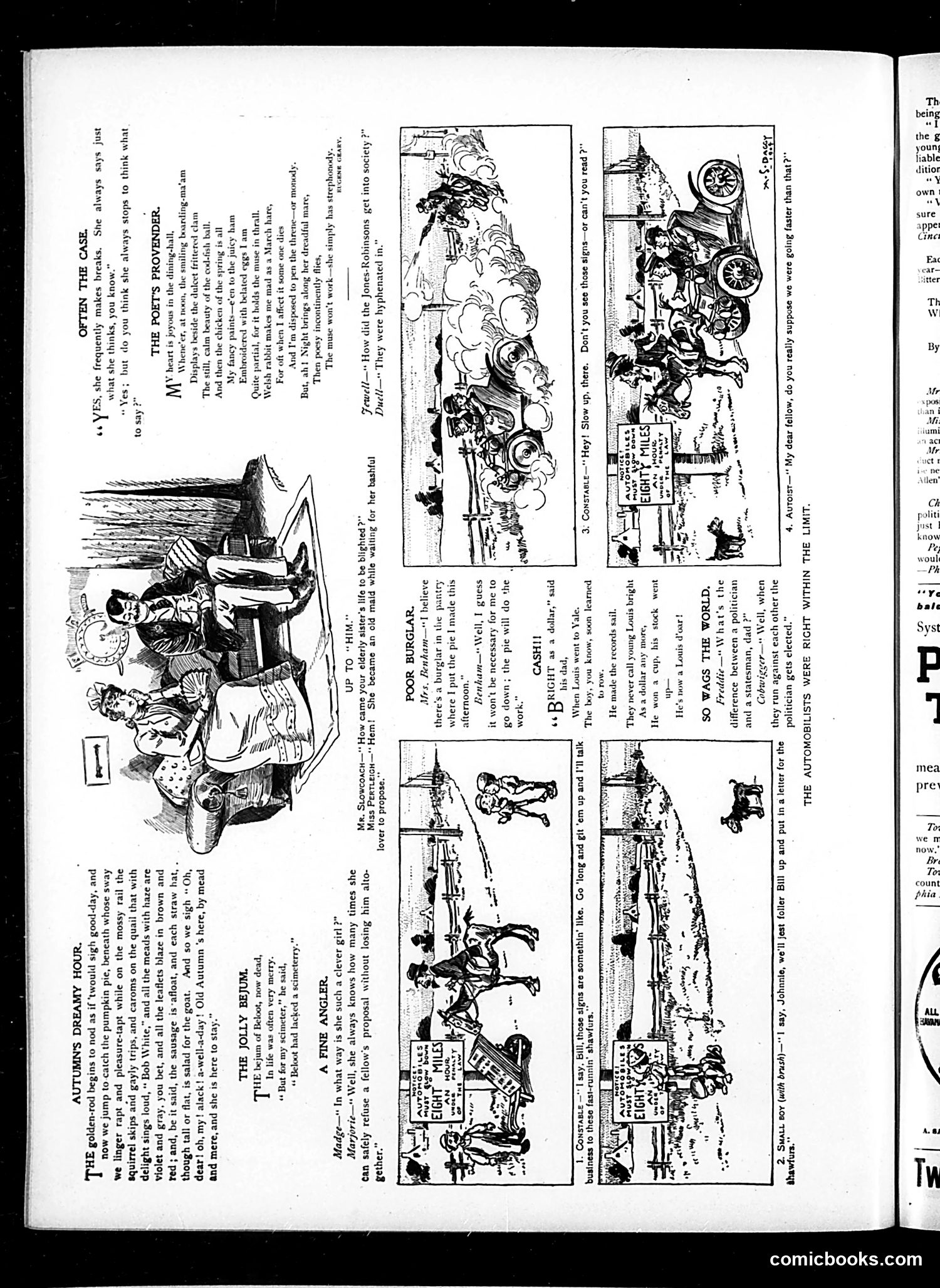
I cannot reliably interpret this page due to severe OCR corruption making the text largely illegible. The backwards/scrambled text suggests significant scanning or processing errors. **What I can see in the images:** The page contains multiple cartoon panels showing figures in early 20th-century dress. One panel (upper left) appears to show a man at a desk or table. Other panels depict people in various situations, though the artistic style and caricatures are consistent with Judge magazine's satirical approach. **What I cannot determine:** - The specific political figures or celebrities being caricatured - The historical events being referenced - The satirical point or joke being made - The article titles and commentary To properly explain this cartoon's meaning to modern readers, I would need either a cleaner text version or the ability to read the caption text more clearly in the image itself.
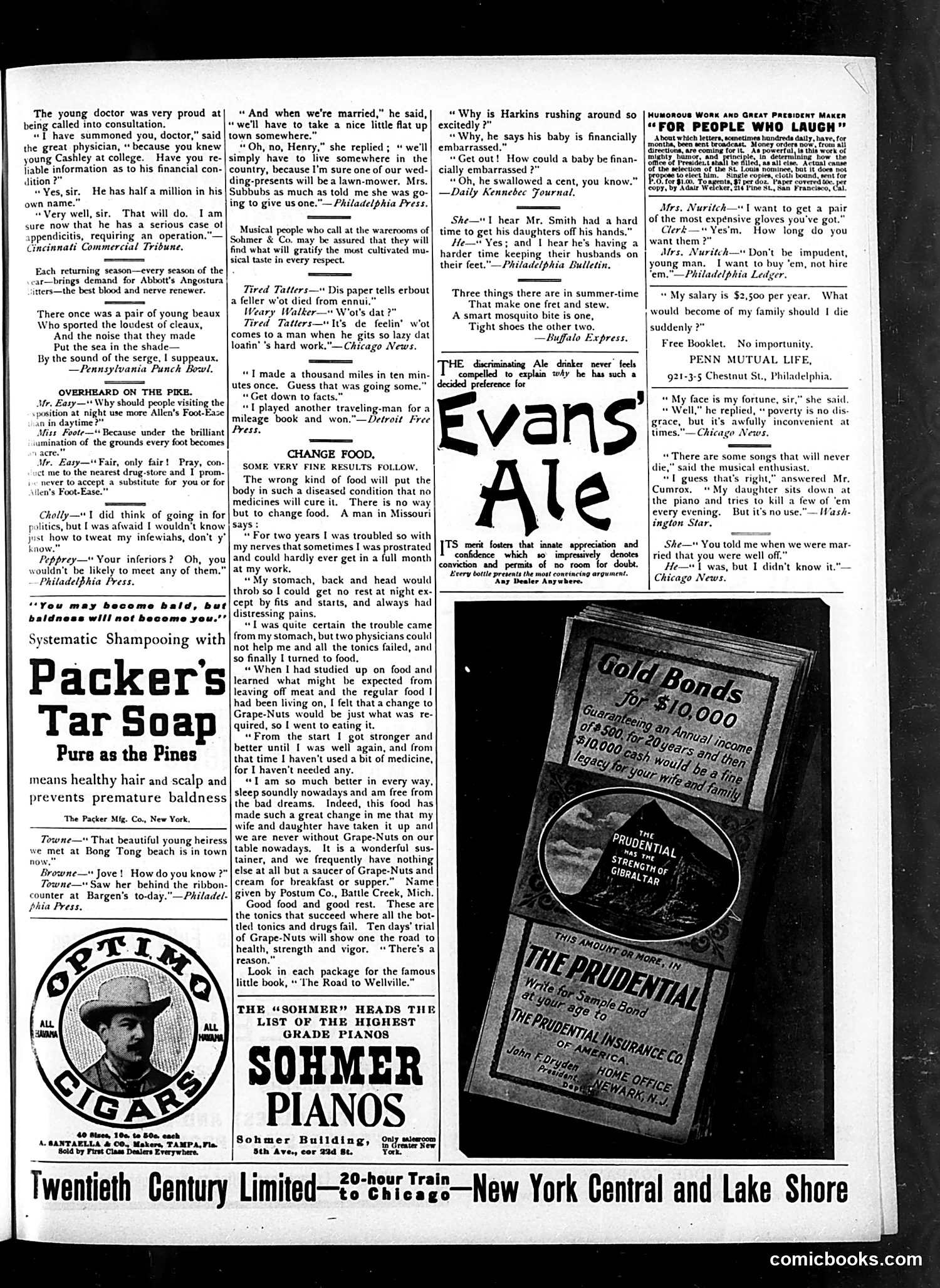
This page is primarily **advertising and humor columns**, not political satire. The content consists of: **Main Jokes/Humor:** - A doctor's consultation joke: A senior physician diagnoses "appendicitis" after learning a patient is wealthy, suggesting the diagnosis depends on financial status rather than actual illness—satirizing medical ethics. - Several short jokes about courtship, laziness, and social pretension typical of early 20th-century magazine humor. **Advertisements:** The page features prominent ads for Packer's Tar Soap, Sohmer Pianos, Optimo Cigars, and Abbott's Angostura Bitters—standard commercial content. **Notable:** One joke mocks wealthy socialites ("Cholly") and their treatment of social inferiors, reflecting class consciousness common in the era. **Overall:** This is a miscellaneous humor/advertising page rather than focused political or social satire. The jokes reflect period attitudes about class, gender, and professional ethics without addressing specific political events or figures.
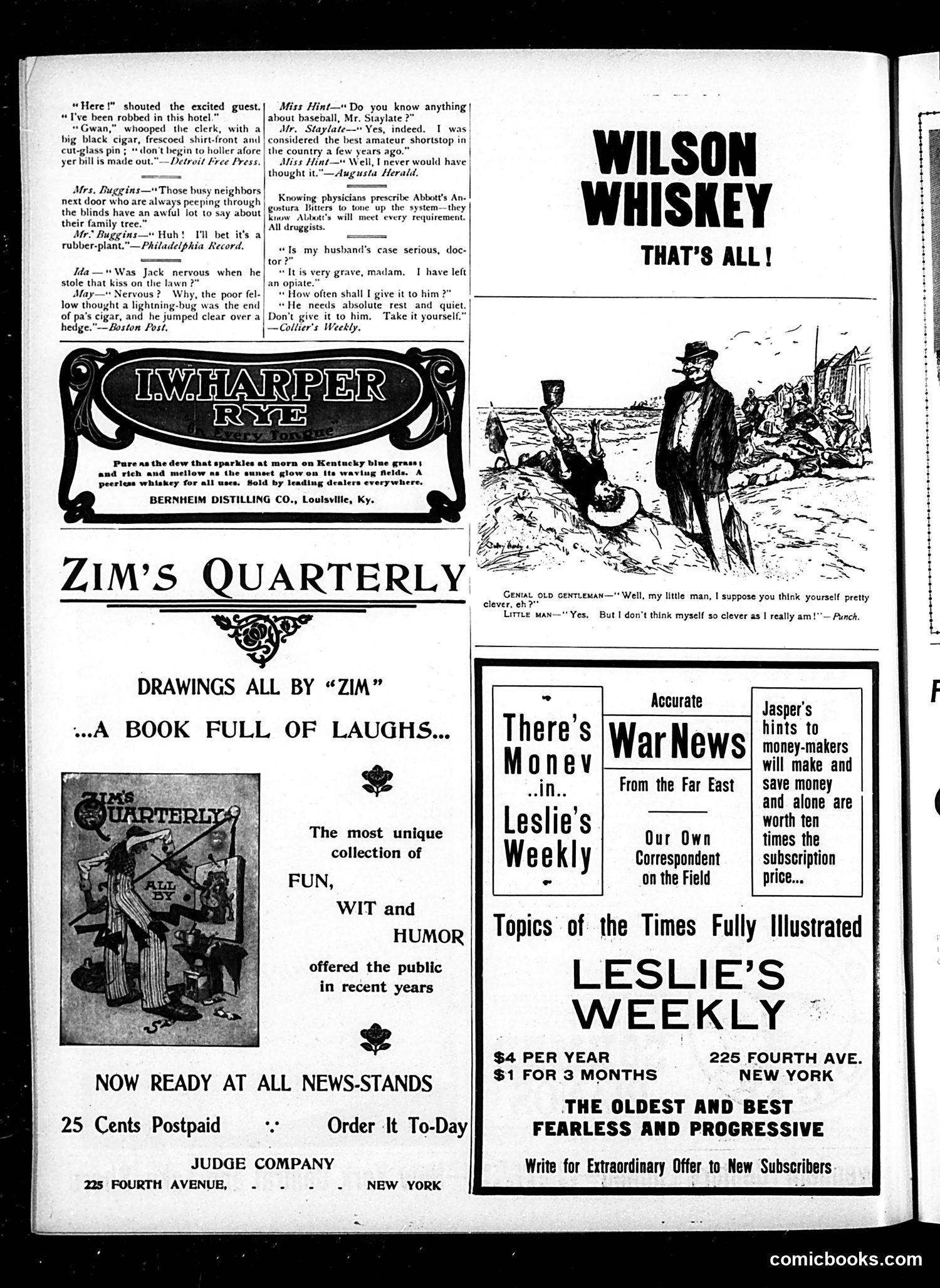
This page from *Judge* magazine (a satirical weekly) contains multiple brief jokes typical of early 20th-century American humor, plus advertisements. **The Cartoons/Jokes:** The page features six short comedic pieces with minimal visual elements—mostly text-based jokes on domestic situations, flirtation, and professional incompetence. Topics include: a hotel clerk dismissing a robbery complaint; neighbors gossiping; a husband's nervousness about stealing a kiss; a doctor's deadpan prescription advice (telling the wife to take the sedative herself rather than give it to the sick husband); and a conversation between a gentleman and a street boy about cleverness. **The Satire:** These represent typical *Judge* humor: gentle mockery of middle-class life, marital dynamics, and social pretension. The jokes rely on wordplay and surprise reversals rather than visual wit. **Advertisements:** The page also promotes *Zim's Quarterly* (a humor book), Wilson Whiskey, and Leslie's Weekly magazine—standard period advertising reflecting the magazine's affluent readership. The overall tone is lighthearted domestic comedy with no apparent political content.
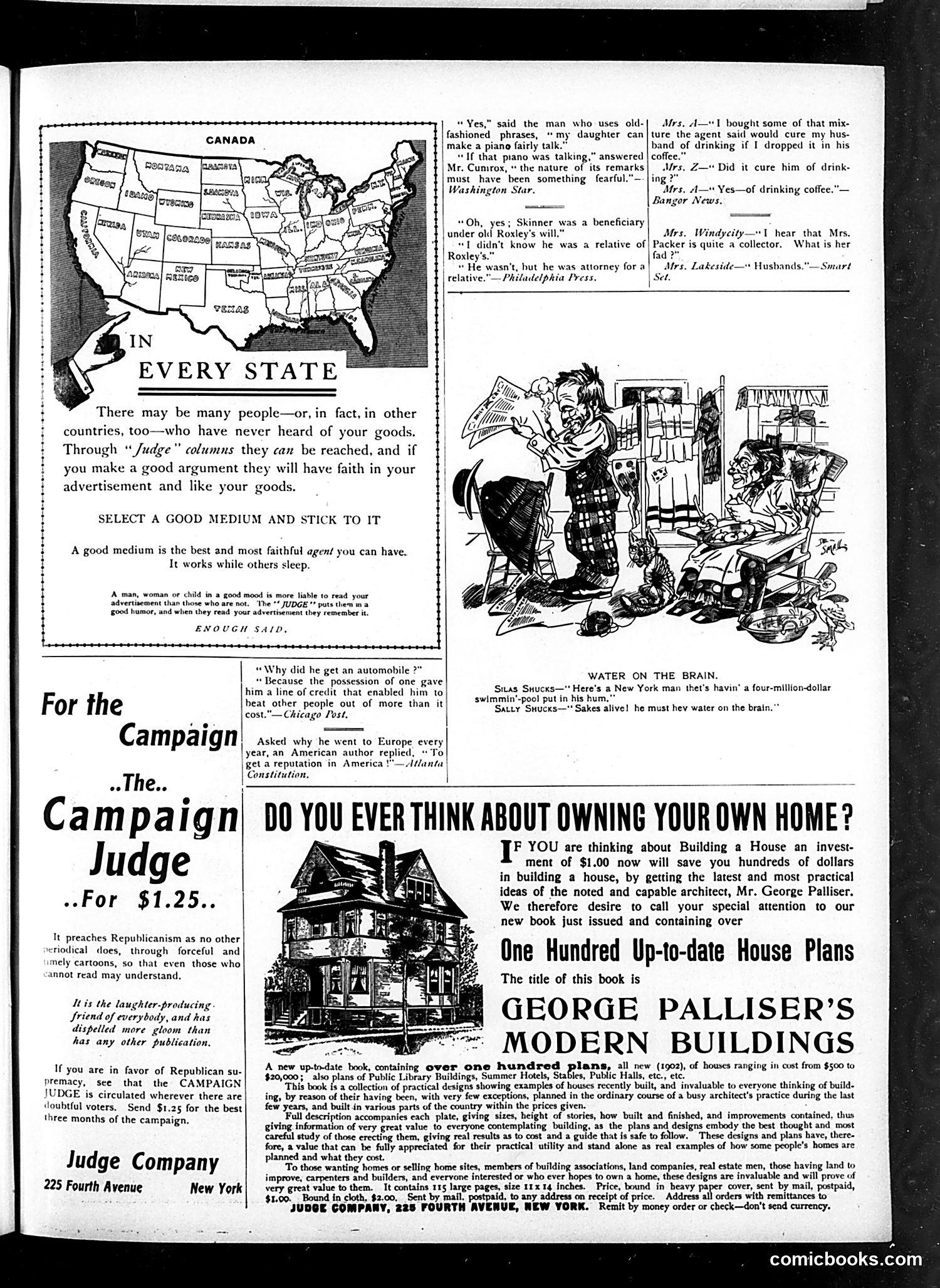
This page from *Judge* magazine contains mostly advertising and lighter satirical content. The small jokes at top mock old-fashioned speech ("make a piano fairly talk"), opportunistic lawyers inheriting from clients, and dubious patent medicines for alcoholism. One quip references an American author needing to go to Europe to gain reputation at home—satirizing American cultural insecurity. The cartoon "Water on the Brain" depicts rural characters amazed that a wealthy New Yorker is installing an expensive swimming pool, calling it excessive ("water on the brain" meaning crazy). This reflects early 1900s class commentary—mocking nouveau riche excess. The bulk of the page advertises *Judge* itself as an advertising medium reaching "every state," plus George Palliser's house-plan book. The left sidebar promotes *Campaign Judge* as Republican propaganda "preaching Republicanism" through cartoons for those "who cannot read."
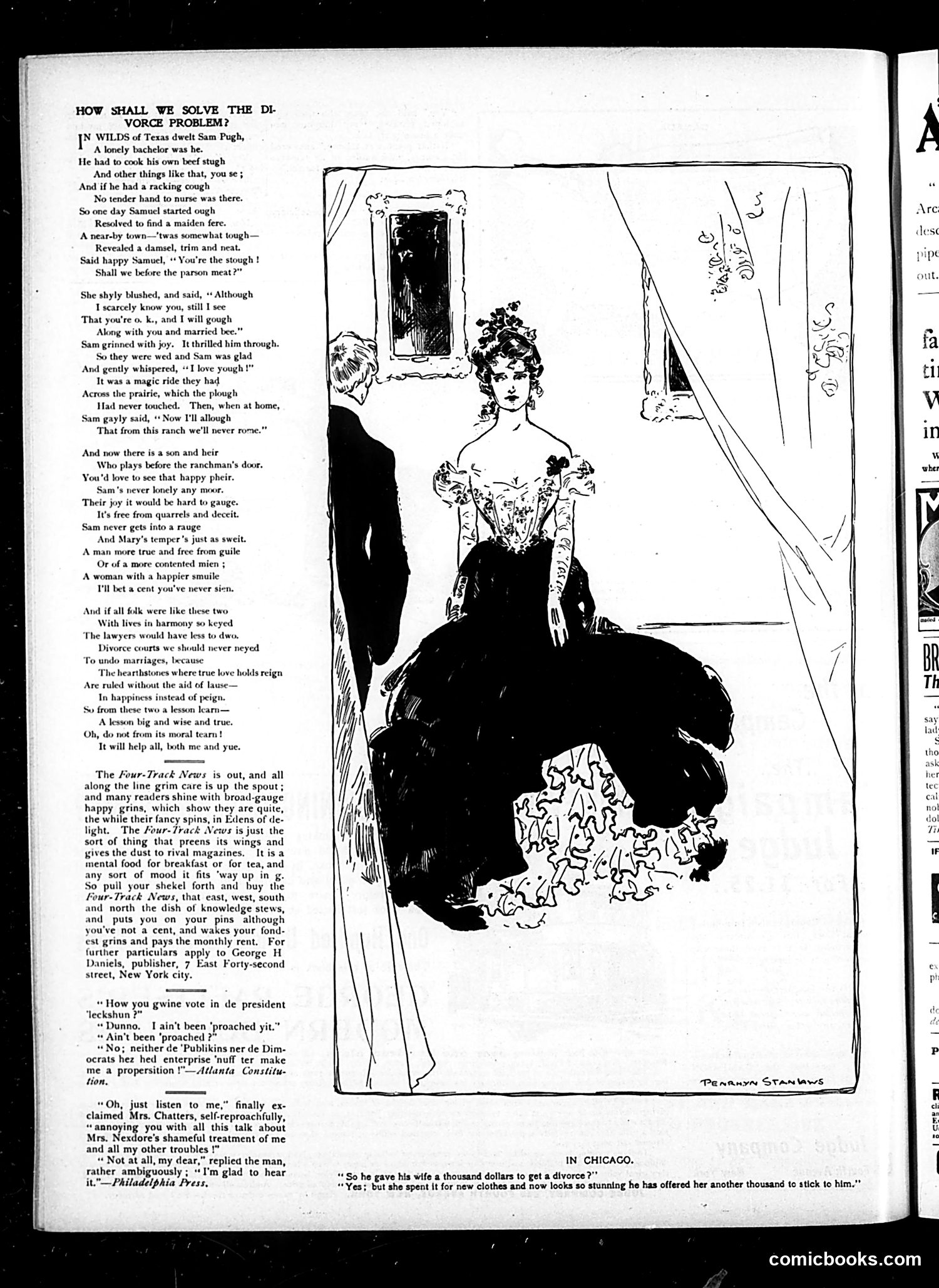
This page contains satirical poetry and cartoons addressing divorce in early 20th-century America. The main illustrated narrative poem ("How Shall We Solve the Divorce Problem?") tells of Sam Pugh, a Texas bachelor who marries quickly and lives in perfect harmony—the satire being that such ideal marriages were rare. The poem mocks both hasty marriages and the growing divorce epidemic by presenting an impossibly perfect union as the "solution" to America's divorce crisis. Below, smaller humorous anecdotes include a dialogue about political vote-buying and a Chicago scene where a wealthy man reportedly paid his wife $1,000 to *stay* married rather than divorce—mocking both marital instability among the wealthy and the mercenary nature of relationships. The *Four-Track News* advertisement celebrates a railroad magazine's cheerful escapism from "grim care." Overall, the page satirizes contemporary anxieties about marriage dissolution and moral decline while offering cynical commentary on how money, not love, often determined marital outcomes.
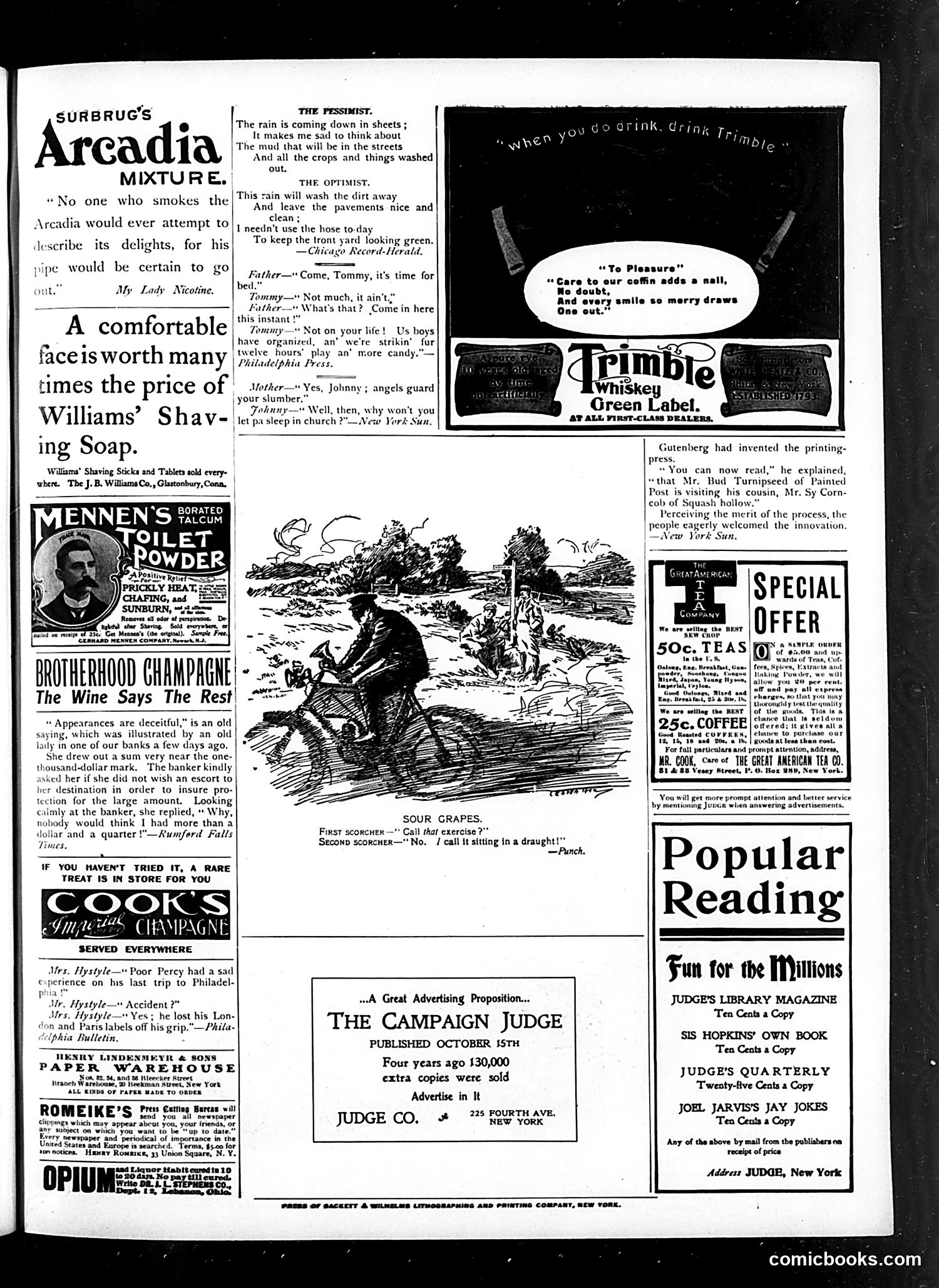
This is primarily an **advertising page** from *Judge* magazine (October 15th issue), containing multiple commercial ads and light humor pieces typical of early 20th-century American publications. The central cartoon depicts two cyclists examining a steep hill—a simple visual gag about exercise masquerading as laziness ("Call that exercise?" / "No, I call it sitting in a draught!"). Other humor includes domestic scenes: a father ordering his son to bed while the boy claims children have organized labor strikes for later bedtimes and more candy; a banker offering a well-dressed woman protection for her withdrawn money, learning she looks wealthier than she is. The advertisements promote **consumer goods** (Williams' Shaving Soap, Mennen's Powder, Brotherhood Champagne, Trimble Whiskey) and **publishing services** (*Judge* itself, which emphasizes 30,000 copies sold four years prior). A Gutenberg printing-press anecdote jokes that mass media enabled gossiping about obscure people like "Bud Turnipseed of Painted Post." The page reflects **turn-of-century middle-class consumer culture** and light domestic humor—nothing overtly political or satirical.
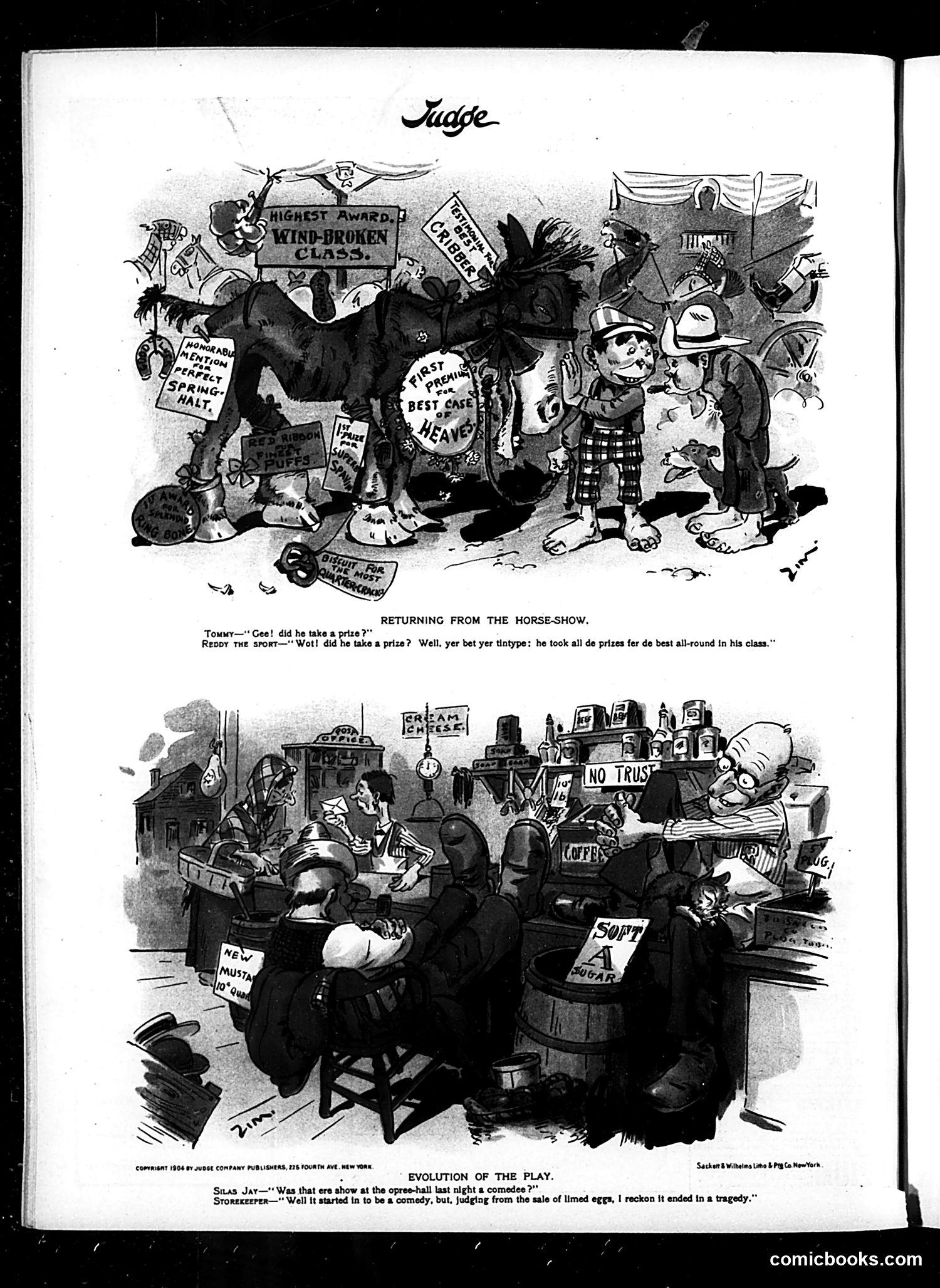
This page contains two separate comic sketches satirizing American leisure and entertainment. **"Returning from the Horse-Show"** depicts a child asking about prize-winning at a prestigious horse show. The humor plays on class contrast: a working-class man ("Roody the Sport") boasts that his entry won "all de prizes fer de best all-round in his class"—the lower-class qualifier undercutting the prestige. The dialect and character suggest satirizing working-class aspirations to participate in upper-class sporting events. **"Evolution of the Play"** jokes about a theater performance at the opera hall that started as comedy but became tragedy. The punchline references "limed eggs"—rotten eggs audiences threw at bad performances. The satire suggests the show was so poorly received that what began comedically devolved into literal tragedy, with the audience literally pelting the stage. This mocks both poor theatrical quality and audience reaction traditions. Both sketches use class commentary and exaggeration typical of Judge's satirical approach.