
A complete issue · 16 pages · 1904
Judge — August 20, 1904
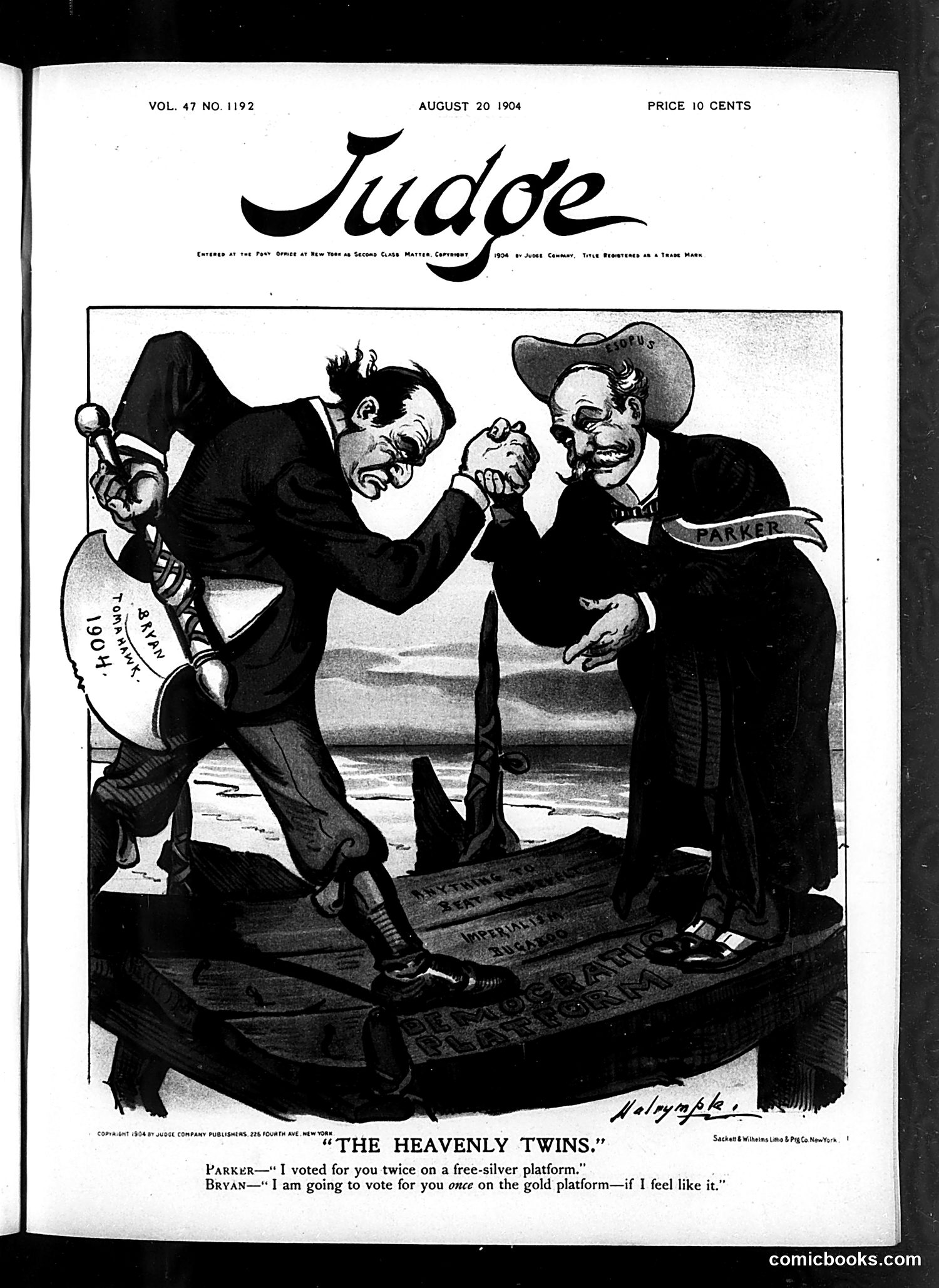
This political cartoon satirizes the 1904 U.S. presidential election, specifically the monetary policy debate dividing the Democratic Party. The two figures labeled "Parker" and "Bryan" represent the party's fractured leadership over currency standards. **The satire:** Parker (Democratic nominee) and Bryan (former candidate and free-silver advocate) are depicted as "heavenly twins" standing on opposing platforms—one labeled "free-silver," the other "gold." Their dialogue mocks the contradiction: Parker promises Bryan one vote for free-silver while actually intending to vote for the gold standard instead. The cartoon ridicules Democratic hypocrisy and the party's inability to unite on economic policy, with both men appearing to make conflicting promises to secure support. The seascape background suggests their political fortunes are adrift.
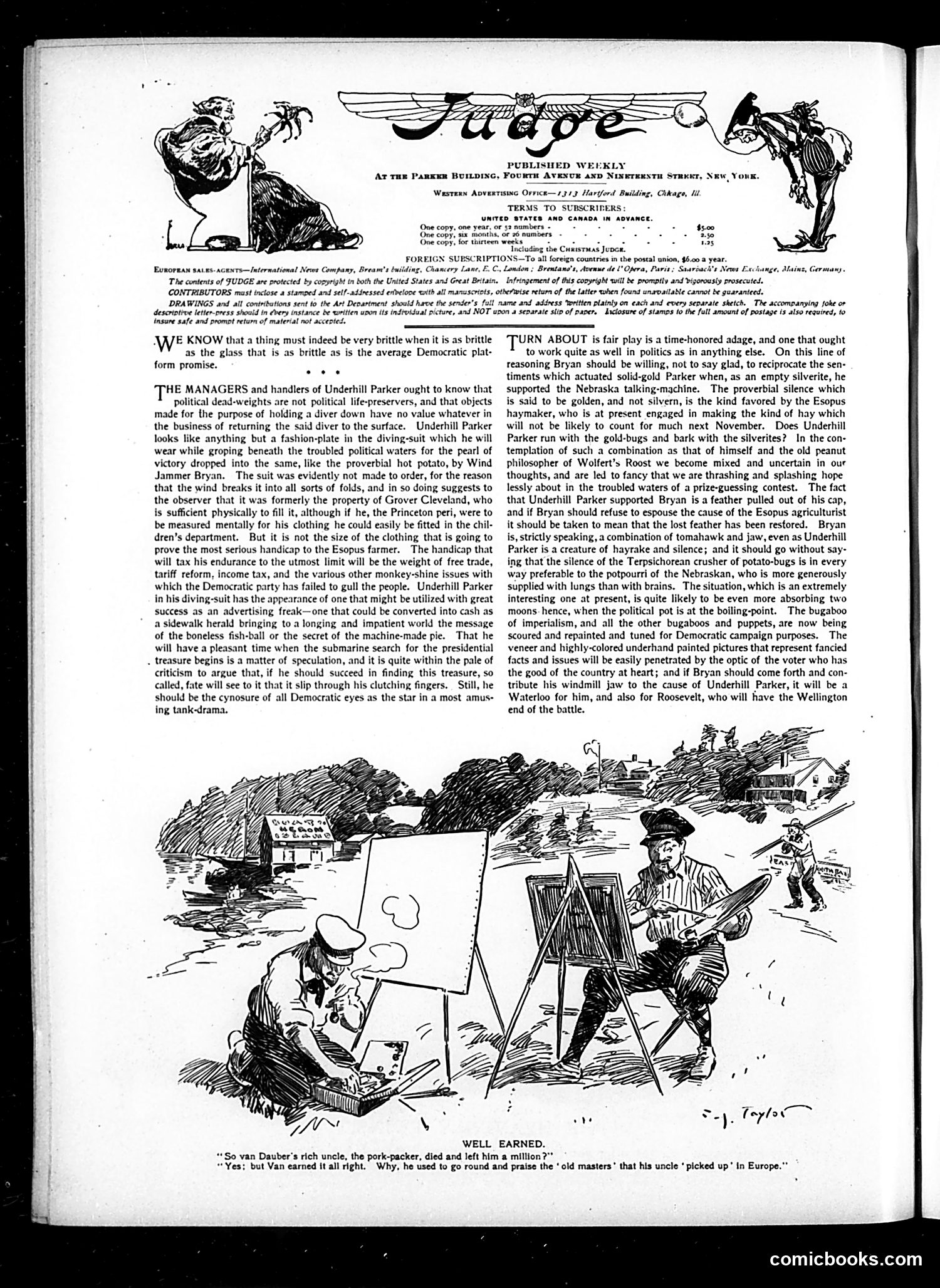
This satirical cartoon depicts two men painting outdoors—likely representing artists or political commentators. The caption "Well Earned" and accompanying dialogue reference Van Dausler's rich uncle, a pork-packer who died and left him a million dollars. The joke hinges on the phrase "picked up" in Europe, suggesting the uncle accumulated wealth through questionable means abroad. The cartoon satirizes American wealth-building practices of the Gilded Age, implying that fortunes made through meat-packing (a notoriously corrupt industry) could be "polished" or legitimized through European travel and cultural refinement. It critiques both the moral compromises of industrial capitalism and the pretension of newly wealthy Americans seeking respectability through European sophistication.
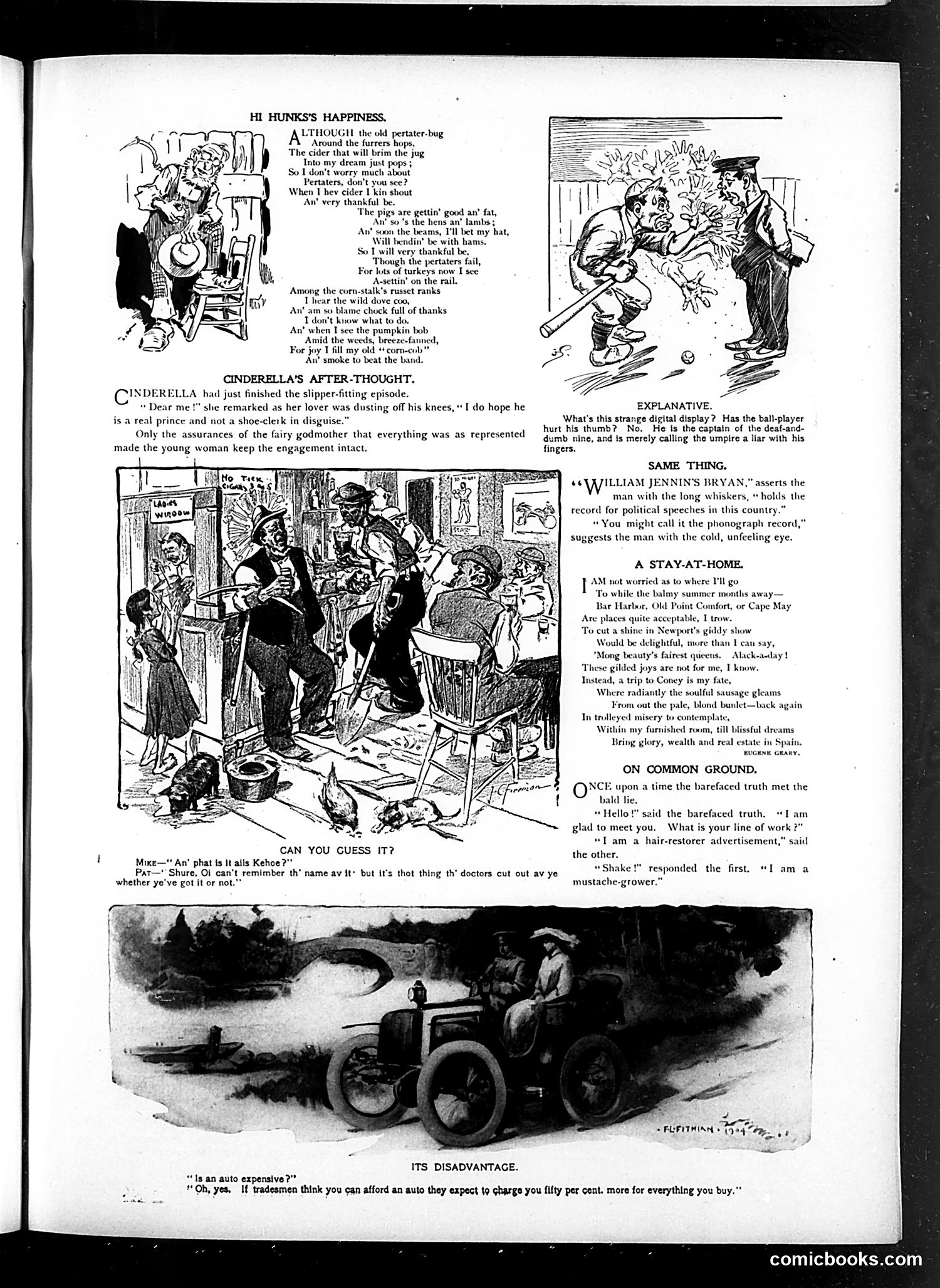
This page contains several humor pieces and illustrations typical of early-20th-century Judge magazine: **"Hi Hunks's Happiness"** (top left): A poem about a farmer's contentment with his animals and crops, accompanied by a sketch of a rustic figure. **"Cinderella's After-Thought"**: A brief text joke playing on the fairy tale, suggesting the prince may be a "shoe-clerk in disguise." **"Can You Guess It?"** (center): A crowded tavern scene where two characters debate whether a medical procedure ("doctors cut out ay ye") is memorable—appears to be period wordplay. **"Same Thing"** and **"A Stay-at-Home"**: Short humorous pieces about travel preferences and summer destinations. **"On Common Ground"**: A joke about a "barefaced truth" meeting a "bald lie," with punchlines involving occupations (hair-restorer, mustache-grower). **"Its Disadvantage"** (bottom): An auto-industry joke about expense. The content is primarily domestic humor without evident political satire.
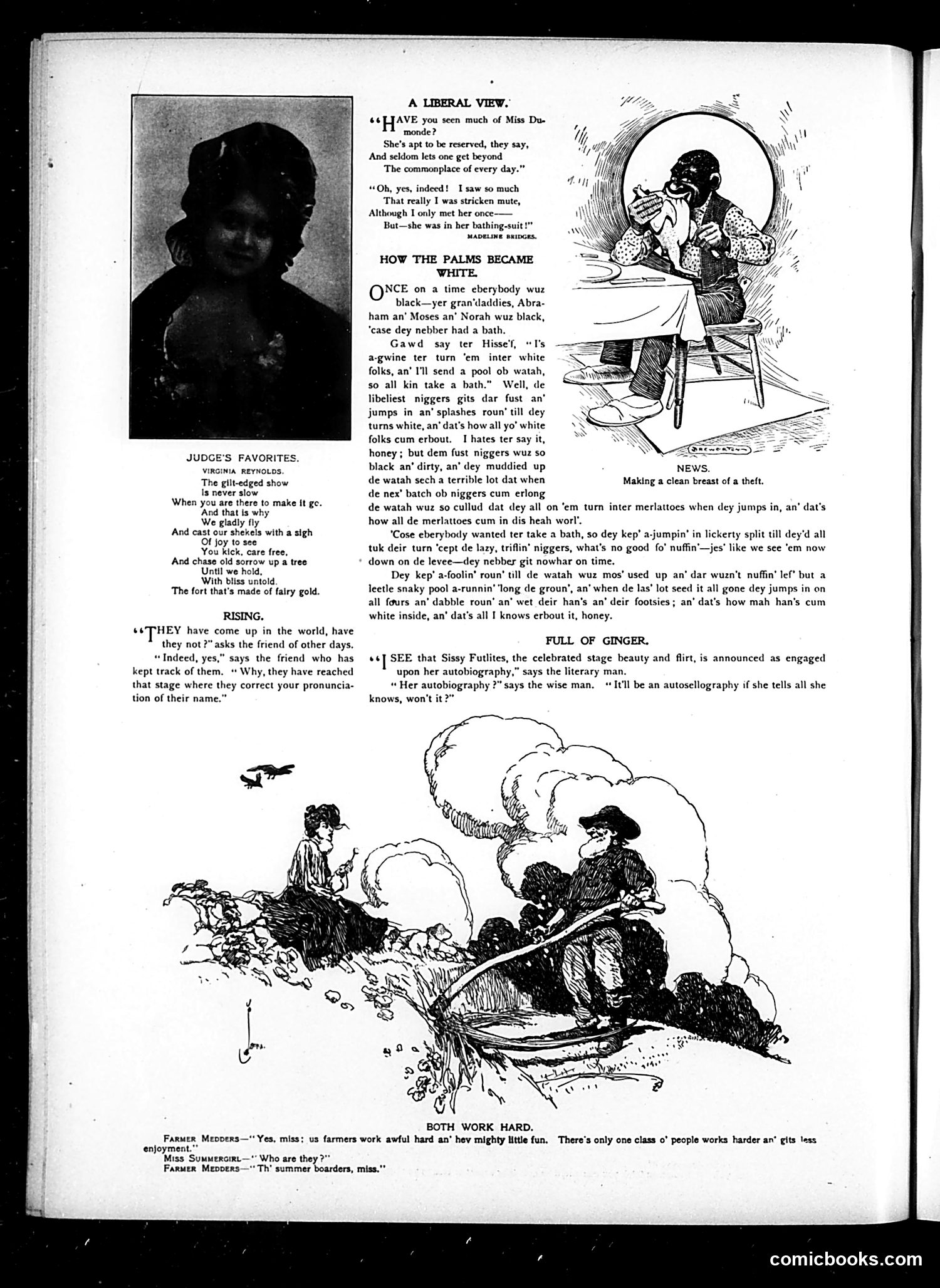
This page contains three satirical pieces using racist imagery and stereotypes common to late 19th/early 20th-century American humor magazines. "How the Palms Became White" presents a pseudo-scientific folk tale mocking Black dialect and perpetuating racist pseudoscience about skin color through exaggerated dialect speech. The narrative presents enslaved people's labor as the source of palm whitening. "Judge's Favorites" and "Rising" appear to be brief satirical poems about social climbing and status among performers. "Full of Ginger" references "Sissy Fultites," likely a theatrical figure, with commentary on autobiographies. "Both Work Hard" depicts farmers in a humorous conversation about labor. The entire page exemplifies Judge's reliance on dehumanizing racial caricature as its primary comedic vehicle—content reflecting and reinforcing the racist attitudes of its era.
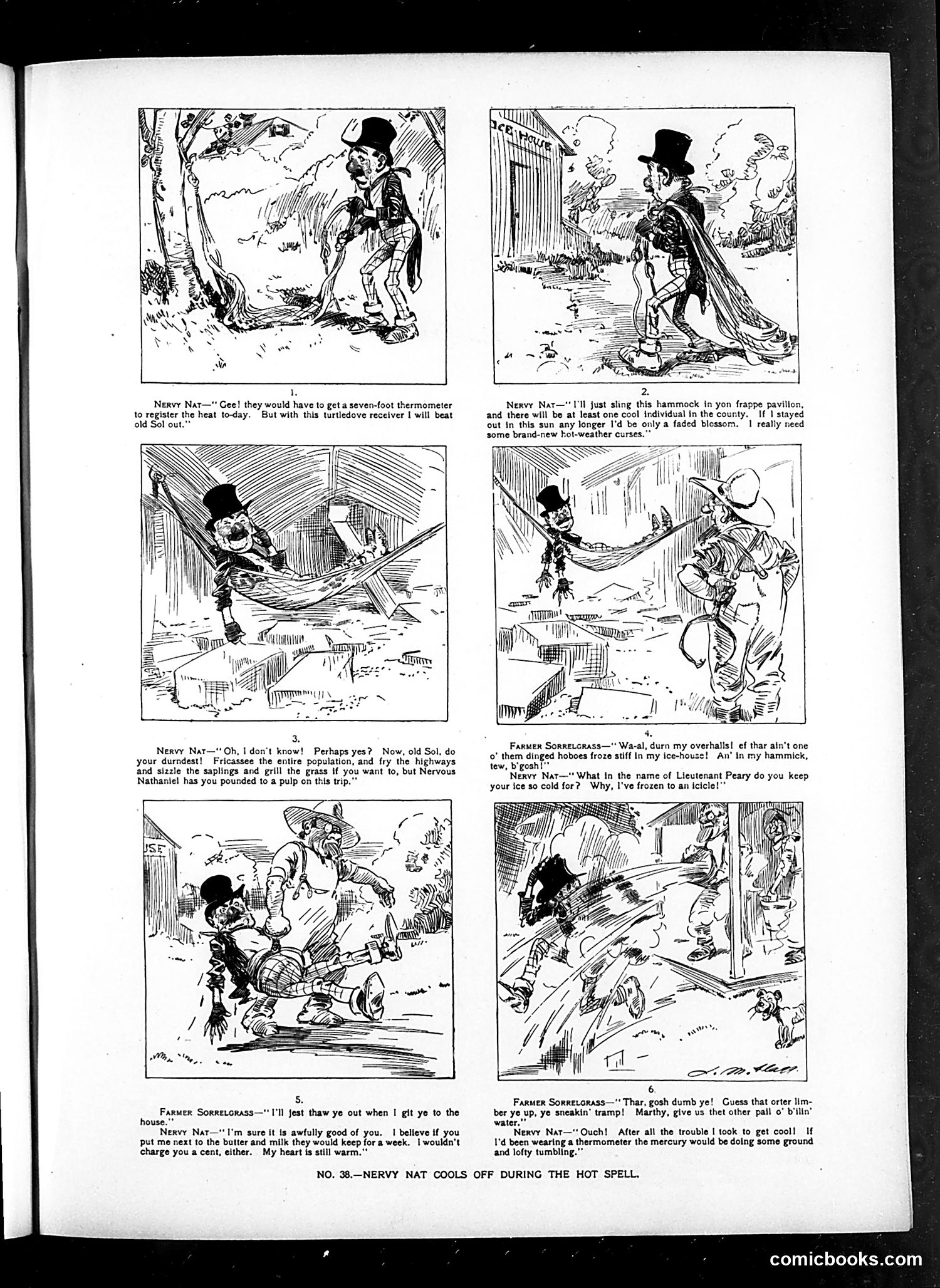
This comic strip satirizes a heatwave through the misadventures of "Nervy Nat," a con-artist vagrant. During extreme summer heat, Nat boasts he'll stay cool through various schemes: a "turtledove receiver" (unclear device), a hammock in a "frappe pavilion," and other dubious methods—all while mocking the sun itself. The joke culminates when Nat arrives at Farmer Sorrelgrass's house and discovers he's been frozen solid in the farmer's ice house. The farmer then thaws him out with scalding water, causing Nat to suffer the opposite problem. The satire targets both Nat's braggadocio about outsmarting nature and the era's extreme weather challenges. The rural dialect ("Wa-al," "b'gosh") and vagrant character were common Judge stereotypes of the period.
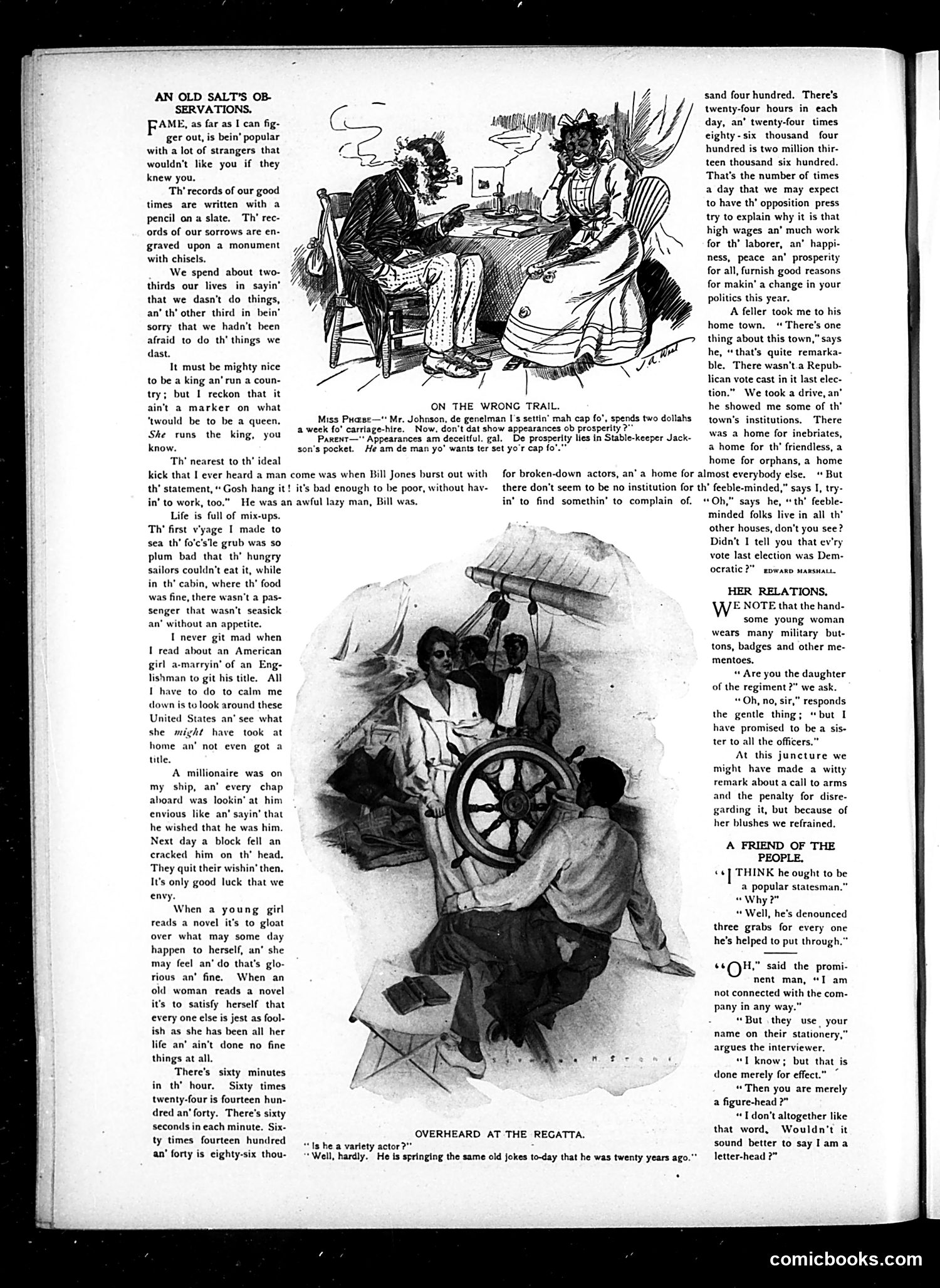
This page contains satirical commentary from "An Old Salt's Observations"—a sailor's philosophical musings about life and society. The cartoons illustrate specific jokes: "On the Wrong Trail" depicts a woman being advised about a suitor's finances (his carriage-hire comes from a stable keeper's pocket, not his own wealth). "Overheard at the Regatta" mocks someone repeating old jokes from twenty years prior. The main text uses the sailor character to critique political hypocrisy. Most notably, one section attacks Democratic claims about a town with "no Republican votes," yet the town houses institutions for the poor, friendless, orphans, and "broken-down actors"—implying Democratic governance produces social problems. The final joke suggests the "feeble-minded" live among the general population, a harsh swipe at Democratic voters. The opening discusses how fame relies on strangers' ignorance; other passages cynically observe human nature regarding wealth, class, and ambition—typical Judge magazine satire targeting progressive politics and social pretension.
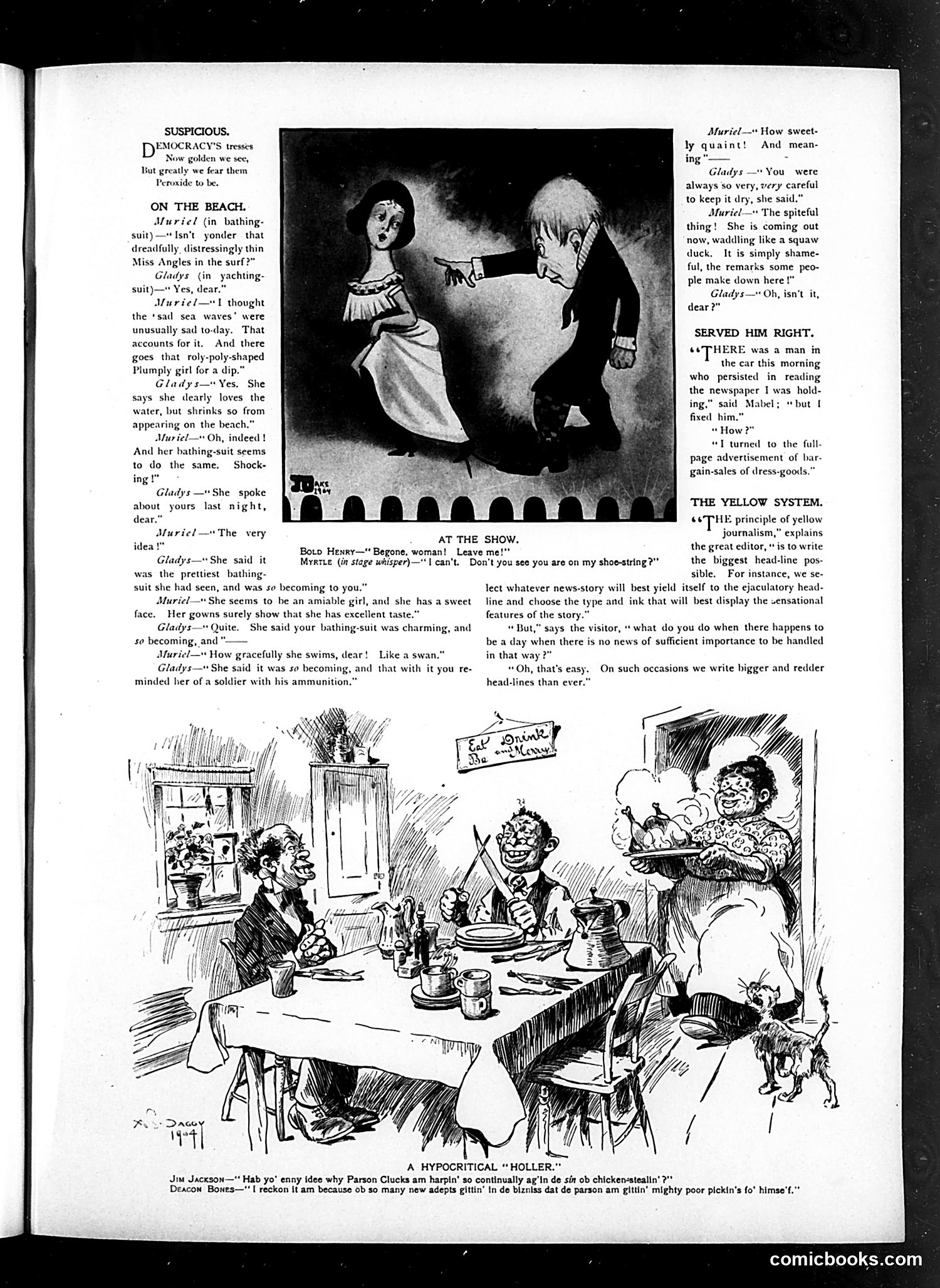
This page contains three satirical pieces mocking social hypocrisy and journalistic practices circa early 1900s: **"Suspicious" & "At the Show":** Two women (Muriel and Gladys) trade barbed compliments about a third woman's appearance and bathing suit, each praising her while delivering cutting insults. The satire targets cattiness disguised as politeness among upper-class women. **"The Yellow System":** Mocks sensationalist journalism by showing an editor who admits that "yellow journalism" prioritizes eye-catching headlines over substantive news. When real news is scarce, he simply manufactures bigger, redder headlines anyway—satirizing the media's prioritization of spectacle over truth. **"A Hypocritical 'Holler'":** Two Black men (rendered in dialect) discuss why a preacher constantly rails against chicken-stealing: the preacher himself steals chickens and fears competition from newcomers. The satire critiques hypocrisy—condemning others for sins one commits personally. All three pieces expose gap between public morality and private behavior.
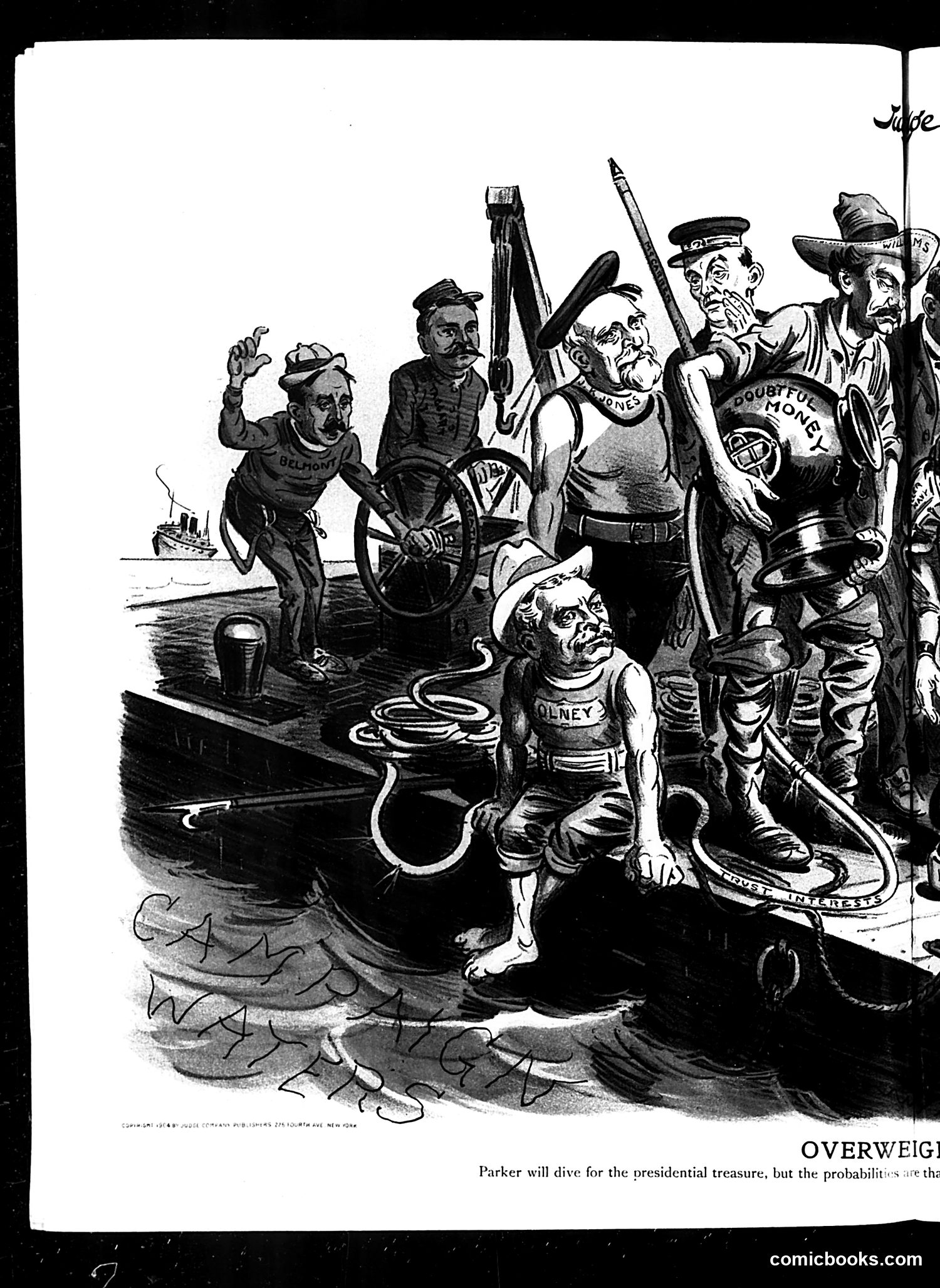
This Judge cartoon satirizes a figure labeled "Parker" who appears as a diver attempting to retrieve "the presidential treasure." The caption suggests Parker will "dive for the presidential treasure, but the probabilities are the" (text cuts off). The cartoon depicts Parker surrounded by military/naval personnel on what appears to be a ship, with ropes and diving equipment visible. The caricatured figures wear military garb labeled with text (partially legible: "Belmont," "Doubtful Mobs"). Without the complete caption and clearer date/context, the specific political reference is unclear. This likely concerns a presidential scandal or financial matter involving someone named Parker, probably from the early 1900s Judge era. The "diving" metaphor suggests attempting to recover something valuable or hidden.
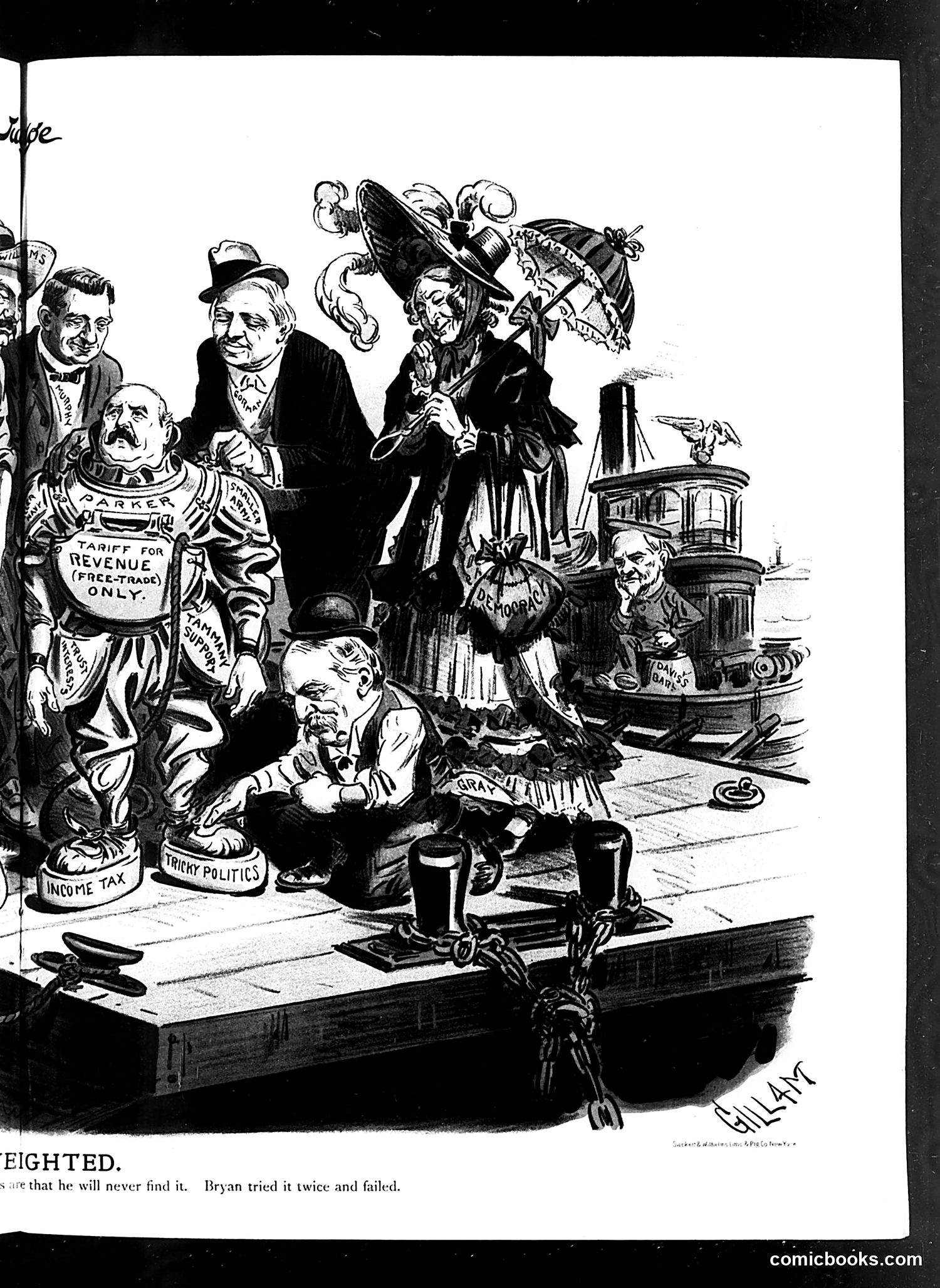
This is a Gilded Age political cartoon satirizing William Jennings Bryan's presidential campaigns. The cartoon depicts Bryan as a bound figure (literally weighted down and chained) surrounded by political operatives and special interests—figures labeled with references to "Income Tax," "Tricky Politics," and tariff issues. The witch-like figure above appears to represent the manipulation of Bryan by party handlers. The text references Bryan's failed attempts to win the presidency, suggesting he was weighed down by competing political interests and unable to achieve his goals despite trying twice. The cartoon critiques both Bryan's political viability and the corrupt machinery controlling late-19th-century American politics. The chains and restraints symbolize how Bryan was constrained by forces beyond his control.
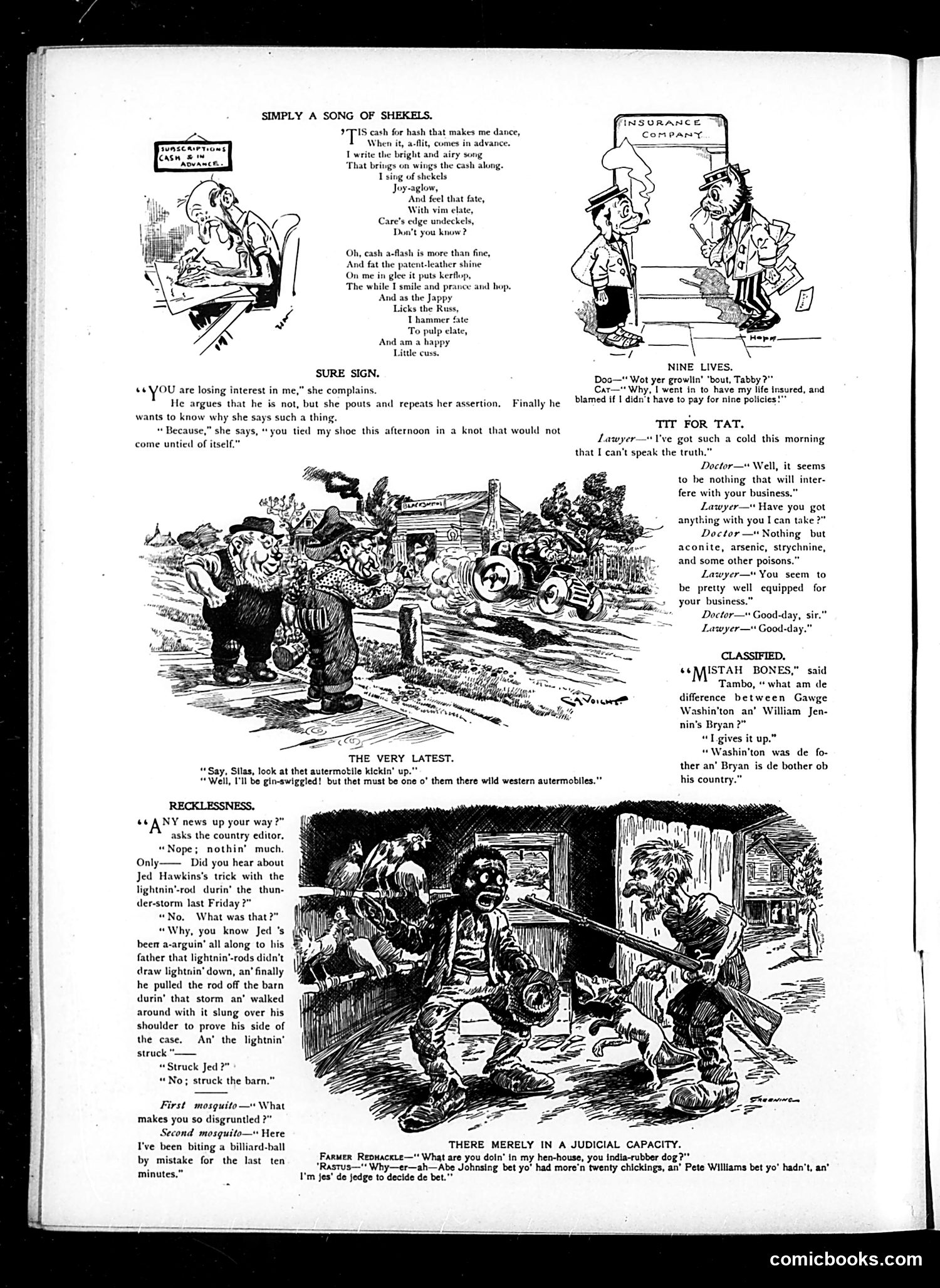
This page contains several satirical pieces typical of early 20th-century humor: **"Song of Shekels"** mocks Jewish immigrants' perceived obsession with money, using "shekels" (a Jewish currency reference) and exaggerated dialect to ridicule financial ambition. **"Nine Lives"** is a straightforward domestic joke: a cat bought nine insurance policies because she was told she has nine lives, and must pay for each one. **"Tit for Tat"** satirizes lawyers as poisoners—a lawyer carrying "aconite, arsenic, strychnine" is equipped for his profession, implying lawyers are as deadly as toxins. **"Classified"** uses racist minstrel-show dialect ("Tambo," "Sistah Bones") to make a crude political comparison between Washington and Bryan, likely referring to William Jennings Bryan. **"The Very Latest"** jokes about automobiles as dangerous new technology. **"Recklessness"** humorously describes a man struck by lightning while proving lightning rods don't attract lightning—ironic comeuppance. The page reflects Judge's casual bigotry alongside general satirical commentary on American life and new technologies.
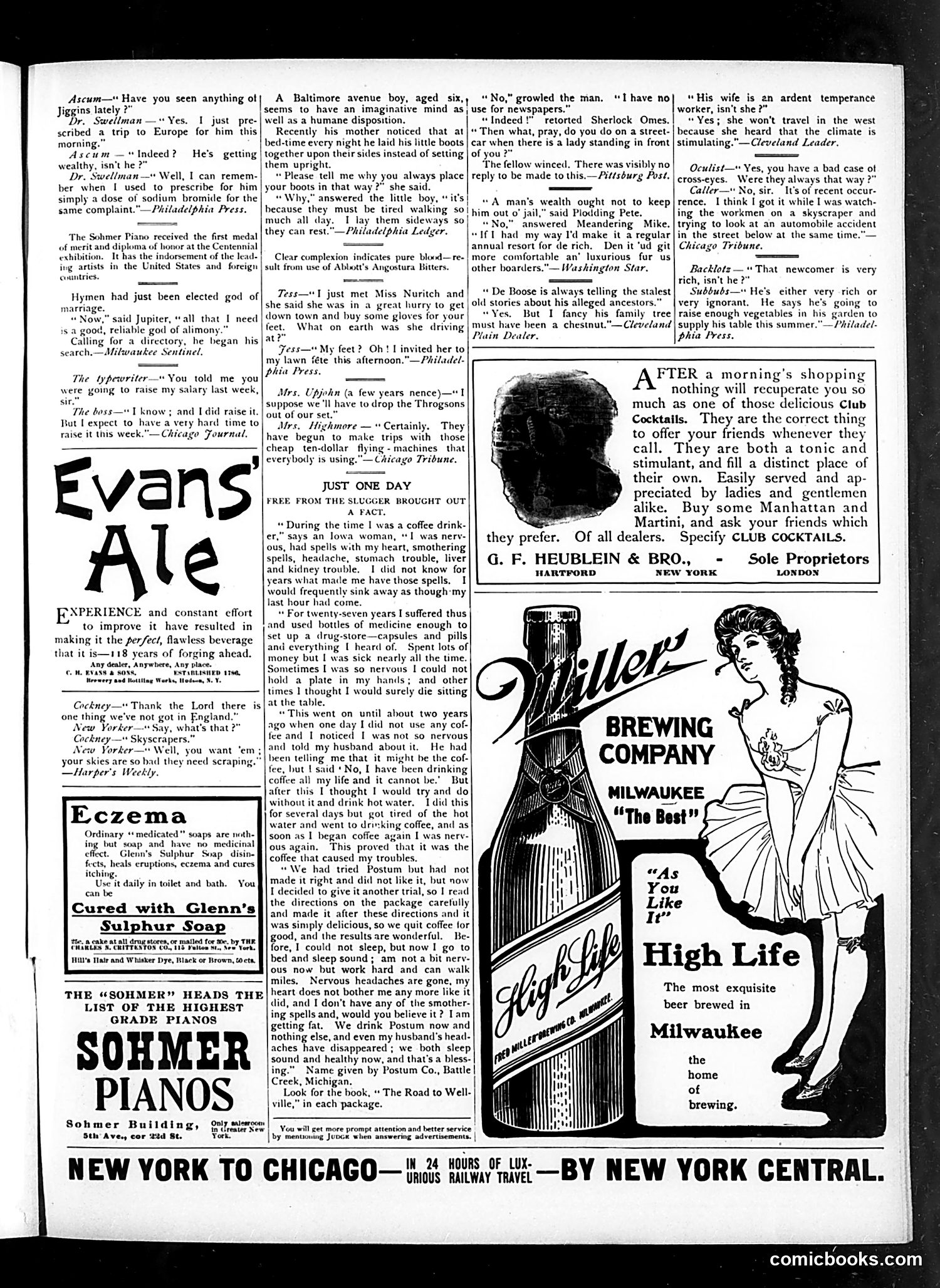
This page contains primarily **advertising and humor snippets** rather than political cartoons. The content reflects early-20th-century concerns: **The humor pieces** mock social pretensions and marital dynamics—a wealthy doctor with hypochondria, a newlywed's naïveté about alimony, class anxiety about appearing "tired" (wealthy people apparently set boots upright, not on their sides). One joke contrasts English restraint with American excess (skyscrapers). **The advertisements** reveal period preoccupations: health tonics (Angostura Bitters for "pure blood"), piano manufacturers advertising quality, and prominently, **coffee replacement products** and caffeine-related ailments. A woman's lengthy testimonial describes coffee-induced nervousness, heart palpitations, and exhaustion—reflecting contemporary anxieties about stimulants and modernity. The beer and ale ads at bottom show alcohol as a respectable social beverage. **Overall:** This page illustrates Gilded Age anxieties about health, class status, and the physical effects of modern stimulants, wrapped in gentle satire.
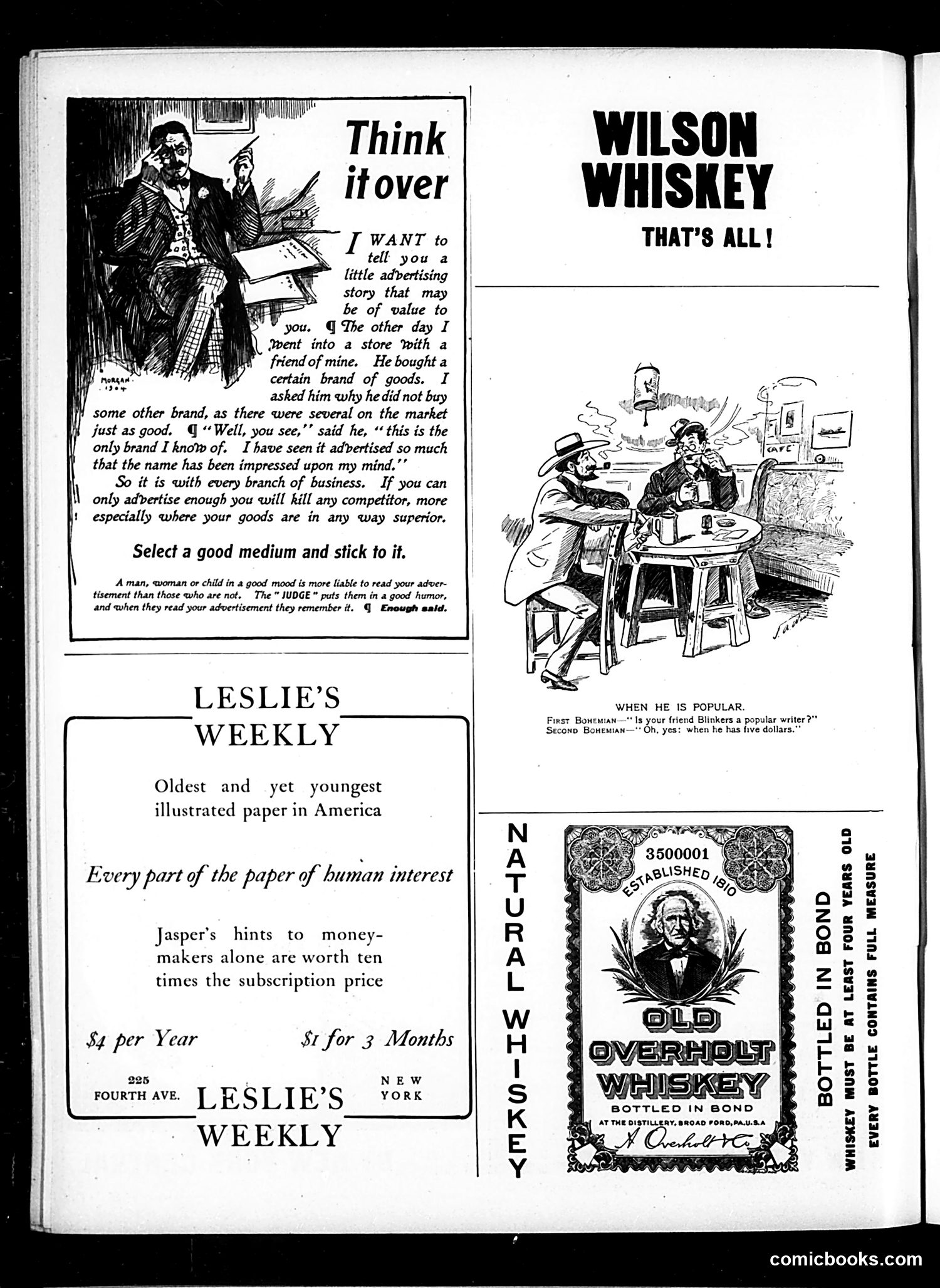
This page contains **advertising and promotional content** rather than political satire. The main editorial cartoon (upper left) argues that **repetitive advertising creates brand loyalty**, using an anecdote about a customer who buys a product simply because he's seen it advertised frequently. The message: advertising volume matters more than product quality. The smaller cartoon (right) satirizes **shallow literary fame**—a writer is "popular" only when he has money to spend, implying his reputation depends on financial status rather than talent. The page features advertisements for **Leslie's Weekly** (a rival illustrated magazine) and **Wilson and Overholt whiskeys**, both leveraging the argument that familiar brand names drive purchasing decisions. The cartoons essentially function as **meta-advertising**: they argue FOR advertising's effectiveness while simultaneously advertising these publications and spirits. This was standard practice—magazines used editorial content to promote both themselves and paying advertisers.
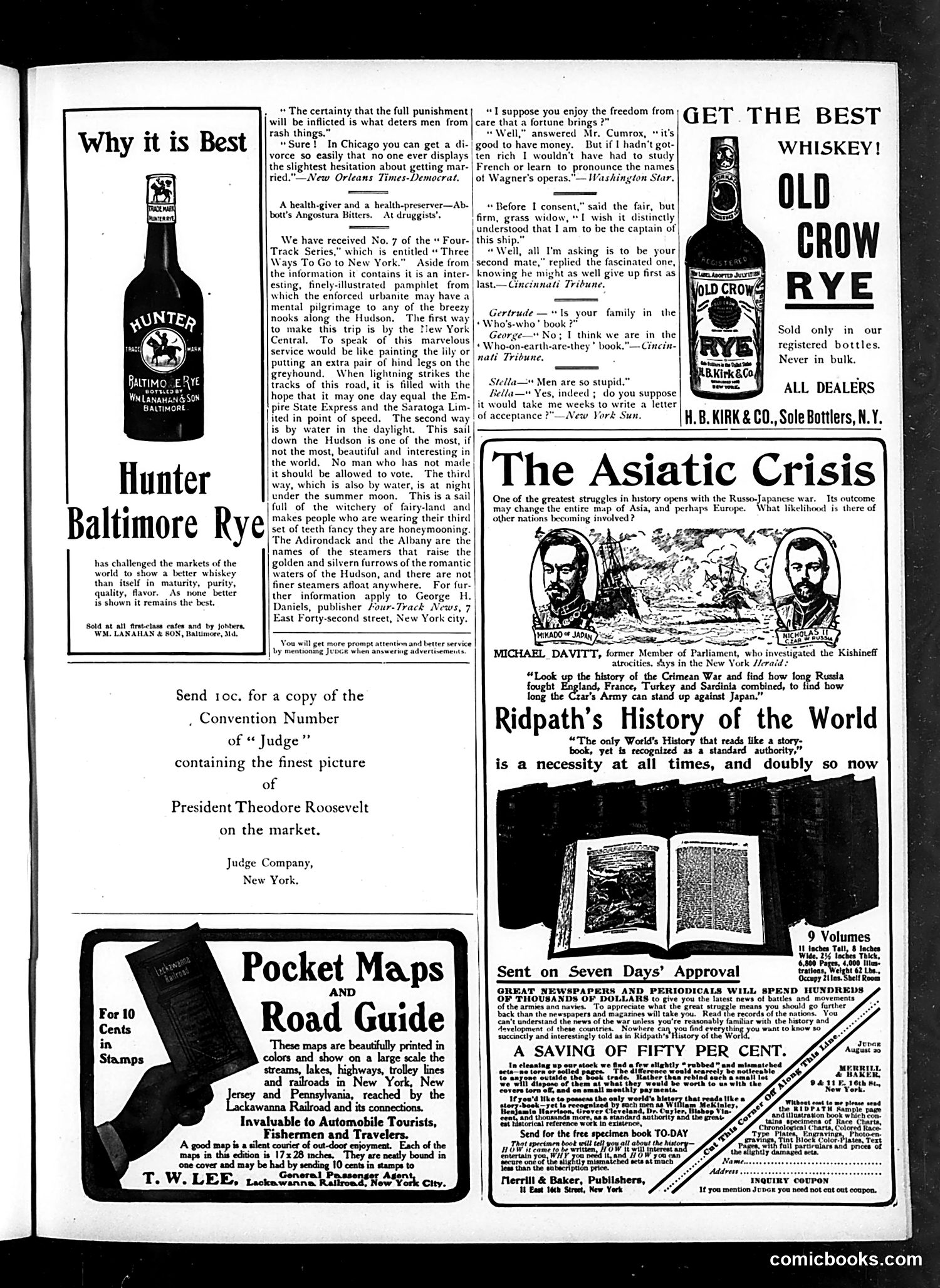
This is primarily an **advertising page** from Judge magazine, not a political cartoon. The content consists of several product advertisements and brief humorous vignettes rather than substantive satire. The page includes ads for: - **Hunter Baltimore Rye whiskey** and **Old Crow Rye** (competing liquor brands) - **Ridpath's History of the World** (a reference encyclopedia) - **Pocket Maps and Road Guide** for automobile tourists - A promotional offer for a Theodore Roosevelt picture The brief text items are light social humor typical of the era—jokes about easy Chicago divorces, wealthy people forced to learn French and opera names, and romantic misunderstandings between couples. None addresses serious political issues. The Roosevelt reference reflects his contemporary prominence (he was president 1901-1909), but it's merely a sales pitch, not political commentary. **In sum**: This is a standard advertising page with filler humor, not satirical content requiring historical context.
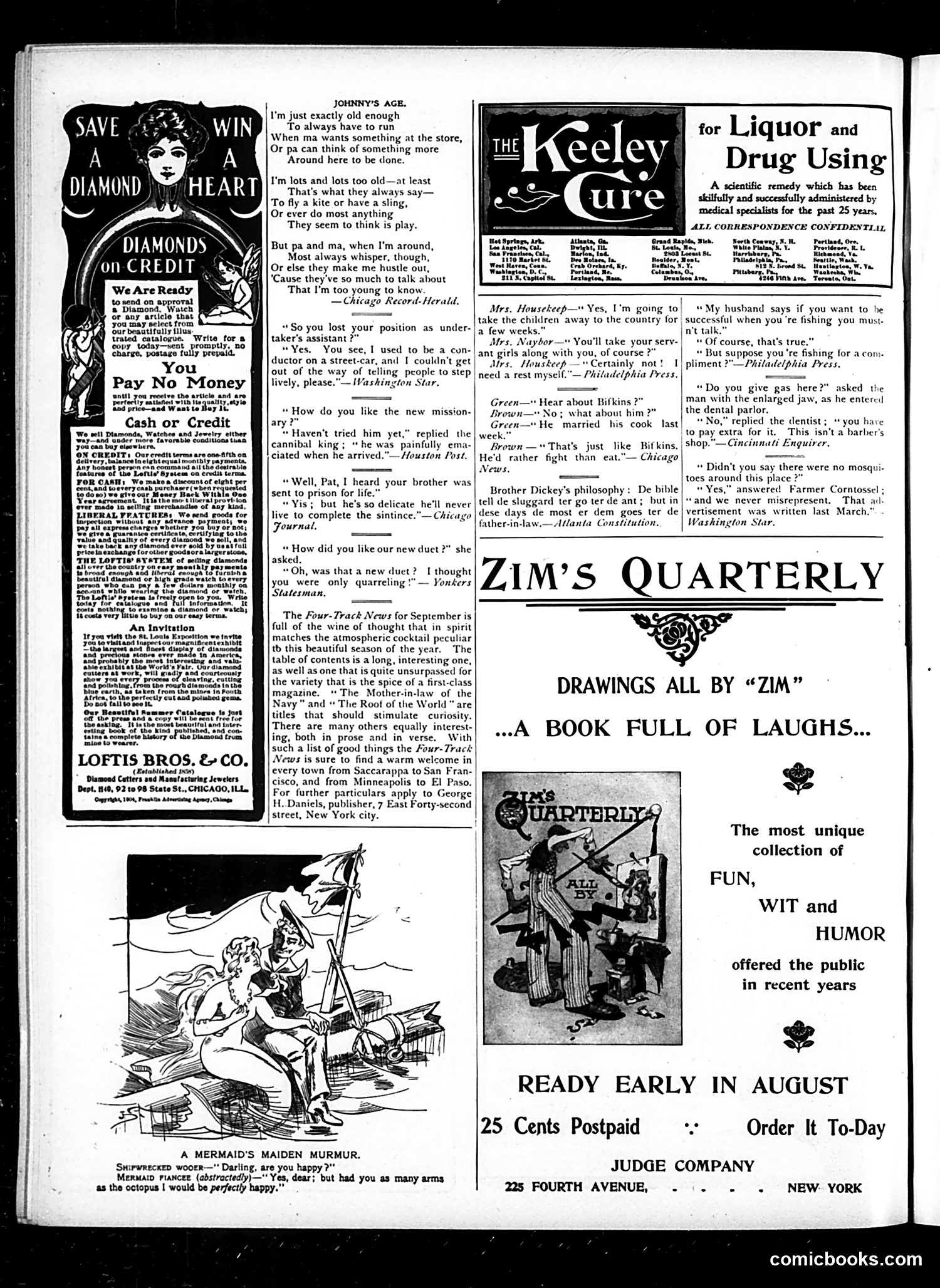
This is primarily an **advertising and filler-content page** from Judge magazine, with several brief humorous items rather than political satire. ## The Cartoons/Jokes: **"Johnny's Age"** satirizes childhood's awkward middle ground—old enough for chores, too young for adult activities or knowledge. It captures a relatable complaint about arbitrary parental restrictions. **Other brief jokes** include workplace humor ("undertaker's assistant"), cannibalism humor (topical for the era's colonial adventure stories), and domestic situations. **"A Mermaid's Maiden Murmur"** is a mild sexual joke: a mermaid fiancée wishes her suitor had octopus-like multiple arms—implying desire for increased physical affection. ## Advertisements: The page features large ads for **Loftis Bros. jewelry** (diamonds on credit), **The Keeley Cure** (a legitimate medical treatment for alcohol/drug addiction), and **Zim's Quarterly** (a humor book). The overall content reflects Judge's mix of advertising and light, domestic humor rather than sharp political commentary. Most jokes target everyday life rather than public figures or events.
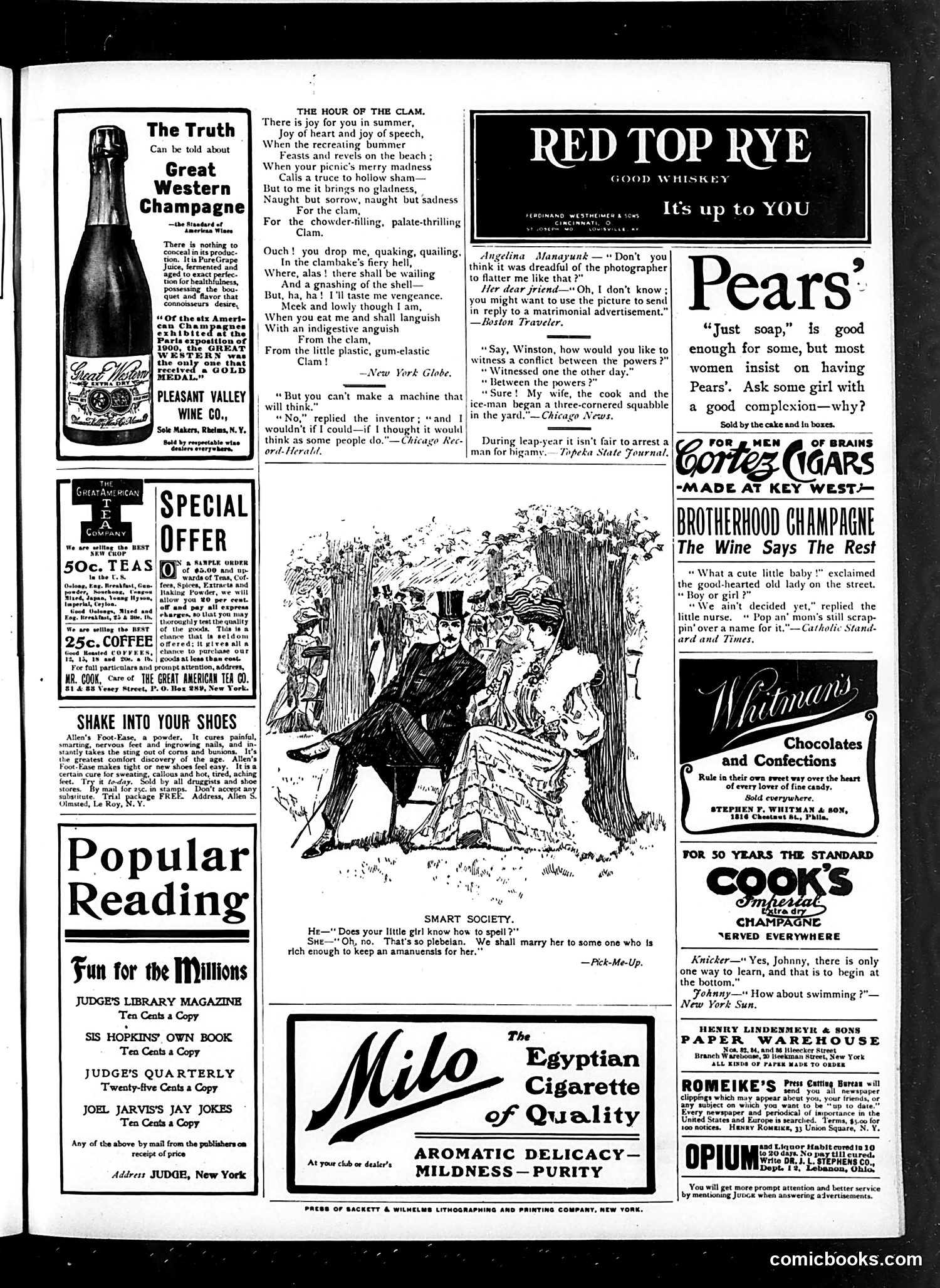
This page is primarily **advertising**, typical of Judge magazine's format. The central cartoon depicts a well-dressed man and woman in a romantic garden setting—a common "smart society" scene for the era's humor. The accompanying jokes mock upper-class pretension: one quip jokes that a rich man will marry someone who can afford to hire someone else to spell for his daughter; another satirizes marital conflict disguised as genteel disagreement. The **poetry section** about "The Hour of the Clam" humorously personifies a clam's revenge through indigestion—a lighthearted jab at summer dining. Other jokes reference leap-year marriage customs and photography flattery for matrimonial advertisements—period-specific social practices now obscure. The **advertisements** (champagne, whiskey, cigars, foot powder, tea, chocolates) reflect turn-of-century consumer culture and are largely self-explanatory, though they reveal contemporary anxieties about personal grooming and social status. The page carries no overtly political content—it's entertainment and consumer culture.
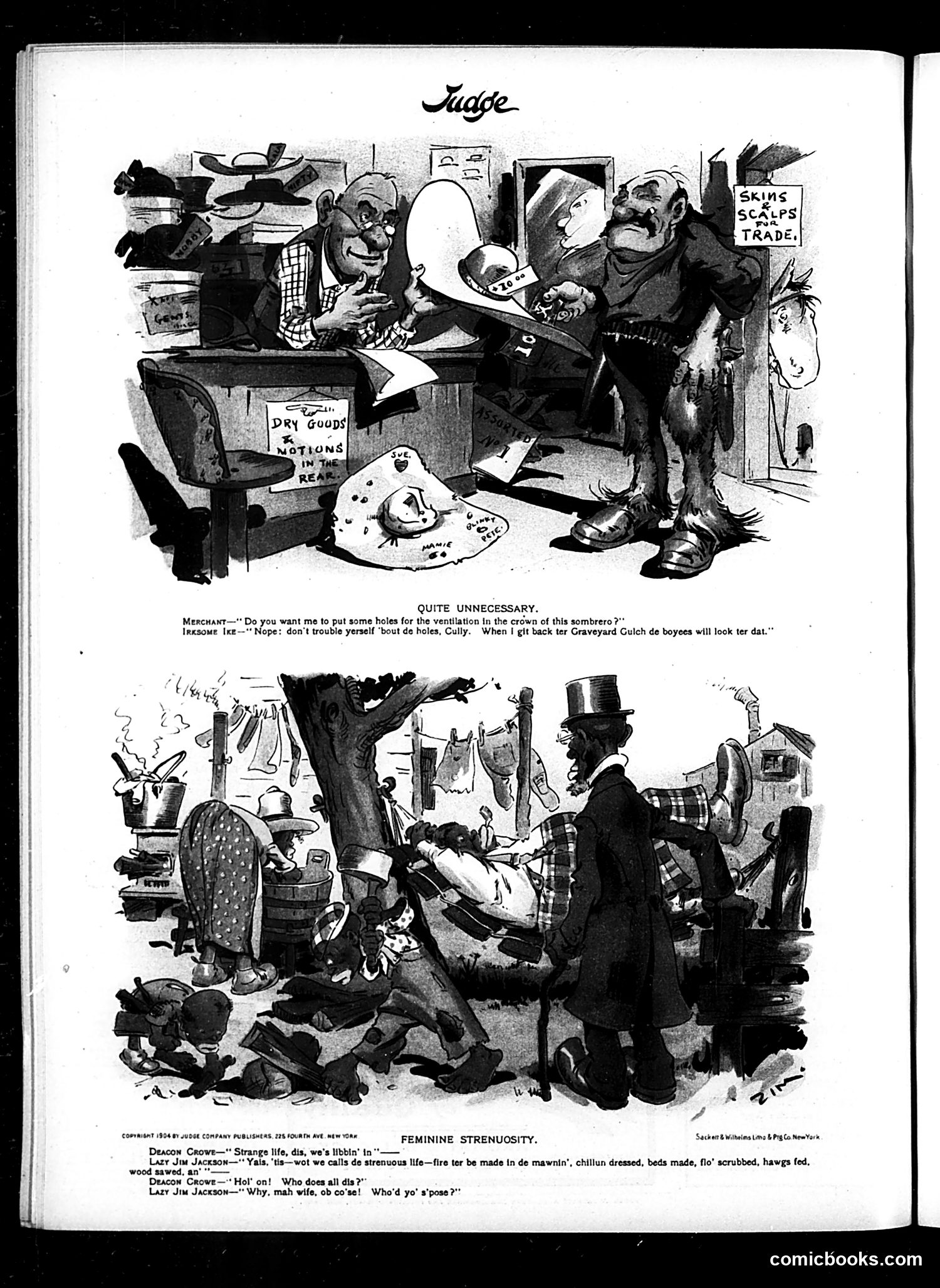
This page contains two separate satirical cartoons: **"Quite Unnecessary"** (top): A merchant tries to sell a sombrero to a rough frontier character ("Irksome Ike") from "Graveyard Gulch." The joke is that Ike won't pay extra for ventilation holes in the crown—the bullet holes will come naturally when he returns to his lawless mining town. It satirizes Western frontier violence as inevitable and commonplace. **"Feminine Strenuosity"** (bottom): Playing on Theodore Roosevelt's popular "Strenuous Life" philosophy, this mocks the backbreaking domestic labor women performed. "Lazy Jim Jackson" brags that his wife lives this strenuous life—making fires, dressing children, scrubbing floors, feeding hogs. The irony is harsh: while Roosevelt's "strenuosity" meant vigorous athletics and outdoor pursuits for men, women's strenuous lives meant endless exhausting housework. The cartoon critiques both male complacency about women's labor and Roosevelt's gendered ideal.