
Judge, 1904-08-20 · page 6 of 16
Judge — August 20, 1904 — page 6: what you’re looking at
What you’re looking at
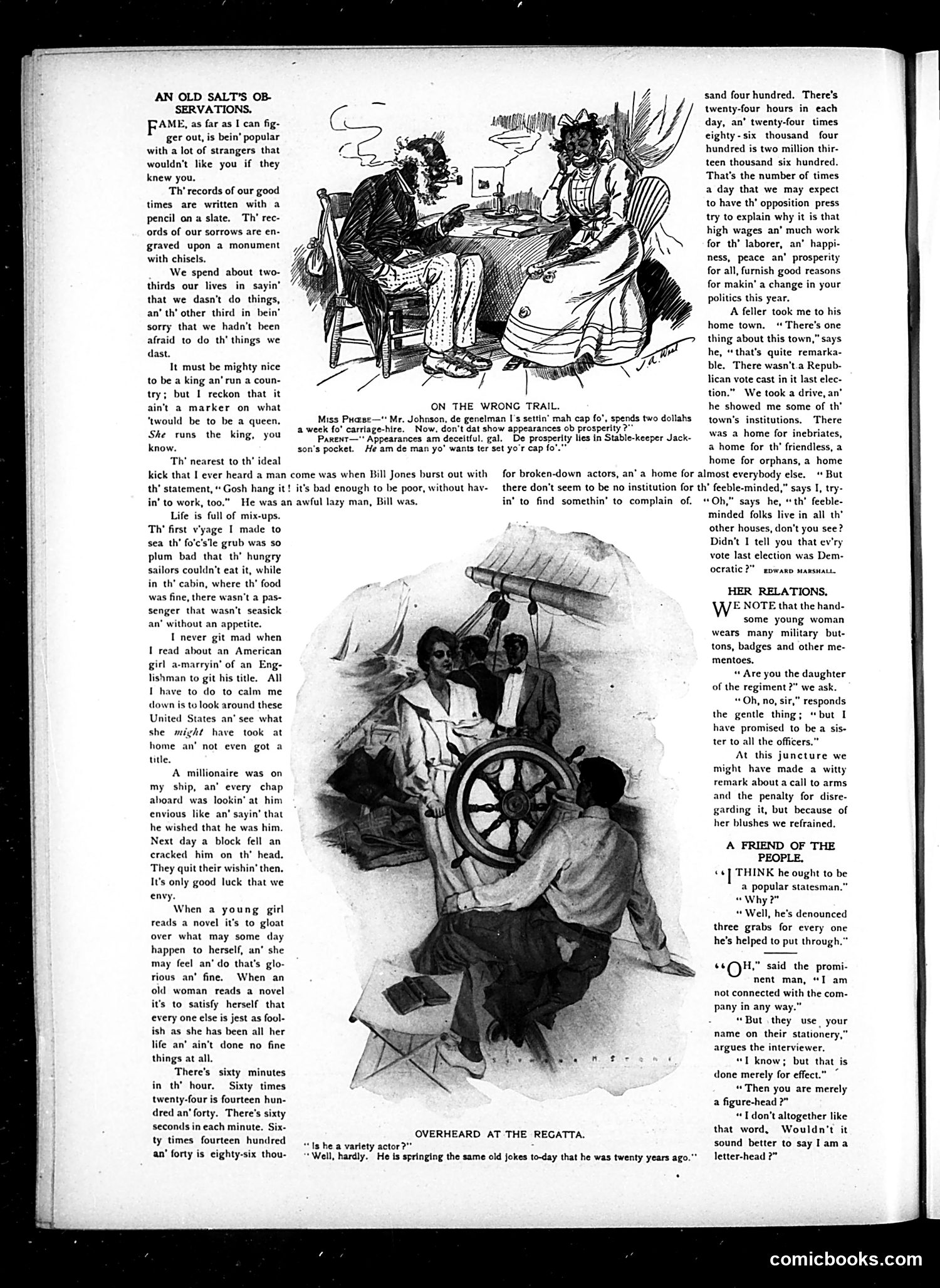
This page contains satirical commentary from "An Old Salt's Observations"—a sailor's philosophical musings about life and society. The cartoons illustrate specific jokes: "On the Wrong Trail" depicts a woman being advised about a suitor's finances (his carriage-hire comes from a stable keeper's pocket, not his own wealth). "Overheard at the Regatta" mocks someone repeating old jokes from twenty years prior. The main text uses the sailor character to critique political hypocrisy. Most notably, one section attacks Democratic claims about a town with "no Republican votes," yet the town houses institutions for the poor, friendless, orphans, and "broken-down actors"—implying Democratic governance produces social problems. The final joke suggests the "feeble-minded" live among the general population, a harsh swipe at Democratic voters. The opening discusses how fame relies on strangers' ignorance; other passages cynically observe human nature regarding wealth, class, and ambition—typical Judge magazine satire targeting progressive politics and social pretension.
📄 Transcribed text from this page (OCR, searchable)
Machine-transcribed from the original scan — historical spelling and the odd misread are preserved.
AN OLD SALT’S OB- SERVATIONS. AME, as far as I can fig- ger out, is bein’ popular with a lot of strangers that wouldn't like you if they knew you. Th’ records of our good times are written with a pencil ona slate. Th’ rec- ords of our sorrows are en- graved upon a monument with chisels, We spend about two- thirds our lives in sayin’ that we dasn’t do things, an’ th’ other third in bein’ sorry that we hadn't been afraid to do th’ things we dast. It must be mighty nice to be a king an’ run a coun- try; but I reckon that it ain't a marker on what ‘twould be to be a queen. She runs the king, you know. Th’ nearest to th’ ideal kick that I ever heard a man come was when Bill Jones burst out with th’ statement, “Gosh hang it! it's bad enough to be poor, without hav- in’ to work, too.” He was an awful lazy man, Bill was. Life is full of mix-ups. Th’ first v'yage I made to sea th’ fo'c’s'‘le grub was so plum bad that th’ hungry sailors couldn't eat it, while in th’ cabin, where th’ food was fine, there wasn’t a pas- senger that wasn't seasick an’ without an appetite. I never git mad when I read about an American girl a-marryin’ of an Eng- lishman to git his title. All I have to do to calm me down is to look around these United States an’ see what she might have took at home an’ not even got a ttle. A millionaire was on my ship, an’ every chap aboard was lookin’ at him envious like an’ sayin’ that he wished that he was him. Next day a block fell an cracked him on th’ head. ‘They quit their wishin’ then, It's only good luck that we envy. When a young girl reads a novel it's to gloat over what may some day happen to herself, an’ she may feel an‘ do that's glo- rious an’ fine. When an old woman reads a novel it's to satisfy herself that every one else is jest as fool- ish as she has been all her life an’ ain't done no fine things at all. There's sixty minutes in th’ hour, Sixty times twenty-four is fourteen hun- dred an‘ forty. There's sixty seconds in each minute. Six- ty times fourteen hundred an’ forty is eighty-six thou- Miss PHa@se—" Mr. Johnson, de genelman I's settin’ mah cap fo", spends two dollahs Now, don’t dat show appearances ob prosperity ? Paxent—" Appearances am deceitful. gal. De prosperity lies in Stable-keeper Jack- son's pocket. He am de man yo’ wants ter set yo'r cap fo'."" a week fo’ carriage-hire. “Is he a variety actor?" “Well, hardly. He is springing the same old jokes to-day that he was twenty years ago." ON THE WRONG TRAIL. OVERHEARD AT THE REGATTA. sand four hundred. There's twenty-four hours in each day, an’ twenty-four times eighty-six thousand four hundred is two million thir- teen thousand six hundred. That's the number of times a day that we may expect to have th’ opposition press try to explain why it is that high wages an’ much work for th’ laborer, an’ happi- ness, peace an’ prosperity for all, furnish good reasons for makin’ a change in your politics this year. A feller took me to his home town, “ There's one thing about this town,” says he, “that's quite remarka- ble. There wasn't.a Repub- lican vote cast in it last elec- tion.” We took a drive, an’ he showed me some of th’ town's institutions. There was a home for inebriates, a home for th’ friendless, a home for orphans, a home for broken-down actors, an’ a home for almost everybody else.“ But there don't seem to be no institution for th’ feeble-minded,” says I, try- in’ to find somethin’ to complain of. “Oh,” says he, th’ feeble- minded folks live in all th’ other houses, don't you see? Didn't I tell you that ev'ry vote last election was Dem- ocratic 2" epwaro warswaut. HER RELATIONS. WE NOTE that the hand- some young woman wears many military but- tons, badges and other me- mentoes, “ Are you the daughter of the regiment 2” we ask. “Oh, no, sir,” responds the gentle thing; “but I have promised to be a sis- ter to all the officers.” At this juncture we might have made a witty remark about a call to arms and the penalty for disre- garding it, but because of her blushes we refrained. A FRIEND OF THE PEOPLE. <4] THINK he ought to be a popular statesman.” Why 2?” “ Well, he’s denounced three grabs for every one he’s helped to put through.” 46Q)H,” said the promi- O nent man, “I am not connected with the com- pany in any way.” “But they use your name on their stationery,” argues the interviewer. “I know; but that is done merely for effect.” “ “Then you are merely a figure-head 2" “I don't altogether like that word, Wouldn't it sound better to say lama letter-head 2” comicbooks.com