
A complete issue · 16 pages · 1904
Judge — March 26, 1904
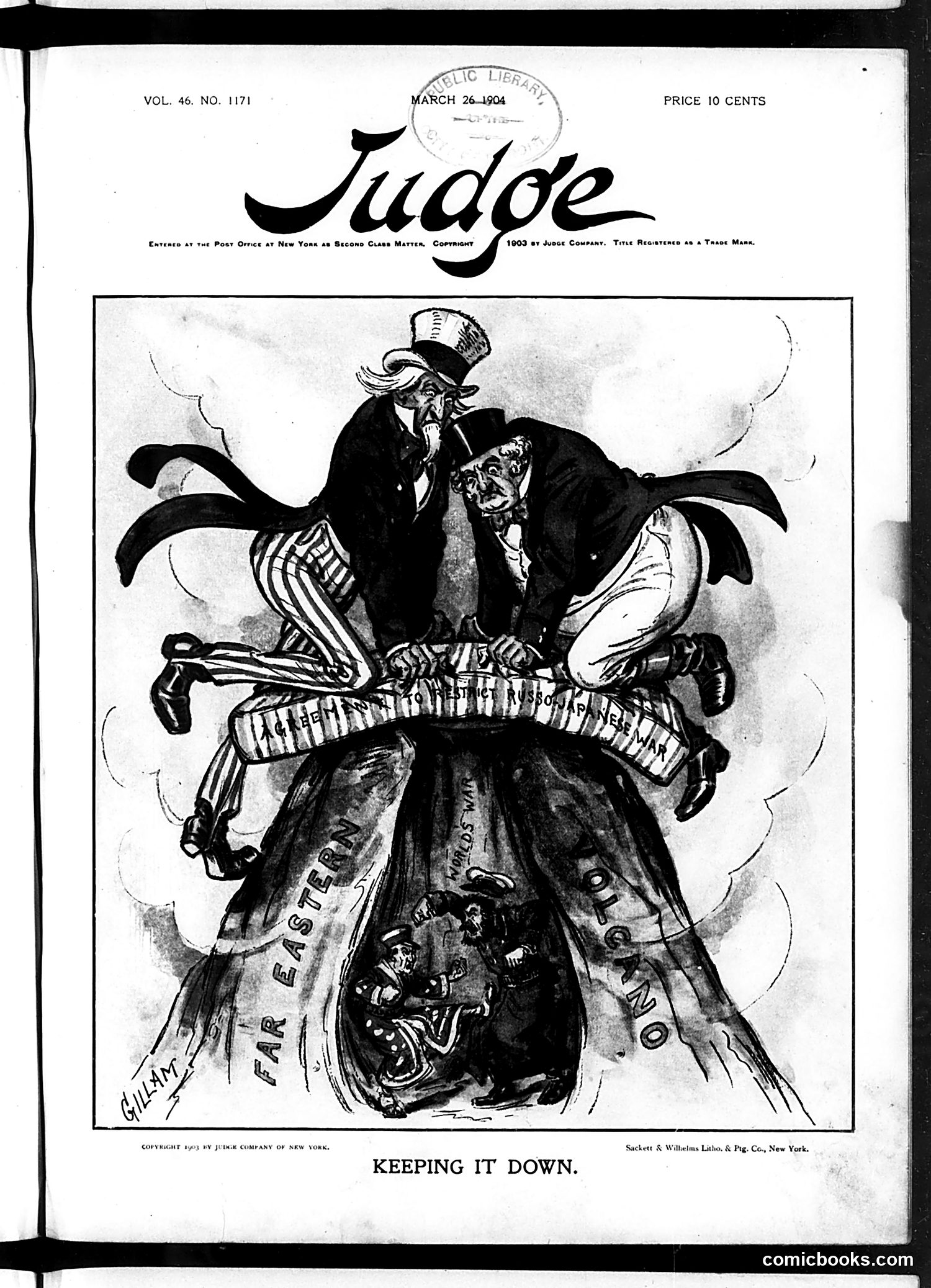
This political cartoon depicts Uncle Sam (the bearded figure in the tall hat) struggling to restrain a writhing, demonic creature labeled "FAR EASTERN TROUBLE" while seated atop what appears to be Japan and other regional conflicts. The figure's strained posture suggests difficulty maintaining control. The satire addresses U.S. foreign policy challenges in East Asia following the Russo-Japanese War (1904-1905), which had recently erupted. The "Far Eastern Trouble" represents the regional instability and American concerns about maintaining influence in China and Japan while managing imperial rivalries. The cartoon mocks the difficulty of U.S. diplomatic efforts to "keep down" or suppress escalating conflicts in that volatile region during the early 20th century.
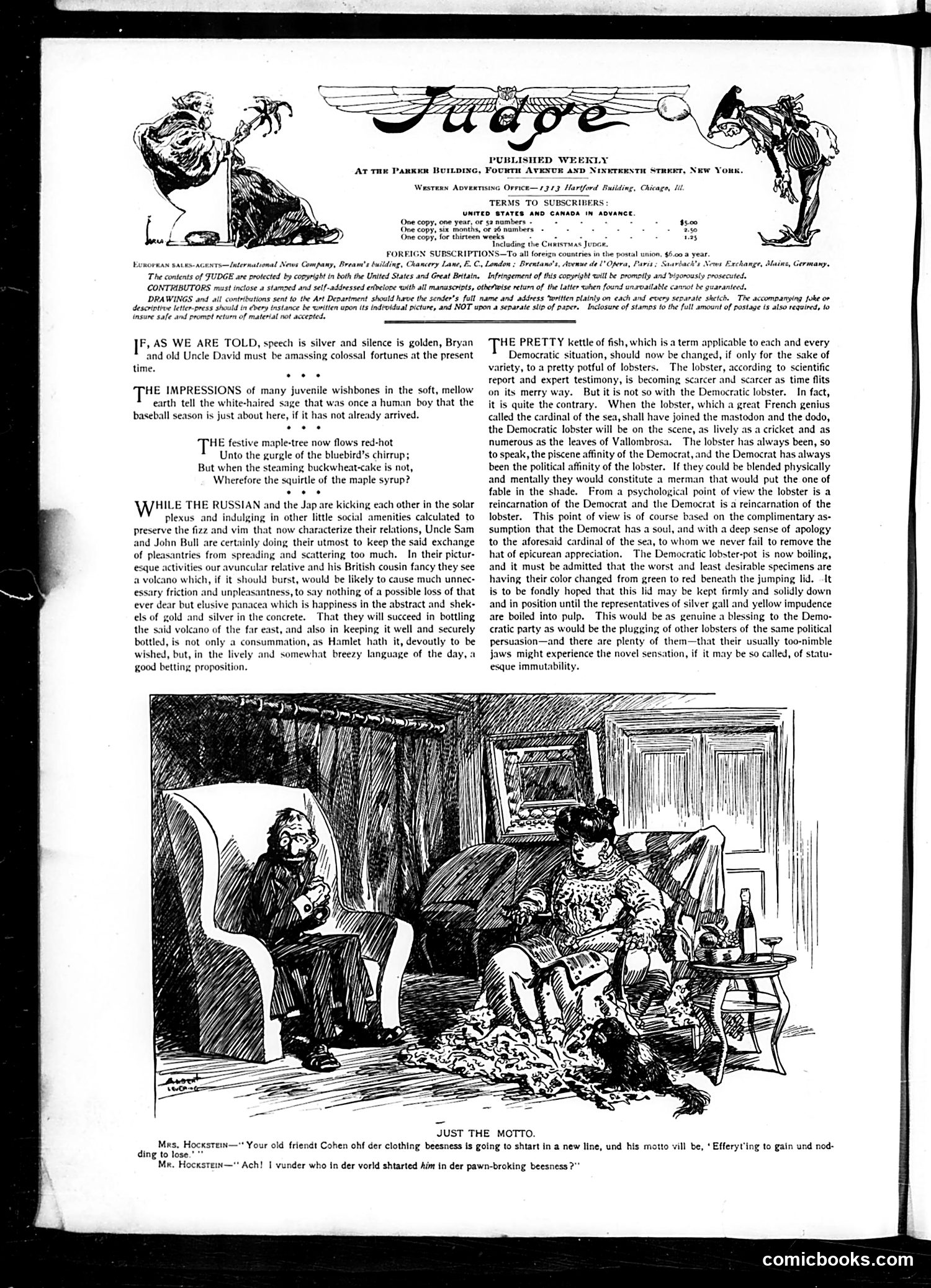
This page contains political commentary and a cartoon titled "Just the Motto." The main cartoon depicts two wealthy Jewish men (identifiable by stereotypical caricature conventions of the era) discussing business matters in an ornate interior. The caption references Cohen's clothing business starting "a new line" with the motto of "Efforting to gain and nodding to lose." The satire targets Jewish merchants, using ethnic stereotypes common to turn-of-the-century American humor. The "motto" joke appears to mock Jewish business practices through exaggerated physical characterization—the notion of perpetual effort paired with dismissive gestures toward losses. The surrounding text discusses political matters, including references to Democratic and Republican positions, though specific events remain unclear from this excerpt alone.
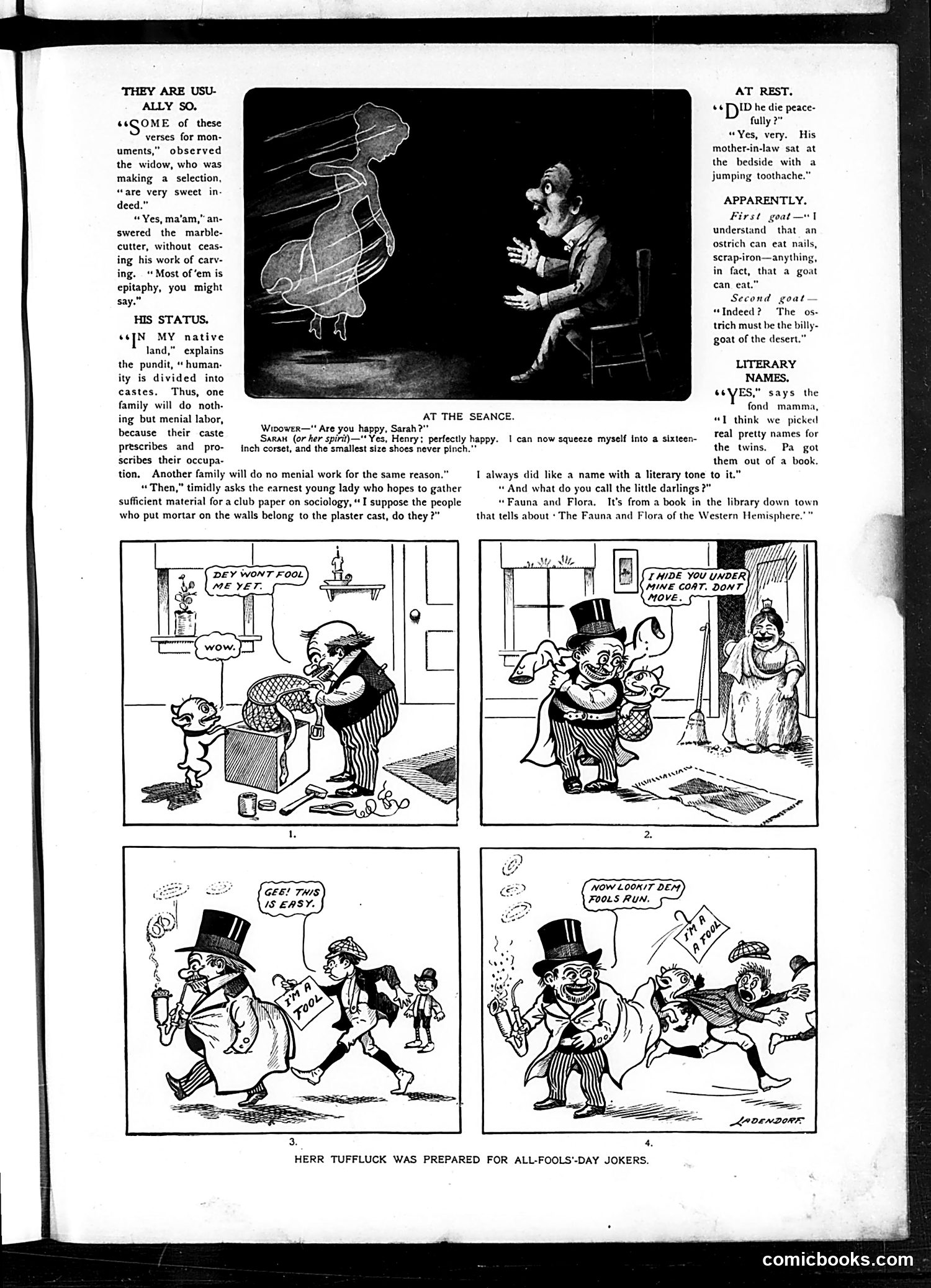
This page from *Judge* magazine contains satirical commentary presented through several formats: **Upper section:** Discussion of memorial verses and social class divisions, with anecdotes about naming practices ("Fauna and Flora"). **Comic strip (panels 1-4):** Depicts "Herr Tuffluck" as an April Fools' Day figure, likely a German caricature (suggested by the name and top-hat styling). The sequential panels show him engaging in pranks and foolish behavior with children and other characters—the joke being that he's "prepared" to be tricked by fools on April 1st. The overall tone reflects early 20th-century American humor targeting European stereotypes and mocking foolishness, with the Tuffluck character appearing designed for broad comedic effect rather than specific political satire.
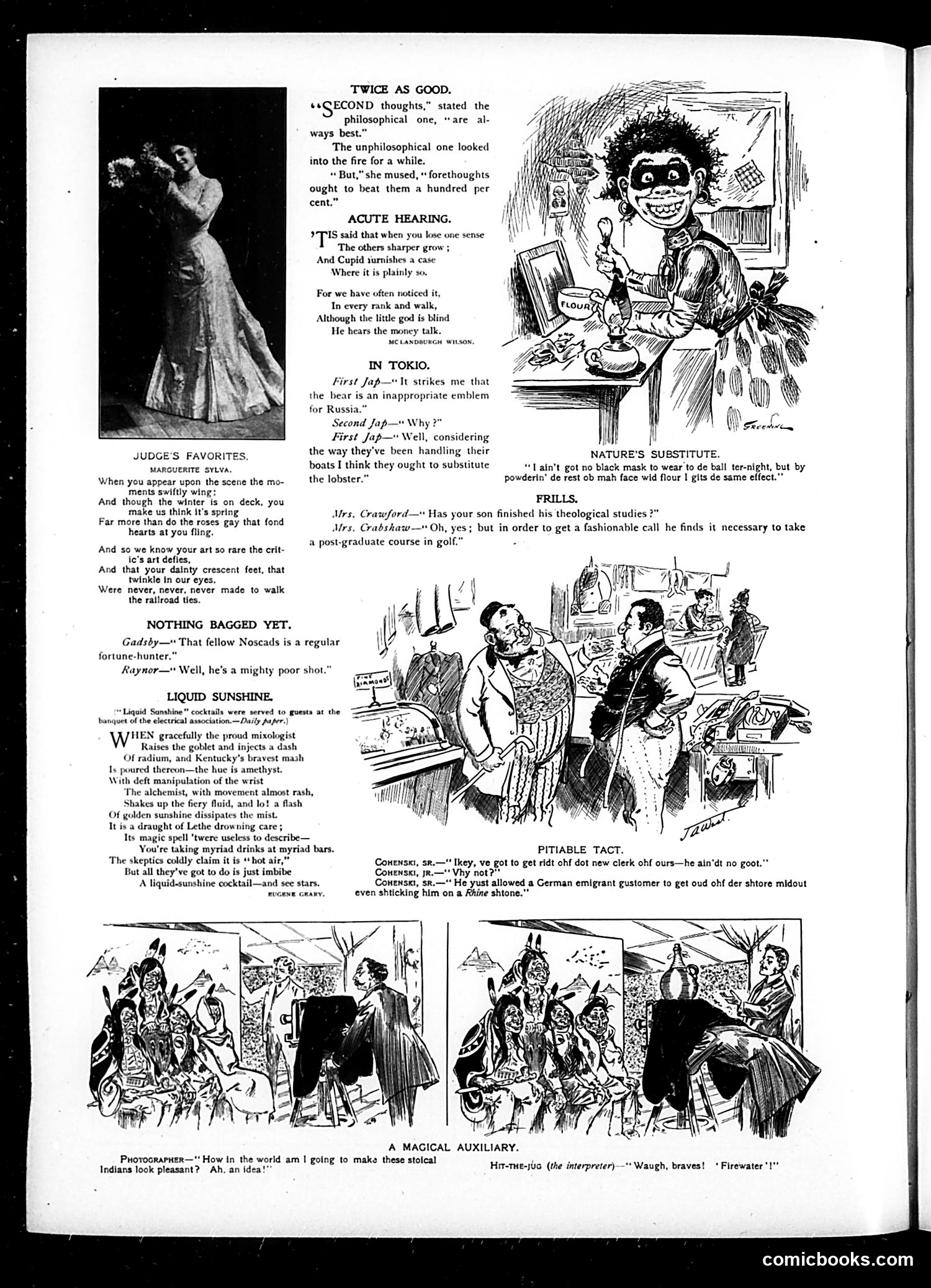
This page contains several unrelated humorous sketches and poems typical of Judge's satirical format: **"Twice as Good"** satirizes philosophical pretension through a dialogue between two women debating whether "second thoughts are always better." **"Acute Hearing"** is a poem about how losing one sense sharpens others, illustrated with a figure at a table. **"In Tokio"** jokes about Russia using a bear as its national emblem, questioning the appropriateness of this choice. **"Nothing Bagged Yet"** mocks fortune-hunting through a brief exchange about a poor fortune-seeker. **"Liquid Sunshine"** celebrates cocktails served at electrical association banquets, describing an alchemical transformation of various spirits. The remaining sketches show domestic or professional scenes with accompanying humorous captions about German emigrant customers and Native American photography. These are general-interest humor pieces rather than targeted political satire.
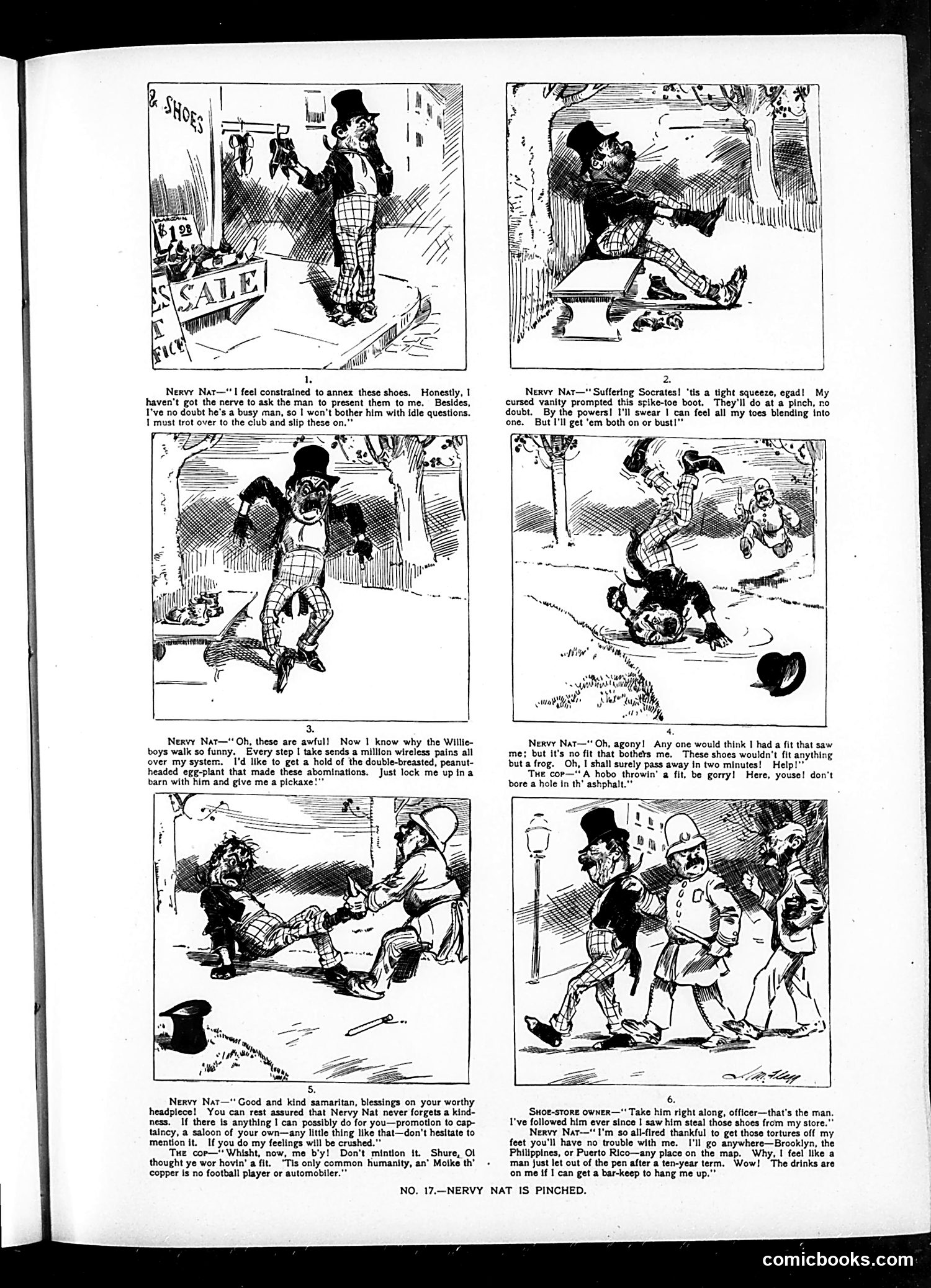
This comic strip follows a character ("Nervy Nat") who steals a pair of fashionable spike-toe boots from a shoe store. The humor derives from his escalating physical suffering as the ill-fitting shoes torment him through a series of escalating mishaps—he can barely walk, experiences shooting pains, and appears to have a public breakdown on the street. The satire targets vanity and fashion obsession: Nat prioritizes stylish appearance over comfort and propriety, committing theft to acquire trendy footwear he cannot afford. A sympathetic cop helps him, but ultimately the shoe-store owner has him arrested ("pinched" = arrested in period slang), revealing Nat's crime. The comic mocks both foolish fashion victims and the era's wireless technology (mentioned as "wireless pains"), suggesting modern conveniences were equally absurd. The Irish-accented cop provides comic relief typical of early 20th-century American humor.
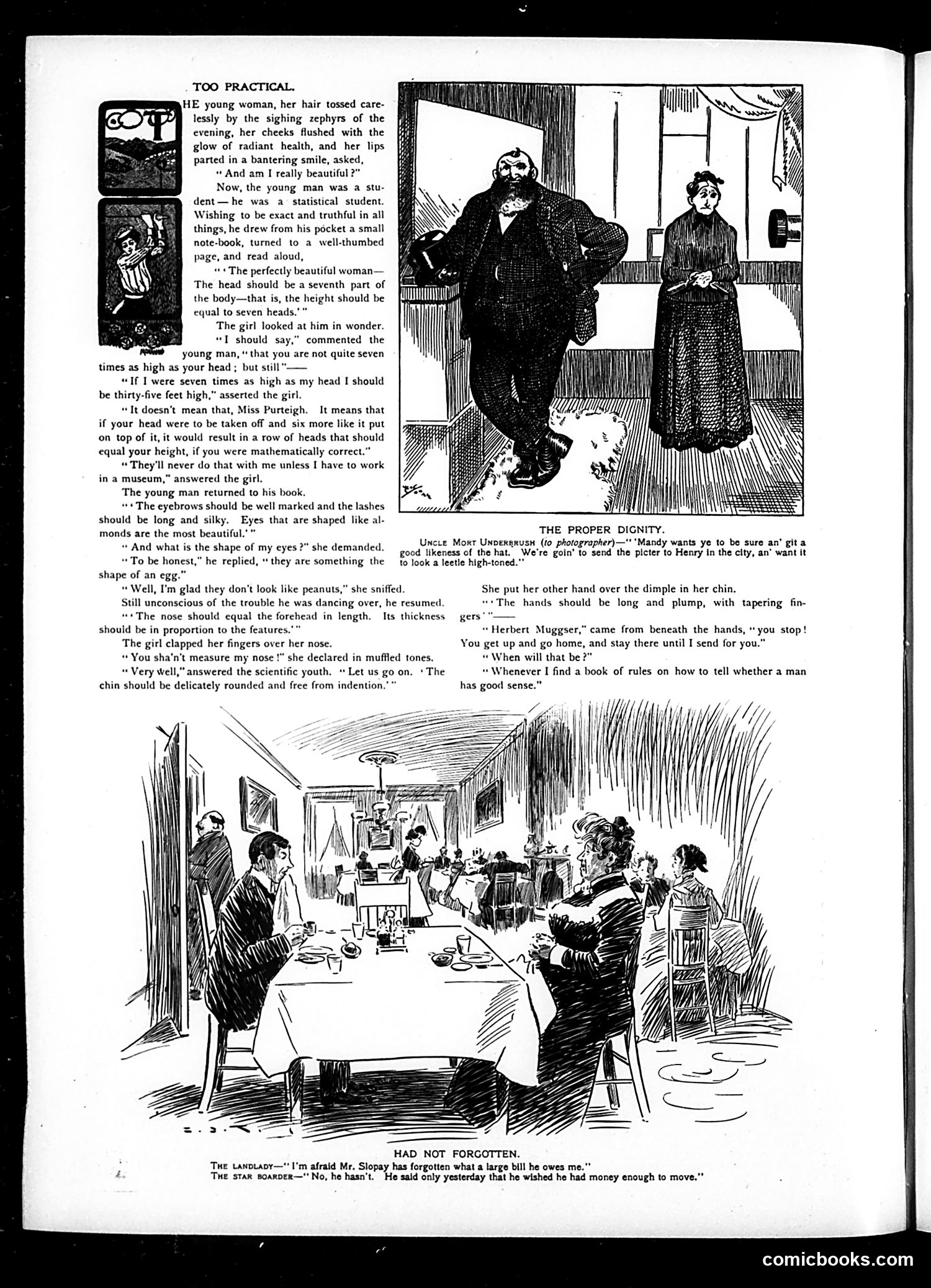
This page contains two separate comedic pieces satirizing Victorian-era courtship and social pretension. **Top story ("Too Practical"):** A young statistical student attempts to woo a woman by reading from a notebook containing mathematical formulas for "perfect beauty" — proportions like the head being one-seventh of body height, egg-shaped eyes, and specific nose-to-forehead ratios. The woman responds with practical mockery, rejecting his pedantic approach. The satire mocks both scientific reductionism applied to human beauty and the young man's complete lack of social awareness or romantic charm. His statistical earnestness kills any romance. **Bottom cartoons:** Two brief jokes about financial embarrassment and pretension — one about a photographer ensuring a hat looks "high-toned" for a city relative, and another about a tenant owing rent who hopes to move away rather than pay. The overall theme: Victorian pretension and impracticality meet reality's harsh demands.
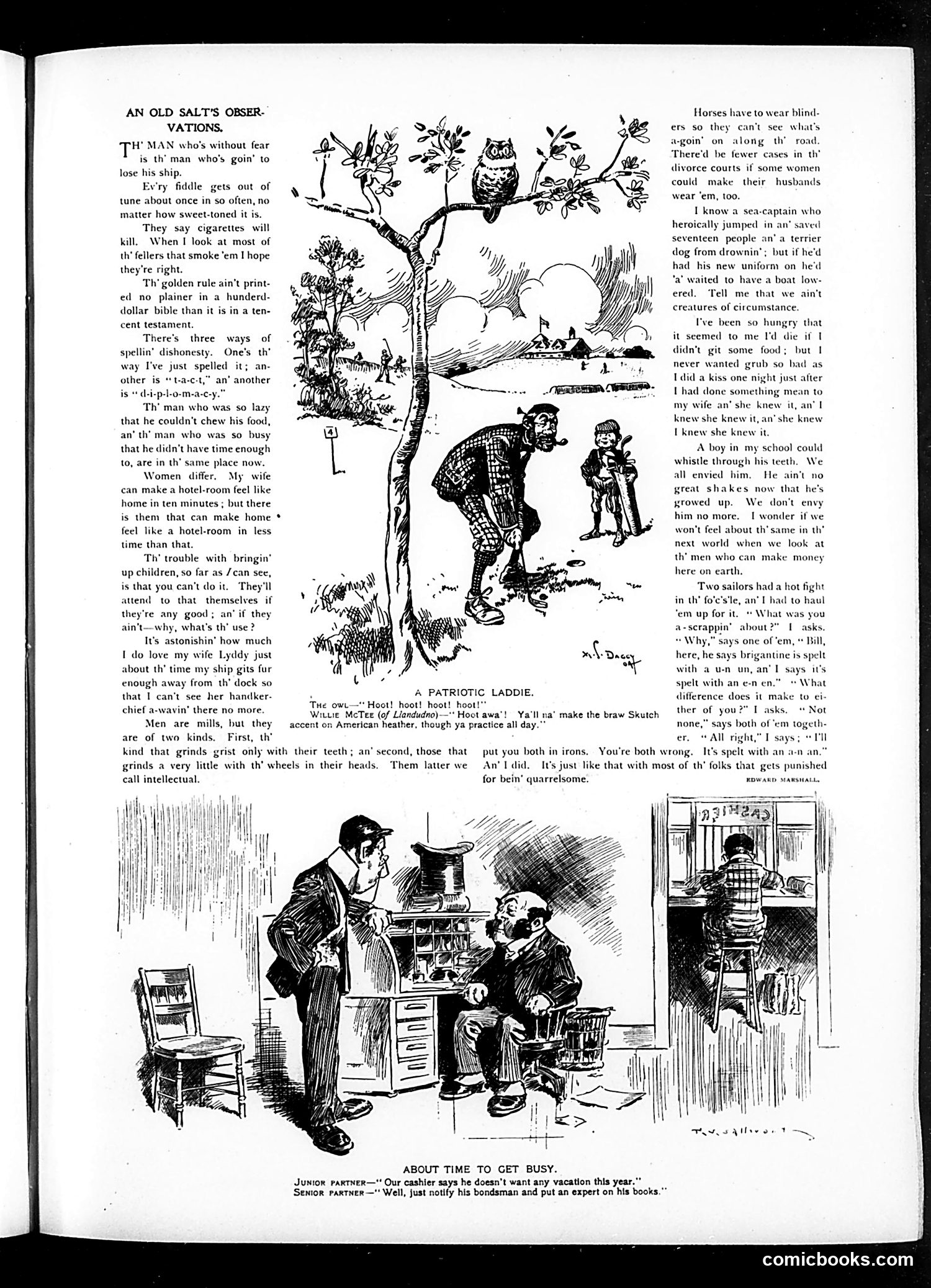
This page contains humorous commentary and cartoons typical of early 20th-century American satirical journalism. **"An Old Salt's Observations"** presents a seafarer's cynical wisdom about human nature—covering topics from cowardice, smoking, morality, laziness, marriage dynamics, and child-rearing. The observations are folksy and misanthropic, offering no particular political target. **"A Patriotic Laddie"** cartoon depicts two Scottish boys arguing over spelling ("brigantine" vs. "brigantin"), with the caption suggesting their quarrel is pointless—a gentle jab at pedantry and Scottish accents. **"About Time to Get Busy"** presents a business joke: a senior partner advises notifying the cashier's bondsman and hiring a financial auditor because the cashier refuses vacation—implying suspicion of embezzlement or financial misconduct during his absence. None of these items target specific political figures or events. The page reflects period attitudes toward gender relations, national stereotypes, and business humor rather than contemporary political satire.
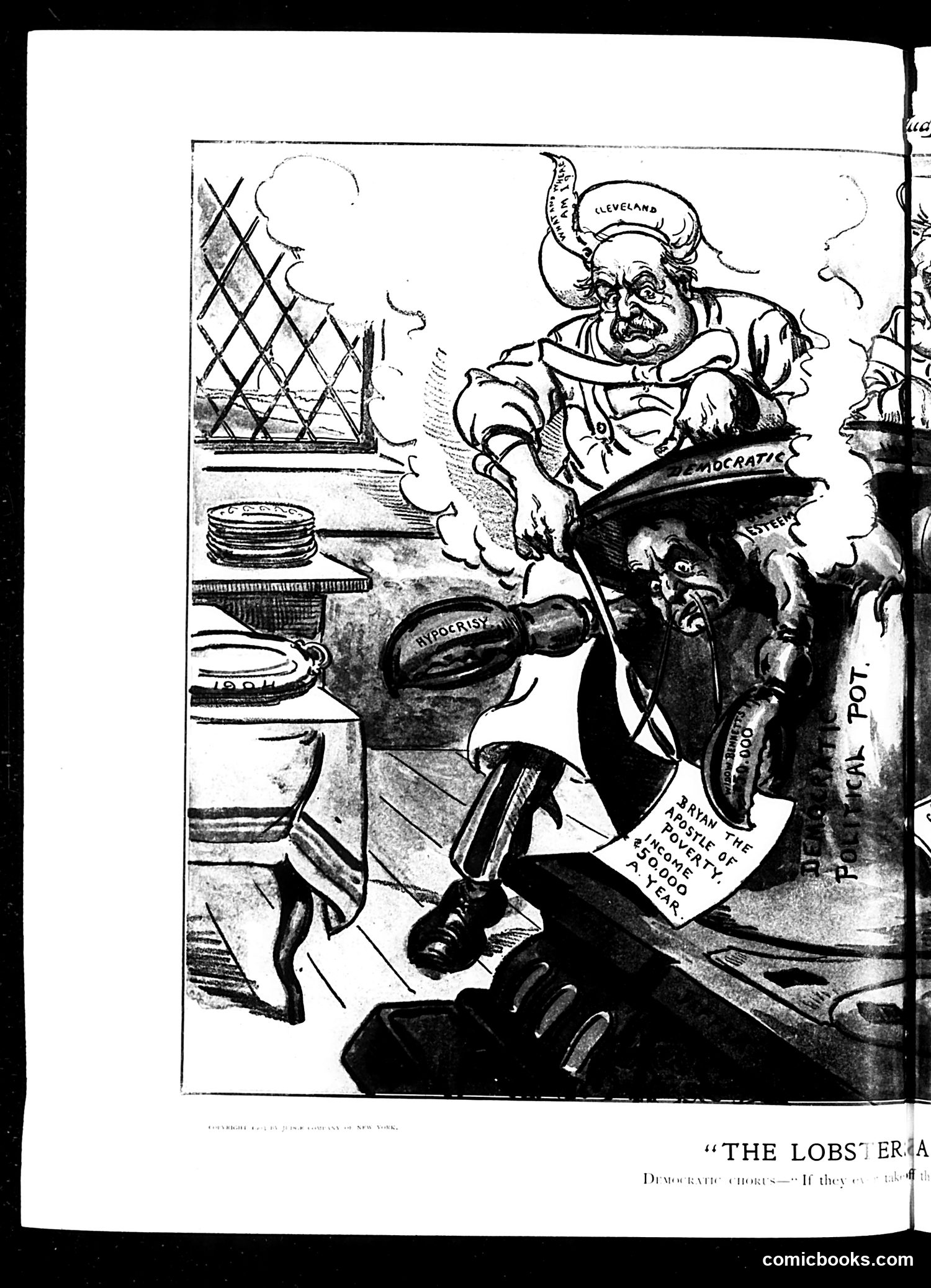
This Judge magazine cartoon satirizes political corruption, specifically targeting what appears to be Democratic Party bosses or "lobbyists" (the "lobs" of the title). The caricatured figure labeled "Cleveland" wears horns and represents a devil-like political operator. He's depicted in an office setting with papers labeled "Democracy" and "Hypocrisy," suggesting the corruption of democratic principles. The cartoon critiques how political bosses manipulate and control the democratic process for personal gain. The demonic imagery emphasizes the moral corruption of politics during this era. The specific reference to "Democratic Chores" in the caption suggests this targets Democratic Party machine politics, though the exact historical moment remains unclear without additional dating or context.
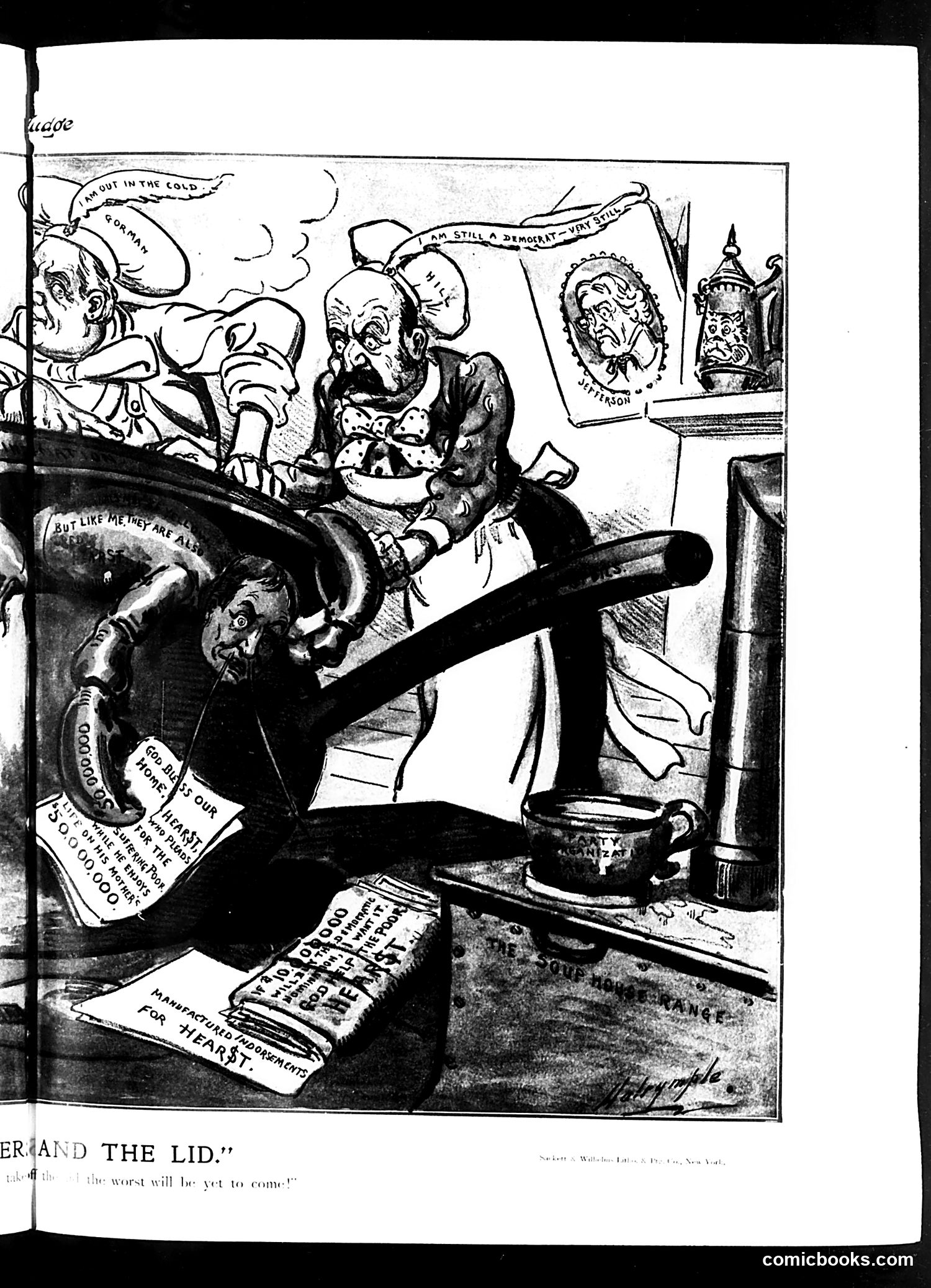
This political cartoon satirizes the opening of a metaphorical "Pandora's box" of troubles. A demonic or mischievous figure operates a large cannon or pipe labeled with references to "Woodrow" (likely President Wilson) and various social ills. The cannon shoots destructive force toward figures on the right, including what appears to be caricatured political opponents or representatives of different factions. The title references the Greek myth where opening Pandora's box releases all evils into the world. The cartoon warns that certain political actions will unleash uncontrollable consequences. The character saying "the worst will be yet to come" emphasizes this ominous prophecy about escalating chaos from the opened "lid." The exact political context remains unclear without dating information, but this appears to critique Wilson-era policies or decisions perceived as dangerously destabilizing.
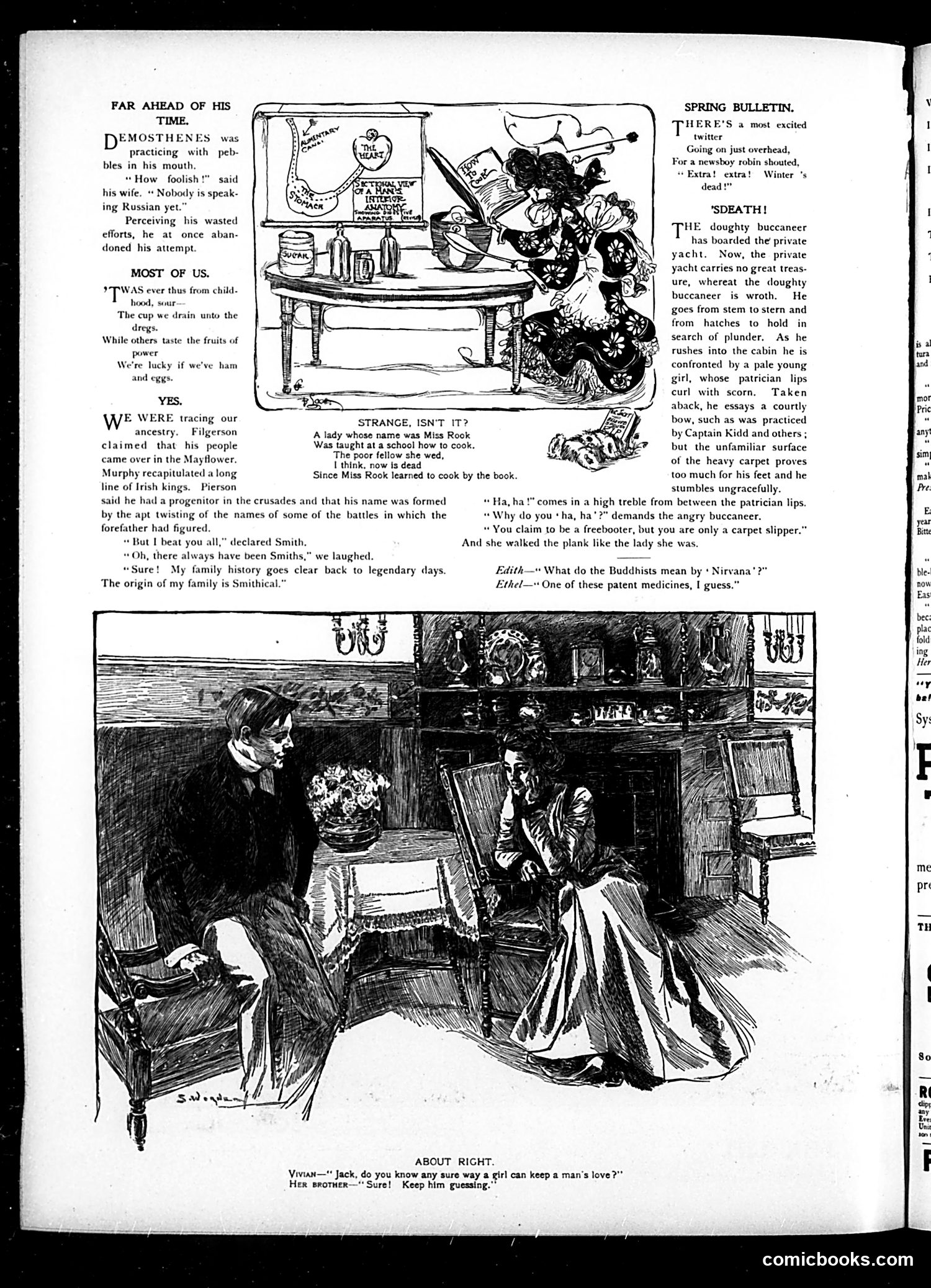
This page contains several brief satirical pieces typical of early 20th-century *Judge* magazine: **"Far Ahead of His Time"** mocks those pursuing pointless preparation—Demosthenes practiced rhetoric before Russian was even spoken, just as many waste effort on irrelevant skills. **"Most of Us"** and **"Yes"** present working-class complaints about ancestry obsession: while others boast lineage from the Mayflower or Crusades, ordinary people like "Smith" get nothing. The joke's that "Smithical" (made-up word) ironically claims legendary origins for the most common name. **"Strange, Isn't It?"** is a dark joke: a woman taught cooking "by the book" apparently poisoned her husband. **"Spring Bulletin"** and **"'Sdeath"** are lighter: birds announce winter's end; a clumsy pirate gets mocked for slipping on carpet. **"About Right"** offers cynical relationship advice: keep a man guessing rather than committing. The tone throughout is misogynistic and class-conscious, typical of the era's satirical magazines.
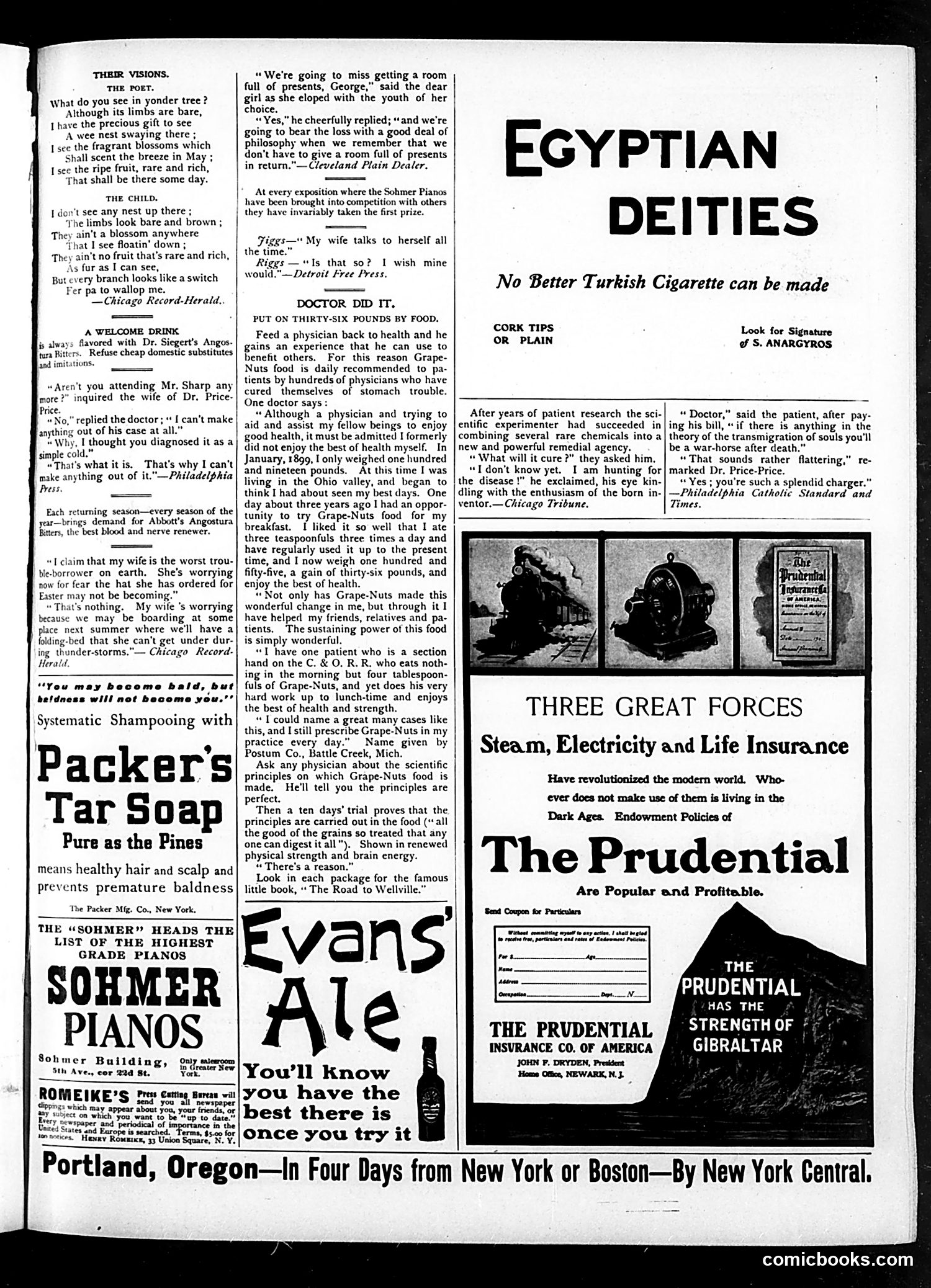
This appears to be a two-part cartoon contrasting romantic idealism with practical reality. **The Poet** sees a bare tree and envisions future blossoms and fruit—imagining potential beauty and abundance. **The Child** looks at the same tree and sees only bare branches that resemble a switch for spanking—viewing it through the lens of immediate, practical (and painful) experience. The satire mocks poetic sentimentality by juxtaposing it with a child's blunt, pragmatic perspective. Where the poet romanticizes nature's promise, the child sees only what's currently present and what threatens him personally. The joke suggests that poetry obscures reality rather than illuminating it—a criticism of the Romantic literary tradition popular in Judge magazine's era, favoring instead the magazine's characteristic skeptical realism.
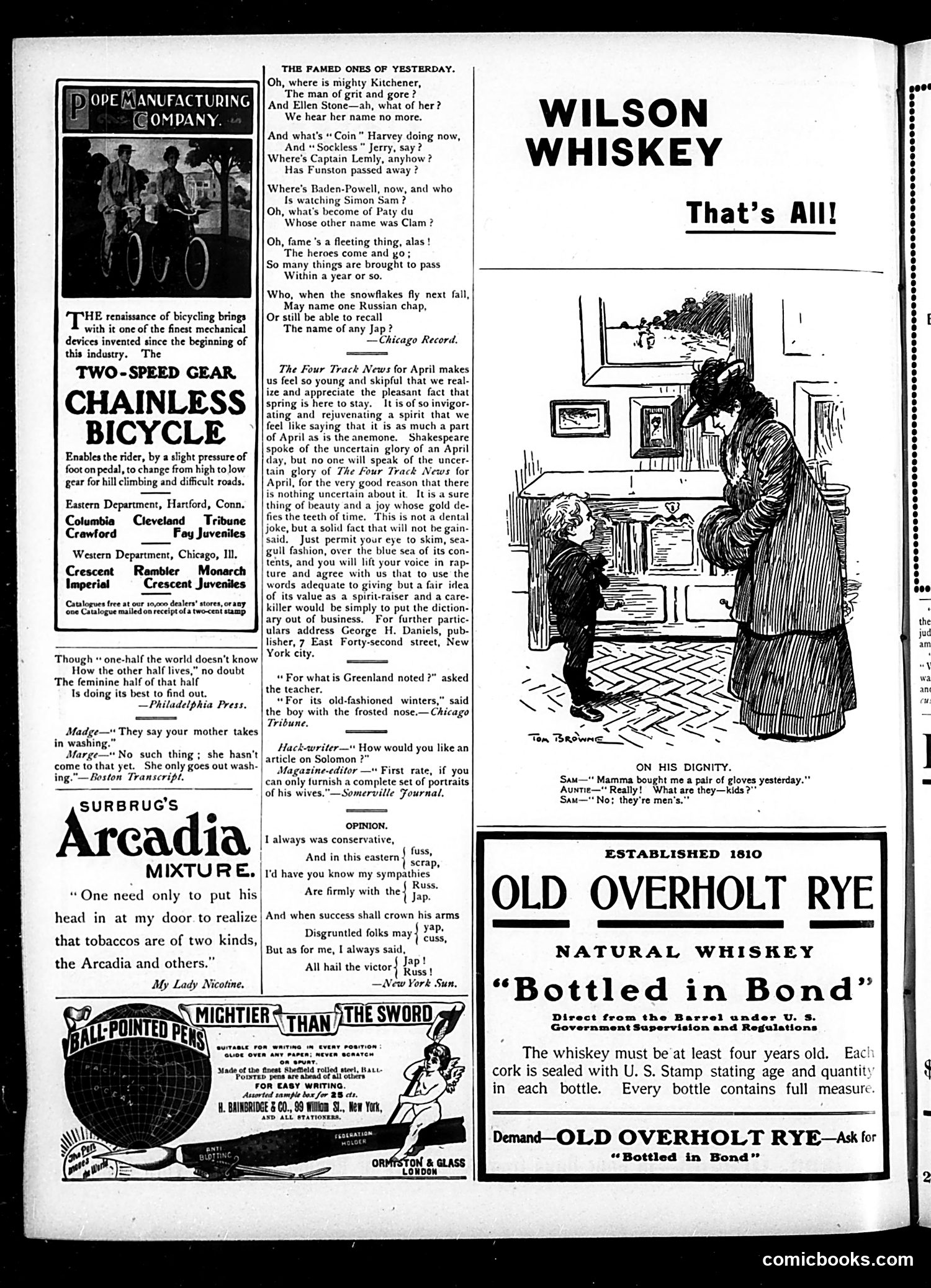
This page's main satirical content is the poem "The Famed Ones of Yesterday," which mocks the fleeting nature of celebrity and public attention. It lists figures who dominated headlines in the late 1890s/early 1900s but have since faded from public consciousness: - **Kitchener** (British military commander in the Boer War) - **Ellen Stone** (American missionary famously ransomed from kidnappers in 1901) - **"Coin" Harvey** (populist political figure) - **"Sockless" Jerry** (appears to reference a contemporary politician, identity unclear) - **Baden-Powell** (British military figure) - **Russian and Japanese figures** (likely references to the Russo-Japanese War) The poem's joke: these once-celebrated names will be completely forgotten within a year or two. The satire targets both the public's short memory and the media's obsession with sensational, temporary heroes rather than enduring significance. The rest of the page contains period advertising (bicycles, whiskey, tobacco, pens) and light humor pieces unrelated to the satirical poem.
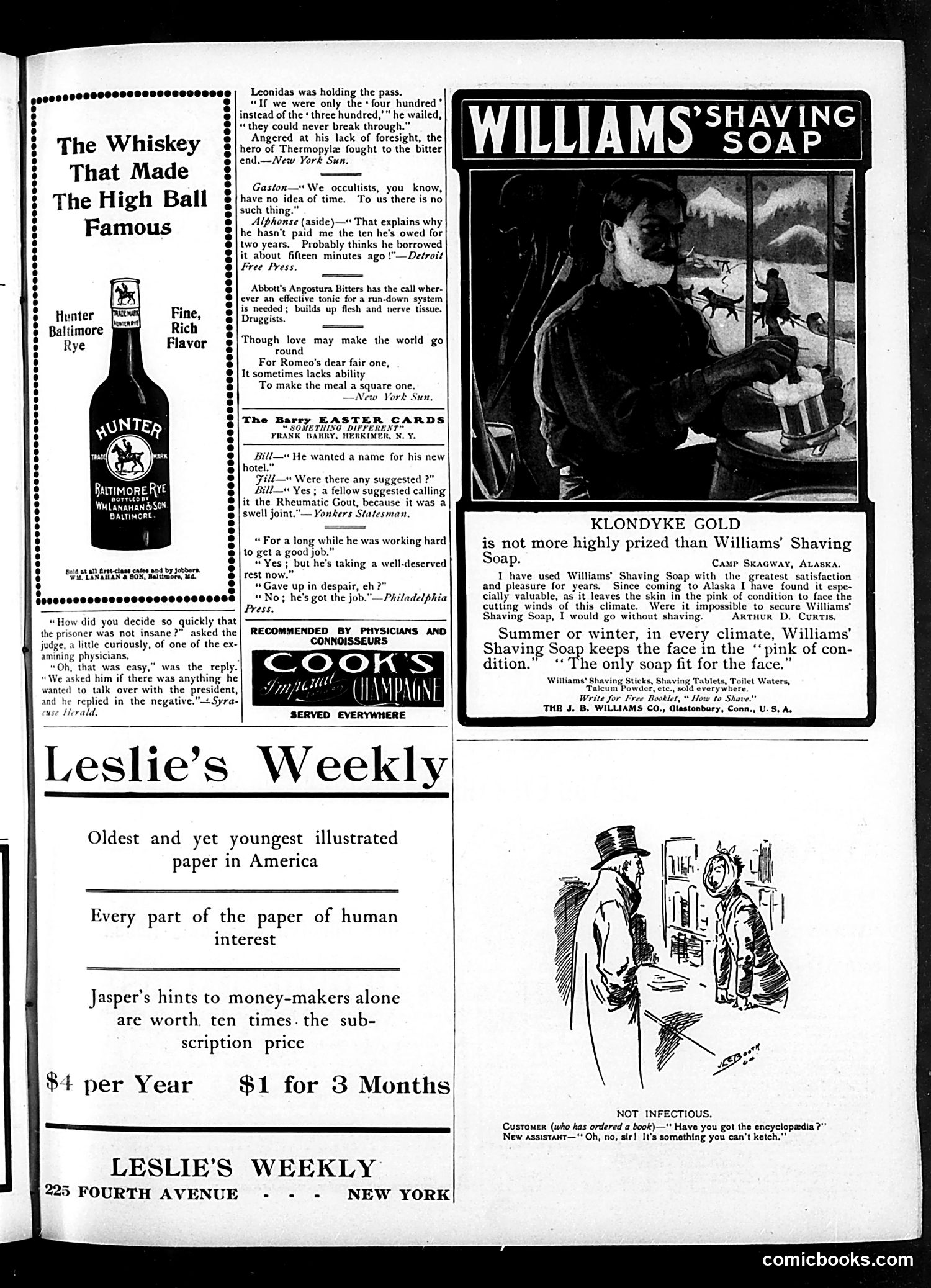
This is primarily an **advertising and humor page** from Judge magazine, not a political cartoon page. The content includes: **Humorous Short Jokes:** - A doctor's quip about diagnosing insanity: a patient is "sane" because he wouldn't discuss matters with the president—likely satirizing President Theodore Roosevelt's prominence in public discourse - Occultist jokes about poor timekeeping and debt - Puns about hotel names ("swell joint") and employment **Classical Reference Humor:** A brief piece mocks Leonidas at Thermopylae, lamenting they're the "three hundred" instead of the "four hundred"—satirizing wealthy New York "four hundred" (the social elite) by pretending military honor depends on exclusive social status. **Advertisements:** Hunter Baltimore Rye whiskey, Abbott's Angostura Bitters, Cook's Champagne, Williams' Shaving Soap, and Leslie's Weekly dominate the page. **The Bottom Cartoon:** Shows a bookstore exchange where an assistant tells a customer the encyclopedia is "something you can't ketch"—a mild wordplay joke. The page reflects early 20th-century advertising and light humor rather than substantive satire.
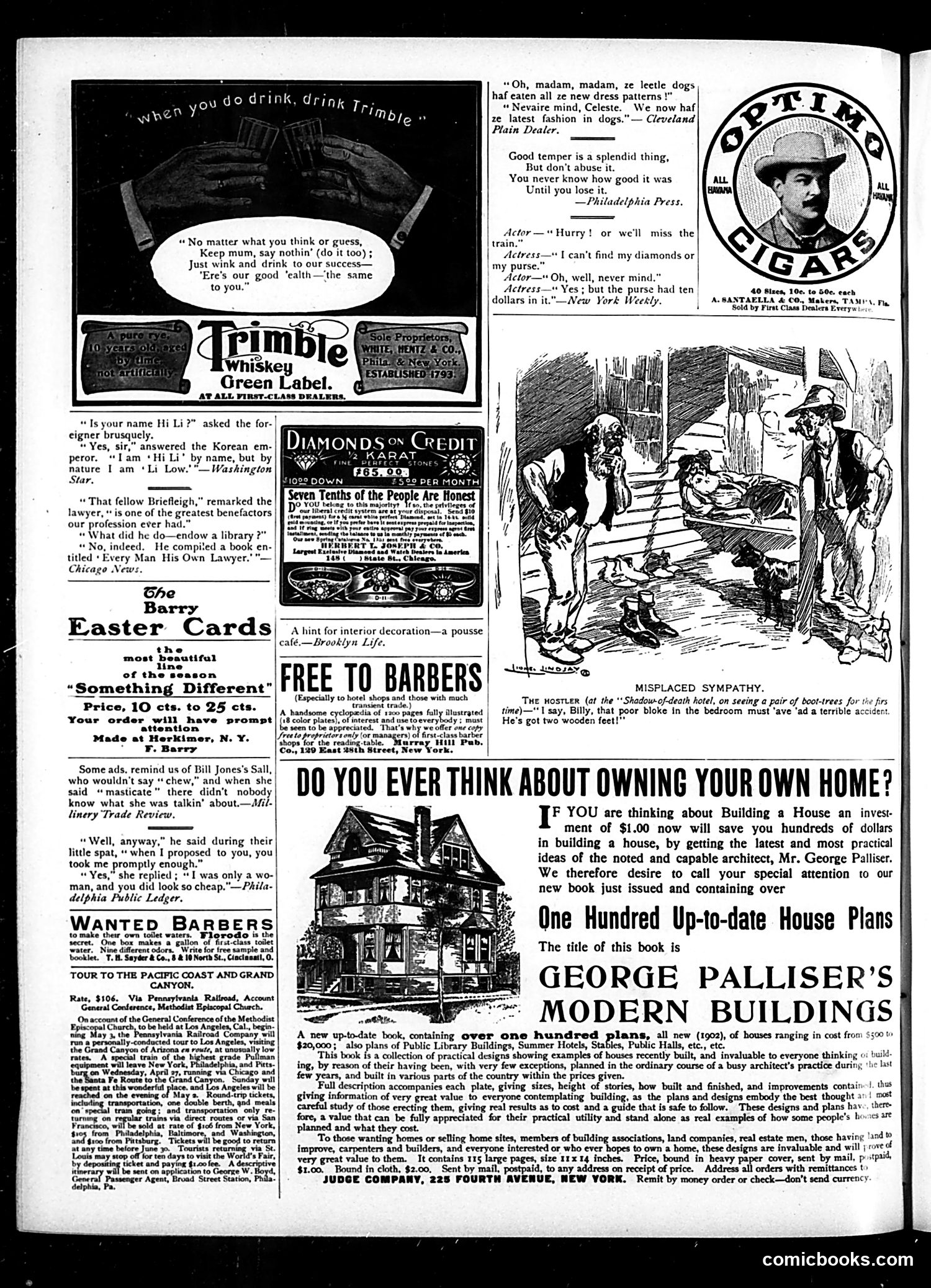
This page is primarily **advertising and filler content**, typical of early 20th-century satirical magazines. Notable elements: **The Humor/Satire:** The scattered jokes are light social comedy rather than political satire. Examples include wordplay about a Korean emperor named "Hi Li" and "Li Low," and a joke about a lawyer who compiled a book called "Every Man His Own Lawyer"—mocking both lawyers' complexity and DIY legal culture. **The Cartoons:** A small cartoon titled "Misplaced Sympathy" depicts a hostel worker mistaking boot-trees (shoe stretchers) for prosthetic wooden feet, showing period working-class humor based on misunderstanding. **Context for Modern Readers:** This reflects early 1900s advertising culture, with products like Trimble Whiskey and "diamonds on credit," plus a house-plan book advertisement—capturing consumer capitalism of that era. The tone is whimsical rather than biting political commentary. The page emphasizes that Judge, despite its satirical reputation, frequently ran conventional advertising and mild domestic humor.
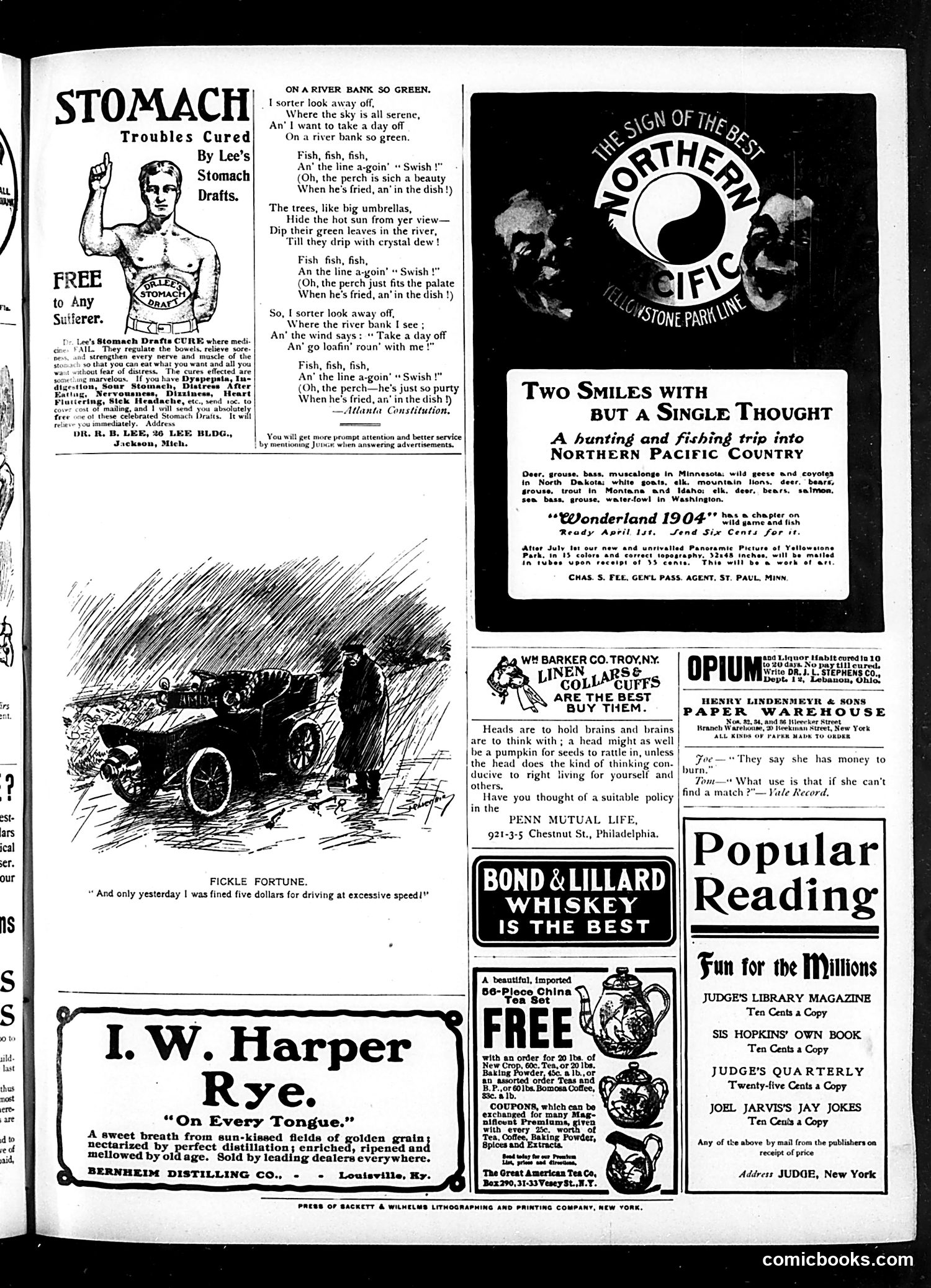
This page is primarily **advertising and filler content** rather than political satire. The dominant elements are commercial advertisements interspersed with light entertainment. **Main content:** The left side features "On a River Bank So Green," a sentimental poem about fishing and leisure, paired with Dr. Lee's stomach remedy advertisement—a common patent medicine pitch of the era promising cures for dyspepsia and digestive complaints. Below is a cartoon captioned "Fickle Fortune" showing a man in a car stopped by police, complaining he was fined yesterday for speeding. This is mild social commentary about traffic enforcement, not political satire. **The right side** contains travel advertisements (Northern Pacific Railway), product ads (whiskey, tea, paper goods, opium), and promotions for Judge's sister publications. The page reflects early 1900s magazine culture: nostalgic Americana mixed with aggressive patent medicine marketing and period product endorsements (including opium, which was legal then). There's no identifiable political cartoon or significant satirical content here.
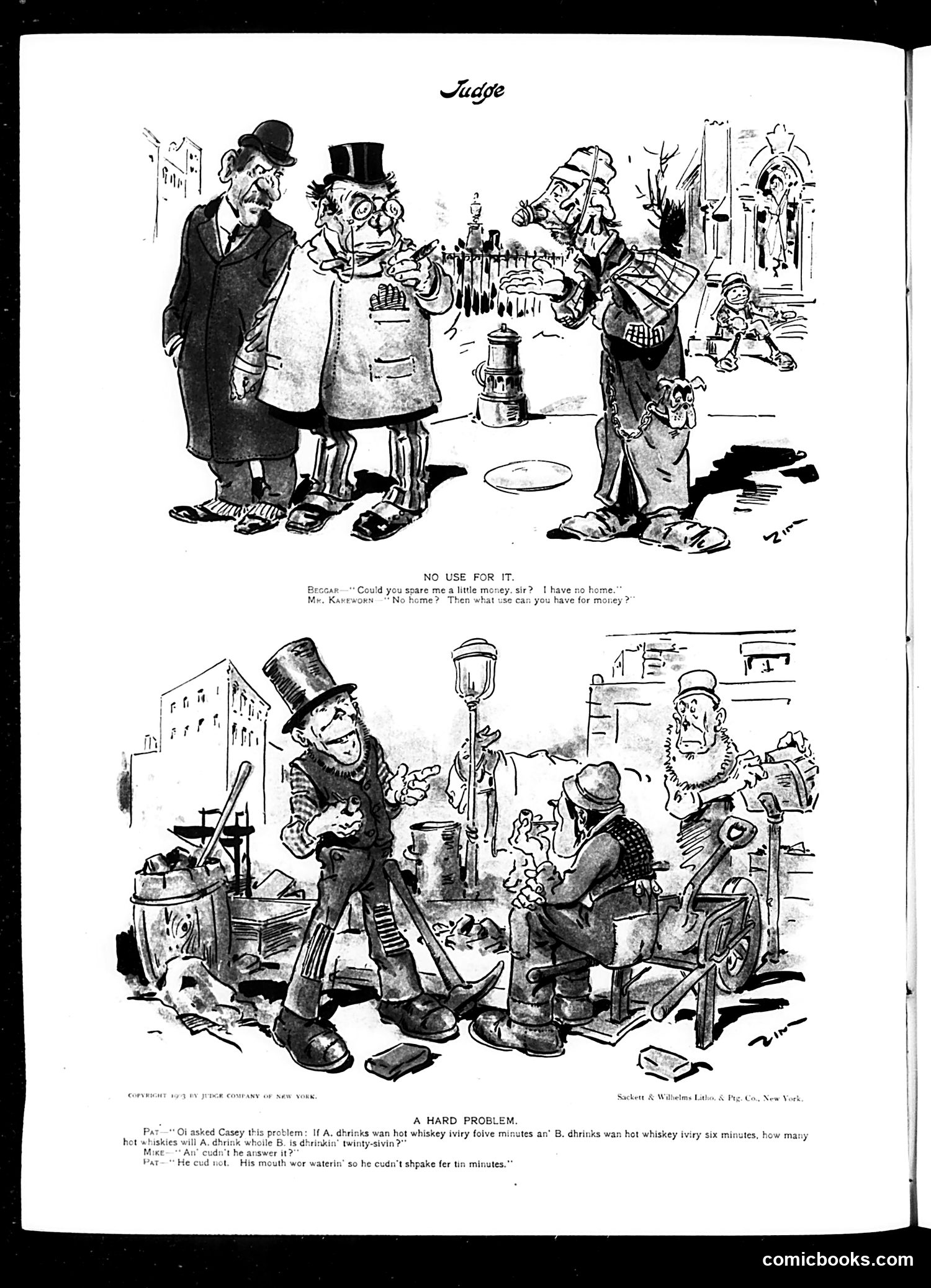
This Judge magazine page contains two satirical cartoons about poverty and immigrant life in early 20th-century America. **"No Use for It"** mocks wealthy indifference to homelessness. A well-dressed man (labeled "Kameradem," likely a German immigrant stereotype) dismissively tells a beggar that homelessness makes money pointless—ignoring that money buys food and shelter. The satire targets the rich man's callous logic. **"A Hard Problem"** presents a drunk-logic math puzzle where Irish immigrants (identifiable by dialect and stereotypical features) attempt an impossible riddle about whiskey consumption timing, culminating in absurdist humor about being too intoxicated to speak. Both cartoons employ ethnic stereotypes common to Judge's era, satirizing immigrant poverty, alcoholism, and their perceived incompetence—reflecting period attitudes toward working-class and immigrant communities that would be considered offensive today.