
A complete issue · 18 pages · 1904
Judge — January 23, 1904
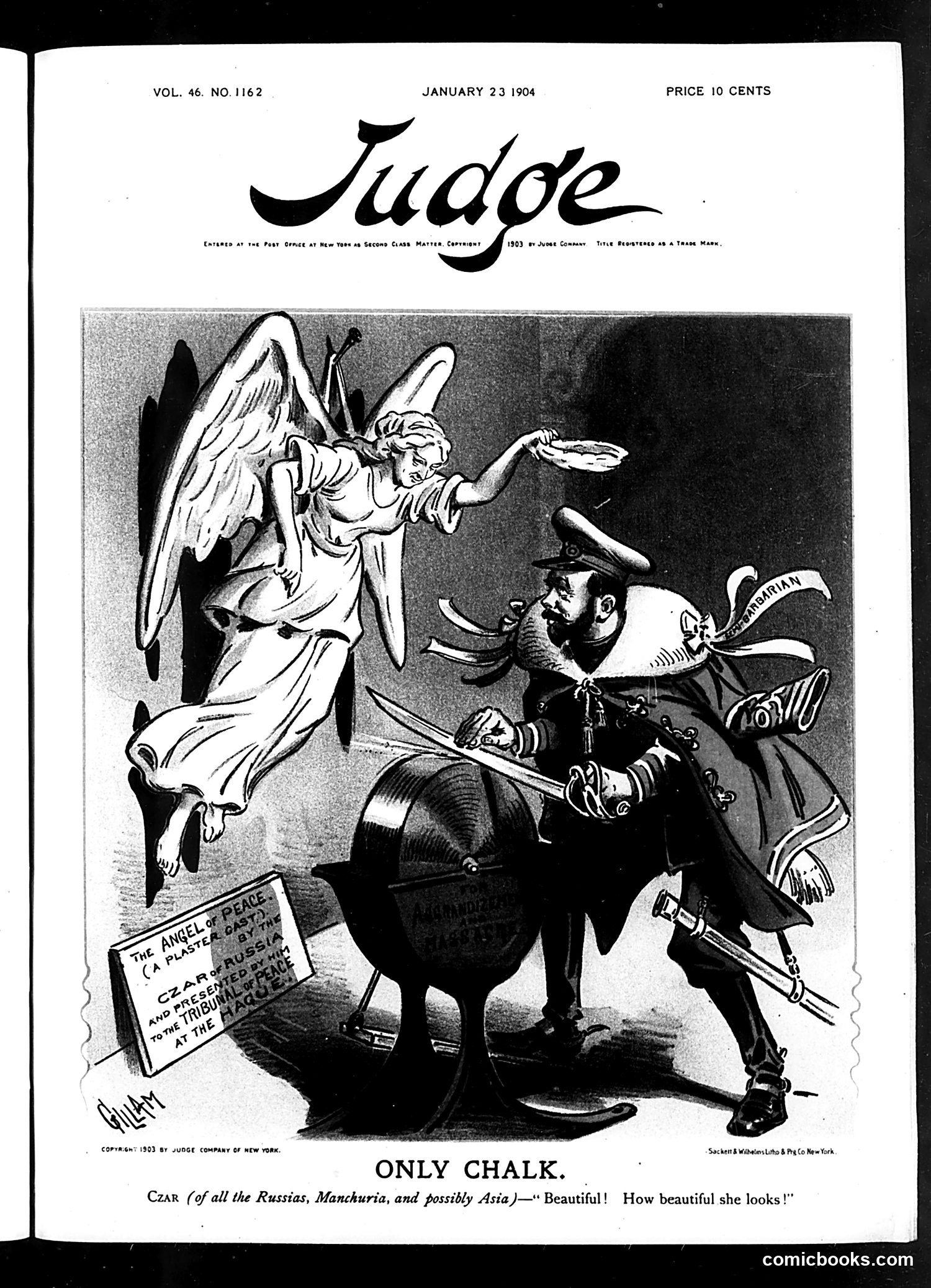
This political cartoon satirizes the Czar of Russia during the Russo-Japanese War. An angel of peace descends toward the Czar, offering a peaceful resolution. The Czar, depicted as a military figure, dismisses this peaceful overture. The title "Only Chalk" suggests the angel's peace offering is merely symbolic—insubstantial and easily erasable, like chalk drawings. The placard references "The Anglo-Japanese Alliance" and "Czar of all the Russias, Manchuria, and possibly Asia," mocking the Czar's imperial ambitions in Asia. The satire criticizes the Czar for ignoring peace efforts and continuing aggressive military expansion despite mounting losses in the war with Japan. The cartoon presents him as militaristic and impervious to diplomatic solutions.
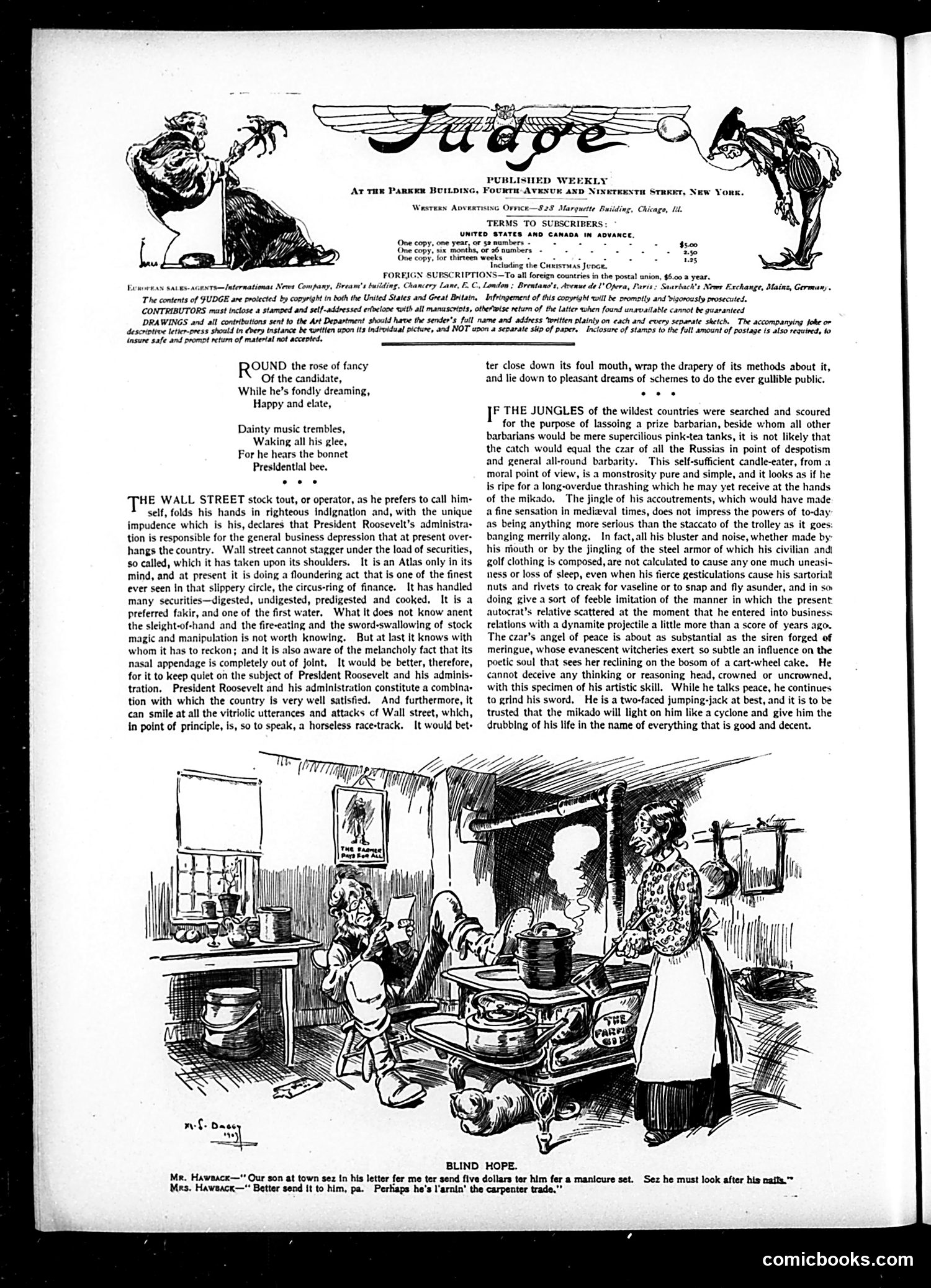
This page contains two distinct pieces: **Upper Section:** A lengthy prose article titled "The Wall Street Stock Tout, or Speculator" criticizes a financial operator who manipulates stock markets and exploits public trust. The piece satirizes Wall Street's influence over President Roosevelt's administration, suggesting the financial sector bears responsibility for the current business depression. It portrays the stock speculator as fundamentally parasitic and morally corrupt. **Lower Cartoon:** Titled "Blind Hope," this domestic scene depicts a mother asking her son to request five dollars from his father "for a manicure set," while the father apparently works as a carpenter. The satire targets economic desperation during hard times—the mother's transparent deception suggests families grasping at dignity despite financial struggle. Both pieces critique economic inequality and desperation of the era.
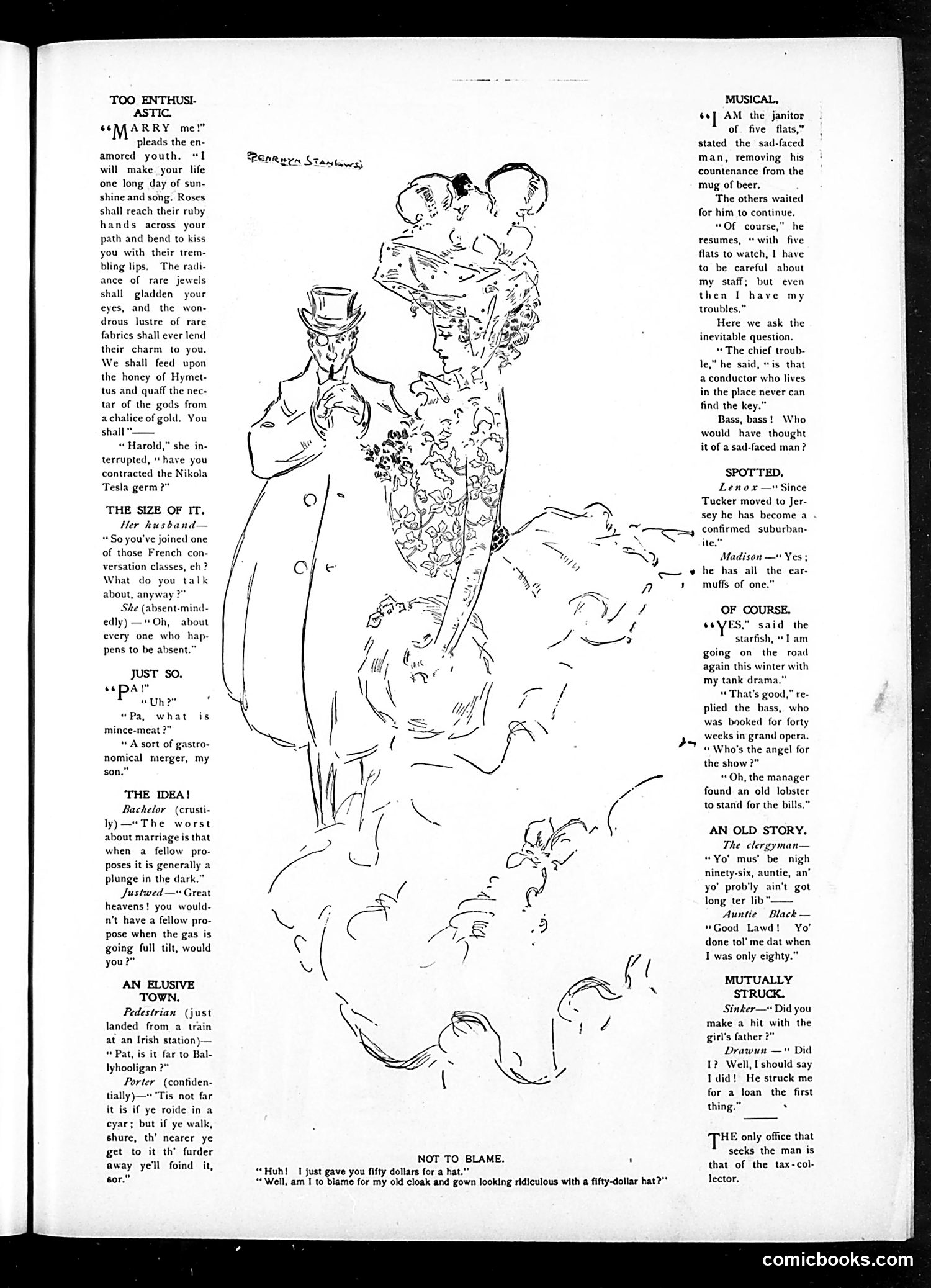
This page contains humor columns and a central cartoon titled "NOT TO BLAME," depicting a portly gentleman in formal dress (top hat and coat) with various objects and creatures emerging from his body—suggesting internal chaos or moral corruption. The caption reads: "Hah! I just gave you fifty dollars for a hat!" / "Well, am I to blame for my old cloak and gown looking ridiculous with a fifty-dollar hat?" The joke satirizes wealthy vanity and conspicuous consumption—a man purchases an expensive hat but wears worn clothing, then shifts blame externally rather than acknowledging his own foolish priorities. This reflects Gilded Age anxieties about nouveau-riche pretension and misplaced values among the aspiring wealthy class. The surrounding text consists of unrelated humorous sketches and comic dialogues typical of Judge's satirical format.
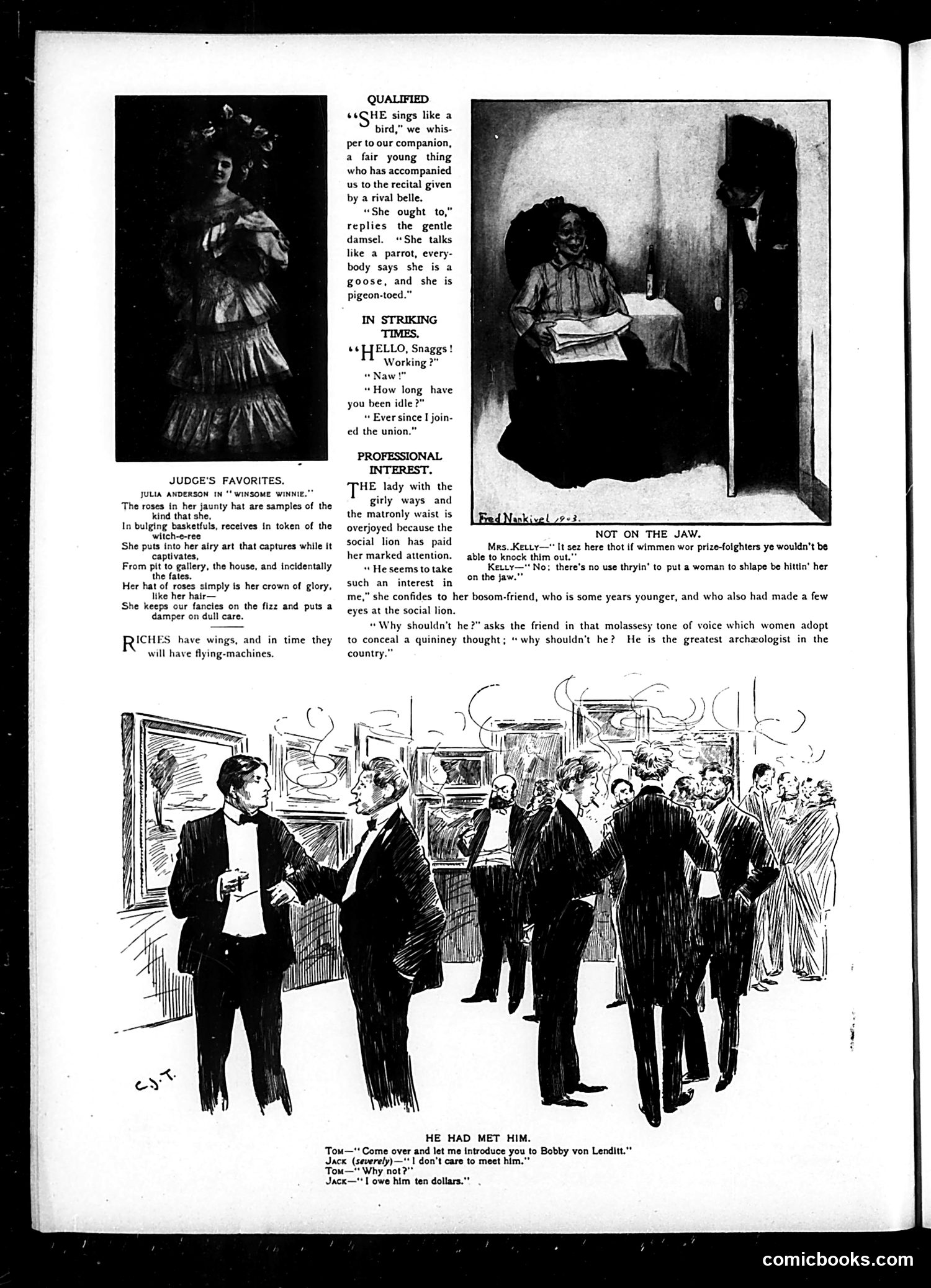
This page contains theatrical/entertainment criticism rather than political satire. The top sections critique performers—particularly Julia Anderson in "Winsome Winnie"—using period-typical gendered language ("her dainty hat," observations about her appearance and voice). The main cartoon at bottom depicts an art gallery opening or social event. The dialogue references "Bobby von Lenditt," whom Jack apparently owes money to ("ten dollars"). Tom tries to introduce them, but Jack declines, suggesting social embarrassment over a debt. The satire targets **social pretense**: wealthy people attending cultural events while concealing financial troubles or personal conflicts. It mocks the performative nature of high society—the irony of mingling at prestigious venues while avoiding creditors. The humor relies on recognizing that social facades mask real financial anxiety among the supposedly respectable classes.
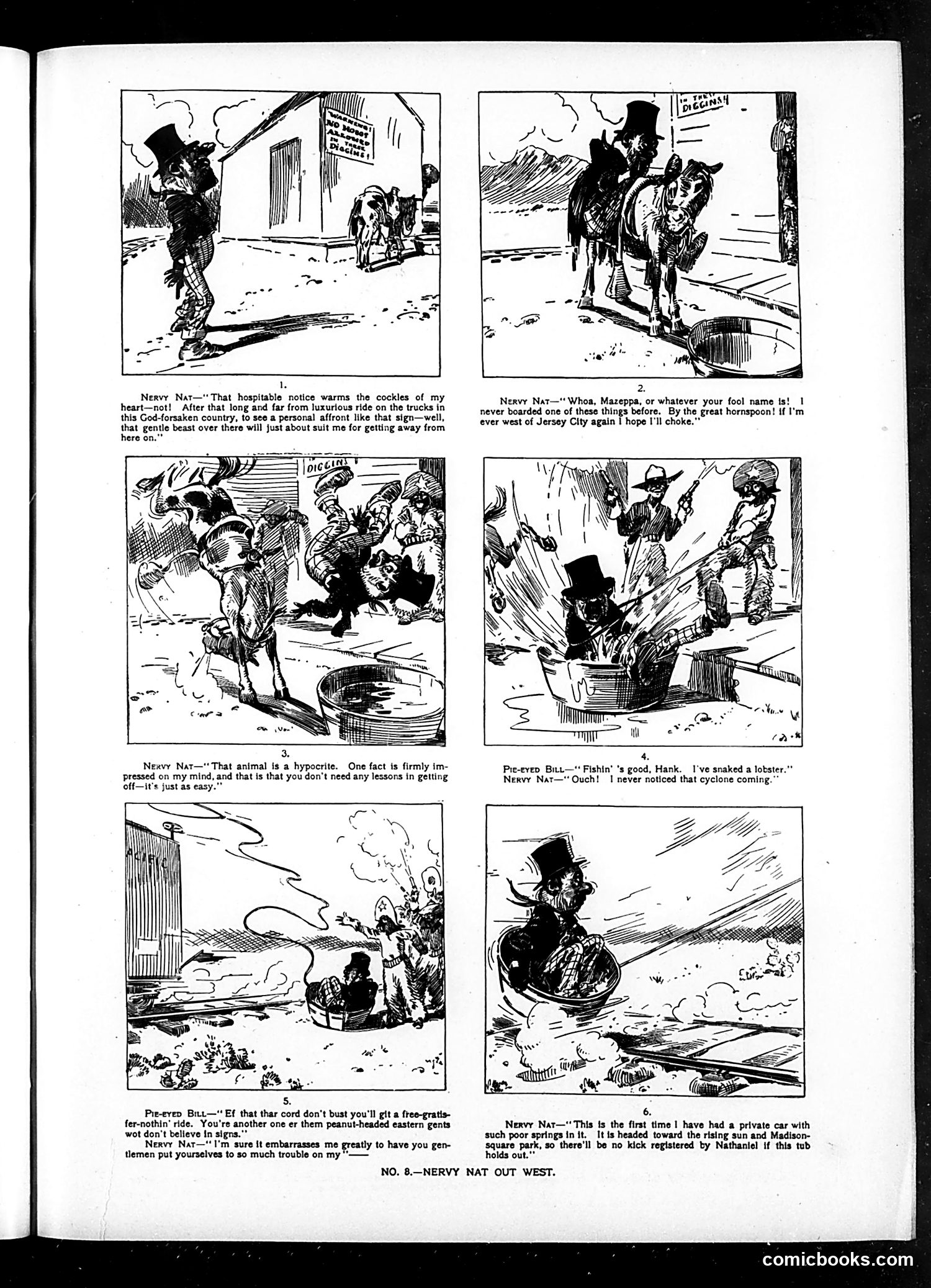
This is a satirical comic strip following an arrogant Eastern character (Nervy Nat) encountering Western life. The humor relies on contrasting his citified pretension with rough frontier realities. Nervy Nat, a wealthy New Yorker (references to "Jersey City" and "Madison-square park"), arrives out West expecting comfort but is repeatedly humiliated: he rides freight trains, attempts to mount a stubborn mule named Mazeppa, gets thrown by a cyclone, and ends up in a ramshackle carriage with broken springs. The satire mocks Eastern dandies' ignorance of and contempt for rural life, while the local Westerners (Pierced Bill, Hank) represent honest, unsentimental frontier folk. The joke is Nat's progressive comeuppance—his effete complaints and inexperience repeatedly backfire, and he learns that Western transportation, animals, and hospitality operate by different (harsher) rules than Eastern society.
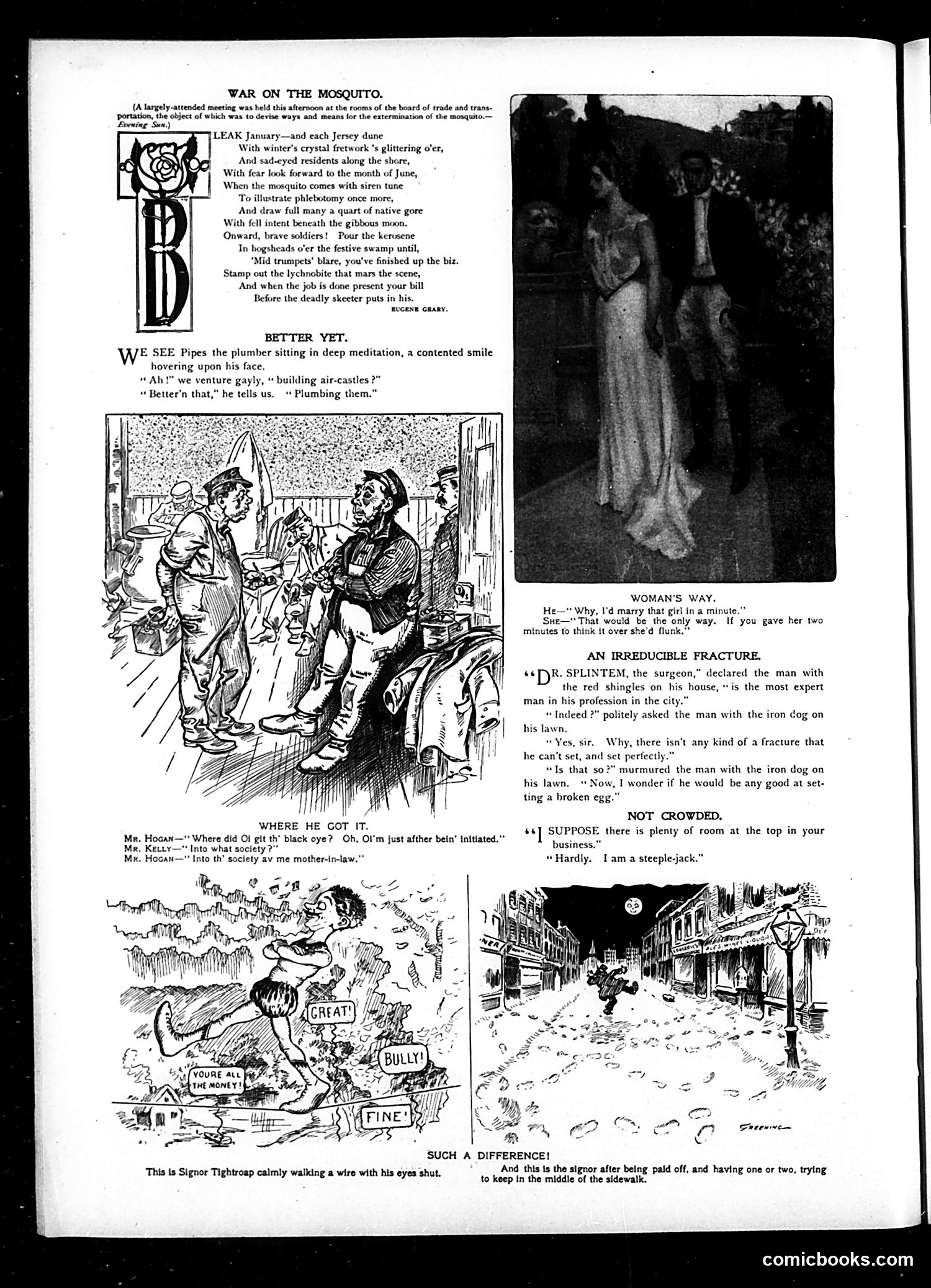
This page contains several short humorous pieces typical of early 20th-century American humor magazines: **"War on the Mosquito"** satirizes a real board of trade meeting about mosquito extermination (referenced in the header). The poem mocks New Jersey residents' seasonal dread of mosquitoes and suggests military-style intervention with kerosene, treating the pest problem with mock-heroic language. **"Better Yet"** is a simple plumber joke playing on double meaning: while others build "air-castles" (daydream), Pipes literally "plumbs" them—a pun on his profession. **Other short gags** include jokes about marriage, a surgeon's expertise, and casual ethnic humor (the "black eye" initiation joke uses Irish dialect stereotyping common to the era). **"Such a Difference"** contrasts a tightrope walker's sobriety versus drunkenness—the final cartoon shows him drunk on a sidewalk, unable to walk straight. The page is primarily lighthearted domestic and professional humor rather than political satire, with illustrations accompanying each brief joke or poem.
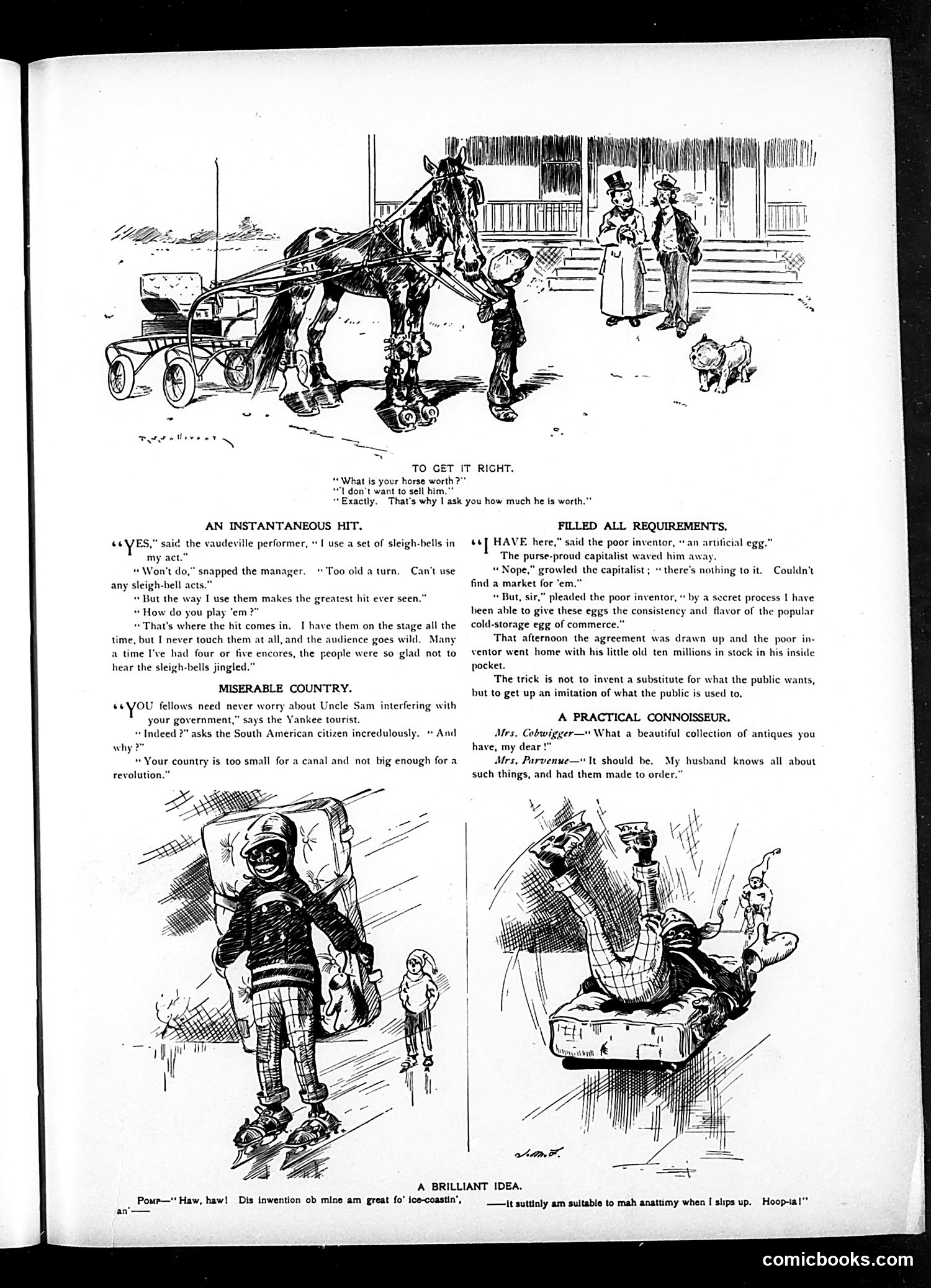
This page contains several disconnected satirical vignettes typical of early 20th-century American humor magazines: **"To Get It Right"**: Mocks pretentious horse-trading logic—asking a man his horse's worth when he won't sell reveals the absurdity of pricing valuables. **"An Instantaneous Hit"**: Ridicules vaudeville acts, suggesting sleigh-bells are only popular when *not* used—satirizing low-quality entertainment and audience taste. **"Miserable Country"**: A South American tourist challenges American exceptionalism, implying U.S. government interference is actually undesirable. **"Filled All Requirements"**: Satirizes capitalism and entrepreneurship—a poor inventor's artificial egg succeeds not through innovation but by mimicking inferior mass-produced eggs. The capitalist profits by selling imitation rather than genuine improvement. **"A Practical Connoisseur"**: Mocks the newly wealthy ("Parvenue") who fake sophistication by buying antiques "made to order"—new items disguised as antiques. The bottom cartoon appears to show a comedic character with a sled contraption.
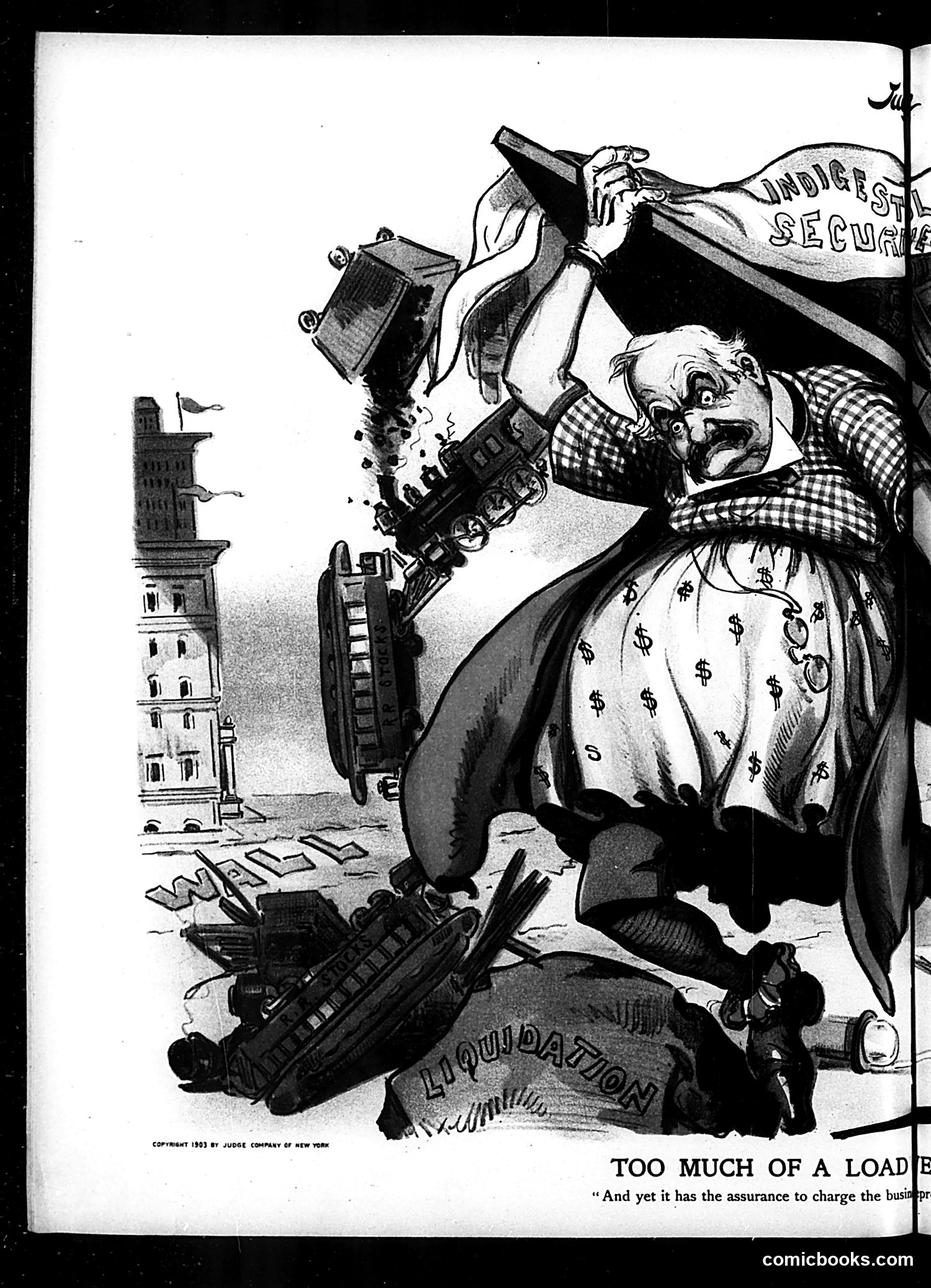
This Judge magazine cartoon satirizes corporate financial irresponsibility, likely from the early 20th century. A fat, mustachioed capitalist figure—representing unchecked business interests—is grotesquely overloaded with trains, money bags marked "LIQUIDATION," and other symbols of greed and speculation. He's precariously balanced atop a classical building (likely representing government or Wall Street), with his sack decorated with dollar signs. The title "Too Much of a Load" and partial caption critique how such enterprises accumulate excessive debt or assets while maintaining the audacity to continue charging customers or conducting business. The cartoon warns against unsustainable corporate practices and the danger they pose to the broader economy. The rupturing sack suggests imminent collapse.
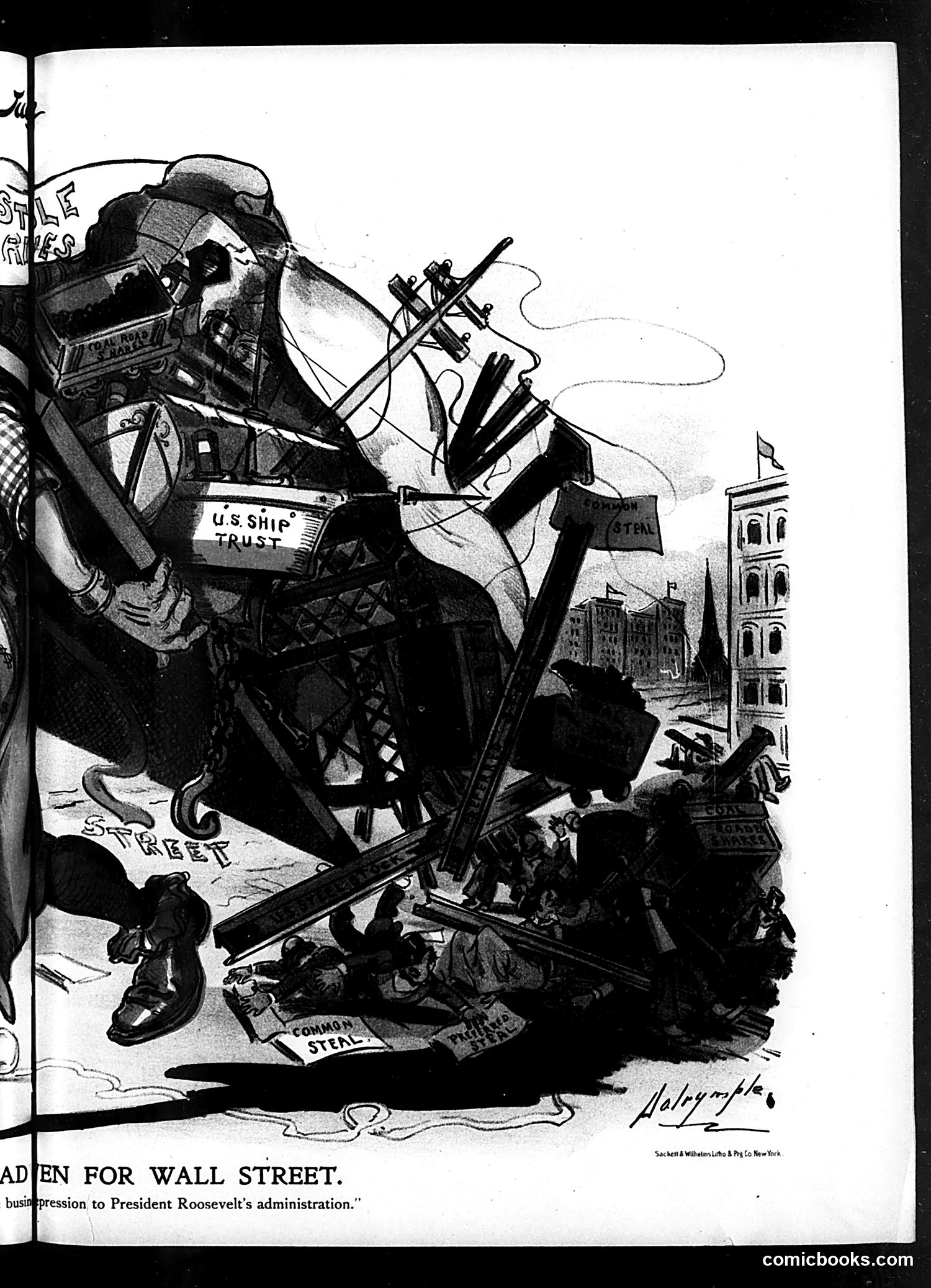
This cartoon criticizes Wall Street's response to President Roosevelt's administration. A grotesque figure labeled "U.S. SHIP TRUST" operates a massive mechanical contraption aimed at buildings labeled "WALL STREET," while tiny figures below appear crushed or struggling beneath the machinery. The cartoon suggests that Roosevelt's policies—likely regarding trusts and monopolies—are being wielded as a weapon against Wall Street interests. The satire critiques either: (1) Roosevelt's aggressive trust-busting as destructive to legitimate business, or (2) Wall Street's resistance to reform. The elaborate mechanical imagery emphasizes the scale and force of governmental action. The small, helpless figures below suggest either displaced workers or Wall Street players rendered powerless by Roosevelt's policies. The exact satirical stance—whether pro- or anti-Roosevelt—remains somewhat ambiguous from the image alone.
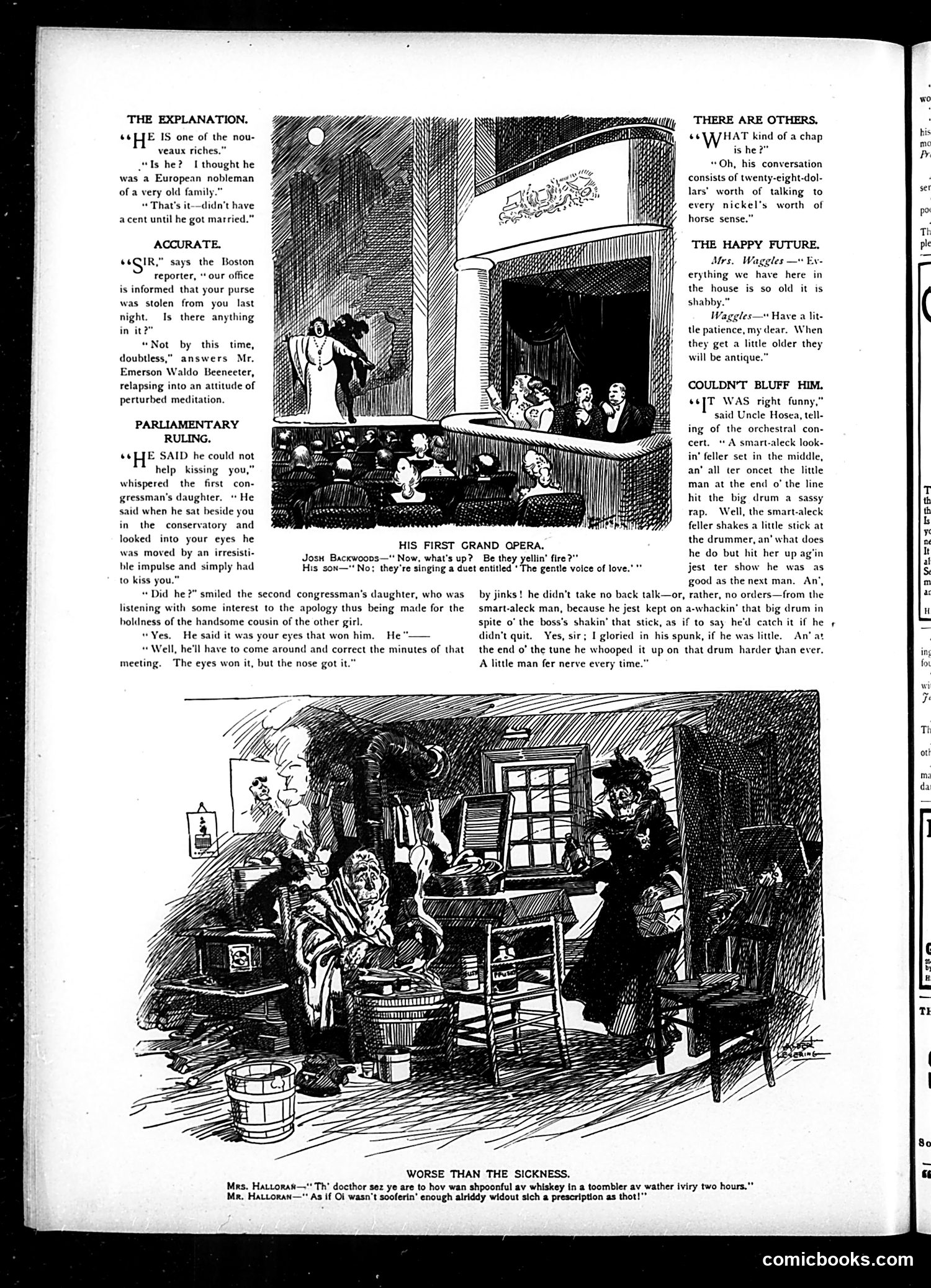
This page collects brief satirical sketches typical of late 19th/early 20th-century American humor. Key targets include: **"The Explanation"**: Mocks newly wealthy Americans (nouveaux riches) who lack aristocratic lineage—a common anxiety among the social-climbing middle class. **"Accurate"**: Plays on the stereotype of Boston reporters as precise but pedantic. **"Parliamentary Ruling"**: A congressman's daughter uses a suggestive anecdote to test whether congressmen have standards; the implication is they don't. **"There Are Others"** and **"The Happy Future"**: Mock middle-class social pretension and self-deception. **"His First Grand Opera"**: Rural dialect humor (Uncle Hosea) where an unsophisticated drummer ignores a conductor's stick—valuing independence over deference to authority. **"Worse Than the Sickness"**: Irish immigrant dialect humor: Mr. Halloran finds the whiskey cure for illness worse than the illness itself—playing on period stereotypes about Irish drinking. The page reflects Judge's typical blend of class satire, ethnic humor, and gentle social commentary aimed at educated readers.
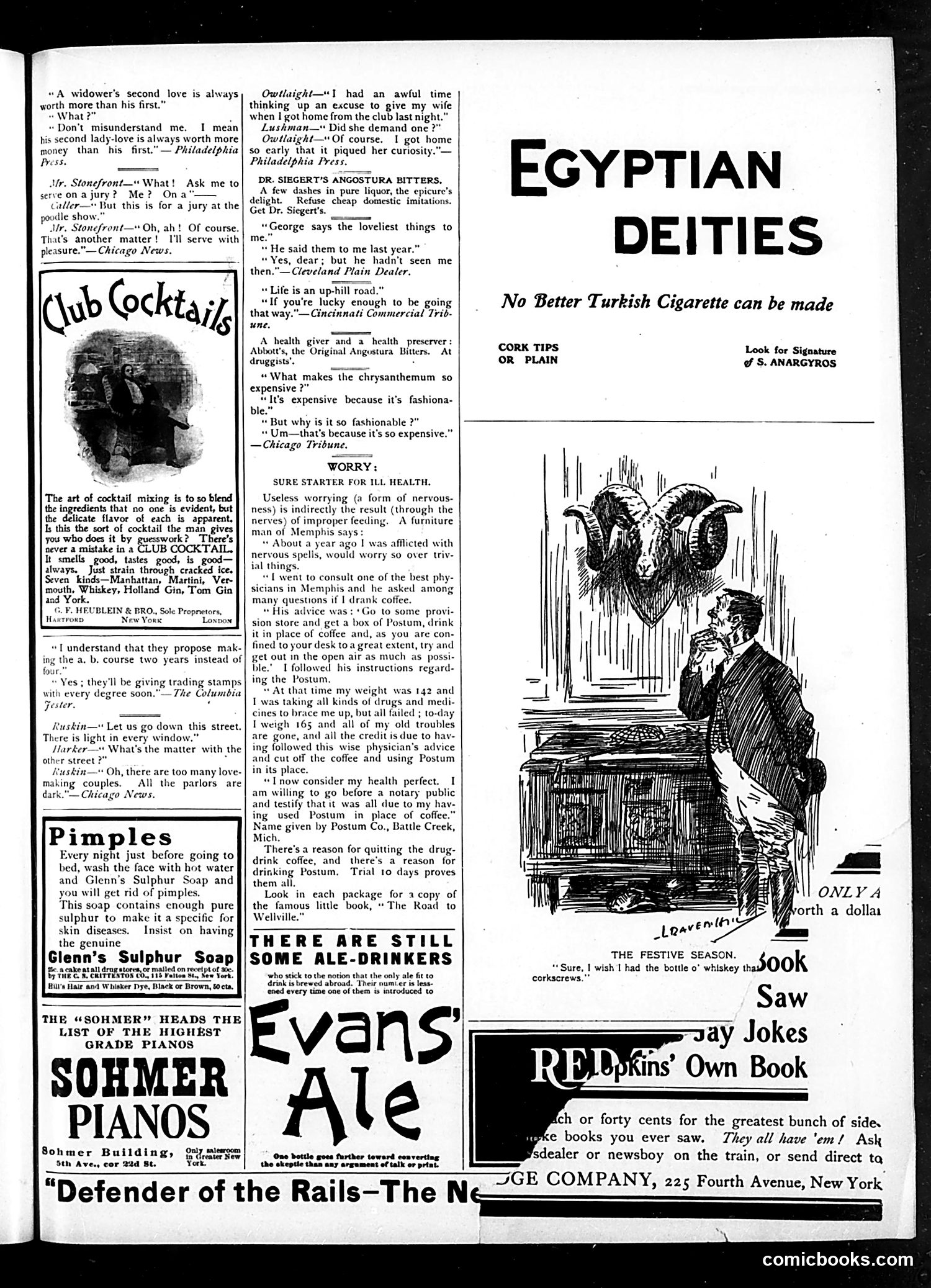
This page is primarily **advertisements and short humor columns**, typical of Judge magazine's format. The notable cartoon/joke content includes: **"Poodle Show Jury" joke**: A man refuses jury duty until learning it's for a poodle show, then eagerly volunteers. The satire mocks the wealthy's obsession with frivolous pet shows over civic responsibility. **Marriage/Infidelity jokes**: Several quips about men making excuses to wives about late nights at clubs, and remarking that second wives are "worth more" (money). These reflect early 20th-century attitudes about marital deception and gold-digging. **Fashion satire**: A circular joke about chrysanthemums being expensive because fashionable, and fashionable because expensive—mocking arbitrary status symbols. The bulk of the page features **patent medicine and consumer product ads** (Postum coffee substitute, Glenn's Sulphur Soap, Evans Ale, Sohmer Pianos), reflecting common magazine monetization of the era. These ads often included testimonials making dubious health claims.
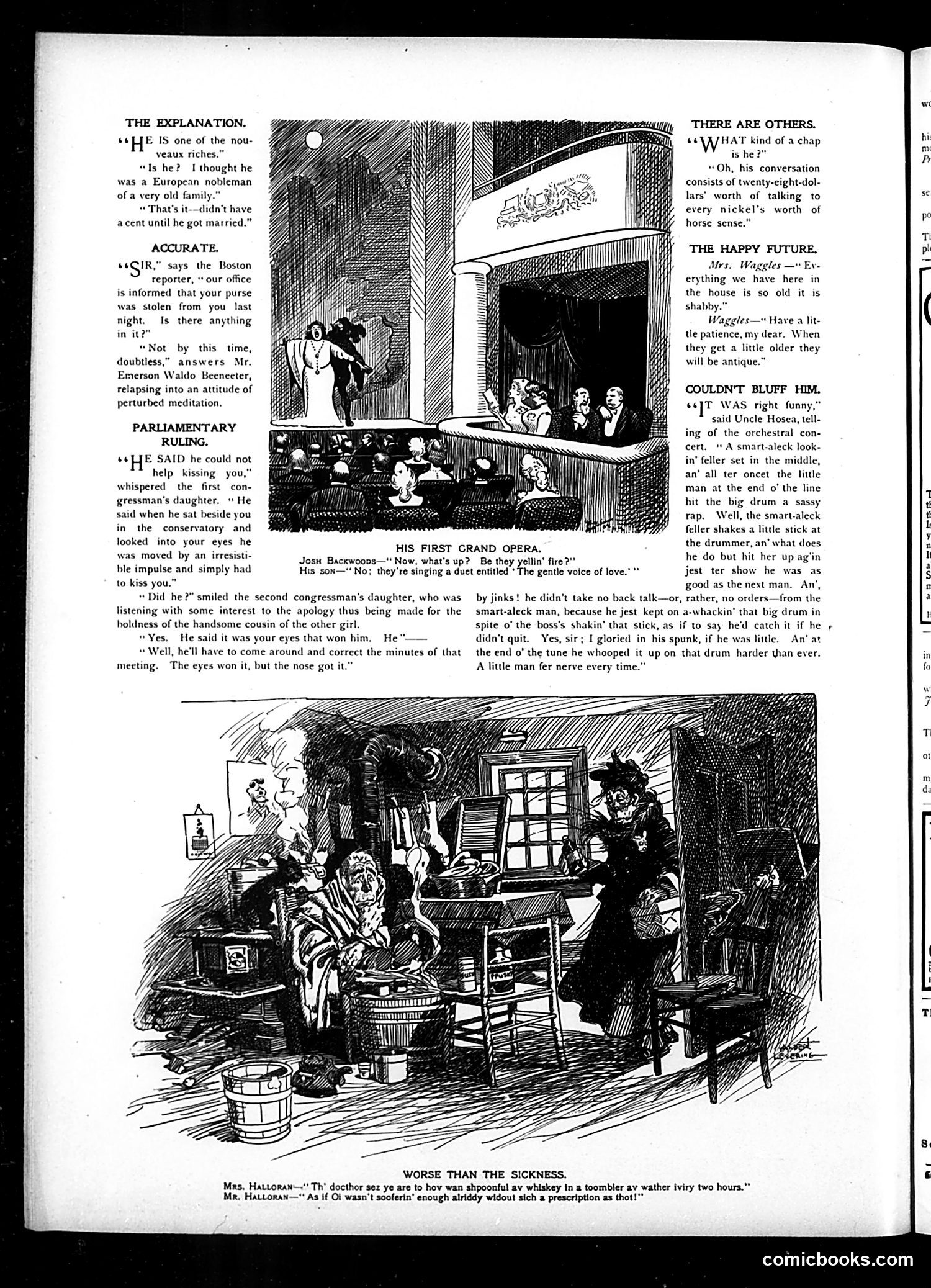
This page contains multiple satirical vignettes typical of late-19th/early-20th-century American humor: **"The Explanation"**: Jokes about newly wealthy Americans (nouveaux riches) marrying into European nobility to gain legitimacy and old-family prestige—a common target of satire about American social climbing. **"Accurate"** and **"Parliamentary Ruling"**: Brief gags about literal misunderstandings and wordplay, typical filler humor. **"His First Grand Opera"**: Rural character (Joe Backwoods) mistakes an orchestral performance for an emergency, satirizing rural/urban cultural divides. **"The Happy Future"**: Middle-class couple's optimism that their cheap current possessions will eventually become valuable antiques—poking fun at consumerism and false hope. **"Couldn't Bluff Him"**: Uncle Hosea recounts a drummer defying a conductor's authority, celebrating working-class resistance to hierarchy. **"Worse Than the Sickness"**: Irish immigrant complains that the whiskey remedy prescribed for illness is itself unbearable—ethnic humor playing on stereotypes about Irish drinking. The page demonstrates Judge's range: class satire, regional humor, and ethnic caricature typical of the era.
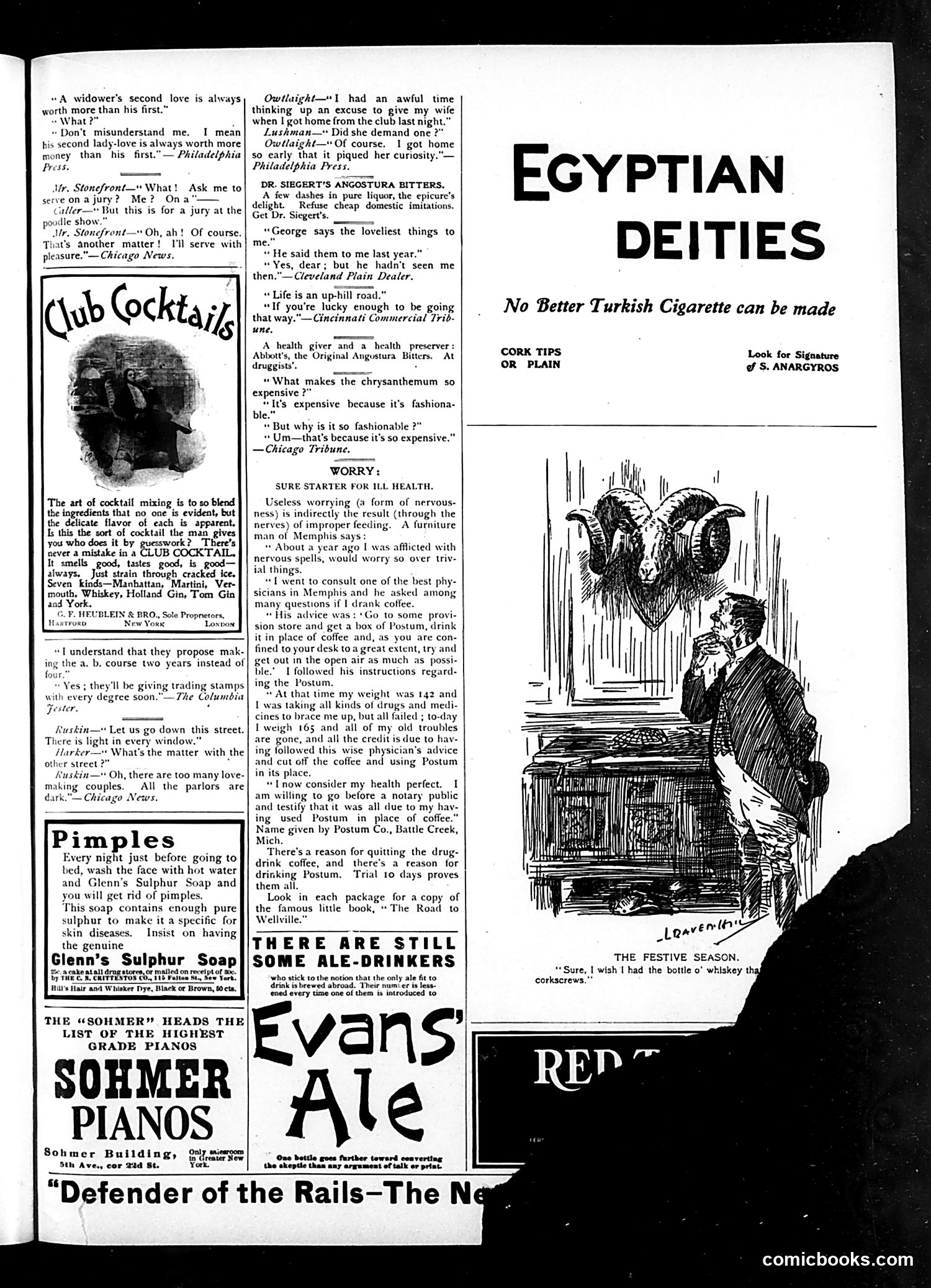
This page is primarily **advertisements and humor snippets** rather than political cartoons. The main content includes: **The Cartoon:** "The Festive Season" shows a goat in a domestic interior with the caption "Sure, I wish I had the bottle o' whiskey the coachman's." This is a simple visual gag about animals envying human pleasures—not political satire. **The Humor:** Short jokes about marital dynamics (widowers' second wives being wealthier), jury duty preferences, and social observations—typical light satire of early 20th-century life. **The Advertising:** The page is dominated by product ads: Egyptian Deities cigarettes, Club Cocktails, Glenn's Sulphur Soap (for pimples), Sohmer Pianos, Evans Ale, and Postum (a caffeine-free coffee substitute marketed as health-promoting). **Context:** This reflects a period when magazines mixed editorial humor with extensive advertising, and when patent medicines and health tonics were heavily promoted with pseudo-scientific claims. There is no significant political commentary on this particular page.
This page is primarily **advertisements and filler jokes** from Judge magazine, not political satire. The content includes: **Ads**: Whiskey (Hunter, Wilson), Coolene antiperspirant, White Rock beverages, Gomez cigars, Whitman's chocolates, and Carl H. Schultz products from Key West. **Jokes**: Mostly mild domestic humor—a couple joking that their insomnia is named "Ethel" (implying marital discord), a boy saying "no" repeatedly at dinner, a woman calling a compliment "becoming threadbare," and a chauffeur explaining a horse has a lame leg. **House-building advertisement**: The largest feature advertises George Palliser's architectural book offering 100 house plans for $1. The "satire" is gentle and formulaic—puns, domestic misunderstandings, and light social observation. Nothing here references current politics or events. This appears to be a typical Judge page mixing paid advertisements with brief, inoffensive jokes targeting middle-class readers.
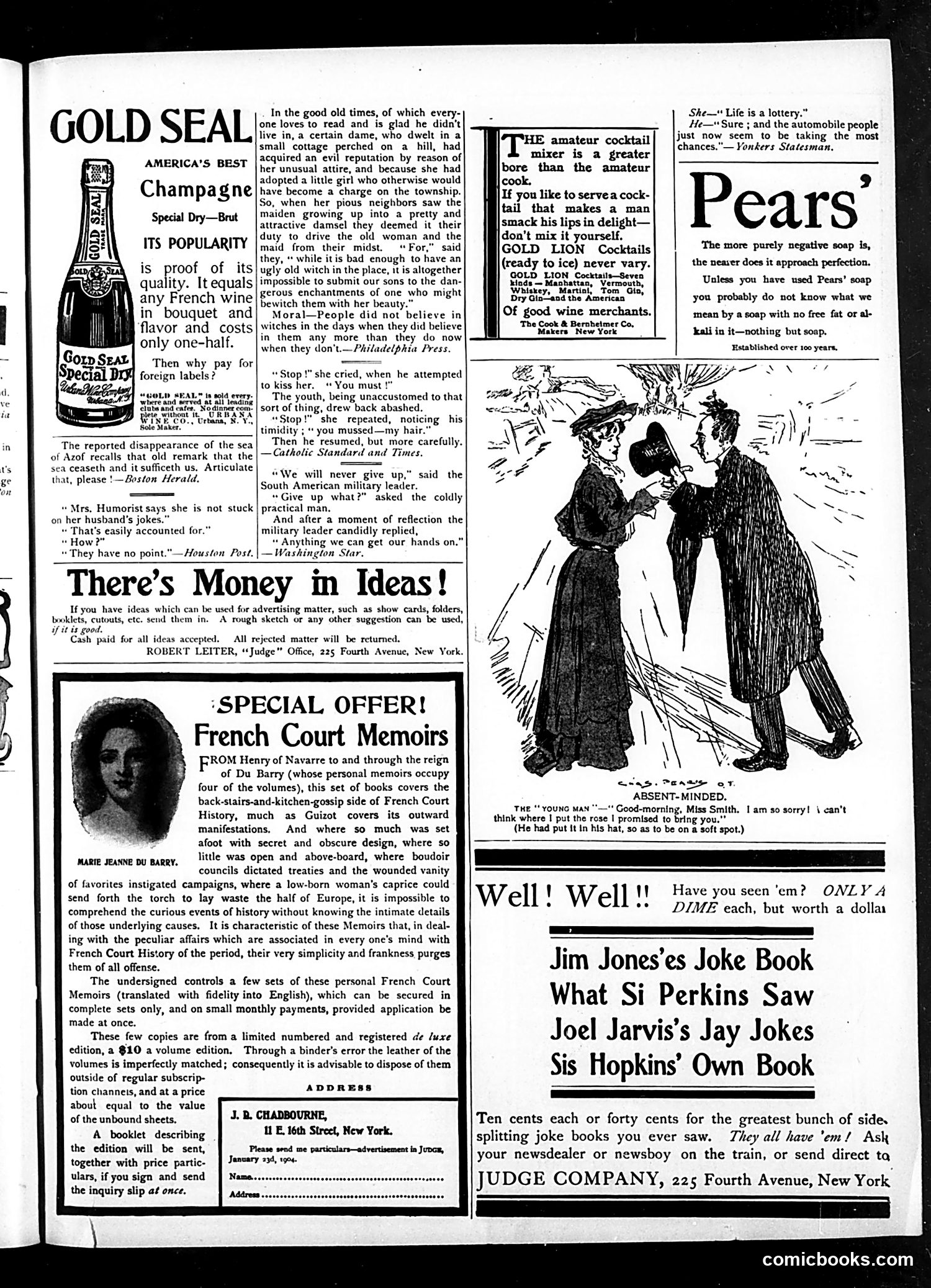
This page is primarily **advertisements and short humor pieces**, typical of Judge magazine's format. **The cartoon** (center-right) shows two figures in conversation titled "Absent-Minded." The humor relies on a misunderstanding: a young man lost a rose he promised to bring to a woman, and she responds sarcastically that he's "so kind" to lose it in her hat—implying he actually put it there but forgot, showing absent-mindedness rather than genuine forgetfulness. **The short anecdotes** scattered throughout are typical Judge humor: - One mocks a "South American military leader" for saying they'll "never give up"—then admitting they'll give up "anything we can get our hands on" (satirizing greed/hypocrisy) - Another jokes about a woman's negative opinion of her husband's jokes for having "no point" **The advertisements** promote Gold Seal champagne, Pears' soap, cocktail mixers, French Court memoirs, and joke books—standard commercial content. The overall tone is lighthearted social satire targeting human folly, romantic mishaps, and commercial absurdity.
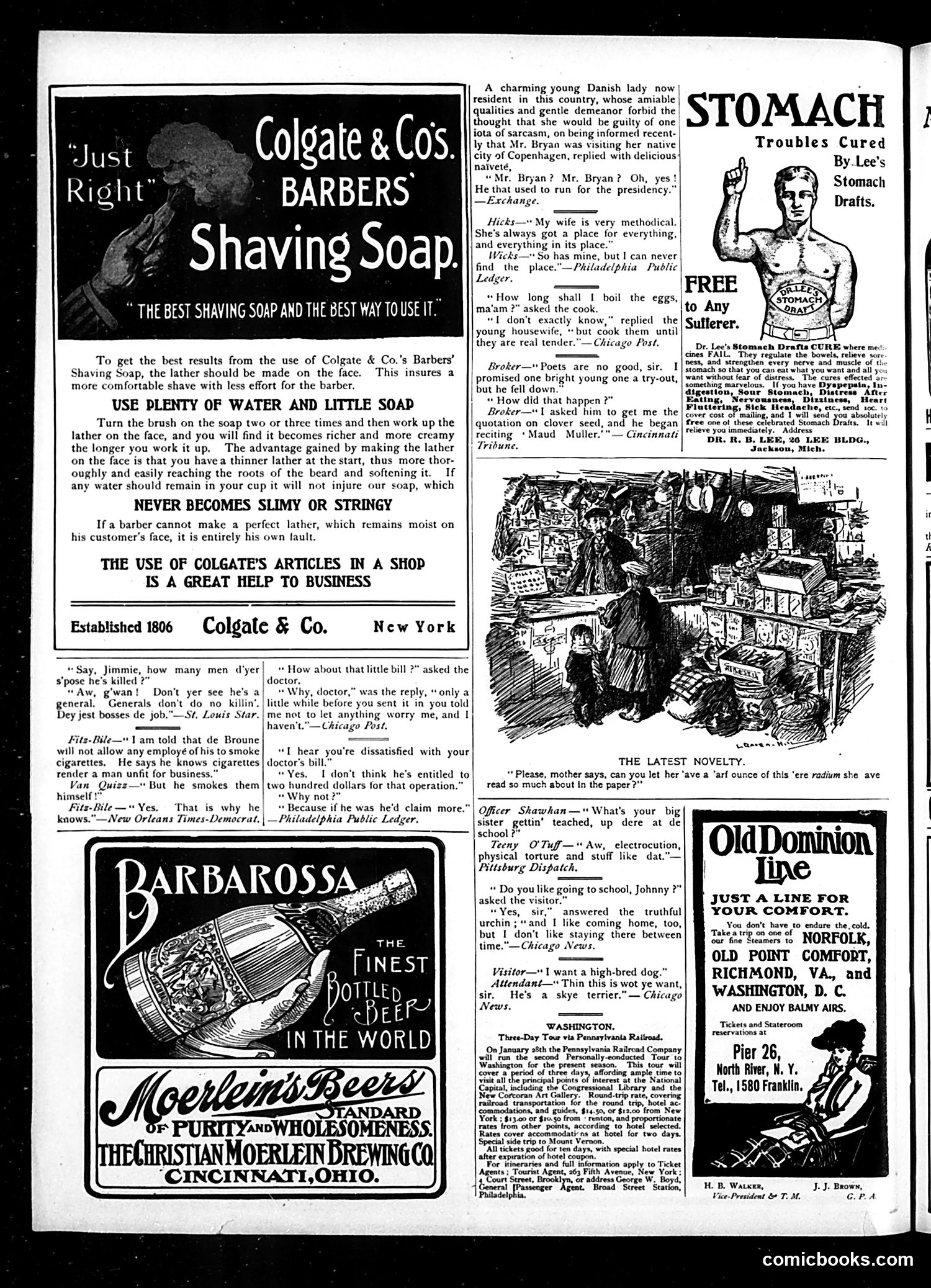
This page is primarily **advertising with humor interspersed**—typical of Judge's format. The main content includes: **Advertisements:** Colgate & Co.'s Barbers' Shaving Soap (with instructions), Barbarossa bottled beef, Moerlein's Beer, Dr. Lee's Stomach Drafts, and Old Dominion Line steamships dominate the layout. **Humor section:** A collection of brief jokes and anecdotes in the center-right. Most are light social commentary—a joke about generals not doing the killing, cigarette smoking affecting work fitness, doctor's bills, and notably, a reference to **William Jennings Bryan's visit to Copenhagen**, where a Danish woman naively asks if he's "that used to run for the presidency"—mocking Bryan's failed presidential campaigns. **"Latest Novelty" cartoon:** A child asks her mother for radium powder, having read about it in newspapers—satirizing public fascination with the newly-discovered element and media hype around it. The page reflects early-1900s concerns: patent medicines, smoking, Bryan's political prominence, and scientific novelties.
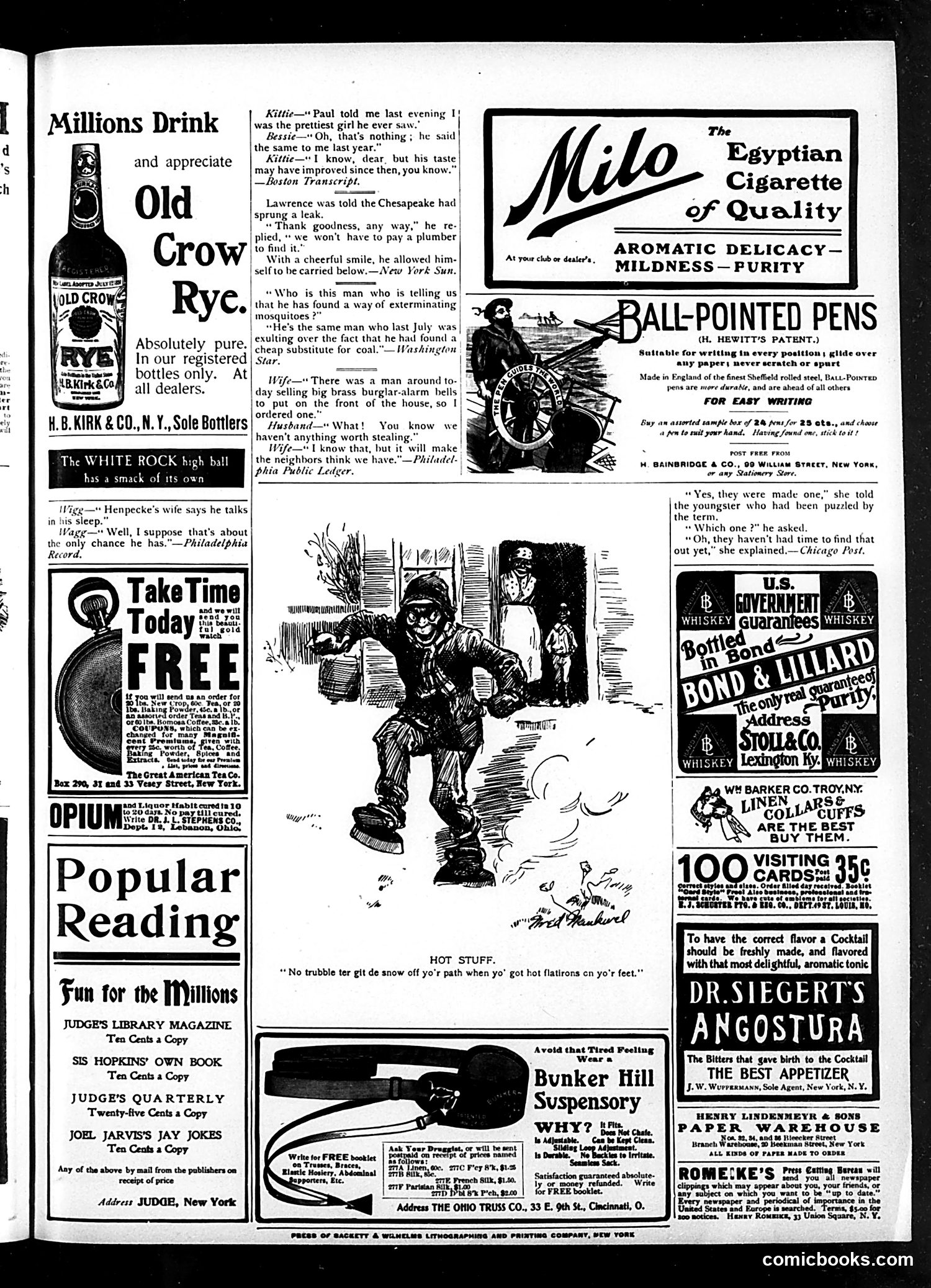
This page is primarily **advertising**, with brief humor snippets interspersed. The main content includes: **Central Cartoon:** A caricatured Black figure in exaggerated dress, captioned "Hot Stuff: No trouble ter git de snow off yo'r path when yo' got hot flatirons on yo'r feet." This reflects the racist stereotyping common in early 20th-century American humor—depicting Black people in dialect with crude physical humor. **Humor Items:** Brief jokes about marriage, infidelity, and domestic life reflect period attitudes. One joke mocks a wife's vanity; another suggests marital discord is routine. **Advertisements:** Primarily alcohol (Old Crow Rye, White Rock, Angostura bitters), medical quacks (opium for liquor addiction, trusses), and consumer goods. The medical ads are notably dubious by modern standards. The page exemplifies Judge's satirical approach while revealing the era's casual racism, gender stereotypes, and unregulated advertising of harmful substances—elements modern readers would find deeply offensive and medically dangerous.
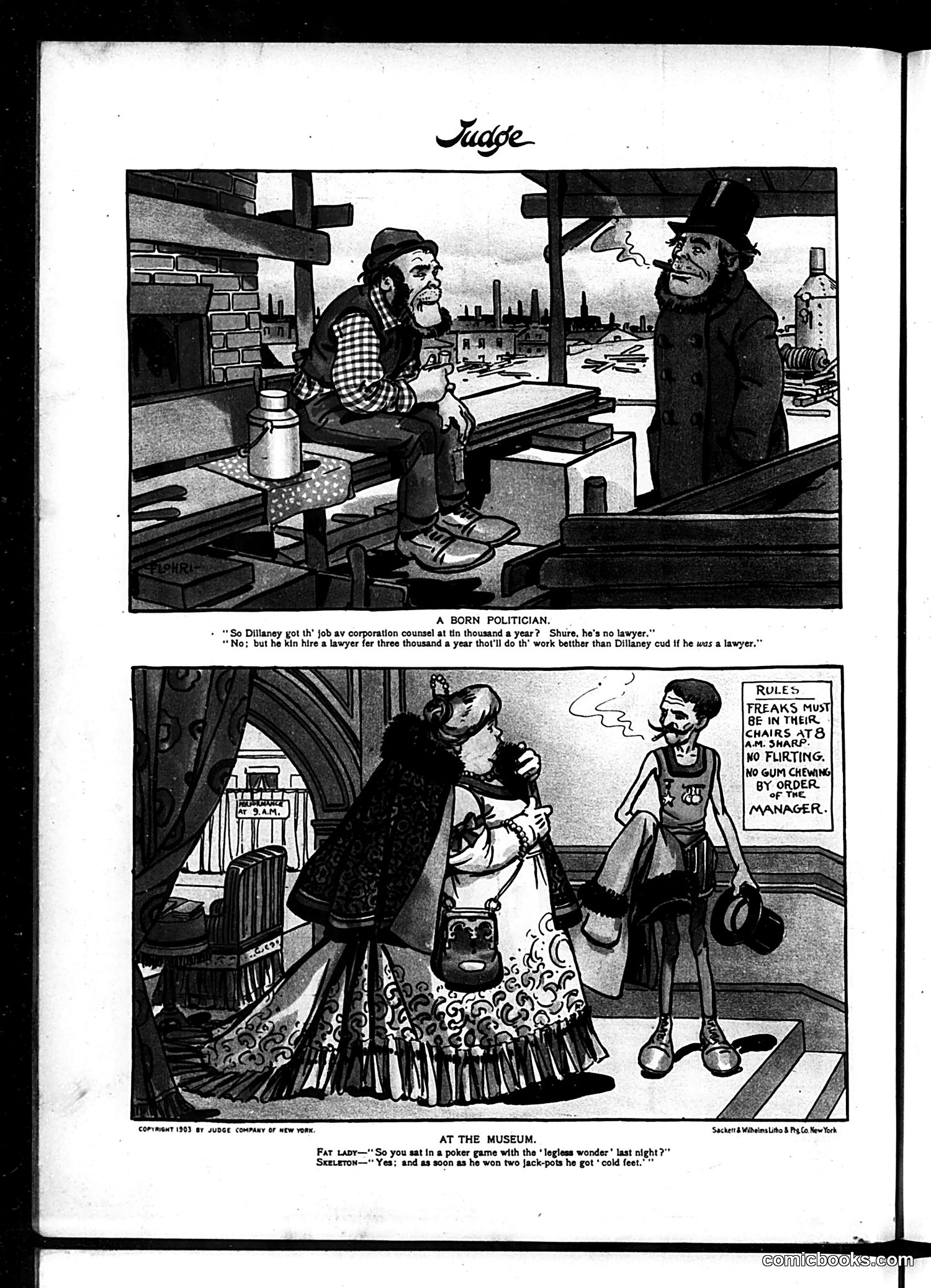
**Top Cartoon: "A Born Politician"** Two working-class men on a rooftop discuss Dillaney's appointment as corporation counsel at $10,000/year. The joke satirizes political corruption: Dillaney isn't qualified as a lawyer, but that's irrelevant—he'll simply hire an actual lawyer for $3,000 to do the work, pocketing $7,000 as profit. This mocks the practice of political appointments rewarding cronies with lucrative sinecures regardless of competence. **Bottom Cartoon: "At the Museum"** A society woman and a "Skeleton" character reference a poker game with the "Legless Wonder" (likely a circus sideshow attraction). The pun: after winning two jackpots, the Legless Wonder got "cold feet"—a witty play on the idiom meaning to lose nerve, absurd when applied to someone without feet. Both cartoons rely on period-specific knowledge: early 1900s political patronage and circus/sideshow culture.