
A complete issue · 17 pages · 1903
Judge — December 26, 1903
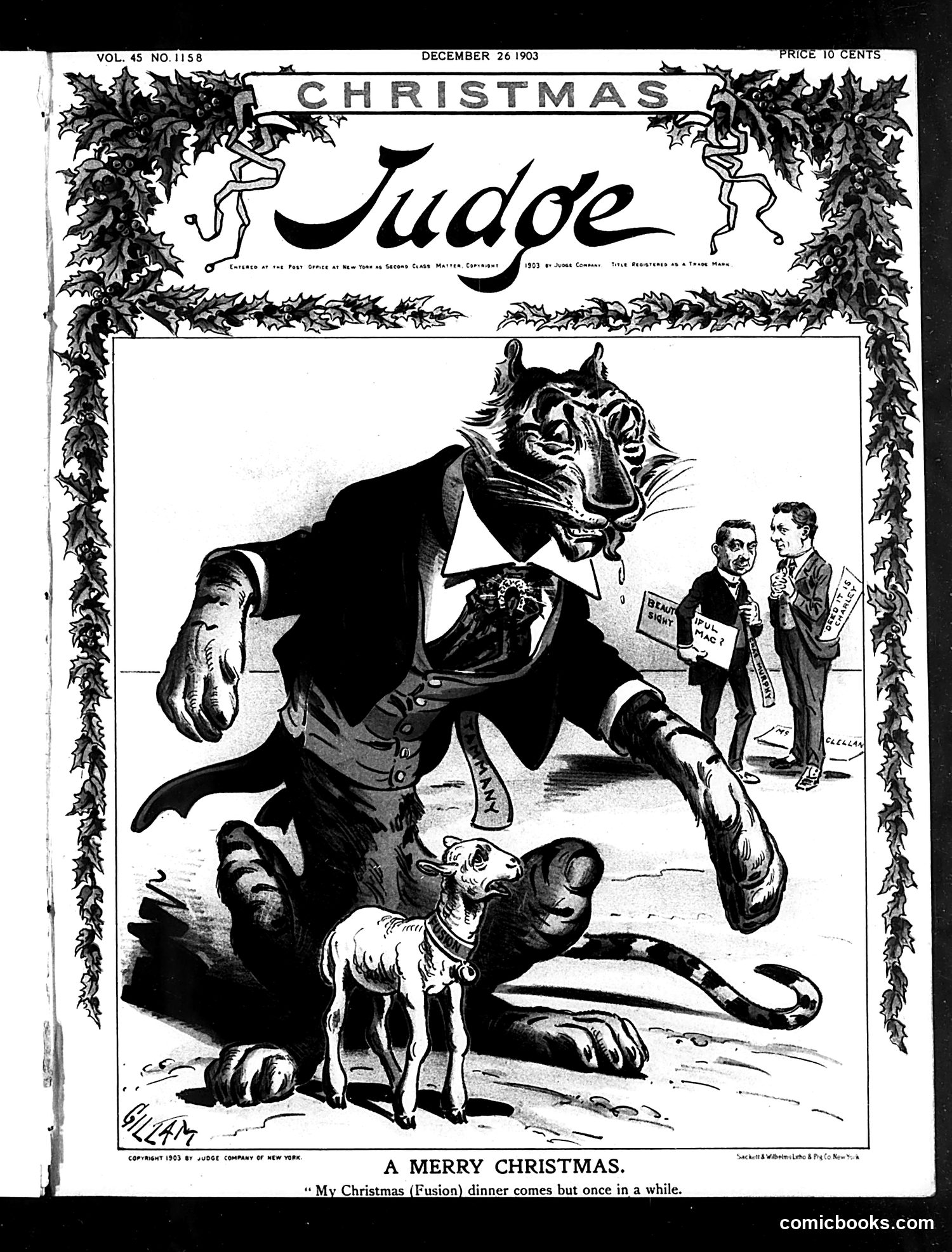
This satirical Christmas cartoon depicts a grotesque tiger-headed figure in formal dress kicking a small dog, while two men in the background hold papers labeled "RUSSIAN ARMY" and "PEACE," appearing to discuss or argue. The cartoon likely references the Russo-Japanese War (1904-1905), which was imminent in late 1903. The tiger presumably represents Russia, shown as brutish and aggressive despite diplomatic peace efforts. The small dog represents Japan, depicted as vulnerable. The formal clothing on the tiger-figure suggests ironic contrast between civilized diplomatic pretense and violent imperial ambitions. The caption's reference to a "fusion dinner" suggests commentary on political coalitions or compromises regarding the conflict.
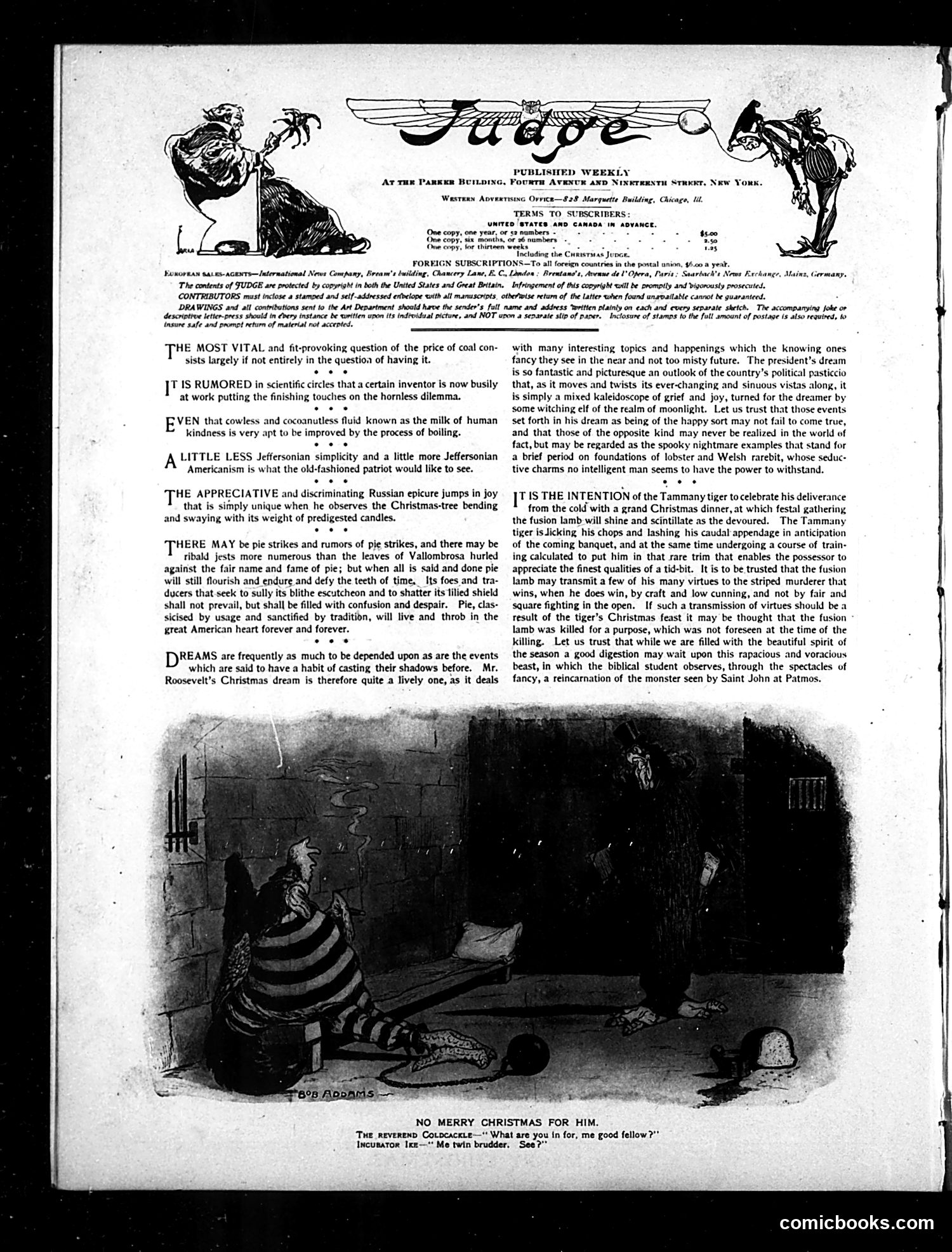
The main cartoon depicts a prisoner in striped jail garb sitting in a dark cell, confronted by what appears to be a jailer or guard. The caption reads: "The Reverend Convict—'What are you in for, me good fellow?' Incarceree (as usual)—'17.'" This is satirizing the contrast between religious hypocrisy and criminal justice. The "Reverend Convict" suggests a clergy member or religious figure who has been imprisoned, while the other inmate's cryptic answer "17" likely refers to either seventeen years of sentence or a vague legal charge. The cartoon mocks the irony of a religious man facing imprisonment during the Christmas season, critiquing either clerical corruption or the severity of sentencing. The overall message emphasizes the lack of mercy in the justice system, particularly during the holiday period.
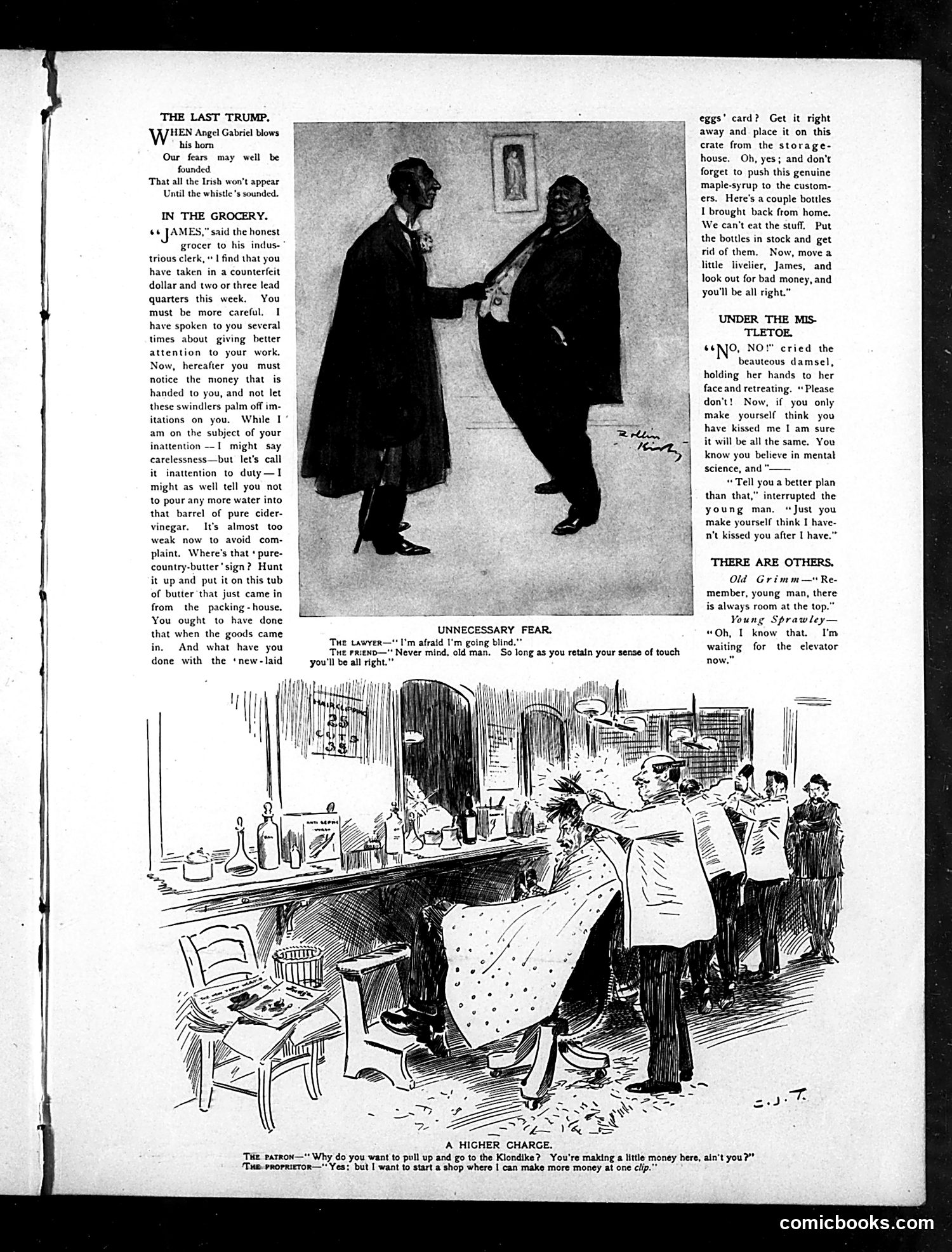
This page contains three distinct sections: a poem titled "The Last Trump," a short story "In the Grocery," and two cartoon illustrations. The top cartoon ("Unnecessary Fear") depicts two men in conversation, with the caption suggesting reassurance about maintaining composure during uncertain times—likely referencing early 20th-century anxieties. The bottom cartoon ("A Higher Charge") shows a shop interior where a proprietor refuses an employee's request to start his own competing business, sarcastically suggesting the employee is "making little money" at his current job. The satire mocks both employer exploitation and employee ambition during an era of limited economic opportunity. The text sections appear to address workplace ethics and relationships, consistent with Judge's typical satirical commentary on American social and commercial life.
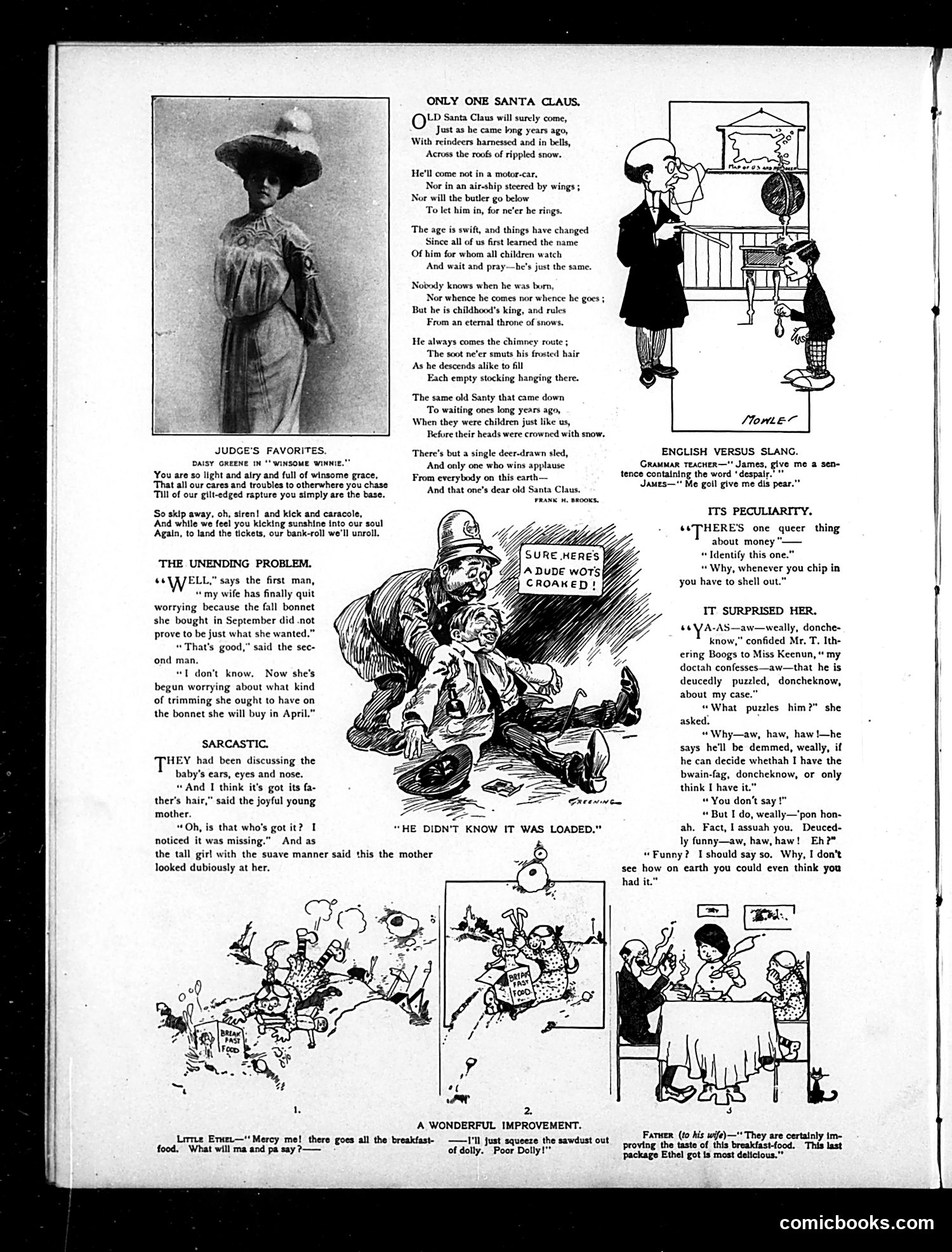
This page contains several unrelated humor pieces typical of early 20th-century Judge magazine: **"Only One Santa Claus"** is a nostalgic poem noting that Santa's methods remain unchanged despite modern progress—still arriving via chimney, not motor-car or airship. **"Judge's Favorites"** and other brief sections are simple domestic humor pieces with no apparent political content. **"A Wonderful Improvement"** (bottom comic strip) appears to depict a child spilling breakfast food, with a parent's resignation to the mess—gentle family humor requiring no historical context. The page also includes what appears to be a photograph of a woman in Edwardian dress (labeled "Judge's Favorites"), though her identity is unclear from the image alone. Overall, this represents the magazine's typical mix of light social satire and domestic comedy rather than pointed political commentary.
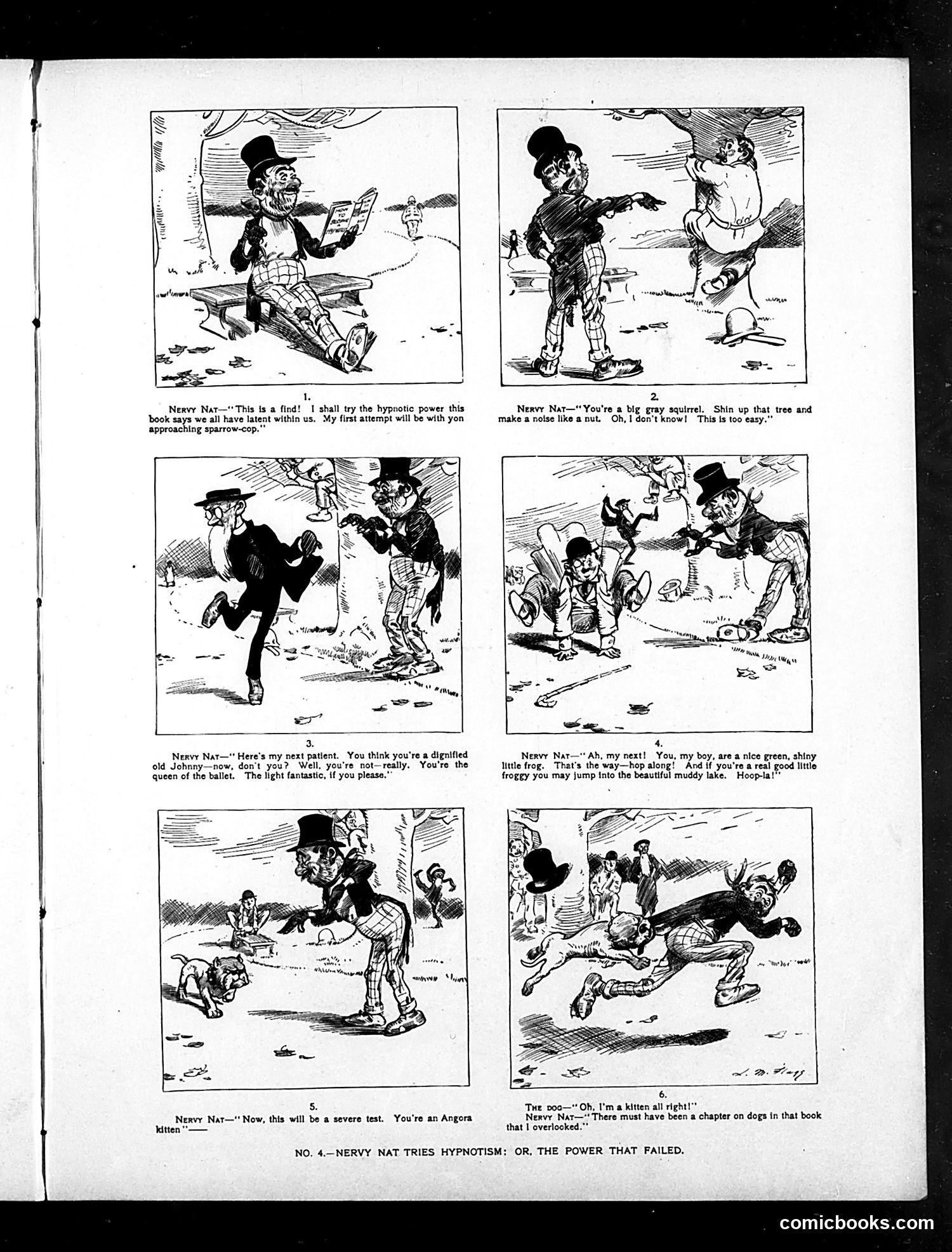
This is a six-panel comic strip satirizing the popular early-20th-century fad of hypnotism and mesmerism. The protagonist, "Nervy Nat," attempts to hypnotize various animals using a book on hypnotic powers, commanding them to adopt false identities (a sparrow becomes a cop, a man becomes a ballet queen, a frog behaves like a frog, etc.). The satire targets two things: the pseudoscientific craze for hypnotism that captivated the public, and Nat's incompetence—his attempts repeatedly fail or produce absurd results. The humor lies in the gap between what Nat intends and what actually happens. By the final panel, even Nat acknowledges he's overlooked crucial information, suggesting the entire enterprise of amateur hypnotism is foolish. The strip mocks both the practice itself and those gullible enough to attempt it.
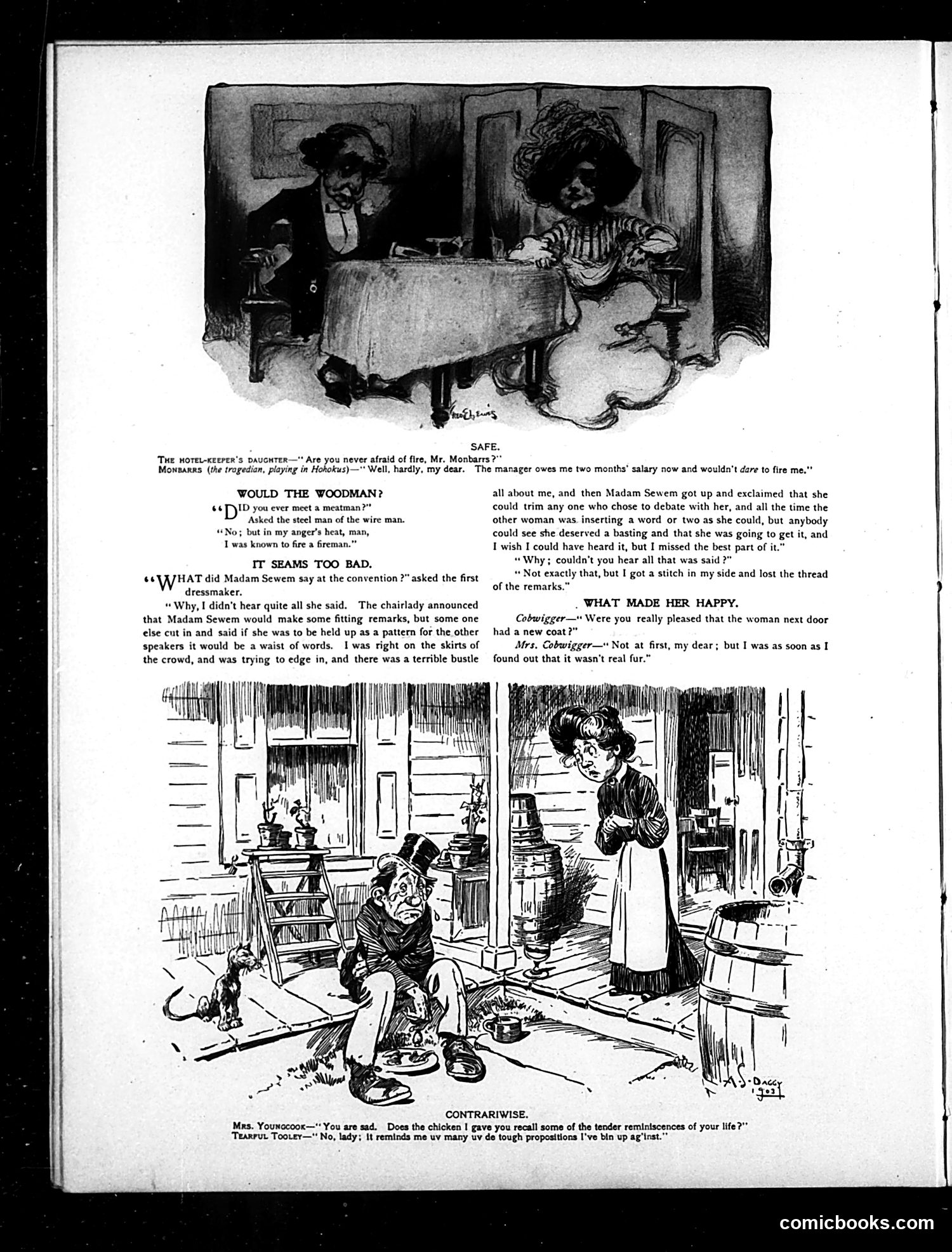
This page contains **four separate humorous anecdotes** typical of early 20th-century American satire: 1. **"Safe"**: A pun about job security. An actor claims he's fearless of being fired because his manager owes him two months' unpaid salary—so firing him would cost money. 2. **"Would the Woodman?"**: A tongue-twister joke playing on profession names (meatman, steel man, wire man, fireman) with no clear satirical target. 3. **"It Seams Too Bad"**: Extended pun-humor centered on sewing terminology (Madam Sewem, "fitting remarks," "waist of words," "pattern," "trim," "basting," "stitch"). A woman missed gossip at a dressmakers' convention. 4. **"What Made Her Happy"** and **"Contrariwise"**: Class-conscious humor. The first mocks nouveau-riche concern with status symbols; the second uses dialect humor ("uv," "ag'inst") to mock working-class immigrants, showing their hardship has made them cynical. The page emphasizes **wordplay and domestic/social comedy** rather than political satire.
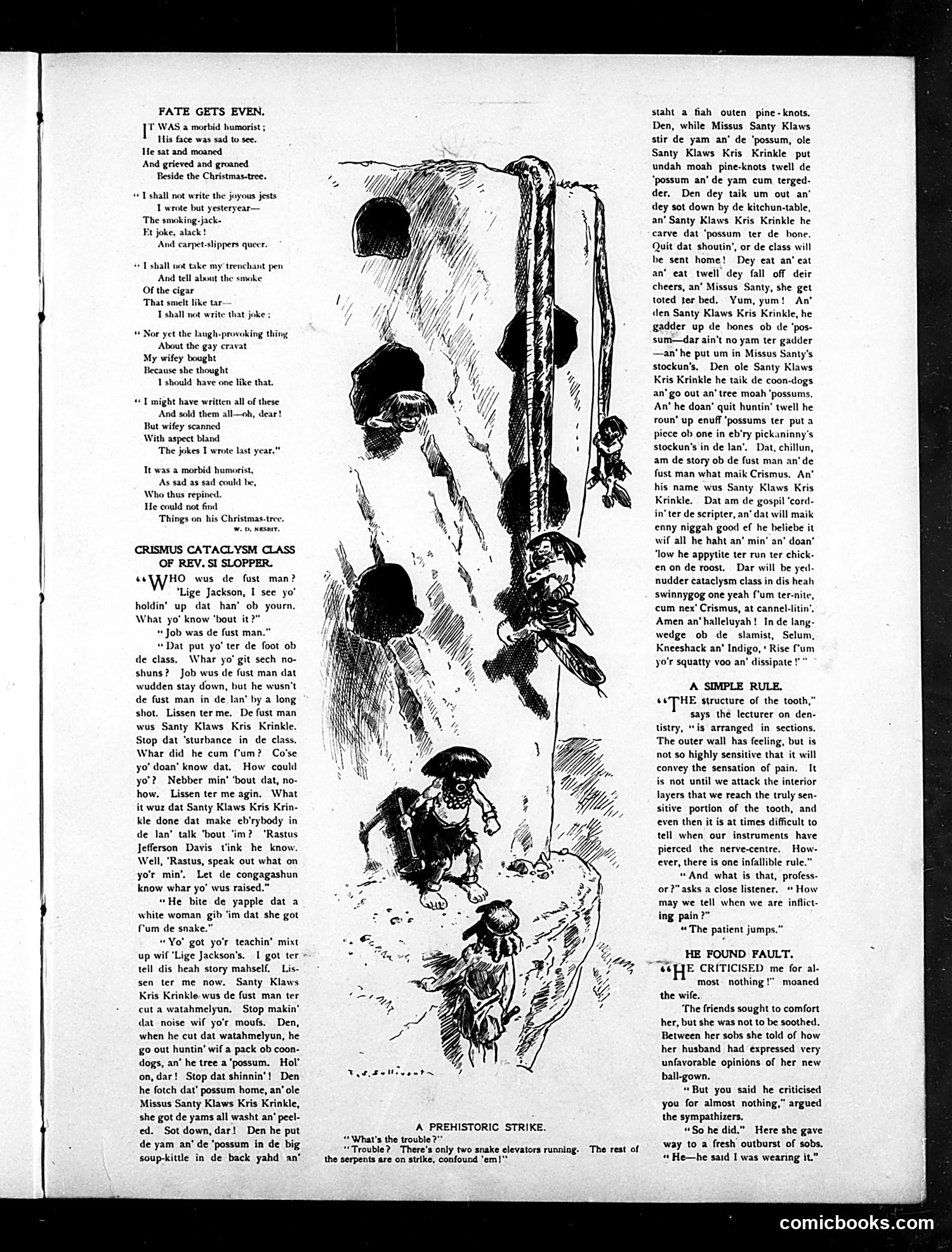
This *Judge* page contains three satirical pieces: **"Fate Gets Even"** mocks a struggling humorist who laments he can't reuse his old jokes because his wife discovered them—a commentary on male writers' domestic frustrations and creative bankruptcy. **"Crismus Cataclysm Class"** is a dialect comedy featuring "Rev. Si Slopper" teaching formerly enslaved children a tall tale crediting "Santy Klaws Kris Krinkle" (Santa Claus) as the first man who invented possum-and-yam cuisine, which he allegedly distributed to all Black children. This uses racist stereotypes and dialect humor common to the era, presenting a grotesque parody of Black religious instruction and Christmas tradition. **"A Prehistoric Strike"** shows snake elevators on strike—a humorous absurdist panel likely referencing contemporary labor disputes by applying them anachronistically to prehistory. The racial caricature and dialect in the middle piece reflects *Judge*'s regular reliance on minstrelsy-adjacent humor targeting Black Americans, typical of late-19th/early-20th-century American satire magazines.
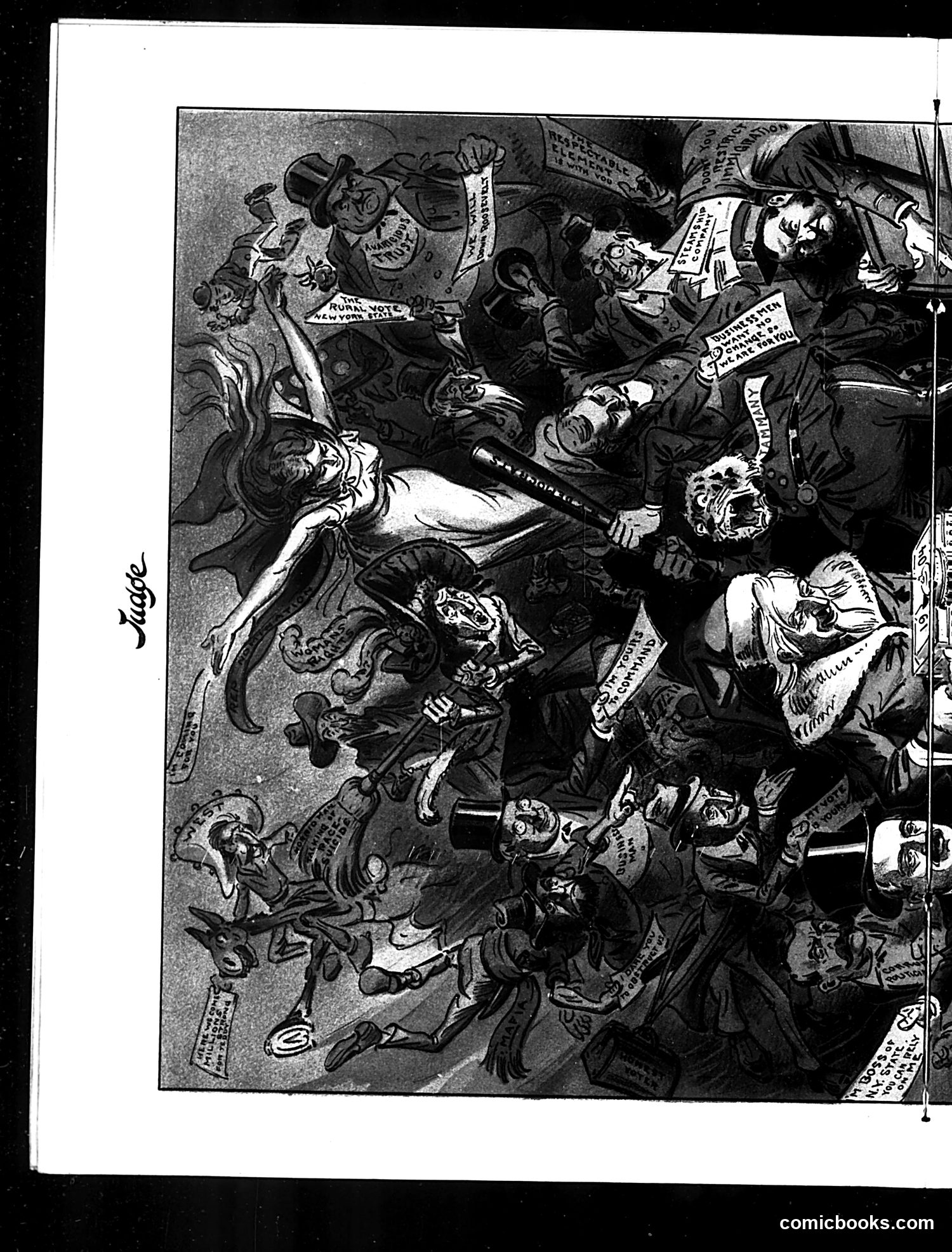
This appears to be a satirical Judge magazine cartoon depicting a chaotic scene with multiple figures engaged in conflict or mayhem. The image shows various caricatured characters with labels (visible but difficult to read clearly in this reproduction), suggesting commentary on specific political or social figures of the era. The style and composition—crowded figures in dynamic, aggressive poses—is typical of Judge's political satire. However, without being able to clearly read the individual labels and text ribbons throughout the cartoon, I cannot definitively identify which specific political figures, events, or issues this addresses. The overall tone suggests criticism of political corruption, infighting, or social disorder, common themes in Judge's satirical work. More legible source material would be needed for precise identification of the targets and specific satirical point.
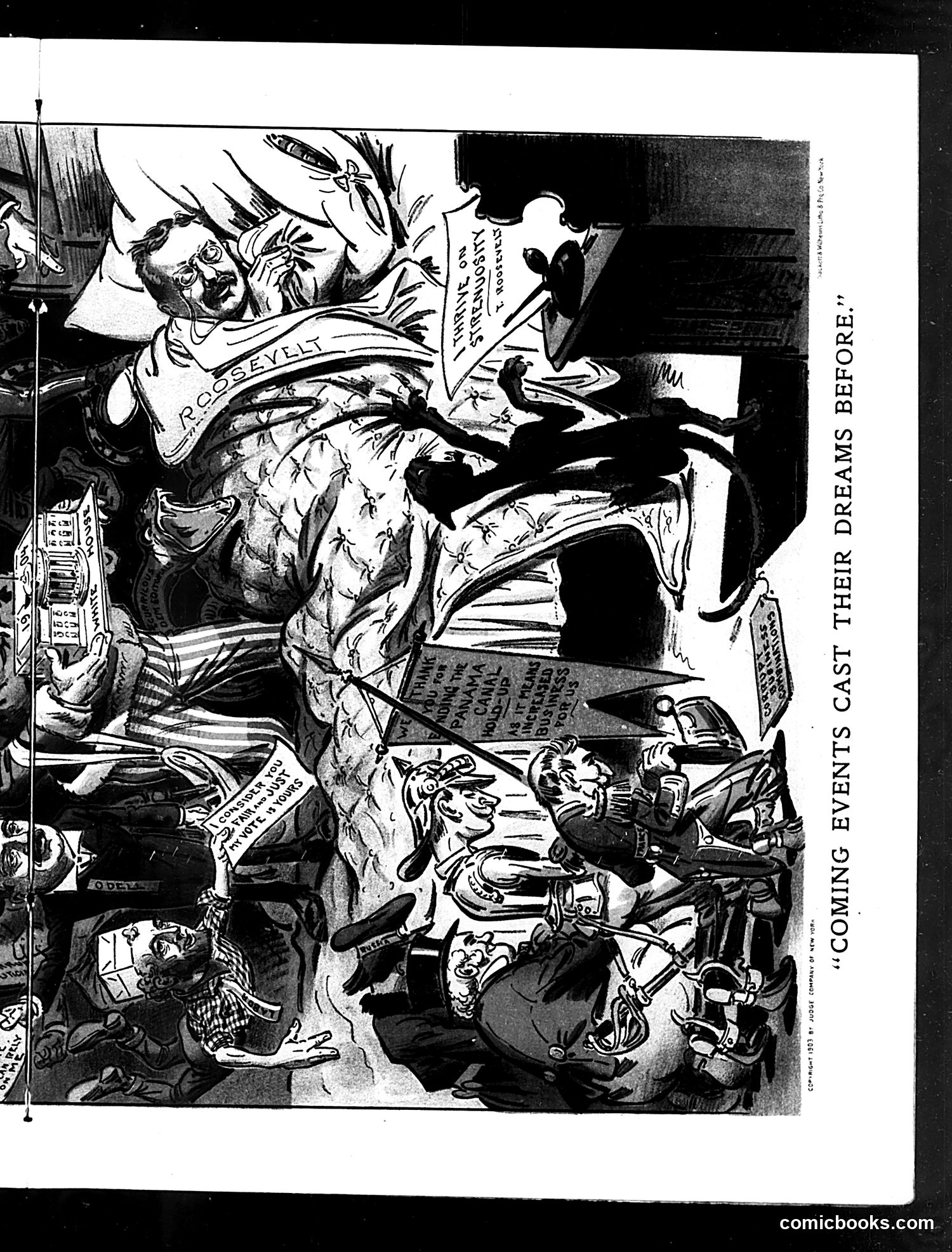
This page shows a satirical cartoon titled **"Coming Events Cast Their Dreams Before!"** The image depicts what appears to be a nightmarish or prophetic dream sequence, with multiple figures in period dress surrounding a central prone figure on a bed. The composition is crowded and chaotic, using typical political cartoon conventions—exaggerated features and caricature. However, the OCR text is severely corrupted and illegible, making it impossible to identify specific political figures, events, or the cartoon's precise satirical target. Without readable text or clearer context, I cannot accurately explain which contemporary politicians or events this references, what the "coming events" being mocked are, or the intended point of the satire. To properly interpret this *Judge* cartoon would require either a clearer OCR pass or the original publication date and caption.
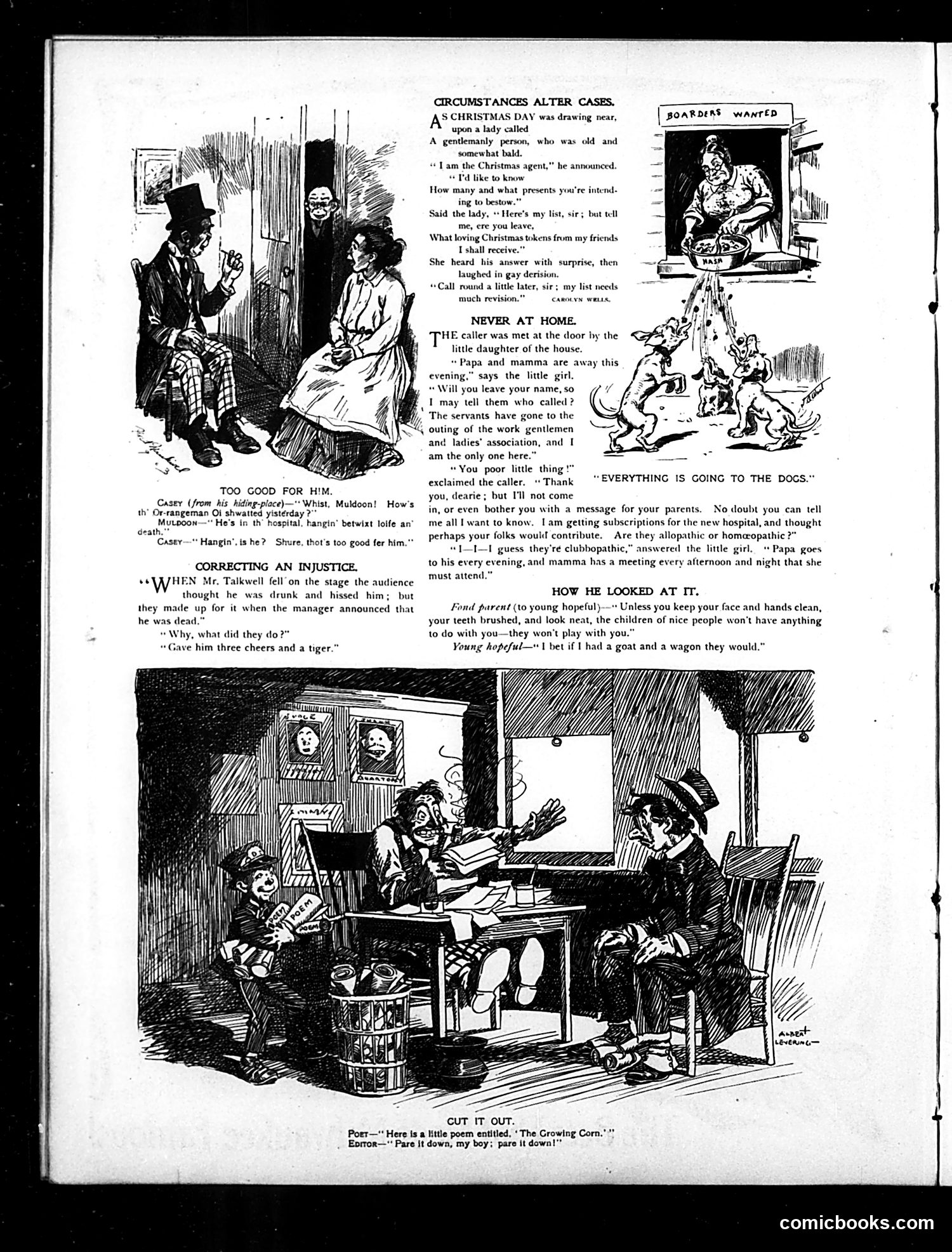
This page contains multiple satirical vignettes critiquing Victorian-era social hypocrisy and class attitudes: **"Circumstances Alter Cases"** mocks a woman's selective charity—she enthusiastically lists Christmas gifts *she'll receive* but dismisses the "Christmas agent" soliciting donations, then revises her giving list downward when learning her friends won't reciprocate. **"Never at Home"** satirizes neglectful wealthy parents who are perpetually absent at social events, leaving their child alone. A hospital fundraiser's patronizing comment about the family being "clubbopathic" (joking they only attend clubs, not medical treatments) exposes class pretension. **"Too Good for Him"** presents dark Irish-inflected humor: workers celebrate a man's death with cheers, suggesting he deserved it. **"Correcting an Injustice"** shows similar class mockery—an actor hissed when appearing drunk gets applause when announced dead. **"How He Looked at It"** depicts a father warning his son that cleanliness ensures friendships, but the boy notes a goat and wagon would work better—suggesting material possessions matter more than virtue. The page critiques shallow materialism, parental neglect, and the arbitrariness of social approval.
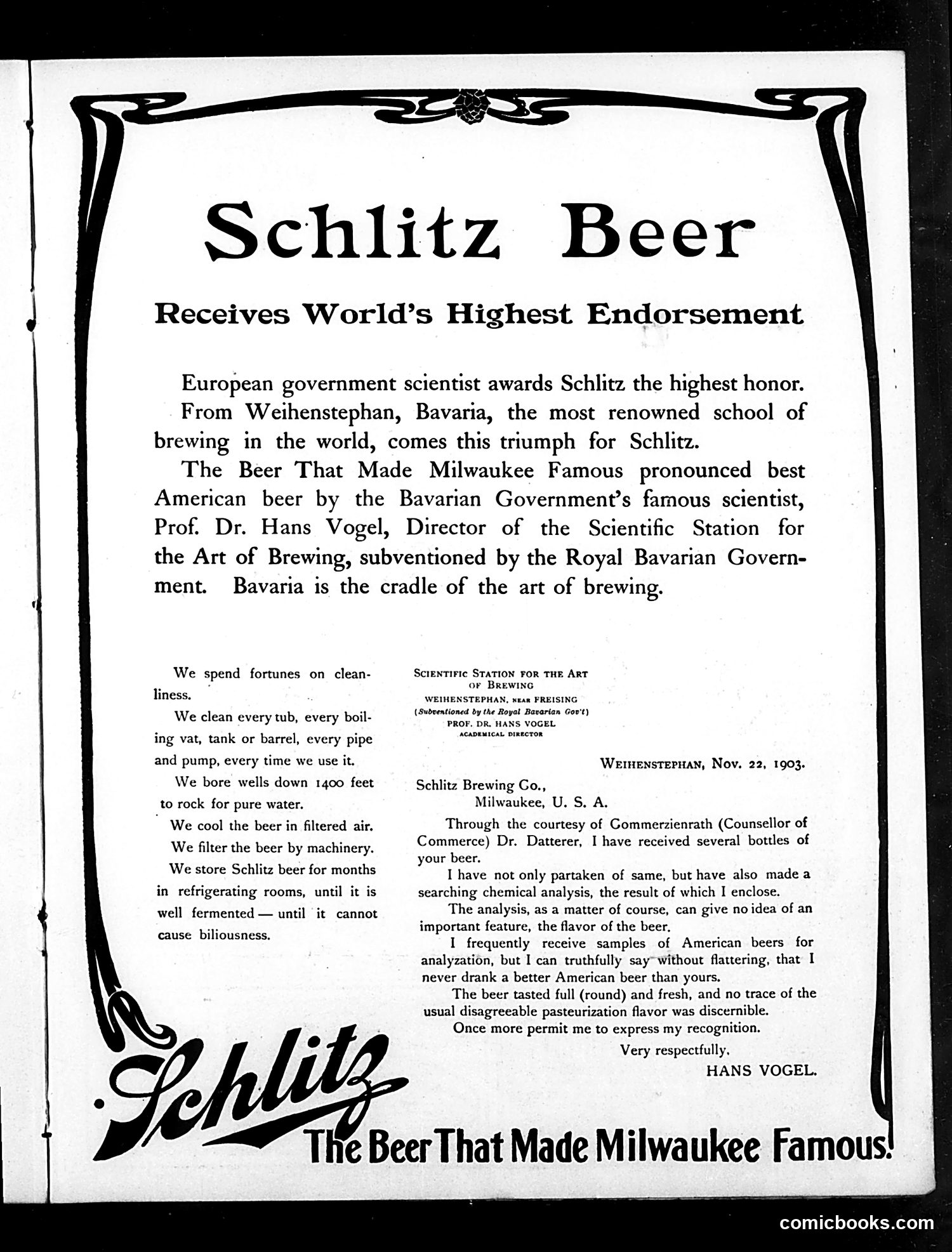
This is a full-page **advertisement**, not satire or cartoon content. It presents Schlitz Beer's marketing claim: that a prestigious Bavarian brewing scientist, Prof. Dr. Hans Vogel, endorsed it as the finest American beer. The ad reproduces what appears to be Vogel's actual letter from November 1903, praising Schlitz's purity, freshness, and superiority to other American beers he'd tested. The left column lists Schlitz's manufacturing practices (deep wells for water, filtering, refrigeration) to establish scientific credibility. For modern readers: This leverages **German authority** on brewing—Bavaria was genuinely renowned for beer science—to market an American product. The endorsement strategy was common in early 1900s advertising. The emphasis on cleanliness and "no pasteurization flavor" reflects contemporary concerns about beer quality and food safety. "The Beer That Made Milwaukee Famous" became Schlitz's actual slogan, reflecting Milwaukee's major brewing industry status.
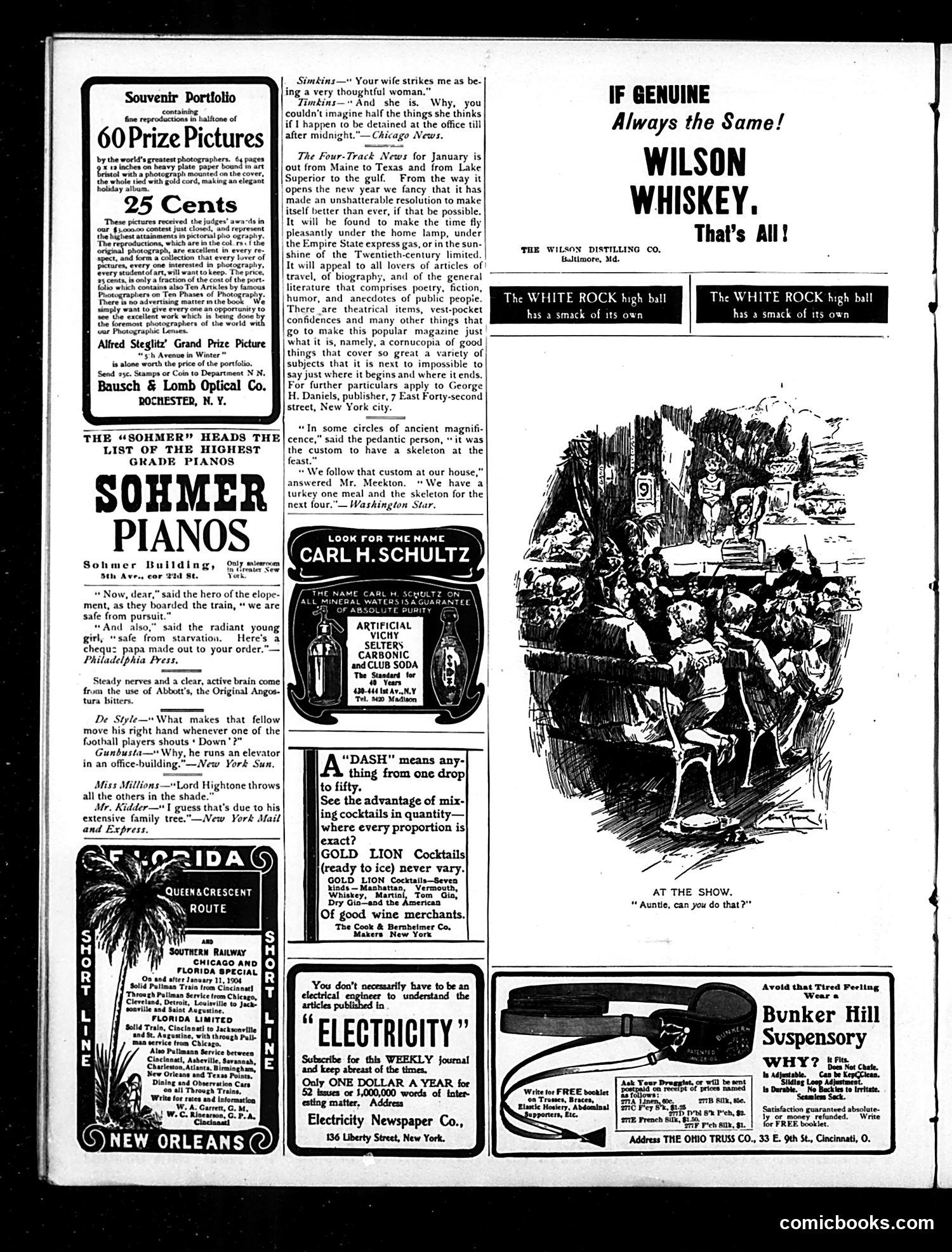
This page is primarily vintage advertising with one small cartoon titled "At the Show" in the lower right, captioned "Auntie, can you do that?" The cartoon depicts a theatrical scene where an elderly woman (labeled "Auntie") is being invited to perform acrobatic feats by performers. The satire appears to target either: (1) the social awkwardness of being put on the spot at public entertainments, or (2) possibly poking fun at elderly people being pressured into undignified physical stunts for amusement. The rest of the page consists of period advertisements for pianos, optical equipment, travel routes, whiskey, and other products typical of early 20th-century magazines. The text snippets are brief anecdotes and jokes, unrelated to the cartoon itself.
This is primarily an **advertising page** from Judge magazine, not a political cartoon. The page contains several brief humorous anecdotes and multiple product advertisements. The small jokes scattered throughout use dated conventions: one mocks a prospective bride for accepting a proposal ("good enough for her son"), another uses a "persimmon needs frost" metaphor about an actor, and a third plays on a woman's sarcasm about her suitor leaving early. The dominant content is **advertising**: Club Cocktails, Angostura Bitters, Glenn's Sulphur Soap (for dandruff treatment), Ed. Pinaud's perfume, Bond & Lilliard whiskey, and most prominently, **Milwaukee Beer** and **Grape-Nuts cereal**. The Grape-Nuts ad includes a testimonial claiming the food restored memory and health to a formerly ill Canadian man—a common early-20th-century marketing tactic using pseudo-medical claims. There is **no significant political satire** on this page. It reflects period advertising practices and social humor conventions rather than commentary on current events.
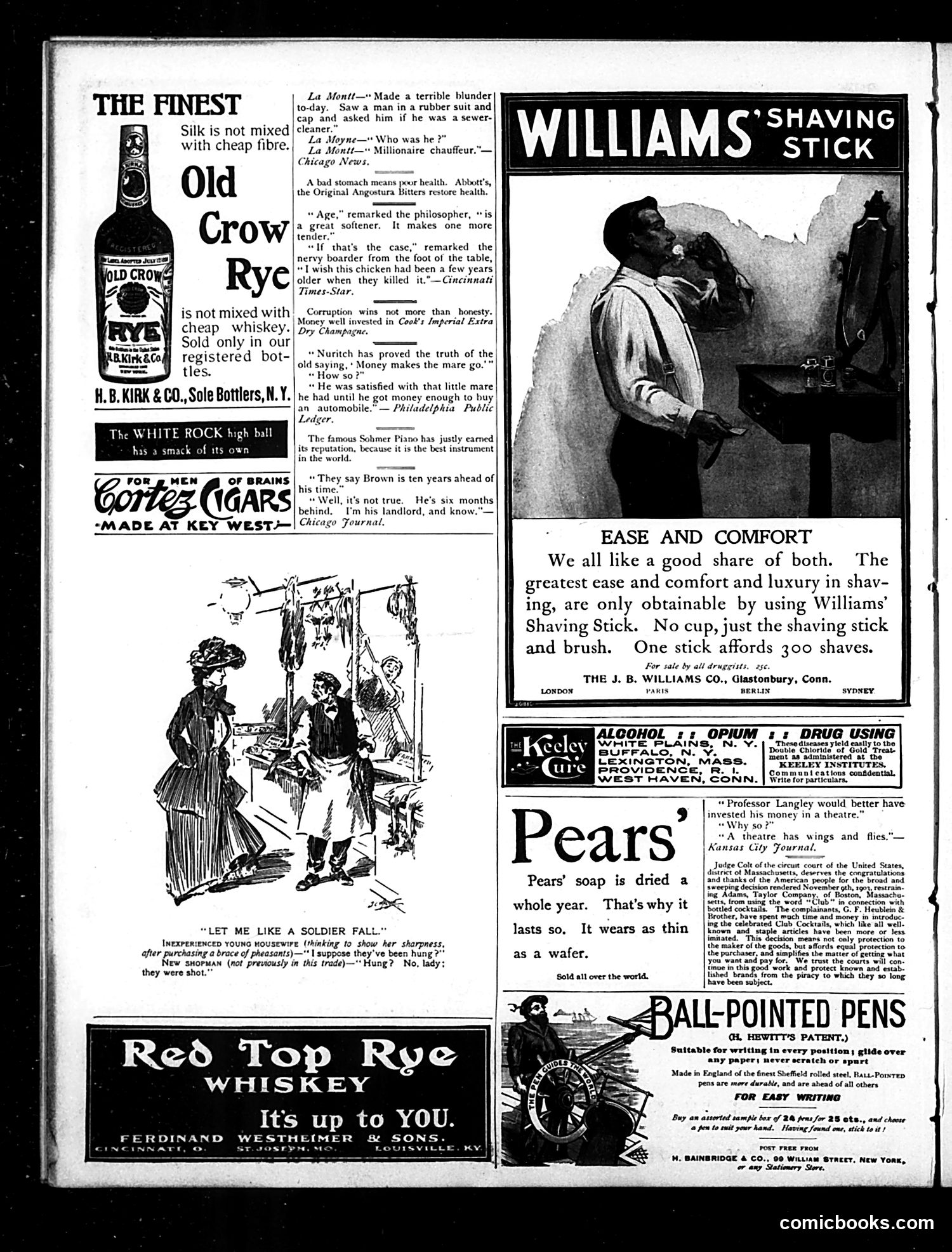
This page is primarily **advertisements** with a few short jokes interspersed. The cartoons are minimal. The main visual content is a single cartoon captioned "LET ME LIKE A SOLDIER FALL," depicting an inexperienced young housekeeper who, when asked if pheasants have been "hung" (aged), replies they were "shot" instead—misunderstanding the culinary term as a reference to execution method. The rest consists of product advertisements for whiskey (Old Crow Rye, Red Top Rye), cigars, pianos, shaving products, and soap. Several include brief jokes playing on wordplay or social observations—such as one about a "millionaire chauffeur" mistaken for a sewer cleaner, or quips about money and romance. The page reflects early 20th-century American consumer culture and humor, with no apparent political satire. It's typical of *Judge*'s mix of light humor and commercial content.
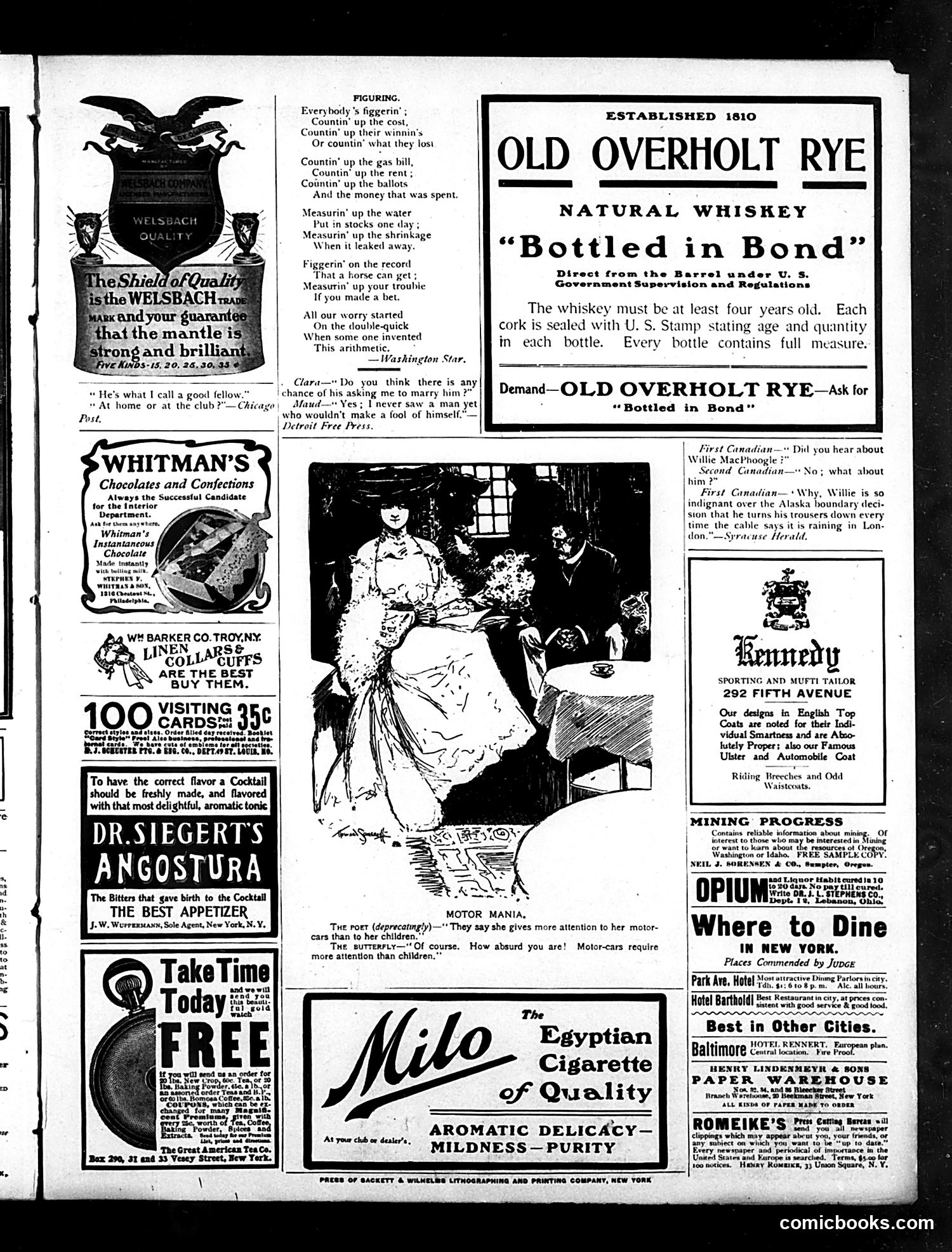
This page is primarily **advertising** with one satirical poem and several comic vignettes mixed throughout. The main illustrated cartoon, titled "MOTOR MANIA," depicts a fashionably dressed woman neglecting her children to fuss over her motorcar. The poet's caption jokes that motorcars require "more attention than children"—satire on the newly wealthy's obsession with automobiles as status symbols and the perceived neglect of parental duties. This reflects early 1900s anxieties about modern technology disrupting traditional family values. A secondary joke about "Willie MacPhoog" mocks Canadian sensitivity over the Alaska boundary dispute, a contemporary diplomatic issue. The remaining content consists of product advertisements (Old Overholt Rye whiskey, Whitman's chocolates, Dr. Siegert's bitters, Milo cigarettes, etc.) interspersed with brief humorous verses about people "figuring" costs and measurements—likely referencing accounting during economic uncertainty, though the specific context is unclear from the image alone.
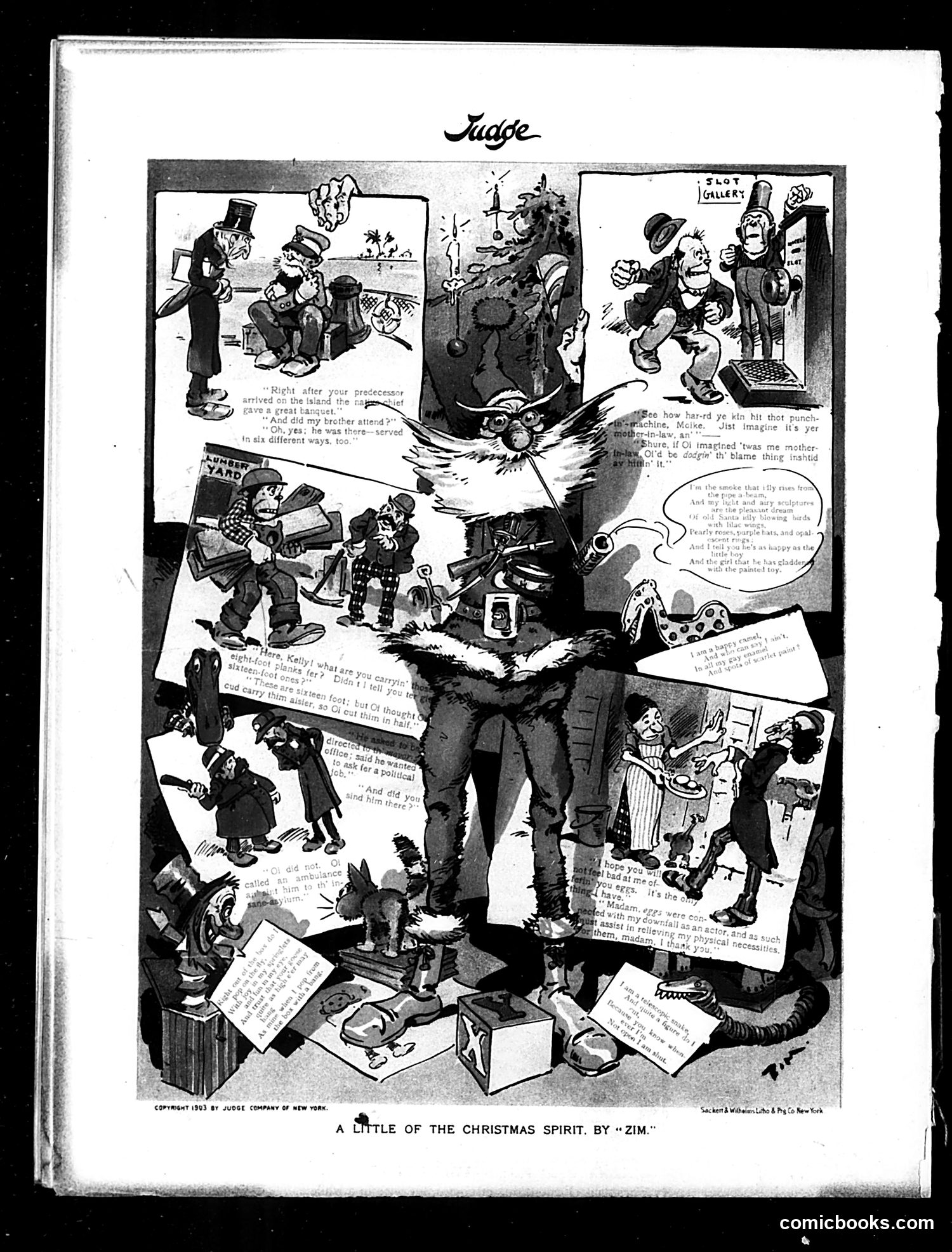
This composite cartoon by "Zim" uses a central figure—appearing to be a wealthy or powerful man—surrounded by smaller vignettes depicting various Christmas scenarios. The satirical point seems to contrast the stated "Christmas spirit" of generosity and goodwill with the harsh realities of early 1900s urban life: poverty, labor disputes, political corruption, and social inequality. The surrounding scenes likely show street children, workers, beggars, and common folk experiencing hardship during the holiday season, while the well-dressed central figure represents those with means who ignore or fail to address these problems. The title's ironic tone suggests Judge magazine is critiquing the hypocrisy between Christmas ideals and actual social conditions—a common Progressive-era satirical theme mocking the wealthy's indifference to poverty.

I cannot reliably interpret this page. The image is almost entirely black or extremely underexposed, making any cartoon artwork, caricatures, or illustrations essentially invisible. While the OCR text confirms this is from *Judge* magazine (visible in the footer as "comicbooks.com"), I cannot discern: - What figures or caricatures appear - What political or social references are depicted - What the intended satire or joke might be - Any text content beyond the website attribution To provide accurate historical analysis as requested, I would need a clearer, properly exposed version of this page. The current image quality prevents me from following your accuracy-first instruction.