
A complete issue · 16 pages · 1903
Judge — December 12, 1903
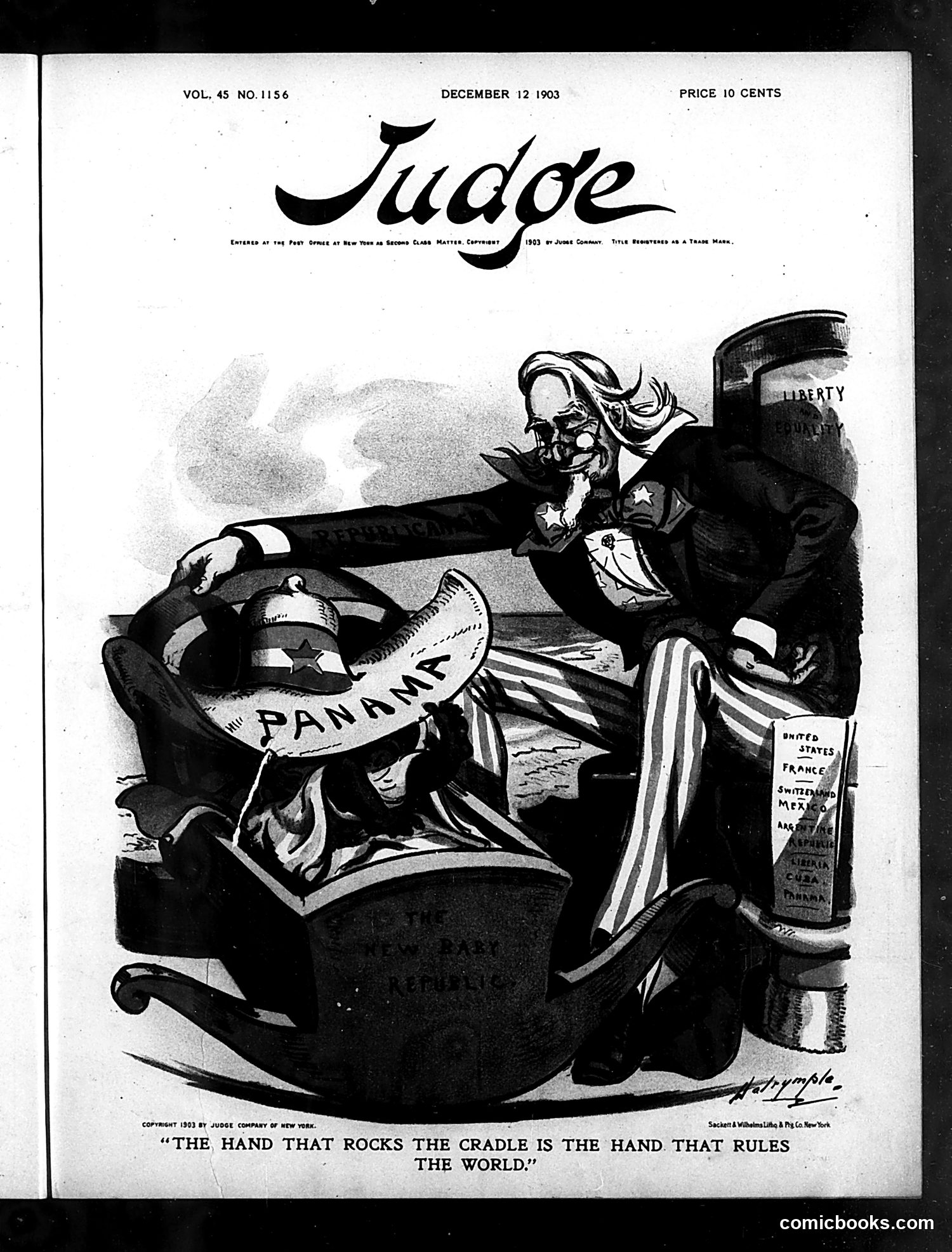
This political cartoon satirizes American interventionism in Latin America. An elderly Uncle Sam figure (representing the U.S.) rocks a cradle containing a figure labeled "Panama" while holding a bottle labeled with various Latin American nations (United States, France, Switzerland, Mexico, etc.). The caption reads: "The Hand That Rocks the Cradle Is the Hand That Rules the World." The cartoon critiques U.S. control over Panama following the 1903 Panamanian independence (backed by American interests to enable the Canal construction). The surrounding bottle suggests America's broader imperial ambitions across the hemisphere. The satire implies the U.S. is paternalistically "managing" weaker nations rather than respecting their independence.
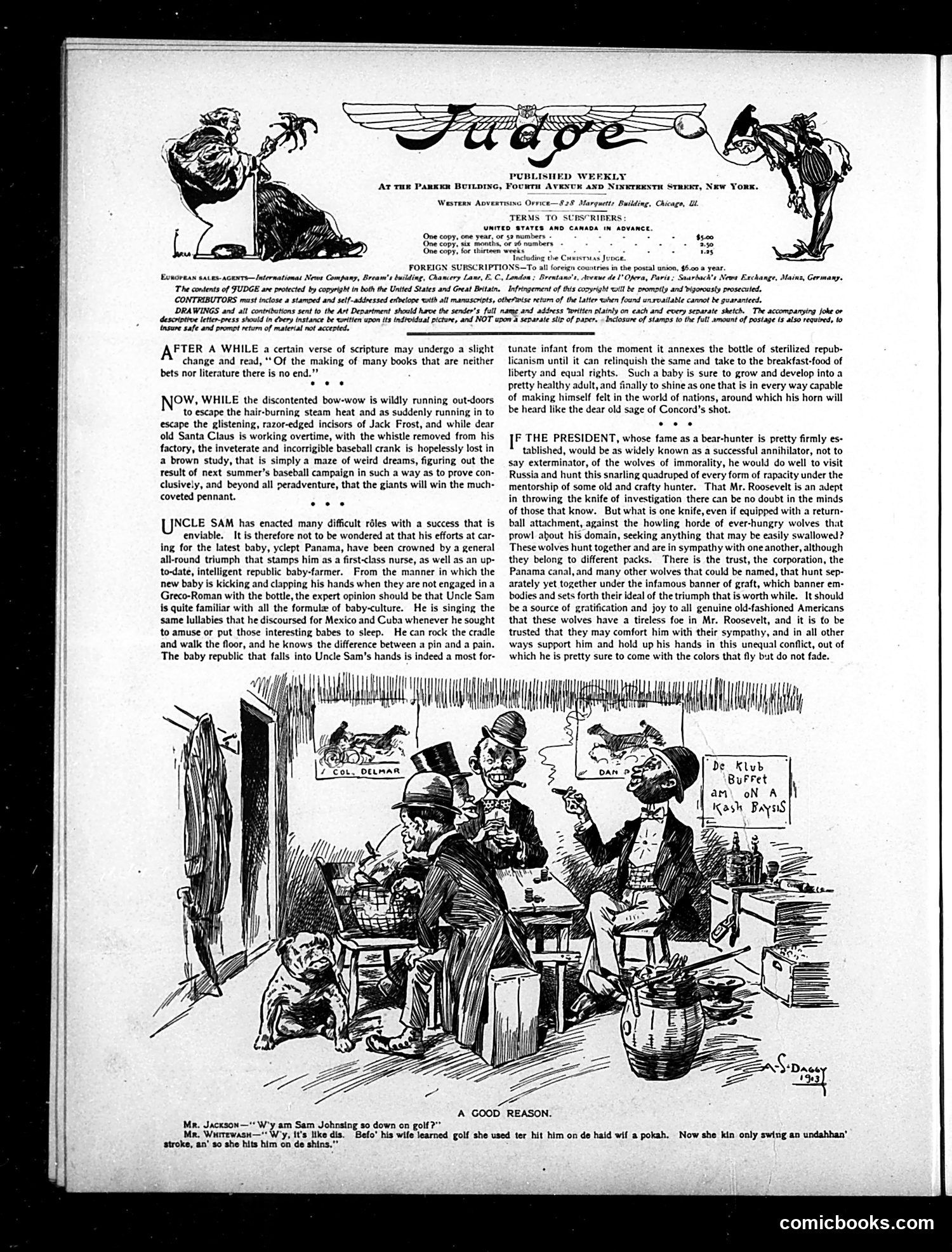
This page contains three distinct pieces: **Top Editorial Section**: Discusses President Roosevelt's reputation as a "bear-hunter" and uses extended metaphor comparing wolves (his political enemies) to game animals. The text argues Roosevelt should be comfortable handling political conflicts, suggesting he's equipped to manage both literal and figurative threats. **Bottom Cartoon ("A Good Reason")**: Depicts men discussing golf. The caption indicates "Sam Johnson" used his wife's golf club to hit his wife on the head with a poker, and she responded by swinging an "undahanded stroke" at him. This appears satirizing domestic disputes, though the exact political or social reference remains unclear without additional context. The overall tone suggests early 20th-century commentary on Roosevelt's political style and masculine reputation.
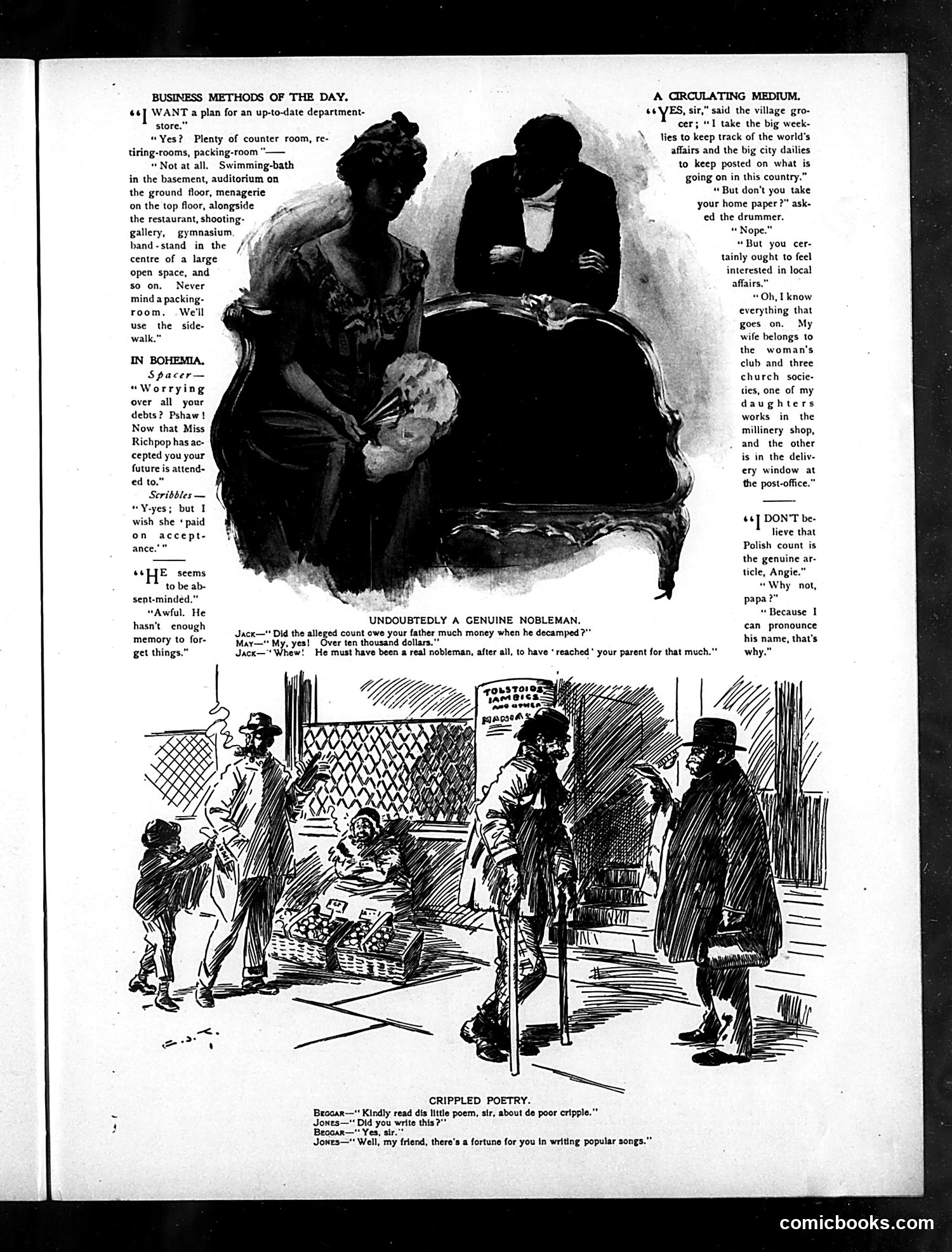
This page contains three satirical pieces from early 20th-century Judge magazine: **Top section ("Business Methods of the Day")**: Dialogue between characters discussing modern department store design and urban awareness, mocking how people consume newspapers and local gossip rather than substantive information. **Middle cartoon ("Undoubtedly a Genuine Nobleman")**: Depicts a conversation between Jack and Max about a count's debts. The satire targets wealthy European nobility who arrive in America claiming ancient lineage while being financially irresponsible—a common theme ridiculing Old World aristocracy's decline and Americans' susceptibility to titles. **Bottom cartoon ("Crippled Poetry")**: Shows street vendors or performers, satirizing commercial exploitation of sentimental poetry. The dialogue suggests writers cynically produce popular verses for profit rather than artistic merit. All three pieces reflect Judge's typical focus: critiquing consumer culture, social pretension, and commercialism in turn-of-the-century America.
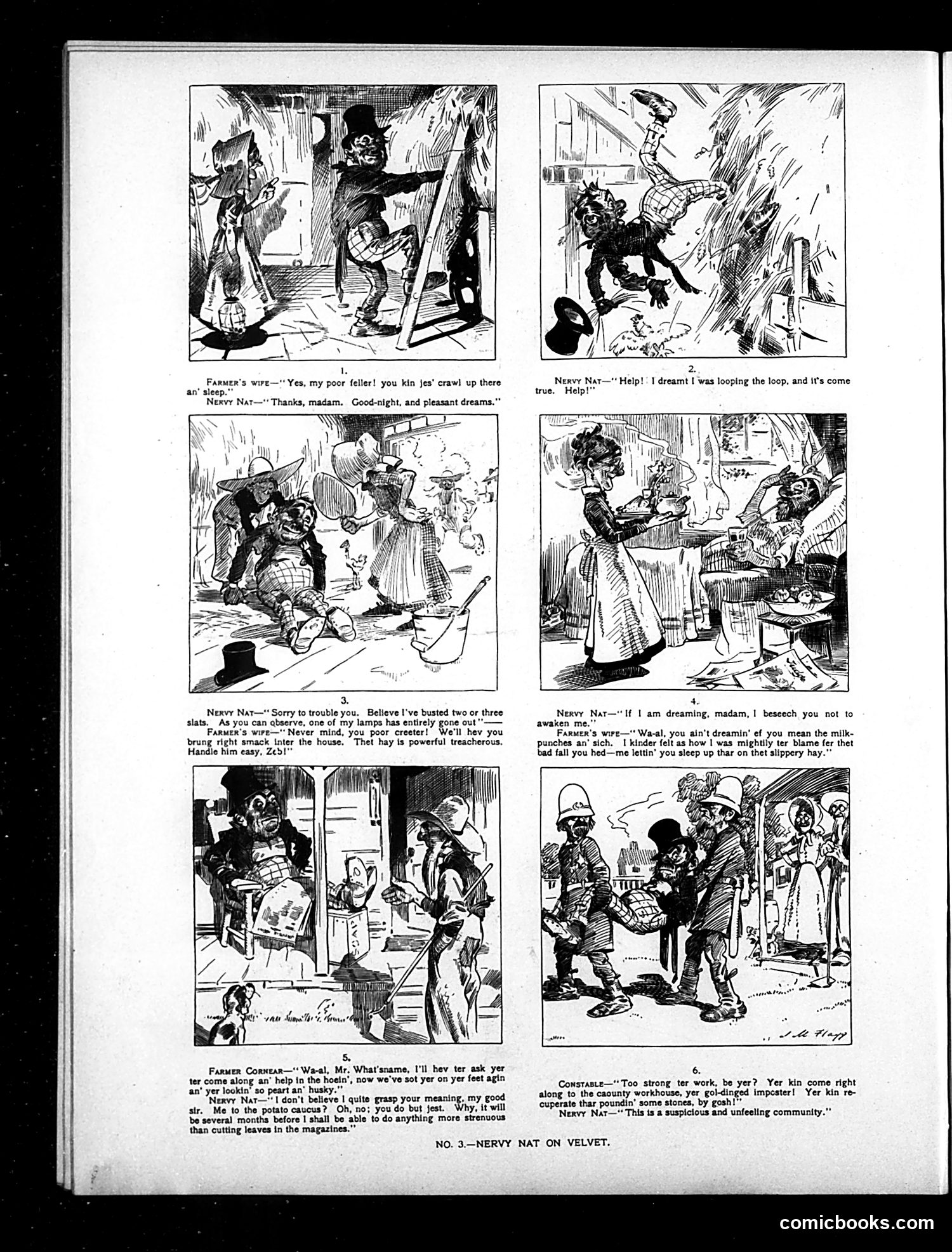
This appears to be a multi-panel comic strip titled "Nervy Nat on Velvet" featuring a mischievous character named Nervy Nat causing domestic chaos. The narrative follows Nat disrupting a farmer's household—looping the loop on a roof (endangering himself), breaking items, and creating general mayhem while the farmer's wife and farmhand attempt damage control. The satire targets working-class domestic life and rural settings, mocking both Nat's reckless behavior and the adults' exasperated attempts at discipline. The humor relies on physical comedy and the character's persistent troublemaking despite warnings. Without specific historical markers, the exact date is unclear, but the style suggests early-to-mid 20th century American popular humor focused on generational conflict and rural domesticity.
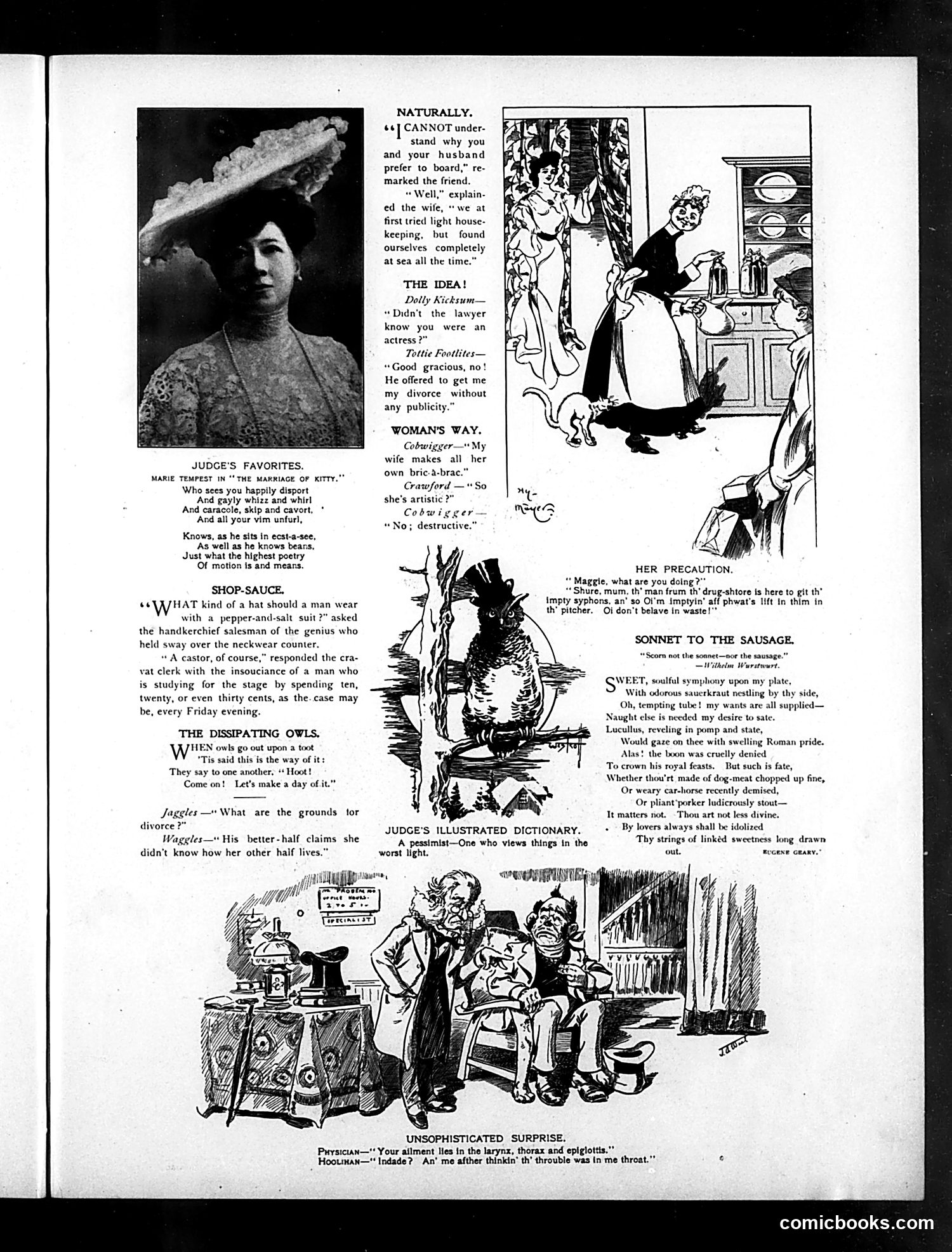
This page from Judge presents a collection of light humor pieces typical of early 20th-century American satirical magazines. **Key Content:** The main items mock everyday domestic and social situations: - **Marriage jokes** ridicule couples' living arrangements and the absurdities of divorce proceedings, including references to actresses seeking discretion - **Gender humor** pokes fun at wives' domestic habits and decorative arts - **Class/accent humor** features Irish domestic servants (Maggie) using exaggerated brogue—reflecting the era's casual ethnic stereotyping common in American publications - **Professional pretension** satirizes a cravat clerk posturing as artistic while discussing haberdashery - **The "Sonnet to the Sausage"** is humorous verse elevating lowbrow food, mocking overly serious literary sentiment The page includes Marie Tempest (an actual actress of the period) referenced in "Judge's Favorites," a visual cartoon about a physician's medical misunderstanding, and predictable puns about owls and divorce. **Overall tone:** Genteel satirical humor targeting middle-class manners, marital discord, and professional pretentiousness—with casual period racism evident in the servant character portrayal.
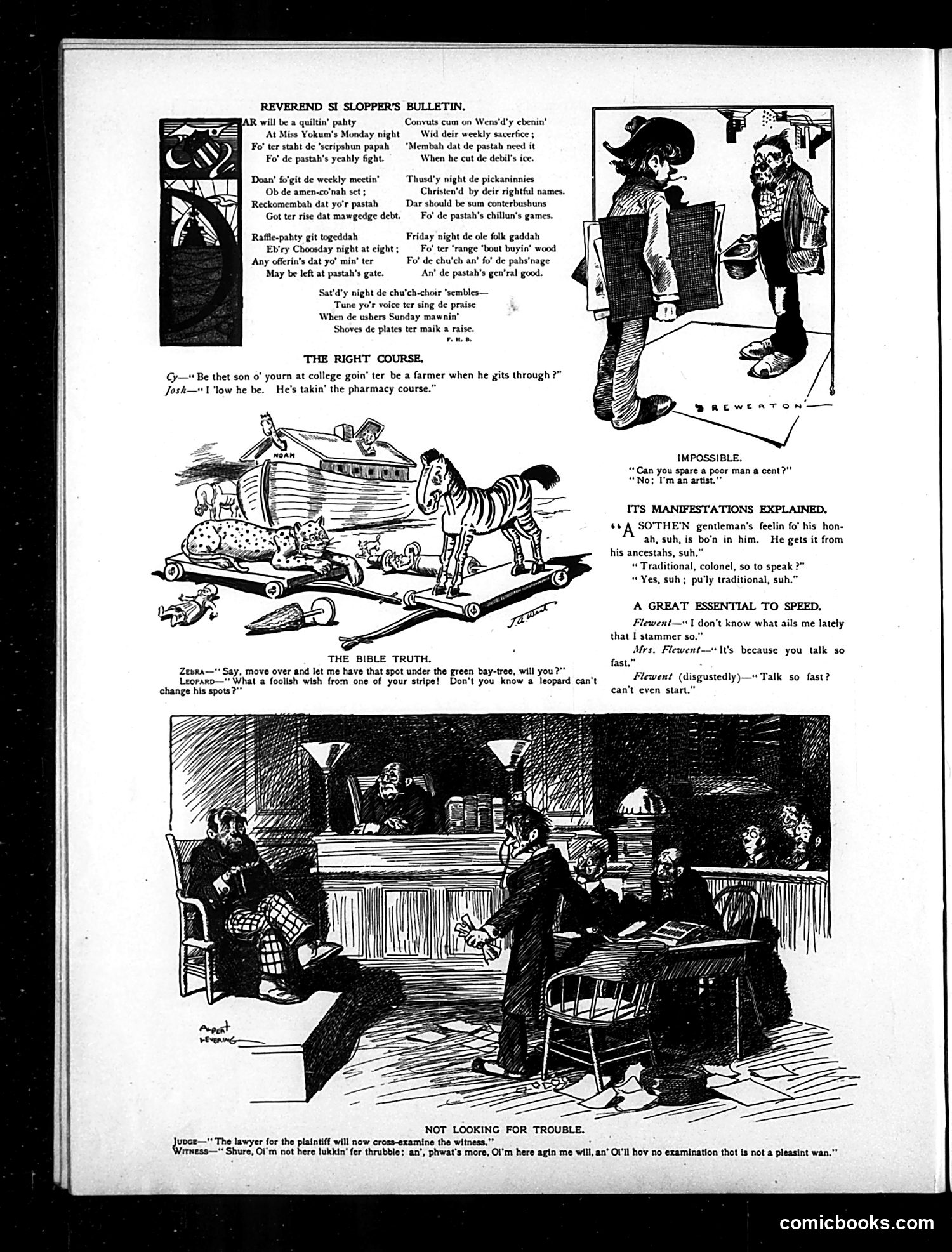
This page contains early 20th-century satirical humor relying heavily on racial stereotypes now considered offensive. **"Reverend Si Slopper's Bulletin"** mocks African American Southern church life through exaggerated dialect, depicting a pastor primarily concerned with fundraising and material self-interest rather than spiritual matters. **"The Right Course"** jokes about a college student choosing pharmacy over farming—a commentary on changing rural/urban economic patterns. **"The Bible Truth"** uses the proverb "a leopard can't change his spots" to suggest inherent, unchangeable character traits (likely a racial reference). **"Not Looking for Trouble"** features an Irish immigrant (indicated by dialect) in a courtroom, portrayed as combative and unreliable—reflecting anti-Irish prejudice common to the era. **"Impossible" and other brief jokes** mock artists and nervous stutterers. The page demonstrates how Judge used ethnic and racial caricature as standard satirical currency. Modern readers should recognize these reflect period prejudices, not contemporary standards.
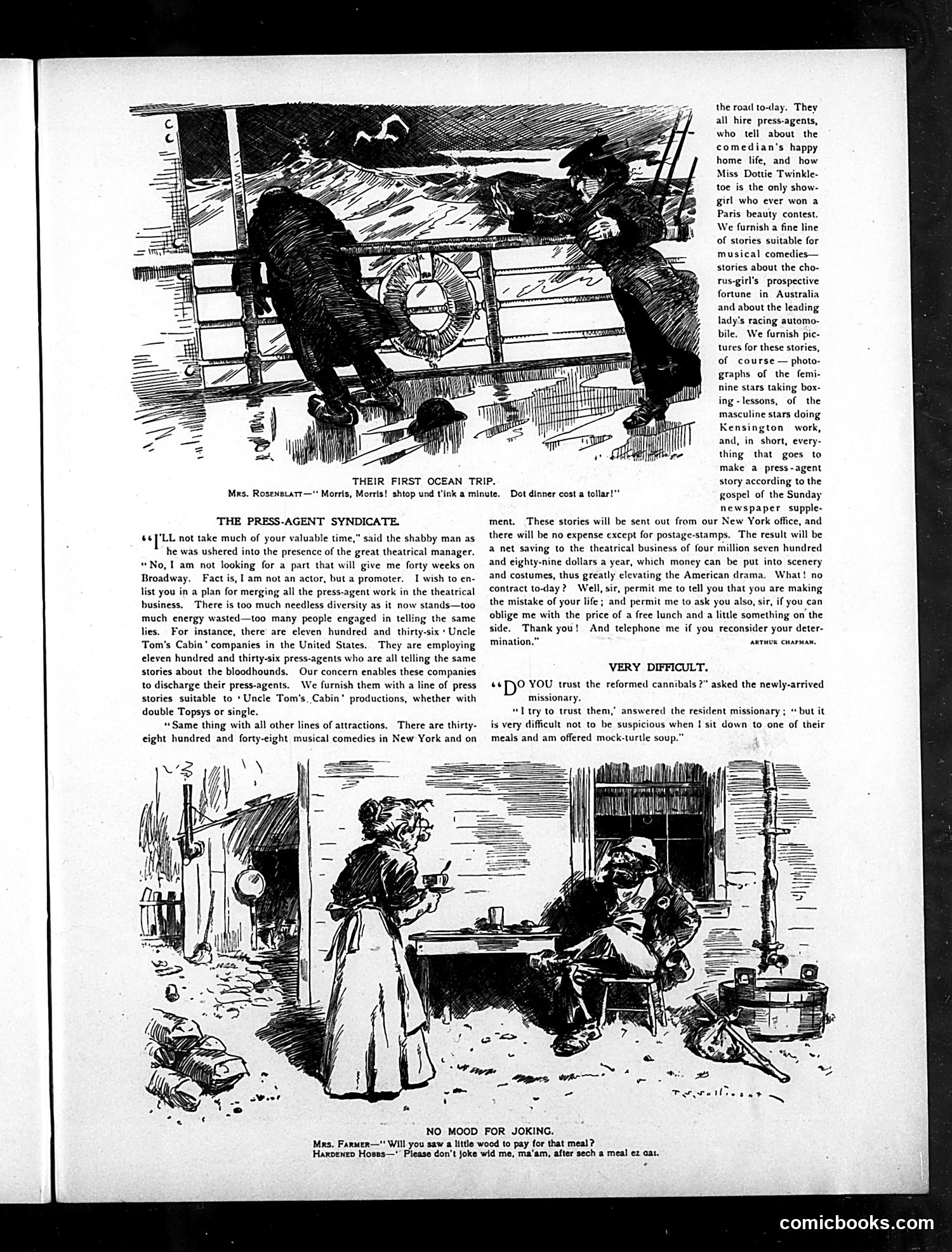
This page contains three separate satirical pieces: **"Their First Ocean Trip"** (top cartoon): A domestic humor joke about Mrs. Rosenblatt on a ship, concerned about expense ("Did dinner cost a dollar?"). **"The Press-Agent Syndicate"** (main text article): Satirizes theatrical publicity practices. A shabby promoter pitches a scheme to consolidate press-agent work across hundreds of theater companies—arguing that instead of each show hiring individual publicists to spread the same exaggerated stories (chorus girls winning beauty contests, leading ladies with racing cars), one centralized syndicate could supply pre-written promotional material. The satire mocks both the redundancy and dishonesty of theatrical publicity and the financial desperation of the promoter himself (who ends by panhandling for lunch money). **"Very Difficult"** and **"No Mood for Joking"** (bottom cartoons): Quick gag comics. The first jokes about missionary work among cannibals and suspicious "mock-turtle soup." The second depicts a farmer too exhausted from eating to work for payment, resisting jokes about his meal. The page satirizes turn-of-century show business hucksterism and publicity culture.
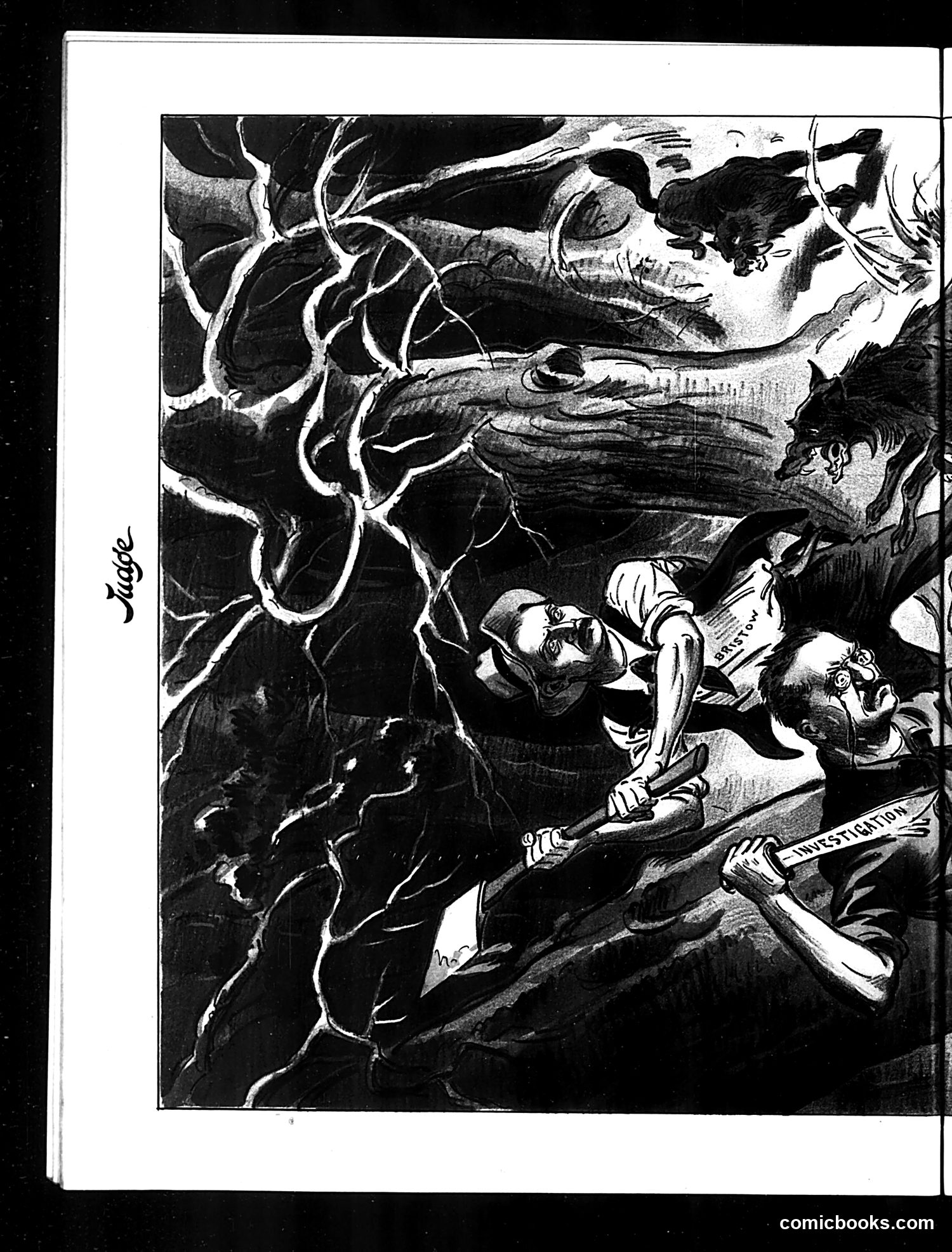
This appears to be a dramatic political cartoon from *Judge* magazine showing a supernatural or apocalyptic scene. The image depicts what looks like demonic or monstrous figures emerging from darkness, with lightning bolts prominently featured. In the foreground, several human figures appear to be reacting with alarm or attempting to defend themselves with tools or weapons. The signature "Judge" appears on the left margin, confirming the publication. However, without visible text labels identifying specific political figures or clearer context about which historical moment this references, I cannot definitively explain which political events or personalities are being satirized. The theatrical, ominous tone suggests commentary on a perceived threat or crisis, but the specific target remains unclear from the image alone. Additional publication date information would be needed for accurate interpretation.
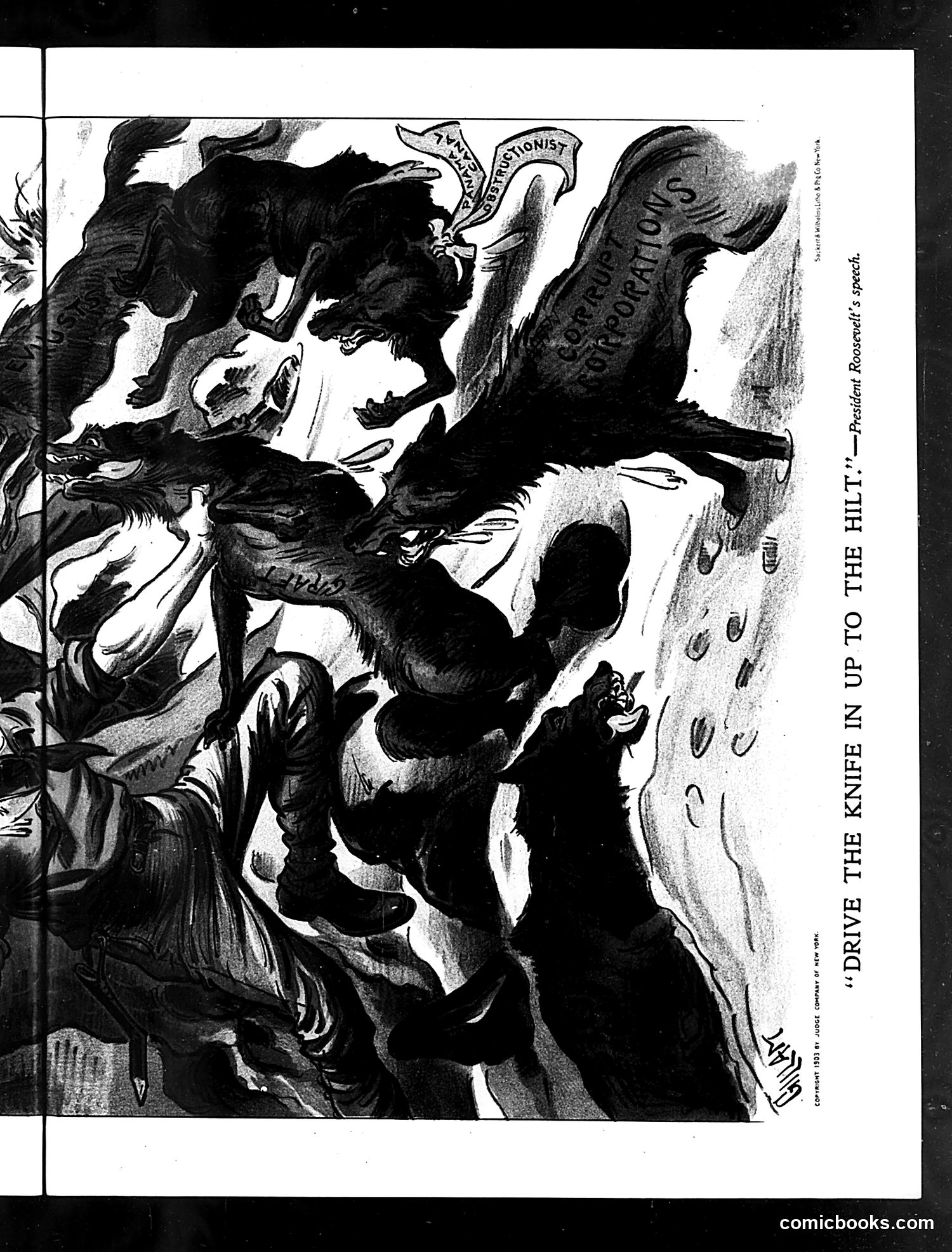
This is a satirical cartoon titled **"Drive the Knife in Up to the Hilt"** by an artist whose signature appears at bottom left. The image depicts a group of figures—appearing to represent different political or social factions—wielding or being associated with a large knife. One figure is labeled "REVISIONIST" on a banner. The cartoon appears to critique **internal political conflict or factional infighting**, using the knife as a metaphor for destructive attacks between groups. The "revisionist" label suggests conflict over ideological interpretation or party direction. Without clearer dates or additional context from *Judge* magazine's publication period, the specific historical reference remains uncertain, though it likely addresses early 20th-century American political divisions.
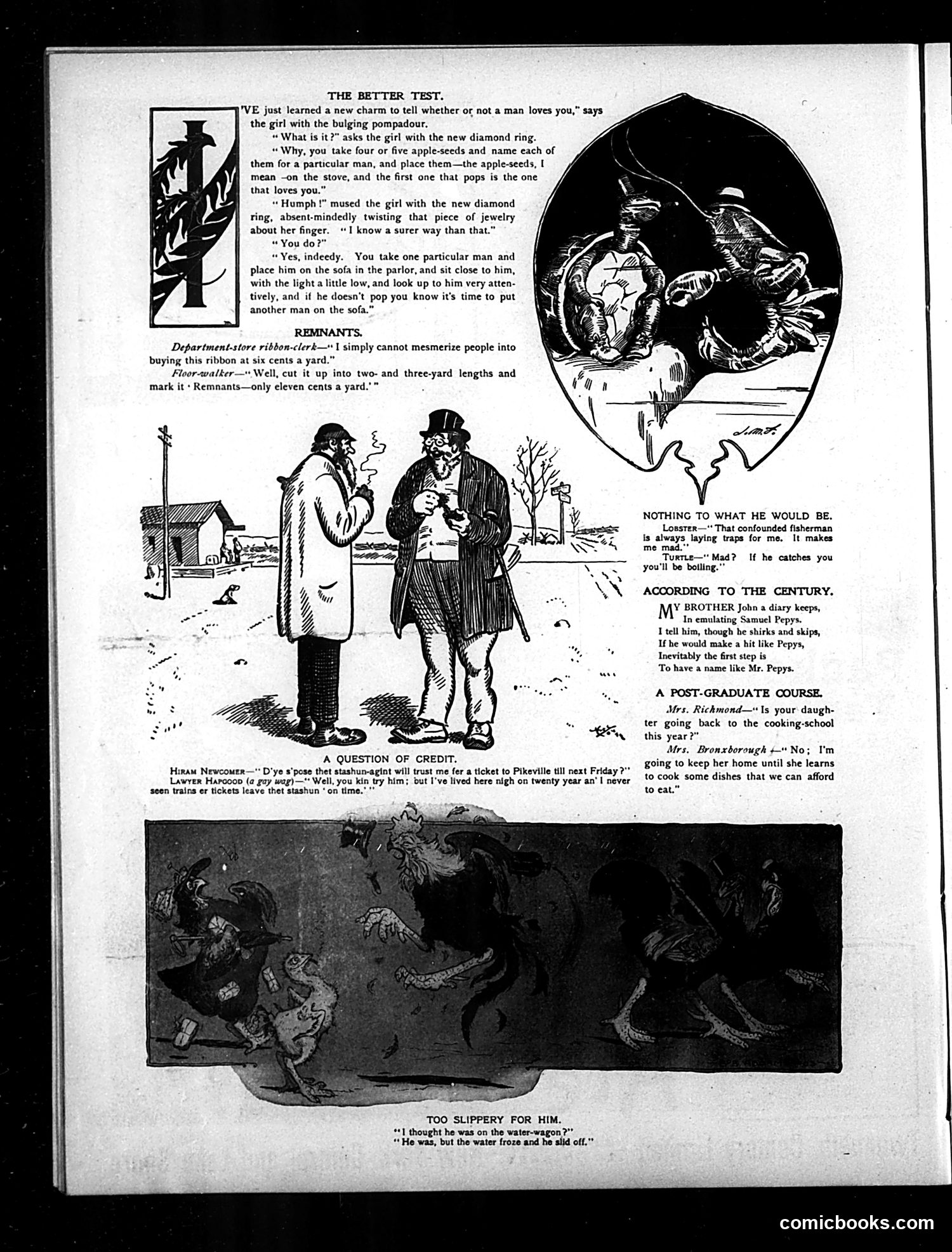
This page contains multiple short satirical pieces typical of early 20th-century humor: **"The Better Test"** mocks romantic courtship rituals. A girl claims apple seeds predict which suitor loves her; another girl cynically counters that the real test is whether a man will propose after being alone with her in dim parlor light—implying women strategically use seduction to secure marriage proposals. **"Remnants"** jokes about retail deception: a department store clerk struggles selling ribbon at fair price until his supervisor suggests repackaging it as discounted "remnants," fooling customers into thinking they're getting a bargain. **"Nothing to What He Would Be"** is a fisherman/lobster pun: a lobster complains about traps, and another warns that if caught, he'll be "boiling"—a dark joke about his fate. The remaining pieces are brief gags about diary-keeping, cooking school, train station credit, and a drunk ("water-wagon") joke. Overall, the page satirizes commercialism, female marriage strategies, retail fraud, and working-class life with gentle, period-appropriate humor.
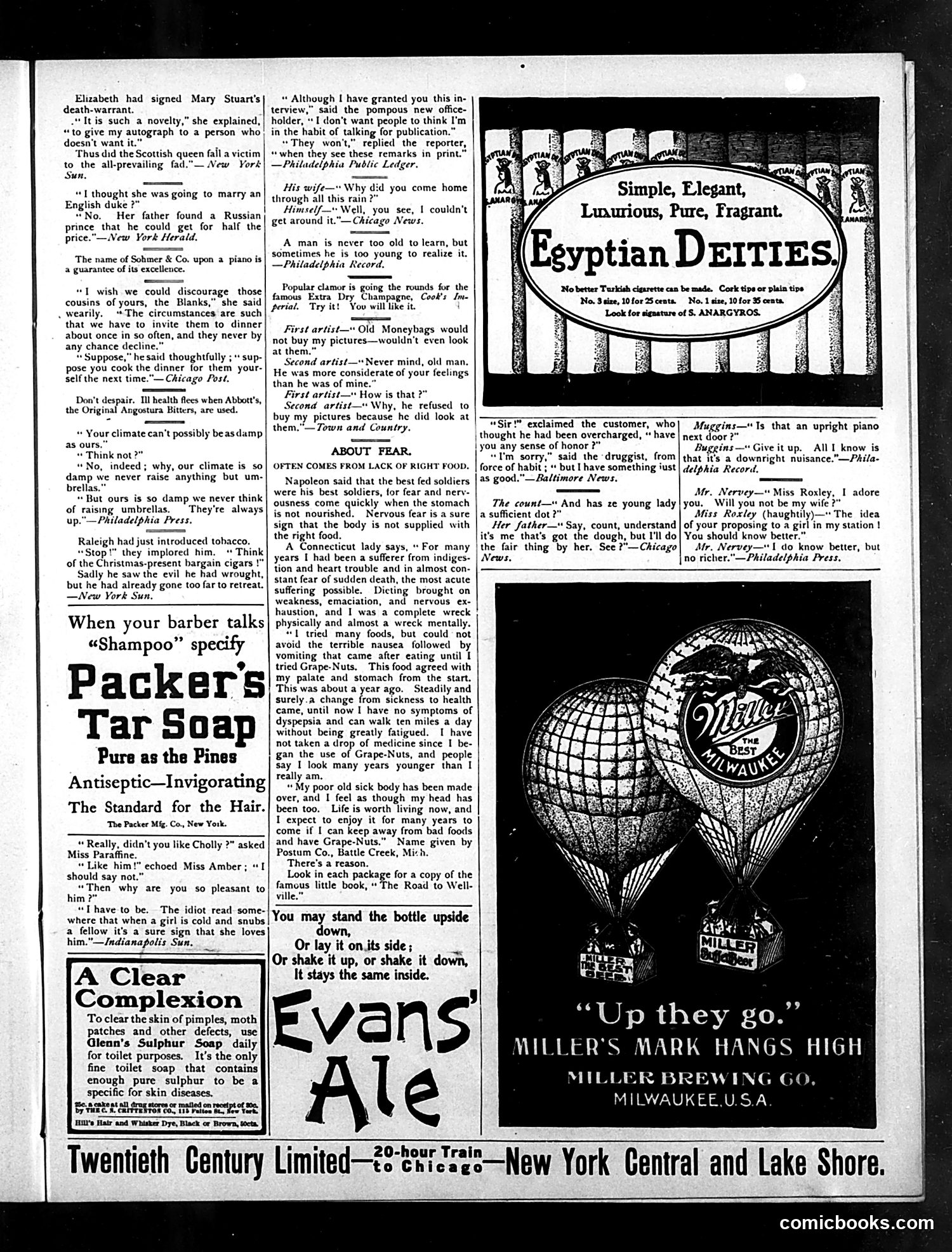
This page from *Judge* magazine contains primarily **short humor pieces and advertisements** rather than political cartoons. The satirical content consists of brief jokes targeting contemporary social absurdities: **Notable satirical pieces:** - A joke about Queen Elizabeth signing Mary Stuart's death warrant, mocking the era's obsession with autographs as fashionable collectibles - Commentary on the tedium of obligatory dinner invitations to boring relatives - A quip about Raleigh introducing tobacco, lamenting the commercial exploitation it would spawn **The humor reflects Gilded Age concerns:** social climbing, courtship conventions, class anxiety, and consumer culture. The jokes are genteel rather than biting—they mock social pretension and modern fads without targeting specific political figures or events. **The page is dominated by period advertisements** (Packer's Tar Soap, Evans Ale, Egyptian Deities cigarettes, Miller's beer), which were the magazine's revenue source and often themselves subjects of mild satire in the era's humor publications.
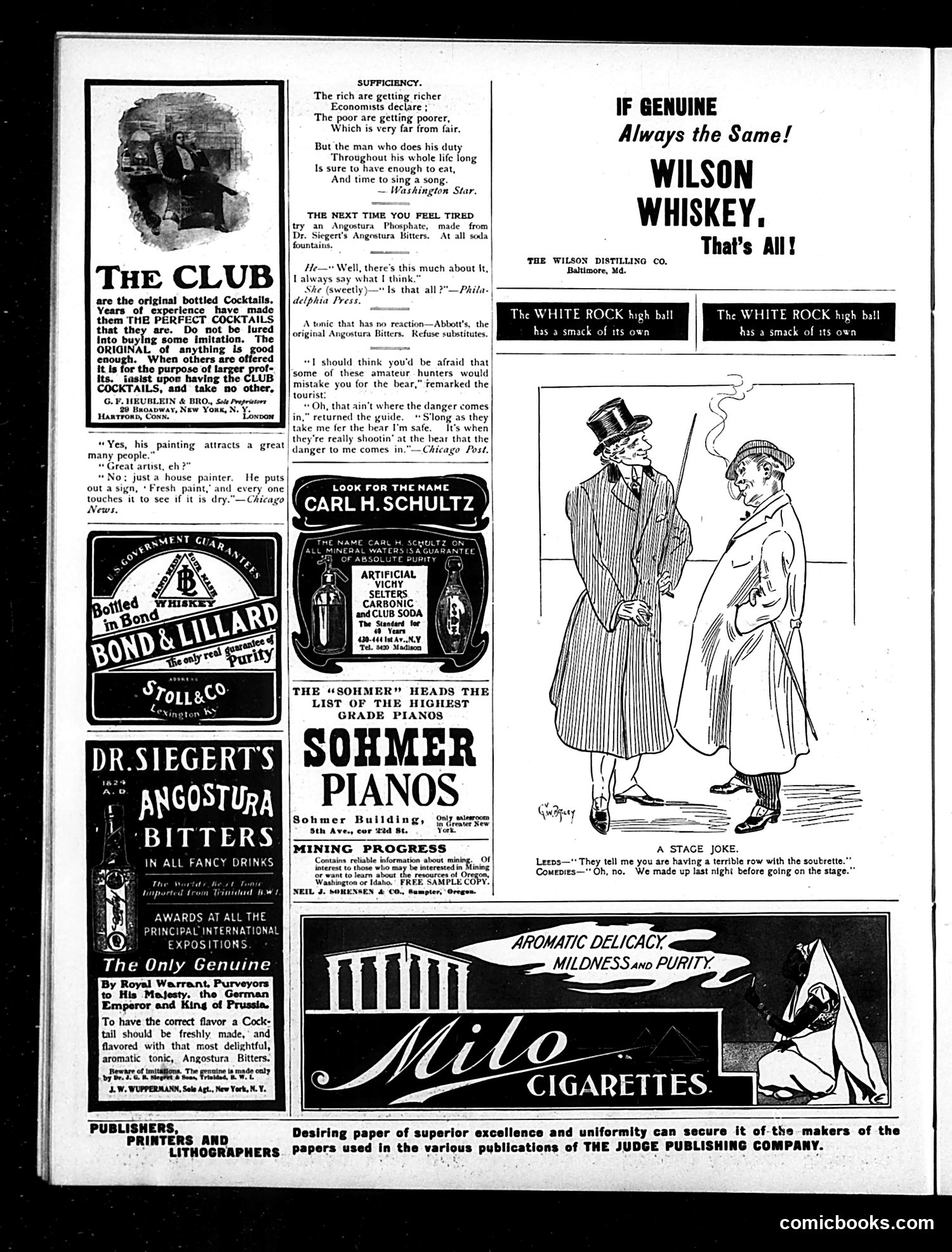
This is primarily an **advertising page** from Judge magazine, with one small cartoon joke embedded among product advertisements. ## The Cartoon The single cartoon titled "A Stage Joke" depicts two theatrical performers discussing a conflict. One asks if the other is having "a terrible row with the soubrette" (a minor female theatrical role). The response—that they "made up last night before going on the stage"—plays on the double meaning: the characters reconciled their personal dispute specifically to maintain professional performance. The humor relies on the contrast between backstage drama and the requirement to present a unified front onstage. ## Context This reflects early 20th-century theatrical culture where personal conflicts among cast members were common but had to be set aside for performances. The joke assumes reader familiarity with theater world dynamics. ## Advertisements The page is dominated by ads for alcoholic beverages (whiskey, bitters, cocktails) and consumer goods (pianos, cigarettes, soda water)—typical Judge content from the pre-Prohibition era. These ads indicate the magazine's affluent readership.
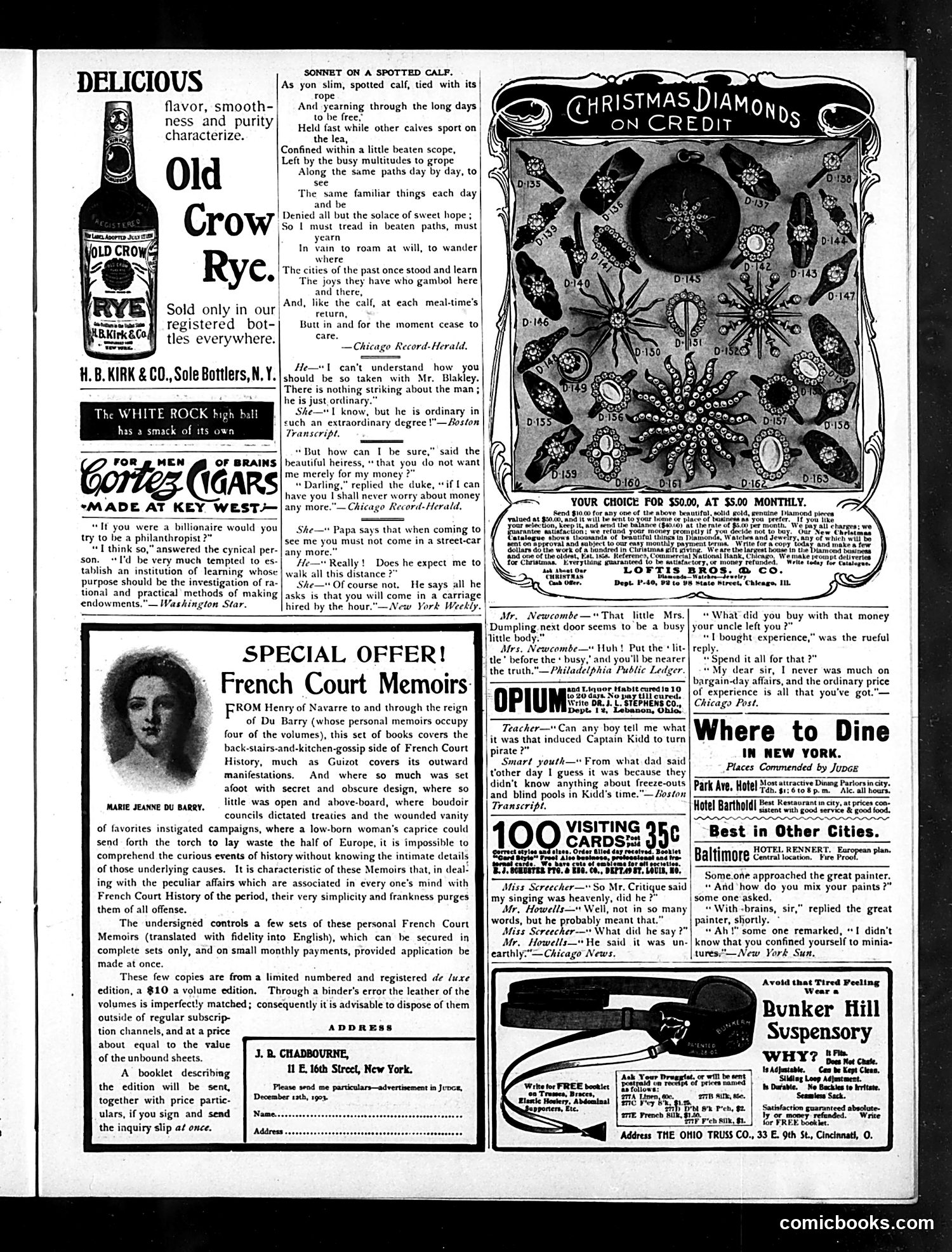
This page is primarily **advertisements and light humor**, not political satire. The content includes: **Advertisements:** - Old Crow Rye whiskey and White Rock beverages - Cortes cigars - Christmas diamonds on credit (central ornate display) - French Court Memoirs book offer - "Where to Dine in New York" restaurant listings - Bunker Hill Suspensory (medical device) **Humor Content:** Short comedic exchanges and verses without clear political messaging: - A cynical joke about billionaires establishing learning institutions - A sentimental poem comparing a confined calf to human constraint - Light romantic/social humor about courtship etiquette and class expectations **No identifiable political cartoons or caricatures appear.** The page represents typical early-20th-century Judge content—mixing advertisements with genteel humor aimed at middle/upper-class readers. The jokes reflect period attitudes about wealth, romance, and social propriety but lack direct political commentary or satirical targets.
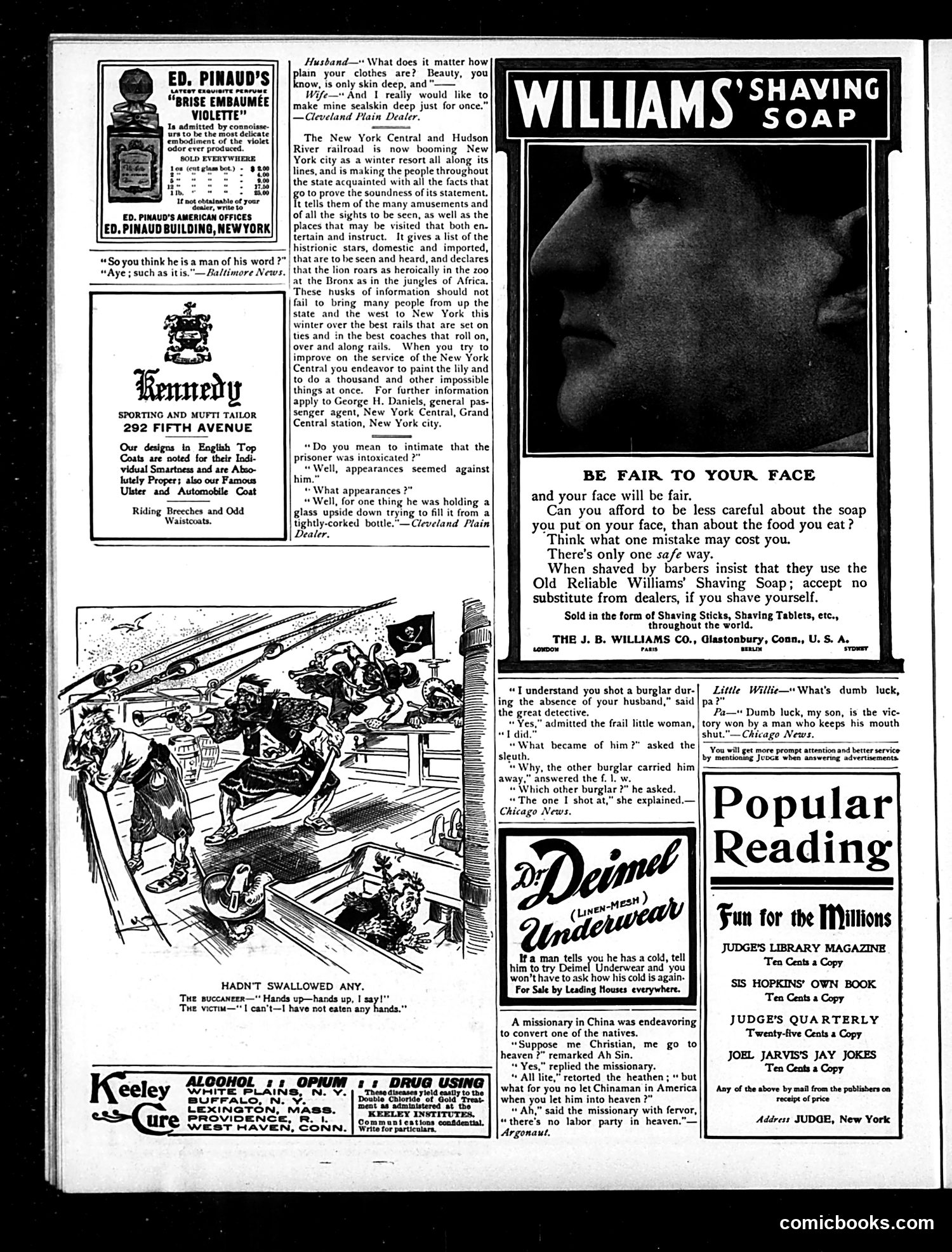
This page from *Judge* magazine contains several standalone jokes and advertisements rather than a unified political cartoon. **The main illustrated cartoon** (bottom left) depicts a pirate encounter: a victim tells a detective he shot a burglar, but "the other burglar carried him away." When asked which burglar he shot, the woman replies "the one I shot at"—the joke being her poor marksmanship. This is a domestic humor piece with no political content. **The other jokes** include wordplay about intoxication, a missionary converting a Chinese convert, and a pirate demanding money from someone who "hadn't swallowed any" (their money). These are light, absurdist humor typical of the era. **The advertisements** promote beauty products (Ed. Pinaud's hair tonic), tailoring services (Kennedy), and Williams' Shaving Soap, which dominates the right side with messaging about self-care. The page contains **no clear political satire or caricature**—it's primarily entertainment and advertising for an early 20th-century general-interest magazine.
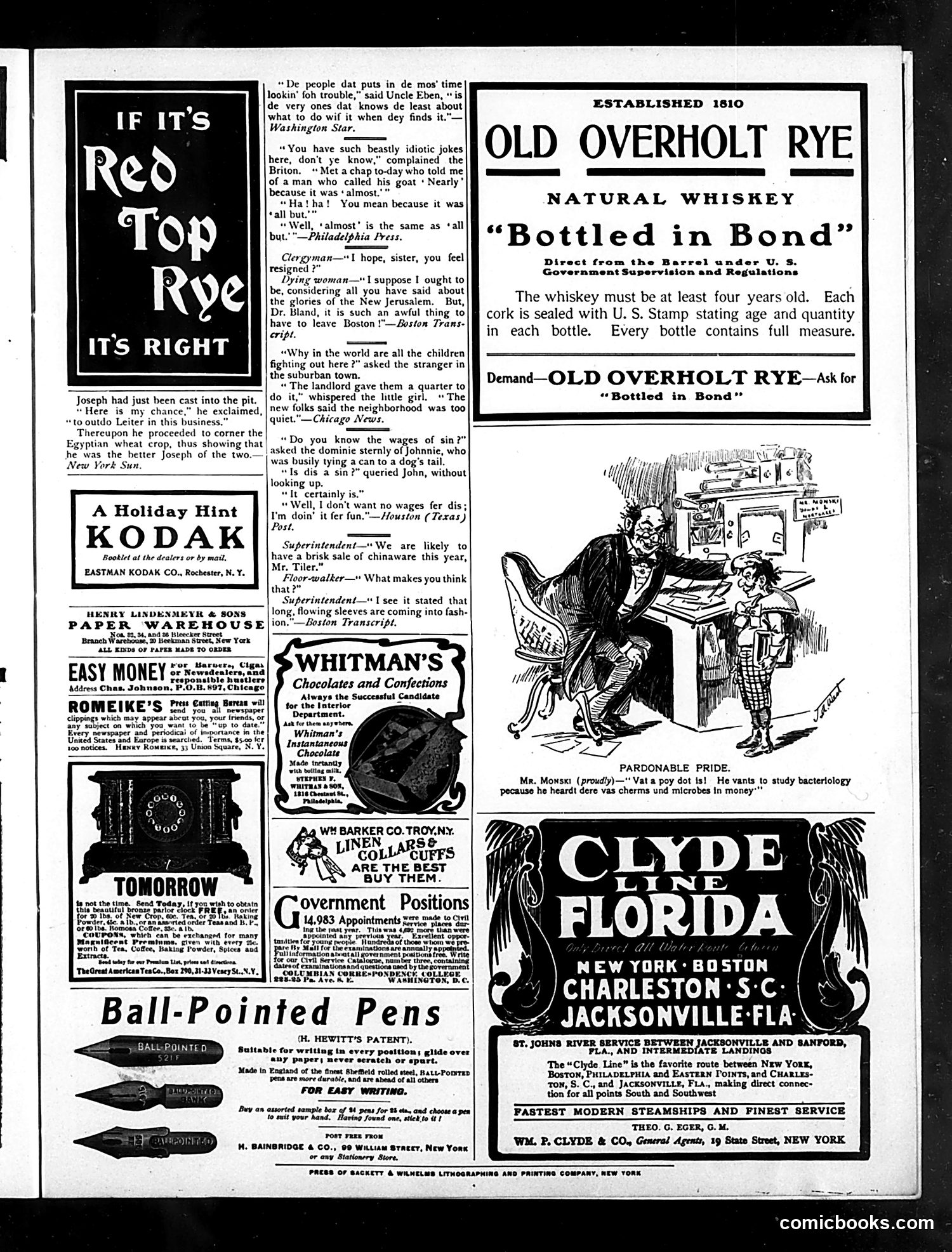
This page consists primarily of **advertisements and joke fillers** typical of Judge magazine. The cartoons are minimal—mostly single-panel jokes presented as text anecdotes with brief accompanying commentary. The jokes reference contemporary American life: a Briton's confusion over wordplay, a dying woman's reluctance to leave Boston, children fighting for hired entertainment, a boy's misdirected morality about sinfulness, and servants anticipating broken dishes from fashionable flowing sleeves. One illustration depicts a humorous bacteriology scenario. The page is dominated by **commercial advertisements** for cameras (Kodak), paper warehouses, clocks, pens, whiskey (Old Overholt Rye), and other goods—reflecting Judge's reliance on paid advertising. The "If It's Red Top Rye—It's Right" advertisement appears as a prominent branded filler. This layout and content mix was standard for early-1900s satirical magazines, blending editorial humor with revenue-generating ads to reach middle-class readers.
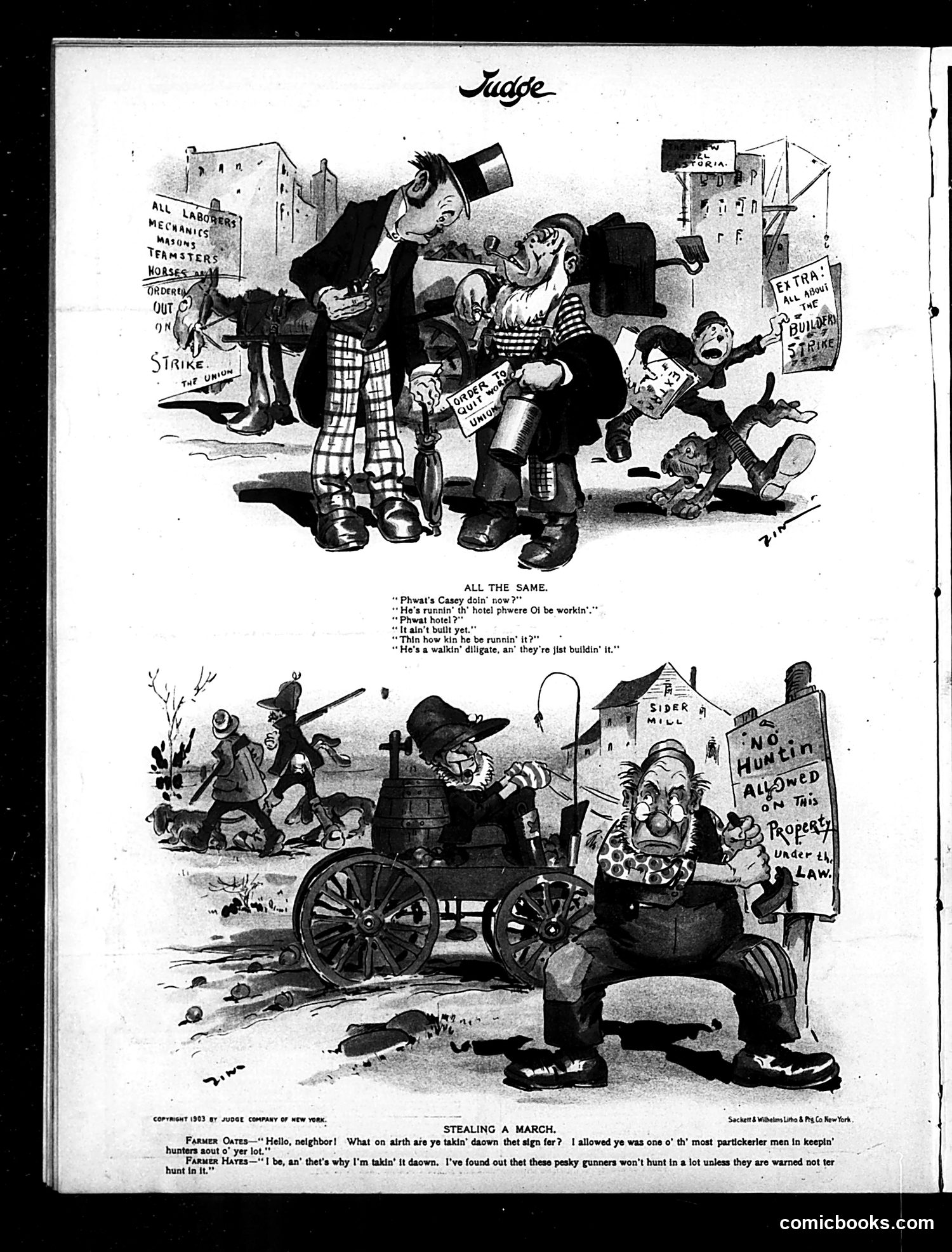
This page contains two separate satirical cartoons mocking Irish-American workers and rural life. **Top cartoon ("All the Same"):** Features exaggerated Irish dialect and caricatures. A man describes his employer Casey as "running" a hotel that hasn't been built yet—Casey is a "walkin' delegate" (a labor union representative who walks around organizing). The satire targets Irish laborers' credulity and malapropisms, while also mocking union organizers as insubstantial or fraudulent figures. **Bottom cartoon ("Stealing a March"):** Depicts two farmers discussing a hunting sign. One farmer removes his "No Hunting Allowed" notice, explaining that removing the prohibition actually *prevents* hunters from trespassing—paradoxically, hunters avoid posted lands, so the sign attracts rather than deters them. The joke plays on reverse psychology and rural shrewdness. Both cartoons rely on ethnic and class-based humor typical of early 1900s American satire, targeting Irish immigrants and rural Americans as figures of mockery.