
A complete issue · 16 pages · 1903
Judge — November 14, 1903
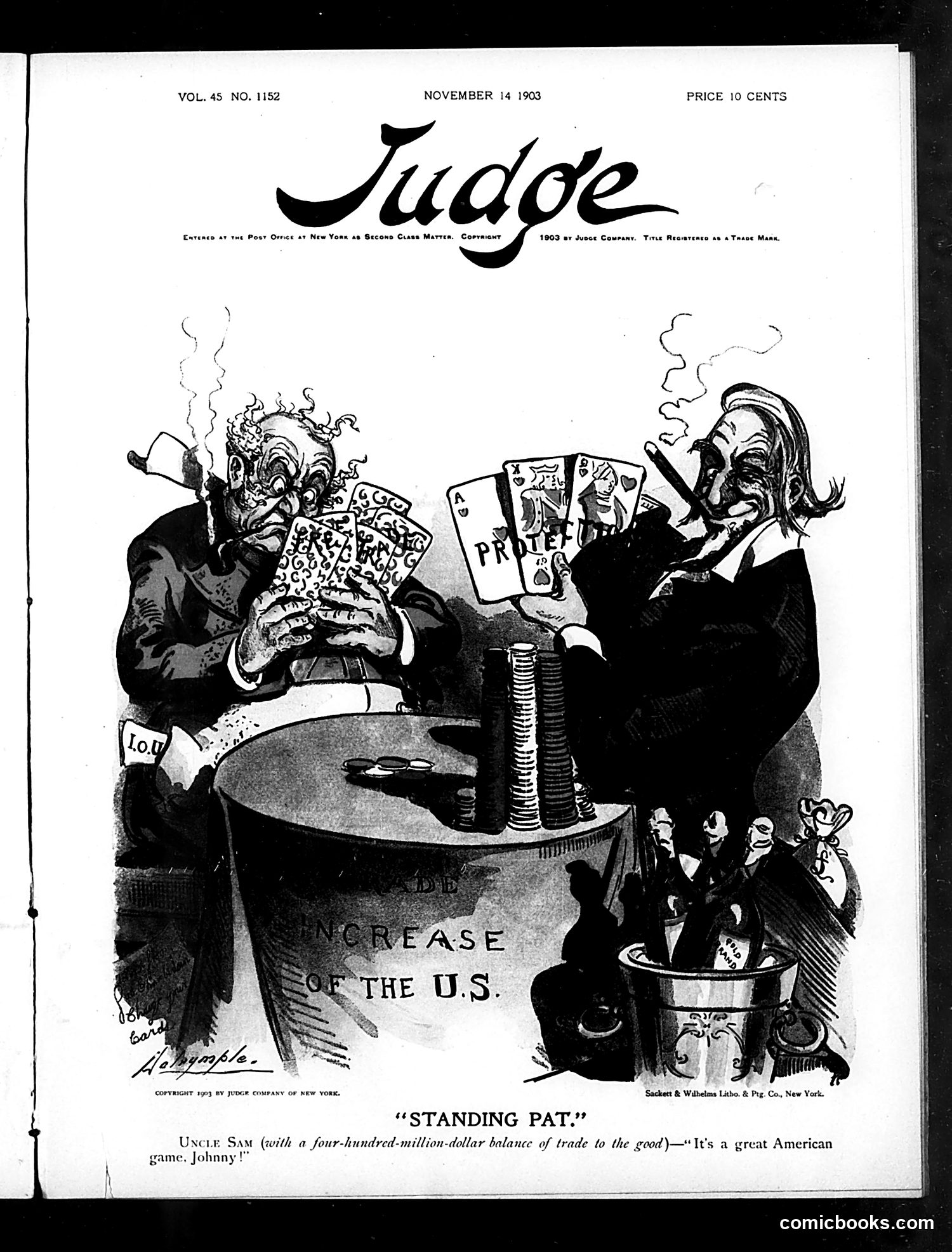
This political cartoon satirizes Uncle Sam's complacent trade policy. The title refers to President Theodore Roosevelt's stance of maintaining the status quo on tariffs—"standing pat" rather than reforming them. The cartoon shows two devil-like figures (representing competing foreign interests or trade manipulators) playing cards over a cauldron labeled "INCREASE OF THE U.S." with stacks of money. Uncle Sam watches passively, declaring "It's a great American game, Johnny!"—sarcastically suggesting he's been sidelined from economic policy-making. The small figures in the cauldron likely represent American workers or citizens caught in the trade disputes. The satire criticizes the administration for allowing powerful interests to control trade policy while ordinary Americans suffer the consequences, rather than actively managing the nation's economic welfare.
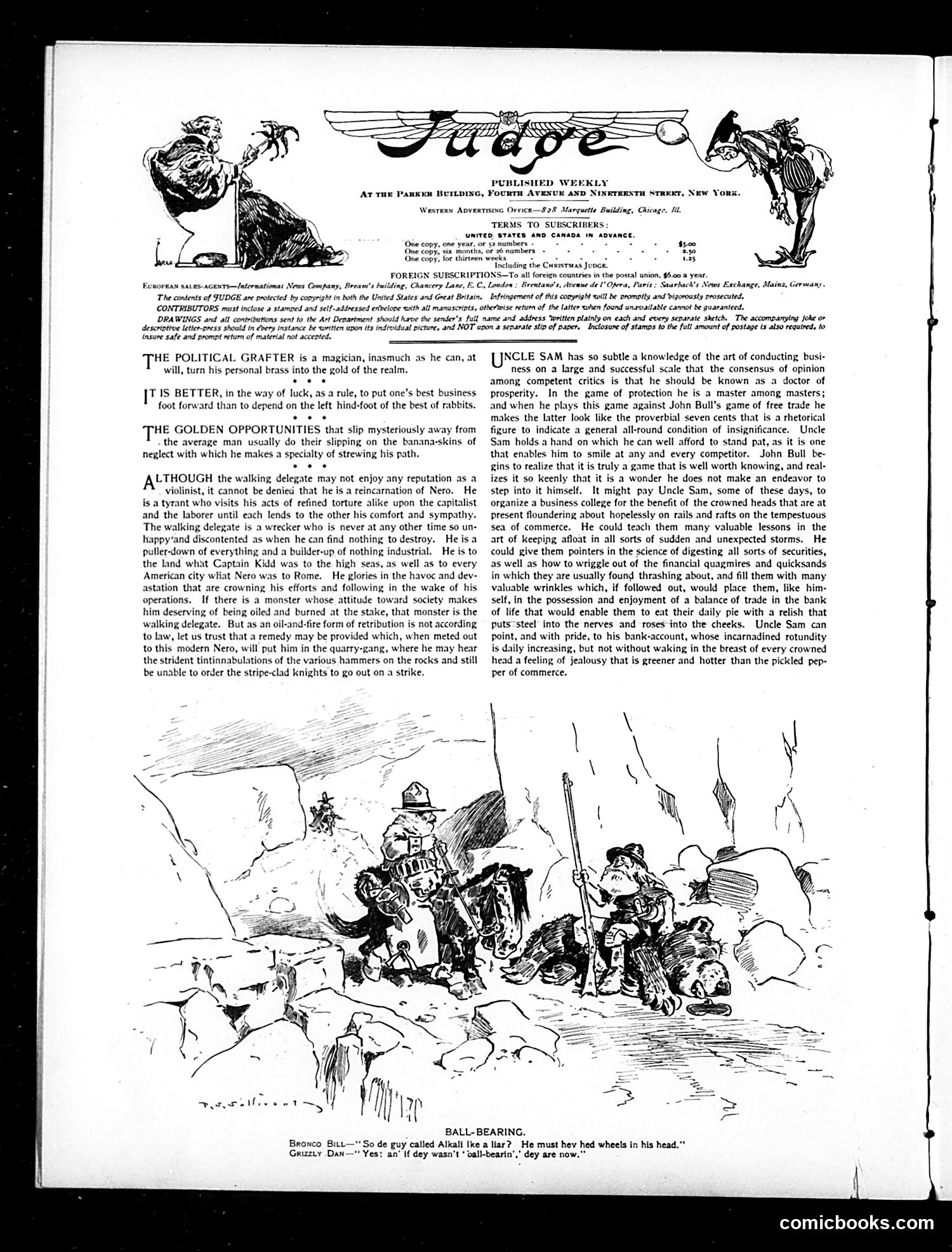
This page contains two distinct elements: **Upper section:** An editorial essay praising "Uncle Sam" as a skilled political and business operator. The text argues Uncle Sam competently manages both protection and commerce despite critics' complaints about railroads and commerce issues. It's a defense of American capitalist enterprise and government stewardship during what appears to be a period of labor unrest or business criticism (likely late 19th/early 20th century). **Lower cartoon ("Ball-Bearing"):** Shows characters labeled "Bronco Bill" and "Grizzly Dan" in a snowy mountain setting. The joke involves wordplay: when Bronco Bill asks if someone called Alkali Ike a liar, Grizzly Dan responds that Ike had "ball-bearings" in his head. The humor relies on conflating the mechanical term with the slang meaning of having balls (courage).
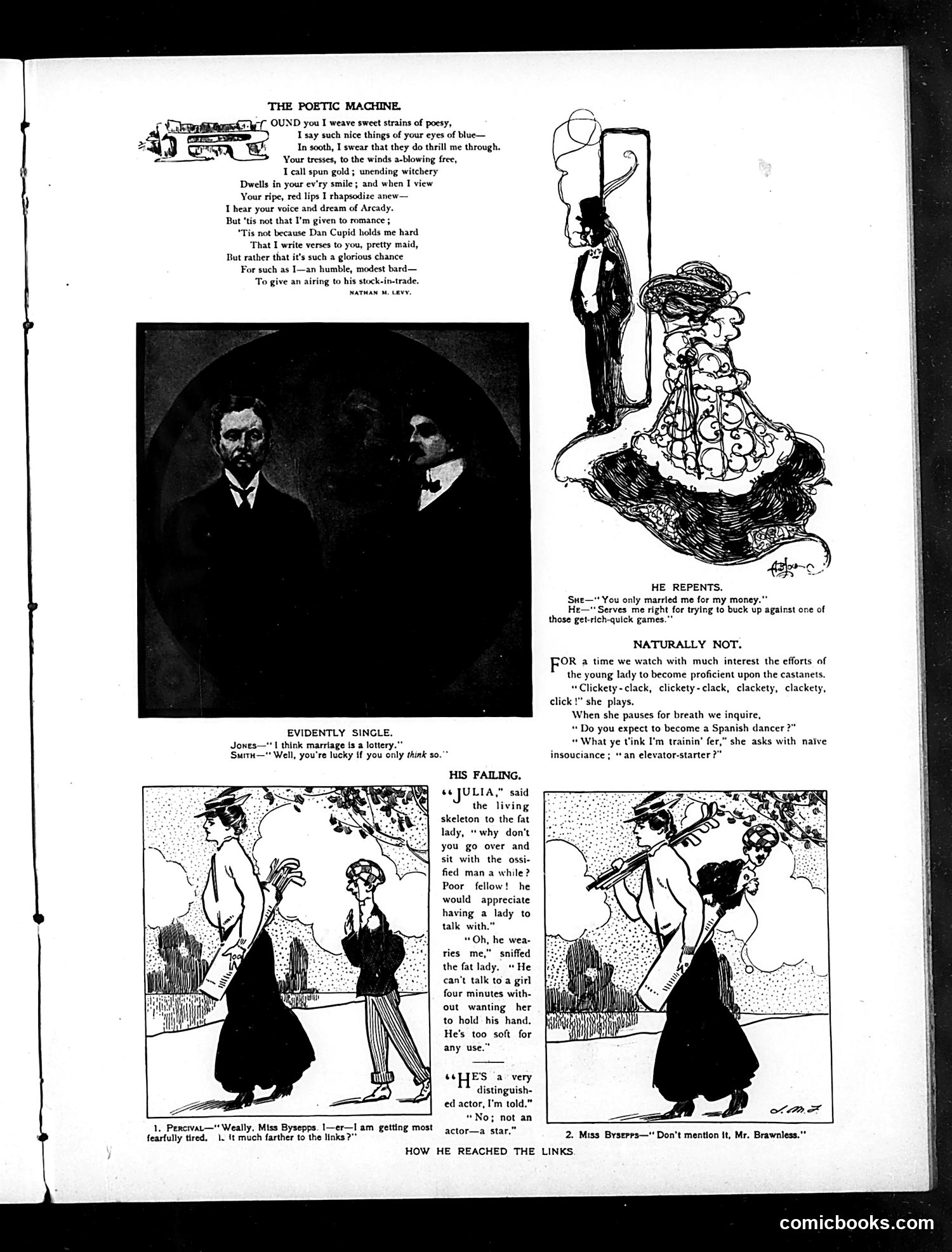
This page contains several satirical pieces about social dynamics and gender relations, typical of early-20th-century Judge magazine humor. **"Evidently Single"**: A joke about marriage misconceptions—a man misunderstands a woman's comment about "lottery" as approval of marriage. **"Naturally Not"**: Satirizes a young woman's failed attempts at various accomplishments (castanets, Spanish dancing, "elevator-starter"), mocking women's dilettantish pursuits and lack of genuine skill. **"His Failing"**: A multi-panel comic depicts a man's social awkwardness—he cannot sustain conversation with women without becoming romantic or demanding physical affection. The humor targets male clumsiness in courtship rather than female behavior. The overall tone reflects period attitudes about gender roles, courtship rituals, and social propriety, with gentle mockery of both masculine and feminine social failings.
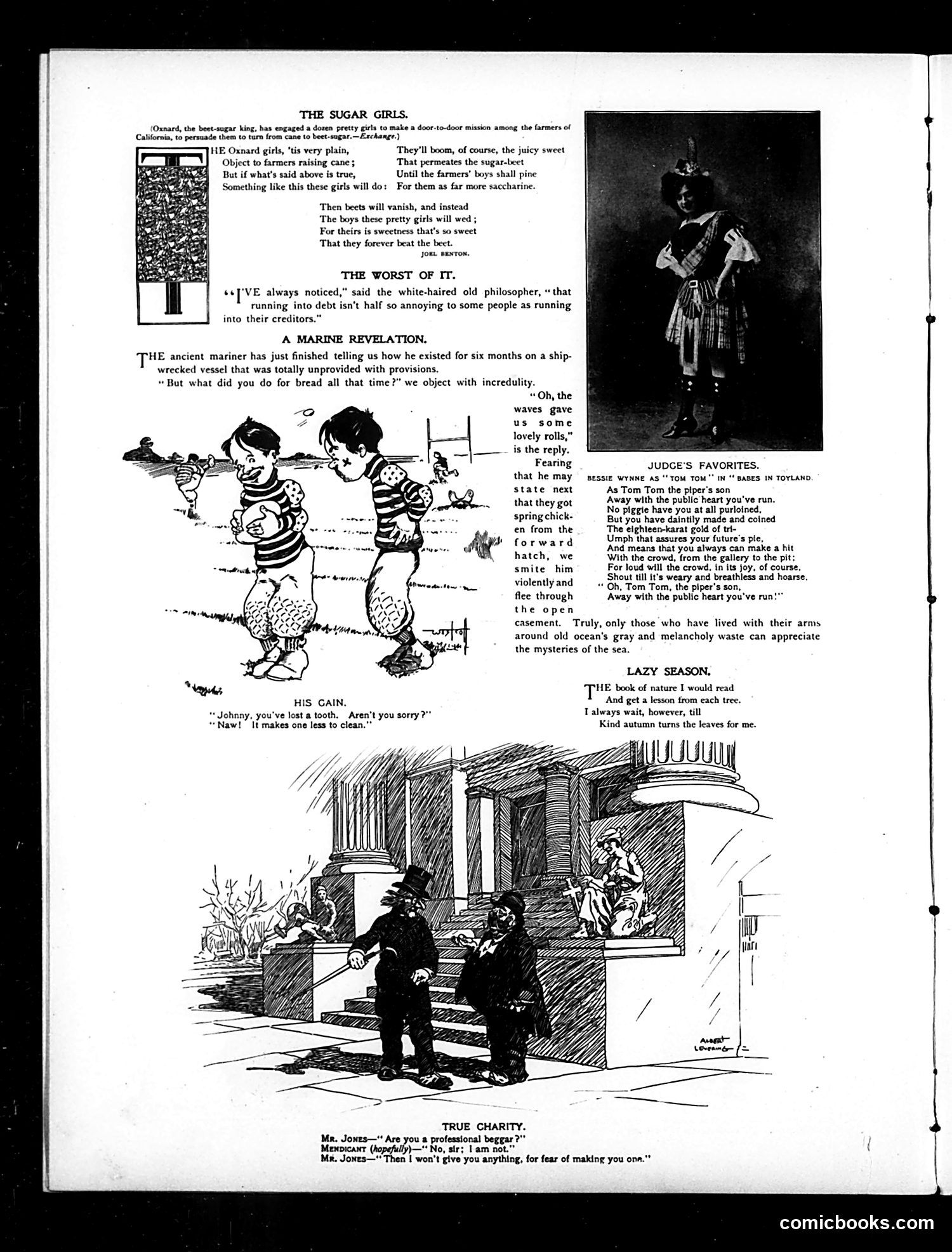
This page contains several unrelated satirical pieces and poems rather than a cohesive political cartoon. **"The Sugar Girls"** is a poem about Oswald, a sugar king, attempting to market beet sugar by employing women ("sugar girls") to promote it to farmers. The satire targets corporate marketing tactics and perhaps labor exploitation. **"A Marine Revelation"** features a dialogue between children and an old sailor about provisions on a wrecked ship—a humorous anecdote with no obvious political message. **"Judge's Favorites"** is a poem about a character named Tom Tom. **"True Charity"** shows a beggar confronting a merchant, satirizing class attitudes toward poverty and charitable giving. The illustrations are generic comic sketches rather than pointed political commentary. The page appears to be filler content mixing light humor with social observation rather than hard political satire.
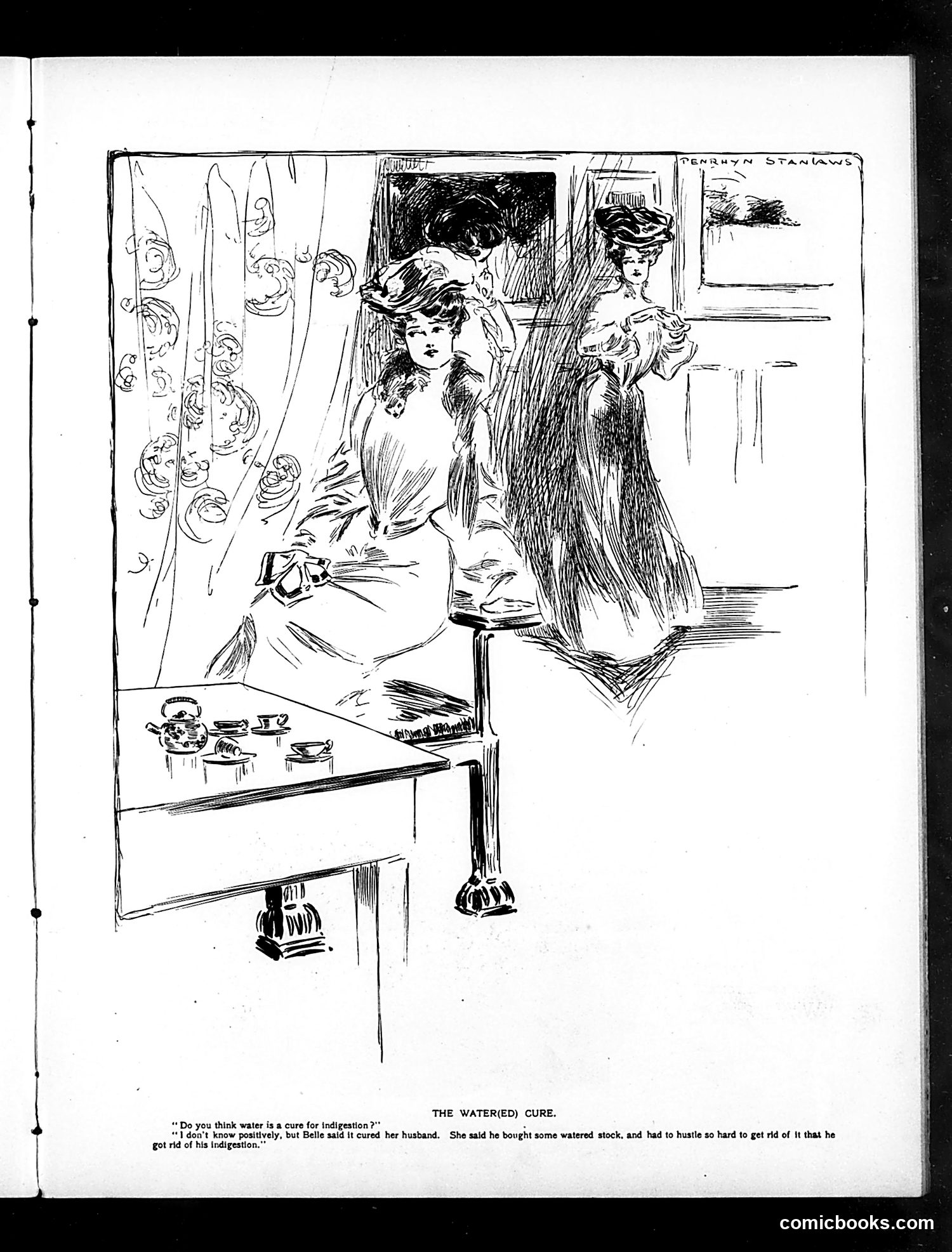
This is a visual pun playing on "water cure" (a legitimate indigestion treatment) versus "watered stock" (fraudulent financial practice). The sketch shows well-dressed women in what appears to be an elegant drawing room, discussing Belle's husband who allegedly cured his indigestion by frantically selling watered stock—shares padded with inflated or worthless value. The joke: the stress of unloading fraudulent investments on unsuspecting buyers kept him so busy hustling that his digestive troubles disappeared. It's satirizing both the prevalence of stock market fraud during this era and the irony that dishonest financial desperation could inadvertently solve a medical problem. The cartoon mocks the gilded-age practice of scheming businessmen peddling worthless securities.
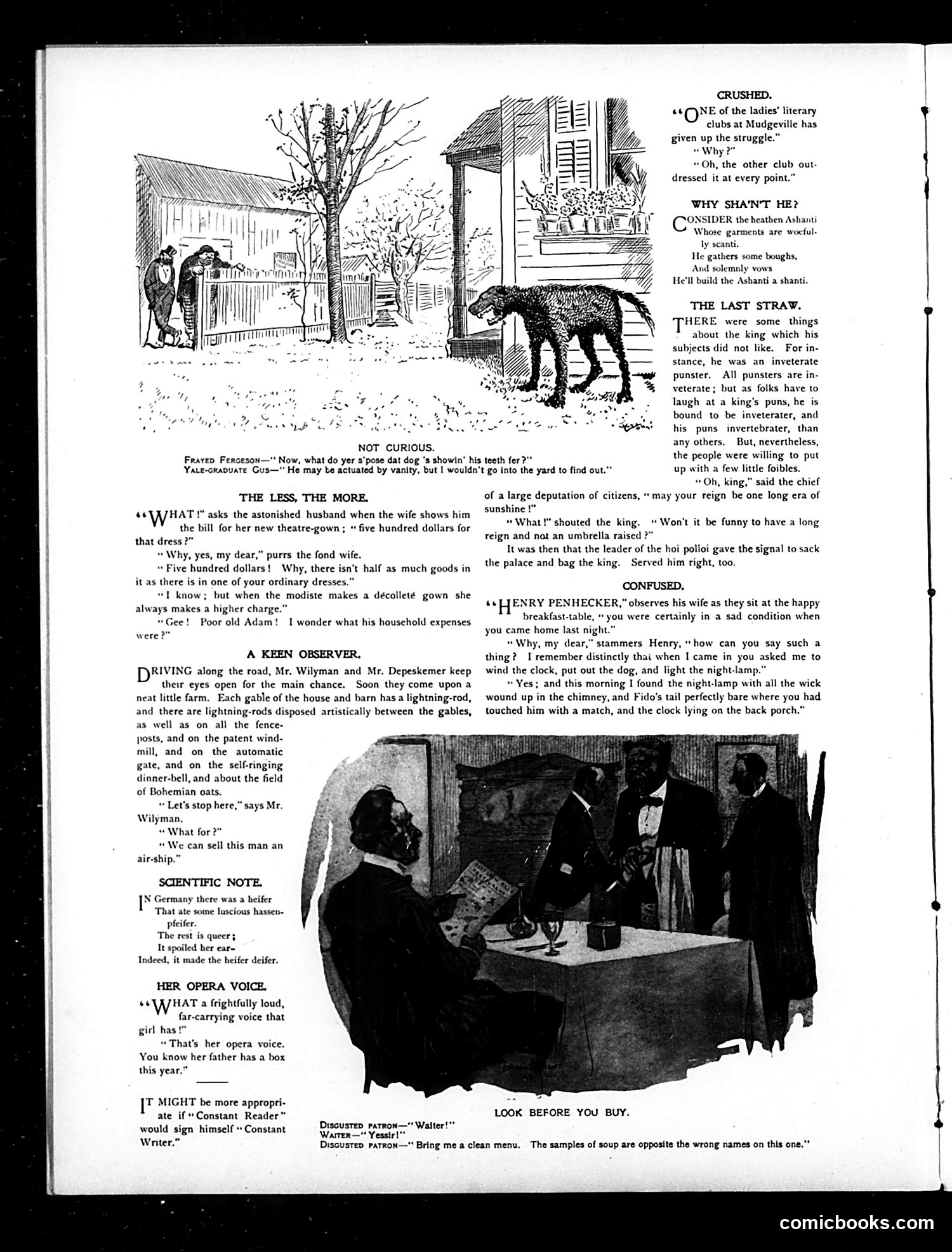
This page contains multiple brief satirical pieces typical of Judge magazine's humor: **"The Less, the More"** mocks wives' extravagant spending on fashionable clothing. A husband protests paying $500 for a theater gown with minimal fabric, while his wife explains that expensive dressmakers charge *more* for *less* material—a commentary on conspicuous consumption and fashion industry absurdity. **"A Keen Observer"** satirizes con artists. Two schemers spot a farmer's property bristling with lightning rods (an expensive status symbol), and immediately recognize him as a gullible mark they can sell an "air-ship" to—mocking both the farmer's naive investment in unnecessary technology and the con men's predatory observation. **"The Last Straw"** jokes about an Ashanti king's terrible punning finally driving his subjects to rebellion. The king puns about a "reign" versus "rain" and umbrella—so unbearable that citizens overthrow him. **"Confused"** depicts a drunk husband who, when asked to wind the clock and light a lamp, instead wounds the dog with a match and leaves the clock on the porch—physical comedy from inebriation. These are light domestic and social humor pieces, not political commentary.
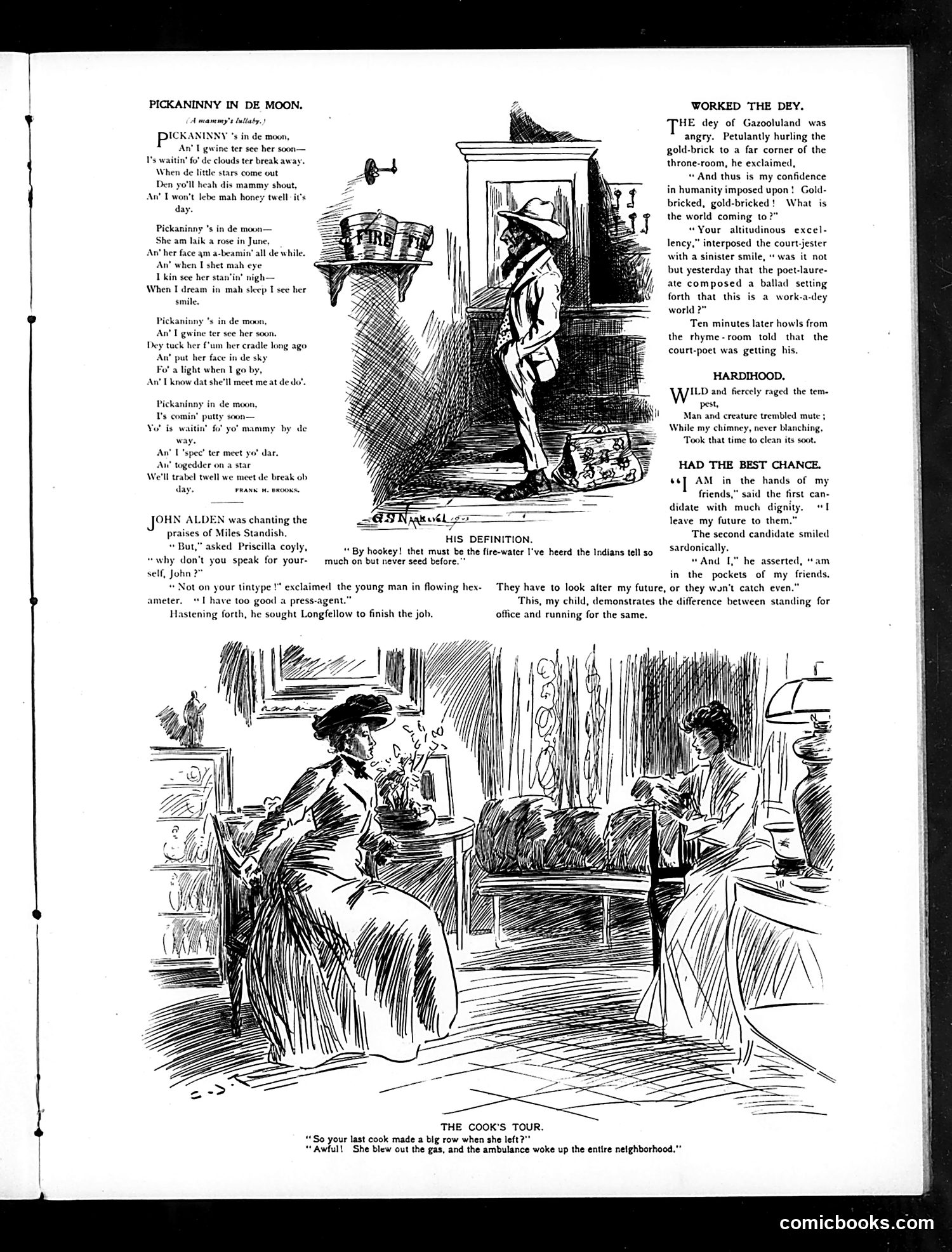
This page contains three distinct pieces of turn-of-the-century American satire: **"Pickaninny in De Moon"** is a racist dialect poem typical of the era, written in minstrel-show style with offensive stereotyping of African Americans. **"Worked the Dey"** satirizes a foreign ruler (likely from a fictional "Gazooluland") who has been defrauded with a "gold brick"—a common con-artist scheme of that period where victims were sold worthless items as gold. The court jester mocks the ruler's gullibility by quoting the saying "it's a work-a-day world." **"Had the Best Chance"** mocks political candidates who claim to leave their futures "in the hands of friends" rather than actively campaigning themselves—contrasting passive dependency with active office-seeking. **"The Cook's Tour"** presents a brief joke about a departing cook who caused such chaos (blowing out gas) that an ambulance response disturbed the entire neighborhood. These pieces reflect Judge magazine's typical mix of class-conscious humor, political commentary, and period stereotypes.
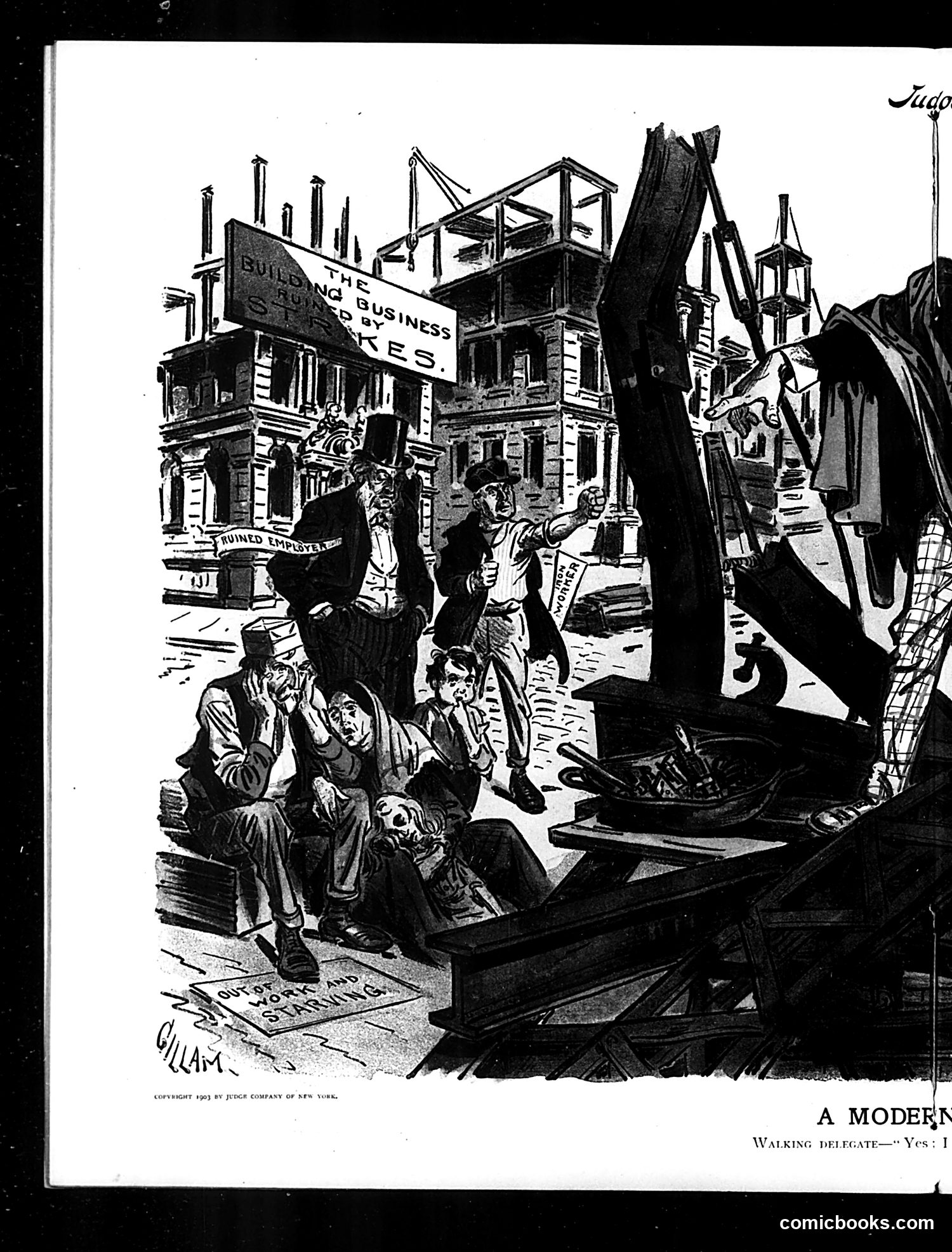
This is a Judge magazine political cartoon depicting urban poverty and labor unrest. The scene shows a ruined, damaged building labeled "RUINED BUSINESS" with impoverished families (adults and children) sitting amid debris in the foreground. Well-dressed figures gesture from the building above. The title references a "Walking Delegate"—a labor union representative who organized workers and enforced strikes. The cartoon appears to satirize the destructive consequences of labor activism, suggesting that strikes and union organizing (represented by the delegate) have devastated businesses and left poor families homeless and destitute. This reflects Gilded Age tensions between labor movements and business interests, with Judge (a conservative publication) criticizing unions for harming workers they claimed to help.
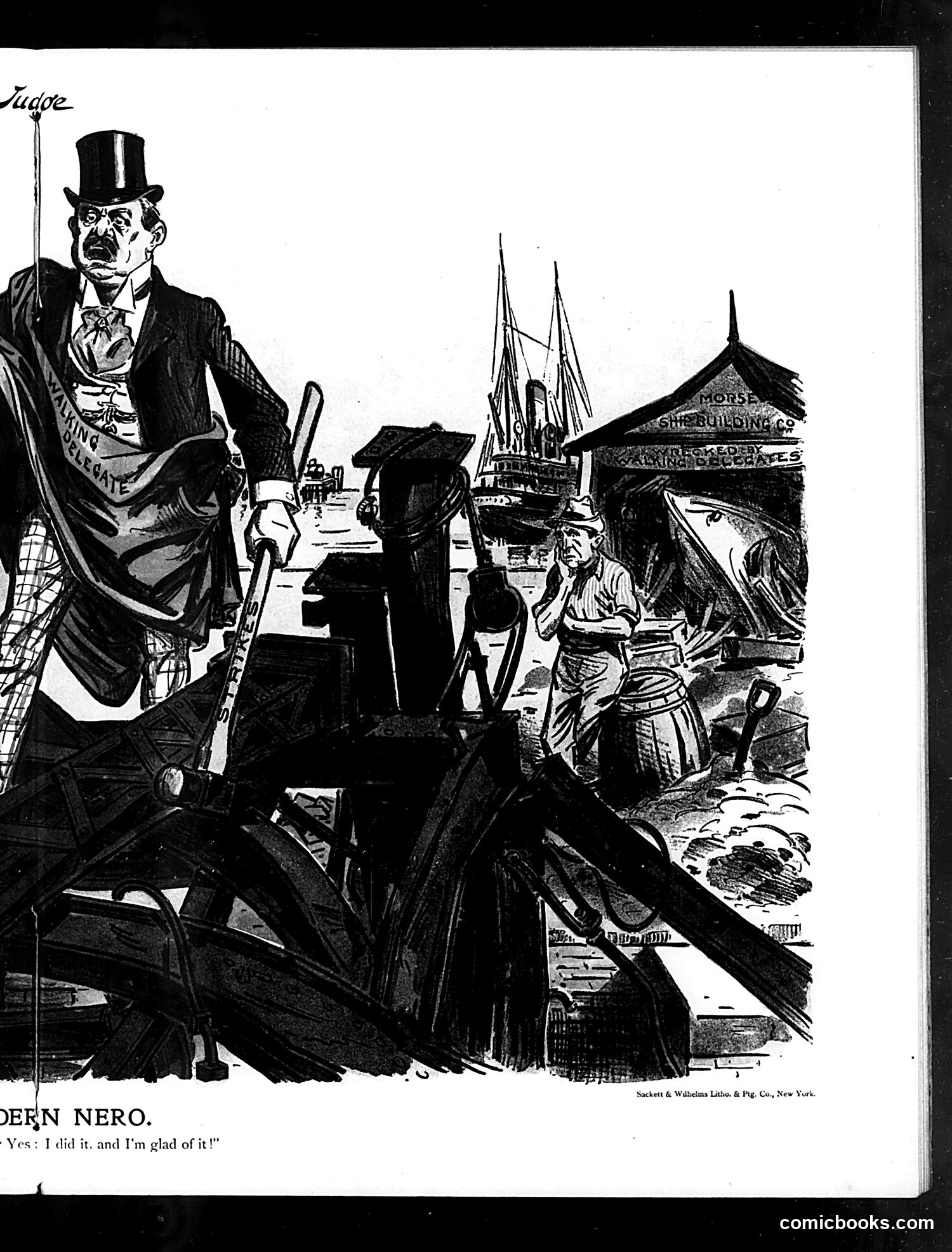
This Judge magazine cartoon satirizes a powerful figure compared to the Roman Emperor Nero, who infamously fiddled while Rome burned. The elegantly dressed man in the top hat on the left—wearing what appears to be a judicial or political sash—presides over a shipyard scene with workers and industrial activity. The cartoon's title "Modern Nero" and caption "Yes: I did it, and I'm glad of it!" suggest the figure is taking proud responsibility for some controversial action affecting labor or industry. The comparison implies he's indifferent to the consequences of his decisions on ordinary workers below him, much like Nero's legendary apathy during Rome's destruction. Without a clear date visible, the specific historical reference remains unclear, though the shipyard setting and labor context suggest early 20th-century industrial disputes or policies.
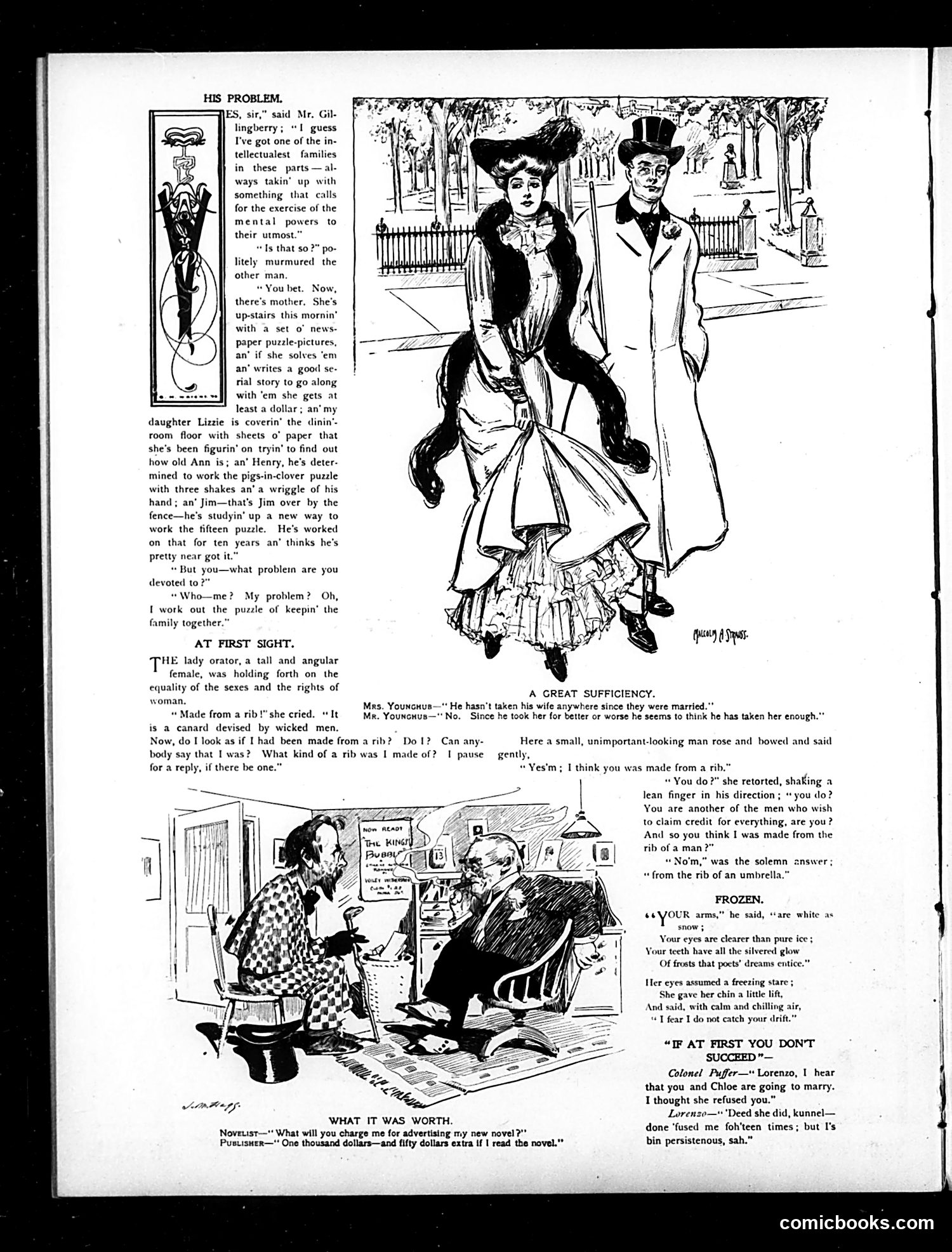
This page contains several satirical pieces typical of early 20th-century American humor: **"His Problem"**: A rural father boasts his family solves puzzles (newspaper contests, mathematical puzzles, the "fifteen puzzle"). When asked his own intellectual pursuit, he reveals it's simply keeping the family together—a gentle joke about domestic management versus intellectual pretension. **"A Great Sufficiency"**: A woman argues against the biblical creation of women from Adam's rib, claiming men invented this to take credit. A meek man agrees—but says she was made from an umbrella's rib instead. The joke mocks both feminist rhetoric and male condescension. **"Frozen"**: A romantic poet compliments a woman's "frozen" beauty; she coldly rejects his advances, taking his metaphors literally. **"If at First You Don't Succeed"**: A man boasts of persistence in courting "Chloe" despite fourteen rejections. These pieces satirize contemporary social debates (women's rights), courtship customs, and human vanity through gentle, pun-based humor typical of Edwardian-era Judge magazine.
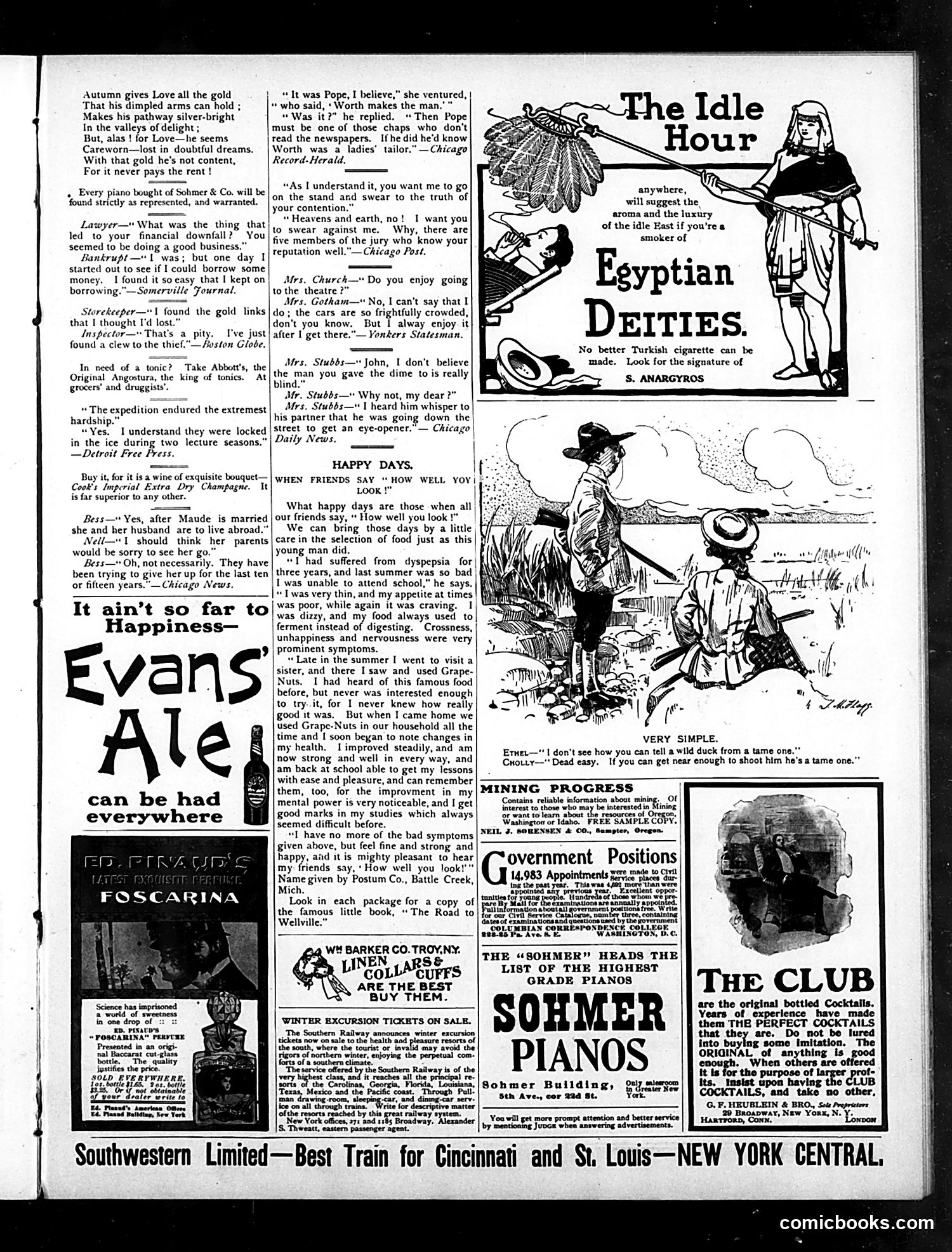
This page is primarily **advertising and humor** rather than political satire. The cartoons and jokes address domestic and social concerns of the era. **Key content:** - **"The Idle Hour"** section advertises Egyptian Deities cigarettes, featuring a classical Egyptian figure - Multiple short **humorous anecdotes** about everyday life: a lawyer advising against borrowing money, a shopkeeper finding stolen goods, couples discussing marriage and theater attendance - A lengthy **testimonial advertisement for Grape-Nuts cereal**, presented as a health cure for dyspepsia (indigestion) - Additional product advertisements: Evans Ale, Foscarina (a tonic), Cook's Champagne, Abbott's Angostura, and Sohmer Pianos **The satire is gentle**, mocking human folly—financial irresponsibility, marital discord, urban transportation crowds—rather than political targets. The Grape-Nuts testimonial exemplifies period advertising that made broad health claims for processed foods. This appears to be a typical Judge interior page blending light humor with commercial sponsorship.
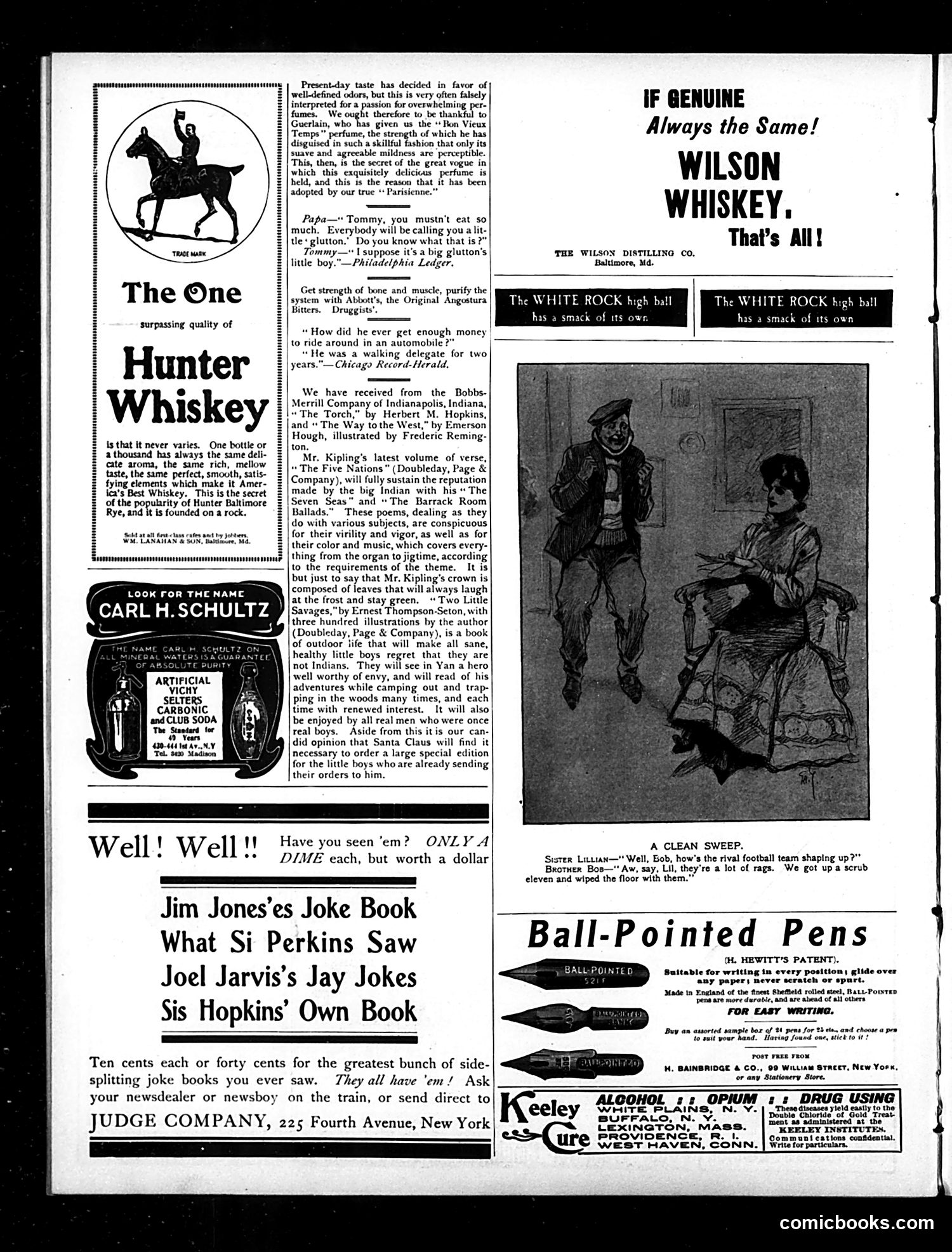
This page primarily consists of **advertisements and product promotions** rather than political satire. The main content includes: **Advertisements:** Hunter Whiskey, Wilson Whiskey, White Rock beverage, perfume (Guerlain), Angostura Bitters, and Ball-Pointed Pens dominate the page. **Light Humor:** A brief joke about a "walking delegate" (labor union representative) and automobile ownership reflects early 1900s class commentary. Another joke plays on children's misunderstanding of the word "glutton." **Book Reviews:** Notices for works by Rudyard Kipling and Ernest Thompson-Seton emphasize their masculine vigor and appeal to boys. **Joke Books:** Multiple volumes advertised at ten cents each, targeting casual readers. The page reflects **turn-of-the-century consumer culture**—emphasizing product consistency, masculinity, and wholesome entertainment. The "Sister Lillian" football joke at bottom suggests gentle, family-friendly humor typical of the era.
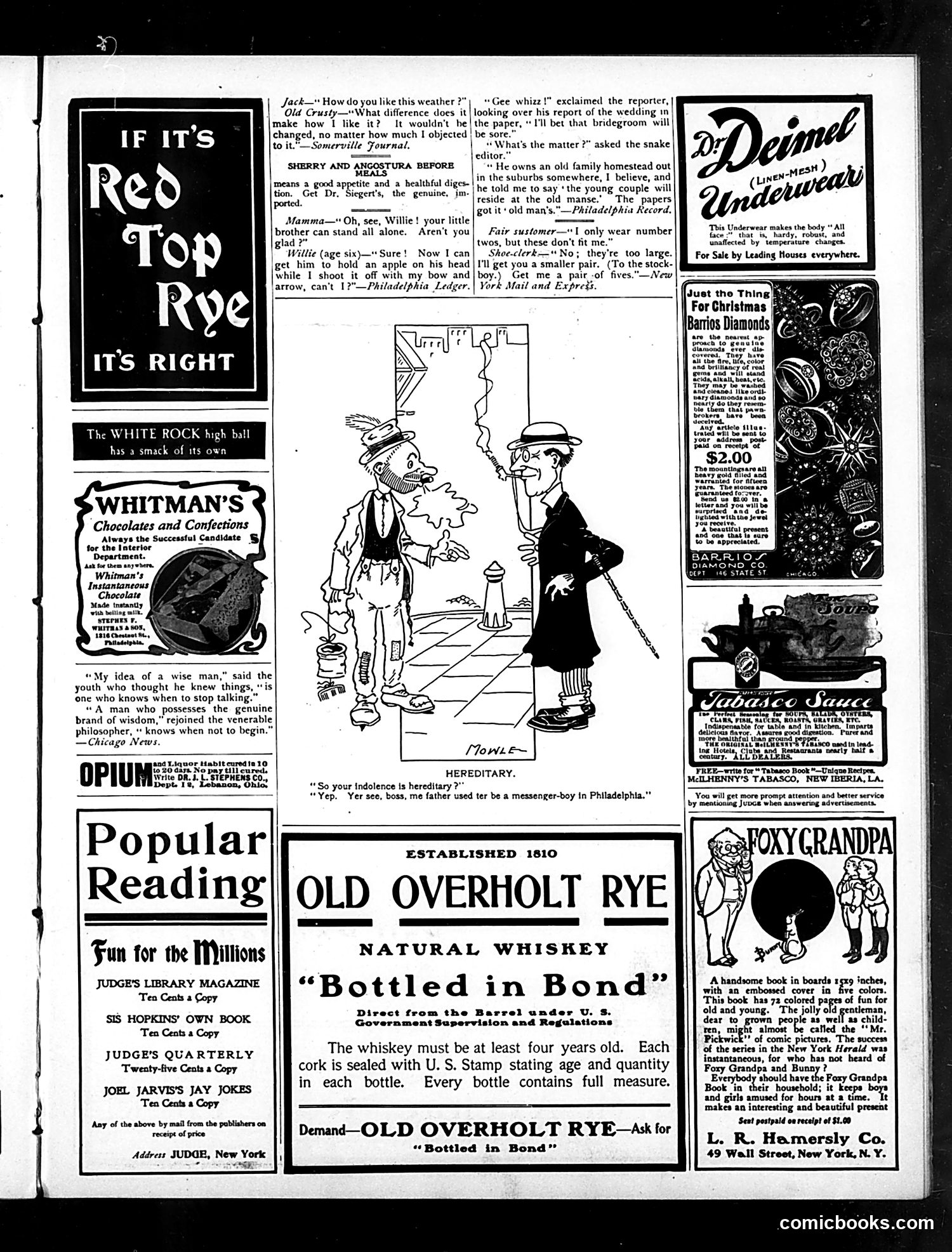
This page from Judge magazine (established as a satirical publication) contains primarily **short humorous anecdotes and advertisements** rather than political cartoons. The one cartoon present, titled "HEREDITARY," depicts a social joke about class: a working man claims his laziness is hereditary because his father was a messenger boy in Philadelphia—satirizing the idea that poverty and low social status are passed down through families, while the joke's humor relies on the absurdity of calling messenger work "hereditary indolence." The page is dominated by **advertisements** for consumer goods (whiskey, chocolates, diamonds, books) and Judge's own publications. The text snippets are typical turn-of-century humor: witty exchanges about weather complaints, a child's dangerous naïveté, and marriage observations. **Historical context**: This reflects Judge's format as a humor magazine mixing light social commentary with commercial advertising, rather than hard political satire. The "hereditary" joke reflects period attitudes about class and social mobility.
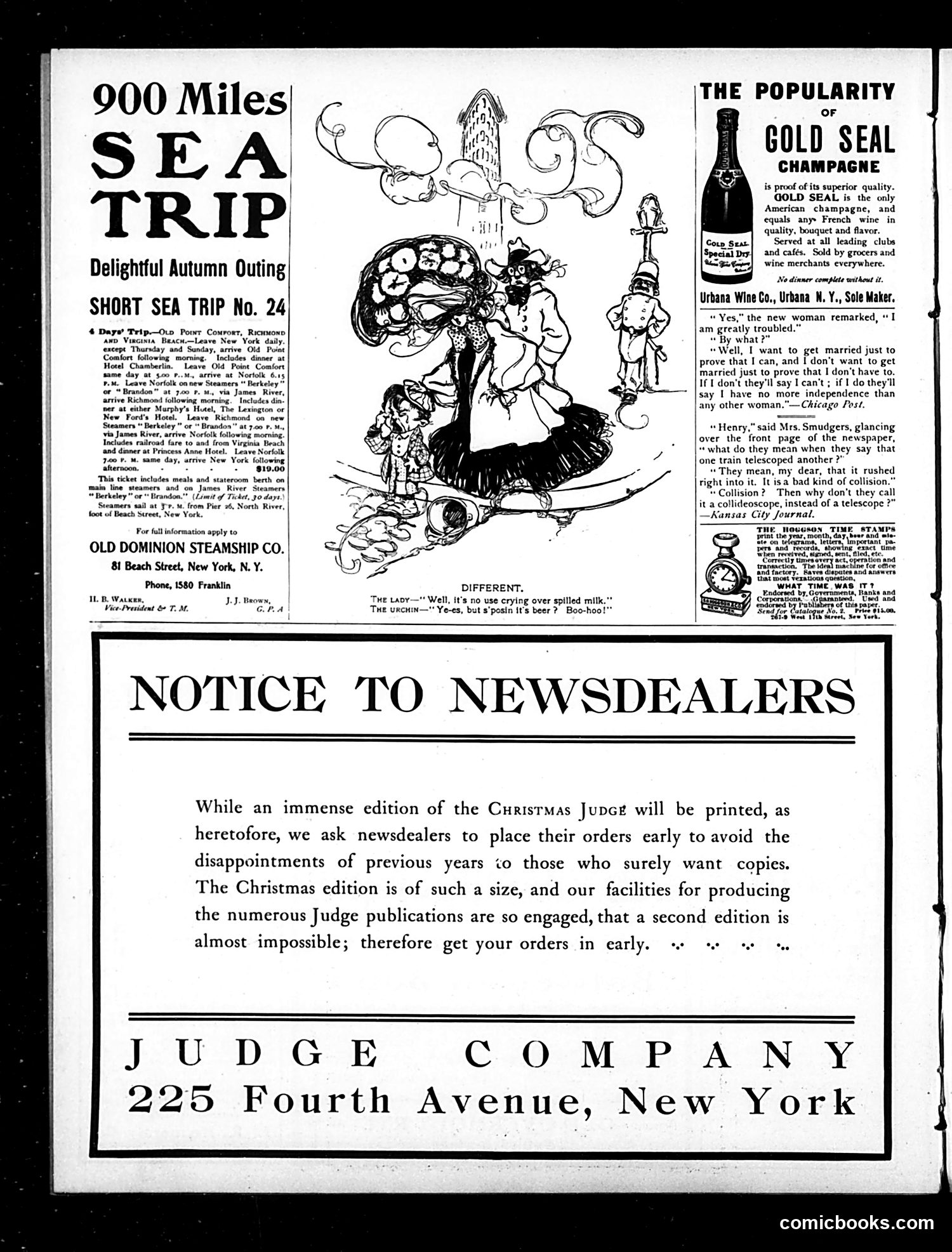
This page contains **advertisements and brief humorous items** rather than political cartoons requiring historical context. The main content includes: - A steamship company ad for a 900-mile autumn sea trip - Gold Seal Champagne advertisement - Three short jokes about contemporary social issues: 1. **"The New Woman"** joke satirizes the emerging feminist movement—specifically the paradox that early 20th-century women faced: proving independence through marriage seemed contradictory, yet refusing marriage invited criticism. 2. **The train "telescope" joke** is simply a pun about collision terminology. 3. **The spilled milk/beer joke** appears to reference class or economic differences in beverage preferences. The page concludes with a **publisher's notice** urging newsdealer orders for the Christmas Judge edition, warning that demand will likely exceed supply and a second printing is unlikely.
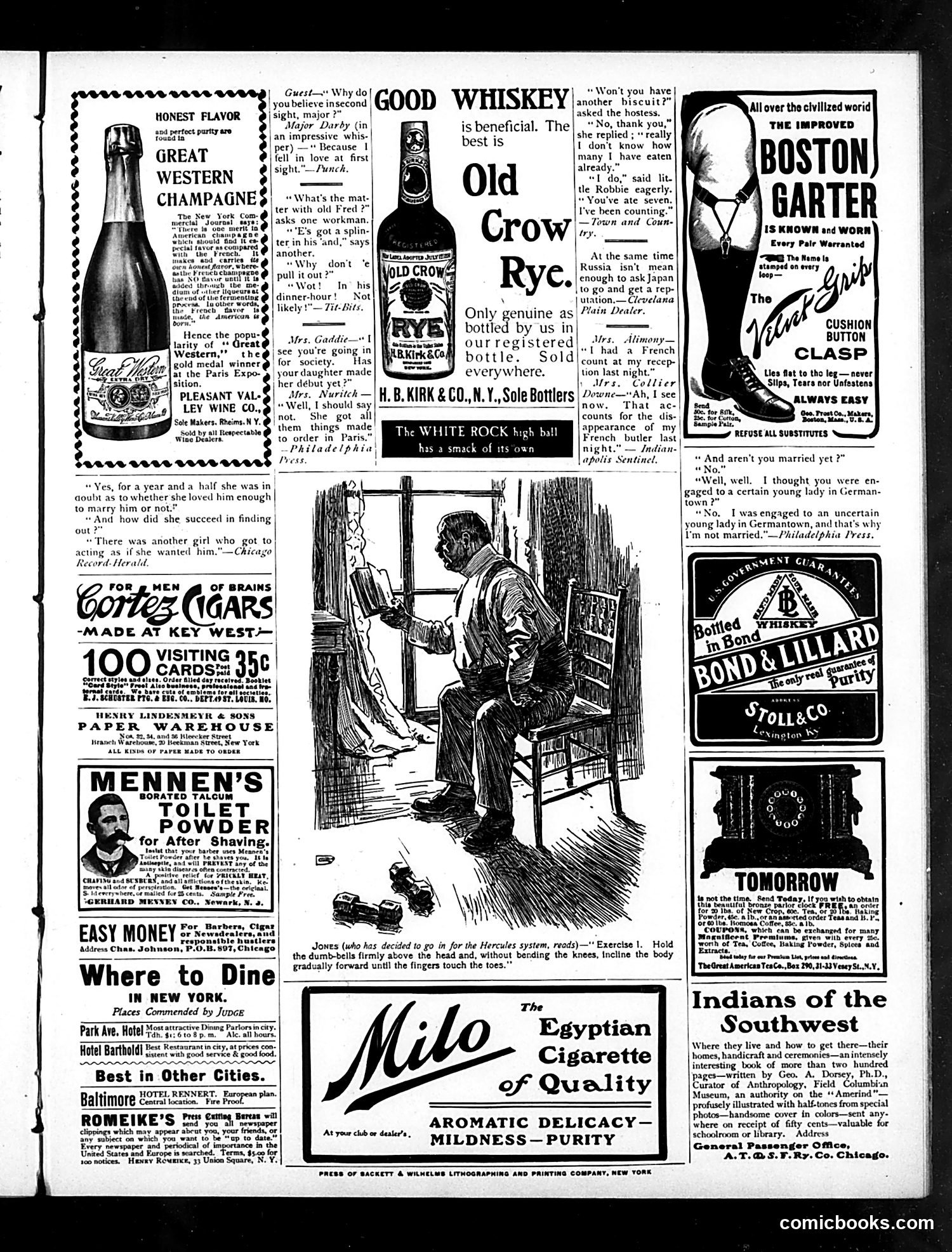
This page is primarily **advertising mixed with brief humorous anecdotes**, rather than political satire. The main cartoon shows a man doing calisthenics (the "Hercules system"), illustrating an exercise instruction. The humor is in the impracticality: he's instructed to hold dumbbells above his head while bending forward to touch his toes—a physically awkward or impossible position meant to be comedic. The scattered short jokes deal with domestic/romantic situations: a woman uncertain about marriage, a hostess counting biscuits eaten by a guest, a man who was engaged to an "uncertain" lady in Germantown. These reflect era-appropriate parlor humor about courtship and social etiquette. The advertisements promote whiskey (Old Crow Rye, Bond & Lillard), garters, talcum powder, and other products typical of early 1900s publications. There is **no clear political content** on this page—it's entertainment and commerce aimed at middle-class readers.
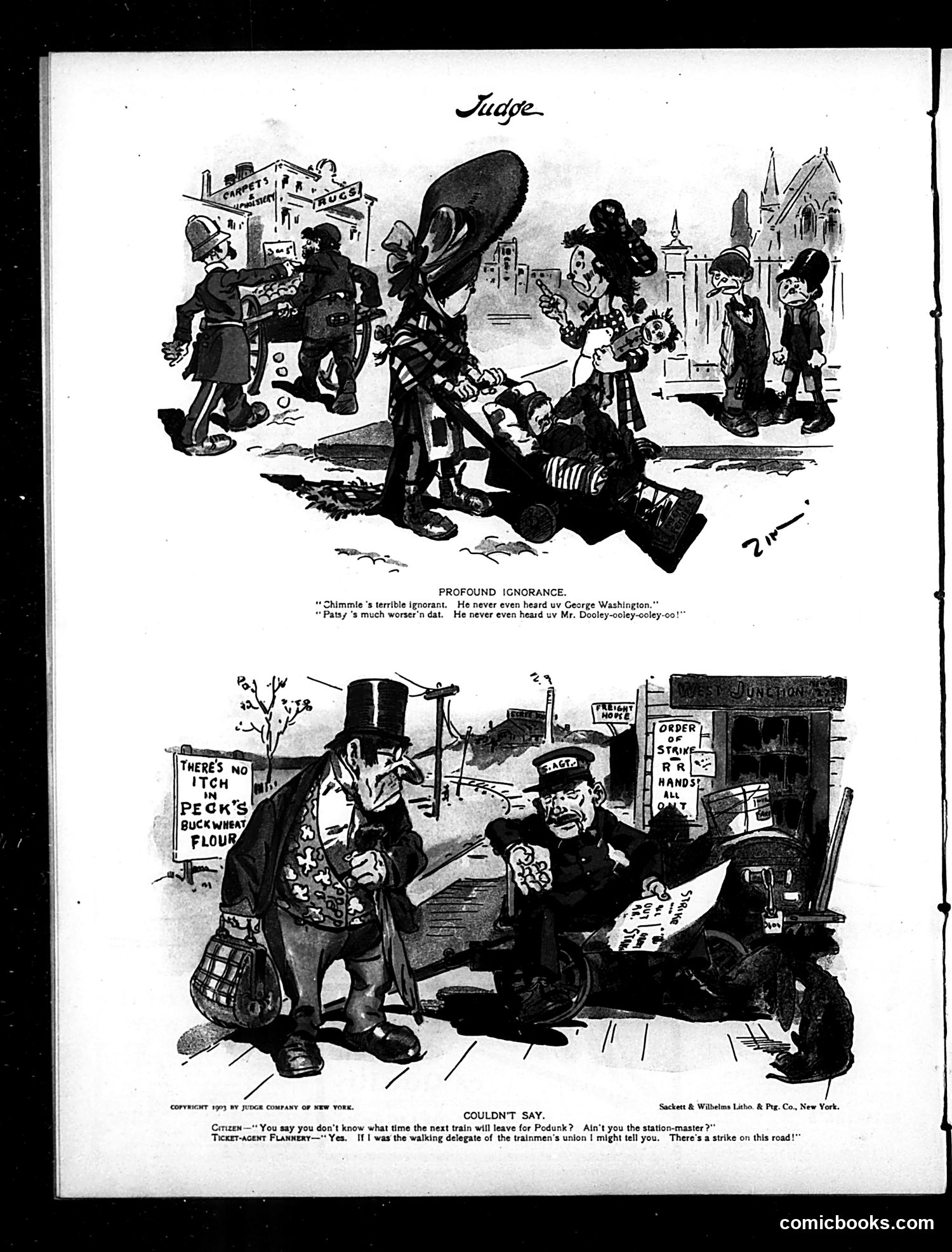
**Top cartoon, "Profound Ignorance":** Two children argue about who's more ignorant. One claims his friend "Chimmie" is terrible because he's never heard of George Washington. The other counters that "Patsy" is worse because he's never heard of "Mr. Dooley-ooley-coley-oo"—likely referencing Mr. Dooley, a popular Irish-American humorist character of the era. The joke satirizes how people measure ignorance by different standards, with the dialect suggesting working-class or immigrant children. **Bottom cartoon, "Couldn't Say":** A citizen asks a station-master about train schedules to Podunk. The ticket agent (Flannery) refuses to answer, claiming that only the trainmen's union walking delegate could say—because there's "a strike on this road!" This satirizes labor unrest in railroad operations, where union actions disrupted service and left even station staff unable to provide information.