
A complete issue · 16 pages · 1903
Judge — September 19, 1903
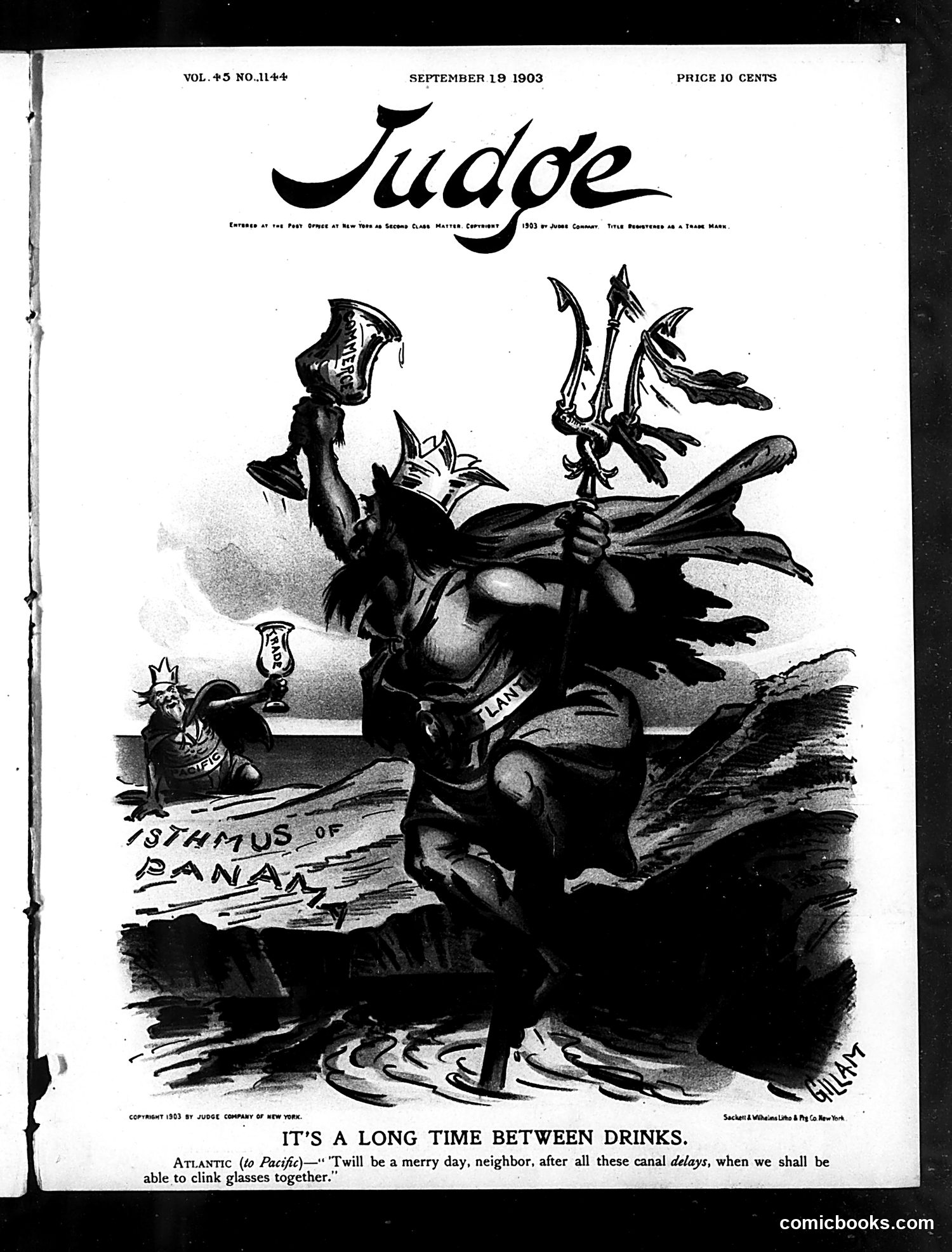
This September 1903 Judge cartoon satirizes delays in the Panama Canal project. The central figure appears to be "Isthmus of Panama" (labeled on the banner), depicted as a chaotic, multi-armed creature juggling various conflicts and obstacles. The smaller figure on the left likely represents the United States or American interests, appearing frustrated or impatient. The caption's pun—referencing the long wait between drinks—suggests the canal's construction delays are frustrating American commercial interests eager to complete the waterway connecting the Atlantic and Pacific oceans. The cartoon mocks the tangled complications hindering progress on this major engineering project, a significant political issue of the Roosevelt administration's early years.
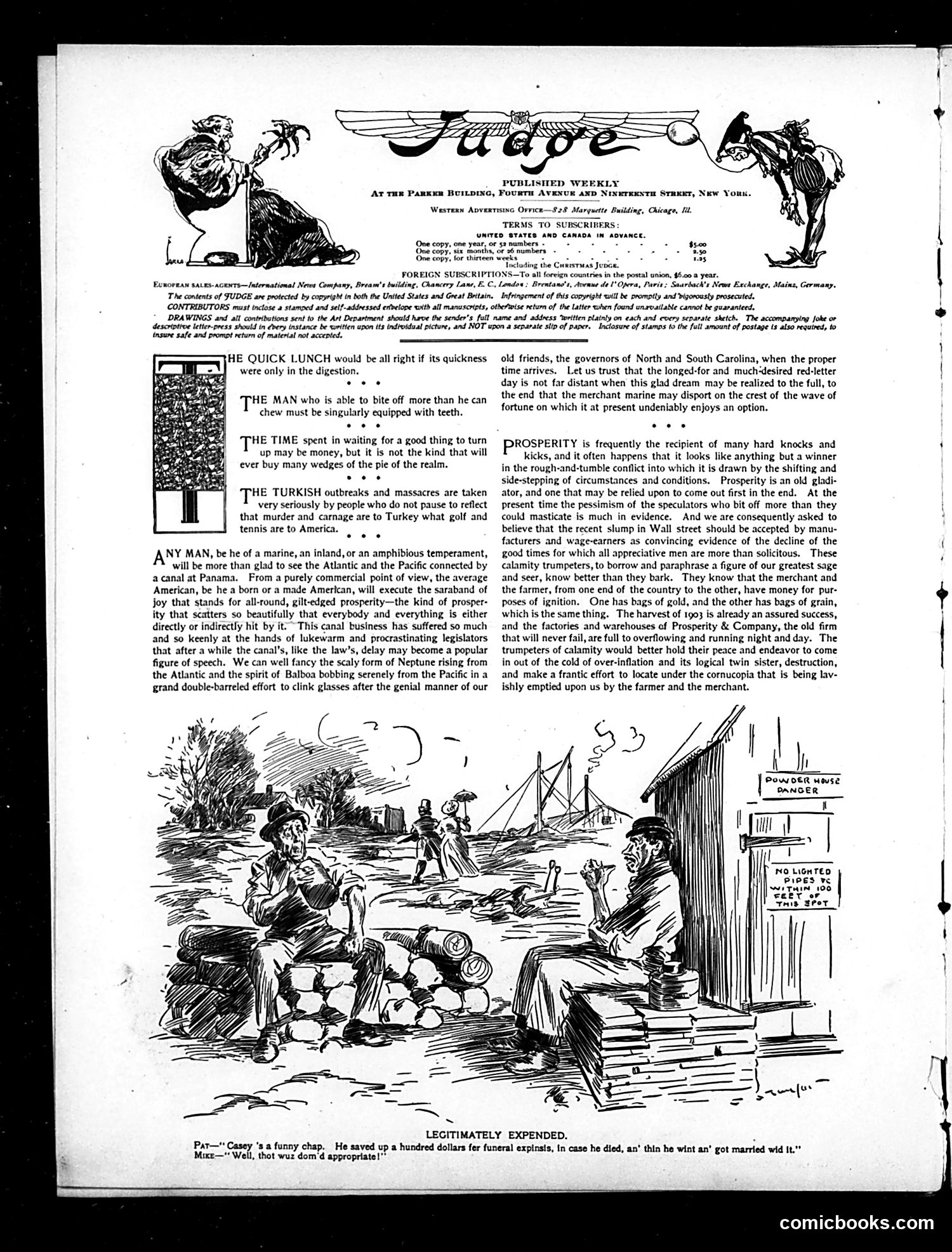
This page contains editorial commentary and a cartoon titled "Legitimately Expended." The main cartoon depicts two men at a waterfront, apparently discussing funeral expenses. The caption reads: "Pat: 'Casey's a funny chap. He saved up a hundred dollars for funeral expanse, in case he died, an' thin he wint an' got married wid it.' / Mike: 'Well, that was doin' a appropriate!'" The satire targets working-class Irish immigrants (suggested by the names "Pat," "Casey," and "Mike"). The joke mocks the irony of saving money designated for death expenses and instead spending it on marriage—both life-changing events requiring significant expenditure. The cartoon humorously presents this as "appropriate" misdirection of carefully hoarded funds, likely satirizing Irish-American economic struggles and priorities of the era.
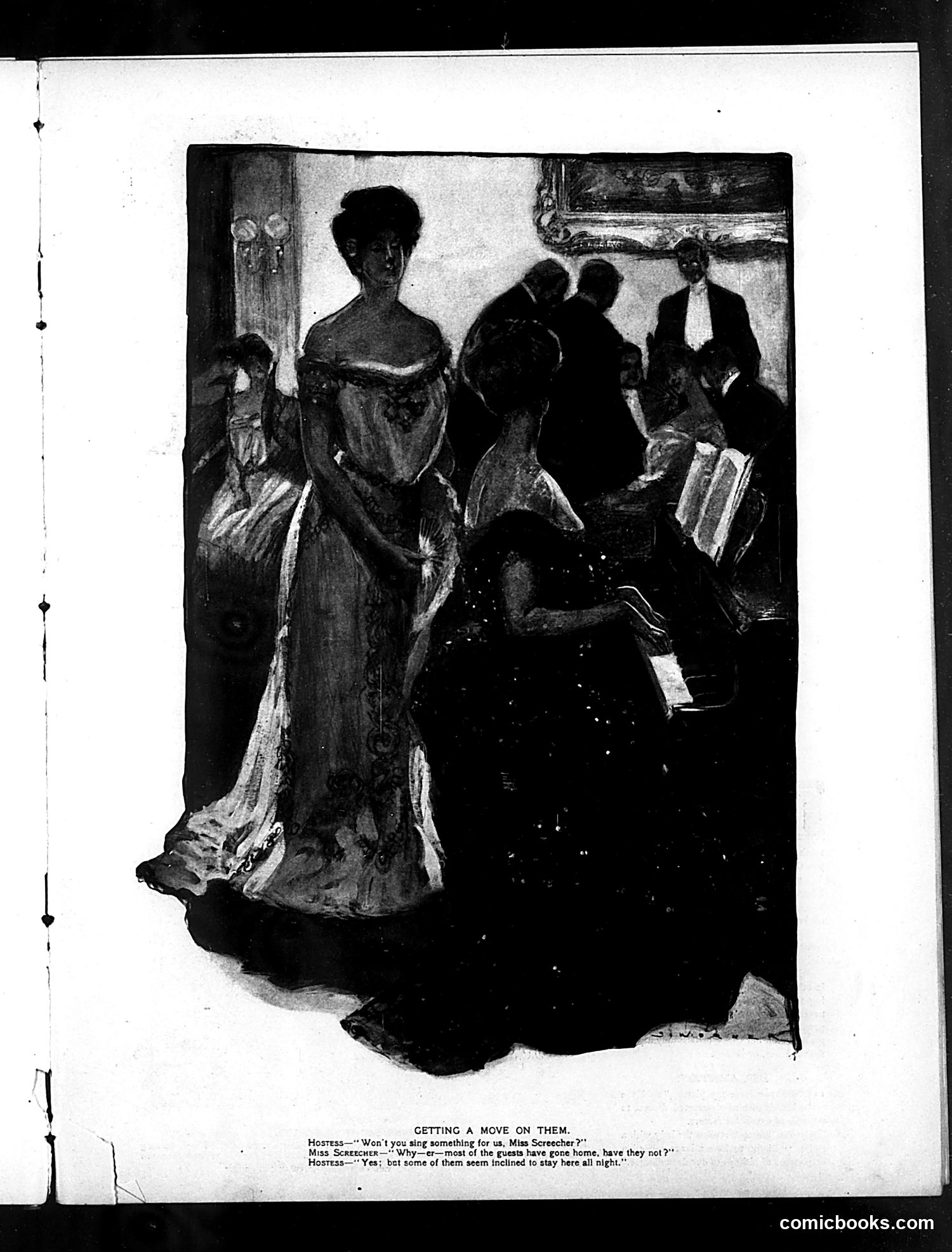
This satirical illustration depicts an elegant hostess attempting to encourage her guests to leave a late evening gathering. The hostess addresses "Miss Screecher," asking her to sing to help move things along, while Miss Screecher protests that most guests have already gone home—yet some seem reluctant to depart despite the late hour. The humor targets upper-class social conventions and the awkwardness of ending social events. The cartoon mocks both overstaying guests (who won't take hints to leave) and the hostess's indirect, performative attempts at subtly pushing them out rather than directly asking them to go. It's a gentle satire of Gilded Age etiquette and social performance among the wealthy.
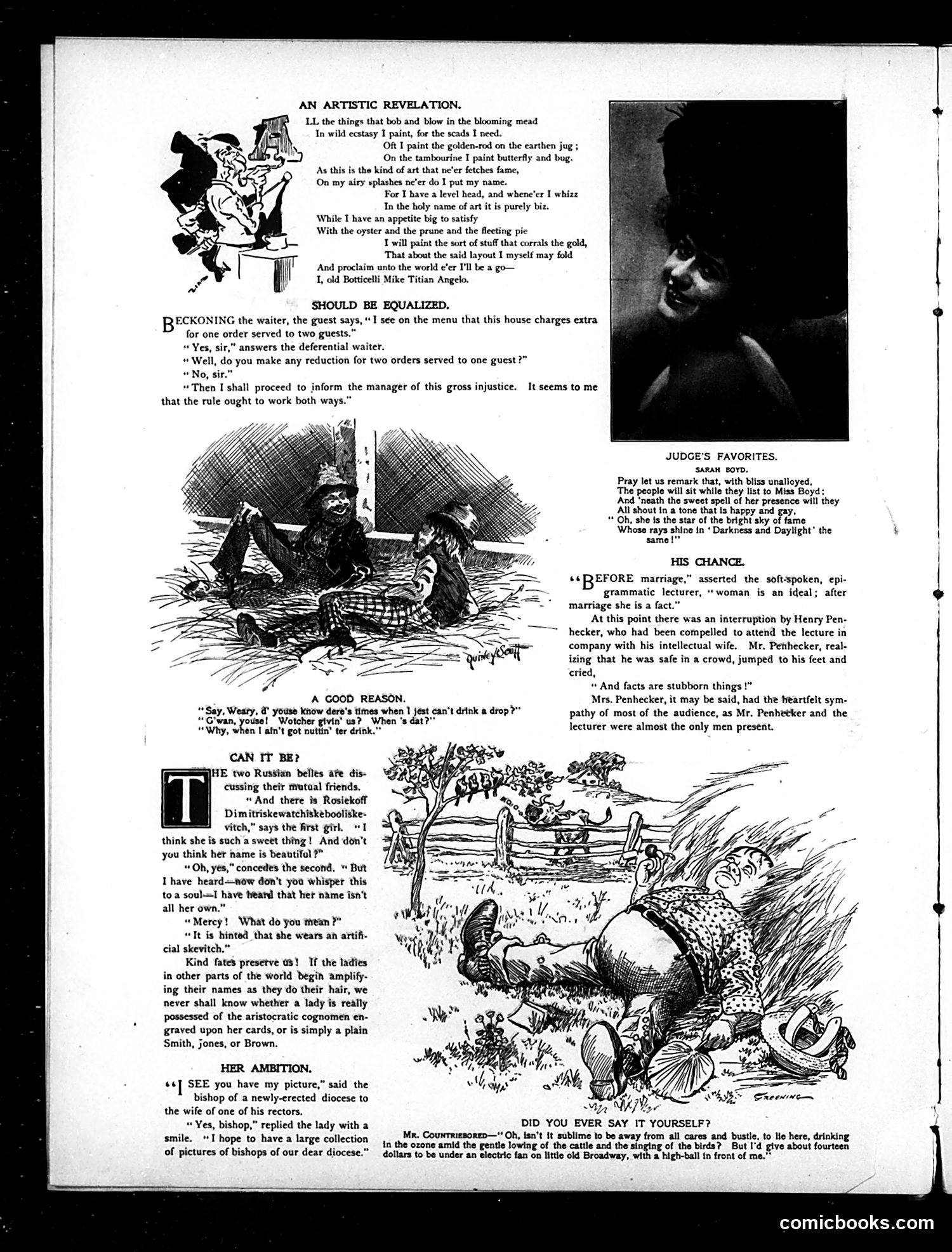
This page contains several satirical pieces typical of Judge magazine's social commentary: **"An Artistic Revelation"** (top left): A caricatured artist proclaims his unorthodox painting methods—using oysters, prunes, and other foods instead of traditional materials. The satire mocks pretentious artists who claim unconventional techniques justify poor or absurd work. **"Should Be Equalized"**: A guest complains about differential pricing for single versus multiple diners. The satire criticizes restaurant pricing practices as unfair. **"Can It Be?"** and other sections discuss women's names and aristocratic pretense, mocking social pretension and naming conventions. The illustrations feature period-appropriate sketches of domestic scenes and countryside landscapes. Overall, the page satirizes artistic pretension, class consciousness, and social inequities common to early 20th-century American society.
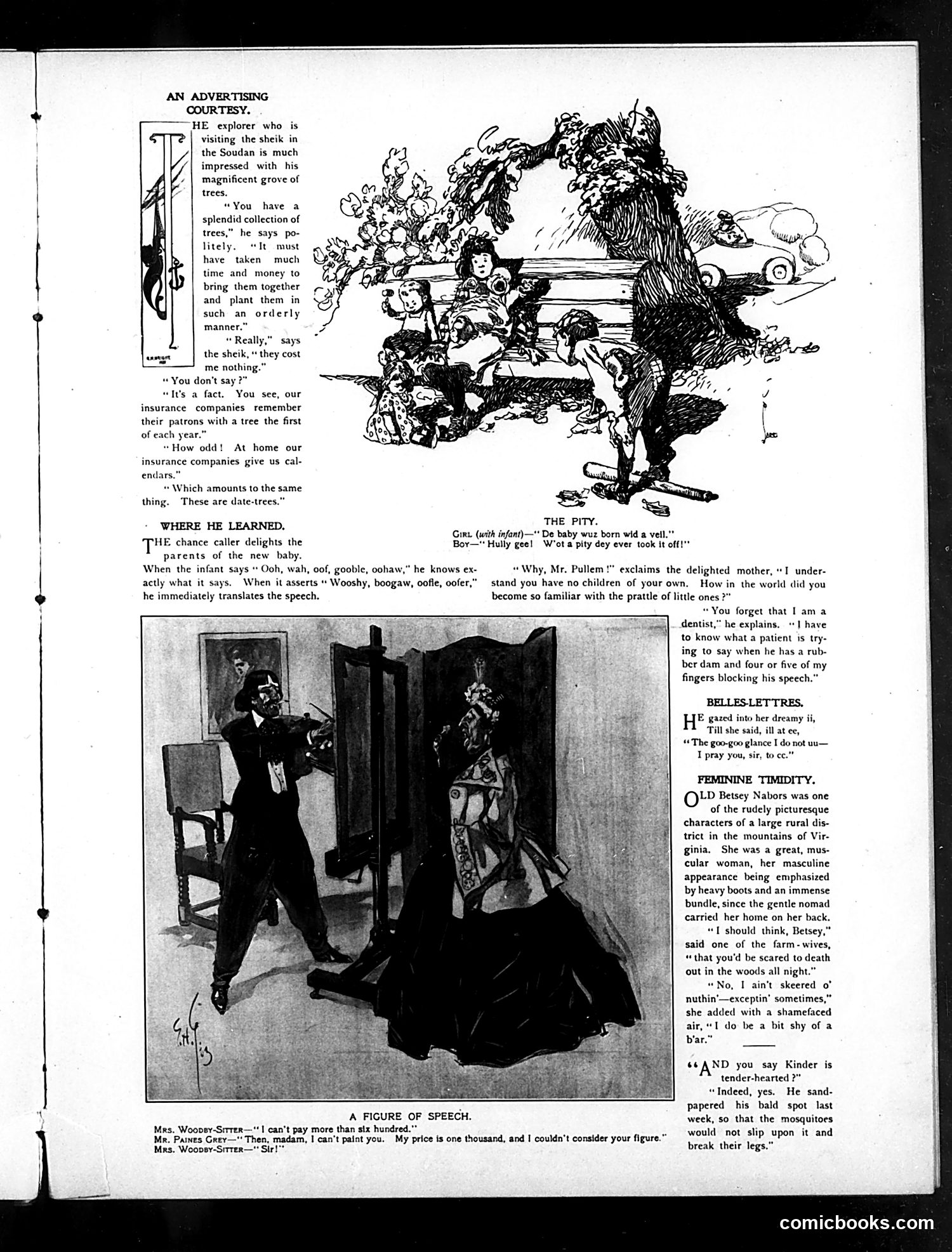
This page contains several short humorous pieces typical of early-20th-century American satirical magazines: **"An Advertising Courtesy"** jokes about a Sudanese sheik's tree grove—a pun revealing the trees are "date-trees" given by insurance companies as promotional gifts, mimicking how American insurers gave calendars. **"Where He Learned"** features a dentist explaining his ability to interpret baby gibberish through professional experience managing patients with rubber dams and fingers in their mouths—absurdist humor about occupational knowledge. **"The Pity"** presents a mother's delight that a visiting dentist understands her baby's nonsense speech, contrasting with his profession's exposure to muffled patient communication. **"Belles-Letters"** shows a dreamy young woman reciting romantic poetry. **"Feminine Timidity"** satirizes gender stereotypes through "Old Betsey Nabors," a physically strong rural Virginia woman who fearlessly traverses woods alone but admits embarrassment about bears—subverting expected notions of delicate femininity. **"A Figure of Speech"** depicts a painting negotiation where a client and artist miscommunicate about price. These represent Judge's characteristic light social satire and wordplay humor.
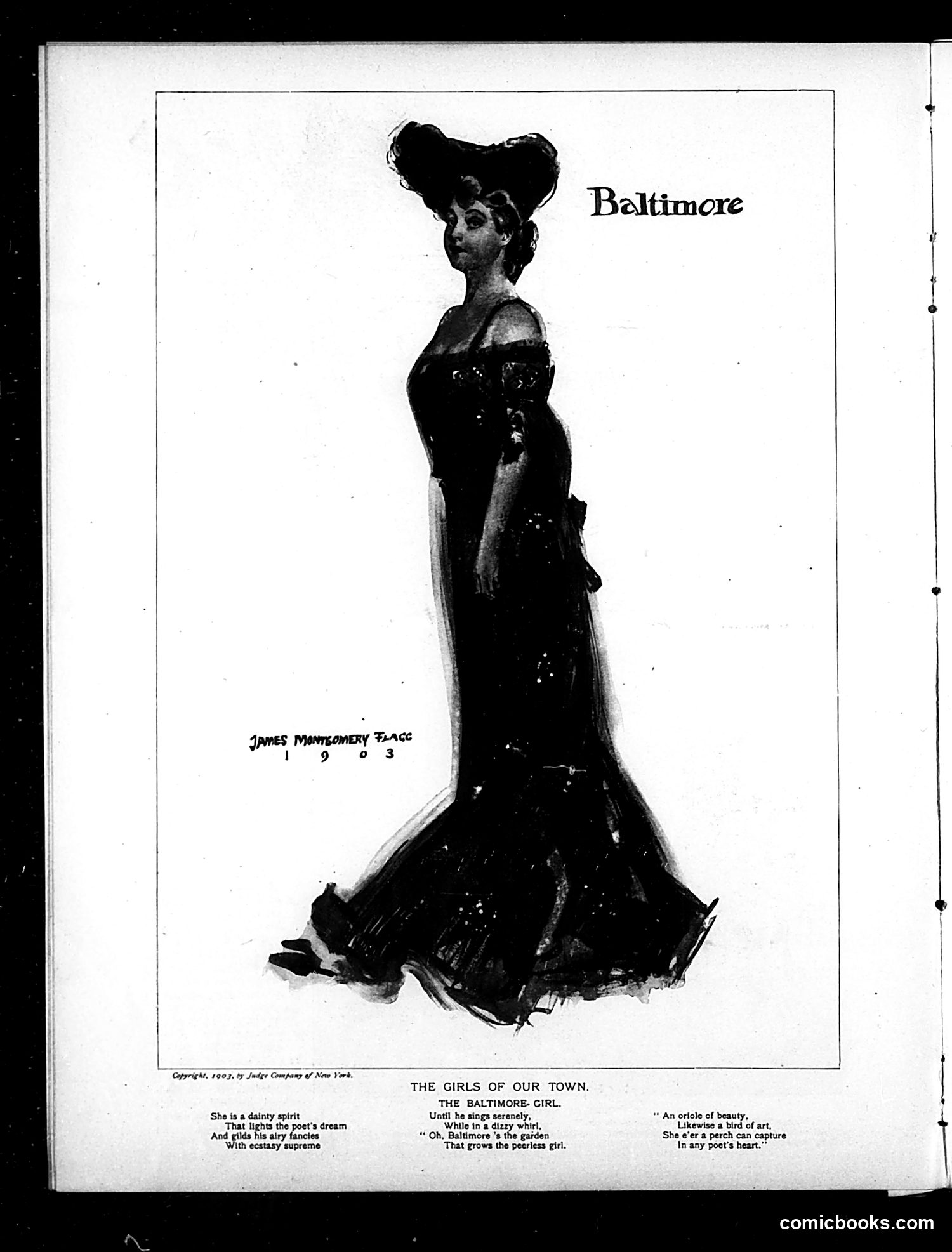
This 1903 Judge magazine page presents an idealized portrait of a Baltimore woman as part of a series celebrating regional American femininity. The illustration, credited to James Montgomery Flagg, depicts an elegant woman in an elaborate dark gown with an ornate upswept hairstyle—representing the Gibson Girl aesthetic popular in the early 1900s. The accompanying verse romanticizes the "Baltimore girl" using flowery language: she's a "dainty spirit," an "oriole of beauty," and "the peerless girl" of Baltimore's metaphorical garden. The satire likely mocks the pretentious, overwrought praise cities lavished on their eligible women during this era, treating them as regional commodities or status symbols. For modern readers, this reflects outdated gender stereotypes and the era's tendency to reduce women to ornamental ideals tied to geographical identity.
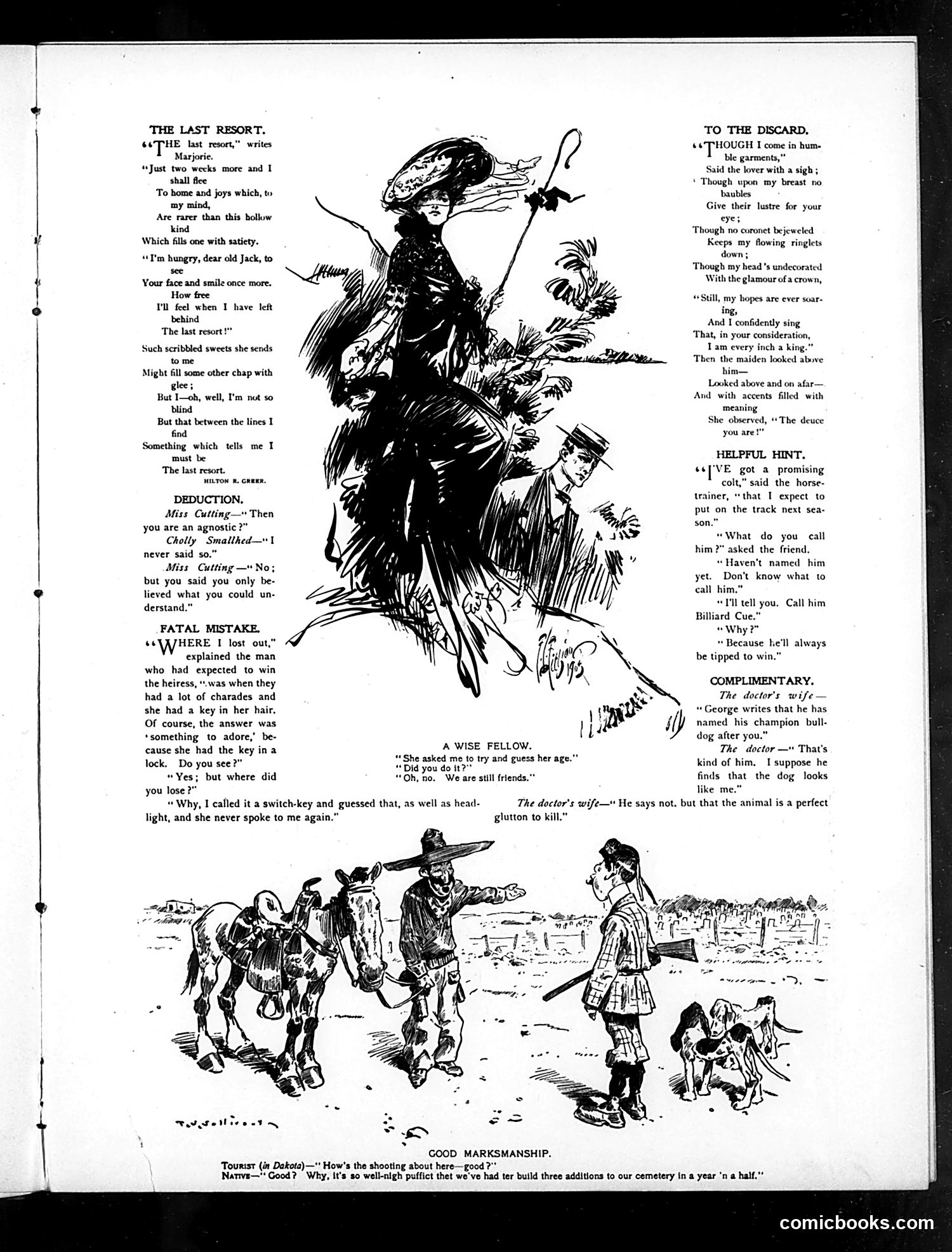
This page contains several short humorous pieces typical of early 20th-century American satirical journalism: **"The Last Resort"** and **"To the Discard"** are romantic poems about lovers—one pining to leave socialite circles for genuine home life, the other a woman dismissing her suitor's flowery declarations of devotion as meaningless. **"Deduction," "Fatal Mistake,"** and **"A Wise Fellow"** are brief comedic dialogues mocking social pretension: a man misidentifies an agnostic's statements; another ruins his chances with an heiress through poor wordplay about a key; a third wisely avoids guessing a woman's age. **"Good Marksmanship"** jokes about frontier violence—a Dakota native boasts their shooting is so accurate they've had to expand the cemetery three times in eighteen months, treating casual frontier killing as a point of pride. **"Helpful Hint"** and **"Complimentary"** are brief quips about naming a racehorse and a doctor's reputation. The page combines light social satire with period humor reflecting American attitudes about courtship, class, and frontier life.
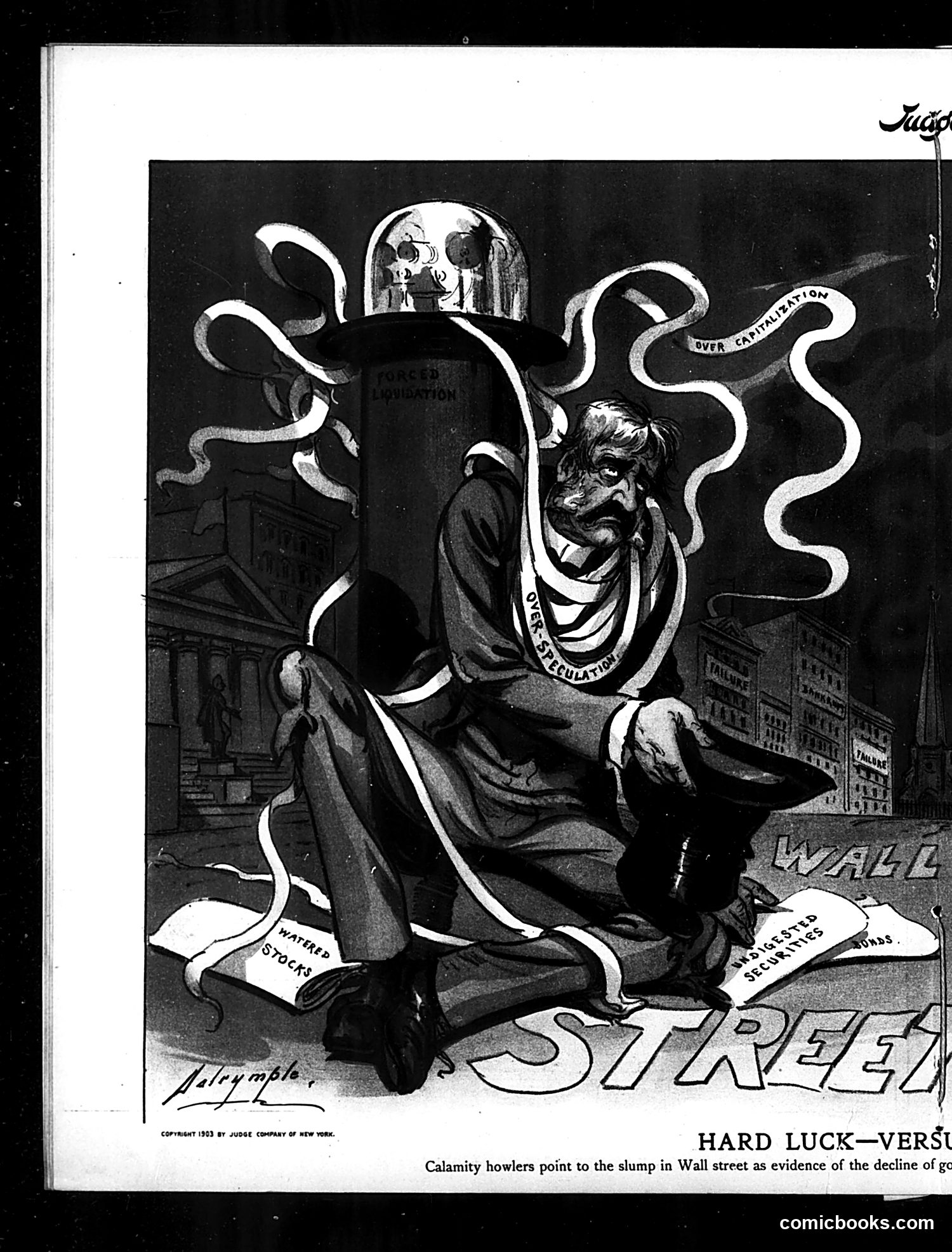
This political cartoon satirizes "calamity howlers"—pessimists predicting economic doom—who point to Wall Street's decline as proof of America's decay. The octopus-like figure emerging from a barrel labeled "FORCED LIQUIDATION" represents financial crisis or market collapse. The creature has a skull head and multiple tentacles wrapped around a distressed businessman on Wall Street. Papers scattered below reference "WATERED STOCKS" and "INFLATED SECURITIES," indicating speculation and financial manipulation. The caption suggests these doomsayers exaggerate economic problems. The cartoon mocks both the crisis itself and those who weaponize it for pessimistic rhetoric. The date (copyright 1923) places this during post-WWI economic uncertainty, when financial instability fueled both genuine concern and sensationalized panic about America's future.
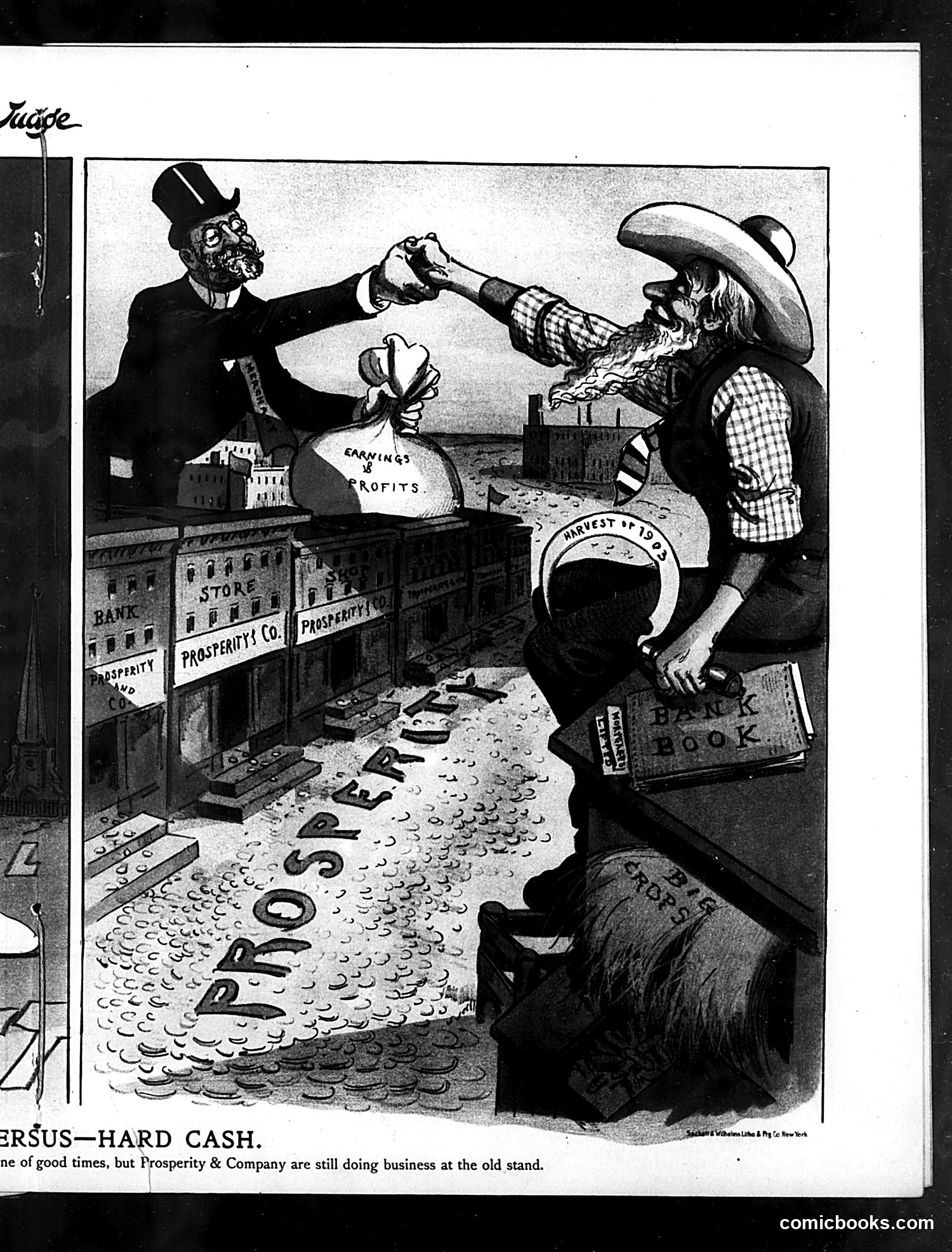
This political cartoon depicts a confrontation between two figures over wealth during economic turbulence. The man in formal dress (left, top hat) represents established financial institutions or wealthy elites, while the bearded man (right, cowboy hat) represents working-class or agrarian interests—likely farmers or laborers. The bag labeled "Earnings & Profits" is being contested between them, surrounded by scattered coins and currency on the ground. The buildings below labeled "Bank," "Store," and "Prosperity Co." suggest the commercial establishment's entrenched position. The caption's final phrase—"Prosperity & Company are still doing business at the old stand"—conveys sardonic commentary: despite claims of good times, the wealthy class continues profiting while ordinary people struggle over financial scraps. This reflects late 19th/early 20th-century class tensions and debates over wealth distribution and economic fairness.
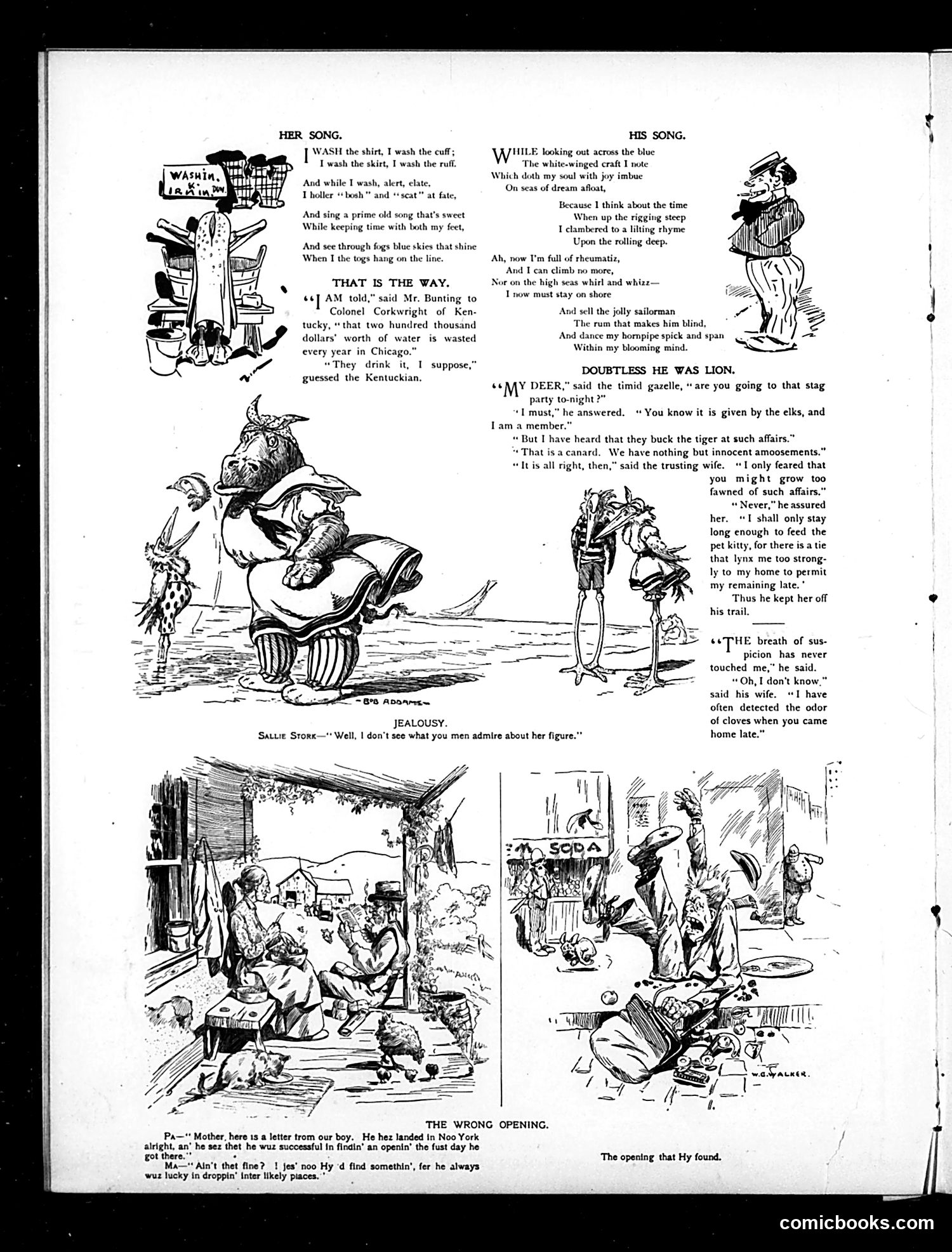
This page contains multiple satirical pieces typical of early American humor magazines: **"Her Song" vs. "His Song"**: A gender-contrast piece. The working-class woman cheerfully sings while doing laundry, finding joy in domestic drudgery. The man nostalgically recalls his seafaring youth but now sells rum to sailors and merely dances in his imagination—suggesting masculine decline and obsolescence. The satire mocks both the romanticization of labor and male wistfulness. **"That Is the Way"**: A joke about Chicago's water waste, with a Kentucky colonel humorously misinterpreting the problem as intentional consumption rather than infrastructure loss. **"Doubtless He Was Lion"**: An extended animal pun where a gazelle husband attends an "stag party" given by "elks," with wordplay on "buck," "canard," "amoosements," "fawned," and "lynx." It satirizes marital deception through elaborate animal-related double meanings. **"The Wrong Opening"**: Rural dialect humor about a son finding success in New York—plays on misunderstanding "opening" (opportunity vs. literally opening something). **"Jealousy"**: A wife detects clove scent on her husband, implying infidelity or at least suspicious late nights.
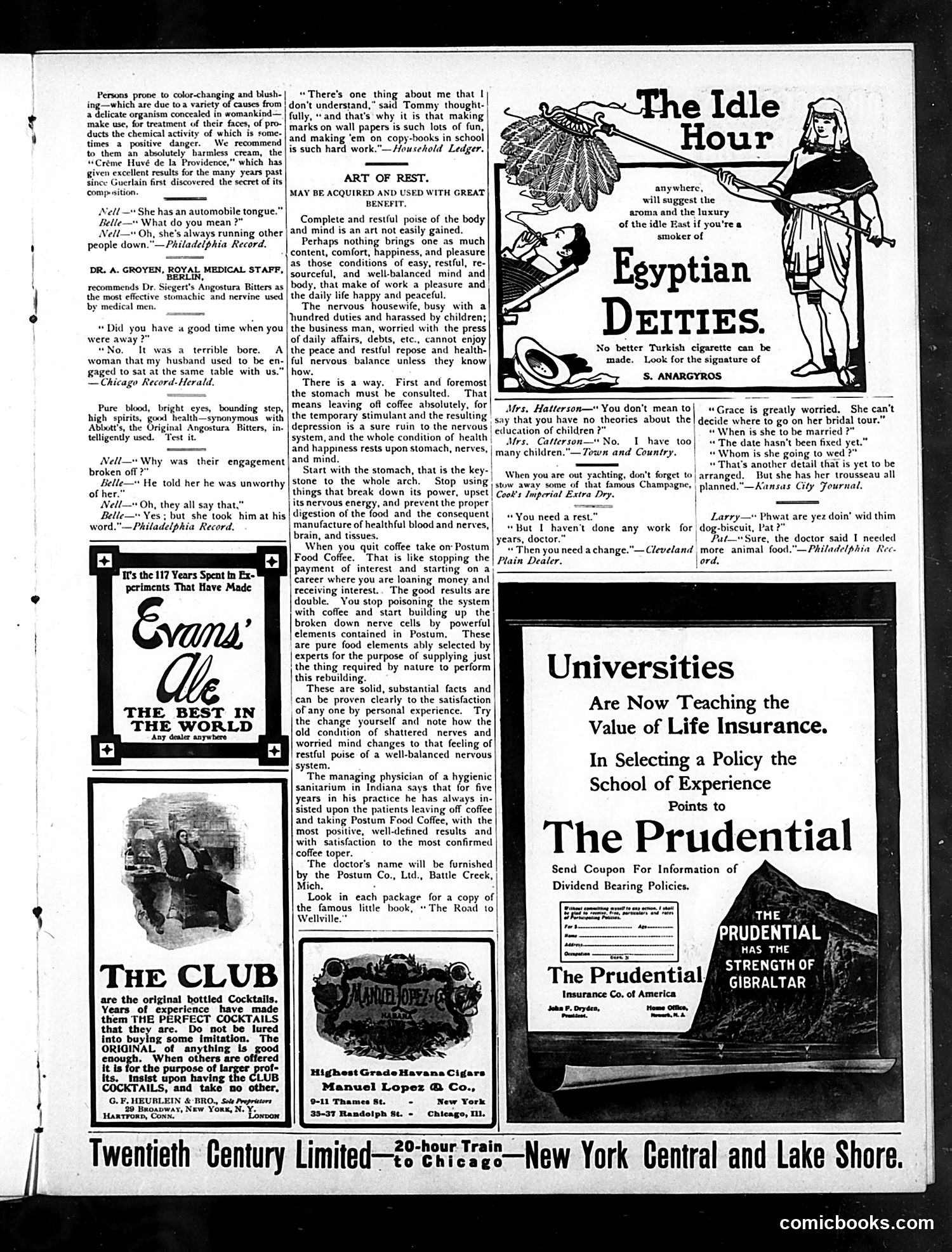
This is primarily an **advertising page** from Judge magazine, not a political cartoon. The page consists mostly of product advertisements (Evans ale, Angostura Bitters, Postum coffee substitute, life insurance, cigars, cocktails) interspersed with brief humor items. **"The Idle Hour" section** features an Egyptian-themed cigarette advertisement—exploiting the early 20th-century fascination with Egyptology. **The humor pieces** are short jokes typical of the era: one about a woman with an "automobile tongue" (always criticizing others), another about a broken engagement where a man claimed unworthiness and the woman believed him. These target gender dynamics and social pretension. **The Postum advertisement** is notable—it argues against coffee drinking as harmful to nerves and digestion, promoting their grain-based substitute as healthful. This reflects genuine period medical anxieties about caffeine. Overall, this is a **commercial publication page** rather than satirical commentary.
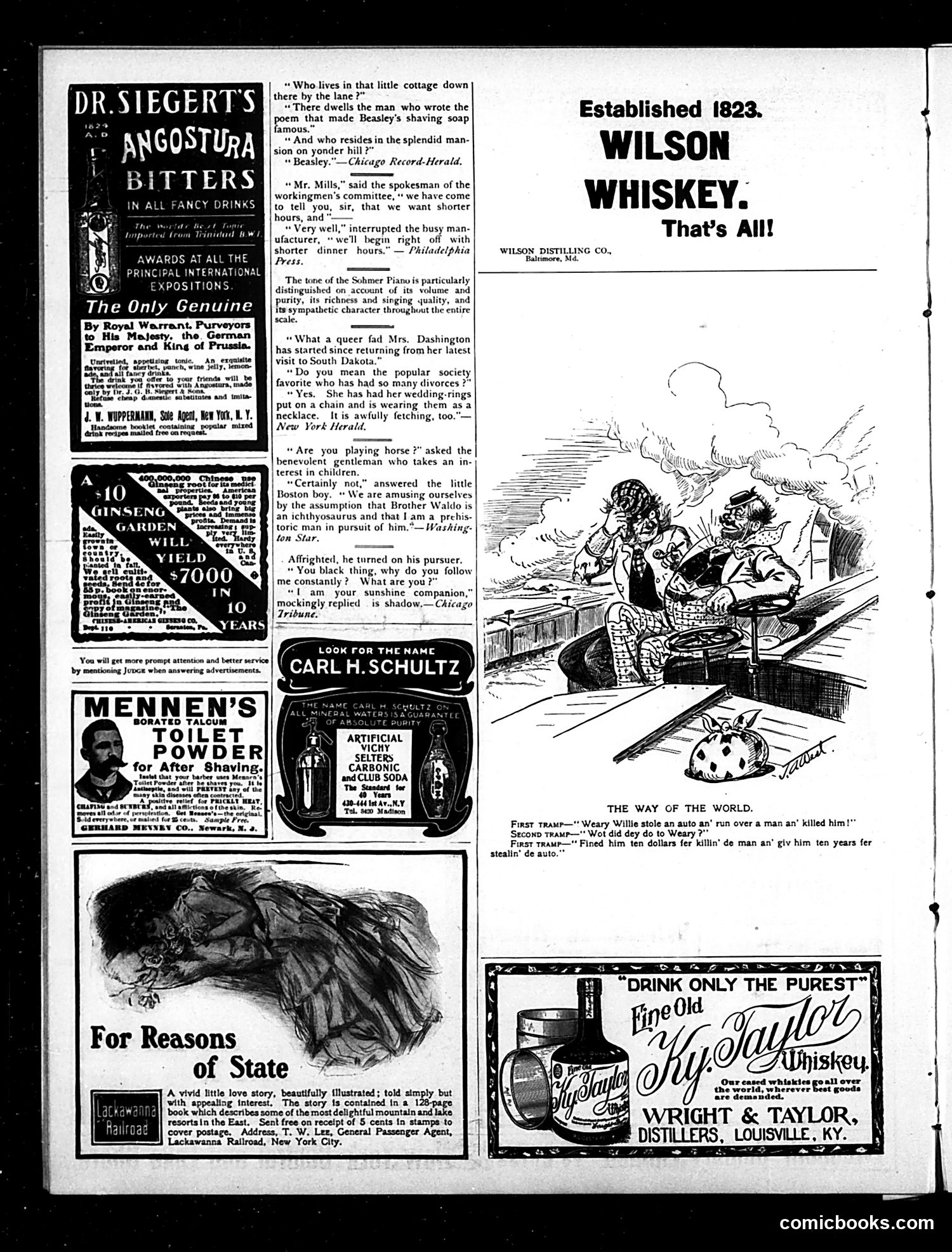
This page is primarily **advertisements** interspersed with brief satirical jokes typical of Judge magazine's humor. The main cartoon—"The Way of the World"—depicts two tramps discussing legal consequences. The satire comments on **inverted justice priorities**: a man who steals an automobile receives ten years imprisonment, while the same man who kills someone with that stolen vehicle gets only a ten-dollar fine. This reflects early 20th-century anxieties about property crimes being punished more severely than crimes against persons, and satirizes how courts valued material goods over human life. The surrounding text contains short jokes mocking various social types: poets who write advertising copy, impatient manufacturers, society divorcées, Boston children affecting pseudo-intellectual speech, and shadows as "sunshine companions." These represent typical Judge humor—brief, often absurdist jabs at contemporary social pretensions and absurdities. The page functions primarily as a vehicle for advertisements (whiskey, bitters, pianos, talcum powder) with satirical filler content.
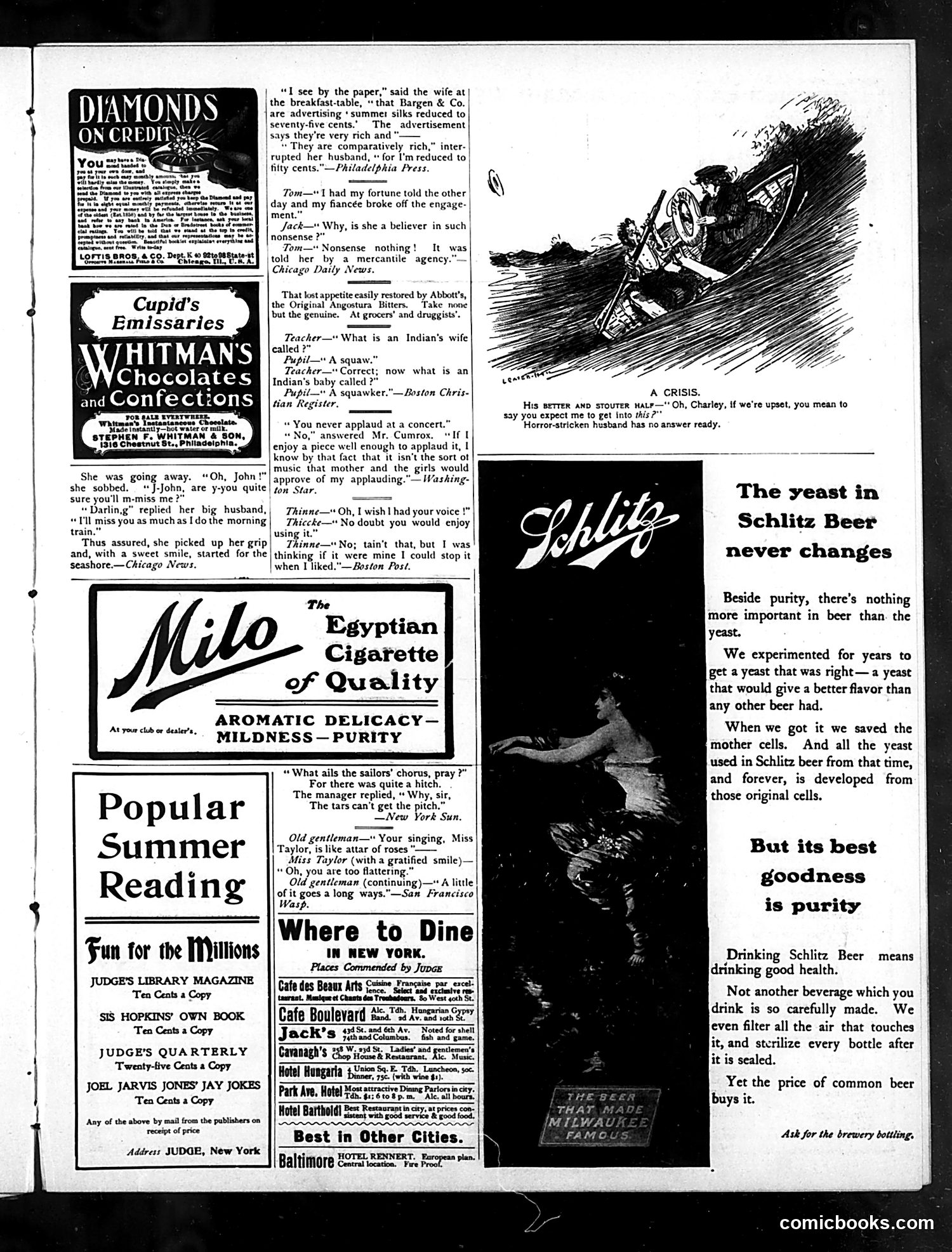
This page from the satirical magazine **Judge** contains primarily **short humor pieces and advertisements** rather than political cartoons. The main comic content includes brief jokes satirizing domestic life and social pretension: - A husband, reduced to "fifty cents," comments wryly on his wife's excitement over bargain silks - A man's fiancée breaks their engagement after a fortune-teller's prediction—revealed as coming from a "mercantile agency" (credit report), mocking both superstition and financial anxiety - A teacher's joke playing on "squaw" (a derogatory term for Native American women) - A husband's deadpan response to his departing wife: he'll miss her "as much as I do the morning train" These jokes reflect early 20th-century attitudes toward marriage (humorously strained), class consciousness, and casual ethnic stereotyping typical of the era. The page is dominated by **period advertisements**: Whitman's Chocolates, Schlitz Beer (emphasizing yeast purity), Milo cigarettes, and dining guides—standard magazine revenue sources then.
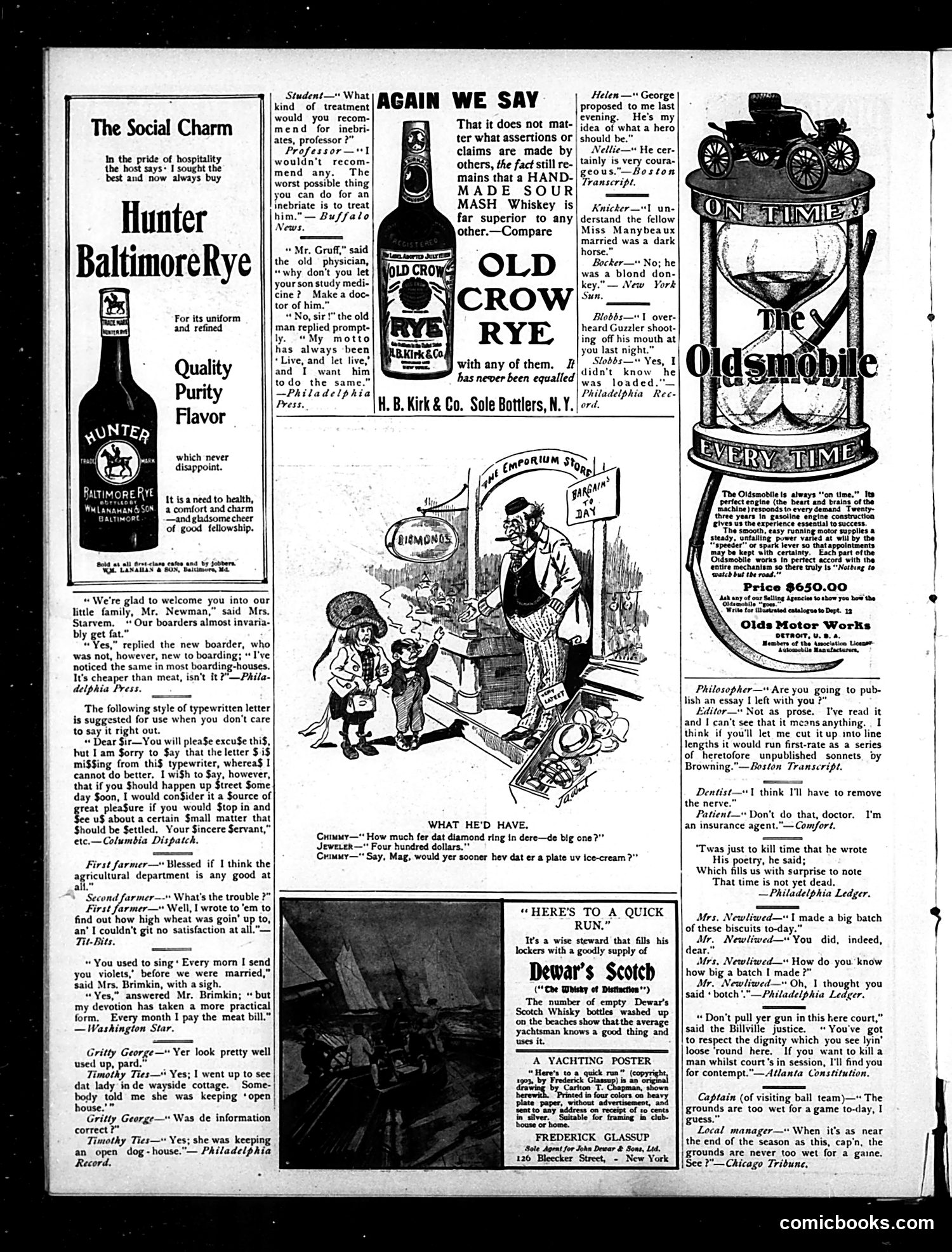
This page from *Judge* magazine (likely early 1900s) combines advertisements, comic vignettes, and brief humorous exchanges typical of the era's satirical journalism. **Main Content:** The page features multiple short jokes and anecdotes about everyday life—marital relationships, boarding houses, farming bureaucracy, and social encounters. These reflect common turn-of-the-century concerns: domestic dynamics, economic practicality, and courtship rituals. **Advertisements:** Three liquor ads dominate: Hunter Baltimore Rye whiskey (emphasizing "quality, purity, flavor"), Old Crow Rye (claiming superiority over competitors), Dewar's Scotch, and Olds Motor Works automobiles. These ads reflect the pre-Prohibition era when alcohol advertising was standard magazine content. **The Satire:** The humor relies on wordplay, misunderstandings, and social observation rather than political commentary. One joke depicts Irish immigrants ("Crimmy," "Mag") in stereotypical dialect at a jewelry shop, reflecting period attitudes toward immigrant communities. The overall tone is genteel, middle-class oriented humor aimed at educated readers comfortable with references to housekeeping, courtship, and social propriety.
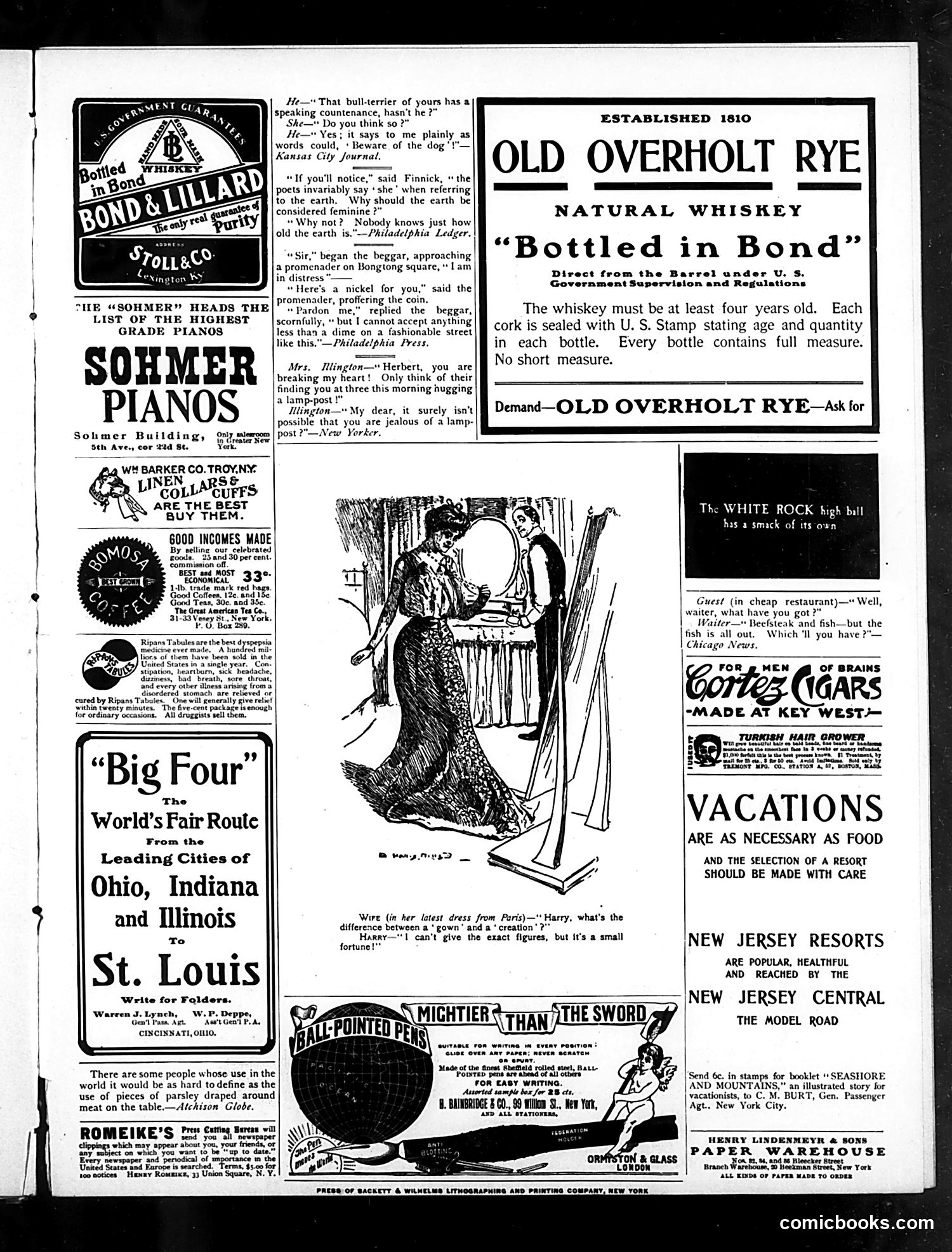
This is primarily an **advertising page** from Judge magazine, with one central cartoon and numerous product advertisements typical of early 1900s publications. ## The Main Cartoon The large central illustration depicts a **domestic scene** with a woman in an elegant dress confronting a man. The caption reveals a marital joke: the wife asks the difference between a "gown" and a "creation," and the husband admits he "can't give the exact figures, but it's a small fortune." **The satire**: This is a common theme in Judge—mocking men's bewilderment at women's fashion expenses and the inflated language used to justify luxury clothing prices. "Creation" was fashionable terminology for expensive, designer garments, implying artistic value to justify costs. ## Advertisements The page features typical period ads: Sohmer pianos, Old Overholt Rye whiskey (emphasizing government regulation), Cortez cigars, New Jersey resorts, and various patent medicines—reflecting the magazine's middle-to-upper-class readership concerned with refinement, health, and leisure. The humor relies on period anxieties about consumption, marriage dynamics, and masculine confusion regarding feminine extravagance.
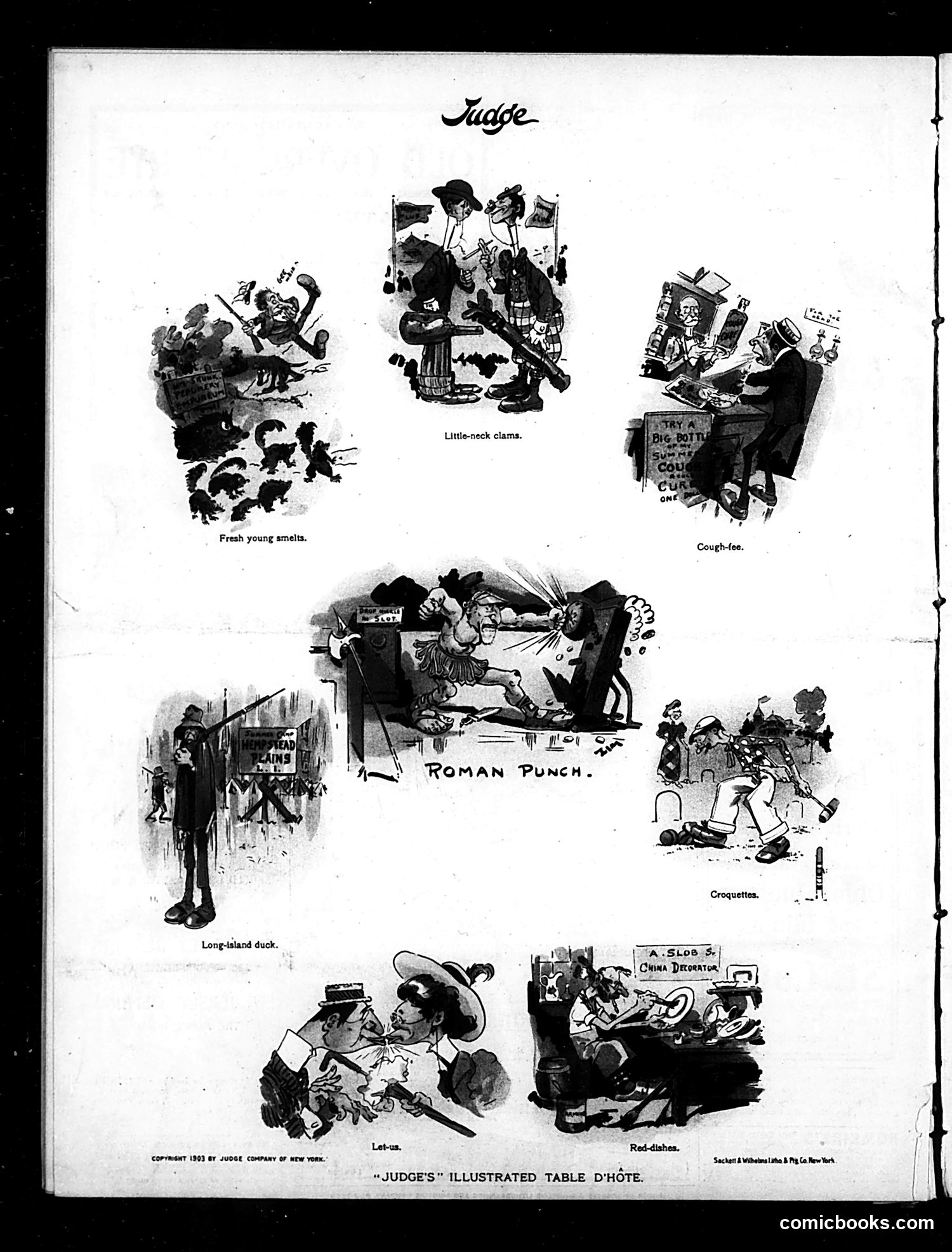
This 1903 Judge page presents a satirical "menu" of current events and social issues, styled as a fancy French restaurant's table d'hôte (fixed-price meal). Each cartoon represents a different "dish": - "Fresh young smells" and "Little-neck clams" likely mock naive politicians or public figures - "Cough-fee" satirizes a health or political scandal (the visual pun on "coffee") - "Roman Punch" appears to reference Vatican/Catholic Church matters - "Long-island duck," "Croquettes," "Lat-ea," and "Red-dishes" use food names as puns for current events or social commentary The overall conceit mocks contemporary news and scandals as items to be "consumed" by the public, treating serious matters with irreverent humor typical of Judge magazine's satirical approach. Without specific historical context, the exact references remain unclear, but the format—combining food puns with political/social critique—is characteristic of early 1900s American satire.