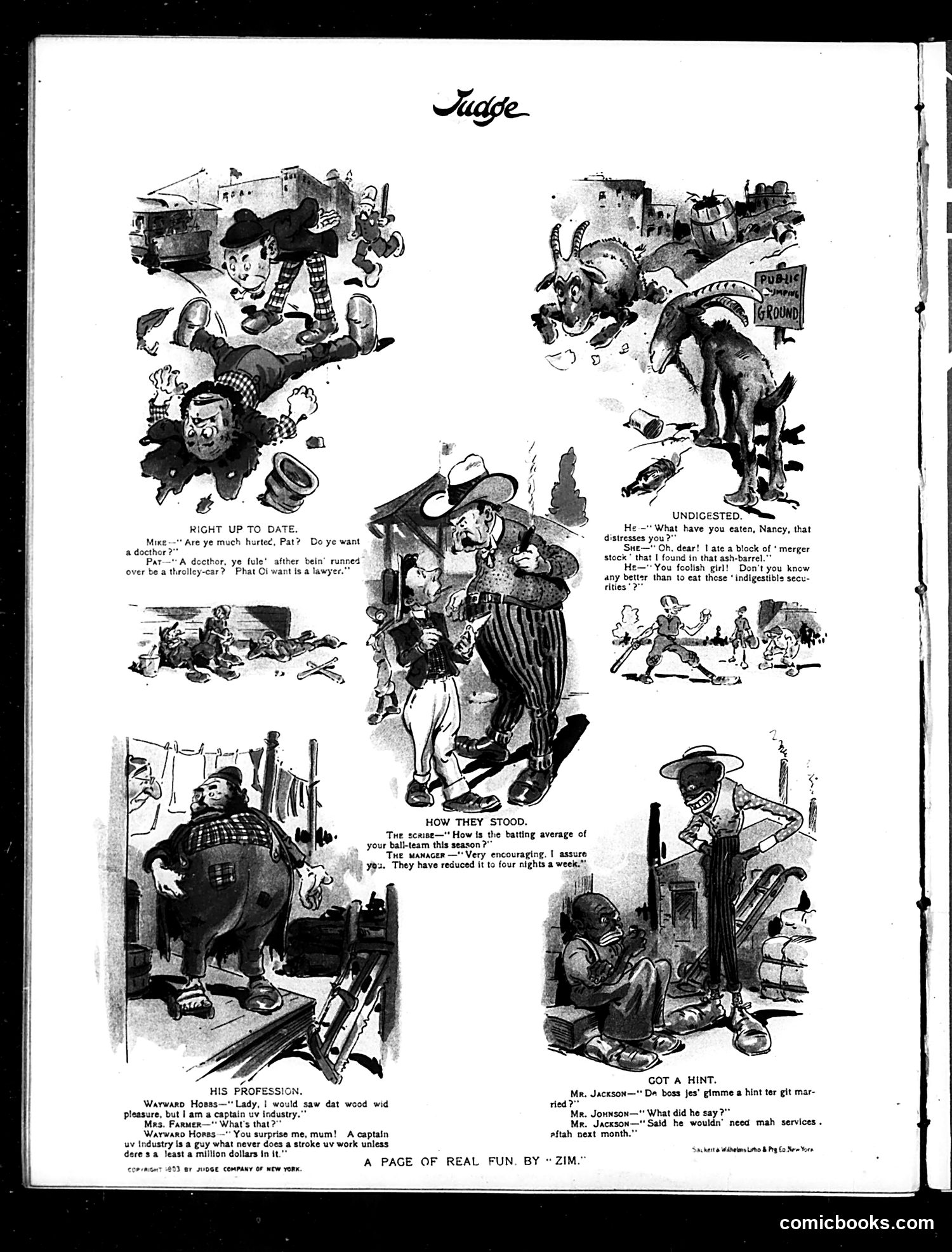
A complete issue · 16 pages · 1903
Judge — August 22, 1903
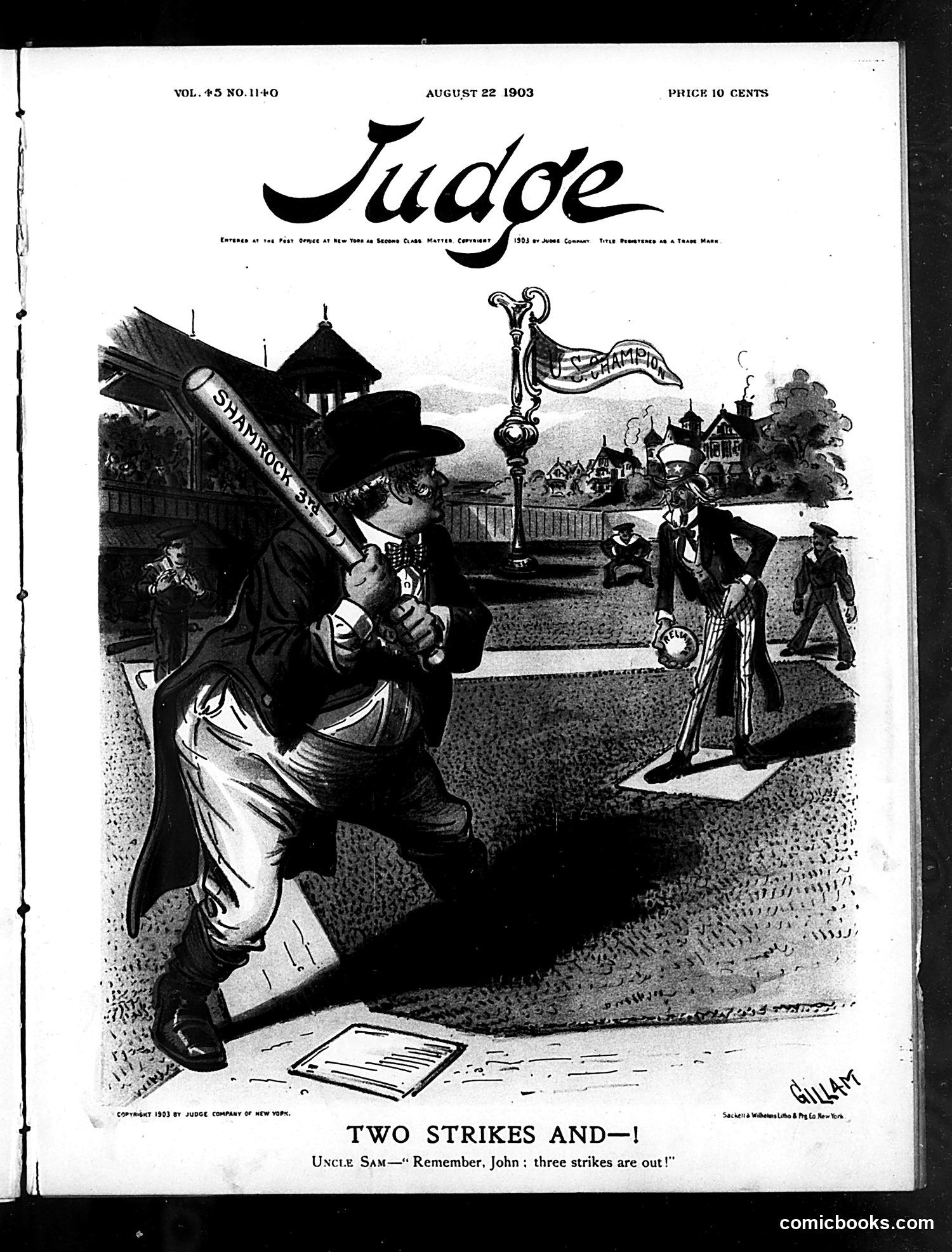
This is a political cartoon from Judge magazine (August 22, 1903) depicting Uncle Sam as a baseball batter about to strike. The caption reads: "Uncle Sam—'Remember, John: three strikes are out!'" The cartoon appears to reference labor disputes or strikes during the early 1900s, a period of significant industrial unrest in America. Uncle Sam warns "John" (likely representing a labor leader or worker) that he's already taken two strikes and a third will result in being "out"—meaning disqualification or defeat. The baseball metaphor suggests the cartoonist is warning against continued labor actions, presenting them as a threat to American stability. The "Champion" flag visible in the background suggests national interest is at stake. The satire advocates for restraint in labor organizing.
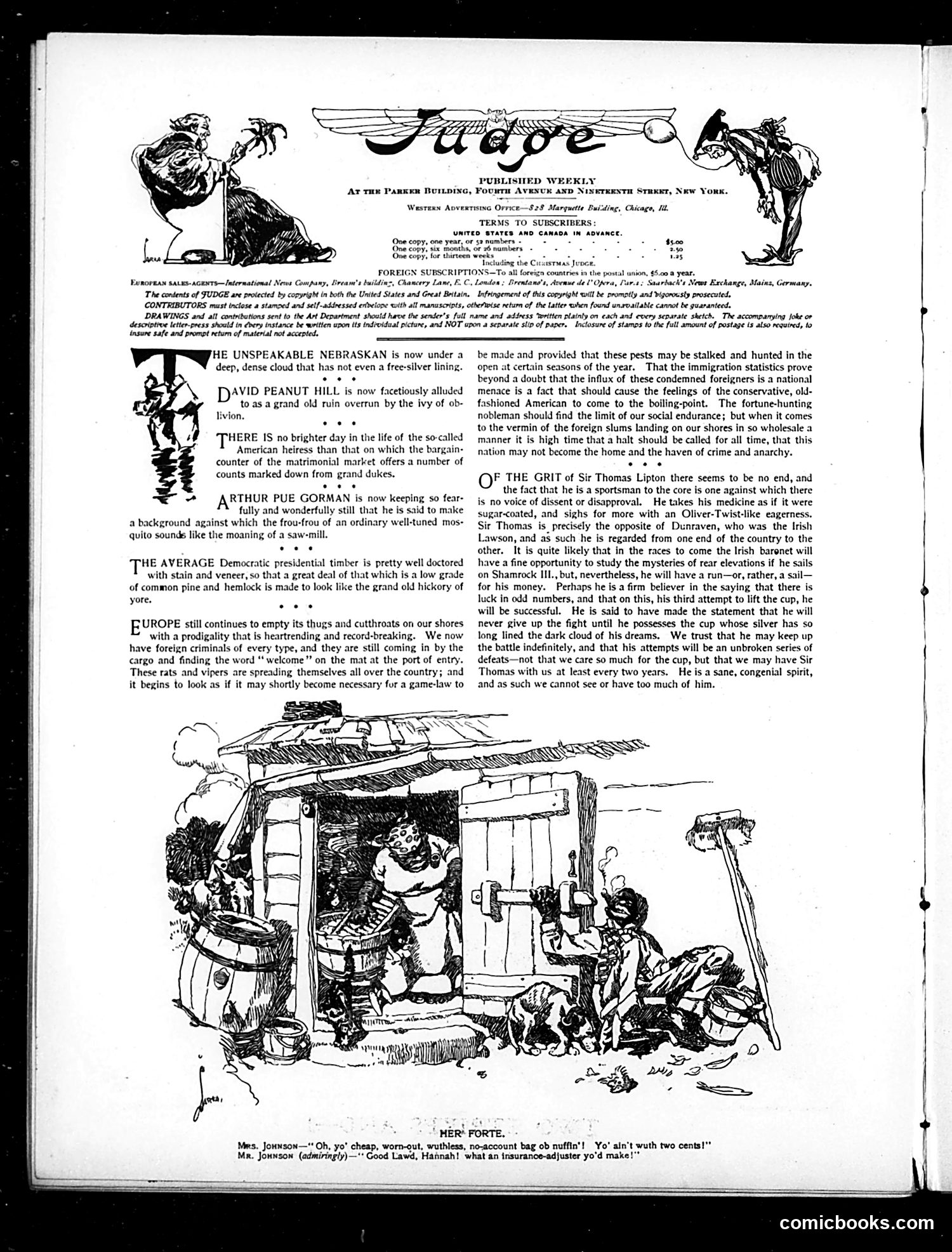
This page contains several short political commentaries typical of Judge's satirical style. The main topics include: **Immigration concerns**: A section criticizes the influx of "foreign criminals" landing on American shores, arguing this threatens the nation's stability and creates crime and anarchy—reflecting early-20th-century anti-immigration anxieties. **Nebraska pest control**: References "unsheltered Nebraska" dealing with prairie dogs, using this as a metaphor for pest elimination. **Sir Thomas Lipton**: Discusses the British sportsman's yacht racing pursuits and his determination to win the America's Cup, portraying him as admirably persistent despite repeated failures. The bottom illustration labeled "HER FORTE" shows a domestic scene with a woman and child, depicting a humorous domestic moment about household management or parenting. The artwork and tone reflect Judge's characteristic blend of political commentary and genteel humor targeting educated American audiences.
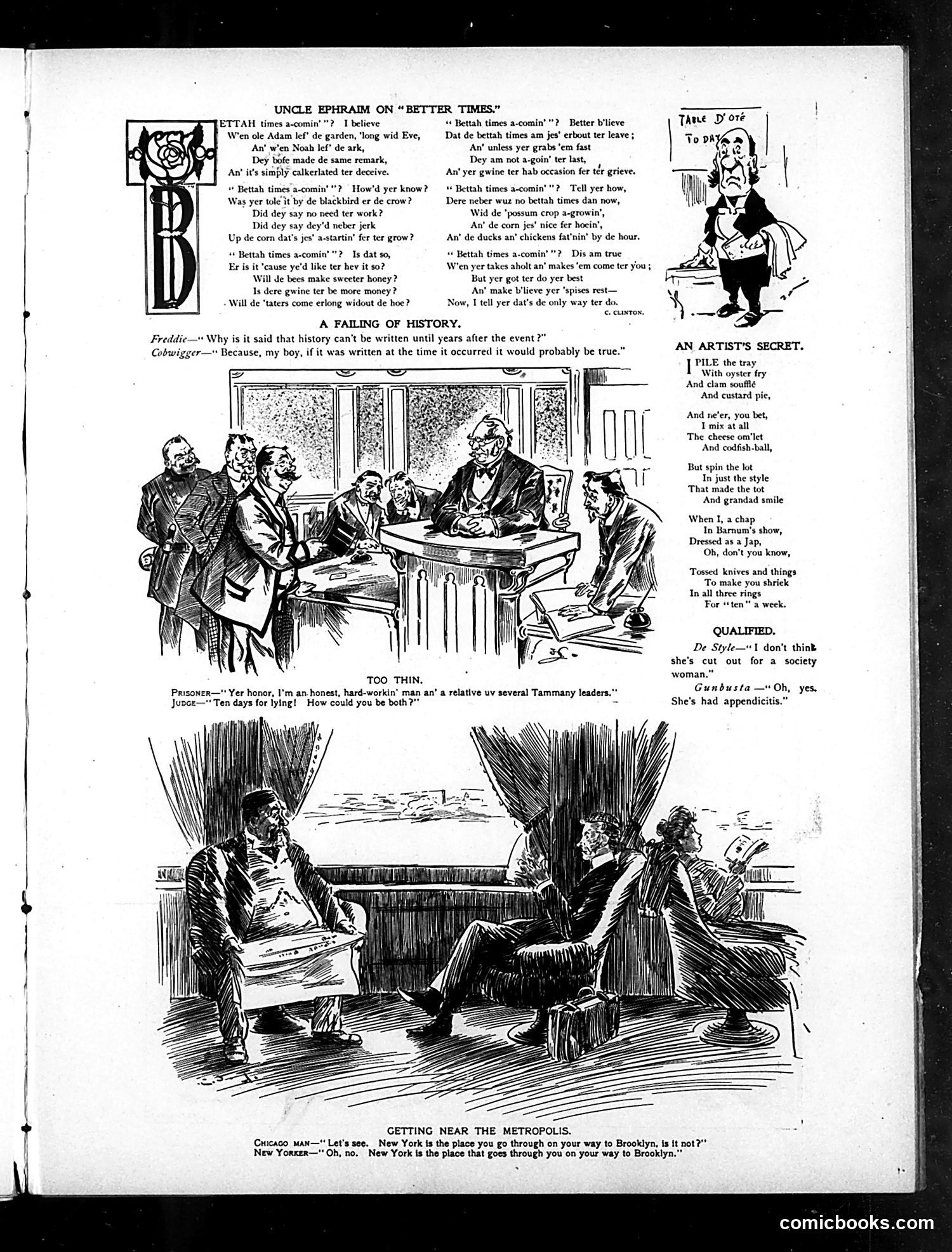
This page contains several satirical pieces typical of early 20th-century Judge magazine: **"Uncle Ephraim on Better Times"** presents dialect humor, with a character using rural/folk speech patterns to comment on economic conditions—a common format of the era. **"A Failing of History"** depicts a courtroom scene where a prisoner claims to be "an honest, hard-working man" and "a relative of several Tammany leaders." The joke satirizes Tammany Hall (New York's Democratic political machine) and suggests connections to it provided corruption or legal advantage. **"Getting Near the Metropolis"** is a brief geographical joke about New York and Brooklyn. **"An Artist's Secret"** and **"Qualified"** are short humor pieces about social pretension and gender roles. The overall page reflects Judge's focus on urban politics, class satire, and social commentary through caricature and dialect humor typical of that period.
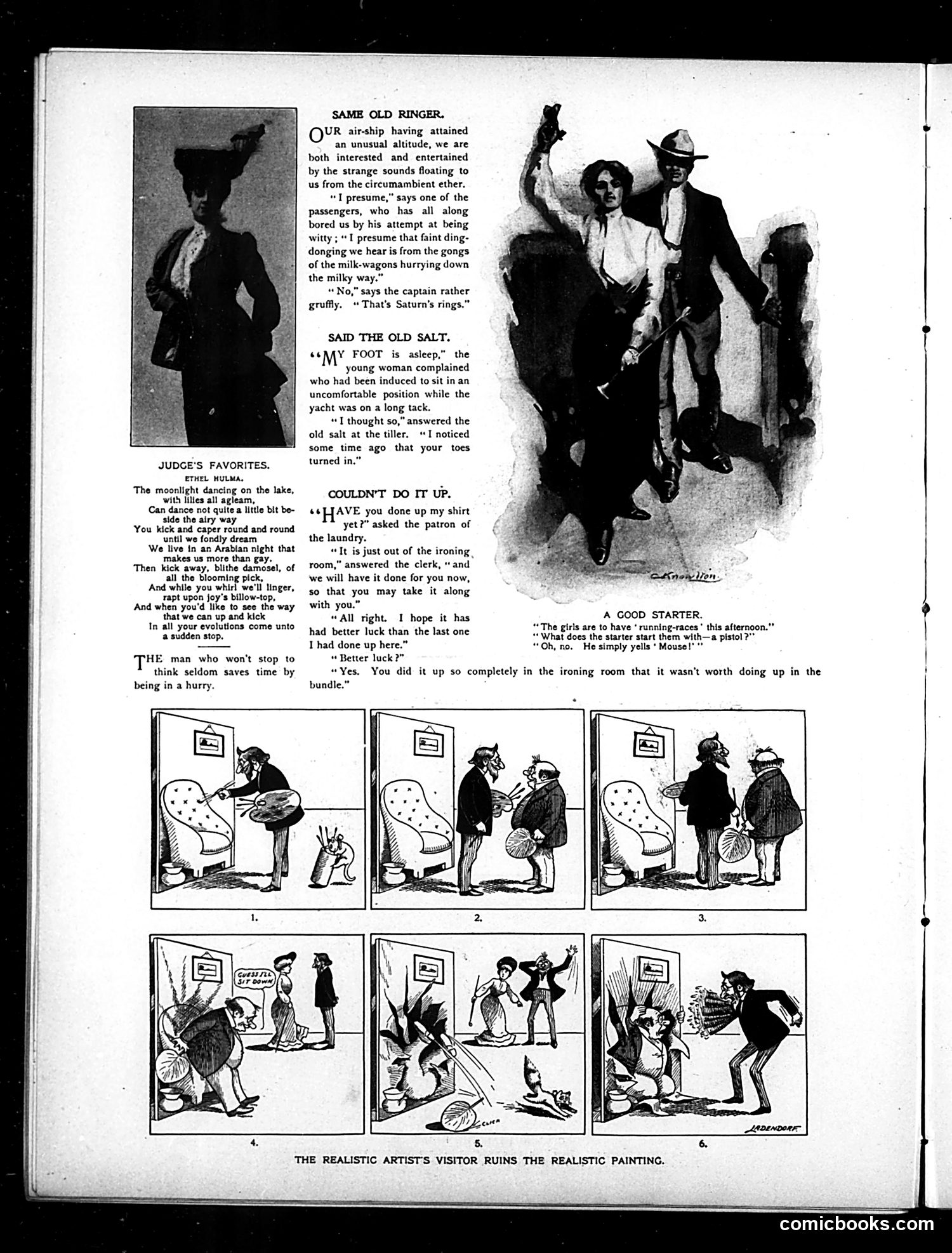
This page contains several distinct pieces of light humor rather than political satire: **"Same Old Ringer"** and **"Said the Old Salt"** are comedic dialogues about shipboard life—one involves passengers hearing strange sounds during an airship journey; the other concerns a woman's sore foot and laundry mishaps. These are gentle, domestic humor pieces. **"Judge's Favorites"** presents a sentimental poem about moonlit dancing. **"Couldn't Do It Up"** is a brief joke about laundry service incompetence. The bottom feature, **"The Realistic Artist's Visitor Ruins the Realistic Painting,"** is a six-panel comic strip showing an artist's work being progressively destroyed by a clumsy visitor—purely slapstick humor with no political content. Overall, this page focuses on everyday comedy rather than social or political commentary.
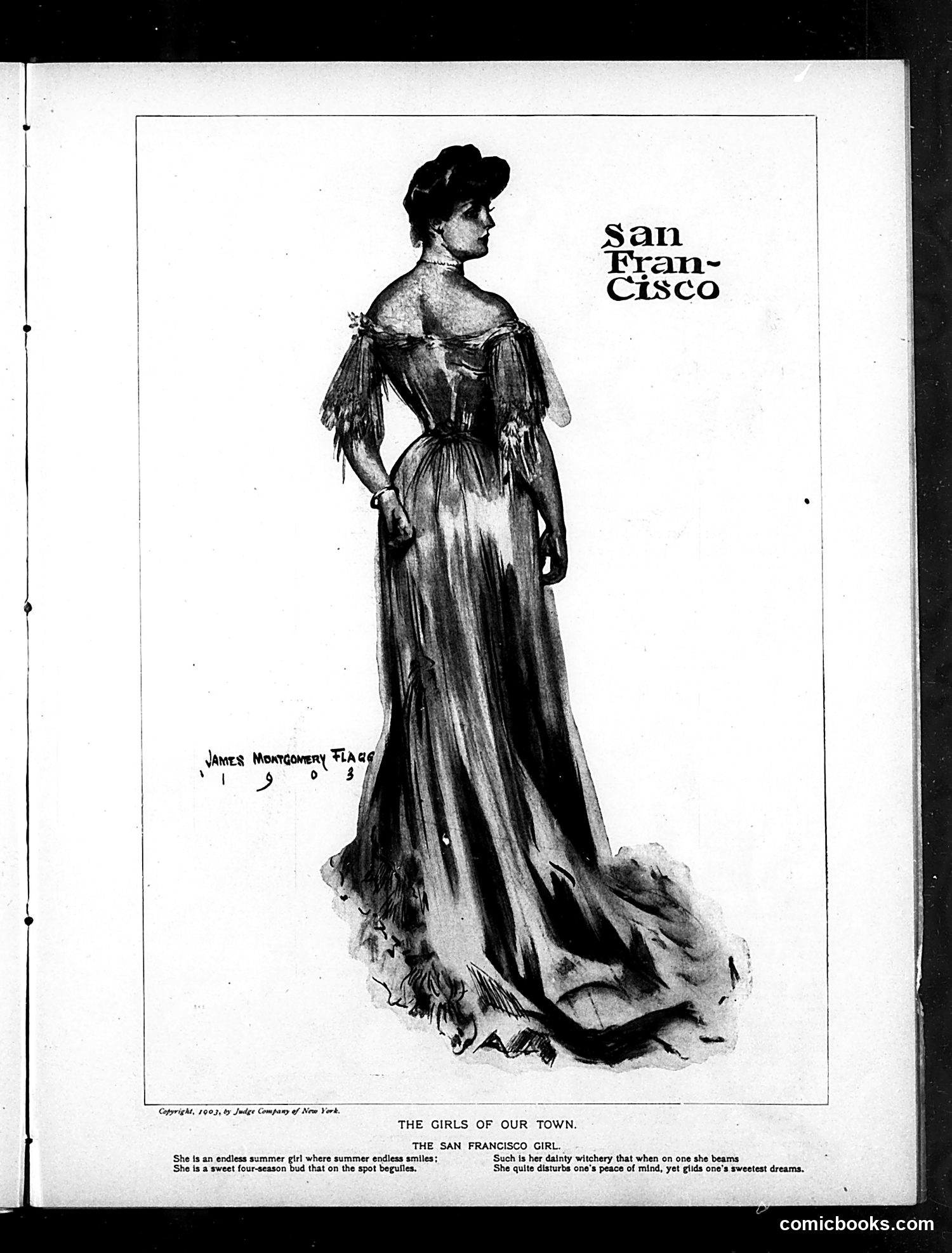
This 1903 Judge magazine page presents a satirical portrait of "The San Francisco Girl." The illustration, credited to James Montgomery Flagg, depicts an elegantly dressed woman in profile wearing an elaborate gown with a trailing train. The accompanying verse employs romantic exaggeration typical of Judge's social commentary. It characterizes San Francisco women as perpetually charming ("endless summer girl where summer endless smiles"), using flowery language about their beauty and enchanting effect on men. The satire lies in the hyperbolic praise—she's simultaneously a "sweet four-season bud" and possesses "dainty witchery" that "disturbs one's peace of mind." This reflects early 1900s American attitudes toward regional female types, presenting San Francisco women as particularly captivating and alluring. The piece exemplifies Judge's practice of satirizing regional and social stereotypes through idealized portraiture and ironic verse.
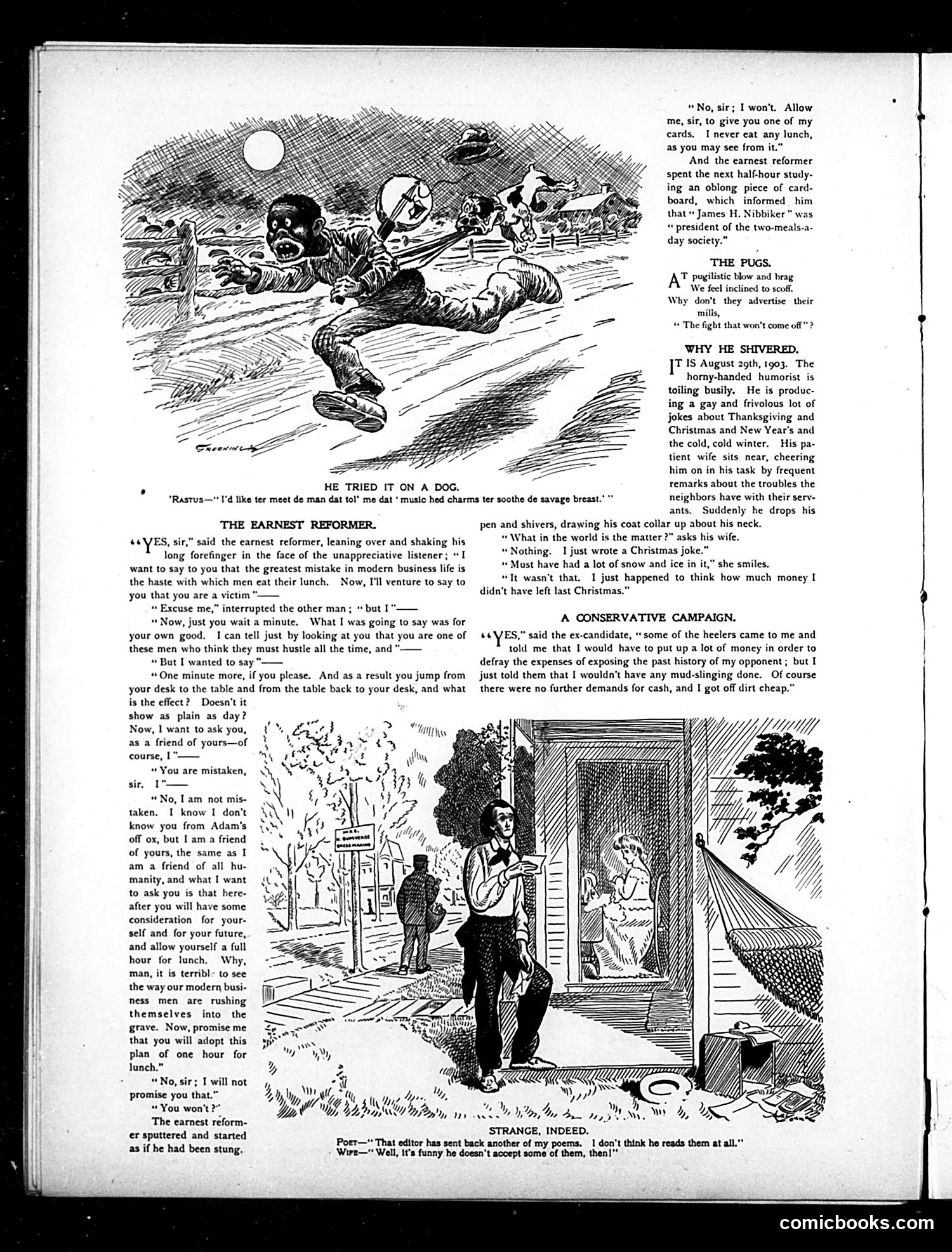
This page contains four unrelated satirical pieces typical of early-1900s humor magazines: **"He Tried It on a Dog"** mocks the proverb "music hath charms to soothe the savage beast" by depicting someone attempting this on an actual dog—with predictably violent results. **"The Earnest Reformer"** satirizes sanctimonious do-gooders who interrupt others with unsolicited advice. The joke's punchline reveals the reformer's hypocrisy: he lectures about leisurely lunching while belonging to a "two-meals-a-day society," meaning he skips lunch entirely. **"Why He Shivered"** jokes about a humorist writing cheerful holiday material in August while financially broke—the thought of past Christmas expenses causes literal chills. **"The Conservative Campaign"** ridicules politicians claiming moral superiority while admitting their campaign avoided "mud-slinging" only because opponents refused to fund opposition research—making their restraint purely circumstantial, not principled. The humor relies on exposing hypocrisy and contradictions between stated values and actual behavior.
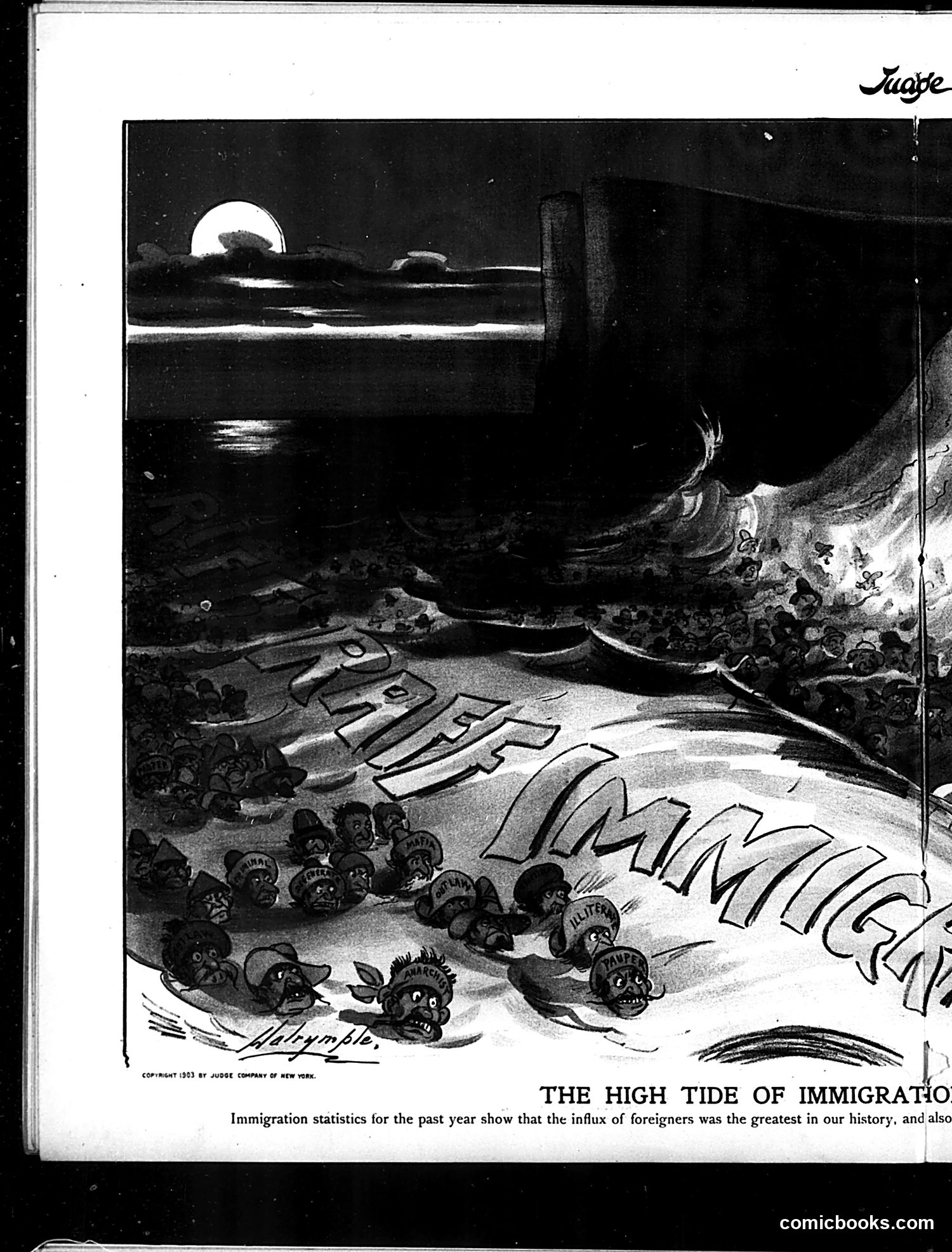
This political cartoon satirizes America's record immigration levels in 1903. The image depicts a massive wave of immigrants—caricatured as rats wearing labels identifying their nationalities—overwhelming American shores under a full moon. The rats swarm across text reading "THE HIGH TIDE OF IMMIGRATION," with ships visible in the background. The rat imagery reflects the dehumanizing xenophobic rhetoric common in early 1900s America, depicting immigrants as pests or vermin. The "high tide" metaphor suggests an uncontrollable natural disaster rather than human migration. Judge magazine's satirical intent appears critical of high immigration levels, reflecting nativist anxieties of the era when millions arrived from Southern and Eastern Europe. The cartoon reflects period anti-immigrant sentiment that would eventually contribute to restrictive legislation like the 1924 National Origins Act.
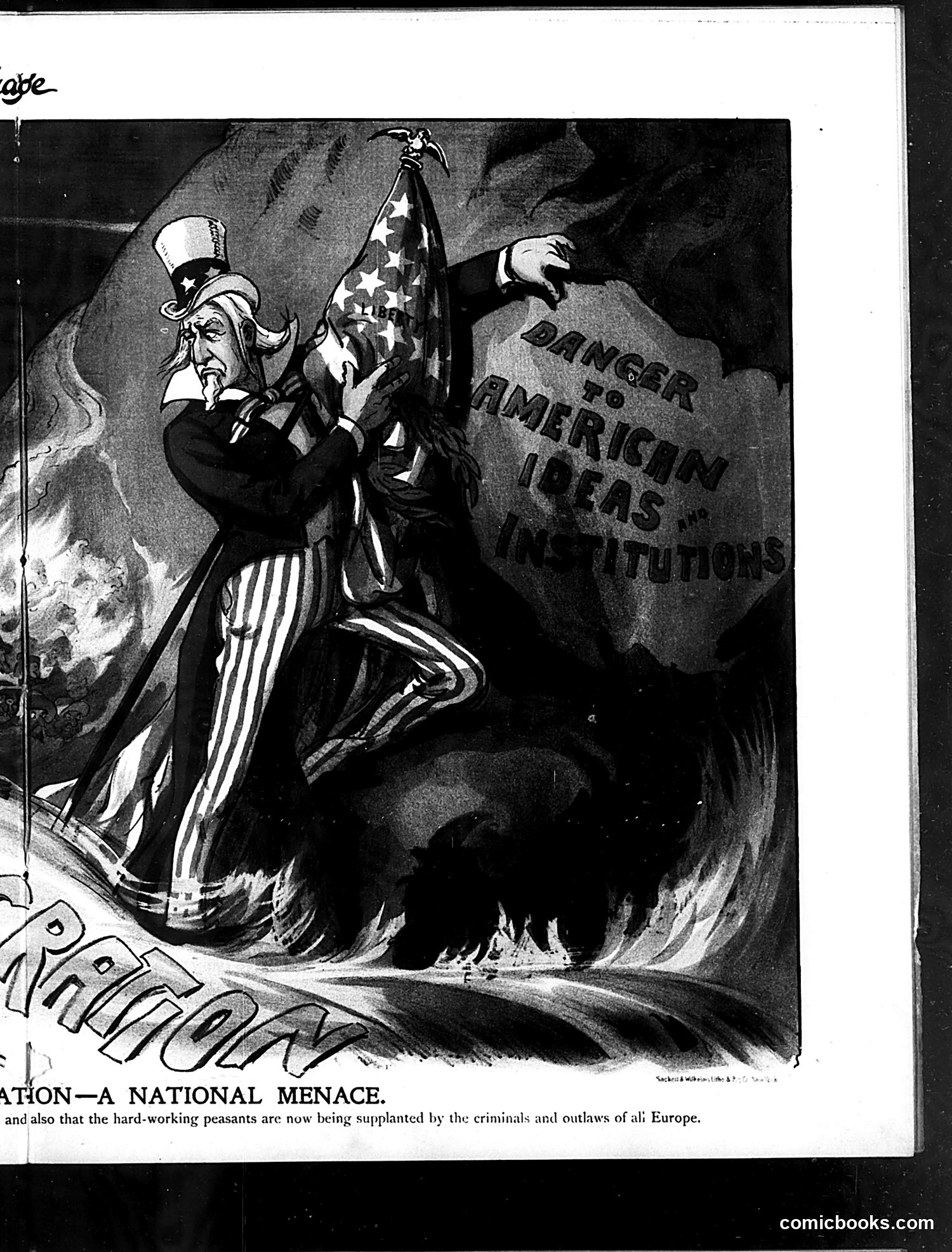
This Judge magazine cartoon depicts Uncle Sam (identifiable by his top hat and starred flag) appearing alarmed or defensive against an encroaching dark force. The text references "DANGER TO AMERICAN INSTITUTIONS" and warns that "hard-working peasants are now being supplanted by the criminals and outlaws of all Europe." This reflects early 20th-century anti-immigration sentiment, specifically the "Yellow Peril" and European criminal immigration fears. The cartoon uses apocalyptic imagery (flames, menacing shadows) to warn American readers that foreign criminals and undesirables were infiltrating the nation and displacing honest workers. The satire targets immigration restrictions advocates, though the exact publication date remains unclear from the visible text. This represents a common nativist argument of that era.
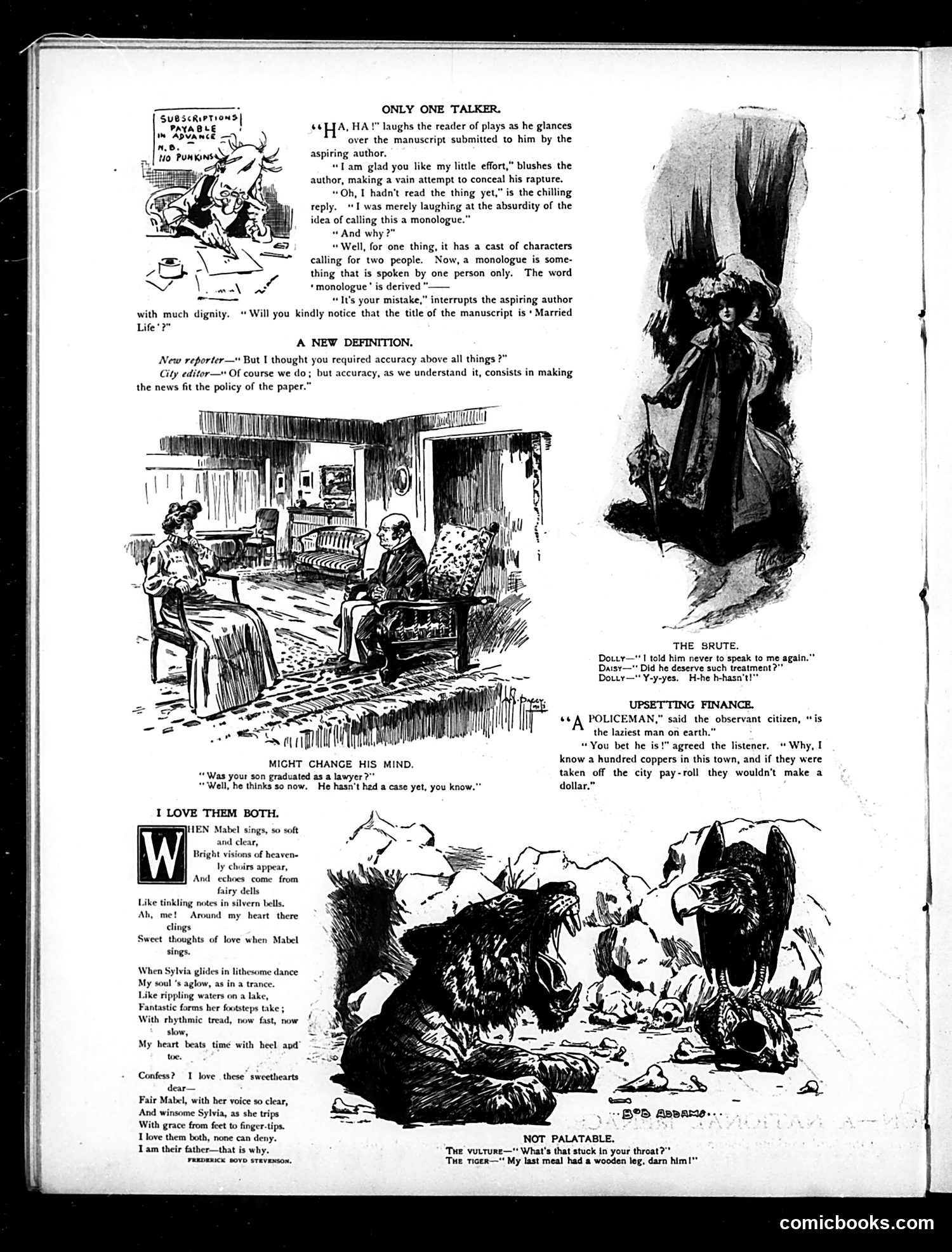
This page collects several short humorous pieces mocking various professions and social conventions: **"Only One Talker"** ridicules an aspiring playwright who submitted a script titled "Married Life?" claiming it's a monologue (solo performance) despite requiring two characters. The editor's pedantic correction about the word's definition highlights the author's pretension and incompetence. **"A New Definition"** satirizes newspaper editors' elastic relationship with truth—they equate "accuracy" with fitting news to editorial policy rather than objective fact. The remaining pieces mock: lawyers without cases, a father's embarrassing pride in his daughters' performances (poem "I Love Them Both"), and a policeman's laziness. The final cartoon shows a tiger and vulture discussing an unpalatable meal with a wooden leg—likely dark humor about the vulture's terrible experience rather than commentary on specific events. The overall tone is genteel Victorian satire targeting professional incompetence and social pretension.
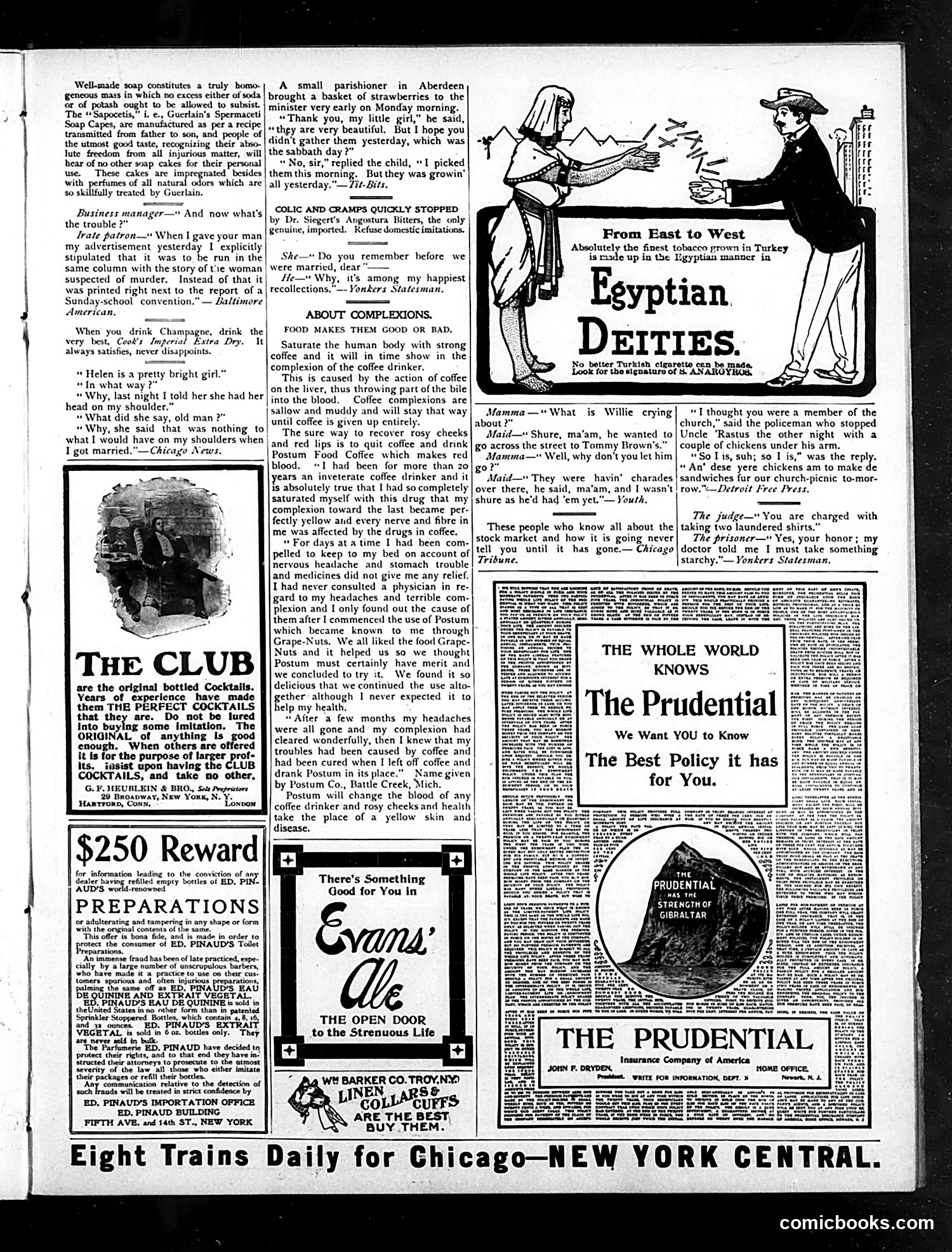
This page from the satirical magazine *Judge* is primarily **advertising content** with interspersed humorous anecdotes rather than political cartoons. The main illustrated cartoon shows a figure in formal dress (appears to be Turkish or Middle Eastern clothing based on the fez) labeled "From East to West," advertising "Egyptian Dentifrices"—toothpaste marketed as authentically imported. This reflects period stereotyping: exotic foreign products were marketed as superior through orientalist imagery. The scattered jokes mock everyday social situations: a business manager and irate patron dispute ad placement; a flirtation misfire; concerns about coffee's health effects. The dominant advertising emphasizes **product authenticity and fraud prevention**—notably an ED. Pinaud ad offering a $250 reward for reporting counterfeit toiletries, and warnings against imitation cocktails. This reflects early 20th-century consumer concerns about widespread product adulteration and counterfeiting before modern FDA regulations. The *Judge* page reflects contemporary anxieties: consumer fraud, product quality, and reliance on exotic/imported goods as markers of status.
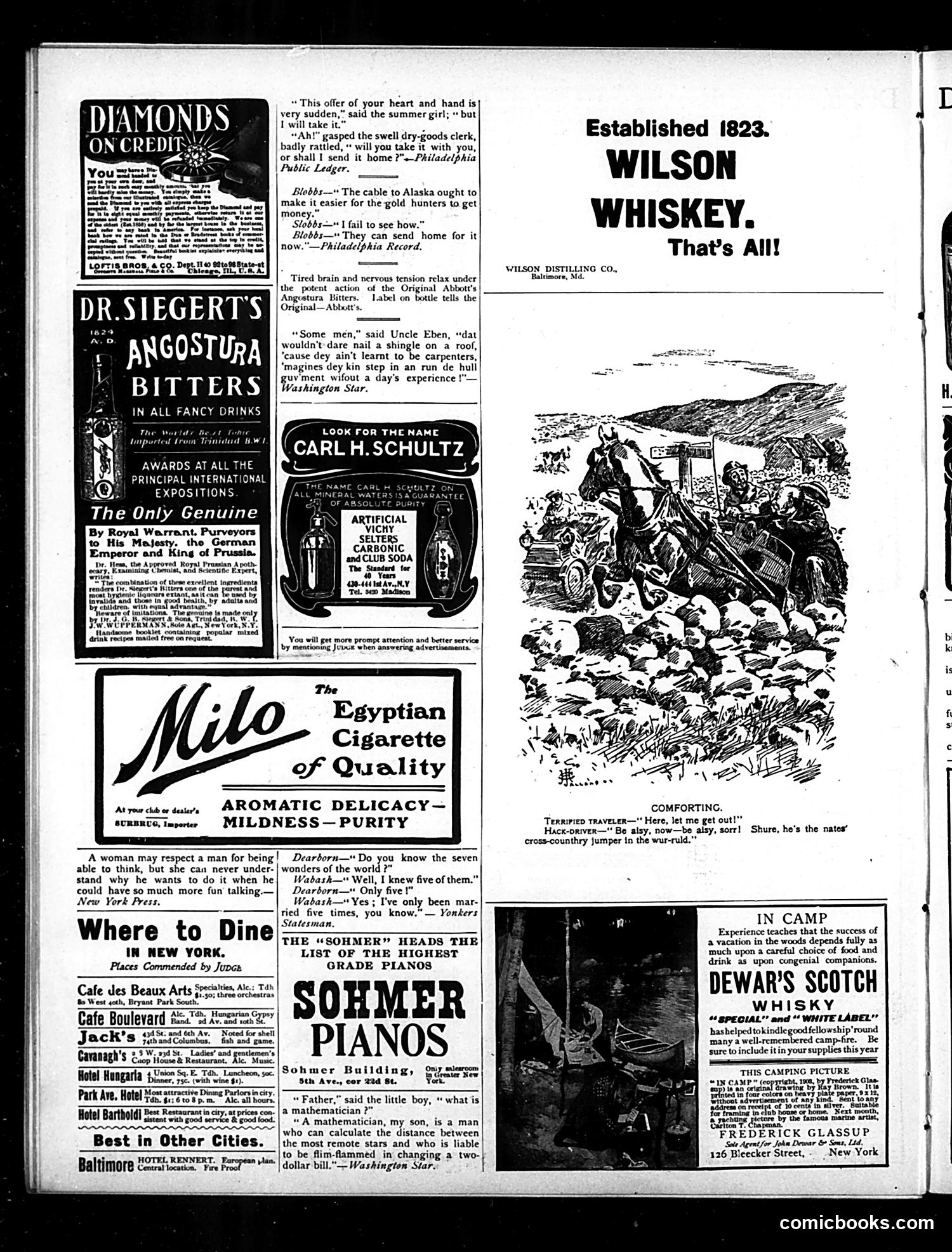
This is primarily an **advertising page** from Judge magazine, with minimal satirical content. The page features numerous commercial advertisements for spirits, bitters, pianos, and dining establishments typical of early 20th-century publications. The few joke items scattered throughout are brief, generic humor pieces unrelated to politics or current events: - A joke about a dry-goods clerk misunderstanding a marriage proposal - Uncle Eben's commentary on unqualified people entering government (appears to be a recurring character offering folk wisdom) - Light domestic humor about women not understanding men's thinking - A mathematician joke about miscalculating a two-dollar bill The dominant content is **commercial**: Wilson Whiskey, Dewar's Scotch, Sohmer Pianos, Dr. Siegert's Angostura Bitters, and Milo cigarettes all receive prominent placement. The page demonstrates how advertising increasingly dominated satirical magazines by this era, with editorial content becoming secondary.
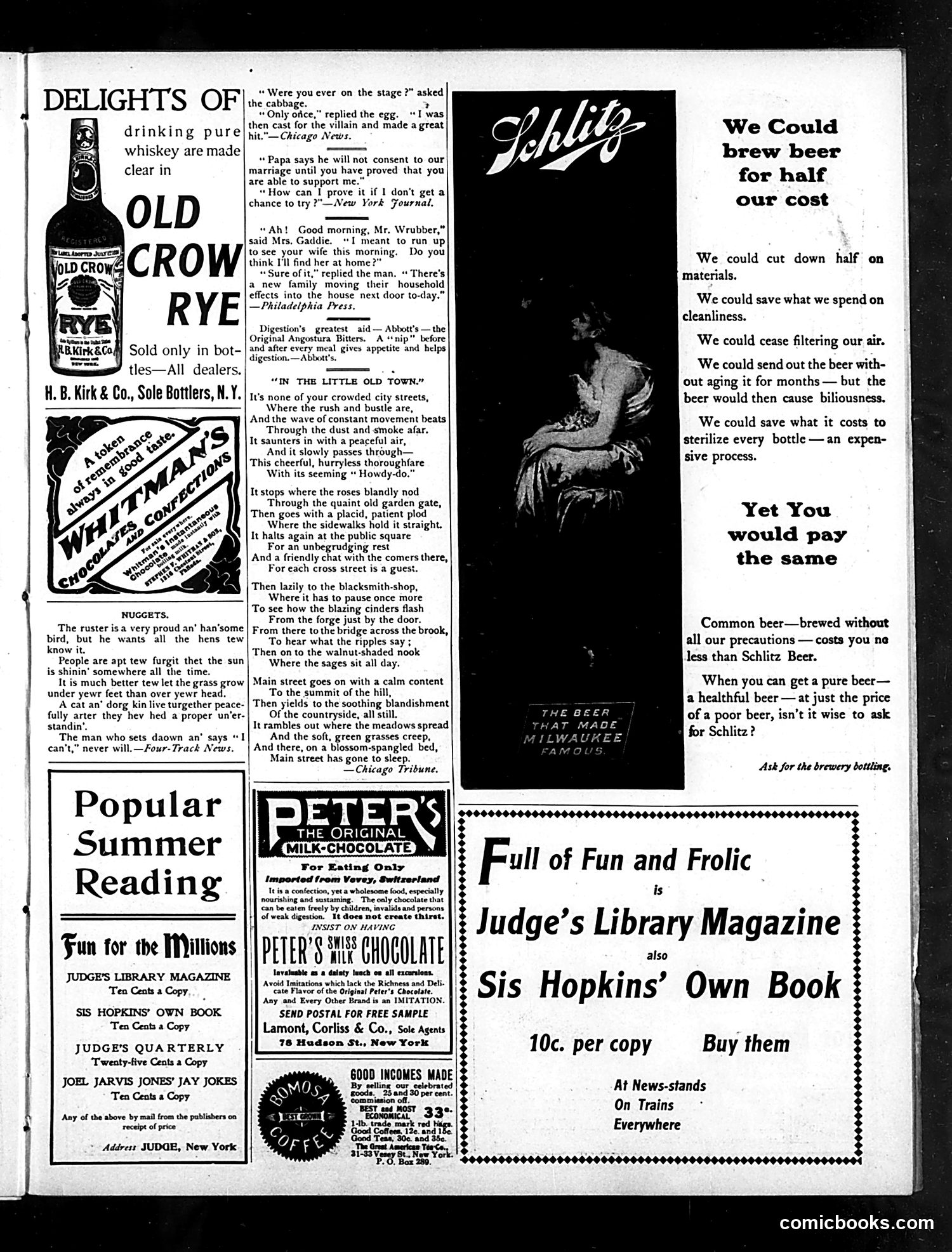
This page is primarily **advertising**, with the Schlitz beer ad dominating the right side. The ad makes an economic argument: Schlitz could cut production costs substantially (cheaper materials, less filtering, reduced sterilization) yet charges the same price as inferior competitors. The implicit message is that Schlitz's quality justifies its premium pricing. The left side contains **humorous short jokes and aphorisms** typical of Judge magazine—puns (an egg "cast for the villain"), domestic humor, and folk wisdom ("The man who sets down an' never will"). These are lighthearted filler content, not satire. The bottom features advertisements for Judge's own publications (magazines and joke books at 10-25 cents) and period products like Peter's chocolate and Abbott's bitters. **No political satire is present on this page.** It represents Judge in its commercial, entertainment-focused mode rather than its satirical editorial function.
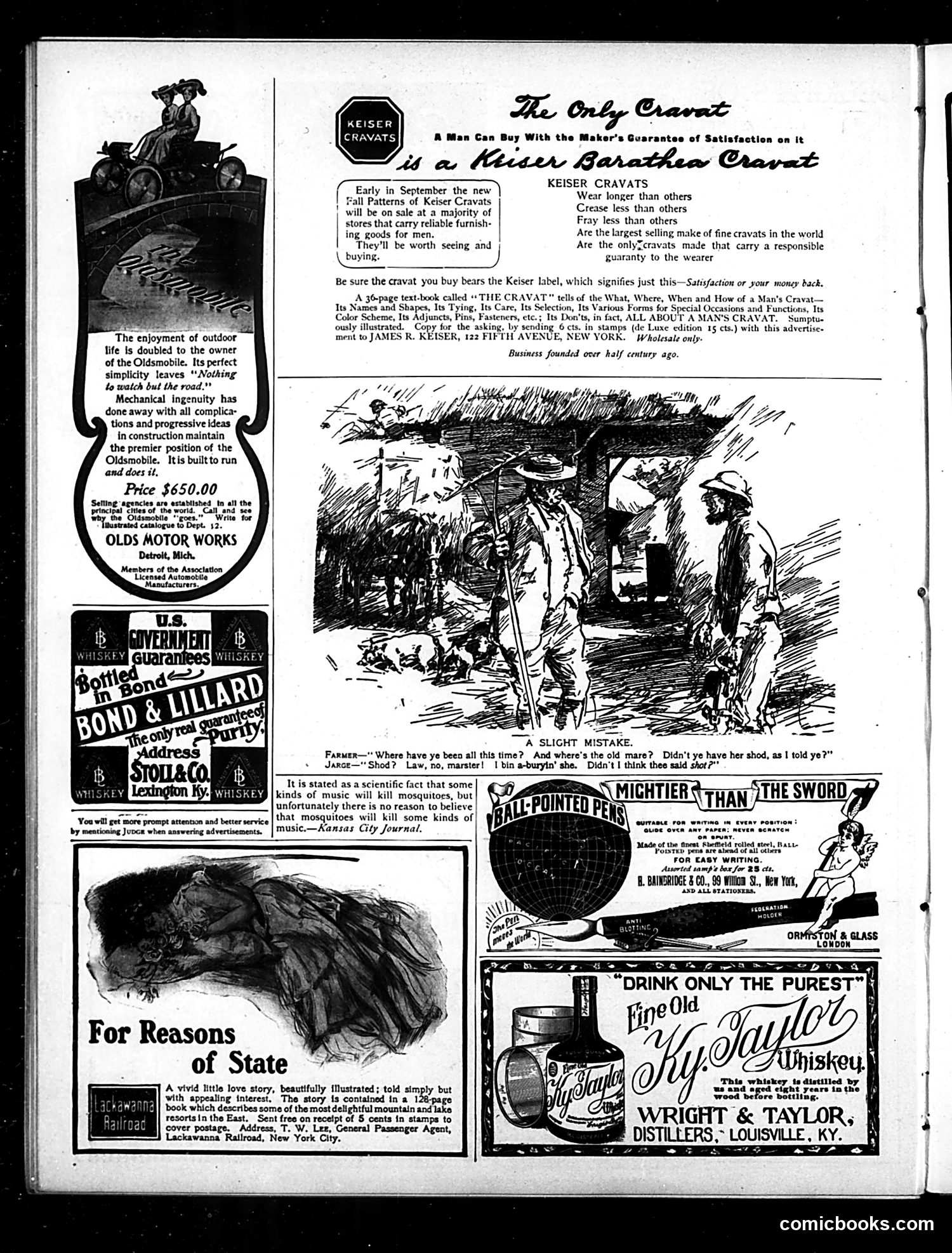
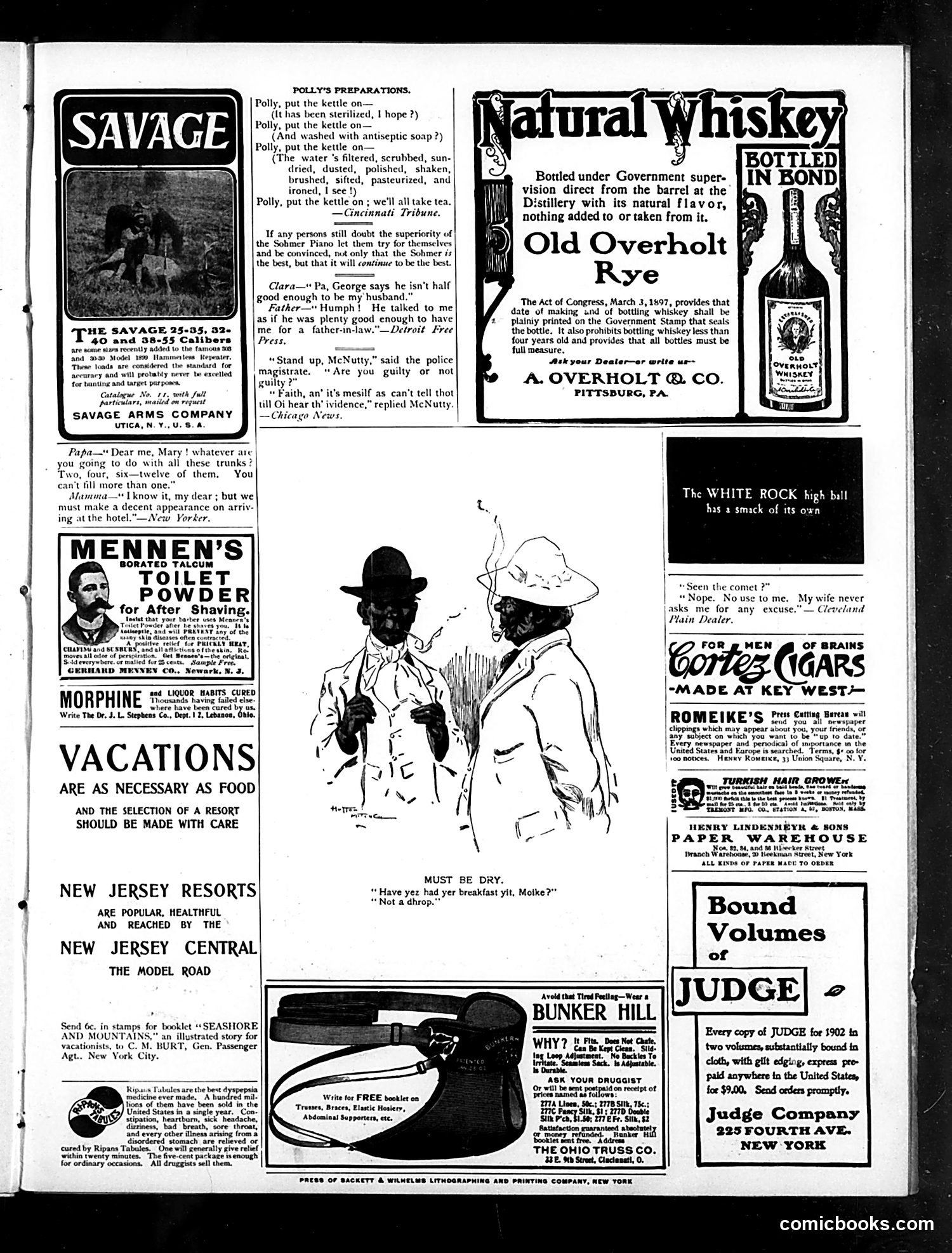
This page is primarily **advertisements and filler material** rather than substantial editorial or satirical cartoons. The main visual element is a small sketch showing two figures in conversation with the caption "MUST BE DRY / 'Have yez had yer breakfast yit, Moike?' / 'Not a dhrop.'" This appears to be **Irish-American ethnic humor** common to the era, using stereotypical Irish dialect ("yiz," "dhrop" for "drop") to depict working-class Irish immigrants. The joke relies on the stereotype of Irish laborers and alcohol consumption. The bulk of the page consists of **period advertisements**: Savage Arms, Mennen's talcum powder, morphine medicines, New Jersey Central Railroad resorts, Sohmer pianos, Old Overholt whiskey, Coney cigars, and various other products. These ads reveal contemporary consumer concerns and available treatments (notably including morphine). The page lacks the political satire or sophisticated commentary one might expect from Judge's more prominent editorial content.