
A complete issue · 16 pages · 1903
Judge — August 1, 1903
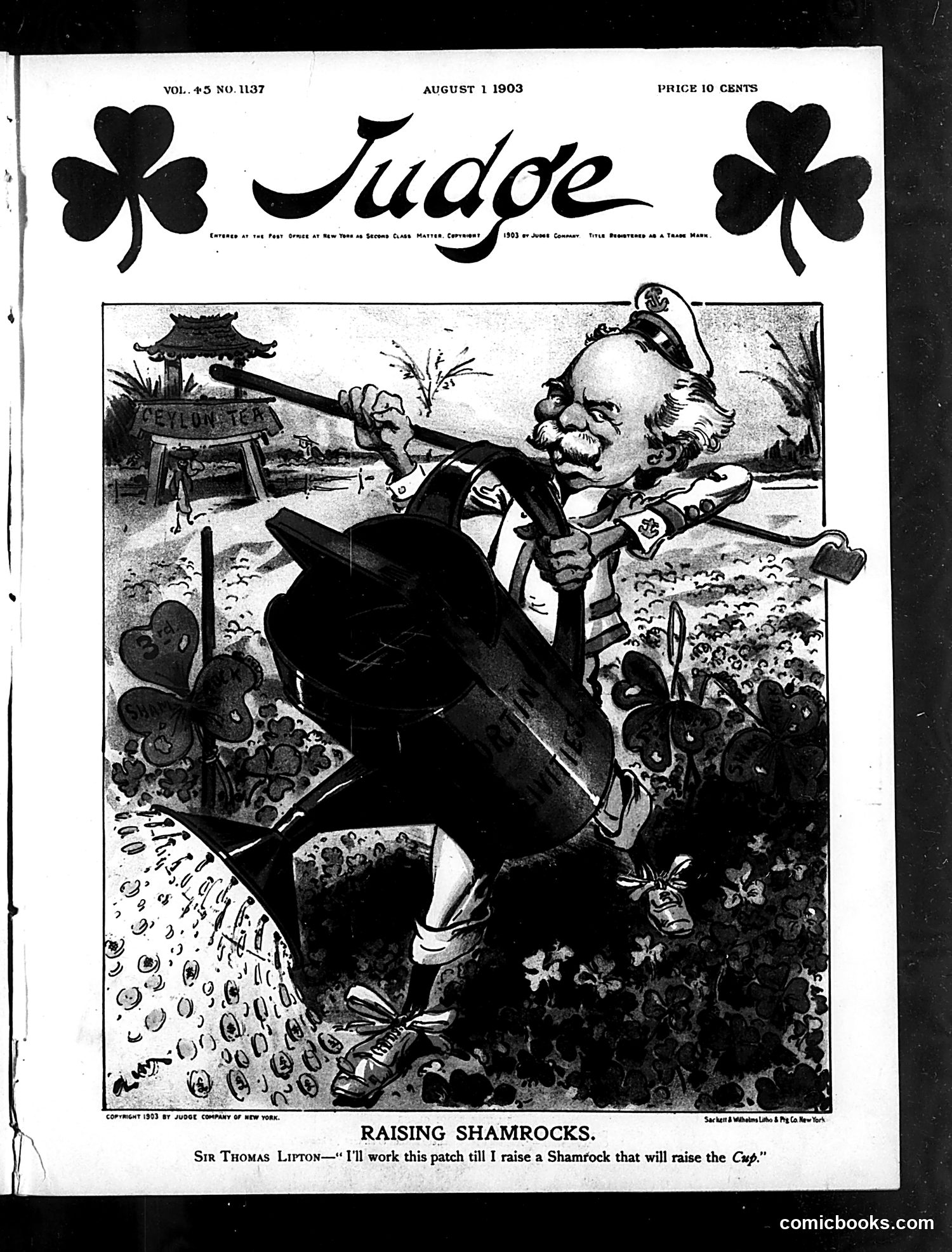
This political cartoon satirizes **Sir Thomas Lipton**, the Scottish tea magnate and yacht-racing enthusiast, shown here as a caricatured figure digging in soil. The caption reads: "I'll work this patch till I raise a Shamrock that will raise the Cup." The joke plays on multiple meanings: Lipton is literally depicted gardening (raising shamrocks as plants), but the satire references his repeated attempts to win the America's Cup yacht race. As a tea magnate seeking to cultivate Irish identity, Lipton (despite being Scottish) famously championed Irish causes. The cartoon mocks his persistent but unsuccessful America's Cup campaigns by suggesting he's still futilely "working" toward victory, comparing his efforts to growing shamrocks—a symbol of Irish aspiration.
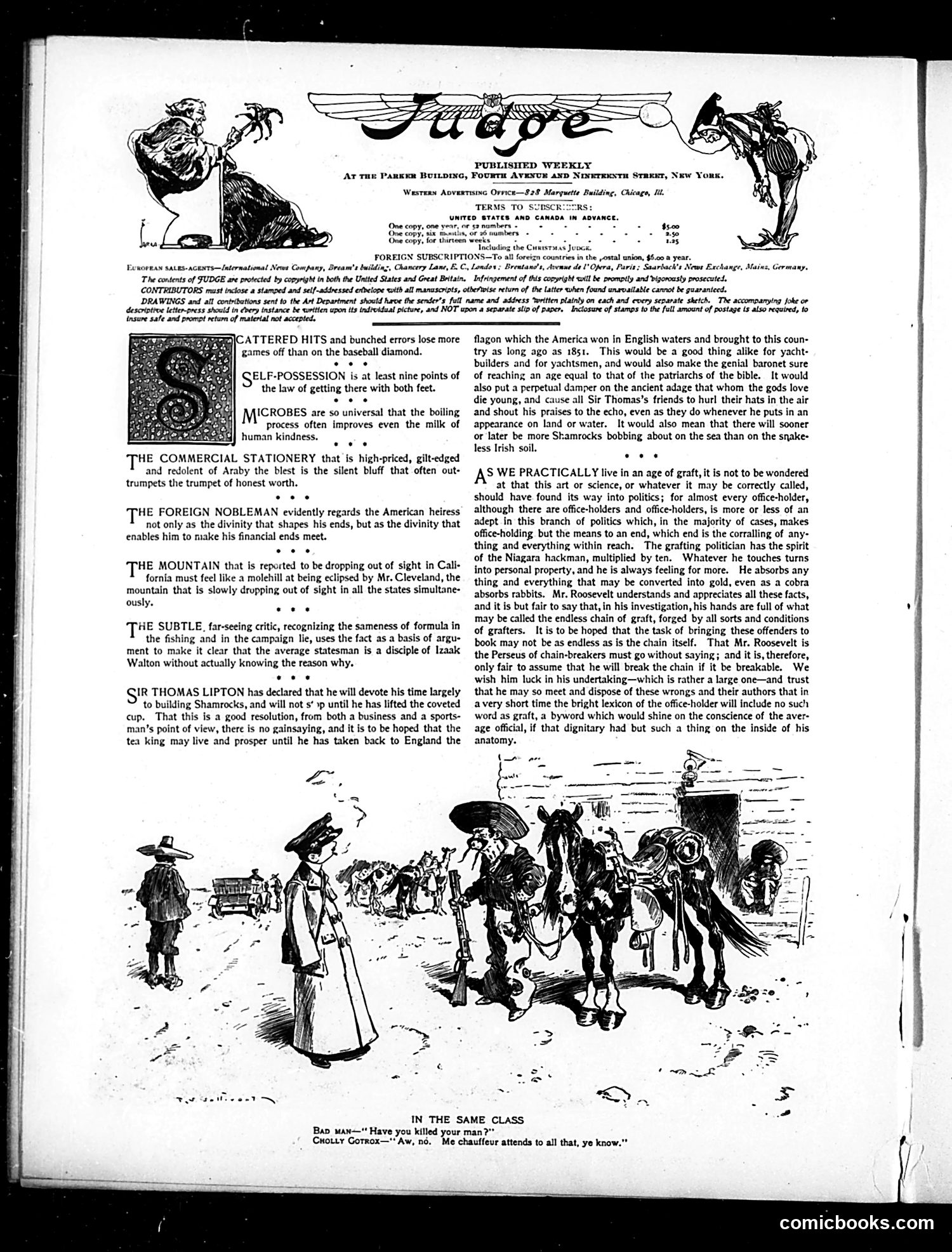
This page from **Judge** magazine (published weekly in New York) contains several satirical commentary sections plus a cartoon illustration at the bottom. The text includes brief humorous observations on contemporary topics: self-possession in baseball, microbes improving milk quality, commercial stationery as "bluff," American heiresses, California mountains dropping, formula in fighting, and **Sir Thomas Lipton** devoting himself to building Shamrocks (likely referencing his yacht racing pursuits). The bottom cartoon depicts a seaside or fairground scene with well-dressed figures, including a woman in prominent position. The caption reads: "BAD MAN—'Have you killed your man?'" / "CHOLLY CADGER—'Aw, go. Me chauffeur attends to all that, ye know.'" This satirizes wealthy, idle society gentlemen who delegate even violent crimes to their servants—mocking upper-class detachment from consequences.
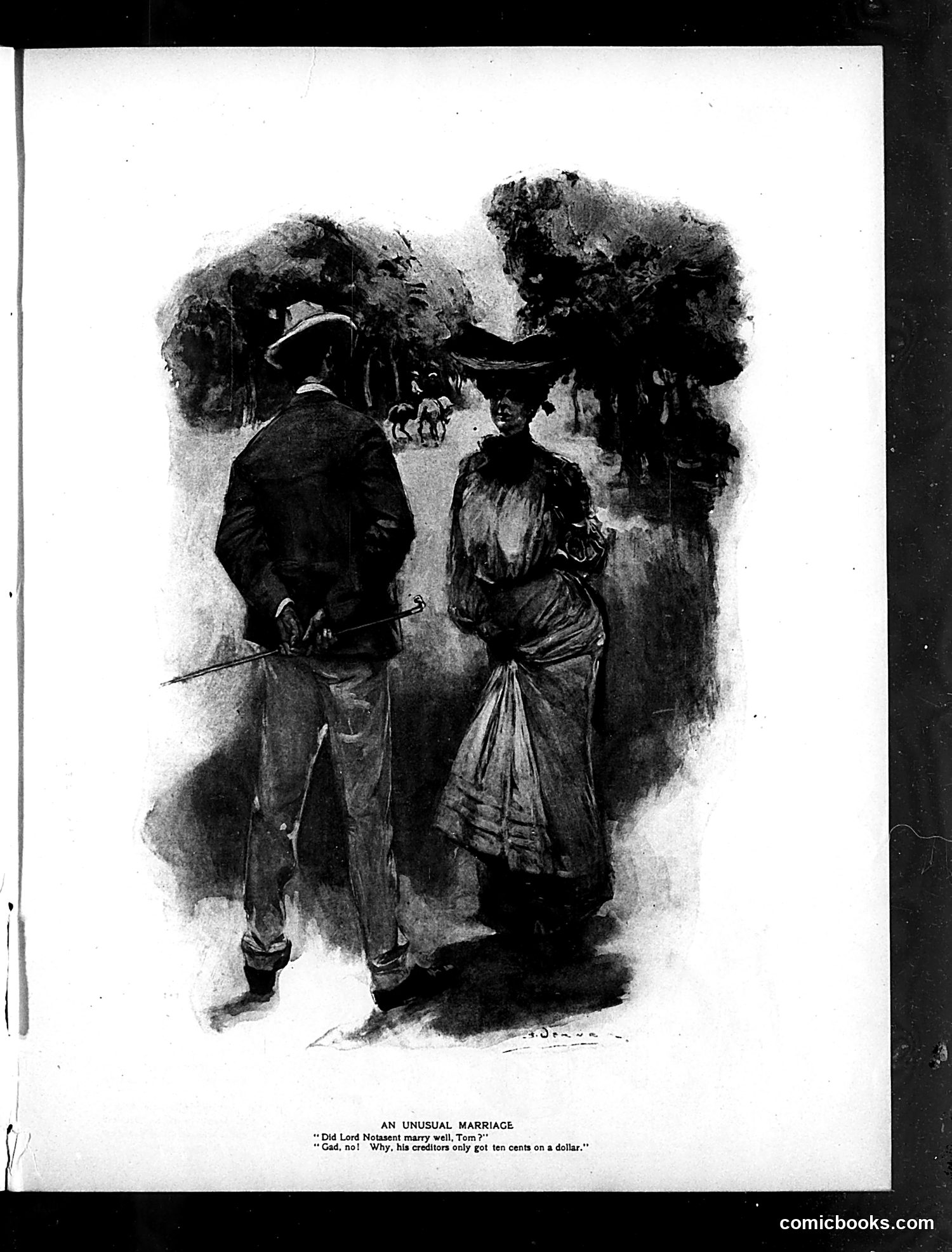
This satirical cartoon depicts a man and woman viewing what appears to be a tree or foliage. The dialogue reveals the joke: when asked if "Lord Nobleson" married well, the response is "Gad, no! Why, his creditors only got ten cents on a dollar." The satire mocks a wealthy nobleman who married despite having significant financial troubles—his creditors received only partial payment (ten cents per dollar owed). The "unusual marriage" is unusual because it's financially imprudent; a man deeply in debt married anyway, suggesting either foolishness or desperation. This reflects Gilded Age concerns about aristocratic financial mismanagement and the gap between noble titles and actual solvency. The cartoon satirizes both the nobleman's poor judgment and, implicitly, the creditor system's inability to recover debts from the wealthy.
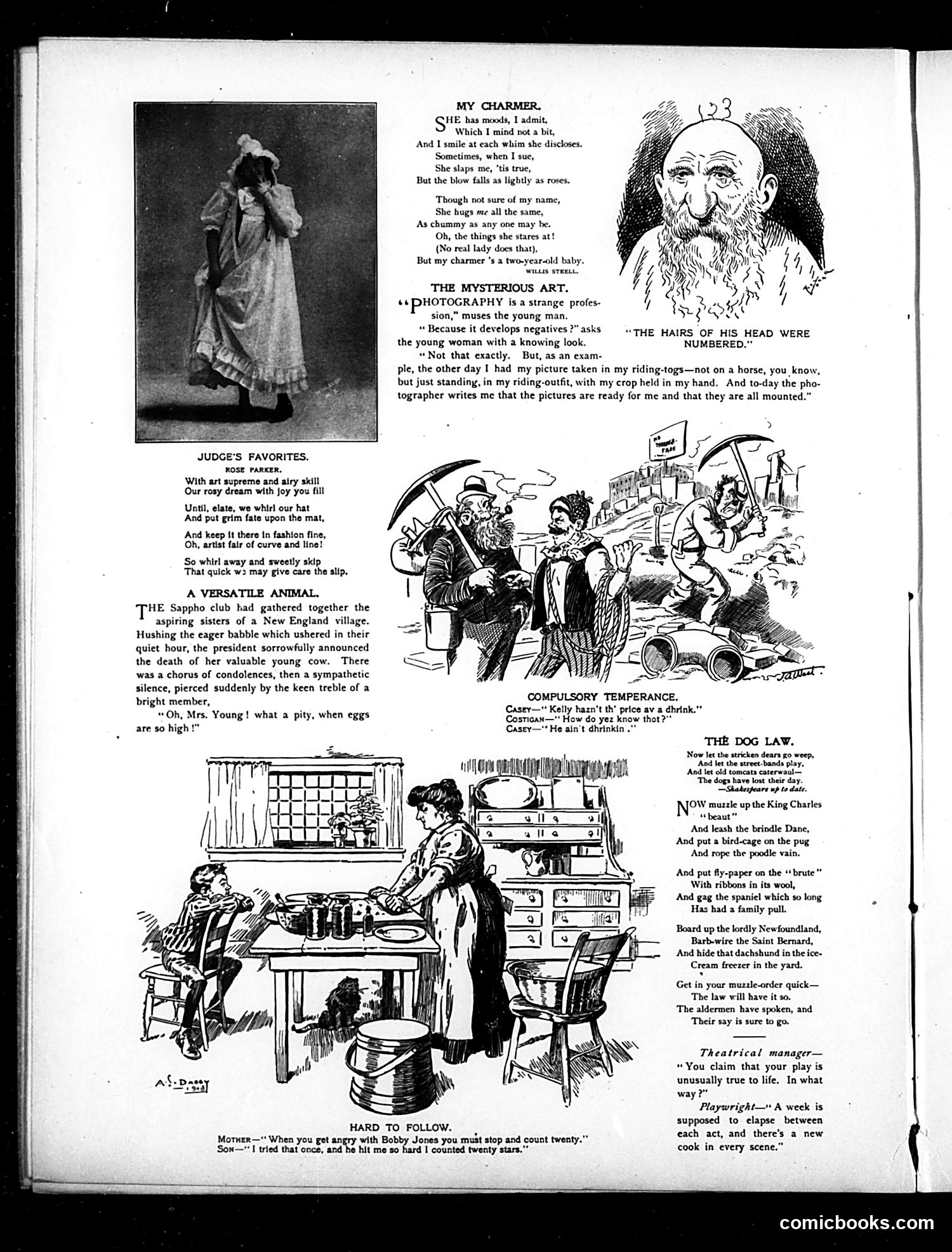
This page contains several unrelated satirical pieces typical of Judge's format: **"My Charmer"** and **"Judge's Favorites"** appear to be light verse about romantic relationships and social behavior—standard humor for the era. **"The Mysterious Art"** satirizes photography as a profession, with a woman learning that candid photos of her in riding clothes have been taken and "mounted" (professionally prepared). The joke plays on the novelty and invasiveness of photography. **"Compulsory Temperance"** depicts a drunk man being confronted about alcohol consumption—likely commentary on the temperance movement gaining momentum in early 20th-century America. **"The Dog Law"** and other pieces use doggerel verse and illustrations for domestic humor. **"Hard to Follow"** jokes about child discipline and counting. Overall, this is general-audience satire on social customs, not specific political commentary.
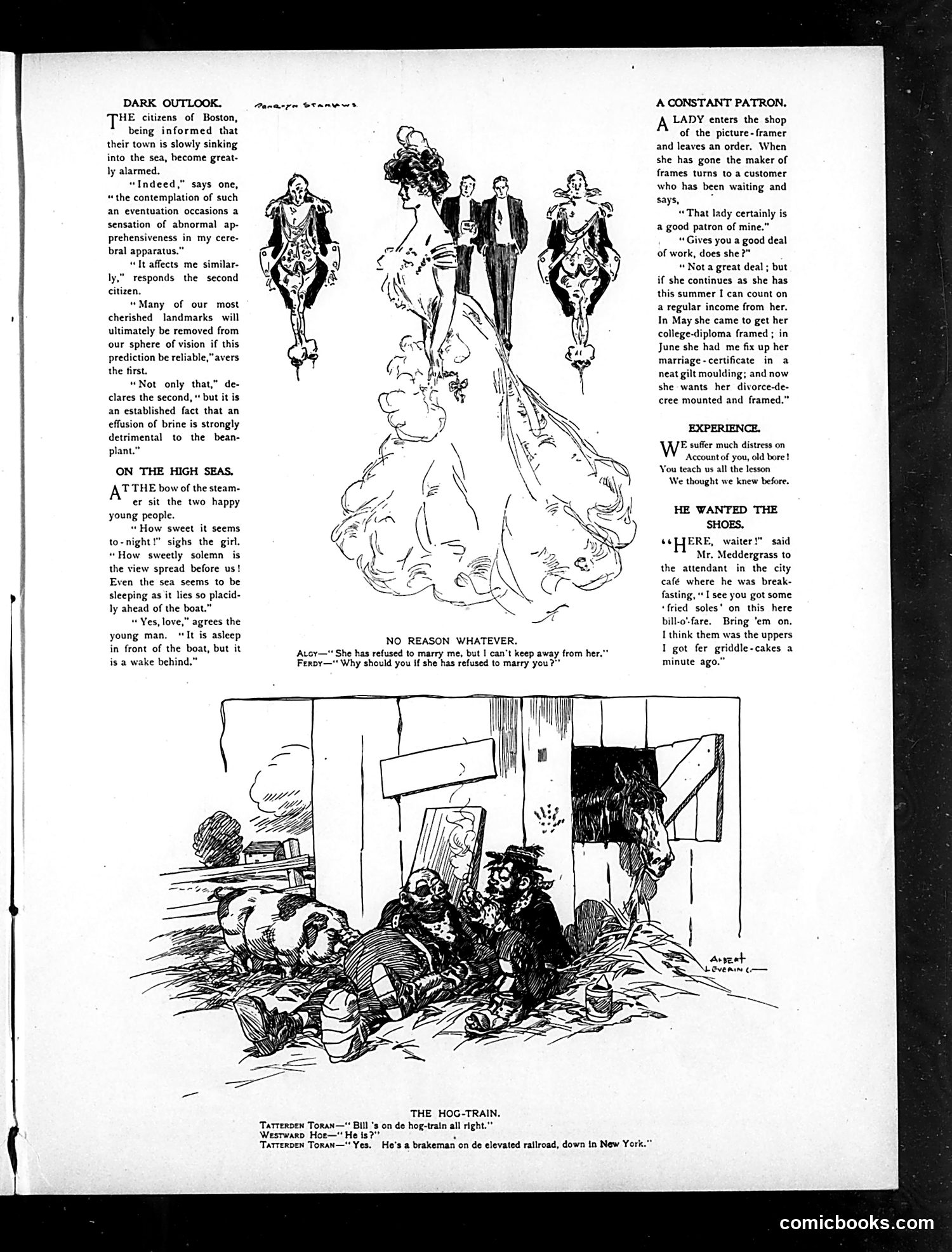
This page contains multiple satirical pieces typical of Judge magazine's humor: **"Dark Outlook"** mocks Boston's learned citizens overreacting to geological predictions that the city is sinking into the sea. Their pompous, verbose responses and concern about bean plants satirize pretentious intellectual hand-wringing over natural disasters. **"On the High Seas"** is a romantic comedy: a young couple enjoys a peaceful ocean view until the man notes the sea is "asleep in front" but "awake behind"—a pun on maritime terminology that deflates the sentimental moment. **"No Reason Whatever"** presents a brief absurdist joke about a man who can't stop pursuing a woman who rejected him. **"The Hog-Train"** contains a dialect joke: "Bill's on de hog-train" means he works on an elevated railroad (slang usage), creating confusion that the punchline clarifies. **"A Constant Patron"** observes darkly that a picture-framer profits from a woman's repeated life crises—college diploma, marriage certificate, divorce decree—each requiring framing. The humor ranges from verbal wordplay to social observation about commercialism.
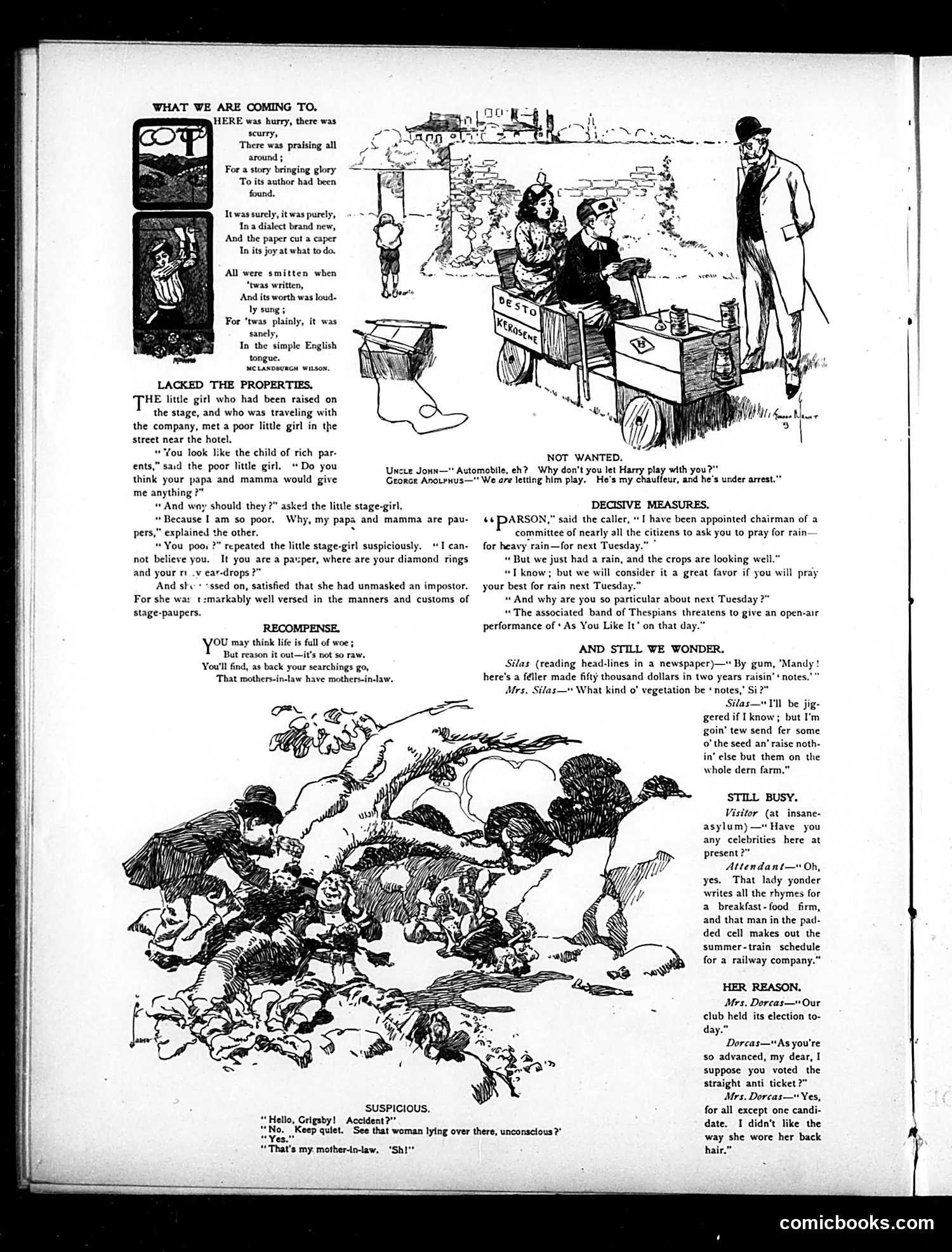
This page contains multiple satirical vignettes typical of early 20th-century American humor: **"Lacked the Properties"** mocks stage children's skewed worldview. A theater-raised girl cannot conceive of poverty without theatrical trappings (diamond rings, ear-drops), having internalized only the artificial wealth of stage "paupers." **"Recompense"** offers dark comfort: even life's sorrows have a silver lining—mothers-in-law themselves have mothers-in-law (implying shared suffering). **"Not Wanted"** jokes about an automobile chauffeur under arrest while being used as a toy/plaything. **"Decisive Measures"** satirizes small-town priorities: a chairman begs for rain specifically to prevent amateur theatrical performances. **"Still We Wonder"** plays on rural ignorance—a farmer reads of someone making money raising "notes" (financial instruments) and plans to literally plant them as seeds. **"Her Reason"** ridicules women's suffrage advocates: though voting progressively, this woman rejected a candidate based solely on hairstyle—suggesting women voters aren't serious. The humor targets theatrical pretension, rural naïveté, and women's political engagement.
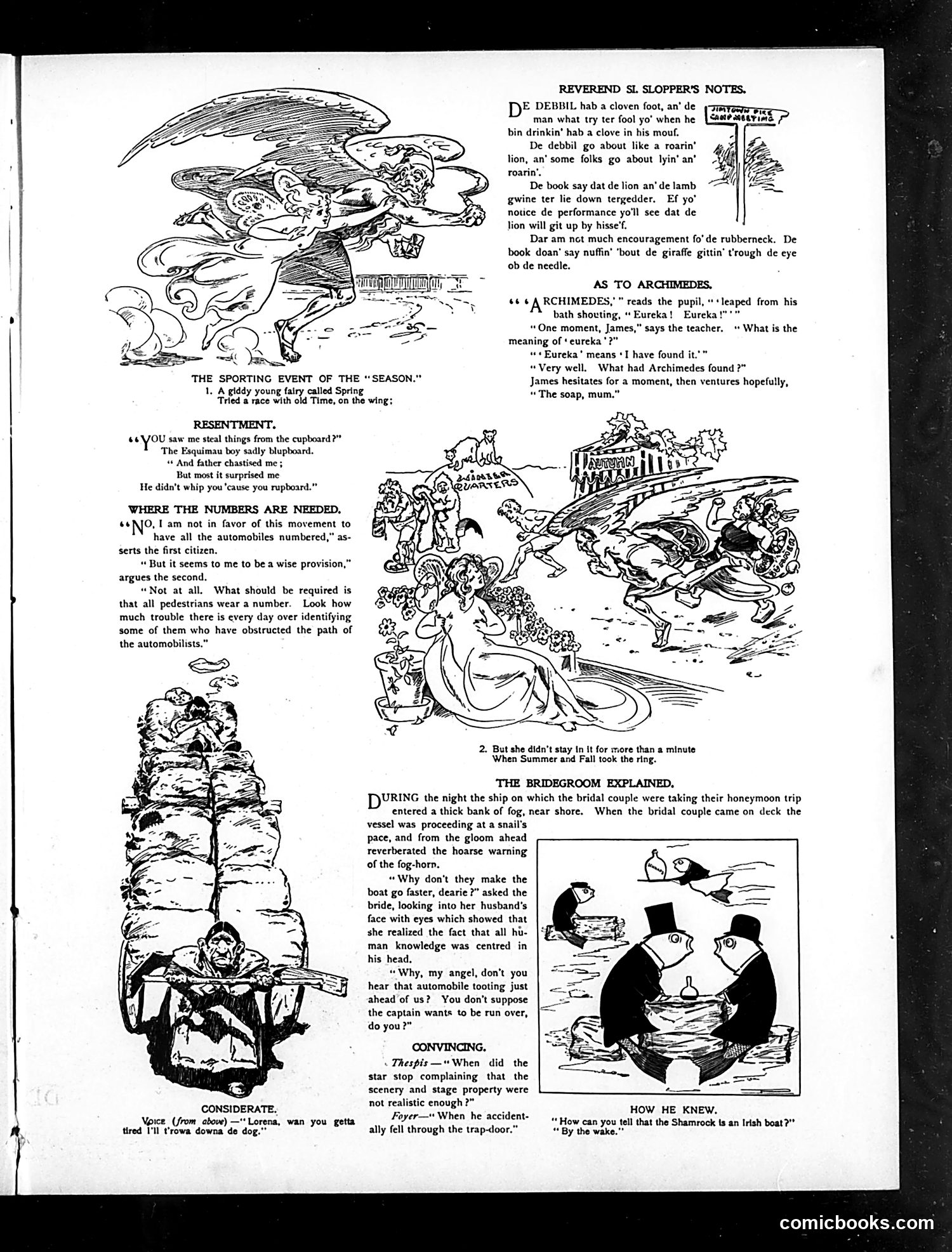
This Judge page collects multiple short satirical pieces and jokes typical of early 20th-century humor: **"Reverend Slopper's Notes"** presents dialect humor featuring a Black preacher offering folk wisdom mixed with Biblical references—a common (if now-offensive) comedic convention of the era. **"As to Archimedes"** jokes on a student's confusion about Archimedes' famous bath discovery, with the punchline that the boy thinks he discovered soap rather than principles of physics—simple wordplay humor. **"The Sporting Event of the Season"** uses personified seasons (Spring, Summer, Fall) as competitors in a whimsical fairy tale race. **"Where the Numbers Are Needed"** satirizes early automobile safety debates, arguing pedestrians—not cars—should be numbered to prevent accidents, reversing contemporary arguments about vehicle regulation. **"The Bridegroom Explained"** jokes on a newlywed bride's naiveté, playing on period stereotypes about women's ignorance while punning on automobile sounds mistaken for fog horns. The remaining pieces employ similar period-typical joke structures: dialect humor, puns, and domestic satire reflecting early 1900s concerns about automobiles, gender roles, and class anxieties.
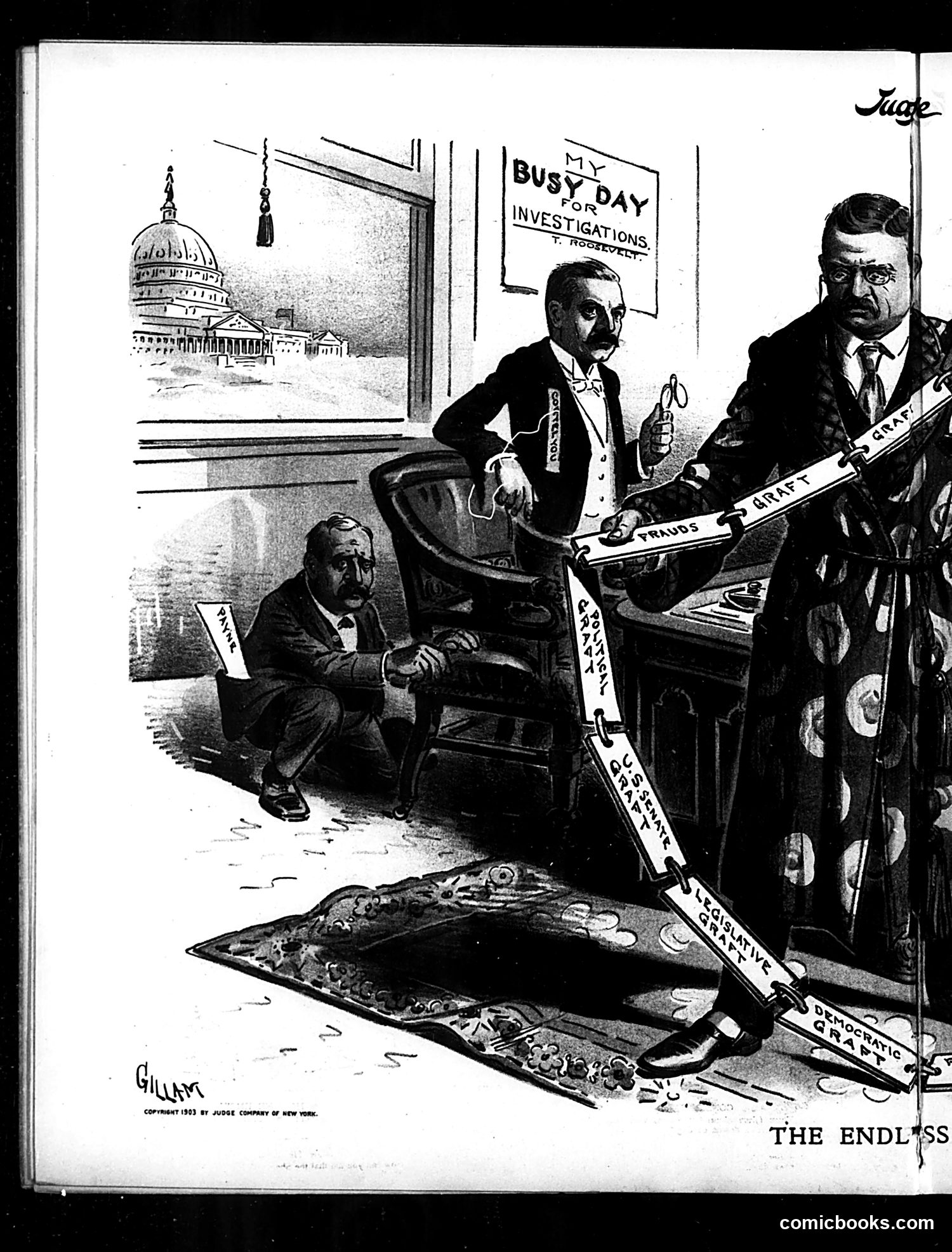
This Judge magazine cartoon depicts what appears to be a congressional investigation into government corruption. Three men in suits examine a tangled rope or chain labeled with various scandals: "FRAUDS," "GRAFT," "DRAFT," and "DEMOCRATIC GRAFT" are visible. A Capitol Building window shows in the background, confirming the Washington D.C. setting. One figure sits exhausted while two others continue investigating the seemingly endless web of wrongdoing. The cartoon's title—"THE ENDLESS"—and the satirical sign "BUSY DAY FOR INVESTIGATIONS" mock the perpetual nature of governmental corruption investigations, suggesting that such scandals are so numerous and intertwined that investigations never truly conclude. This reflects early 20th-century concerns about systematic political corruption.
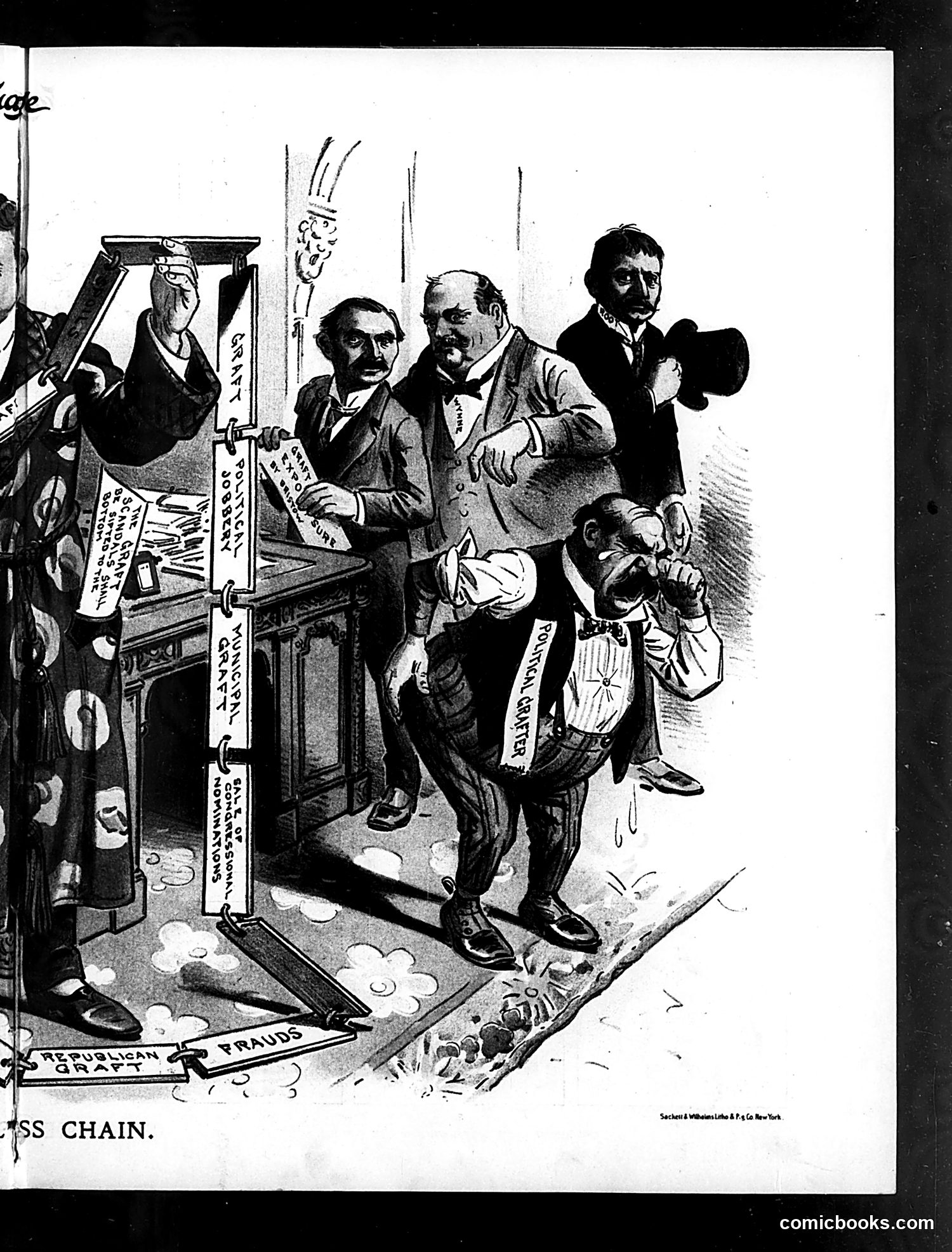
This Judge magazine cartoon satirizes Republican political corruption during the Gilded Age. The image depicts several well-dressed men connected by a chain labeled "Republican Graft," suggesting they are linked together in corrupt schemes. At the center stands a caricatured figure (likely a prominent Republican politician or party leader) who appears to be pulling or controlling the others. The chain visibly connects multiple figures, implying a network of complicity in fraudulent activities. The bottom text references "Republican Graft," explicitly stating the cartoon's target. The exaggerated caricatures and their positioning suggest interconnected corruption within Republican leadership—a common Judge theme attacking the party's perceived moral failings. The visual metaphor of the chain emphasizes that these individuals cannot separate themselves from the scandal; they're bound together by shared guilt. This reflects late 19th-century American political discourse criticizing Republican Party machines.
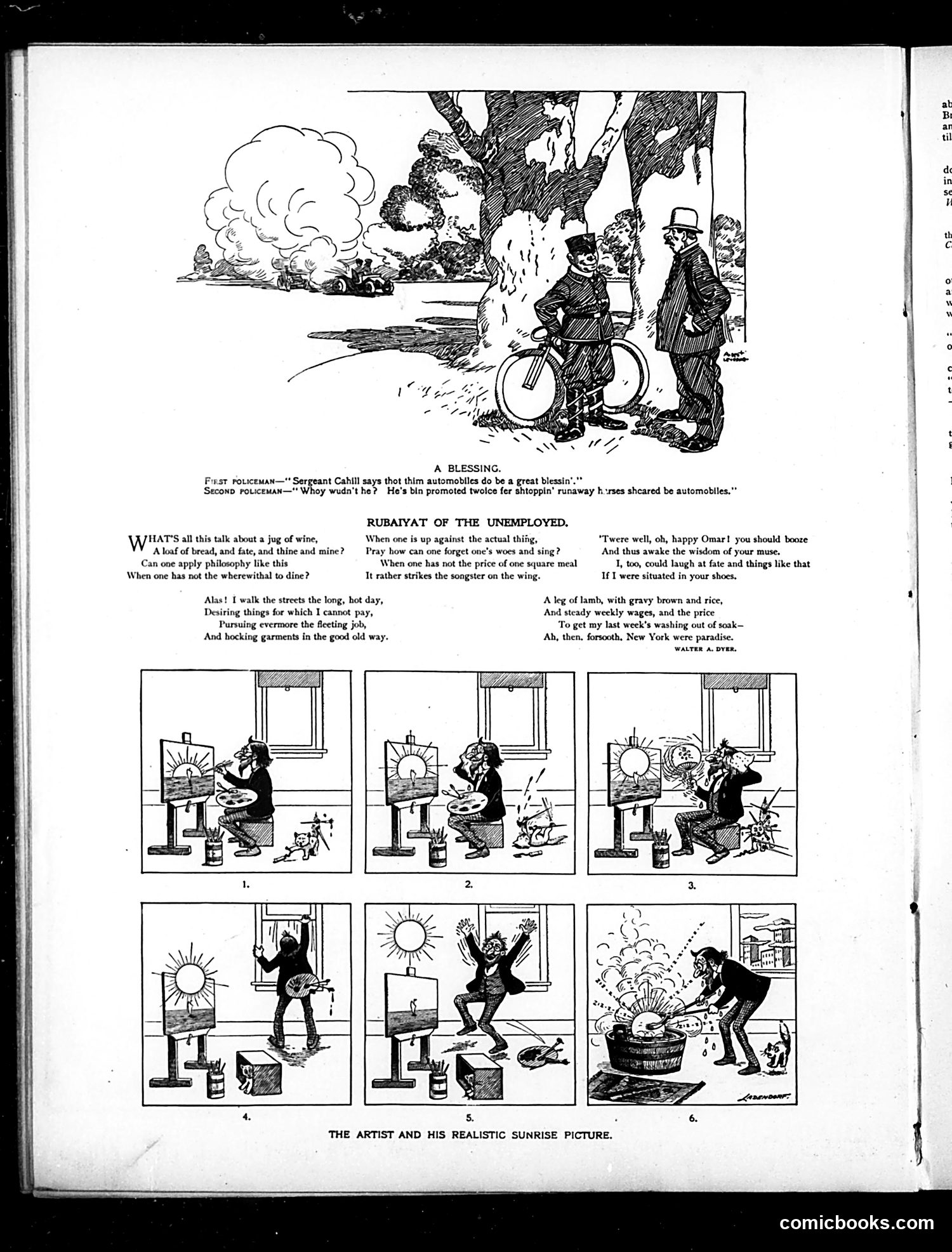
**Top Cartoon ("A Blessing"):** Two Irish-accented policemen discuss how automobiles benefit them professionally. One notes that Sergeant Cahill has been promoted twice for stopping runaway horses scared by automobiles. The satire targets how new technology creates unexpected job advantages—in this case, police promotion through managing automobile-induced chaos rather than through traditional merit. **"Rubaiyat of the Unemployed":** A poem parodying Omar Khayyam's famous work, but substituting hedonistic philosophy with the grim realities of unemployment during what appears to be an economic downturn (likely post-WWI era). The speaker contrasts Khayyam's romantic advice about wine and bread with the desperate unemployed person's inability to afford even basic meals, transforming the original's philosophical escapism into commentary on economic hardship. **"The Artist and His Realistic Sunrise Picture":** A six-panel comic showing an artist painting a sunrise, which progressively becomes more chaotic—culminating in an actual explosion or disaster. The joke mocks pretentious "realism" in art through absurdist exaggeration.
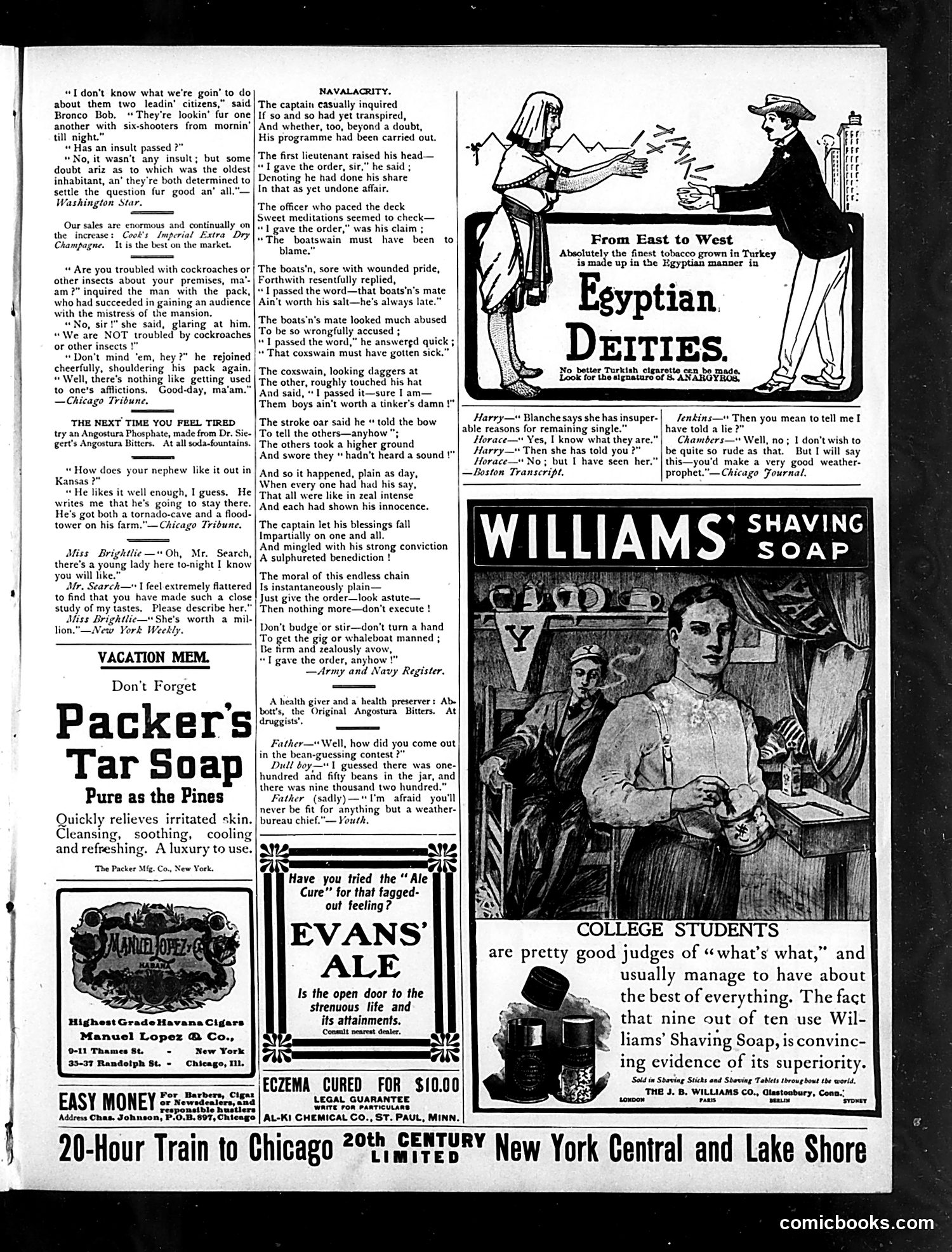
This page from *Judge* magazine contains several short humorous pieces and advertisements typical of early 20th-century American satirical humor. The main cartoon feature, "NAVALACUITY," satirizes military bureaucracy and buck-passing. When a ship's captain orders a task completed, each officer in the chain of command—from first lieutenant to coxswain—claims to have "given the order" while blaming subordinates for non-execution. The joke's moral, stated explicitly, mocks institutional dysfunction: issue orders, look competent, but don't actually do the work yourself. This reflects contemporary frustration with naval (and broader government) inefficiency. The page also includes brief joke items: one about Wild West settlers feuding over who's the oldest resident, another mocking a door-to-door pest control salesman, and a Kansas pioneer joke about tornado preparedness. The remaining content is period advertising for champagne, cigars, tar soap, and other products—standard filler in 19th-century magazines.
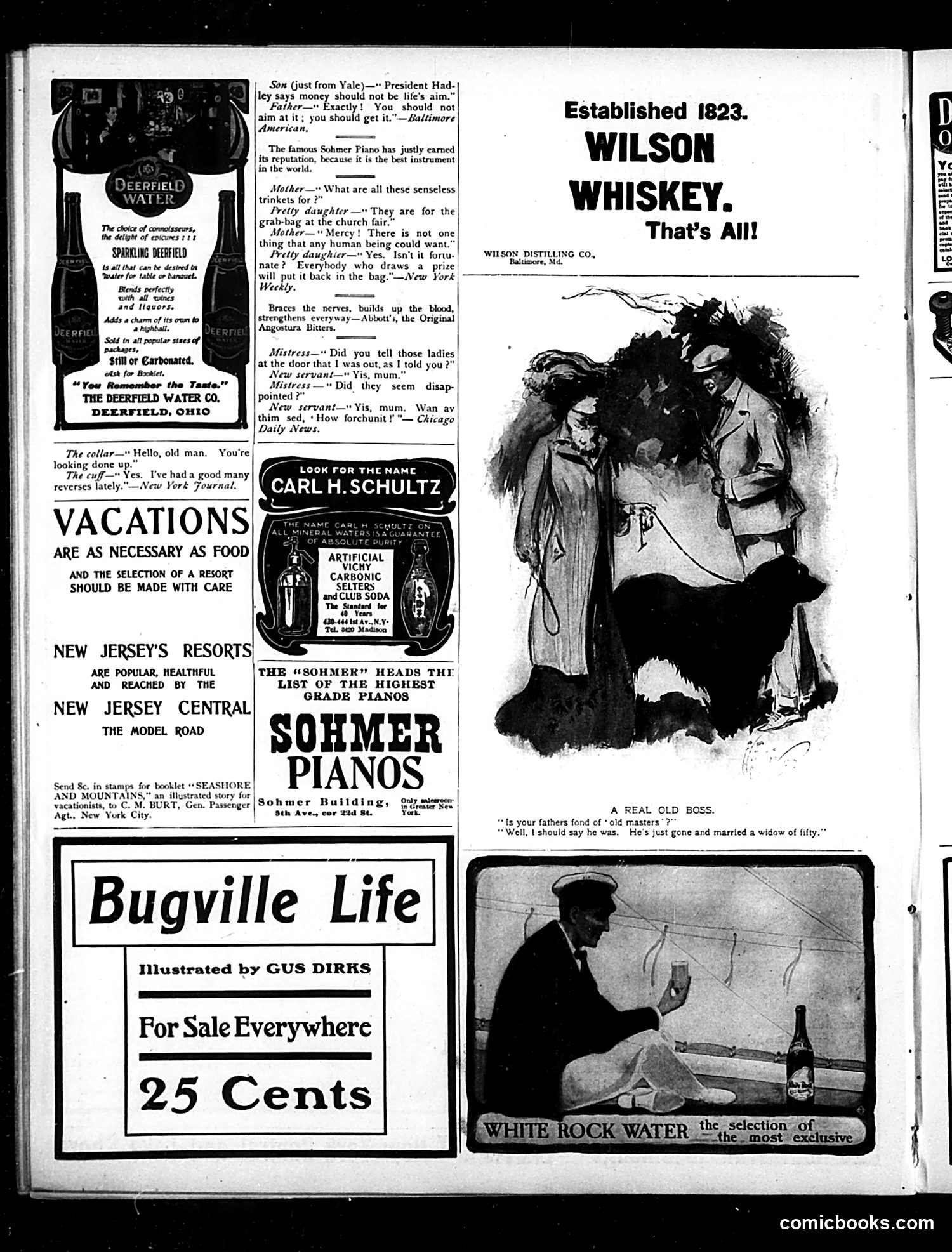
This page is primarily **advertisements and brief humor jokes** typical of Judge magazine's format. The cartoons and jokes include: **"A Real Old Boss"** (right side): A visual gag showing a man admiring what appears to be a portrait, with the caption playing on "old masters" (fine art) versus an "old master" as slang for an older woman. The joke: a father marrying a wealthy widow of fifty is humorously called appreciating "old masters." **Multiple brief jokes** throughout mock social pretension and gender dynamics—a Yale student's father dismissing idealism about money, a daughter's church fair "grab-bag" scheme, and domestic servant misunderstandings. The page is dominated by **product advertisements** for Deerfield Water, Sohmer Pianos, Wilson Whiskey, and other goods—standard revenue for the magazine. The humor reflects early-20th-century attitudes: materialism over ideals, women's limited roles, and class-conscious social observations presented as witty observations for an educated, affluent readership.
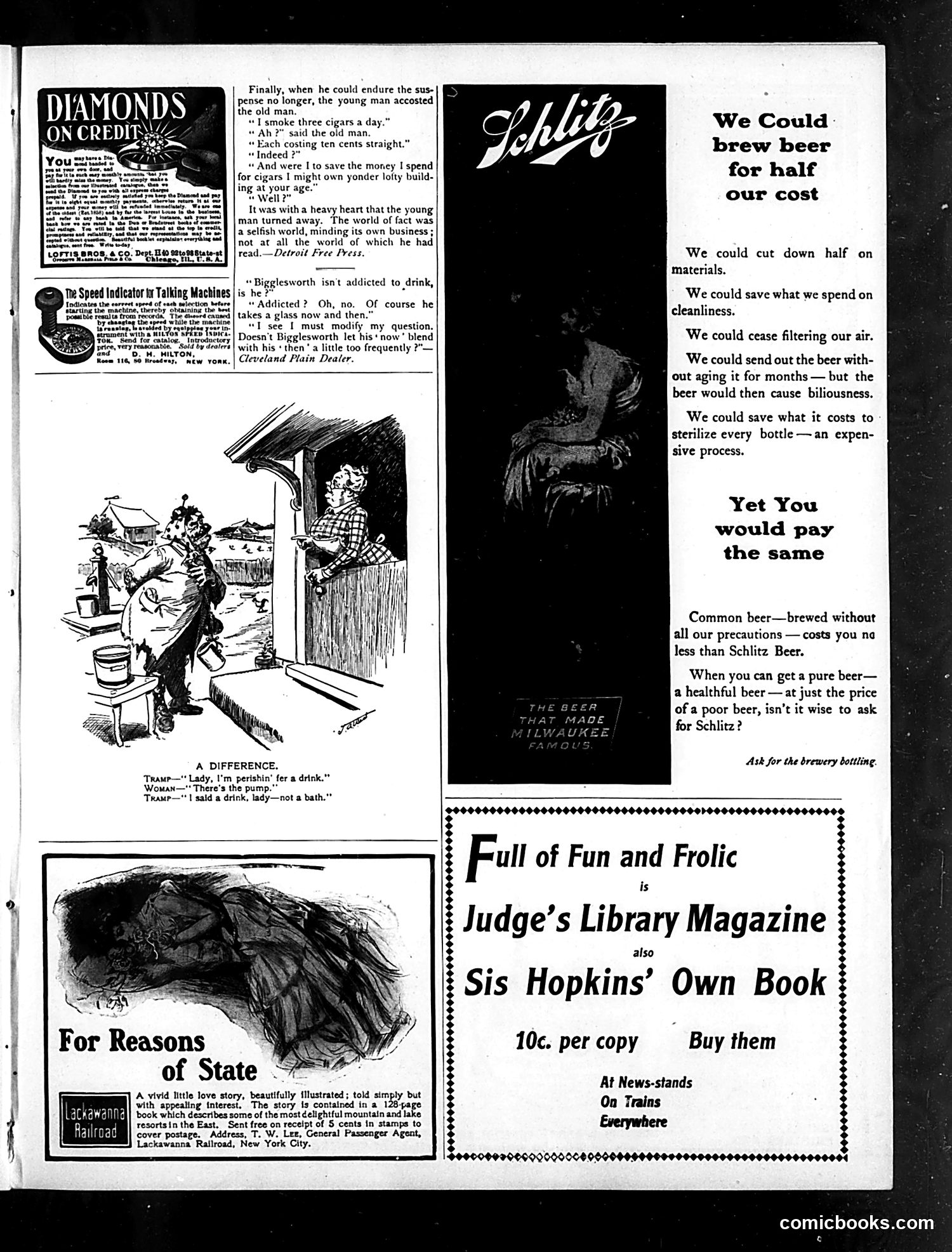
This page contains multiple satirical pieces and advertisements typical of early 20th-century Judge magazine: **The main cartoon** ("A Difference") depicts a tramp asking a woman for "a drink," which she misinterprets as requesting water from her pump rather than alcohol. The joke plays on class assumptions: a well-dressed man might request a beverage expecting liquor, while a poor tramp would be offered only water—highlighting social hypocrisy about drinking. **The Schlitz Beer advertisement** uses a defensive marketing strategy, essentially arguing: "Yes, we *could* cut corners and charge less like competitors, but we don't." This suggests competitors were brewing cheaper beer with fewer quality controls. The ad emphasizes purity, sterilization, and aging as expensive processes justifying premium pricing—a response to likely accusations that Schlitz overcharged. **Other items** include a short story excerpt about a young man learning harsh life lessons (presumably moralizing about financial prudence), jokes about drinking habits, and advertisements for Judge's Library Magazine and Lackawanna Railroad publications. The page reflects early-1900s concerns about quality, class, and morality surrounding alcohol consumption.
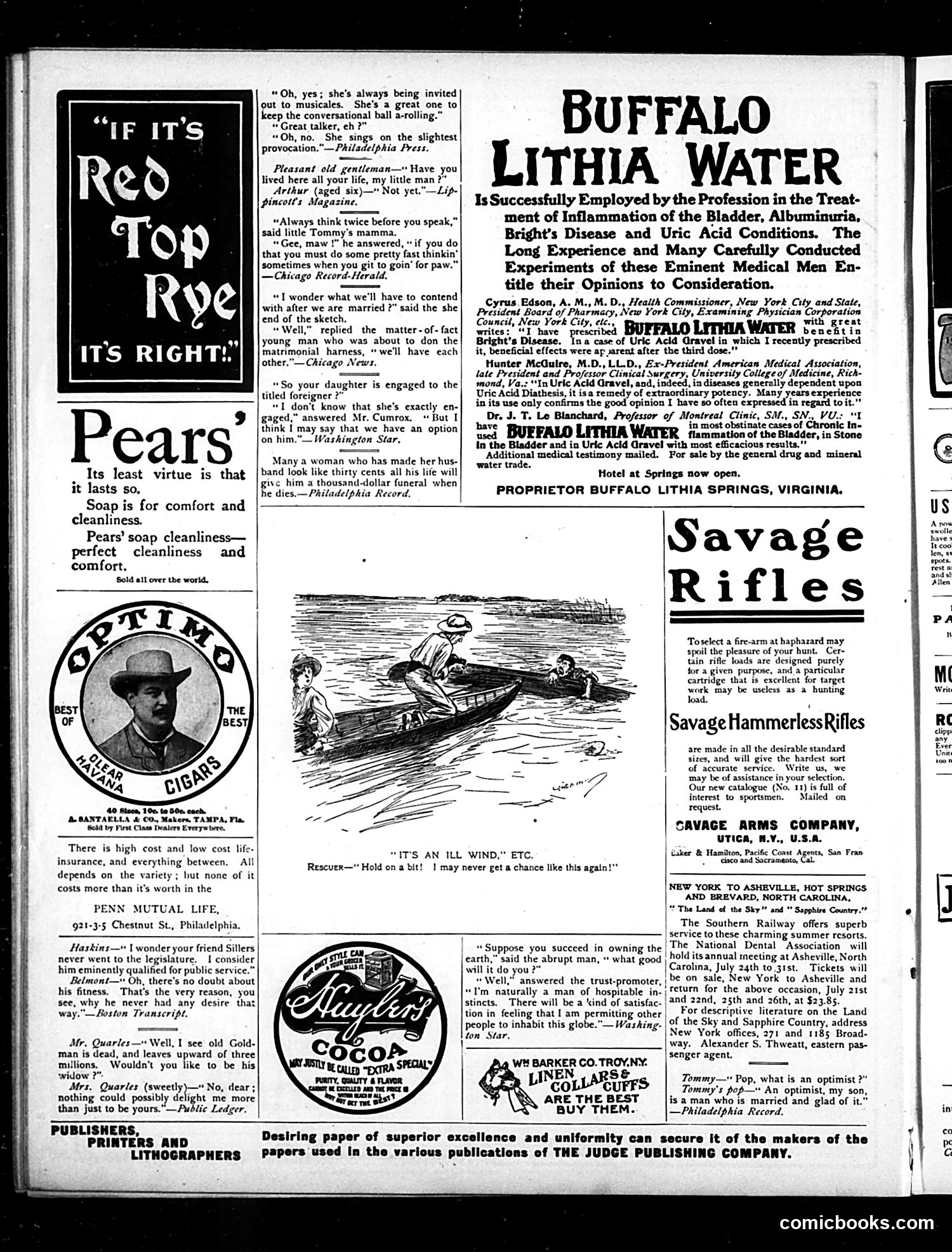
This is primarily an **advertising page** from Judge magazine (early 20th century), with scattered humorous snippets typical of the publication's format. The main content features: **Buffalo Lithia Water advertisement** — promoting mineral water as medical treatment for kidney/bladder conditions (Bright's Disease, uric acid problems). It includes endorsements from physicians, reflecting the era's widespread promotion of "medicinal waters" as cure-alls—a practice we'd now recognize as pseudoscience. **Pears' Soap ad** — emphasizing "cleanliness and comfort," standard early advertising rhetoric. **Penn Mutual Life Insurance** — typical financial services advertising. **Short humor pieces** — brief jokes about marriage, public service fitness, and death that rely on period-specific social assumptions (wives as financial dependents, etc.). **An illustration captioned "It's an Ill Wind"** — appears to show a boating rescue scene. The page reflects **early 20th-century advertising trends**: medical/mineral product promotion, soap marketing focused on gentility, and brief satirical commentary on domestic life. Most content now seems dated rather than satirically pointed.
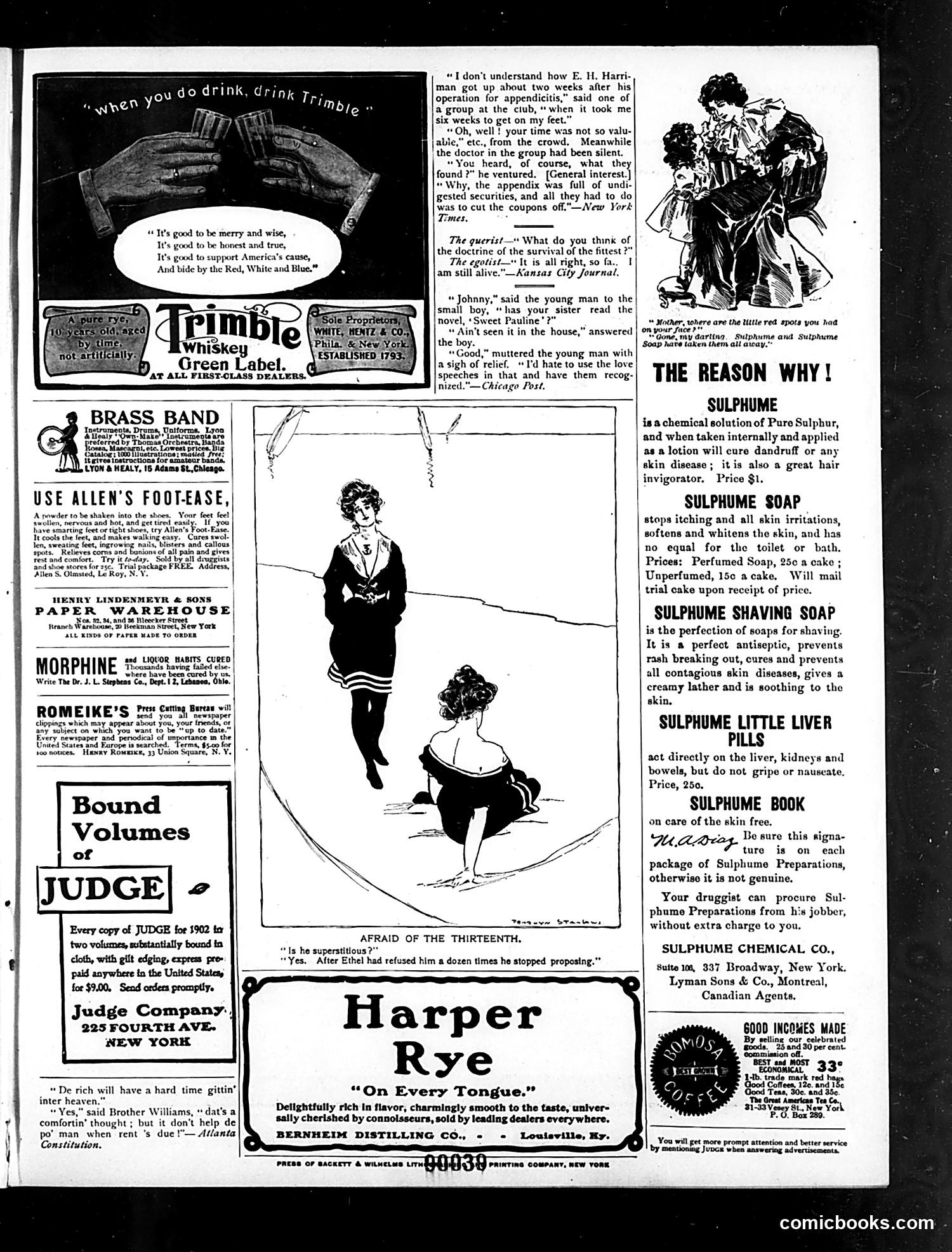
This page from Judge magazine (c. 1902) is primarily **advertising**—roughly 60% consists of product ads (Trimble Whiskey, Sulphume remedies, Allen's Foot-Ease, etc.)—interspersed with brief comic anecdotes. The substantive jokes include: 1. **E.H. Harriman anecdote**: A contemporary railroad magnate undergoes appendicitis surgery but recovers in two weeks (unusually fast). The satirical punchline: his appendix contained only "undigested securities" and coupons—mocking wealthy robber barons for obsessing over investments even during illness. 2. **"Afraid of the Thirteenth"**: A woman refused a suitor repeatedly; he eventually gave up proposing—the joke being superstition about unlucky number 13 actually works (the 13th refusal was the charm). The magazine's humor targets **gilded-age wealth** and **frivolous superstition**. The surrounding product advertisements reflect typical early-1900s patent medicine marketing, most notably the dubious "Sulphume" cure-all claiming to treat dandruff, skin disease, and various ailments.
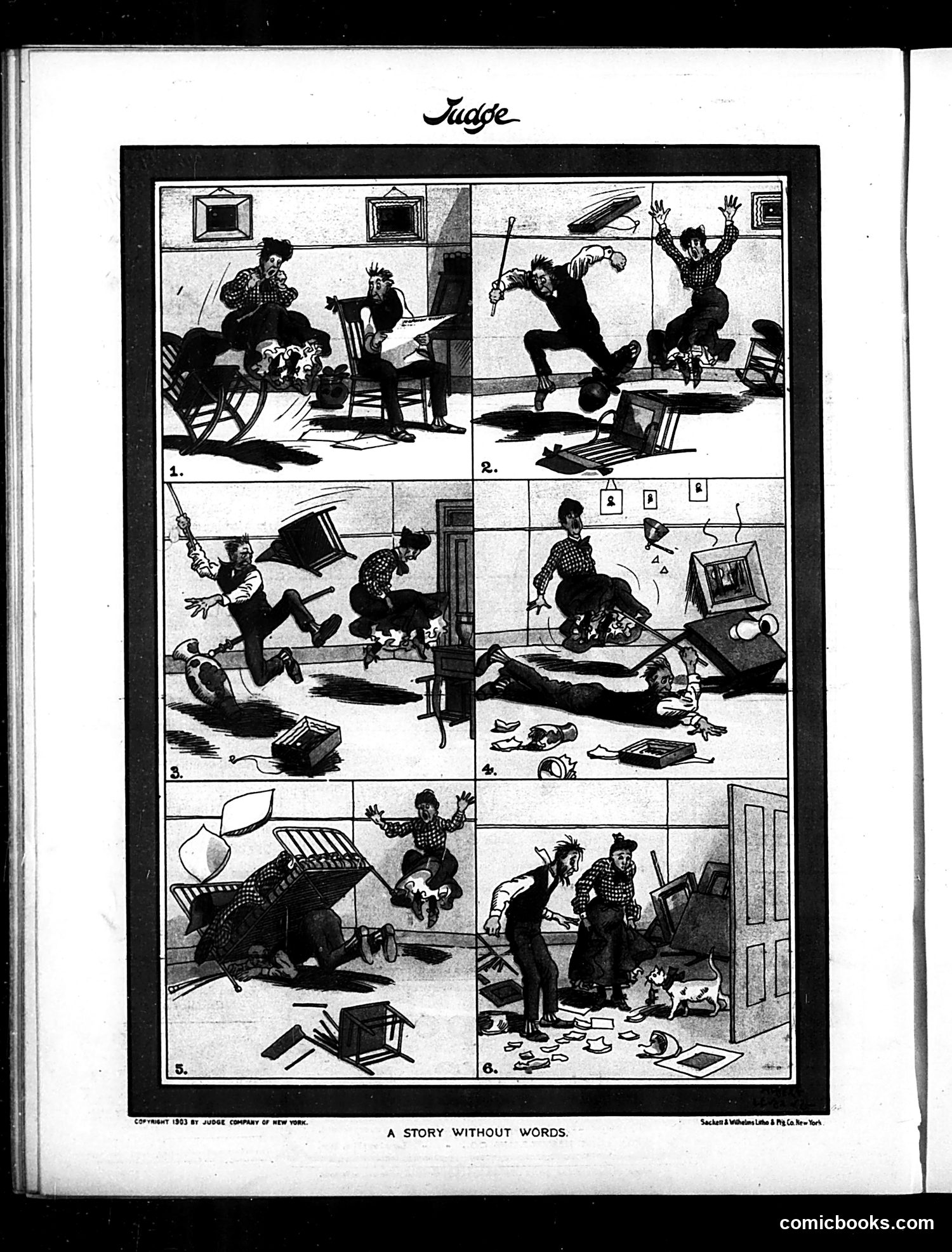
This is a six-panel silent comic titled "A Story Without Words" from Judge magazine (copyright 1923). The narrative shows a domestic chaos sequence: what appears to be a housewife or homeowner attempting to manage increasingly destructive events—furniture being thrown, objects breaking, people falling—while others (possibly children or servants) create mayhem throughout a home's interior spaces. The satire likely targets either domestic incompetence, the challenges of household management in post-WWI America, or possibly critiques gender roles and domestic labor. Without identifying specific caricatures or understanding whether individuals represent particular types rather than specific people, the humor appears to derive from the escalating physical comedy and visual pandemonium—typical of Judge's slapstick approach to social commentary.