
A complete issue · 16 pages · 1903
Judge — July 4, 1903
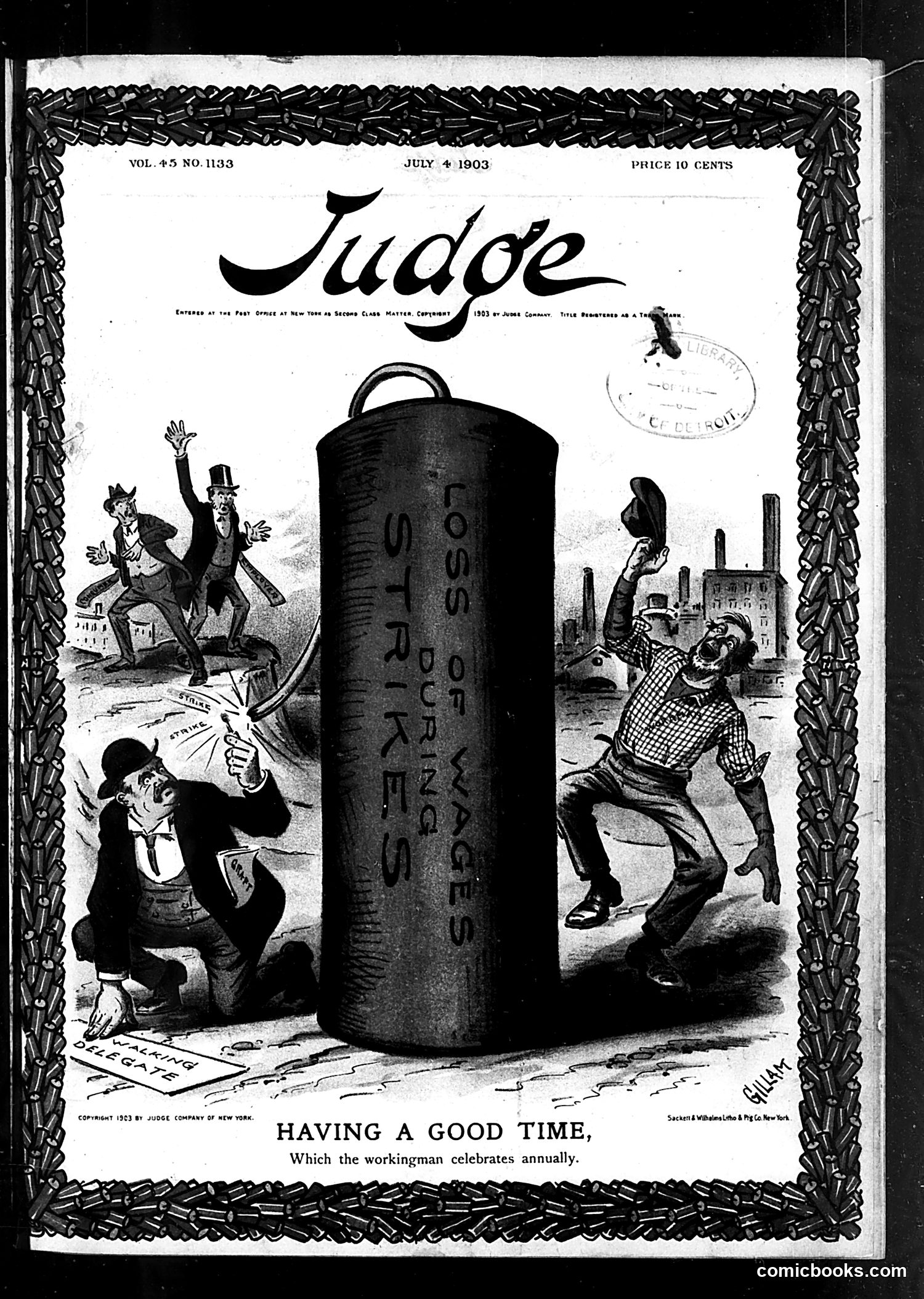
This cover satirizes Fourth of July celebrations among working-class Americans. The central image shows a large firecracker or explosive device labeled "FIRECRACKERS" (text reads vertically on the cylinder). Around it, working men are depicted celebrating in chaotic fashion—one man crouches protectively near the explosive, another poses dramatically, and figures in the background react with alarm near industrial buildings. The caption states: "HAVING A GOOD TIME, Which the workingman celebrates annually." The satire appears to mock working-class Fourth of July traditions by equating their celebrations with dangerous explosives and reckless behavior. The imagery suggests that fireworks and holiday merrymaking among laborers were viewed by the magazine's middle-class audience as foolish or threatening rather than patriotic.
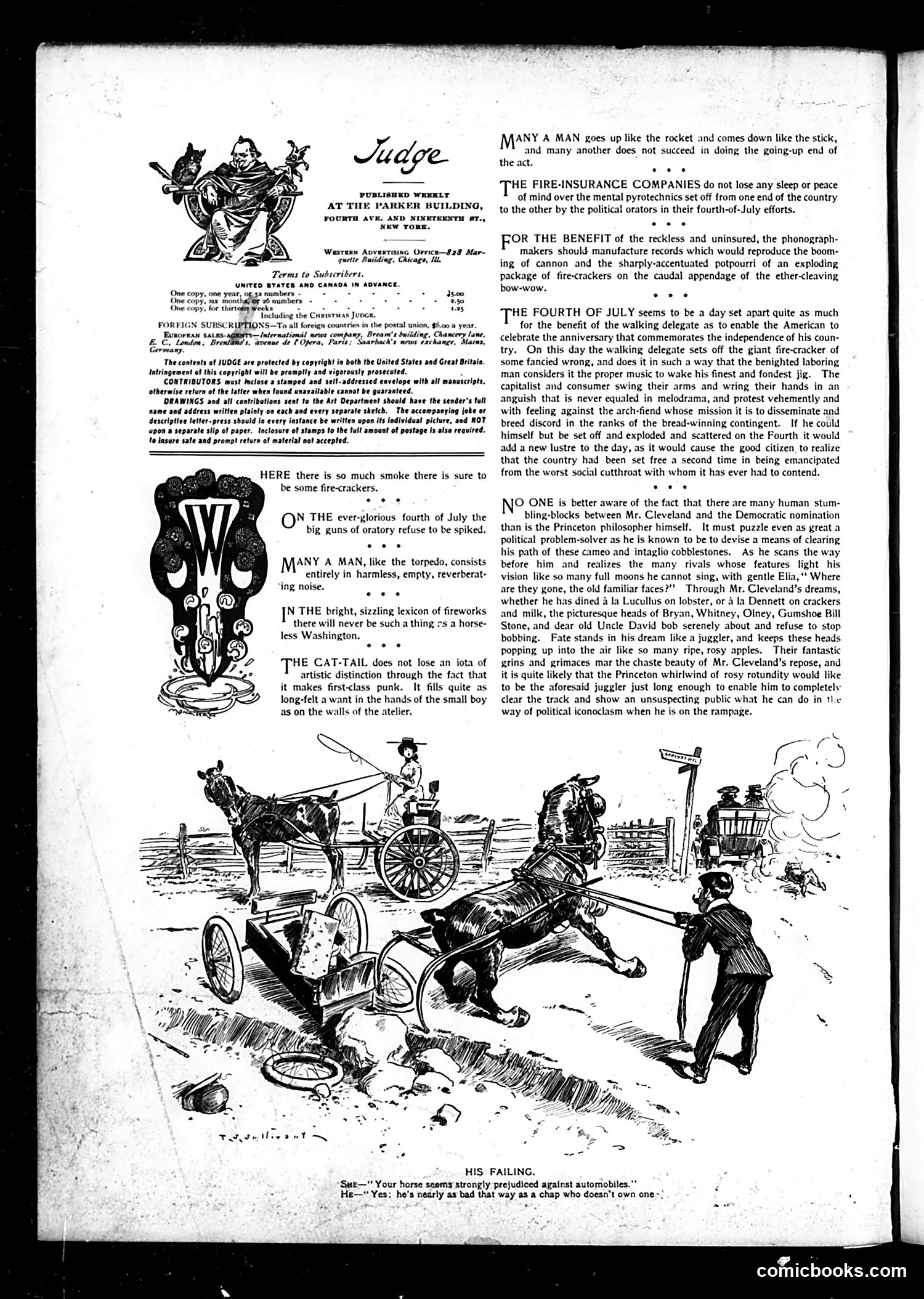
This page satirizes Fourth of July celebrations and political discord. The main editorial criticizes how Americans celebrate Independence Day while ignoring serious political divisions. It references Cleveland and the Democratic nomination, suggesting a Princeton philosopher involved in political maneuvering. The bottom cartoon, captioned "HIS FAILING," depicts a man struggling to control a horse-drawn cart while an automobile passes—satirizing resistance to modern technology. The dialogue ("Your horse seems strongly prejudiced against automobiles") mocks those clinging to outdated ways. The overall message critiques political leaders as impractical idealists disconnected from reality, using the horse-versus-automobile contrast as metaphor for progress versus obsolescence. The Fourth of July framing suggests hypocrisy: celebrating national unity while fostering partisan conflict.
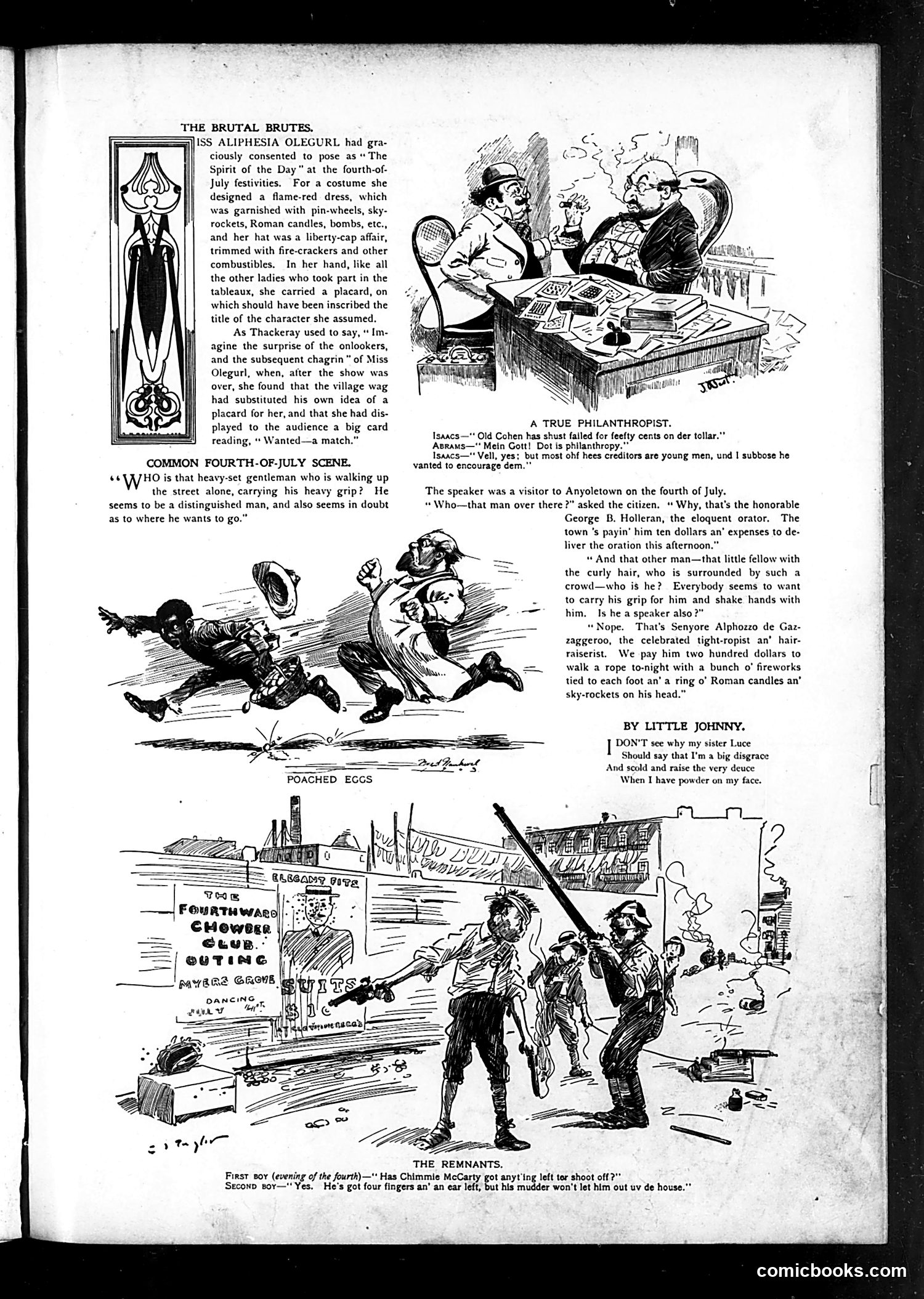
This page contains three satirical pieces mocking Fourth of July celebrations and public figures: **"A True Philanthropist"** (top): Mocks someone named Cohen who allegedly "failed for lowly peck on der dollar," suggesting financial fraud or exploitation dressed as charity. **"Common Fourth-of-July Scene"** (middle): Depicts rowdy, intoxicated men engaged in dangerous behavior—one swinging a pan, others running chaotically—illustrating the satirical title "The Brutal Brutes." This critiques how Independence Day celebrations often devolved into drunken violence and disorder among working-class men. **"The Remnants"** (bottom): Shows boys playing with fireworks and weapons near abandoned military equipment and signs advertising "chowder" and "outing," commenting on chaotic holiday celebrations and children's reckless behavior with dangerous materials. The overall theme satirizes how Fourth of July festivities frequently produced public drunkenness, violence, and dangerous conduct.
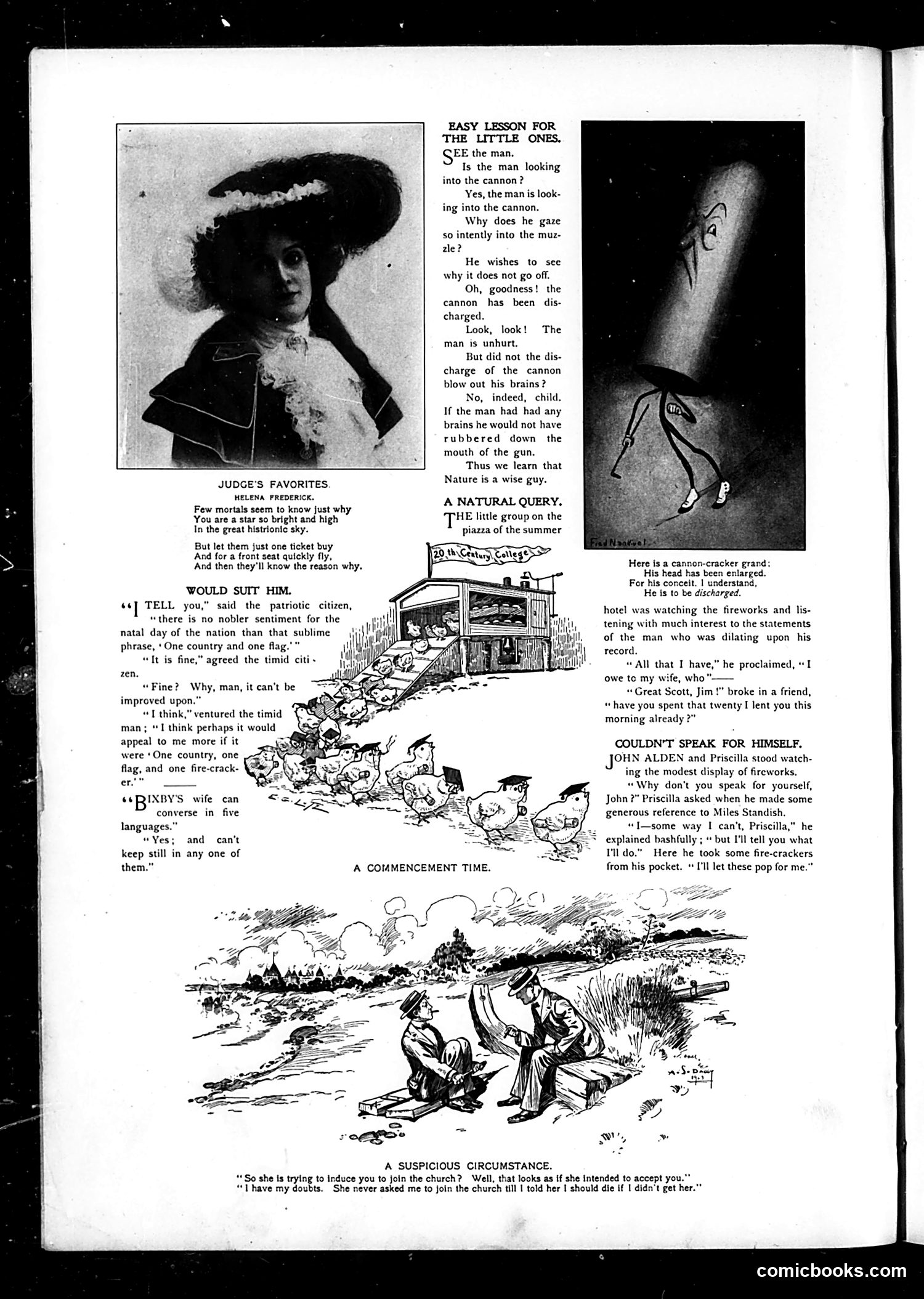
This page contains several satirical pieces and illustrations typical of Judge's humor: **"Easy Lesson for the Little Ones"** uses a cannon accident to teach children that unintelligent people lack common sense—the man's brains weren't "blown out" because he had none to begin with. **"Judge's Favorites"** is a poem mocking patriotic sentiment, suggesting blind nationalism isn't worth emulating. **"Would Suit Him"** satirizes a politician's vague patriotic rhetoric about "one country, one flag," suggesting such empty phrases appeal to those lacking substance. **"Couldn't Speak for Himself"** appears to involve characters named John Alden and Priscilla (historical/literary references), with humor about speaking for others and firecracker pranks. The various cartoons and jokes reflect Judge's typical approach: social satire through wordplay, ironic commentary on patriotism, and lighthearted domestic humor.
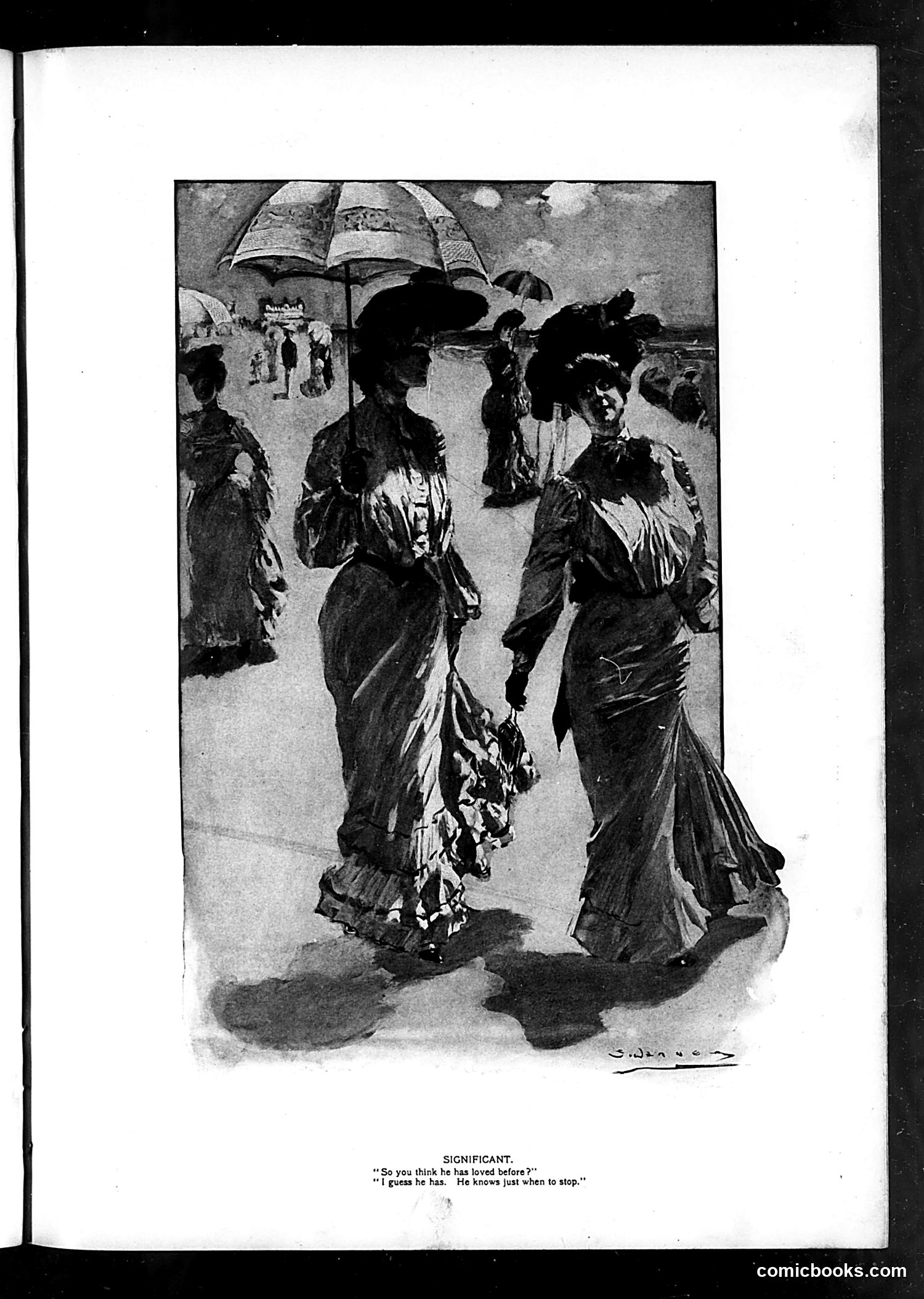
This appears to be a romantic or social commentary cartoon from Judge magazine. The image shows elegantly dressed women with umbrellas in what seems to be a public setting, with men visible in the background. The caption's dialogue suggests satire about courtship and romantic experience. The punchline—"He knows just when to stop"—implies the male subject is experienced in romance, specifically in knowing how far to pursue women before they reject him. This reflects turn-of-the-century anxieties about male behavior, propriety, and the boundaries of courtship. The title "SIGNIFICANT" underscores that this seemingly casual romantic knowledge reveals character. The humor operates as social commentary on gender dynamics and what women found notable (or troubling) about men's romantic conduct during this era.
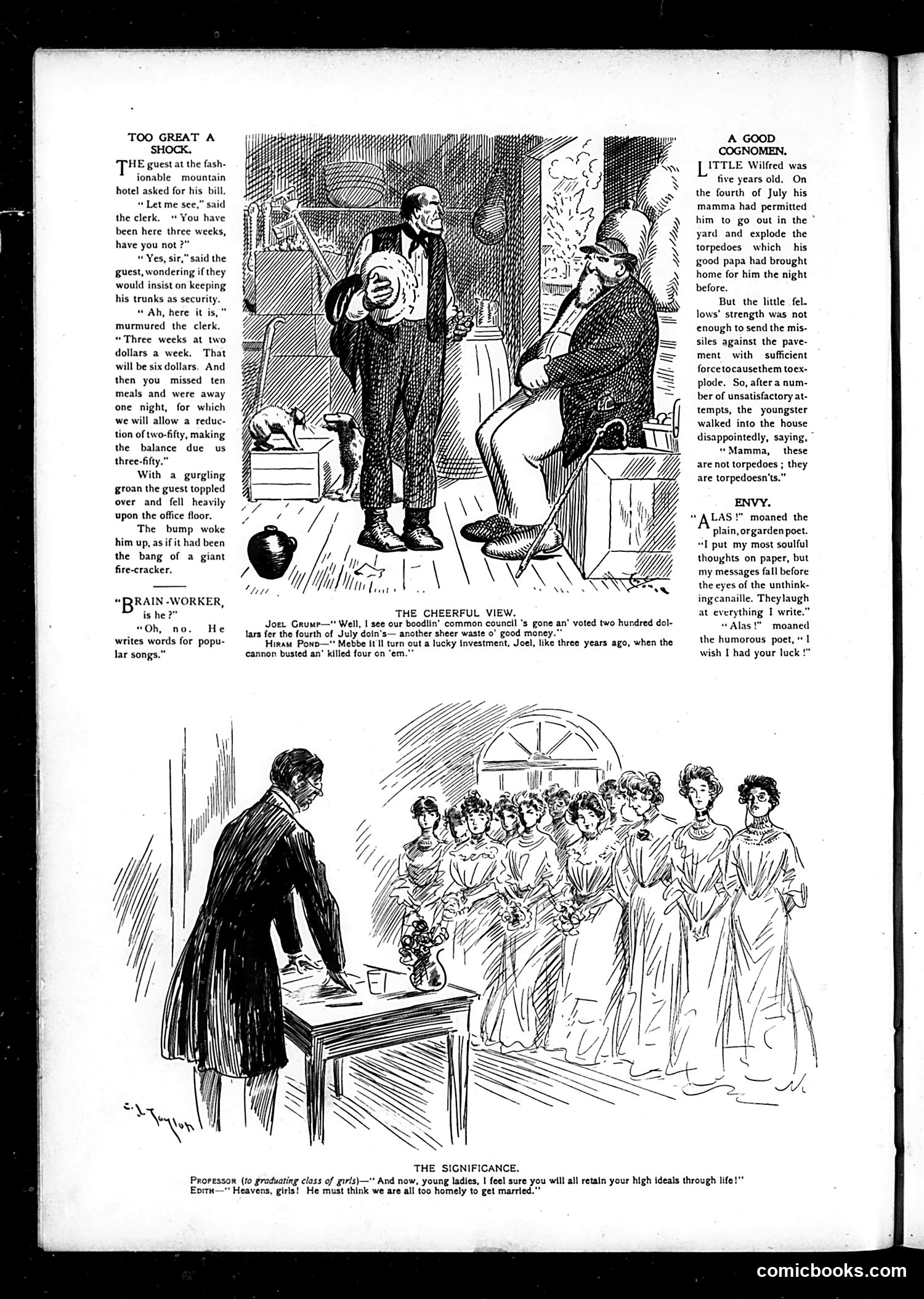
This Judge magazine page contains three separate satirical pieces: **"Too Great a Shock"** (top): A humorous story about a hotel guest shocked by an unexpectedly low bill ($3.50 for three weeks), finding the reasonable pricing so surprising he faints. The joke mocks the guest's assumption that hotels always overcharge. **"The Cheerful View"** (middle): Two rustic characters discuss Fourth of July municipal spending. One cynically notes taxpayer waste; the other darkly quips that past fireworks mishaps killed people—implying accidental deaths might represent "good value." This satirizes small-town corruption and political indifference. **"The Significance"** (bottom): A graduating class receives platitudes about maintaining "high ideals," with a deadpan editorial note suggesting the professor assumes his female students are too unattractive to marry—therefore he needn't worry about their futures. This satirizes patronizing attitudes toward women's education and beauty standards of the era. Each piece uses irony and dark humor to critique social hypocrisy and foolishness.
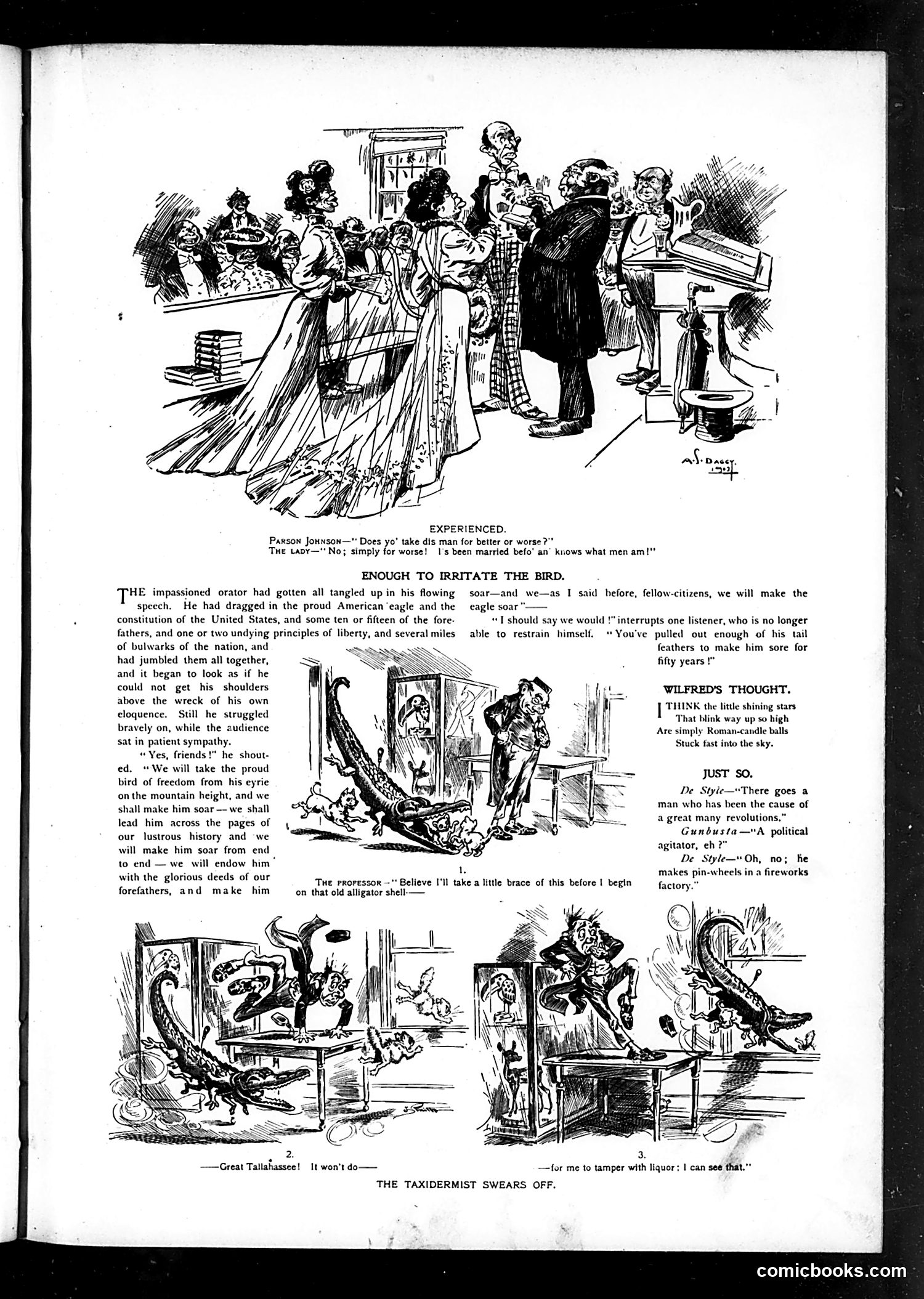
This page contains satirical commentary on oratory and political speech. The top cartoon shows "Parson Johnson" being questioned by a lady about his marital prospects—he claims marriage would make him "for better or worse," a joke on wedding vows. The main text, "ENOUGH TO IRRITATE THE BIRD," mocks an unnamed "impassioned orator" who has delivered lengthy speeches about American democracy and liberty. The satire suggests his verbose rhetoric is tedious rather than inspiring. The lower cartoons titled "THE TAXIDERMIST SWEARS OFF" appear to show someone (possibly a taxidermist) dealing with chaotic consequences, though the specific reference is unclear without additional context. The page primarily satirizes flowery political speech and its disconnect from reality—a recurring Judge magazine theme mocking pompous oratory.
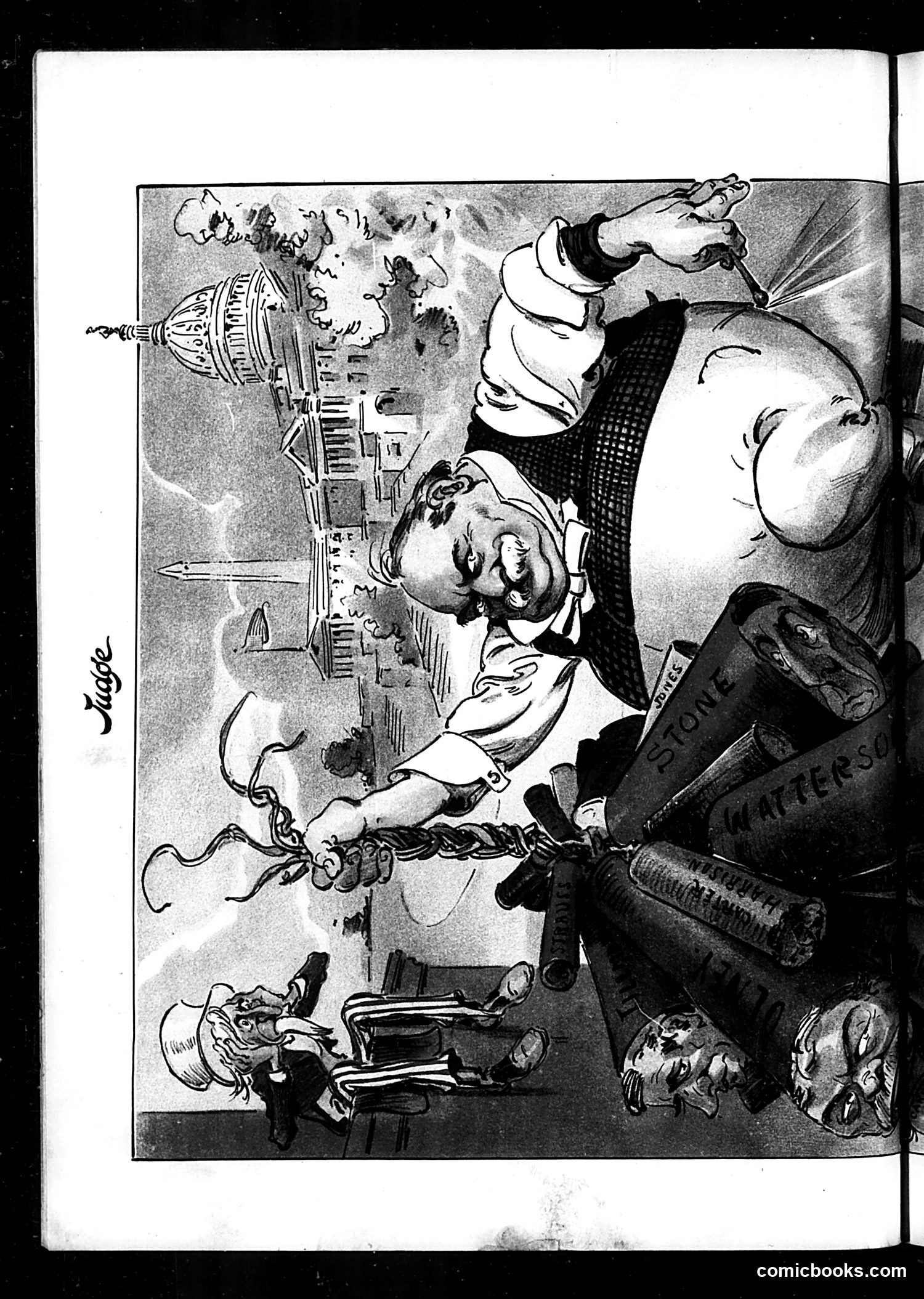
This appears to be a satirical cartoon from *Judge* magazine depicting a wealthy, rotund figure (likely representing a capitalist or industrialist) surrounded by symbols of corruption and excess. The man holds what appears to be a snake or serpent, suggesting deception or manipulation. Around him are barrels labeled "STORE" and "WINTERS," possibly referencing specific businesses or industries. The caricatured style emphasizes his corpulence and self-satisfaction, a common visual trope in Gilded Age satire to mock the wealthy and powerful. The smaller figures and chaotic composition suggest societal disorder resulting from his influence. Without clearer text or date information visible, the specific political target remains unclear, but the cartoon's general message critiques wealth inequality and corporate malfeasance—themes central to *Judge's* satirical mission.
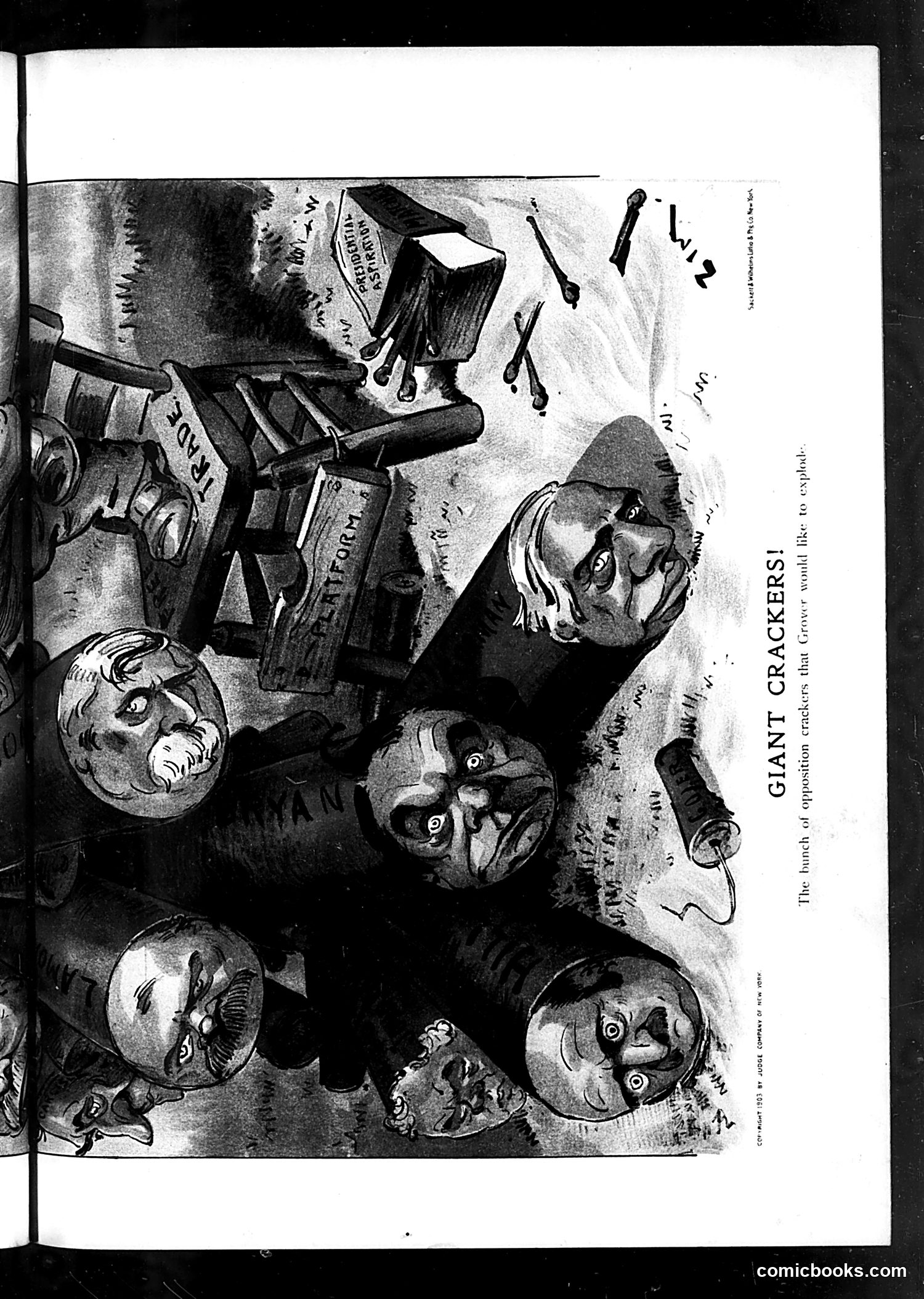
This cartoon satirizes political opposition to anti-monopoly efforts. A central figure (appearing to be a politician or industrialist) operates a large mechanical device labeled as a "bunch of opposition cracks that frown like to exploit" — the text is partially unclear, but suggests mechanisms of corporate resistance. The surrounding grotesque caricatured faces represent different opposing interests or political factions resisting reform. The "giant crackers" reference (visible in the title) appears to mock large industrial or monopolistic enterprises, possibly linked to food trusts or similar business combinations that were controversial subjects of Progressive-era regulation. The satirical point criticizes how powerful interests deploy multiple opposing voices and mechanisms to resist regulatory oversight — showing the coordinated nature of corporate opposition to trust-busting legislation that was a major political issue in early 20th-century America.
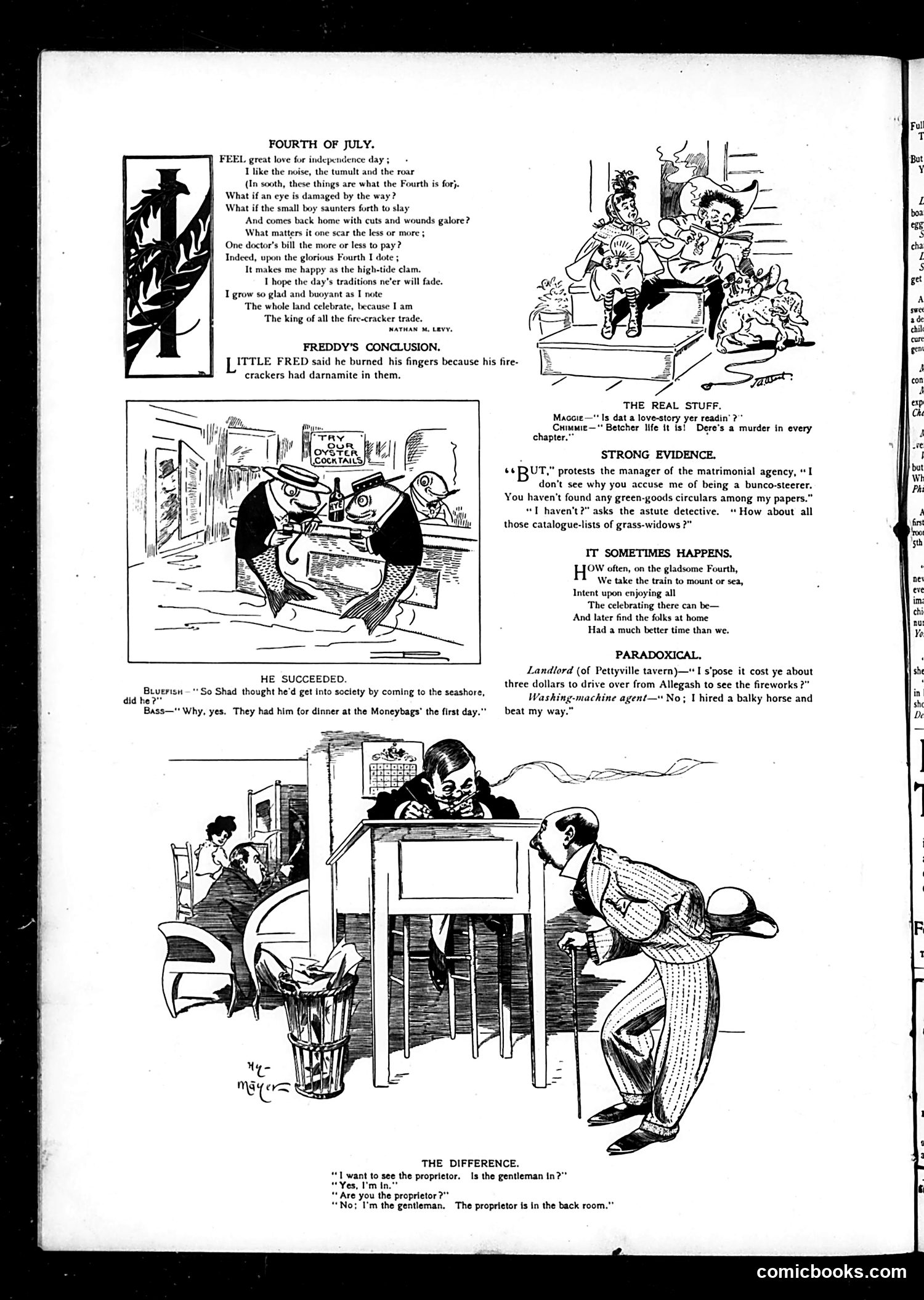
This Judge magazine page contains multiple satirical items about Independence Day and American life: **"Fourth of July" (poem)**: The opening poem satirizes firecracker safety by presenting a cynical narrator who profits from fireworks sales. He celebrates the holiday's "tumult and roar" while dismissing children's injuries ("What matters it one scar the less or more") and medical bills—revealing his self-interested hypocrisy. Nathan S. M. Levy is identified as "king of all the fire-cracker trade." **Supporting cartoons**: "Freddy's Conclusion" jokes about dangerous firecrackers containing dynamite. Other items mock holiday clichés ("It Sometimes Happens") and social pretensions. **The broader satire**: The page critiques both holiday recklessness and commercialism—manufacturers profiting while children are injured. It also satirizes class anxieties and social climbing ("He Succeeded," "The Difference"), with the final cartoon distinguishing between a gentleman and a proprietor as commentary on nouveau riche pretension. The content reflects turn-of-century concerns about unregulated consumer products and children's safety.
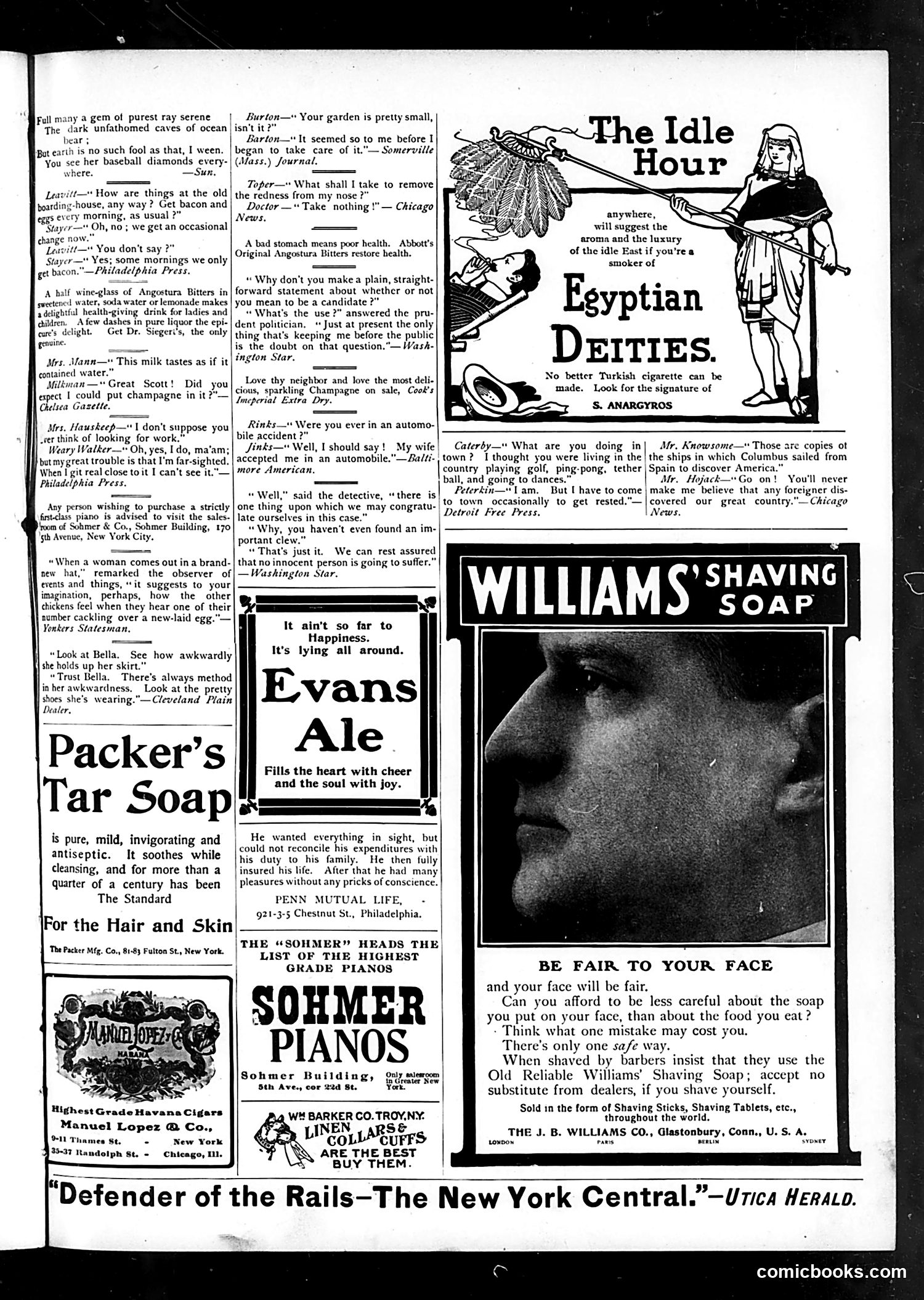
This page contains multiple brief satirical jokes and advertisements typical of Judge magazine. The main cartoon titled "The Idle Hour" and "Egyptian Deities" appears to mock leisured orientalism—depicting a woman in Egyptian costume, likely satirizing the early 20th-century fashion for "Oriental" aesthetics and the romanticization of idle Eastern luxury among wealthy Americans. The surrounding text consists of short comedic exchanges about everyday life: boarding house meals, patent medicine effectiveness, automobile accidents, and social pretensions. One joke mocks a politician's evasiveness about candidacy; another features a detective's ironic observation about an unsolved case. The advertisements—for Packer's Tar Soap, Evans Ale, Sohmer Pianos, and Williams' Shaving Soap—are typical period marketing, with Williams' notably emphasizing quality and warning against counterfeits. The overall tone is light, satirizing mundane American life and contemporary fashions.
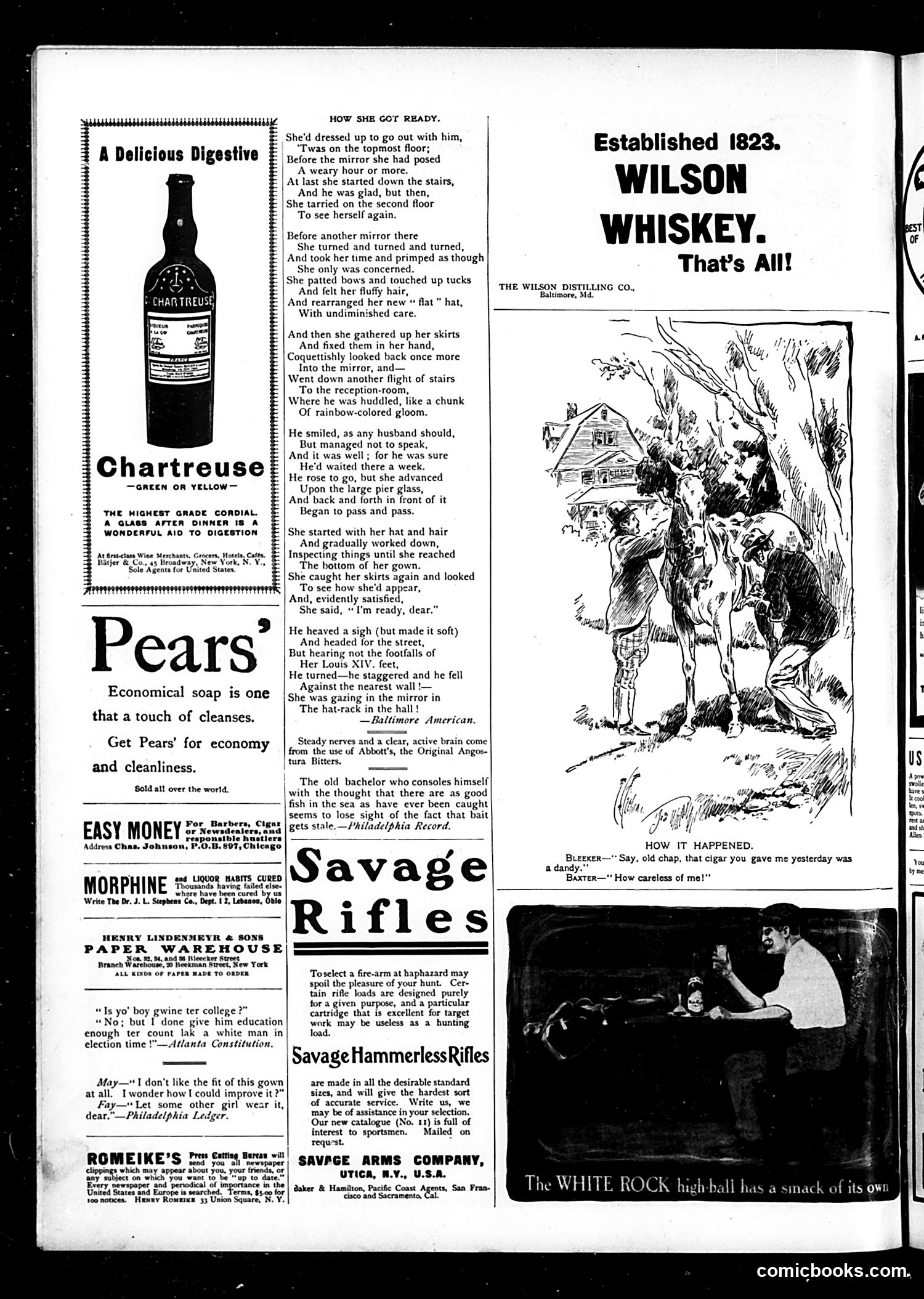
This page is primarily **advertisements and light humor** rather than political satire. The main content includes: **"How She Got Ready"** (center): A humorous poem about a wife's excessive vanity, stopping repeatedly to admire herself in mirrors before going out with her husband. The joke satirizes women's obsession with appearance—she checks mirrors on multiple floors, adjusts her hat and dress repeatedly, and even pauses at a hat-rack mirror before finally declaring herself ready. The husband's frustration (waiting a week, nearly fainting) is played for domestic comedy. **Advertisements** dominate the page: Chartreuse liqueur, Pears' soap, morphine treatments, Wilson Whiskey, Savage rifles, and paper warehouse services—typical for early 1900s Judge magazine. **Small humor pieces** include brief jokes about education, fashion, and courtship from various newspapers (Atlanta Constitution, Philadelphia Ledger). The overall tone reflects period attitudes about gender roles, portraying female vanity as humorous rather than offensive by modern standards.
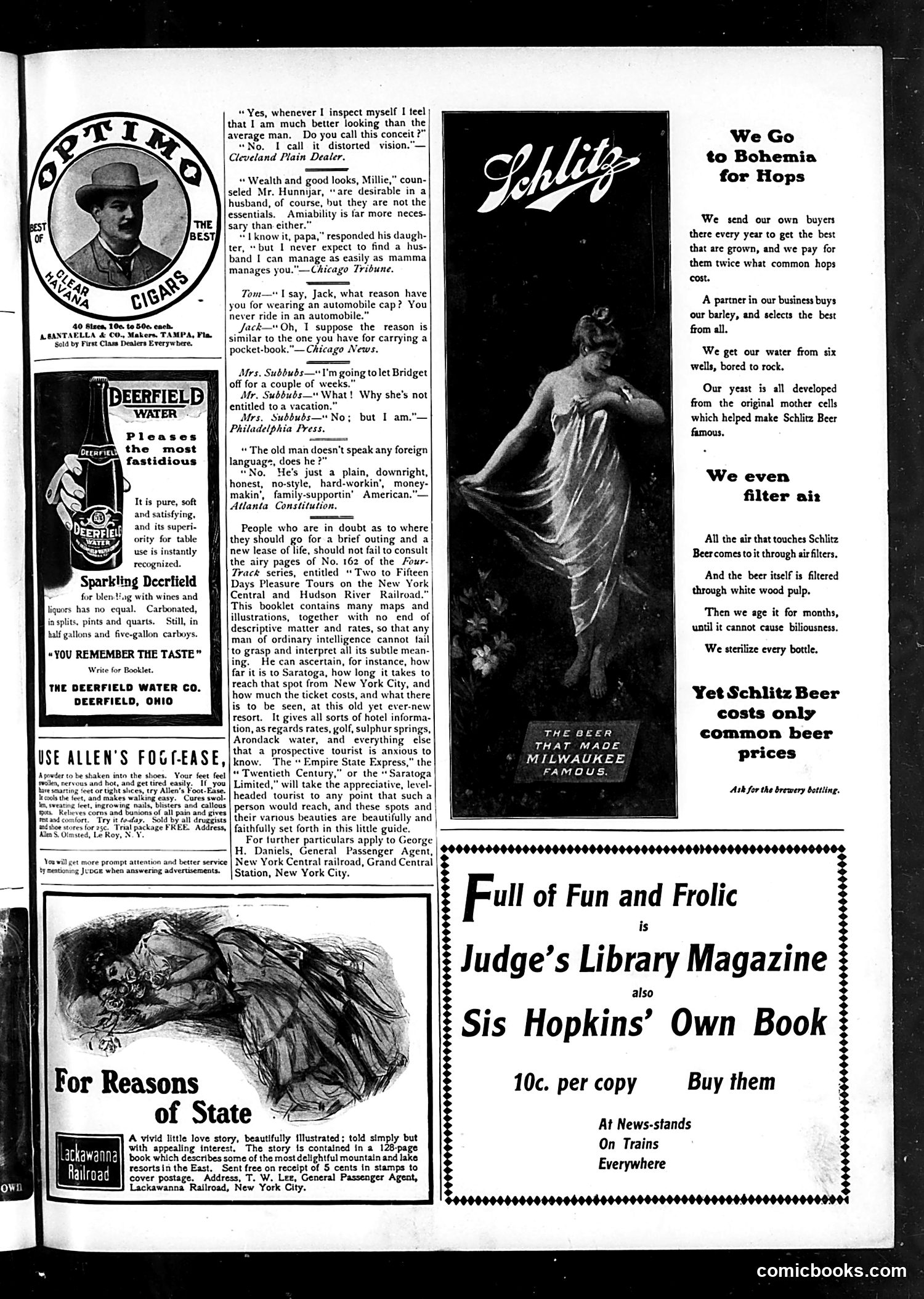
This page is primarily **advertising** with brief satirical jokes interspersed. The main content includes: **Satirical Jokes:** Short, domestic humor pieces mocking middle-class pretensions—a man with inflated self-image, a daughter viewing marriage pragmatically, a husband wearing an automobile cap without owning an automobile, and a wife taking a vacation from her maid. **Advertisements:** - Schlitz Beer dominates the right side, emphasizing quality control and purity ("filter all," "sterilize every bottle") - Allen's Foot-Ease, Deerfield Water, and other patent medicines/products - Judge's Library Magazine and Sis Hopkins' Own Book (10¢ publications) - A Lackawanna Railroad booklet promoting leisure tourism to upstate New York resorts The satire reflects early 20th-century American anxieties: status-seeking through consumer goods, emerging automobile culture, and middle-class aspirations. The page captures a moment when advertising and humor coexisted in magazines to attract readers through entertainment.
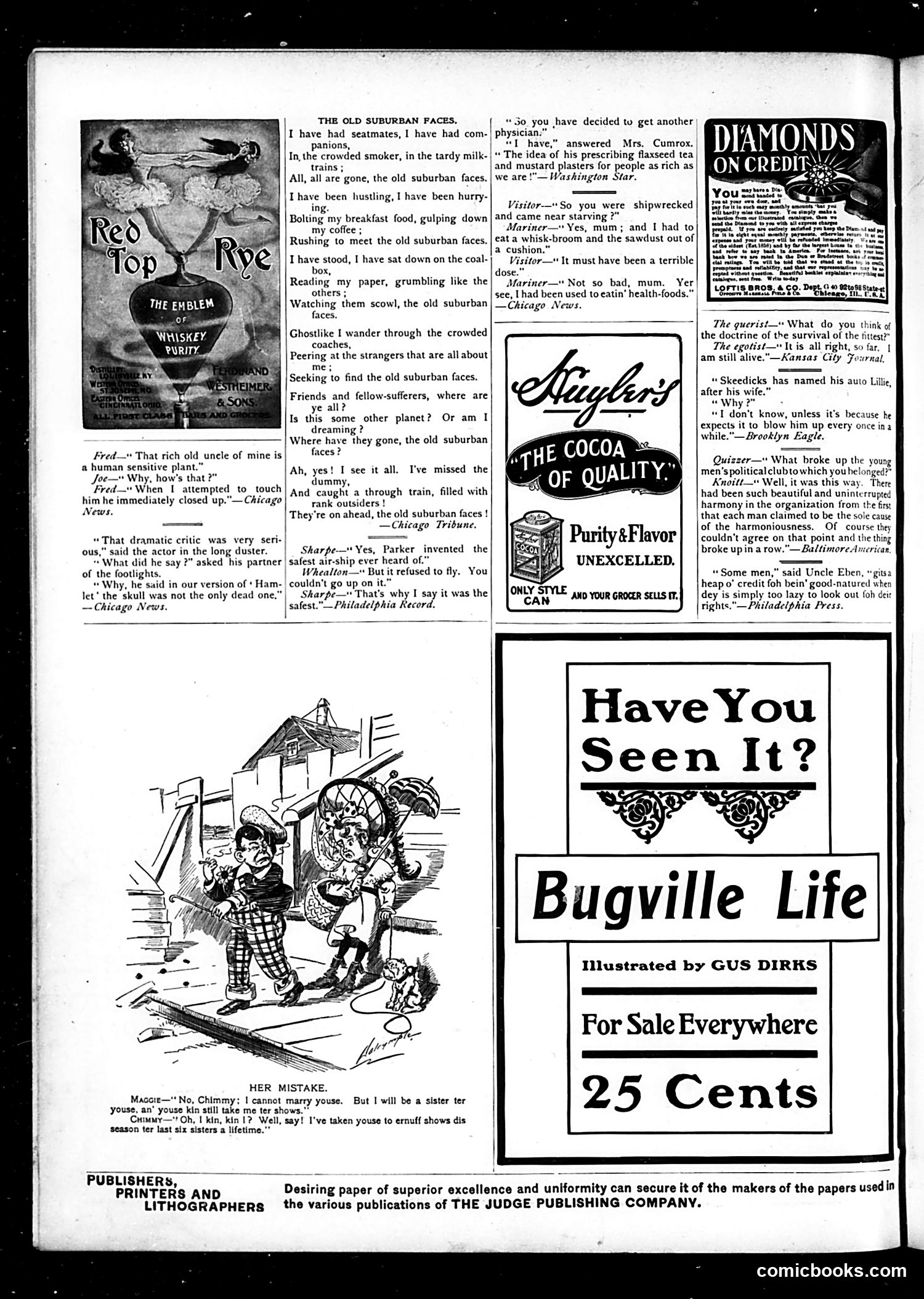
This page contains primarily **short humorous jokes and advertisements** rather than political cartoons. The main content includes: **Humor pieces:** Brief jokes from newspapers (Chicago News, Philadelphia Record, etc.) about everyday situations—a sensitive uncle, a dramatic critic, a safe but flightless airplane, and romantic/domestic mishaps. These reflect early 20th-century urban middle-class life. **"The Old Suburban Faces"** is a nostalgic poem (likely parody of classical verse) about a commuter missing his regular train-mates after accidentally boarding a different train—mocking the mundane routine of suburban rail travel. **Advertisements:** The page heavily features ads for Red Top Rye whiskey, Saylor's cocoa, diamonds, and notably "Bugville Life"—an illustrated humor publication by Gus Dirks selling for 25 cents. **Social commentary:** The jokes subtly mock class pretensions (wealthy patients rejecting "health foods," women judging doctors by patient wealth) and emerging automobile culture (cars as unreliable). There is **no significant political satire** on this page—it's primarily entertainment and commercial content typical of Judge magazine's lighter content.
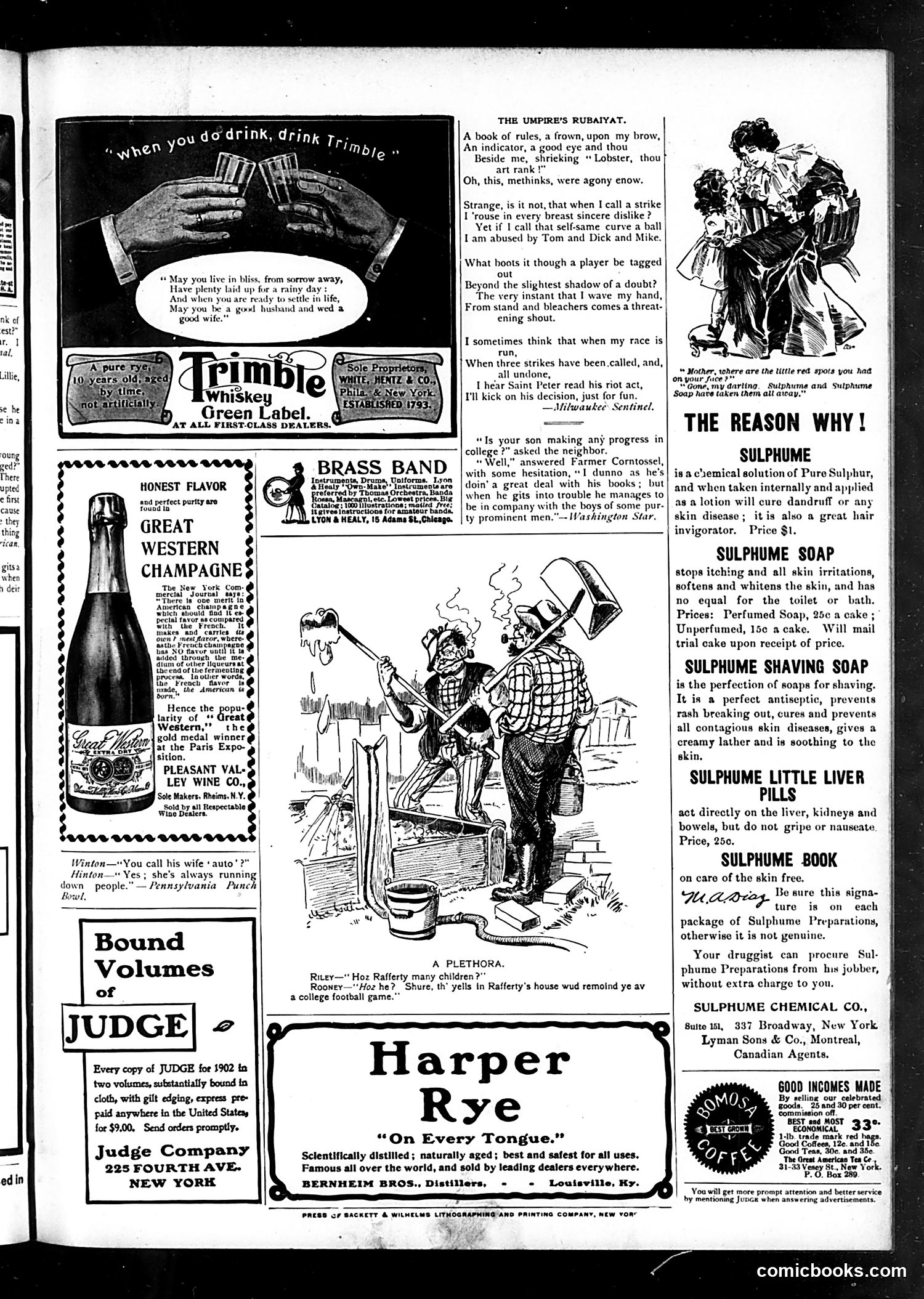
This page features a satirical poem mocking baseball umpires. The piece parodies Omar Khayyam's famous *Rubaiyat* (a philosophical Persian poem), applying its contemplative structure to an umpire's frustrations. The satire targets the impossible position of the umpire: he's criticized regardless of his calls—strike or ball, out or safe, his decisions generate anger from players and crowds. The joke is that even when objectively correct (a player "tagged out / Beyond the slightest shadow of a doubt"), the umpire faces threats and abuse. The final stanza suggests the umpire will even dispute Saint Peter's judgment in the afterlife—a humorous commentary on how the role encourages argumentative confrontation with authority. This reflects early 1900s baseball culture, when umpire authority and crowd behavior were contentious issues. The poem uses elevated literary reference to humorously deflate the umpire's dignity while sympathizing with his thankless job.
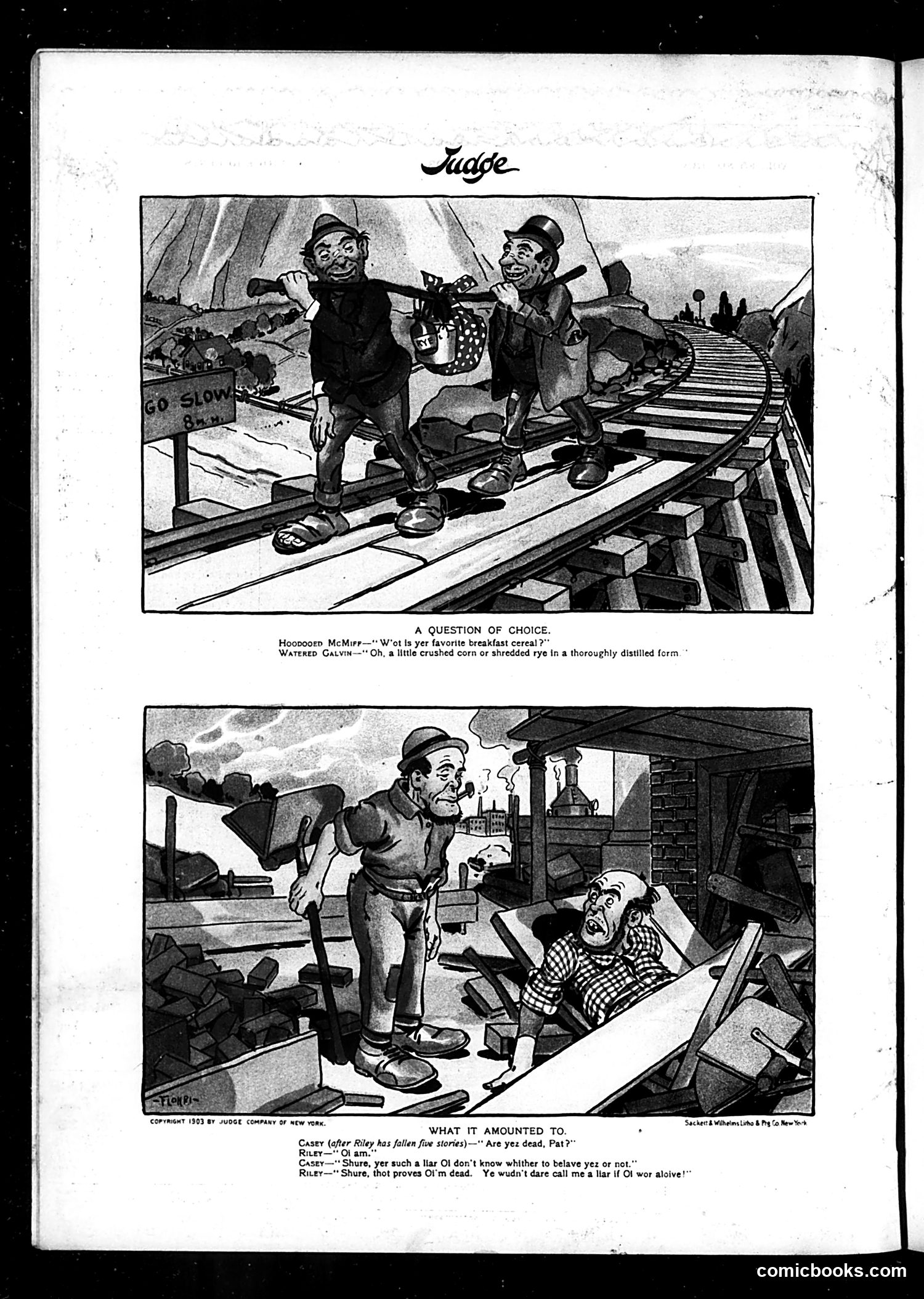
These two cartoons satirize Irish-American stereotypes common in early 1900s American humor. **Top cartoon:** "A Question of Choice" plays on Irish drinking culture. When asked about breakfast cereal, the character responds with a crude joke equating "crushed corn or shredded rye in a thoroughly distilled form"—meaning whiskey—with breakfast. The humor relies on the stereotype that Irish immigrants preferred alcohol to wholesome food. **Bottom cartoon:** "What It Amounted To" uses Irish dialect and names (Pat, Riley, Casey) to mock Irish character. The joke's premise: Riley claims to be dead, then "proves" it by saying Pat wouldn't dare call him a liar if alive—implying dead people are honest. It's absurdist humor built on ethnic caricature and exaggerated Irish speech patterns. Both cartoons reflect widespread early-20th-century American prejudice against Irish immigrants through dialect mockery and vice-based stereotyping.