
A complete issue · 16 pages · 1903
Judge — April 4, 1903
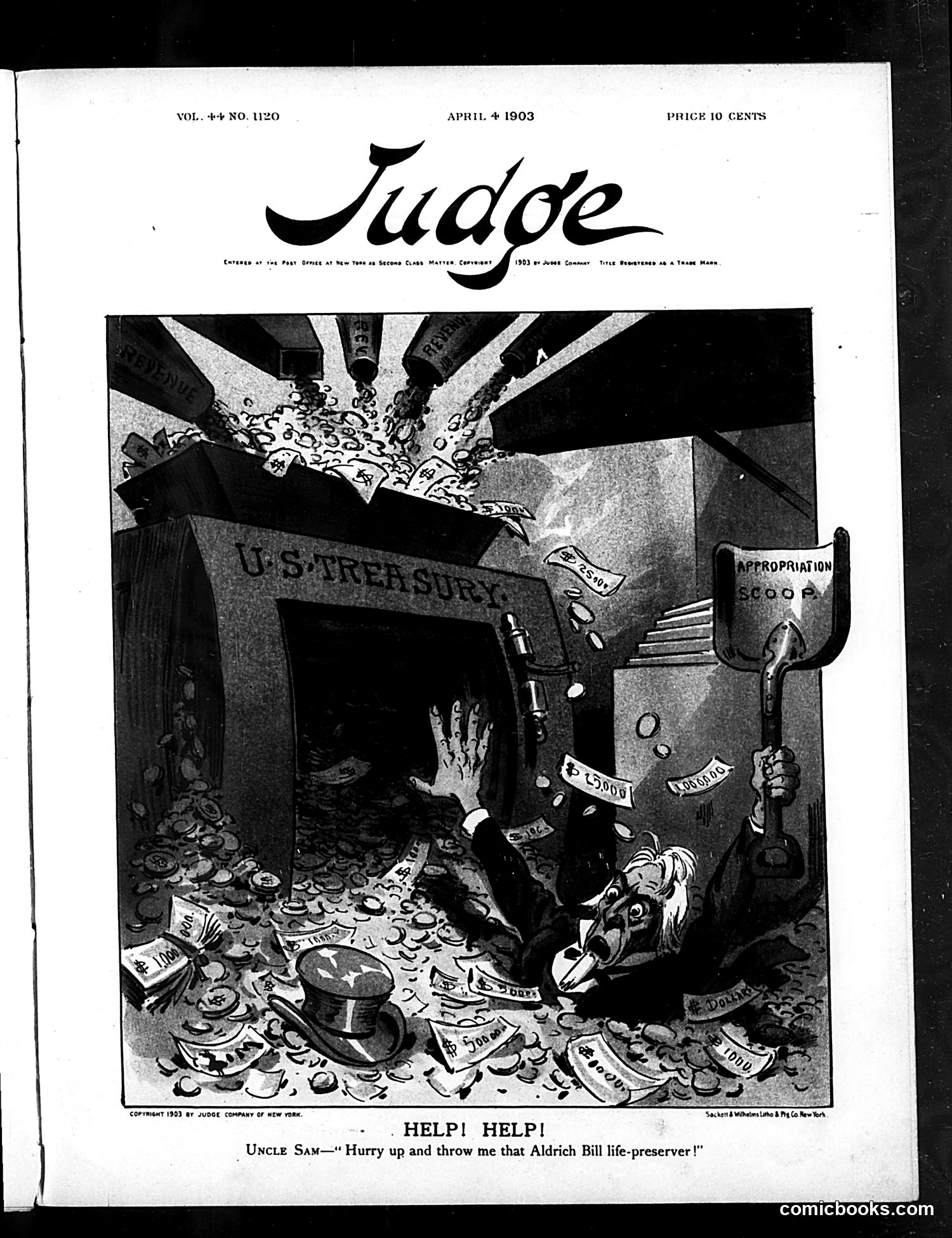
**Publication:** April 1903, Vol. 44, No. 1120 **Cartoon Title:** "Help! Help!" - Uncle Sam calls out for an "Aldrich Bill life-preserver" **Context:** This satirizes the U.S. Treasury's financial crisis. Uncle Sam, drowning in a vault overflowing with money and various financial documents, desperately seeks salvation via the "Aldrich Bill"—legislation likely sponsored by Senator Nelson Aldrich addressing fiscal/monetary policy. **The Satire:** The cartoon ironically depicts the Treasury *drowning in wealth* while needing rescue, suggesting the government's money-management problems weren't scarcity but mishandling. The "Appropriation Scoop" held by a figure (possibly representing Congress) implies wasteful spending or corruption. **Political Message:** Criticism of government financial mismanagement and hopes that Aldrich's legislation might provide solutions to fiscal disorder.
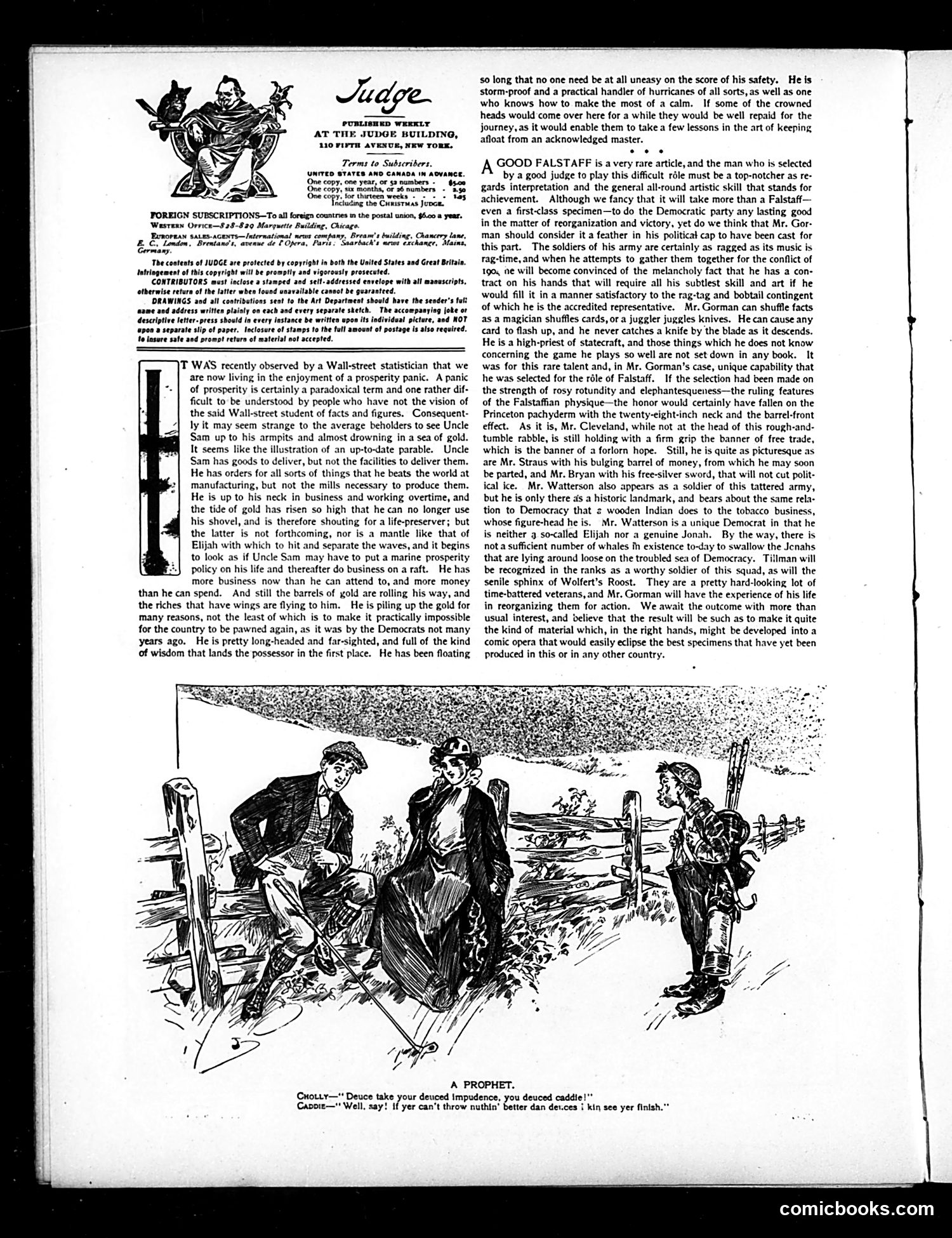
This Judge magazine page contains a satirical cartoon titled "A Prophet," depicting what appears to be a fortune teller or charlatan ("Crolley") making predictions to a woman ("Cadge"). The dialogue suggests Crolley is offering vague, contradictory prophecies—claiming the woman will "throw nothin' better dan de-ces" (dice) if unable to do better. The satire likely mocks fortune tellers and their dubious predictions, a common target of period humor. The accompanying article discusses selecting a "Falstaff" (a character representing a boisterous, unreliable figure) for some unspecified purpose, suggesting the page combines commentary on deception and poor judgment. Without clearer historical context about specific figures or events referenced, the primary target appears to be fraudulent soothsayers and gullible believers.
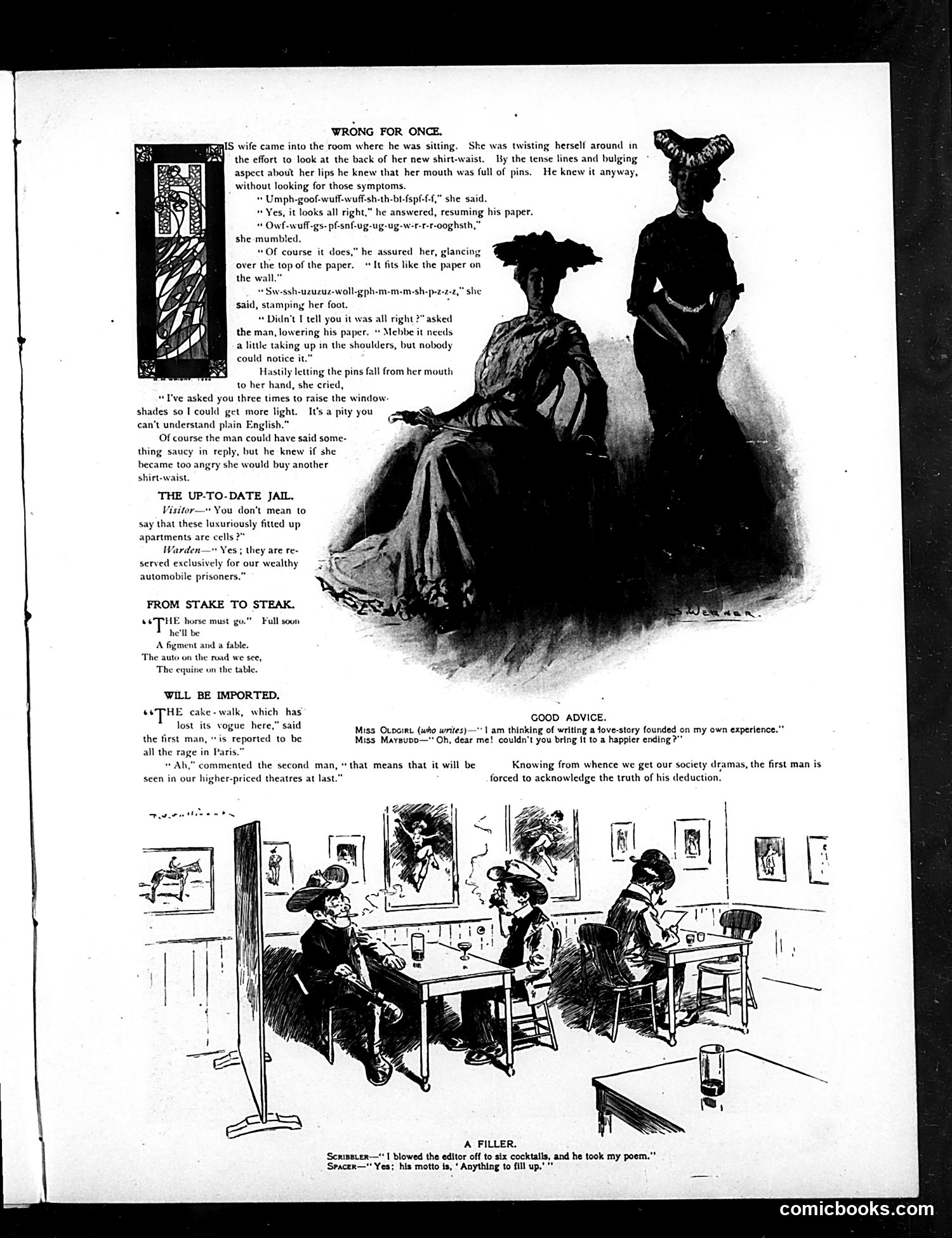
This page contains several satirical pieces targeting early 20th-century social issues: **"Wrong for Once"** mocks a husband who writes gibberish while his wife complains about unintelligible English—satirizing either literary pretension or foreign immigrant speech. **"The Up-to-Date Jail"** jokes that wealthy automobile criminals get luxurious prison cells, mocking class-based justice disparities. **"From Stake to Steak"** and **"Will Be Imported"** reference theater and cake-walk entertainment, likely satirizing commercialism and cultural imports. **"Good Advice"** portrays a woman seeking to write love stories based on experience, with commentary on society drama and deduction. **"A Filler"** at bottom shows three men discussing cocktails and poetry, satirizing artistic pretension among social drinkers. Overall, the page targets class privilege, linguistic absurdity, and cultural pretension typical of Judge's satirical approach.
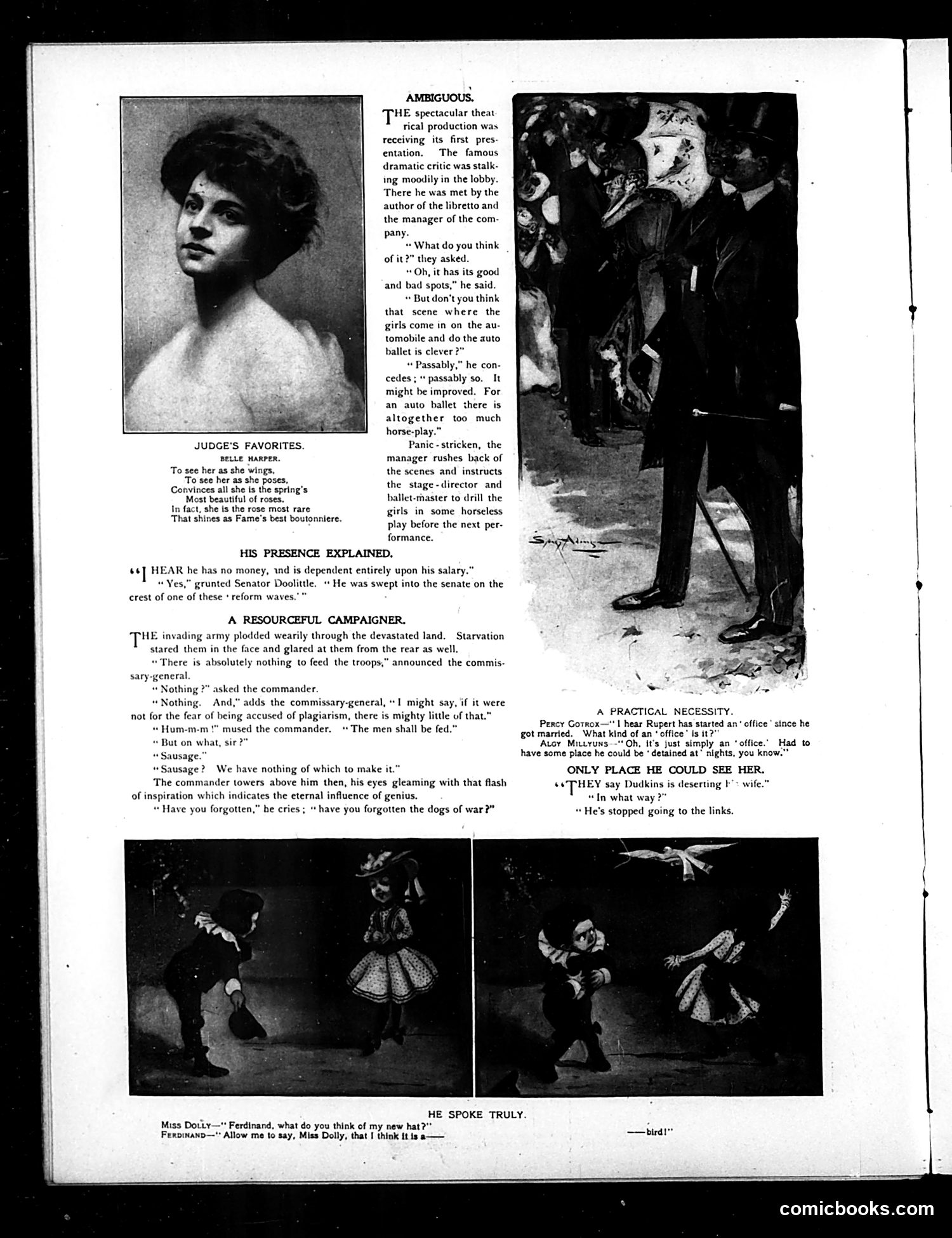
This page appears to be from an early 20th-century theatrical satire issue. The content focuses on a theatrical production titled "Ambiguous" with commentary on its merits and flaws. **Key elements:** - A portrait of **Belle Harper**, identified as "Judge's Favorites," appears at left - The main narrative discusses a theatrical manager's critique of a production, particularly criticizing an "automobile ballet" scene as having "too much horse-play" - Political content includes a brief section mocking a senator as dependent on his salary, swept into office on "reform waves" - Lower sections contain dialogue-driven comedy about military supply shortages and domestic life - The bottom features theatrical scenes with characters Ferdinand and Dolly discussing a hat The satire targets both theatrical pretension and political hypocrisy typical of Judge magazine's social commentary.
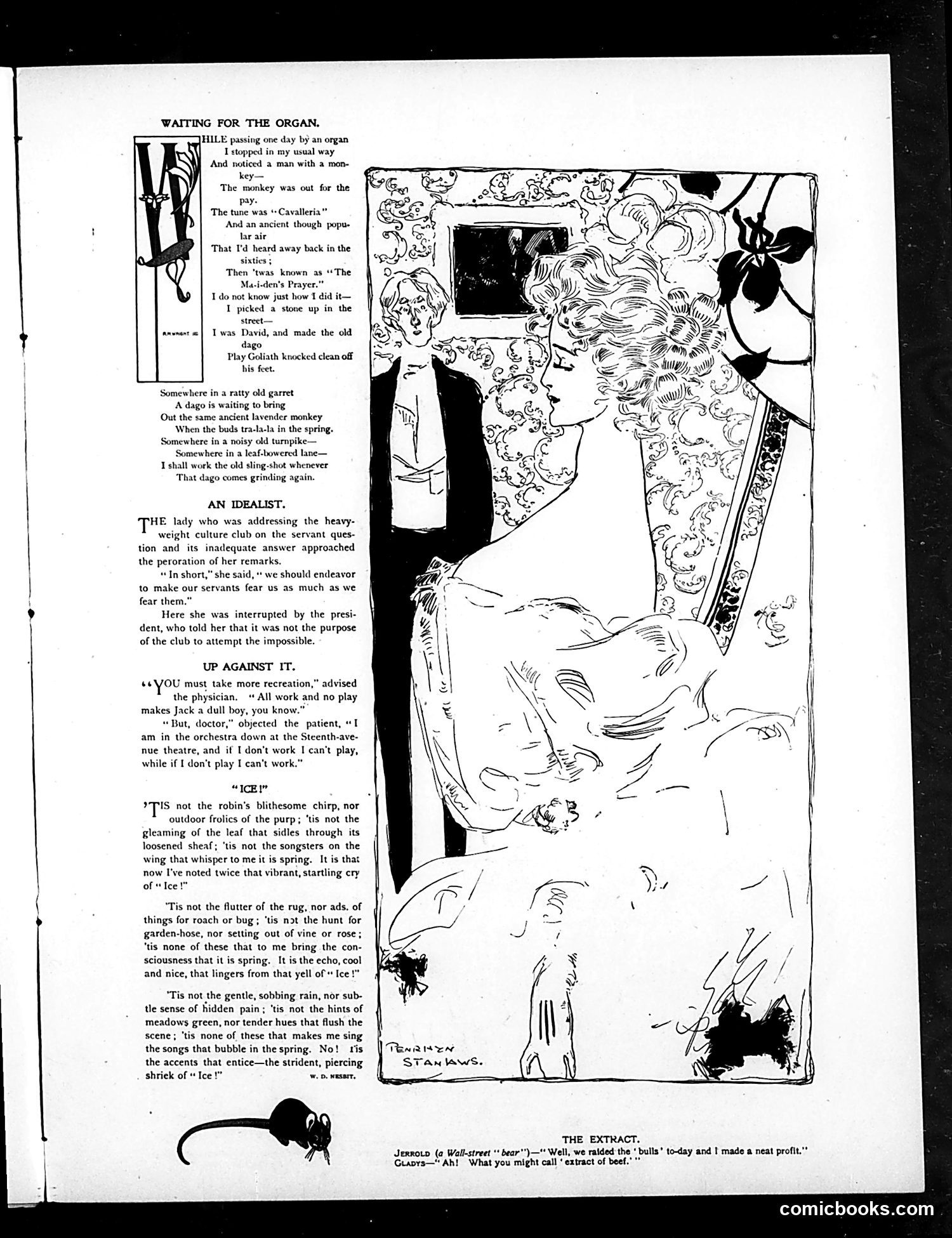
This Judge magazine page contains several satirical pieces reflecting early-20th-century American social attitudes: **"Waiting for the Organ"** uses ethnic slurs common to the era, depicting an organ grinder (labeled "dago," a derogatory term for Italian immigrants) and his monkey. The poem recounts attacking the street performer—offensive content by any standard. **"An Idealist"** mocks a wealthy woman's naive ideology about servant relations. She suggests making servants fear employers as much as employers fear servants—absurd logic the club president dismisses as "impossible," satirizing detached upper-class attitudes toward labor. **"Up Against It"** humorously presents an orchestra musician's paradox: work prevents playing music, but not playing prevents earning money—a gentle joke about conflicting obligations. **"Ice"** is quirky verse claiming the street vendor's cry of "Ice!" (selling ice blocks, essential before refrigeration) signals spring more reliably than traditional natural indicators—a humorous inversion of romantic nature poetry. **"The Extract"** shows a Wall Street "bear" (speculator betting on market decline) joking about raiding "bulls" for profit, using food terminology as metaphor.
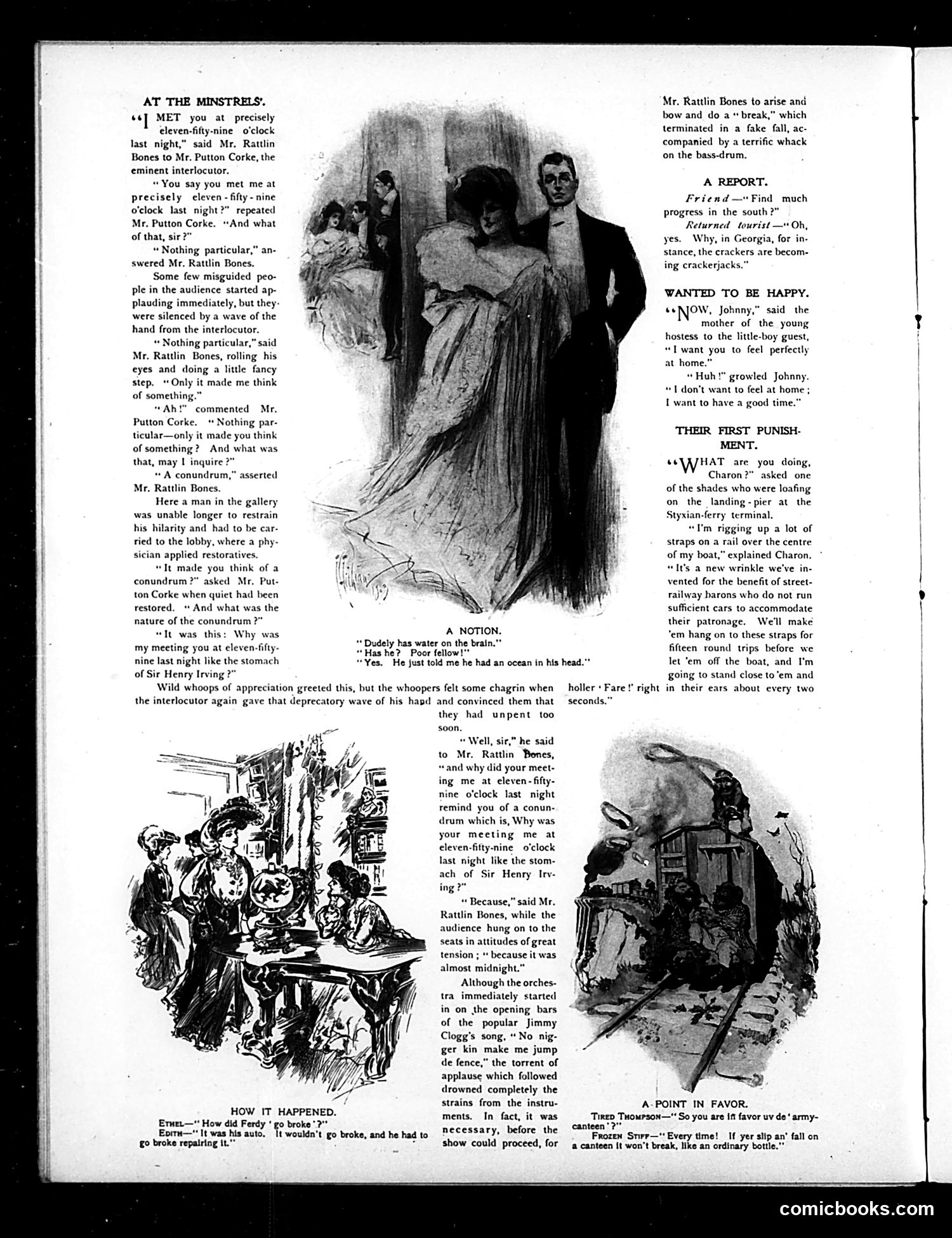
This page from *Judge* contains several short satirical pieces mocking American entertainment and contemporary issues: **"At the Minstrels'"** parodies minstrel show humor—a popular but increasingly dated entertainment form. The "conundrum" joke is intentionally anticlimactic (the punchline being merely that it was "almost midnight"), satirizing how audiences tolerate weak humor when primed for laughter. The interlocutor's hand-wave controls applause, mocking audiences' suggestibility. **Other brief items** include wordplay ("crackers are becoming crackerjacks" in Georgia) and social commentary: "Wanted to Be Happy" gently mocks children's expectations; "Their First Punishment" uses Greek mythology to satirize streetcar companies' poor service—suggesting transit barons should suffer crowded conditions themselves as punishment. The cartoons illustrate these pieces with period-appropriate sketches. Overall, the page reflects early-20th-century urban complaints about transportation and entertainment mediocrity.
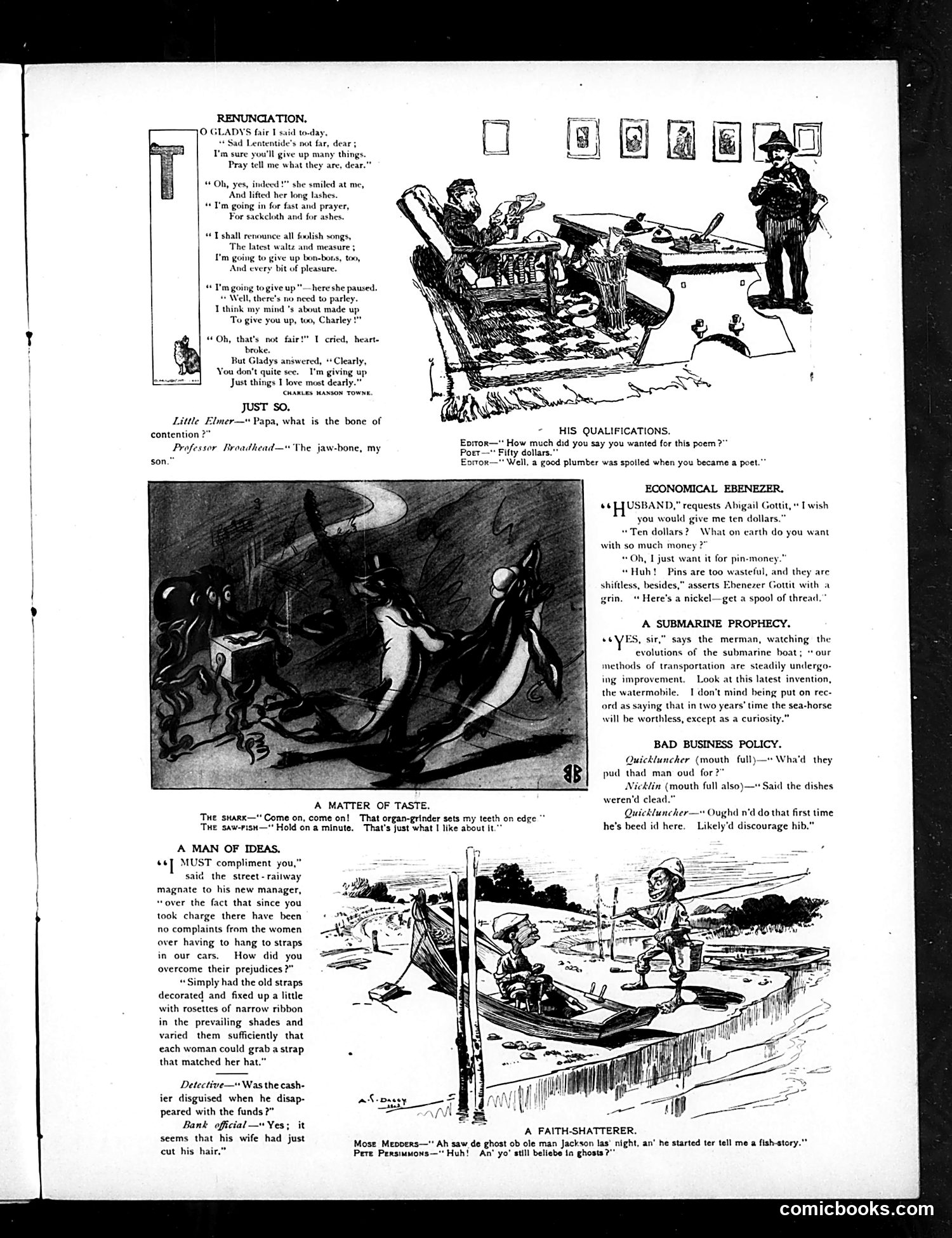
This page contains several brief satirical humor pieces typical of early 20th-century Judge magazine: **"Renunciation"** mocks a woman's hollow Lenten promises—she claims she'll renounce pleasures, but when asked what she's giving up, pauses, then admits she's only surrendering things she doesn't actually care about. The boyfriend cynically concludes she's willing to give up him, since that apparently qualifies as genuine sacrifice. **"Just So"** is a simple pun: a boy asks his professor father about "the bone of contention," and receives the literal answer "jaw-bone." **"His Qualifications"** satirizes a poet's lack of marketable skills—an editor rejects his work, saying a good plumber was "spoiled" when he became a poet. **"A Man of Ideas"** praises a transit manager for solving women's complaints about holding straps by decorating them with ribbons matching fashionable hat colors—reducing practical concerns to vanity. The remaining pieces offer workplace humor and economic satire typical of the era's light comedy.
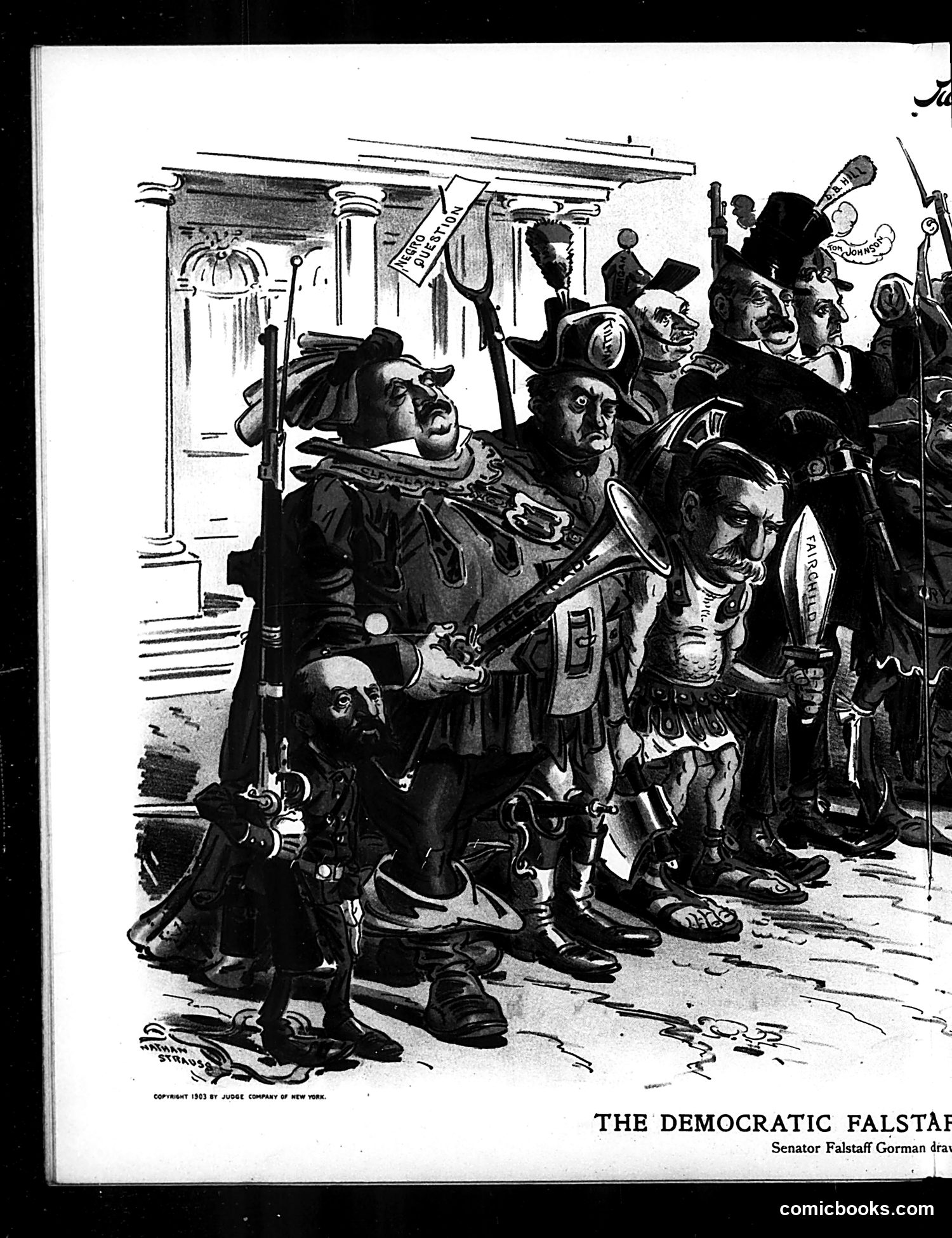
This political cartoon satirizes Senator Falstaff Gorman (the text appears incomplete). The caricature depicts him as Shakespeare's Falstaff—a corpulent, disreputable character—surrounded by what appear to be military or uniformed figures in a classical columned setting. The satire likely criticizes Gorman as bloated, self-indulgent, or morally compromised, comparing him unfavorably to the Shakespearean drunk and coward. The military figures surrounding him suggest either corruption within military/political circles or his reliance on armed supporters. Published in *Judge* magazine (copyright 1893), this reflects Gilded Age political mockery targeting Democratic politicians. The specific scandal or controversy motivating this cartoon remains unclear from the visible text, though the classical setting implies institutional corruption or constitutional violation.
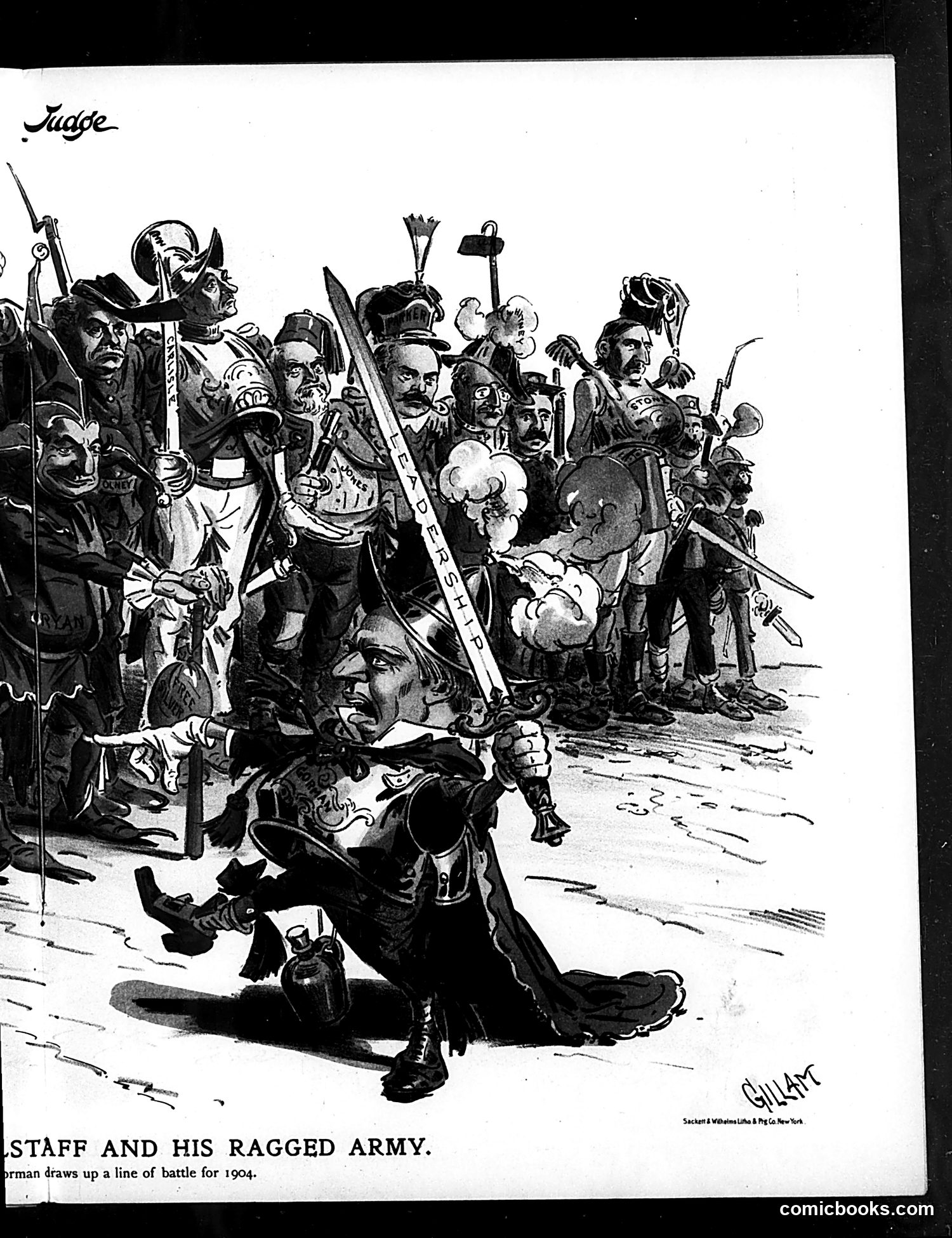
This Judge cartoon satirizes German military leadership around 1904. The caption indicates it depicts a German general (likely referring to "the Staff") drawing up a battle line with poorly equipped, disheveled troops. The figure in the foreground appears fallen or struggling, while the military officers behind him are elaborately dressed and armed. The satire mocks the contrast between German military brass and their actual fighting forces—suggesting incompetence or that soldiers were expendable compared to the vanity of their commanders. The "ragged" descriptor emphasizes the disorganization or inadequacy of the army despite its officers' pretensions. This likely reflects American skepticism of German militarism during a period of rising international tensions before World War I, presenting German military culture as both pompous and ineffectual.
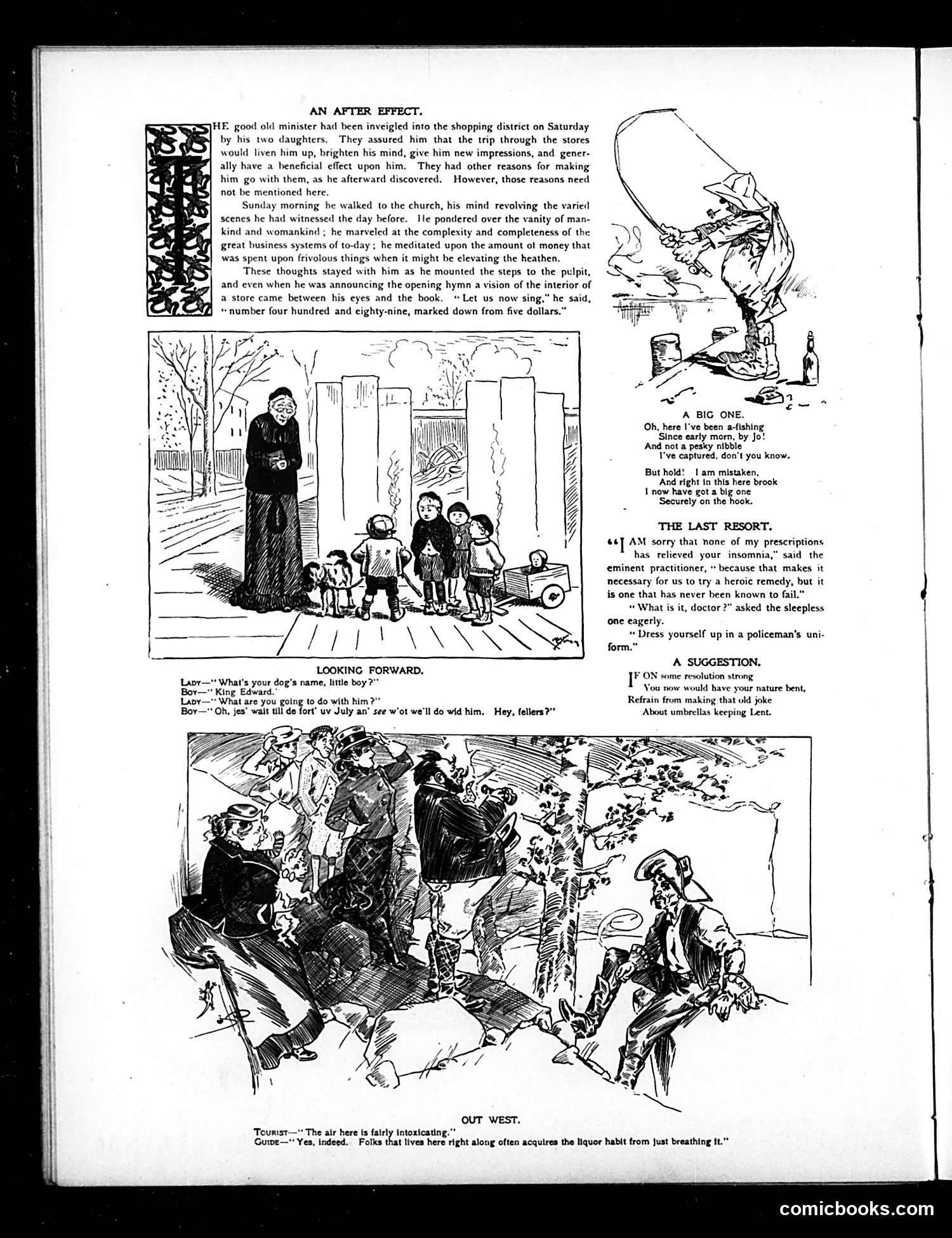
This page contains several satirical sketches mocking contemporary American society: **"An After Effect"** ridicules shopping culture and its effects. A minister, dragged by daughters into stores for Saturday shopping, becomes so distracted by commercial displays that Sunday morning he accidentally announces a hymn as "marked down from five dollars"—confusing church ritual with retail language. The satire targets both commercial consumerism's invasive influence and the shallow materialism of the era. **"The Last Resort"** jokes darkly about insomnia treatments: a doctor prescribes dressing as a policeman, implying that fear of arrest would prevent sleep—absurdist humor about failed medical remedies. **"Looking Forward"** satirizes a child's innocent plan to harm a dog on July 4th, likely critiquing casual cruelty and poor parenting. **"Out West"** contains a Guide/Tourist exchange mocking Western stereotypes: that locals become alcoholics simply from breathing the air. These sketches represent Judge's satirical approach—using exaggeration and wordplay to critique consumer culture, medical ineffectiveness, and regional American stereotypes.
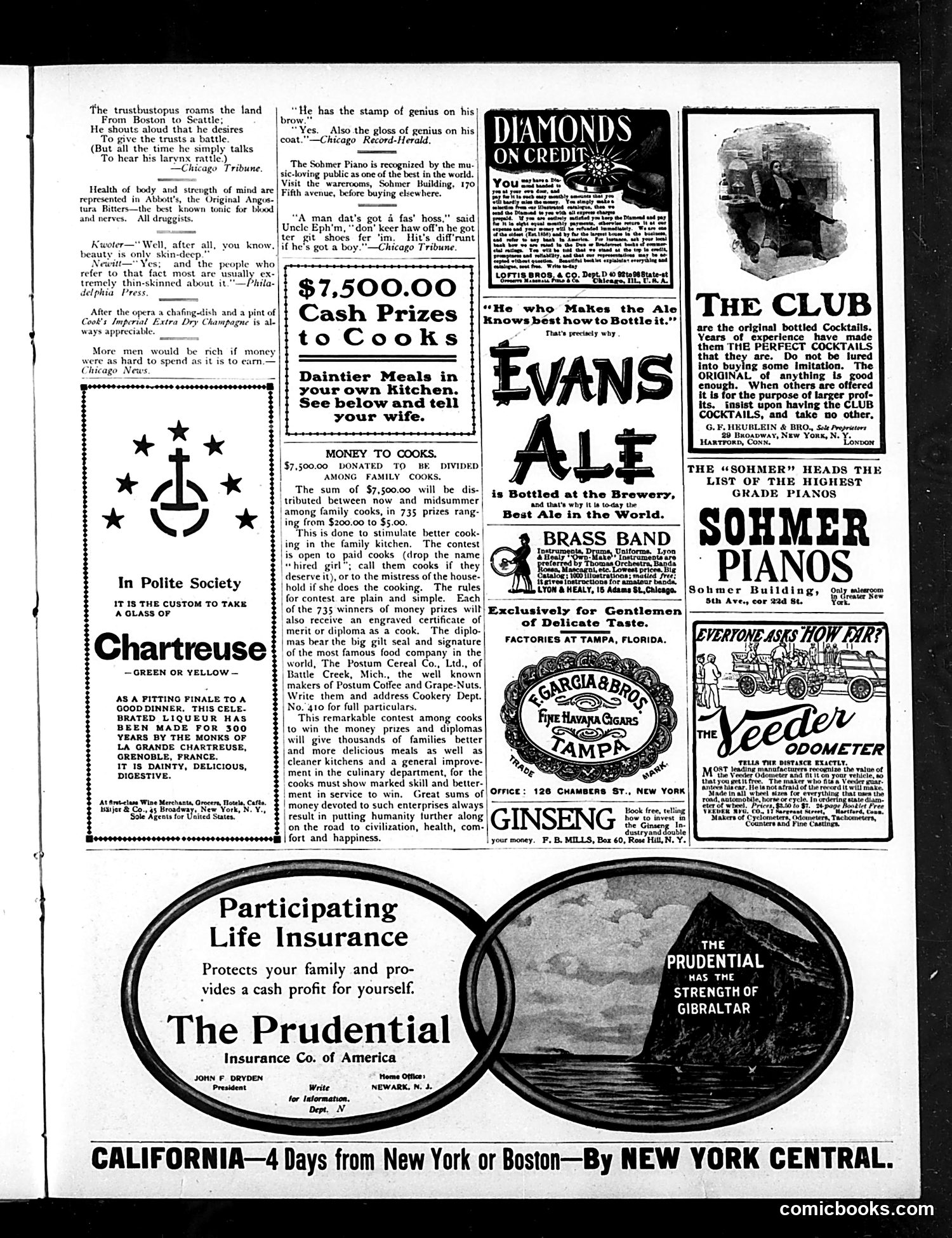
This page is primarily **advertising**, with one notable political cartoon at the top. The cartoon depicts the **"trustbustopus"** (a play on "octopus")—a creature roaming from Boston to Seattle. This satirizes politicians who publicly crusade against corporate monopolies (trusts) while "simply talks / To hear his larynx rattle"—suggesting they're all bluster, no action. The reference is to the trust-busting era of early 1900s American politics, when breaking up large corporations was a major political issue. The cartoon mocks the gap between politicians' loud rhetoric and their actual accomplishments. The remainder of the page contains period advertisements for Chartreuse liqueur, Sohmer pianos, Evans ale, Prudential Insurance, and a cooking contest offering $7,500 in prizes. Several comic quotations appear throughout, including dialect humor typical of the era. The bottom advertises California travel via New York Central Railroad.
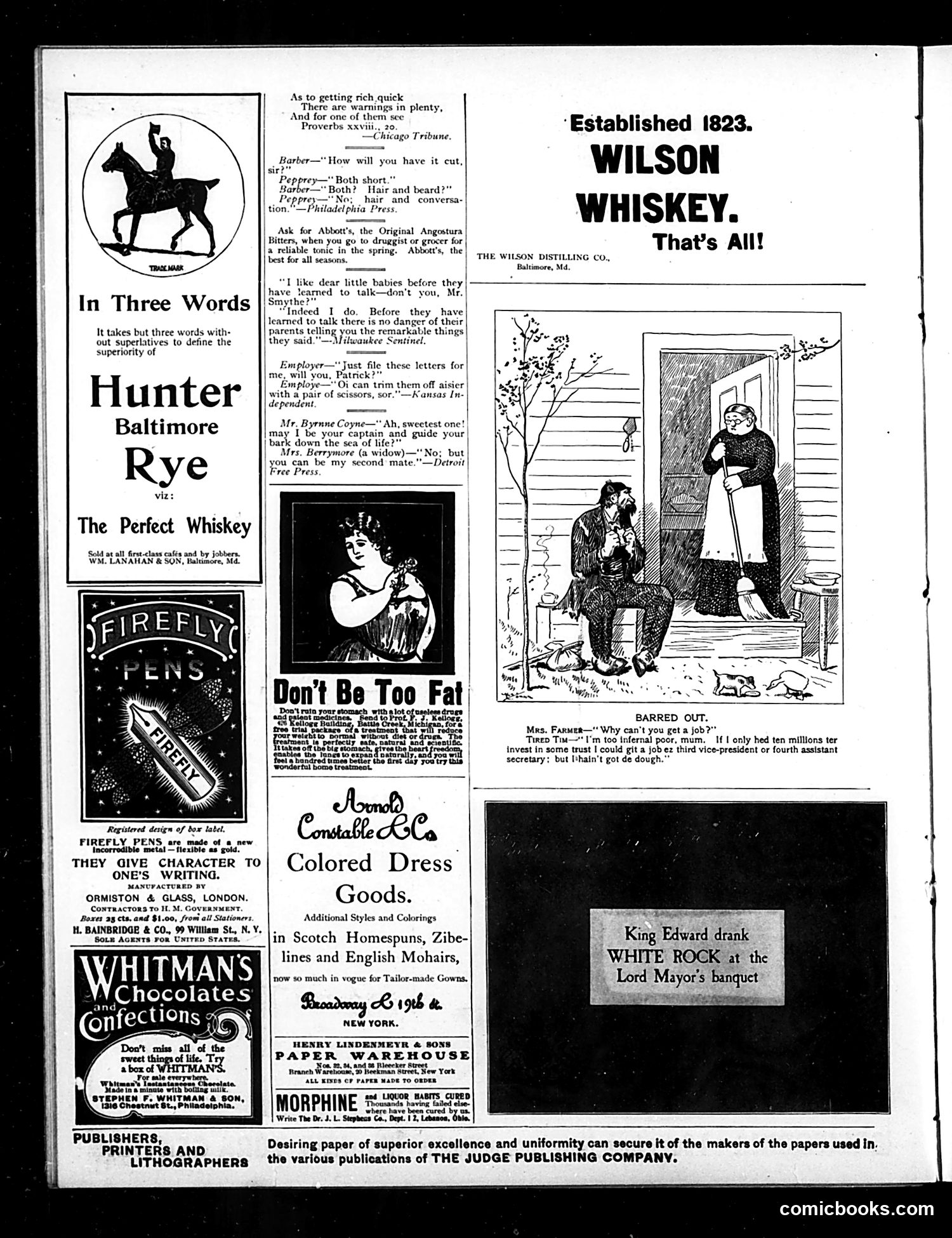
This page is primarily **advertisements and filler content** rather than substantive political satire. The main cartoon, "Barred Out," depicts a poor man unable to secure employment despite having qualifications. He explains he could get a job as a corporate officer if he had ten million dollars to invest in a trust, but lacks the capital—satirizing how wealth, rather than merit, determines access to positions of power and profit during the Gilded Age. The page also includes brief humorous exchanges (jokes about barber services, babies, and widows) and numerous product advertisements (whiskey, chocolates, pens, dress goods), reflecting the magazine's commercial nature. A reference to Proverbs warns against "getting rich quick," suggesting contemporary concern about financial schemes and get-rich-quick frauds. The overall tone reflects turn-of-the-century anxieties about class mobility and corruption in American business.
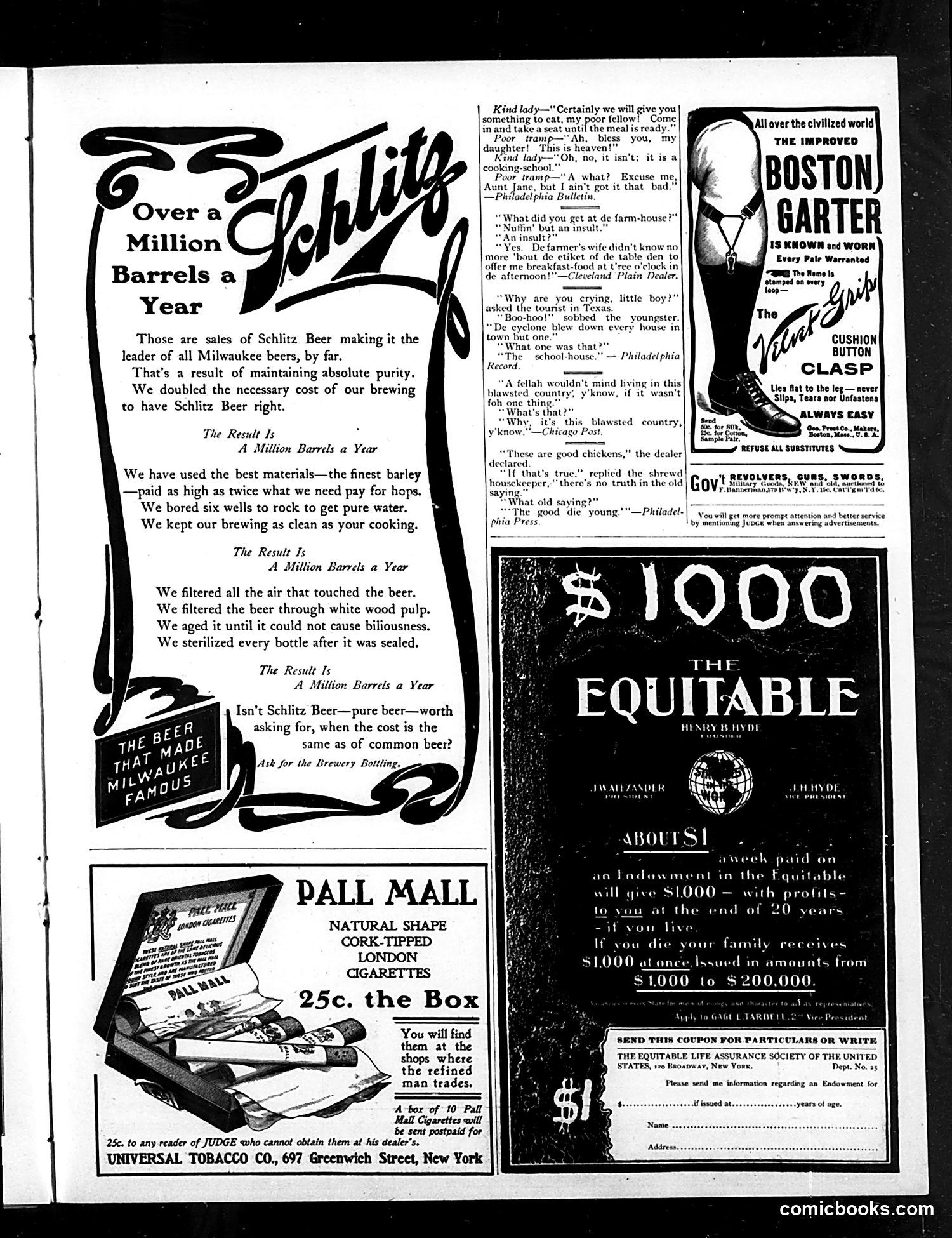
This page is primarily **advertising**, not editorial satire. It contains: **Main Advertisements:** - **Schlitz Beer**: A lengthy ad emphasizing purity through expensive production methods (filtered water, aged beer, sterilized bottles), targeting Milwaukee's competitive beer market. - **Pall Mall Cigarettes**: Promoting "refined" cigarettes. - **Boston Garter**: A men's sock garter advertised as "always easy." - **The Equitable Life Insurance**: An endowment plan offering $1,000 after 20 years. **Humor Content:** The page includes several short, unrelated comic anecdotes mocking rural/working-class figures (a tramp mistaking a cooking school for heaven, farmers offering breakfast food at wrong hours, a Texan crying about a cyclone). These represent typical period humor stereotyping poor and rural Americans. The satire is light and formulaic rather than politically sharp—standard filler material for magazines of this era.
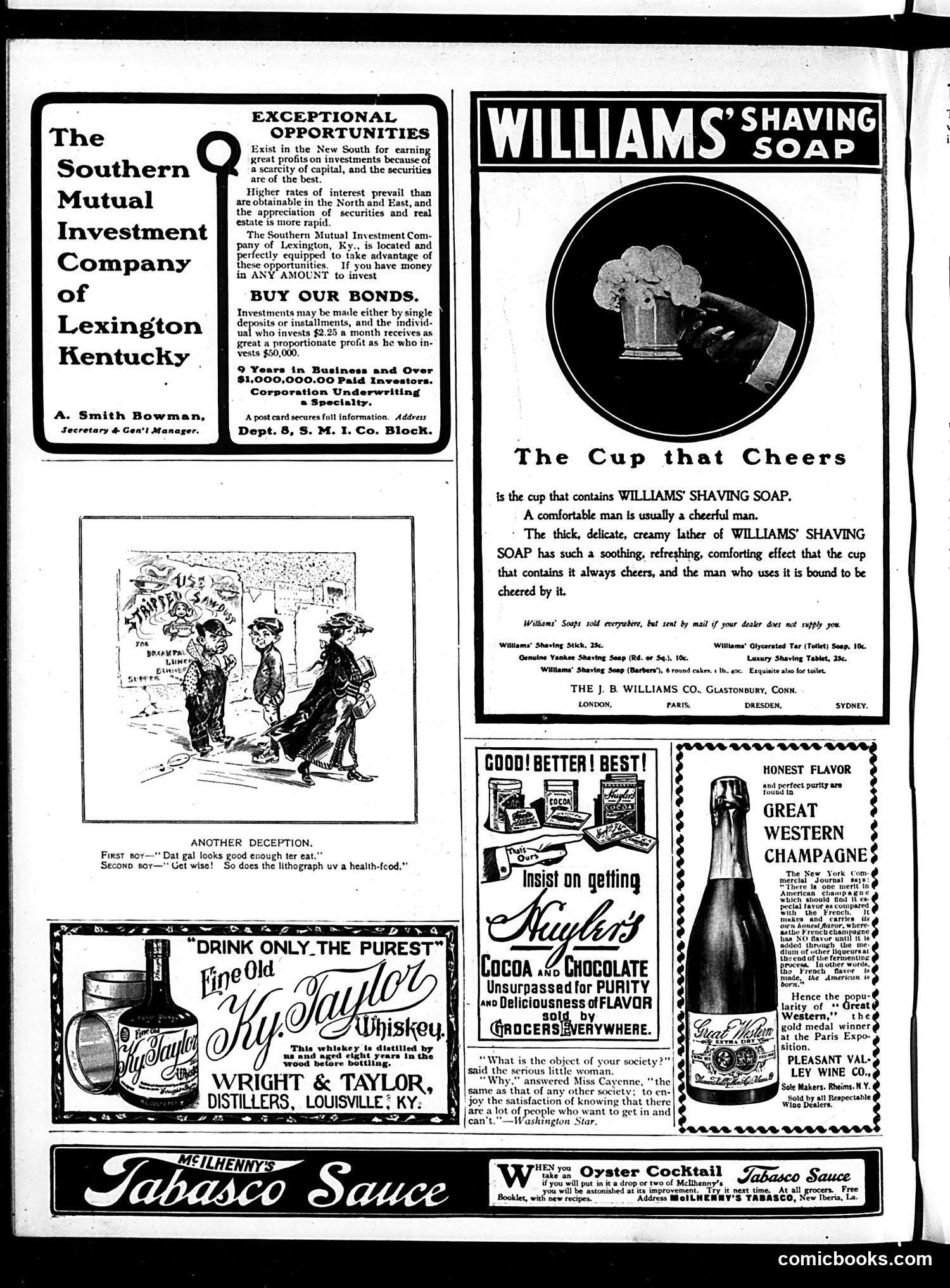
This page is primarily **advertising**, not political satire. It contains multiple product advertisements typical of early 20th-century magazines. The one actual cartoon—titled "Another Deception"—is a mild visual joke, not political commentary. Two men observe a woman, with the first saying she "looks good enough to eat." The second responds that she's as deceptive as a lithographed health-food advertisement, implying her appearance is artificially enhanced or misleading. The rest of the page advertises various products: investment bonds from a Kentucky company, Williams' Shaving Soap ("The Cup that Cheers"), Naylor's Cocoa and Chocolate, Old Sky Taylor Whiskey, Great Western Champagne, and Tabasco Sauce. The advertisements use typical period marketing language emphasizing purity, quality, and comfort. There is **no significant political or social satire** on this page—it represents the commercial content that filled Judge magazine between editorial pieces.
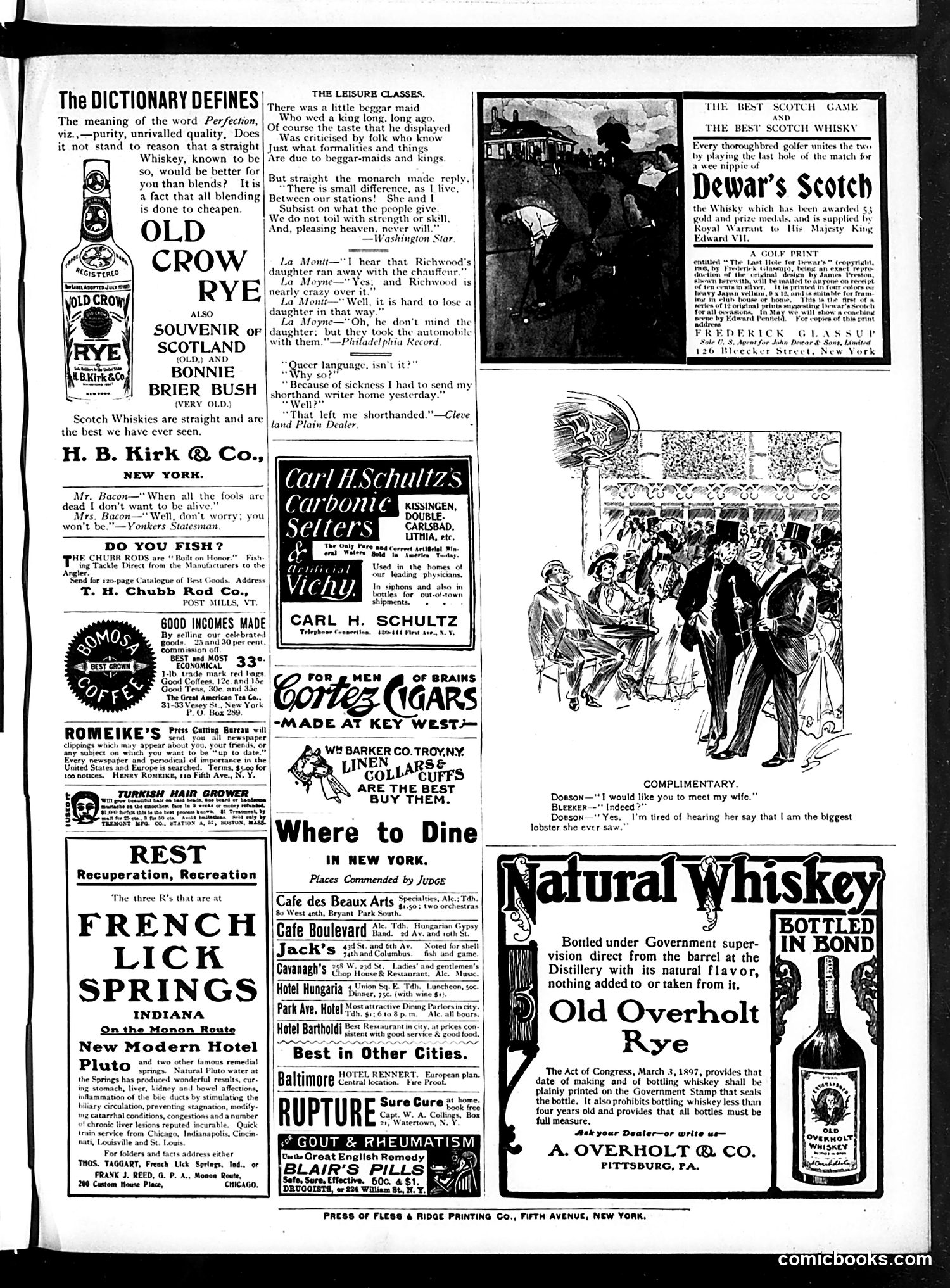
This page is primarily **advertisements and filler content** for Judge magazine, with one notable satirical cartoon. The main cartoon titled "COMPLIMENTARY" depicts a social exchange between two men (identified as "Dodson") about meeting someone's wife. The joke hinges on the husband's boast that he is "the biggest lobster she ever saw"—a self-deprecating comment comparing himself unfavorably to his spouse, suggesting she dominates him or is more impressive. His companion expresses fatigue at hearing this complaint repeatedly. The page is otherwise dominated by **whiskey and spirits advertisements** (Old Crow Rye, Dewar's Scotch, Natural Whiskey), promoting these as products of quality and refinement. There's also an advertisement featuring Dewar's connection to "Royal Warrant to His Majesty King Edward VII," appealing to upper-class consumers through royal endorsement—a common advertising strategy of the era. The remaining content consists of dining recommendations, patent medicine ads, and various commercial notices typical of early 20th-century magazines.
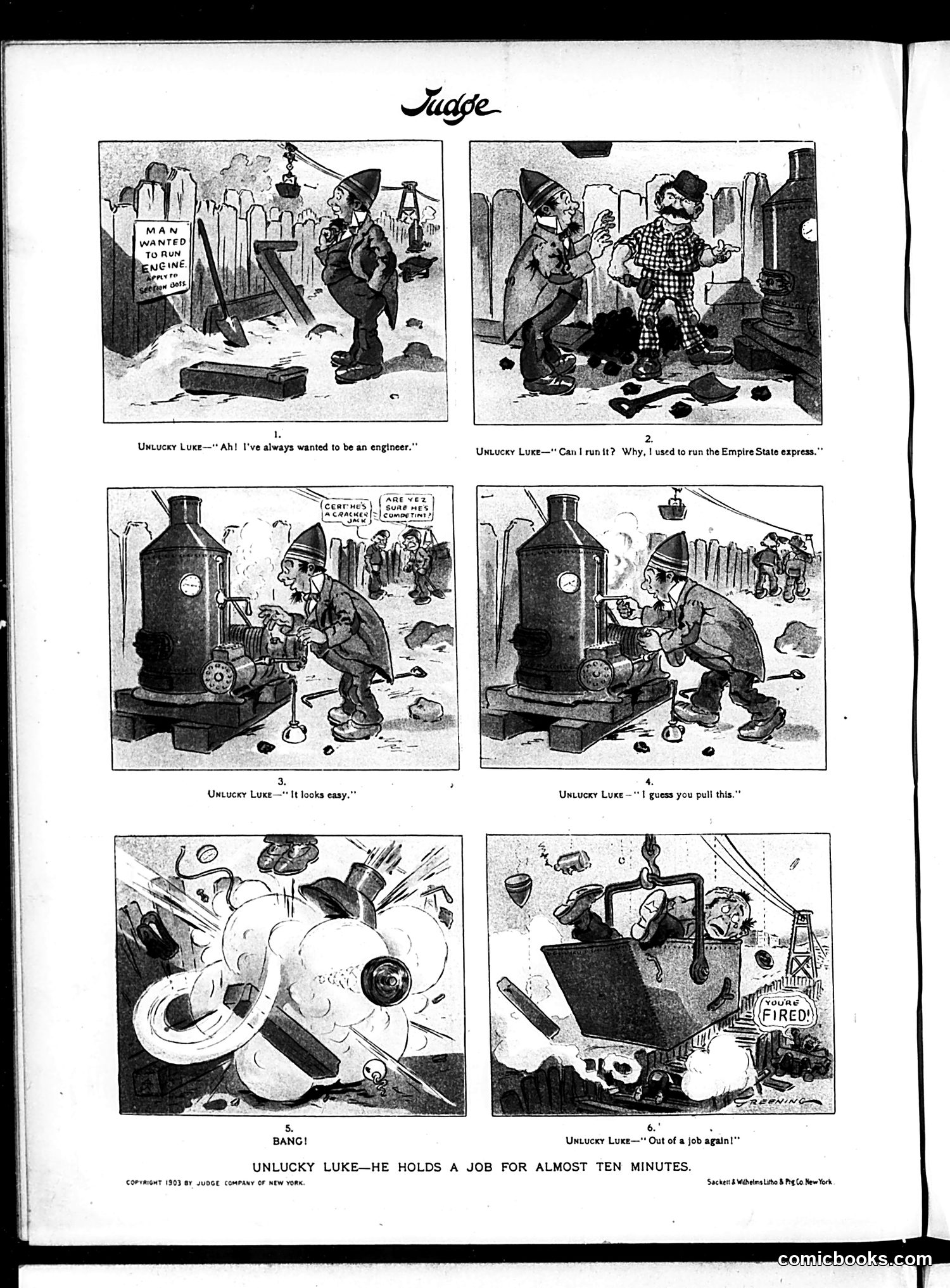
This is a slapstick comedy strip about a hapless character named Unlucky Luke who repeatedly fails at employment. The six-panel sequence shows him attempting work as a railroad engineer: he expresses desire for the job, claims experience running the Empire State Express, attempts to operate a large locomotive, but through incompetence causes a catastrophic explosion (panel 5: "BANG!"), ending with him fired again. The humor relies on physical comedy and the absurdist premise of someone spectacularly failing within minutes. This 1903 Judge comic reflects period attitudes toward industrial labor and incompetence, using exaggerated visual gags typical of early twentieth-century American comics to satirize both worker unreliability and the dangers of railroad operations.