
A complete issue · 18 pages · 1903
Judge — March 7, 1903
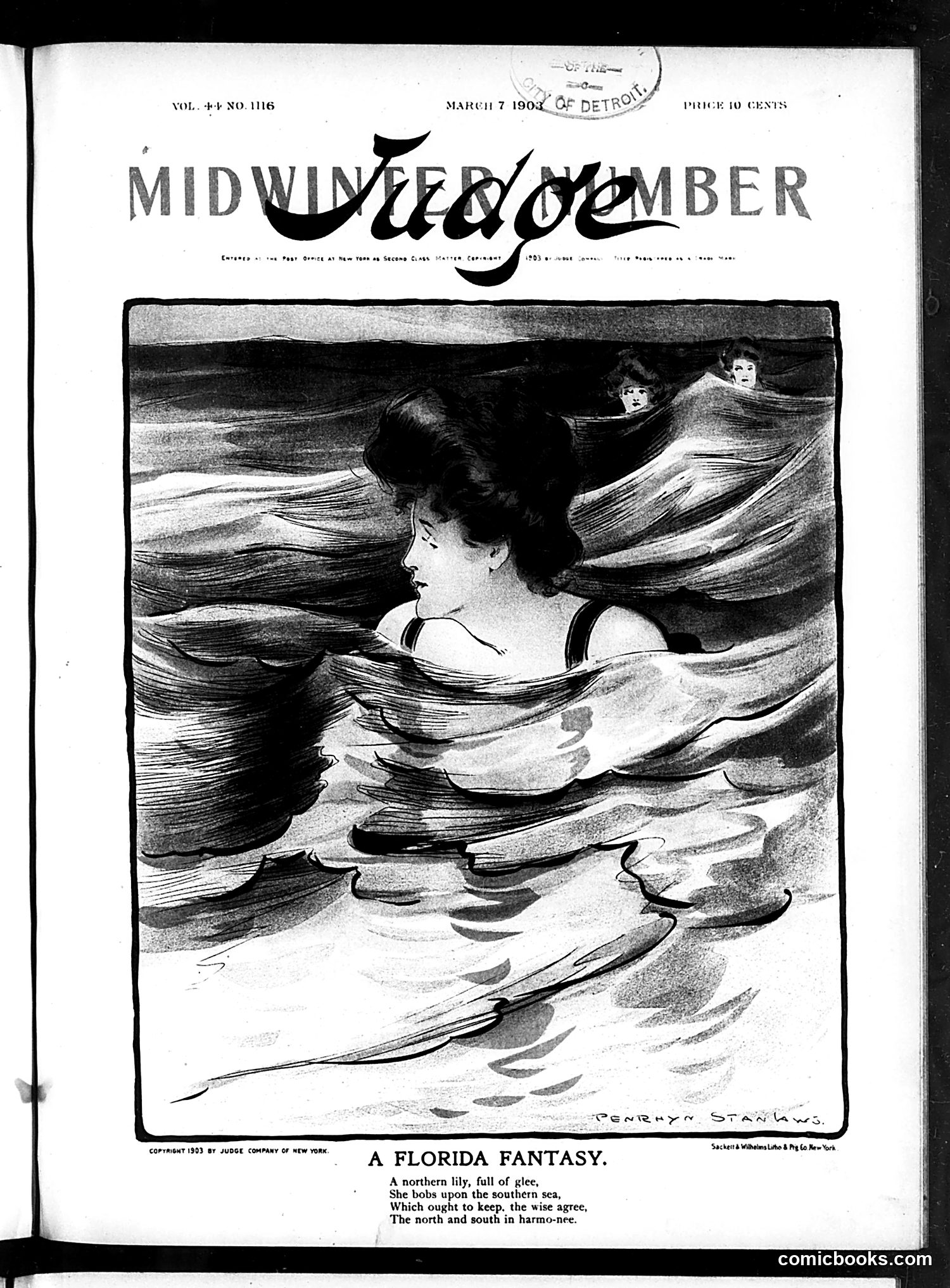
This March 7, 1904 *Judge* magazine cover satirizes Northern attitudes toward the American South through the metaphor of a woman in water. The title "A Florida Fantasy" and accompanying verse ("A northern lily, full of glee, / She bobs upon the southern sea") suggest the piece mocks a Northern woman's romantic or naive notions about the South. The flowing, turbulent water likely represents the South's actual conditions—social, political, or economic dangers that the "northern lily" fails to recognize or appreciate. The figures in the background appear to observe the scene, possibly representing Southern observers of Northern outsiders. The satire critiques Northern idealization of Southern life while implying the South's underlying turbulence and complications remained invisible to outsiders.
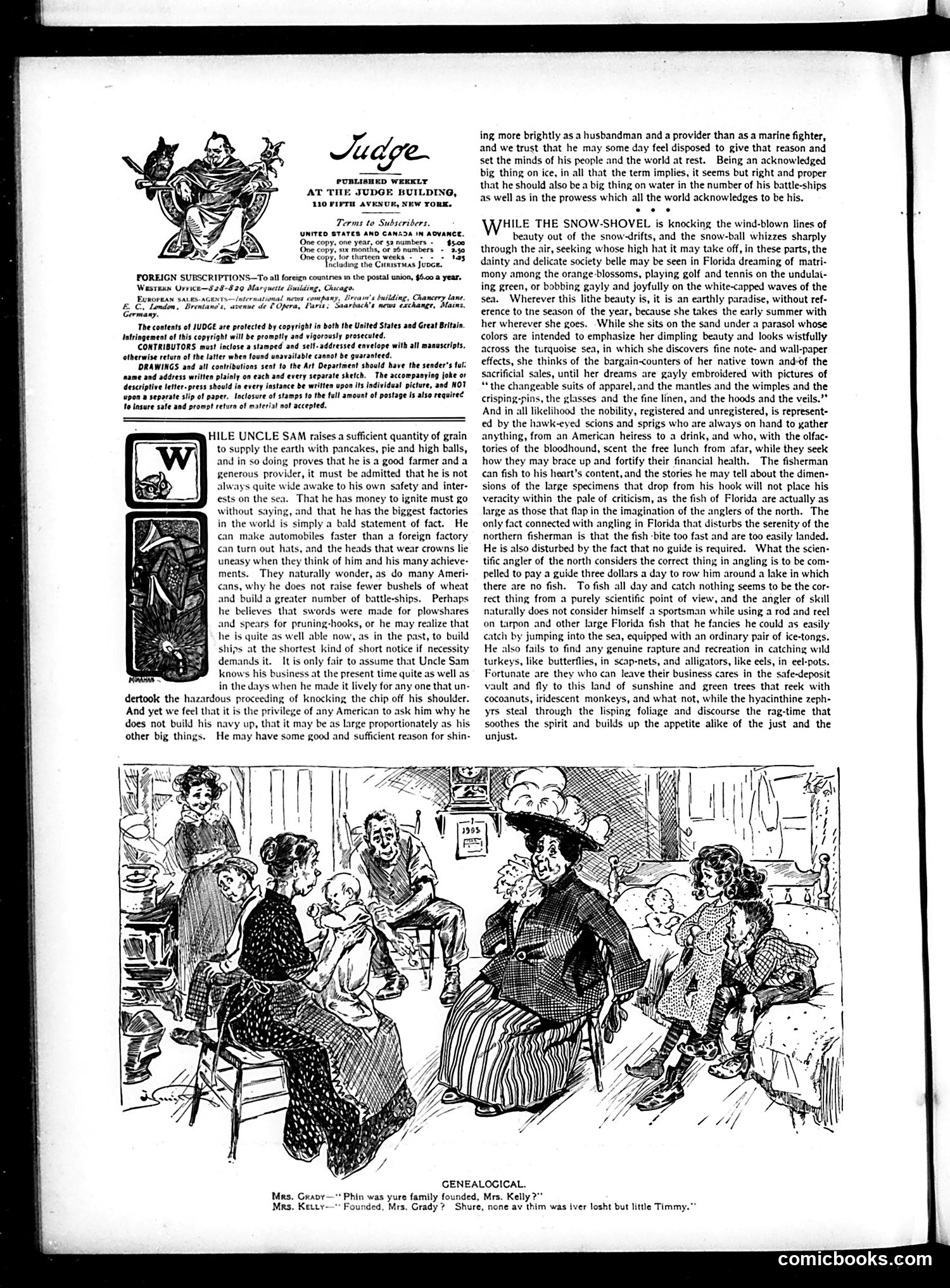
This page contains two main sections: **Upper text:** Two editorial pieces discussing Uncle Sam's grain production and Florida fishing/tourism—praising American agricultural and recreational industries without obvious partisan critique. **Lower cartoon ("Genealogical"):** A domestic scene showing women and children in conversation. Mrs. Grady and Mrs. Kelly discuss family lineage, with Mrs. Kelly claiming her family was "founded" while Mrs. Grady counters that none of them were "ever loath but little Timmy." The satire appears to mock *social pretension*—specifically Irish-American women claiming superior ancestry or social standing. The humor lies in deflating such claims with working-class vernacular and the implied ordinariness of their actual backgrounds. This reflects Judge's frequent satirizing of immigrant communities' attempts at social climbing in early 20th-century America.
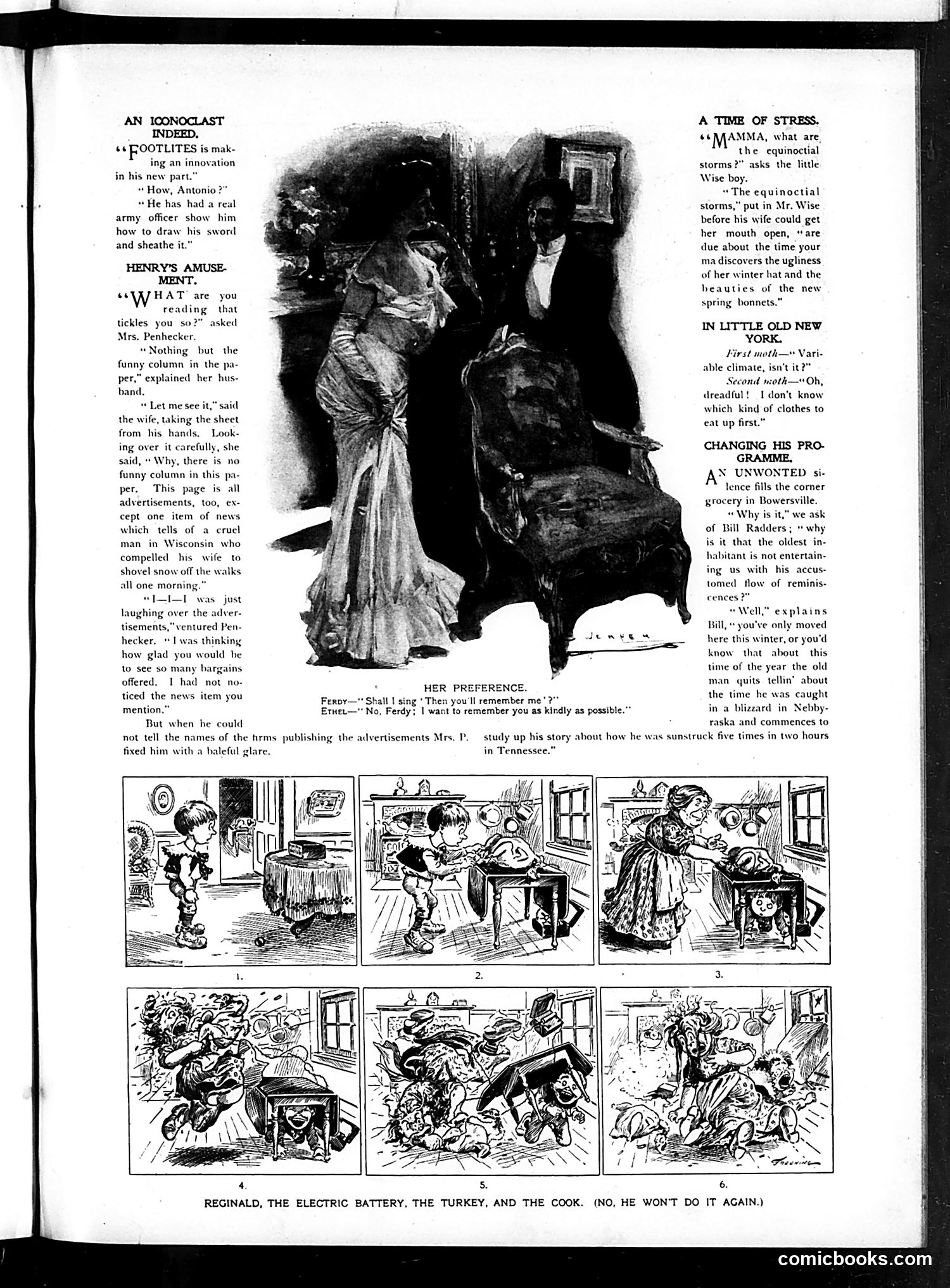
This page contains three separate items: **"An Iconoclast Ruined"** discusses someone named Footlites making an innovation, likely theatrical commentary. **"Henry's Amusement"** is a brief anecdote about Mrs. Penhecker reading a newspaper's funny column—which turns out to be entirely advertisements about a cruel Wisconsin man. The joke satirizes how newspapers filled space with ads disguised as content. **"A Time of Stress"** and **"In Little Old New York"** are short humorous observations about seasonal clothing and fashion. **"Champe's Mrs. Programme"** discusses a Bill Radders character and an anecdote about someone caught in a blizzard in Nebraska. The bottom section shows a six-panel comic strip titled "Reginald, the Electric Battery, the Turkey, and the Cook" depicting slapstick chaos, likely involving an electric device accidentally creating mayhem during turkey preparation.
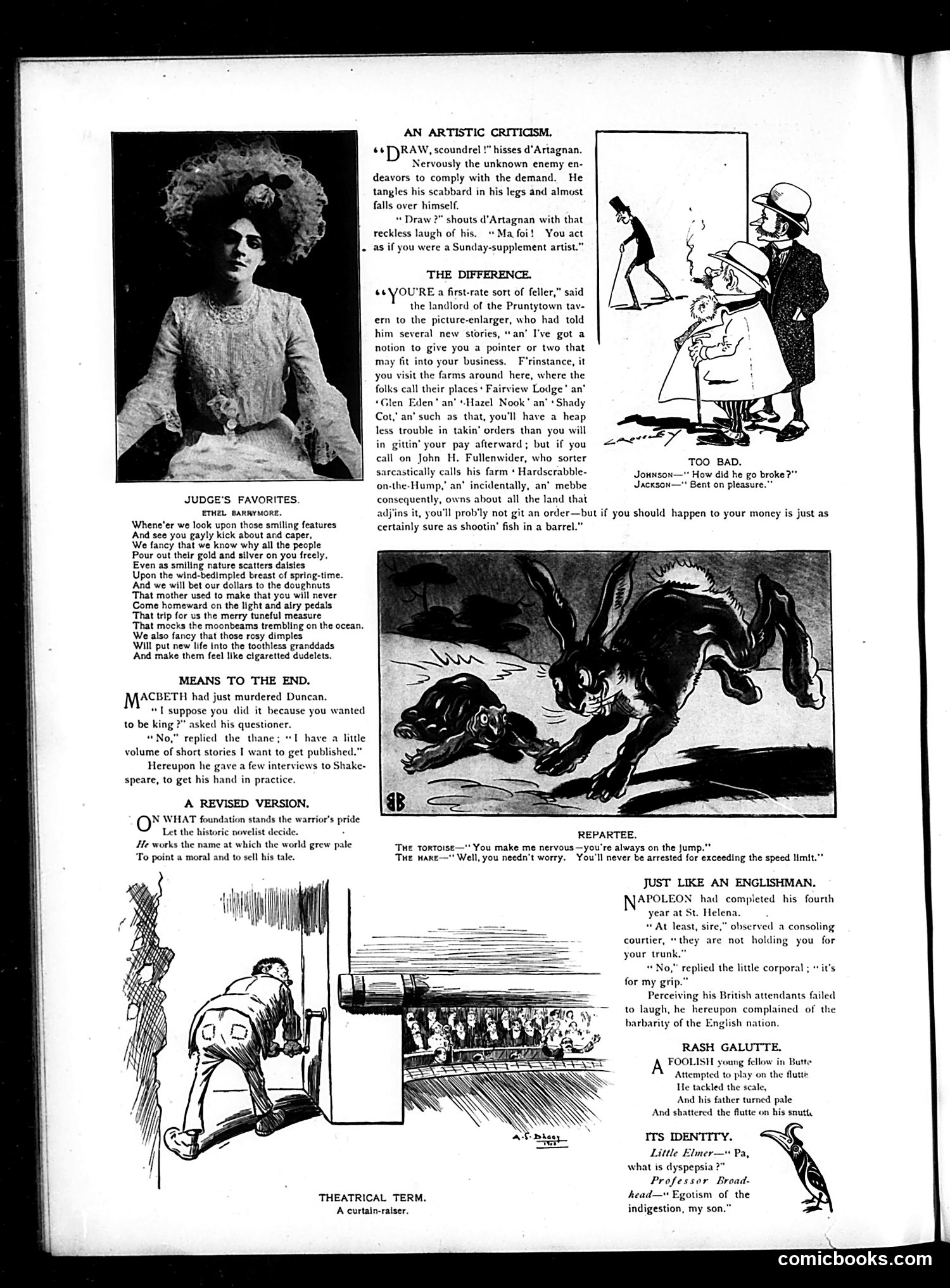
This page contains several satirical pieces and illustrations typical of early 20th-century American humor: **"An Artistic Criticism"** mocks an artist named d'Artagnan for his crude drawing style, with the critic sarcastically suggesting he work as a "Sunday-supplement artist" instead. **"The Difference"** presents a landlord's pitch to a city tenant about rural farmland, naming properties with humorous names like "Fairyview Lodge" and "Shady Cot," suggesting the prospect of ordering supplies from rural merchants would prove difficult compared to city convenience. **"Judge's Favorites"** features a poem by Ethel Barnymore praising nature's beauties. The page includes various short jokes and cartoon illustrations (a dog fight, Napoleon anecdote, theatrical humor) typical of Judge's miscellaneous satirical content mixing social commentary with light wordplay.
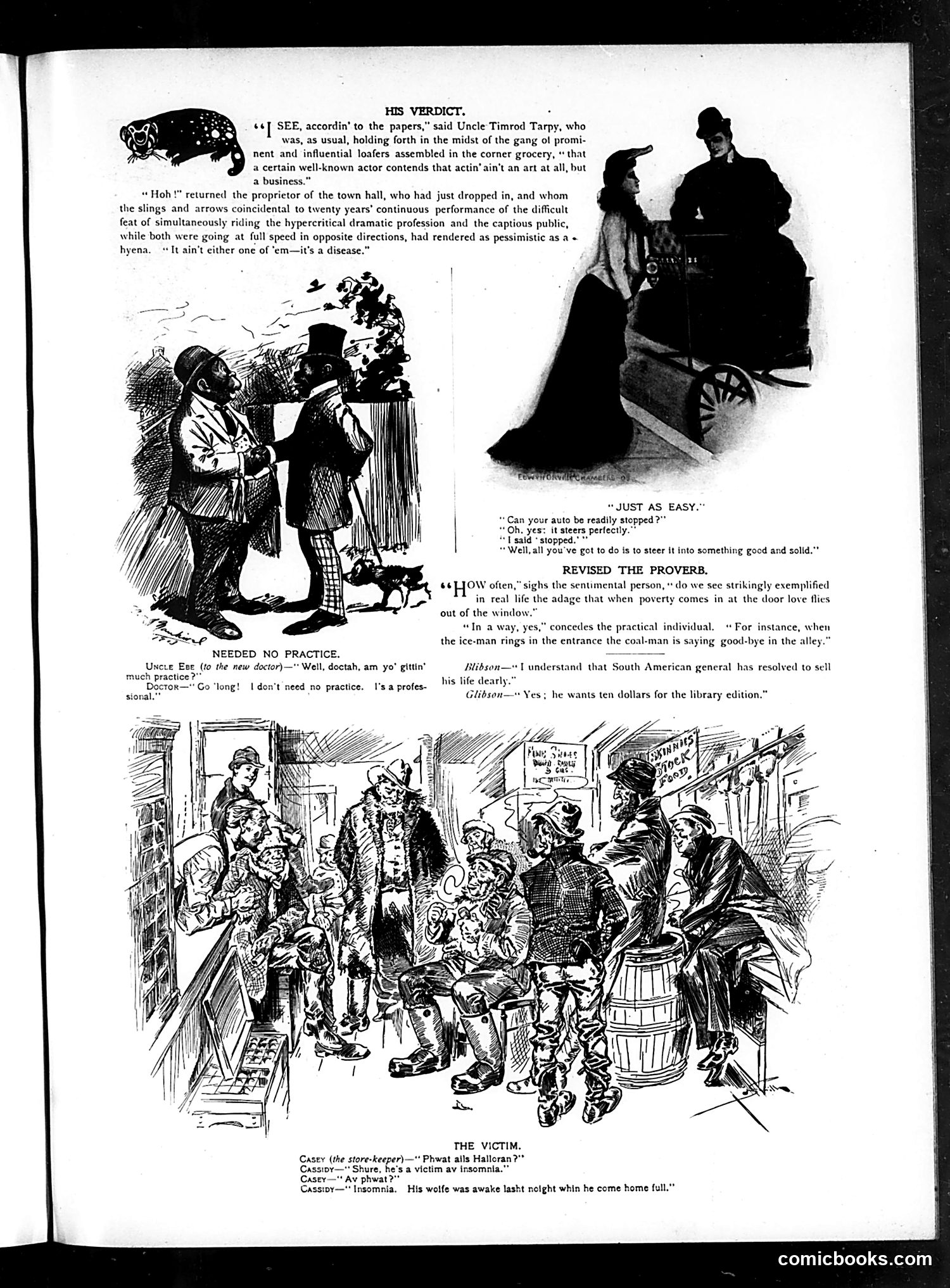
This page contains several unrelated satirical sketches typical of early Judge magazine: **"His Verdict"**: Small-town men debate whether acting is an art or business. The town hall proprietor—exhausted from twenty years managing both demanding audiences and theatrical performers—dismisses both positions, calling acting "a disease." The satire mocks the pretensions of theatrical discourse. **"Just as Easy"**: A car owner claims his auto stops perfectly but only steers. The joke's absurdist humor suggests mechanical/automotive incompetence. **"Revised the Proverb"**: Characters reinterpret the saying "when poverty comes in, love flies out," updating it with modern examples—the ice-man and coal-man replacing traditional poverty imagery. Social commentary on economic hardship. **"The Victim"**: Irish characters (dialect humor) discuss Halloran's "insomnia," revealed as his wife staying awake because he came home drunk. The joke plays on misunderstanding and marital discord. These sketches represent Judge's characteristic blend of social observation, class humor, and ethnic caricature typical of early 20th-century American satire.
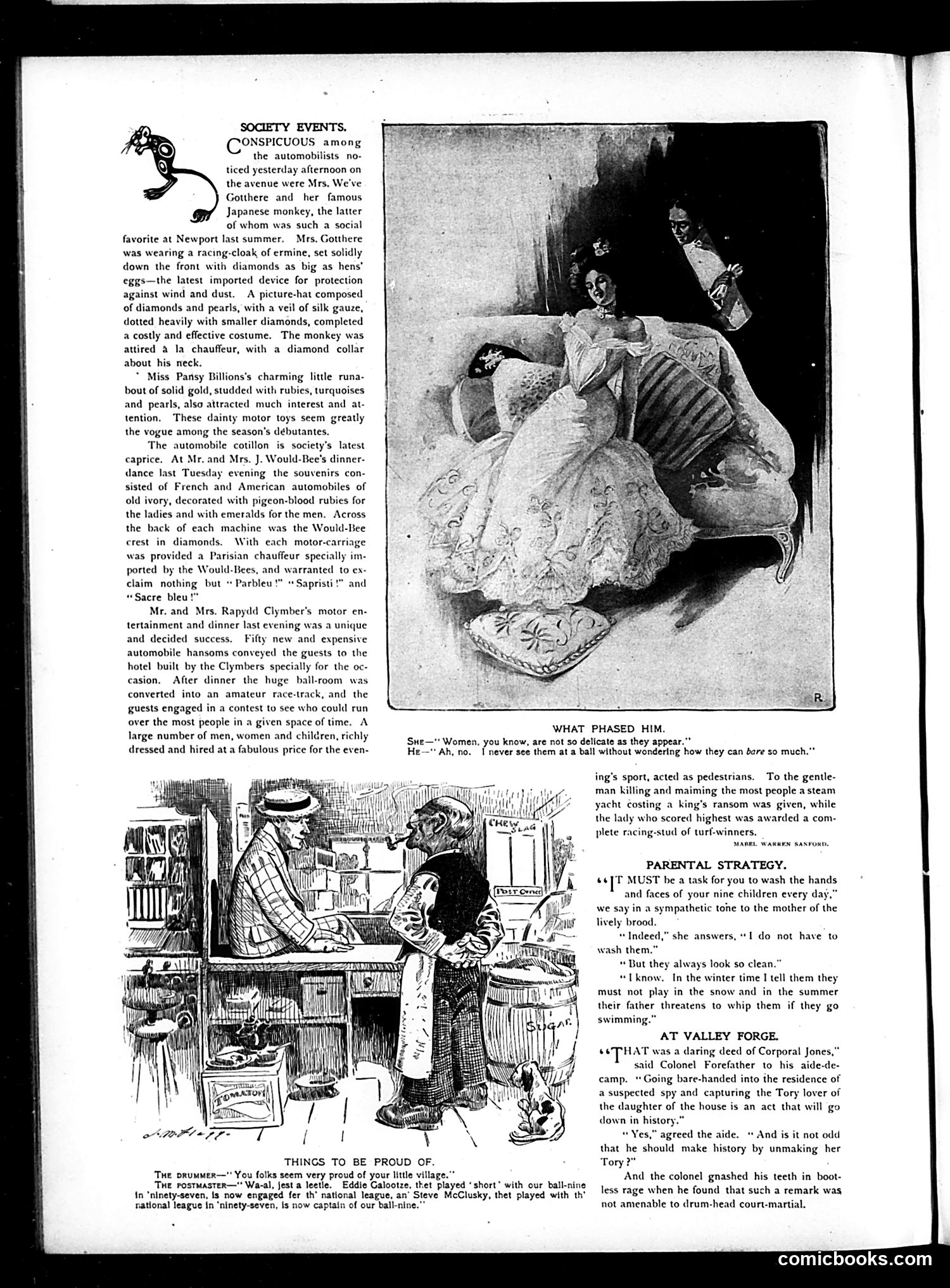
This page satirizes **Gilded Age wealth excess and nouveau riche pretension**. The "Society Events" section mocks ostentatious automobiles and their owners—absurdly named figures like "Mrs. We've Gotthere," "Miss Pansy Billions," and the "Would-Bees"—who deck their cars with diamonds, pearls, and imported French chauffeurs. The darkest joke: guests at a motor entertainment compete to run over hired pedestrians (poor people dressed up for pay), with the "winner" earning a steam yacht. This grotesque image exposes how the wealthy treat human life as disposable entertainment. The smaller cartoons and anecdotes maintain this satirical tone: the kitchen scene mocks parental laziness; "Parental Strategy" jokes about mothers preventing children from playing; "At Valley Forge" uses Revolutionary War nostalgia to mock modern morality; and "Things to be Proud Of" ridicules small-town boasting. Overall, Judge attacks conspicuous consumption, class indifference, and the moral bankruptcy of unrestrained wealth during America's Gilded Age.
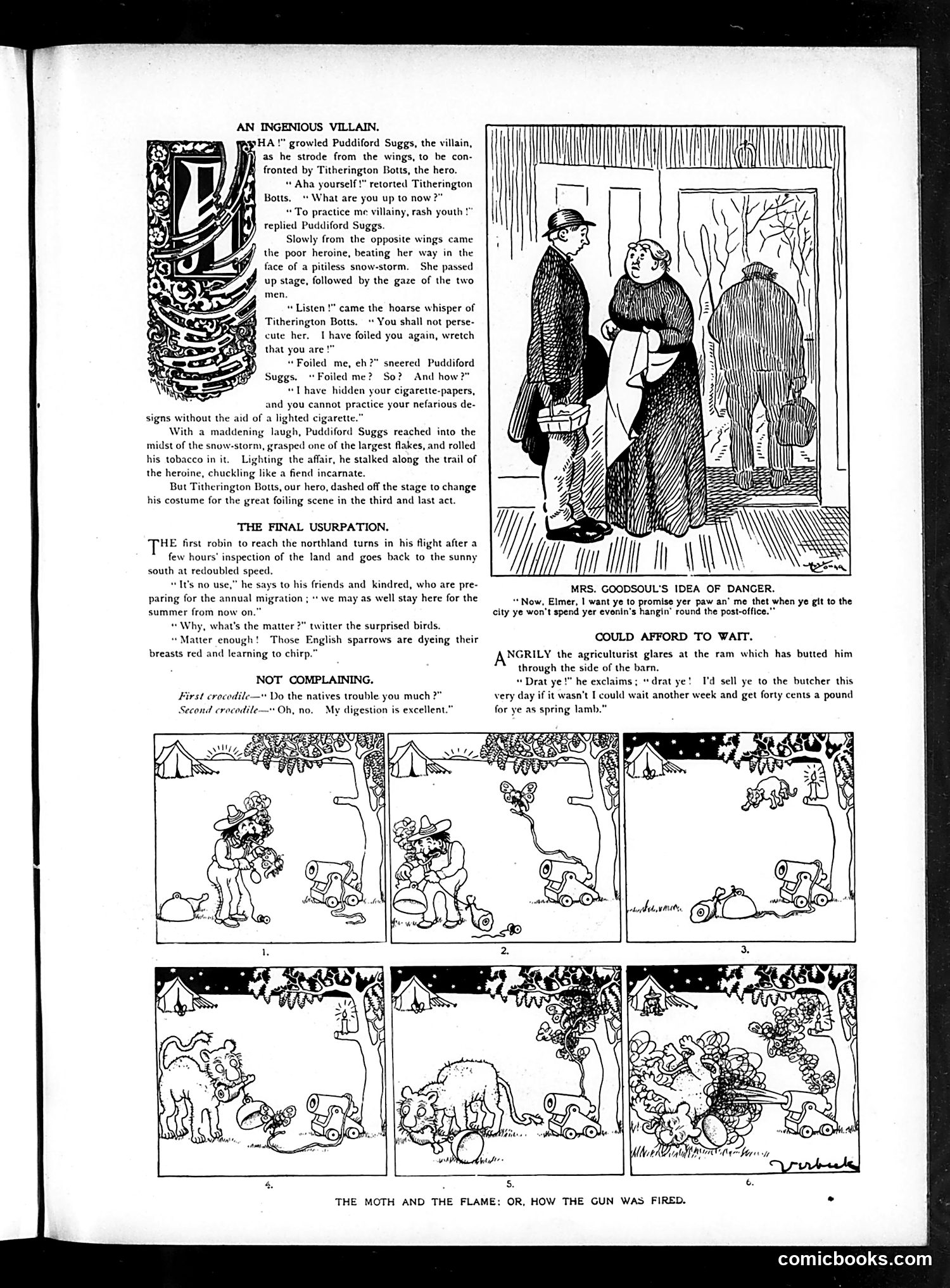
This page contains three distinct humorous pieces typical of Judge's satirical style: **"An Ingenious Villain"** mocks melodramatic theater conventions. The villain Puddiford Suggs and hero Titherington Botts engage in absurdly trivial conflict—the hero's "masterstroke" is hiding cigarette papers. The joke undercuts theatrical villainy by making the stakes ridiculous; the villain simply uses a snowflake as a rolling paper, rendering the hero's sabotage pointless. **"The Final Usurpation"** satirizes English sparrows' invasion of America, presenting immigrant birds as a threat serious enough to discourage native robins from migration—a xenophobic joke common to the era. **"Mrs. Goodsoul's Idea of Danger"** and the crocodile/agriculturist pieces are brief gags about misplaced parental worry and animal humor respectively. The six-panel "The Moth and the Flame" comic strip appears to depict slapstick scenes, though details remain unclear.
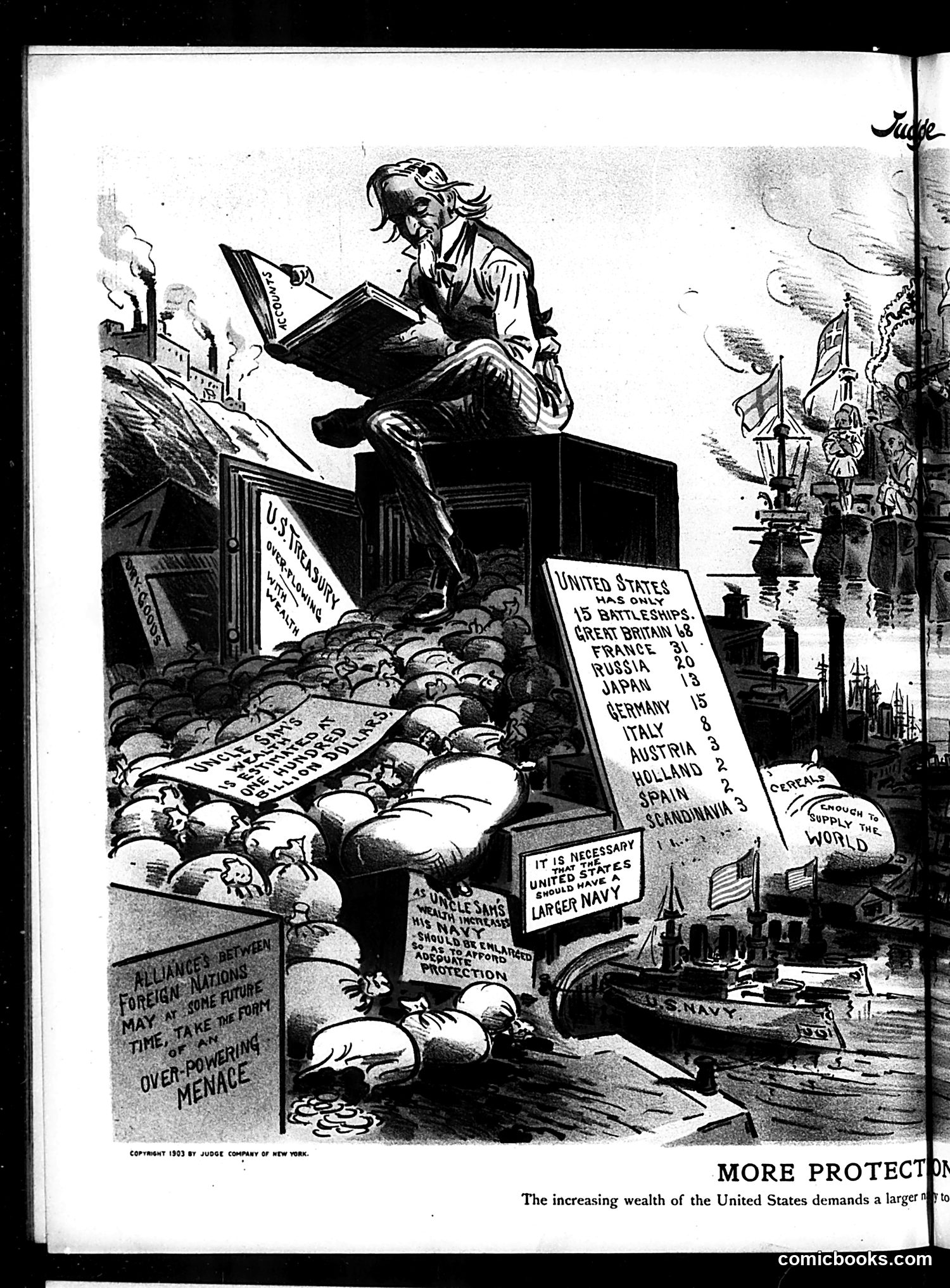
This 1903 Judge cartoon advocates for a larger U.S. Navy. An Uncle Sam figure sits atop a treasure chest overflowing with money, reading a ledger comparing naval battleship counts among world powers. The U.S. has only 4 battleships versus Britain's 8, France's 3, Russia's 4, and Germany's 15. The surrounding naval vessels and fortifications emphasize military vulnerability. Signs reference "an over-powering menace" and argue that America's growing wealth requires greater naval protection to compete globally. The cartoon's message is clear: economic prosperity demands military expansion—a common imperialist-era argument for increased defense spending during the pre-WWI naval arms race period.
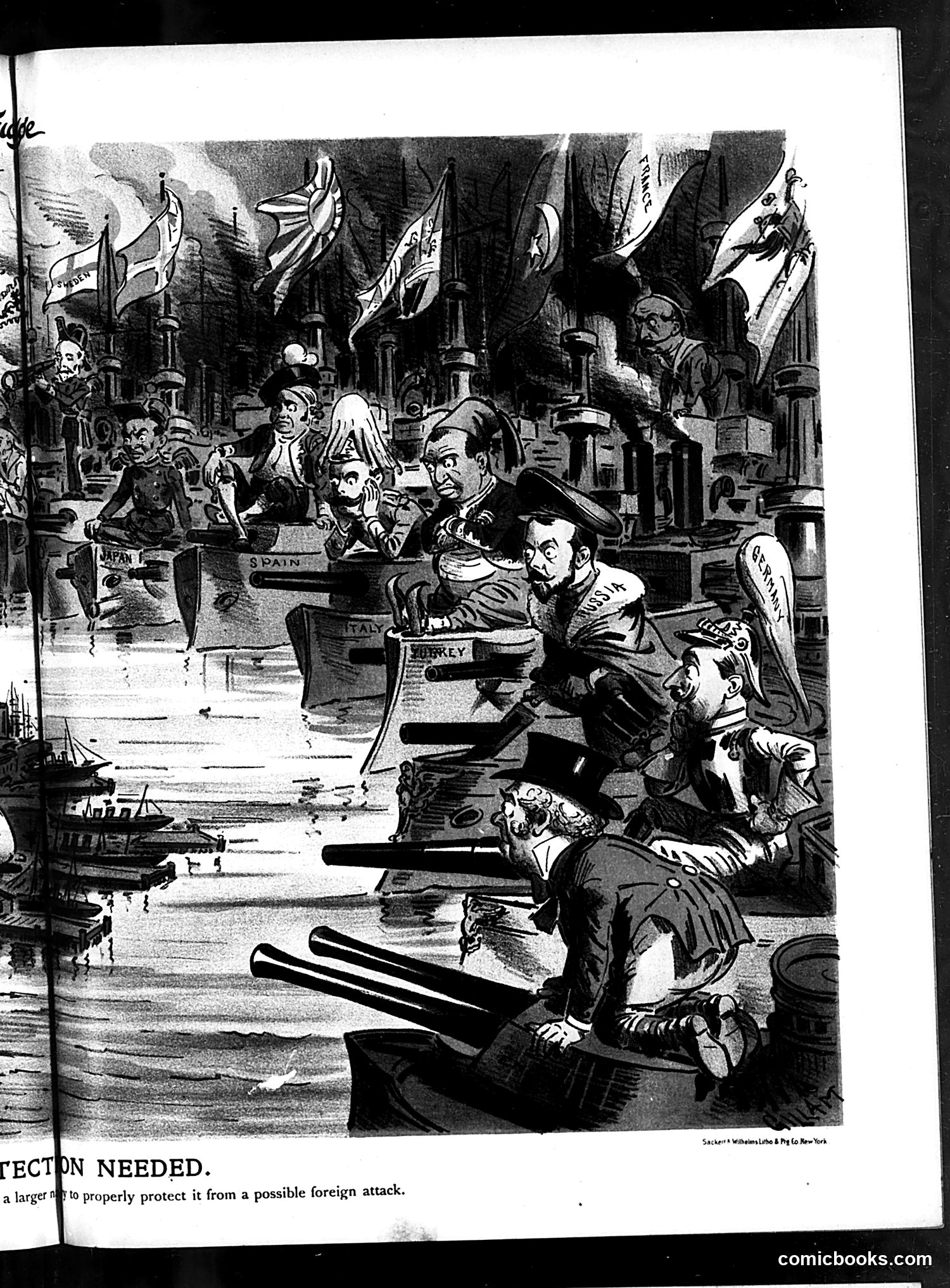
This satirical cartoon depicts military/naval leaders of major powers gathered in what appears to be a fortified or industrial setting, with flags and military infrastructure visible. Labels identify figures representing **Spain, Italy, Turkey, and other nations**. The caricatured figures appear to be engaged in military posturing or negotiation. The visible text fragment "ECTION NEEDED" and reference to "protecting it from a possible foreign attack" suggests this cartoon addresses **international military tensions and defense preparedness**—likely from the pre-WWI or early 20th-century period when European and imperial powers were actively competing militarily. The satire appears to mock either the complexity of international alliances, the absurdity of military buildups, or tensions between specific nations, though the OCR corruption prevents definitive interpretation of the cartoon's exact argument.
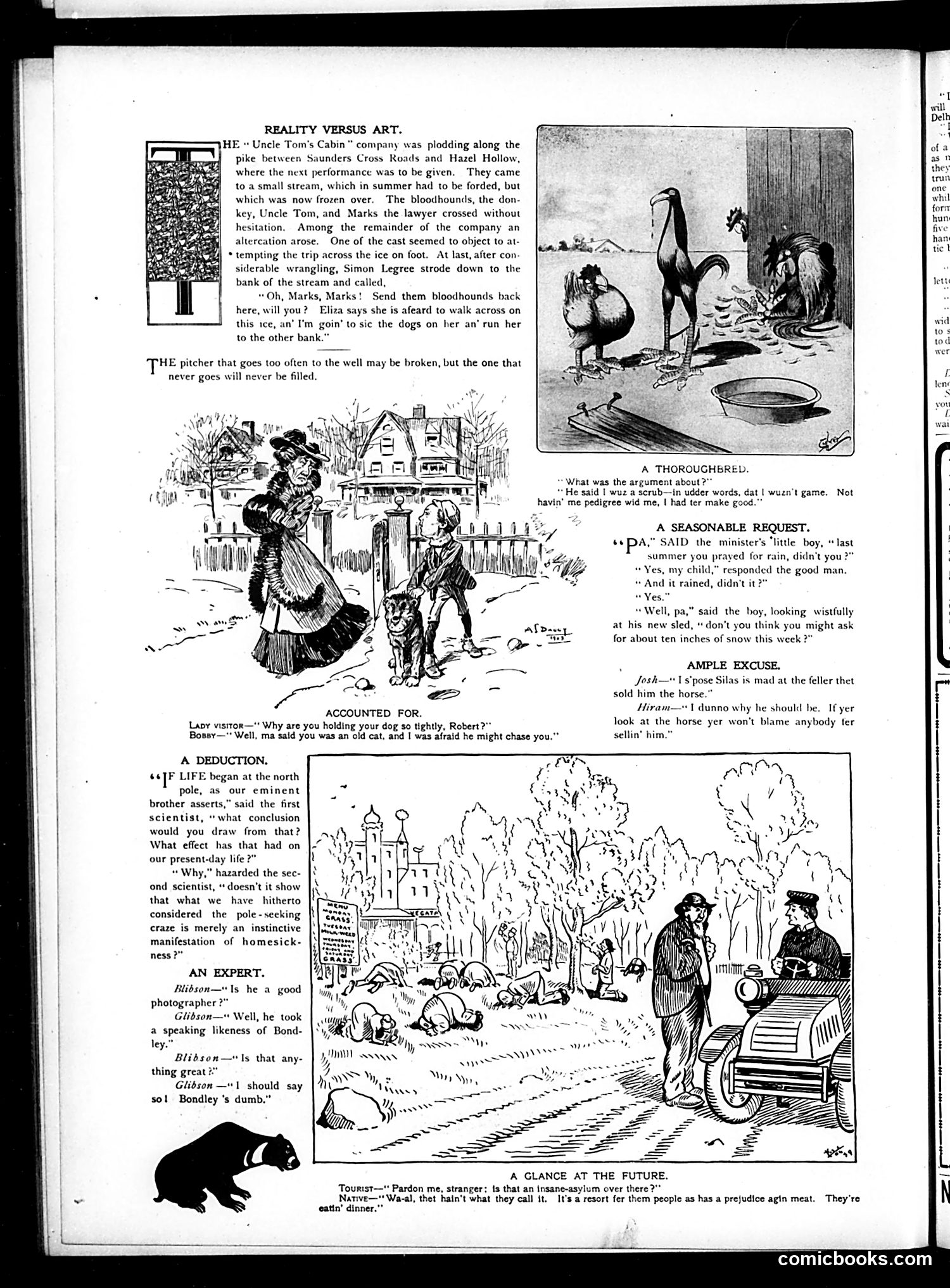
This page contains several brief satirical humor pieces typical of late 19th/early 20th-century American comic magazines: **"Reality Versus Art"** mocks the theatrical company performing "Uncle Tom's Cabin"—the famous antislavery novel adapted for stage. The joke is that actors playing characters from the dramatic story (Simon Legree, Eliza) encounter real-world complications (crossing frozen streams) that undermine the theatrical drama they're meant to perform. **Other segments** are standard period humor: a child's logical request for snow (after rain prayers worked), a dog owner protecting their pet from an "old cat," a minister's boy with practical faith, and jokes about horses and photography. **"A Glance at the Future"** appears to satirize vegetarianism or dietary reform movements, suggesting such establishments will become asylums for those "prejudiced agin meat"—reflecting contemporary skepticism toward emerging health/dietary movements. The humor relies on wordplay, logical absurdity, and social commentary typical of Judge's satirical approach to contemporary American life and attitudes.
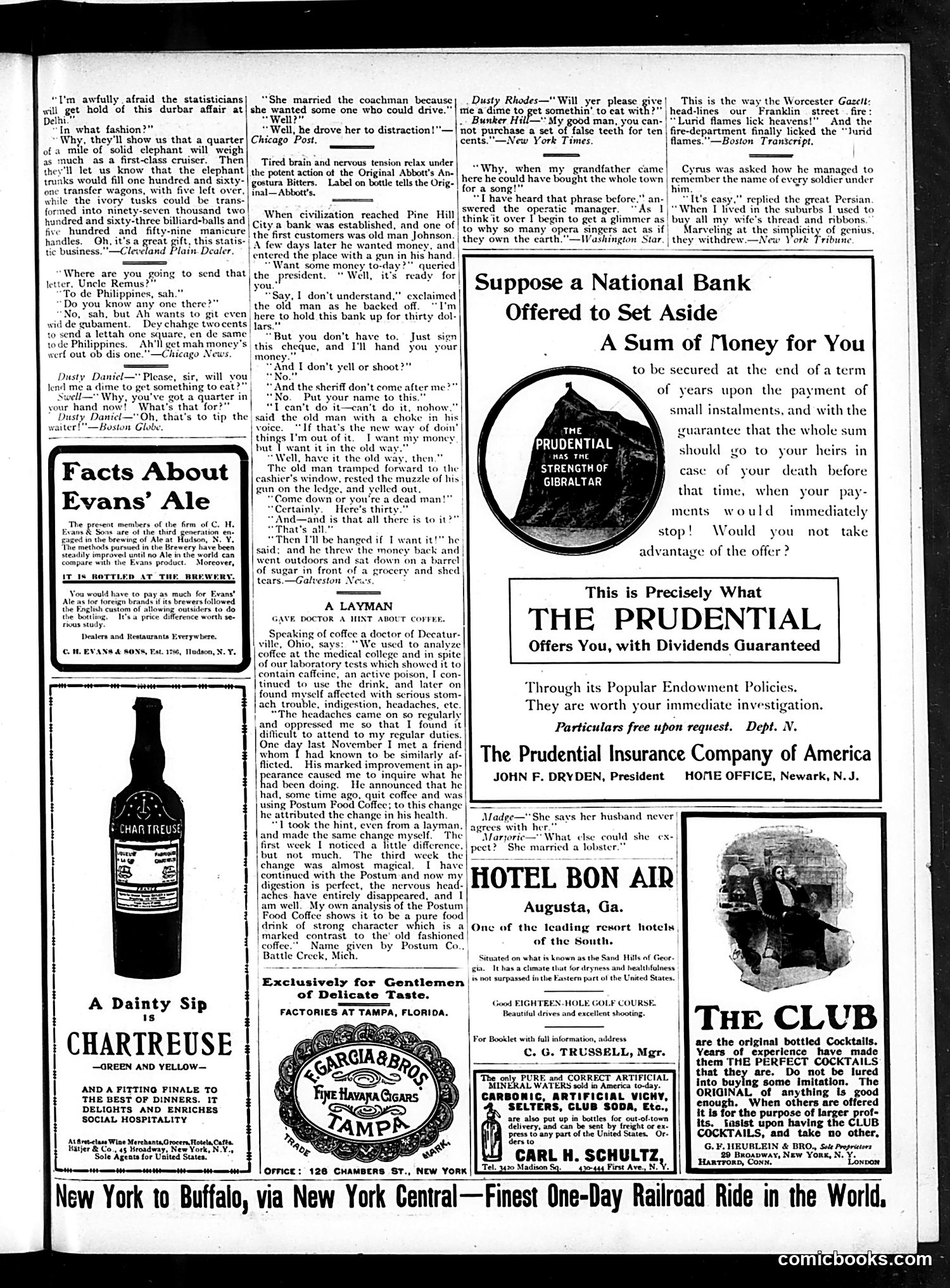
This page contains multiple short humorous anecdotes and advertisements typical of early 20th-century Judge magazine. **The main cartoon** (center-right) depicts a bank robbery that subverts expectations: a would-be robber enters with a gun intending to steal, but the bank president offers him a legal loan via check instead. The robber refuses—he wants money "the old way" (through intimidation), not through civilized financial instruments. The joke satirizes the contrast between frontier lawlessness and modern banking procedures. **Supporting jokes** include wordplay about statistics, marital humor about a coachman driver, and Uncle Remus discussing international postage rates to the Philippines. **The advertisements** promote Evans' Ale, Chartreuse liqueur, The Prudential Insurance Company's endowment policies, cigars, and resort hotels—typical luxury goods marketed to affluent readers. The overall satire targets both outdated criminal methods and the absurdities of modern civilization (statistics, bureaucracy, insurance schemes).
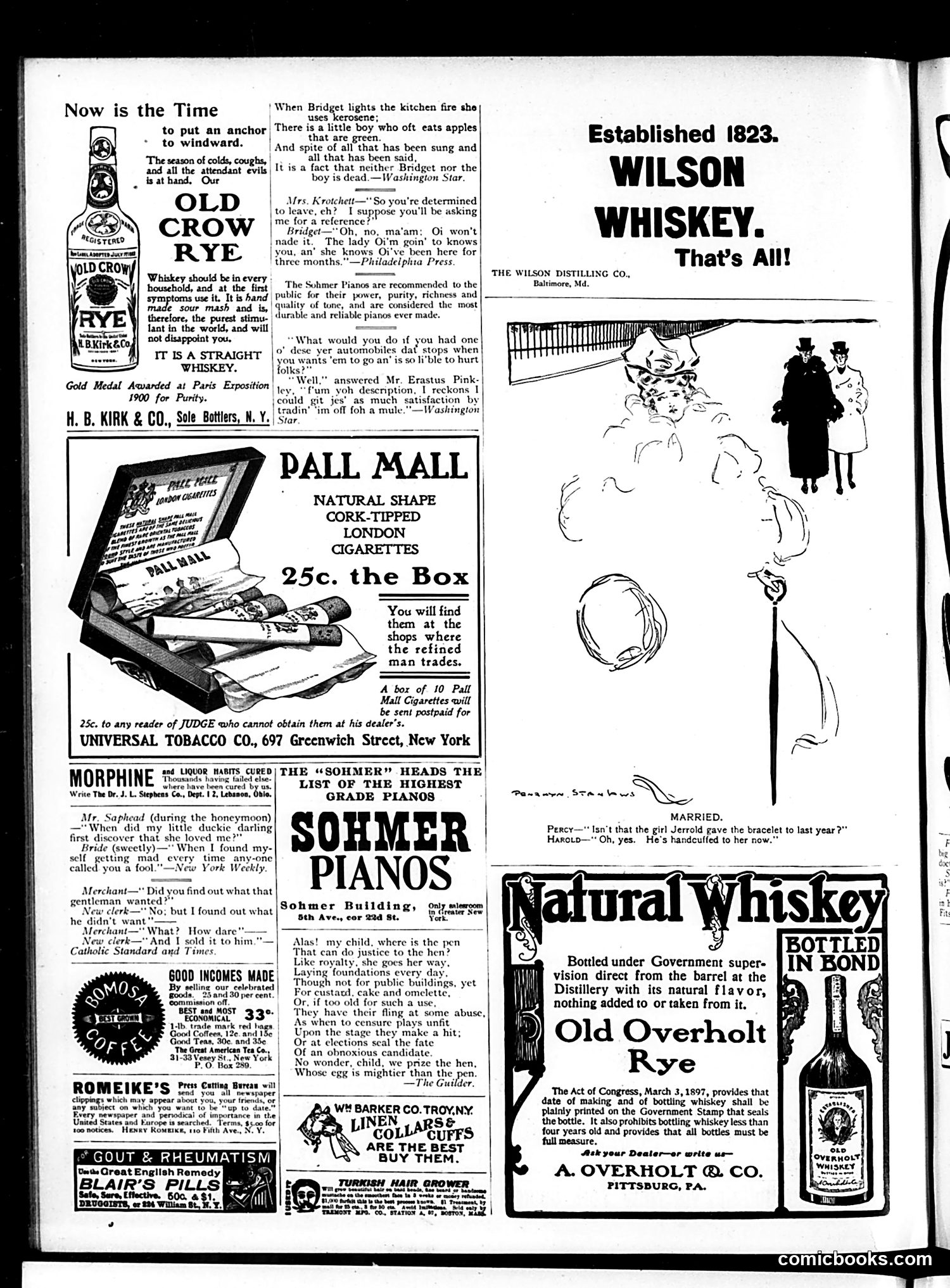
This page is primarily **advertising with minimal editorial cartoons**. The main satirical content appears in brief joke segments interspersed among product advertisements. **Key satirical elements:** The opening "Now is the Time" section mocks domestic Irish servants ("Bridget"), a common stereotype in early 1900s American humor. The joke plays on servant hiring practices and references. A small cartoon depicts an argument between a man and woman about automobiles—typical early-20th-century anxiety about new technology, suggesting autos are unreliable and dangerous. A honeymoon joke plays on newlywed insecurity: the bride reveals she loved him only after becoming angry at others insulting him—suggesting her love is defensive rather than genuine. **The bulk of the page** consists of advertisements for whiskey, pianos, coffee, cigarettes, and patent medicines (notably morphine), reflecting common early-1900s commerce. These ads reveal period attitudes: aggressive marketing of addictive substances, gender-targeted piano advertisements (refined gentlemen/women), and ethnic humor in product naming. The page reflects early-20th-century American values: servant-class stereotyping, technological skepticism, and casual acceptance of dangerous substances in consumer products.
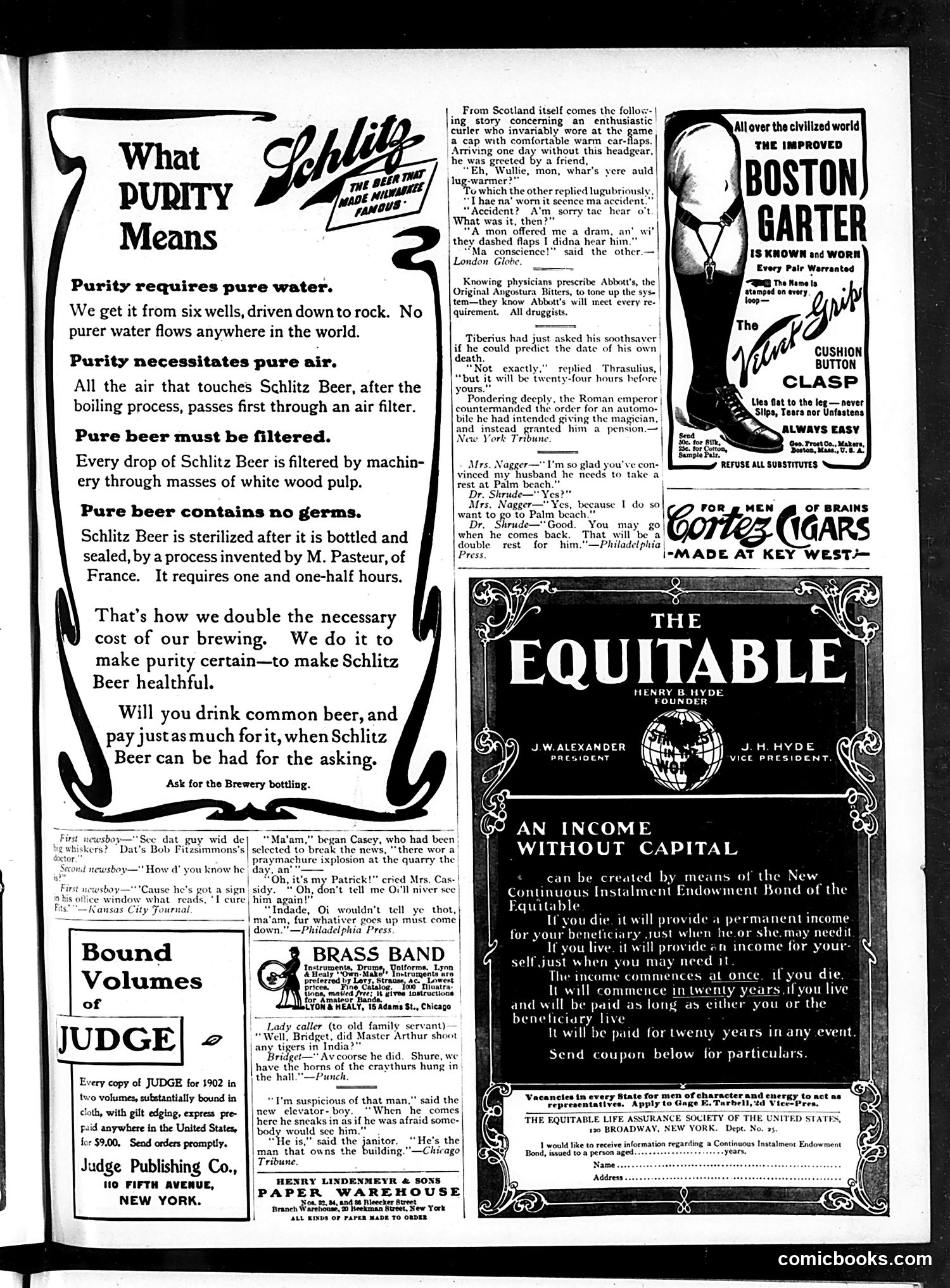
This page is primarily **advertisements and filler content** rather than political satire. The left side features a Schlitz Beer ad emphasizing "purity"—invoking Pasteur's sterilization process, filtered water and air, and germ-free production. This marketing pitch reflects early 1900s health anxieties and competitive brewing claims. The remaining space contains scattered **humorous anecdotes**: - A Scottish joke about a man who can't hear without his ear-covering cap - A Tiberius/Roman emperor joke about mortality - A doctor joke about a nagging wife needing rest - Various short quips (an elevator boy, a quarry explosion, etc.) These are generic period humor—mild, domestic jokes with no apparent political content or social critique. The page includes advertisements for products (Boston Garter, Cortes Cigars, Equitable Life Insurance) and Judge's own bound volumes. **No significant satire or caricature is evident.** This appears to be filler typical of early-1900s magazines mixing advertisements with light entertainment.
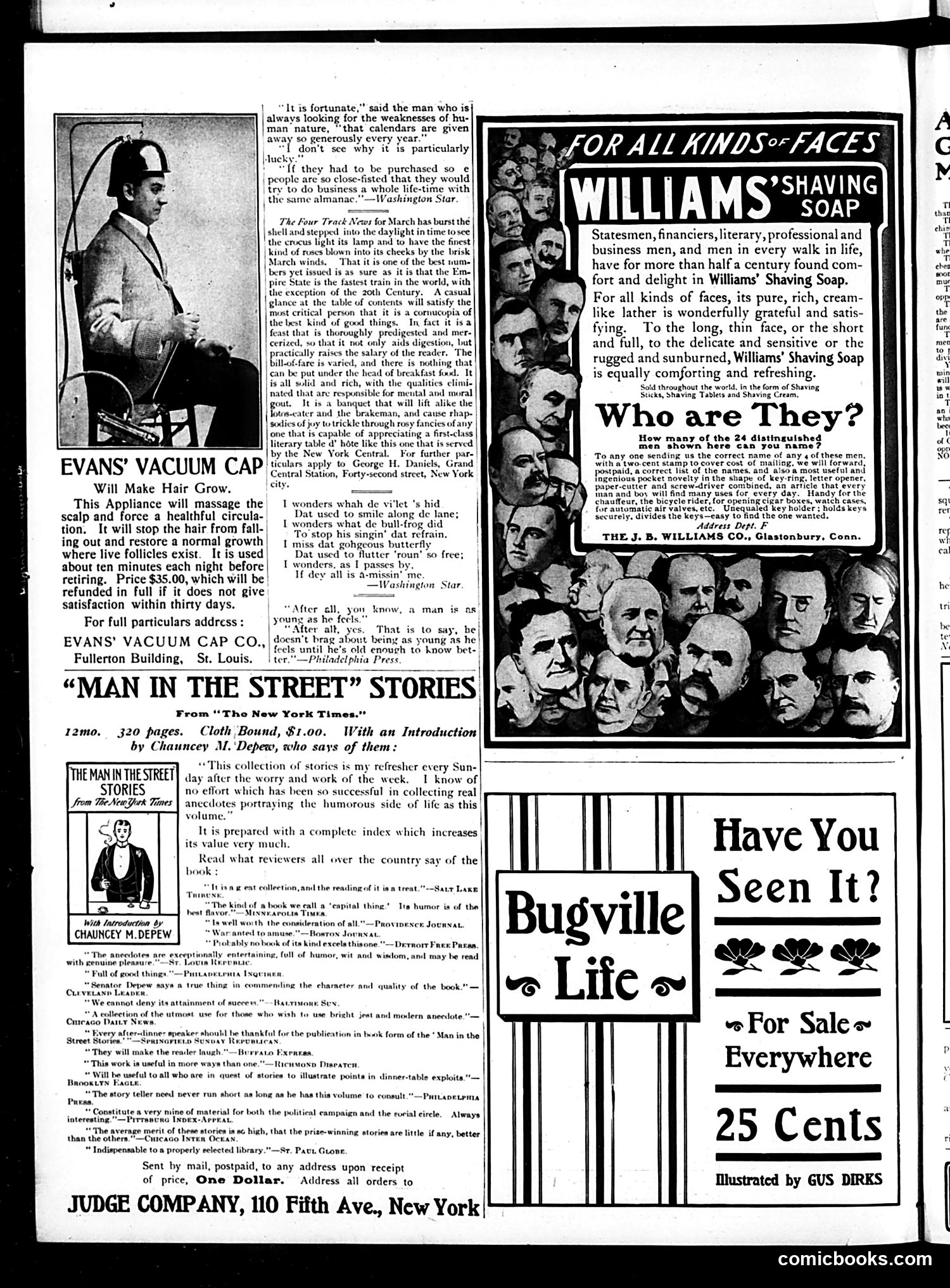
This page is primarily **advertising and promotional content** rather than political satire. It contains: 1. **Evans' Vacuum Cap advertisement** (left): Promotes a scalp-massage device claimed to restore hair growth, priced at $35, with a money-back guarantee. This represents dubious medical claims typical of early 20th-century patent medicine advertising. 2. **Williams' Shaving Soap advertisement** (center-right): Features numerous male faces of different types—statesmen, financiers, laborers—claiming the soap suits "all kinds of faces." The "Who are they?" section lists 24 distinguished men purportedly endorsing the product, a common advertising strategy of the era. 3. **"Man in the Street" Stories** (bottom-left): Promotes a book of humorous anecdotes from the *New York Times*, introduced by prominent figure Chauncey M. Depew. 4. **Bugville Life** (right): Advertises an illustrated publication at 25 cents. The scattered text snippets between ads are brief humorous observations—typical "man in the street" filler content. There is **no significant political cartoon or satire** on this page.
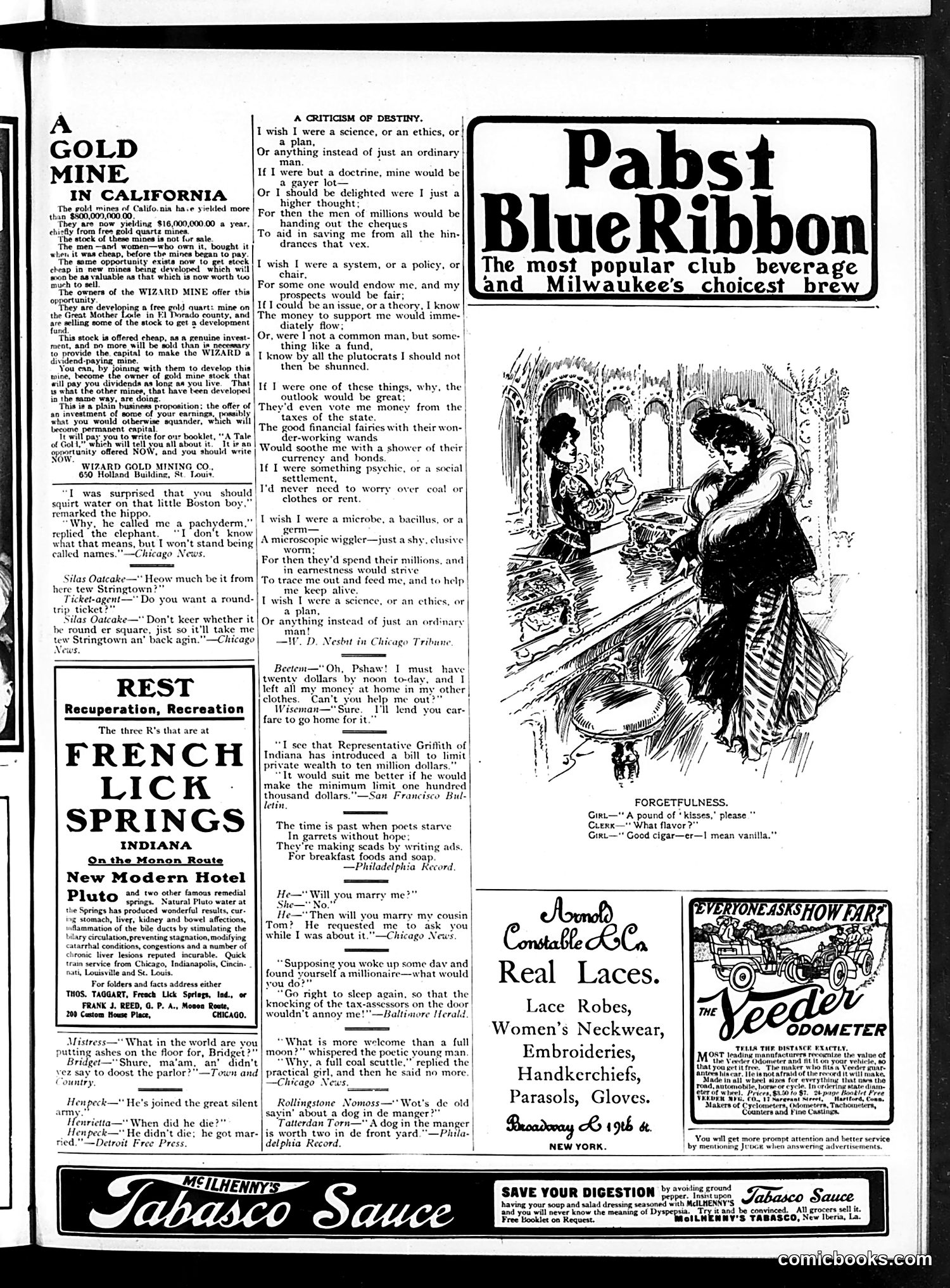
This page is primarily **advertising** with minimal satirical content. The main cartoon—"Forgetfulness"—depicts a domestic scene where a woman asks a man for "a pound of kisses," he responds "What flavor?" and she clarifies "Cocoa"—a pun playing on cocoa candy products. The substantive text piece, "A Criticism of Destiny," is a **social commentary poem** lamenting ordinary manhood. The speaker wishes to be something with institutional value—a science, doctrine, policy, or fund—because wealthy "plutocrats" shower money on such entities. He's invisible as "just an ordinary man." This **critiques Gilded Age inequality**: the wealthy endow abstract concepts and institutions while dismissing individual human needs. The implicit message: late-19th-century capitalism valued capital structures over human dignity. The remainder comprises genuine advertisements (gold mines, springs resort, laces) and light humor.
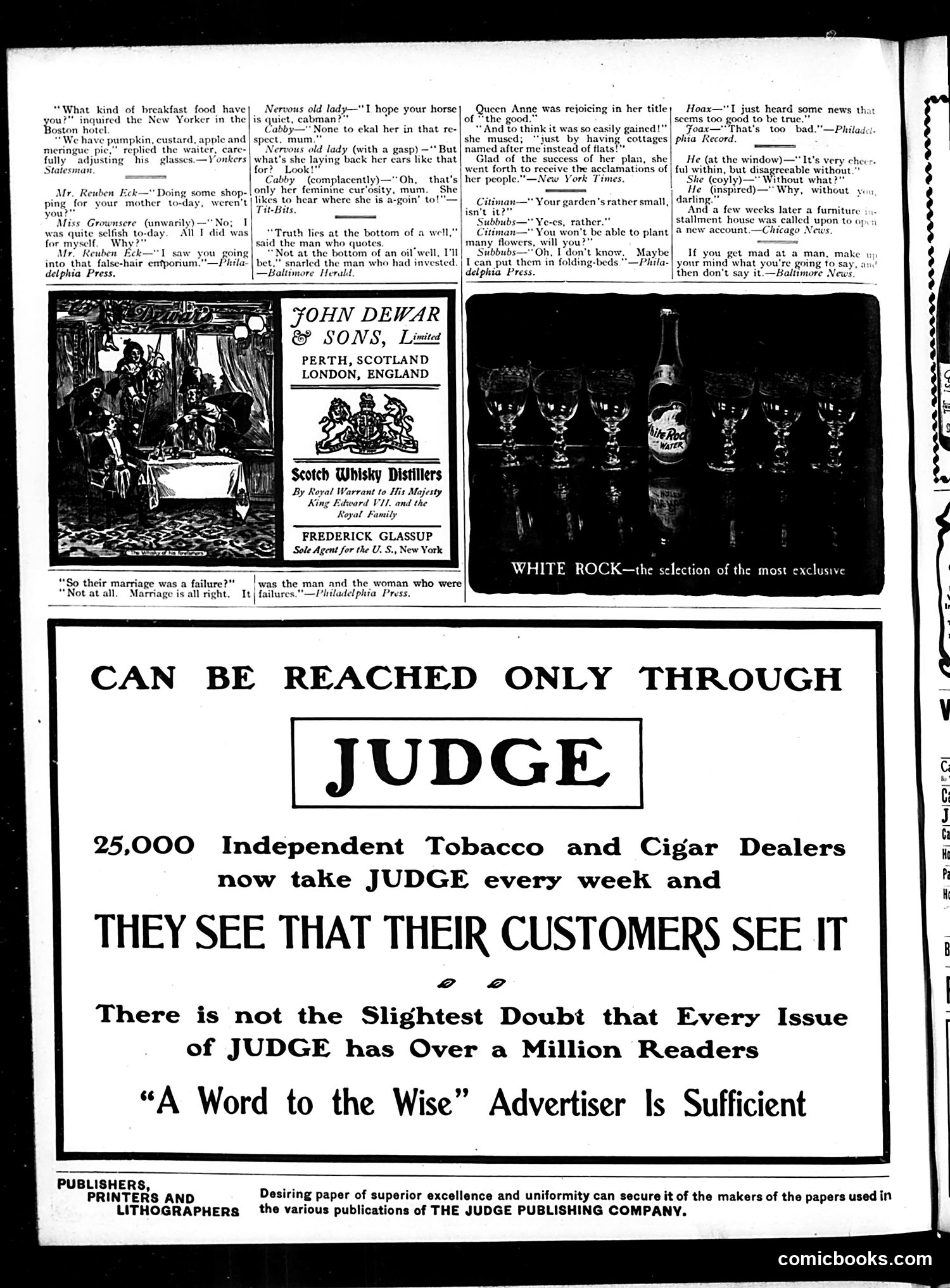
This page mixes short humorous anecdotes with period advertisements. The jokes reflect early 20th-century concerns: a Boston hotel's unusual breakfast offerings, a nervous woman fussing over a cab horse, and exchanges about urban living (apartment buildings vs. cottages, small city gardens). One joke plays on the phrase "truth lies at the bottom of a well"—a classical reference subverted when applied to an oil well investment, suggesting financial loss. The largest content is an advertisement for Judge magazine itself, claiming 25,000 tobacco dealers distribute it weekly and boasting over a million readers per issue. A Dewar's Scotch Whisky ad and White Rock beverage advertisement appear alongside. The cartoons (small illustrations) are period genre scenes—domestic, romantic, or social humor typical of Judge's satirical style. No specific political figures or events are identified. The page demonstrates Judge's business model: satirical content attracting advertisers seeking middle-class readership.
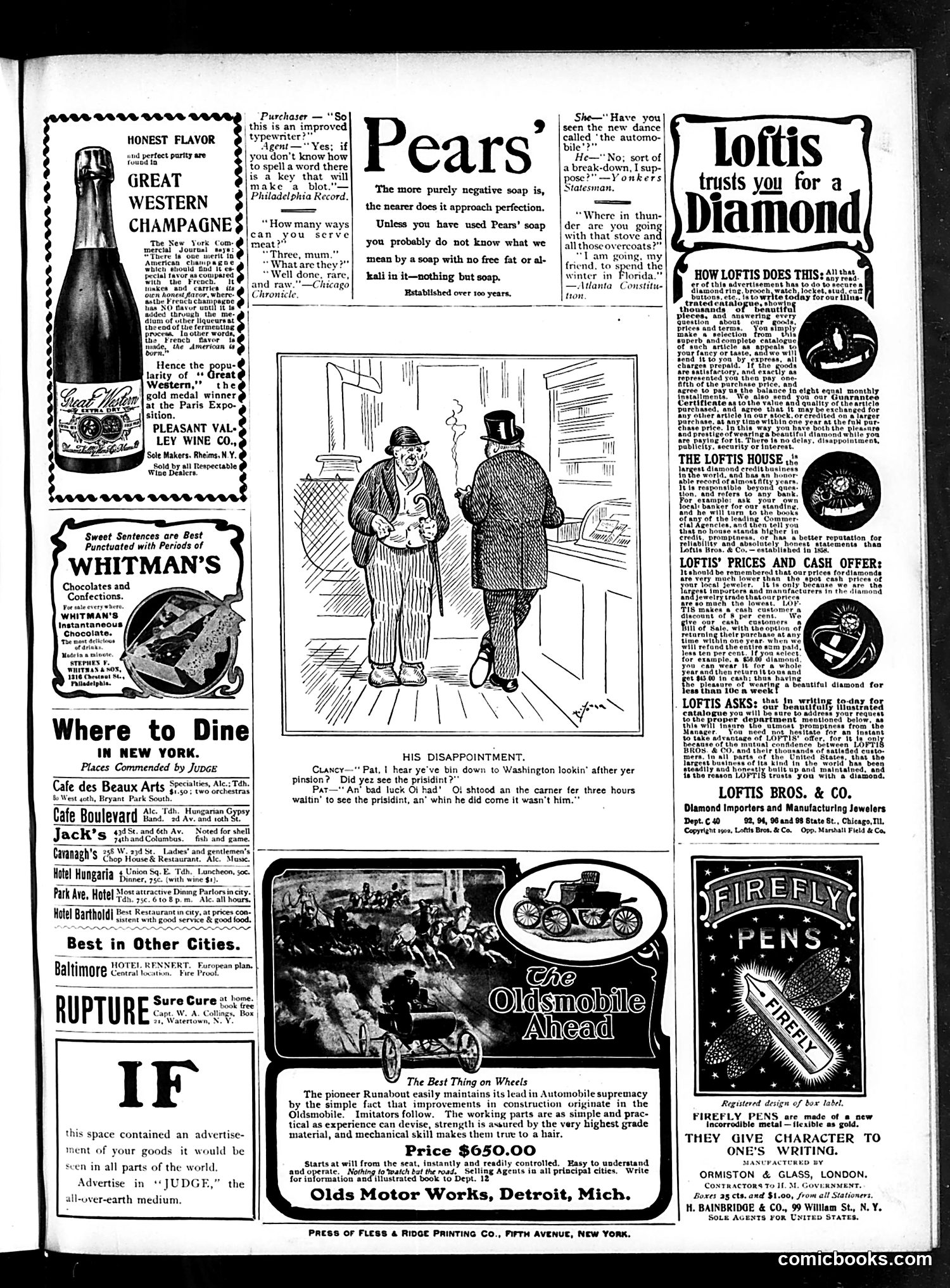
This cartoon satirizes Irish immigrant disappointment with American politics, likely referencing early 20th-century pension disputes or federal appointments. Two Irish characters (identifiable by names "Clancy" and "Pat" and dialect spelling) discuss one's failed attempt to see the President about a pension claim. The punchline—"whin he did come it wasn't him"—suggests the person waited hours only to discover the wrong official, satirizing both Irish hopes for presidential access and the bureaucratic runaround facing working-class immigrants seeking federal benefits or patronage. The joke relies on period stereotypes of Irish immigrants as politically naive, pursuing pensions or government favors through direct presidential appeal rather than proper channels. The cartoon mocks both their optimism and the political system's impenetrability to ordinary citizens.
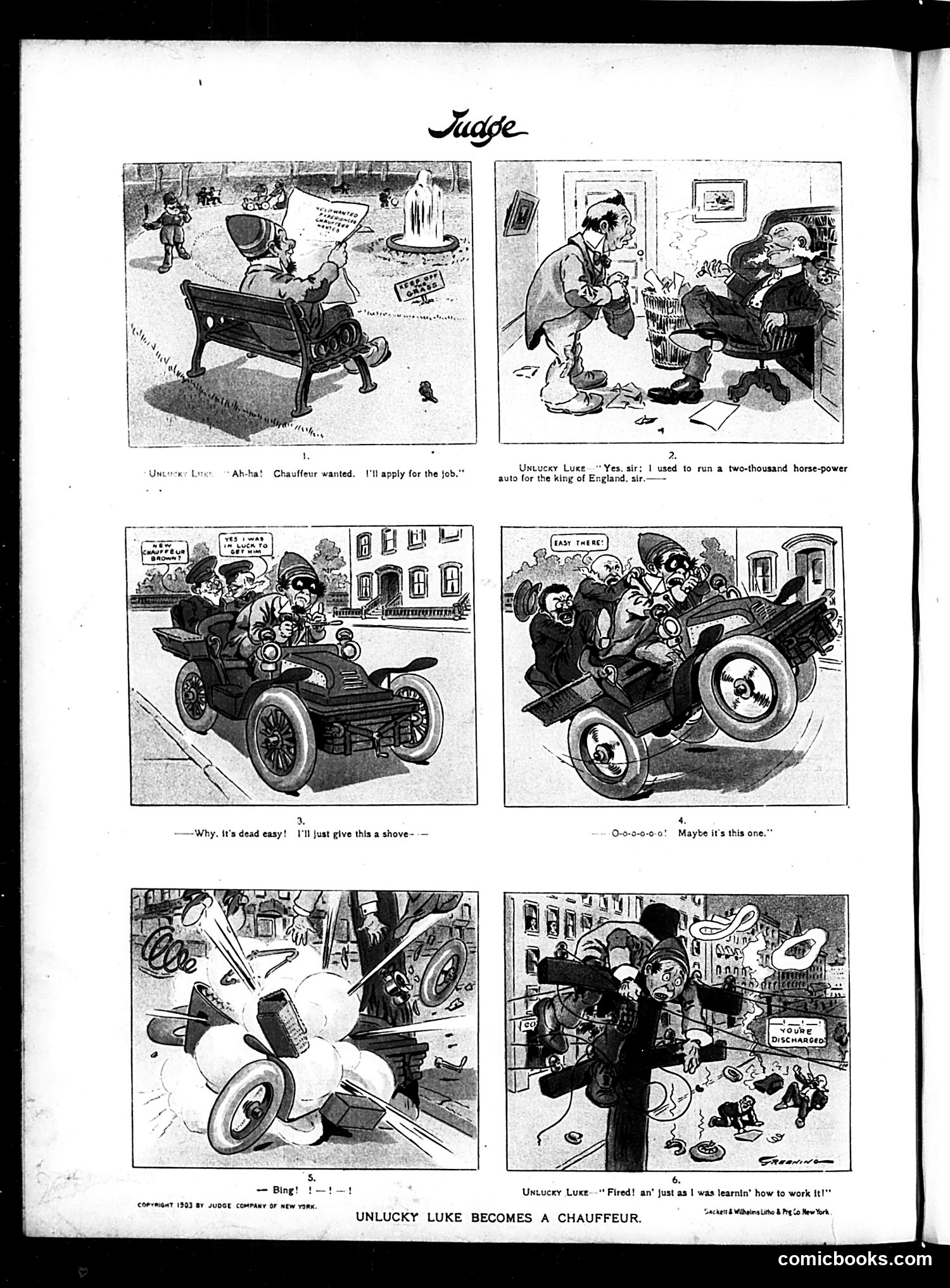
This six-panel comic strip follows a recurring character named Unlucky Luke through automotive mishaps. In panel 1, Luke seeks employment as a chauffeur, boasting of past experience driving a "two-thousand horse-power auto for the king of England." Panels 2-4 show him attempting to operate a car with multiple passengers, who crowd into the vehicle. Panel 5 depicts a violent crash—the car has collided catastrophically. Panel 6 shows Luke fired from his job "just as I was learnin' how to work it!" The satire targets early-1900s automobile culture and the comic incompetence of working-class aspirants. Luke's claimed aristocratic credentials prove worthless; his boasts about royal service don't translate to actual skill. The joke relies on slapstick physical comedy and the irony of failure despite prior claims of expertise—a common theme in period humor mocking social pretension and the chaos of emerging automobile technology.