
Judge, 1903-03-07 · page 5 of 18
Judge — March 7, 1903 — page 5: what you’re looking at
What you’re looking at
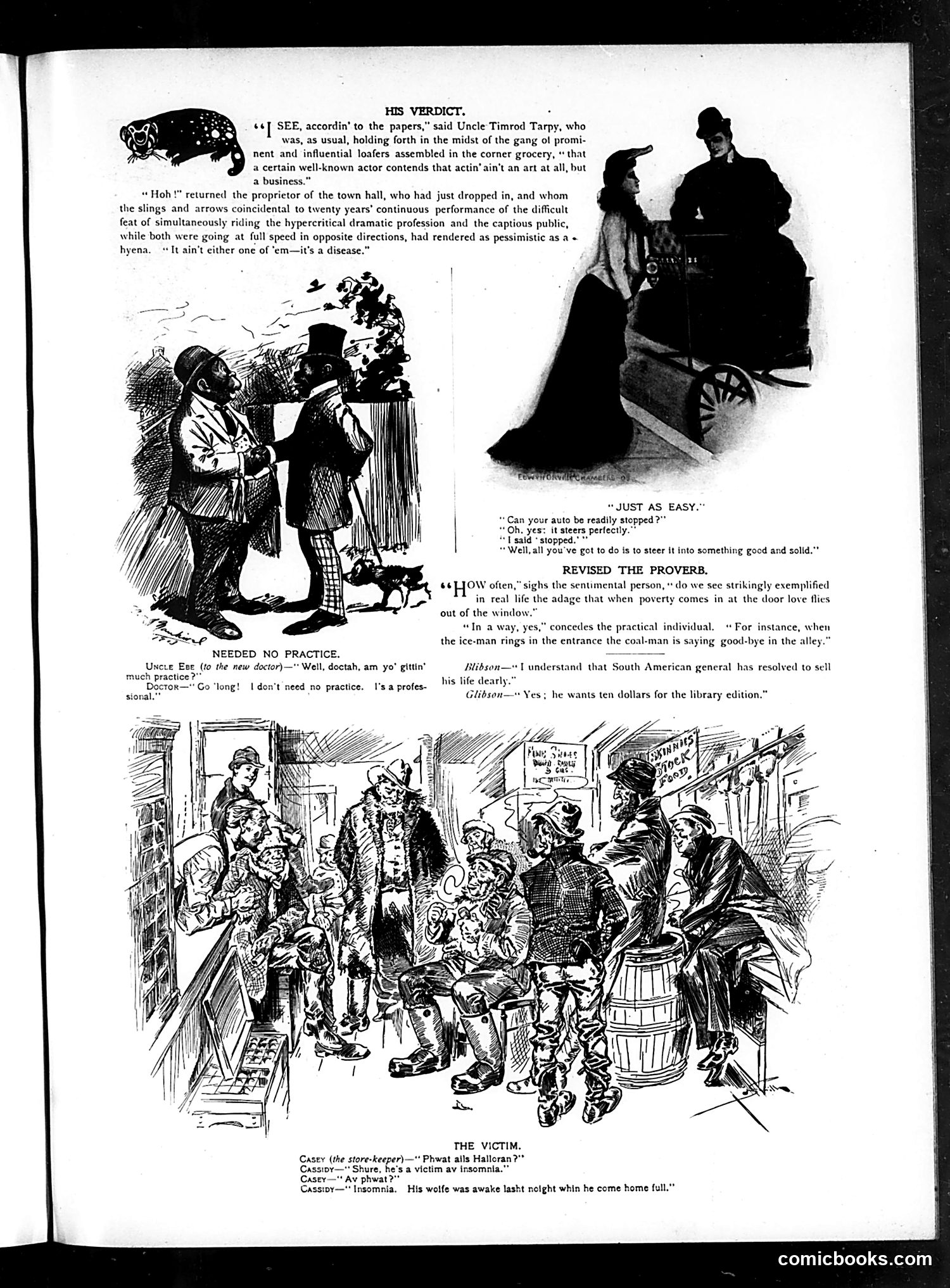
This page contains several unrelated satirical sketches typical of early Judge magazine: **"His Verdict"**: Small-town men debate whether acting is an art or business. The town hall proprietor—exhausted from twenty years managing both demanding audiences and theatrical performers—dismisses both positions, calling acting "a disease." The satire mocks the pretensions of theatrical discourse. **"Just as Easy"**: A car owner claims his auto stops perfectly but only steers. The joke's absurdist humor suggests mechanical/automotive incompetence. **"Revised the Proverb"**: Characters reinterpret the saying "when poverty comes in, love flies out," updating it with modern examples—the ice-man and coal-man replacing traditional poverty imagery. Social commentary on economic hardship. **"The Victim"**: Irish characters (dialect humor) discuss Halloran's "insomnia," revealed as his wife staying awake because he came home drunk. The joke plays on misunderstanding and marital discord. These sketches represent Judge's characteristic blend of social observation, class humor, and ethnic caricature typical of early 20th-century American satire.
📄 Transcribed text from this page (OCR, searchable)
Machine-transcribed from the original scan — historical spelling and the odd misread are preserved.
HIS VERDICT. : +6] SEE, accordin’ to the papers," said Uncle Timrod Tarpy, who was, as usual, holding forth in the midst of the gang ol promi- nent and influential loafers assembled in the corner grocery, “that a certain well-known actor contends that actin’ ain't an art at all, but a business.” “Hoh !" returned the proprietor of the town hall, who had just dropped in, and whom the slings and arrows coincidental to twenty years’ continuous performance of the difficult feat of simultaneously riding the hypercritical dramatic profession and the captious public, while both were going at full speed in opposite directions, had rendered as pessimistic as a = hyena. «It ain't either one of ‘em—it's a disease.” “JUST AS EASY.” “Can your auto be readily stopped?" “Oh. yes: it steers pertectly.”* [sald * stopped.’ ** “ Well,all you've got to do is to steer it into something gocd and solld.”* REVISED THE PROVERB. 66 LJOW often,” sighs the sentimental person, "do we see strikingly exemplified is p gly br in real life the adage that when poverty comes in at the door love flies out of the window.” “In a way, yes,” concedes the practical individual. “For instance, when the ice-man rings in the entrance the coal-man is saying good-bye in the alley.” NEEDED NO PRACTICE. Uxcte Eve (to the new doctor)—" Well, doctah, am yo" gittin’ slibson—* L understand that much practice ?”” Doctor—""Go ‘long! I don't’need no practice. I'saprofes- lis life dearly sional.”” South American general has resolved to sell Glibson—« Yes ; he wants ten dollars for the library edition.” THE VICTIM. Casey (the store-keeper)—"’ Phwat alls Halloran?" Cassioy—"' Shure, he's a victim av insomnia.”” Casey—“* Av phwat?” Casstpy—"' Insomnia. His wolfe was awake lasht noight whin he come home full.” comicbooks.com