
A complete issue · 16 pages · 1903
Judge — February 28, 1903
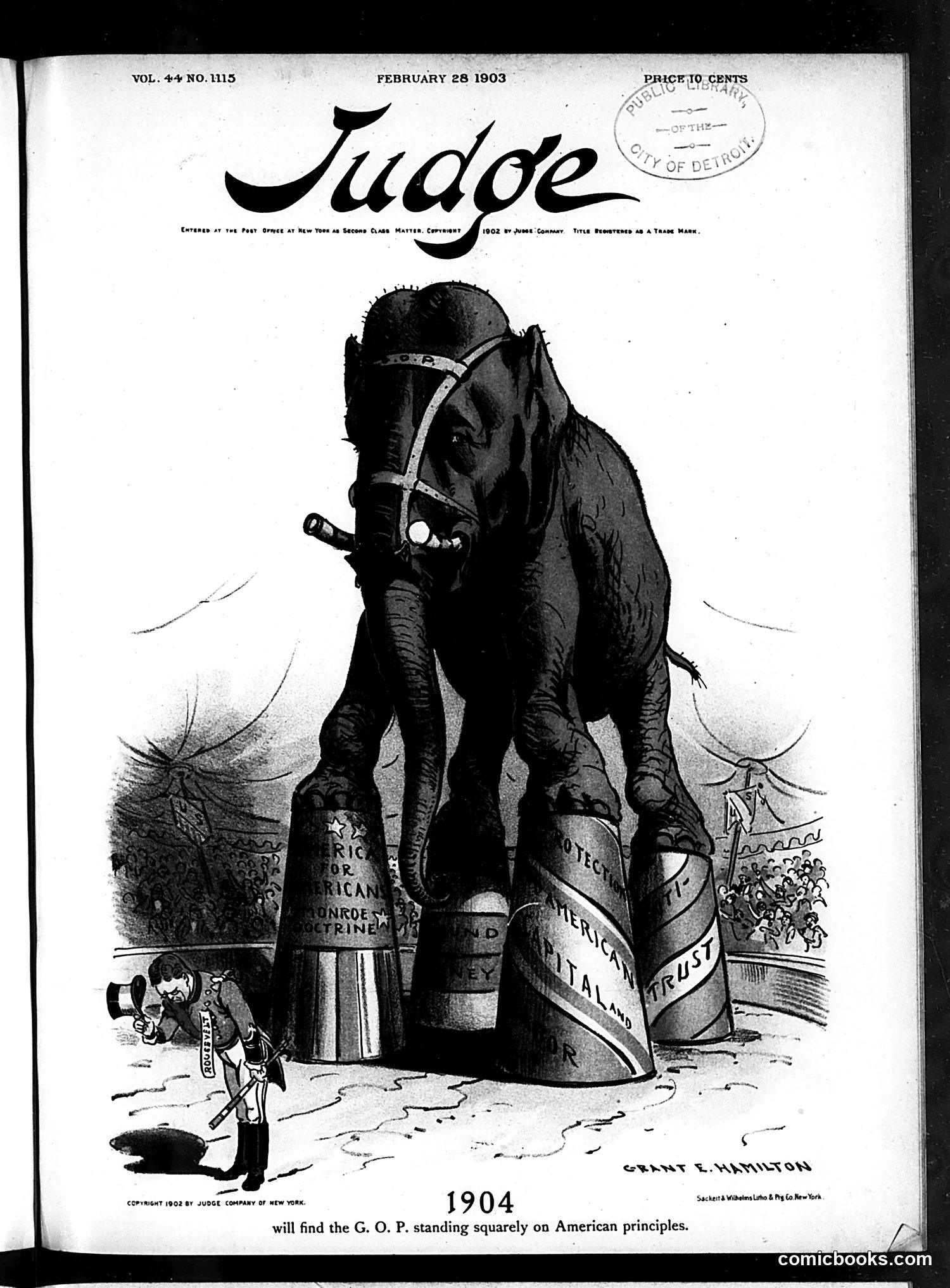
**Date & Source:** February 28, 1903 (with reference to 1904) **Main Image:** An elephant (Republican Party symbol) stands astride, wearing labels including "PROTECTION," "MONROE DOCTRINE," and "TRUST." A small figure (appears to be Theodore Roosevelt) stands confidently beneath it. **The Satire:** The cartoon satirizes the Republican Party's (G.O.P.'s) relationship with Roosevelt heading into the 1904 election. The caption states the G.O.P. will "find the...standing squarely on American principles." **Political Context:** This appears to celebrate Roosevelt's alignment with Republican principles—protectionism, American isolationism (Monroe Doctrine), and handling of industrial trusts. The elephant supporting Roosevelt suggests party confidence in his 1904 presidential viability, positioning him as embodying core Republican values.
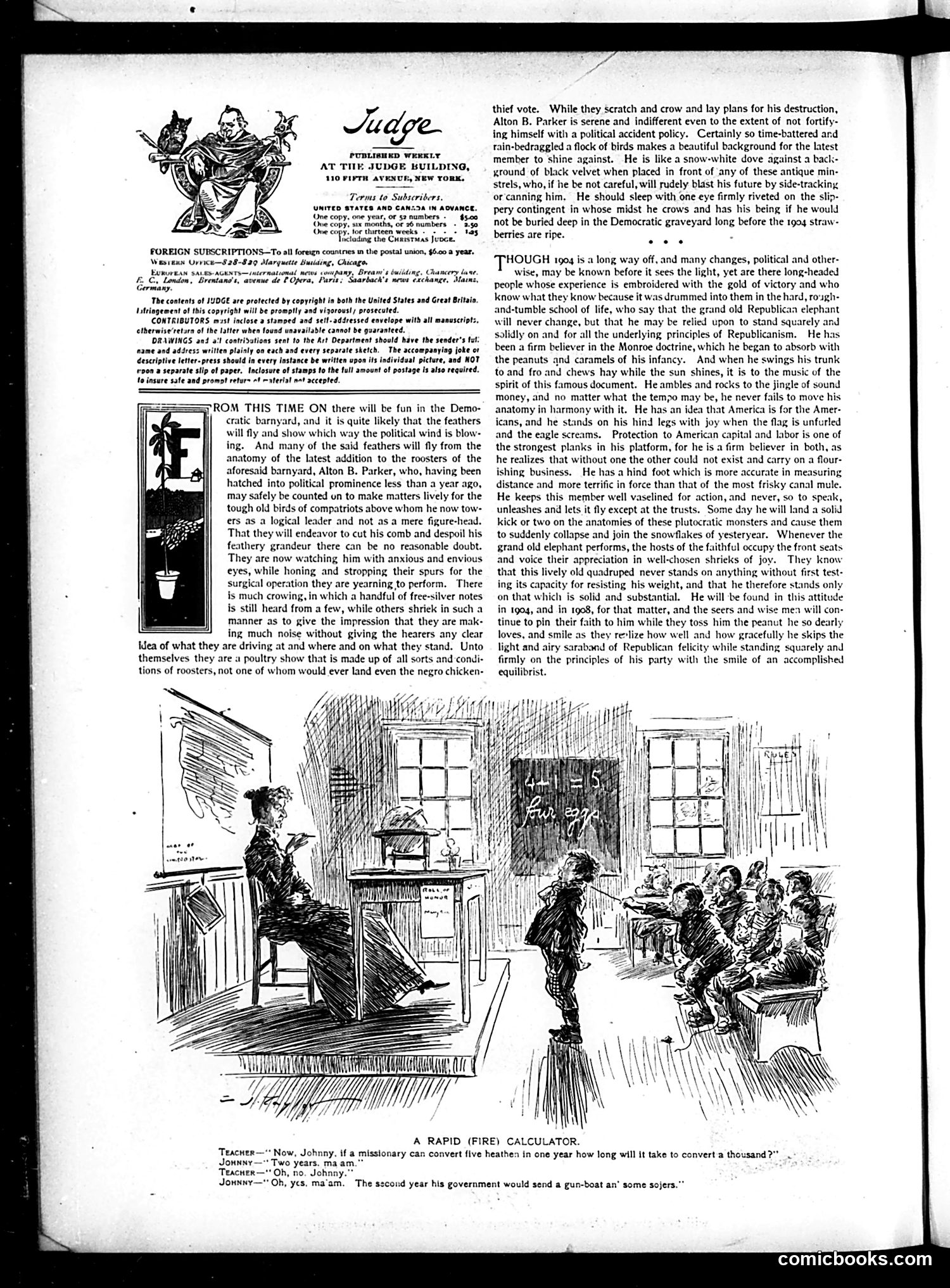
This cartoon satirizes religious conversion efforts through a schoolroom scene. A teacher poses a math problem to students: if a missionary converts five heathen in one year, how long to convert a thousand? Johnny answers "Two years, ma'am," but the teacher corrects him. Johnny then quips that "the second year his government would send a gun-boat an' some sojer's." The joke critiques American imperialism and missionary work in the late 19th/early 20th century, suggesting that religious conversion efforts were actually backed by military force and gunboat diplomacy. The "rapid fire calculator" pun refers both to quick math and to rapid-fire weapons used in colonial expansion. It's a cynical commentary on how Western powers combined religious conversion with military conquest.
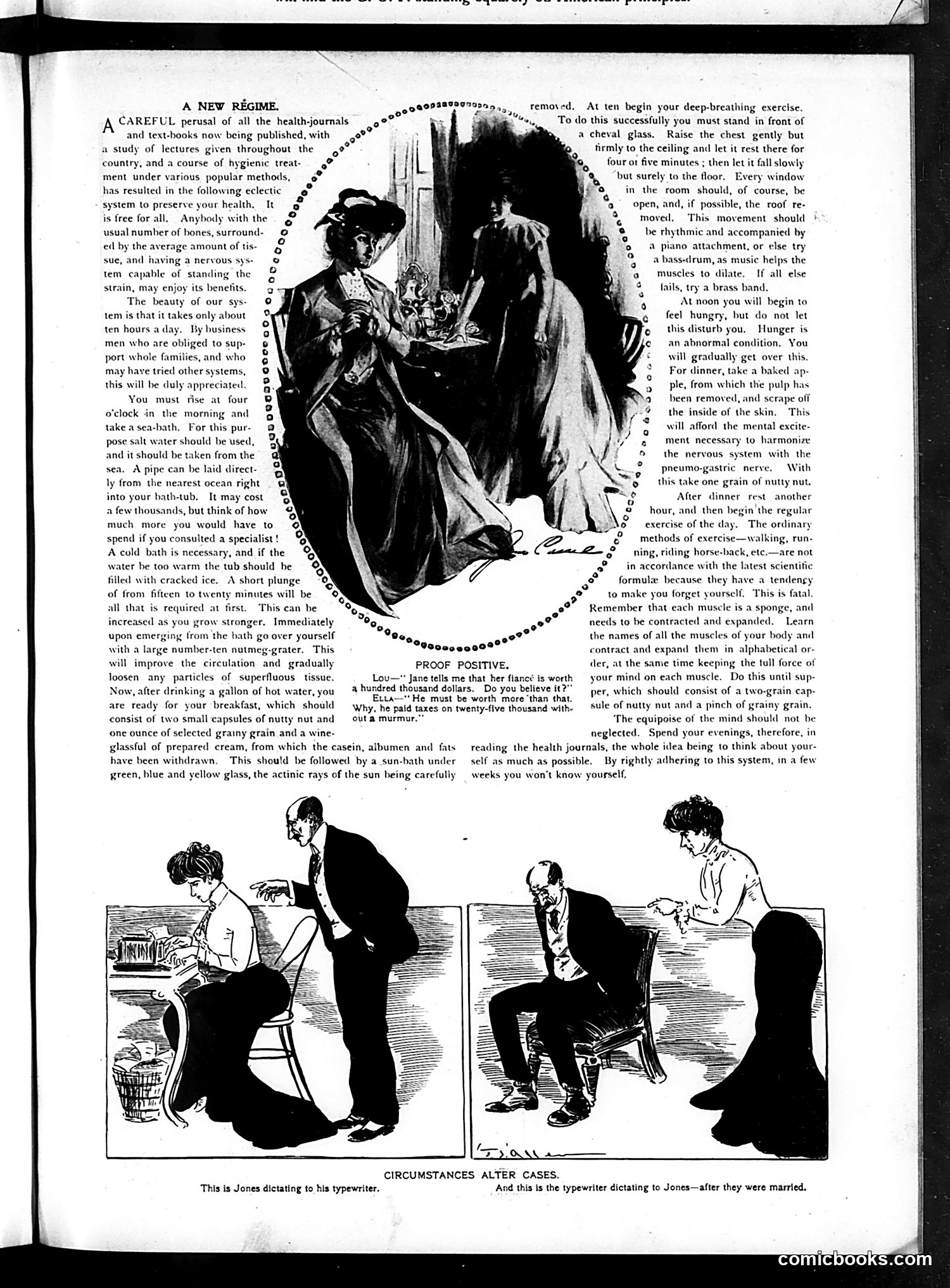
This page satirizes early-20th-century health fad literature. The main article promotes an eccentric daily regimen—rising at 4 AM, salt-water baths, specific breathing exercises, and controlled diet—claiming it prevents illness and extends life. The central illustration shows a woman and man in fashionable dress, likely representing the health-conscious upper classes adopting such regimens. The two bottom cartoons, titled "Circumstances Alter Cases," humorously depict role reversal in marriage: the left shows a man dictating to his typewriter-wielding secretary; the right shows the *same couple after marriage*, with the woman dictating while the man operates the typewriter. The joke mocks how marriage reverses power dynamics—what seemed like professional authority becomes domestic subordination. This reflects contemporary anxieties about women's expanding roles and marital authority.
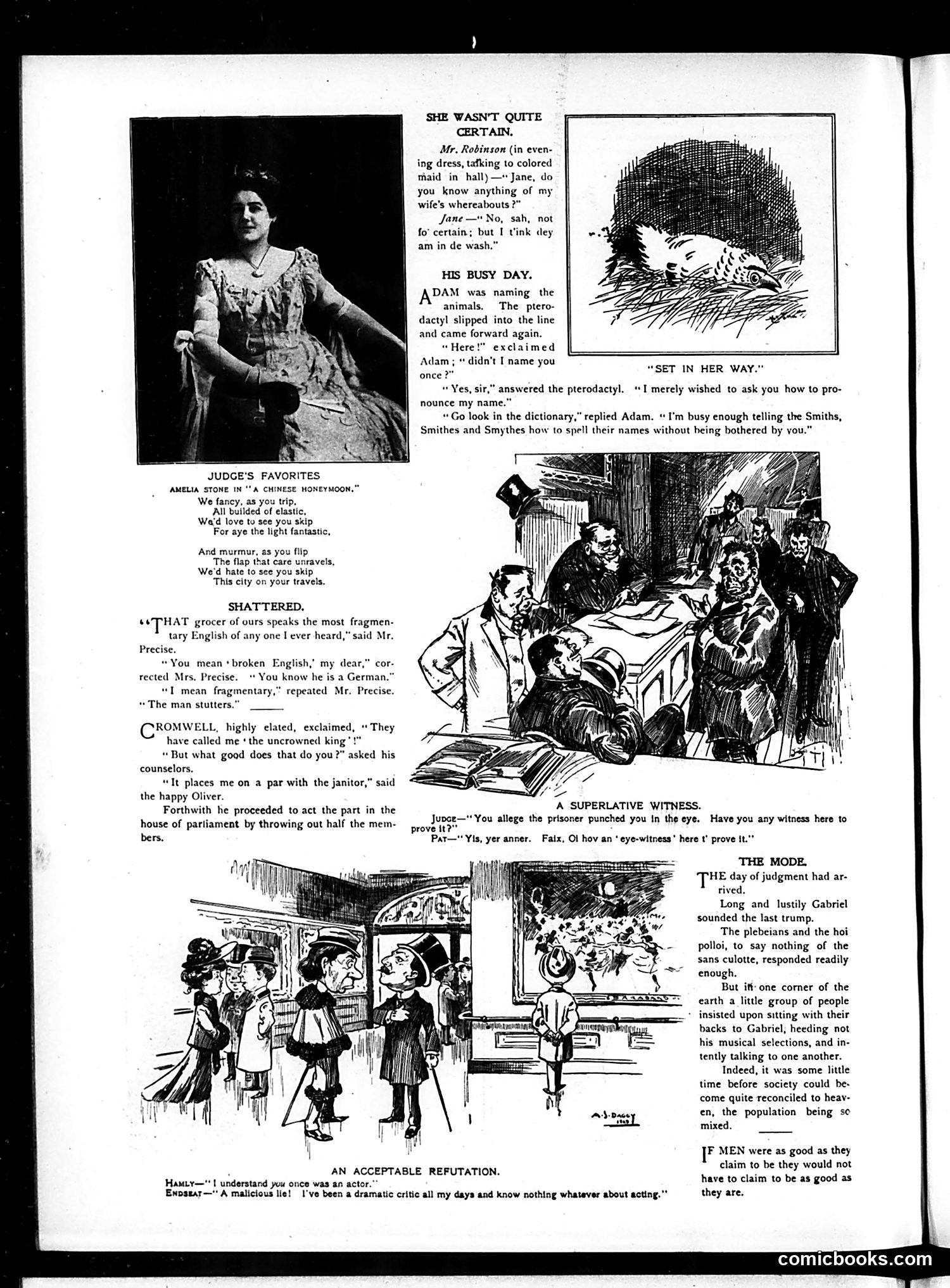
This page contains several short satirical pieces and illustrations typical of early 20th-century Judge magazine humor. **"She Wasn't Quite Certain"** mocks a husband's uncertainty about his wife's whereabouts, suggesting domestic carelessness. **"His Busy Day"** depicts Adam naming animals, with a pun on "pterodactyl" pronunciation—light wordplay humor. **"Shattered"** satirizes poor English speech, with characters mocking a German-speaker's fractured English as "broken English" and comparing him unfavorably to a janitor. **"A Superlative Witness"** shows a courtroom scene where a witness claims to have an "eye-witness" to prove the prisoner's guilt—likely wordplay on the term. **"The Model"** and **"An Acceptable Reputation"** appear to be society/theater jokes referencing actors and social pretension. The overall tone targets immigrant speech, class distinctions, and urban social dynamics.
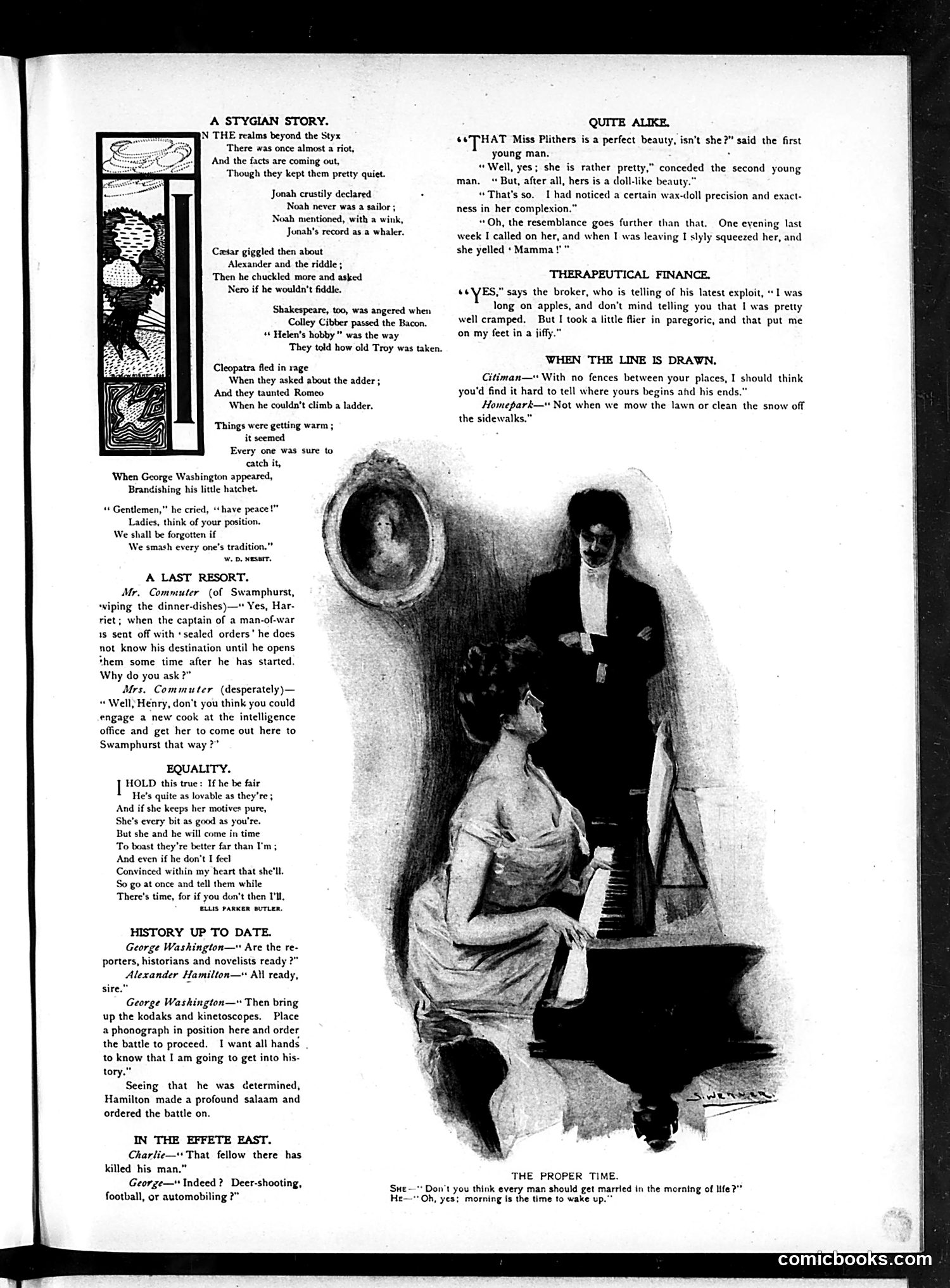
This page contains several satirical pieces typical of early 20th-century American humor: **"A Stygian Story"** mocks the tendency to debunk historical figures' accomplishments. Famous figures in the afterlife squabble over each other's legacies—Noah vs. Jonah over sailing, Shakespeare over authorship—until George Washington appears and appeals to preserve their reputations. The satire targets how successive generations rewrite history to diminish predecessors. **"A Last Resort"** jokes about a commuter's desperation: he suggests hiring a new cook via "sealed orders" (like military dispatch) so she won't know she's going to remote Swamphurst—implying no cook would accept the position knowingly. **Other pieces** include light social commentary: "Equality" on treating people fairly; "History Up to Date" satirizes modern documentation obsession (kodaks, kinetoscopes, phonographs) replacing actual historical events; and "Quite Alike" contains a doll-joke about a woman's mechanical response. The humor is genteel and topical rather than pointed political satire, reflecting Judge's style of social observation for educated readers.
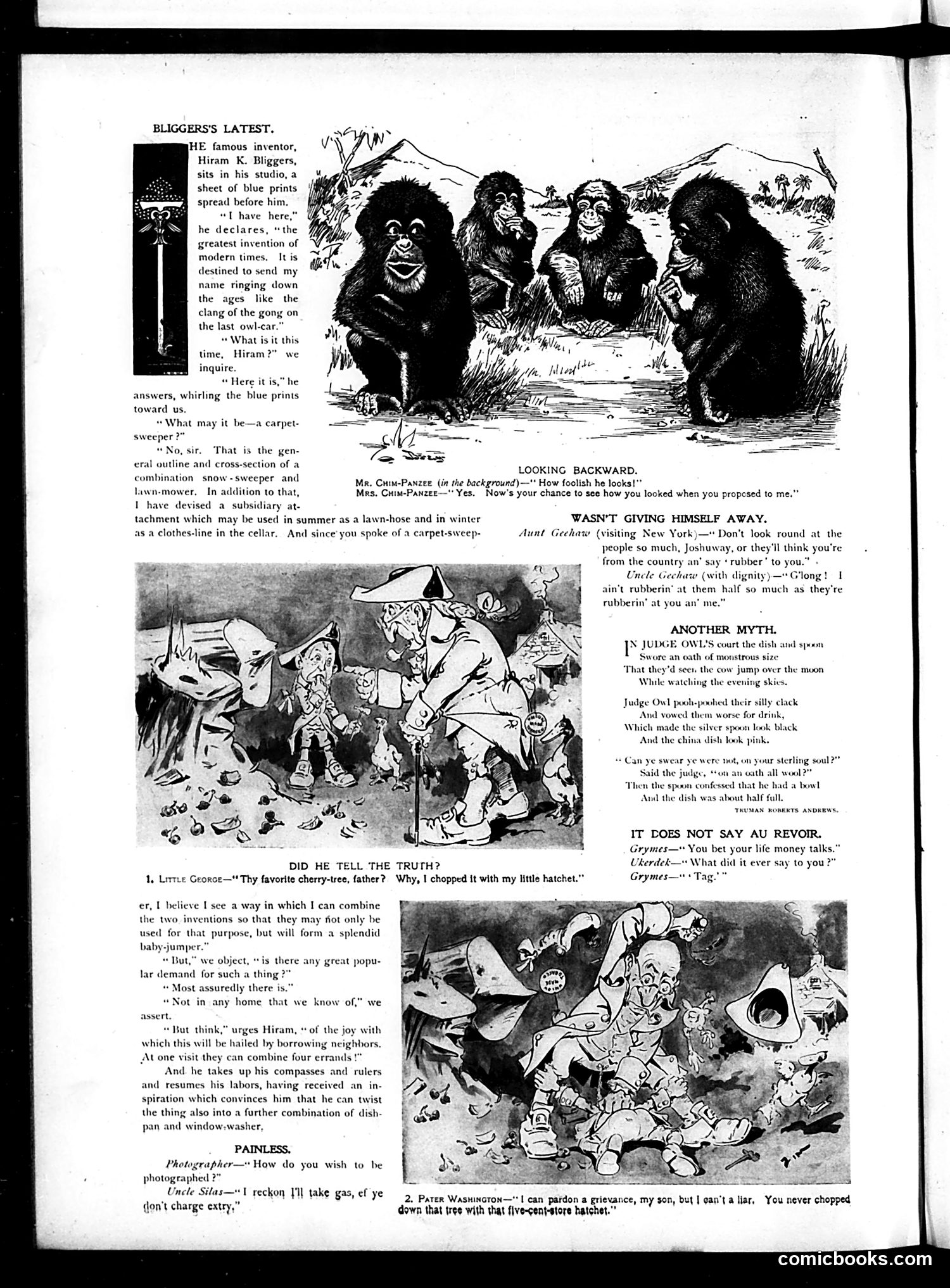
This page from Judge magazine features multiple satirical cartoons mocking American life and character: **"Bliggers's Latest"** ridicules inventor culture and consumer gullibility. Hiram K. Bliggers presents an absurdly impractical multi-purpose contraption (snow-sweeper/lawn-mower/clothes-line/baby-jumper/dish-pan/window-washer), satirizing both inventors' grandiose claims and neighbors' eagerness to borrow gadgets. **"Looking Backward"** uses chimpanzees as caricatures of humans, with the female ape mocking the male for his foolish proposal—a crude joke about courtship and regret. **Rural/Urban humor** sections mock country visitors in New York ("rubberin'") and portray Uncle Silas as a cheapskate requesting anesthesia to avoid paying for photography. **"Another Myth"** and other sections present humorous takes on lying and dishonesty. The recurring Washington cherry-tree reference alludes to the apocryphal young George Washington story about confessing to cutting down a tree—here inverted to expose that confession itself may be false. Overall: early 20th-century satire targeting inventors, class differences, rural stereotypes, and American character.
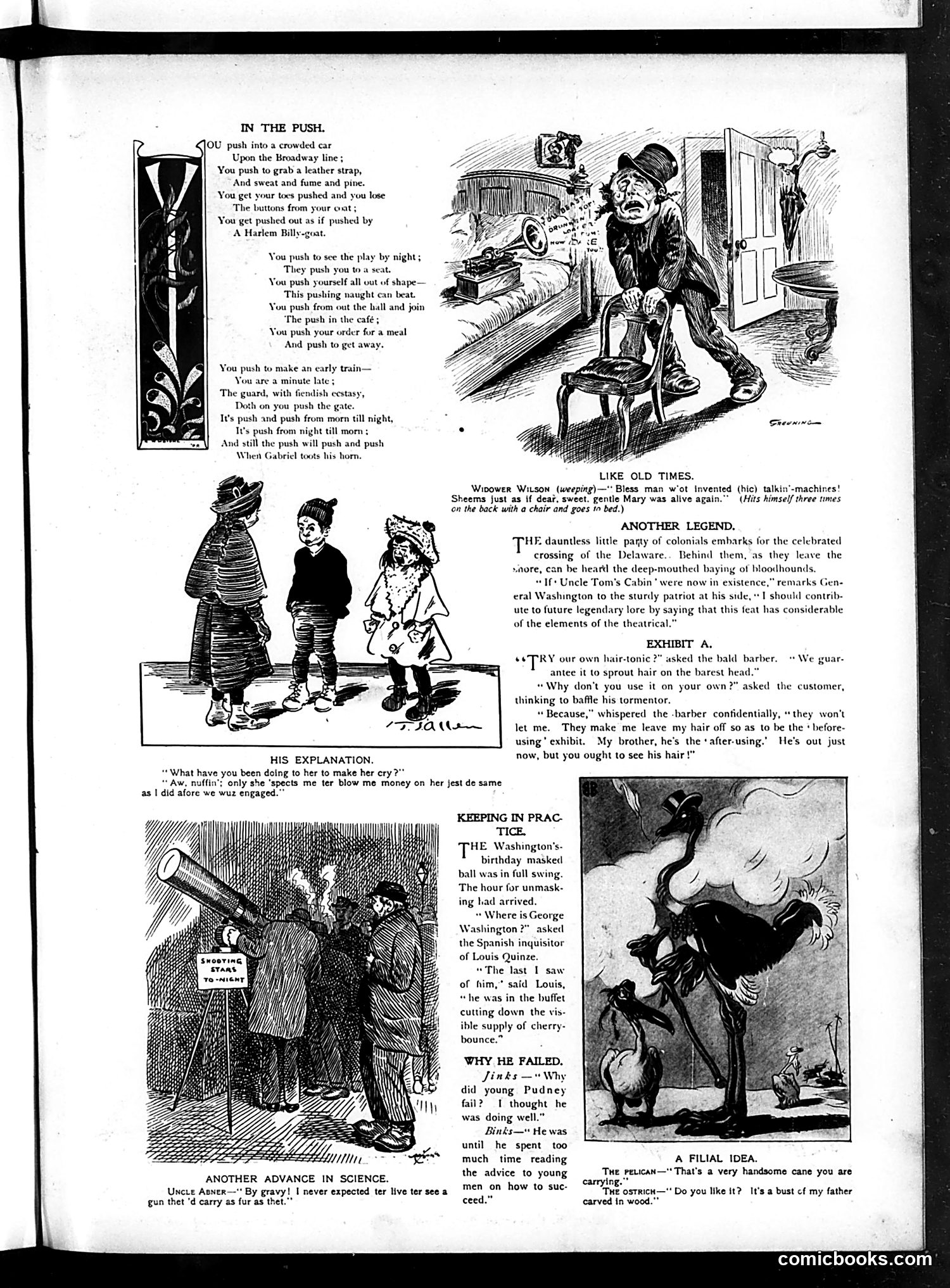
This page from *Judge* contains multiple humor pieces typical of early 20th-century American satire: **"In the Push"** satirizes the chaotic experience of crowded New York City public transportation and urban life—the relentless jostling on Broadway streetcars, theaters, and restaurants. The poem mocks modern city-dwellers' constant struggle against crowds. **"Like Old Times"** jokes about a widower using a phonograph (talking machine) to hear his deceased wife's voice, then hitting himself with a chair—dark humor about grief and marital discord. **"Another Legend"** anachronistically imagines George Washington's Delaware crossing accompanied by bloodhounds (likely referencing slave-catching imagery), satirizing how historical events get dramatized. The remaining items are brief gags: a bald barber selling ineffective hair tonic, a fiancée's mercenary expectations, and similar period comedic tropes. The cartoons use caricature and visual exaggeration typical of era humor. Overall, the page reflects urban anxieties and domestic comedy popular with *Judge's* middle-class readership.
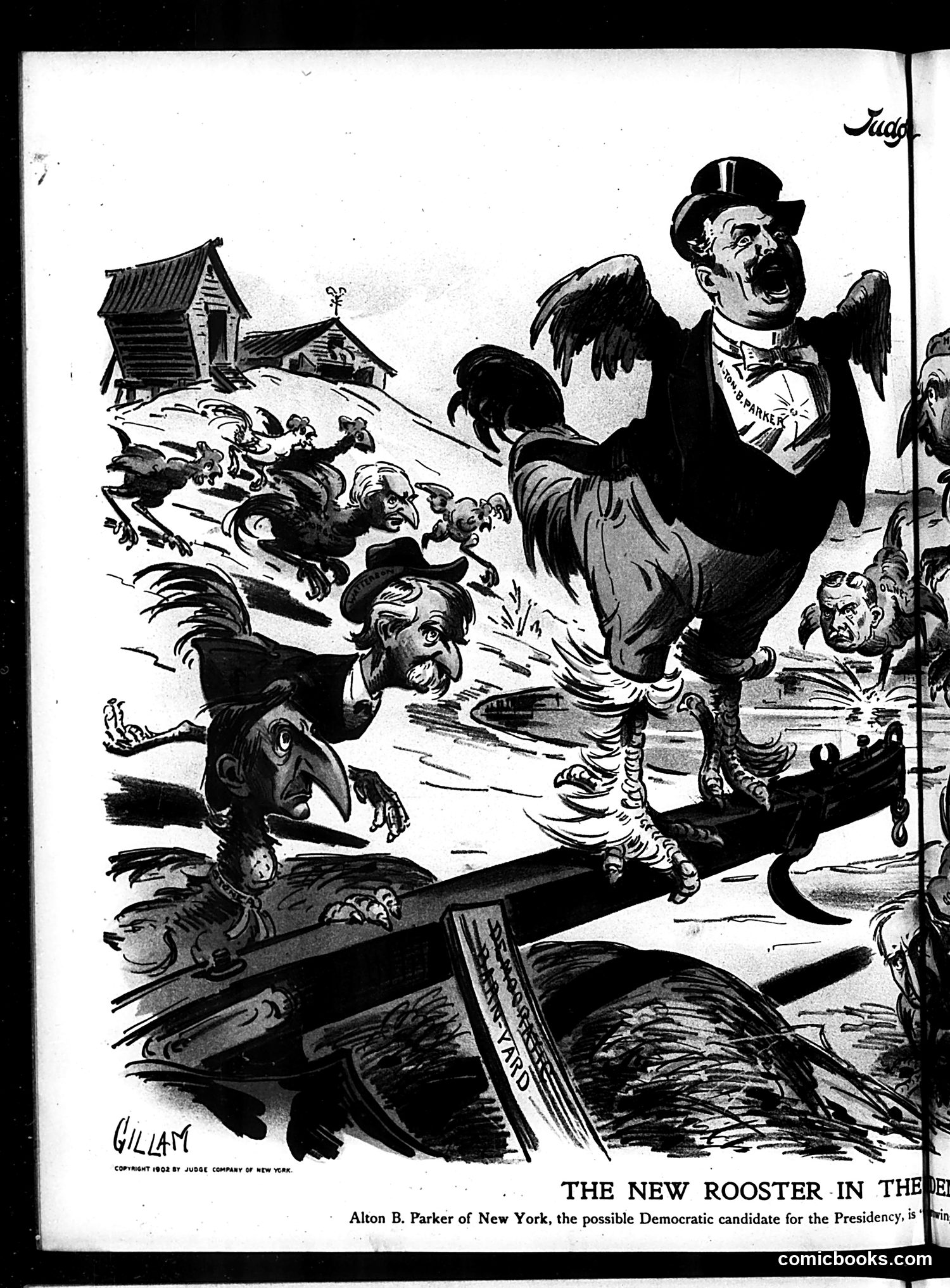
This 1902 *Judge* cartoon satirizes Alton B. Parker of New York as a potential Democratic presidential candidate. The large rooster (representing Parker) struts among smaller figures with caricatured features, depicted as demons or devils—likely representing Democratic party rivals or internal factions. The rural setting with a church suggests commentary on Parker's provincial appeal or background. The "new rooster" metaphor implies Parker as an untested or upstart leader within the party "den." The threatening postures of the surrounding figures suggest skepticism about his viability or warnings of trouble ahead. The artist (Gillam) uses animal caricature—a common *Judge* technique—to mock Parker's candidacy and the Democratic party's internal divisions during this election cycle.
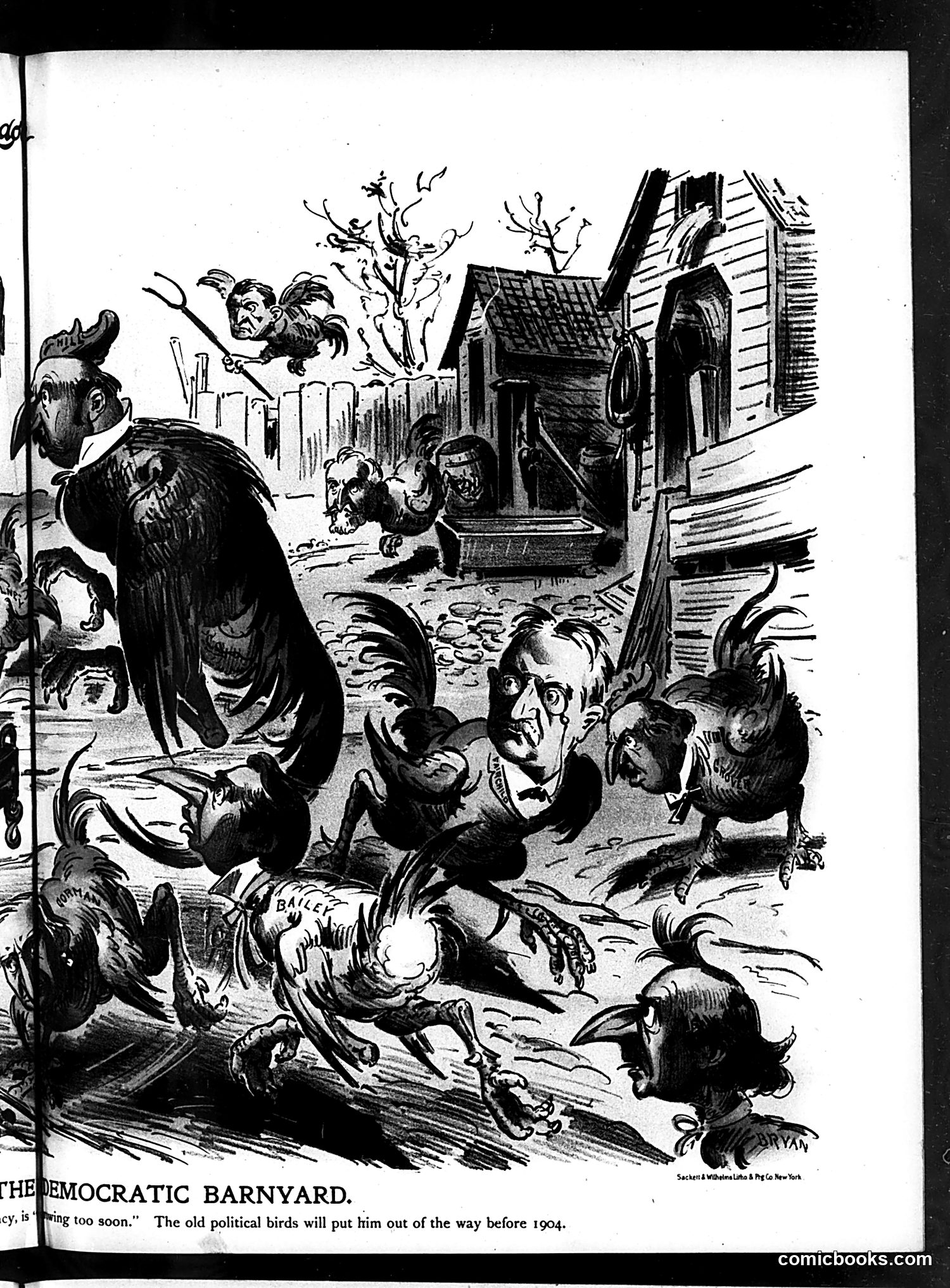
This political cartoon satirizes the Democratic Party as a chaotic farmyard filled with quarreling animals and figures. The title and caption ("coming too soon"/"The old political birds will put him out of the way before 1904") suggest internal Democratic conflict ahead of the 1904 election. The central human figure appears distressed amid various animals—likely representing competing Democratic factions or candidates fighting for control. The barnyard setting is a deliberate insult, equating Democratic leadership with livestock and disorder. The cartoon reflects Judge magazine's Republican perspective, mocking Democrats as disorganized and unable to present a unified front. The reference to 1904 suggests this was published during Theodore Roosevelt's presidency, anticipating Democratic turmoil in the upcoming election cycle.
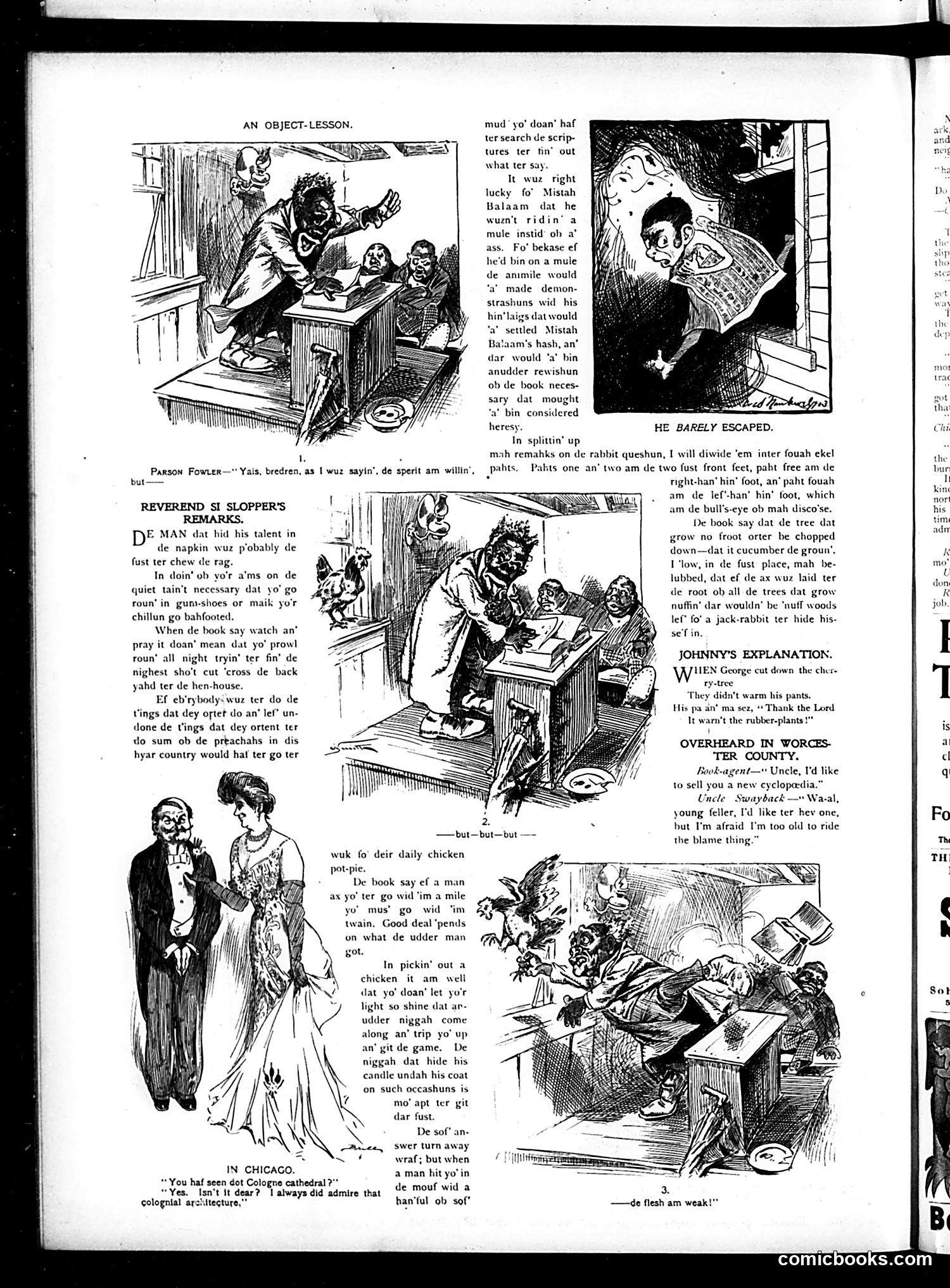
This page contains humorous anecdotes and satirical commentary, primarily targeting rural/Southern dialect speech and hypocrisy. **Main Content:** **"Reverend Si Slopper's Remarks"** features a Black preacher delivering sermons in exaggerated dialect, ostensibly offering moral guidance while revealing practical self-interest. The satire mocks religious hypocrisy—the reverend preaches Christian virtues (charity, honesty) while making accommodations for human weakness and selfishness. **Illustrations** show classroom and domestic scenes with crude caricatures in period-appropriate dress. **Supporting jokes** include: - A Chicago dialogue about architectural appreciation (playing on mispronunciation) - "Johnny's Explanation" about the cherry tree legend, deflating its morality - "Overheard in Worcester County," an old man's joke about being too old for modern technology **The Point:** The page satirizes gap between professed morality and actual behavior across social classes, using dialect humor and everyday scenarios. The exaggerated Black dialect reflects late-19th-century Judge's standard comedic approach, though offensive by modern standards.
This page contains multiple short humorous anecdotes typical of Judge magazine's satirical commentary on American life, circa early 1900s. **Notable content:** The opening cartoon depicts Noah (biblical reference) boarding animals for an ark, with a neighbor mocking him for lacking a mule—the joke being the mule's stubborn reputation makes it the one animal Noah couldn't convince aboard. Other brief jokes target contemporary frustrations: a burglar finding nothing to steal, a poet's "burning" Georgia accent, and recurring complaints about coal rationing/pricing (referencing early 20th-century fuel shortages or inflation). One anecdote satirizes rural voters' indifference to the gold-silver debate, caring only about practical purchasing power—coal and food affordability. The remainder is advertising for Packer's Tar Soap, Sohmer Pianos, and other products typical of the era. **Context:** These represent working-class anxieties and humor about economic hardship and daily inconveniences rather than explicit political satire.
This page is primarily **advertising**, featuring whiskey, patent medicine, and playing cards from early 1900s America. The small humor pieces are period jokes: 1. **"Invisible Men"**: A joke about married men becoming socially invisible—the implication being that famous wives overshadow their husbands' identities. 2. **"Little Mary"**: A child's conversation with her mother assumes her father can't go to heaven because he "can't leave the store"—satirizing workaholic merchants prioritizing business over spiritual matters. 3. **"Annual Shopping"**: A customer asks a gunsmith for "bullet-proof vests" because baseball pitchers ("hurlers") throw recklessly. This reflects actual contemporary concerns about dangerous playing conditions before modern safety standards. The advertisements promote **Sulphume** (a dubious "liquid sulphur" cure-all for skin conditions), **Wilson Whiskey**, and **Bicycle Playing Cards**—typical products marketed with exaggerated health claims, status appeals, and quality assurances characteristic of unregulated early-20th-century American advertising.
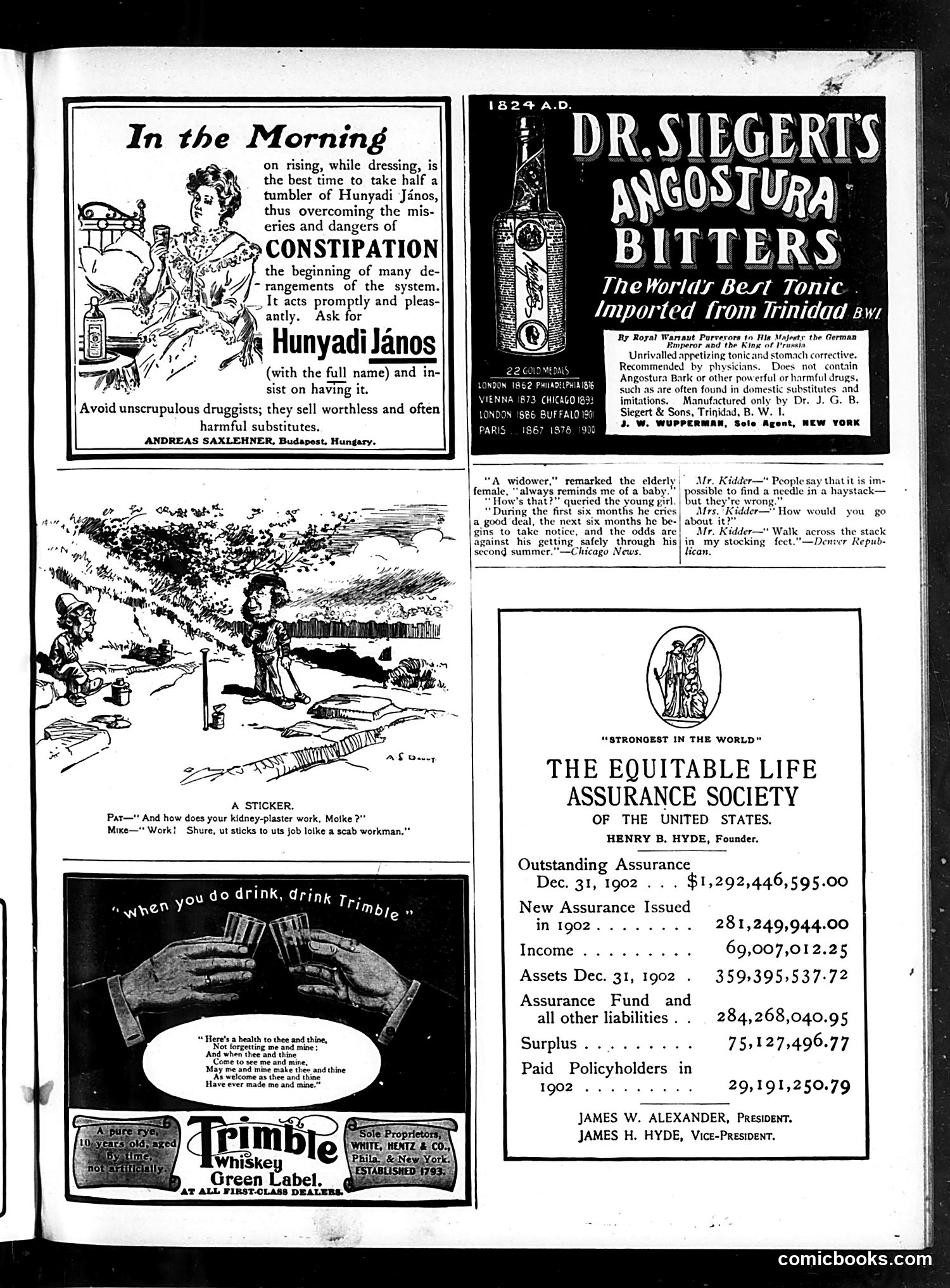
This page is primarily **advertisements** for patent medicines and financial services typical of 1902, with minimal editorial cartoon content. The main satirical element is "A Sticker," a brief comic featuring working-class Irish characters (Pat and Mike, indicated by dialect) discussing a kidney-plaster that "sticks to uts job lolke a scab workman." The joke plays on the term "scab"—a worker who crosses strikes—suggesting the plaster adheres stubbornly, like a strikebreaker clinging to a job. This reflects early-1900s labor tensions. Other content includes: - **Patent medicine ads** for Hunyadi Janos (a laxative), Dr. Siegert's Angostura Bitters, and Trimble Whiskey—typical of an era before FDA regulation when such products made health claims freely - **Equitable Life Assurance Society** statistics, showing financial strength - Brief joke excerpts about babies and haystacks The page reflects a period when Judge mixed editorial satire with unregulated commercial advertising.
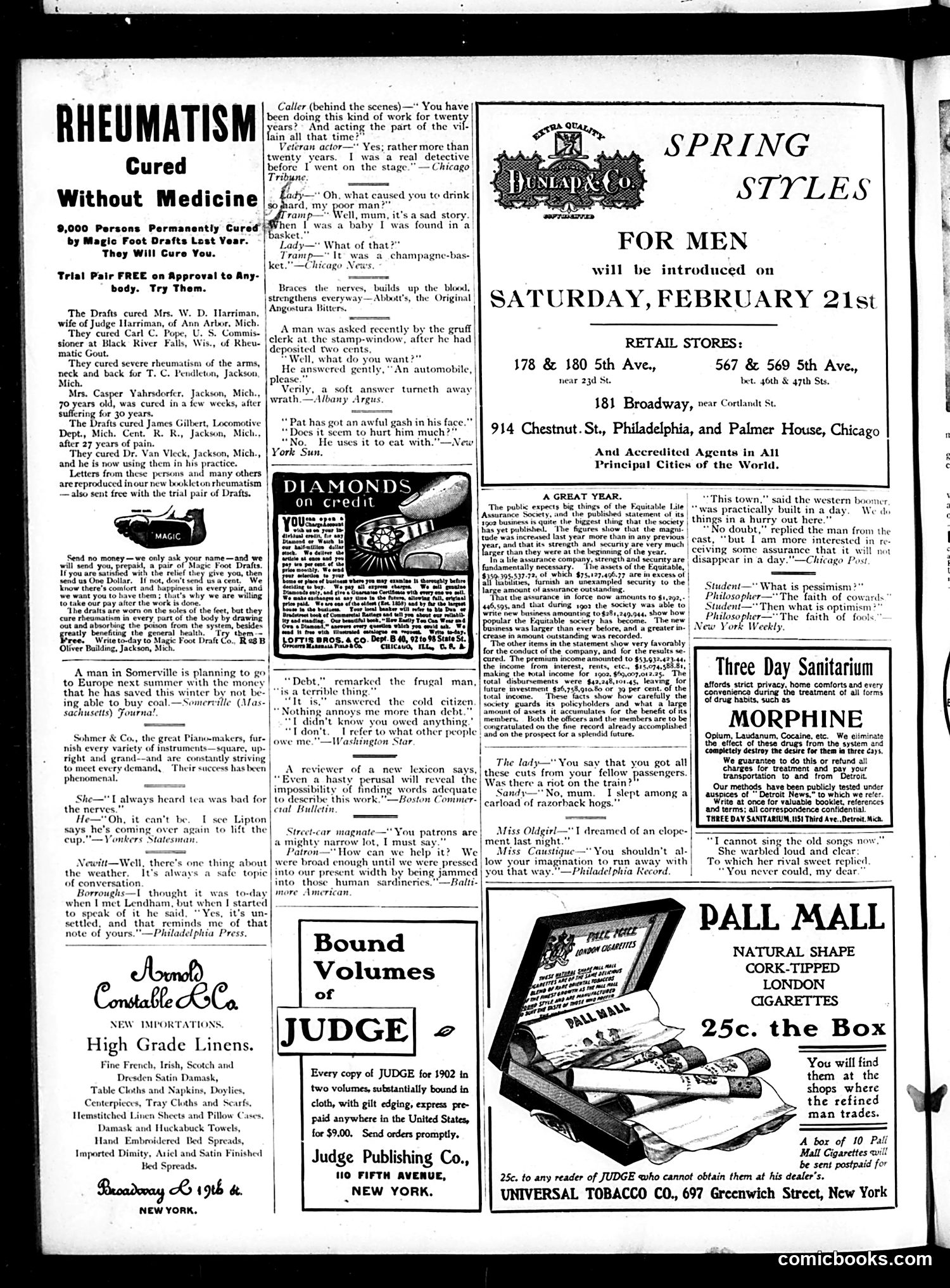
This page is primarily **advertising** mixed with humor excerpts. The main content includes: **Medical Ads:** "Magic Foot Drafts" claim to cure rheumatism without medicine, citing testimonials from supposedly cured patients. This is typical **patent medicine fraud**—common in early 1900s before FDA regulation. **Humor Sections:** Brief jokes about: - An actor claiming stage experience as detective work - A tramp's champagne-bottle origin story - A postal clerk asking for an automobile (absurdist humor) - A man with a facial gash using it to eat (dark humor) **Fashion Ad:** Dunlap & Co. announcing spring menswear introduction. **Product Ads:** Judge magazine bound volumes, Pall Mall cigarettes, Judge Publishing Company books. The page reflects **early 20th-century advertising practices**—exaggerated health claims, irreverent jokes, and heavy product promotion mixed throughout editorial content. The "rheumatism cure" particularly exemplifies how unregulated medical marketing exploited desperate patients before modern consumer protection laws.
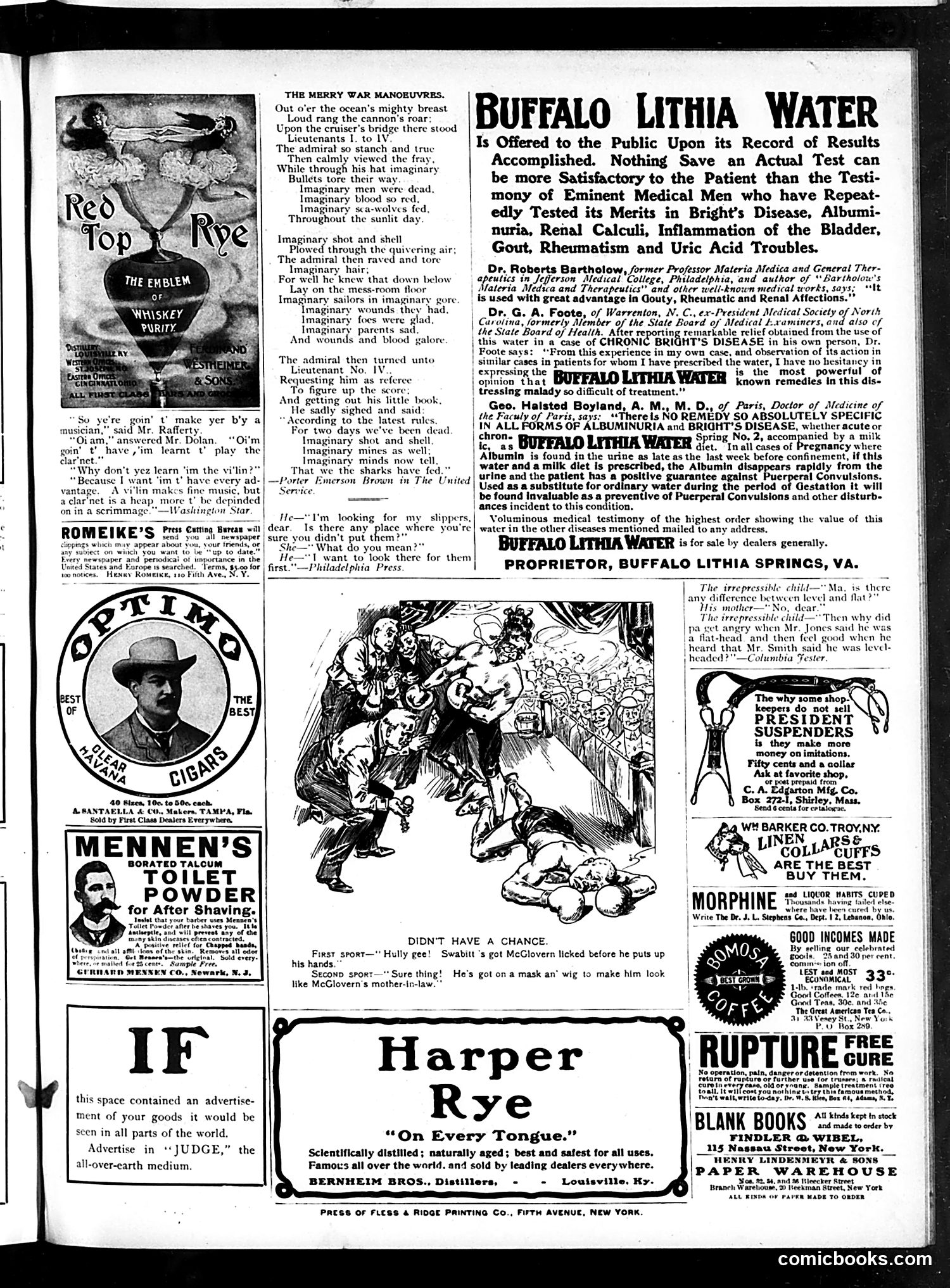
This Judge magazine page is primarily **advertising-focused** rather than political satire. The main content includes: **The Cartoon ("Didn't Have a Chance")**: A humorous domestic scene depicting a man being beaten or roughed up, with text referencing "McGlover" and "mother-in-law." The joke appears to be about domestic conflict or marital discord—a common humor topic of the era. **Dominant Advertisement**: The bulk of the page promotes **Buffalo Lithia Water**, a patent medicine claiming to cure kidney disease, gout, rheumatism, and related ailments. It cites testimonials from medical doctors—a marketing strategy common in this period before FDA regulations. **Smaller Ads & Humor**: Include whiskey ("Red Top Rye"), cigars, talcum powder, and other period products. There's also a brief joke about a man searching for slippers. The page reflects early 20th-century publishing: entertainment mixed heavily with unregulated medical/product claims that would be illegal today. The satirical content is minimal—mostly lighthearted domestic humor rather than political commentary.
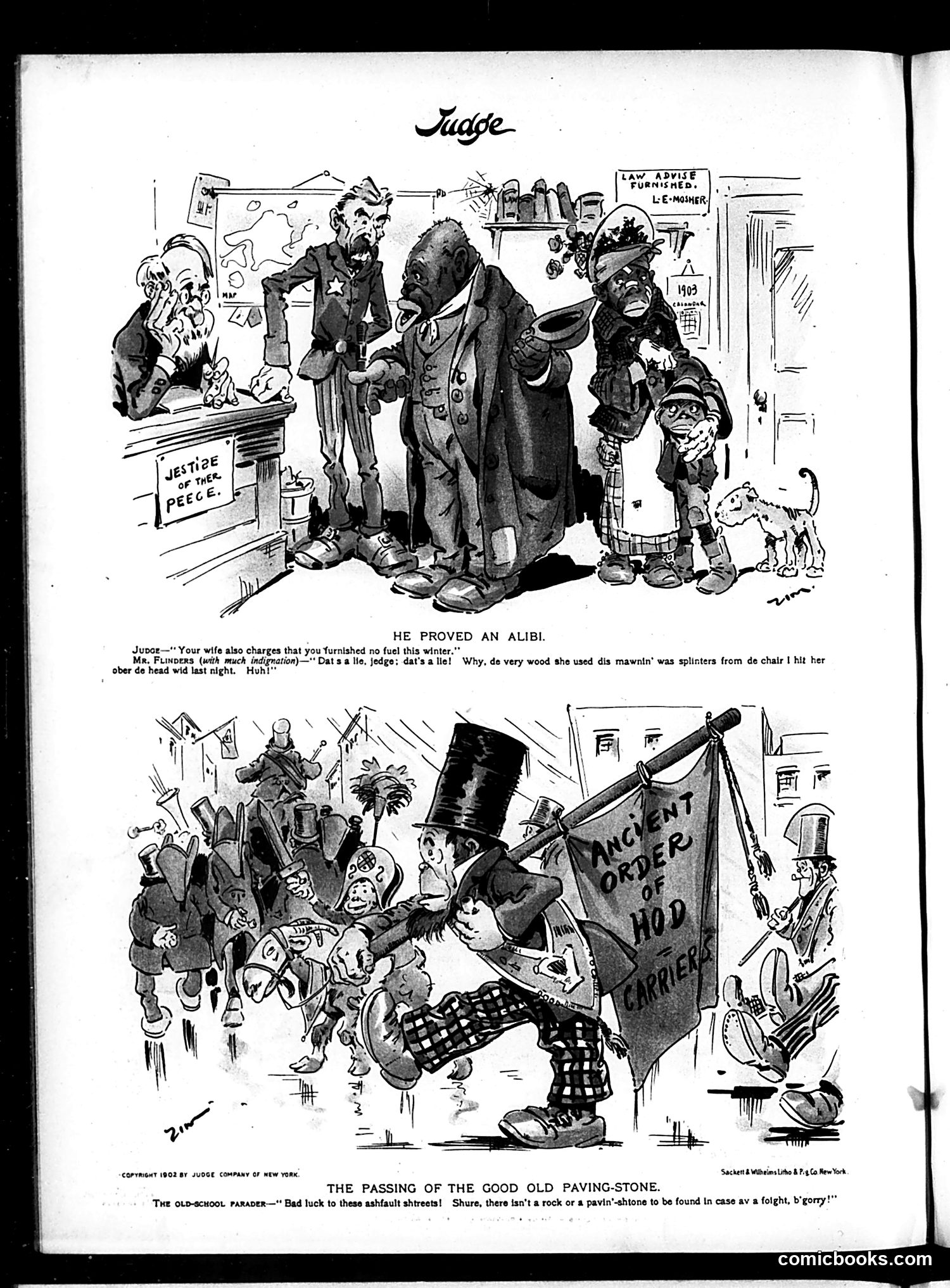
**Top Cartoon: "He Proved an Alibi"** A man accused of not providing fuel during winter "proves" he *did* use wood—by breaking up his chair to hit his wife with it the night before. The satire mocks both domestic violence (treated as comedic) and circular logic in court testimony. The caricatured defendant appears to be depicted with ethnic features suggesting an immigrant, common in early 1900s Judge satire that often stereotyped working-class foreigners. **Bottom Cartoon: "The Passing of the Good Old Paving-Stone"** An Irish-accented "old-school paver" laments that modern ashphalt streets provide no loose rocks or stones for street fights. The caricature relies on Irish immigrant stereotypes, satirizing both the perception of Irish immigrants as brawlers and nostalgia for older urban conditions. The joke reflects period anxieties about changing city infrastructure and immigrant behavior. Both cartoons employ ethnic caricature typical of early 1900s American humor.