
Judge, 1903-02-28 · page 16 of 16
Judge — February 28, 1903 — page 16: what you’re looking at
What you’re looking at
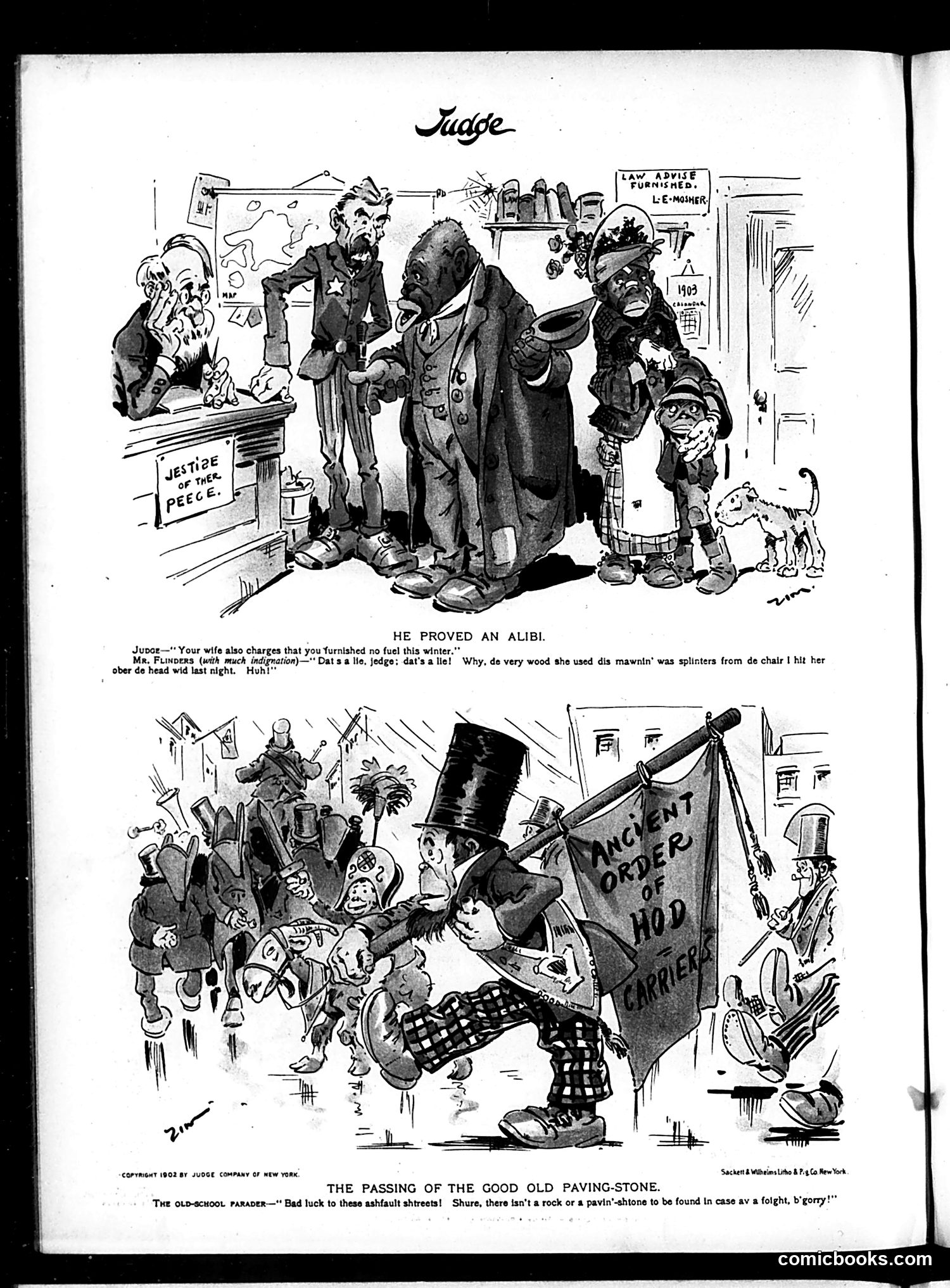
**Top Cartoon: "He Proved an Alibi"** A man accused of not providing fuel during winter "proves" he *did* use wood—by breaking up his chair to hit his wife with it the night before. The satire mocks both domestic violence (treated as comedic) and circular logic in court testimony. The caricatured defendant appears to be depicted with ethnic features suggesting an immigrant, common in early 1900s Judge satire that often stereotyped working-class foreigners. **Bottom Cartoon: "The Passing of the Good Old Paving-Stone"** An Irish-accented "old-school paver" laments that modern ashphalt streets provide no loose rocks or stones for street fights. The caricature relies on Irish immigrant stereotypes, satirizing both the perception of Irish immigrants as brawlers and nostalgia for older urban conditions. The joke reflects period anxieties about changing city infrastructure and immigrant behavior. Both cartoons employ ethnic caricature typical of early 1900s American humor.
📄 Transcribed text from this page (OCR, searchable)
Machine-transcribed from the original scan — historical spelling and the odd misread are preserved.
LAW ADVISE FURNISHED, HE PROVED AN ALIBI. Jupoz—"' Your wife also charges that you furnished no fuel this winter."* Mr, Fuinoers (with much indignation) —'* Dat 3 a le, jedge; dat's a lie! Why, de very wood she used dis mawnin’ was splinters from de chair | hit her ober de head wid last night. Huh!" COPYRIGNT 1902 BY JUOGE COMPANY OF KEW YORK: Sackett & Whlans Litho & Pig.Co Rew York THE PASSING OF THE GOOD OLD PAVING-STONE. ‘Tue ot-sctoot raraver—" Bad luck to these ashfault shtreets! Shure, there isn't a rock or a pavin'-shtone to be found In case av a folght, b’gorry!"” comicbooks.com