
A complete issue · 16 pages · 1903
Judge — January 31, 1903
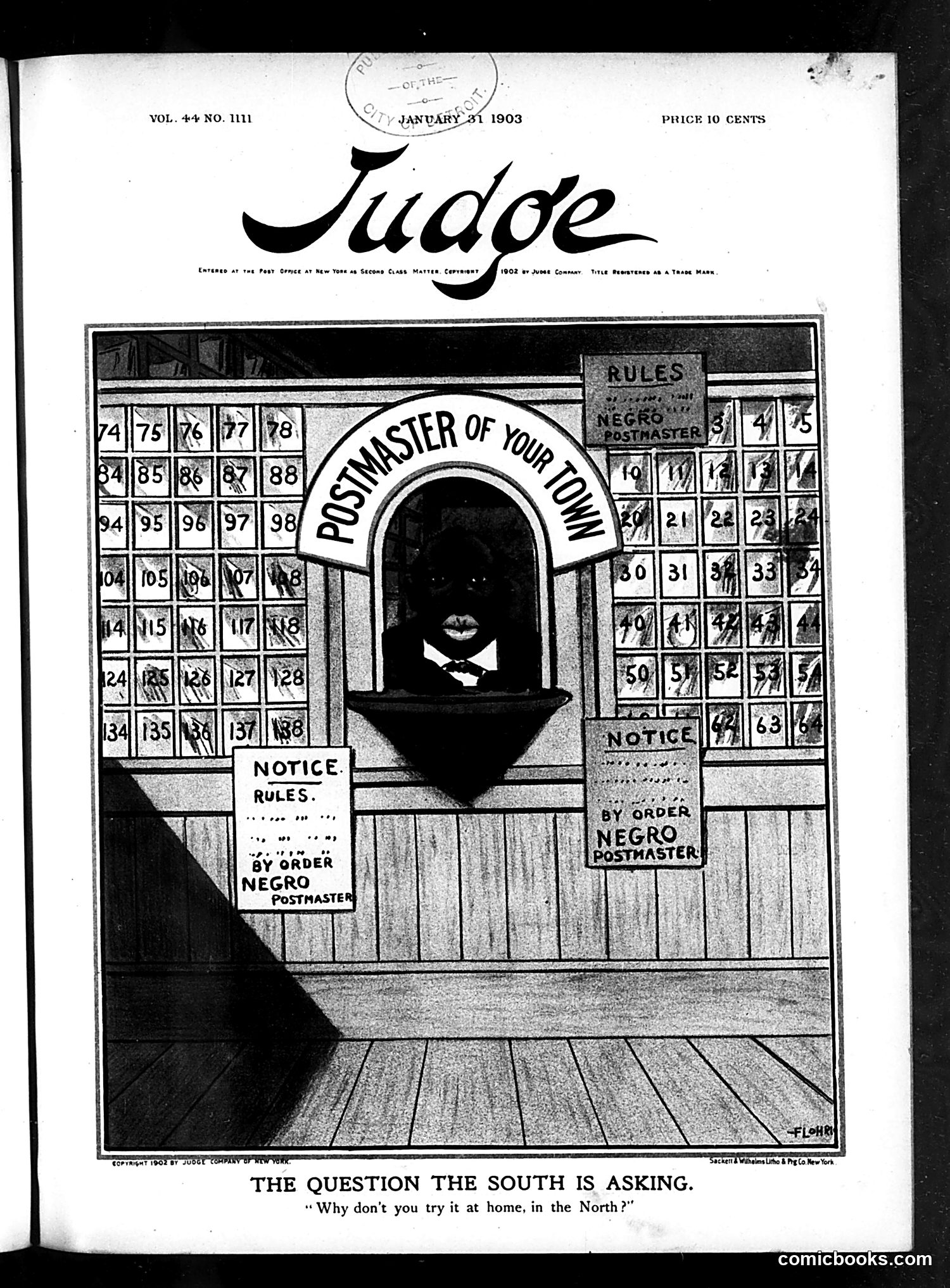
This 1903 *Judge* magazine cover satirizes racial segregation and postal discrimination in the American South. The illustration shows a Black postmaster at a window labeled "Postmaster of Your Town," surrounded by notices reading "Rules by Order Negro Postmaster" and "Negro Postmaster." The caption asks: "Why don't you try it at home, in the North?" The satire critiques Northern hypocrisy—while Northerners claimed moral superiority on racial issues, they too practiced segregation and discrimination. The cartoon suggests that rigid racial hierarchies and exclusionary rules weren't uniquely Southern problems but reflected nationwide prejudice. The appointment of Black postmasters was itself controversial during this era, making the position a focal point for racial tension.
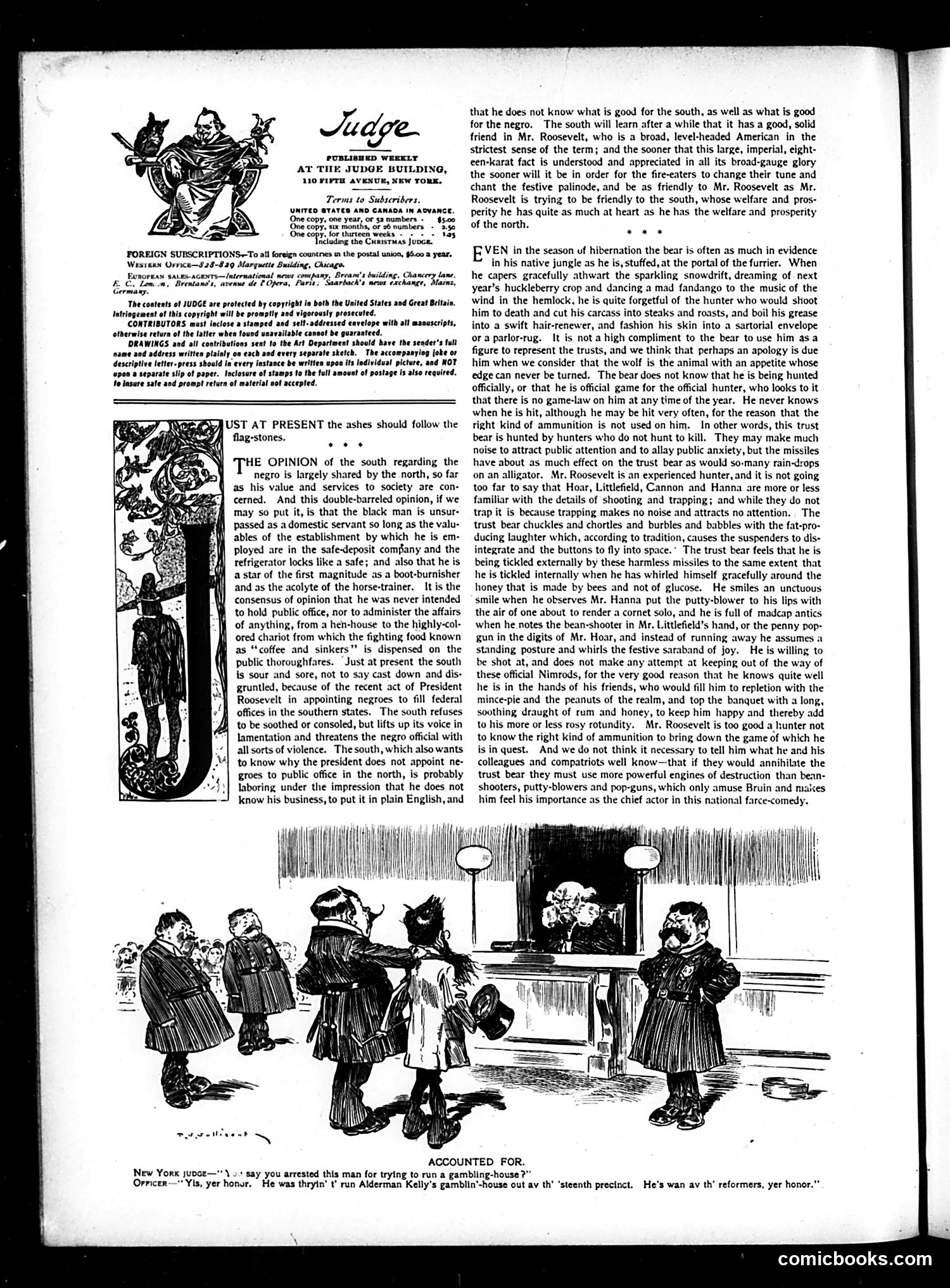
The main editorial article critiques President Roosevelt's appointment of Black federal officials in the South, arguing this causes racial tension. The writer claims Roosevelt doesn't understand Southern affairs and that appointing Black "coffee-sinkers" (a derogatory term) to government positions is inappropriate. The bottom cartoon, titled "Accounted For," depicts a police officer explaining to a superior why he arrested a man. The officer claims the man was running an illegal gambling operation disguised as "Alderman Katy's gambling-house" in "the 'teenth precinct." This satirizes municipal corruption—specifically how police either tolerate or participate in illegal activities within their precincts under political protection. Both pieces reflect early 1900s attitudes regarding race, corruption, and governance.
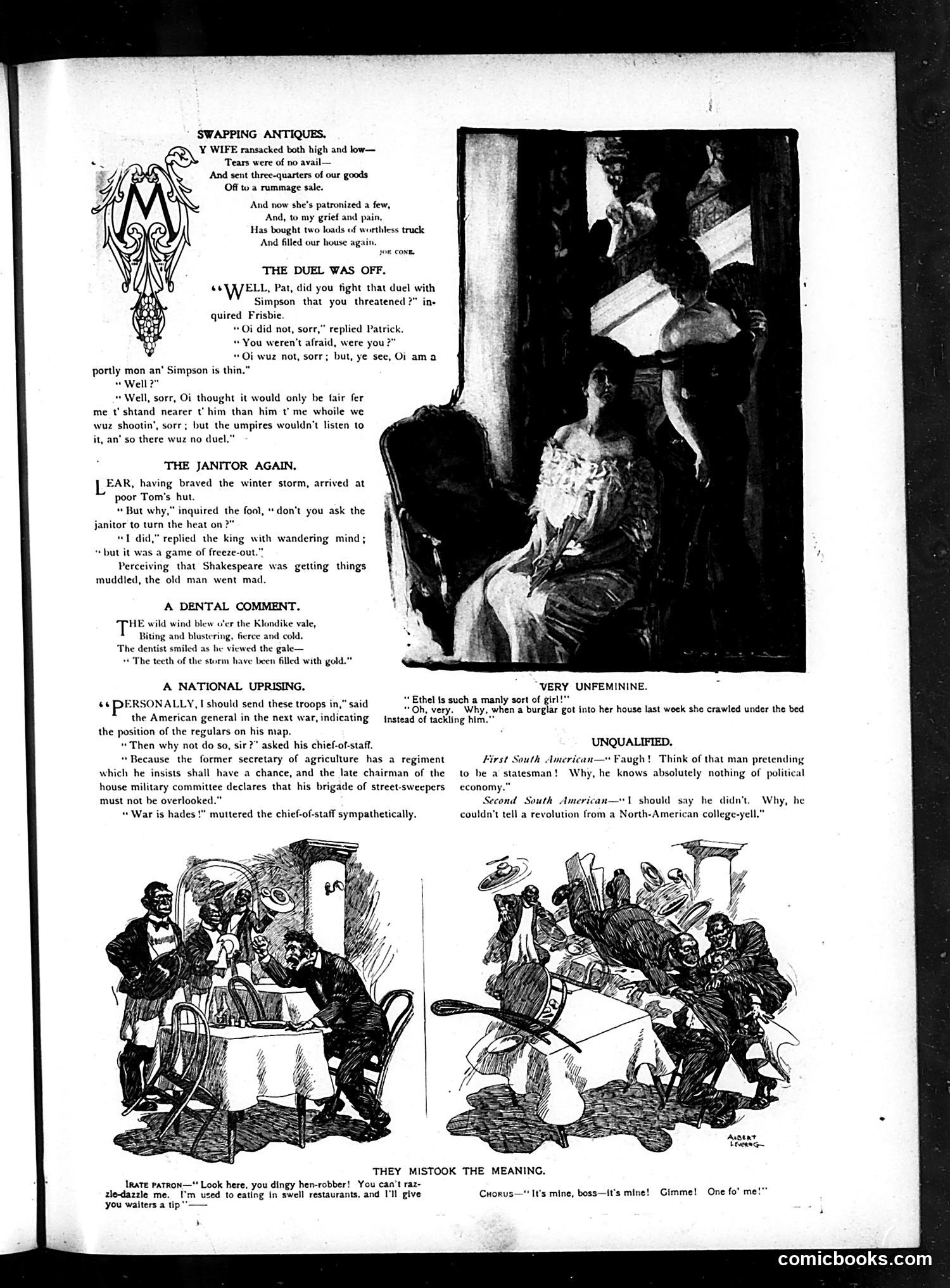
This page contains several satirical pieces and cartoons typical of early 20th-century Judge magazine humor: **"Swapping Antiques"** and **"The Duel Was Off"** are comedic anecdotes about domestic life and masculine posturing—likely poking fun at marriage tensions and men's exaggerated concerns about honor. **"The Janitor Again"** appears to mock Shakespeare references and pretension, while **"A Dental Comment"** makes a pun about storms filling teeth with gold. **"A National Uprising"** satirizes military bureaucracy and incompetence, with an American general's confusion about agricultural regulation. The bottom cartoons labeled **"Very Unfeminine"** and **"They Mistook the Meaning"** show domestic/social misunderstandings—likely targeting evolving gender roles and class pretensions of the era. The humor relies on visual gags and wordplay typical of period satirical magazines.
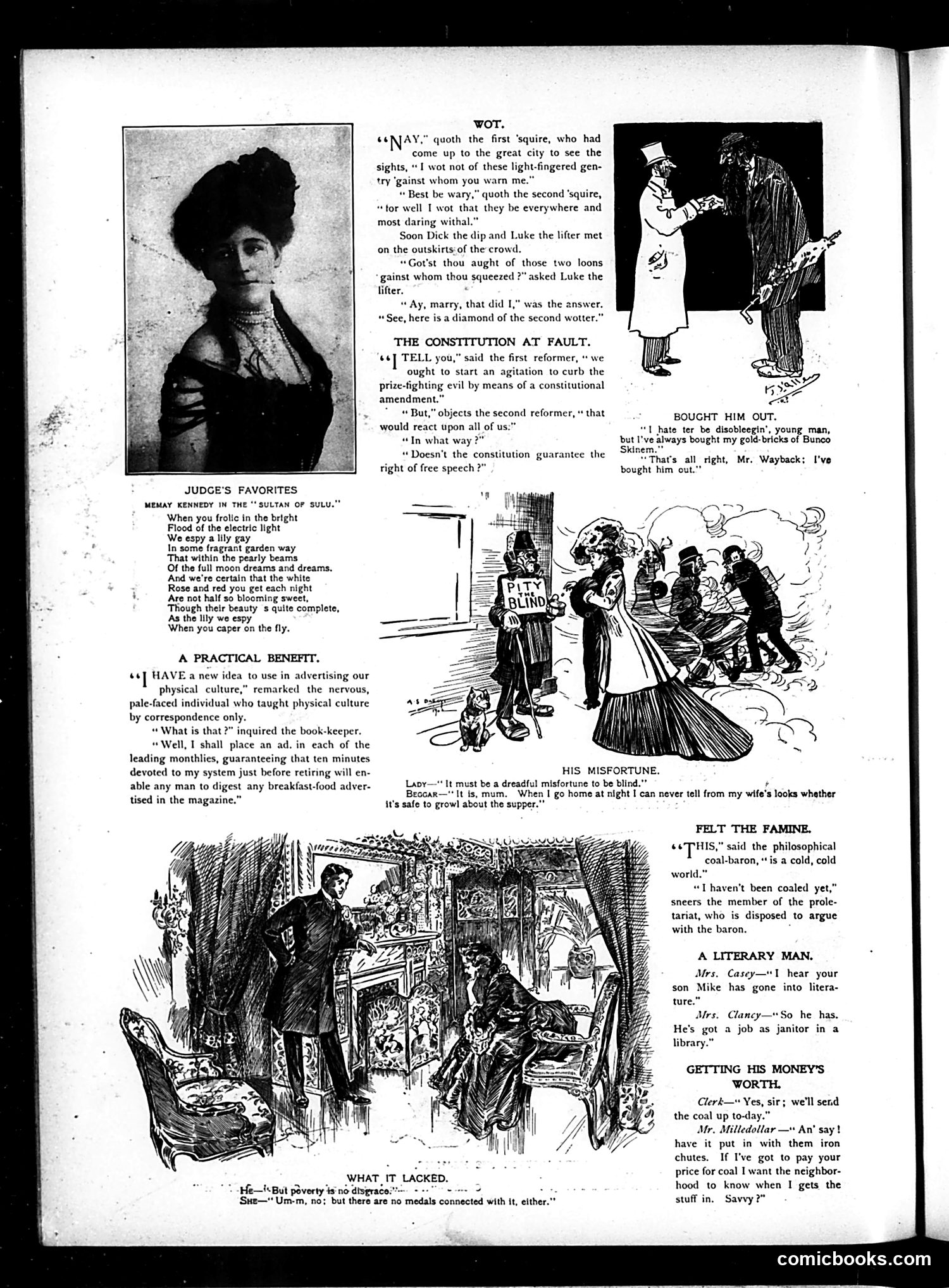
This page contains several satirical pieces typical of early 20th-century humor magazines: **"The Constitution at Fault"** section mocks reformers debating constitutional amendments to address social problems like prize-fighting, with one reformer questioning whether the Constitution guarantees free speech—suggesting the debate was frivolous or incomplete. **"A Practical Benefit"** satirizes dubious advertising claims in magazines, where a physical culture instructor promises miraculous digestive benefits from ten-minute daily routines. The remaining sketches appear to be generic domestic humor: a wife's confusion about her husband's earnings and coal delivery, and a son becoming a library janitor rather than pursuing "literature." The page functions as social satire targeting advertising fraud, constitutional debates, and middle-class pretensions—not specific political figures or events.
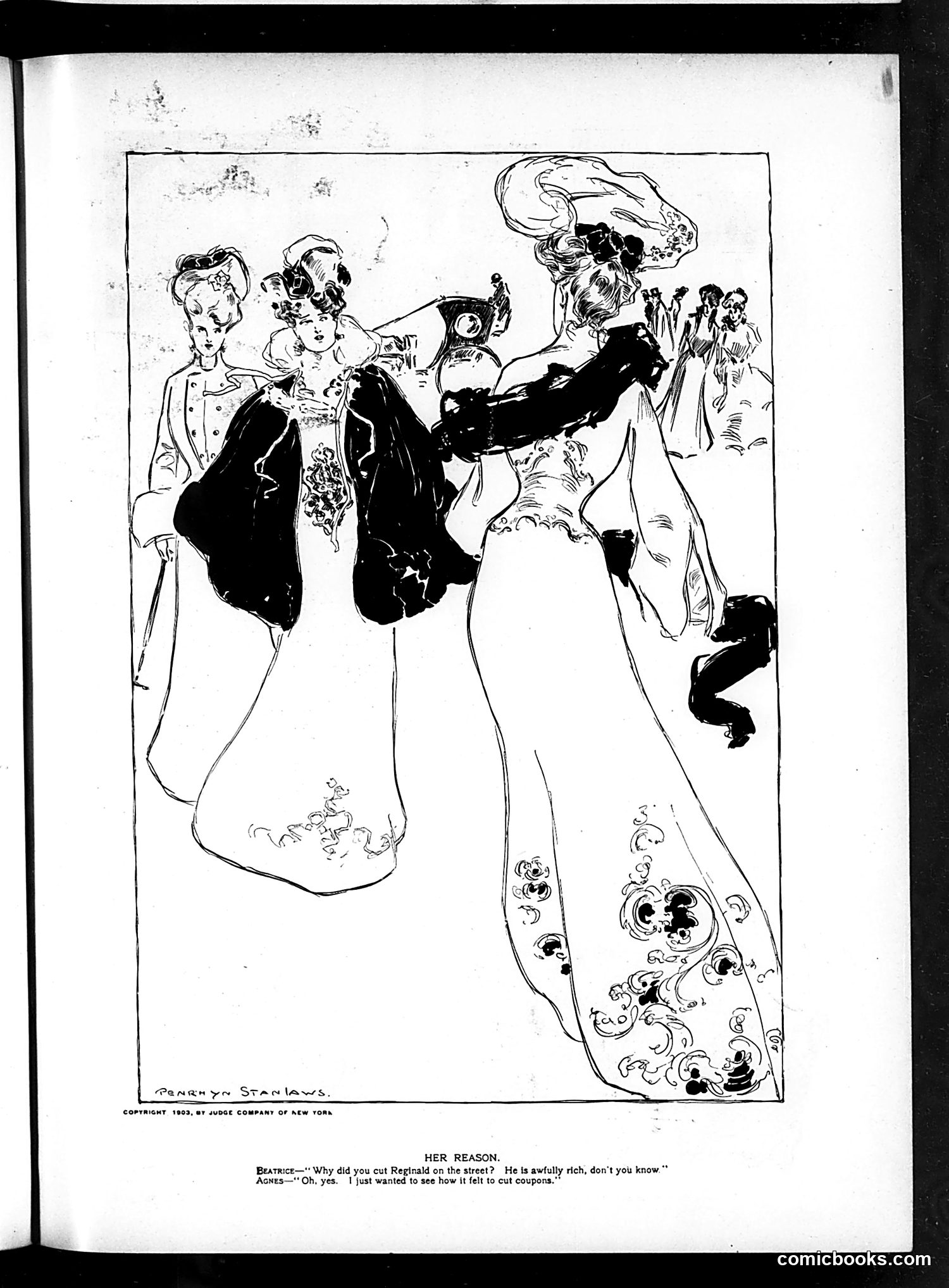
This cartoon by Penrhyn Stanlaws satirizes social climbing and wealth obsession among the wealthy. Two women, Beatrice and Agnes, discuss why Agnes "cut" (snubbed) a wealthy man named Reginald on the street. Agnes's response is a pun: she claims she wanted to experience "cutting coupons"—the literal act of clipping bond coupons for investment income—by socially cutting someone rich. The joke mocks the pretension that wealthy people live off investment returns rather than work, and Agnes's snobbish desire to feel financially superior by rejecting someone merely "awfully rich." It's early-20th-century satire of nouveau riche social anxiety and the obsession with displaying financial status through social exclusion.
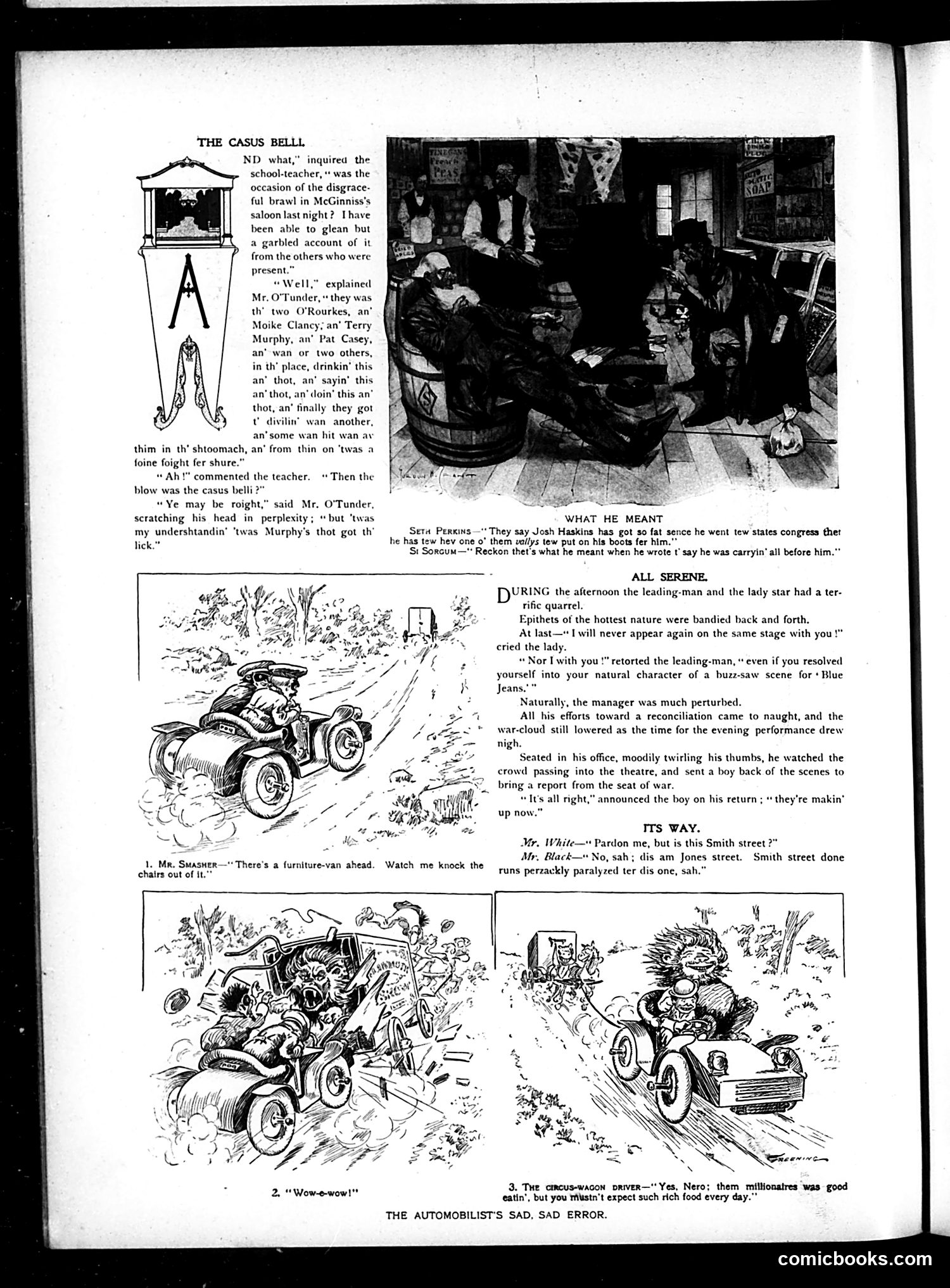
This page from **Judge** contains three separate satirical pieces: 1. **"The Casus Belli"** (top): A dialogue between a schoolteacher and Mr. O'Tunder, an Irish immigrant, about a barroom brawl. The satire mocks both Irish-American working-class dialect and pretentious vocabulary—the teacher uses the Latin legal term "casus belli" (cause of war) to describe a punch, while O'Tunder describes a chaotic fight without clear cause. The joke: the fight's origin is as murky as international conflicts. 2. **"All Serene"** (middle): Theater backstage drama where leading actors quarrel viciously but reconcile immediately when the show must go on—satirizing theatrical vanity and the priority of performance over genuine conflict. 3. **"The Automoblist's Sad, Sad Error"** (bottom): Three cartoon panels showing automobile mishaps, including a collision with a furniture van. This satirizes early motorists' incompetence and recklessness on roads, a contemporary anxiety as automobiles were still relatively new. The page reflects early 20th-century American concerns: immigration, class differences, theatrical culture, and automotive dangers.
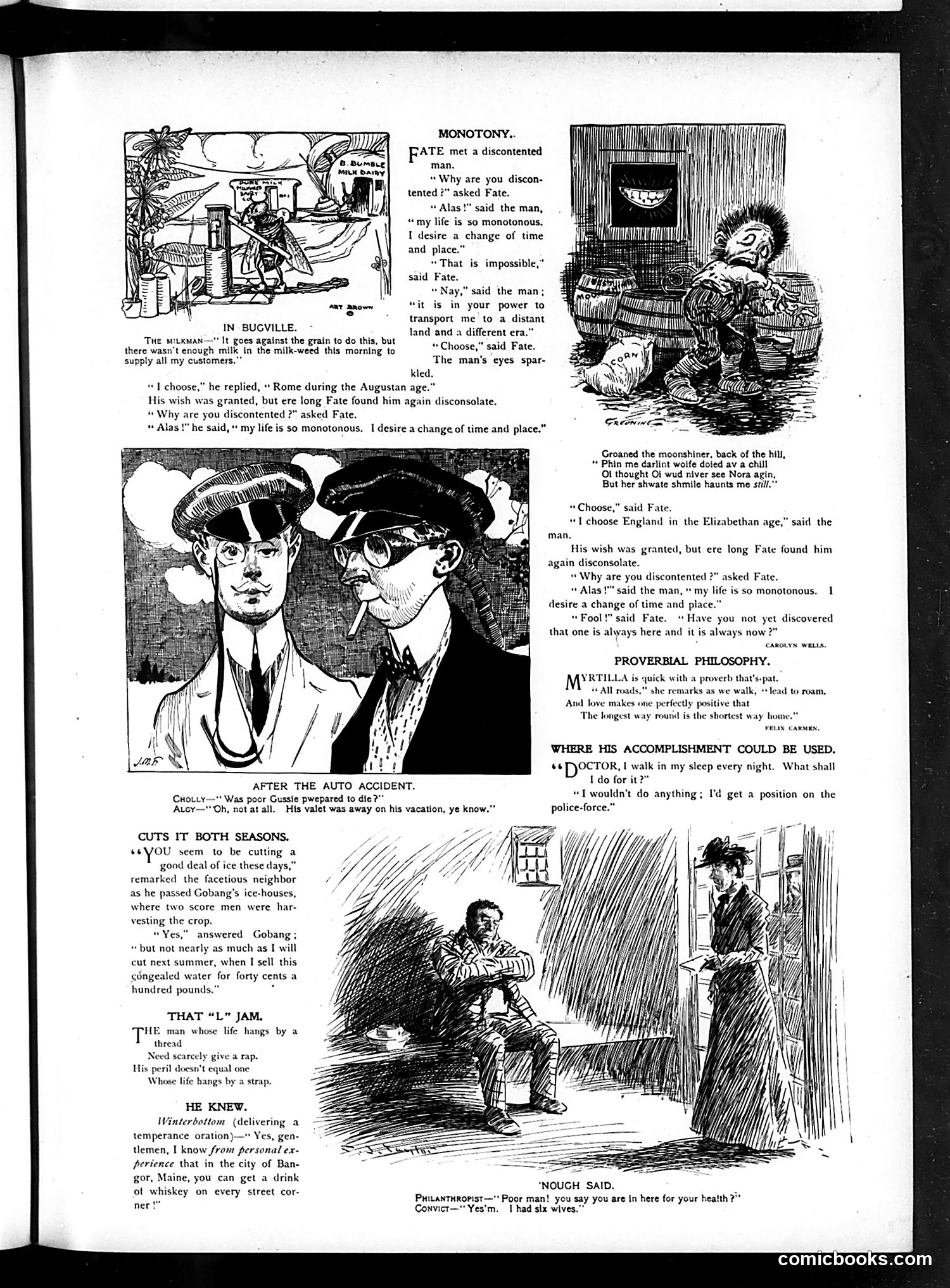
This page contains multiple unrelated satirical items typical of Judge's format: **"Monotony"** is a philosophical fable mocking human nature. A man dissatisfied with his monotonous life wishes Fate to transport him to different historical eras (Augustan Rome, Elizabethan England), but discovers each era equally tedious. Fate's punchline—"that one is always here and it is always now"—suggests that unhappiness stems from internal character, not circumstance. The satire targets perpetual complainers who blame their environment rather than themselves. **Other items** include lightweight humor: a pun about an iceman selling frozen water at markup; a joke about a sleepwalker's suitability for police work; and wordplay about life "hanging by a thread" versus "a strap." The "Bugville" vignette and auto-accident cartoon appear to be visual gags without deeper political content. The page lacks identifiable political figures or specific historical events—it's general social satire on human folly rather than topical commentary.
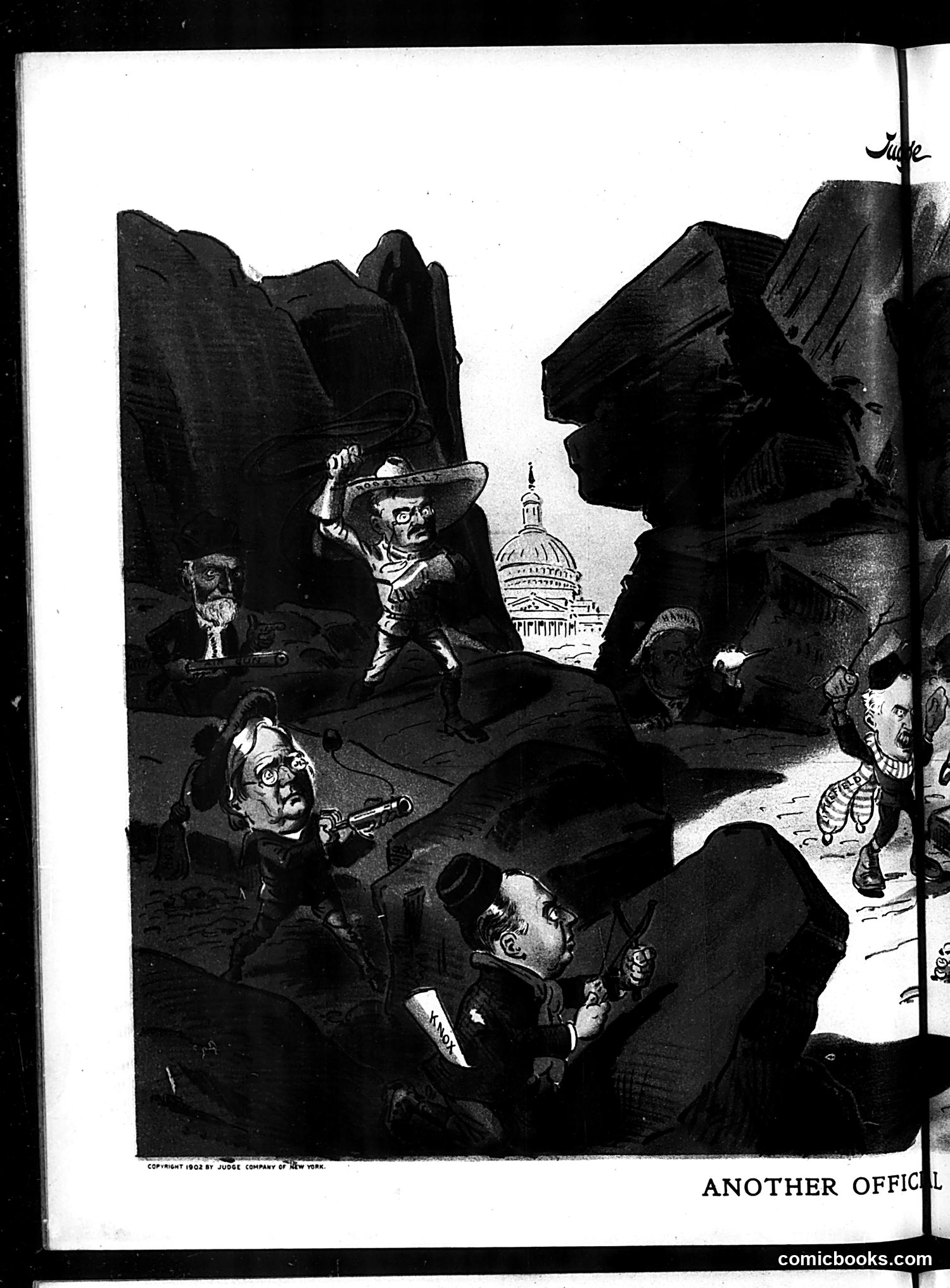
This is a political cartoon from Judge magazine (copyright 1902) satirizing corruption in Washington, D.C. The Capitol building is visible in the background, establishing the setting. The cartoon depicts caricatured figures—appearing to represent politicians or bureaucrats—engaged in suspicious activity in shadowy circumstances. The exaggerated facial features and theatrical poses suggest mockery of government officials. The title "Another Official" implies this is commentary on yet another corrupt or questionable appointee or administrator. The dark, cramped composition and sinister tone suggest the cartoonist is criticizing backroom political dealing, nepotism, or malfeasance in the Theodore Roosevelt administration (1902 date). The specific individuals depicted remain unclear without additional context, but the overall message concerns systemic governmental corruption during this Progressive Era period.
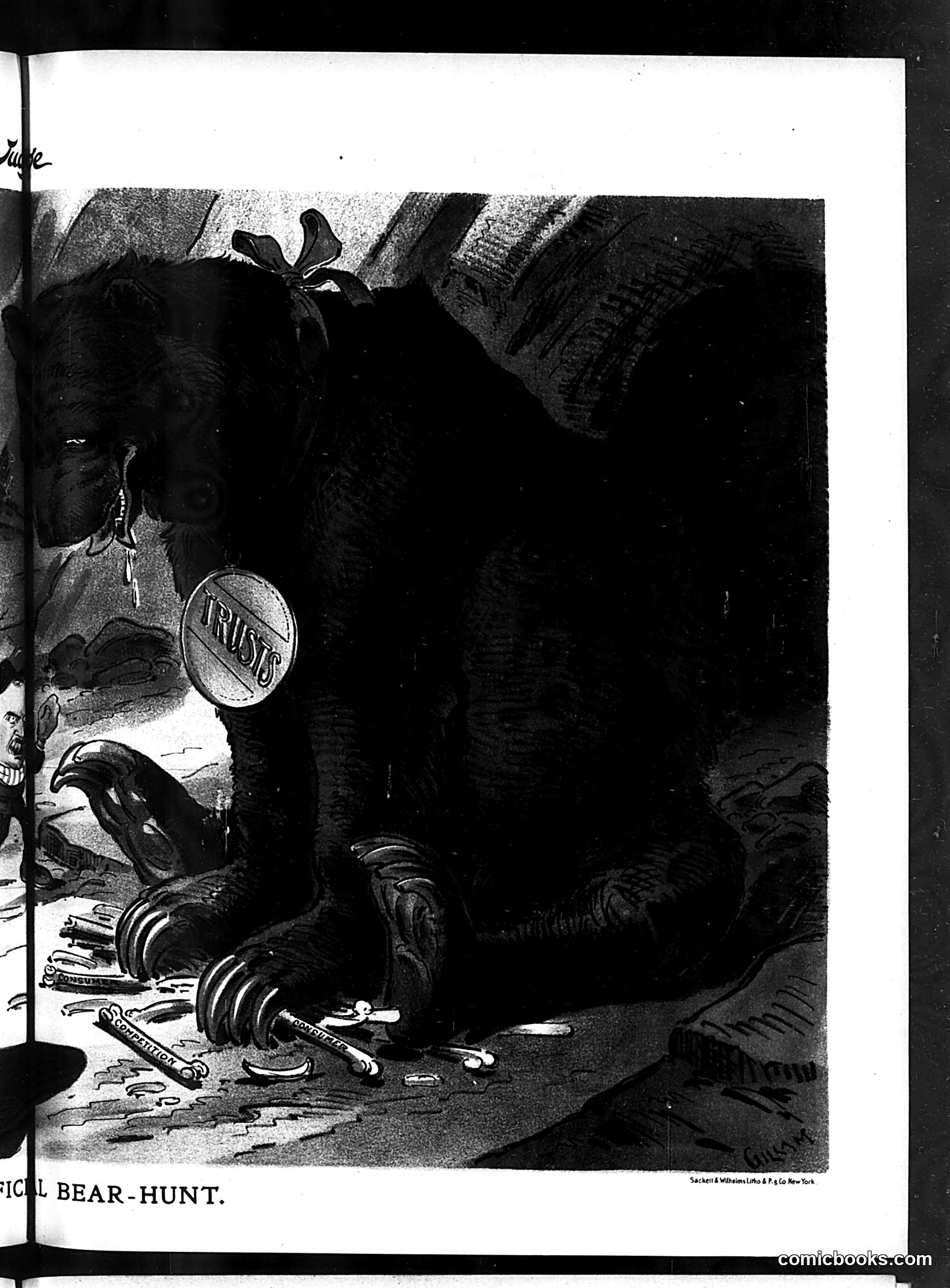
This appears to be a political cartoon from Judge magazine depicting a bear in a cave surrounded by hunting equipment and weapons. The bear wears a medal or tag labeled "TRUST," suggesting this is an anthropomorphic representation of corporate trusts or monopolies—a major political issue of the early 20th century. The cartoon satirizes efforts to regulate or "hunt down" large business monopolies, which were seen as predatory threats to fair competition. The bear's cornered position in the cave, surrounded by hunting gear, suggests the government or reformers attempting to control these powerful economic entities. Without a visible date, the exact historical moment remains unclear, but this reflects the era's intense debate over trust-busting and corporate regulation.
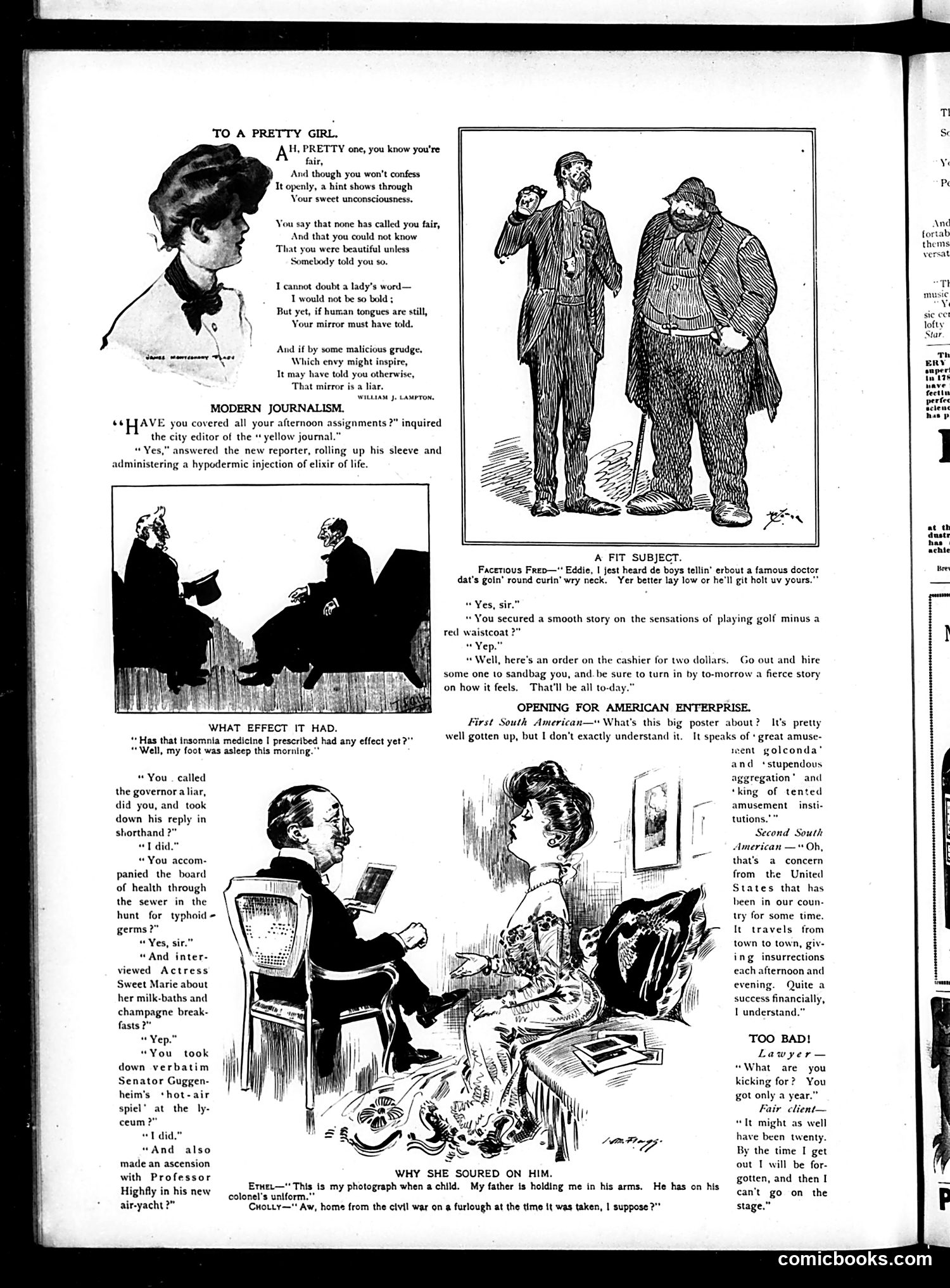
This page satirizes **yellow journalism** and American entertainment culture circa early 1900s. The "Modern Journalism" section mocks sensationalist reporting: a new reporter injects himself with "elixir of life" (stimulant drugs) to meet deadlines, then editors assign increasingly absurd assignments—hiring someone to sandbag him so he can write about the experience. This ridicules how yellow papers fabricated drama and exploited reporters. "Opening for American Enterprise" shows South American observers puzzled by a U.S. traveling circus/show promoting "great amusement" and "tented amusement institutions." The satire suggests Americans are aggressively exporting entertainment spectacles abroad. Other sections mock insomnia medicine ineffectiveness, shorthand court reporting, and sensationalist interviews. The top poem "To a Pretty Girl" appears unrelated social commentary on vanity. Overall, the page critiques both irresponsible journalism practices and American commercial culture's expanding influence.
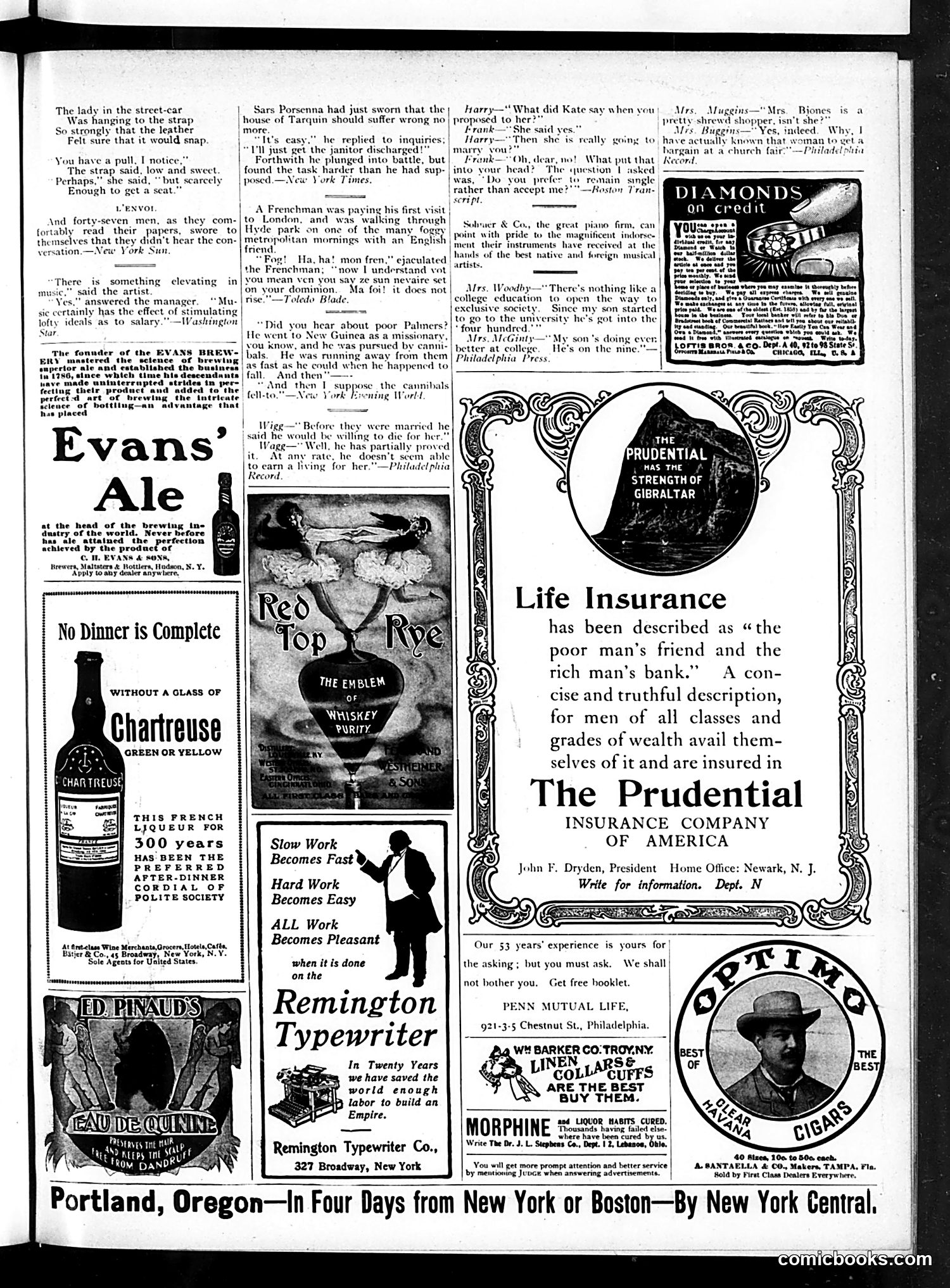
This page is primarily **advertising**, with minimal editorial content. The visible cartoon/joke material includes brief humorous snippets about streetcar etiquette, a Frenchman's confusion about London fog, and various one-liners about courtship and social behavior—typical light satire of the era. The **advertisements dominate**: Evans' Ale (brewing company), Chartreuse liqueur (positioning itself as genteel after-dinner drink), Remington Typewriter (emphasizing labor-saving), and most prominently, **The Prudential Insurance Company**, which uses the phrase "poor man's friend and the rich man's bank"—suggesting life insurance as a democratic financial tool accessible across class lines. Also notable: ads for **morphine and other "habits"** (drug addiction treatment), reflecting early 20th-century attitudes toward pharmaceutical marketing before regulatory restrictions. The page reflects Judge's dual nature: satirical commentary mixed with advertisements targeting middle and upper-class readers, selling them respectability, modern convenience, and financial security.
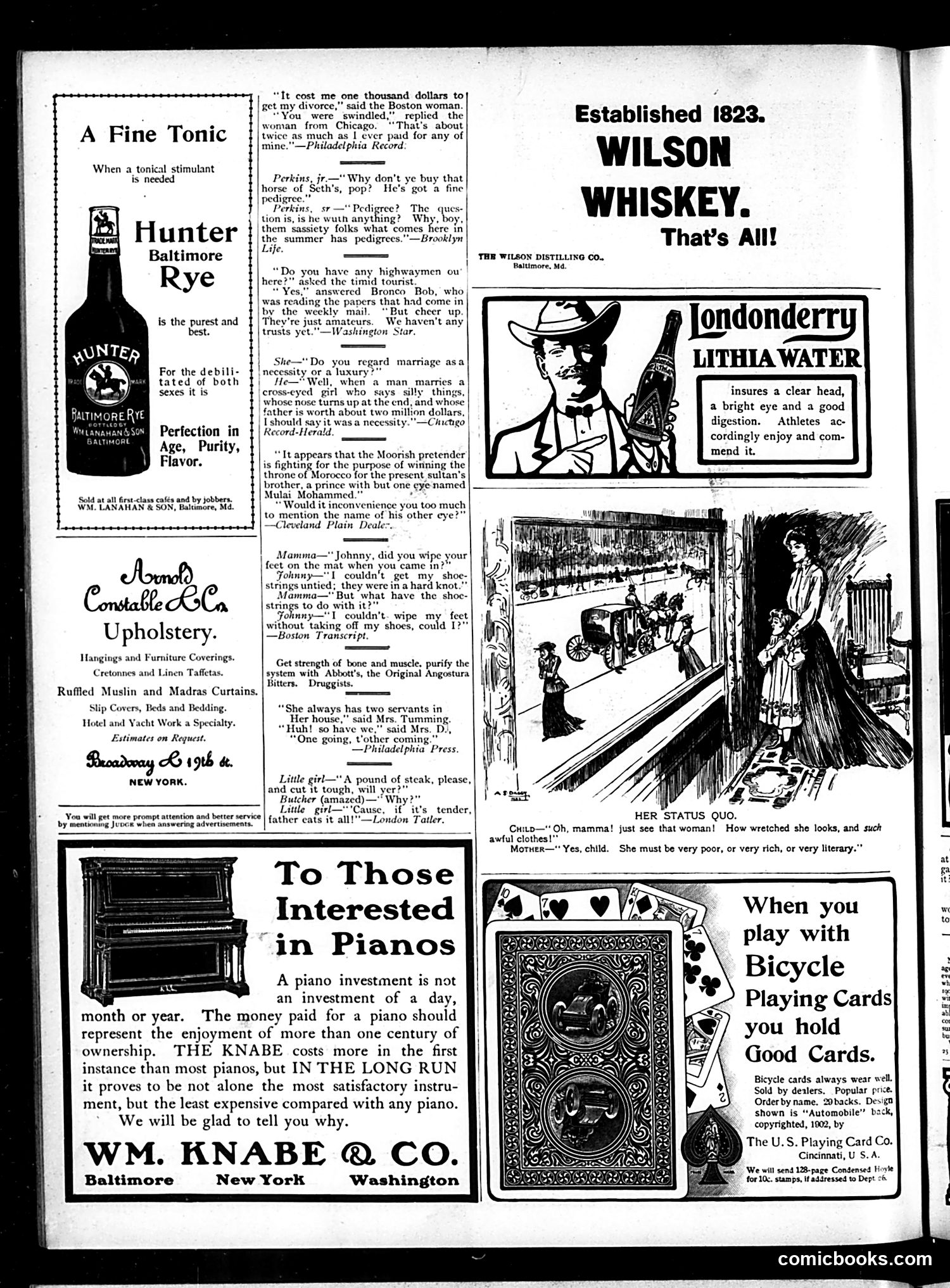
This page is primarily **advertising**, with a collection of short jokes interspersed between ads. The advertisements promote whiskey, upholstery, pianos, playing cards, and tonics—typical early 1900s consumer goods. The scattered **jokes** reflect period social attitudes: one references expensive divorce costs (suggesting marital discord among wealthy women); another mocks rural ignorance (a farmer questioning a horse's "pedigree"); and several feature condescending humor about servants, children's logic, and immigrant speech patterns. One joke references Morocco's political instability and a one-eyed pretender to the throne—a topical reference to early 1900s colonial conflicts. The cartoon "Her Status Quo" depicts a wealthy woman in fine clothes, with the caption suggesting she's either "very poor, very rich, or very literary"—satire on social ambiguity and class performance. Overall, this represents **turn-of-the-century American humor**: genteel, focused on domestic situations, class commentary, and contemporary news events, all surrounding commercial messaging.
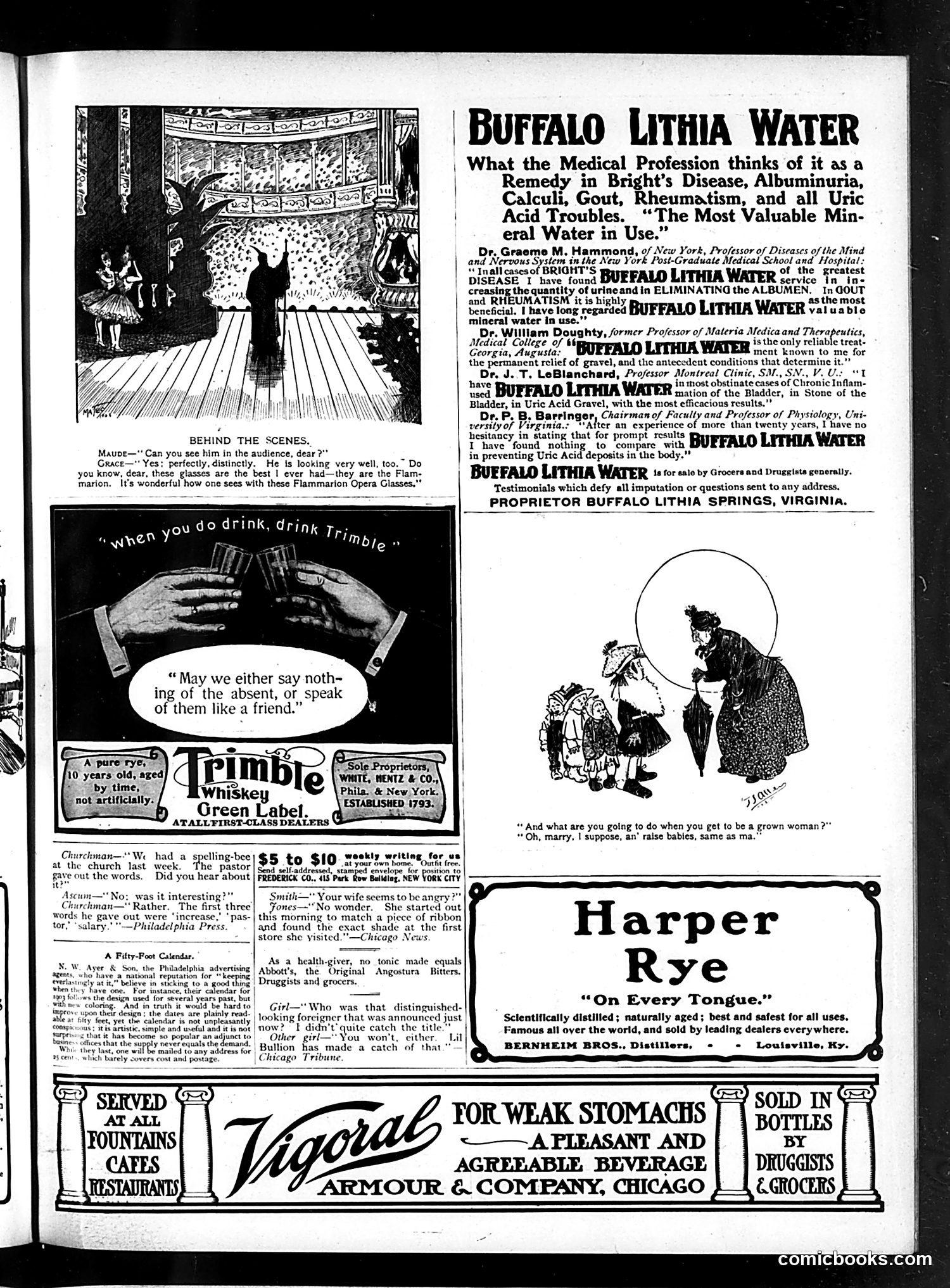
This page from the satirical magazine *Judge* contains multiple advertisements and two cartoon vignettes: **"Behind the Scenes"** depicts a theater patron using "Flammarion Opera Glasses" to see performers clearly—a product advertisement disguised as dialogue. **The second cartoon** shows a girl stating she'll grow up to "marry and raise babies, same as ma"—satirizing limited expectations for women's futures and rigid gender roles of the era. The page is primarily **advertising-driven**, featuring promotions for products like Trimble Whiskey, Buffalo Lithia Water (marketed as a medical cure for gout and kidney ailments—typical of patent medicine claims), Harper Rye whiskey, and Vigoral tonic. Medical testimonials from named doctors endorse Buffalo Lithia Water's supposed curative powers. The humor and satire are minimal; this is largely a commercial publication using light comedy to frame product pitches. The gendered joke reflects period attitudes about women's domestic roles.
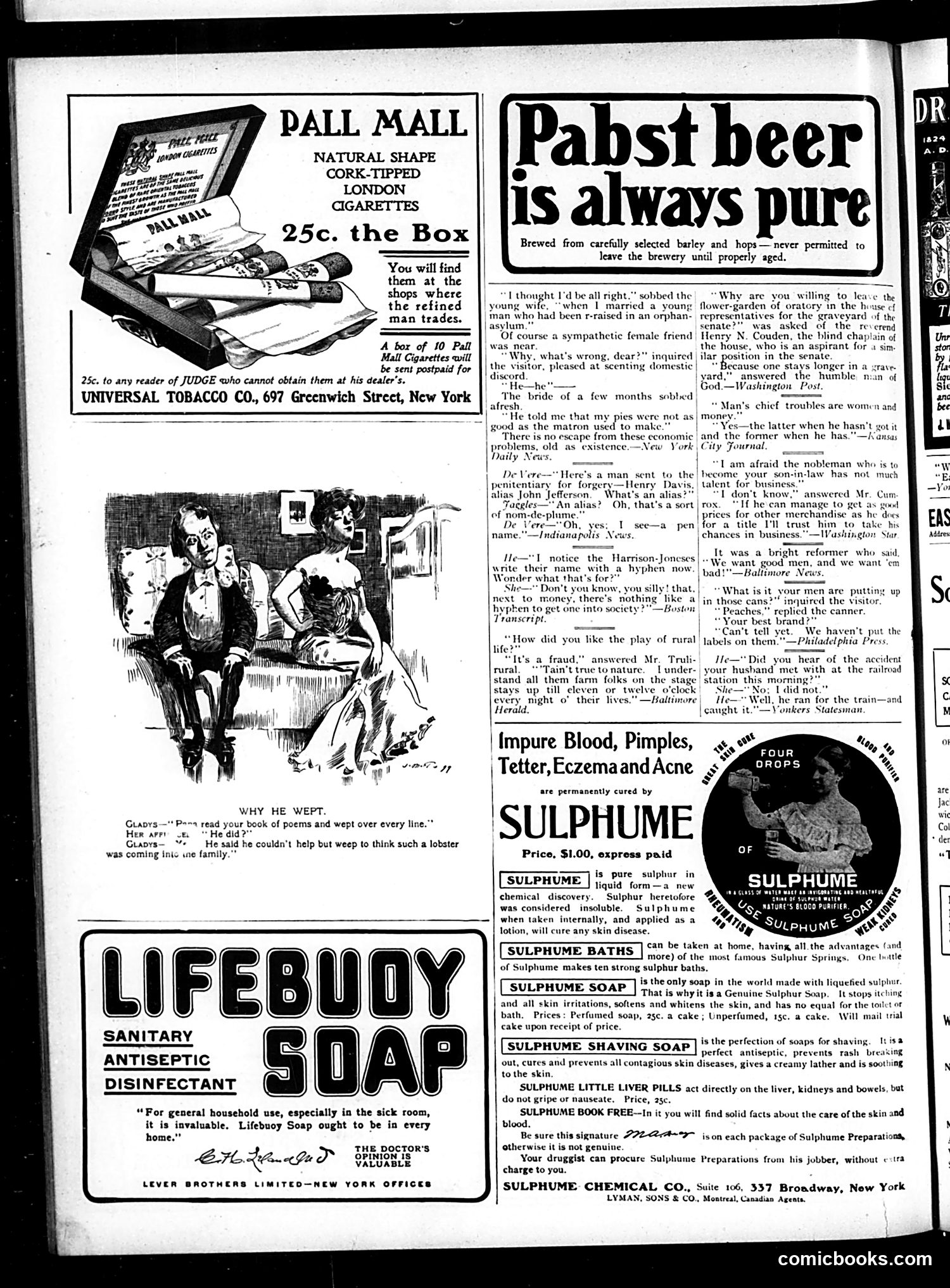
This page combines satirical humor with period advertising. The main cartoon, "Why He Wept," depicts a domestic comedy: a man weeps reading his own poetry book—not from emotion, but because he's horrified his future son-in-law (described as a "lobster," slang for an awkward person) is entering the family. The joke relies on self-deprecating humor about artistic merit and social anxieties about marriage. The page's numerous short anecdotes mock social pretensions: a blind chaplain abandoning "oratory" for the Senate; a man trusting a forger with business deals; rural theater-goers criticizing farm life portrayals for inaccuracy. These satirize vanity, poor judgment, and provincial attitudes. The advertisements (Pabst beer, Sulphume medical remedy, Lifebuoy soap) are typical period marketing, claiming purity and scientific authority—reflecting early-20th-century consumer culture and patent medicine prevalence.
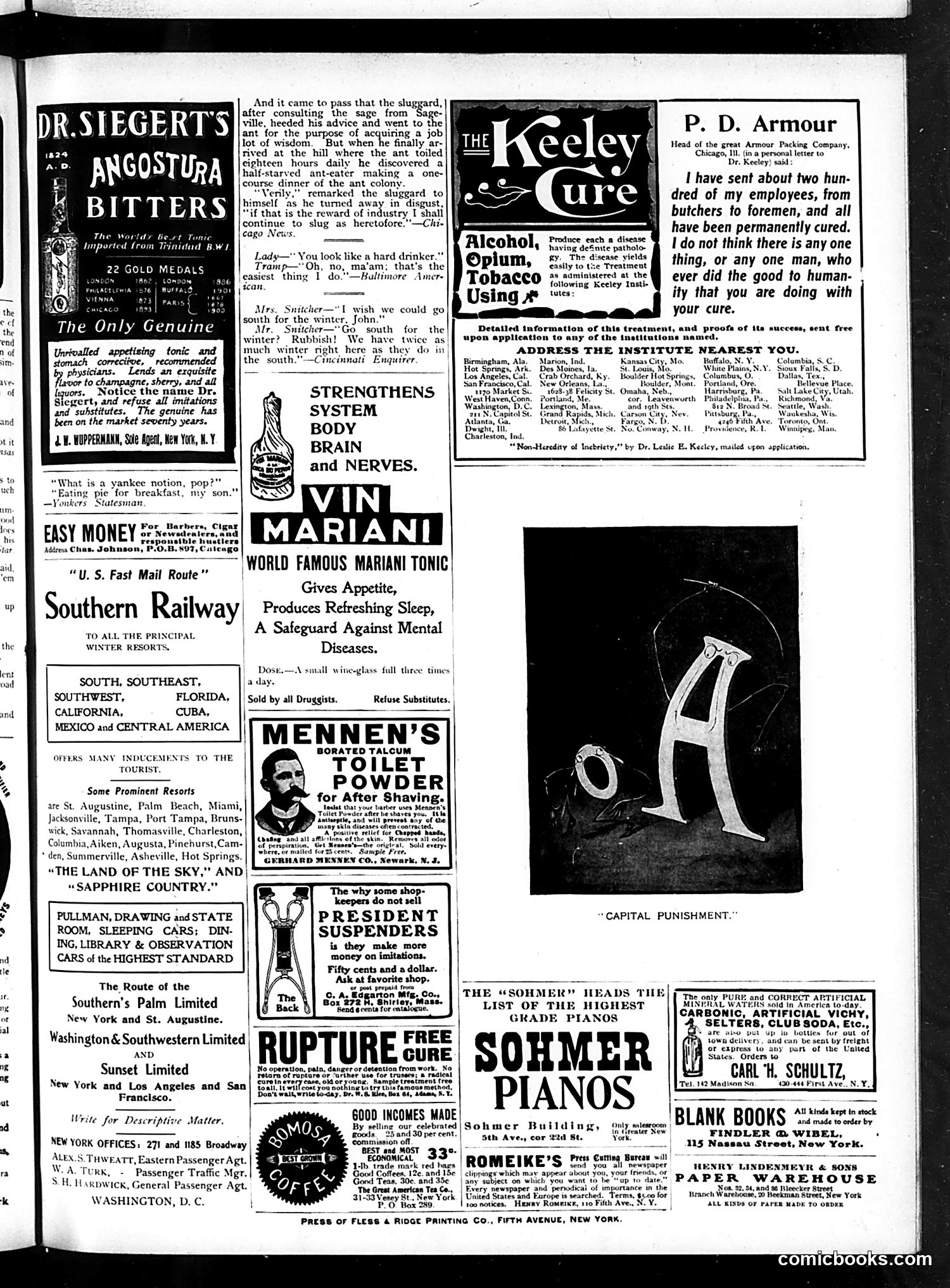
This page is primarily **advertising**, not political satire. It contains vintage product advertisements for patent medicines and services common to the Gilded Age/early 20th century. The notable content includes: **"Capital Punishment" cartoon** (bottom right): Shows an execution device (appears to be a gallows or electric chair mechanism). The caption suggests dark humor about capital punishment, though the specific satirical point is unclear without additional context. **Social commentary in brief anecdotes**: Small jokes about "yankee notions" (American habits) and a "sluggard vs. ant" fable satirizing work ethic reflect period attitudes about American industriousness. **The bulk of the page** advertises dubious "cure-alls": Dr. Siegert's Bitters, Vin Mariani (cocaine-wine tonic), and the Keeley Institute (alcoholism treatment). These were typical of unregulated patent medicine era marketing. A testimonial from P.D. Armour (real Chicago meatpacking magnate) lends false credibility. The page reflects turn-of-century American consumer culture and the prevalence of unscientific medical claims presented as legitimate treatments.
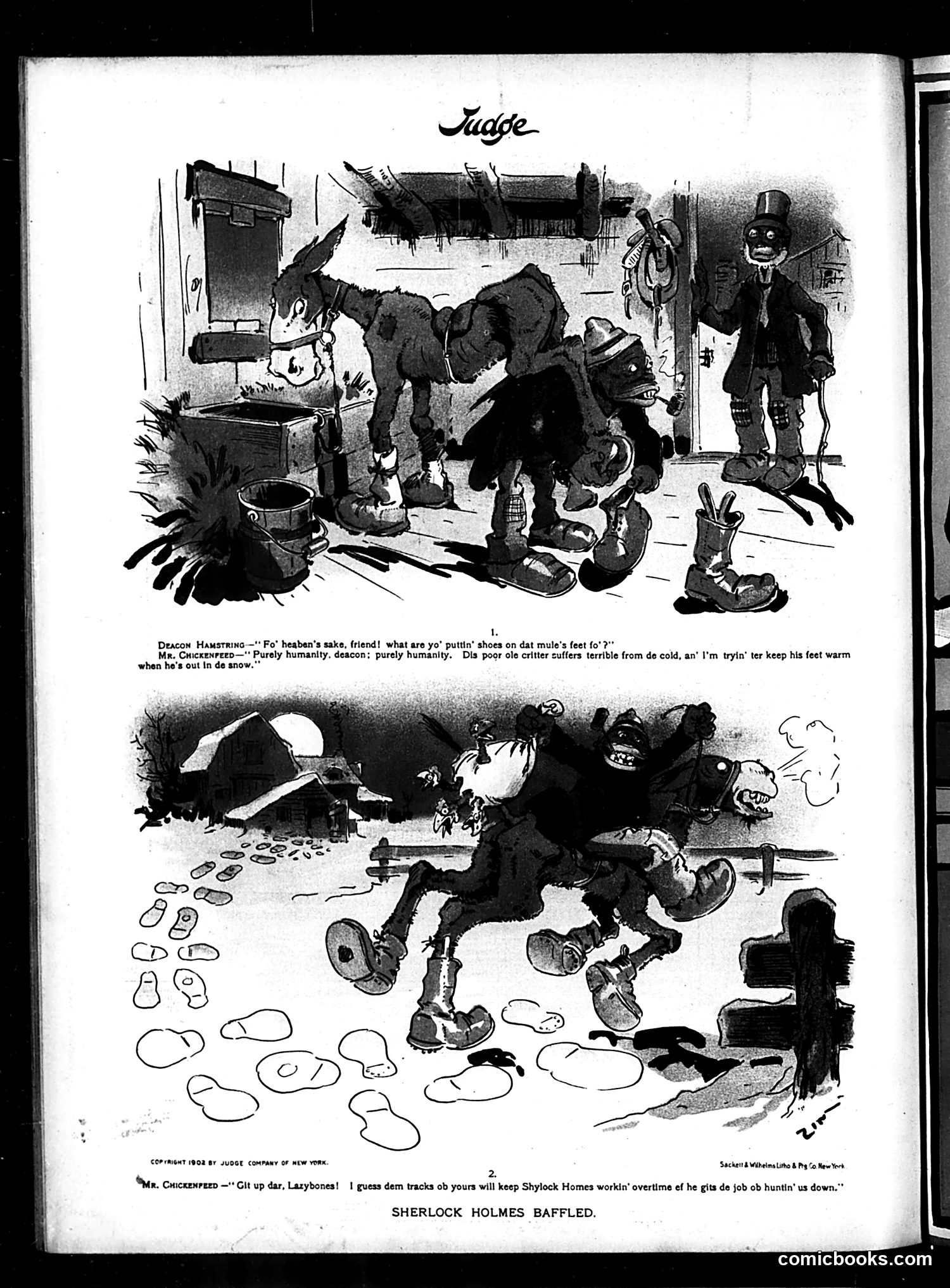
This Judge magazine page (1902) contains two satirical cartoons mocking Sherlock Holmes, the famous detective. **Top panel**: A deacon puts shoes on a mule for "humanity"—keeping the animal's feet warm in cold weather. The joke appears to be about misplaced compassion or absurd sentimentality. **Bottom panel**: Titled "Sherlock Holmes Baffled," it shows a criminal character (likely representing a fugitive or vagrant) boasting that the mule's footprints will confuse the famous detective's investigation. The satire mocks Holmes' legendary deductive abilities by suggesting even he'd be stumped by animal tracks instead of human evidence. The cartoons seem to ridicule both excessive sentimentalism and, more pointedly, to playfully deflate Holmes' reputation as an infallible investigator—a popular literary figure at the time whose fame the magazine enjoyed poking fun at.